Key Takeaways
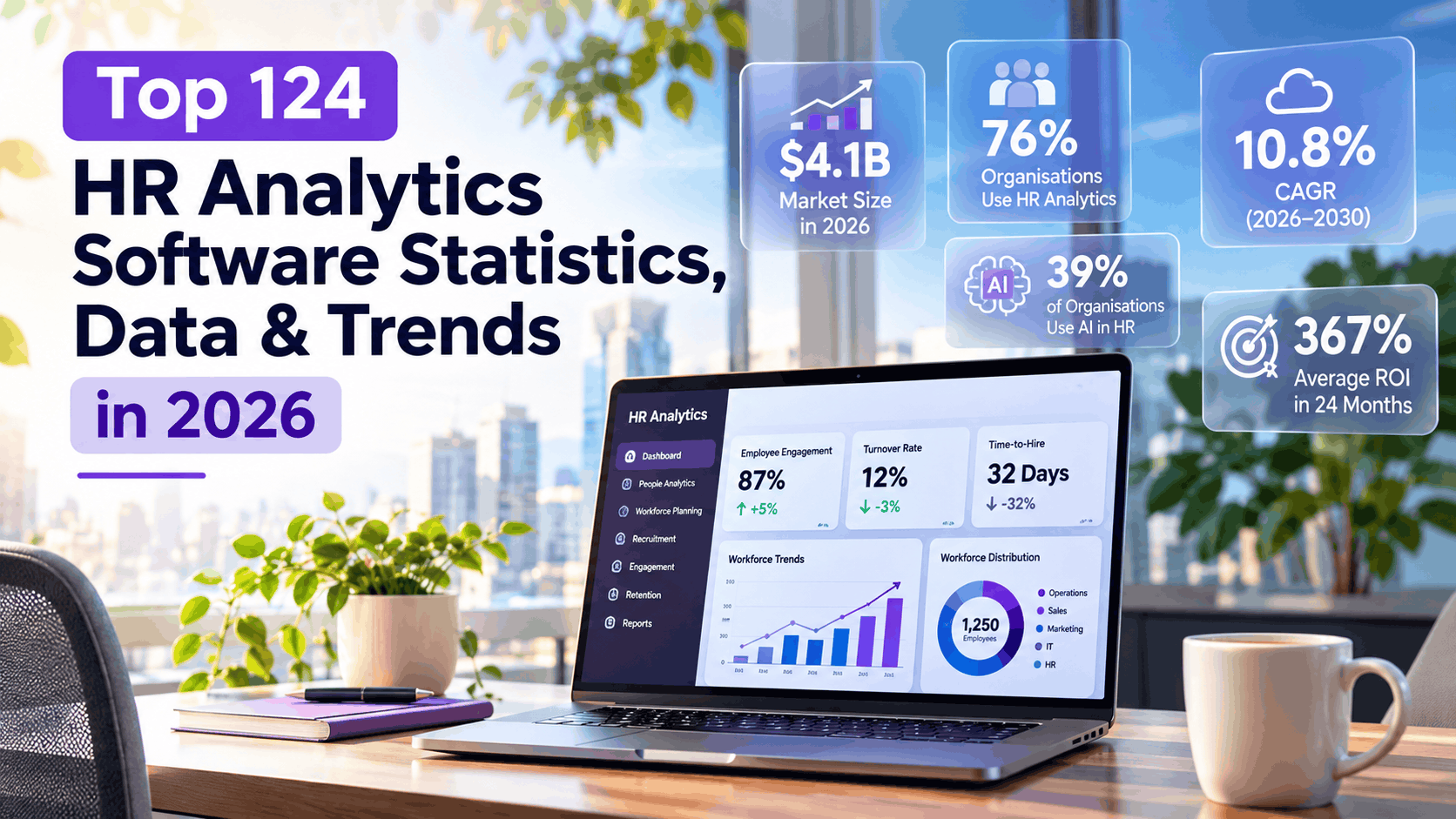
- Rapid HR Analytics Software Market Growth: The global HR analytics software market is valued at $4.1 billion in 2026 and is projected to reach $6.13 billion by 2030, growing at a CAGR of 10.8%.
- Growing AI and Predictive Analytics Adoption: While 76% of organisations have HR analytics capabilities, only 6% have achieved full predictive maturity, highlighting significant opportunities for AI-powered workforce intelligence.
- Strong ROI and Business Impact: Mature HR analytics programmes reportedly deliver an average ROI of 367% within 24 months, while predictive retention analytics can generate a 421% ROI, demonstrating substantial potential for workforce optimisation and cost reduction.
HR analytics software enables data-driven workforce management, with an estimated global market value of $4.1 billion in 2026 and projected revenue of $6.13 billion by 2030. Key industry statistics include 76% organisational adoption, 6% predictive analytics maturity, and a reported 367% average return on investment for mature HR analytics programmes.
The global human resources industry is undergoing a profound transformation in 2026 as organisations increasingly adopt advanced technologies to optimise workforce management, improve employee experiences, and strengthen strategic business decision-making. HR analytics software has emerged as a critical component of this transformation, enabling businesses to convert complex workforce data into actionable insights that support recruitment, employee retention, performance management, talent development, and long-term organisational growth.

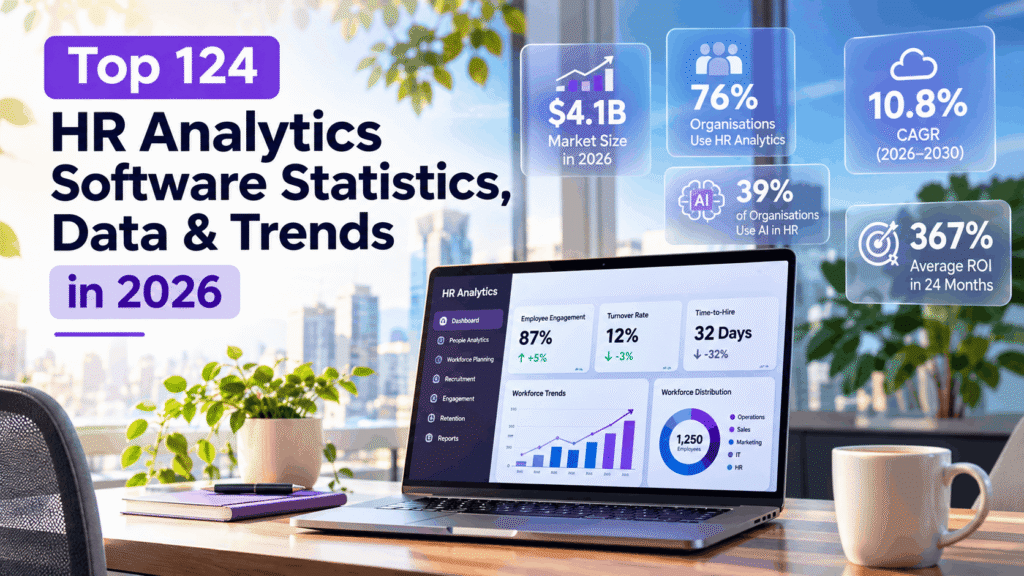
As businesses navigate evolving workforce expectations, intensifying competition for skilled talent, rising operational costs, and rapid technological advancements, traditional human resource management practices are becoming increasingly insufficient. Organisations are shifting towards data-driven HR strategies powered by artificial intelligence (AI), machine learning, predictive analytics, cloud computing, and automated workforce intelligence platforms.
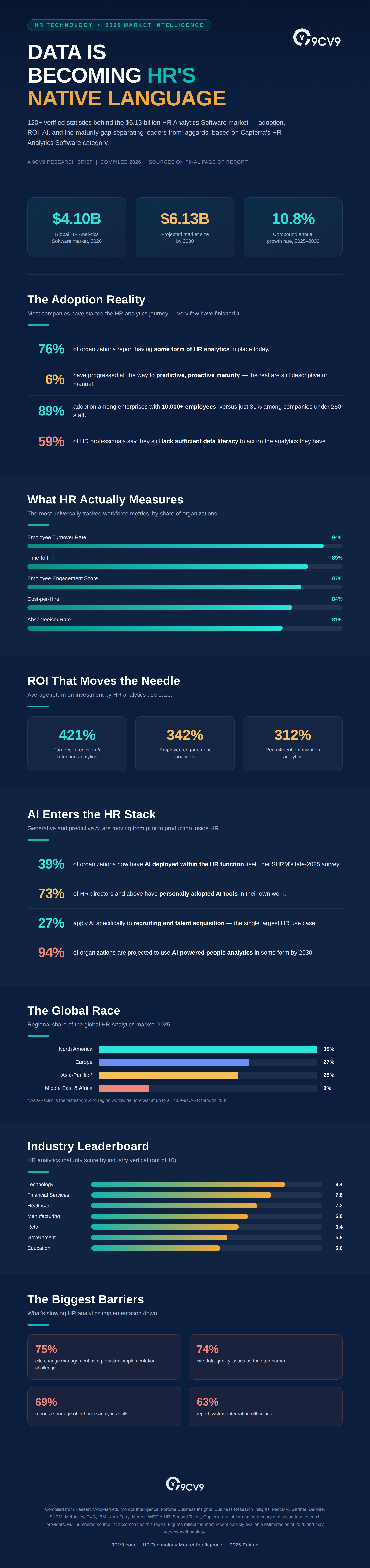
The growing demand for these technologies is reflected in the substantial expansion of the global HR analytics software market. The global HR analytics software market is estimated to be worth $4.1 billion in 2026 and is projected to reach $6.13 billion by 2030, growing at a compound annual growth rate (CAGR) of 10.8%. Broader industry forecasts estimate that the HR analytics market could reach $19.54 billion by 2035, reflecting sustained investment in intelligent workforce management and advanced people analytics solutions.

The wider HR software market is also experiencing significant expansion, with its estimated value increasing from $26.21 billion in 2026 to a projected $66.70 billion by 2034. These market projections demonstrate the growing importance of digital human resource management infrastructure across enterprises, small and medium-sized businesses, and multinational organisations.
The Growing Adoption of HR Analytics Software in 2026
HR analytics software adoption has accelerated considerably as organisations recognise the strategic value of workforce data. Approximately 76% of organisations report having some form of HR analytics capability, while 87% identify improved decision-making as their primary motivation for investing in workforce analytics technologies.
Furthermore, 79% of organisations adopt HR analytics to improve employee retention and engagement outcomes, demonstrating the increasing importance of employee-centric workforce management strategies.
However, despite widespread adoption, significant differences remain in organisational analytics maturity. Only 6% of organisations have achieved full predictive and proactive HR analytics maturity, while just 21% describe their analytics capabilities as advanced. Approximately 34% continue to operate at a basic and reactive maturity level, relying primarily on manual reporting and spreadsheets.
The adoption gap is particularly pronounced between large enterprises and smaller businesses. Approximately 89% of enterprises employing at least 10,000 people report HR analytics adoption, compared with just 31% of organisations with fewer than 250 employees.
These statistics highlight substantial opportunities for HR technology providers and businesses seeking to transition from conventional workforce reporting towards sophisticated, automated, and predictive people analytics solutions.
Artificial Intelligence and Predictive Analytics Are Transforming Human Resources
Artificial intelligence and machine learning are among the most influential technological developments shaping the HR analytics software industry in 2026.
Modern HR analytics platforms increasingly incorporate intelligent capabilities that enable organisations to forecast workforce trends, identify employee turnover risks, optimise recruitment strategies, anticipate skills shortages, and improve workforce planning.
Several significant statistics demonstrate the growing influence of AI-powered HR analytics:
- 34% of organisations use artificial intelligence to predict employee turnover risk.
- AI-powered employee turnover prediction models report accuracy levels ranging from 75% to 89%.
- 28% of organisations apply predictive modelling to estimate hiring success.
- 23% of organisations use predictive analytics to forecast employee performance.
- 19% of organisations apply predictive modelling to skills-gap forecasting.
- 39% of organisations have deployed AI within their HR functions, according to SHRM’s late-2025 research.
- 92% of chief human resources officers expect further AI integration across their workforce over the coming year.
- 94% of organisations are projected to use some form of AI-powered people analytics by 2030.
The emergence of generative AI is further expanding the capabilities of HR analytics software by supporting automated workforce reporting, natural language data queries, intelligent recommendations, and more accessible workforce insights.
As these technologies continue to mature, HR departments are increasingly positioned to move beyond retrospective reporting towards proactive workforce management and strategic talent intelligence.
The Financial and Operational Benefits of HR Analytics Software
One of the most compelling drivers of HR analytics software adoption is its potential to generate measurable financial and operational improvements.
According to the compiled industry research, mature HR analytics programmes reportedly generate average annual savings of $1.96 million and an average return on investment of 367% within 24 months of full deployment.
Different HR analytics applications demonstrate varying levels of reported financial performance:
| HR Analytics Application | Reported Average ROI |
|---|---|
| Employee retention and turnover prediction | 421% |
| Employee engagement analytics | 342% |
| Recruitment optimisation analytics | 312% |
| Workforce planning analytics | 298% |
Beyond financial returns, advanced HR analytics capabilities are associated with an 18% increase in revenue per employee, a 24% improvement in employee productivity, a 32% reduction in time-to-hire, and a 41% reduction in turnover-related costs.
These findings demonstrate the potential of workforce analytics to support organisational profitability, operational efficiency, talent acquisition, employee satisfaction, and sustainable business growth. Actual results, however, depend on implementation quality, workforce characteristics, data accuracy, and organisational readiness.
Cloud-Based HR Analytics Software and Regional Market Growth
Cloud computing continues to reshape the global HR technology ecosystem, enabling organisations to access scalable, flexible, and integrated workforce analytics capabilities without relying exclusively on traditional on-premises infrastructure.
Cloud-based HR analytics deployments are projected to expand at a CAGR of 13.96%, making cloud technology one of the fastest-growing delivery models within the industry.
Organisations using cloud-based HR analytics platforms also report 34% faster time-to-insight and 28% lower total cost of ownership compared with on-premises alternatives.
From a geographical perspective, North America remains the largest HR analytics market, accounting for approximately 39% of global industry revenue. Europe represents another significant regional market, while Asia-Pacific is emerging as the fastest-growing region, with projected annual growth rates reaching 14.69% through 2031.
Rapid enterprise digitalisation, expanding cloud infrastructure, growing workforce populations, and increasing investments in human capital management technologies are expected to support continued HR analytics adoption across emerging economies.
Key Challenges Facing the HR Analytics Software Industry
Despite the promising market outlook, organisations continue to encounter significant barriers when implementing and scaling HR analytics software.
Data quality remains a particularly important concern, with 74% of organisations identifying it as a major implementation obstacle. Additionally, 76% struggle with fragmented data silos across disconnected HR systems, while 68% report that data-quality issues undermine the accuracy of their workforce analytics.
Other significant challenges include insufficient internal analytical expertise, system integration difficulties, organisational resistance to change, employee privacy concerns, and budget limitations.
Approximately 69% of organisations report a shortage of in-house analytics skills, while nearly 59% of HR professionals indicate that they lack sufficient data literacy. Meanwhile, 75% of organisations identify change management as a persistent implementation challenge.
Responsible artificial intelligence adoption is also becoming increasingly important. Although 63% of employees reportedly trust AI to inform important workplace decisions, only 1% trust artificial intelligence to make those decisions autonomously.
These findings reinforce the importance of maintaining human oversight, ethical AI practices, robust data governance, employee privacy protections, and continuous professional development throughout the HR analytics implementation process.
The Increasing Importance of Strategic Workforce Planning and Skills Intelligence
The rapid evolution of workforce requirements is creating additional demand for advanced HR analytics and strategic workforce planning software.
Approximately 74% of employers globally report difficulties finding the specific skills their businesses require. Meanwhile, 63% of employers identify skills gaps as a major barrier to business transformation through 2030.
An estimated 39% of existing workforce skill sets are also expected to undergo meaningful transformation by 2030, highlighting the growing importance of employee reskilling, talent development, internal mobility, and predictive skills intelligence.
Despite these emerging challenges, only 12% of HR leaders engage in strategic workforce planning with a time horizon of three years or more.
HR analytics software can help organisations address these challenges by improving workforce visibility, forecasting future talent requirements, identifying critical skills shortages, and aligning human capital investments with long-term business objectives.
What This Comprehensive HR Analytics Software Statistics Guide Covers
This comprehensive guide to the Top 124 HR Analytics Software Statistics, Data & Trends in 2026 examines the most significant developments shaping the global HR technology, people analytics, and workforce intelligence industries.
The article provides detailed insights into global market size and growth forecasts, regional market distribution, organisational adoption rates, HR analytics maturity, workforce data literacy, commonly tracked HR metrics, cloud technology adoption, financial returns, predictive analytics, artificial intelligence, implementation challenges, industry-specific maturity, leading software vendors, strategic workforce planning, skills intelligence, and the future of work.
For HR professionals, business executives, technology providers, investors, and workforce management specialists, these statistics provide a valuable foundation for understanding the evolving HR analytics software landscape and identifying emerging opportunities for digital transformation.
Whether an organisation is evaluating the best HR analytics software in 2026, developing a comprehensive people analytics strategy, benchmarking workforce performance, or exploring AI-powered human capital management solutions, understanding these industry statistics can support more informed strategic and operational decisions.
As the global business environment becomes increasingly competitive, interconnected, and data-driven, HR analytics software is evolving beyond its traditional role as a workforce reporting solution. It is becoming a strategic foundation for intelligent talent management, organisational resilience, operational efficiency, and sustainable business growth.
Organisations that successfully combine high-quality workforce data, advanced predictive analytics, responsible artificial intelligence, and human expertise will be better positioned to anticipate workforce challenges, capitalise on emerging opportunities, and build productive, adaptable, and future-ready workforces in 2026 and beyond.
Before we venture further into this article, we would like to share who we are and what we do.
About 9cv9
9cv9 is a business tech startup based in Singapore and Asia, with a strong presence all over the world.
With over ten years of startup and business experience, and being highly involved in connecting with thousands of companies and startups, the 9cv9 team has listed some of the top and best companies/tools in this review.
If you like to get your company listed in our top B2B software reviews, check out our world-class 9cv9 Media and PR service and pricing plans here.
Top 124 HR Analytics Software Statistics, Data & Trends in 2026
Market Size & Growth
- The global HR Analytics Software market is valued at $4.1 billion in 2026 and is on pace to reach $6.13 billion by 2030, expanding at a 10.8% CAGR as digitalization and cloud HR platforms accelerate adoption.
- A broader definition of the HR Analytics market puts 2026 revenue at $5.71 billion, projected to more than double to $10.82 billion by 2031 at a 13.64% compound annual growth rate.
- A separate long-range forecast estimates the HR Analytics market at $5.96 billion in 2026, climbing to $19.54 billion by 2035 — a 14.11% CAGR signaling sustained, decade-long investment in workforce data.
- The People & HR Analytics Software segment is forecast to grow from $3.5 billion in 2025 to $6.2 billion by 2033, roughly a 7.4% CAGR, as descriptive dashboards migrate toward predictive analytics.
- HR Analytics Consulting Services alone represent a $4.06 billion market in 2026, expected to reach $10.27 billion by 2035, showing implementation expertise is scaling as fast as the software itself.
- The wider HR Software market that HR analytics sits within is projected to grow from $26.21 billion in 2026 to $66.70 billion by 2034 at a 12.38% CAGR.
- Core HR software — the record-keeping and compliance backbone that feeds analytics platforms — is sized at $28.62 billion in 2026, growing to $38.64 billion by 2030.
- Cloud-based HR analytics deployments are growing faster than any other delivery model, projected at a 13.96% CAGR versus considerably slower on-premises growth.
- Diversity, equity and inclusion (DEI) analytics is the fastest-growing application segment within HR analytics, forecast to expand at a 14.83% CAGR as pay-equity disclosure rules widen globally.
- The top five HR analytics vendors collectively hold roughly 45% of total category revenue, indicating a moderately concentrated but still fragmented competitive landscape.
- The dedicated DEI Analytics Platform market is valued at $2.9 billion in 2026 and projected to almost triple to $8.7 billion by 2036 at an 11.6% CAGR.
- Within DEI analytics platforms, predictive workforce analytics functionality is expected to command 38% of category share in 2026 as employers seek earlier signals on retention and promotion risk.
- The AI-Powered Workforce Planning software market is valued at $1.87 billion in 2026 and forecast to reach $2.69 billion by 2031, a 7.52% CAGR.
- Workforce Planning Tools overall are valued at roughly $2.9 billion in 2025, projected to hit $6.3 billion by 2033 — a 13.4% CAGR as scenario-based headcount planning goes mainstream.
- The Workforce Management Software market — covering scheduling, time-tracking and analytics — is valued at $9.76 billion in 2026 and set to reach $12.04 billion by 2031.
- Within workforce management software, the workforce-analytics application segment is projected to capture the largest share of category revenue in 2026, ahead of scheduling and time-tracking modules.
- The Employee Engagement Software market is projected to grow from roughly $1.36 billion in 2026 to $2.99 billion by 2032, a 13.93% CAGR, as engagement scoring becomes a core analytics use case.
- Cloud deployment already accounts for more than 70% of employee engagement software revenue, underscoring the industry-wide shift away from on-premises HR analytics infrastructure.
Regional Breakdown
- North America holds the largest share of the global HR Analytics market at roughly 39% of revenue, reflecting early and sustained enterprise investment in workforce data.
- Asia-Pacific is consistently identified as the fastest-growing HR analytics region worldwide, with forecast CAGRs as high as 14.69% through 2031 on the back of digital-HR mandates in China and India’s expanding IT-services sector.
- Europe accounts for roughly 27%–29% of global HR analytics and HR software revenue, the second-largest regional bloc behind North America.
- The Middle East & Africa region contributes the smallest regional share of HR analytics revenue, at roughly 8%–9%, though adoption is accelerating across Gulf states and South Africa.
- India’s workforce exceeds 600 million people and China’s economically active population tops 700 million, giving Asia-Pacific an outsized long-term addressable market for HR analytics software.
- Asia-Pacific captures approximately 25% of the global HR software market, propelled by rapid enterprise digitalization and expanding cloud infrastructure across the region.
Adoption & Maturity
- 76% of organizations report having some form of HR analytics capability in place, yet only 6% have progressed to full predictive/proactive maturity.
- Just 21% of organizations describe their HR analytics capability as “advanced,” underscoring how much headroom remains between basic reporting and true data science.
- 34% of organizations still operate at a “basic/reactive” HR analytics maturity level, relying primarily on manual reporting and spreadsheets.
- 41% of organizations sit at an “intermediate/descriptive” maturity level, using automated dashboards but with limited predictive capability.
- Enterprise organizations with 10,000+ employees report 89% HR analytics adoption, compared with just 31% among companies with fewer than 250 employees.
- Large enterprises invest an average of $2.4 million annually in HR analytics, versus roughly $18,000 for small businesses — a more than 130x spending gap.
- 78% of enterprise-scale organizations maintain a dedicated people-analytics team, compared to only 8% of small companies.
- 87% of organizations cite “better decision-making” as their primary motivation for investing in HR analytics software.
- 79% of organizations adopt HR analytics specifically to improve employee retention and engagement outcomes.
- Organizations with mature HR analytics programs are 5 times more likely to make fast, data-driven decisions and 3.2 times more likely to outperform competitors, according to McKinsey research.
- Fewer than one in four HR teams are considered “highly effective” at people analytics, a share that has barely moved over the past two years.
- Only 45% of HR professionals believe their analytics systems actually improve talent and business decisions, down sharply from 57% just two years earlier.
Data Literacy & Skills Gaps
- Nearly 59% of HR professionals report lacking sufficient data literacy — considered a core competency for effective people analytics work.
- Only 18% of CHROs say their organization consistently uses data analytics to guide people decisions, according to Korn Ferry’s 2025 CHRO survey.
- After more than a decade of investment, only about 10% of companies have successfully correlated HR and people data with measurable business results.
- In 2024, 71% of organizations said they were actively investing in “democratizing” people data, yet fewer than half achieved high analytics adoption within HR.
Most-Tracked HR Metrics
- Employee turnover rate is the single most universally tracked HR metric, monitored by 94% of organizations.
- 89% of organizations monitor time-to-fill for open positions, usually reviewed weekly given its direct link to business continuity.
- 87% of organizations track an employee engagement score, most often on a quarterly reporting cycle.
- 84% of organizations track cost-per-hire monthly as a core recruitment-efficiency metric.
- 81% of organizations monitor absenteeism rate monthly, the metric with the highest reported data-quality confidence of any HR KPI.
- 76% of organizations track training ROI quarterly, though it scores lowest of major metrics on data-quality confidence.
- 73% of organizations track performance-ratings distribution annually as part of calibration and promotion cycles.
- 68% of organizations track internal mobility rate quarterly, reflecting growing interest in redeployment over external hiring.
- Organizations that track 15 or more distinct HR metrics report 23% better business outcomes than those tracking fewer than five, according to Gartner.
- 46% of organizations now use statistical modeling for compensation and pay-gap equity analysis, one of the most widely adopted “advanced” analytics use cases.
Technology & Tools Adoption
- 91% of organizations rely on native HRIS/HCM reporting as the technological foundation of their HR analytics capability.
- 78% of organizations use dedicated survey and feedback platforms to feed engagement and sentiment data into their analytics stack.
- 67% of organizations use general-purpose business intelligence tools, rather than HR-specific platforms, for workforce analytics.
- 54% of organizations have adopted dedicated workforce-planning software distinct from their core HRIS.
- 43% of organizations use specialized, purpose-built HR analytics platforms, at an average annual investment of roughly $240,000.
- Only 29% of organizations have adopted dedicated AI/machine-learning tooling for HR analytics, leaving significant headroom for predictive-capability growth.
- Organizations running cloud-based HR analytics platforms report 34% faster time-to-insight and 28% lower total cost of ownership than on-premises equivalents.
- 76% of organizations struggle with fragmented data silos spread across disconnected HR systems.
- 68% report that data-quality issues directly undermine the accuracy of their HR analytics output.
- 62% of organizations find it difficult to integrate external, non-HR data sources into their workforce analytics.
ROI & Business Impact
- Mature HR analytics programs generate average annual savings of $1.96 million and a 367% ROI within 24 months of full deployment.
- Turnover prediction and retention analytics deliver the highest average ROI of any HR analytics use case, at 421%, with a typical payback period of just 8 months.
- Recruitment-optimization analytics return an average 312% ROI with an 84% reported success rate — the highest success rate of any analytics use case measured.
- Employee-engagement analytics programs report 342% average ROI and an 82% implementation success rate.
- Workforce-planning analytics deliver a 298% average ROI with a 10-month payback period.
- Companies applying advanced HR analytics report an 18% increase in revenue per employee compared to peers using basic reporting.
- Data-driven HR insight correlates with a 24% improvement in overall employee productivity.
- Optimized, analytics-driven recruitment processes cut time-to-hire by 32% on average.
- Predictive retention modeling is associated with a 41% reduction in turnover-related costs.
- Proactive, analytics-based compliance monitoring is linked to a 54% reduction in compliance risk exposure.
Predictive Analytics & Machine Learning
- 34% of organizations now use AI specifically to predict individual employee turnover risk, with reported model accuracy ranging from 75% to 89%.
- Production HR turnover-prediction models typically report AUC-ROC values between 0.70 and 0.85, a solid-to-strong range for binary risk classification.
- A peer-reviewed 2025 study found an ELM-SMOTE machine-learning model achieved 87.8% accuracy predicting employee turnover, while a comparison Random Forest model reached 91.4%.
- A systematic review of 58 academic studies on machine-learning turnover prediction found Random Forest to be both the most frequently used and most accurate algorithm, with job satisfaction the single most predictive input feature.
- A 2026 study combining LightGBM and XGBoost achieved an AUC of 0.9504 predicting employee turnover, outperforming either algorithm used alone.
- Organizations using predictive HR analytics report 41% better talent decisions and 32% faster problem resolution than those relying on descriptive reporting alone.
- 28% of organizations apply predictive modeling to estimate hiring-success probability, with reported accuracy of 71%–81%.
- 23% of organizations use predictive analytics to forecast individual employee performance, with accuracy in the 68%–82% range.
- 19% of organizations apply predictive modeling to skills-gap forecasting — the use case with the lowest current adoption but among the highest strategic value.
- 16% of organizations use predictive analytics for promotion-readiness scoring, typically achieving 69%–81% model accuracy.
- Gartner research shows AI-assisted capacity planning improves 30-day staffing-forecast accuracy by 29 percentage points compared with manual planning methods.
- By 2030, an estimated 94% of organizations are projected to use some form of AI-powered people analytics, up sharply from current adoption levels.
AI & Generative AI in HR
- SHRM’s late-2025 survey of 1,908 HR professionals found 39% have AI deployed within the HR function itself, while 62% use AI somewhere in the broader organization.
- Among HR directors and above, 73% report having personally adopted AI tools in their day-to-day work — the highest adoption rate of any HR seniority tier.
- 60% of organizations with 5,000 or more employees have implemented AI tools in HR, compared with just 33%–35% of small and midsize organizations.
- Recruiting is the single largest application of AI within HR, with 27% of organizations specifically using AI for talent acquisition.
- Among organizations that have adopted AI in HR at all, 64% apply it to recruiting, interviewing, and hiring workflows specifically.
- Inclusion-and-diversity functions show 2% or less AI adoption — among the lowest of any HR sub-function — reflecting caution around automating equity-sensitive decisions.
- 92% of CHROs expect further AI integration across their workforce over the coming year, per SHRM’s 2026 research.
- In Capterra’s 2026 Software Buying Trends Survey of 3,385 buyers, 41% of HR software purchasers said they used generative AI tools during their research and vendor-shortlisting process.
- CIPD research finds 63% of employees trust AI to inform important workplace decisions, but only 1% trust it to make those decisions autonomously.
- 30% of organizations report regularly using generative AI in HR workflows, despite far higher levels of executive optimism about the technology.
Implementation Challenges
- 74% of organizations cite data-quality issues as their top barrier to successful HR analytics implementation.
- 69% report a shortage of in-house analytics skills as a major implementation obstacle.
- 75% cite change management — getting managers and employees to actually use the insights — as a persistent implementation challenge.
- 63% of organizations report system-integration difficulties when connecting HR analytics tools to existing HRIS and payroll systems.
- 52% of organizations cite employee privacy concerns as a constraint shaping how far their HR analytics initiatives can go.
- 47% point to budget constraints as a limiting factor on HR analytics investment.
- 89% of successful HR analytics implementations have an identifiable, engaged C-level executive sponsor driving adoption.
- Organizations following a structured, phased implementation methodology achieve 67% higher success rates and 43% faster time-to-value than ad hoc rollouts.
Industry-Specific Maturity
- The technology sector leads all industries in HR analytics maturity, scoring 8.4 out of 10, with 67% of tech companies using advanced analytics techniques.
- Financial services follows closely with a 7.8/10 maturity score and the highest advanced-analytics usage rate of any sector, at 75%.
- Healthcare organizations score 7.2/10 on HR analytics maturity, with staffing optimization and burnout prevention as leading use cases.
- Government and education report the lowest HR analytics maturity of any sector, at 5.9/10 and 5.6/10 respectively.
- Industry leaders in HR analytics maturity achieve 28% better operational efficiency and 34% stronger competitive positioning than sector laggards.
Marketplace, Reviews & Vendor Landscape
- Capterra’s HR Analytics Software directory lists results across 14 pages, reflecting well over 300 individual products competing in this single category.
- Capterra has verified more than 2.5 million user reviews across its broader software marketplace, giving HR buyers an unusually large evidence base for vendor comparison.
- Capterra’s overall platform spans more than 100,000 software listings across roughly 900 distinct categories, of which HR analytics is one of the most actively reviewed.
- Rippling and Deel are the two joint-highest-rated major platforms in Capterra’s HR analytics directory, each holding a 4.9-out-of-5 average rating from thousands of verified reviews.
- ADP Workforce Now is the most-reviewed product in Capterra’s HR analytics category, with 7,259 verified user reviews at a 4.4-out-of-5 average rating.
- Connecteam holds a 4.6-out-of-5 rating across more than 5,300 verified Capterra reviews for its frontline-focused HR analytics tools.
- At least one Capterra-listed HR analytics vendor, Bizneo HR, advertises AI-driven predictive-analytics accuracy above 80% for anticipating workforce needs.
- Achievers, listed in Capterra’s HR analytics directory, has logged more than 272 million recognition moments across 4 million-plus employees, feeding its people-analytics and culture-insight models.
Workforce Planning & Skills Intelligence
- Only 12% of HR leaders engage in strategic workforce planning with a time horizon of three years or more, according to McKinsey.
- 74% of employers globally report difficulty finding the specific skills their business needs, per ManpowerGroup’s latest talent-shortage survey.
- 55% of organizations now map employee skills directly to jobs, up from 47% in 2023, according to Mercer’s Skills Snapshot survey.
- The World Economic Forum’s Future of Jobs 2025 report identifies skills gaps as the number-one barrier to business transformation, cited by 63% of employers through 2030.
- The WEF projects that 39% of today’s core workforce skill sets will meaningfully change or “transform” by 2030.
- Only 34% of organizations report having reskilling programs with the capacity to retrain even half of their at-risk workforce.
Future of Work & Transformation
- Deloitte’s 2026 Global Human Capital Trends survey of more than 9,000 leaders across 89 countries found one-third of workers experienced 15 or more major organizational changes in the past year alone.
- Only 27% of respondents believe their organization manages workplace change effectively, despite the accelerating pace of disruption.
- 65% of organizations say their culture needs significant change because of AI, and 34% say culture is actively inhibiting their AI goals.
- Organizations that intentionally design human-AI collaboration are twice as likely to exceed their AI ROI expectations, per Deloitte’s 2026 research.
- Only 29% of CFOs plan to increase HR budgets in 2026, with 22% expecting cuts — the sharpest budget pullback of any corporate function tracked by Gartner.
Conclusion
The findings presented in the Top 124 HR Analytics Software Statistics, Data & Trends in 2026 highlight a fundamental transformation in how organisations manage human capital, optimise workforce performance, and make strategic business decisions. As artificial intelligence, predictive analytics, cloud computing, and workforce intelligence technologies continue to advance, HR analytics software is becoming an increasingly important component of modern human resource management and long-term organisational competitiveness.
The substantial growth of the global HR analytics software market demonstrates the increasing importance of data-driven workforce management. Valued at approximately $4.1 billion in 2026, the market is projected to reach $6.13 billion by 2030, expanding at a compound annual growth rate of 10.8%. Broader industry forecasts estimate that the HR analytics market could reach $19.54 billion by 2035, reflecting sustained investment in advanced people analytics, workforce planning, talent intelligence, and automated decision-support technologies.
These projections indicate that HR analytics is evolving beyond traditional administrative reporting into a sophisticated ecosystem that connects workforce data with measurable business outcomes.
HR Analytics Adoption Is Growing, but Analytical Maturity Remains Limited
One of the most significant findings from the 124 HR analytics software statistics is the considerable gap between technology adoption and analytical maturity.
Although 76% of organisations report having some form of HR analytics capability, only 6% have achieved full predictive and proactive maturity. Furthermore, just 21% describe their HR analytics capabilities as advanced, while 34% continue to rely on basic and reactive analytical processes.
This disparity highlights substantial opportunities for organisations to improve their workforce intelligence capabilities through:
- Automated HR reporting and real-time workforce dashboards.
- Predictive employee turnover and retention analytics.
- AI-powered recruitment and talent acquisition solutions.
- Strategic workforce planning and skills-gap forecasting.
- Integrated employee performance and engagement analytics.
- Advanced compensation and pay-equity analysis.
- Data-driven succession planning and leadership development.
- Proactive workforce risk identification and mitigation.
Organisations that successfully transition from descriptive reporting towards predictive and proactive analytics may be better positioned to anticipate workforce challenges, improve resource allocation, and strengthen organisational resilience.
The Business Value and ROI of HR Analytics Software
The financial and operational benefits of HR analytics software represent another major driver of industry growth in 2026.
According to the compiled research, mature HR analytics programmes reportedly generate average annual savings of $1.96 million and an average return on investment of 367% within 24 months of full deployment.
Employee retention analytics demonstrate particularly strong reported financial potential, delivering an average ROI of 421%, followed by employee engagement analytics at 342%, recruitment optimisation at 312%, and workforce planning analytics at 298%.
Additional findings associate advanced HR analytics with an 18% increase in revenue per employee, a 24% improvement in employee productivity, a 32% reduction in time-to-hire, and a 41% reduction in turnover-related costs.
These reported outcomes demonstrate the potential of HR analytics software to contribute to business profitability, operational efficiency, workforce stability, and sustainable organisational growth. However, actual returns depend on implementation quality, organisational readiness, data accuracy, and the effectiveness of workforce management strategies.
Artificial Intelligence Will Shape the Future of HR Analytics
Artificial intelligence and machine learning are emerging as defining forces within the HR analytics software industry.
Approximately 34% of organisations already use AI to predict employee turnover risk, while 28% apply predictive modelling to estimate hiring success and 23% use predictive analytics to forecast employee performance.
Furthermore, 92% of chief human resources officers expect greater AI integration across their workforce over the coming year, demonstrating strong executive interest in intelligent HR technologies.
The next generation of HR analytics software is expected to increasingly incorporate generative AI, natural language processing, automated workforce insights, predictive talent intelligence, intelligent skills mapping, and scenario-based workforce planning.
These innovations have the potential to enable HR professionals to identify emerging workforce risks, anticipate future talent requirements, improve recruitment efficiency, and develop more personalised employee experiences.
Nevertheless, responsible AI implementation remains essential. While 63% of employees reportedly trust AI to inform important workplace decisions, only 1% trust AI to make those decisions autonomously. This finding reinforces the importance of human oversight, algorithmic transparency, employee privacy, fairness, and ethical workforce data governance.
Overcoming HR Analytics Implementation Challenges
Despite the promising growth outlook, organisations must address several critical barriers to successful HR analytics software implementation.
Data quality remains a significant concern, with 74% of organisations identifying it as an implementation obstacle. Meanwhile, 69% report insufficient internal analytics expertise, 75% experience change management challenges, and 63% encounter difficulties integrating analytics platforms with existing HR information and payroll systems.
These challenges demonstrate that purchasing advanced HR analytics software alone is insufficient to achieve meaningful business transformation.
Successful implementation requires a comprehensive approach encompassing data governance, employee training, executive sponsorship, system integration, organisational change management, and clearly defined business objectives.
Organisations must also prioritise workforce data literacy, particularly given that nearly 59% of HR professionals reportedly lack sufficient analytical skills. Developing these capabilities will be essential to transforming complex workforce data into actionable insights that support strategic decision-making.
The Future Outlook for HR Analytics Software Beyond 2026
The long-term outlook for the global HR analytics software industry remains promising as organisations increasingly recognise the strategic value of workforce intelligence.
North America currently accounts for approximately 39% of global HR analytics revenue, while Asia-Pacific is emerging as the fastest-growing regional market, with projected compound annual growth rates reaching 14.69% through 2031.
Cloud-based HR analytics platforms are also expected to experience sustained expansion, with a projected CAGR of 13.96%, reflecting increasing demand for scalable, flexible, and integrated workforce management solutions.
Meanwhile, growing skills shortages and changing workforce requirements are creating additional opportunities for strategic workforce planning software. Approximately 74% of employers globally report difficulty finding the skills their businesses require, while 39% of existing workforce skill sets are projected to undergo meaningful transformation by 2030.
These developments will likely accelerate demand for intelligent HR analytics platforms capable of supporting workforce forecasting, employee reskilling, internal mobility, talent development, and long-term organisational planning.
Final Thoughts
The 124 HR analytics software statistics, data, and trends examined in this article collectively demonstrate that the future of human resource management is increasingly data-driven, predictive, interconnected, and AI-enabled.
For HR leaders, business executives, technology providers, and workforce management professionals, understanding these emerging trends is essential for making informed technology investments, improving talent management strategies, and maintaining competitiveness in an increasingly complex global labour market.
The most successful organisations will not necessarily be those that adopt the greatest number of HR technologies, but those that effectively integrate workforce data, advanced analytics, responsible artificial intelligence, and human expertise into a cohesive business strategy.
Ultimately, HR analytics software is becoming more than a technological solution for measuring employee performance. It is evolving into a strategic foundation for workforce transformation, talent optimisation, organisational intelligence, and sustainable business growth.
As the global HR technology ecosystem continues to evolve beyond 2026, organisations that prioritise data quality, predictive workforce intelligence, ethical AI adoption, analytical maturity, and continuous innovation will be better positioned to build productive, adaptable, resilient, and future-ready workforces.
If you find this article useful, why not share it with your hiring manager and C-level suite friends and also leave a nice comment below?
We, at the 9cv9 Research Team, strive to bring the latest and most meaningful data, guides, and statistics to your doorstep.
To get access to top-quality guides, click over to 9cv9 Blog.
To hire top talents using our modern AI-powered recruitment agency, find out more at 9cv9 Modern AI-Powered Recruitment Agency.
People Also Ask
What is HR analytics software?
HR analytics software is a digital solution that collects, processes, and analyses workforce data to improve recruitment, employee retention, performance management, workforce planning, and strategic human resource decision-making.
How big is the global HR analytics software market in 2026?
The global HR analytics software market is estimated at $4.1 billion in 2026, driven by increasing demand for workforce intelligence, cloud-based HR platforms, predictive analytics, and AI-powered talent management solutions.
What is the projected growth rate of the HR analytics software market?
The global HR analytics software market is projected to grow at a CAGR of 10.8%, reaching approximately $6.13 billion by 2030 as organisations accelerate HR digital transformation.
What percentage of organisations use HR analytics in 2026?
Approximately 76% of organisations report having some form of HR analytics capability, reflecting the growing importance of data-driven workforce management and strategic human resource planning.
What are the biggest HR analytics software trends in 2026?
Leading trends include predictive workforce analytics, generative AI, cloud-based platforms, automated HR reporting, employee retention modelling, skills intelligence, and real-time workforce performance monitoring.
Which region has the largest HR analytics software market?
North America leads the global HR analytics market, accounting for approximately 39% of revenue due to established HR technology infrastructure and substantial enterprise investment in workforce analytics.
Which region is the fastest-growing HR analytics market?
Asia-Pacific is the fastest-growing HR analytics market, with projected annual growth rates reaching 14.69% through 2031, supported by enterprise digitalisation and expanding cloud infrastructure.
What are the main benefits of HR analytics software?
HR analytics software improves workforce visibility, recruitment efficiency, employee retention, productivity, talent management, workforce planning, operational cost control, and strategic business decision-making.
What is the average ROI of HR analytics software?
Mature HR analytics programmes reportedly generate an average ROI of 367% within 24 months of full deployment, alongside average annual savings of approximately $1.96 million.
How does HR analytics software improve employee retention?
HR analytics software identifies turnover risks, employee engagement patterns, and workforce dissatisfaction through predictive modelling, helping organisations develop targeted retention strategies and reduce turnover-related costs.
What percentage of companies use predictive HR analytics?
Approximately 34% of organisations use AI to predict employee turnover risk. However, only 6% have achieved full predictive and proactive HR analytics maturity.
How accurate is AI-powered employee turnover prediction?
AI-powered employee turnover prediction models report accuracy levels ranging from 75% to 89%, although actual performance depends on data quality, model selection, workforce characteristics, and validation methods.
How does HR analytics software improve recruitment?
HR analytics software helps optimise recruitment by analysing hiring costs, candidate pipelines, time-to-hire, and hiring outcomes. Analytics-driven recruitment processes reportedly reduce time-to-hire by an average of 32%.
What are the most commonly tracked HR analytics metrics?
Common HR analytics metrics include employee turnover rate, time-to-fill, cost-per-hire, employee engagement, absenteeism, training ROI, performance ratings, and internal mobility rates.
What is the most important HR analytics metric in 2026?
Employee turnover rate is the most widely tracked HR analytics metric, monitored by approximately 94% of organisations to evaluate workforce stability and employee retention performance.
What is the difference between HR analytics and people analytics?
HR analytics primarily focuses on human resource processes and workforce performance metrics, while people analytics applies broader employee and organisational data to understand behaviours, experiences, and business outcomes.
What is predictive HR analytics?
Predictive HR analytics uses historical workforce data, statistical modelling, and machine learning to forecast employee turnover, hiring outcomes, staffing requirements, skills shortages, and future workforce trends.
How is artificial intelligence transforming HR analytics software?
AI enhances HR analytics through automated data processing, predictive modelling, workforce forecasting, employee sentiment analysis, recruitment optimisation, and intelligent decision support.
What percentage of organisations use AI in human resources?
According to SHRM’s late-2025 research, 39% of organisations surveyed have deployed AI within their HR functions, while 62% use AI across their broader organisational operations.
How does HR analytics software improve employee productivity?
HR analytics software identifies performance trends, workforce inefficiencies, engagement issues, and resource allocation opportunities. Data-driven HR insights are associated with a reported 24% improvement in employee productivity.
What are the biggest challenges of implementing HR analytics software?
Major challenges include change management, data-quality issues, fragmented HR systems, limited analytics expertise, integration difficulties, employee privacy concerns, and budget constraints.
Why is data quality important in HR analytics?
Accurate and consistent workforce data supports reliable analytics and informed decision-making. Approximately 74% of organisations identify data-quality issues as a major barrier to successful HR analytics implementation.
What is the adoption rate of HR analytics among large enterprises?
Approximately 89% of enterprises with at least 10,000 employees have adopted HR analytics, compared with just 31% of organisations employing fewer than 250 people.
How much do companies spend on HR analytics software?
Large enterprises reportedly invest an average of $2.4 million annually in HR analytics, compared with approximately $18,000 among small businesses. Actual expenditure varies by software functionality and implementation requirements.
What are the leading HR analytics software platforms in 2026?
Prominent HR analytics software platforms include Rippling, Deel, ADP Workforce Now, Connecteam, Bizneo HR, and Achievers, offering various workforce reporting, talent intelligence, and predictive analytics capabilities.
Why is cloud-based HR analytics software becoming popular?
Cloud-based HR analytics software offers scalability, accessibility, automated updates, and system integration. Cloud-based deployments are projected to grow at a CAGR of 13.96%, outpacing on-premises solutions.
How does HR analytics support strategic workforce planning?
HR analytics supports strategic workforce planning by forecasting staffing requirements, identifying skills gaps, evaluating workforce capacity, monitoring labour costs, and aligning talent strategies with long-term business objectives.
Which industries have the highest HR analytics maturity?
Technology and financial services lead HR analytics maturity, with reported scores of 8.4 and 7.8 out of 10, respectively. Healthcare also demonstrates relatively advanced workforce analytics capabilities.
What are the privacy concerns associated with HR analytics software?
Key privacy concerns include employee surveillance, unauthorised data access, algorithmic bias, sensitive information exposure, and automated employment decisions. Approximately 52% of organisations cite employee privacy as an implementation constraint.
What is the future of HR analytics software beyond 2026?
The future of HR analytics software will increasingly involve AI-powered workforce intelligence, predictive talent management, automated reporting, skills forecasting, responsible AI governance, and integrated human capital management ecosystems.
Sources
- Mordor Intelligence
- Research and Markets
- GlobeNewswire
- Verified Market Reports
- Verified Market Research
- Fortune Business Insights
- Business Research Insights
- The Business Research Company
- Coherent Market Insights
- Fact.MR
- Grand View Research
- Second Talent
- McKinsey & Company
- Gartner
- Deloitte
- PwC
- IBM
- Accenture
- Society for Human Resource Management (SHRM)
- HR.com
- Academy to Innovate HR (AIHR)
- Korn Ferry
- Inop.ai
- Josh Bersin
- MiHCM
- Journal of Business Analytics
- Taylor & Francis
- Engineering Reports
- Wiley
- ScienceDirect
- StealthAgents
- Betterworks
- Evolveup
- Futurefactors
- Capterra
- Chartered Institute of Personnel and Development (CIPD)
- Evalflow
- Mercer
- SQ Magazine
- Employers Association of the NorthEast (EANE)
- ManpowerGroup
- World Economic Forum (WEF)
- IBM Institute for Business Value
- Becker’s