
Key Takeaways
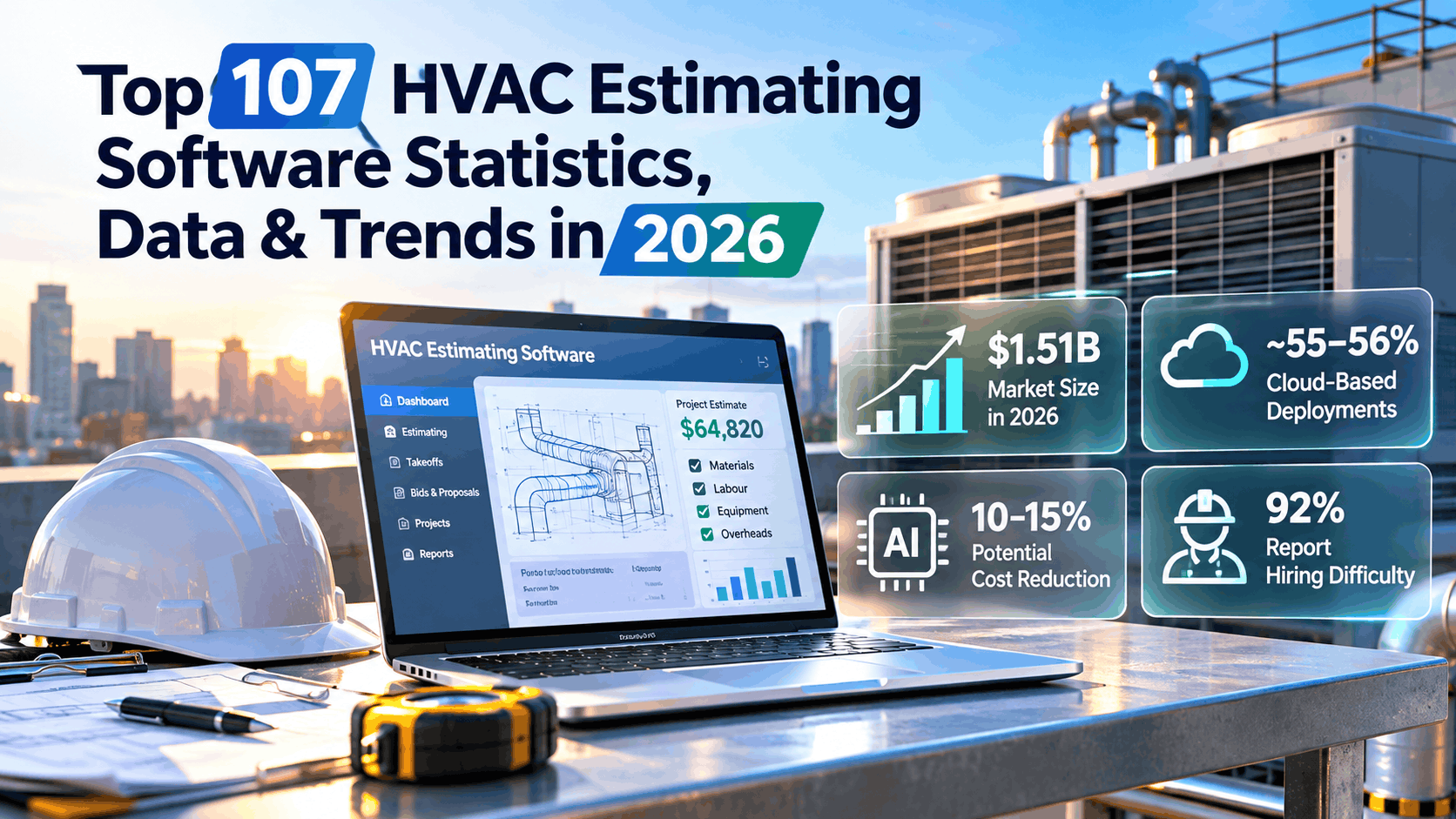
- Rapid HVAC Software Market Growth: The global HVAC service management software market is projected to grow from $1.51 billion in 2026 to $6.29 billion by 2035, registering a 17.3% CAGR.
- AI and Cloud-Based Estimating Adoption: Approximately 55–56% of HVAC software deployments are cloud-based, while AI-assisted cost estimation could reduce construction project costs by 10–15%.
- Workforce Shortages Accelerate Automation: With 92% of contractors reporting hiring difficulties, HVAC estimating software is becoming increasingly important for improving bid accuracy, automating workflows, reducing operational costs, and maximising profitability.
HVAC estimating software improves cost estimation, bid accuracy, and operational efficiency through digital automation. In 2026, the global HVAC service management software market stands at $1.51 billion, with projected annual growth of 17.3% through 2035. Cloud adoption, artificial intelligence, workforce shortages, and demand for accurate project estimates are key industry growth drivers.
The heating, ventilation, and air conditioning (HVAC) industry is undergoing a significant digital transformation in 2026, driven by artificial intelligence, cloud computing, workforce shortages, rising operational costs, and increasing demand for accurate project estimation. As HVAC contractors face intensifying competition and growing customer expectations, HVAC estimating software has become an increasingly important tool for streamlining cost calculations, automating material takeoffs, improving bid accuracy, accelerating proposal generation, and enhancing overall business profitability.

The rapid expansion of the HVAC software market highlights the growing importance of digital solutions across residential, commercial, and industrial contracting operations. The global HVAC service management software market is valued at approximately $1.51 billion in 2026 and is projected to reach $6.29 billion by 2035, growing at a compound annual growth rate (CAGR) of 17.3%. Meanwhile, the more specialised HVAC estimating and takeoff software market is forecast to expand from $1.2 billion in 2023 to $2.5 billion by 2032, reflecting an annual growth rate of approximately 8.5%.
Cloud-based HVAC estimating software is also gaining considerable momentum, with approximately 55% to 56% of HVAC software deployments operating through cloud-based environments. This transition enables contractors to access project estimates, material pricing databases, customer information, and digital proposals from multiple locations, supporting greater collaboration between office personnel, field technicians, estimators, and project managers.
Workforce challenges represent another major factor accelerating HVAC estimating software adoption. The United States recorded approximately 440,900 HVAC technician jobs in 2025, with employment projected to grow by 11% between 2025 and 2035. Furthermore, approximately 40,600 annual job openings are expected throughout the forecast period. Across the broader construction industry, 92% of contractors reported difficulties filling open field positions, while 45% of firms experienced project delays associated with workforce shortages. These challenges are increasing the importance of automation, operational efficiency, and technology-enabled productivity.
Artificial intelligence is emerging as one of the most influential HVAC estimating software trends in 2026. Approximately 61% of construction firms are using AI or planning to increase their AI investments, compared with 44% two years earlier. Additionally, 24% of construction and specialty-trade firms already utilise AI for cost estimation and budgeting, while 22% apply AI to bid management workflows. Industry research suggests that AI-assisted cost estimation could reduce project costs by 10% to 15% through improved forecasting, greater estimation accuracy, and reduced errors.
The financial implications of inaccurate estimating further demonstrate the importance of digital transformation. The construction industry reportedly loses approximately $31 billion annually to rework associated with miscommunication and inaccurate project data. Advanced HVAC estimating solutions can help mitigate these risks through automated quantity takeoffs, centralised pricing databases, standardised calculations, digital documentation, and integrated project management capabilities.
The HVAC estimating software landscape is also becoming increasingly competitive, with established platforms such as Jobber, Housecall Pro, Procore, STACK, ServiceTitan, FieldPulse, BuildOps, and Simpro offering diverse capabilities for contractors of different sizes. Software pricing varies considerably, with average entry-level subscriptions estimated at $469 per month and premium plans averaging approximately $1,702 per month. However, affordable alternatives and specialised estimating tools provide additional opportunities for smaller HVAC businesses and independent contractors to adopt digital solutions.
Despite strong market growth, HVAC estimating software market valuations differ substantially across research providers due to variations in market definitions, geographical coverage, software functionality, and research methodologies. Consequently, market forecasts and vendor-reported performance improvements should be interpreted within their respective contexts rather than treated as universally applicable benchmarks.
This comprehensive guide to the Top 107 HVAC Estimating Software Statistics, Data & Trends in 2026 examines the most significant developments shaping the industry, including:
- Global HVAC estimating software market size, growth forecasts, and revenue projections.
- Cloud-based software adoption and enterprise deployment trends.
- HVAC contracting industry growth and workforce demographics.
- Labour shortages and their influence on software adoption.
- Leading HVAC estimating software platforms, customer ratings, and user reviews.
- Software subscription pricing, affordability, and purchasing considerations.
- Artificial intelligence, automated takeoffs, and digital bid management.
- Construction technology adoption and mobile estimating capabilities.
- Commercial HVAC and sheet-metal estimating software developments.
- Operational efficiency, cost reduction, and business productivity opportunities.
By examining these 107 HVAC estimating software statistics, HVAC business owners, mechanical contractors, construction executives, project managers, software developers, technology investors, and procurement professionals can gain a deeper understanding of the evolving digital estimating ecosystem.
As the HVAC industry continues to embrace intelligent automation, cloud-based infrastructure, mobile-first applications, and data-driven decision-making, HVAC estimating software is becoming a strategic investment rather than merely an administrative tool. Organisations that successfully integrate advanced estimating technologies into their operations will be better positioned to improve bidding efficiency, protect profit margins, minimise costly errors, overcome workforce constraints, and maintain long-term competitiveness in an increasingly technology-driven HVAC market.
Before we venture further into this article, we would like to share who we are and what we do.
About 9cv9
9cv9 is a business tech startup based in Singapore and Asia, with a strong presence all over the world.
With over ten years of startup and business experience, and being highly involved in connecting with thousands of companies and startups, the 9cv9 team has listed some of the top and best companies/tools in this review.
If you like to get your company listed in our top B2B software reviews, check out our world-class 9cv9 Media and PR service and pricing plans here.
Top 107 HVAC Estimating Software Statistics, Data & Trends in 2026
A. Market Size & Growth
- $1.51 billion — The global HVAC service-management software market is valued at $1.51B in 2026, reflecting the industry’s steady shift away from spreadsheets and paper bids toward purpose-built platforms.
- 17.3% CAGR — Analysts project the HVAC service-management software market to compound at 17.3% annually through 2035, among the faster growth rates in vertical field-service software.
- $6.29 billion by 2035 — At that growth rate, the market is forecast to reach $6.29B within a decade, more than quadrupling its 2026 size.
- $1.2B → $2.5B (2023–2032) — A narrower analyst view sizes the pure-play HVAC estimating/takeoff software segment (excluding broader field-service tools) at $1.2B in 2023, growing to $2.5B by 2032.
- 8.5% CAGR — That narrower estimating/takeoff segment is projected to grow more slowly than the broader service-management category, at roughly 8.5% annually.
- $283.22 million (2026) — The US-specific HVAC software market (covering design, energy-optimization, and management platforms) is estimated at $283.22M in 2026.
- $567.64 million by 2036 — That same US market is projected to roughly double over the following decade, at a 7.2% CAGR.
- Analyst estimates diverge sharply — Published HVAC estimating software market sizes range from roughly $1.2B to $8.2B depending on the research firm and category definition used, underscoring why buyers should treat any single market-size figure as directional rather than definitive.
B. Deployment Model & Enterprise Mix
- ~55–56% cloud-based — More than half of HVAC software deployments are now cloud-based rather than on-premise, reflecting contractors’ need for field access from phones and tablets.
- 63% large-enterprise share — Large enterprises account for 63% of the US HVAC software market by enterprise size, though small contractors represent the much larger unit count.
- $17B–$24.3B by 2030 — Broader AI-in-construction software market forecasts range from about $17B (Grand View Research) to $24.3B (Mordor Intelligence) by 2030, with the spread reflecting different definitions of what counts as “AI software.”
C. US HVAC Contracting Industry Structure
- 111,207 employer establishments — The US Census Bureau counted 111,207 employer HVAC business establishments in its 2023 County Business Patterns release.
- 178,663 nonemployer businesses — A further 178,663 owner-operator HVAC shops with no paid staff were counted separately in 2023 Census Nonemployer Statistics.
- 1.6 solo shops per employer firm — For every employer HVAC establishment, roughly 1.6 solo owner-operator businesses also operate in the market.
- 1,214,761 employees — Employer HVAC establishments collectively employ over 1.2 million people nationwide.
- $89.5 billion payroll — Those establishments pay a combined $89.5B in annual wages.
- $73,693 average pay — Average annual pay per HVAC-industry employee works out to $73,693, according to Census payroll data.
- 10.9 employees per establishment — The average HVAC employer establishment carries 10.9 employees and roughly $805,000 in annual payroll.
- California leads with 11,686 establishments — California accounts for 10.5% of the national HVAC establishment count, followed by Florida (9,353) and Texas (8,966).
- 120,461 HVAC contractor businesses (2026) — IBISWorld separately counts 120,461 heating and air-conditioning contractor businesses in 2026, up 1.7% from 2025.
- 2.6% five-year CAGR — That contractor population grew at a 2.6% compound annual rate between 2021 and 2026.
- ~$392 billion industry revenue — The broader plumbing, heating, and air-conditioning contracting industry (NAICS 238220) generates an estimated $392B in annual US revenue.
D. HVAC Workforce (Bureau of Labor Statistics)
- 440,900 technician jobs (2025) — The BLS counted about 440,900 heating, air-conditioning, and refrigeration mechanic and installer jobs in the US in 2025.
- 11% projected growth (2025–2035) — The BLS projects 11% employment growth for HVAC technicians over the next decade, much faster than the average occupation.
- ~40,600 annual openings — The BLS projects roughly 40,600 average annual job openings for HVAC technicians over the coming decade, mostly from retirements and career changes.
- $28.75/hour median wage — The median HVAC technician hourly wage was $28.75 as of the BLS’s May 2024 occupational wage estimates.
- 394,100 → 440,900 workforce growth — The HVAC technician workforce grew from about 394,100 in 2021 to roughly 440,900 by 2025, a meaningful expansion in just four years.
- ~20% union wage premium — Union HVAC workers reportedly earn about 20% more on average than non-union technicians on a weekly-wage basis.
E. Labor Shortage Pressures Driving Software Adoption
- 92% report hiring difficulty — 92% of contractors reported difficulty filling open field roles, per the AGC/NCCER 2025 Workforce Survey.
- 94% of construction firms, early 2025 — A separate early-2025 reading found 94% of construction firms reporting difficulty filling open positions industry-wide.
- 349,000 net new workers needed (2026) — The construction industry needs an estimated 349,000 net new workers in 2026 alone to keep pace with demand, per Associated Builders and Contractors.
- 439,000 net new workers (2025 estimate) — ABC’s comparable estimate for 2025 was 439,000 net new workers needed, illustrating the scale of the ongoing labor gap.
- 45% report project delays — 45% of firms said worker shortages delayed at least one project in the past year, per the AGC/NCCER 2025 survey.
- Solo contractors grew from 2% to 5% — Independent, one-person HVAC contractors reportedly grew from about 2% of the contractor base in 2010 to roughly 5% today, a trend that favors lightweight, affordable estimating tools over enterprise suites.
F. Capterra’s HVAC Estimating Software Directory (Primary Source)
- 25 vendors on page 1 alone — Capterra’s HVAC Estimating Software directory (the category linked at the top of this request) lists at least 25 vendors on its first page, spanning four total result pages.
- Housecall Pro: 4.7★, 2,744 reviews — Housecall Pro carries the highest review volume in the category at 2,744 verified Capterra reviews.
- Procore: 4.5★, 2,674 reviews — Procore is the second most-reviewed listing in the category, reflecting its broad use as a general construction management platform.
- Jobber: 4.6★, 1,478 reviews — Jobber ranks third by review volume among HVAC estimating tools on Capterra.
- STACK: 4.5★, 1,399 reviews — STACK, a dedicated takeoff-and-estimating platform, holds the fourth-highest review count in the category.
- Contractor Foreman: 4.5★, 836 reviews — Contractor Foreman’s all-in-one construction management approach has drawn 836 verified reviews.
- mHelpDesk: 4.3★, 824 reviews — mHelpDesk rounds out the top six most-reviewed HVAC estimating listings.
- FieldPulse: 4.6★, 492 reviews — FieldPulse combines a relatively high rating with solid review volume for a mid-sized field-service platform.
- ServiceTitan: 4.3★, 339 reviews — ServiceTitan, positioned toward larger enterprise shops, shows fewer reviews relative to its market visibility.
- FieldEdge: 4.2★, 312 reviews — FieldEdge markets itself around a 30,000+ user base with 35+ years in the HVAC software space.
- Service Fusion: 4.3★, 308 reviews — Service Fusion differentiates on a flat monthly fee with no per-user charges.
- Commusoft: 4.7★, 211 reviews — Commusoft cites over 10,000 contractors using its platform for commercial and residential estimating.
- BuildOps: 4.4★, 177 reviews — BuildOps targets commercial service contractors specifically, rather than residential HVAC.
- ArcSite: 4.7★, 162 reviews — ArcSite focuses on draw-to-quote functionality for field-based proposal creation.
- Fergus: 4.6★, 155 reviews — Fergus states that over 10 million jobs have been created on its platform globally.
- Tradify: 4.7★, 152 reviews — Tradify is built specifically for trade businesses with 1–20 employees.
- Simpro: 4.0★, 148 reviews — Simpro holds the lowest average rating among the category’s top 16 most-reviewed listings.
- FastPIPE: 4.7★, 129 reviews — FastPIPE serves mechanical and plumbing estimating specifically for the piping trade.
- Procore Estimating (Esticom): 4.5★, 116 reviews — Procore’s dedicated estimating module uses AI-powered symbol recognition for quantity takeoff.
- Trimble Estimation Desktop: 4.4★, 110 reviews — This tool targets MEP (mechanical, electrical, plumbing) contractors specifically.
- Joblogic: 4.3★, 102 reviews — Joblogic centers its pitch on centralized quote-to-job conversion.
- Synchroteam: 4.4★, 96 reviews — Synchroteam emphasizes mobile, on-site estimate generation for field technicians.
- ThermoGrid: 4.4★, 77 reviews — ThermoGrid positions itself as a fully paperless HVAC business management system.
- Groundplan: 4.8★, 63 reviews — Groundplan is one of the highest-rated tools in the category despite a smaller review base.
- Bolt: 4.2★, 62 reviews — Bolt focuses on trade contractors working with new home builders specifically.
- YourTradebase: 4.9★, 59 reviews — YourTradebase holds the single highest star rating of any vendor listed in the category.
- 56% rate 4.5★ or higher — Across all 25 listed vendors, 56% carry an average rating of 4.5 stars or above.
- 32% cluster at 4.3–4.4★ — The largest single rating band (8 of 25 vendors) falls in the 4.3–4.4 star range, Capterra’s “solid but not exceptional” tier.
- STACK claims up to 10x faster takeoffs — STACK’s own Capterra listing states its AI-accelerated takeoff tools can process estimates up to 10 times faster than manual methods.
- STACK claims 35% more accurate estimates — The same listing claims a 35% improvement in estimate accuracy versus manual takeoff.
- STACK reports 90%+ customer satisfaction — STACK’s vendor-reported customer satisfaction rate exceeds 90%, per its own product listing.
- ArcSite claims a 60% average close-rate improvement — ArcSite states its draw-and-quote workflow improves close rates by an average of 60% versus paper-based estimating.
- BuildOps claims up to 30% revenue growth — BuildOps markets a potential 30% revenue increase for commercial contractors adopting its platform.
- Jobber serves 250,000+ home service pros — Jobber’s vendor-stated user base spans more than a quarter-million home service businesses across trades.
- Housecall Pro serves 45,000+ businesses — Housecall Pro cites over 45,000 businesses on its platform in its current Capterra listing.
- 287 candidates narrowed to 34 eligible — Capterra’s broader “Best HVAC Software” methodology started from 287 candidate products and narrowed the field to 34 that met its minimum 20-review, 4.0-star eligibility bar.
- 100+ data points per product — Capterra states its research draws on more than 100 data points per product, spanning both capability and popularity signals.
- Jobber tops the Capterra Shortlist at 96/100 — On Capterra’s dedicated HVAC Estimating Shortlist, Jobber earns the top overall score of 96/100, ahead of Procore’s 92/100.
G. Software Advice: Verified Pricing & Ratings
- 95 products / 77 profiles — Software Advice lists 95 total products and maintains 77 unique vendor profiles in its HVAC Estimating Software category.
- $469/month average entry-level price — Across the category, a typical entry-level HVAC estimating software plan costs approximately $469 per month.
- $1,702/month average premium price — Premium and advanced-tier subscriptions in the same category average roughly $1,702 per month — a more than 3.6x jump from entry level.
- Housecall Pro: $79/mo Basic, $329/mo MAX — Housecall Pro’s verified pricing spans a $79/month single-user Basic plan up to a $329/month plan supporting 100+ users.
- Jobber: $39/mo Core, $199/mo Grow — Jobber’s published tiers run from $39/month for a single-user Core plan to $199/month for its Grow tier.
- ArcSite starts at $15/month — ArcSite carries the lowest verified starting price of any vendor reviewed in this category.
- Service Fusion starts at $259/month — Service Fusion’s starting price sits considerably above the category’s own average entry-level benchmark.
- Groundplan starts at $75/month — Groundplan’s takeoff-focused tool starts at a comparatively affordable $75 per month.
- Zoho FSM starts at $30/month — Zoho’s field-service module starts at $30/month, one of the lower verified entry points in the category.
- Several leaders don’t publish pricing at all — Procore, ServiceTitan, FieldPulse, BuildOps, and Simpro all list pricing as “available upon request” rather than a public rate card, a pattern common among platforms targeting larger accounts.
- FrontRunners 2026: Jobber scores 93/100 — Software Advice’s 2026 FrontRunners methodology ranks Jobber highest overall in the category at 93/100.
- FrontRunners 2026: Procore scores 88/100 — Procore ranks second in the same FrontRunners methodology.
- FieldPulse rated highest for customer satisfaction — Software Advice’s own analysis names FieldPulse the highest-rated HVAC estimating tool for customer satisfaction specifically.
- Simpro claims 250,000+ users worldwide — Simpro’s own Software Advice profile states more than 250,000 users rely on its platform group globally, spanning several affiliated brands.
H. G2 & Marketplace Consolidation
- G2’s HVAC category lists 8 small-business products — G2’s small-business filter for HVAC software surfaces 8 listed products as of 2026.
- ServiceTitan: 4.4/5 on G2 (375 reviews) — ServiceTitan’s G2 rating closely mirrors its Capterra and Software Advice scores, suggesting consistent sentiment across review platforms.
- G2 acquired Capterra, GetApp, and Software Advice (Feb 2026) — In February 2026, G2 acquired the three other major software-review marketplaces, consolidating the platforms that host this very category under one parent company.
- G2 Grid Report threshold: 6 products, 150+ reviews — G2 requires at least 6 products with 10+ reviews each, and 150+ total category reviews, before it will publish a quarterly Grid Report.
I. AI & Technology Adoption in Estimating
- 61% of firms use or are increasing AI investment (2026) — 61% of construction firms now use AI or plan to increase AI investment, up from 44% just two years earlier, per AGC and Sage’s 2026 Construction Hiring and Business Outlook.
- 45% of AI use goes to office/admin functions — Among firms deploying AI, 45% apply it to office and administrative work.
- 23% of AI use goes to estimating specifically — Cost estimating is the second-largest AI use case in construction, drawing 23% of deployment effort.
- 20% of AI use goes to design/preconstruction — Design and preconstruction functions account for another 20% of AI application within adopting firms.
- 38% report measurable AI impact (2026) — 38% of commercial specialty contractors now report measurable business impact from AI, more than double the 17% who said so a year earlier, per ServiceTitan’s 2026 industry report.
- 24% use AI for cost estimation/budgeting — Nearly a quarter of construction and specialty-trade firms already apply AI directly to cost estimation and budgeting tasks.
- 22% use AI for bid management — A similar share, 22%, apply AI specifically to bid management workflows.
- 45% of construction professionals report no AI implementation — A global RICS survey of 2,200+ construction professionals found 45% report no AI implementation at all, showing adoption is still uneven worldwide.
- 87% expect AI impact, but only 19% have adapted — Dodge Construction Network found 87% of contractors predict AI will meaningfully affect the industry, yet only 19% have actually changed their workflows so far.
- AI-assisted estimating can cut costs 10–15% — Deloitte’s 2026 Engineering & Construction Outlook estimates AI-assisted cost estimation can reduce project costs by 10–15% through better estimates and error mitigation.
- 46% of early AI adopters saved 500–1,000 hours — Nearly half of early construction AI adopters report saving between 500 and 1,000 work-hours using AI tools, per Bluebeam’s AEC Technology Outlook.
- 68% of early adopters saved $50,000+ — More than two-thirds of early AI adopters in construction report saving at least $50,000 as a direct result.
- $31 billion lost annually to rework — The construction industry loses an estimated $31B every year to rework driven by miscommunication and inaccurate project data, according to FMI — a key justification vendors cite for estimating software.
J. Broader Construction Technology Baseline
- 92% used a smartphone daily on the job — A widely-cited JBKnowledge ConTech Report baseline found 92% of construction workers used a smartphone every day at work.
- 97% used construction-specific software daily — By 2021, 97% of construction companies reported using construction-specific software on a daily basis.
- 48% require an easy mobile app to adopt new software — Nearly half of construction professionals say they will only adopt new software if it includes an easy-to-use mobile app.
K. Commercial / Sheet-Metal Estimating Segment
- 250,000+ line items in a commercial HVAC cost database — FastDUCT’s estimating catalog for commercial and industrial sheet-metal contractors includes more than 250,000 priced material and labor line items, illustrating the scale of data commercial-grade estimating tools must manage.
Conclusion
The findings presented in these Top 107 HVAC Estimating Software Statistics, Data & Trends in 2026 highlight a fundamental transformation in how HVAC contractors manage project estimation, cost forecasting, material takeoffs, bid preparation, and business operations. As artificial intelligence, cloud computing, mobile applications, and intelligent automation continue to reshape the industry, HVAC estimating software is becoming an increasingly important investment for businesses seeking greater accuracy, operational efficiency, and long-term profitability.
Strong Market Growth Reflects Increasing Demand for HVAC Software
The global HVAC software industry is experiencing substantial expansion as contractors increasingly replace traditional spreadsheets, manual calculations, and paper-based estimating processes with integrated digital platforms.
The global HVAC service management software market is valued at approximately $1.51 billion in 2026 and is projected to reach $6.29 billion by 2035, growing at a compound annual growth rate of 17.3%. Meanwhile, the specialised HVAC estimating and takeoff software market is forecast to expand from $1.2 billion in 2023 to $2.5 billion by 2032, registering an estimated CAGR of 8.5%.
The United States HVAC software market is also expected to experience sustained growth, increasing from approximately $283.22 million in 2026 to $567.64 million by 2036.
Although market valuations differ across research providers because of varying market definitions and methodologies, these projections collectively indicate increasing demand for digital HVAC management and estimating solutions.
Artificial Intelligence Is Reshaping HVAC Cost Estimation
Artificial intelligence represents one of the most significant technological developments influencing HVAC estimating software in 2026.
Approximately 61% of construction firms are using AI or planning to increase their AI investments, compared with 44% two years earlier. Furthermore, 24% of construction and specialty-trade firms already utilise AI for cost estimation and budgeting, while 22% apply artificial intelligence to bid management.
The potential benefits of AI-powered estimating technologies are substantial. Industry research suggests that AI-assisted cost estimation could reduce construction project costs by 10% to 15% through improved forecasting, greater accuracy, and reduced estimation errors.
Software providers are also reporting considerable productivity improvements. STACK claims that its AI-powered takeoff technology can accelerate material takeoffs by up to 10 times while improving estimation accuracy by 35%. Although these vendor-reported outcomes may vary between businesses, they illustrate the potential operational advantages of intelligent estimating technologies.
However, AI adoption remains uneven. Approximately 45% of surveyed construction professionals report no AI implementation, while 87% of contractors anticipate significant industry disruption from artificial intelligence, despite only 19% having adapted their workflows.
This gap between technological expectations and practical implementation represents a significant opportunity for HVAC contractors seeking to establish a competitive advantage through responsible AI adoption.
Cloud-Based and Mobile HVAC Estimating Software Is Becoming Increasingly Important
Cloud computing continues to transform how HVAC businesses access, manage, and distribute estimating information. Approximately 55% to 56% of HVAC software deployments are now cloud-based, reflecting growing demand for flexible accessibility, centralised data management, and real-time collaboration.
Cloud-based HVAC estimating software offers several operational advantages, including:
- Remote access to project estimates and pricing databases.
- Real-time collaboration between estimators, technicians, and project managers.
- Faster generation of customer quotations and proposals.
- Centralised management of labour, material, and equipment costs.
- Improved accessibility across smartphones, tablets, and desktop computers.
- Integration with accounting, scheduling, invoicing, and field service management systems.
- Reduced dependence on fragmented spreadsheets and paper-based documentation.
Mobile accessibility is equally important, particularly for contractors operating across multiple job sites. Historical construction technology research found that 92% of construction workers used smartphones daily at work, while approximately 48% of construction professionals require an easy-to-use mobile application when adopting new software.
These findings reinforce the importance of mobile-first HVAC estimating solutions that support efficient decision-making in both office and field environments.
Workforce Shortages Are Accelerating HVAC Estimating Automation
Labour shortages remain a significant challenge for the HVAC and broader construction industries.
The United States recorded approximately 440,900 HVAC technician jobs in 2025, with employment projected to increase by 11% between 2025 and 2035. Approximately 40,600 annual job openings are also expected throughout the forecast period.
Across the construction industry, 92% of surveyed contractors reported difficulties filling open field positions, while 45% of firms experienced project delays associated with workforce shortages. The broader construction sector is estimated to require approximately 349,000 net new workers in 2026 alone.
These workforce pressures are increasing the importance of automation technologies that allow contractors to manage larger workloads without proportionally increasing administrative staffing requirements.
HVAC estimating software can support businesses by automating repetitive calculations, standardising pricing processes, accelerating bid preparation, reducing administrative workloads, and allowing experienced professionals to concentrate on higher-value technical and commercial activities.
Although software cannot replace skilled HVAC technicians, effective automation can help businesses utilise their existing workforce more efficiently.
Software Pricing and Vendor Competition Are Expanding Purchasing Opportunities
The HVAC estimating software market offers a diverse range of platforms designed to accommodate independent contractors, small businesses, medium-sized enterprises, and large commercial mechanical contractors.
Leading software providers such as Jobber, Housecall Pro, Procore, STACK, ServiceTitan, FieldPulse, BuildOps, Simpro, and ArcSite offer different combinations of estimating, automation, project management, and field service capabilities.
According to the reviewed software pricing data, entry-level HVAC estimating software subscriptions average approximately $469 per month, while premium subscriptions average $1,702 per month. Nevertheless, several affordable alternatives offer significantly lower starting prices, creating opportunities for smaller contractors to adopt digital estimating technologies.
Customer satisfaction also remains an important purchasing consideration. Among the 25 reviewed Capterra listings, 56% achieved customer ratings of at least 4.5 out of 5, indicating generally positive user experiences across a substantial proportion of the reviewed platforms.
However, businesses should avoid selecting HVAC estimating software solely on subscription costs, popularity, or customer ratings. A comprehensive purchasing decision should consider estimating accuracy, functionality, scalability, integration capabilities, mobile accessibility, implementation requirements, customer support, and total cost of ownership.
Accurate HVAC Estimating Is Essential for Protecting Profit Margins
The financial consequences of inaccurate project estimates, communication failures, and inefficient workflows reinforce the strategic importance of HVAC estimating software.
The broader construction industry reportedly loses approximately $31 billion annually to rework associated with miscommunication and inaccurate project data. While this figure extends beyond HVAC contracting, it demonstrates the potential financial risks of fragmented information management and inefficient project planning.
Modern HVAC estimating platforms can help mitigate these challenges through automated quantity takeoffs, standardised labour calculations, centralised material pricing, digital proposal generation, and improved project documentation.
For HVAC contractors, greater estimating accuracy can support more competitive bidding, stronger cost control, improved resource allocation, and better protection against unexpected project expenses.
Nevertheless, successful implementation depends on maintaining accurate pricing databases, training employees effectively, establishing consistent estimating procedures, and regularly reviewing software-generated calculations.
The Future of HVAC Estimating Software Beyond 2026
The future of HVAC estimating software is expected to be increasingly shaped by artificial intelligence, intelligent automation, cloud-based infrastructure, mobile accessibility, and integrated construction management ecosystems.
Several developments are likely to influence the next generation of HVAC estimating solutions:
- AI-powered cost estimation and predictive project forecasting.
- Automated material takeoffs and intelligent drawing recognition.
- Integrated estimating, accounting, and field service management platforms.
- Real-time labour, equipment, and material pricing updates.
- Advanced commercial HVAC and mechanical estimating capabilities.
- Mobile-first estimating and on-site proposal generation.
- Data-driven profitability analysis and project performance monitoring.
- Scalable software solutions for independent contractors and growing HVAC businesses.
As these technologies mature, HVAC estimating software is likely to become more closely integrated with broader business management processes, enabling contractors to connect initial project estimates with scheduling, procurement, execution, invoicing, and financial performance analysis.
Final Thoughts
The 107 HVAC estimating software statistics, data, and trends examined in this guide demonstrate that digital transformation is becoming a central component of competitiveness within the HVAC contracting industry.
Strong market growth, increasing AI adoption, widespread cloud deployment, persistent workforce shortages, and demand for greater estimating accuracy are collectively encouraging contractors to reconsider traditional business processes and invest in modern estimating technologies.
However, successful digital transformation requires more than purchasing software. HVAC businesses must carefully evaluate their operational requirements, establish measurable performance objectives, select suitable platforms, train employees, and continuously assess the effectiveness of their technology investments.
Market forecasts, software pricing benchmarks, customer ratings, and vendor-reported performance improvements should also be interpreted carefully, as research methodologies, product capabilities, subscription structures, and implementation outcomes vary considerably.
Ultimately, HVAC estimating software in 2026 represents a strategic investment in operational efficiency, bidding accuracy, cost management, workforce productivity, and sustainable business growth. Contractors that effectively integrate artificial intelligence, cloud computing, and automated estimating technologies into their operations will be better positioned to protect profit margins, improve customer experiences, overcome operational challenges, and remain competitive in an increasingly digital HVAC industry.
If you find this article useful, why not share it with your hiring manager and C-level suite friends and also leave a nice comment below?
We, at the 9cv9 Research Team, strive to bring the latest and most meaningful data, guides, and statistics to your doorstep.
To get access to top-quality guides, click over to 9cv9 Blog.
To hire top talents using our modern AI-powered recruitment agency, find out more at 9cv9 Modern AI-Powered Recruitment Agency.
People Also Ask
What is HVAC estimating software?
HVAC estimating software is a digital solution that helps contractors calculate labour costs, material requirements, equipment expenses, and project pricing while automating takeoffs, bids, quotes, and proposals.
How big is the HVAC software market in 2026?
The global HVAC service management software market is valued at approximately $1.51 billion in 2026 and is projected to reach $6.29 billion by 2035.
What is the projected growth rate of the HVAC software market?
The global HVAC service management software market is projected to grow at a compound annual growth rate of 17.3% through 2035, driven by automation, cloud adoption, and digital transformation.
What is the market size of HVAC estimating and takeoff software?
The specialised HVAC estimating and takeoff software market is projected to grow from $1.2 billion in 2023 to $2.5 billion by 2032, registering an estimated CAGR of 8.5%.
What percentage of HVAC software deployments are cloud-based?
Approximately 55% to 56% of HVAC software deployments are cloud-based, reflecting increasing demand for remote accessibility, mobile estimating, centralised data, and real-time collaboration.
How much does HVAC estimating software cost in 2026?
Entry-level HVAC estimating software costs approximately $469 per month on average, while premium subscriptions average $1,702 per month. Actual pricing depends on features, users, and deployment requirements.
What are the best HVAC estimating software platforms in 2026?
Leading HVAC estimating software platforms include Jobber, Housecall Pro, Procore, STACK, ServiceTitan, FieldPulse, BuildOps, Simpro, ArcSite, and Contractor Foreman.
Which HVAC estimating software has the highest customer rating?
YourTradebase holds a 4.9 out of 5 rating among the 25 reviewed Capterra listings, followed by Groundplan at 4.8 out of 5. Ratings may change as additional customer reviews are submitted.
Which HVAC estimating software has the most customer reviews?
Housecall Pro leads the reviewed Capterra listings with 2,744 customer reviews, followed by Procore with 2,674 reviews and Jobber with 1,478 reviews.
Which HVAC estimating software is best for small businesses?
Jobber, Housecall Pro, Tradify, ArcSite, and Zoho FSM are suitable options for small HVAC businesses seeking affordable estimating, quoting, scheduling, and business management capabilities.
Which HVAC estimating software is suitable for commercial contractors?
BuildOps, Procore, STACK, Simpro, FastDUCT, and Trimble Estimation Desktop offer capabilities relevant to commercial HVAC contractors managing complex estimates, material takeoffs, and large-scale projects.
How is artificial intelligence transforming HVAC estimating software?
Artificial intelligence supports automated material takeoffs, intelligent cost forecasting, bid preparation, symbol recognition, and error detection, helping HVAC contractors improve estimating efficiency and accuracy.
What percentage of construction companies are adopting AI in 2026?
Approximately 61% of construction firms use artificial intelligence or plan to increase AI investment in 2026, compared with 44% two years earlier.
How many construction companies use AI for cost estimation?
Approximately 24% of construction and specialty-trade firms use artificial intelligence for cost estimation and budgeting, while 22% apply AI to bid management workflows.
Can AI-powered HVAC estimating software reduce project costs?
Industry research suggests that AI-assisted construction cost estimation could reduce project costs by 10% to 15% through improved forecasting, greater accuracy, and fewer estimation errors.
How much faster can HVAC estimating software complete material takeoffs?
STACK reports that its AI-powered takeoff tools can complete takeoffs up to 10 times faster than manual methods. Actual performance depends on project complexity, software configuration, and user experience.
Can HVAC estimating software improve estimation accuracy?
Yes. HVAC estimating software can improve accuracy through automated calculations, standardised pricing databases, and digital takeoffs. STACK reports potential estimation accuracy improvements of 35%.
How do labour shortages influence HVAC estimating software adoption?
With 92% of surveyed contractors reporting difficulties filling field positions, automation helps businesses reduce administrative workloads, improve estimator productivity, and manage projects with limited staffing.
How many HVAC technicians work in the United States?
The United States recorded approximately 440,900 HVAC mechanic and installer jobs in 2025. Employment is projected to increase by 11% between 2025 and 2035.
How many HVAC technician job openings are expected annually?
Approximately 40,600 HVAC technician job openings are projected annually in the United States through 2035, driven by workforce expansion, retirements, and occupational changes.
How many HVAC contractor businesses operate in the United States?
Industry estimates indicate that approximately 120,461 heating and air-conditioning contractor businesses operate in the United States in 2026, representing 1.7% growth from 2025.
What are the main benefits of HVAC estimating software?
Key benefits include faster quote generation, improved bid accuracy, reduced administrative workloads, standardised pricing, better cost control, enhanced customer communication, and improved profitability.
What features should HVAC estimating software include?
Essential features include digital material takeoffs, labour cost calculations, equipment pricing databases, automated proposals, mobile accessibility, bid management, reporting, and accounting integrations.
What is the difference between HVAC estimating software and HVAC field service management software?
HVAC estimating software focuses on project costs, material takeoffs, bids, and quotations. Field service management software covers broader operations, including scheduling, dispatching, invoicing, and customer management.
Why is mobile HVAC estimating software important?
Mobile HVAC estimating software allows technicians to prepare quotes, access pricing information, and generate proposals directly from job sites. Approximately 48% of construction professionals require an easy-to-use mobile app for software adoption.
Can HVAC estimating software increase sales conversion rates?
Digital estimating tools can accelerate proposal delivery and improve customer communication. ArcSite reports an average close-rate improvement of 60% through its draw-and-quote workflow, although individual results vary.
How does HVAC estimating software help reduce construction rework?
HVAC estimating software reduces calculation errors, standardises project information, and improves communication. The broader construction industry reportedly loses approximately $31 billion annually to rework linked to inaccurate data and miscommunication.
Is HVAC estimating software worth the investment?
HVAC estimating software can deliver value through faster bidding, improved cost accuracy, reduced administrative expenses, and stronger profit margins. Return on investment depends on project volume, subscription costs, and implementation effectiveness.
What are the biggest HVAC estimating software trends in 2026?
Major trends include AI-powered estimating, automated material takeoffs, cloud-based deployment, mobile-first applications, integrated field service management, digital proposals, and intelligent cost forecasting.
What is the future of HVAC estimating software?
The future of HVAC estimating software will increasingly centre on artificial intelligence, intelligent automation, cloud infrastructure, mobile accessibility, and integrated project management, supporting greater accuracy, productivity, and operational profitability.
Sources
- Capterra
- Software Advice
- G2
- U.S. Census Bureau
- Start Business by State
- U.S. Bureau of Labor Statistics
- IBISWorld
- Associated General Contractors of America (AGC)
- Sage
- ServiceTitan
- Associated Builders and Contractors (ABC)
- Bridgit
- Royal Institution of Chartered Surveyors (RICS)
- Dodge Construction Network
- Civils AI
- Provision
- OfficeTwo
- AI Building Tools
- Deloitte
- Bluebeam
- FMI
- Business Research Insights
- DataIntelo
- Future Market Insights
- GetApp
- QuoteIQ
- JBKnowledge
- Construction Dive
- Sensera Systems
- VantaInsights