


Key Takeaways
- The customer service software market is experiencing explosive growth in 2026, driven by AI, cloud-based SaaS platforms, omnichannel support, and rising enterprise investment, making customer experience a key competitive advantage.
- Artificial intelligence is transforming customer service operations, enabling businesses to automate routine enquiries, reduce support costs, improve agent productivity, deliver faster resolutions, and generate substantial returns on investment.
- Customer expectations continue to reshape the industry, with consumers demanding instant, personalised, and seamless omnichannel support, pushing organisations to adopt intelligent customer service software that combines AI efficiency with human expertise.
Customer service software helps businesses automate support, improve customer satisfaction, and deliver faster, more personalised experiences across multiple channels. This collection of the top 112 customer service software statistics for 2026 explores the latest market growth, AI adoption, customer behaviour, and technology trends shaping the future of customer experience.
Customer service has evolved from a traditional support function into one of the most influential drivers of business growth, customer loyalty, and competitive advantage. In 2026, organisations across every major industry are investing heavily in customer service software to meet rising customer expectations, streamline operations, and harness the power of artificial intelligence. What was once viewed as a cost centre has rapidly transformed into a strategic business asset, with executives recognising that exceptional customer experiences directly influence revenue growth, customer retention, and long-term brand reputation. As digital transformation accelerates worldwide, customer service software has become an essential component of modern business infrastructure rather than an optional technology investment.
Also, read our top guide on the Top 10 Best Customer Service Software.


The numbers behind this transformation are remarkable. The global customer service software market continues to experience extraordinary expansion, growing from a market worth billions of dollars into one of the fastest-growing enterprise software sectors. Industry forecasts project sustained double-digit compound annual growth rates throughout the decade, driven by cloud adoption, AI-powered automation, omnichannel customer engagement, and the increasing need for businesses to deliver personalised customer experiences at scale. These trends demonstrate that customer service technology is no longer reserved for large multinational corporations; businesses of all sizes are embracing sophisticated platforms to remain competitive in an increasingly digital economy.
Artificial intelligence has emerged as the defining force reshaping customer service in 2026. AI-powered chatbots, virtual assistants, intelligent ticket routing, automated knowledge management, predictive analytics, and generative AI copilots are fundamentally changing how businesses interact with customers. Industry research shows that the overwhelming majority of customer service leaders are actively exploring, piloting, or deploying conversational AI solutions, while executive teams continue to pressure organisations to accelerate AI adoption. The shift represents far more than simple automation—it signals a complete reinvention of customer support operations where AI and human agents increasingly collaborate to deliver faster, smarter, and more personalised service experiences.


The economic benefits of AI-driven customer service are equally compelling. Businesses implementing AI-powered support systems are reporting substantial reductions in operational costs, dramatic improvements in productivity, and significant returns on investment. Automated customer interactions cost only a fraction of traditional human-assisted support while enabling organisations to resolve routine enquiries instantly around the clock. At the same time, support agents equipped with AI copilots are handling more cases, responding faster, and spending less time on repetitive administrative tasks. These measurable financial gains explain why customer service software budgets continue to grow even amid broader economic uncertainty.

Customer expectations have also reached unprecedented levels. Modern consumers increasingly expect immediate responses, personalised interactions, seamless omnichannel communication, and frictionless self-service experiences. A single poor interaction can now be enough to drive customers toward competing brands, while exceptional customer experiences encourage repeat purchases, stronger loyalty, and increased willingness to pay premium prices. Businesses that fail to modernise their customer service capabilities risk not only losing customers but also damaging long-term brand equity in an era where online reviews, social media, and digital word-of-mouth amplify every customer interaction.

The evolution of communication channels has further transformed the customer service landscape. Today’s consumers move effortlessly between email, phone calls, live chat, messaging apps, social media, websites, mobile applications, and video interactions during a single customer journey. This behavioural shift has fuelled the rapid adoption of omnichannel customer service platforms that consolidate conversations into unified workspaces, giving agents complete customer context regardless of where interactions originate. Organisations implementing strong omnichannel strategies consistently outperform competitors in customer retention, satisfaction scores, engagement rates, and operational efficiency.

Self-service technologies are simultaneously becoming an essential pillar of modern customer support strategies. AI-powered knowledge bases, intelligent search, community forums, conversational chatbots, and automated help centres now resolve an increasing percentage of customer enquiries without requiring human intervention. These capabilities not only reduce contact centre workloads but also align with growing customer preferences for finding answers independently whenever possible. As self-service platforms become increasingly sophisticated through machine learning and natural language processing, businesses can deliver faster resolutions while lowering service costs and improving customer satisfaction.

Despite rapid advances in automation, the human element remains critically important. Research consistently shows that while consumers appreciate AI for handling routine requests, they continue to value the ability to escalate complex issues to knowledgeable human agents. Many customers remain sceptical about fully AI-driven support experiences and expect organisations to provide seamless transitions between automated systems and live representatives. As a result, the future of customer service is increasingly defined by hybrid support models that combine AI efficiency with human empathy, expertise, and problem-solving capabilities.

The customer service workforce itself is undergoing profound transformation. AI-powered productivity tools are enabling service professionals to resolve more enquiries in less time while reducing repetitive workloads that contribute to burnout. At the same time, organisations are creating entirely new roles focused on conversational AI design, automation management, customer journey optimisation, and AI governance. Rather than simply replacing human agents, customer service software is redefining how support teams operate, allowing employees to focus on higher-value customer interactions that require critical thinking, emotional intelligence, and relationship building.

Looking ahead, customer service software is expected to become even more intelligent, predictive, and proactive. Future platforms will increasingly leverage multimodal AI, autonomous AI agents, predictive customer support, advanced sentiment analysis, and hyper-personalised customer experiences powered by real-time data. Businesses will continue shifting from reactive support models toward proactive service strategies that identify and resolve issues before customers even recognise problems. This evolution represents one of the most significant technological transformations currently taking place across enterprise software.

Whether you are a business executive evaluating customer experience technology, a customer support leader planning future investments, a technology professional researching AI adoption, a software vendor analysing market opportunities, or simply someone interested in the future of customer service, understanding the latest industry statistics is essential for making informed decisions. Data-driven insights reveal where the market is heading, which technologies are delivering measurable business value, how customer expectations continue to evolve, and what competitive strategies leading organisations are adopting to stay ahead.
This comprehensive guide presents the Top 112 Customer Service Software Statistics, Data & Trends in 2026, bringing together the latest research on global market growth, artificial intelligence adoption, customer behaviour, omnichannel engagement, self-service technologies, workforce productivity, operational efficiency, consumer trust, return on investment, and future industry forecasts. These carefully curated statistics provide a complete snapshot of one of the world’s fastest-evolving software markets, equipping business leaders, technology buyers, customer experience professionals, and digital transformation teams with the insights needed to navigate the future of customer service confidently.
Before we venture further into this article, we would like to share who we are and what we do.
About 9cv9
9cv9 is a business tech startup based in Singapore and Asia, with a strong presence all over the world.
With over ten years of startup and business experience, and being highly involved in connecting with thousands of companies and startups, the 9cv9 team has listed some important and crucial software tools in this review.
If you like to get your company listed in our top B2B software reviews, check out our world-class 9cv9 Media and PR service and pricing plans here.
Top 112 Customer Service Software Statistics, Data & Trends in 2026
🏦 MARKET SIZE & GROWTH
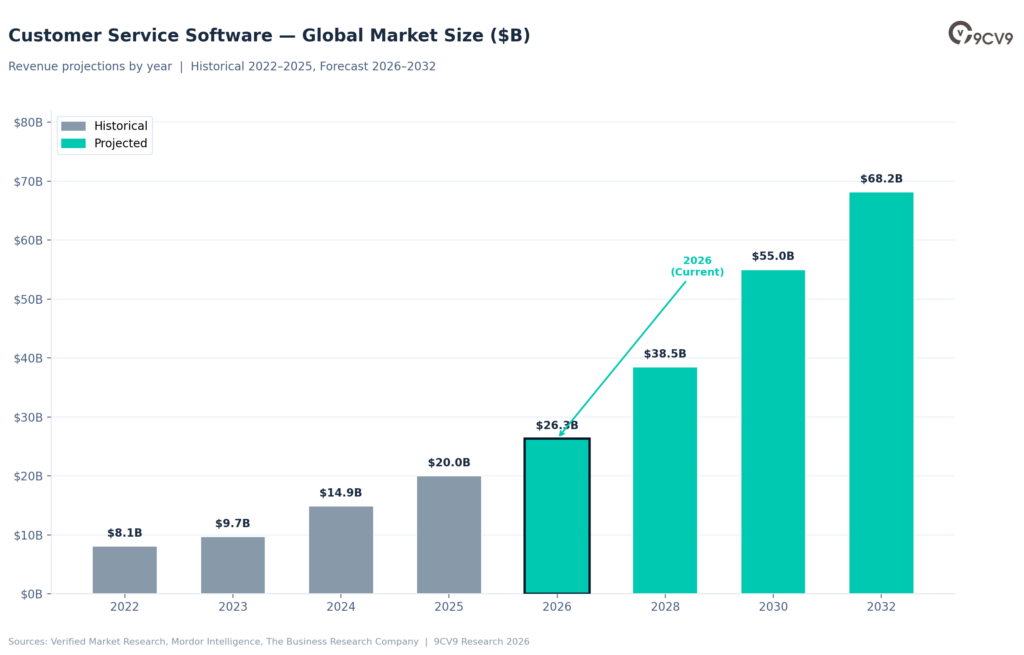
- The global customer service software market was valued at $14.9 billion in 2024 — signaling a rapidly maturing industry that is far from its ceiling.
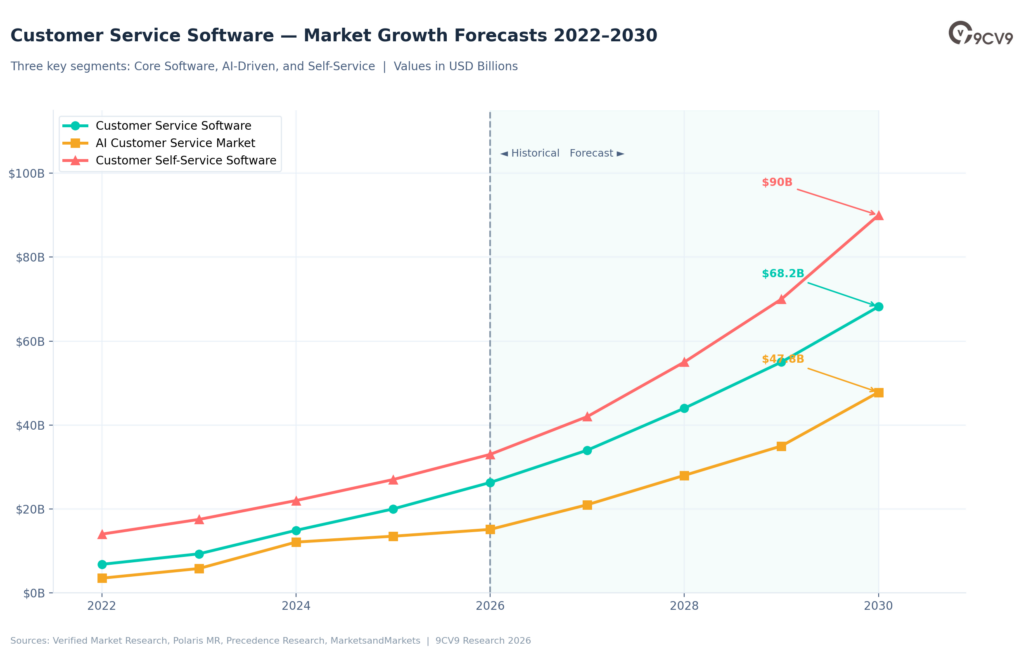
- The market is projected to reach $68.19 billion by 2032, reflecting the strategic priority businesses place on digital customer engagement infrastructure.
- Growing at a CAGR of 20.94% from 2026 to 2032, customer service software is outpacing many enterprise software categories in investment velocity.
- The broader customer service market (including services) stood at $55.76 billion in 2026, validating boardroom investments in CX platforms.
- This broader market is forecast to hit $95.26 billion by 2031, growing at an 11.31% CAGR — driven by enterprises replacing legacy contact centers with cloud-native AI solutions.
- The AI customer service software segment alone reached $15.12 billion in 2026, with a projected CAGR of 25.6% through 2034.
- The customer self-service software market is valued at $26.78 billion in 2026, on a path to $148.49 billion by 2035 at a 21.03% CAGR.
- The long-term CSS market is projected to reach $96.6 billion by 2035, growing at a 6.5% CAGR from 2026 — making it one of the most durable enterprise software growth stories.
- The customer service software market grew from $9.29 billion in 2024 to $11.01 billion in 2025, a 18.6% single-year jump.
- North America commanded 38.74% of customer service market share in 2025, buoyed by high digital transformation rates and enterprise AI spending.
- Asia-Pacific is the fastest-growing region at a 13.28% CAGR to 2031, fueled by digitalization in China, India, and Southeast Asia.
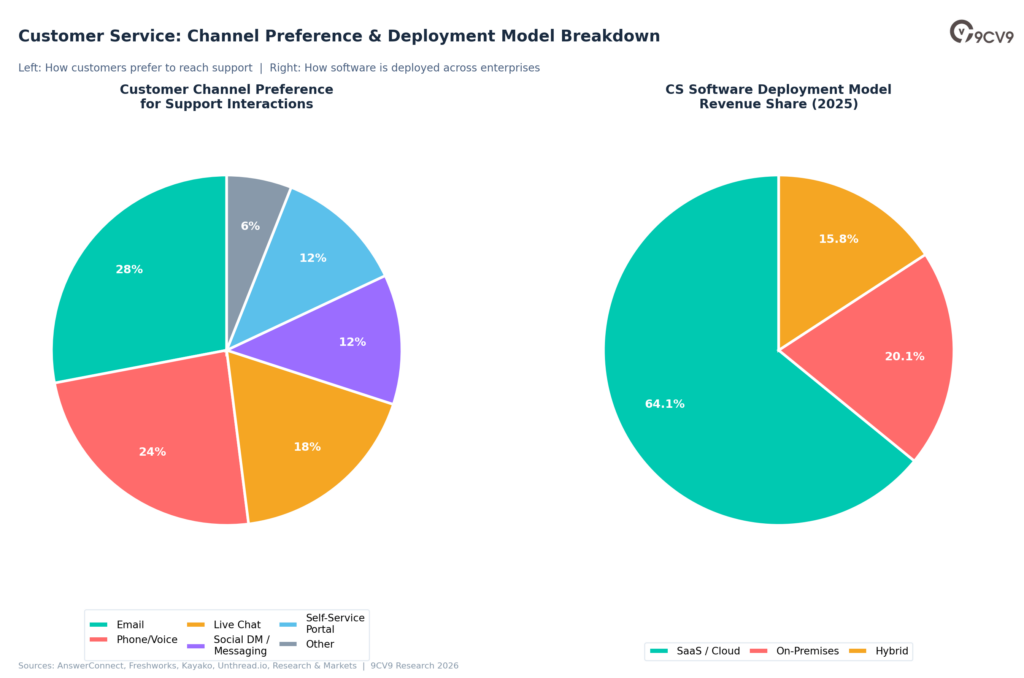
- 64.1% of customer service software revenue in 2025 comes from SaaS-based deployment models, reflecting cloud-first corporate mandates.
- Enterprise-grade solutions account for 57.6% of market revenue in 2025, indicating that large organizations are the primary growth engine.
- Solutions (platforms/licenses) hold a 69.02% revenue share, though the services segment is growing faster at 12.05% CAGR as firms seek outcome-based contracts.
- The AI for customer service market is forecast to grow from $12B (2024) to $47.8B by 2030 at a 25.8% CAGR.
- The global customer self-service market was valued at $3.97 billion in 2025, projected to hit $9.84 billion by 2035 at a 9.5% CAGR.
🤖 AI ADOPTION & MATURITY
- 80% of routine customer interactions will be fully handled by AI in 2026 — encompassing ticket categorization, order tracking, and basic troubleshooting.
- 85% of customer service leaders are exploring or piloting customer-facing conversational GenAI in 2025, making it the #1 strategic CX initiative.
- 91% of customer service leaders report being under pressure to implement AI in 2026, driven by executive mandates rather than ops-level experiments.
- 88% of contact centers report using some form of AI-powered solution, yet only 25% have fully integrated automation into daily operations.
- 80% of companies are either using or planning to adopt AI-powered chatbots for customer service — a 16x increase from just 5% in 2020.
- 92% of Fortune 500 companies now use ChatGPT or similar LLMs in their operations, according to OpenAI.
- Telecom leads AI adoption at 95%, with banking and finance at 92%, and healthcare at 79% — industries with high-volume repetitive queries.
- AI is now the #2 priority for service leaders — up from #10 just one year prior.
- 79% of customer service leaders intend to continue investing in AI throughout 2025 and beyond.
- 44% of CS leaders are exploring customer-facing GenAI voicebots, with 11% in pilot and 5% already deployed.
- 81% of consumers believe AI has become a part of modern customer service — up significantly from prior years.
- AI adoption has grown 4.7 times since 2020, making it one of the fastest-adopted enterprise technologies of the decade.
- By 2026, 40% of enterprise applications will feature task-specific AI agents, up from less than 5% in 2025.
- In 2025, AI agents accounted for 95% of all customer interactions managed by AI systems.
💰 COST SAVINGS & ROI
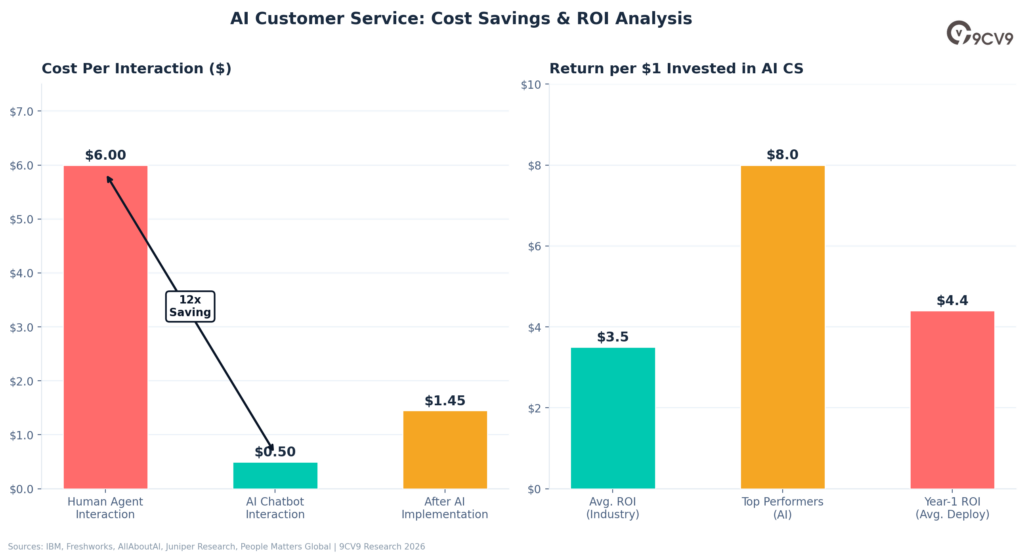
- AI chatbot interactions cost approximately $0.50 on average, compared to $6.00 for human agent interactions — a 12x cost difference per ticket.
- Companies investing in AI customer service see an average return of $3.50 for every $1 spent, with top performers achieving up to 8x returns.
- Conversational AI is projected to save $80 billion in contact center labor costs by 2026 — the largest single cost-reduction wave in contact center history.
- Companies report average annual savings of $127,000 through AI-powered ticket automation, with automation rates ranging from 60–80% of routine tickets.
- Klarna’s AI assistant projected a $40 million profit improvement in its first year, handling two-thirds of all customer service conversations — equivalent to 700 full-time agents — within one month.
- NIB Health Insurance saved $22 million and reduced customer service costs by 60% through AI-driven digital assistants.
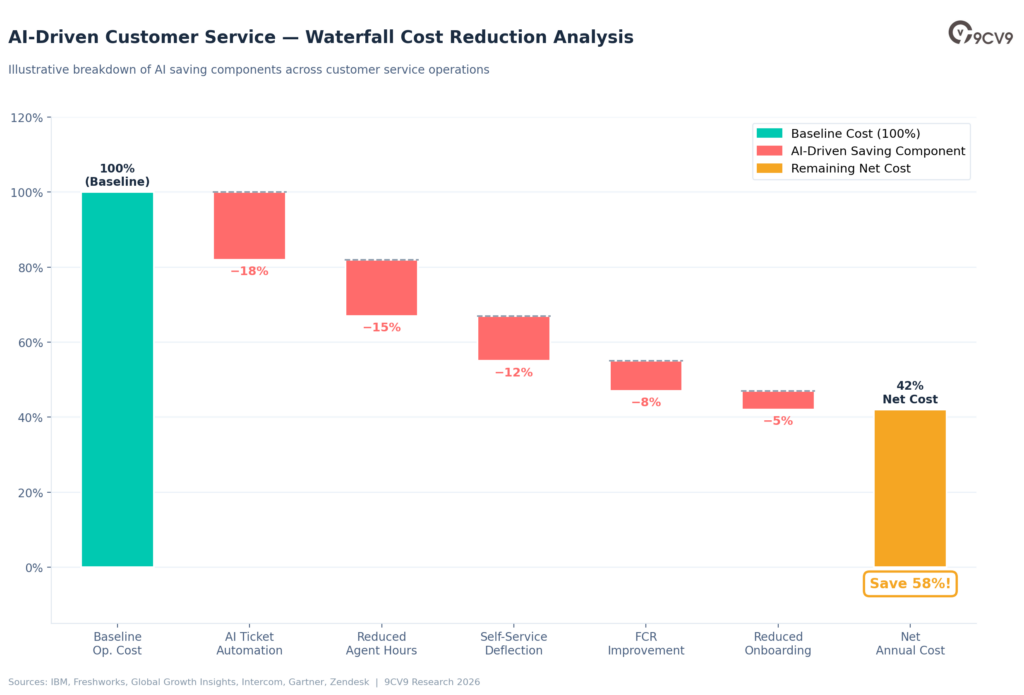
- Cost per customer interaction dropped 68% after AI implementation across companies surveyed by Freshworks — from $4.60 to $1.45.
- AI can reduce customer service operational costs by 30–50% according to IBM Research; for purely routine tasks, labor cost reductions of up to 90% are possible.
- Companies implementing AI support see a 30% reduction in overall operating costs when AI handles 80%+ of routine interactions.
- The insurance sector alone is saving $1.3 billion annually through AI chatbot implementations.
- Companies can save up to 2.5 billion working hours and $11 billion annually through AI chatbot automation.
- 94% of retail companies report that implementing AI has helped decrease costs.
- Companies report an average 340% ROI in the first year of AI customer service deployment.
- Businesses could save $8 billion annually in support costs through AI-powered customer service.
- The call center AI market is growing from $3.23 billion in 2024 to $3.98 billion in 2025 — a segment expanding at speed.
🎯 CUSTOMER EXPECTATIONS
- 90% of customers expect an immediate response when contacting a business — setting the bar that only AI can reliably meet at scale.
- Nearly 50% of customers expect a response in under four hours, and 12% want help within 15 minutes.
- 73% of consumers will switch to a competitor after multiple bad experiences, while more than half will do so after just one.
- 56% of consumers rarely complain about a negative experience — they quietly switch to a competitor instead, creating silent churn risk.
- 79% of consumers would switch to a different company if they found it offered a better customer experience.
- 86% of buyers are willing to pay more for a better customer experience, with PwC finding a premium of up to 16%.
- 80% of customers value their experience with a company as much as its products or services — making CX a tier-one competitive battlefield.
- 3 in 4 consumers say a bad interaction with a business can ruin their entire day, underscoring the emotional weight of CX.
- Customers are 2.4 times more likely to remain loyal when their problems are resolved quickly.
- 87% of customers who had a single negative experience said they would likely avoid that company in the future.
- Increasing customer retention by just 5% can boost profits by up to 25%, according to research cited by Verified Market Research.
- 78% of customers are more likely to repurchase from brands that personalize their support experience.
📱 CHANNEL PREFERENCES
- 93% of customers use email to engage with businesses for customer service — it remains the foundational support channel.
- 88% of customers use phone calls for customer service interactions, demonstrating voice’s enduring relevance.
- 41% of customers prefer live chat for quick questions, while 48% still turn to phone for complex issues.
- 70% of customers still prefer email for getting help in tech-company contexts, reinforcing the need for email-integrated platforms.
- 71% of Gen Z consumers would now reach out to customer support via a live phone call — counter-intuitively reversing prior digital-only assumptions.
- 56% of businesses plan to invest in social media for customer engagement in 2025 and beyond.
- People now use an average of 9 different channels to engage with a single company throughout their journey.
- 95% of companies have invested in multiple CX tools; 13% use 10 or more tools in parallel.
- 76% of customers say they’d choose a company that lets them blend text, images, and video within a single support conversation.
- Nearly 1 in 5 Gen Z, Millennial, and Gen X customers prefer using social DMs for customer service.
🔗 OMNICHANNEL PERFORMANCE
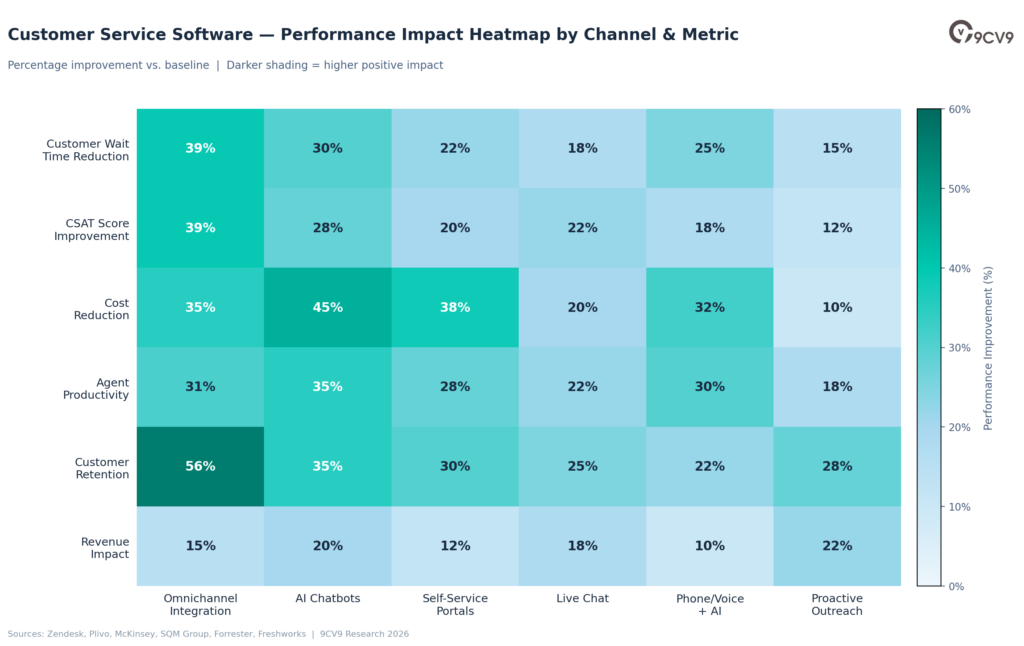
- Companies with strong omnichannel strategies retain 89% of customers, versus just 33% for those with weak omnichannel implementations.
- CSAT scores reach 67% with smooth omnichannel support, compared to just 28% for disconnected multichannel environments.
- Purchase and engagement rates for omnichannel CX are 250% higher than single-channel campaigns — and customer retention is 90% higher.
- Companies utilizing integrated omnichannel solutions experience a 31% reduction in first-resolution times and a 39% decrease in customer wait times.
- Only 13% of businesses currently fully carry customer context across all support channels — a critical gap in a 9-channel world.
- Omnichannel retailers report 179% faster revenue growth than those without integrated strategies.
- Brands reaching consumers via 3 or more channels generate 250% more engagement versus single-channel brands.
- Companies adopting omnichannel strategies reduce service delivery costs by 3–7% according to McKinsey.
- 81% of brands say customer experience would improve significantly if they could consolidate all conversations into one omnichannel platform.
- 4 in 5 brands have implemented channel steering strategies, with 36% successfully deflecting calls to more efficient channels.
⚙️ SELF-SERVICE & AUTOMATION
- 58% of organizations globally are adopting customer self-service software to reduce dependency on live agents and improve operational efficiency.
- 52% of enterprises have already integrated self-service tools such as AI chatbots, knowledge bases, and community portals.
- Businesses report up to a 45% reduction in call center costs after integrating self-service solutions.
- 65% of incoming support queries were resolved without human intervention in 2025 — up from 52% in 2023.
- By 2027, 25% of organizations will use chatbots as their primary customer service channel.
- Salesforce reports 30% of service cases are now resolved by AI, with a projection of 50% by 2027.
- By 2028, 70% of customer service journeys will begin and end with third-party conversational assistants on mobile devices.
- By 2029, agentic AI will autonomously resolve 80% of common customer service issues without human involvement.
- A 35% rise in AI product launches and 32% increase in voice/multilingual self-service platform adoption were recorded in 2024–2025.
- 75% of customer inquiries can be fully resolved by AI tools without requiring human intervention in 2026.
👩💼 AGENT PRODUCTIVITY & WORKFORCE
- Service professionals using AI save more than 2.2 hours per day through automated workflows and quick-response generation.
- Support agents using AI tools handle 13.8% more customer inquiries per hour — a compounding productivity advantage at scale.
- 84% of CS reps using AI say it makes responding to tickets easier, reducing cognitive load and improving response quality.
- 74% of agents report that AI copilots helped them feel more confident in resolving complex cases.
- 77% of customer service reps say their workload and the complexity of customer issues have increased compared to a year ago.
- 56% of service agents report experiencing burnout — a crisis that AI automation can help address by removing repetitive workloads.
- 69% of CS decision-makers say agent attrition is a major challenge, costing far more than AI tooling investments.
- Organizations are expected to replace 20–30% of service agents with generative AI by 2026, though many plan to redeploy staff into higher-value roles.
🛡️ CONSUMER TRUST & AI SKEPTICISM
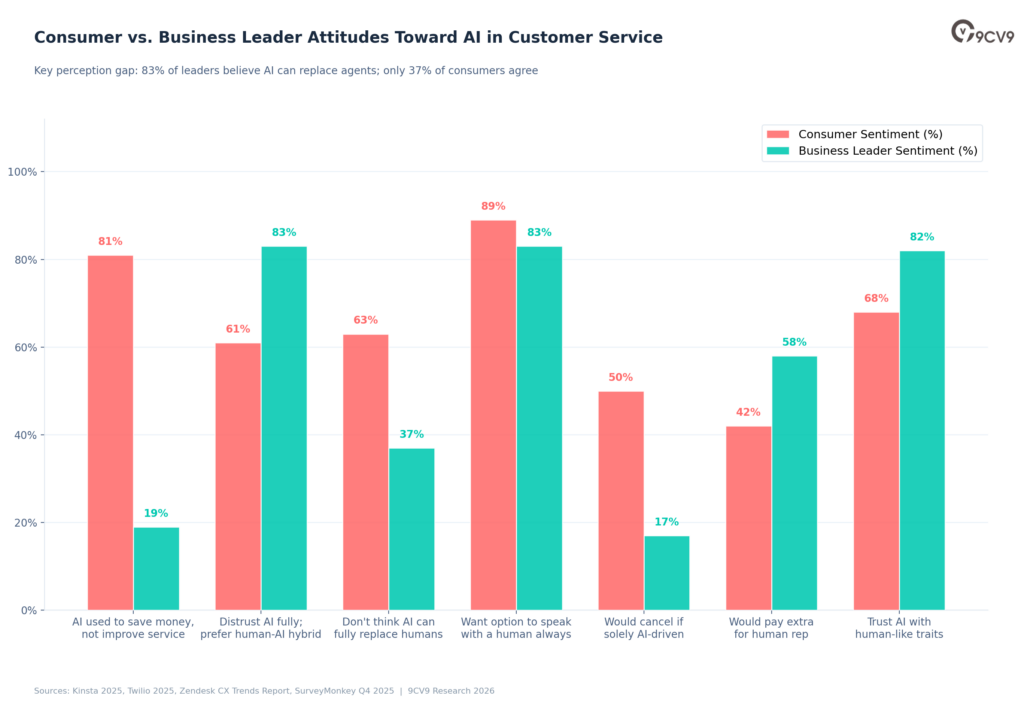
- 61% of customers still distrust AI fully in 2026, preferring human-AI hybrid interactions for complex problem-solving.
- 63% of consumers do not believe AI could ever fully replace humans in customer service.
- 81% of consumers believe AI in customer service is used primarily to save money rather than to improve their experience.
- 89% of consumers believe companies should always offer the option to speak with a human agent.
- 50% of consumers would cancel a service if they discovered it was solely AI-driven with no human option.
- 42% of consumers would be willing to pay a premium for access to human customer service representatives.
- 78% of consumers say the ability to switch from an AI agent to a human agent is important to them.
- 68% of consumers are more trusting of AI agents that exhibit human-like traits such as empathy and friendliness.
- 32% of consumers will abandon a brand they love after just one frustrating encounter with a looping or unhelpful chatbot.
- 54% of consumers feel they can confidently identify when they’re interacting with an AI chatbot.
🔭 FUTURE OUTLOOK
- By 2026, 40% of customer service organizations will adopt proactive service strategies to anticipate customer needs before issues arise.
- 42% of organizations expect to hire for AI-focused CX roles — including conversational AI designers and automation analysts — by end of 2026.
- 40% of generative AI solutions are expected to be multimodal (voice + image + text) by 2027.
- The broader CX management market was $12.04 billion in 2023, growing at 15.8% CAGR through 2030 — an adjacent market fueled by customer service investments.
- 89% of businesses are expected to compete primarily on customer experience by 2026, surpassing price and product as differentiators.
- 79% of companies view customer experience as a revenue driver, not a cost center — a fundamental business model shift.
- The American Customer Satisfaction Index dipped to 76.9 in late 2025, indicating that despite AI investment, satisfaction execution still lags expectation.
Conclusion
As the statistics throughout this report clearly demonstrate, customer service software has evolved far beyond its traditional role as a help desk or ticket management solution. In 2026, it has become a strategic business platform that influences customer satisfaction, operational efficiency, employee productivity, brand loyalty, and long-term revenue growth. Organisations are no longer investing in customer service software simply to answer customer enquiries—they are deploying intelligent, AI-powered ecosystems that enable personalised, proactive, and seamless customer experiences across every touchpoint.
One of the most significant takeaways from these 112 customer service software statistics is the extraordinary pace of market expansion. With the global market projected to grow rapidly over the coming years and multiple segments—including AI-powered customer service, self-service platforms, and omnichannel solutions—experiencing double-digit compound annual growth rates, it is evident that businesses worldwide consider customer experience technology a mission-critical investment rather than a discretionary expense. The continued migration toward cloud-based SaaS platforms further reinforces the industry’s long-term growth trajectory as organisations prioritise scalability, flexibility, and continuous innovation.
Artificial intelligence has undoubtedly emerged as the defining technology shaping customer service in 2026. The overwhelming majority of service leaders are actively investing in generative AI, intelligent chatbots, AI copilots, automated ticket routing, predictive analytics, and conversational virtual assistants. These technologies are enabling organisations to automate routine enquiries, accelerate response times, improve first-contact resolution, and empower human agents with real-time recommendations. Rather than representing a temporary technology trend, AI has become a foundational capability that will continue transforming customer service for years to come.
The financial implications of these innovations are equally compelling. Numerous studies show that AI-powered customer service significantly lowers operational costs while delivering measurable returns on investment. Automated interactions cost only a fraction of traditional human-assisted support, organisations report substantial annual savings through intelligent automation, and many businesses achieve impressive ROI within the first year of deployment. These financial outcomes explain why executive leadership teams increasingly view customer service technology as a revenue-generating investment instead of merely an operational cost centre.
However, the statistics also reveal that technology alone does not guarantee exceptional customer experiences. Today’s consumers expect much more than fast responses. They demand personalised support, consistent service across multiple communication channels, proactive problem resolution, and the flexibility to switch seamlessly between AI-powered assistance and knowledgeable human representatives. Businesses that fail to meet these expectations face growing risks of customer churn, reduced loyalty, and lost market share, particularly as switching between competitors becomes easier than ever in today’s digital economy.
Omnichannel engagement has become another defining characteristic of successful customer service strategies. Modern consumers frequently interact with businesses through email, telephone, live chat, websites, mobile applications, messaging platforms, and social media during a single customer journey. Organisations capable of integrating these touchpoints into a unified customer experience consistently outperform those relying on disconnected communication channels. Higher customer retention, improved satisfaction scores, shorter resolution times, and stronger engagement rates all demonstrate the measurable value of comprehensive omnichannel customer service platforms.
The growing adoption of customer self-service technologies also reflects changing consumer behaviour. AI-powered knowledge bases, intelligent search capabilities, community forums, and conversational chatbots now resolve a significant proportion of customer enquiries without requiring live agents. This shift benefits both businesses and customers by reducing support costs, improving response times, and allowing human service professionals to focus on more complex and higher-value interactions. As self-service capabilities continue advancing through machine learning and natural language processing, they will become an increasingly important pillar of customer service operations.
Interestingly, despite rapid advances in artificial intelligence, consumers continue to place tremendous value on human expertise. Many customers remain hesitant to rely entirely on automated support systems and expect organisations to provide accessible human assistance whenever needed. The data consistently indicates that trust, empathy, emotional intelligence, and personalised problem-solving remain essential components of outstanding customer service. Consequently, the future is unlikely to belong exclusively to AI or human agents—it will belong to organisations that successfully integrate both into a collaborative, hybrid service model.
Another major trend highlighted by these statistics is the transformation of the customer service workforce. AI is not simply automating tasks; it is reshaping job roles and enabling support teams to become more productive, knowledgeable, and customer-focused. Service professionals equipped with AI-powered tools resolve more cases, experience lower administrative burdens, and spend more time handling strategic customer interactions. At the same time, organisations are increasingly recruiting specialists in conversational AI, customer journey optimisation, automation strategy, and customer experience analytics, reflecting the growing sophistication of the industry.
Regional trends further illustrate the global nature of customer service software adoption. While North America continues to dominate market share through significant enterprise investment and AI adoption, Asia-Pacific is emerging as the fastest-growing region thanks to rapid digital transformation across countries such as China, India, and Southeast Asia. As businesses worldwide continue digitising customer engagement, the competitive landscape will become increasingly international, encouraging continuous innovation among software vendors and service providers.
Looking beyond 2026, the future of customer service software appears exceptionally promising. Proactive customer support, autonomous AI agents, multimodal conversational interfaces, predictive analytics, hyper-personalisation, voice AI, and intelligent workflow automation are expected to redefine how organisations build and maintain customer relationships. Businesses that embrace these innovations strategically while maintaining strong human-centred service principles will likely establish lasting competitive advantages in increasingly crowded markets.
Ultimately, these Top 112 Customer Service Software Statistics, Data & Trends in 2026 reveal a clear and compelling message: customer service has become one of the most powerful differentiators in modern business. Organisations that invest in intelligent customer service software are positioning themselves to improve customer satisfaction, strengthen loyalty, increase operational efficiency, reduce costs, and unlock sustainable long-term growth. Meanwhile, businesses that delay digital transformation risk falling behind competitors that leverage AI, automation, omnichannel engagement, and data-driven customer experience strategies to meet the rapidly evolving expectations of today’s consumers.
Whether you are a business owner evaluating customer service platforms, a customer experience executive planning digital transformation initiatives, a technology leader implementing AI-powered support systems, an investor analysing enterprise software markets, or a software vendor tracking industry developments, the insights presented in these statistics provide a valuable roadmap for understanding where customer service technology stands today—and where it is heading next. As artificial intelligence, cloud computing, and customer expectations continue to evolve, one fact remains undeniable: customer service software will continue serving as a cornerstone of business success throughout 2026 and well beyond.
If you find this article useful, why not share it with your hiring manager and C-level suite friends and also leave a nice comment below?
We, at the 9cv9 Research Team, strive to bring the latest and most meaningful data, guides, and statistics to your doorstep.
To get access to top-quality guides, click over to 9cv9 Blog.
To hire top talents using our modern AI-powered recruitment agency, find out more at 9cv9 Modern AI-Powered Recruitment Agency.
People Also Ask
What is customer service software?
Customer service software is a platform that helps businesses manage customer enquiries, automate support, track tickets, and deliver assistance across channels such as email, live chat, phone, social media, and messaging apps.
Why is customer service software important in 2026?
Customer service software improves response times, increases customer satisfaction, reduces operational costs, and enables businesses to deliver personalised, AI-powered support across multiple communication channels.
How large is the customer service software market in 2026?
The customer service software market is experiencing strong global growth, driven by AI adoption, cloud technology, omnichannel support, and increasing investments in customer experience solutions.
What are the biggest customer service software trends in 2026?
Major trends include generative AI, intelligent chatbots, omnichannel support, predictive analytics, self-service portals, automation, AI copilots, and personalised customer experiences.
How is AI changing customer service software?
AI automates repetitive enquiries, assists agents with real-time recommendations, predicts customer needs, analyses conversations, and improves response speed while lowering operational costs.
What is omnichannel customer service software?
Omnichannel customer service software connects email, phone, live chat, social media, messaging apps, and websites into one platform, giving customers a seamless support experience.
What industries use customer service software?
Industries including retail, healthcare, finance, SaaS, telecommunications, hospitality, e-commerce, education, government, and manufacturing rely on customer service software.
What are the benefits of customer service software?
Benefits include faster response times, improved customer satisfaction, reduced support costs, increased agent productivity, better reporting, and stronger customer loyalty.
How does customer service software improve customer satisfaction?
It enables quicker responses, personalised support, consistent communication, and efficient issue resolution, creating a better overall customer experience.
What features should modern customer service software include?
Essential features include ticket management, AI chatbots, knowledge bases, workflow automation, CRM integration, analytics, omnichannel communication, and self-service capabilities.
What is a customer service chatbot?
A customer service chatbot uses AI to answer common questions, guide customers, resolve simple issues, and transfer complex enquiries to human agents when necessary.
Can AI replace human customer service agents?
AI handles routine tasks efficiently, but human agents remain essential for resolving complex issues, building trust, and delivering empathy in customer interactions.
What is customer self-service software?
Customer self-service software provides knowledge bases, FAQs, help centres, and AI assistants that allow customers to solve problems independently without contacting support.
How does automation improve customer service?
Automation speeds up ticket routing, sends instant replies, manages repetitive workflows, reduces manual work, and allows agents to focus on higher-value customer interactions.
Why are customer service statistics important?
Customer service statistics help businesses benchmark performance, understand industry trends, improve strategies, and make informed technology investment decisions.
What is cloud-based customer service software?
Cloud-based customer service software is hosted online, allowing businesses to access support tools anywhere while benefiting from automatic updates, scalability, and lower infrastructure costs.
How does customer service software reduce costs?
It lowers costs by automating repetitive tasks, reducing call volumes, improving agent efficiency, and resolving customer issues more quickly.
What role does data analytics play in customer service software?
Analytics measure response times, customer satisfaction, agent performance, resolution rates, and emerging trends to help businesses continuously improve service quality.
What is the future of customer service software?
The future includes autonomous AI agents, predictive customer support, voice AI, hyper-personalisation, advanced analytics, and deeper integration with business platforms.
What is customer experience (CX) software?
Customer experience software helps businesses manage and optimise every customer interaction, ensuring consistent, personalised, and satisfying experiences throughout the customer journey.
How do businesses choose customer service software?
Businesses compare features, AI capabilities, scalability, integrations, pricing, security, ease of use, customer support, and reporting tools before selecting a solution.
What are the most common customer service KPIs?
Popular KPIs include first response time, average resolution time, customer satisfaction (CSAT), Net Promoter Score (NPS), first contact resolution, and ticket volume.
Is customer service software suitable for small businesses?
Yes. Many providers offer affordable cloud-based solutions that help small businesses automate support, improve customer communication, and scale efficiently.
How does customer service software improve employee productivity?
It automates repetitive tasks, centralises customer information, recommends solutions using AI, and streamlines workflows, allowing agents to resolve more enquiries.
Why is omnichannel support becoming more important?
Customers expect consistent support across multiple channels without repeating information, making omnichannel platforms essential for delivering seamless experiences.
How does customer service software support remote teams?
Cloud-based platforms allow support agents to access customer information, collaborate, manage tickets, and communicate with customers securely from any location.
What is the difference between help desk software and customer service software?
Help desk software focuses mainly on ticket management, while customer service software includes AI, omnichannel support, CRM integration, analytics, and customer engagement tools.
How does customer service software integrate with CRM systems?
Integration allows agents to access customer histories, purchase records, communication logs, and preferences, enabling faster and more personalised support.
Why is customer service software a strategic investment?
It improves customer retention, increases operational efficiency, reduces support costs, enhances employee productivity, and strengthens long-term business growth.
What can businesses learn from customer service software statistics in 2026?
These statistics reveal market growth, AI adoption, customer expectations, technology trends, and investment opportunities, helping organisations build more effective customer service strategies.
Sources
Verified Market Research Mordor Intelligence Precedence Research Global Growth Insights Research and Markets Zendesk ChatMaxima Ringly Dante AI NextPhone Desk365 Freshworks SurveyMonkey Plivo Chatbot Unthread Nextiva AnswerConnect Salesmate Onramp SupportYourApp Kayako Pylon The Business Research Company


