Key Takeaways
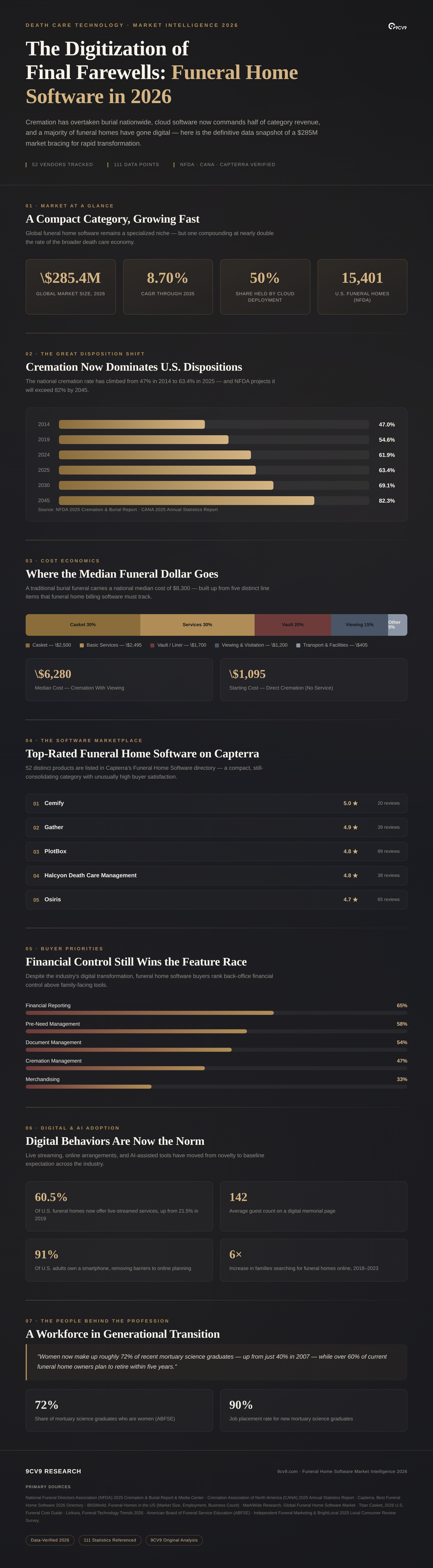
- Funeral Home Software Market Growth: The global funeral home software market is estimated at $285.4 million in 2026 and projected to reach $604.67 million by 2035, growing at an 8.70% CAGR, driven by digital transformation and increasing demand for funeral management solutions.
- Cloud-Based Funeral Management Software Adoption: Cloud-based and web-based solutions account for an estimated 90% of the funeral home software market, highlighting growing demand for digital case management, financial reporting, cremation tracking, and automated funeral planning.
- AI, Cremation, and Digital Funeral Technology Trends: With the US cremation rate reaching 63.4% in 2025 and 60.5% of funeral homes offering live-streaming services, AI-powered automation, online funeral arrangements, and digital memorial platforms are shaping the future of funeral services.
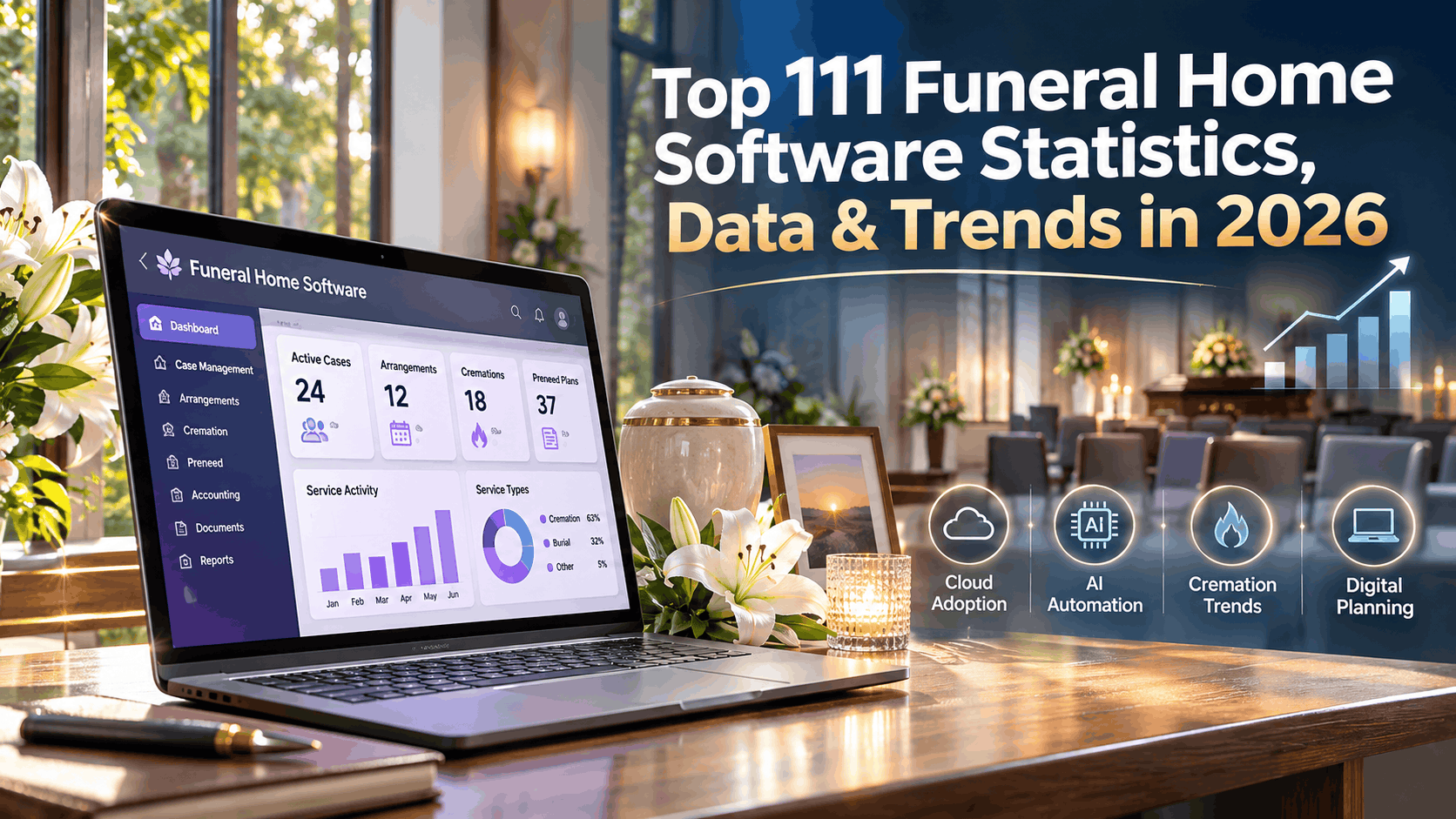
The global funeral home software market is estimated at $285.4 million in 2026 and projected to reach $604.67 million by 2035, growing at an 8.70% CAGR. These 111 funeral home software statistics reveal key trends in cloud adoption, AI automation, cremation management, digital funeral planning, and the future of funeral services.
The funeral services industry is undergoing a significant digital transformation as funeral homes increasingly adopt modern technology to streamline operations, improve customer experiences, and respond to changing consumer preferences. From cloud-based funeral home management software and automated case management systems to artificial intelligence (AI), online memorial platforms, and digital funeral planning tools, technology is reshaping how funeral service providers operate in 2026.
Also, read our article on the Top 10 Best Funeral Home Software To Know.

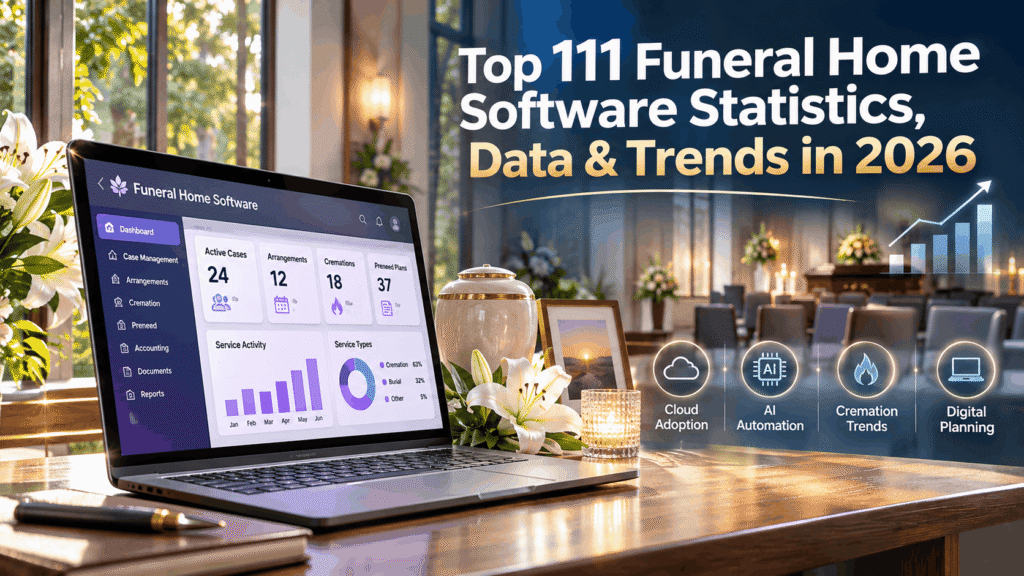
As competition intensifies and consumer expectations evolve, understanding the latest funeral home software statistics, market trends, and industry data for 2026 has become essential for funeral directors, cemetery operators, crematorium managers, software developers, and investors seeking opportunities in the growing death care technology market.
According to industry market research estimates, the global funeral home software market is valued at approximately $285.4 million in 2026 and is projected to reach $604.67 million by 2035, representing a compound annual growth rate (CAGR) of 8.70%. Alternative market projections suggest the industry could grow even faster, with estimates placing its value at $475 million in 2026 and more than $1 billion by 2033. Although these forecasts differ because of varying market definitions and research methodologies, they collectively highlight the expanding commercial potential of funeral management technology.

This growth is closely connected to the broader funeral services industry. The global funeral services market is estimated to reach approximately $79.93 billion in 2026, with projections suggesting it could expand to $119.38 billion by 2032. As funeral service providers seek greater operational efficiency, improved financial management, and more personalized services, software solutions are becoming increasingly important to their long-term competitiveness.
Digital Transformation Is Reshaping Funeral Home Operations
One of the most significant funeral home software trends in 2026 is the continued transition from traditional, paper-based administrative processes to cloud-based and web-based management platforms.
Industry estimates indicate that cloud-based solutions account for approximately 50% of the funeral home software market, while web-based platforms represent another 40%. Together, these deployment categories account for an estimated 90% of the market, demonstrating the industry’s growing preference for accessible, scalable, and digitally connected software solutions.
Modern funeral home management systems are designed to simplify essential administrative and operational activities, including funeral arrangement scheduling, case management, financial reporting, document processing, inventory management, and regulatory compliance.
Financial reporting remains particularly important. Data compiled from funeral home software marketplace reviews indicates that approximately 65% of reviewers consider financial reporting a critical software feature. Other important capabilities include pre-need management, document management, electronic signatures, cremation tracking, and cemetery administration.
For independent funeral homes and multi-location operators alike, these technologies can help reduce repetitive administrative work, improve record accuracy, strengthen financial oversight, and allow funeral directors to devote more attention to supporting grieving families.
Changing Cremation Preferences Are Driving Software Innovation
Another major factor influencing the funeral home software market is the continuing shift from traditional burials toward cremation services.
According to the National Funeral Directors Association (NFDA), the United States cremation rate reached approximately 63.4% in 2025, compared with a burial rate of 31.6%. The association also projects that cremation could account for approximately 82.3% of dispositions by 2045.
These changing preferences have significant implications for funeral home software providers.
As cremation becomes the dominant disposition method, funeral homes increasingly require specialized software capabilities for cremation authorization, identification tracking, regulatory documentation, service coordination, and digital recordkeeping.
At the same time, rising consumer interest in affordable funeral arrangements, environmentally sustainable funeral options, and personalized memorial experiences is encouraging software developers to introduce more flexible service management capabilities.
The growing importance of cremation management demonstrates how changes in consumer behavior directly influence the development and adoption of funeral industry technology.
Online Funeral Planning and Digital Memorial Services Are Expanding
Consumer expectations surrounding funeral arrangements are also evolving as more families become comfortable using digital platforms to research funeral providers, compare services, and make arrangements remotely.
Industry data indicates that approximately 60.5% of funeral homes in the United States offer live-streaming services, compared with just 21.5% in 2019. This substantial increase highlights the growing importance of digital participation in funeral and memorial services.
Additionally, approximately 36.3% of NFDA-member funeral firms offer fully online cremation arrangements, while another 25% report plans to introduce this capability.
Digital memorial websites, virtual tribute pages, electronic signatures, online payment systems, and remote funeral arrangement tools are increasingly relevant to families seeking convenient and accessible services.
For funeral home operators, these developments create opportunities to improve communication, accommodate geographically dispersed families, and provide more personalized experiences without requiring every interaction to take place in person.
Consequently, online funeral planning software, digital memorial platforms, and funeral home website solutions are becoming important components of the wider funeral technology ecosystem.
Artificial Intelligence and Automation Are Creating New Opportunities
Artificial intelligence represents another emerging area of innovation within the funeral home software industry.
Although many funeral management platforms have yet to introduce extensive generative AI capabilities, software providers are beginning to explore AI-powered obituary writing, automated customer support, intelligent scheduling, and digital marketing optimization.
AI-assisted administrative tools have the potential to reduce repetitive tasks, improve scheduling coordination, accelerate document preparation, and support funeral directors during periods of high operational demand.
However, the adoption of AI in funeral services also introduces important considerations involving data privacy, cybersecurity, ethical communication, and the responsible handling of sensitive personal information.
Because funeral homes regularly manage confidential family records, financial information, and legally significant documents, software vendors must balance automation benefits with strong security practices and human oversight.
As AI technology matures, its integration into funeral home management software could become an increasingly important competitive differentiator.
Why Funeral Home Software Statistics Matter in 2026
The funeral home software industry operates within a distinctive business environment characterized by fragmented ownership, changing consumer preferences, increasing regulatory requirements, and growing demand for operational efficiency.
The NFDA reports approximately 15,401 funeral homes operating across the United States, with an estimated 75% to 89% remaining family-owned or privately operated, according to the industry data compiled for this report.
This market structure creates substantial demand for affordable, intuitive, and reliable software that can support smaller funeral businesses without requiring extensive technical expertise.
Meanwhile, larger funeral service corporations and consolidators increasingly require enterprise-grade solutions capable of managing multiple locations, standardizing workflows, consolidating financial reporting, and maintaining regulatory compliance across different jurisdictions.
These contrasting requirements are shaping the competitive landscape for funeral home software vendors and influencing product development, pricing models, and market expansion strategies.
For funeral directors, understanding industry statistics can help identify technology investments that improve efficiency and service quality. For software developers, the data highlights potential product gaps and emerging customer needs. For investors and industry analysts, funeral home software market statistics provide insights into the growth prospects of a specialized vertical software category.
What This Funeral Home Software Statistics Report Covers
This comprehensive guide explores the top 111 funeral home software statistics, data points, and trends in 2026, drawing on industry research, funeral service associations, software marketplace information, and market forecasts.
The analysis examines global funeral home software market size and growth projections, the structure of the US funeral services industry, cremation and burial trends, funeral costs, software pricing, customer reviews, essential software features, cloud technology adoption, artificial intelligence, digital memorial services, pre-need planning, online marketing, and funeral industry workforce demographics.
By bringing these findings together, the report provides a detailed overview of the forces influencing funeral home technology adoption and the opportunities emerging across the broader death care software market.
As the funeral industry continues to modernize, funeral home management software is evolving from a basic administrative tool into an increasingly important platform for operational efficiency, financial management, regulatory compliance, and family engagement.
The following 111 statistics offer valuable insights into where the funeral home software market stands in 2026, how technology adoption is changing the industry, and which trends are likely to shape the future of funeral services.
Before we venture further into this article, we would like to share who we are and what we do.
About 9cv9
9cv9 is a business tech startup based in Singapore and Asia, with a strong presence all over the world.
With over ten years of startup and business experience, and being highly involved in connecting with thousands of companies and startups, the 9cv9 team has listed some of the top and best companies/tools in this review.
If you like to get your company listed in our top B2B software reviews, check out our world-class 9cv9 Media and PR service and pricing plans here.
Top 111 Funeral Home Software Statistics, Data & Trends in 2026
🏛️ Market Size & Growth
- The global funeral home software market is valued at approximately $285.4 million in 2026. This relatively compact market size signals that funeral home software remains a specialized, under-penetrated niche compared to broader vertical SaaS categories.
- The funeral home software market is forecast to reach $604.67 million by 2035, at an 8.70% CAGR. This near-doubling within a decade underscores accelerating digitization pressure across a historically paper-based industry.
- A separate market analysis projects the category could expand from $475 million in 2026 to over $1 billion by 2033, at a 10.5% CAGR. Analyst estimates diverge meaningfully, reflecting inconsistent category definitions across research firms and the market’s early-stage maturity.
- The cloud-based deployment segment commands roughly 50% of total funeral home software revenue. Cloud-first adoption confirms that funeral homes increasingly favor subscription, browser-accessible platforms over legacy desktop installations.
- Web-based software accounts for an additional 40% of the funeral home software market, leaving on-premise/other models around 10%. Combined, cloud and web-based deployments now represent roughly 90% of the category, marking a near-total shift away from installed software.
- North America holds the largest regional share of the funeral home software market, at approximately 40% of global revenue. North American dominance reflects the region’s advanced funeral service infrastructure and high per-home software spending power.
- Asia Pacific is cited as the fastest-growing region for funeral home software adoption in 2026. Rising technological adoption and modernizing death care infrastructure in the region are creating new software demand outside traditional Western markets.
- Large enterprises account for approximately 60% of total funeral home software market revenue. Multi-location funeral corporations and consolidators are driving disproportionate software spend relative to independent single-location operators.
- The broader global funeral services market is estimated at $79.93 billion in 2026, growing at a 6.87% CAGR toward $119.38 billion by 2032. This substantial parent market illustrates the scale of the addressable opportunity that funeral home software vendors are still only lightly penetrating.
- The global death care industry, inclusive of funeral, cremation, and memorial products, is projected to reach roughly $103.5 billion by 2030. The scale of the parent death care economy suggests significant long-term headroom for software vendors to expand wallet share.
🇺🇸 US Funeral Industry Structure
- The NFDA reports 15,401 funeral homes currently operating in the United States. This figure represents the core addressable customer base that funeral home software vendors are competing to serve.
- IBISWorld separately counts 29,015 funeral service businesses in the US as of 2026, though this broader NAICS classification includes ancillary providers. The gap between data sources illustrates the difficulty of precisely sizing a highly fragmented, family-owned industry.
- Approximately 75% to 89% of US funeral homes remain family- or privately-owned, according to NFDA and industry data. This overwhelming small-business character explains why affordable, easy-to-adopt software matters more in this sector than in most other verticals.
- US funeral homes collectively employ 105,300 to 154,830 people, depending on the data source and year measured. This substantial workforce represents the operational base that software platforms are ultimately designed to make more efficient.
- US funeral homes generate approximately $16.3 billion in combined annual revenue. Software vendors are competing for technology budgets carved out of this multi-billion-dollar revenue pool.
- Crematories and cemeteries add a further $4.274 billion in annual US revenue. When combined with funeral home revenue, the addressable death care services economy in the US alone exceeds $20 billion annually.
- The NFDA counts more than 20,000 individual members, representing nearly 11,000 funeral homes across 49 countries. This professional association’s scale gives funeral home software vendors a concentrated distribution and marketing channel.
- The top six funeral operators are estimated to control between 25% and 30% of all funeral services in North America. Growing consolidation among larger operators is creating enterprise-tier demand for multi-location funeral home management software.
- The top four funeral corporations alone own an estimated 15% to 20% of all funeral home locations in North America. This concentration of ownership at the top of the market is a key driver of demand for enterprise-grade, multi-site software deployments.
- The US funeral services industry is valued at $23.9 billion in 2026, per IBISWorld. Despite a mature, slow-declining core market, the industry remains a substantial economic sector supporting software vendor growth.
- The number of US funeral home businesses has declined at roughly a 0.6% CAGR between 2021 and 2026. A shrinking pool of operators is intensifying competitive pressure, pushing surviving funeral homes to seek software-driven efficiency gains.
- Roughly 3.1 million deaths are projected in the United States in 2026, a figure expected to keep climbing for decades. Rising case volume driven by an aging population is a structural tailwind for both funeral home operations and the software supporting them.
⚱️ Cremation & Burial Trends
- The NFDA’s 2025 Cremation & Burial Report puts the national cremation rate at 63.4% for 2025. Cremation has now become the dominant form of disposition in America, a fundamental shift funeral home software must accommodate.
- The corresponding national burial rate stands at just 31.6% in 2025, according to NFDA. Burial’s steep decline relative to cremation is reshaping the feature priorities that funeral homes demand from their management software.
- NFDA projects the US cremation rate will surpass 80%, reaching approximately 82.3%, by 2045. This multi-decade projection confirms that cremation-specific workflow features will remain a critical software investment area for years to come.
- CANA separately reports a 2025 US cremation rate of 62.8%, alongside a Canadian rate of 77.4%. Cross-border data broadly corroborates NFDA’s findings while showing Canada progressing further along the cremation adoption curve.
- CANA projects the US cremation rate will reach 69.1% by 2030, with Canada climbing to 81.1%. The consistent upward trajectory across independent data sources reinforces cremation’s status as the industry’s dominant long-term trend.
- The national cremation rate has climbed from roughly 47% in 2014 to over 62% in 2024, a jump of about 15 percentage points in a decade. This decade-long acceleration illustrates just how quickly consumer disposition preferences have shifted industry-wide.
- By 2035, NFDA projects every US state and Washington DC will exceed a 50% cremation rate. Universal majority-cremation adoption across all states will make cremation-management features a baseline software requirement rather than a differentiator.
- Currently, only three US states are projected to maintain majority-burial rates. The dwindling number of burial-majority states highlights how geographically uniform the shift toward cremation has become.
- CANA’s research indicates that cremation growth accelerates once a state crosses the 40% threshold, then slows again as it approaches roughly 80%. This S-curve adoption pattern gives funeral home software vendors a useful framework for regional feature prioritization and go-to-market timing.
- Washington and Nevada have already reached CANA’s identified cremation growth “slow-down point,” with Oregon close behind. These leading-edge states offer an early preview of software feature demand that will eventually spread nationwide.
- The US South region, which currently has the collectively lowest cremation rates, is expected to see the fastest cremation growth in coming years. This regional inflection point represents a significant emerging opportunity for cremation-focused software features and vendor expansion.
- The median cost of cremation with a viewing was $6,280 in the NFDA’s most recent Funeral Price Survey, compared to $8,300–$9,995 for burial with viewing. The persistent cost gap between cremation and burial remains one of the strongest structural drivers of the cremation trend that software vendors must design around.
💵 Funeral Costs & Pricing
- The national median cost of a funeral with viewing and burial is $8,300, according to NFDA’s most recently published survey data. Understanding this benchmark cost helps funeral homes calibrate the pricing and billing modules they need from their management software.
- Adding a burial vault raises the median traditional funeral cost to $9,995. Vault costs represent a significant line item that funeral home billing and merchandising software must account for in itemized price lists.
- A basic metal burial casket carries a median cost of around $2,500, per NFDA estimates. Casket merchandising remains one of the largest revenue and inventory-tracking categories that funeral home software is built to manage.
- A wooden casket suitable for traditional viewings averages around $5,000. The wide price spread between casket types makes merchandising and catalog management a core software feature funeral homes rely on.
- A grave liner or burial vault adds roughly $1,700 on average to total funeral costs. This recurring add-on cost is typically itemized through the General Price List (GPL) tools built into modern funeral home software.
- Direct cremation, the least expensive disposition option, starts as low as $1,095 to $2,500 in many US markets. The affordability of direct cremation continues to draw price-sensitive consumers away from traditional full-service funerals.
- Direct cremation can cost roughly 89% less than a full traditional burial, according to 2026 pricing analysis. This dramatic cost differential is a primary economic driver behind the funeral industry’s ongoing shift toward cremation-based service models.
- Under the FTC’s Funeral Rule, every US funeral home is legally required to provide an itemized General Price List (GPL) upon request. Compliance-ready pricing and document templates have become a non-negotiable feature requirement in modern funeral home software.
- The same funeral service can cost roughly 30% to 50% more in major metro areas compared with rural markets. This geographic price variability makes location-aware reporting and analytics an increasingly valuable funeral home software capability.
- Funeral costs have risen at an estimated 6% annually according to NFDA cost-trend analysis. Persistent cost inflation is pushing funeral homes to adopt software-driven efficiency gains to help protect already thin operating margins.
- Funeral costs have increased roughly 28% over the past decade, outpacing general consumer inflation. This above-inflation cost growth increases scrutiny on funeral home operating efficiency, a key value proposition of modern management software.
🖥️ Capterra Marketplace & Software Ratings
- The Capterra Funeral Home Software directory currently lists 52 distinct software products available for comparison. This relatively modest catalog size, compared with far larger SaaS categories on Capterra, confirms funeral home software remains a specialized, still-consolidating niche.
- Capterra’s top-rated funeral home software listings carry average user ratings between 4.6 and 5.0 out of 5 stars. Consistently high satisfaction scores across most listed products suggest the category has matured past early usability pain points common to newer software niches.
- PlotBox, a leading cemetery and funeral mapping solution, holds an 89-review, 4.8-out-of-5 rating on Capterra. Strong review volume paired with a high rating makes PlotBox one of the most credibly vetted options in the category.
- Gather, a cloud-based case management platform, holds a 4.9-out-of-5 rating from 39 Capterra reviewers. Gather’s near-perfect ease-of-use score highlights growing demand for mobile-friendly, device-agnostic funeral home platforms.
- Chronicle, a cemetery-plot-focused platform, holds a 4.7-out-of-5 rating across 60 Capterra reviews. Chronicle’s strong review volume signals particularly deep adoption among funeral homes managing on-site burial plots.
- Osiris, a long-standing multi-location funeral management system, holds 65 Capterra reviews at a 4.7-out-of-5 average rating. Osiris’s substantial review base reflects its position as one of the more established, longer-tenured vendors in the space.
- Halcyon Death Care Management Solutions holds a 4.8-out-of-5 rating with particularly strong 4.9 scores in customer service and value for money. These figures suggest Halcyon differentiates through vendor support quality rather than feature breadth alone.
- Parting Pro carries a 4.7-out-of-5 rating across 56 reviews, with a leading 4.9 customer service score. Parting Pro’s premium starting price of $469/month is positioned alongside strong customer-service satisfaction, reflecting a higher-touch vendor model.
- Cemify, a cemetery-specific software product, holds a perfect 5.0-out-of-5 rating across 20 reviews. Cemify’s flawless review record signals strong product-market fit within its narrower cemetery-management niche.
- Financial Reporting is ranked as the single most important feature by funeral home software buyers, cited as critical by 65% of Capterra reviewers. This finding confirms that accounting and financial control remain the top software priority for funeral home operators, ahead of family-facing features.
- Passare, a leading case management platform, reports that 85% of its reviewer base comes from small businesses, with only 8% each from enterprise and midsize firms. This distribution underscores how heavily the funeral home software market still skews toward small, independent operators.
- Entry-level funeral home software pricing on Capterra spans from roughly $25 to $2,500+ depending on deployment model (monthly subscription versus one-time license). This wide pricing spread means funeral homes of virtually any size can find a software tier matching their budget.
- MorTrack, a newer entrant to the Capterra directory, claims to reduce administrative paperwork burden and increase operational efficiency by roughly 30%. Efficiency-focused positioning like this reflects the core value proposition driving software adoption industry-wide.
- PlotBox’s integrations include NetSuite and QuickBooks Online Advanced, both rated 4.2 and 5.0 respectively by users. Deep accounting-system integrations remain a key differentiator among the top-performing funeral home software products.
- Docusign is among the most frequently cited third-party integrations across leading funeral home software products on Capterra. Electronic signature integration reflects the industry’s broader shift toward paperless documentation and remote family authorization.
- QuickBooks (Online and Desktop combined) appears as a top integration partner across more funeral home software products on Capterra than any other single accounting platform. This consistent pairing highlights QuickBooks’ status as the de facto financial backbone for independent funeral home operators.
⚙️ Software Features & Buyer Priorities
- Pre-Need Management is the second most commonly cited critical feature among Capterra funeral home software buyers. Growing pre-need contract volume is pushing funeral homes to demand more sophisticated advance-planning and trust-tracking software modules.
- Document Management and electronic signature capabilities rank consistently among the top three features prioritized by funeral home software buyers. Paperless documentation has moved from a nice-to-have to a baseline expectation across the category.
- Cremation Management functionality is increasingly weighted as a top buying criterion, reflecting cremation’s majority share of US dispositions. Software vendors that fail to offer robust cremation workflows risk losing relevance as burial’s market share continues shrinking.
- Cemetery Management is a differentiating feature offered by roughly half of the products listed in Capterra’s funeral home software directory. This split reflects the category’s bifurcation between funeral-home-focused platforms and dedicated cemetery/mapping solutions.
- Merchandising tools, which let funeral homes publish purchasable memorial products online, are offered by a minority of top-rated Capterra listings. The relatively lower adoption of merchandising features suggests untapped e-commerce potential within the funeral software category.
- AI Copilot and Generative AI features are explicitly marked as “Not available” across the overwhelming majority of currently listed Capterra funeral home software products. This gap indicates funeral home software as a category is still in the early innings of AI feature adoption compared to more mature SaaS verticals.
- Inventory Management is consistently rated among the lowest-scoring feature categories across several major funeral home software platforms. This recurring weak spot suggests inventory tracking represents a significant unmet product opportunity for vendors in the space.
- Cloud-based, SaaS, and web-based deployment options are now the primary filter category on Capterra’s funeral home software directory, ahead of desktop and on-premise options. This filtering hierarchy mirrors the broader industry-wide pivot toward cloud-hosted funeral management platforms.
💻 Technology & Digital Adoption
- 60.5% of US funeral homes now offer live-streaming services, up from just 21.5% in 2019, according to NFDA data. This near-tripling in adoption over six years marks live streaming’s evolution from a pandemic-era experiment into a mainstream funeral home offering.
- In early 2020, roughly 80% of funeral homes rapidly adopted some form of live-streaming technology in response to pandemic-era gathering restrictions. This abrupt adoption spike made live streaming the fastest-adopted digital technology in the profession’s modern history.
- Nearly 64% of all US funeral homes now offer live-streaming as a personalized add-on to traditional in-person services. Streaming has effectively become table-stakes functionality that funeral home software and website platforms must support natively.
- Digital memorial pages now host an average of 142 guests, substantially expanding the number of people who can participate in a farewell. This expanded reach illustrates how digital tools are fundamentally changing the scale and geography of funeral attendance.
- Nearly 30% of American families now report completing all of their funeral planning entirely online. This growing share of fully digital planners underscores the importance of consumer-facing self-service tools within funeral home software platforms.
- 91% of US adults currently own a smartphone, and 78% of baby boomers are active online, per 2026 industry analysis. High digital penetration even among older demographics is removing historical barriers to online funeral planning and software-driven family communication.
- The number of families searching for funeral homes online increased more than sixfold between 2018 and 2023, per NFDA consumer research. This surge in online discovery behavior has made a strong digital and website presence essential for funeral home customer acquisition.
- Digital memorial platform usage rose approximately 33% year-over-year, according to 2026 funeral technology trend analysis. Rising engagement with digital memorials signals growing consumer comfort with online grief and remembrance tools.
- Pre-need planning adoption has surpassed 29% among individuals aged 55 and older, according to 2026 industry data. Rising pre-need adoption among older consumers is driving demand for advance-planning modules within funeral home software suites.
- 36.3% of NFDA-member firms offer the ability to make cremation arrangements entirely online, with an additional 25% planning to add the option soon. Combined, these figures suggest over 60% of NFDA-member firms will offer online cremation arrangement capability in the near term.
- 61.4% of consumers say they are interested in exploring “green” or environmentally sustainable funeral options, up from 55.7% in 2021. Rising green-funeral interest is prompting software vendors to add eco-friendly service and merchandise categories to their product catalogs.
- 58.3% of survey respondents report having attended a funeral held at a non-traditional location, according to NFDA’s 2025 Consumer Awareness and Preferences Report. This shift away from conventional funeral-home venues is increasing demand for mobile-friendly, location-flexible scheduling software.
- 40% of consumers report having discovered and used the services of a funeral home found through Facebook, up from 21% the previous year. Nearly doubling social-discovery rates highlight social media as an increasingly critical funeral home customer acquisition channel.
- The 3D virtual tour adoption rate among funeral homes has grown by an estimated 200% since 2020. This surge reflects rising consumer expectation for remote, visual previews of funeral home facilities before an in-person visit.
- Adoption of live-streaming technology among funeral homes grew by an estimated 300% during the COVID-19 pandemic period. This dramatic short-term surge cemented digital participation as a permanent expectation rather than a temporary pandemic accommodation.
🤖 AI & Automation in Funeral Services
- AI-powered obituary writing tools are increasingly bundled as standard features across leading funeral home website and software platforms. These tools are designed to save funeral directors hours of manual writing time during emotionally demanding periods.
- Chatbots are reported to provide round-the-clock client support for a majority of death care firms that have adopted digital engagement tools. 24/7 automated support helps funeral homes respond to time-sensitive family inquiries outside normal business hours.
- AI-assisted scheduling tools are reported to reduce service-planning time from an estimated 3–4 hours down to under 1 hour per case. This scale of time savings represents a meaningful operational efficiency gain for time-constrained funeral home staff.
- AI-driven scheduling coordination is associated with an estimated 85% reduction in scheduling conflicts, according to implementation case studies. Fewer scheduling errors translate directly into a smoother, more dependable family experience during an already stressful time.
- A majority of surveyed funeral directors express confidence that AI will become a meaningful administrative partner within the funeral profession over the next five years. This growing openness suggests AI-powered features will increasingly differentiate competing funeral home software platforms.
- Data security and privacy concerns remain the most commonly cited hesitation among funeral directors evaluating AI-powered funeral software tools. Vendors that prioritize robust data protection and transparent AI governance are better positioned to win trust in this sensitive category.
- QR-code-enabled memorial markers, which link physical headstones to digital tribute pages, are an emerging trend cited across multiple 2026 funeral technology reports. This technology extends digital memorialization beyond the funeral service itself and into the permanent cemetery experience.
- AI-powered search engine optimization tools are increasingly used by funeral home websites to improve local search visibility. As AI search tools like generative answer engines grow in usage, optimized funeral home content is becoming essential for maintaining discoverability.
🏦 Pre-Need Planning & Insurance
- The global preneed funeral insurance market is projected to grow from $22.4 billion in 2025 to $38.7 billion by 2034, at a 6.3% CAGR. This substantial and growing insurance pool represents a significant adjacent revenue stream that funeral home software increasingly needs to help track and reconcile.
- Approximately 45% of adults aged 55 and older have adopted some form of pre-arranged funeral plan, whether trust-funded or insurance-based. Nearly half of the target demographic having already pre-planned underscores the importance of dedicated pre-need management modules in funeral home software.
- Roughly 67% of all pre-need funeral contracts globally are tied to irrevocable trust plans, rather than insurance products. This trust-heavy structure requires funeral home software to support rigorous, state-compliant fund-tracking and reporting capabilities.
- The number of pre-need funeral contracts is estimated to have grown by roughly 40% between 2020 and 2023. This rapid growth in advance-planning contracts is placing increasing operational demand on funeral homes’ pre-need administration systems.
- The average pre-need funeral plan value ranges between $6,000 and $9,000, frequently paid through installment plans. Installment-based billing structures make recurring payment tracking a critical software capability for funeral homes managing pre-need portfolios.
- All 50 US states have enacted preneed funeral statutes governing how pre-need funds must be held and administered. This patchwork of state-level compliance requirements makes configurable, jurisdiction-aware software an operational necessity for multi-state funeral operators.
- Funeral cost inflation has averaged an estimated 3.5% to 4.0% annually over the past decade, a key driver of pre-need policy sales. Locking in current-day pricing through pre-need plans remains one of the strongest financial incentives funeral homes can offer prospective clients.
📣 Marketing, SEO & Online Reviews
- 83% of US consumers say they use Google as their primary platform for reading local business reviews, per BrightLocal’s 2025 Local Consumer Review Survey. This overwhelming reliance on Google reviews makes online reputation management a critical, software-supported function for funeral homes.
- 98% of people used the internet to find local business information in a recent BrightLocal consumer survey. Near-universal online research behavior confirms that a funeral home’s digital presence now directly shapes at-need and pre-need customer acquisition.
- Over 90% of consumers report reading online reviews before making a purchasing decision, funeral services included. This statistic reinforces why review-solicitation and reputation-management tools have become embedded features within modern funeral home software suites.
- The search phrase “funeral home near me” is estimated to generate roughly 246,000 searches per month globally. This search volume illustrates the scale of local-intent demand that well-optimized funeral home websites and software integrations can help capture.
- A one-star increase in an online business rating has been shown in Harvard Business School research to correlate with as much as a 9% increase in revenue for comparable local service businesses. While drawn from the broader local-services sector, this finding illustrates the tangible commercial stakes tied to funeral home online reputation.
- 50.9% of US funeral homes maintain an active presence on at least one major social media platform, according to 2026 B2B directory data. This relatively modest social penetration rate suggests meaningful headroom remains for funeral homes to expand their digital marketing footprint.
- Approximately 82% of US funeral homes maintain an active website, according to 2026 industry directory data. While high, this figure still leaves roughly one in five funeral homes without a functioning website, a substantial gap that software-bundled website builders are increasingly designed to close.
👥 Workforce & Industry Demographics
- Women now make up approximately 72% of recent mortuary science program graduates, according to the American Board of Funeral Service Education (ABFSE). This dramatic demographic shift reflects the funeral profession’s transformation from a historically male-dominated field into a female-majority one.
- In 2007, women represented just 40% of mortuary science students nationwide; by 2019, that figure had risen to 72%. This nearly doubling of female representation in under 15 years marks one of the most rapid demographic shifts in the death care profession’s modern history.
- Mortuary science program enrollment grew by approximately 24% to 25% between 2020 and 2021 alone. This enrollment surge, even amid a broader pandemic-era labor market disruption, signals resilient long-term interest in funeral service careers.
- Over 60% of funeral home owners surveyed indicated they plan to retire within the next five years. This looming succession wave is expected to accelerate both industry consolidation and the adoption of standardized management software as ownership transitions occur.
- New mortuary science graduates report job placement rates as high as 90%, reflecting the severity of the ongoing funeral director labor shortage. This persistent talent gap increases the value proposition of automation and workflow software that helps thinly staffed funeral homes do more with fewer people.
Conclusion
The top 111 funeral home software statistics, data, and trends in 2026 reveal an industry undergoing significant technological transformation, driven by changing consumer preferences, increasing operational demands, and the growing adoption of digital solutions. As funeral service providers seek to improve efficiency, strengthen financial management, and deliver more personalized experiences, funeral home management software is becoming an increasingly important component of modern death care operations.
With the global funeral home software market estimated at approximately $285.4 million in 2026 and projected to reach $604.67 million by 2035, the industry presents substantial growth opportunities for software developers, funeral service providers, and technology investors. Although market forecasts vary depending on research methodologies and category definitions, the overall outlook indicates continued demand for specialized funeral management technology.
One of the most significant findings is the industry’s transition toward cloud-based funeral home software and digital management platforms. With cloud-based solutions accounting for an estimated 50% of the market and web-based platforms representing another 40%, funeral businesses are increasingly moving away from traditional, locally installed systems. This transition reflects the growing need for accessible, scalable, and integrated software capable of supporting funeral arrangements, financial reporting, document management, regulatory compliance, and multi-location operations.
At the same time, changing funeral preferences are reshaping software requirements. The United States cremation rate reached approximately 63.4% in 2025, according to the National Funeral Directors Association, with projections suggesting it could climb to 82.3% by 2045. This long-term shift is creating greater demand for cremation management software, digital authorization systems, automated documentation, and specialized case management solutions.
Digital funeral planning and online memorial services are also becoming increasingly important. With approximately 60.5% of US funeral homes offering live-streaming services and more funeral providers introducing online cremation arrangements, technology is helping families access funeral services more conveniently, regardless of their geographical location. These developments demonstrate how digital transformation extends beyond administrative efficiency to improve accessibility, communication, and the overall family experience.
Another emerging trend is the integration of artificial intelligence and automation into funeral home software. AI-powered obituary writing, automated scheduling, intelligent customer support, and digital marketing tools offer opportunities to reduce administrative workloads and improve operational responsiveness. However, widespread adoption will depend on software vendors addressing critical concerns surrounding data privacy, cybersecurity, accuracy, and ethical AI implementation.
The statistics also highlight the importance of affordability and usability in funeral home software purchasing decisions. With an estimated 75% to 89% of US funeral homes remaining family-owned or privately operated, many businesses require cost-effective solutions that provide essential functionality without unnecessary complexity. Meanwhile, larger funeral service organizations increasingly need enterprise-level platforms with centralized reporting, advanced analytics, and multi-location management capabilities.
Looking ahead, several developments are likely to influence the future of the funeral home software market, including the continued expansion of cloud-based platforms, increasing demand for cremation management tools, greater adoption of online funeral arrangements, the integration of AI-assisted workflows, and growing interest in environmentally sustainable funeral services.
For funeral directors and cemetery operators, these trends emphasize the importance of selecting software that supports both current operational requirements and future business growth. For technology providers, they reveal opportunities to develop more accessible, secure, and specialized solutions that address the evolving needs of funeral professionals and the families they serve.
Ultimately, the future of funeral home software will be defined by the ability to combine operational efficiency with compassionate, personalized service. Technology cannot replace the empathy, professionalism, and human connection that are fundamental to the funeral profession. However, when implemented effectively, it can reduce administrative burdens, improve communication, strengthen compliance, and allow funeral professionals to dedicate more time to supporting families during difficult moments.
As the death care industry continues to evolve, businesses that embrace appropriate digital technologies will be better positioned to adapt to changing expectations, manage rising operational costs, and maintain long-term competitiveness.
The 111 funeral home software statistics and trends presented in this report provide a foundation for understanding the industry’s current landscape, identifying emerging opportunities, and making informed technology investment decisions in 2026 and beyond.
If you find this article useful, why not share it with your hiring manager and C-level suite friends and also leave a nice comment below?
We, at the 9cv9 Research Team, strive to bring the latest and most meaningful data, guides, and statistics to your doorstep.
To get access to top-quality guides, click over to 9cv9 Blog.
To hire top talents using our modern AI-powered recruitment agency, find out more at 9cv9 Modern AI-Powered Recruitment Agency.
People Also Ask
What is the global funeral home software market size in 2026?
The global funeral home software market is estimated at approximately $285.4 million in 2026, driven by increasing digital adoption, cloud-based management platforms, and demand for automated funeral service operations.
How fast is the funeral home software market growing?
The funeral home software market is projected to grow at a compound annual growth rate (CAGR) of 8.70% from 2026 to 2035, reaching approximately $604.67 million by 2035.
What are the major funeral home software trends in 2026?
Major trends include cloud-based funeral management, AI-powered automation, digital funeral planning, cremation management, electronic signatures, online memorial platforms, and integrated financial reporting.
What is funeral home management software?
Funeral home management software is a digital platform that helps funeral directors manage arrangements, client records, scheduling, billing, cremation services, inventory, regulatory documentation, and communication with families.
Why is funeral home software important in 2026?
Funeral home software improves operational efficiency, reduces administrative workloads, supports regulatory compliance, and helps funeral service providers meet growing consumer expectations for convenient digital services.
What percentage of funeral home software is cloud-based?
Cloud-based platforms account for an estimated 50% of the global funeral home software market, while web-based solutions represent another 40%, according to the market estimates compiled for 2026.
What are the benefits of cloud-based funeral home software?
Cloud-based funeral home software provides remote accessibility, centralized records, automated updates, scalable operations, and improved collaboration across funeral home locations without extensive on-site IT infrastructure.
How many funeral homes operate in the United States?
The National Funeral Directors Association reports approximately 15,401 funeral homes operating in the United States, representing a substantial customer base for funeral management software providers.
What percentage of US funeral homes are family-owned?
Industry estimates suggest approximately 75% to 89% of US funeral homes remain family-owned or privately operated, creating strong demand for affordable, user-friendly funeral home management solutions.
What are the most important funeral home software features?
Essential features include financial reporting, case management, funeral scheduling, pre-need management, electronic signatures, document storage, cremation tracking, inventory management, and regulatory compliance tools.
What percentage of funeral home software users prioritize financial reporting?
Approximately 65% of Capterra funeral home software reviewers identify financial reporting as a critical feature, highlighting the importance of accurate accounting, billing, and financial oversight.
How much does funeral home software cost in 2026?
Funeral home software pricing varies widely, with entry-level options starting around $25 and some solutions costing $2,500 or more, depending on features, deployment models, licensing arrangements, and business requirements.
What is the best funeral home software in 2026?
Popular funeral home software solutions include Passare, Gather, Osiris, Halcyon, Parting Pro, and PlotBox. The best choice depends on business size, budget, cremation workflows, accounting integrations, and operational requirements.
How is artificial intelligence transforming funeral home software?
AI is introducing automated obituary writing, intelligent scheduling, customer support chatbots, document processing, and digital marketing capabilities that can reduce administrative work and improve funeral service efficiency.
What are the benefits of AI-powered funeral home software?
AI-powered funeral software can streamline repetitive tasks, accelerate document preparation, improve scheduling, support customer inquiries, and help funeral directors spend more time providing personalized family services.
What are the biggest challenges facing funeral home software adoption?
Major challenges include implementation costs, employee training, data migration, cybersecurity risks, regulatory compliance, integration with existing systems, and resistance to changing established workflows.
What is the cremation rate in the United States in 2026?
The NFDA reported a US cremation rate of approximately 63.4% in 2025, the latest figure cited in the report. Cremation is expected to remain the dominant disposition method as consumer preferences continue changing.
How will cremation trends affect funeral home software demand?
Increasing cremation rates are driving demand for specialized cremation management software, digital authorization forms, identification tracking, scheduling tools, regulatory documentation, and automated case management.
What is cremation management software?
Cremation management software helps funeral homes and crematories coordinate cremation arrangements, manage authorizations, track cases, schedule services, maintain records, and support regulatory compliance.
What percentage of funeral homes offer live-streaming services?
Approximately 60.5% of US funeral homes offer live-streaming services, compared with 21.5% in 2019, reflecting growing demand for remote funeral attendance and digital memorial experiences.
How popular is online funeral planning in 2026?
Online funeral planning is becoming increasingly popular. Industry data indicates that nearly 30% of American families complete funeral planning entirely online, highlighting demand for digital arrangement platforms.
What percentage of funeral homes offer online cremation arrangements?
Approximately 36.3% of NFDA-member funeral firms offer fully online cremation arrangements, while another 25% plan to introduce the service, according to the industry data cited in the report.
What is digital memorial software?
Digital memorial software enables funeral homes and families to create online tribute pages, publish obituaries, share photographs and videos, collect condolences, and organize virtual memorial experiences.
How does funeral home software improve customer experience?
Funeral home software improves customer experience through easier scheduling, online arrangements, secure document sharing, digital payments, personalized memorial services, and more efficient communication with grieving families.
What is pre-need funeral planning software?
Pre-need funeral planning software helps funeral providers manage advance funeral arrangements, customer contracts, installment payments, insurance policies, trust funds, and compliance documentation.
How large is the pre-need funeral insurance market?
The global pre-need funeral insurance market is projected to grow from approximately $22.4 billion in 2025 to $38.7 billion by 2034, creating opportunities for funeral software supporting advance planning and financial administration.
How does funeral home software support regulatory compliance?
Funeral home software supports compliance through itemized price lists, document management, authorization records, contract tracking, audit trails, and tools designed to accommodate applicable funeral industry regulations.
What role does funeral home accounting software play?
Funeral home accounting software manages invoices, payments, expenses, financial reporting, inventory costs, and revenue tracking. Integrations with platforms such as QuickBooks can simplify bookkeeping and financial management.
How does funeral home software help small funeral businesses?
Funeral home software helps small businesses reduce paperwork, organize client records, automate scheduling, manage finances, and improve communication without requiring large administrative teams or extensive IT resources.
What is the future of funeral home software beyond 2026?
The future of funeral home software will likely feature greater cloud adoption, AI-assisted administration, integrated cremation workflows, digital memorial services, advanced analytics, stronger cybersecurity, and more personalized online funeral planning.
Sources
- National Funeral Directors Association (NFDA)
- Cremation Association of North America (CANA)
- Capterra
- IBISWorld
- MarkWide Research
- Market Research Future
- Data Bridge Market Research
- Memorials
- Titan Casket
- Choice Mutual
- US Funerals Online
- Signature Headstones
- Linkora
- Fortune
- MarketIntelo
- MarketReportsWorld
- Independent Funeral Marketing (IFM)
- LeadGulls
- First Call Marketing
- Proskauer Rose LLP
- Axios
- ABC7 New York
- ByteScraper