Key Takeaways
- Garage Door Software Market Growth: The global garage door software market is projected to reach USD 1.2 billion by 2032, driven by increasing demand for digital scheduling, automation, and field service management solutions.
- AI and Field Service Management Adoption: Approximately 52% of small field service businesses use FSM software, highlighting growing opportunities for AI-powered scheduling, automated dispatching, CRM, and technician productivity optimization.
- Customer Experience and Smart Garage Technology: With 56% of homeowners preferring online booking and 97% prioritizing response speed, garage door businesses are increasingly adopting cloud-based software, smart garage technology, and automated customer communication tools.
Garage door software is transforming the industry in 2026 through automated scheduling, technician dispatching, customer management, and AI-powered tools. The global market is projected to reach USD 1.2 billion by 2032. Explore 110 garage door software statistics covering market growth, field service management, smart garage technology, customer behavior, and emerging industry trends.
The garage door industry is undergoing a significant digital transformation as businesses increasingly adopt specialized software to streamline operations, improve customer experiences, and maximize profitability. From automated scheduling and technician dispatching to inventory management, customer relationship management (CRM), and AI-powered service optimization, garage door software has become an essential business tool for installation, repair, and maintenance companies in 2026.
Also, read our article on the Top 10 Best Garage Door Software To Know.


As customer expectations evolve and competition intensifies, garage door service providers are turning to cloud-based platforms, mobile applications, and intelligent automation to manage their daily operations more efficiently. These technologies are helping businesses reduce administrative workloads, accelerate response times, optimize technician productivity, and create new opportunities for recurring revenue.
According to industry estimates, the global garage door software market could reach approximately USD 1.2 billion by 2032, up from around USD 750 million in 2023. Other market research estimates suggest an even larger opportunity, projecting the market to expand from USD 2.5 billion in 2024 to USD 5.8 billion by 2033, representing a compound annual growth rate (CAGR) of 9.8%. Although these forecasts differ in their market definitions and methodologies, they collectively highlight growing commercial interest in garage door management technology.

This expansion is closely connected to the broader field service management (FSM) software industry. One industry forecast estimates that the global FSM software market will grow from USD 5.64 billion in 2025 to USD 9.68 billion by 2030. Meanwhile, small and medium-sized enterprises are expected to represent one of the fastest-growing customer segments, with a projected growth rate of 16.4%.
For garage door contractors, these developments reflect an important operational shift. Businesses that previously relied on spreadsheets, paper-based work orders, manual scheduling, and traditional phone-based bookings are increasingly exploring integrated software solutions that connect their office teams, field technicians, and customers.
Key Garage Door Software Trends Shaping 2026
Several important statistics from the garage door software industry illustrate how technology is reshaping business operations and customer expectations:
- Automation and operational efficiency: Industry estimates suggest that modern FSM systems automate approximately 65% of routine scheduling and dispatching tasks, helping service companies reduce manual coordination and improve operational consistency.
- Growing software adoption: Approximately 52% of small field service businesses with fewer than 50 technicians reportedly use FSM software, indicating substantial opportunities for further digital adoption.
- Customer satisfaction improvements: Organizations using FSM software report customer satisfaction scores approximately 31% higher than businesses relying on manual processes.
- Demand for online booking: Around 56% of homeowners reportedly prefer booking home services online rather than making phone calls, highlighting the growing importance of convenient digital scheduling.
- Faster customer response: Approximately 97% of homeowners say response speed influences their choice of service provider, making automated notifications, lead management, and rapid scheduling increasingly valuable.
- Smart garage technology adoption: Parks Associates research cited in the industry data indicates that 11% of U.S. internet households owned a smart garage door opener in 2026, reflecting growing consumer interest in connected home access and security.
- Competitive software landscape: Capterra’s garage door software category includes approximately 45 software products in the supplied 2026 dataset, demonstrating the range of solutions available to garage door businesses.
These trends suggest that garage door business management software is evolving beyond basic appointment scheduling into an integrated platform for business growth, workforce productivity, customer engagement, and financial management.
Why Garage Door Software Statistics Matter in 2026
Understanding the latest garage door software statistics is increasingly important for garage door installation companies, repair contractors, software developers, investors, and other stakeholders evaluating the industry’s future.
For small garage door businesses, software adoption can help address common operational challenges such as missed appointments, inefficient technician routing, delayed invoicing, inventory shortages, and inconsistent customer communication. Larger service providers can use integrated management platforms to coordinate multiple technicians, monitor service performance, automate recurring maintenance schedules, and manage operations across different locations.
The growing adoption of smart garage door openers and Internet of Things (IoT) technology is also creating opportunities for service businesses. Connected devices, remote monitoring, automated alerts, and predictive maintenance capabilities could allow contractors to develop more proactive service offerings and strengthen long-term customer relationships.
At the same time, artificial intelligence is becoming an increasingly important component of modern field service software. AI-powered scheduling, automated customer communications, predictive maintenance, and intelligent dispatching have the potential to help garage door companies operate more efficiently while maintaining high service standards.
However, the financial benefits of adopting garage door software depend on factors such as business size, implementation costs, employee training, software integration, and the effectiveness of existing workflows.
What This Garage Door Software Statistics Report Covers
This comprehensive collection of the Top 110 Garage Door Software Statistics, Data & Trends in 2026 examines the market forces, technological developments, and customer behavior trends influencing the garage door software industry.
The report explores garage door software market size and growth forecasts, field service management software adoption, automation and technician productivity, smart garage door technology, home security trends, customer booking preferences, digital marketing performance, and leading garage door software platforms such as ServiceTitan, Housecall Pro, Jobber, FieldPulse, Workiz, and Service Fusion.
It also examines industry safety considerations, workforce management challenges, and the increasing importance of integrated business management solutions for garage door installation and repair companies.
By bringing together 110 industry statistics, market estimates, software adoption indicators, and technology trends, this article provides a data-driven overview of how garage door software is evolving in 2026 and what these developments could mean for the industry’s future.
Whether a business is evaluating its first garage door scheduling software, comparing leading field service management platforms, or exploring AI-powered automation, these statistics offer valuable insights into the opportunities, challenges, and emerging trends shaping the garage door software market in 2026.
Before we venture further into this article, we would like to share who we are and what we do.
About 9cv9
9cv9 is a business tech startup based in Singapore and Asia, with a strong presence all over the world.
With over ten years of startup and business experience, and being highly involved in connecting with thousands of companies and startups, the 9cv9 team has listed some of the top and best companies/tools in this review.
If you like to get your company listed in our top B2B software reviews, check out our world-class 9cv9 Media and PR service and pricing plans here.
Top 110 Garage Door Software Statistics, Data & Trends in 2026
Market Size & Growth
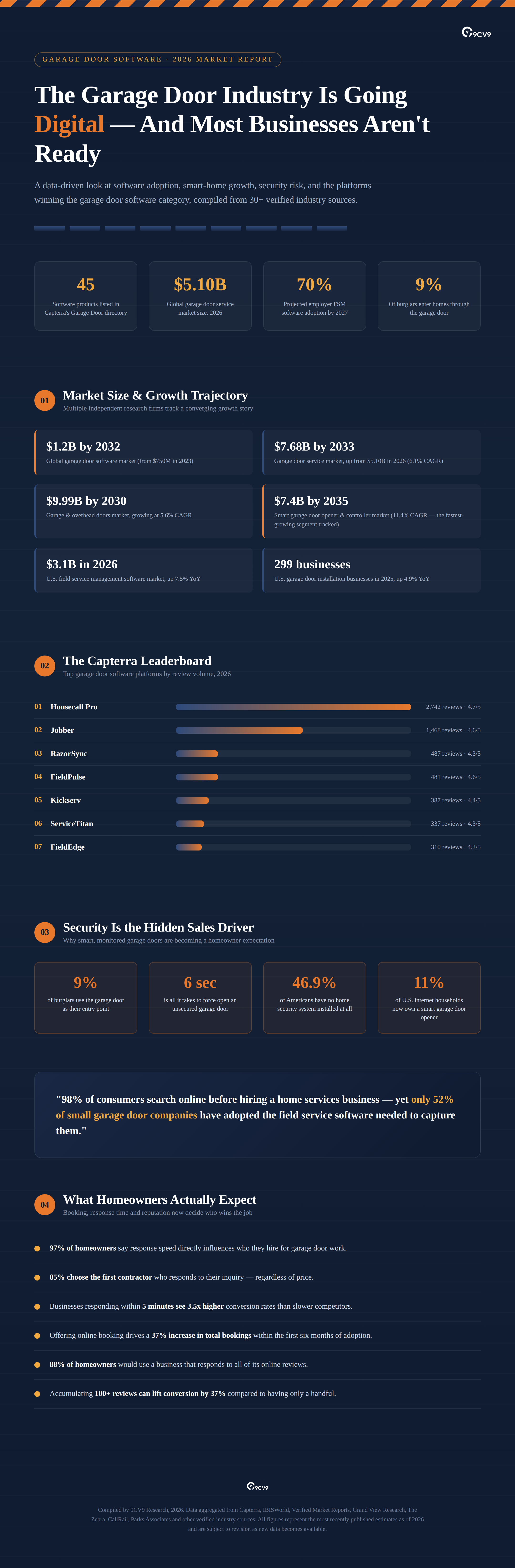
1. The global garage door software market was valued at approximately USD 750 million in 2023 and is projected to reach around USD 1.2 billion by 2032, reflecting steady long-term demand for digital tools in the garage door trade.
2. A separate market forecast pegs the garage door software segment at USD 1.2 billion by 2026, growing at a 6.5% CAGR between 2021 and 2026, underscoring the category’s mid-single-digit growth trajectory.
3. Some analysts value the broader garage door software market considerably higher, at USD 2.5 billion in 2024 and rising to USD 5.8 billion by 2033 (9.8% CAGR), highlighting how differently research firms scope this niche category.
4. The garage door service market — covering both installation and software-enabled service delivery — is projected to grow from USD 5.10 billion in 2026 to USD 7.68 billion by 2033, a 6.1% CAGR.
5. Repair and maintenance services are expected to account for 47.2% of the garage door service market in 2026, making recurring-revenue service management the single largest use case for garage door software.
6. North America is projected to hold a 36.5% share of the global garage door service market in 2026, reflecting the region’s dominance in software-enabled residential trades.
7. Asia Pacific holds an estimated 26.9% share of the garage door service market in 2026 and is tipped as the fastest-growing region, signaling a coming wave of software demand outside North America.
8. The broader garage and overhead doors market is expected to grow from USD 7.57 billion in 2025 to USD 8.02 billion in 2026, a 6.0% year-over-year increase driven by residential infrastructure investment.
9. That same garage and overhead doors market is forecast to reach USD 9.99 billion by 2030 at a 5.6% CAGR, driven partly by smart home automation and energy-efficient door adoption.
10. The U.S. garage door installation industry itself generates USD 459.3 million in revenue in 2026, the direct addressable market that garage door software vendors compete to serve.
11. There are 299 garage door installation businesses operating in the United States as of 2025, up 4.9% from 2024 — each a potential software buyer.
12. The number of U.S. garage door installation businesses grew at a 7.7% CAGR between 2020 and 2025, indicating accelerating market fragmentation and rising demand for scalable back-office software.
13. In 2024, there were 285 garage door installation businesses in the U.S., a 3.6% increase from 2023, showing consistent multi-year business formation in this trade.
Field Service Management (FSM) Software — The Category Garage Door Software Belongs To
14. The U.S. field service management software market — the broader category that includes garage door software — reached USD 3.1 billion in 2026, up 7.5% from the prior year.
15. The U.S. FSM software market has compounded at a 7.7% CAGR between 2021 and 2026, a growth rate closely mirrored by garage door-specific platforms.
16. Globally, the FSM software market was valued at USD 2,341.73 million in 2026 and is projected to reach USD 5,806.26 million by 2035, a 10.5% CAGR.
17. Another global estimate projects the FSM market expanding from USD 5.64 billion in 2025 to USD 9.68 billion by 2030, reinforcing the sector’s double-digit growth outlook.
18. Large enterprises accounted for 66.1% of FSM software revenue share in a recent measured year, though this dominance is now eroding as small trades businesses digitize.
19. The small-and-medium enterprise segment of FSM software — the segment most garage door companies fall into — is projected to grow at the fastest CAGR of any segment, at 16.4%.
20. Software solutions (versus consulting/implementation services) account for 81.3% of total FSM revenue, showing that off-the-shelf platforms dominate over custom builds.
21. 68% of FSM software adoption is driven specifically by mobile workforce management demand — a core garage door technician need.
22. 61% growth has been recorded in real-time service tracking adoption within FSM platforms.
23. 54% of FSM buyers cite demand for automated scheduling systems as a purchase driver.
24. Digital work order management adoption has risen 49% among FSM software users.
25. Predictive maintenance integration within FSM tools has risen 42%, a feature increasingly marketed to garage door service providers for spring and opener lifecycle tracking.
26. More than 45 million field technicians worldwide now rely on mobile-based service platforms for scheduling and reporting.
27. Over 62% of service organizations run digital dispatch systems capable of handling more than 5,000 service orders per month.
28. Currently, 48% of employers use FSM software, with adoption projected to reach 70% by 2027 — a clear signal that garage door companies still on paper or spreadsheets are in the minority soon.
29. Organizations using FSM software report 31% higher customer satisfaction scores than those relying on manual processes.
30. FSM software adoption reaches 84% among enterprises with more than 500 field technicians.
31. Small businesses with fewer than 50 technicians — the profile of most garage door companies — show FSM adoption of 52%, leaving meaningful headroom for growth.
32. Administrative overhead costs drop by approximately 21% when garage door and other trade businesses centralize data through FSM software.
33. 65% of routine scheduling and dispatching tasks are now automated among companies using modern FSM systems, a threefold increase over five years.
34. Inventory management automation has reached nearly 70% adoption among FSM software users, relevant to garage door companies tracking springs, panels, and opener parts.
35. A worker deficit of 2.6 million exists across U.S. service sectors, intensifying pressure on garage door businesses to do more with software rather than headcount.
36. 58% of field service organizations now use a blended workforce of full-time employees and contractors, up from 44% in 2021.
37. As many as 70% of field service organizations are projected to rely on a hybrid full-time/contractor workforce model by 2026.
38. Contractors cost 20–30% less than full-time technicians once benefits, training, and downtime are factored in — a key reason garage door companies use scheduling software to manage mixed crews.
39. Organizations using contractors report 43% faster job completion times for specialized tasks like spring replacement or opener installation.
40. Annual technician turnover in field service trades sits at roughly 35%, above the national average across industries.
41. The cost of a departed technician is estimated at approximately $15,000 once recruitment, onboarding, and lost productivity are included — a strong incentive for software-driven retention tooling.
42. Companies with formal retention programs have reduced technician turnover by 22% on average.
Smart Garage Door & IoT Technology Trends
43. The U.S. market for smart garage door openers and controllers was valued at USD 1.8 billion in 2024 and is projected to reach USD 3.0 billion by 2033, a roughly 6.0% CAGR.
44. In North America specifically, the smart garage door opener market is forecast to grow from USD 2.8 billion in 2025 to USD 4.2 billion by 2033 (5.8% CAGR).
45. A separate global forecast values the smart garage door opener and controller market at USD 2.8 billion in 2026, rising to USD 7.4 billion by 2035 at an 11.40% CAGR — one of the fastest growth rates recorded for the category.
46. The broader garage door openers market (smart and traditional combined) was valued at USD 3.84 billion in 2024 and is projected to reach USD 5.92 billion by 2032 (5.56% CAGR).
47. The global automatic garage door openers market is projected to grow from USD 3.9 billion in 2025 to USD 7.2 billion by 2035, a 6.32% CAGR.
48. The smart garage door opener systems market specifically is expected to grow from USD 0.65 billion in 2024 to USD 1.47 billion by 2033, a 9.4% CAGR, driven by rising smart-home adoption.
49. 11% of U.S. internet households now own a smart garage door opener, according to Parks Associates’ March 2026 research — the same penetration rate as smart door locks.
50. Smart lock and smart garage door opener adoption are increasing in tandem, reflecting how consumers increasingly bundle access-control devices as part of a broader home security ecosystem.
51. The global garage door opener systems market overall is valued at USD 1.37 billion in 2026 and is projected to reach USD 1.89 billion by 2035 (3.6% CAGR).
Garage Door Security & Burglary Data
52. 9% of U.S. burglars use the garage door as their point of entry, making it one of the most exploited — yet often overlooked — vulnerabilities in residential security.
53. A home burglary occurs roughly every 15 seconds in the United States, translating to approximately 4,800 burglaries per day.
54. 46.9% of Americans report not having any home security system installed, according to 2026 proprietary crime data.
55. An unsecured garage door can be forced open from outside in as little as 6 seconds, illustrating why real-time monitoring features in garage door software and smart openers matter for customer trust.
56. 60% of burglars say they would abandon an attempted break-in if they spotted a visible security camera, a statistic garage door companies increasingly use to upsell smart camera-integrated openers.
57. The front door remains the most common burglary entry point at 34% of incidents, with garage doors ranking as a smaller but still significant secondary vulnerability.
58. First-floor windows account for 23% of burglary entry points, ranking above garage doors but reinforcing that perimeter security — including garages — is a top homeowner concern.
59. Back doors account for 22% of burglary entry attempts, rounding out the top entry-point categories tracked by security researchers.
60. Roughly half of all garage-related burglaries result in some form of property damage, adding repair-and-restore revenue opportunity for garage door service companies using software to manage post-incident jobs.
Home Services Customer Behavior, Marketing & Booking Trends
61. The U.S. home services market — the umbrella category garage door businesses operate within — exceeds $524 billion annually.
62. 75% of home services businesses expect revenue growth in 2026, a bullish signal for continued software investment across the trades.
63. 81% of homeowners rely on Google Reviews to decide whether to hire a garage door or other home services business.
64. 88% of homeowners say they would use a business that responds to all of its online reviews, making reputation management a built-in feature homeowners now expect from garage door software platforms.
65. 98% of consumers search online before hiring a home services business, reinforcing why booking, scheduling, and review tools inside garage door software directly affect lead conversion.
66. 86% of homeowners won’t answer a phone call from a number they don’t recognize, a key reason garage door companies increasingly rely on software-driven texting and online booking instead of cold calls.
67. 97% of homeowners say response speed influences who they ultimately hire for a garage door repair or installation.
68. 41% of home services jobs booked online come in after standard business hours, highlighting the value of always-on booking features in garage door software.
69. Construction-category paid search ads average a 6.25% click-through rate, among the highest of all home service trades.
70. Pest control ads average a 5.54% CTR, while plumbing (3.34%) and HVAC (3.40%) trail — useful competitive benchmarks for garage door companies budgeting marketing spend inside their software stack.
71. 85% of homeowners choose the first contractor who responds to their inquiry, regardless of price or reviews.
72. Businesses that respond within five minutes of an inquiry see 3.5x higher conversion rates than slower responders.
73. 35% of home service leads are lost purely due to slow response times — a gap automated software workflows are designed to close.
74. 56% of homeowners now prefer online booking over phone calls for scheduling home services.
75. 42% of home service bookings occur outside standard business hours, reinforcing the ROI case for 24/7 self-service booking portals.
76. A single positive online review can lift conversion rates by 10%.
77. Accumulating 100 reviews can drive a 37% increase in conversions compared to having only a handful.
78. 94% of consumers say a negative online review has convinced them to avoid a business entirely.
79. Businesses that implement online booking see a 37% average increase in total bookings within the first six months of adoption.
80. 26% of online bookings come from repeat customers using the booking page as their primary scheduling channel.
81. Businesses that accept online payment at the time of booking report 23% higher revenue per appointment than those collecting payment only at the visit.
82. The global online appointment scheduling software market was valued at $546 million in 2024 and is projected to exceed $1.3 billion by 2030, a 13.1% CAGR.
83. Businesses offering online booking receive 3.2x more Google reviews than businesses relying solely on phone-based scheduling.
84. 41% of inbound calls to home service businesses go unanswered on weekends, representing a direct revenue leak that scheduling software aims to plug.
85. Repeat clients make post-service home businesses roughly 60% more profitable than those focused solely on new customer acquisition.
86. AI-optimized scheduling has been shown to improve technician utilization by 41%, directly boosting billable hours and revenue.
87. Homeowners who receive proactive maintenance reminders show 4.3x higher customer lifetime value than those who don’t.
Capterra Garage Door Software Directory — Direct Category Data (2026)
88. Capterra’s dedicated Garage Door Software directory lists 45 distinct software products across two result pages as of 2026, reflecting a maturing, competitive category.
89. Housecall Pro leads the Capterra garage door category by review volume, with 2,742 reviews and a 4.7-out-of-5 rating, and states it serves over 45,000 businesses.
90. Jobber ranks second by review count on Capterra’s garage door directory with 1,468 reviews and a 4.6/5 rating, and reports serving more than 250,000 home service professionals overall.
91. Synchroteam holds a 4.4/5 rating from 96 Capterra reviews within the garage door category, positioning it as a mid-market real-time dispatch option.
92. RazorSync carries a 4.3/5 rating across 487 Capterra reviews in the garage door software category.
93. FieldPulse holds a 4.6/5 rating from 481 reviews, among the highest-rated platforms with substantial review volume in the category.
94. Kickserv holds a 4.4/5 rating from 387 reviews and markets itself as the most affordable option for companies with 1–25 employees, with plans starting at $47/month.
95. ServiceTitan holds a 4.3/5 rating from 337 Capterra reviews, positioning it toward larger, more complex garage door and trades operations.
96. FieldEdge holds a 4.2/5 rating from 310 reviews and claims to save office staff over 20 hours per week through QuickBooks integration.
97. Service Fusion holds a 4.3/5 rating from 308 reviews and differentiates on a no-per-user-fee pricing model, appealing to growing garage door teams.
98. BigChange holds a 4.5/5 rating from 270 reviews and is positioned as a paperless job management platform popular with UK-based garage door businesses.
99. Smart Service holds a 4.3/5 rating from 269 reviews, emphasizing native QuickBooks integration for trades businesses.
100. Workiz holds a 4.4/5 rating from 218 reviews and markets AI-enabled scheduling and dispatching tools under its “Genius” feature set.
101. Commusoft holds a 4.7/5 rating from 210 reviews and states it is trusted by more than 10,000 general contractors for planned and reactive service work.
102. Combined, the ten most-reviewed platforms in Capterra’s garage door software category have accumulated 6,886 user reviews, representing nearly 79% of all review volume across the entire 45-product directory.
103. Across all 45 products listed in Capterra’s garage door software directory, total accumulated reviews exceed 8,700, indicating a well-established and heavily vetted software category.
104. The average Capterra star rating among the ten most-reviewed garage door software platforms is approximately 4.43 out of 5, reflecting generally high satisfaction across leading vendors.
105. Several newer entrants to the Capterra garage door directory, including Repair-CRM (4.9/5) and Orcatec (5.0/5), post near-perfect ratings, though on comparatively small review bases of fewer than 25 reviews each.
Industry Body, Safety & Injury Data
106. The International Door Association (IDA) represents over 2,000 members involved in garage door installation and repair across North America.
107. IDA-accredited garage door installers must complete 12 continuing education credits every three years to maintain their certification.
108. Over 1,600 garage door-related injuries occur annually in the United States during repair and maintenance activities.
109. Approximately 1,500 of those annual garage door injuries involve glass, springs, or other sharp components — underscoring why service scheduling and safety-compliance tracking features matter within garage door software.
110. The overall garage door industry, spanning manufacturing, installation, and repair, is estimated to exceed $20 billion in total market value.
Conclusion
The Top 110 Garage Door Software Statistics, Data & Trends in 2026 highlight an industry undergoing significant digital transformation, driven by increasing demand for automation, operational efficiency, improved customer experiences, and smarter field service management solutions. As garage door installation, repair, and maintenance businesses face rising customer expectations and workforce challenges, adopting specialized software is becoming an increasingly important strategy for maintaining competitiveness and achieving sustainable growth.
Industry forecasts suggest that the global garage door software market could reach approximately USD 1.2 billion by 2032, while alternative estimates project growth to USD 5.8 billion by 2033. Although market valuations vary depending on research methodologies and category definitions, these projections indicate expanding opportunities for garage door management software providers, contractors, and technology investors.
One of the most significant trends shaping the industry is the growing adoption of field service management (FSM) software. With approximately 52% of small field service businesses reportedly using FSM solutions, substantial opportunities remain for garage door companies to modernize their operations. Industry data also suggests that businesses implementing FSM platforms can achieve approximately 21% reductions in administrative overhead and report customer satisfaction scores 31% higher than organizations relying on manual processes.
Customer behavior is another major driver of technological change. With 56% of homeowners reportedly preferring online booking and 97% indicating that response speed influences their choice of service provider, garage door businesses increasingly need digital tools that support faster communication, automated appointment scheduling, and convenient customer interactions. Features such as real-time technician tracking, online payments, automated reminders, and customer relationship management are becoming valuable components of competitive service operations.
Meanwhile, artificial intelligence, smart garage door technology, and Internet of Things (IoT) integration are creating new opportunities for innovation. AI-powered scheduling, predictive maintenance, connected garage door openers, and remote monitoring capabilities could help service providers improve technician productivity, reduce unnecessary service visits, and develop recurring maintenance revenue streams.
The competitive landscape is also expanding. With approximately 45 products identified in Capterra’s garage door software category in the supplied 2026 data, businesses can choose from a growing selection of solutions, including Housecall Pro, Jobber, ServiceTitan, FieldPulse, Workiz, and Service Fusion. Selecting the right platform requires evaluating pricing, scalability, ease of use, mobile functionality, integration capabilities, customer support, and the specific operational requirements of each business.
Key Takeaways for Garage Door Businesses
Looking ahead, several priorities are likely to shape successful garage door software adoption:
- Prioritize automation: Implement garage door scheduling, dispatching, invoicing, and inventory management software to reduce repetitive administrative tasks and improve operational efficiency.
- Improve customer convenience: Offer online booking, automated appointment reminders, digital payments, and faster customer communication to meet evolving homeowner expectations.
- Explore AI-powered capabilities: Evaluate intelligent scheduling, automated lead management, predictive maintenance, and technician optimization tools that can support business growth.
- Invest in mobile field service management: Equip technicians with mobile access to work orders, customer information, inventory records, and real-time job updates.
- Monitor software return on investment: Track technician utilization, customer satisfaction, booking conversion rates, administrative costs, and recurring service revenue to assess software effectiveness.
Ultimately, the future of garage door software in 2026 and beyond will be shaped by automation, artificial intelligence, cloud-based field service management, and connected garage technology. Businesses that strategically adopt these solutions may be better positioned to improve service quality, increase operational efficiency, strengthen customer relationships, and respond to changing market demands.
As the garage door industry continues to evolve, software will play an increasingly central role in connecting technicians, customers, equipment, and business operations. For garage door contractors, service companies, and technology providers, understanding these 110 garage door software statistics and trends offers a valuable foundation for making informed investment decisions, identifying growth opportunities, and preparing for the next generation of digital service management.
If you find this article useful, why not share it with your hiring manager and C-level suite friends and also leave a nice comment below?
We, at the 9cv9 Research Team, strive to bring the latest and most meaningful data, guides, and statistics to your doorstep.
To get access to top-quality guides, click over to 9cv9 Blog.
To hire top talents using our modern AI-powered recruitment agency, find out more at 9cv9 Modern AI-Powered Recruitment Agency.
People Also Ask
What is garage door software?
Garage door software is a digital solution that helps installation, repair, and maintenance businesses manage scheduling, dispatching, invoicing, customer relationships, inventory, and technician operations through a centralized platform.
How big is the global garage door software market in 2026?
Market estimates vary, with one forecast valuing the garage door software market at approximately USD 1.2 billion in 2026. Growing demand for automation, cloud-based management, and digital field services supports industry expansion.
What is the projected growth of the garage door software market?
One industry forecast projects the global garage door software market will grow from USD 750 million in 2023 to USD 1.2 billion by 2032. Another estimates USD 5.8 billion by 2033, reflecting differences in market definitions.
What are the biggest garage door software trends in 2026?
Major trends include AI-powered scheduling, automated dispatching, mobile technician management, cloud-based CRM, online booking, predictive maintenance, smart garage door integration, and digital payment processing.
Why is garage door management software important for businesses?
Garage door management software helps businesses reduce administrative workloads, organize technician schedules, track inventory, automate invoices, and improve customer communication while supporting operational efficiency and business growth.
What percentage of field service businesses use management software?
Industry data indicates that approximately 48% of employers use field service management software, with adoption projected to reach 70% by 2027. Among small businesses with fewer than 50 technicians, adoption is approximately 52%.
How does garage door software improve operational efficiency?
Garage door software automates scheduling, dispatching, invoicing, and work order management. Industry estimates suggest centralized field service platforms can reduce administrative overhead by approximately 21%.
What is the best garage door software in 2026?
Popular garage door software platforms include Housecall Pro, Jobber, ServiceTitan, FieldPulse, Workiz, Service Fusion, and Kickserv. The best choice depends on business size, pricing, scheduling capabilities, integrations, and operational needs.
How much does garage door software cost in 2026?
Garage door software pricing varies by provider, features, and user requirements. The supplied industry data identifies Kickserv plans starting at approximately $47 per month, while other platforms offer different subscription structures.
What features should garage door software include?
Essential features include appointment scheduling, technician dispatching, customer relationship management, invoicing, payment processing, inventory tracking, mobile access, automated reminders, reporting, and accounting integrations.
How does AI improve garage door service management?
AI-powered garage door software can optimize technician schedules, automate customer responses, improve dispatching, identify maintenance needs, and analyze operational data to support faster service delivery and better resource allocation.
What is field service management software for garage door companies?
Field service management software helps garage door contractors coordinate technicians, schedule appointments, manage work orders, monitor inventory, process invoices, and communicate with customers through integrated digital tools.
How fast is the field service management software market growing?
One industry forecast projects the global field service management software market will expand from USD 5.64 billion in 2025 to USD 9.68 billion by 2030, reflecting increasing demand for workforce automation and digital service operations.
What percentage of homeowners prefer online booking for garage door services?
According to the supplied home services industry data, approximately 56% of homeowners prefer online booking over phone calls. This highlights the importance of digital appointment scheduling for garage door service businesses.
How important is response time for garage door repair companies?
Industry data suggests that 97% of homeowners consider response speed when choosing a service provider. Automated messaging, online scheduling, and efficient dispatching can help garage door businesses respond faster.
Can garage door software increase customer satisfaction?
Yes. Industry estimates indicate that organizations using field service management software report customer satisfaction scores approximately 31% higher than businesses relying on manual processes.
How does garage door scheduling software work?
Garage door scheduling software organizes appointments, assigns technicians, tracks job availability, sends customer reminders, and updates service schedules. Advanced platforms also support route optimization and automated dispatching.
What are the benefits of cloud-based garage door software?
Cloud-based garage door software provides remote access to customer records, scheduling, invoices, and technician information. It supports real-time collaboration, mobile operations, centralized data management, and business scalability.
How does garage door CRM software help contractors?
Garage door CRM software organizes customer information, tracks service histories, manages inquiries, automates follow-ups, and supports recurring maintenance reminders. These capabilities help contractors strengthen customer relationships.
What is the market size of smart garage door technology in 2026?
One industry forecast values the global smart garage door opener and controller market at approximately USD 2.8 billion in 2026, with projected growth to USD 7.4 billion by 2035.
How many households use smart garage door openers?
Parks Associates research cited in the supplied data indicates that 11% of U.S. internet households owned a smart garage door opener in 2026, highlighting growing consumer adoption of connected home access technology.
What role does IoT play in garage door software?
Internet of Things technology connects smart garage door openers, sensors, and monitoring systems. It enables remote access, equipment status tracking, automated alerts, and potential predictive maintenance capabilities.
Can garage door software help reduce technician turnover?
Garage door software can simplify scheduling, reduce administrative tasks, and improve workload visibility. These capabilities may support employee satisfaction, although actual turnover reductions depend on broader workforce management practices.
How does garage door software improve inventory management?
Garage door inventory management software tracks replacement springs, panels, openers, and other parts. It helps technicians monitor stock availability, reduce inventory errors, and coordinate materials for upcoming service appointments.
What percentage of garage door service bookings happen after business hours?
The supplied home services data indicates that approximately 41% to 42% of online bookings occur outside standard business hours, highlighting the potential value of 24/7 booking systems for garage door contractors.
How does garage door software help businesses generate more revenue?
Garage door software can support revenue growth through faster lead responses, online booking, automated follow-ups, recurring maintenance reminders, efficient technician scheduling, and streamlined payment collection.
What are the most popular garage door software platforms?
The supplied Capterra data identifies Housecall Pro, Jobber, RazorSync, FieldPulse, Kickserv, ServiceTitan, and Service Fusion among garage door software platforms with substantial customer review volumes.
How many garage door software products are available in 2026?
The supplied 2026 dataset identifies approximately 45 products listed in Capterra’s garage door software directory, covering scheduling, dispatching, customer management, invoicing, and field service operations.
What are the biggest challenges facing garage door software adoption?
Common challenges include subscription costs, employee training, data migration, integration with existing accounting systems, workflow changes, and selecting software that matches the company’s operational requirements.
What is the future of garage door software beyond 2026?
Garage door software is expected to evolve through AI automation, predictive maintenance, IoT integration, mobile field service management, cloud-based operations, and improved customer self-service capabilities. These technologies could reshape service delivery and business efficiency.
Sources
- Dataintelo
- Verified Market Reports
- Market Research Intellect
- OpenPR
- Coherent Market Insights
- The Business Research Company
- IBISWorld
- Grand View Research
- Market Reports World
- Fieldwork
- FieldServiceSoftware
- MarkWide Research
- Verified Market Research
- Spherical Insights
- Cognitive Market Research
- Business Research Insights
- Parks Associates
- RJ Garage Door Service
- AAMAX
- The Zebra
- AlfredCamera
- GetSafeAndSound
- CallRail
- SimplyBook.me
- SchedulingKit
- Journela
- eInvoice Generator
- Capterra India
- Jobber