Key Takeaways
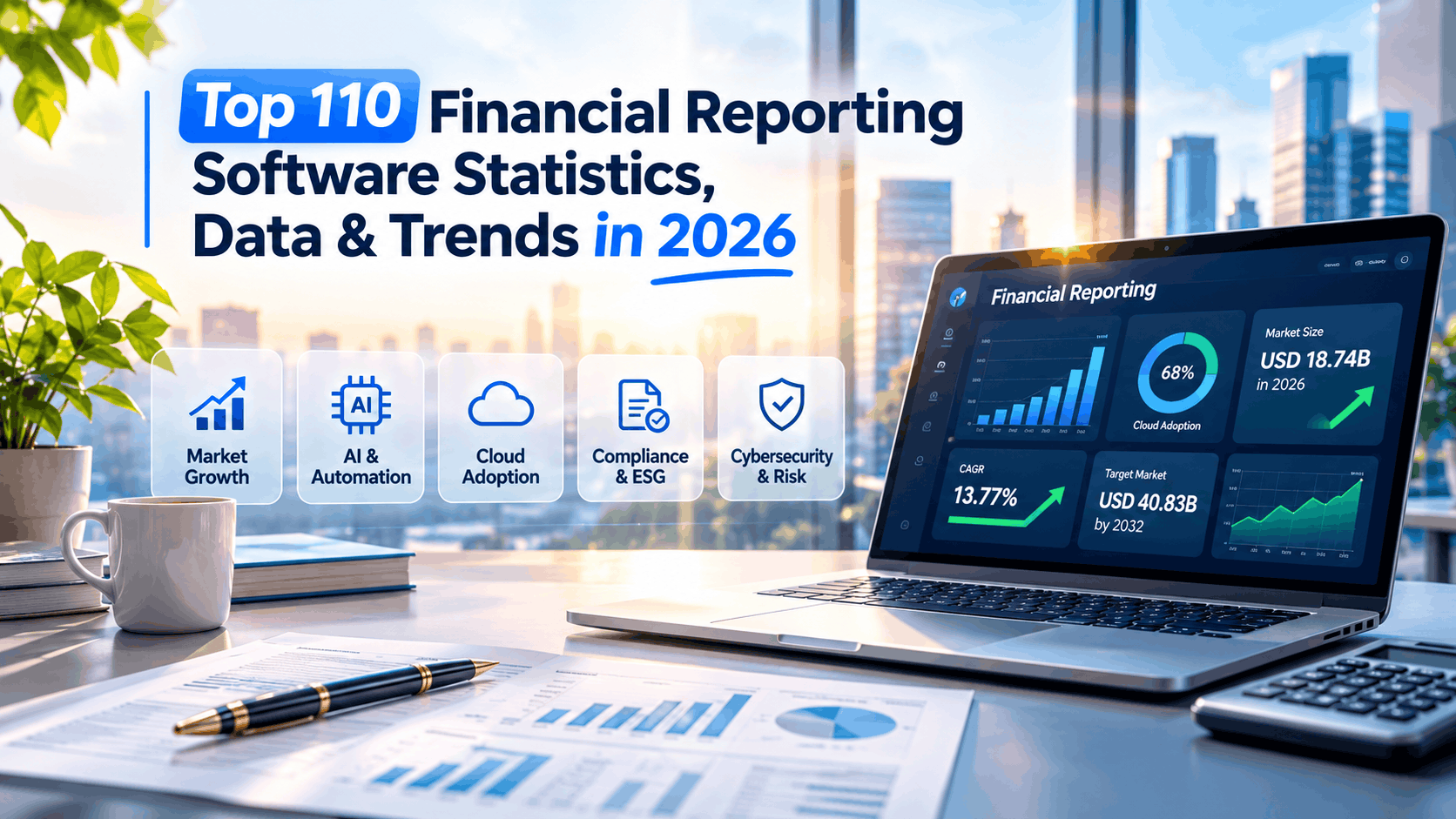
- Financial Reporting Software Market Growth: The global financial reporting software market is projected to reach USD 18.74 billion in 2026 and USD 40.83 billion by 2032, driven by increasing demand for automation, real-time analytics, and digital financial management solutions.
- AI and Financial Reporting Automation: With 56% of finance leaders using AI-powered tools and 87% of CFOs recognizing AI as highly important, intelligent automation is transforming financial reporting accuracy, financial close efficiency, forecasting, and decision-making.
- Cloud Adoption and Financial Reporting Trends: Cloud deployments accounted for 68.08% of accounting software revenue in 2025, highlighting growing demand for scalable cloud-based financial reporting platforms, regulatory compliance tools, and integrated financial analytics.
Financial reporting software is transforming business finance in 2026 through AI automation, cloud adoption, and real-time analytics. The global market is projected to reach USD 18.74 billion in 2026 and USD 40.83 billion by 2032. Explore 110 key statistics covering market growth, financial close efficiency, reporting accuracy, cybersecurity, and emerging industry trends.
Financial reporting software has become an essential component of modern business operations, helping organizations streamline financial processes, improve reporting accuracy, maintain regulatory compliance, and make better data-driven decisions. As businesses navigate increasingly complex financial environments in 2026, the demand for automated, cloud-based, and AI-powered financial reporting solutions continues to accelerate.
Also, read our article on the Top 10 Financial Reporting Software To Try.

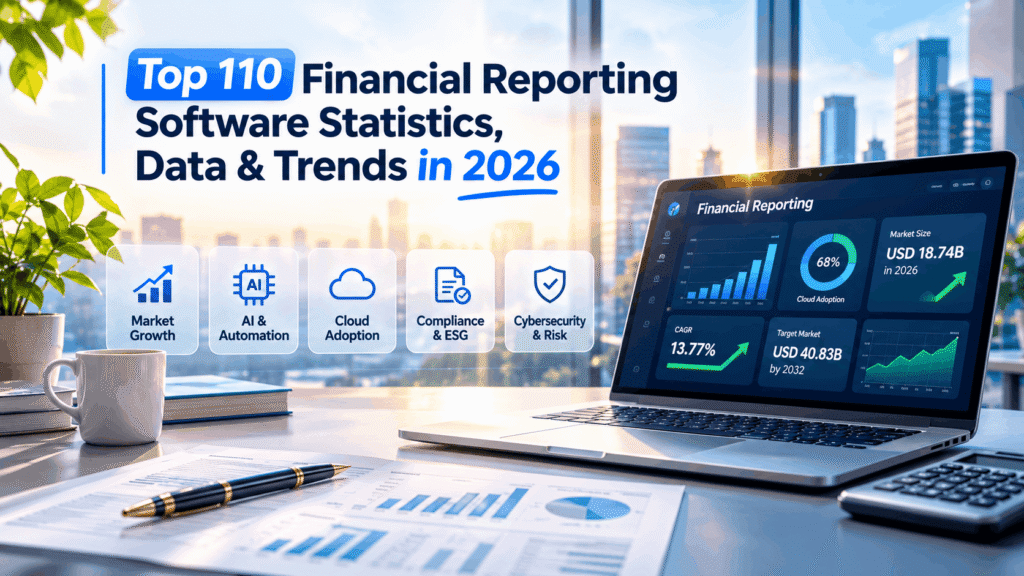
The global financial reporting software market is experiencing significant growth, with its value estimated at USD 18.74 billion in 2026, up from USD 16.54 billion in 2025. Industry projections suggest the market could reach USD 40.83 billion by 2032, representing a compound annual growth rate (CAGR) of approximately 13.77%. This expansion reflects growing investments in financial automation, real-time analytics, regulatory reporting, and integrated financial management platforms across businesses of all sizes.
Artificial intelligence (AI) is emerging as one of the most influential trends transforming financial reporting software in 2026. According to industry research, 56% of finance leaders now use AI-powered tools in their daily work, compared with 31% in 2024 and just 17% in 2023. Furthermore, 87% of CFOs believe AI will be extremely or very important to their finance departments in 2026, while 54% identify embedding AI agents into financial workflows as a major transformation priority. These developments highlight the growing role of intelligent automation in financial analysis, variance reporting, forecasting, and decision-making.

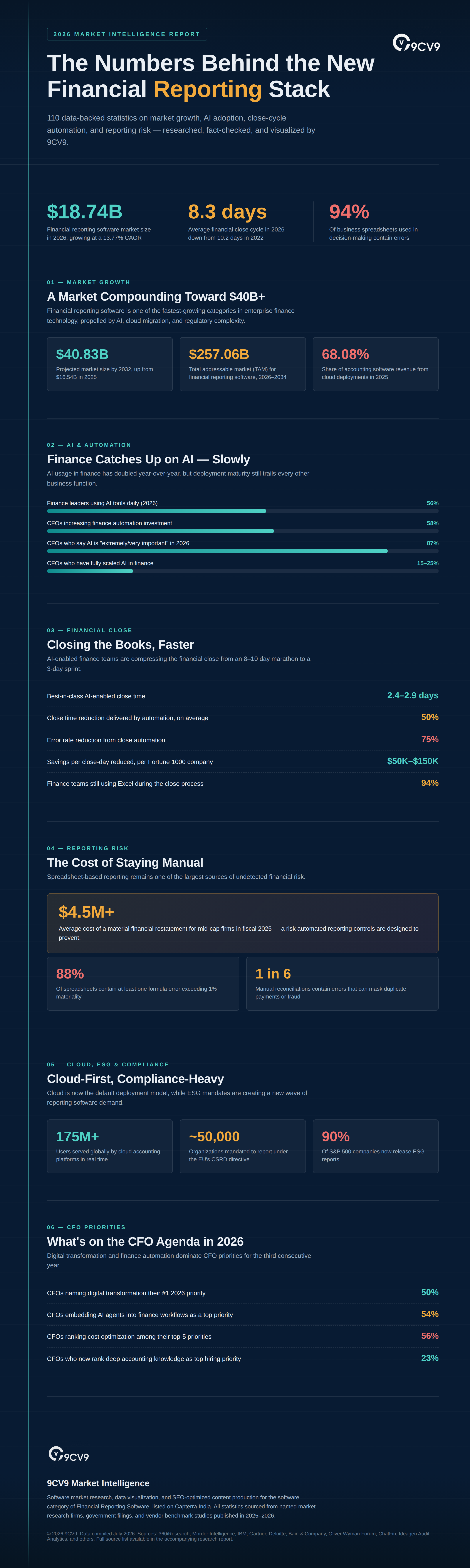
Financial close automation is another major driver of software adoption. The average financial close cycle has reportedly decreased from 10.2 business days in 2022 to 8.3 business days in 2026, while leading AI-enabled finance teams can complete their closing processes in approximately 2.4 to 2.9 days. Despite these improvements, 94% of finance teams still use Excel during their financial close processes, demonstrating the continued reliance on spreadsheets and the substantial opportunities for further automation.
Cloud-based financial reporting software is also reshaping how businesses manage financial information. Cloud deployments accounted for approximately 68.08% of accounting software revenue in 2025, while cloud-based accounting and reporting solutions are projected to grow at a CAGR of 10.15% through 2031. Small and medium-sized enterprises (SMEs) are increasingly adopting subscription-based financial reporting platforms to benefit from improved accessibility, scalability, collaboration, and real-time financial visibility.
Beyond automation and cloud adoption, regulatory compliance, cybersecurity, and financial data accuracy are becoming increasingly important considerations. Organizations must address evolving financial disclosure requirements, sustainability reporting obligations, and growing concerns surrounding sensitive financial information. With the global average cost of a data breach reaching USD 4.44 million in 2025, businesses are placing greater emphasis on secure financial reporting systems, robust internal controls, and reliable data governance.
Meanwhile, CFO priorities are shifting toward digital transformation, operational efficiency, and strategic financial intelligence. Research indicates that 71% of CFOs rank improvements in cost, margins, and productivity among their top three transformation priorities, while 68% are focused on enhancing enterprise performance through advanced analytics and scenario modeling. These trends suggest that financial reporting software is evolving beyond traditional accounting and compliance functions into a strategic platform for business performance management.
This comprehensive guide explores the top 110 financial reporting software statistics, data, and trends in 2026, covering global market size, industry growth forecasts, AI adoption, financial close automation, cloud accounting, spreadsheet risks, regulatory compliance, cybersecurity, and emerging CFO priorities.
Whether you are a CFO, finance director, accountant, financial analyst, business owner, software developer, or technology decision-maker, these financial reporting software statistics provide valuable insights into the technologies, challenges, and opportunities shaping the future of financial management.
By understanding the latest financial reporting software market trends and adoption patterns, organizations can make more informed technology investments, optimize financial operations, reduce reporting risks, and prepare for an increasingly automated, intelligent, and data-driven financial landscape.
Before we venture further into this article, we would like to share who we are and what we do.
About 9cv9
9cv9 is a business tech startup based in Singapore and Asia, with a strong presence all over the world.
With over ten years of startup and business experience, and being highly involved in connecting with thousands of companies and startups, the 9cv9 team has listed some of the top and best companies/tools in this review.
If you like to get your company listed in our top B2B software reviews, check out our world-class 9cv9 Media and PR service and pricing plans here.
Top 110 Financial Reporting Software Statistics, Data & Trends in 2026
1. Market Size & Growth
1. The financial reporting software market was estimated at USD 16.54 billion in 2025 and is expected to reach USD 18.74 billion in 2026. Buyers evaluating financial reporting software in 2026 are entering a market valued at nearly USD 18.74 billion, reflecting a 13.77% CAGR trajectory toward USD 40.83 billion by 2032.
2. An alternative market model projects the sector reaching USD 37.37 billion by 2034 from USD 16.68 billion in 2025. Independent of methodology, multiple analysts agree financial reporting software will more than double in value by the mid-2030s, signaling durable long-term demand.
3. The total addressable market (TAM) for financial reporting software between 2026 and 2034 is projected at approximately USD 257.06 billion. This TAM figure underscores just how much white space remains for vendors and integrators serving finance teams worldwide.
4. The broader accounting software market was valued at USD 21.56 billion in 2025, growing to USD 23.47 billion in 2026 at a CAGR of 8.85%. Financial reporting software sits inside a fast-expanding accounting software ecosystem projected to reach USD 35.86 billion by 2031.
5. North America commanded a 35.77% share of the global accounting software market in 2024. Enterprises shopping for financial reporting tools in North America are operating in the single largest regional market worldwide.
6. Financial consolidation software—an adjacent category to financial reporting—was valued at USD 3.56 billion in 2026 and is expected to reach USD 7.77 billion by 2035. Multi-entity organizations are driving steady 9% CAGR growth in consolidation-focused reporting tools.
7. The dedicated “reporting software” category (spanning finance and BI use cases) was worth USD 17,777.11 million in 2026, forecast to reach USD 34,514.71 million by 2035. This 7.6% CAGR confirms reporting automation is a persistent, multi-year investment priority for enterprises.
8. Financial management software is projected to rise from USD 14.77 billion in 2025 to USD 16.2 billion in 2026. This steady segment growth reflects finance leaders’ ongoing appetite for tools that unify budgeting, reporting, and forecasting.
9. The global accounting software market, including reporting modules, is projected to grow from USD 16,966.38 million in 2026 to USD 33,516.92 million by 2035, with cloud deployments already exceeding 60% of installations. Cloud-first financial reporting has effectively become the default purchasing pattern for new buyers.
10. The cloud accounting software market alone is projected to expand from USD 14.47 billion in 2023 to USD 28.67 billion by 2030. This near-doubling underscores how thoroughly cloud delivery models have reshaped financial reporting software procurement.
11. Cloud accounting software spending reached USD 5.36 billion in 2025, up from USD 4.9 billion in 2024. This single-year jump illustrates the accelerating pace at which businesses are shifting reporting budgets toward subscription-based platforms.
2. AI & Automation in Finance Reporting
12. 58% of CFOs are increasing finance automation investment in 2026, with the financial close identified as the #1 priority workflow. Financial reporting and close automation have overtaken accounts payable and expense management as the top automation target for finance leaders.
13. AI-generated variance commentary recovers 8–12 controller hours per close cycle in most mid-market deployments. Automating narrative reporting tasks is proving to be one of the highest-ROI applications of AI inside financial reporting software.
14. 56% of finance leaders now use AI-powered tools in their daily work, up from just 31% in 2024 and 17% in 2023. AI adoption in financial reporting has effectively doubled year-over-year, marking 2026 as an inflection point for the category.
15. Despite rising adoption, finance still ranks last among all business functions in AI deployment maturity. Financial reporting teams are catching up to—but still trail—sales, marketing, and engineering in production-grade AI usage.
16. 45% of finance teams remain in “limited pilot” mode with AI, while only 17% use AI in core reporting workflows. Most organizations exploring AI-powered financial reporting software are still experimenting rather than operating at scale.
17. 68% of CFOs say they have been slow to adopt AI in finance because they don’t know where to start. This uncertainty represents a significant opportunity for financial reporting software vendors offering guided, low-friction AI onboarding.
18. ChatGPT leads AI tool usage in finance, used by 35% of finance teams for research, analysis, and reporting tasks. General-purpose AI assistants remain more widely used in financial reporting workflows than specialized finance AI tools.
19. 87% of CFOs say AI will be extremely or very important to how their finance department operates in 2026. Financial reporting is increasingly viewed as a strategic AI use case rather than a back-office afterthought.
20. 54% of CFOs cite embedding AI agents directly into finance workflows as a top transformation priority for 2026. Agentic AI is emerging as a defining feature of next-generation financial reporting software roadmaps.
21. 52% of CFOs cite improving data quality, access, and usability as a top finance transformation priority. Clean, well-governed data remains the prerequisite that determines whether AI-powered reporting tools deliver reliable output.
22. Only 36% of CFOs feel confident they can drive meaningful enterprise impact from AI investments. This confidence gap suggests financial reporting software buyers should prioritize measurable outcomes over feature checklists.
23. Nearly 60% of CFOs plan to increase finance function AI investment by 10% or more in 2026. Budget allocations toward AI-enabled financial reporting tools are set to climb meaningfully this year.
24. 88% of CFOs cite efficiency and productivity gains as a top-three priority for AI budget allocation. Financial reporting software that demonstrably reduces manual effort is best positioned to capture this spending.
25. More than half of CFOs are increasing AI investment by over 15% this year, with a significant share directed at finance. Double-digit AI budget growth in finance departments signals sustained demand for intelligent reporting platforms.
26. Only 15%–25% of CFOs have fully scaled AI across their finance departments. The gap between AI experimentation and full-scale deployment remains one of the biggest barriers facing financial reporting technology adoption.
27. 41% of companies that have scaled AI in finance report being satisfied with outcomes, versus 25% still in pilot mode. Scaling AI deployments in financial reporting correlates directly with higher satisfaction and realized ROI.
28. 31.3% of finance leaders identify AI-driven financial reporting as the AI capability expected to have the biggest operational impact in the coming year. Predictive, proactive reporting intelligence is emerging as a top investment theme.
29. 54.2% of finance leaders say their financial processes are only partially automated, still relying on inconsistent manual intervention. More than half of finance functions have room to grow before financial reporting is fully automated end-to-end.
30. 61.6% of finance leaders say improving data accuracy—not cost savings—is their primary driver for automation. Accuracy, not efficiency alone, is the leading justification finance teams give for adopting reporting automation software.
31. 33.3% of finance leaders say their existing reporting tools cannot scale with increasing operational demand. A third of finance teams may be outgrowing their current financial reporting software stack.
3. Financial Close & Reporting Cycle Times
32. The average financial close in 2026 takes 8.3 business days, down from 10.2 days in 2022. Close cycles have compressed by roughly two days over four years, largely credited to reporting and reconciliation automation.
33. Best-in-class, AI-enabled finance teams are now closing the books in 2.4 to 2.9 days. Leading organizations have pushed close times to a fraction of the industry average through automated financial reporting workflows.
34. The average close takes 6.4 business days for public companies and 7 to 10 days for private companies. Reporting obligations and audit scrutiny appear to add measurable time to the close cycle for publicly listed businesses.
35. Close automation reduces close time by 50% on average and cuts error rates by 75%. Automating financial reporting delivers a rare combination of speed and accuracy gains that manual processes cannot match.
36. Each day of close-cycle reduction can save a Fortune 1000 company between USD 50,000 and USD 150,000. Faster financial reporting cycles translate directly into measurable cost savings at enterprise scale.
37. A joint MIT and Stanford study found accounting teams using generative AI cut 7.5 days off their monthly close. Academic research now corroborates vendor claims that AI materially shortens financial reporting timelines.
38. Only 58% of organizations complete their monthly close within six business days. Despite years of technology investment, more than four in ten organizations still take longer than a week to close their books.
39. A traditional close in a complex, multi-entity organization can stretch to 10–15 business days. Organizational complexity—not just tooling—remains a major driver of slow financial reporting cycles.
40. Automated finance teams close in 6.4 days on average, compared to 10 days for manual teams. This gap illustrates the tangible time savings that automated financial reporting software delivers over spreadsheet-based processes.
41. True continuous close—real-time financial reporting without a discrete month-end event—is achieved by only 8–12% of finance organizations. Continuous close remains an aspirational benchmark reserved mostly for large, cloud-native enterprises.
42. AI deployment compresses financial close timelines by 40% to 55% across industries. This consistent improvement range holds true regardless of sector, entity structure, or existing ERP environment.
43. The average month-end close time across all industries in 2026 is 6.1 days without AI automation. This figure serves as a useful baseline for organizations benchmarking their own financial reporting performance.
44. Month-end close times range from 8.1 days in healthcare without AI to under 3 days for SaaS/tech companies using AI. Industry complexity and technology adoption together explain a five-day-plus spread in reporting speed.
45. In 2025, the average manual close still took 10 to 12 calendar days for mid-sized public companies. Manual, spreadsheet-driven financial reporting remains stubbornly slow even among sizable, well-resourced organizations.
46. Automating the close process can reduce material misstatements by up to 85%. Beyond speed, financial reporting automation delivers a substantial accuracy dividend that directly reduces restatement risk.
47. A material restatement can cost mid-cap firms upward of USD 4.5 million in a single fiscal year. This financial exposure makes accurate, automated financial reporting a risk-management imperative, not just an efficiency play.
48. 94% of finance teams still use Excel at some point during the close process. Spreadsheets remain deeply embedded in financial reporting workflows even as dedicated software adoption grows.
49. Only 18% of finance teams achieve the widely cited “1-to-3-day” close as a gold standard. Fewer than one in five organizations currently meet the fastest tier of financial reporting performance.
50. Half of all finance teams take longer than five business days to close their books. A slow close remains the norm rather than the exception across the broader finance function.
4. Spreadsheet Risk & Data Quality
51. 94% of business spreadsheets used in decision-making contain errors, according to a peer-reviewed 2024 study. This widely cited figure highlights the structural fragility of spreadsheet-based financial reporting.
52. Nearly 90% of spreadsheets contain errors, and half of spreadsheet models used in large businesses have “material defects.” Even at conservative estimates, spreadsheet-dependent financial reporting carries meaningful accuracy risk.
53. 88% of spreadsheets contain at least one formula error exceeding 1% materiality. Formula-level errors of this magnitude can meaningfully distort financial statements prepared manually.
54. 41% of finance teams cite error identification as a major challenge in spreadsheet-based reporting processes. Catching mistakes before they reach a board report remains one of the hardest parts of manual financial reporting.
55. 31% of finance teams struggle with data gathering when relying on spreadsheet-driven close and reporting workflows. Fragmented data collection continues to slow down manual financial reporting cycles.
56. 20% of finance teams report broken formulas caused by multiple people editing the same spreadsheet files. Collaborative editing—a basic requirement of modern finance teams—remains a known weak point of spreadsheet-based reporting.
57. Nearly 20% of expense reports contain errors, with each correction adding USD 50 or more in processing cost. Manual expense reporting errors compound quickly across an organization’s broader financial reporting pipeline.
58. One in six manual reconciliations contains errors that can mask duplicate payments or fraud. Reconciliation—the backbone of accurate financial reporting—is particularly vulnerable to manual-process risk.
59. A single spreadsheet input error caused Citigroup to accidentally wire USD 900 million to creditors. This high-profile incident remains one of the starkest real-world illustrations of financial reporting risk tied to manual processes.
60. Spreadsheet copy-paste errors contributed to JPMorgan’s USD 6.2 billion “London Whale” trading loss. Even sophisticated financial institutions have suffered material losses traceable to manual reporting and modeling mistakes.
5. Cloud & SaaS Adoption
61. 68.08% of accounting software revenue came from cloud deployments in 2025. Cloud delivery has become the dominant model for financial reporting and accounting software purchases.
62. Cloud-based accounting and reporting solutions are growing at a 10.15% CAGR through 2031, outpacing on-premise alternatives. Buyers consistently favor cloud financial reporting software for its scalability and lower total cost of ownership.
63. Small and medium enterprises are the fastest-growing segment of the accounting software market, expanding at a 10.85% CAGR from 2026–2031. SMEs are closing the historical adoption gap with large enterprises faster than any other buyer segment.
64. The BFSI (banking, financial services, insurance) sector held a 24.55% revenue share of the accounting software market in 2025. Heavily regulated financial institutions remain the single largest industry vertical purchasing reporting software.
65. 61% of small businesses already run more than 40% of their operations in the cloud. Cloud-based financial reporting is now a mainstream operational reality for small businesses, not an emerging trend.
66. SMEs represent roughly 68% of all cloud accounting software users globally. Small and mid-sized businesses form the backbone of the cloud financial reporting software user base worldwide.
67. UK SME cloud accounting adoption climbed to 62% by 2023, up from 48% in 2021. This rapid two-year jump illustrates how quickly cloud-based financial reporting has been normalized among smaller UK businesses.
68. Indian startups founded after 2018 show an 85% cloud accounting usage rate. Digitally native businesses in emerging markets are adopting cloud financial reporting tools at some of the highest rates globally.
69. Singapore SME cloud accounting adoption reached 70%. Southeast Asia’s most digitally mature economy shows strong appetite for cloud-based financial reporting among small businesses.
70. Intuit QuickBooks holds an estimated 31.2% share of the cloud accounting software market. QuickBooks remains the single largest vendor by market share in the cloud accounting and reporting space.
71. Xero commands roughly 22.5% of the global SMB cloud accounting segment. Xero’s strong SMB footprint makes it one of the two dominant platforms shaping cloud financial reporting adoption worldwide.
72. An estimated 72–75% of SMEs globally have adopted cloud accounting tools as of 2026. Cloud financial reporting has effectively become the default choice for small and mid-sized businesses worldwide.
73. Cloud accounting platforms now serve more than 175 million users globally with real-time financial tracking. This user base size reflects how deeply embedded cloud-based reporting has become in day-to-day business operations.
74. The top five cloud accounting platforms collectively account for approximately 68% of global market share. Market concentration among a handful of vendors shapes much of the competitive landscape for financial reporting buyers.
75. 48% of new accounting software buyers now choose subscription-based SaaS pricing over traditional licensing. Subscription pricing has overtaken perpetual licensing as the preferred commercial model for financial reporting software.
6. Regulatory, Compliance & ESG Reporting
76. The EU’s Corporate Sustainability Reporting Directive (CSRD) mandates disclosure from an estimated 49,000–50,000 organizations. This regulation alone has created one of the largest single waves of new reporting-software demand in recent years.
77. The ESG reporting software market is valued at USD 1.1 billion in 2026 and projected to reach USD 3.1 billion by 2033, a 16.8% CAGR. Sustainability disclosure requirements are fueling one of the fastest-growing adjacent categories to financial reporting software.
78. The broader ESG software market reached USD 4.78 billion in 2026, expected to hit USD 10.31 billion by 2031. Regulatory mandates and investor pressure are driving sustained double-digit growth in ESG-adjacent reporting tools.
79. Europe holds the largest regional share of the ESG reporting software market, estimated between 34.9% and 40.2% depending on methodology. Europe’s early regulatory leadership continues to anchor global ESG and financial reporting software demand.
80. 90% of S&P 500 companies now release ESG reports. Sustainability disclosure has become close to universal practice among the largest publicly traded companies.
81. Only 1 in 5 finance teams currently report on their company’s ESG metrics directly. Despite widespread ESG reporting at the corporate level, the finance function itself is only beginning to own this reporting workstream.
82. 84% of S&P 500 companies now identify climate change as a financial risk, up from 67% in 2021. Climate risk disclosure has moved firmly into mainstream financial reporting and risk management practice.
83. 47% of investors cite ESG data coverage gaps as their single biggest challenge. Inconsistent ESG data quality remains a persistent obstacle even as reporting mandates expand.
84. China now mandates sustainability reports for more than 300 listed entities as of 2026. Asia-Pacific’s regulatory momentum is adding meaningful new demand for standardized financial and ESG reporting tools.
85. 68% of financial institutions prefer on-premises reporting systems specifically due to compliance requirements. Regulatory data-control concerns continue to sustain demand for on-premises financial reporting deployments in banking.
86. 61% of reporting processes across enterprises are now automated, cutting manual intervention by roughly 40%. Automation has moved from a competitive advantage to a baseline expectation in enterprise financial reporting.
87. 78% of enterprises integrate their reporting tools with business intelligence platforms. Financial reporting software is increasingly expected to interoperate seamlessly with broader BI and analytics ecosystems.
88. 52% of enterprises plan to adopt AI-powered reporting tools within the next three years. More than half the market is actively planning an AI-driven upgrade to its financial reporting stack.
89. 72% of organizations prioritize real-time dashboards as part of their financial reporting strategy. Static, periodic reporting is increasingly being supplemented—or replaced—by always-on dashboard visibility.
7. Restatements & Reporting Accuracy
90. Corporate financial restatements dropped 18% in 2025, to 391 total—the second-lowest count in 20 years. Improved financial reporting controls and automation appear to be contributing to a long-term decline in restatement activity.
91. Only 5.1% of public companies issued a financial restatement in 2025. The overwhelming majority of public companies now file accurate financial statements without needing correction.
92. Debt and equity issues were the most common restatement trigger, cited in 27% of all 2025 restatements. Complex financing transactions remain the leading source of financial reporting errors among public companies.
93. Roughly 38% of companies checked the SEC’s error-correction box under Rule 10D-1 in Q1 2026, down from 41% a year earlier. This declining trend reinforces the broader pattern of improving financial reporting accuracy among U.S. issuers.
8. Cybersecurity & Financial Data Risk
94. The global average cost of a data breach was USD 4.44 million in 2025, a 9% decrease from 2024. Even with this improvement, breach costs remain a significant risk factor for any organization handling sensitive financial reporting data.
95. Financial services ranks among the costliest industries for data breaches, averaging between USD 5.56 million and USD 6.08 million per incident depending on methodology. Financial data’s sensitivity keeps the sector consistently near the top of breach-cost rankings.
96. U.S. organizations face the highest average breach cost in the world at USD 10.22 million. Financial reporting software buyers in the U.S. operate under a materially higher breach-cost exposure than the global average.
97. The global average breach lifecycle dropped to 241 days in 2025, the shortest in nine years. Faster detection—often AI-assisted—is measurably reducing the financial impact of data breaches affecting reporting systems.
98. Breaches contained within 200 days cost organizations USD 3.87 million on average, versus USD 5.01 million for breaches that take longer. Speed of detection has a direct, quantifiable effect on the financial cost of a security incident.
99. Organizations with a tested incident response plan save an average of USD 2.66 million per breach. Investing in incident-response readiness pays clear financial dividends when a breach affects reporting or financial systems.
9. CFO Priorities & Finance Talent
100. Half of surveyed CFOs named digital transformation their top priority for 2026. Digital transformation—closely tied to financial reporting modernization—has overtaken risk management as finance leaders’ chief concern.
101. 49% of CFOs say automating processes to free employees for higher-value work is their top finance talent priority. Automation of routine reporting tasks is increasingly framed as a talent strategy, not just a technology decision.
102. 56% of CFOs rank enterprise-wide cost optimization among their top five priorities for 2026. Cost discipline remains a leading motivator behind investment in more efficient financial reporting systems.
103. 47% of CFOs simultaneously rank capital allocation toward growth among their top five priorities. Finance leaders are balancing cost control with growth investment, a tension that shapes reporting and forecasting technology decisions.
104. “Executing finance transformation” has held the #1 spot on CFO functional priority lists for three consecutive years. Financial reporting modernization has become a sustained, recurring agenda item rather than a one-time initiative.
105. Only 23% of CFOs now rank deep accounting knowledge as their top hiring priority. As AI absorbs more routine reporting work, finance leaders increasingly value analytical and communication skills over traditional technical expertise.
106. 71% of CFOs rank driving cost, margin, and productivity improvement among their top three transformation priorities. Financial reporting efficiency gains are directly tied to some of the CFO’s most closely watched performance metrics.
107. 68% of CFOs aim to drive enterprise performance through advanced analytics and scenario modeling. Reporting software with strong analytical and forecasting capabilities aligns closely with this top CFO priority.
108. 47% of CFOs plan to further centralize their finance functions over the next three years. Centralization trends are likely to increase demand for unified, multi-entity financial reporting platforms.
10. Software Buying Landscape
109. Software directories comparing financial reporting tools now draw on more than 1.5 million verified user reviews. The scale of publicly available peer feedback has made review-driven research a standard part of the reporting software buying process.
110. AI-powered financial reporting agents can reduce report preparation time by up to 95% in enterprise close and consolidation workflows, according to recent vendor benchmarking. Even accounting for vendor optimism, this figure illustrates the scale of efficiency gains now achievable in automated financial reporting.
Conclusion
The top 110 financial reporting software statistics, data, and trends in 2026 highlight a rapidly evolving industry driven by artificial intelligence, cloud computing, financial automation, regulatory compliance, and the growing demand for real-time financial intelligence. As organizations face increasing pressure to improve financial transparency, reduce operational costs, and accelerate decision-making, financial reporting software is becoming an indispensable component of modern financial management.
With the global financial reporting software market projected to reach USD 18.74 billion in 2026 and expand to USD 40.83 billion by 2032, the industry presents substantial growth opportunities for software providers, enterprises, and technology investors. This expansion reflects a fundamental shift away from fragmented, spreadsheet-dependent reporting processes toward integrated, automated, and cloud-based financial management platforms.
One of the most significant financial reporting software trends in 2026 is the accelerating adoption of artificial intelligence and intelligent automation. With 56% of finance leaders using AI-powered tools in their daily operations and 87% of CFOs recognizing AI as highly important to their finance departments, intelligent financial reporting is transitioning from an emerging technology into a strategic business priority. AI-powered capabilities such as automated reconciliations, predictive analytics, variance analysis, and financial forecasting are helping organizations improve efficiency while reducing manual workloads.
Financial close automation is also delivering measurable operational improvements. Industry data indicates that the average financial close cycle has decreased to approximately 8.3 business days in 2026, while leading AI-enabled finance teams can complete their closing processes in fewer than three days. However, with 94% of finance teams still relying on Excel during financial close activities, significant opportunities remain for businesses to modernize their reporting infrastructure and minimize spreadsheet-related risks.
The continued expansion of cloud-based financial reporting software further reinforces this transformation. Cloud deployments accounted for approximately 68.08% of accounting software revenue in 2025, demonstrating the growing preference for scalable, accessible, and subscription-based financial management solutions. As SMEs and multinational enterprises increasingly adopt cloud accounting platforms, demand for seamless integrations, real-time financial dashboards, and centralized reporting capabilities is expected to strengthen.
At the same time, financial reporting accuracy, cybersecurity, and regulatory compliance remain critical considerations. Organizations must balance the benefits of automation with robust internal controls, reliable financial data, and effective risk management. The increasing importance of sustainability disclosures, ESG reporting, and financial transparency is also expanding the capabilities expected from modern financial reporting platforms.
Looking ahead, the future of financial reporting software beyond 2026 will likely be shaped by several interconnected developments, including the wider deployment of AI-powered financial agents, continuous accounting processes, predictive financial analytics, automated compliance monitoring, and increasingly sophisticated cloud-based reporting ecosystems. These innovations have the potential to transform finance departments from primarily transactional functions into strategic business partners capable of delivering timely, actionable financial insights.
For CFOs, finance managers, accountants, business owners, and technology decision-makers, the implications are clear. Investing in the right financial reporting software is no longer simply about producing accurate financial statements or meeting compliance deadlines. It is increasingly about building a scalable financial infrastructure that supports operational efficiency, informed decision-making, business resilience, and sustainable growth.
Ultimately, the financial reporting software statistics for 2026 demonstrate that automation, AI integration, data accuracy, and real-time financial visibility are becoming defining characteristics of modern finance operations. Organizations that strategically embrace these technologies, strengthen their financial data governance, and continuously optimize their reporting processes will be better positioned to navigate regulatory complexity, respond to changing market conditions, and maintain a competitive advantage in an increasingly digital business environment.
As financial reporting technology continues to advance, businesses that prioritize intelligent automation, secure cloud infrastructure, and data-driven financial management will be better equipped to meet the challenges and opportunities of 2027 and beyond.
If you find this article useful, why not share it with your hiring manager and C-level suite friends and also leave a nice comment below?
We, at the 9cv9 Research Team, strive to bring the latest and most meaningful data, guides, and statistics to your doorstep.
To get access to top-quality guides, click over to 9cv9 Blog.
To hire top talents using our modern AI-powered recruitment agency, find out more at 9cv9 Modern AI-Powered Recruitment Agency.
People Also Ask
What is financial reporting software?
Financial reporting software is a digital solution that helps businesses prepare, analyze, and manage financial statements. It automates reporting processes, improves data accuracy, supports regulatory compliance, and provides real-time financial insights.
How big is the global financial reporting software market in 2026?
The global financial reporting software market is estimated to reach USD 18.74 billion in 2026, up from USD 16.54 billion in 2025. This growth reflects increasing demand for automated financial reporting, cloud accounting, and AI-powered financial management solutions.
What is the projected growth rate of the financial reporting software market?
The financial reporting software market is projected to grow at a compound annual growth rate (CAGR) of approximately 13.77%, reaching USD 40.83 billion by 2032. AI adoption, automation, and cloud-based financial management are major growth drivers.
What are the biggest financial reporting software trends in 2026?
The leading financial reporting software trends in 2026 include AI-powered automation, cloud accounting, real-time financial dashboards, predictive analytics, continuous financial close, ESG reporting, and stronger cybersecurity and regulatory compliance capabilities.
How is artificial intelligence transforming financial reporting in 2026?
AI is transforming financial reporting by automating reconciliations, generating variance analysis, identifying anomalies, and improving forecasting. Research indicates that 56% of finance leaders use AI-powered tools in their daily operations.
What percentage of CFOs consider AI important in financial reporting?
Approximately 87% of CFOs believe artificial intelligence will be extremely or very important to their finance departments in 2026. This highlights growing demand for intelligent financial reporting, automated analysis, and AI-driven decision-making.
How many finance teams use AI-powered financial reporting tools?
Research indicates that 56% of finance leaders use AI-powered tools in their daily work, compared with 31% in 2024 and 17% in 2023. However, only 17% of finance teams reportedly use AI in core reporting workflows.
What are the benefits of financial reporting automation?
Financial reporting automation reduces manual data entry, accelerates financial close cycles, improves reporting accuracy, and strengthens compliance. Research suggests close automation can reduce closing times by 50% and error rates by 75%.
How long does the average financial close process take in 2026?
The average financial close process takes approximately 8.3 business days in 2026, compared with 10.2 days in 2022. Leading AI-enabled finance teams reportedly complete their financial close in approximately 2.4 to 2.9 days.
How does financial reporting software reduce financial close times?
Financial reporting software accelerates closing processes through automated reconciliations, transaction matching, data consolidation, and reporting workflows. Automated finance teams reportedly close their books in 6.4 days, compared with 10 days for manual teams.
What percentage of finance teams still use Excel for financial reporting?
Approximately 94% of finance teams still use Excel during their financial close processes. Despite growing adoption of specialized financial reporting software, spreadsheets remain widely used for reconciliations, calculations, and financial analysis.
What are the risks of spreadsheet-based financial reporting?
Spreadsheet-based financial reporting can introduce formula errors, inconsistent data, version-control problems, and manual reconciliation mistakes. Research cited in the industry brief suggests spreadsheet errors remain a significant financial reporting risk.
How popular is cloud-based financial reporting software in 2026?
Cloud deployments accounted for approximately 68.08% of accounting software revenue in 2025. Cloud-based accounting and reporting solutions are projected to grow at a CAGR of 10.15% through 2031, reflecting strong demand for scalable financial platforms.
What are the advantages of cloud financial reporting software?
Cloud financial reporting software provides real-time data access, automated updates, centralized financial records, remote collaboration, and scalable infrastructure. It also helps businesses reduce dependence on traditional on-premises reporting systems.
What percentage of small businesses use cloud accounting software?
Industry estimates suggest approximately 72% to 75% of SMEs globally have adopted cloud accounting tools as of 2026. Adoption is driven by affordability, accessibility, automation, and demand for real-time financial visibility.
Which companies dominate the cloud accounting software market?
Intuit QuickBooks and Xero are among the leading cloud accounting software providers. Industry estimates place QuickBooks at approximately 31.2% market share and Xero at roughly 22.5% of the global SMB cloud accounting segment.
How does financial reporting software improve data accuracy?
Financial reporting software improves accuracy through automated calculations, standardized reporting templates, transaction validation, reconciliation controls, and centralized financial data. These capabilities help reduce manual errors and reporting inconsistencies.
What is continuous financial close in financial reporting software?
Continuous financial close is an accounting approach that distributes reconciliation, validation, and reporting activities throughout the accounting period. Industry estimates suggest only 8% to 12% of finance organizations have achieved continuous close.
How much time can AI-powered financial reporting software save?
AI-powered financial reporting can significantly reduce manual workloads. Industry estimates suggest automated variance commentary can save controllers 8 to 12 hours per close cycle, while advanced reporting agents may reduce report preparation time by up to 95%.
How does financial reporting software support regulatory compliance?
Financial reporting software supports compliance through standardized financial statements, audit trails, automated controls, documentation management, and regulatory reporting workflows. These capabilities help organizations manage complex disclosure requirements.
What is ESG reporting software, and why is it important?
ESG reporting software helps organizations collect, analyze, and disclose environmental, social, and governance data. The ESG reporting software market is estimated at USD 1.1 billion in 2026 and projected to reach USD 3.1 billion by 2033.
How is ESG reporting influencing financial reporting software adoption?
ESG reporting requirements are increasing demand for integrated financial and sustainability reporting platforms. Approximately 90% of S&P 500 companies reportedly publish ESG reports, highlighting the importance of standardized sustainability disclosures.
What are the biggest cybersecurity risks in financial reporting software?
Major cybersecurity risks include unauthorized financial data access, ransomware, credential theft, data breaches, and insecure integrations. IBM reported a global average data breach cost of USD 4.44 million in 2025, emphasizing the importance of financial data security.
How much does a financial data breach cost businesses?
The global average cost of a data breach was USD 4.44 million in 2025. Financial services organizations faced higher estimated costs of USD 5.56 million to USD 6.08 million per incident, depending on the research methodology.
Why are CFOs investing in financial reporting software in 2026?
CFOs are investing in financial reporting software to improve efficiency, strengthen financial controls, reduce costs, and support strategic decisions. Research indicates 71% prioritize improvements in costs, margins, and productivity.
What percentage of CFOs are increasing finance automation investments?
Approximately 58% of CFOs are increasing finance automation investments in 2026, with financial close identified as a leading priority. Investments increasingly focus on AI-powered reporting, automated reconciliations, and workflow efficiency.
How does financial reporting software help small and medium-sized businesses?
Financial reporting software helps SMEs automate bookkeeping, generate financial statements, track cash flow, and improve reporting accuracy. Cloud-based platforms also provide scalable financial management capabilities without extensive IT infrastructure.
What should businesses look for when choosing financial reporting software?
Businesses should evaluate financial reporting software based on automation capabilities, AI features, integration options, reporting accuracy, cybersecurity, regulatory compliance, scalability, ease of use, and total cost of ownership.
How does financial reporting software support real-time financial decision-making?
Financial reporting software provides centralized dashboards, automated data updates, financial KPIs, and analytical insights. Industry research suggests 72% of organizations prioritize real-time dashboards as part of their financial reporting strategies.
What is the future of financial reporting software beyond 2026?
The future of financial reporting software will likely feature AI agents, predictive analytics, continuous accounting, automated compliance monitoring, and cloud-based financial intelligence. These technologies are expected to improve reporting speed, accuracy, and strategic decision-making.
Sources
- 360iResearch
- The Insight Partners
- Mordor Intelligence
- The Business Research Company
- Fortune Business Insights
- Business Research Insights
- Market Growth Reports
- Nadcab
- Market Reports World
- Atidiv
- Gitnux
- Global Growth Insights
- Better Accounting
- ERP Software Blog
- ChatFin
- Double
- Safebooks AI
- Trullion
- Tabs
- FinancialModelsLab
- Claryx
- Rossum
- Oliver Wyman Forum
- New York Stock Exchange
- Consero
- CFO Connect
- CFO
- Fortune
- Forbes
- Bain & Company
- Cap Ex SaaS
- NextProcess
- Qashqade
- Limelight
- Phys.org
- Fyle
- Personiv
- Persistence Market Research
- KeyESG
- MarketsandMarkets
- Coherent Market Insights
- Technavio
- Pulsora
- Accounting Today
- Deepquarry
- IBM
- Kirkham IronTech
- StationX
- GetApp
- HighRadius
- Cube Software