
Key Takeaways
- Financial Management Software Market Growth: The global financial management software market is estimated at $12.36 billion in 2026 and projected to reach $25.9 billion by 2035, driven by digital transformation and enterprise adoption.
- AI and Cloud Accounting Adoption: AI-powered financial automation is accelerating, with 97% of surveyed investor-backed finance leaders adopting AI tools and 75% of US SMBs using cloud accounting software.
- Financial Automation and Operational Efficiency: Automated accounts payable, expense management, and FP&A solutions are transforming finance operations, reducing invoice processing costs by up to 80% while improving accuracy, productivity, and financial visibility.
Financial management software in 2026 is transforming business finance through AI, cloud accounting, and automation. The global market is estimated at $12.36 billion in 2026 and projected to reach $25.9 billion by 2035. Key trends include automated financial reporting, expense management, real-time forecasting, and improved financial efficiency for businesses worldwide.
The financial management software industry is undergoing a major transformation in 2026 as businesses increasingly adopt artificial intelligence (AI), cloud-based accounting platforms, automated financial reporting, and real-time financial analytics to improve operational efficiency and strengthen financial decision-making. From small businesses managing everyday expenses to multinational corporations overseeing complex financial operations, modern financial management software has become an essential component of digital transformation, financial transparency, and sustainable business growth.
Also, read our article on the Top 10 Best Financial Management Software To Use.

The global financial management software market continues to expand rapidly, with one industry estimate valuing the market at approximately $12.36 billion in 2026, projected to reach $25.9 billion by 2035, representing a compound annual growth rate (CAGR) of 8.5%. Meanwhile, the broader financial services software market is expected to reach $180.96 billion in 2026, reflecting growing investments in financial technology, enterprise resource planning (ERP), regulatory compliance, and integrated financial management solutions.
Artificial intelligence is emerging as one of the most influential trends shaping the financial management software landscape. According to the research compiled for this report, 97% of surveyed investor-backed finance leaders reported adopting AI tools in 2026, while 76% expected to achieve a return on AI investments within 12 months. AI-powered financial software is increasingly being deployed to automate repetitive accounting tasks, accelerate financial closing processes, detect fraudulent transactions, improve cash flow forecasting, and deliver more accurate financial insights. However, challenges involving data quality, implementation costs, cybersecurity, and employee training continue to influence adoption strategies.

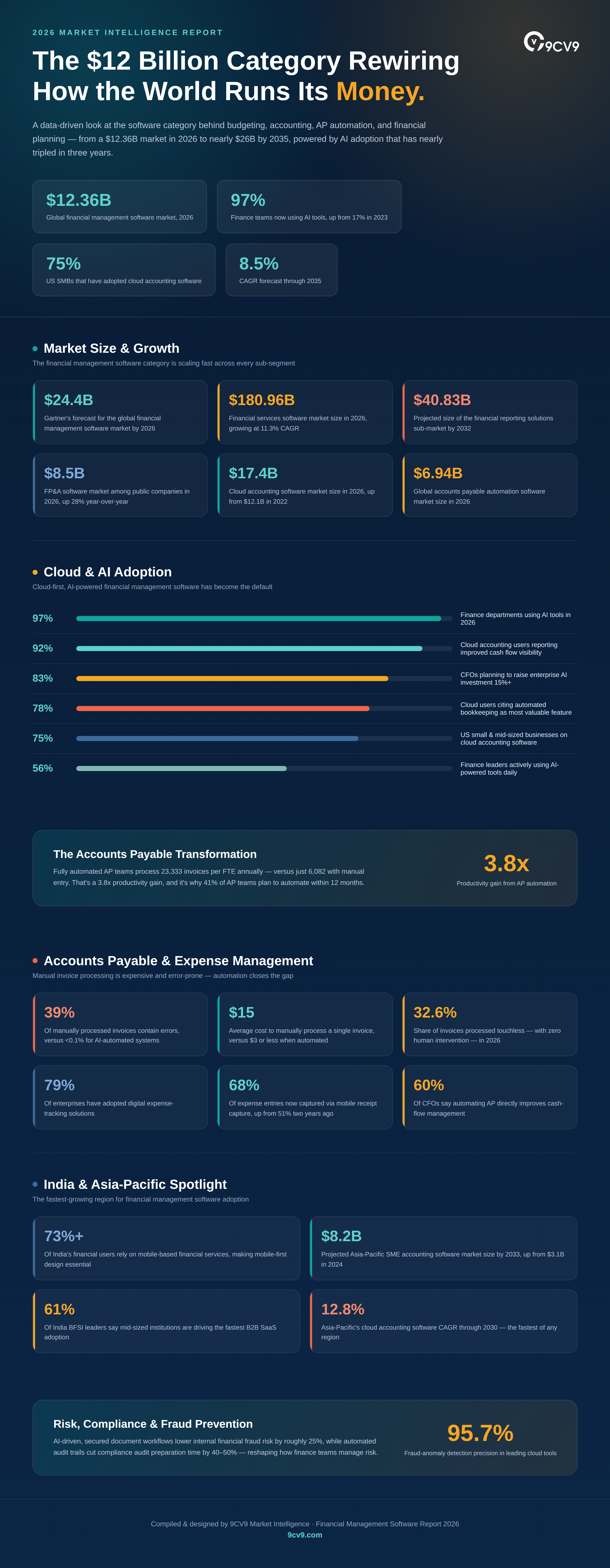
Cloud-based financial management software is also reshaping how organizations manage their finances. Research estimates indicate that 75% of US small and medium-sized businesses have adopted cloud accounting software, while 92% of surveyed cloud accounting users reported improvements in cash flow management. The growing popularity of subscription-based financial platforms, mobile accounting applications, and integrated financial dashboards highlights the increasing demand for accessible, scalable, and cost-effective financial management solutions.
Beyond accounting and financial reporting, automation is transforming critical business functions such as accounts payable, expense management, budgeting, forecasting, and financial risk management. Industry benchmarks suggest that automated invoice processing can reduce costs from approximately $15 per invoice to $3 or less, while mature accounts payable automation can deliver substantial improvements in productivity and processing speed. These developments demonstrate why organizations are prioritizing financial management technologies that reduce manual workloads, minimize errors, and support faster financial decision-making.
Regional adoption patterns further illustrate the industry’s expanding global opportunities. North America remains a major market for enterprise financial software, while Asia-Pacific is emerging as a high-growth region, supported by increasing cloud adoption, business digitalization, and growing demand for financial technology among small and medium-sized enterprises. In particular, India’s expanding SaaS ecosystem and the rapid adoption of mobile financial services are creating new opportunities for financial management software providers.
As organizations prepare for increasingly complex financial environments, understanding the latest financial management software statistics, market size, adoption rates, industry trends, and growth forecasts for 2026 is essential for business leaders, chief financial officers (CFOs), finance professionals, software vendors, and technology investors.
This comprehensive guide explores the Top 122 Financial Management Software Statistics, Data & Trends in 2026, covering global market growth, cloud accounting adoption, AI-powered financial automation, accounts payable efficiency, financial planning and analysis (FP&A), expense management, regional market developments, and financial risk management.
By examining these statistics and emerging trends, businesses can gain valuable insights into how financial management technology is evolving, identify opportunities for operational improvement, evaluate software investment priorities, and develop more effective financial strategies for 2026 and beyond.
Top 122 Financial Management Software Statistics, Data & Trends in 2026
Market Size & Growth
- The global financial management software market is valued at approximately $12.36 billion in 2026 and is projected to reach $25.9 billion by 2035 at an 8.5% CAGR — proof that financial management software adoption is accelerating worldwide as businesses digitize core finance operations.
- At the segment level, financial management software is projected to rise from $14.77 billion (2025) to $16.2 billion in 2026, while enterprise-grade financial management software alone is on track to reach $26.35 billion by 2030, reflecting sustained enterprise demand for integrated financial control systems.
- Gartner forecasts the global financial management software market will hit $24.4 billion by 2026, underscoring how mainstream financial software has become for B2B software buyers across every industry.
- The financial reporting solutions sub-segment of financial management software is expected to grow to $40.83 billion by 2032 at a 13.77% CAGR, highlighting compliance-driven demand for automated reporting tools.
- The US financial management software market was worth $8.4 billion in 2024 and is expected to grow to $15.3 billion by 2033, driven by regulatory mandates like Sarbanes-Oxley and Dodd-Frank that require sophisticated financial controls.
- China’s financial management software market was valued at $4.8 billion in 2024 and is forecast to reach $9.4 billion by 2033, fueled by rapid enterprise digitalization and fintech-friendly government policy.
- The broader financial services software market is expected to grow from $162.59 billion in 2025 to $180.96 billion in 2026, a strong 11.3% CAGR reflecting banking digitization and rising online transaction volumes.
- Some analysts project the financial services software market will reach $248.94 billion by 2029 at an 11.2% CAGR, signaling long-term structural growth in fintech software spend.
- The wider financial software market — spanning accounting, treasury, and risk platforms — is already valued at over $156 billion in 2026, growing 9–17% annually depending on the sub-segment.
- The global accounting software market is estimated at $16.97 billion in 2026, expected to reach $33.52 billion by 2035 at a 7.86% CAGR, as automated bookkeeping becomes the industry standard.
- Cloud accounting software spending reached $5.36 billion in 2025, up from $4.9 billion in 2024 — a clear signal that businesses are rapidly shifting budgets toward subscription-based financial tools.
- Cloud accounting software is forecast to reach about $17.4 billion in 2026, up sharply from $12.1 billion in 2022, showing how quickly finance workflows have moved online.
- The global cloud accounting software market stood at $5.09 billion in 2024 and is projected to reach $12.44 billion by 2033 at a 10.46% CAGR.
- The cloud accounting service market was worth $6,097.5 million in 2026 and is projected to touch $14,979.32 million by 2035 at an 8.4% CAGR.
- The personal finance software market was valued at $1.35 billion in 2025 and is projected to grow to $2.57 billion by 2034 at a 7.6% CAGR, as consumers demand better budgeting tools.
- Budgeting software dominates the personal finance software market, accounting for 30.77% of global share in 2026 — the single largest functional category for individual financial management tools.
- Estimates for the financial risk management software market in 2026 range from $2.36 billion to $4.79 billion, depending on methodology, with most analysts agreeing on double-digit long-term CAGR growth.
- One projection has the global financial risk management software market growing from $4.79 billion in 2026 to $13.31 billion by 2034 at a 13.60% CAGR.
- Another estimate places the 2026 industry size for financial risk management software at $4.51 billion, en route to $14.74 billion by 2035 at a 13.9% CAGR.
- The FP&A (financial planning & analysis) software market among publicly traded companies is projected to reach nearly $8.5 billion in 2026, growing 28% year-over-year — one of the fastest-growing segments in financial management software.
- A separate FP&A market forecast pegs growth from $3.9 billion (2024) to $9.7 billion by 2032 at a 16.4% CAGR, reflecting demand for real-time forecasting over static annual budgets.
- The budgeting and forecasting software market was worth $5.7 billion in 2024 and is forecast to reach $12.4 billion by 2033 at a 9.3% CAGR.
- The expense management software market is estimated at $4.89 billion in 2026, growing to $9.28 billion by 2035 at a 7.4% CAGR.
- A higher estimate places the expense management software market at $8.48 billion in 2026, projected to hit $13.82 billion by 2031 at a 10.10% CAGR.
- Spherical Insights projects the expense management software market will surge from $7.95 billion (2025) to $21.18 billion by 2035 at a 10.3% CAGR.
- India’s accounting software market generated $698.87 million in revenue in 2025 and is projected to reach $1,496.95 million by 2034 at an 8.83% CAGR, driven by GST-compliant tooling and SME formalization.
- The accounts payable (AP) automation software market is valued at $6.94 billion in 2026, projected to reach $12.46 billion by 2031 at a 12.44% CAGR.
- A competing estimate values the AP automation software market at approximately $7.95 billion in 2026 at a 13.9% CAGR.
- The AI-in-finance market overall is estimated at $38.36 billion in 2024, rising to $190.33 billion by 2030 at a striking 30.6% CAGR — one of the fastest-growing technology categories touching financial management software.
- Enterprise accounting and financial reporting integrated with ERP systems are used in more than 83% of global multinational deployments for consolidated reporting, reflecting how large enterprises rely on unified financial platforms.
Cloud & SaaS Adoption
- 61% of small businesses already run more than 40% of their operations in the cloud, a milestone that shows cloud-first financial management is now the norm rather than the exception.
- 75% of US small and mid-sized businesses have adopted cloud accounting software, moving decisively away from spreadsheets and legacy desktop tools.
- SMEs account for a 61% share of the cloud accounting software market, confirming that small-business needs are the primary driver of product development in financial management software.
- Around 70% of small and medium businesses globally have adopted accounting software of some kind, a sign of near-universal digital financial record-keeping.
- 78% of cloud accounting users cite automated bookkeeping as the single most valuable feature driving their choice of financial management software.
- Cloud-based accounting platforms now serve over 175 million users worldwide, offering real-time financial tracking that was unimaginable a decade ago.
- 73% of accounting firms now use cloud accounting tools to serve clients, a sharp rise from the on-premise norm of the past.
- 92% of cloud accounting users report improved cash flow management after switching to cloud-based financial management software.
- QuickBooks commands an estimated 60%+ share of the US domestic accounting software market, making it the dominant financial management platform for American small businesses.
- Over 62% of small-to-medium enterprises have shifted to cloud-based accounting platforms specifically to streamline financial operations.
- The adoption rate of mobile-accessible accounting tools has increased by 48%, as finance teams demand anywhere, anytime access to financial data.
- Regional cloud accounting adoption breaks down as 63% in North America, 56% in Asia-Pacific, and 48% in Europe, showing North America’s continued lead in financial software maturity.
- AI-powered accounting tool implementation has risen by 52%, confirming that intelligent automation is now a core buying criterion for financial management software.
- 55% of enterprises now prefer flexible monthly subscription pricing over traditional perpetual licenses for their financial management software.
- The Asia-Pacific cloud accounting software market is projected to register the fastest CAGR of 12.8% through 2030, outpacing every other region.
AI & the Finance Function
- 97% of finance departments adopted AI tools in 2026, up sharply from 76% the prior year — one of the fastest technology-adoption curves ever recorded in corporate finance.
- AI automation is saving accountants an estimated 240 hours per year per professional, freeing finance teams for higher-value strategic work.
- 56% of finance leaders now use AI-powered tools in their daily work, double the adoption rate seen in 2023.
- Despite rapid growth, finance still ranks last among all business functions in AI deployment, trailing engineering, marketing, and customer success.
- 45% of finance teams remain in “limited pilot” mode with AI, while only 17% have moved AI into their core financial workflows.
- 68% of CFOs admit they’ve been slow to adopt AI because they simply don’t know where to start — a clear signal for financial management software vendors to prioritize onboarding support.
- ChatGPT leads finance AI usage with 35% of finance teams using it, ahead of dedicated finance-specific AI tools.
- AI deployment that is “broadly or fully embedded” in finance functions jumped to 42% in 2026, up 20 points from 22% in 2025.
- Overall AI adoption among investor-backed finance leaders reached 97% in 2026, a 23-point swing over just two years.
- 87% of finance leaders are hiring more finance staff even as AI scales — automation is augmenting, not replacing, finance teams.
- 76% of finance leaders expect AI ROI within 12 months, while just 3% remain skeptical of eventual payoff.
- 33% of finance leaders cite data quality as the top obstacle preventing broader AI deployment in financial management software.
- Nearly two-thirds (65%) of finance leaders can now complete their monthly close within nine days, though many still rely on labor-intensive manual processes.
- 91.9% of CFOs say they are already integrating AI into financial decision-making, either across some or virtually all processes.
- CFOs at VC-backed companies expect to spend a median of $50,000 on AI tools in 2026, more than double the prior year’s budget.
- 83% of CFOs plan to raise enterprise AI investment by more than 15% over the next two years, with 42% planning increases above 30%.
- Only 31% of CFOs rate AI outcomes in finance as “strongly positive” so far, showing the technology’s promise still outpaces measured results.
- When CFOs describe their biggest AI win, speed and cycle-time reduction leads at 48%, ahead of headcount or cost savings at 34%.
- Deloitte’s Finance Trends 2026 study finds 63% of finance departments are actively using AI solutions in production.
- 87% of large-company CFOs expect AI to be “very” or “extremely” important to their finance operations in 2026.
- Gartner’s 2025 survey found AI adoption in finance has plateaued at 59%, nearly identical to 58% in 2024, after a sharp jump from 37% in 2023.
- Small business AI adoption reached 55–58% in 2025, up from just 39–40% in 2024 — SMBs are catching up to enterprises fast.
- 46% of accountants now use AI every day, according to Intuit QuickBooks research, though only 37% of firms formally invest in AI training.
- Firms that invest in AI training for finance staff unlock roughly seven extra weeks of capacity per employee per year.
- Gartner predicts at least 15% of day-to-day finance work decisions will be made autonomously by AI by 2028, though 40%+ of agentic AI projects are expected to be cancelled by 2027 due to unclear value.
Accounts Payable & Invoice Automation
- A fully automated accounts payable system enables one FTE to process 23,333 invoices per year, versus just 6,082 manually — a 3.8x productivity gain from the same headcount.
- 66% of businesses still use Excel spreadsheets to track AP metrics and KPIs, revealing a massive gap between available automation and actual practice.
- The average cost of manually processing an invoice is $15, compared to $3 or less with automated financial management software.
- 68% of AP teams still manually key invoice data into their ERP or accounting software, despite mature automation options being available.
- Only 20% of AP teams are fully automated today, though 41% plan to automate their payables processes within the next 12 months.
- 39% of manually processed invoices contain errors, ranging from incorrect amounts to misrouted approvals.
- AI-automated invoice processing achieves error rates below 0.1%, a roughly 390x improvement in accuracy over manual entry.
- 29% of enterprises require six or more approvals for invoice processing, extending approval cycles to three weeks or longer.
- Only 21% of US small and mid-sized firms have connected their accounting system with payments and invoicing tools.
- Manual, repetitive tasks consume 84% of the average AP practitioner’s time, according to IOFM benchmark data.
- Just 32.6% of invoices are processed “touchless” — without any human intervention — despite most finance leaders wanting far higher rates.
- Best-in-class AP teams have pushed touchless processing to 49.2% of invoice volume, according to Quadient’s 2025 benchmark.
- Manual invoice processing typically costs $12.88–$19.83 per invoice, once labor, errors, and delays are factored in.
- Automating accounts payable can reduce processing costs by up to 80%, one of the clearest ROI cases in financial management software.
- 60% of CFOs report that automating AP improves cash-flow management, directly linking automation investment to liquidity outcomes.
- 75% of suppliers prefer electronic invoicing over paper, adding commercial pressure on buyers to modernize their AP stack.
- Cloud-based solutions are expected to hold around 60% of the AP automation market in 2026, the fastest-growing deployment model.
- Only 7% of AP processes currently use AI, but 40% of businesses plan to adopt AI-driven AP tools within 2026.
- Businesses that automate AP report a 50% reduction in invoice processing time on average.
- Duplicate payments occur in roughly 2% of manually processed invoices, representing significant recoverable overpayment risk for large payables teams.
- North American organizations account for 33.2% of the global AP automation market, the largest regional share.
- Organizations with mature AP automation achieve a 3.5x improvement in AP productivity and 59% faster AP cycle times compared to manual peers.
FP&A, Budgeting & Forecasting
- Large enterprises currently hold a 60% share of the budgeting and forecasting software market, though SMEs are projected to reach 40% share by 2027 as affordable cloud tools spread.
- Documented case studies show FP&A software cutting budget finalization time from 45 days to just 3 days.
- Finance teams using modern FP&A platforms have cut budget cycles by 50% and reduced manual data entry by 80%.
- Cloud-based FP&A solutions dominate the market due to their scalability advantage over on-premise planning tools.
Expense Management
- Approximately 79% of enterprises have adopted digital expense-tracking solutions to streamline financial operations.
- 72% of organizations have automated expense reporting, cutting manual errors by 43% in the process.
- 68% of businesses integrate expense management systems with their accounting and ERP platforms for a unified financial view.
- 64% of companies use mobile-based expense-tracking apps, reflecting the mobile-first shift across financial management software.
- 59% of businesses rely on AI-powered tools for expense fraud detection, a growing use case for machine learning in finance.
- SAP Concur alone captured 49.6% of travel-and-expense software revenue in 2024, the dominant player in this category.
- Mobile receipt capture now accounts for 68% of all expense entries, up from 51% just two years earlier.
- Organizations report a 72% reduction in manual data-entry time after implementing automated expense workflows.
- Cloud-hosted expense management deployments represent 76% of all implementations globally, versus 24% on-premise or hybrid.
- The expense management software category now handles more than 1.3 billion transactions annually across 62,000+ enterprise deployments.
India & Asia-Pacific
- Over 73% of India’s financial users rely on mobile-based financial services, making mobile-first design essential for financial management software sold into the Indian market.
- 61% of India’s BFSI survey respondents say mid-sized financial institutions are driving the fastest B2B SaaS adoption in the sector.
- 57% believe B2B SaaS will significantly catalyze growth for India’s MSME segment specifically, through automated invoicing and compliance.
- 40% of India BFSI respondents cite data security and privacy as their single biggest technology adoption challenge.
- The Asia-Pacific SME accounting software market was worth $3.1 billion in 2024 and is projected to reach $8.2 billion by 2033 at an 11.2% CAGR.
- India’s broader SaaS market — including vertical finance and accounting tools — reached $50 billion-plus in ARR in 2025.
- The Asia-Pacific cloud accounting software market is set to grow at the fastest CAGR of any region (12.8%) through 2030.
- The Asia-Pacific personal finance software market accounted for $0.28 billion in 2025 (20.9% of global share), projected to reach $0.31 billion in 2026.
Risk, Compliance & Fraud Prevention
- More than 45% of financial risk management software demand is driven by financial institutions prioritizing integrated, real-time risk platforms.
- Over 30% of financial risk management software adoption is linked to AI-enabled risk modules that improve decision accuracy by more than 20%.
- The cloud segment is expected to capture 71.02% of the financial risk management software market in 2026.
- Large enterprises hold 52.22% share of the financial risk management software market in 2026, though SMEs are the fastest-growing segment.
- North America holds between 35.6% and 48.1% of the global financial risk management software market, the largest regional share.
- AI-driven, secured document workflows can lower internal financial fraud risk by about 25% compared to manual processes.
- Automated audit trails embedded in modern financial management software can reduce compliance audit preparation time by 40–50%.
- Leading cloud accounting platforms now use machine learning to detect fraud anomalies with 95.7% precision.
Conclusion
The financial management software industry is entering a transformative period in 2026, driven by rapid advancements in artificial intelligence, cloud computing, financial automation, and data-driven decision-making. As businesses face increasing pressure to improve financial accuracy, reduce operational costs, strengthen regulatory compliance, and maintain financial visibility, modern financial management software has become an essential investment for organizations of all sizes.
The Top 122 Financial Management Software Statistics, Data & Trends in 2026 highlight an industry experiencing sustained growth across multiple technology segments. With the global financial management software market estimated at approximately $12.36 billion in 2026 and projected to reach $25.9 billion by 2035, the demand for integrated financial solutions is expected to remain strong. Growth in accounting software, financial planning and analysis (FP&A), expense management, accounts payable automation, and financial risk management further demonstrates the expanding role of financial technology in modern business operations.
One of the most significant developments shaping the industry is the increasing adoption of AI-powered financial management software. Research included in this report indicates that 97% of surveyed investor-backed finance leaders have adopted AI tools, while 76% expect to achieve a return on their AI investments within 12 months. These findings suggest that artificial intelligence is becoming an increasingly important component of financial operations, enabling organizations to automate repetitive processes, improve forecasting accuracy, identify financial anomalies, and accelerate strategic decision-making.
However, widespread AI adoption does not necessarily translate into immediate business value. Challenges involving data quality, system integration, cybersecurity, implementation complexity, and workforce readiness remain important considerations. Organizations that combine AI capabilities with strong financial governance, reliable data infrastructure, and employee training are likely to achieve more sustainable improvements in financial performance.
The continued expansion of cloud-based financial management software represents another defining trend in 2026. With an estimated 75% of US small and medium-sized businesses adopting cloud accounting solutions, organizations are increasingly prioritizing financial platforms that provide real-time reporting, remote accessibility, automated workflows, and seamless integration with enterprise systems. Cloud-based solutions are also making sophisticated financial management capabilities more accessible to smaller businesses that previously relied on spreadsheets and manual accounting processes.
Financial automation is delivering measurable operational benefits, particularly in accounts payable and expense management. Industry benchmarks indicate that automated invoice processing can reduce per-invoice costs from approximately $15 to $3 or less, while mature accounts payable automation can significantly improve processing productivity and cycle times. These efficiency gains reinforce the business case for investing in financial management technologies that minimize manual intervention, reduce errors, and improve cash flow visibility.
From a regional perspective, North America continues to represent a major market for financial management software, while Asia-Pacific is emerging as an important growth opportunity. Increasing digital transformation investments, expanding SaaS adoption, and the growing financial technology needs of small and medium-sized enterprises are supporting demand across markets such as India, China, and other developing economies.
Looking ahead, the future of financial management software will increasingly be shaped by intelligent automation, predictive financial analytics, integrated cloud ecosystems, mobile accessibility, and stronger financial risk controls. Businesses will likely place greater emphasis on platforms that connect accounting, budgeting, forecasting, expense tracking, compliance, and financial reporting within unified digital environments.
For CFOs, finance directors, business owners, technology providers, and investors, these financial management software statistics offer valuable insights into evolving market opportunities and technology investment priorities. Selecting the right financial management solution will require organizations to evaluate not only software functionality and implementation costs but also scalability, security, integration capabilities, automation potential, and long-term return on investment.
Ultimately, the financial management software trends of 2026 demonstrate that the industry is moving beyond traditional bookkeeping and financial record-keeping toward more intelligent, automated, and strategically integrated financial operations. Organizations that successfully embrace these developments will be better positioned to improve operational efficiency, strengthen financial resilience, respond to changing market conditions, and support sustainable business growth.
As financial technology continues to evolve, businesses that prioritize digital transformation, invest in reliable financial management systems, and develop data-driven financial strategies will be better equipped to navigate the increasingly complex financial landscape of 2026 and beyond.
leave a nice comment below?
We, at the 9cv9 Research Team, strive to bring the latest and most meaningful data, guides, and statistics to your doorstep.
To get access to top-quality guides, click over to 9cv9 Blog.
To hire top talents using our modern AI-powered recruitment agency, find out more at 9cv9 Modern AI-Powered Recruitment Agency.
People Also Ask
What is financial management software?
Financial management software is a digital solution that helps businesses manage accounting, budgeting, financial reporting, cash flow, expenses, and forecasting. It improves financial accuracy, automates routine tasks, and supports informed business decisions.
What is the global financial management software market size in 2026?
The global financial management software market is estimated at approximately $12.36 billion in 2026, with projections indicating continued growth as businesses adopt cloud accounting, AI-powered automation, and integrated financial platforms.
How fast is the financial management software market growing?
The global financial management software market is projected to grow at a compound annual growth rate (CAGR) of 8.5%, reaching approximately $25.9 billion by 2035, according to one market forecast.
What are the biggest financial management software trends in 2026?
Major trends include AI-powered accounting, cloud-based financial platforms, automated financial reporting, predictive analytics, real-time cash flow monitoring, mobile accounting applications, and integrated expense management systems.
How is artificial intelligence transforming financial management software?
AI transforms financial management software by automating bookkeeping, improving financial forecasting, detecting anomalies, accelerating invoice processing, and generating financial insights that support faster business decisions.
What percentage of finance departments use AI in 2026?
One 2026 estimate indicates that 97% of finance departments have adopted AI tools, up from 76% in the previous year. Adoption varies by survey population, with many organizations still testing AI before integrating it into core financial workflows.
What are the benefits of cloud-based financial management software?
Cloud financial management software provides real-time financial visibility, remote accessibility, automated updates, scalable infrastructure, and easier integration with business applications. It also reduces dependence on traditional desktop accounting systems.
What percentage of small businesses use cloud accounting software?
Approximately 75% of US small and medium-sized businesses have adopted cloud accounting software, reflecting growing demand for accessible, subscription-based financial management solutions.
How big is the cloud accounting software market in 2026?
Market estimates vary by definition and methodology. One forecast values cloud accounting services at approximately $6.1 billion in 2026, while broader cloud accounting software estimates indicate significantly larger market opportunities.
What is the accounting software market forecast for 2035?
The global accounting software market is estimated at $16.97 billion in 2026 and projected to reach $33.52 billion by 2035, representing a compound annual growth rate of approximately 7.86%.
How does financial management software improve business efficiency?
Financial management software improves efficiency by automating repetitive accounting tasks, reducing manual data entry, accelerating financial reporting, simplifying invoice approvals, and providing real-time visibility into financial performance.
How much time can AI accounting software save?
AI-powered accounting automation is estimated to save accountants approximately 240 hours annually per professional. These savings allow finance teams to spend more time on financial analysis, strategic planning, and business advisory activities.
What is accounts payable automation software?
Accounts payable automation software digitizes invoice capture, approval workflows, payment processing, and financial record-keeping. It reduces manual workloads, minimizes processing errors, and improves financial control.
How much does automated invoice processing cost?
Automated invoice processing can cost $3 or less per invoice, compared with approximately $15 for manual processing. Actual costs depend on transaction volume, software capabilities, implementation expenses, and workflow complexity.
How much can accounts payable automation reduce costs?
Accounts payable automation can reduce invoice processing costs by up to 80%. Savings typically result from reduced manual data entry, fewer processing errors, faster approvals, and improved operational productivity.
What percentage of accounts payable teams are fully automated?
Approximately 20% of accounts payable teams are fully automated, while 41% plan to automate their payables processes within the following 12 months, highlighting significant opportunities for financial workflow modernization.
What is the financial planning and analysis software market size in 2026?
One estimate projects the FP&A software market among publicly traded companies to reach nearly $8.5 billion in 2026, representing 28% year-over-year growth as businesses prioritize advanced budgeting and forecasting capabilities.
How does FP&A software improve financial forecasting?
FP&A software improves forecasting by consolidating financial data, automating budget calculations, supporting scenario planning, and enabling real-time performance analysis. These capabilities help finance teams respond to changing business conditions.
What is the expense management software market size in 2026?
One market forecast values the global expense management software market at approximately $4.89 billion in 2026, with projected growth to $9.28 billion by 2035. Other forecasts report higher estimates due to differing market definitions.
What percentage of businesses use digital expense management software?
Approximately 79% of enterprises have adopted digital expense-tracking solutions. These platforms help organizations automate expense reporting, improve spending visibility, and strengthen financial policy compliance.
How does expense management automation reduce financial errors?
Expense management automation reduces errors through digital receipt capture, automated data extraction, policy validation, and accounting system integration. Research estimates indicate that automated expense reporting can reduce manual errors by 43%.
What percentage of businesses use mobile expense management apps?
Approximately 64% of companies use mobile-based expense-tracking applications. Mobile solutions allow employees to capture receipts, submit expenses, and monitor reimbursements without relying on desktop accounting systems.
What is the financial risk management software market size in 2026?
Estimates place the global financial risk management software market between $2.36 billion and $4.79 billion in 2026. Differences reflect varying market definitions, research methodologies, and software categories.
How does financial management software help prevent fraud?
Financial management software helps prevent fraud through automated transaction monitoring, anomaly detection, approval controls, audit trails, and AI-powered risk analysis. These capabilities improve financial transparency and identify suspicious activities.
What are the biggest challenges in adopting AI financial management software?
Major challenges include poor data quality, cybersecurity concerns, integration complexity, implementation costs, limited employee expertise, and uncertain returns on investment. Around 33% of surveyed finance leaders identify data quality as their leading obstacle.
What percentage of CFOs plan to increase AI investments?
Approximately 83% of surveyed CFOs plan to increase enterprise AI investments by more than 15% over the next two years, while 42% anticipate increases exceeding 30%.
Which region has the fastest-growing cloud accounting software market?
Asia-Pacific is projected to experience the fastest cloud accounting software market growth, with an estimated CAGR of 12.8% through 2030, supported by business digitalization and growing adoption among small and medium-sized enterprises.
How is financial management software adoption growing in India?
India’s financial management software adoption is supported by expanding SaaS infrastructure, mobile financial services, and digital accounting requirements. Its accounting software market is projected to grow from $698.87 million in 2025 to $1.50 billion by 2034.
What should businesses consider when choosing financial management software in 2026?
Businesses should evaluate accounting features, automation capabilities, cloud accessibility, cybersecurity, integration options, scalability, regulatory compliance, pricing, and reporting functionality when selecting financial management software.
What is the future of financial management software beyond 2026?
Financial management software will increasingly emphasize AI-driven automation, predictive analytics, real-time reporting, integrated financial platforms, and stronger risk controls. These developments are expected to improve financial efficiency and strategic decision-making.
Sources
- Business Research Insights
- Straits Research
- Custom Market Insights
- Fortune Business Insights
- Verified Market Reports
- DataHorizzon Research
- Global Growth Insights
- Gartner
- Mordor Intelligence
- Market.us
- DocuClipper
- Grand View Research
- Dimension Market Research
- Ramp
- Vic.ai
- Consero
- Bain & Company
- Deloitte
- CFO
- Quadient
- Institute of Finance and Management (IOFM)
- Tipalti
- Beancount
- Factura
- FP&A Trends
- Abacum
- Datarails
- Zinnov
- NASSCOM
- Precedence Research
- Spherical Insights
- SkyQuest