Key Takeaways
- ERM Software Market Growth: The global Enterprise Risk Management (ERM) software market is projected to reach $6.33 billion in 2026 and $12 billion by 2030, driven by regulatory compliance, cybersecurity risks, and digital transformation.
- AI and Cloud-Based ERM Adoption: Approximately 74% of organizations are investing in AI-powered risk management, while cloud-based GRC platforms account for around 65% of deployments, accelerating automation and predictive risk analytics.
- ERM Software ROI and Future Trends: Integrated risk management solutions can deliver up to 280% ROI over three years, while AI governance, compliance automation, third-party risk management, and real-time risk monitoring are shaping enterprise risk management trends in 2026.
Enterprise Risk Management (ERM) software helps businesses identify, assess, and manage financial, operational, cybersecurity, and compliance risks. In 2026, the global ERM software market is projected to reach $6.33 billion, with forecasts of $12 billion by 2030. Key trends include AI-powered risk assessment, cloud adoption, compliance automation, and real-time risk monitoring.
Enterprise Risk Management (ERM) software has become an essential component of modern business operations as organizations navigate increasingly complex financial, operational, cybersecurity, regulatory, and technological risks. In 2026, businesses are investing in advanced ERM solutions to strengthen risk visibility, automate compliance processes, improve decision-making, and build organizational resilience in an unpredictable global environment.
Also, read our article on the Top 10 Enterprise Risk Management Software (ERM) To Try.

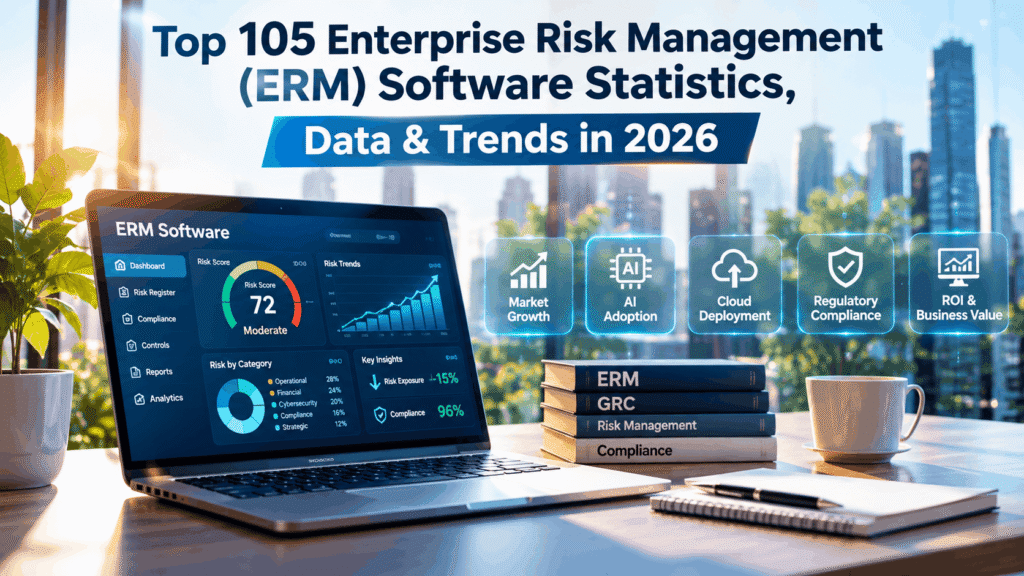
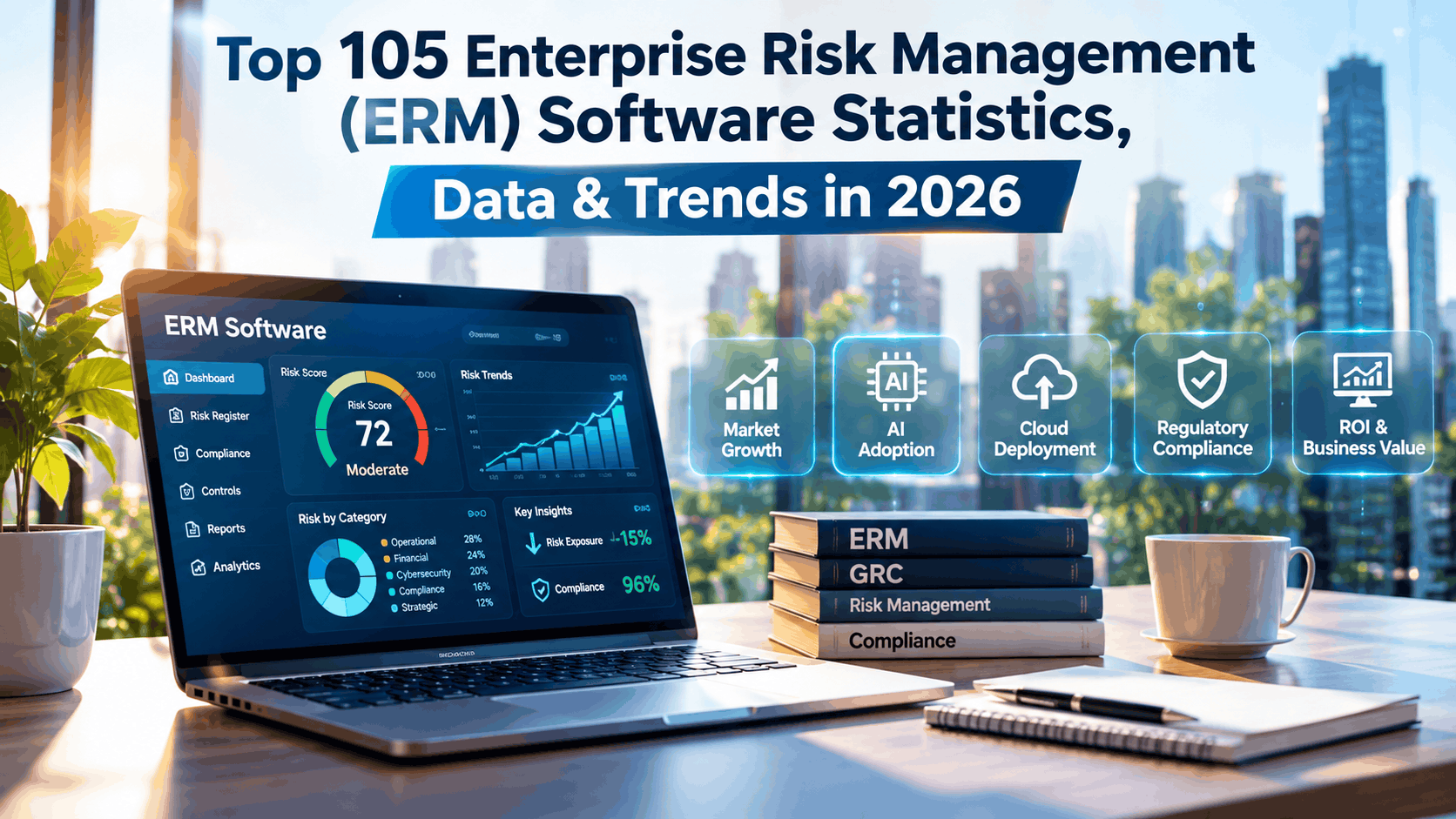
The global Enterprise Risk Management software market was valued at approximately $5.94 billion in 2025 and is projected to reach $6.33 billion in 2026, with forecasts suggesting the market could expand to $12 billion by 2030. Meanwhile, the broader enterprise Governance, Risk, and Compliance (eGRC) market is expected to reach $82.93 billion in 2026, highlighting the growing importance of integrated risk management technologies across industries.
One of the most significant enterprise risk management trends in 2026 is the rapid adoption of artificial intelligence (AI), machine learning, predictive analytics, and cloud-based risk management platforms. According to industry research, 74% of organizations are actively investing in AI and generative AI capabilities for risk management, yet only 6% currently use AI to assist with identifying risks. This substantial gap between investment and practical implementation presents opportunities for ERM software providers to deliver more intelligent, automated, and proactive risk management capabilities.


Cloud adoption is also transforming the enterprise risk management software landscape. Cloud-based GRC platforms accounted for approximately 65% of deployments in 2025, reflecting growing demand for scalable, accessible, and integrated risk management solutions. However, 59% of organizations still rely on spreadsheets to manage their ERM programs, while only 21% have implemented dedicated GRC platforms. These figures demonstrate the considerable potential for digital transformation as businesses transition from fragmented manual processes to centralized enterprise risk management systems.
Industry-specific adoption is another major driver of ERM software market growth. Banking, financial services, and insurance (BFSI), healthcare, information technology, telecommunications, manufacturing, and energy organizations are increasingly adopting sophisticated risk management platforms to address regulatory obligations, cybersecurity threats, operational disruptions, and third-party vulnerabilities. At the same time, emerging regulatory frameworks, including the EU AI Act, Digital Operational Resilience Act (DORA), and evolving cybersecurity disclosure requirements, are encouraging organizations to strengthen their governance and compliance capabilities.
Beyond regulatory compliance, enterprise risk management software is increasingly recognized as a strategic investment capable of generating measurable business value. Research cited in the industry indicates that integrated risk management deployments can deliver a 280% return on investment over three years, while automated evidence collection can reduce compliance preparation time by up to 60%. These potential efficiency gains reinforce the business case for adopting modern ERM platforms, although actual results depend on implementation scope, organizational maturity, and technology integration.
Looking ahead, enterprise risk management software trends in 2026 are increasingly shaped by AI governance, agentic AI, continuous risk monitoring, third-party risk management, cybersecurity resilience, and real-time regulatory intelligence. As organizations introduce more autonomous AI systems and interconnected digital infrastructure, effective risk management will require greater visibility, stronger governance frameworks, and more sophisticated analytical capabilities.
This comprehensive guide explores the top 105 Enterprise Risk Management (ERM) software statistics, data, and trends in 2026, covering global market size, growth forecasts, regional adoption, industry-specific demand, AI integration, cloud deployment, implementation challenges, return on investment, and emerging regulatory developments. These insights provide business leaders, chief risk officers, compliance professionals, IT decision-makers, and software vendors with a data-driven understanding of the evolving ERM software market and the technologies shaping the future of enterprise risk management.
Before we venture further into this article, we would like to share who we are and what we do.
About 9cv9
9cv9 is a business tech startup based in Singapore and Asia, with a strong presence all over the world.
With over ten years of startup and business experience, and being highly involved in connecting with thousands of companies and startups, the 9cv9 team has listed some of the top and best companies/tools in this review.
If you like to get your company listed in our top B2B software reviews, check out our world-class 9cv9 Media and PR service and pricing plans here.
Top 105 Enterprise Risk Management (ERM) Software Statistics, Data & Trends in 2026
🏦 MARKET SIZE & GROWTH
- The global Enterprise Risk Management (ERM) software market (narrow definition) was valued at $5.94 billion in 2025, underscoring the segment’s rapid institutionalization across regulated industries. (MarketsandMarkets)
- The ERM software market is projected to reach $6.33 billion in 2026, continuing a strong compound annual expansion driven by regulatory complexity and AI-powered risk tools. (MarketsandMarkets)
- The ERM market is forecast to hit $12 billion by 2030 at a CAGR of 14.8%, making it one of the fastest-growing segments in enterprise software. (MarketsandMarkets)
- The broader enterprise Governance, Risk & Compliance (eGRC) market was valued at $72.42 billion in 2025, reflecting enormous enterprise investment in integrated risk governance platforms. (Grand View Research)
- The eGRC market is projected to reach $82.93 billion in 2026, on a trajectory driven by regulatory expansion, ESG mandates, and digital transformation risks. (Grand View Research)
- By 2033, the eGRC market is expected to reach $203.65 billion, growing at a 13.7% CAGR — positioning ERM software as core enterprise infrastructure. (Grand View Research)
- The GRC Platforms market stood at $51.43 billion in 2025, boosted by intensifying regulatory complexity and mandatory ESG disclosures. (Mordor Intelligence)
- The GRC Platforms market is expected to reach $56.73 billion in 2026 and $92.68 billion by 2031 at a 10.31% CAGR. (Mordor Intelligence)
- Mordor Intelligence estimates the Enterprise Governance Risk & Compliance (eGRC) market will grow from $21.04 billion in 2025 to $42.19 billion by 2031, at a 12.3% CAGR. (Mordor Intelligence)
- The global Governance, Compliance & Risk Management Software market is projected to reach $98.67 billion by 2030 at a 14.2% CAGR. (The Business Research Company)
- Fortune Business Insights pegs the global eGRC market at $49.85 billion in 2025, set to reach $129.45 billion by 2034 at a 10.8% CAGR. (Fortune Business Insights)
- Precedence Research estimates the GRC solutions market surpassed $16.20 billion in 2025, forecast to reach $53.08 billion by 2035 at a 12.6% CAGR. (Precedence Research)
🌍 REGIONAL BREAKDOWN
- North America held the largest regional share of the eGRC market — 34.8% in 2025 — driven by the SEC’s cybersecurity disclosure rules and mature enterprise IT budgets. (Mordor Intelligence)
- North America’s GRC Platforms market share was even larger at 40.85% in 2025, thanks to sophisticated regulatory frameworks and high enterprise adoption. (Mordor Intelligence)
- The U.S. eGRC market is projected to reach $17.62 billion in 2026, the largest single-country market globally. (Fortune Business Insights)
- North America’s eGRC market was estimated at $20.56 billion in 2025, capturing a 41% global share and projected to reach $23.44 billion in 2026. (Fortune Business Insights)
- Asia-Pacific is the fastest-growing region, with a projected 12.9% CAGR through 2031, driven by regulatory modernization and rapid digitization. (Mordor Intelligence)
- Asia-Pacific posted a 50% surge in AI risk management investments in 2023, reaching $3.2 billion — signaling an accelerating regional build-out. (Gitnux)
- The Asia-Pacific eGRC market reached $8.77 billion in 2025 (17.8% global share) and is projected to reach $10.14 billion in 2026. (Fortune Business Insights)
- Europe’s eGRC market growth is being driven by GDPR, CSRD, DORA, and expanded ESG disclosure mandates — making regulatory pressure the primary regional demand driver. (Grand View Research)
- Latin America held 4.1% of the global eGRC market in 2025, valued at $2.08 billion, projected to reach $2.34 billion in 2026. (Fortune Business Insights)
🏥 INDUSTRY VERTICAL ADOPTION
- Healthcare & Life Sciences commanded 34.25% of GRC revenue in 2025, driven by strict patient-safety norms, HIPAA, and FDA guidelines. (Mordor Intelligence)
- The BFSI sector is the fastest-growing vertical at a 12.7% CAGR through 2031, propelled by rising financial crime costs of $61 billion annually in North America alone. (Mordor Intelligence)
- BFSI led industry vertical revenue share in GRC Platforms with 24.88% in 2025. (Mordor Intelligence)
- Healthcare & Life Sciences are projected to grow at a 15.58% CAGR through 2031 — the highest among all verticals — due to data privacy and clinical governance mandates. (Mordor Intelligence)
- BFSI adoption of ERM exceeds 45%, driven by regulatory intensity, financial risk scrutiny, and stringent governance mandates. (Reanin Research)
- Healthcare ERM adoption surpasses 38%, intensifying as data governance, safety regulations, and quality-compliance tracking accelerate. (Reanin Research)
- The BFSI segment held a 25% share of the enterprise GRC solutions market in 2025. (Precedence Research)
- IT & Telecom is expected to register the highest CAGR within the ERM market due to continuous exposure to cyber threats, vendor risks, and evolving data protection regulations. (MarketsandMarkets)
- The IT & Telecom sector demonstrates a 38% risk management AI adoption rate — the highest sector-function figure across all industries. (High Peak Software)
- Manufacturing & Energy firms increasingly connect shop-floor IoT devices to GRC hubs, monitoring safety compliance in real time and linking findings to maintenance tickets. (Mordor Intelligence)
- The cyber risk management segment is expected to grow at the highest CAGR, fueled by ransomware incidents, cloud vulnerabilities, and digital fraud. (MarketsandMarkets)
🤖 AI & TECHNOLOGY INTEGRATION
- 74% of organizations are actively investing in AI/GenAI capabilities for risk management, allocating an average of 36% of digital initiative budgets to AI technologies. (Deloitte 2025 Tech Value Survey)
- Despite heavy AI investment, only 6% of organizations currently use AI to assist in identifying risks — exposing a massive execution gap. (IIA’s 2025 Enhanced ERM Study)
- AI reduces manual risk assessment time by 76%, yielding an average of $2.5 million in annual savings per enterprise. (Gitnux 2026)
- 80% of North American firms have achieved AI penetration in enterprise risk management systems — the highest concentration globally. (Gitnux 2026)
- By 2025, 90% of large banks were expected to use AI for real-time fraud detection in risk management processes. (Gitnux 2026)
- AI fraud detection systems reduced losses by 40%, saving $1.2 billion annually across the top 50 banks globally. (Gitnux 2026)
- Generative AI models now interpret regulations with 95% accuracy and cut compliance false positives by 42%. (Mordor Intelligence)
- AI adoption in risk management is growing at an estimated annual rate of 35%, among the fastest-growing enterprise AI use cases. (Precedence Research)
- Enterprise spending on AI governance, compliance, and risk management tools reached $2.8 billion in 2025, projected to triple by 2028. (IDC, via Medhacloud)
- Machine learning comprises 45% of AI applications in credit risk scoring, achieving 92% accuracy using neural networks. (Gitnux 2026)
- Natural Language Processing (NLP) analyzes 80% of unstructured data for compliance risk detection in real time. (Gitnux 2026)
- AI-driven liquidity risk management enhanced capital efficiency by 18%, freeing $3 billion industry-wide. (Gitnux 2026)
- By 2027, 85% of enterprises will use AI for hyper-personalized risk strategies. (Gitnux 2026)
- Multimodal AI integrating text and video for risk assessment is set to dominate 65% of the market by 2026. (Gitnux 2026)
- AI Ethics Officers are expected in 70% of risk functions by 2026, reflecting the governance response to AI proliferation in ERM. (Gitnux 2026)
- AI implementations in credit risk delivered 15–20% ROI within the first year for 64% of banks. (Gitnux 2026)
- Supply chain AI risk tools saved 25% in disruption costs, equating to $10 million or more for manufacturers. (Gitnux 2026)
- Cyber risk AI tools prevented an average of $500,000 in breach costs per incident for 70% of adopters. (Gitnux 2026)
- Operational risk AI tools cut compliance costs by 30%, averaging $4.7 million in savings for large insurers. (Gitnux 2026)
- AI risk management software adoption in healthcare grew 35% in 2023, driven by compliance risk tools. (Gitnux 2026)
☁️ DEPLOYMENT MODELS & ADOPTION PATTERNS
- Cloud-based GRC platforms dominate with a 65% deployment share in 2025, with the segment expected to maintain leadership through the forecast period. (Precedence Research)
- Cloud solutions captured 66.88% of GRC Platform demand in 2025 and continue to outpace on-premises deployments. (Mordor Intelligence)
- Large enterprises held a 65% revenue share of the GRC solutions market in 2025, driven by complex regulatory requirements and global operations. (Precedence Research)
- The SME segment is expected to grow at a 14.5% CAGR from 2026–2035, as cloud-based GRC becomes more affordable and accessible. (Precedence Research)
- The software segment dominated eGRC with a 70% share in 2025, as enterprises shifted toward integrated platforms with real-time risk monitoring. (Precedence Research)
- Software solutions represent 66.72% of GRC revenue in 2025, with services growing at a 12.74% CAGR driven by demand for implementation expertise. (Mordor Intelligence)
- A striking 59% of organizations still rely on spreadsheets for ERM program management — despite the availability of purpose-built platforms. (IIA Foundation 2025)
- Only 21% of organizations have implemented dedicated GRC platforms, creating a major opportunity for early adopters to gain competitive risk intelligence advantages. (IIA Foundation 2025)
- Integrated ERM platforms deliver 25–50% reduction in implementation time compared to fragmented point solutions. (SAP CIO Trends 2025)
- Integrated platforms reduce maintenance overhead by up to 70% by eliminating the need for custom integration development. (SAP CIO Trends 2025)
- High implementation and legacy-system integration costs can add 40–60% to project budgets — the chief constraint cited by buyers. (Mordor Intelligence)
- Community banks deploying ERM modules can expect 60–120 days to a working state; mid-size firms running broader IRM suites commonly take 6–9 months. (360factors 2026)
- Nearly two-thirds of organizations use multiple GRC solutions, with some deploying five or more — creating integration challenges that unified platforms solve. (IDC Survey 2021)
💼 ROI & BUSINESS BENEFITS
- ERM software platforms deliver a documented 280% three-year ROI per Forrester Consulting research on integrated risk management deployments. (Forrester Consulting / Riskonnect)
- A Forrester-sponsored study identified $443,000 in savings from a single integrated risk solution, encompassing productivity gains and incident reduction. (ERM Academy / Forrester)
- 71% of firms with mature ERM credit their frameworks for mitigating adverse outcomes during crises — vs. just 37% of less mature peers. (BCG ESG & Risk Report 2023)
- Companies with strong risk cultures demonstrate 2.5× higher crisis-resilient response rates compared to those without structured ERM programs. (Precedence Research)
- Health-risk wellness programs embedded in ERM frameworks saw an ROI of $2.03 per dollar invested. (ERM Academy)
- Automated evidence collection in modern ERM platforms cuts compliance preparation time by up to 60% across SOC 2, ISO 27001, PCI DSS, HIPAA, and NIST CSF. (Akitra 2026)
- 52% of risk leaders agree that organizations with integrated risk identification, evaluation, and response approaches achieve reduced exposure and better outcomes. (Continuity2 / Capterra 2026)
- Organizations reporting ERM program value see improvements in controls, visibility, and faster mitigation — with platform ROI measurable within the first year. (Riskonnect 2026)
🔐 RISK LANDSCAPE & CHALLENGES
- Only 18% of ERM leaders express high confidence in their ability to identify emerging risks — a stark gap between expectation and execution capacity. (Gartner)
- Third-party involvement in data breaches doubled from 15% to 30% between 2023 and 2025 — making vendor risk management a critical ERM priority. (Verizon DBIR 2025)
- Risk leaders rated the current risk environment at 7.4 out of 10 in 2026 — a sharp increase from 5.8 in Q1 2025 — underscoring the urgency of ERM investment. (Diligent / GC Risk Index)
- Financial institutions must simultaneously comply with Basel III, DORA, SOX, GDPR, AML regulations, sanctions regimes, and ESG frameworks — a compliance complexity threshold that renders manual approaches untenable. (EY Global Regulatory Outlook 2025)
- Financial institutions face more than 1,200 regulatory rules and 250 regulatory updates each day — highlighting the critical need for automated compliance monitoring. (Mordor Intelligence)
- 362 AI-related incidents were recorded in 2025 — a 55% year-on-year rise from 233 incidents in 2024 — driving demand for AI governance within ERM frameworks. (Stanford HAI 2026)
- 35% of directors were concerned about third-party data breaches in 2025, ranking it among the top three cyber threats tracked at board level. (PwC Digital Trust Insights 2025)
- Only 36% of organizations report confidence in managing cloud-based threats, highlighting a significant cyber risk readiness gap. (Precedence Research)
- Global cybercrime costs are expected to reach £8.2 trillion annually — pushing organizations to reestablish risk governance as a core financial control mechanism. (Precedence Research)
- 65% of employees still lack risk awareness training, representing a persistent human capital gap in ERM program effectiveness. (Precedence Research)
📋 REGULATORY & COMPLIANCE DRIVERS
- By 2026, more than 60% of enterprises will adopt integrated risk-compliance dashboards combining CSPM, GRC, and data lineage tracking. (Datastackhub 2026)
- Compliance automation is expected to become standard practice for 80% of regulated industries by 2027, replacing static checklists with dynamic, data-driven validation. (Datastackhub 2026)
- The EU AI Act, fully effective in 2026, affects an estimated 42% of enterprise AI deployments involving high-risk use cases such as hiring, credit scoring, and healthcare diagnosis. (Gartner, via Medhacloud)
- The EU AI Act imposes penalties of up to €35 million or 7% of global turnover for prohibited AI practices — among the most stringent corporate penalties in technology history. (EU AI Act 2026)
- The SEC’s cybersecurity disclosure rules require public companies to report material breaches within four business days of determining materiality on Form 8-K. (SEC Cybersecurity Rules)
- Europe’s NIS2 Directive and DORA include provisions for personal executive liability if organizations fail to meet required standards. (Diligent 2026)
- 90% of executives expect climate risks to impact their businesses within five years, driving ESG risk integration into core ERM frameworks. (Precedence Research)
- Global ESG investments exceed $27.3 trillion, making sustainability risk a mainstream component of enterprise governance platforms. (Precedence Research)
- The European Banking Authority’s 2026 Work Programme identifies DORA implementation as a top priority, focusing on ICT risk management and third-party risk oversight. (EBA 2026)
- Data sovereignty regulations now affect over 60% of all cloud-hosted workloads globally, reshaping ERM and compliance strategies. (Datastackhub 2026)
- Financial institutions report the highest compliance maturity, with 84% achieving full regulatory alignment across cloud workloads. (Datastackhub 2026)
🤖 AI GOVERNANCE & FUTURE OUTLOOK
- 74% of organizations plan to adopt agentic AI within two years, but only 21% have a mature governance model to support autonomous AI agents. (Deloitte 2026)
- Only 8% of organizations globally have a comprehensive AI governance framework — dropping to just 2% among small firms. (Economist Impact 2026)
- 35% of organizations have no formal plan for deploying AI agents at all — a significant governance blind spot as autonomous AI proliferates. (Writer / Deloitte 2026)
- Alarmingly, 35% of organizations admit they could not shut down a rogue AI agent if one emerged — making AI risk an acute ERM priority. (Writer 2026)
- 74% of all AI-generated economic value flows to just 20% of organizations, reinforcing the importance of structured AI risk governance to unlock value equitably. (AI Governance Report 2026)
- By 2026, 40% of enterprise applications are expected to embed AI agents, representing a massive architectural shift in software that ERM must govern. (Trixly AI / Deloitte)
- 55% of enterprises in the energy sector now deploy AI for supply chain risk monitoring — a 30% rise since 2021. (Gitnux 2026)
- 71% of asset managers use AI for market risk modeling, with adoption doubling since 2019. (Gitnux 2026)
- Quantum-resistant AI encryption is expected to secure 70% of risk data by 2030 — reshaping the long-term ERM security landscape. (Gitnux 2026)
- Federated learning across consortia is expected to enable 55% shared risk intelligence by 2027, transforming cross-industry threat response. (Gitnux 2026)
- From 42% in 2020 to 68% today, risk management professionals are increasingly turning to AI not just to predict threats but to fundamentally transform their governance models. (Gitnux 2026)
Conclusion
The top 105 Enterprise Risk Management (ERM) software statistics, data, and trends in 2026 highlight a rapidly evolving market driven by increasing regulatory complexity, cybersecurity threats, artificial intelligence adoption, and the growing need for enterprise-wide risk visibility. As businesses face more interconnected financial, operational, technological, and compliance risks, ERM software is transitioning from a traditional governance tool into a strategic platform for improving organizational resilience, operational efficiency, and long-term business performance.
With the global Enterprise Risk Management software market projected to reach $6.33 billion in 2026 and potentially $12 billion by 2030, demand for integrated risk management solutions is expected to remain strong. The broader enterprise Governance, Risk, and Compliance (eGRC) market is also expanding, reflecting increased investment in automated compliance monitoring, predictive risk analytics, third-party risk management, and enterprise risk intelligence.
One of the most important enterprise risk management trends in 2026 is the growing influence of artificial intelligence and automation. While 74% of organizations are investing in AI and generative AI capabilities for risk management, only 6% currently use AI to assist with risk identification. This disparity underscores the significant opportunities for organizations to move beyond experimental AI initiatives and implement practical, measurable risk management applications.
Cloud-based ERM software is another major growth driver, with cloud deployments accounting for approximately 65% of the GRC solutions market. Nevertheless, the continued reliance on spreadsheets by 59% of organizations demonstrates that many businesses remain in the early stages of risk management digital transformation. As cloud platforms become more accessible and affordable, both large enterprises and small and medium-sized businesses are expected to accelerate their adoption of centralized risk management systems.
The financial benefits of modern ERM solutions further strengthen their business case. Research highlighted in this report suggests that integrated risk management deployments can generate a 280% return on investment over three years, while compliance automation can reduce preparation time, streamline evidence collection, and improve operational efficiency. However, these outcomes are not guaranteed and depend heavily on implementation quality, organizational readiness, and the effectiveness of risk management processes.
Looking ahead, the future of enterprise risk management software will be shaped by several interconnected developments, including AI-powered risk assessment, continuous compliance monitoring, agentic AI governance, cybersecurity resilience, cloud risk management, ESG reporting, and predictive analytics. Organizations that successfully integrate these capabilities into their enterprise risk management frameworks will be better positioned to identify emerging threats, respond to disruptions, and make informed strategic decisions.
For business leaders, chief risk officers, compliance teams, and technology decision-makers, the key takeaway from these 105 ERM software statistics and trends is that effective enterprise risk management increasingly requires a combination of advanced technology, reliable data, strong governance, and proactive risk culture. Investing in the right ERM software is no longer simply about satisfying regulatory requirements; it is about creating a more resilient, transparent, and adaptable organization.
Ultimately, 2026 represents an important period for enterprise risk management software adoption and innovation. Businesses that prioritize integrated risk visibility, intelligent automation, and continuous risk assessment will be better equipped to navigate uncertainty, protect organizational assets, and support sustainable growth in an increasingly complex global business environment.
If you find this article useful, why not share it with your hiring manager and C-level suite friends and also leave a nice comment below?
We, at the 9cv9 Research Team, strive to bring the latest and most meaningful data, guides, and statistics to your doorstep.
To get access to top-quality guides, click over to 9cv9 Blog.
To hire top talents using our modern AI-powered recruitment agency, find out more at 9cv9 Modern AI-Powered Recruitment Agency.
People Also Ask
What is Enterprise Risk Management (ERM) software?
Enterprise Risk Management (ERM) software helps organizations identify, assess, monitor, and manage financial, operational, cybersecurity, regulatory, and strategic risks through centralized platforms, automated workflows, and real-time reporting.
What is the global Enterprise Risk Management software market size in 2026?
The global Enterprise Risk Management software market is projected to reach $6.33 billion in 2026, up from $5.94 billion in 2025, driven by increasing regulatory requirements, cybersecurity threats, and demand for automated risk management solutions.
How fast is the Enterprise Risk Management software market growing?
The global ERM software market is forecast to reach $12 billion by 2030, with a projected compound annual growth rate (CAGR) of 14.8%, reflecting growing enterprise investment in integrated risk management technologies.
What are the biggest Enterprise Risk Management software trends in 2026?
Major ERM software trends in 2026 include AI-powered risk assessment, predictive analytics, cloud-based platforms, compliance automation, third-party risk management, cybersecurity resilience, and real-time enterprise risk monitoring.
What is the difference between ERM software and GRC software?
ERM software focuses on identifying and managing enterprise-wide risks, while Governance, Risk, and Compliance (GRC) software integrates risk management with corporate governance, regulatory compliance, internal controls, and audit management.
How large is the Governance, Risk, and Compliance software market in 2026?
According to Grand View Research, the global enterprise Governance, Risk, and Compliance (eGRC) market is projected to reach $82.93 billion in 2026, reflecting increasing demand for integrated governance and risk management solutions.
Which region has the largest Enterprise Risk Management software market share?
North America leads the enterprise GRC software market, accounting for approximately 34.8% of the global eGRC market in 2025, supported by established regulatory frameworks, cybersecurity requirements, and significant enterprise technology investments.
Which region is experiencing the fastest ERM software market growth?
Asia-Pacific is among the fastest-growing regions for enterprise risk management solutions, with a projected CAGR of 12.9% through 2031, driven by digital transformation, regulatory modernization, and expanding enterprise technology adoption.
Which industries use Enterprise Risk Management software the most?
Banking, financial services, insurance, healthcare, telecommunications, manufacturing, and energy are major ERM software users. These industries face complex regulatory obligations, operational risks, cybersecurity threats, and third-party vulnerabilities.
Why is ERM software important for financial institutions?
Financial institutions use ERM software to manage credit risk, market volatility, operational disruptions, fraud, cybersecurity threats, and regulatory compliance requirements, including Basel III, DORA, anti-money laundering regulations, and data protection laws.
How is artificial intelligence transforming Enterprise Risk Management software?
Artificial intelligence enhances ERM software through predictive risk analytics, automated risk identification, fraud detection, regulatory monitoring, anomaly detection, and faster decision-making, helping organizations identify emerging threats more efficiently.
What percentage of organizations are investing in AI for risk management?
According to the research cited in the report, approximately 74% of organizations are investing in AI and generative AI capabilities for risk management, demonstrating growing interest in intelligent automation and predictive risk assessment.
How many organizations currently use AI for risk identification?
Research cited from the Institute of Internal Auditors indicates that only 6% of organizations currently use AI to assist with risk identification, highlighting a significant gap between AI investment and practical implementation.
What percentage of ERM software platforms are cloud-based?
Cloud-based GRC platforms accounted for approximately 65% of deployments in 2025, reflecting enterprise demand for scalable infrastructure, remote accessibility, automated updates, and centralized risk management capabilities.
What are the benefits of cloud-based Enterprise Risk Management software?
Cloud-based ERM software offers scalability, centralized risk visibility, automated compliance workflows, real-time reporting, easier collaboration, and reduced infrastructure requirements compared with traditional on-premises risk management systems.
How many organizations still use spreadsheets for Enterprise Risk Management?
Approximately 59% of organizations still rely on spreadsheets to manage ERM programs, according to research cited from the IIA Foundation, highlighting opportunities for dedicated risk management software and automated reporting solutions.
What percentage of organizations use dedicated GRC software platforms?
Research cited from the IIA Foundation indicates that only 21% of organizations have implemented dedicated GRC platforms, suggesting substantial potential for further enterprise risk management software adoption.
What is the average ROI of Enterprise Risk Management software?
A Forrester Consulting study cited in the report identified a 280% three-year return on investment for an integrated risk management deployment. Actual ERM software ROI varies depending on implementation costs, organizational size, and operational improvements.
How does ERM software reduce compliance costs?
ERM software reduces compliance costs by automating evidence collection, monitoring regulatory requirements, centralizing documentation, and streamlining audit preparation. Research cited in the report suggests automated evidence collection can reduce preparation time by up to 60%.
How long does it take to implement Enterprise Risk Management software?
ERM software implementation timelines vary by organizational complexity. Community banks may achieve operational deployment within 60–120 days, while mid-sized organizations implementing broader integrated risk management platforms may require six to nine months.
What are the biggest challenges in implementing ERM software?
Common ERM software implementation challenges include high upfront costs, legacy-system integration, data migration, employee resistance, regulatory complexity, fragmented risk information, and the need for specialized technical expertise.
How does Enterprise Risk Management software improve cybersecurity?
ERM software strengthens cybersecurity governance by identifying vulnerabilities, monitoring cyber risks, assessing third-party exposure, tracking security controls, and integrating incident reporting into broader enterprise risk management frameworks.
Why is third-party risk management important in 2026?
Third-party risk management is increasingly important because vendor-related cybersecurity exposure is rising. The 2025 Verizon Data Breach Investigations Report found that third-party involvement in data breaches increased from 15% to 30%.
How does ERM software support regulatory compliance?
ERM software supports regulatory compliance by monitoring requirements, automating control assessments, maintaining audit trails, managing compliance documentation, and tracking obligations under frameworks such as GDPR, DORA, SOX, and cybersecurity regulations.
How does the EU AI Act affect Enterprise Risk Management software?
The EU AI Act increases the importance of AI governance, risk classification, transparency, documentation, and regulatory oversight. ERM software can help organizations assess AI-related risks and manage compliance obligations for high-risk AI applications.
What role does predictive analytics play in Enterprise Risk Management?
Predictive analytics helps organizations identify emerging risks, forecast potential disruptions, detect unusual patterns, and evaluate possible financial or operational impacts using historical data, machine learning, and statistical models.
How does ERM software help small and medium-sized businesses?
ERM software helps SMEs centralize risk assessments, automate compliance tasks, monitor operational threats, and improve decision-making. Cloud-based solutions make enterprise risk management capabilities more accessible without extensive IT infrastructure.
What is the future of AI governance in Enterprise Risk Management?
AI governance is becoming a major ERM priority as organizations deploy autonomous AI agents. Research cited in the report indicates that 74% of organizations plan to adopt agentic AI within two years, while only 21% have mature governance models.
What features should businesses look for in Enterprise Risk Management software?
Important ERM software features include centralized risk registers, automated assessments, compliance monitoring, AI-powered analytics, real-time dashboards, incident management, third-party risk tracking, audit trails, and integration capabilities.
What is the future outlook for Enterprise Risk Management software beyond 2026?
The future of ERM software will be shaped by AI-driven risk intelligence, continuous compliance automation, cloud adoption, predictive analytics, cybersecurity governance, and autonomous risk monitoring as organizations seek greater resilience and operational efficiency.
Sources
MarketsandMarkets
Grand View Research
Mordor Intelligence
Precedence Research
Fortune Business Insights
Gitnux
Diligent Institute
IIA Foundation
Deloitte
SAP
Verizon
Akitra
Riskonnect
ERM Academy
Datastackhub
Medhacloud
Reanin Research
Boston Consulting Group (BCG)
Stanford Institute for Human-Centered Artificial Intelligence (Stanford HAI)
PwC
GII Research
High Peak Software
Centraleyes
Riskpublishing
European Commission
U.S. Securities and Exchange Commission (SEC)