


Key Takeaways
- Data Management Platforms (DMPs) continue to experience strong double-digit market growth, fueled by AI adoption, first-party data strategies, cloud computing, and increasing enterprise demand for customer intelligence.
- Privacy regulations, the decline of third-party cookies, and the rise of first-party data are reshaping the DMP landscape, making compliance, consent management, and data governance essential business priorities.
- Explore 105 up-to-date DMP statistics covering market size, regional growth, AI, programmatic advertising, personalization, retail media, and future industry trends shaping data management in 2026.
Data Management Platforms (DMPs) help organizations collect, organize, and activate audience data for smarter marketing and business decisions. This guide explores 105 of the latest DMP statistics, market trends, AI developments, privacy insights, and growth forecasts for 2026 to help businesses understand the future of data-driven customer engagement.
In an era where data has become one of the world’s most valuable business assets, Data Management Platforms (DMPs) continue to play a critical role in helping organizations collect, organize, analyze, and activate vast amounts of audience and customer data. As businesses navigate increasingly complex digital ecosystems, stricter privacy regulations, AI-driven marketing technologies, and the rapid evolution of first-party data strategies, DMPs have transformed from traditional advertising tools into sophisticated data intelligence platforms that power modern marketing, personalization, and business decision-making.
Also, read our top guide on the Top 10 Best Data Management Platforms.


The global digital economy in 2026 is more data-intensive than ever before. Enterprises now manage customer interactions across websites, mobile applications, connected television, retail media networks, social platforms, e-commerce marketplaces, and emerging AI-powered channels. Every interaction generates valuable behavioral signals that organizations must capture, unify, and interpret in real time. Data Management Platforms provide the foundation that enables marketers, advertisers, publishers, and enterprises to convert fragmented data into actionable audience insights while maintaining compliance with increasingly demanding privacy regulations.
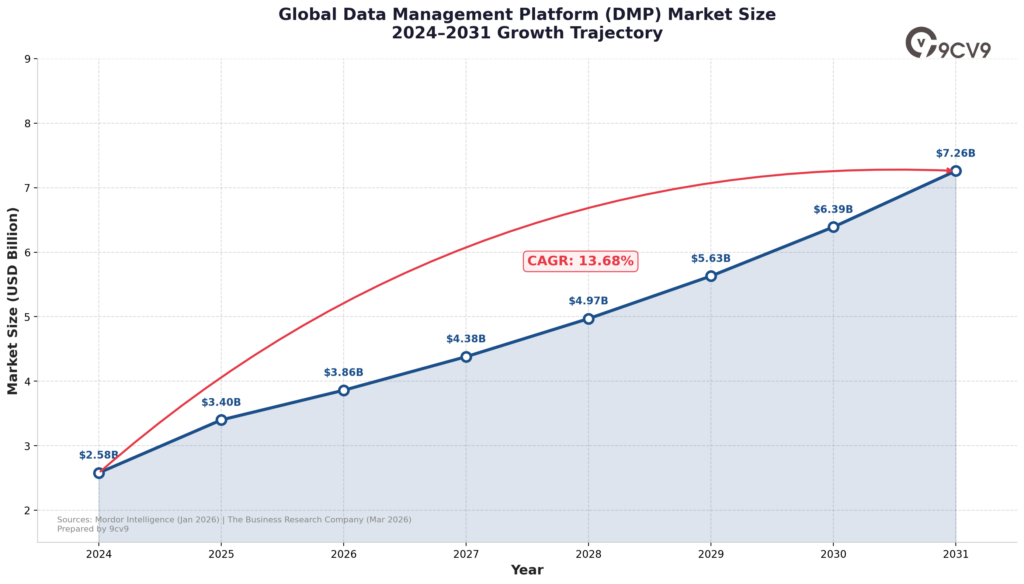
The scale of the DMP industry reflects its growing strategic importance. Multiple industry analysts estimate the global market to be worth billions of dollars, with projections ranging from approximately $2.9 billion to nearly $8 billion in 2026, depending on market definitions and scope. Despite differences in valuation methodologies, virtually every major research firm agrees on one consistent trend: the market is experiencing sustained double-digit annual growth. Forecast compound annual growth rates between 12% and nearly 14% illustrate how organizations continue investing heavily in data infrastructure as digital transformation accelerates. Looking ahead, several forecasts expect the market to exceed $10 billion over the next decade as artificial intelligence, retail media, cloud computing, and customer data integration become increasingly interconnected.

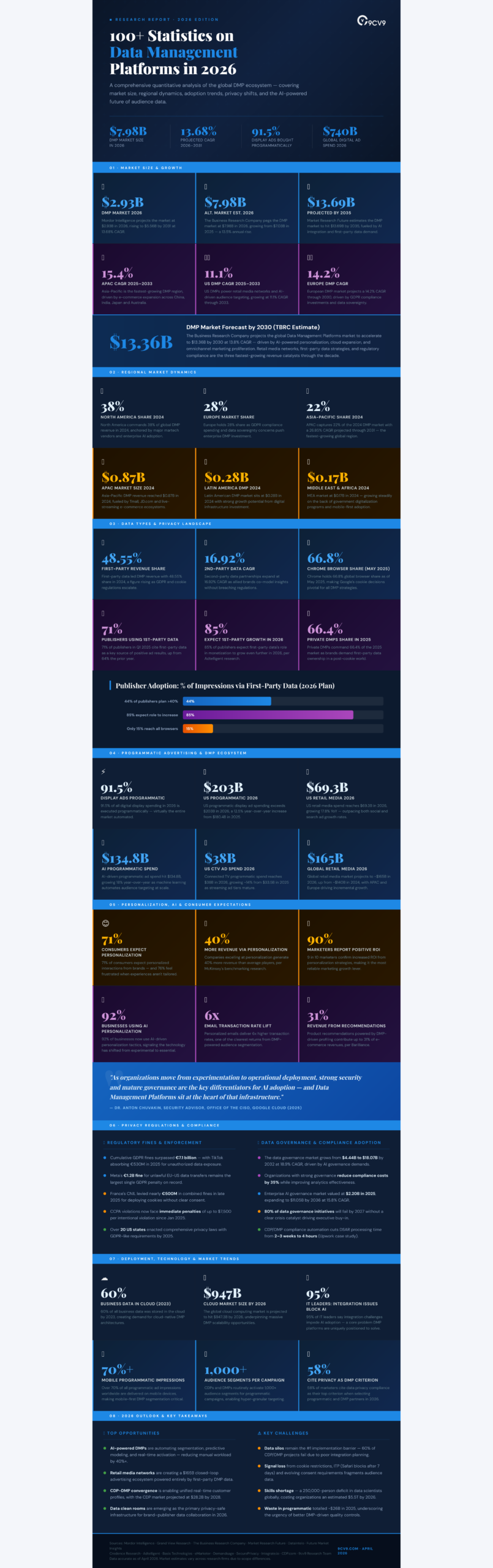
One of the biggest forces reshaping the DMP landscape is the industry’s migration toward first-party data. As third-party cookies gradually disappear and privacy expectations continue to rise, businesses are shifting their investments toward collecting, managing, and activating consent-based customer information. Industry research shows that first-party data now accounts for nearly half of total DMP revenues, while publishers overwhelmingly identify first-party data as their primary driver of advertising performance. Marketing leaders across industries are rapidly increasing investments in first-party data strategies to maintain targeting effectiveness, improve personalization, and future-proof their digital marketing operations.

Privacy legislation has become another defining factor influencing DMP adoption worldwide. Since the introduction of GDPR and similar regulations, organizations have faced unprecedented pressure to improve data governance, transparency, and compliance. Billions of euros in cumulative regulatory fines demonstrate that governments are taking data protection seriously, while new privacy laws across the United States and other regions continue to expand compliance obligations. Modern Data Management Platforms increasingly incorporate consent management, data governance, identity resolution, and automated compliance workflows that dramatically reduce the time required to process Data Subject Access Requests (DSARs) and other regulatory requirements.

Artificial intelligence is simultaneously transforming how DMPs create value. AI-powered audience segmentation, predictive analytics, machine learning optimization, automated bidding, and intelligent personalization have become standard capabilities across enterprise marketing stacks. Today, AI influences the majority of digital advertising expenditure worldwide, while automated campaign optimization consistently delivers measurable improvements in conversion performance. At the same time, enterprises are investing heavily in AI governance frameworks to ensure responsible deployment of machine learning technologies, further expanding the role of DMPs as centralized data intelligence hubs.

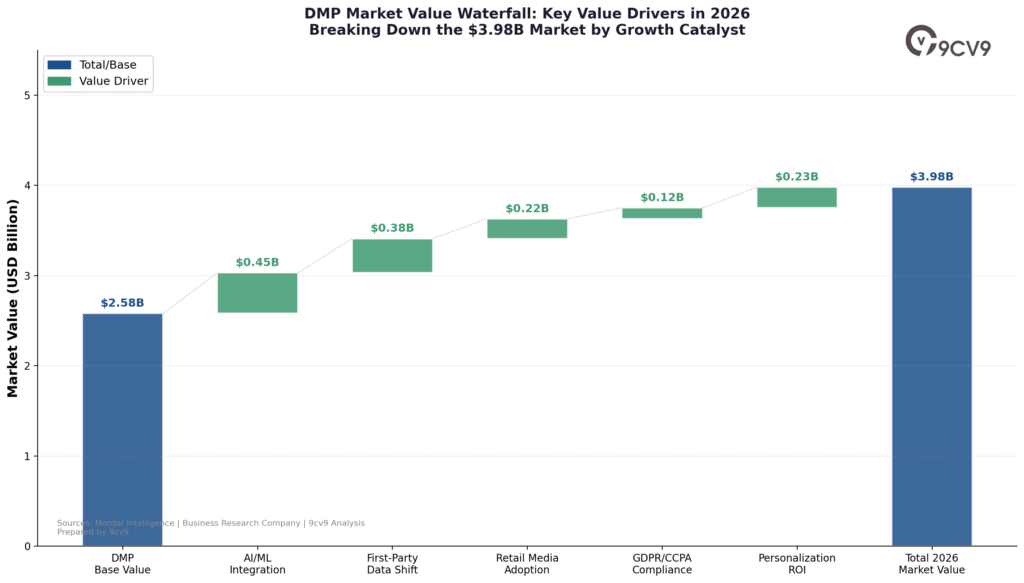
The rapid expansion of programmatic advertising and retail media networks has also strengthened demand for sophisticated audience management capabilities. More than 90% of digital display advertising is now executed programmatically, with retail media emerging as one of the fastest-growing advertising channels globally. Major retailers have built highly valuable advertising ecosystems powered by first-party consumer data, making DMPs essential infrastructure for audience targeting, campaign optimization, attribution, and cross-channel activation. As connected television, mobile advertising, and commerce media continue expanding, the importance of accurate audience data has never been greater.
Personalization has evolved from a competitive advantage into a business necessity. Consumers increasingly expect relevant, individualized experiences across every digital touchpoint, while organizations that successfully personalize customer interactions consistently outperform competitors in revenue growth and profitability. Research shows that personalized experiences influence purchasing decisions, increase transaction rates, improve customer satisfaction, and generate significantly higher marketing returns. Behind these personalized experiences lies the ability of Data Management Platforms to consolidate fragmented customer information into unified audience profiles that enable intelligent decision-making at scale.
Cloud computing has further accelerated DMP innovation by providing scalable infrastructure capable of processing enormous volumes of structured and unstructured data. Cloud-native architectures enable organizations to integrate hundreds of applications, activate thousands of audience segments, and support increasingly sophisticated analytics workloads without the infrastructure limitations of legacy on-premises systems. As enterprise technology stacks continue expanding, DMPs have become essential integration layers that connect marketing platforms, analytics systems, customer relationship management software, customer data platforms, AI engines, and business intelligence solutions.
Regional market dynamics further highlight the global importance of Data Management Platforms. North America continues to dominate overall market share thanks to its mature advertising ecosystem, cloud adoption, and advanced digital infrastructure. Europe remains a major market driven by GDPR compliance and privacy-focused innovation, while Asia-Pacific is emerging as the fastest-growing region due to explosive digital transformation, expanding e-commerce ecosystems, increasing internet penetration, and rising enterprise investments in AI-powered marketing technologies. Emerging markets across Latin America, the Middle East, and Africa also present substantial long-term opportunities as businesses modernize their digital capabilities.
However, implementing a successful DMP strategy extends beyond technology alone. Organizations continue facing challenges related to fragmented data environments, integration complexity, data quality, regulatory compliance, organizational data literacy, and shortages of skilled data professionals. Many enterprises still struggle to fully realize the expected return on investment from their data platforms, highlighting the importance of strong governance, well-planned implementation strategies, and cross-functional collaboration between marketing, IT, analytics, and compliance teams.
Against this rapidly evolving backdrop, understanding the latest statistics, market trends, adoption patterns, investment forecasts, and technological developments has become essential for executives, marketers, advertisers, data professionals, technology vendors, and business leaders alike. Reliable data provides valuable context for evaluating emerging opportunities, benchmarking organizational performance, anticipating future market shifts, and making informed technology investment decisions.
This comprehensive guide, “Top 105 Data Management Platforms (DMP) Statistics, Data & Trends in 2026,” brings together the latest quantitative insights from leading industry research covering every major aspect of the DMP ecosystem. From global market growth, regional adoption, privacy compliance, AI integration, programmatic advertising, and personalization to cloud infrastructure, customer expectations, and enterprise implementation challenges, these carefully curated statistics provide a detailed snapshot of one of the most important technologies driving the modern digital economy. Whether you are evaluating Data Management Platform vendors, planning your organization’s data strategy, optimizing digital marketing initiatives, or simply seeking a deeper understanding of the industry’s direction, these 105 statistics offer valuable insights into the forces shaping the future of data management in 2026 and beyond.
Before we venture further into this article, we would like to share who we are and what we do.
About 9cv9
9cv9 is a business tech startup based in Singapore and Asia, with a strong presence all over the world.
With over ten years of startup and business experience, and being highly involved in connecting with thousands of companies and startups, the 9cv9 team has listed some important and crucial software tools in this review.
If you like to get your company listed in our top B2B software reviews, check out our world-class 9cv9 Media and PR service and pricing plans here.
Top 105 Data Management Platforms (DMP) Statistics, Data & Trends in 2026
🔵 MARKET SIZE & GROWTH
- $2.93B — The DMP market is valued at $2.93 billion in 2026, according to Mordor Intelligence, and is forecast to grow to $5.56B by 2031. The DMP sector’s sustained double-digit growth reflects how central audience data infrastructure has become to enterprise marketing stacks.
- $7.98B — The Business Research Company estimates the DMP market at $7.98B in 2026, growing from $7.03B in 2025, reflecting a 13.5% annual rise. Variance between research firms underscores differing scope boundaries in what qualifies as a “DMP.”
- 13.68% — Mordor Intelligence projects a CAGR of 13.68% from 2026 to 2031 for the DMP market. This growth pace outstrips average SaaS market growth and reflects an industry in structural transformation.
- 13.5% — Market Research Future estimates a slightly lower 13.5% CAGR from 2025 to 2035. Even at the lower bound, DMPs are outperforming general enterprise software growth.
- 13.8% — The Business Research Company forecasts a 13.8% CAGR from 2026 to 2030. The slight acceleration into 2030 reflects compounding AI and retail media tailwinds.
- 12.2% — Grand View Research projects a 12.2% CAGR from 2025 to 2033. A more conservative baseline, yet still indicating robust structural demand.
- 12.3% — Credence Research estimates a 12.3% CAGR to reach $5.32B by 2032. This figure aligns with a scenario where third-party cookie deprecation progresses slower than anticipated.
- $3.40B — Market Research Future estimated the 2024 DMP market at $3.40B. A higher baseline relative to Mordor reflects the inclusion of adjacent data orchestration products.
- $3.86B — Market Research Future projects the DMP market at $3.86B in 2025. The ramp-up reflects enterprise AI integration driving platform upgrades.
- $3.89B — DataIntelo estimated the 2024 DMP market at $3.89B. Variance in estimates highlights the definitional ambiguity between DMP, CDP, and data lake categories.
- $13.69B — Market Research Future projects the market will reach $13.69B by 2035. Over a decade, AI-driven automation and IoT data growth could push the market to near $14B.
- $7.02B — Grand View Research estimates the DMP market at $7.02B by 2033. A realistic mid-scenario for a market growing without major disruption.
- $11.34B — DataIntelo projects the DMP market at $11.34B by 2033 at 13.2% CAGR. Strong AI adoption is the primary growth driver in this scenario.
- $13.36B — TBRC projects the DMP market at $13.36B by 2030. Achieving this would require sustained AI adoption and the full maturation of retail media networks.
- $5.05B — Business Research Insights projects a more modest $5.05B by 2033 at 8.5% CAGR — a conservative scenario reflecting heightened privacy headwinds.
🌍 REGIONAL DYNAMICS
- 38% — North America held the largest DMP market share at 38% in 2024. The region’s dominance stems from deep adtech infrastructure, high cloud adoption, and CCPA-driven compliance spending.
- 35.48% — Grand View Research specifically measured North America’s revenue share at 35.48% in 2024. Even at the lower estimate, North America leads all other regions by a wide margin.
- 28% — Europe accounts for 28% of the global DMP market, driven by GDPR-mandated compliance investment and rising demand for privacy-compliant data solutions.
- 30% — One variant estimate (Market Research Future) puts Europe’s DMP share at 30%, reflecting broader CDP-DMP convergence in the region.
- 22% — Asia-Pacific holds a 22% market share in 2024, expected to grow the fastest of any region through 2031.
- 26.85% — Asia-Pacific is forecast to grow at a 26.85% CAGR through 2031, per Mordor Intelligence — nearly double the global average rate.
- 15.4% — DataIntelo projects APAC’s DMP CAGR at 15.4% from 2025 to 2033, accounting for India’s digital explosion and China’s e-commerce ecosystem.
- $0.87B — APAC’s DMP market size stood at $0.87B in 2024. Despite being third globally, APAC’s growth pace will make it the top market by the mid-2030s on current trajectories.
- $0.28B — Latin America’s DMP market was valued at $0.28B in 2024. Growing digital ad ecosystems in Brazil and Mexico are driving incremental adoption.
- $0.17B — The Middle East & Africa DMP market sits at $0.17B, with growth supported by government digitalization programs and mobile-first consumers.
- 12% — Rest of World (Latin America, MEA) collectively accounts for 12% of the global DMP market. These regions offer the highest growth optionality for platform vendors willing to localize.
🔐 DATA TYPES & PRIVACY
- 48.55% — First-party data led DMP revenue with 48.55% market share in 2024, per Grand View Research. Brands collecting consented behavioral data now hold a durable competitive advantage.
- 46.15% — Mordor Intelligence pegs first-party modules at 46.15% of 2025 DMP revenue. The slight variation highlights different product scope definitions.
- 16.92% — Second-party data partnerships expand at 16.92% CAGR — the fastest of any data type segment — as brands seek privacy-safe data co-modeling with trusted partners.
- 66.4% — Private DMPs command 66.4% of the 2025 market as brands seek first-party data ownership and tighter regulatory control.
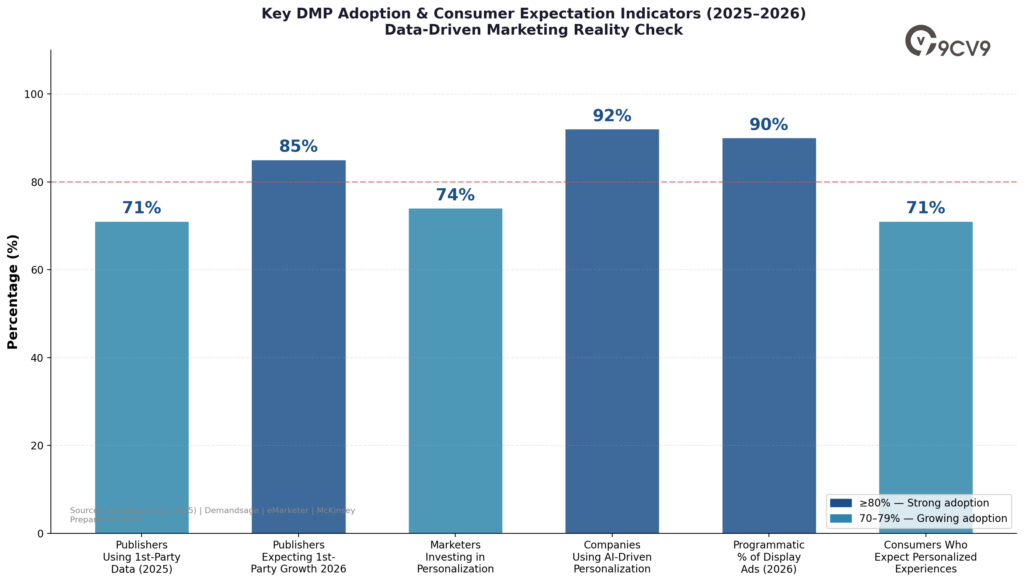
- 71% — In Q1 2025, 71% of publishers cited first-party data as a key driver of positive advertising results, up from 64% in 2024.
- 85% — 85% of publishers expect the role of first-party data in ad monetization to grow even further in 2026, while third-party data’s importance is rapidly declining.
- 44% — 44% of publishers plan for more than 40% of their 2026 impressions to be served via first-party data strategies.
- 15% — Only 15% of publishers effectively reach audiences across all browsers — a stark reminder of the cross-device fragmentation challenge facing data management teams.
- 66.8% — Chrome holds 66.8% of global browser share as of May 2025, meaning Google’s data policies remain the single biggest external variable for DMP operators.
- 7 days — Safari’s Intelligent Tracking Prevention (ITP) limits JavaScript-set cookies to just 7 days (24 hours with tracking parameters), significantly compressing attribution windows.
- 400 days — Chrome allows first-party cookies up to 400 days, creating a markedly different tracking environment compared to Safari and Firefox.
- 2.9x — Stores investing in first-party data strategies see 2.9x revenue uplift compared to third-party data approaches, per Seresa.io analysis.
- 75% — 75% of marketing leaders are already actively investing in first-party data collection strategies to futureproof their DMP infrastructure.
- 71% — 71% of consumers are more likely to buy from brands that are transparent about their data practices, linking privacy investment directly to commercial outcomes.
📋 GDPR, CCPA & COMPLIANCE
- €7.1B — Cumulative GDPR fines have surpassed €7.1 billion since the regulation took effect in 2018. The scale of enforcement demonstrates that regulators are no longer issuing token penalties.
- €1.2B — Meta’s single GDPR fine for EU-US data transfer violations remains the largest individual GDPR penalty on record, underscoring the enormous financial exposure of non-compliance.
- €530M — TikTok absorbed a €530M fine in 2025 for failing to protect EEA user data from unauthorized access in China. Cross-border data flows remain a top regulatory flashpoint.
- €500M — France’s CNIL levied nearly €500M in combined fines in late 2025 against major tech and retail platforms for deploying cookies without clear prior consent.
- $7,500 — CCPA violations now carry immediate penalties of up to $7,500 per intentional violation, with no cure period following the January 2025 regulatory update.
- 20+ — Over 20 US states enacted comprehensive privacy laws with GDPR-comparable requirements by 2025, creating a complex multi-jurisdictional compliance patchwork.
- 4 hours — CDP/DMP-powered compliance automation cuts DSAR (Data Subject Access Request) processing from 2–3 weeks to just 4 hours — a 95% reduction in processing time.
- 35% — Organizations with strong data governance frameworks reduce compliance costs by 35% while simultaneously improving analytics effectiveness.
- €20M or 4% revenue — GDPR maximum penalty is €20 million or 4% of annual global revenue, whichever is higher — a ceiling that makes DMP compliance infrastructure a financially critical investment.
- 12–24 months — Under GDPR and CCPA data minimization principles, maximum retention periods for most marketing data should not exceed 12–24 months before deletion or anonymization.
🤖 AI, AUTOMATION & TECHNOLOGY
- 80% — Around 80% of digital advertisers now use AI-driven tools to optimize programmatic campaigns and audience targeting — a near-universal adoption rate.
- 60% — AI now influences roughly 60% of all digital ad spending via automated targeting, optimization, and activation systems.
- $134.8B — AI-driven programmatic advertising spend reached $134.8B, growing 18% year-over-year as ML algorithms replace manual audience curation at scale.
- 10–30% — Machine learning–optimized campaigns typically achieve 10–30% higher conversion rates compared to non-AI programmatic campaigns.
- $4.18B — Generative AI in the advertising market reached $4.18B in market size, on track for a 23.8% CAGR to reach $9.81B by 2030.
- 95% — 95% of IT leaders report that integration challenges are impeding their organization’s AI adoption — a problem that unified DMPs are designed to resolve.
- ~897 apps — Organizations average approximately 897 applications in their tech stack, with only 28% connected — highlighting the fragmentation challenge DMPs must address.
- $2.20B — The enterprise AI governance and compliance market was valued at $2.20B in 2025, projected to reach $11.05B by 2036 at 15.8% CAGR.
- 15.8% — AI governance market CAGR through 2036, driven by mandatory regulatory compliance obligations replacing voluntary AI ethics guidelines.
- $1B — Adobe allocated $1 billion to expand its Experience Platform Agent Orchestrator, enabling autonomous AI agents to adjust personalized offers in real time.
📢 PROGRAMMATIC ADVERTISING & RETAIL MEDIA
- 91.5% — 91.5% of all digital display spending is executed programmatically in 2026 — leaving direct-sold display as a niche segment for premium custom placements.
- $203B — US programmatic display ad spend is expected to exceed $203B in 2026, growing 12.5% year-over-year from $180.4B in 2025.
- $740B — Global digital ad spend reaches $740B in 2026, with digital now commanding 73% of total global media spend.
- $69.3B — US advertisers will spend $69.3B on retail media in 2026, growing 17.8% YoY — outpacing both social and search ad spending growth.
- 79.7% — Amazon dominates retail media with 79.7% US market share, followed by Walmart Connect at 8.0%.
- $165B — Global retail media market is projected at ~$165B in 2026, up from ~$140B in 2024, with APAC and Europe driving incremental growth.
- 41.7% — Programmatic retail media display ad spending grew 41.7% in 2024 and is projected to leap another 29.3% in 2025.
- 154% — Some companies have seen 154% ROI for every $1 spent on retail media campaigns, thanks to precision first-party data targeting.
- 39% — US consumer packaged goods (CPG) companies allocate 39% of their advertising spend to retail media budgets — a major demand driver for DMP audience data.
- $38B — US CTV programmatic ad spend reaches ~$38B in 2026, a 14% increase from $33.5B in 2025, representing one of the fastest-growing DMP-adjacent channels.
- 70% — Nearly 70% of CTV advertisers expect to increase their CTV spending by an average of 17% in 2026.
- 70%+ — Over 70% of all programmatic ad impressions worldwide are now delivered on mobile devices, making mobile-first DMP segmentation non-negotiable.
- $26B — Inefficiencies and waste in programmatic spend were estimated at approximately $26B in 2025, underscoring the need for better DMP-driven quality and fraud controls.
🧑💼 PERSONALIZATION & CONSUMER EXPECTATIONS
- 71% — 71% of consumers expect personalized interactions from brands — a figure that has held consistent across multiple McKinsey and Salesforce surveys.
- 76% — 76% of consumers feel frustrated when interactions are not personalized, making poor data management directly detrimental to customer satisfaction.
- 40% — Companies excelling at personalization generate 40% more revenue than average players, per McKinsey’s personalization benchmarking.
- 90% — 90% of leading marketers report that personalization significantly contributes to business profitability.
- 92% — 92% of businesses are now using AI-driven personalization tactics — what was once a competitive advantage has become a market baseline.
- 82% — 82% of consumers are willing to share their personal data in exchange for a more customized brand experience.
- 6x — Personalized emails deliver 6x higher transaction rates compared to generic broadcast communications.
- 31% — Product recommendation engines powered by DMP audience data contribute up to 31% of e-commerce site revenues.
- 369% — Sessions where customers engage with product recommendations show a 369% increase in average order value (Barilliance data).
- 40% — Brands that excel at personalization generate 40% more revenue from those activities — making the ROI case for DMP investment unambiguous.
- 63% — 63% of digital marketing executives report struggling to deliver truly tailored customer experiences, pointing to ongoing DMP implementation gaps.
- 89% — 89% of marketing decision-makers consider personalization essential for their business over the next three years, ensuring sustained DMP demand.
- ~40% — Marketers now allocate approximately 40% of their total budgets to personalization-related activities, versus only 22% in 2023.
- $9.5B — By 2024, the global revenue for customer experience personalization and optimization software surpassed $9.5B.
- 48% — “Personalization leaders” are 48% more likely to exceed their revenue goals compared to peers who underinvest in data-driven targeting.
🏗️ DEPLOYMENT, INFRASTRUCTURE & MARKET STRUCTURE
- $947.3B — The global cloud computing market is projected to hit $947.3B by 2026, providing the infrastructure backbone for cloud-native DMP deployments.
- 60% — 60% of all business data was stored in the cloud by 2023, with cloud-native DMPs being the default architecture for most new enterprise deployments.
- $15.24B — The data integration market reaches $15.24B in 2026, projected to hit $47.6B by 2034 at a 12–15% CAGR — a direct complement to DMP growth.
- 69.7% — Large enterprises command 69.7% of data integration market revenue in 2026, reflecting the heavy enterprise bias in DMP adoption.
- $28.2B — The Customer Data Platform (CDP) market — the DMP’s primary convergence partner — is projected to reach $28.2B by 2028 at a 39.9% CAGR.
- 47.32% — North America accounted for 47.32% of global CDP revenue in 2025, with Asia Pacific forecast to grow at 24.41% CAGR through 2031.
- 24.41% — Asia-Pacific CDP CAGR through 2031 outstrips the global average — and CDP-DMP convergence in APAC will be a dominant theme for the rest of the decade.
- 60% — 60% of DMP/CDP implementations fail to deliver expected ROI due to poor integration planning, per Data Innovation Barcelona’s analysis of enterprise deployments.
- 1,000+ — CDPs and DMPs routinely activate over 1,000 audience segments per programmatic campaign, enabling hyper-granular audience strategies that manual media buying cannot achieve.
- 58% — 58% of marketers cite data privacy compliance as their top criterion when selecting programmatic and DMP partners — surpassing cost and performance as selection drivers.
- 15–20% — Proper implementation of a unified customer data management platform typically improves marketing ROI by 15–20%, per Usercentrics CDP analysis.
- $300M — In January 2025, Rokt acquired mParticle for $300 million to combine commerce optimization with first-party data platform technology — one of 2025’s defining DMP M&A deals.
- $18.07B — The data governance market is projected to grow from $4.44B to $18.07B by 2032 at an 18.9% CAGR, fueled by AI governance mandates and regulatory expansion.
- 83% — Data literacy challenges affect 83% of organizations, with only 28% achieving adequate data literacy levels — creating a systemic bottleneck to DMP value realization.
- 250,000 — There is an estimated 250,000-person shortage in data scientists globally, projected to cost organizations $5.5T by 2026, severely constraining DMP talent pools.
- 80% — 80% of data governance initiatives are predicted to fail by 2027 without a clear crisis catalyst, per Gartner-cited secondary research.
- 4 hours vs. 2–3 weeks — With DMP-integrated automation, DSAR compliance processing drops from 2–3 weeks to 4 hours — a 90%+ operational improvement that makes the compliance business case self-evident.
Conclusion
As organizations continue accelerating their digital transformation initiatives, Data Management Platforms (DMPs) have become far more than advertising technologies—they are now foundational components of enterprise data strategy, customer intelligence, and privacy-first marketing. The statistics presented throughout this report paint a clear picture of an industry undergoing rapid evolution, driven by artificial intelligence, cloud computing, stricter data privacy regulations, the decline of third-party cookies, and the growing importance of first-party data. Together, these trends illustrate why DMPs remain critical infrastructure for businesses seeking to compete effectively in an increasingly data-driven global economy.
One of the most significant takeaways from these 105 statistics is the industry’s sustained growth trajectory. Despite varying market estimates among research firms due to differing definitions of DMP capabilities, virtually all forecasts point toward strong double-digit annual growth over the coming years. This consistent expansion reflects increasing enterprise investment in technologies capable of collecting, organizing, enriching, and activating customer data across multiple digital channels. As organizations generate unprecedented volumes of behavioral, transactional, and engagement data, the need for scalable data management solutions will only continue to intensify.
The statistics also demonstrate that first-party data has firmly established itself as the future of digital marketing. With privacy regulations becoming more comprehensive and browser vendors limiting traditional tracking technologies, organizations are prioritizing consent-based customer relationships over reliance on third-party data sources. Businesses investing in first-party data collection, governance, and activation are positioning themselves for long-term competitive advantage while simultaneously improving customer trust and regulatory compliance. This transition represents one of the most important structural changes in the digital advertising industry over the past decade.
Artificial intelligence emerges throughout the data as another transformational force reshaping the DMP ecosystem. AI-powered audience segmentation, predictive analytics, campaign optimization, personalization, and automated decision-making are becoming standard capabilities rather than optional enhancements. As machine learning continues improving marketing performance while reducing operational complexity, enterprises increasingly view DMPs as intelligent data platforms capable of generating actionable business insights rather than simply storing audience information. The convergence of AI, automation, and customer data will likely define the next generation of enterprise marketing technology.
Privacy and regulatory compliance remain equally influential drivers of innovation. The substantial financial penalties imposed under GDPR and other global privacy frameworks highlight the growing risks associated with poor data governance. Organizations can no longer treat compliance as a secondary consideration. Instead, privacy has become a strategic business priority that directly influences technology purchasing decisions, operational processes, and customer relationships. Modern DMPs are evolving accordingly by incorporating stronger consent management, governance controls, identity resolution, security features, and compliance automation into their core functionality.
Another major insight revealed by these statistics is the rapid expansion of programmatic advertising and retail media. With the overwhelming majority of digital display advertising now purchased programmatically, advertisers increasingly depend on high-quality audience data to maximize campaign effectiveness and return on investment. Simultaneously, retail media networks continue generating substantial new advertising opportunities powered by rich first-party customer data. These developments reinforce the growing importance of DMPs as essential infrastructure supporting audience activation, measurement, attribution, and cross-channel campaign execution.
The report also highlights how customer expectations continue driving enterprise investment in data management technologies. Consumers increasingly expect personalized experiences across every interaction, while businesses capable of delivering meaningful personalization consistently outperform competitors in revenue growth, customer engagement, and long-term loyalty. Achieving this level of personalization requires unified customer profiles, accurate audience segmentation, and real-time analytics—all capabilities that modern DMPs are designed to deliver. As customer journeys become increasingly complex, organizations that successfully integrate their data ecosystems will be better positioned to create seamless, relevant, and trusted digital experiences.
Regional trends further emphasize the global nature of DMP adoption. North America continues leading overall market share through its mature advertising ecosystem and cloud infrastructure, while Europe advances privacy-focused innovation driven by regulatory leadership. Meanwhile, Asia-Pacific stands out as the fastest-growing region, fueled by rapid digitalization, expanding e-commerce markets, increasing AI adoption, and significant enterprise technology investment. These regional dynamics suggest that future innovation will increasingly emerge from diverse global markets rather than a single geographic center.
At the same time, these statistics reveal that technology alone does not guarantee success. Many organizations continue facing significant challenges involving fragmented technology stacks, poor system integration, limited data literacy, governance complexity, and shortages of experienced data professionals. Successful DMP implementation requires more than software acquisition—it demands clear business objectives, strong leadership, cross-functional collaboration, effective governance frameworks, and ongoing investment in people, processes, and organizational capabilities. Businesses that address these foundational elements will be far more likely to realize the full value of their data investments.
Looking beyond 2026, the Data Management Platform landscape will continue evolving alongside broader developments in artificial intelligence, customer data platforms, cloud computing, identity management, retail media, connected television, and enterprise analytics. The distinction between DMPs, CDPs, marketing automation platforms, and AI-powered customer intelligence solutions is expected to become increasingly blurred as vendors integrate more capabilities into unified data ecosystems. Organizations evaluating future technology investments should therefore consider not only current platform capabilities but also long-term scalability, interoperability, regulatory readiness, AI integration, and support for evolving privacy requirements.
Ultimately, the 105 Data Management Platform statistics presented in this report demonstrate that data has become one of the most valuable strategic assets for modern organizations. Companies that successfully collect, govern, analyze, and activate their data while maintaining transparency, privacy, and customer trust will be significantly better positioned to compete in an increasingly digital and AI-powered marketplace. Whether you are a marketing executive, enterprise decision-maker, technology strategist, data analyst, publisher, advertiser, or business leader, understanding these trends provides valuable context for making smarter technology investments and preparing for the next phase of digital transformation.
As the volume, complexity, and strategic value of enterprise data continue expanding, Data Management Platforms will remain central to how organizations understand customers, optimize marketing performance, ensure regulatory compliance, and deliver personalized digital experiences at scale. The insights contained within these 105 statistics not only capture the current state of the DMP market in 2026 but also provide a roadmap for understanding where the industry is headed, the opportunities that lie ahead, and the challenges businesses must overcome to thrive in the increasingly data-centric economy of the future.
If you find this article useful, why not share it with your hiring manager and C-level suite friends and also leave a nice comment below?
We, at the 9cv9 Research Team, strive to bring the latest and most meaningful data, guides, and statistics to your doorstep.
To get access to top-quality guides, click over to 9cv9 Blog.
To hire top talents using our modern AI-powered recruitment agency, find out more at 9cv9 Modern AI-Powered Recruitment Agency.
People Also Ask
What is a Data Management Platform (DMP)?
A Data Management Platform (DMP) is software that collects, organizes, analyzes, and activates audience data from multiple sources to improve digital marketing, advertising, and customer targeting.
Why are Data Management Platforms important in 2026?
DMPs help businesses leverage first-party data, improve personalization, comply with privacy regulations, and optimize marketing campaigns using AI-driven audience insights.
How large is the global Data Management Platform market in 2026?
Industry estimates value the DMP market between approximately $2.9 billion and $8 billion in 2026, depending on the scope and methodology used by research firms.
What is driving the growth of the DMP market?
Growth is fueled by AI adoption, first-party data strategies, cloud computing, retail media expansion, stricter privacy laws, and increasing demand for personalized customer experiences.
What is the projected CAGR of the DMP market?
Most industry forecasts estimate the DMP market will grow at an annual rate between 12% and nearly 14% over the coming years.
How does first-party data impact DMP adoption?
First-party data has become the foundation of modern DMP strategies as businesses move away from third-party cookies and prioritize privacy-compliant customer relationships.
What role does AI play in Data Management Platforms?
AI helps DMPs automate audience segmentation, predictive analytics, campaign optimization, personalization, and real-time marketing decisions.
Which region dominates the global DMP market?
North America holds the largest share due to advanced advertising technology, cloud adoption, and strong enterprise investment in digital marketing infrastructure.
Which region is growing the fastest for DMP adoption?
Asia-Pacific is the fastest-growing region, driven by rapid digital transformation, expanding e-commerce, AI adoption, and increasing enterprise technology investments.
How do Data Management Platforms improve marketing performance?
DMPs centralize customer data, create detailed audience segments, improve targeting accuracy, and enhance campaign performance across multiple digital channels.
What industries use Data Management Platforms?
Retail, e-commerce, finance, healthcare, media, telecommunications, travel, technology, and advertising industries all use DMPs to improve customer engagement and marketing effectiveness.
What is the difference between a DMP and a CDP?
A DMP focuses primarily on anonymous audience data for advertising, while a Customer Data Platform (CDP) manages persistent customer profiles using identifiable first-party data.
How do DMPs support programmatic advertising?
DMPs provide audience segmentation and behavioral insights that enable advertisers to deliver more relevant ads through automated programmatic advertising platforms.
Why is data privacy important for DMPs?
Privacy regulations require businesses to manage customer data responsibly, making consent management, governance, and transparency essential DMP capabilities.
How do privacy regulations affect Data Management Platforms?
Laws such as GDPR and CCPA require DMPs to support consent management, secure data handling, user rights requests, and regulatory compliance.
What is the role of DMPs in personalization?
DMPs combine customer data from multiple channels to deliver personalized recommendations, targeted advertising, and relevant digital experiences.
How does cloud computing benefit Data Management Platforms?
Cloud infrastructure enables DMPs to process massive datasets, scale efficiently, integrate with enterprise applications, and support real-time analytics.
Why are third-party cookies becoming less important?
Browser restrictions and privacy regulations have reduced reliance on third-party cookies, encouraging businesses to invest in first-party data strategies instead.
How do DMPs improve customer insights?
They consolidate data from multiple sources into unified audience profiles, helping businesses better understand customer behavior and preferences.
What challenges do organizations face when implementing DMPs?
Common challenges include system integration, data quality, governance, privacy compliance, organizational data literacy, and skilled talent shortages.
How do DMPs support retail media networks?
DMPs help retailers build audience segments using first-party data, enabling advertisers to run highly targeted retail media campaigns.
Can small businesses benefit from Data Management Platforms?
Yes. Smaller organizations can use cloud-based DMP solutions to improve customer targeting, campaign performance, and marketing efficiency.
How do DMPs contribute to AI-powered marketing?
They provide high-quality customer data that fuels machine learning models for predictive targeting, personalization, and automated campaign optimization.
What trends are shaping the future of DMPs?
Major trends include AI integration, first-party data growth, retail media expansion, cloud-native platforms, privacy-first marketing, and greater automation.
How do DMPs help improve return on investment (ROI)?
By improving audience targeting and reducing wasted advertising spend, DMPs help businesses increase campaign efficiency and marketing ROI.
What role do DMPs play in enterprise data strategy?
DMPs serve as centralized platforms that organize audience data, improve governance, and support data-driven decision-making across marketing teams.
Are Data Management Platforms replacing traditional marketing tools?
Rather than replacing them, DMPs integrate with CRM systems, CDPs, analytics platforms, and marketing automation tools to strengthen the overall technology stack.
How does personalization influence DMP demand?
Growing consumer expectations for personalized experiences encourage organizations to invest in DMPs that can deliver accurate customer segmentation and insights.
What should businesses consider when choosing a DMP?
Organizations should evaluate scalability, AI capabilities, privacy compliance, cloud architecture, integrations, audience segmentation features, and long-term flexibility.
Why should businesses monitor Data Management Platform statistics in 2026?
Keeping track of DMP statistics helps organizations understand market trends, benchmark technology investments, anticipate industry changes, and make informed strategic decisions.
Sources
Mordor Intelligence The Business Research Company Market Research Future Grand View Research DataIntelo Credence Research Future Market Insights Business Research Insights Adtelligent Basis Technologies eMarketer Digital Applied AutoFaceless SQ Magazine Fugo Demandsage Marketing LTB SecurePrivacy Ethyca Integrate.io CDP Maestra Alation Help Net Security Publift Seresa Usercentrics Envive AI



%20statistics,%20market%20data,%20trends,%20AI%20insights,%20and%20growth%20forecasts%20for%202026.)