
Key Takeaways
- The global data analysis software market has surpassed $100 billion in 2026, driven by rapid enterprise adoption, AI integration, cloud analytics, and accelerating digital transformation across industries.
- Artificial intelligence, machine learning, and generative AI are revolutionizing business intelligence platforms by automating reporting, enabling predictive analytics, and delivering faster, data-driven decision-making.
- Strong double-digit market growth, increasing cloud adoption, expanding enterprise investments, and rising demand for analytics talent position data analysis software as one of the fastest-growing enterprise technology sectors through the next decade.
Data analysis software is transforming how organizations turn raw information into faster, smarter business decisions. This collection of the Top 105 Data Analysis Software Statistics, Data & Trends in 2026 explores the latest market growth, AI adoption, cloud analytics, enterprise usage, and emerging trends to help businesses, investors, and technology leaders make informed decisions.
Data analysis software has become one of the most strategically important technology categories in the modern digital economy. As organizations generate unprecedented volumes of structured and unstructured data, the ability to transform raw information into actionable business intelligence has evolved from a competitive advantage into an operational necessity. In 2026, enterprises across every major industry—from finance and healthcare to manufacturing, retail, logistics, telecommunications, and government—are investing heavily in advanced analytics platforms that enable faster, smarter, and more data-driven decision-making. The widespread adoption of cloud computing, artificial intelligence (AI), machine learning (ML), predictive analytics, real-time dashboards, and self-service business intelligence tools is fundamentally reshaping how organizations collect, process, visualize, and monetize data.
Also, read our guide on the Top 10 Best Data Analysis Software.


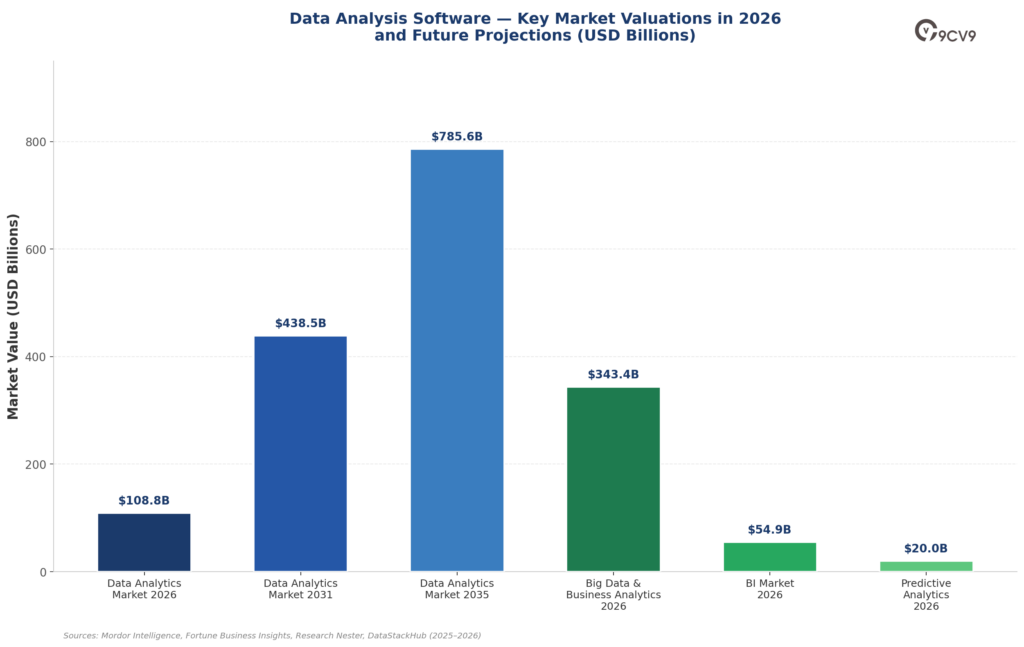
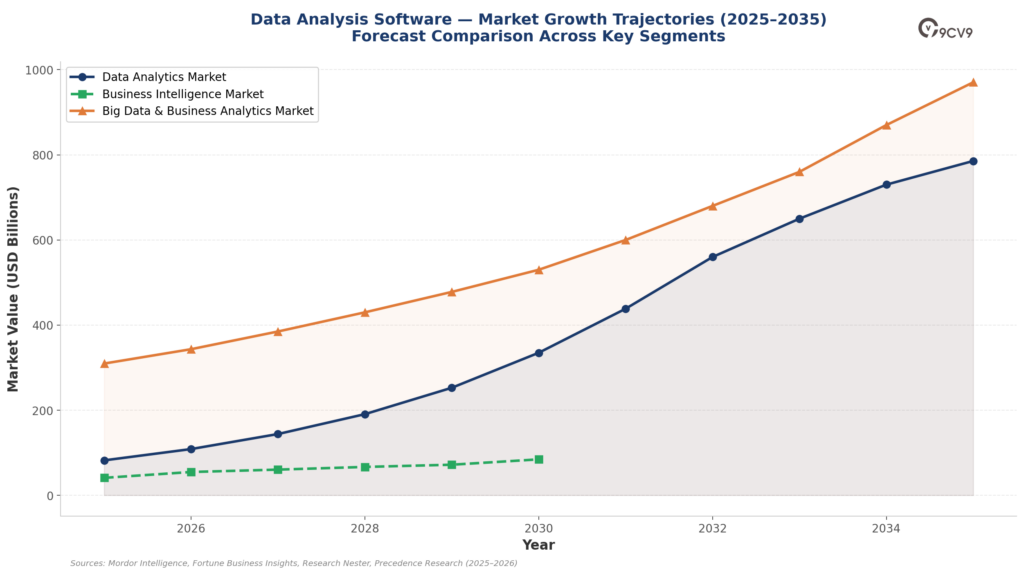
The scale of this transformation is reflected in the industry’s remarkable financial growth. Depending on the market definition, the global data analytics software market is valued between approximately $84 billion and $109 billion in 2026, while the broader big data and analytics ecosystem exceeds $343 billion globally. Multiple leading research firms project sustained double-digit compound annual growth rates extending well into the next decade, with forecasts indicating that the market could approach $785 billion by 2035. Such extraordinary growth demonstrates that data analysis software has become one of the fastest-expanding enterprise technology sectors worldwide, driven by the increasing need for automation, AI-powered insights, and scalable cloud-native platforms.
Artificial intelligence is accelerating this evolution at an unprecedented pace. Nearly two-thirds of organizations now regularly use generative AI, while almost eight in ten businesses have implemented AI in at least one core business function. Analytics vendors are rapidly embedding AI into their platforms through natural language querying, automated report generation, predictive modeling, anomaly detection, intelligent recommendations, and conversational business intelligence. Organizations increasingly expect analytics software to do far more than generate dashboards—it must proactively identify trends, surface opportunities, automate repetitive tasks, and support strategic decisions in real time. AI is transforming analytics from a retrospective reporting function into an intelligent decision-support ecosystem capable of delivering competitive advantages across every department.

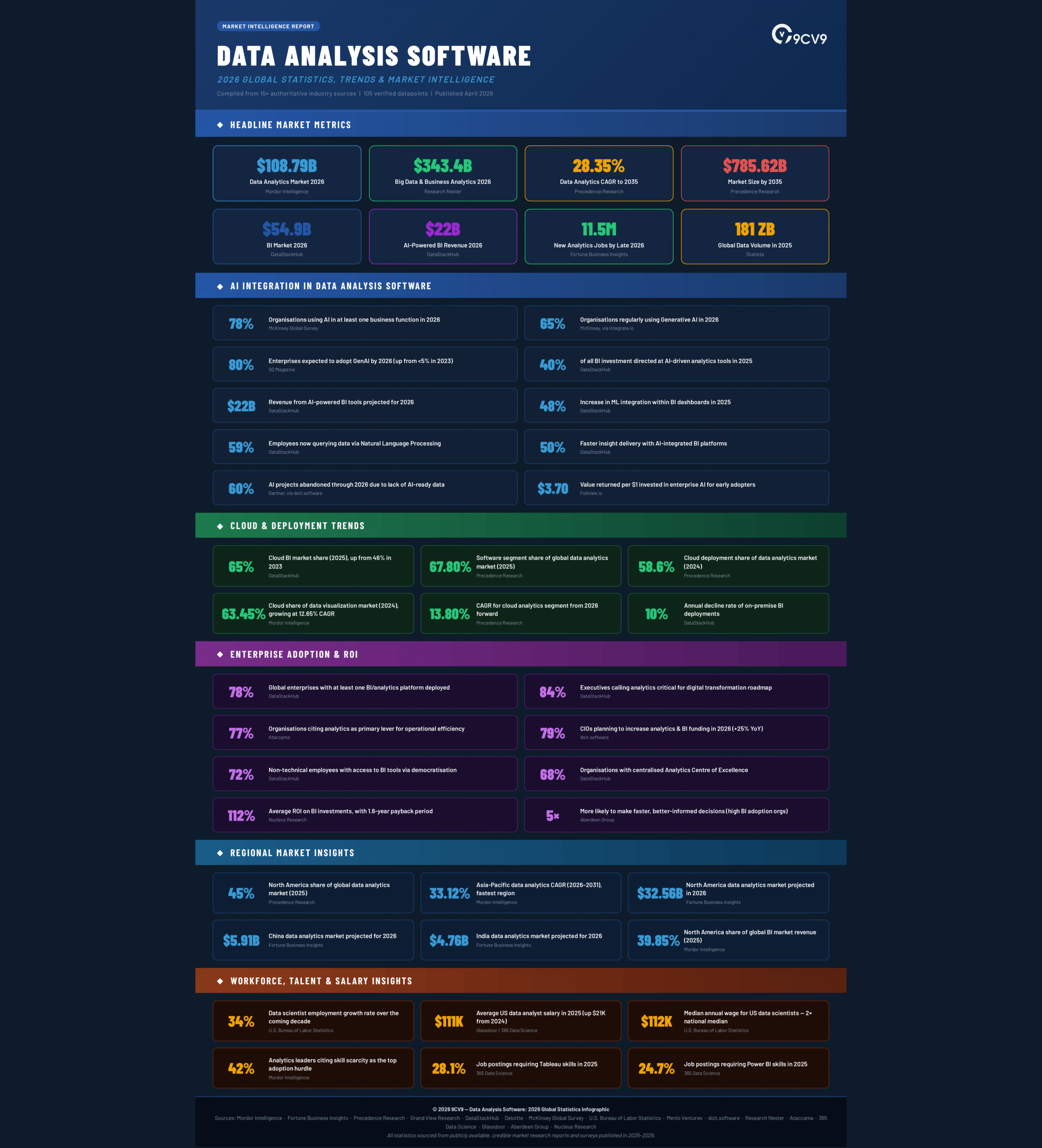
Cloud adoption is equally transforming the analytics landscape. Cloud-native business intelligence platforms now account for the majority of new deployments, offering organizations greater scalability, lower infrastructure costs, simplified maintenance, and seamless collaboration across distributed workforces. Although hybrid deployments remain common among highly regulated industries, on-premise analytics systems continue to decline as enterprises migrate toward Software-as-a-Service (SaaS) analytics platforms. Small and medium-sized businesses are benefiting particularly from cloud delivery models, gaining affordable access to enterprise-grade analytical capabilities that were previously reserved for large corporations with substantial IT budgets.

Business intelligence has also become significantly more accessible. Self-service analytics platforms allow non-technical employees to create dashboards, perform advanced analysis, and explore datasets without requiring specialized programming knowledge. Data democratization initiatives have expanded analytics access across organizations, enabling marketing teams, finance departments, sales managers, HR professionals, operations leaders, and executives to make informed decisions based on real-time insights. The growing adoption of embedded analytics further integrates business intelligence directly into enterprise applications, allowing users to access relevant insights within their daily workflows rather than switching between multiple software systems.

The explosion of global data generation continues to fuel demand for increasingly sophisticated analytics software. Hundreds of millions of terabytes of new data are generated every day, while worldwide data volumes have nearly tripled over the past five years. The rapid expansion of Internet of Things (IoT) devices, digital commerce, mobile applications, cloud services, connected factories, and AI systems has created enormous analytical workloads requiring scalable platforms capable of processing vast datasets efficiently. Modern organizations are therefore investing not only in analytics software itself but also in complementary technologies such as data visualization, data integration, data quality management, predictive analytics, streaming analytics, and Data-as-a-Service (DaaS) solutions.

Industry-specific adoption is creating new opportunities across virtually every economic sector. Healthcare organizations are leveraging advanced analytics to improve patient outcomes, accelerate diagnostics, optimize hospital operations, and support precision medicine. Financial institutions rely on sophisticated analytical models for fraud detection, credit scoring, regulatory compliance, and investment management. Manufacturers use predictive maintenance and industrial IoT analytics to maximize operational efficiency, while retailers deploy customer analytics to personalize shopping experiences and optimize inventory management. Supply chain analytics has become increasingly critical following years of global disruption, enabling organizations to improve resilience through real-time visibility and predictive forecasting. These sector-specific applications continue to drive innovation among software vendors seeking to address increasingly complex analytical requirements.
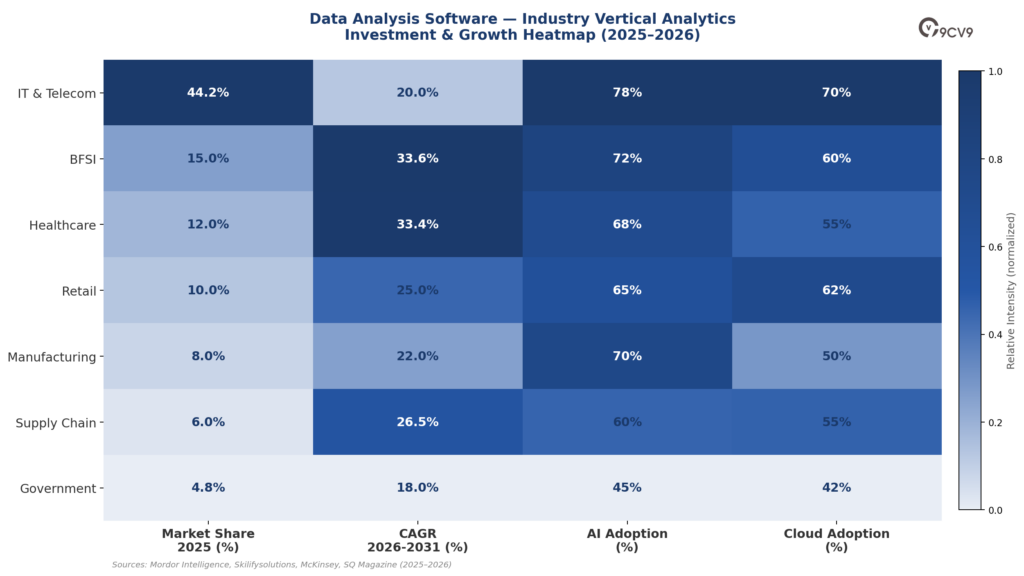
At the same time, organizations continue to face substantial challenges that influence software selection and implementation strategies. Poor data quality remains one of the most expensive barriers to successful analytics initiatives, costing businesses millions of dollars annually while undermining AI performance and business confidence. Skill shortages persist across the analytics workforce despite growing investments in automation and low-code platforms. Many organizations still struggle with fragmented data architectures, inconsistent governance policies, legacy infrastructure, cybersecurity concerns, and regulatory compliance requirements. As a result, vendors that simplify implementation, automate data preparation, strengthen governance capabilities, and improve usability are gaining significant competitive advantages in an increasingly crowded marketplace.

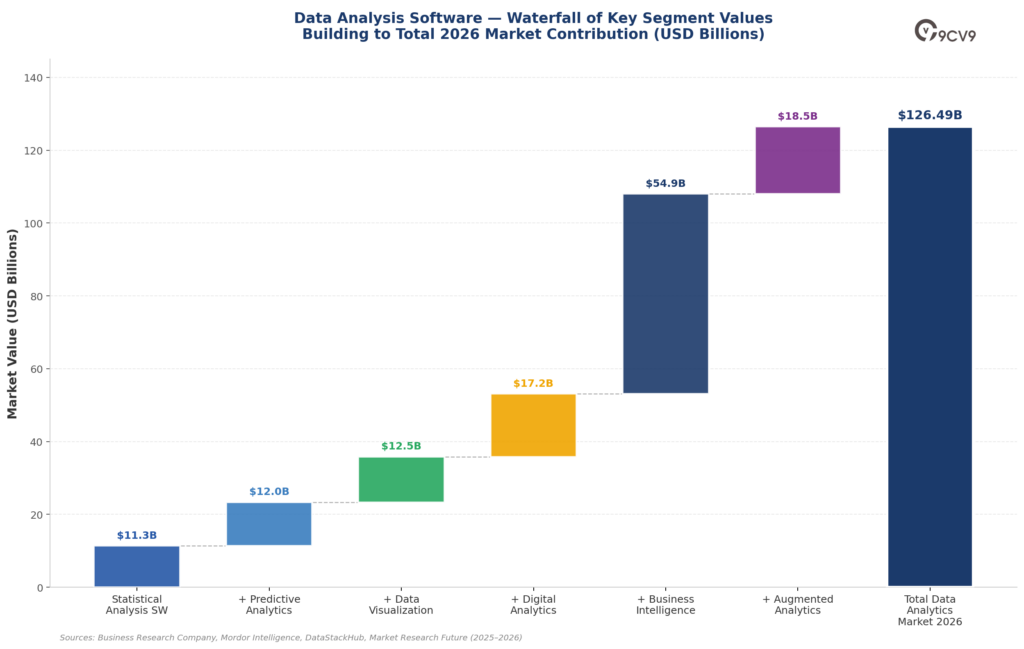
Investment momentum further highlights the industry’s strategic importance. Enterprises continue to increase budgets for business intelligence, augmented analytics, generative AI integration, predictive analytics, and real-time reporting. Venture capital investment into AI-focused companies has reached record levels, while organizations consistently report strong returns on analytics investments through improved operational efficiency, faster decision-making, increased productivity, and enhanced customer experiences. Business intelligence platforms frequently achieve rapid payback periods and deliver measurable returns on investment, reinforcing analytics software as one of the highest-value technology investments available to modern enterprises.

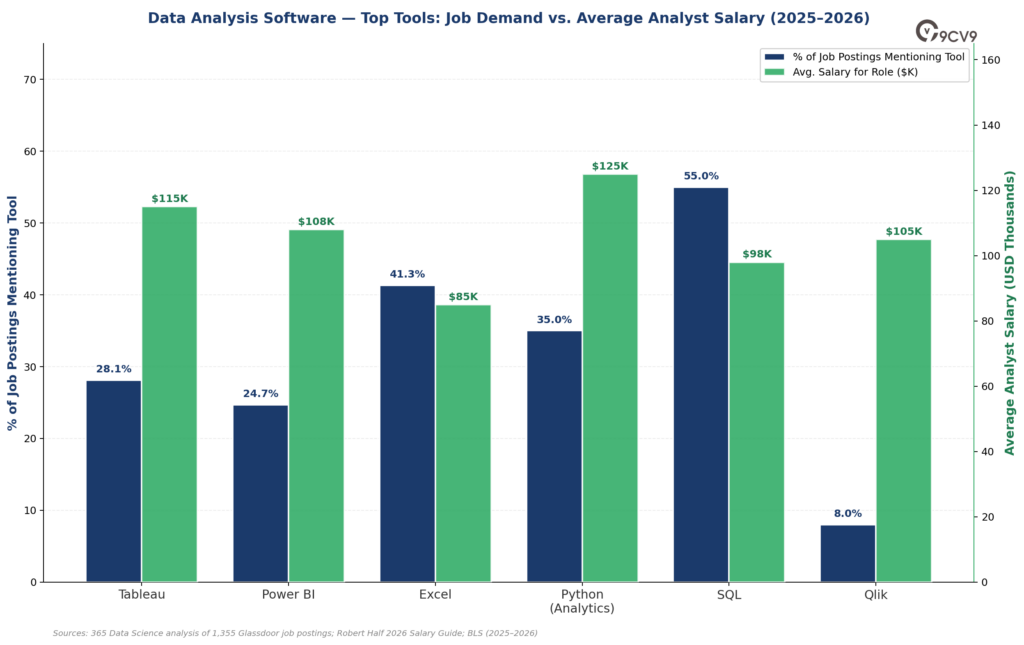
The global workforce is evolving alongside these technological advances. Demand for data scientists, business analysts, analytics engineers, machine learning specialists, and visualization experts continues to rise as organizations seek professionals capable of transforming complex datasets into strategic business outcomes. Salaries across analytics-related professions remain among the highest in the technology sector, reflecting persistent talent shortages despite expanding educational programs and AI-assisted development tools. Rather than replacing human expertise, AI-powered analytics is augmenting analytical capabilities, allowing professionals to focus increasingly on strategic interpretation, business context, and high-value decision support.
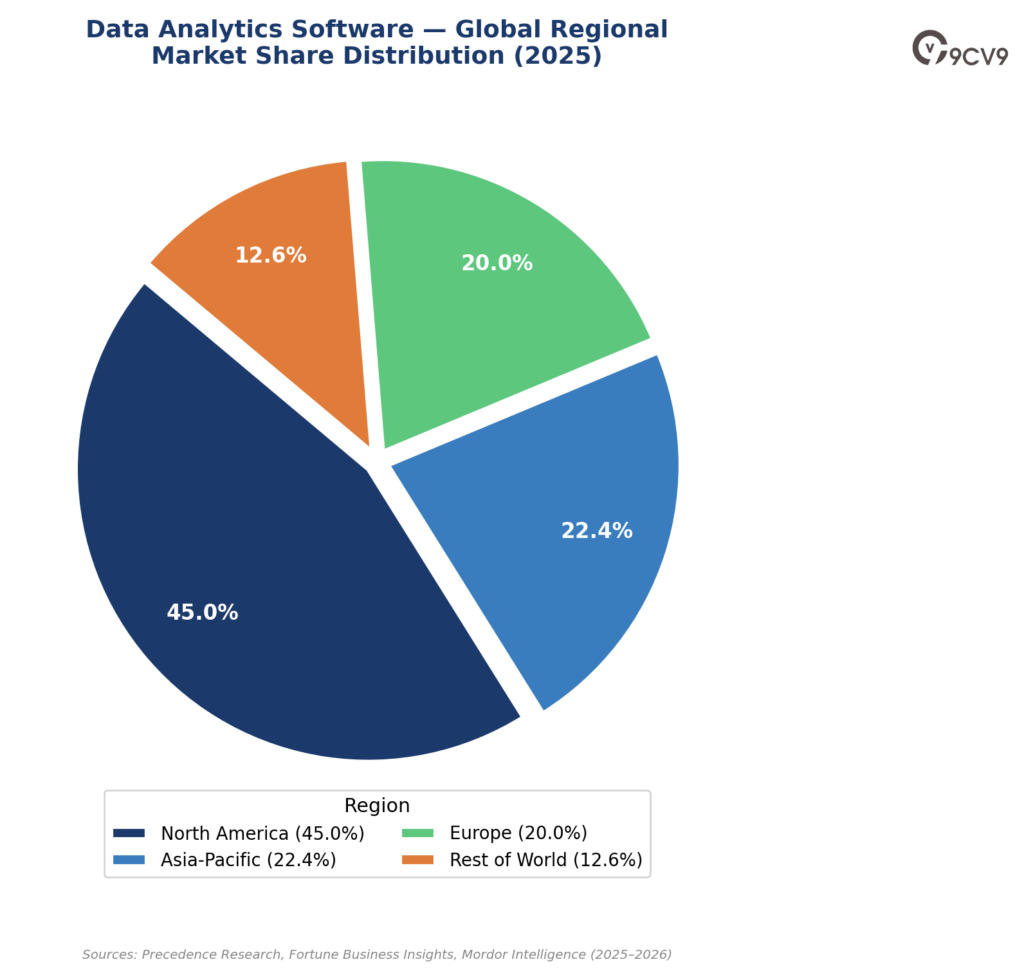
Regional markets also present varying opportunities for growth. North America continues to dominate global analytics spending due to its mature enterprise software ecosystem and concentration of leading technology vendors. However, Asia-Pacific represents the fastest-growing regional market, supported by rapid digital transformation, expanding cloud infrastructure, government AI initiatives, and increasing enterprise technology investments across China, India, Japan, Southeast Asia, and other emerging economies. Europe likewise continues to expand its analytics capabilities as organizations prioritize data governance, regulatory compliance, and AI-driven innovation across both public and private sectors.
As organizations increasingly recognize data as one of their most valuable strategic assets, the demand for intelligent, scalable, AI-powered data analysis software will continue to accelerate throughout the remainder of the decade. Whether enabling executive dashboards, predictive forecasting, fraud detection, customer analytics, supply chain optimization, financial planning, operational intelligence, or machine learning workflows, modern analytics platforms now serve as the foundation upon which digital transformation initiatives are built.
This comprehensive collection of the Top 105 Data Analysis Software Statistics, Data & Trends in 2026 brings together the latest verified market data, adoption rates, investment figures, AI developments, cloud computing trends, workforce insights, regional growth patterns, industry applications, financial metrics, and emerging technologies shaping the future of enterprise analytics. Whether you are a CIO evaluating analytics platforms, a business leader developing a digital transformation strategy, an investor monitoring technology markets, a software vendor tracking competitive trends, or a data professional seeking the latest industry benchmarks, these carefully curated statistics provide valuable insights into one of the fastest-growing and most influential segments of the global software industry.
Before we venture further into this article, we would like to share who we are and what we do.
About 9cv9
9cv9 is a business tech startup based in Singapore and Asia, with a strong presence all over the world.
With over ten years of startup and business experience, and being highly involved in connecting with thousands of companies and startups, the 9cv9 team has listed some important and crucial software tools in this review.
If you like to get your company listed in our top B2B software reviews, check out our world-class 9cv9 Media and PR service and pricing plans here.
Top 105 Data Analysis Software Statistics, Data & Trends in 2026
MARKET SIZE & GROWTH
- $108.79 billion — The global data analytics market size in 2026 (Mordor Intelligence).
The data analytics market crossing the $100 billion threshold in 2026 signals a pivotal shift, as enterprises worldwide now treat data analysis software not as a luxury but as a core operational necessity driving competitive advantage. - $83.79 billion — Alternative estimate of global data analytics market size in 2026 (Precedence Research).
Multiple credible forecasters place the 2026 data analytics software market in the $83–109 billion range, reflecting strong consensus that the industry has reached robust maturity while sustaining double-digit growth momentum. - $343.4 billion — Global big data and business analytics market size in 2026 (Research Nester).
When the broader big data and analytics ecosystem is included, the 2026 market surpasses $343 billion — underscoring how data analysis software is the nucleus of an immense global technology infrastructure. - $151.89 billion — Big Data and Analytics market size specifically in 2026, up from $134.64 billion in 2025 (Business Research Company).
Year-over-year growth of over $17 billion in the big data and analytics segment alone demonstrates that enterprise investment in data analysis platforms shows no sign of slowing in 2026. - $202.05 billion — Big data and analytics services market in 2026, growing from $168.11 billion in 2025 (SQ Magazine / Research Nester).
The services layer surrounding data analysis software—consulting, managed services, and integration—now commands over $200 billion, illustrating how software licenses represent only a fraction of the full analytical investment organisations make. - $11.34 billion — Statistical analysis software market size in 2026, growing from $10.26 billion in 2025 (Business Research Company).
Even the narrower statistical analysis software niche is on track to exceed $11 billion in 2026, driven by cloud adoption in academia, pharmaceuticals, and financial risk modelling. - $37.96 billion — Business Intelligence (BI) market size in 2026 (Fortune Business Insights).
The business intelligence software market’s 2026 valuation of nearly $38 billion reflects how BI dashboards and reporting tools have become foundational, not optional, for organisations of all sizes. - $41.16 billion — BI market size in 2026 per Mordor Intelligence’s updated framework.
Different modelling approaches produce slightly different BI market estimates, but all credible analysts agree the sector comfortably exceeds $40 billion in 2026 — a fourfold increase from a decade prior. - $54.9 billion — Projected global BI market in 2026 per DataStackHub survey synthesis.
Industry aggregator data places the BI market even higher at $54.9 billion in 2026 when embedded analytics, mobile BI, and AI-augmented tools are included, signalling the broadening definition of what constitutes BI software today. - $104.39 billion — Data analytics market projected value for 2026 per Fortune Business Insights, growing to $495.87 billion by 2034.
With a 21.5% CAGR forecast from 2026 to 2034, the data analytics software market is one of the fastest-compounding categories in enterprise technology, rewarding early platform adopters with durable competitive moats.
GROWTH RATES & CAGR
- 28.35% CAGR — Data analytics market compound annual growth rate from 2026 to 2035 (Precedence Research).
A nearly 30% CAGR for data analytics software from 2026 to 2035 places the sector among the highest-growth technology categories globally, surpassing most cloud infrastructure and cybersecurity subsegments. - 21.50% CAGR — Data analytics market CAGR from 2026 to 2034 (Fortune Business Insights).
Sustaining a 21.5% annual expansion over eight years is a testament to the structural demand for analytics software, as every industry vertical accelerates its journey toward data-driven decision-making. - 32.15% CAGR — Data analytics market CAGR from 2026 to 2031 (Mordor Intelligence).
Mordor Intelligence’s 32.15% CAGR projection for data analytics software through 2031 reflects the accelerating AI integration and real-time processing demands that are reshaping enterprise data stacks. - 10.5% CAGR — Statistical analysis software market CAGR from 2025 to 2026 (Business Research Company).
The statistical analysis software segment’s 10.5% CAGR in 2026 indicates healthy, sustainable growth across government, pharmaceutical, and academic users who depend on rigorous, reproducible quantitative methods. - 9.3% CAGR — Business intelligence software CAGR from 2026 to 2033 (Grand View Research).
The BI software segment’s steady 9.3% CAGR through 2033 reflects a market that is maturing but far from saturating, as mid-market buyers and public-sector organisations ramp adoption of cloud-native dashboards. - 13.6% CAGR — Data and analytics software CAGR from 2024 to 2030 (Grand View Research).
Grand View Research’s 13.6% CAGR for the broader data and analytics software category through 2030 underscores the durable, multi-year demand cycle powered by AI integration and cloud migration. - 12.8% CAGR — Big data and analytics services CAGR from 2025 to 2030 (Business Research Company).
A 12.8% services CAGR means that organisations are investing not just in software licences but in the human and technical capacity to operationalise data analysis at scale. - 15% CAGR — Digital analytics software market CAGR through the forecast period (DataInsightsMarket).
The digital analytics software segment’s 15% CAGR is being propelled by exploding digital channel data, multi-touch attribution requirements, and the consumerisation of real-time dashboards across marketing and e-commerce teams. - 10.95% CAGR — Data visualisation market CAGR from 2025 to 2030 (Mordor Intelligence).
Data visualisation — the human interface of data analysis software — is growing at nearly 11% annually, driven by executive demand for real-time KPI dashboards and the democratisation of self-service reporting. - 23.86% CAGR — Predictive analytics market CAGR from 2025 to 2035 (Market Research Future).
Predictive analytics software is on the steepest growth curve within the analytics stack, as organisations move from descriptive hindsight to forward-looking forecasting in supply chain, credit risk, and healthcare.
AI & MACHINE LEARNING INTEGRATION
- 65% — Share of organisations globally that regularly use generative AI in 2026 (McKinsey, via Integrate.io).
With nearly two-thirds of global organisations regularly deploying generative AI in 2026, data analysis software vendors that fail to embed gen AI capabilities risk rapid commoditisation and customer attrition. - 78% — Share of organisations using AI in at least one business function in 2026 (McKinsey).
AI integration is now mainstream, not experimental — the 78% adoption figure means data analysis software buyers expect AI augmentation as a baseline feature, not a premium add-on. - 40% — Share of all BI investment accounted for by AI-driven analytics tools in 2025 (DataStackHub).
When 40 cents of every BI dollar is directed at AI-powered analytics tools in 2025, it signals a decisive strategic shift: intelligence is now embedded in the analytics layer, not bolted on separately. - $22 billion — Revenue projected for AI-powered BI tools by 2026 (DataStackHub).
AI-powered business intelligence software alone is on track to generate $22 billion in revenue in 2026 — a figure that would have represented the entire global BI market less than a decade ago. - 48% — Increase in machine learning integration within BI dashboards in 2025 (DataStackHub).
A 48% year-over-year surge in ML-embedded BI dashboards indicates that predictive and prescriptive analytics are rapidly displacing static reporting as the dominant mode of organisational intelligence. - 59% — Share of employees who can query data using conversational NLP in 2026 (DataStackHub).
Natural language processing capabilities enabling 59% of employees to ask data questions in plain language represent a fundamental democratisation of data analysis, eroding the technical gatekeeping that historically limited insight access. - 50% — Projected share of report creation and visualisation tasks automated by generative AI by 2027 (DataStackHub).
Automation of half of all reporting tasks by 2027 will radically compress analytics cycle times, forcing organisations to shift analyst roles from data preparation toward strategic interpretation and decision support. - 80% — Share of enterprises expected to adopt generative AI by 2026, up from under 5% in 2023 (SQ Magazine).
The leap from under 5% to 80% generative AI adoption in just three years represents one of the fastest institutional technology transitions ever recorded, with data analysis software serving as the primary integration layer. - 35–40% — Reduction in manual data preparation tasks enabled by AI-assisted BI tools (DataStackHub).
Eliminating 35–40% of manual data preparation through AI automation allows data teams to reallocate significant capacity toward higher-value analytical tasks such as hypothesis design and strategic modelling. - 50% — Faster insight delivery reported by enterprises integrating AI into BI platforms (DataStackHub).
Cutting insight delivery times in half through AI-integrated analytics is not merely an efficiency gain — it is a strategic advantage in markets where decision velocity determines competitive outcomes.
CLOUD & DEPLOYMENT
- 65% — Share of BI deployments using cloud-native platforms in 2025, up from 46% in 2023 (DataStackHub).
Cloud BI’s rapid rise from 46% to 65% market share in just two years reflects the decisive industry consensus that cloud-native analytics delivers superior agility, scalability, and total cost of ownership compared to on-premise alternatives. - 67.80% — Software segment share of the global data analytics market in 2025 (Precedence Research).
Software commanding over two-thirds of the data analytics market share confirms that platform licences and subscriptions — rather than services or hardware — are the primary economic engine of the analytics industry. - 58.60% — Cloud deployment share of data analytics market in 2024, expected to grow at 13.80% CAGR (Precedence Research).
With cloud already commanding 58.6% of data analytics deployments in 2024 and accelerating, on-premise analytics infrastructure is rapidly becoming a legacy liability rather than a security advantage. - 53.6% — Cloud BI segment revenue share of global BI software market in 2025 (Grand View Research).
Cloud BI’s majority market position in 2025 reflects how subscription-based analytics platforms have permanently displaced perpetual-licence software as the preferred procurement model for organisations of all sizes. - 50.55% — Projected cloud BI market share in 2026 (Fortune Business Insights).
Despite the cloud majority, the 50.55% figure for 2026 reveals that nearly half of BI deployments remain on-premise or hybrid — highlighting significant remaining migration opportunity for cloud analytics vendors. - 63.45% — Cloud share of the data visualisation market in 2024, expanding at 12.65% CAGR (Mordor Intelligence).
Cloud’s 63.45% share of data visualisation deployments confirms that interactive dashboards and real-time charts are now predominantly cloud-delivered, benefiting from elastic compute and zero-maintenance SaaS models. - 29% — Share of large enterprises operating hybrid BI environments in 2026 (DataStackHub).
Nearly three in ten large enterprises are navigating hybrid analytics architectures in 2026 — a pragmatic response to the tension between cloud scalability desires and regulatory data sovereignty requirements. - 10% — Annual rate at which on-premise BI deployments are declining (DataStackHub).
The 10% annual contraction in on-premise BI reflects not just market preference but organisational strategy, as finance, compliance, and IT teams increasingly weigh flexibility over perceived control. - 61% — Share of SMB workloads now in the cloud for analytics (SQ Magazine).
Small and medium businesses now run the majority of their analytics workloads in the cloud, validating that cloud-native data analysis software has successfully removed the cost and complexity barriers that once reserved advanced analytics for large enterprises. - 13.80% CAGR — Cloud analytics market growth rate from 2026 (Precedence Research).
The cloud analytics subsegment’s 13.8% CAGR outpaces the broader analytics market, confirming that cloud delivery is the dominant growth vector and that on-premise adoption will increasingly represent a shrinking minority.
ENTERPRISE ADOPTION & USAGE
- 78% — Global enterprises that have implemented at least one BI or analytics platform by 2025 (DataStackHub).
With nearly four in five global enterprises deploying at least one analytics platform by 2025, data analysis software has reached a tipping point of ubiquity comparable to CRM or ERP systems a decade prior. - 77% — Share of organisations that list analytics as the principal lever for operational efficiency in 2025 (Ataccama, via Mordor Intelligence).
Analytics topping the operational efficiency priority list for 77% of organisations in 2025 reflects a maturation of data strategy: leadership now views insight extraction as a capability requirement, not an IT project. - 84% — Share of executives saying BI and analytics are critical for their digital transformation roadmap (DataStackHub).
When 84% of executives describe analytics as critical to digital transformation — not merely helpful — it signals that analytics software investment is now a board-level discussion rather than a departmental budget decision. - 63% — Share of business leaders describing their organisations as data-driven (SQ Magazine).
Despite 63% of leaders claiming a data-driven culture, the persistent gap between aspiration and execution means significant demand remains for analytics software that reduces the friction between raw data and actionable insight. - 72% — Share of non-technical employees who now have access to BI tools via data democratisation initiatives (DataStackHub).
Extending BI tool access to 72% of non-technical employees is the most direct indicator that data analysis software is no longer a specialist privilege — it is becoming workplace infrastructure as universal as email. - 68% — Share of organisations with a centralised analytics or BI Centre of Excellence (DataStackHub).
The majority of organisations now operating a dedicated analytics Centre of Excellence signals the institutionalisation of data analysis as a strategic discipline, driving standardised governance, tool procurement, and capability development. - 46% — Share of companies deploying BI at departmental level vs. 38% with enterprise-wide frameworks (DataStackHub).
The predominance of departmental BI deployment over enterprise-wide analytics frameworks reveals that data analysis software adoption frequently follows a land-and-expand pattern rather than top-down, monolithic rollouts. - 74% — Top four BI platform vendors’ combined market share in 2025: Power BI, Tableau, Qlik, Looker (DataStackHub).
With Power BI, Tableau, Qlik, and Looker collectively commanding 74% of the BI market in 2025, the analytics software space has consolidated around a small set of dominant platforms, creating high switching costs for enterprises. - 34% — Year-over-year growth in embedded BI within SaaS products as vendors add analytics as a value-add feature (DataStackHub).
Embedded analytics growing at 34% annually signals a significant structural shift: data analysis capabilities are increasingly delivered as part of vertical software applications rather than standalone analytics platforms. - 80% — BI adoption rate among firms with more than 5,000 employees (360Suite, via Straits Research).
Enterprise-scale organisations with over 5,000 employees have achieved 80% BI adoption, confirming that analytics software is now as standard as ERP in large-organisation technology stacks.
WORKFORCE & TALENT
- ~11.5 million — New jobs in data science and analytics expected to be created by late 2026 (Fortune Business Insights, via Skilifysolutions).
The projected creation of 11.5 million data-related jobs by late 2026 confirms that AI is augmenting rather than eliminating the data analyst workforce — creating roles that combine domain expertise with technical tooling fluency. - 34% — Projected employment growth rate for data scientists over the coming decade (U.S. Bureau of Labor Statistics).
Data scientist employment growing at 34% — more than eight times the national average — is the clearest signal that organisations need human expertise to extract strategic value from data analysis software outputs. - $111,000 — Average data analyst salary in the US in 2025, up from $90,000 in 2024 (Glassdoor, via 365 Data Science).
A $21,000 year-over-year salary jump for US data analysts in 2025 reflects a classic supply-demand imbalance: the volume of data analysis software deployments is dramatically outpacing the pipeline of qualified professionals to operate them. - $112,000 — Median annual wage for data scientists in the US, more than double the national median (BLS, via University of Dallas).
Data scientists earning double the national median wage underscores the premium that data analysis expertise commands — a premium that is unlikely to compress as AI-augmented analytics creates demand for increasingly sophisticated human judgement. - 42% — Share of analytics leaders citing skill scarcity as the top adoption hurdle in 2026 (Mordor Intelligence).
Talent scarcity edging out cost and technical complexity as the primary barrier to analytics adoption reveals that data analysis software vendors must prioritise ease of use, automation, and low-code capabilities to unlock the next wave of enterprise growth. - 28.1% — Share of job postings requiring Tableau skills in 2025 (365 Data Science analysis of 1,355 postings).
Tableau’s 28.1% presence in data analyst job postings affirms its continued dominance as the industry’s benchmark visualisation platform, making Tableau proficiency a near-essential credential for aspiring analysts. - 24.7% — Share of job postings requiring Power BI skills in 2025 (365 Data Science).
Microsoft Power BI’s near-25% job posting presence demonstrates that it has closed the gap with Tableau significantly, and organisations embedded in the Microsoft 365 ecosystem are standardising on Power BI as their default analytics surface. - 41.3% — Share of data analyst job postings referencing Microsoft Excel in 2025 (365 Data Science).
Excel’s 41% mention rate in 2025 data analyst postings confirms that, despite the proliferation of sophisticated analytics platforms, spreadsheet fluency remains a foundational and irreplaceable skill in the analyst’s toolkit. - $129,000 — Average US salary for data scientists in 2026, reflecting a 34% growth rate (Skilifysolutions).
Data science professionals commanding $129,000 annually in 2026 positions the role as one of the most financially rewarding entry points into the broader software and technology ecosystem. - 25% — Expected employment growth in data-related fields from 2021 to 2031 (Research.com, citing BLS projections).
A quarter-century of sustained employment growth in data fields through 2031 provides prospective analysts with a structurally robust career pathway relatively insulated from broader cyclical technology layoff pressures.
REGIONAL INSIGHTS
- 45% — North America’s share of the global data analytics market in 2025 (Precedence Research).
North America’s near-majority share of the global data analytics market in 2025 reflects decades of enterprise software investment, Silicon Valley innovation leadership, and a regulatory environment that has historically encouraged aggressive data utilisation. - 32.10% — North America’s data analytics market share per Fortune Business Insights (2025).
Even under more conservative market scope definitions, North America commands nearly a third of global analytics spend — a structural advantage that stems from the concentration of the world’s largest analytics platform vendors. - $26.4 billion — North American data analytics market size in 2025, projected to reach $32.56 billion in 2026 (Fortune Business Insights).
The North American analytics market’s $6 billion single-year expansion from 2025 to 2026 underscores the region’s continued capacity to absorb significant platform investment even at its already dominant scale. - 33.12% CAGR — Asia-Pacific data analytics market growth rate from 2026 to 2031 (Mordor Intelligence).
Asia-Pacific’s 33% CAGR — the fastest of any region — reflects the accelerating cloud and AI adoption among China, India, Japan, and Southeast Asian enterprises that are rapidly closing the analytics maturity gap with Western peers. - 23.5% CAGR — Asia-Pacific data analytics market CAGR per Precedence Research.
Across multiple forecasters, Asia-Pacific consistently emerges as the fastest-growing analytics market, driven by government AI initiatives, expanding cloud infrastructure, and a young digital-native enterprise base. - $5.91 billion — China data analytics market projected for 2026 (Fortune Business Insights).
China’s near-$6 billion analytics market in 2026 reflects aggressive state investment in digital infrastructure and a rapidly modernising private-sector demand base for advanced data analysis software. - $4.76 billion — India data analytics market projected for 2026 (Fortune Business Insights).
India’s nearly $5 billion analytics market in 2026 is growing rapidly, underpinned by a large English-speaking data talent pool, a booming domestic tech sector, and accelerating enterprise digital transformation across BFSI, retail, and healthcare. - $5.6 billion — Japan data analytics market projected for 2026 (Fortune Business Insights).
Japan’s $5.6 billion analytics market reflects a nation balancing advanced manufacturing analytics — particularly in automotive and semiconductor industries — with the challenges of an ageing workforce and conservative enterprise adoption pace. - 39.85% — North America’s share of BI market revenue in 2025 (Mordor Intelligence BI report).
North America’s commanding 39.85% share of BI revenues in 2025 is reinforced by the presence of the world’s largest BI vendors — Microsoft, Salesforce/Tableau, Google, and AWS — which collectively define global product direction. - 10.12% CAGR — Asia-Pacific BI market growth rate from 2026 to 2031 (Mordor Intelligence).
Asia-Pacific’s double-digit BI market CAGR through 2031 signals a sustained, multi-year growth opportunity for platform vendors willing to localise, price flexibly, and partner with regional system integrators.
INDUSTRY VERTICALS
- 44.20% — IT and Telecom’s share of data analytics market in 2025, the leading vertical (Mordor Intelligence).
IT and Telecom sectors commanding 44% of data analytics market share in 2025 is a natural reflection of their data-intensive operations, but it also means that analytics software vendors serving other verticals have enormous greenfield opportunity ahead. - 33.40% CAGR — Healthcare’s projected analytics growth rate, the fastest of any vertical (Mordor Intelligence).
Healthcare analytics growing at over 33% annually is the sector’s most important digital transformation signal: data analysis software is now directly improving patient outcomes through genomic analysis, predictive diagnostics, and real-time monitoring. - 32% — CAGR for healthcare analytics specifically (Forbes/research consensus).
With healthcare generating 30% of global data and the sector’s analytics CAGR at 32%, the intersection of clinical data and analytics software represents one of the highest-impact investment and deployment opportunities of the decade. - $31.3 billion — Financial services’ investment in AI and analytics in 2026 (SQ Magazine).
Financial services’ $31.3 billion analytics and AI spend in 2026 reflects the sector’s fundamental dependence on quantitative models — from credit scoring and fraud detection to portfolio optimisation and regulatory reporting. - $43.1 billion — Healthcare analytics market value in 2026 (SQ Magazine).
A $43.1 billion healthcare analytics market in 2026 confirms that clinical and operational data analysis has crossed the threshold from pilot to core infrastructure, reshaping how hospitals, insurers, and biotech firms make decisions. - 26% — Global BI adoption rate (fraction of employees in a given department using BI tools frequently) per 360Suite (Straits Research).
The 26% frequency-of-use rate reveals that while BI platform deployments are widespread, deep daily usage remains a minority behaviour — indicating substantial whitespace for vendors to improve usability, personalisation, and workflow integration. - 33.6% CAGR — Growth rate in financial risk and fraud analytics, one of the fastest-growing analytical use cases (Skilifysolutions).
Financial risk and fraud analytics growing at 33.6% annually reflects the arms race between increasingly sophisticated financial crimes and the AI-powered analytical systems that data analysis software vendors are deploying to detect and prevent them. - 26.5% — Supply chain analytics market share, indicating rapid expansion (Skilifysolutions).
Supply chain analytics commanding 26.5% market share in 2026 is a post-pandemic structural outcome: organisations that suffered from opacity in their supply chains are now investing heavily in data analysis software to achieve real-time end-to-end visibility.
DATA QUALITY, GOVERNANCE & CHALLENGES
- $12.9 million — Average annual cost to organisations of poor data quality in 2025 (Gartner/industry consensus, via doit.software).
Poor data quality costing organisations $12.9 million annually — before productivity losses are factored in — creates a powerful economic case for investment in data governance tools and high-quality analytics pipelines. - 60% — Share of AI projects predicted to be abandoned through 2026 due to lack of AI-ready data (Gartner, via doit.software).
Gartner’s forecast that 60% of AI projects will fail due to poor data quality is the strongest argument for investing in data quality and analytics infrastructure before deploying AI — without clean data, even the best analytics software cannot deliver results. - 63% — Share of data leaders who lack or are unsure they have the right data practices for AI (doit.software).
Two-thirds of data leaders acknowledging inadequate AI-readiness in their data practices reveals a critical execution gap: analytics software capabilities have outpaced organisations’ underlying data management maturity. - 40% — Share of analytics leaders citing skill scarcity as the top implementation hurdle (Mordor Intelligence).
Skill scarcity ranking as the number-one analytics challenge — above cost and technology — demonstrates that the bottleneck to analytics value realisation has shifted from software capability to human capability. - 22% — Share of firms that consider their infrastructure adequate for AI workloads (Mordor Intelligence).
Only 22% of firms rating their current infrastructure as AI-ready means 78% face material underinvestment in the compute, storage, and data pipeline capabilities required to operationalise advanced analytics software at scale. - 40% — Share of data quality challenges attributed to data integration issues (G2 / via pixelplex.io).
Data integration problems accounting for 40% of data quality challenges underscore why data analysis software that prioritises seamless multi-source connectivity and automated ETL will outperform siloed point solutions. - 14% — Share of self-service BI challenges attributed to data security concerns (G2).
Data security representing 14% of self-service BI challenges highlights that analytics democratisation cannot proceed without robust access controls, audit trails, and privacy-preserving computation capabilities.
INVESTMENT & FINANCIAL METRICS
- $37 billion — Enterprise spending on generative AI in 2025, up 3.2x from $11.5 billion in 2024 (Menlo Ventures).
A 3.2x year-over-year surge in enterprise generative AI spending to $37 billion in 2025 confirms that gen AI has moved from cost centre experimentation to revenue-generating, production-grade deployment — with data analysis software as the primary integration layer. - $211 billion — Global venture capital directed to AI-focused companies in 2025 (Modall/Deloitte).
Half of all global VC flowing into AI companies in 2025 signals the investment community’s conviction that AI-augmented data analysis represents one of the defining value creation opportunities of the current technology cycle. - 112% — Average ROI for organisations using BI software, with a 1.6-year payback period (Nucleus Research, via scoop.market.us).
A 112% ROI and 1.6-year payback period for BI investments provides CFOs with a compelling financial case: analytics software is among the most rapidly self-funding technology categories in the enterprise stack. - $3.70 — Value returned per dollar invested in enterprise AI initiatives for early adopters (Fullview.io).
Early AI and analytics adopters generating $3.70 per dollar invested — with top performers achieving $10.30 — creates a powerful first-mover incentive structure that will continue to drive accelerated analytics software adoption. - 5x — Likelihood that organisations with high BI adoption make faster, better-informed decisions vs. peers (Aberdeen Group, via scoop.market.us).
Organisations with high BI adoption being five times more likely to make superior decisions is perhaps the most compelling statistic in analytics software marketing — it quantifies the decision quality premium that data-driven organisations achieve. - $15 billion — Digital analytics software market size in 2025, projected to grow at 15% CAGR (DataInsightsMarket).
The $15 billion digital analytics software market in 2025 represents the fastest-growing sub-segment, as the explosion of online commerce, content, and digital customer journeys creates inexhaustible demand for web and app analytics platforms. - $10.92 billion — Data visualisation market size in 2025, projected to reach $18.36 billion by 2030 (Mordor Intelligence).
Data visualisation software growing from $10.92 billion in 2025 to $18.36 billion by 2030 confirms that organisations are investing heavily in the human interface of analytics — transforming complex data into comprehensible, actionable visuals. - $24.89 billion — Data as a Service (DaaS) market size in 2025, projected to reach $61.93 billion by 2030 at 20% CAGR (doit.software).
The DaaS market’s trajectory to nearly $62 billion by 2030 indicates that many organisations are decoupling data acquisition from analytics software procurement — buying insights-ready data streams rather than building proprietary data collection infrastructure. - $7.23 billion — Software analytics market size in 2025, projected to reach $17.2 billion by 2035 at 9.05% CAGR (Market Research Future).
The software analytics market’s steady 9.05% CAGR through 2035 reflects the sector’s resilience — as software portfolios grow and DevOps practices mature, analytics embedded in development workflows becomes an increasingly non-negotiable capability. - 6% — Enterprise generative AI’s share of the global SaaS market in 2025, growing faster than any prior software category (Menlo Ventures).
Generative AI capturing 6% of the global SaaS market within just a few years of commercial availability sets a historic adoption velocity benchmark, validating that AI-powered data analysis tools are not a niche but a market-defining shift.
TECHNOLOGY TRENDS
- 79% — Share of CIOs planning to increase funding for data analytics and BI in 2026, up 25% from 2025 (doit.software).
Nearly 80% of CIOs planning analytics budget increases in 2026 — a 25-percentage-point jump from 2025 — signals that analytics investment is entering a sustained acceleration phase driven by AI integration and real-time decision-making requirements. - $15.26 billion — Augmented analytics market value in 2025, forecast to reach $87.03 billion by 2032 (doit.software).
Augmented analytics — where AI automatically surfaces insights without user-initiated queries — represents one of the most disruptive force vectors in data analysis software, potentially reshaping the analyst role from data interpreter to strategic validator. - $345.32 billion — Projected data and analytics software market value by 2030 at 13.6% CAGR (Grand View Research).
Grand View Research’s $345 billion 2030 forecast for the data and analytics software market places analytics spending on par with some of the world’s largest national defence budgets — a dramatic illustration of data’s economic centrality. - $862.31 billion — Global big data market projected to reach by 2030 at 14.9% CAGR (SQ Magazine).
The big data market approaching $1 trillion by 2030 confirms that data analysis software is not a technology trend but an economic megatrend, reshaping how wealth is created, distributed, and governed in the digital economy. - 328.77 million terabytes — Volume of data generated globally per day in 2025, creating insatiable demand for analytics tools (doit.software).
Humanity generating 328.77 million terabytes of new data every single day in 2025 is the ultimate demand driver for data analysis software — as the data volume grows, so does the commercial imperative to extract intelligence from it. - 181 zettabytes — Total global data volume projected for 2025, up from 64.2 zettabytes in 2020 (Statista, via multiple sources).
The near-tripling of global data volume from 64.2 to 181 zettabytes between 2020 and 2025 has created an analytics infrastructure gap that only modern, AI-powered data analysis software platforms can feasibly bridge. - 21.09 billion — Number of IoT devices worldwide projected for 2026, generating vast analytics workloads (bigdataanalyticsnews.com).
Over 21 billion IoT devices in operation by 2026 creates a machine-generated data torrent that is driving explosive demand for edge analytics, streaming data platforms, and real-time data analysis software capabilities. - 31% — Share of self-service BI adoption increase year-over-year as business teams demand autonomy from IT (DataStackHub).
Self-service BI growing at 31% annually is a structural disruption to traditional analytics workflows: business users are demanding direct data access, compelling analytics vendors to prioritise intuitive interfaces and guided analytics experiences. - 24.34% — Executive dashboards’ share as the largest departmental use case in the data visualisation market in 2024 (Mordor Intelligence).
Executive dashboards capturing nearly a quarter of the data visualisation market confirms that the C-suite remains both the primary consumer and the primary funding authority for enterprise analytics investments. - $785.62 billion — Global data analytics market projected to reach by 2035, growing from $83.79 billion in 2026 (Precedence Research).
The data analytics market’s trajectory from $83 billion in 2026 to $785 billion by 2035 represents one of the most dramatic value creation curves in technology history — a nearly 10-fold expansion in under a decade driven by AI integration, cloud adoption, and data volume explosion.
Conclusion
The data analysis software industry has firmly established itself as one of the most influential and strategically important segments of the global enterprise software market in 2026. As organizations generate exponentially larger volumes of structured and unstructured data, the ability to convert information into actionable intelligence has become a defining factor separating market leaders from their competitors. The statistics presented throughout this report clearly demonstrate that data analytics is no longer viewed merely as an operational support function—it has become a fundamental driver of digital transformation, innovation, operational efficiency, customer experience, and long-term business growth.
One of the clearest takeaways from these statistics is the remarkable scale of market expansion. Multiple industry analysts estimate the global data analytics software market to be worth between approximately $84 billion and $109 billion in 2026, while the broader big data and analytics ecosystem has already surpassed $343 billion globally. Long-term forecasts extending through 2030 and 2035 project sustained double-digit compound annual growth rates, with some estimates placing the market at nearly $785 billion within the next decade. Such extraordinary growth illustrates that enterprise investment in analytics software remains in its acceleration phase rather than approaching maturity. Organizations across every industry continue to recognize data as one of their most valuable strategic assets, fueling ongoing investment in modern analytics platforms.
Artificial intelligence is emerging as the single greatest catalyst reshaping the future of data analysis software. The widespread adoption of generative AI, machine learning, natural language processing, predictive analytics, and automated insight generation is fundamentally changing how organizations interact with data. Rather than relying solely on traditional dashboards and manually generated reports, businesses increasingly expect analytics platforms to proactively identify opportunities, forecast trends, automate repetitive tasks, and deliver real-time recommendations. AI is transforming analytics software from descriptive reporting tools into intelligent decision-support systems capable of driving faster, more accurate, and more confident business decisions.
Cloud computing continues to reinforce this transformation. The steady migration toward cloud-native analytics platforms demonstrates that organizations increasingly prioritize scalability, accessibility, lower infrastructure costs, and rapid deployment over traditional on-premise environments. While hybrid architectures remain important for highly regulated industries and organizations with strict data sovereignty requirements, the long-term trajectory clearly favors cloud-first analytics strategies. The rapid growth of Software-as-a-Service analytics solutions also enables small and medium-sized businesses to access sophisticated analytical capabilities that were previously available only to large enterprises with extensive IT resources. This democratization of advanced analytics is expanding the addressable market and accelerating adoption across businesses of every size.
Another defining trend highlighted by these statistics is the growing democratization of data. Modern business intelligence platforms increasingly empower non-technical users through self-service analytics, intuitive visualization tools, conversational AI interfaces, and low-code or no-code capabilities. Organizations are actively extending analytics access beyond data scientists and IT departments to executives, marketers, finance teams, HR professionals, operations managers, and frontline employees. As analytics becomes embedded directly into daily business workflows, organizations are developing stronger data-driven cultures where decisions are supported by evidence rather than intuition alone.
The explosion of global data generation further reinforces the importance of robust analytics platforms. Massive increases in IoT devices, cloud applications, mobile technologies, digital commerce, industrial automation, and AI systems continue to create unprecedented analytical workloads. Every new connected device, customer interaction, business transaction, and operational process generates valuable information that organizations must capture, process, analyze, and convert into strategic insights. This ongoing expansion of data volumes ensures that demand for scalable analytics software will remain exceptionally strong throughout the remainder of the decade.
Industry-specific adoption patterns reveal that data analysis software has become indispensable across virtually every sector of the global economy. Healthcare organizations increasingly rely on predictive analytics to improve patient care and operational efficiency. Financial institutions continue expanding investments in fraud detection, regulatory reporting, and risk management platforms. Manufacturers leverage real-time analytics for predictive maintenance and production optimization, while retailers utilize customer intelligence to personalize experiences and improve inventory planning. Supply chain analytics has become a strategic priority following years of global disruption, enabling organizations to build greater resilience through improved forecasting and end-to-end visibility. These expanding use cases demonstrate that analytics software is becoming deeply integrated into nearly every critical business function.
Regional trends also illustrate a dynamic global market. North America continues to lead worldwide analytics spending, supported by a mature enterprise software ecosystem and the presence of many of the industry’s largest vendors. However, Asia-Pacific consistently records the fastest growth rates as governments, enterprises, and technology providers invest heavily in cloud infrastructure, artificial intelligence, and digital transformation initiatives. Emerging markets throughout Asia are rapidly narrowing the analytics maturity gap, creating significant expansion opportunities for both established software providers and innovative startups seeking new customer segments.
Despite this strong momentum, the statistics also highlight several persistent challenges organizations must address. Poor data quality remains one of the most expensive obstacles to successful analytics initiatives, costing organizations millions of dollars annually while reducing the effectiveness of AI systems. Talent shortages continue to limit implementation capacity, even as salaries for analytics professionals remain among the highest in the technology industry. Data governance, cybersecurity, regulatory compliance, integration complexity, and legacy infrastructure continue to influence purchasing decisions. Organizations that successfully overcome these challenges through modern governance frameworks, automated data preparation, cloud-native architectures, and AI-assisted workflows will be significantly better positioned to maximize returns on their analytics investments.
Financial metrics further reinforce the compelling business case for analytics software adoption. Strong returns on investment, relatively short payback periods, increasing enterprise AI spending, and growing venture capital investment into analytics and AI companies demonstrate that both corporate buyers and investors view analytics as a long-term strategic priority rather than a temporary technology trend. Organizations that effectively leverage analytics consistently outperform peers through improved operational efficiency, faster decision-making, stronger customer engagement, enhanced risk management, and greater organizational agility.
Looking ahead, the future of data analysis software will increasingly revolve around intelligent automation, augmented analytics, embedded AI, predictive decision-making, real-time processing, and autonomous business intelligence. Future platforms will not simply present historical information but will continuously recommend optimal actions, simulate potential business scenarios, identify emerging risks, and automate complex analytical workflows. Advances in large language models, agentic AI, edge computing, streaming analytics, and multimodal data processing will continue expanding the capabilities of analytics software beyond today’s expectations.
Ultimately, the Top 105 Data Analysis Software Statistics, Data & Trends in 2026 provide compelling evidence that analytics has evolved into one of the foundational technologies powering the global digital economy. From billion-dollar market expansion and accelerating AI adoption to cloud migration, workforce transformation, industry-specific innovation, and sustained enterprise investment, every major trend points toward continued long-term growth. For business leaders, technology executives, software vendors, investors, consultants, and analytics professionals alike, understanding these data-driven trends is essential for making informed strategic decisions in an increasingly competitive and information-rich world. Organizations that embrace modern data analysis software, invest in high-quality data governance, cultivate analytical talent, and leverage AI-powered insights will be best positioned to unlock sustainable competitive advantage and thrive in the rapidly evolving data-driven economy of the years ahead.
If you find this article useful, why not share it with your hiring manager and C-level suite friends and also leave a nice comment below?
We, at the 9cv9 Research Team, strive to bring the latest and most meaningful data, guides, and statistics to your doorstep.
To get access to top-quality guides, click over to 9cv9 Blog.
To hire top talents using our modern AI-powered recruitment agency, find out more at 9cv9 Modern AI-Powered Recruitment Agency.
People Also Ask
What is data analysis software?
Data analysis software helps organizations collect, process, visualize, and interpret data to uncover insights, improve decision-making, and optimize business performance across multiple industries.
Why is data analysis software important in 2026?
Data analysis software enables businesses to leverage AI, automation, and real-time analytics to make faster decisions, improve efficiency, reduce costs, and gain competitive advantages.
How large is the global data analysis software market in 2026?
Industry reports estimate the global data analysis software market exceeds $100 billion in 2026, supported by increasing enterprise investments in AI, cloud computing, and digital transformation.
What are the biggest trends in data analysis software in 2026?
Major trends include generative AI integration, cloud-native analytics, predictive analytics, self-service business intelligence, embedded analytics, and automated data preparation.
How is artificial intelligence changing data analysis software?
AI automates data processing, generates insights, predicts future outcomes, detects anomalies, and enables natural language queries, making analytics faster and more accessible.
What industries use data analysis software the most?
Banking, healthcare, retail, manufacturing, telecommunications, government, logistics, education, and financial services are among the largest users of analytics software.
What is business intelligence software?
Business intelligence software transforms raw business data into dashboards, reports, and visualizations that help organizations monitor performance and support strategic decisions.
How does cloud analytics differ from on-premise analytics?
Cloud analytics offers greater scalability, lower infrastructure costs, faster deployment, and remote accessibility, while on-premise analytics provides more direct control over infrastructure.
What is self-service analytics?
Self-service analytics allows non-technical users to explore data, build dashboards, and generate reports without relying heavily on IT or data science teams.
What is predictive analytics?
Predictive analytics uses historical data, statistical models, and machine learning to forecast future trends, customer behavior, and business outcomes.
Why are businesses investing more in analytics software?
Organizations invest in analytics software to improve decision-making, increase operational efficiency, personalize customer experiences, reduce risks, and gain competitive insights.
How does big data affect analytics software?
Growing data volumes require more scalable analytics platforms capable of processing structured and unstructured data quickly while delivering real-time business insights.
What role does machine learning play in analytics?
Machine learning identifies patterns, automates predictions, detects anomalies, and continuously improves analytical models using historical and real-time data.
Which regions are leading the data analytics market?
North America remains the largest market, while Asia-Pacific is experiencing the fastest growth due to rapid digital transformation and increasing cloud adoption.
What challenges do organizations face with data analytics?
Common challenges include poor data quality, data silos, cybersecurity risks, integration complexity, talent shortages, and regulatory compliance requirements.
How does data visualization improve decision-making?
Data visualization converts complex datasets into charts, dashboards, and graphs that help users quickly identify trends, patterns, and business opportunities.
What is embedded analytics?
Embedded analytics integrates dashboards and reporting directly into business applications, allowing users to access insights without switching platforms.
How does analytics software support digital transformation?
Analytics software enables organizations to automate decisions, optimize operations, monitor performance in real time, and support innovation through data-driven strategies.
What are the benefits of real-time analytics?
Real-time analytics enables businesses to respond immediately to customer behavior, operational issues, security threats, and changing market conditions.
How is generative AI improving business intelligence?
Generative AI allows users to ask questions in natural language, automatically generate reports, summarize insights, and recommend actions based on business data.
Why is data quality critical for analytics?
High-quality data improves reporting accuracy, strengthens AI models, reduces costly errors, and ensures more reliable business decisions.
What features should businesses look for in analytics software?
Important features include AI capabilities, cloud deployment, dashboard customization, data integration, predictive analytics, security, scalability, and collaboration tools.
How does analytics software improve customer experience?
Businesses use analytics to understand customer behavior, personalize recommendations, optimize marketing campaigns, and improve service quality.
What is the future of data analysis software?
The future includes autonomous analytics, AI-powered decision support, conversational interfaces, edge analytics, real-time intelligence, and deeper business automation.
How does analytics software support small businesses?
Modern cloud-based analytics platforms provide affordable tools for reporting, forecasting, customer analysis, and operational optimization without requiring large IT teams.
How is analytics software used in healthcare?
Healthcare providers use analytics for patient outcome prediction, resource planning, medical research, operational efficiency, and disease monitoring.
What is the relationship between data science and analytics software?
Data science develops analytical models and algorithms, while analytics software delivers insights, dashboards, and reporting that businesses use for decision-making.
Why is demand for analytics professionals increasing?
Organizations increasingly need professionals who can analyze data, build AI models, interpret business insights, and manage growing data ecosystems.
What factors are driving the growth of analytics software?
Cloud computing, AI adoption, digital transformation, increasing data generation, automation, and growing enterprise investments continue driving market expansion.
Where can businesses find the latest data analysis software statistics?
Comprehensive industry reports, market research firms, technology analysts, and curated collections like the Top 105 Data Analysis Software Statistics, Data & Trends in 2026 provide the latest market insights.
Sources
Mordor Intelligence Fortune Business Insights Precedence Research Business Research Company Grand View Research DataStackHub doit.software Market Research Future Research Nester SQ Magazine Integrate.io Menlo Ventures Deloitte McKinsey Global Survey Federal Reserve 365 Data Science Robert Half Skilifysolutions U.S. Bureau of Labor Statistics Big Data Analytics News Straits Research Market.us MIT Sloan Management Review Fullview.io