
Key Takeaways
- The Customer Data Platform market is experiencing rapid growth in 2026, driven by AI adoption, first-party data strategies, real-time personalization, and increasing enterprise demand for unified customer intelligence.
- Customer Data Platforms are becoming essential business infrastructure, helping organizations improve customer experience, boost conversion rates, reduce churn, increase customer lifetime value, and achieve measurable ROI through data-driven decision-making.
- Emerging trends such as warehouse-native CDPs, agentic AI, zero-copy architectures, privacy-first marketing, and real-time customer data activation are reshaping the future of customer engagement and enterprise digital transformation.
A Customer Data Platform (CDP) helps organizations unify customer information from multiple channels and activate it for personalization, analytics, and AI-driven experiences. In 2026, CDPs are growing rapidly as businesses use them to improve customer engagement, increase revenue, strengthen first-party data strategies, and support real-time decision-making across the enterprise.
Customer Data Platforms (CDPs) have emerged as one of the most transformative technologies in the modern digital economy, fundamentally changing how organizations collect, unify, analyze, and activate customer data. In 2026, businesses operate in an environment where customers interact with brands across dozens of touchpoints, including websites, mobile applications, social media platforms, e-commerce stores, call centers, physical retail locations, email campaigns, and connected devices. Managing these fragmented customer interactions has become increasingly challenging, making unified customer data not just a competitive advantage but a business necessity. This shift has propelled Customer Data Platforms from a specialized marketing technology into a core component of enterprise infrastructure.
Also, read our guide on the Top 11 Customer Data Platforms.


The rapid rise of artificial intelligence, predictive analytics, personalization technologies, and privacy-first marketing strategies has accelerated demand for CDPs worldwide. Organizations are investing heavily in platforms that can create a single, accurate, and actionable customer view across every channel and interaction. As businesses seek to improve customer experiences, reduce churn, increase customer lifetime value, and maximize marketing efficiency, CDPs have become the foundation upon which many of these initiatives are built.
The numbers behind the industry’s growth are remarkable. The global Customer Data Platform market is estimated to be worth approximately USD 4.58 billion in 2026, reflecting strong enterprise demand for customer intelligence and data activation capabilities. Even more impressive is the long-term outlook. Various industry forecasts project the market to reach anywhere from USD 13 billion to over USD 58 billion within the next decade, depending on methodology and market definitions. Many analysts expect annual growth rates exceeding 20%, while some forecasts suggest growth rates approaching or even surpassing 30% annually. Such figures place CDPs among the fastest-growing segments within the broader marketing technology, data management, and customer experience software sectors.

One of the primary drivers of this growth is the increasing importance of first-party data. The digital advertising landscape has undergone a profound transformation as browsers phase out third-party cookies and regulators enforce stricter privacy requirements. Businesses can no longer rely on external data sources to understand customer behavior. Instead, they must build direct relationships with customers and leverage their own data assets. Customer Data Platforms have emerged as the essential technology for collecting, organizing, and activating first-party data at scale. As a result, more than two-thirds of organizations are increasing investments in first-party data strategies, while many view CDPs as foundational to their future customer engagement efforts.

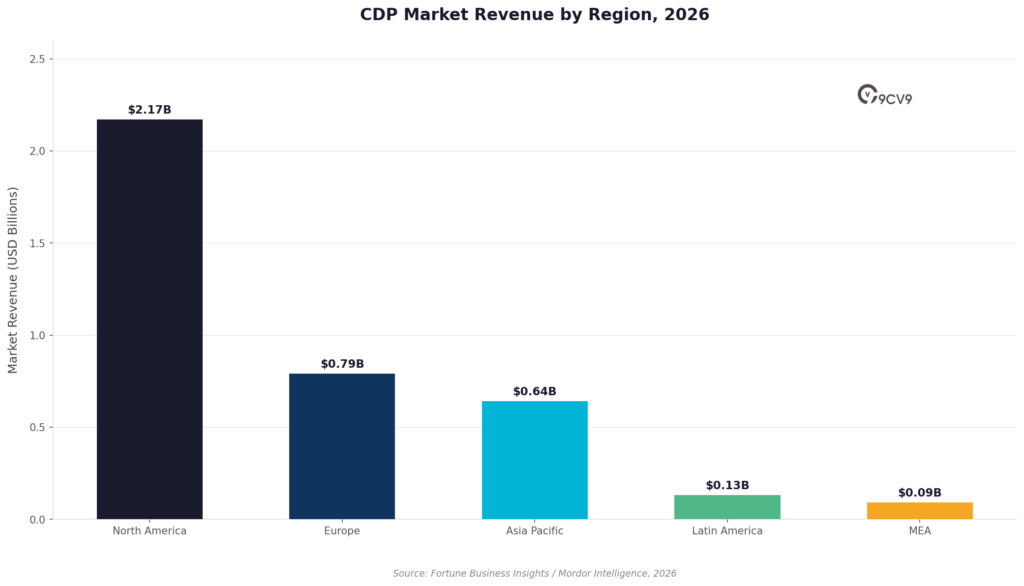
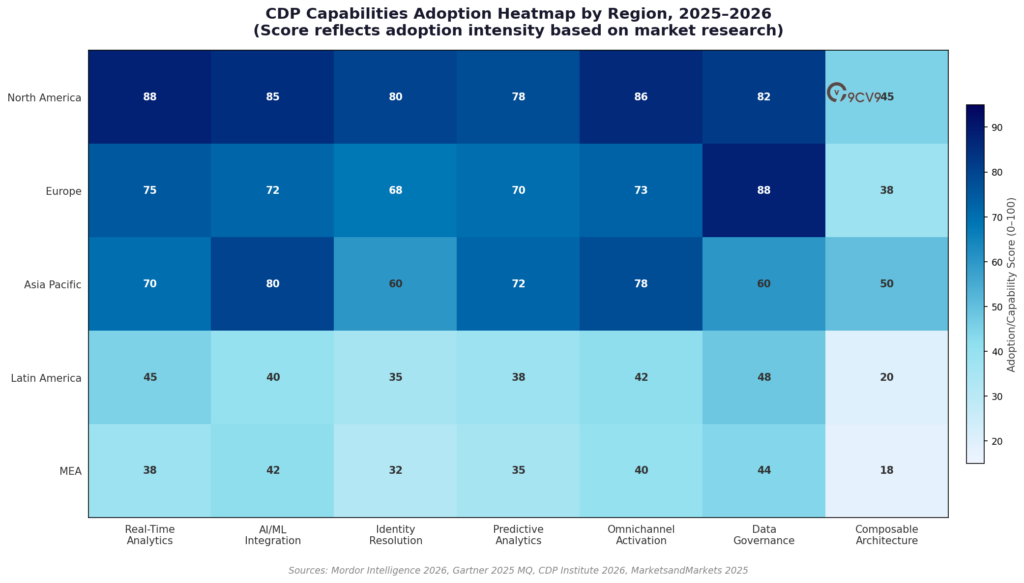
Regional market trends further highlight the global significance of CDPs. North America continues to dominate the industry, accounting for nearly half of global revenue and serving as the home of many leading CDP vendors. The United States remains the largest single market, setting many of the standards and best practices adopted worldwide. However, the Asia-Pacific region is rapidly emerging as the industry’s fastest-growing geography, driven by digital transformation initiatives across China, India, Southeast Asia, and other high-growth markets. Europe also remains a critical market, particularly as organizations seek GDPR-compliant solutions capable of balancing personalization with regulatory requirements.

Artificial intelligence is another major catalyst reshaping the Customer Data Platform landscape in 2026. Modern CDPs are evolving far beyond traditional customer databases. Today’s platforms increasingly incorporate predictive analytics, machine learning models, automated segmentation, identity resolution engines, and real-time decision-making capabilities. Industry research indicates that more than 80% of CDP users believe their platform significantly improves AI-related projects. At the same time, analysts are identifying entirely new concepts such as “agentic CDPs” and “platformized CDPs,” where customer data systems become active participants in autonomous business processes powered by AI agents.

Adoption rates demonstrate that Customer Data Platforms have crossed the threshold from emerging technology to mainstream enterprise solution. A significant percentage of organizations have already implemented a CDP, while many others are actively evaluating deployment strategies. Yet despite widespread adoption, substantial opportunities remain. Research shows that many organizations currently utilize less than half of their CDP’s available capabilities, suggesting that future growth will come not only from new customers but also from deeper platform utilization and more advanced use cases.

The business case for CDPs continues to strengthen as organizations report measurable returns on investment. Companies using Customer Data Platforms frequently cite improvements in customer retention, revenue growth, campaign performance, personalization effectiveness, and customer lifetime value. Many organizations report double-digit increases in conversion rates, significant reductions in customer churn, and enhanced engagement across digital channels. Some studies even suggest that organizations using CDPs are substantially more likely to outperform competitors in revenue growth, highlighting the strategic importance of unified customer intelligence.
The vendor ecosystem surrounding Customer Data Platforms is also evolving rapidly. The market now includes more than 200 vendors globally, ranging from specialized CDP providers to major enterprise software companies integrating CDP capabilities into broader customer experience suites. The rise of warehouse-native and composable CDPs has introduced new architectural choices for buyers, while ongoing mergers, acquisitions, and billion-dollar funding rounds continue to reshape the competitive landscape. Enterprises evaluating CDPs in 2026 face a broader and more sophisticated set of options than ever before.
As customer expectations continue to rise and AI-driven personalization becomes increasingly essential, Customer Data Platforms are positioned at the center of the next generation of customer experience innovation. They serve as the bridge connecting data, analytics, automation, and engagement across the entire customer lifecycle. Whether enabling real-time personalization, powering predictive churn models, supporting privacy compliance, or feeding AI systems with unified customer profiles, CDPs are becoming indispensable assets for organizations seeking sustainable growth in a highly competitive digital marketplace.
In this comprehensive guide, we explore the Top 105 Customer Data Platforms Statistics, Data & Trends in 2026. These carefully curated insights reveal the latest market sizes, growth projections, adoption patterns, technology innovations, AI developments, regional dynamics, funding activity, business outcomes, privacy trends, and emerging opportunities shaping the global CDP industry. Whether you are a marketing leader, data strategist, technology executive, investor, consultant, or business owner, these statistics provide valuable insights into one of the most important and rapidly evolving segments of the enterprise software landscape today.
Before we venture further into this article, we would like to share who we are and what we do.
About 9cv9
9cv9 is a business tech startup based in Singapore and Asia, with a strong presence all over the world.
With over ten years of startup and business experience, and being highly involved in connecting with thousands of companies and startups, the 9cv9 team has listed some important and crucial software tools in this review.
If you like to get your company listed in our top B2B software reviews, check out our world-class 9cv9 Media and PR service and pricing plans here.
Top 105 Customer Data Platforms Statistics, Data & Trends in 2026
📊 SECTION 1: MARKET SIZE & GROWTH
1. The global CDP market is valued at USD 4.58 billion in 2026.
The CDP industry has crossed a major milestone in 2026, with the market valued at USD 4.58 billion—reflecting accelerating enterprise investment in unified customer data infrastructure as first-party data strategies become non-negotiable.
2. The CDP market is projected to reach USD 13.14 billion by 2031 at a CAGR of 23.47%.
A nearly 3× expansion from 2026 to 2031 signals that CDPs are transitioning from a marketing-team tool into core enterprise infrastructure, driven by AI-powered personalization and identity resolution at scale.
3. MarketsandMarkets estimates the global CDP market will grow from USD 9.72 billion in 2025 to USD 37.11 billion by 2030, at a CAGR of 30.7%.
When nearly every major analyst firm agrees on double-digit CAGR growth through 2030, it is a reliable signal that CDPs are moving from optional martech to mission-critical platform—regardless of which methodology you trust.
4. Fortune Business Insights values the CDP market at USD 3.28 billion in 2025, growing to USD 17.03 billion by 2034 at a CAGR of 19.60%.
Even the more conservative forecasts point to consistent market expansion, suggesting that CDP adoption is broad-based and not simply driven by a handful of large enterprises inflating totals.
5. Grand View Research projects the CDP market to reach USD 58.41 billion by 2033, at a CAGR of 27.8% from 2026 to 2033.
With a nearly 7× market expansion expected over seven years, vendors who establish category leadership in 2026 stand to capture disproportionate share as the market matures and consolidates.
6. The CDP market is projected to reach USD 28.2 billion by 2028 at a CAGR of 39.9%.
The steeper short-term growth forecast from CDP.com reflects a burst of AI-triggered investment, with enterprises rapidly upgrading platforms to support autonomous AI agents that require clean, unified customer profiles.
7. The Business Research Company projects the CDP market to reach USD 7.39 billion by 2027 with a CAGR of 29.2%, and USD 23.98 billion by 2029 at a CAGR of 34.2%.
The accelerating CAGR between forecast periods captures a demand curve still in its steep ascent phase, driven by real-time activation needs and tightening privacy regulations globally.
8. Reanin Research values the CDP market at USD 11,795 million in 2025, projecting it to reach USD 95,399 million by 2032 at a CAGR of 34.8%.
While methodologies differ, even outlier forecasts confirm the same structural trend: CDPs are becoming the connective tissue of enterprise data stacks across retail, finance, healthcare, and beyond.
9. Expert Market Research reports a global CDP market value of USD 3.43 billion in 2025, projected to grow at a CAGR of 21.60% to USD 24.25 billion by 2035.
A decade-long forecast at over 21% annual growth underscores that the CDP build-out is not a short-term wave—organizations that delay adoption now risk falling multiple capability generations behind competitors.
10. Note: CDP market size estimates vary widely (USD 4B to USD 10B for 2026) across research firms due to differing market definitions and scoping methodologies.
The divergence in market sizing illustrates how differently research firms define “CDP”—buyers should focus on the directional consensus (strong growth at 20–35% CAGR) rather than debating which single number is correct.
🌍 SECTION 2: REGIONAL LANDSCAPE
11. North America holds 47.32% of global CDP revenue in 2025.
North America’s near-majority share confirms that US and Canadian enterprises remain the world’s primary CDP spenders, reflecting the region’s early adoption cycles, mature martech ecosystems, and concentration of global CDP vendor headquarters.
12. The US CDP market is projected to reach USD 2.14 billion in 2026.
As the world’s single largest national CDP market, the US sets the innovation tempo—US-based enterprises deploying CDPs today are building the playbooks that competitors in other regions will follow within two to three years.
13. North America’s CDP market reached USD 1.95 billion in 2025, accounting for 59.60% of the global market (Fortune Business Insights methodology).
Even on a narrower market definition, North America’s dominance is undeniable, and its ongoing investment in AI-enabled personalization infrastructure is creating a widening competitive gap with slower-adopting regions.
14. Asia Pacific is the fastest-growing CDP region at a CAGR of 24.41% through 2031.
Driven by explosive mobile-first engagement in India, China, and Southeast Asia, Asia Pacific is rapidly closing the gap with Western markets and will likely become the world’s second-largest CDP market before the end of the decade.
15. The Asia Pacific CDP market is projected to reach USD 0.64 billion in 2026.
While the absolute figure remains modest compared to North America, Asia Pacific’s trajectory—fueled by hundreds of millions of newly digitally active consumers—makes it the highest-upside growth opportunity for CDP vendors over the next five years.
16. Europe generated USD 0.64 billion in CDP revenue in 2025, contributing 19.4% to global market revenue.
Europe’s CDP market is characterized by compliance-led adoption: GDPR’s stringent first-party data requirements have paradoxically become an accelerant for CDP investment, as brands need certified data infrastructure to engage customers legally.
17. Europe’s CDP market is projected to reach USD 0.79 billion in 2026.
The EU’s expanding data sovereignty requirements—and the emergence of GDPR-compliant CDP solutions built by UK and French vendors—are differentiating European CDPs from their US counterparts in ways that will shape global standards.
18. Germany’s CDP market is projected to reach USD 0.24 billion by 2026.
As Europe’s largest B2B economy, Germany’s rising CDP spending reflects growing enterprise demand for data-driven customer engagement in its manufacturing, automotive, and financial services sectors.
19. The UK market is projected to reach USD 0.18 billion in CDP revenue by 2026.
The UK’s outsized contribution—housing more than half of Europe’s homegrown CDP vendors—means it functions both as a primary end market and as a product innovation hub for compliance-forward CDP features.
20. Latin America contributed 3.10% to the global CDP market in 2025, valued at approximately USD 0.1 billion.
Latin America’s low penetration despite high internet growth in Brazil and Mexico represents an untapped opportunity—vendors who localize data residency and compliance capabilities early will capture disproportionate first-mover advantages as digital marketing matures in the region.
21. The Americas represent 46% of CDP firms, 62% of employment, and 84% of total industry funding.
The deep concentration of funding in the Americas—particularly in the US—means that nearly every major product innovation in the CDP category will continue to originate from North America for the foreseeable future.
22. Most industry growth in January 2025 was outside the United States: 9 new firms from Asia, 7 from Europe, and 1 from Latin America versus only 2 from the US.
The global diffusion of CDP entrepreneurship signals that the next wave of competitive differentiation will come from regionally specialized vendors who understand local data cultures, regulations, and consumer behaviors better than global incumbents.
🤖 SECTION 3: AI & TECHNOLOGY TRENDS
23. The Gartner 2026 Magic Quadrant for CDPs identifies two emerging CDP models: “platformization” and “agentification.”
The shift to platformization (CDPs as enterprise ecosystems) and agentification (CDPs as AI-agent infrastructure) marks a pivotal architectural evolution—buyers evaluating CDPs in 2026 must ask not just “how does it unify data?” but “how does it serve AI agents?”
24. Composable/warehouse-native CDP vendors recorded 7.8% organic employment growth in January 2026—nearly 6× the industry average of 1.3%.
The talent concentration in composable CDP vendors is a leading indicator of where customer expectations and enterprise architectures are heading: toward flexible, modular data layers that avoid vendor lock-in while enabling real-time AI applications.
25. More than 25% of CDPs now support warehouse-centric architecture.
Warehouse-native CDPs have moved from niche to mainstream in just three years, reflecting the broader enterprise shift to cloud data platforms like Snowflake, BigQuery, and Databricks as the foundation of their analytics and activation stacks.
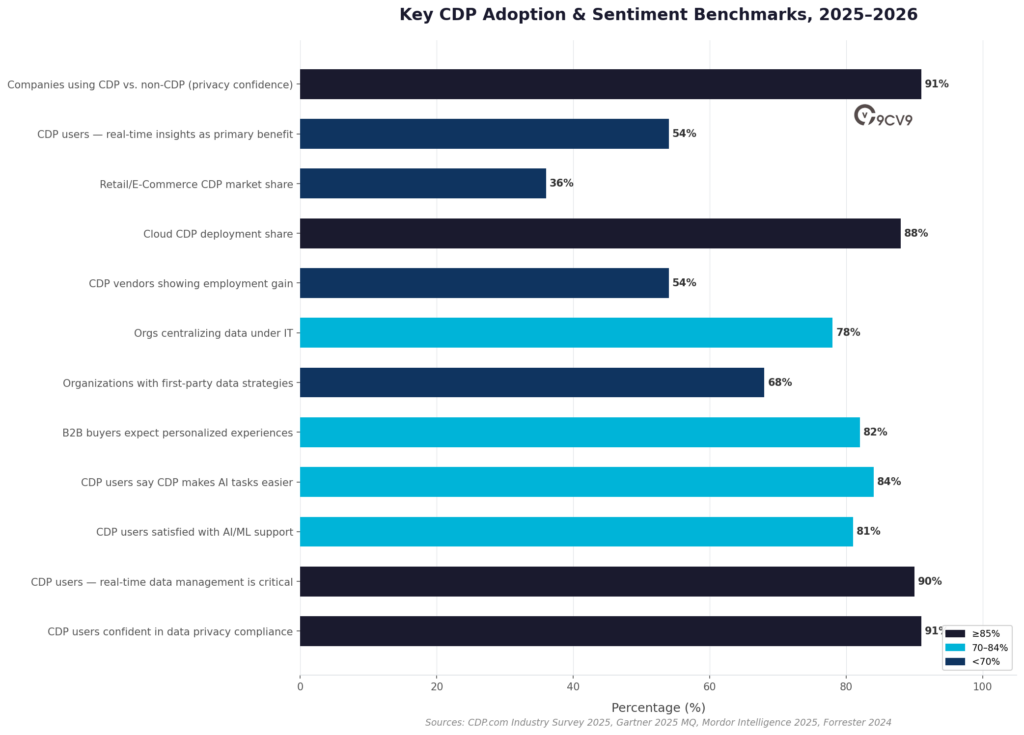
26. 84% of CDP users say their CDP makes AI tasks and projects easier.
Near-universal agreement among users that CDPs simplify AI delivery confirms that unified customer profiles are the non-negotiable data foundation for every generative AI, predictive analytics, and agentic marketing initiative.
27. 81% of CDP users reported high satisfaction with their platform’s ability to support AI/ML projects.
High AI/ML satisfaction rates from CDP users stand in sharp contrast to the frustrations many enterprises report when attempting to run AI models on fragmented, siloed data—quantifying the productivity value of a clean unified profile.
28. Forrester identifies the emergence of the “agentic CDP” as a next-generation paradigm in Q1 2026.
As AI agents begin autonomously orchestrating customer journeys, the CDP’s role evolves from a data store that marketers query to an active intelligence layer that feeds autonomous systems—a fundamental shift in how platform value will be measured and priced.
29. 54% of CDP users identify real-time insights and predictive analytics as the primary CDP benefit.
More than half of CDP users now rank real-time intelligence above traditional benefits like data consolidation or segmentation, signaling that operational speed—not just analytical depth—is the primary competitive differentiator for CDP buyers.
30. 90% of respondents consider real-time data management crucial for overall business success.
With 9 in 10 businesses viewing real-time data management as mission-critical, CDPs that process and activate events in under 100 milliseconds are no longer premium offerings—they are the baseline expectation for enterprise-grade deployments.
31. Business scaling confidence increased from 35% to 46% with CDP adoption—an 11 percentage point lift.
The 31% relative improvement in scaling confidence among CDP adopters captures a qualitative competitive advantage that compounds over time: organizations that trust their data infrastructure are faster to launch campaigns, enter new markets, and respond to disruptions.
32. AI integration within CDPs is becoming a key differentiator, with vendors operationalizing predictive analytics and model fine-tuning capabilities.
CDPs that embed native AI capabilities—rather than requiring external tools to analyze their data—are winning deals because they shorten the time from customer event to personalized response, a gap that can determine whether a customer converts or churns.
📈 SECTION 4: ADOPTION & UTILIZATION
33. 41% of companies have implemented a CDP; another 36% are considering implementing one.
With 77% of organizations either using or actively evaluating CDPs, the technology has definitively crossed the chasm from early adopter to mainstream—the question for most enterprises is no longer “whether to adopt” but “which architecture to choose.”
34. 67% of respondents to the 2023 Gartner Marketing Technology Survey say they’ve adopted a CDP.
Gartner’s survey penetration rate is notably higher than WorldMetrics’, reflecting that larger and more digitally mature organizations are early movers—smaller enterprises represent the next wave of adoption opportunity for vendors offering simplified deployment models.
35. Despite CDP adoption, companies estimate using only 47% of total CDP capabilities available, down from 55% in 2022.
The declining capability utilization trend is a troubling sign: as CDPs add more AI and automation features, the gap between what platforms can do and what organizations actually use is widening—pointing to a critical need for better onboarding, training, and change management.
36. Only 22% of marketers report high CDP utilization.
The low high-utilization rate among marketers reveals a persistent organizational bottleneck: technical implementation is outpacing human adoption, and vendors who invest in no-code interfaces and AI-assisted workflow automation will unlock the untapped value sitting dormant in already-purchased platforms.
37. Cloud deployments account for 88.43% of the CDP market in 2025.
The near-total shift to cloud CDP deployments reflects both the economics (zero-copy integrations eliminate data movement costs) and the speed requirements (real-time AI activation demands cloud-native latency) of modern customer data strategies.
38. Platform solutions account for 79.82% of total 2025 CDP revenue.
The enduring dominance of integrated CDP platforms—despite the growth of composable alternatives—confirms that most enterprises still prefer a single-vendor experience that bundles identity resolution, analytics, and activation, even if it comes at a higher TCO.
39. Over 65% of organizations now rely on CDPs to consolidate data from digital, physical, and third-party channels.
The majority of CDP deployments now span both online and offline data sources, reflecting the growing recognition that a customer’s physical-world behaviors—in-store visits, call center interactions—are as commercially valuable as their digital clickstream.
40. 78% of organizations report centralizing customer data and systems under IT.
The shift of CDP governance from marketing to IT reflects a maturation of the technology: as CDPs become foundational infrastructure rather than campaign tools, they require the reliability, security, and cross-functional access controls that IT is best positioned to provide.
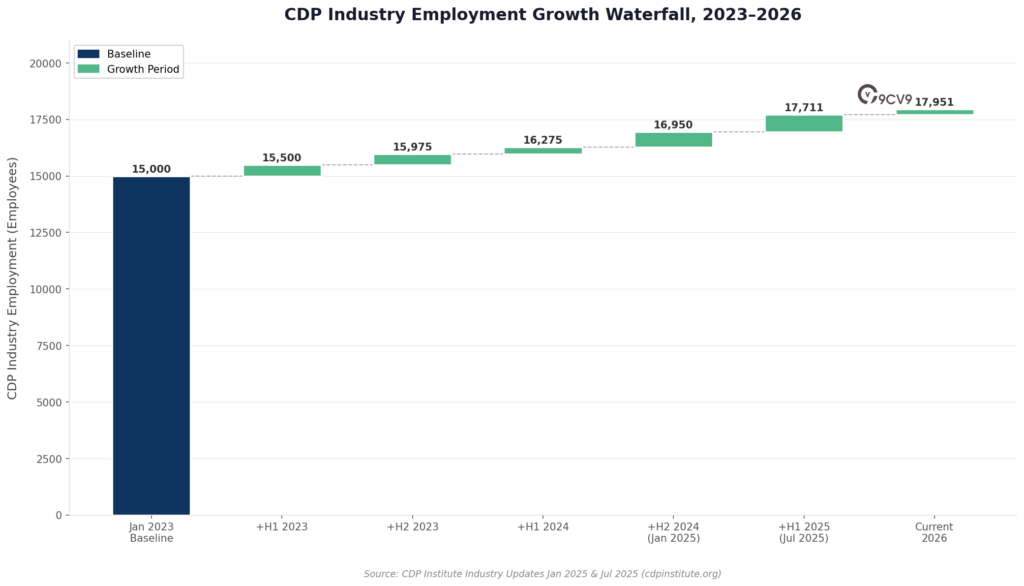
41. 54% of CDP vendors showed an employment gain in H1 2025, up from 47% in the prior period.
The rising percentage of vendors growing their workforce is a positive signal for the category’s health—when more than half of suppliers are actively expanding, it suggests that demand-side momentum is broad and not concentrated in just a few major players.
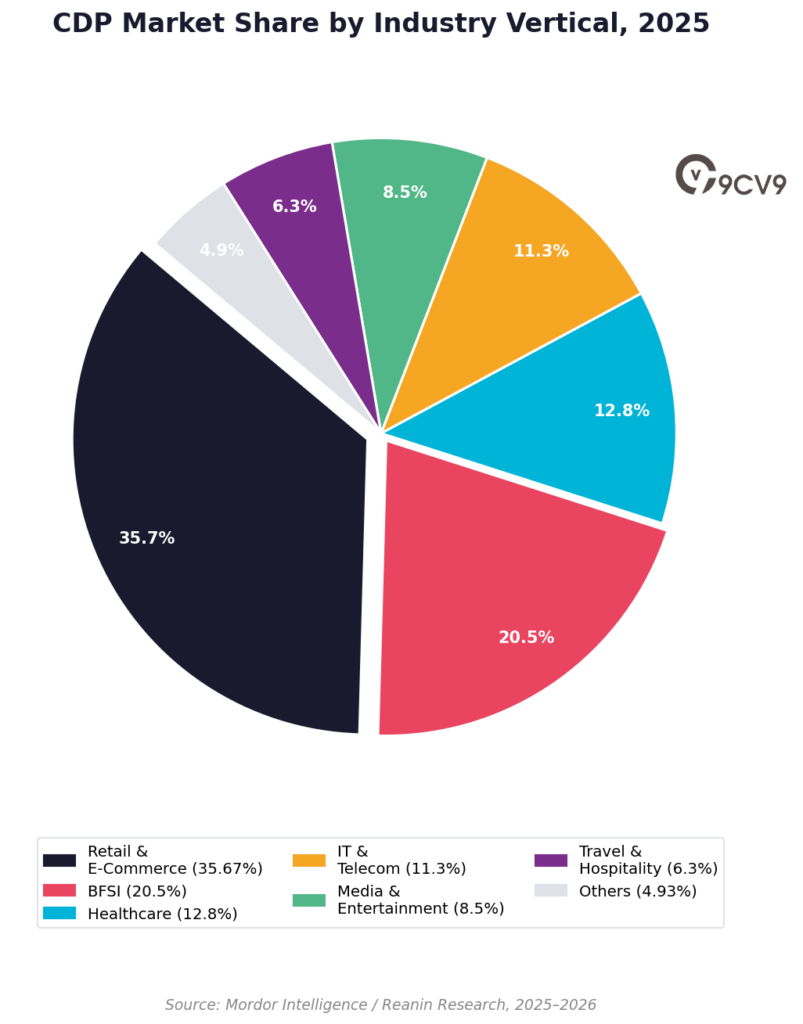
42. Retail and e-commerce represent 35.67% of CDP market share by end-user industry in 2025.
Retail’s outsized CDP adoption reflects the category’s perfect alignment with its highest-value use cases: abandoned cart recovery, cross-sell personalization, and loyalty program optimization—all of which require the exact real-time unified profiles that CDPs produce.
43. The large enterprises segment holds the dominant market position with the largest revenue share in 2025.
While large enterprises drive the majority of current CDP revenue, their saturation creates a clear next-wave opportunity in the mid-market—vendors who simplify implementation and reduce minimum viable data requirements will be best positioned to capture it.
44. More than 40% of organizations seek external expertise to help with CDP deployment and strategy.
The high rate of third-party consulting engagement highlights that CDP implementation remains complex enough to require specialist help—creating a durable system integrator ecosystem around the major platforms that is itself a market worth billions.
💰 SECTION 5: ROI & BUSINESS VALUE
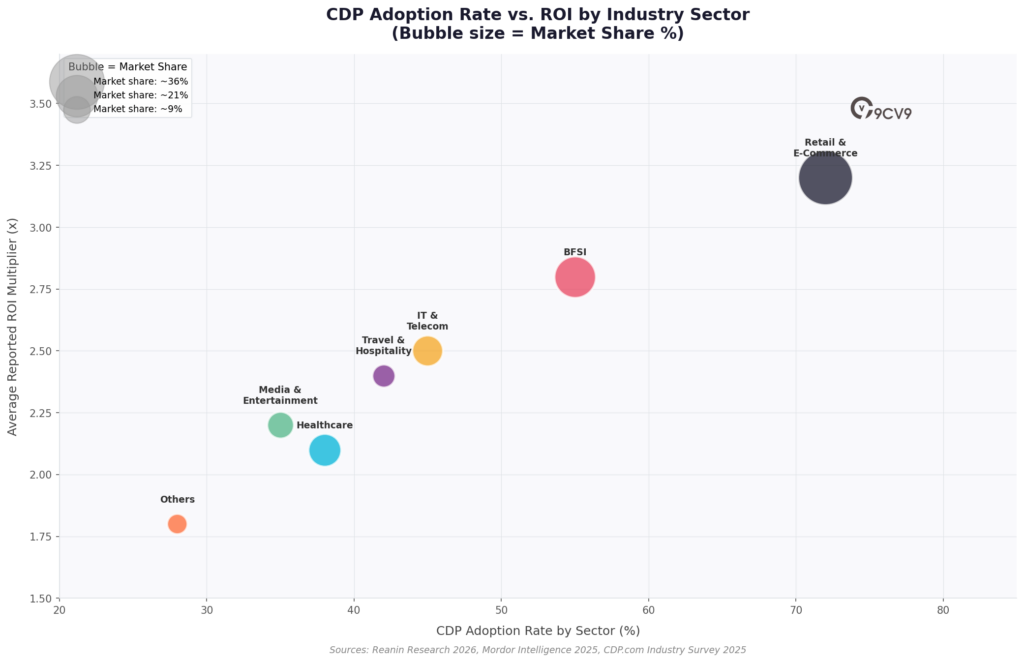
45. Average ROI for CDP users: USD 2.70 for every $1 spent.
A 2.7× return on CDP investment confirms the platform’s economic case is not merely theoretical—when customer lifetime value, reduced acquisition costs, and operational efficiency gains are quantified, CDPs consistently deliver measurable financial returns.
46. Companies using CDPs are 2.5× more likely to outperform competitors in revenue growth.
The performance gap between CDP users and non-users is not marginal—it is transformational. Organizations that have unified their customer data are fundamentally better positioned to capitalize on personalization at scale, and the revenue difference is now measurable at the enterprise level.
47. Early CDP adopters are reporting 15–25% lifts in customer lifetime value.
Double-digit improvements in CLV represent among the most compelling financial arguments for CDP investment: if even 20% more customers generate maximum lifetime revenue, the compounding effect on profitability far exceeds the annual platform cost.
48. Organizations using predictive CDP models report a 10–25% reduction in voluntary churn.
Proactive retention—enabled by AI models that identify at-risk customers before they cancel—is one of the highest-ROI CDP use cases, because preventing a single churned customer is almost always cheaper than acquiring a replacement.
49. 10–12% improvements in conversion rates have been reported by early CDP adopters.
Double-digit conversion improvements from unified customer profiles illustrate the commercial cost of data silos: every percentage point of conversion rate left on the table due to generic messaging represents millions in forgone revenue for mid-to-large organizations.
50. Companies using CDPs with targeted campaigns report 101% better engagement.
A 2× engagement improvement from targeted versus generic campaigns reflects a simple but powerful truth: customers respond dramatically better to communications that feel relevant and timely—and CDPs provide the data foundation to make that relevance possible at scale.
51. Revenue increases of 10–15% have been attributed to unified customer profiles from CDP implementations.
A 10–15% revenue uplift from unified customer profiles—achievable in most CDP deployments within 12–18 months—is sufficient to justify investment in all but the most capital-constrained organizations, making a business case relatively straightforward to construct.
52. 46% of responding CMOs increased investment in customer analytics in 2023, pointing to sustained CDP demand.
CMO budget allocation toward customer analytics—a proxy for CDP and adjacent investment—is a reliable leading indicator of platform spending, and a sustained 46% increase rate means the demand funnel for CDP vendors remains robustly filled.
👥 SECTION 6: EMPLOYMENT & FUNDING
53. Total CDP industry employment rose to 18,361 in July 2025, a 4% increase from the prior period.
Resumed organic employment growth across the CDP industry after two years of near-stagnation signals genuine demand-side recovery—not just M&A-driven headcount consolidation—as enterprises accelerate spending on real-time data infrastructure.
54. Total CDP industry funding reached USD 9.396 billion by July 2025.
Nearly USD 9.4 billion in cumulative funding positions the CDP category as one of the most heavily capitalized enterprise software segments—giving leading vendors the balance sheets needed to invest aggressively in AI capabilities, acquisitions, and global expansion.
55. Funding rose by USD 830 million (10%) in H1 2025 alone.
The H1 2025 funding acceleration—despite a broader venture capital slowdown—reflects investors’ conviction that CDPs are the enabling infrastructure layer for the AI marketing transformation, making them recession-resilient capital allocations.
56. A small group of large vendors accounts for 67% of CDP employment and 73% of total funding as of January 2026.
The increasing concentration of employment and capital in a small number of large vendors is a classic indicator of category maturation—expect continued consolidation as resource-constrained smaller vendors either exit, get acquired, or pivot to niche segments.
57. Insider raised a USD 500 million Series E—the largest CDP funding round in the January 2025 period.
Insider’s half-billion-dollar raise at an established stage confirms that the most successful CDP vendors are still attracting growth-stage capital, using it to accelerate AI feature development and global geographic expansion simultaneously.
58. Companies founded after 2014 account for just 11% of industry funding despite comprising 25% of the vendor count.
The stark funding gap facing newer CDP entrants reflects a market reality: buyers overwhelmingly prefer established platforms with proven identity resolution capabilities and deep ecosystem integrations, making it structurally difficult for startups to displace incumbents on capital alone.
59. Six CDP acquisitions occurred in H1 2025, matching the total for the prior two full years combined.
The M&A acceleration—with Lytics, mParticle, Relay42, and Informatica all acquired—signals that established technology companies are using CDPs as on-ramps to AI-powered customer experience, accelerating category consolidation at a pace that will reshape the vendor landscape within 24 months.
60. Firms where CDP is not the primary business now account for 35% of companies and ~46% of employment, up from 25% and 35% in 2021.
The growing share of CDP capability embedded within broader enterprise platforms (CRM, DXP, ERP) is both validating the category and making it harder for stand-alone CDP vendors to compete on features alone—differentiation must increasingly come through depth of AI and data governance.
61. Total CDP investment reached approximately USD 1.02 billion across 6 companies in the 2024–H1 2025 period.
Concentrated capital deployment into a small number of proven winners—rather than broadly distributed seed funding—signals that the CDP industry has entered a scale-up phase where winners take most of the available investment capital.
🔒 SECTION 7: DATA PRIVACY & FIRST-PARTY DATA
62. 91% of CDP users are confident in handling data privacy regulation changes, vs. 76% of non-CDP users.
The 15-percentage-point confidence gap between CDP users and non-users is a compelling compliance argument for adoption: as regulators add new privacy requirements annually, CDP-enabled organizations adapt faster and with lower legal risk than those relying on fragmented, manually managed data.
63. 68% of organizations increased investment in first-party data strategies in 2025.
More than two-thirds of enterprises are actively reallocating budget from third-party data acquisition to first-party data infrastructure—a structural shift that makes CDPs the essential enabling technology for any organization’s long-term audience strategy.
64. 72% of companies are doubling down on first-party data strategies.
The phase-out of third-party cookies from Chrome has converted first-party data from a competitive advantage into a business continuity requirement—organizations without robust first-party collection and activation systems face existential threats to their digital marketing performance.
65. 88% of companies leverage real-time CDP activation for better engagement.
The near-universal adoption of real-time activation among surveyed organizations reflects a fundamental shift in customer expectations: in a world of instant digital experiences, batch processing of customer data is no longer competitive—it’s a liability.
66. 82% of B2B marketing decision-makers agree that buyers expect personalized experiences.
Personalization expectations have reached critical mass in B2B markets—where they were historically lower than in B2C—confirming that CDPs are becoming indispensable for enterprise sales and account-based marketing programs, not just consumer-facing campaigns.
67. 88% of consumers expect personalized recommendations in their shopping experiences.
Near-universal consumer expectation of personalization creates an enormous “personalization tax” for retailers who fail to deliver it: customers who receive irrelevant communications increasingly disengage, making the business cost of inadequate CDP investment directly visible in declining engagement metrics.
68. Warehouse-native CDPs cut total cost of ownership by 30–50% and minimize vendor lock-in.
The TCO advantage of composable, warehouse-native architectures is a powerful procurement argument that is driving category disruption: organizations that can achieve equivalent personalization capabilities at half the cost have a material competitive cost structure advantage.
69. CDP buying groups now average 2–3 functional groups including IT, marketing, supply chain, finance, and HR.
The expansion of CDP buying committees beyond marketing and IT reflects the platform’s growing enterprise footprint—when finance, supply chain, and HR stakeholders co-sponsor CDP investments, it fundamentally changes both the evaluation criteria and the expected use cases.
70. Google’s final removal of third-party cookies from Chrome has made CDP investment foundational, not optional.
Chrome’s cookie retirement—following similar moves by Safari and Firefox—has permanently altered the digital advertising landscape, making first-party data infrastructure the only sustainable foundation for personalized marketing at scale.
🏭 SECTION 8: INDUSTRY VERTICAL BREAKDOWN
71. Retail and e-commerce represents 35.67% of CDP market share in 2025.
Retail’s leading position in CDP adoption is self-reinforcing: early retail adopters demonstrated measurable ROI from personalized recommendations and loyalty programs, creating compelling internal case studies that accelerated enterprise-wide deployments across the sector.
72. Over 55% of banks and financial institutions utilize CDPs to improve customer retention.
The financial services sector’s majority adoption of CDPs reflects the unique data richness of banking relationships—transaction histories, product holdings, and life events create profile depth that enables highly precise next-best-action recommendations when unified correctly.
73. Healthcare organizations are adopting CDPs to unify real-time patient profiles and power predictive care models.
As healthcare providers face mounting pressure to improve patient outcomes while reducing costs, CDPs are emerging as the data integration layer that connects clinical, behavioral, and social determinant data into actionable care coordination profiles.
74. Telecom companies use CDPs for cross-sell campaigns and predictive churn analytics through unified subscriber profiles.
Telecom’s high-volume, high-churn customer base creates an ideal CDP use case: the ability to process millions of real-time behavioral signals—network usage, service calls, app interactions—and predict defection 30–90 days before it occurs is worth hundreds of millions in prevented churn.
75. Media and entertainment companies use CDPs to synchronize viewer data across platforms and customize content recommendations.
Content personalization at streaming scale requires exactly what CDPs provide: real-time identity resolution across devices, behavioral pattern matching against vast historical datasets, and sub-second activation latency for recommendation engines.
76. Travel and hospitality is expected to grow at the fastest vertical CAGR in the CDP market from 2026 to 2033.
The travel sector’s accelerating CDP adoption reflects a post-pandemic consumer expectation reset: travelers who experienced friction-free digital experiences now expect airlines, hotels, and car rental companies to anticipate their preferences without being asked.
🧩 SECTION 9: ARCHITECTURE & TECHNOLOGY
77. Platform solutions account for 79.82% of total CDP revenue in 2025.
The continued dominance of comprehensive CDP platforms—despite composable alternatives’ rapid growth—reflects the enterprise preference for integrated identity resolution, storage, analytics, and activation in a single governed system rather than a fragmented multi-vendor stack.
78. More than 25% of CDPs now support warehouse-centric architecture.
The quarter-mark penetration of warehouse-native architecture marks a tipping point: what was a specialist approach three years ago is now a mainstream architectural option, and vendors who lack warehouse connectivity are increasingly at risk in competitive evaluations.
79. Deterministic identity matching achieves up to 90% accuracy using exact identifiers like email addresses and phone numbers.
The 90% deterministic match rate establishes a high baseline for modern CDP identity resolution—but the remaining 10% of anonymous or fragmented identities represents a significant commercial opportunity that probabilistic AI-powered matching continues to close.
80. CDP deployment implementations from Latin American SMEs add 25–30% to project cost due to talent scarcity.
The premium implementation cost in emerging markets quantifies the market access barrier that CDPs must overcome to expand beyond enterprise buyers in developed economies—creating a clear opportunity for low-code, self-service CDP models targeted at cost-sensitive mid-market buyers globally.
81. The service segment of the CDP market is anticipated to grow at the fastest CAGR during the forecast period.
Professional services growth outpacing platform growth reflects the complexity tax of CDP deployment: as platforms add capabilities faster than internal teams can absorb them, the demand for implementation, optimization, and ongoing managed services compounds in parallel.
82. Zero-copy and zero-ETL data architectures are gaining share because they remove data egress fees while sustaining real-time identity graphs.
Zero-copy approaches fundamentally change the CDP economic model—by eliminating the data duplication cost that inflated TCO in traditional deployments, these architectures make enterprise-grade CDP capabilities accessible to organizations that previously found them cost-prohibitive.
🔬 SECTION 10: VENDOR LANDSCAPE & M&A
83. There are approximately 208 CDP vendors globally as of July 2025.
A vendor count of over 200 confirms that the CDP category remains dynamic and fragmented—but the rapid concentration of funding and employment in a small number of large vendors suggests the next three years will bring significant consolidation.
84. The CDP Institute’s January 2026 update reports that AI is reinforcing—not collapsing—the distinction between integrated CDP platforms and warehouse-native architectures.
The persistence of two distinct CDP architectural philosophies in the AI era is a nuanced finding: rather than converging into a single dominant model, AI capabilities are being implemented differently in each architecture, creating genuinely different value propositions for different buyer profiles.
85. Gartner’s 2026 Magic Quadrant for CDPs identifies “platformization” as one of two major emerging paradigms.
Platformization—CDPs evolving into integrated enterprise application ecosystems—represents a strategic threat to every stand-alone enterprise SaaS solution that relies on the same customer data: CRM, marketing automation, customer service, and analytics platforms are all being pulled into the CDP’s gravitational field.
86. Top CDP vendors have renewed focus on zero-copy data sharing innovations per the Gartner 2025 Magic Quadrant.
Zero-copy data sharing is becoming a must-have capability for enterprise CDPs—organizations that have invested heavily in cloud data platforms will not accept a CDP that requires them to duplicate data, pay egress fees, or tolerate latency from unnecessary data movement.
87. Salesforce advanced its Data Cloud with AI-powered data tagging, policy-based governance, and unstructured data connectivity in June 2025.
Salesforce’s continued platform investment in Data Cloud underscores how critical CDP capabilities have become to CRM vendors’ competitive survival: the ability to connect every customer record to an AI-ready unified profile is no longer a differentiator—it is table stakes.
📊 SECTION 11: BENCHMARKS & SATISFACTION
88. 54% of CDP vendors showed employment gains in H1 2025, up from 47% in the prior period.
The rising share of growing vendors—more than half of the category—reflects a healthier demand environment than the stagnation of 2023–2024, and suggests that enterprise CDP budgets are expanding again after a period of post-pandemic martech rationalization.
89. 3.4% organic employment growth rate among existing CDP vendors in H1 2025 was the best since 2022.
The return to 2022-level growth rates signals that the CDP market has successfully navigated the post-ZIRP investment slowdown and is now accelerating on fundamentals—real enterprise demand for AI-ready customer data infrastructure—rather than venture-fueled hype.
90. CDP industry total funding reached USD 8.526 billion by January 2025, a 13% increase from the prior period.
A 13% funding increase in a single reporting period, despite challenging venture capital conditions, reflects the CDP category’s perceived defensive quality: in a volatile macro environment, customer data infrastructure spending is one of the last marketing budgets to be cut.
91. Composable/warehouse-native vendors represent the fastest-growing employment segment at 7.8%, versus 1.3% for the industry average.
The 6× talent concentration advantage of composable CDP vendors over the industry average is the clearest leading indicator of where architectural investment is headed—organizations hiring data engineers and ML practitioners for CDP work are overwhelmingly choosing warehouse-native approaches.
92. CDP period-on-period employment growth averaged only 0.2% for two years before resuming at 3.4% in H1 2025.
The sharp recovery from two years of near-stagnation to 3.4% growth in a single period captures the AI investment trigger: enterprises that had paused CDP hiring resumed aggressively once it became clear that unified customer profiles are the foundation of every credible AI marketing strategy.
🧠 SECTION 12: USE CASES & BUSINESS OUTCOMES
93. Predictive CDP models reduce voluntary churn by 10–25% when paired with proactive retention campaigns.
Churn prediction combined with proactive outreach represents one of the clearest CDP ROI stories available: the measurable reduction in subscription cancellations and contract non-renewals produces a quantifiable revenue retention number that executives can verify against platform costs within one fiscal year.
94. Organizations using CDPs report double-digit gains in conversion rates, reduced churn, and increased lifetime value.
The trifecta of conversion, churn, and CLV improvements confirms that CDP benefits are not siloed in a single metric—the platform’s value cascades across the entire customer revenue cycle, from acquisition through retention to expansion.
95. CDP-enabled real-time personalization improves campaign engagement by up to 101%.
Doubling campaign engagement through data-driven personalization is not an incremental improvement—it is a transformational one. Organizations capable of delivering this level of uplift consistently gain sustainable competitive advantages that are difficult to replicate without equivalent data infrastructure.
96. Real-time website personalization powered by CDPs adapts content to individual users based on browsing history and current behavior.
The ability to serve a different version of a website to each visitor—based on their complete historical profile plus their current session behavior—represents a personalization capability that simply cannot exist without a real-time CDP providing the unified data layer.
97. CDP-powered chatbots and customer support systems equipped with real-time profiles provide faster, more relevant responses.
When support agents and AI chatbots have instant access to a customer’s complete interaction history, product usage, and recent behavior, first-call resolution rates rise measurably—delivering cost savings in service operations alongside improved customer satisfaction scores.
98. Only 23% of businesses utilize customer insights immediately after collection—a significant capability gap for non-CDP users.
The 77% of businesses not yet acting on real-time customer insights represent both a performance gap and a commercial opportunity: every competitor who closes this gap with CDP-enabled real-time activation gains a measurable conversion and retention advantage.
99. CDPs enable predictive analytics including churn propensity, purchase likelihood, and lifetime value forecasting.
The ability to forecast each individual customer’s future behavior—rather than relying on historical cohort averages—transforms marketing from a retrospective reporting function into a prospective revenue management capability, fundamentally changing its strategic role in the organization.
100. Dynamic website personalization, live campaign adjustments, and customer support enhancements are among the top real-time CDP use cases.
The breadth of real-time CDP use cases—spanning acquisition, engagement, and service—confirms that unified customer data delivers value across every customer-facing function, not just in the marketing automation platforms where CDP deployments typically begin.
🌐 SECTION 13: ADDITIONAL STATISTICS
101. CDP market projected to grow at 21.60% CAGR from 2026 to 2035 to reach USD 24.25 billion.
A decade-long growth projection at over 21% annual expansion places the CDP market among the most durable growth opportunities in enterprise software—making long-term investment in CDP capabilities and partnerships a strategically sound allocation across business cycles.
102. China is projected to hold 47.5% of the East Asian CDP market share by the end of 2034.
China’s projected dominance of the East Asian market reflects both the scale of its digital consumer base and the government’s push for domestic data sovereignty solutions—creating a bifurcated market where global CDP vendors must compete with state-aligned alternatives.
103. On-premise CDP implementations in Brazil and Argentina can cost SMEs over USD 500,000 over three years.
The prohibitive on-premise TCO in Latin America quantifies why cloud-first CDP models are essential for regional expansion: the $500K+ barrier essentially excludes most mid-market Latin American businesses from advanced CDP capabilities unless cloud-native, lower-cost alternatives emerge.
104. The service segment of CDPs is growing fastest due to the rising complexity of CDP integration with CRM, ERP, analytics, and marketing automation platforms.
As CDPs become the central hub connecting marketing clouds, data warehouses, and AI platforms, the integration complexity compounds—creating a thriving professional services ecosystem that often generates as much revenue as the platforms themselves.
105. CDP implementation partners from the US or Europe charge 25–30% cost premiums in markets with talent scarcity.
The talent premium in emerging markets is a measurable adoption barrier that cloud-native, self-service CDP vendors are well-positioned to disrupt—by reducing the implementation complexity to a level manageable by local teams without imported expertise.
Conclusion
In conclusion, the Customer Data Platform industry stands at a defining moment in 2026. What began as a specialized solution for unifying marketing data has evolved into one of the most critical layers of modern enterprise technology. The statistics presented throughout this report demonstrate that CDPs are no longer viewed as optional marketing tools but as foundational infrastructure that powers customer intelligence, real-time engagement, artificial intelligence initiatives, privacy compliance, and long-term business growth.
The overwhelming consensus across industry analysts, technology vendors, investors, and enterprise buyers is that the CDP market is entering a period of sustained and accelerated expansion. Market forecasts consistently point toward double-digit annual growth rates, with many projections exceeding 20% CAGR and some approaching 30% or more over the coming years. Whether one follows conservative estimates or more aggressive forecasts, the direction is unmistakable: Customer Data Platforms are becoming increasingly central to how organizations operate, compete, and engage with customers in a digital-first world.
One of the most significant themes emerging from the data is the growing importance of first-party data. As third-party cookies disappear and privacy regulations become more stringent worldwide, organizations are being forced to rethink how they collect, manage, and activate customer information. The era of relying heavily on external data sources is rapidly coming to an end. Instead, businesses are investing in technologies that allow them to build trusted, permission-based relationships with customers while maintaining compliance with evolving regulatory frameworks. CDPs have emerged as the preferred solution for managing this transition, enabling organizations to create unified customer profiles that are both actionable and privacy-conscious.
The statistics also reveal that artificial intelligence is becoming inseparable from the future of Customer Data Platforms. AI-powered segmentation, predictive analytics, identity resolution, customer journey orchestration, and autonomous decision-making capabilities are transforming what CDPs can deliver. Modern organizations increasingly view customer data not as a static asset but as a dynamic resource that fuels machine learning models, generative AI applications, and agentic systems. The emergence of concepts such as platformization and agentification demonstrates that CDPs are evolving into intelligent ecosystems capable of supporting AI-driven business operations at scale.
Regional market trends further reinforce the industry’s global momentum. North America continues to lead in market share, innovation, and investment, while Asia-Pacific is rapidly establishing itself as the fastest-growing region. Europe remains a critical hub for privacy-focused innovation, driven by regulatory requirements that encourage robust first-party data strategies. Meanwhile, emerging markets across Latin America, the Middle East, and parts of Asia represent substantial untapped opportunities for vendors capable of addressing local compliance, infrastructure, and talent challenges. These regional dynamics suggest that CDP adoption will become increasingly global throughout the remainder of the decade.
Another critical insight is the maturation of CDP buying behavior. Customer Data Platforms are no longer purchased solely by marketing teams. Modern buying committees increasingly involve IT, data, finance, operations, customer experience, and executive leadership stakeholders. This shift reflects the reality that customer data has become a strategic enterprise asset rather than a departmental resource. Organizations are recognizing that effective customer data management impacts virtually every business function, from acquisition and retention to product development, support, and revenue forecasting.
The business value generated by CDPs continues to strengthen their position within enterprise technology stacks. The statistics consistently point to measurable improvements in conversion rates, customer lifetime value, engagement metrics, revenue growth, and churn reduction. Organizations that successfully leverage unified customer profiles are gaining significant competitive advantages through more personalized experiences, faster decision-making, and better customer understanding. As these benefits become more visible and quantifiable, CDP investments are increasingly viewed as revenue-generating initiatives rather than technology expenditures.
At the same time, the data highlights several challenges and opportunities that will shape the next phase of industry development. Many organizations continue to utilize only a fraction of their CDP’s available capabilities, revealing a significant adoption and skills gap. As platforms become more sophisticated, businesses must invest not only in technology but also in training, governance, operational processes, and organizational alignment. Vendors that simplify deployment, improve usability, and provide AI-assisted workflows will likely gain a competitive advantage as enterprises seek to maximize value from their investments.
The architectural evolution of the market is equally noteworthy. The rise of warehouse-native and composable CDPs has introduced new approaches to customer data management, challenging traditional platform-centric models. Organizations now have greater flexibility in how they design and deploy their customer data ecosystems. The increasing adoption of zero-copy architectures, cloud-native deployments, and real-time activation capabilities reflects broader trends in enterprise technology toward agility, scalability, and cost efficiency. Rather than converging toward a single architecture, the market appears to be supporting multiple models tailored to different business requirements.
Funding activity, mergers and acquisitions, and vendor consolidation further illustrate the industry’s strategic importance. Billions of dollars continue to flow into the CDP ecosystem, while acquisitions by larger technology companies validate the category’s long-term relevance. As customer data becomes the foundation for AI-powered business strategies, ownership and control of customer intelligence capabilities are becoming increasingly valuable competitive assets. This trend is expected to drive continued consolidation while simultaneously creating opportunities for innovative vendors that address emerging needs and underserved segments.
Looking ahead, Customer Data Platforms are poised to become even more deeply embedded within enterprise operations. The next generation of CDPs will likely extend beyond customer engagement and marketing use cases into areas such as sales enablement, customer service optimization, supply chain intelligence, financial forecasting, workforce planning, and autonomous business processes. As organizations seek to unify not only customer data but also broader operational datasets, CDPs may evolve into comprehensive intelligence platforms that support decision-making across the entire enterprise.
Ultimately, the Top 105 Customer Data Platforms Statistics, Data & Trends in 2026 reveal a market undergoing rapid transformation while simultaneously establishing itself as a permanent fixture of the enterprise technology landscape. The convergence of artificial intelligence, real-time personalization, privacy-first marketing, first-party data strategies, and digital transformation initiatives has created an environment in which unified customer intelligence is more valuable than ever before. Organizations that successfully invest in and operationalize Customer Data Platforms will be better positioned to understand their customers, adapt to changing market conditions, and compete effectively in an increasingly data-driven economy.
As the industry continues its remarkable growth trajectory, one conclusion stands above all others: customer data has become one of the most valuable assets in modern business, and Customer Data Platforms are emerging as the primary systems responsible for transforming that data into measurable business outcomes. For executives, marketers, data leaders, investors, and technology professionals alike, understanding the trends shaping the CDP market is no longer optional—it is essential for navigating the future of customer experience, digital transformation, and enterprise growth.
If you find this article useful, why not share it with your hiring manager and C-level suite friends and also leave a nice comment below?
We, at the 9cv9 Research Team, strive to bring the latest and most meaningful data, guides, and statistics to your doorstep.
To get access to top-quality guides, click over to 9cv9 Blog.
To hire top talents using our modern AI-powered recruitment agency, find out more at 9cv9 Modern AI-Powered Recruitment Agency.
People Also Ask
What is a Customer Data Platform (CDP)?
A Customer Data Platform is software that collects, unifies, and organizes customer data from multiple sources into a single profile for analytics, personalization, and marketing activation.
How large is the Customer Data Platform market in 2026?
The global Customer Data Platform market is valued at approximately USD 4.58 billion in 2026, reflecting strong demand for customer intelligence and data-driven marketing solutions.
What is the projected growth rate of the CDP market?
Most industry forecasts estimate annual growth rates between 20% and 35%, making CDPs one of the fastest-growing segments in enterprise software.
Why are Customer Data Platforms becoming more important?
CDPs help organizations unify customer data, improve personalization, support AI initiatives, comply with privacy regulations, and increase revenue through better customer experiences.
Which region dominates the global CDP market?
North America leads the CDP market, accounting for nearly half of global revenue due to strong enterprise adoption and a mature marketing technology ecosystem.
Which region is growing fastest in CDP adoption?
Asia-Pacific is the fastest-growing CDP market, driven by rapid digital transformation, mobile-first consumers, and increasing investments in customer experience technologies.
How does a CDP support artificial intelligence projects?
CDPs provide unified customer profiles that enable AI models to deliver predictive analytics, personalization, customer segmentation, and automated decision-making.
What percentage of companies have implemented a CDP?
Research indicates that approximately 41% of companies have implemented a CDP, while many others are actively evaluating adoption.
What industries use Customer Data Platforms the most?
Retail and e-commerce lead CDP adoption, followed by financial services, healthcare, telecommunications, media, and travel industries.
How do CDPs improve customer personalization?
CDPs consolidate customer information from multiple channels, allowing businesses to deliver more relevant content, recommendations, and offers in real time.
What is first-party data in a CDP?
First-party data is information collected directly from customers through websites, apps, purchases, emails, and interactions owned by the business.
Why are first-party data strategies growing in 2026?
The decline of third-party cookies and stricter privacy regulations are pushing businesses to invest heavily in first-party data collection and activation.
What is a warehouse-native CDP?
A warehouse-native CDP operates directly on cloud data warehouses, reducing data duplication while improving flexibility, scalability, and governance.
How many CDP vendors exist globally?
There are more than 200 Customer Data Platform vendors worldwide, ranging from specialized providers to enterprise software giants.
What is the average ROI of a Customer Data Platform?
Studies suggest CDP users achieve an average return of approximately USD 2.70 for every dollar invested.
Can CDPs increase conversion rates?
Yes. Organizations using CDPs often report conversion rate improvements of 10% to 12% through better targeting and personalization.
How do CDPs reduce customer churn?
CDPs use predictive analytics and behavioral data to identify at-risk customers, enabling proactive retention campaigns before churn occurs.
What role does real-time data play in CDPs?
Real-time data allows organizations to respond instantly to customer behavior, improving engagement, personalization, and customer satisfaction.
What is identity resolution in a Customer Data Platform?
Identity resolution connects customer data across devices, channels, and interactions to create a single, accurate customer profile.
How does a CDP help with privacy compliance?
CDPs centralize consent management, data governance, and customer information, making it easier to comply with regulations such as GDPR and CCPA.
Are CDPs mainly used by marketing teams?
No. Modern CDPs are increasingly managed by cross-functional teams involving marketing, IT, analytics, customer experience, and executive leadership.
What is an agentic CDP?
An agentic CDP is an emerging concept where AI agents use unified customer data to automate decisions, customer journeys, and engagement strategies.
Why is AI integration important in CDPs?
AI capabilities help organizations automate segmentation, predict customer behavior, optimize campaigns, and generate personalized experiences at scale.
Do CDPs support omnichannel customer experiences?
Yes. CDPs unify customer interactions across websites, mobile apps, email, social media, call centers, and physical stores.
What are the biggest benefits of implementing a CDP?
Key benefits include improved personalization, stronger customer insights, higher engagement, reduced churn, better compliance, and increased revenue.
How do CDPs help improve customer lifetime value?
By delivering relevant experiences and retention strategies, CDPs encourage repeat purchases and stronger long-term customer relationships.
What percentage of organizations use CDPs for data consolidation?
More than 65% of organizations use CDPs to consolidate customer data from digital, physical, and third-party sources.
What trends are shaping the future of CDPs in 2026?
Major trends include AI-powered personalization, warehouse-native architectures, zero-copy data sharing, predictive analytics, and real-time customer engagement.
How are CDPs changing enterprise technology stacks?
CDPs are becoming central platforms that connect CRM systems, analytics tools, marketing automation platforms, AI applications, and customer service systems.
What is the future outlook for the Customer Data Platform market?
The CDP market is expected to experience strong double-digit growth throughout the decade as businesses prioritize customer intelligence, AI adoption, and first-party data strategies.
Sources
Mordor Intelligence MarketsandMarkets Fortune Business Insights Grand View Research CDP Institute CDP Gartner Treasure Data Reanin Research WorldMetrics Tealium Forrester Business Research Company Expert Market Research Fact.MR Optimove LayerFive QuickMarketPitch Xerago DinMo Verified Market Research