
Key Takeaways
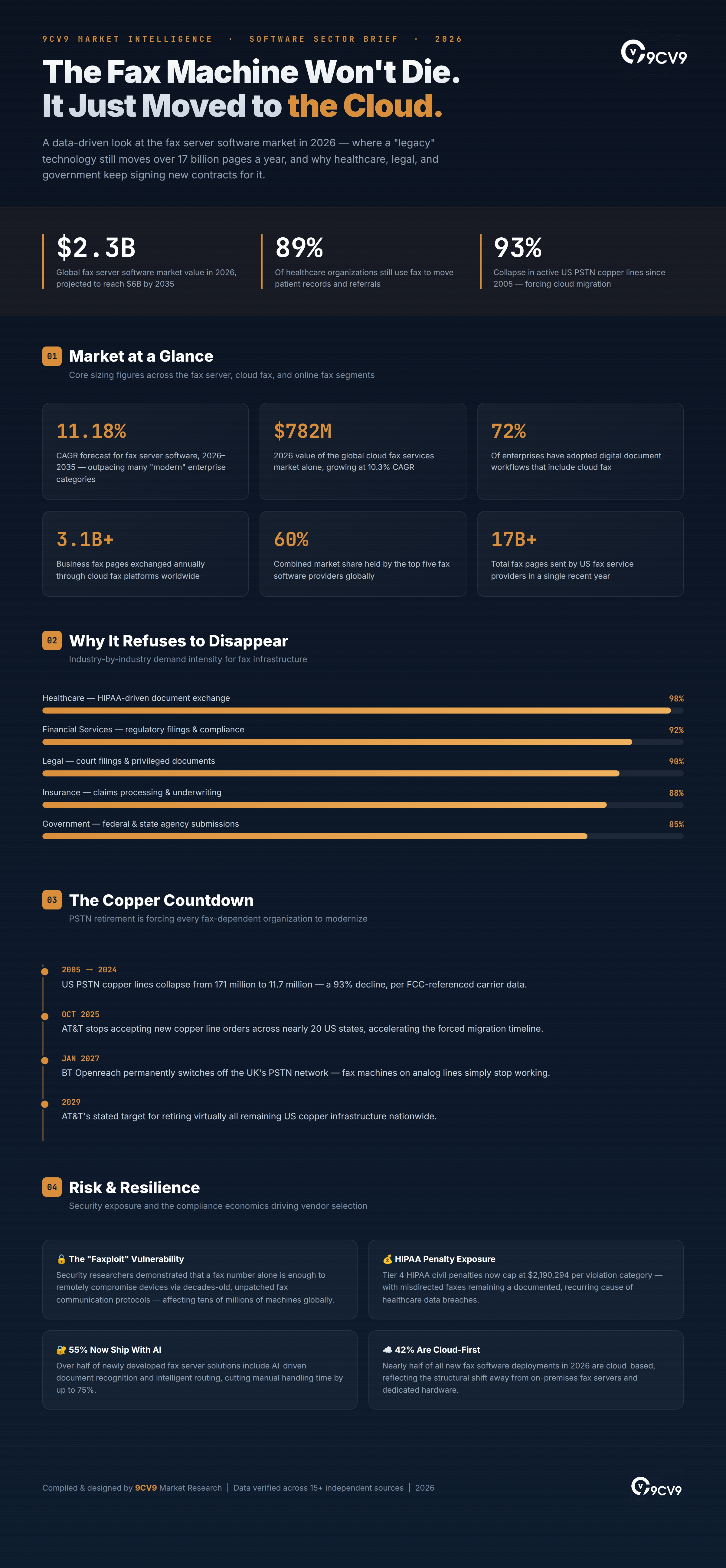
- Fax Server Software Market Growth: The global fax server software market is estimated at $2.3 billion in 2026 and projected to reach $6 billion by 2035, driven by enterprise digital transformation and secure document communication needs.
- Cloud Fax Adoption and Healthcare Demand: Approximately 89% of healthcare organizations continue using fax technology, while growing cloud fax adoption is accelerating the shift toward secure, scalable, and automated document transmission solutions.
- AI, Cybersecurity, and Digital Transformation Trends: Artificial intelligence, workflow automation, encryption, and legacy telephone network retirement are reshaping the fax server software industry, driving demand for cloud-based platforms and integrated enterprise communication systems.
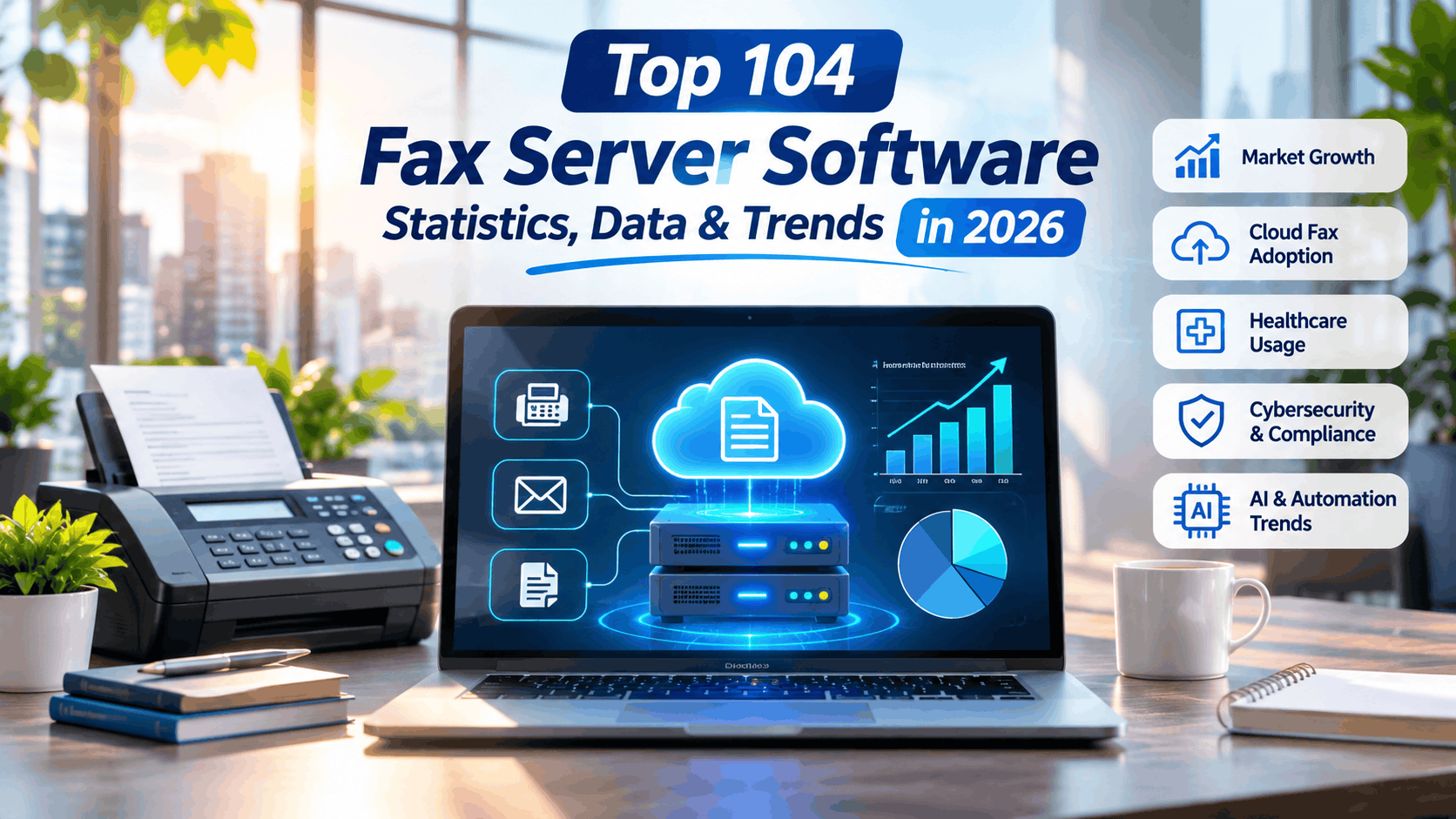
Fax server software remains essential for secure business communication in 2026, with the global market estimated at $2.3 billion and projected to reach $6 billion by 2035. Explore 104 fax server software statistics covering market growth, cloud fax adoption, healthcare demand, cybersecurity, AI automation, and emerging digital document management trends.
Fax server software continues to play an important role in enterprise communication, document management, and secure information exchange despite the rapid adoption of digital technologies. As businesses modernize their IT infrastructure, the demand for reliable, compliant, and automated fax solutions remains significant, particularly across healthcare, financial services, legal practices, and government organizations. Understanding the latest fax server software statistics, market trends, and industry data in 2026 is essential for organizations evaluating their communication infrastructure and digital transformation strategies.
Also, read our article on the Top 10 Fax Server Software.

The global fax server software market is estimated to reach approximately $2.3 billion in 2026, with projections suggesting growth to $6 billion by 2035 at a compound annual growth rate (CAGR) of 11.18%. Although market estimates vary depending on research methodologies and product definitions, these forecasts highlight the continued commercial relevance of fax technology. Meanwhile, cloud-based fax solutions are reshaping the industry as organizations transition away from traditional on-premises fax servers toward more scalable, cost-effective, and integrated communication platforms.
One of the most significant drivers of fax server software adoption is the need for secure document transmission in highly regulated industries. Healthcare organizations, in particular, remain heavily dependent on fax communication for exchanging patient records, processing insurance claims, managing referrals, and handling prior authorizations. Industry estimates suggest that approximately 89% of healthcare organizations continue to use fax technology, while billions of fax pages are exchanged annually across the United States. These figures demonstrate why fax server software remains relevant even as electronic health records, interoperability platforms, and digital document management systems become more widespread.

Beyond healthcare, the fax server software industry is experiencing substantial technological changes driven by cloud computing, artificial intelligence, cybersecurity, and workflow automation. Modern fax platforms increasingly incorporate intelligent document recognition, automated routing, encrypted transmissions, audit trails, and integrations with enterprise resource planning (ERP), customer relationship management (CRM), and other business applications. These capabilities help organizations reduce manual administrative workloads, improve operational efficiency, and strengthen compliance with evolving data protection requirements.
At the same time, the retirement of traditional public switched telephone networks (PSTN), increasing cybersecurity threats, and changing regulatory requirements are accelerating the transition toward internet-based fax services. Businesses must balance the continued need for fax communication with the advantages of modern digital infrastructure, making cloud fax migration, hybrid deployment models, and secure document automation important considerations in 2026.
This comprehensive guide to the Top 104 Fax Server Software Statistics, Data & Trends in 2026 examines the industry’s market size, revenue forecasts, cloud fax adoption rates, regional market shares, competitive landscape, healthcare usage, cybersecurity challenges, regulatory developments, and emerging technologies. By exploring these statistics and industry insights, businesses, IT professionals, software vendors, and decision-makers can gain a clearer understanding of the evolving fax server software market and identify the trends likely to shape enterprise document communication in the years ahead.
Before we venture further into this article, we would like to share who we are and what we do.
About 9cv9
9cv9 is a business tech startup based in Singapore and Asia, with a strong presence all over the world.
With over ten years of startup and business experience, and being highly involved in connecting with thousands of companies and startups, the 9cv9 team has listed some of the top and best companies/tools in this review.
If you like to get your company listed in our top B2B software reviews, check out our world-class 9cv9 Media and PR service and pricing plans here.
Top 104 Fax Server Software Statistics, Data & Trends in 2026
Market Size & Growth
- Fax server software market value 2026: The global fax server software market is valued at approximately $2.3 billion in 2026, underscoring the segment’s continued commercial relevance despite the digital shift.
- Projected 2035 value: Analysts project the fax server software market will reach $6 billion by 2035, reflecting sustained enterprise demand for document transmission infrastructure.
- CAGR 2026–2035: The fax server software market is forecast to grow at an 11.18% CAGR between 2026 and 2035, a pace that outstrips many legacy enterprise software categories.
- Alternate market estimate 2024: One market analysis pegs the fax server software segment at $1.2 billion in 2024, rising toward $1.8 billion by 2033 at a 5.0% CAGR, illustrating how estimates vary by research methodology.
- Broader 2023 valuation: A separate report values the global fax server software market at $2.1 billion in 2023, projected to nearly double to $4.8 billion by 2033 at an 8.6% CAGR.
- 2024 baseline figure: Global fax server software revenue was recorded at $1,885.91 million in 2024, expected to climb to $2,092.61 million in 2025.
- Long-range 2033 forecast: By 2033, fax server software revenue could reach $4,807.63 million, growing at a robust 10.96% CAGR from 2025 onward.
- Fax software (broader category) 2026 value: The wider fax software market is valued at $1,122.77 million in 2026, expected to nearly double to $1,973.92 million by 2035 at a 6.47% CAGR.
- Fax services market size: The global fax services market — spanning hardware, software, and cloud offerings — was valued at $3.31 billion in 2024, projected to reach $4.47 billion by 2030.
- Fax services CAGR: Fax services are growing at a 5.15% CAGR through 2030, a modest but stable trajectory for a supposedly “obsolete” technology.
- Alternate CAGR estimate: Some market research firms cite a fax server software CAGR as high as 9.2%, driven by cloud integration and remote-access demand.
- On-premises fax server replacement rate: Roughly 40% of on-premises fax servers are currently being replaced by cloud-based fax solutions, marking a structural shift in deployment models.
Cloud Fax Market
- Cloud fax services market size 2026: The global cloud fax services market is forecast at $782.03 million in 2026, rising to $1,885.69 million by 2035 at a 10.3% CAGR.
- Enterprise cloud migration rate: More than 72% of enterprises have adopted digital document workflows that include cloud fax capabilities, signaling mainstream digital transformation.
- Legacy infrastructure shift: Over 54% of organizations have shifted from legacy on-premise fax infrastructure to IP-based fax transmission.
- Annual fax page volume: More than 3.1 billion business fax pages are exchanged yearly through cloud fax platforms globally.
- Compliance-bound communication share: More than 38% of enterprise communication in regulated industries remains compliance-bound, sustaining demand for auditable fax channels.
- US cloud fax adoption: The United States represents the largest cloud fax services market share globally, with more than 41% of national enterprises using cloud fax platforms.
- Regulated organizations in the US: Over 2.6 million regulated organizations in the US are subject to data privacy policies that favor compliant fax solutions.
- Global fax transmissions processed annually: Cloud fax platforms process more than 2.8 billion global fax transmissions each year.
- Regulatory-driven encryption adoption: Nearly 61% of compliance-bound industries have adopted encrypted cloud fax channels to secure document transfer.
- Integration challenge rate: More than 42% of enterprises report facing integration challenges with legacy software when adopting cloud fax platforms.
- Cybersecurity concern rate: About 33% of enterprises express cybersecurity concerns specifically related to fax and document transmission systems.
- API adoption in fax platforms: Growing API adoption is reported among 53% of businesses using cloud fax services, enabling deeper workflow automation.
- Manual workload reduction: Automation improvements in cloud fax platforms have reduced manual workload by approximately 41% for adopting organizations.
- SME share of cloud fax demand: Small and medium-sized enterprises account for 37% of global cloud fax demand.
- SME fax page volume: SMEs using cloud fax typically transmit between 8,000 and 45,000 pages annually.
- SME compliance need: More than 54% of SMEs require secure fax communication tools to meet contractual and regulatory obligations.
- Cloud fax market alternate 2025 estimate: A separate valuation places the cloud fax market at $559.40 million in 2025.
- North America cloud fax share (alt. estimate): North America leads the cloud fax market with approximately 39% share, driven by advanced infrastructure and regulatory needs.
- Cloud fax market 2025 broader estimate: Another analysis values the global cloud fax market at $3.8 billion in 2025, projected to reach $8.6 billion by 2034 at a 9.5% CAGR.
- Historical cloud fax valuation: An older but widely cited estimate placed the cloud fax services market at $102 billion in 2023 (broader “cloud fax services” definition), projected to reach $148.72 billion by 2031.
Online Fax Service Market
- Online fax market size 2026: The global online fax service market is estimated at $3.16 billion in 2026.
- Online fax projected 2035 value: This market is projected to reach $7.22 billion by 2035, growing at a 9.5% CAGR.
- North America online fax share: North America dominates the online fax service market with roughly 38% share.
- Europe online fax share: Europe holds around 28% of the global online fax service market, supported by strong digital infrastructure.
- Asia Pacific growth rate: The Asia Pacific region is expected to register the highest online fax growth rate, capturing nearly 22% market share by 2035.
- US market share within fax services: The US contributes over 60% of the North American fax services market share.
Vendor Landscape & Competitive Concentration
- Top vendor concentration: The top five fax software providers control about 60% of the global market, indicating a moderately consolidated competitive landscape.
- Leading vendors named across research: Key players named across multiple independent market reports include WestFax, 3CX, XMedius Solutions, FaxCore, eFax, Alohi (FAX.PLUS), Biscom, Alt-N Technologies (RelayFax), Esker, OpenText (RightFax), Documo, and RingCentral.
- eFax reported revenue: eFax has reported revenues exceeding $30 million, reflecting strong demand in the fax-as-a-service segment.
- OpenText market leadership: OpenText Corporation has been identified as leading the competitive landscape in cloud fax with a broad enterprise-grade portfolio.
- North America revenue leadership (healthcare-driven): North America is anticipated to hold the largest cloud fax market share largely due to high revenue contribution from the healthcare sector.
- Capterra review volume: Capterra has verified over 2.5 million+ software reviews across its platform, a portion of which cover fax server and online fax solutions.
- Highest-rated fax platform on Capterra: Among fax server listings, several vendors — including FaxLogic — have achieved near-perfect review scores when sorted by “Highest Rated” on Capterra.
- etherFAX integration depth: etherFAX integrates with 9+ third-party platforms including Microsoft 365, Microsoft Teams, Google Workspace, and Slack, reflecting the trend toward workflow-embedded faxing.
- HIPAA/SOC2/HITRUST layering: Multiple top-rated fax platforms (e.g., etherFAX, Fax.Plus) now combine HIPAA, SOC 2 Type 2, HITRUST CSF, and PCI DSS certifications simultaneously.
Healthcare Sector Usage
- Healthcare fax reliance: Approximately 89% of healthcare organizations continue to use fax machines as of the most recent available survey data.
- Share of healthcare communication via fax: About 70% of all healthcare communication occurs via fax, a figure that rises to 90% when including faxes routed through EHR systems.
- Annual healthcare fax page volume: The US healthcare industry exchanges over 9 billion fax pages annually.
- Total US fax page volume: Over 17 billion pages were sent by fax service providers in the US in a single recent year across all industries.
- Alternate healthcare communication estimate: A separate estimate places the share of US medical communication still conducted by fax at around 75%.
- Healthcare sector market share (cloud fax): The healthcare sector accounts for approximately 35% of the cloud fax and fax server software market share, the largest of any vertical.
- Prior authorization electronic adoption: Only about 12% of the 182 million annual prior-authorization transactions in US healthcare use the mandated electronic (5010 X12 278) format, with the remainder still relying on fax, phone, or portals.
- Fax workflow automation gap: Roughly 71% of healthcare organizations have not implemented fully automated fax workflows, leaving manual sorting and routing in place.
- Full automation adoption: Only 29% of healthcare organizations report complete fax workflow automation.
- HIPAA-driven interoperability investment: Healthcare organizations are expected to increase investment in interoperable communication solutions — including secure fax — by 45% relative to prior years.
- CMS/provider fax reliance: Approximately 85% of healthcare providers still rely on fax communications for patient information exchange, according to CMS-referenced estimates.
- AI-driven document processing potential: AI-powered document processing in fax workflows could reduce manual handling time by up to 75% while improving accuracy by 60%, per NSF-referenced research.
- CMS prior-authorization reform timeline: CMS’s Interoperability and Prior Authorization Final Rule (CMS-0057) is pushing payers toward electronic prior authorization by 2027, a direct policy pressure point on fax-dependent workflows.
- SMB “stuck in the fax lane” impact: 88% of healthcare professionals in a 2025 SMB-focused survey said fax-related delays directly impact patient care.
HIPAA Compliance & Data Security
- HHS OCR complaint volume: The HHS Office for Civil Rights has logged 374,322 HIPAA complaints since 2003, a portion tied to misdirected fax transmissions of protected health information.
- Healthcare breaches since 2009: 7,419 healthcare data breaches have been reported since 2009, with network/server-related incidents (including fax infrastructure) forming a growing share.
- Tier 4 HIPAA penalty cap: The current annual cap on a single-tier civil monetary HIPAA penalty stands at $2,190,294, underscoring the financial exposure of fax-related PHI mishandling.
- Hacking share of healthcare breaches: Hacking and IT incidents now account for over 80% of healthcare data breaches, a category that increasingly includes networked fax servers.
- Average healthcare breach cost: IBM estimates the average healthcare data breach costs $7.42 million and takes 279 days to contain.
- Fax-related claim delays: Hospitals average 59 fax-related claim delays annually, according to healthcare administration research.
Legal & Financial Services
- Financial services fax market share: The financial services vertical accounts for approximately 19% of the global fax services market.
- Law firm fax usage rate: 89% of law firms continue using fax as part of standard practice, according to legal-industry surveys.
- Law firm necessity belief: 93% of law firm respondents believe fax remains necessary for their practice despite digital alternatives.
- Law firm cybersecurity tool adoption: 80% of law firms use spam filters as a security tool, while 76% use software firewalls, both relevant to protecting fax-adjacent digital infrastructure.
- Law firm file encryption adoption: Nearly 48% of law firms use file encryption, and 42% use email encryption, reflecting a broader security posture that fax-server vendors compete within.
- Law firm cyber liability insurance: Only 40% of law firms carry cyber liability insurance, a figure that has declined from 46% two years prior.
- Law firm breach rate: 29% of law firms reported a security breach in the most recent reporting year, up from 27% previously.
- US lawyer population: There are more than 1.37 million lawyers in the United States, a population that represents a substantial base of potential fax-server end users for court and regulatory filings.
PSTN Retirement & Infrastructure Transition
- US PSTN line decline: PSTN (copper) lines in the United States have collapsed from 171 million in 2005 to just 11.7 million in 2024 — a 93% drop.
- AT&T copper maintenance cost: AT&T alone spends approximately $6 billion annually maintaining its legacy copper network infrastructure.
- AT&T copper order cutoff: AT&T stopped accepting new copper line orders, moves, or changes as of October 15, 2025, across nearly 20 US states.
- AT&T full retirement target: AT&T’s stated target for retiring virtually all remaining copper services nationwide is 2029.
- FCC notice period reduction: The FCC cut the required notice period for copper wire center shutdowns from 180 days to 90 days in March 2025, compressing migration timelines for fax-dependent organizations.
- UK PSTN switch-off date: BT Openreach will permanently switch off the UK’s PSTN network by January 31, 2027, directly affecting analog fax machines nationwide.
- Historical fax paper consumption: Fax machines historically consumed approximately 200 billion pages annually across the US, according to a 2017 IDC survey.
- Peak fax transmission rate: At peak volume, US fax transmissions were estimated at roughly 6,000 pages per second.
- Large enterprise fax usage trend (2017): 82% of large enterprises surveyed by IDC said fax usage had increased or stayed the same year over year, challenging assumptions of fax decline.
- Global fax device installed base: More than 45 million physical fax machines remain in active use worldwide, alongside over 300 million registered fax numbers globally.
Cybersecurity Vulnerabilities
- Faxploit vulnerability disclosure: Security researchers disclosed critical remote-code-execution vulnerabilities (“Faxploit”) in fax communication protocols affecting tens of millions of fax-enabled devices globally.
- Attack vector simplicity: These vulnerabilities require only a target’s fax number to potentially execute an attack, since a malicious image file can be encoded and transmitted directly over the phone line.
- Affected printer models (unrelated firmware flaw): Separately, researchers identified firmware vulnerabilities affecting at least 150 multi-function print-scan-fax printer models from a major manufacturer.
- Protocol age as risk factor: The vulnerable fax communication protocols underlying most attacks date back to standards set in the 1980s that have not been substantially updated since.
Government & Regulatory Use
- Government/education/manufacturing contribution: Government agencies, educational institutions, manufacturing firms, and legal practices collectively contribute significantly to global online fax industry revenue.
- US federal agency fax acceptance: The IRS accepts fax submissions for dozens of form types, while the Social Security Administration uses fax for disability claims and appeals processing.
- GSA digital processing increase: The US General Services Administration reported a 30% increase in digital document processing requirements across federal agencies, with secure fax remaining a component of that transformation.
- Rural court fax dependency: Many rural courthouses in state court systems lack electronic filing infrastructure and rely on fax as a primary electronic communication method for filings.
Trends: AI, Automation & Sustainability
- AI-driven fax feature adoption: Over 55% of newly developed fax server solutions now feature AI-driven functionality such as automated document recognition and intelligent routing.
- Cloud-based fax deployment share: Approximately 42% of new fax software deployments are cloud-based, according to 2026 industry tracking.
- AI document routing among providers: About 38% of fax software providers now offer AI-driven document routing as a core feature.
- Encryption/audit-trail feature adoption: Nearly 30% of new fax deployments include advanced encryption paired with detailed audit-trail features.
- Usage split by method: Around 45% of fax software usage occurs via email-to-fax, 38% via desktop faxing, and 17% via web-portal faxing.
- Integration complexity as a restraint: Approximately 54% of companies report facing integration complexity when connecting new fax software with legacy fax servers.
- Cloud-based fax dominance (2023 baseline): Cloud-based fax deployment held over 60% market share in 2023, driven by lower maintenance requirements and scalability.
- Paper-reduction/sustainability motivation: Approximately 40% of organizations have adopted fax server software partly to reduce paper usage and align with sustainability goals.
- ERP/CRM integration preference: Around 50% of enterprises report a preference for fax solutions that integrate seamlessly with existing ERP and CRM ecosystems.
- Hybrid fax model adoption: Over 40% of organizations currently utilize hybrid fax systems that combine traditional and digital methods for flexibility and compliance.
- Global fax usage persistence (Statista-referenced): Approximately 17% of businesses worldwide still rely on fax for critical operational communication, according to a 2024 Statista-referenced estimate.
Conclusion
The Top 104 Fax Server Software Statistics, Data & Trends in 2026 demonstrate that fax technology remains an important component of enterprise communication, even as businesses accelerate their transition toward digital workflows. Rather than disappearing, fax server software is evolving into a more sophisticated, cloud-enabled, and security-focused solution that supports document exchange, regulatory compliance, and business process automation across multiple industries.
With the global fax server software market estimated at approximately $2.3 billion in 2026 and projected to reach $6 billion by 2035, the industry presents continued opportunities for software providers, enterprise technology vendors, and organizations investing in modern communication infrastructure. Although market forecasts differ depending on research methodologies and industry definitions, the overall outlook suggests sustained demand for reliable fax solutions, particularly as businesses replace traditional hardware with cloud-based and hybrid alternatives.
One of the most important findings is the continued reliance on fax communication within highly regulated sectors. Healthcare remains a major contributor to fax software demand, with approximately 89% of healthcare organizations reportedly continuing to use fax technology. Financial institutions, legal firms, and government agencies also maintain fax-dependent processes because of established workflows, documentation requirements, and the need for secure information exchange. These industries are expected to remain important customers for fax server software providers as digital modernization progresses.
Meanwhile, cloud fax adoption, artificial intelligence, and workflow automation are reshaping the competitive landscape. Organizations increasingly prioritize fax solutions that offer encrypted document transmission, intelligent routing, automated document processing, electronic health record integration, and compatibility with existing ERP and CRM systems. These developments create opportunities to reduce administrative workloads, improve document accessibility, strengthen data protection, and enhance operational efficiency.
The gradual retirement of traditional public switched telephone networks (PSTN) represents another significant turning point for the industry. As telecommunications providers phase out legacy copper infrastructure, businesses relying on conventional fax machines and on-premises fax servers face growing pressure to adopt internet-based communication alternatives. This transition is likely to accelerate investment in cloud fax platforms, Fax over IP technologies, and hybrid document transmission systems.
However, the industry also faces challenges involving cybersecurity vulnerabilities, integration complexity, evolving compliance requirements, and competition from alternative digital communication technologies. Organizations evaluating fax server software must therefore consider not only pricing and functionality but also security capabilities, scalability, interoperability, vendor reliability, and long-term infrastructure compatibility.
Looking ahead, the future of fax server software will increasingly depend on its ability to integrate with broader enterprise digital transformation strategies. Cloud-native deployment, AI-powered document management, API-driven automation, and secure communication infrastructure are likely to become important competitive differentiators. Software vendors that successfully combine traditional fax reliability with modern digital capabilities will be better positioned to serve organizations that continue to require dependable document transmission.
Ultimately, these 104 fax server software statistics and trends for 2026 highlight an industry undergoing technological transformation rather than simply declining. For businesses, IT decision-makers, healthcare administrators, and software providers, understanding these developments is essential for making informed technology investments, improving operational efficiency, and preparing for changing communication requirements.
As enterprise communication continues to evolve, fax server software is likely to remain relevant wherever secure, traceable, and interoperable document exchange is required, with cloud adoption, automation, and cybersecurity shaping its next phase of development.
Also, read our article on the
If you find this article useful, why not share it with your hiring manager and C-level suite friends and also leave a nice comment below?
We, at the 9cv9 Research Team, strive to bring the latest and most meaningful data, guides, and statistics to your doorstep.
To get access to top-quality guides, click over to 9cv9 Blog.
To hire top talents using our modern AI-powered recruitment agency, find out more at 9cv9 Modern AI-Powered Recruitment Agency.
People Also Ask
What is fax server software?
Fax server software is a digital solution that enables businesses to send, receive, store, and manage fax documents electronically. It integrates with existing IT systems, reducing reliance on traditional fax machines and improving document management efficiency.
What is the global fax server software market size in 2026?
The global fax server software market is estimated at approximately $2.3 billion in 2026. Growing demand for secure document transmission, cloud-based fax solutions, and enterprise workflow automation supports continued market expansion.
How fast is the fax server software market growing?
The global fax server software market is projected to grow at a compound annual growth rate (CAGR) of approximately 11.18% between 2026 and 2035, potentially reaching $6 billion by 2035.
What are the key fax server software trends in 2026?
Major fax server software trends in 2026 include cloud fax migration, AI-powered document processing, automated fax routing, cybersecurity improvements, API integrations, and the replacement of traditional telephone infrastructure.
What is the projected fax server software market size by 2035?
The global fax server software market is forecast to reach approximately $6 billion by 2035, supported by increasing enterprise demand for secure communication, digital document management, and cloud-based fax infrastructure.
Why is fax server software still relevant in 2026?
Fax server software remains relevant because healthcare organizations, financial institutions, legal firms, and government agencies continue using fax for established document exchange workflows, compliance requirements, and secure information transmission.
What is cloud fax software?
Cloud fax software allows businesses to send and receive faxes through internet-based platforms without maintaining traditional fax machines or dedicated on-premises servers. It supports remote access, document storage, workflow integration, and centralized management.
How large is the cloud fax services market in 2026?
One market forecast estimates the global cloud fax services market at approximately $782.03 million in 2026, with projected growth to $1.89 billion by 2035 at a CAGR of 10.3%.
What percentage of businesses use cloud fax solutions?
Industry estimates suggest that more than 72% of enterprises have adopted digital document workflows incorporating cloud fax capabilities. Adoption varies by industry, organization size, and the definition of cloud fax usage.
Which industries use fax server software the most?
Healthcare is a major user of fax server software, followed by financial services, legal organizations, and government agencies. These sectors depend on established document exchange processes, regulatory compliance, and reliable communication infrastructure.
How widely is fax technology used in healthcare?
Approximately 89% of healthcare organizations reportedly continue using fax technology. Fax remains common for patient referrals, medical records, insurance documentation, prior authorizations, and communication between healthcare providers.
What percentage of healthcare communication occurs through fax?
Industry estimates suggest that approximately 70% of healthcare communication involves fax, potentially reaching 90% when fax transmissions integrated with electronic health record systems are included.
How many fax pages does the healthcare industry send annually?
The United States healthcare industry is estimated to exchange more than 9 billion fax pages annually, reflecting continued reliance on fax communication for medical records, patient referrals, insurance claims, and administrative documentation.
Is fax server software HIPAA compliant?
Fax server software can support HIPAA compliance when appropriate safeguards are implemented. Healthcare organizations should evaluate encryption, access controls, audit trails, secure storage, vendor agreements, and administrative security procedures.
What are the main benefits of cloud fax software?
Cloud fax software can reduce hardware maintenance, improve remote accessibility, simplify document management, support automated workflows, and integrate with business applications. Security and compliance benefits depend on platform capabilities and configuration.
How does AI improve fax server software?
Artificial intelligence improves fax server software through automated document recognition, intelligent routing, data extraction, and workflow optimization. These capabilities can reduce manual processing and improve the efficiency of document management.
What percentage of fax software providers offer AI-powered routing?
Industry estimates suggest that approximately 38% of fax software providers offer AI-driven document routing as a core feature, reflecting growing interest in intelligent automation and streamlined document processing.
What is the market share of cloud-based fax software?
One industry estimate indicates that cloud-based fax deployments accounted for more than 60% of the fax software market in 2023. Market share figures vary depending on whether cloud fax services, software, or deployment volumes are measured.
Which region dominates the fax server software market?
North America is a leading market for fax server software and cloud fax services. Its position is supported by healthcare demand, established enterprise communication infrastructure, and regulatory requirements for document handling.
What is North America’s share of the online fax services market?
North America accounts for approximately 38% of the global online fax services market, according to industry estimates. Healthcare adoption, financial services demand, and enterprise digital transformation contribute to its market position.
What is the fastest-growing region for online fax services?
Asia Pacific is expected to experience strong online fax services growth as businesses modernize communication infrastructure, expand cloud adoption, and invest in secure digital document transmission technologies.
Who are the leading fax server software providers in 2026?
Major fax server software providers include OpenText RightFax, eFax, RingCentral, WestFax, FaxCore, Biscom, Esker, Documo, etherFAX, and FAX.PLUS. These vendors offer different combinations of enterprise fax management and cloud-based services.
What is the difference between fax server software and online fax services?
Fax server software typically manages fax transmission through dedicated enterprise infrastructure, while online fax services operate through internet-based platforms. Both support electronic faxing, but deployment, maintenance, and integration requirements differ.
How does fax server software integrate with ERP and CRM systems?
Modern fax server software connects with ERP and CRM platforms through APIs, email gateways, and enterprise integrations. These connections enable automated document transmission, centralized record management, and streamlined business workflows.
What are the biggest cybersecurity risks associated with fax servers?
Major cybersecurity risks include unauthorized access, outdated firmware, insecure network configurations, misdirected documents, and vulnerabilities in fax-enabled devices. Regular updates, encryption, monitoring, and access controls help reduce exposure.
How does fax server software support regulatory compliance?
Fax server software supports regulatory compliance through document encryption, user authentication, transmission logs, audit trails, retention controls, and secure storage. Organizations must configure these capabilities according to applicable regulations.
How will PSTN retirement affect fax server software?
The retirement of traditional public switched telephone networks is encouraging organizations to replace analog fax infrastructure with cloud fax, Fax over IP, and hybrid solutions. Migration planning is important for maintaining reliable document transmission.
What percentage of businesses use hybrid fax systems?
Industry estimates indicate that more than 40% of organizations use hybrid fax systems combining traditional and digital communication methods. These deployments allow businesses to maintain existing workflows while gradually modernizing infrastructure.
Can fax server software reduce paper consumption?
Yes. Fax server software enables electronic document transmission, digital storage, and automated processing, reducing the need for printed fax documents. Approximately 40% of organizations reportedly consider paper reduction when adopting fax software.
What is the future of fax server software beyond 2026?
The future of fax server software will likely center on cloud-native platforms, AI-powered automation, stronger cybersecurity, API integrations, and interoperability with enterprise applications. Demand is expected to persist in industries requiring secure document exchange.
Sources
Business Research Insights
Cognitive Market Research
Verified Market Reports
OpenPR
Market Research Intellect
360 Research Reports
GitHub
Reliable Business Arena
LP Information
DataHorizzon Research
Global Growth Insights
Market Research Future
Verified Market Research
WiseGuyReports
DataIntelo
Arizton
GetCodesHealth
FaxSIPit
FaxDrop
CodeBrand
Paperless Productivity
Documo
eFax
eGoldFax
Capterra
Krowdbase
Phonewire
DIDWW
Fax.Plus
Connection Technologies
Comms365
Stride Communications
Acefone
SignalWire
Focus Group
The Hacker News
Computer Weekly
BleepingComputer
Check Point Software
CNBC
AccuShred
Wizard Cyber
OneTimeFax
Clio
FaxSpecialist
FaxItOnce
FAXAGE
ABA Journal


