


Key Takeaways
- Customer support software is experiencing rapid global growth, fuelled by AI, cloud adoption, self-service platforms, and increasing enterprise investment in customer experience technologies.
- AI-powered customer support is transforming business operations by reducing costs, accelerating response times, improving agent productivity, and delivering higher customer satisfaction through intelligent automation.
- Omnichannel support, conversational AI, and customer-centric service strategies are becoming essential competitive advantages as businesses prepare for the future of AI-driven customer experience in 2026 and beyond.
Customer support software enables businesses to manage customer enquiries, automate support workflows, and deliver faster, more personalised service across multiple channels. This guide analyses the top 103 customer support software statistics, data, and trends in 2026 to help business leaders understand market growth, AI adoption, customer expectations, and the technologies shaping the future of customer experience.
Customer support has evolved from a reactive business function into one of the most important competitive advantages for organisations operating in the digital economy. In 2026, customers no longer compare companies solely on product quality or pricing—they judge brands based on how quickly, consistently, and effectively they resolve problems across every touchpoint. Whether interacting through live chat, email, phone, social media, AI-powered chatbots, or self-service knowledge bases, customers expect seamless, personalised, and immediate support. Businesses that fail to meet these expectations risk losing customers to competitors that deliver faster, smarter, and more connected service experiences.
Also, read our top guide on the Top 10 Best Customer Support Software.


At the same time, customer support software has undergone one of the most dramatic transformations in enterprise technology. Traditional help desk systems have rapidly evolved into intelligent customer experience platforms powered by artificial intelligence, machine learning, automation, conversational AI, predictive analytics, and omnichannel communication. Modern customer support platforms are no longer designed simply to organise support tickets—they are built to automate workflows, empower agents, anticipate customer needs, personalise every interaction, and generate measurable business outcomes ranging from increased customer loyalty to significant cost savings.
The numbers behind this transformation are remarkable. Industry research shows that the global customer service software market continues to experience exceptional double-digit growth, with forecasts indicating it will expand from a multibillion-dollar industry today into one worth tens of billions of dollars over the coming decade. Multiple independent market research firms project compound annual growth rates approaching or exceeding 20%, demonstrating that customer support technology has become one of the fastest-growing segments within enterprise software. This rapid expansion reflects a broader shift in corporate priorities, where customer experience is increasingly viewed as a strategic investment rather than a back-office operational expense.

Artificial intelligence is undoubtedly the defining force behind this evolution. What began as simple rule-based chatbots has matured into sophisticated AI-powered virtual assistants capable of understanding context, generating human-like responses, resolving complex enquiries, and autonomously completing customer service tasks. Organisations around the world are aggressively investing in conversational AI, generative AI, agentic AI, and intelligent automation, with the overwhelming majority of customer service leaders now facing executive pressure to deploy AI technologies across their support operations. AI adoption has accelerated at an unprecedented pace, transforming from a niche capability into an operational necessity across industries.

The economic impact of AI-powered customer support is equally compelling. Businesses implementing intelligent automation consistently report significant reductions in operational costs while simultaneously improving service quality. AI-powered interactions are substantially cheaper than traditional human-assisted conversations, allowing organisations to serve larger customer bases without proportionally increasing staffing costs. Many enterprises now achieve impressive returns on investment through AI deployments, with automation reducing handling times, accelerating issue resolution, increasing agent productivity, and lowering overall support expenses. These measurable financial benefits explain why customer support software continues attracting substantial enterprise investment despite broader economic uncertainty.

Customer expectations have also changed dramatically over recent years. Today’s consumers expect near-instant responses regardless of communication channel. Waiting hours—or even minutes—for assistance increasingly feels unacceptable in an era where AI systems can provide responses within seconds. Live chat has emerged as one of the most preferred customer service channels, while self-service portals, AI chatbots, and omnichannel communication platforms have become standard components of modern customer support strategies. Customers now expect companies to remember previous conversations, maintain context across multiple channels, and deliver personalised assistance without requiring them to repeat information repeatedly. These rising expectations have fundamentally reshaped how organisations design their customer service operations.

Omnichannel customer support has become another defining trend reshaping the industry. Modern consumers frequently begin their customer journey on one channel and complete it on another, expecting every interaction to remain connected throughout the process. Businesses that integrate phone support, email, live chat, messaging apps, social media, and AI assistants into unified customer support platforms consistently report higher customer satisfaction, stronger customer retention, reduced operational costs, and increased revenue. Conversely, fragmented support systems continue to frustrate customers by forcing them to repeat information, leading to lower satisfaction scores and increased churn.

While automation continues expanding rapidly, the role of human customer service professionals remains critically important. Rather than replacing support agents entirely, AI is reshaping their responsibilities. Routine enquiries are increasingly handled automatically, allowing human agents to focus on complex, emotionally sensitive, or high-value customer interactions. AI copilots now assist support representatives by summarising conversations, recommending responses, retrieving knowledge articles, and automating repetitive administrative tasks. This collaborative approach enables agents to handle more enquiries, resolve issues faster, and deliver higher-quality customer experiences while reducing burnout associated with repetitive work.

Trust remains one of the most important considerations in AI-driven customer support. Although customers appreciate the speed and convenience of automation, many still prefer having access to human representatives, particularly for complicated or emotionally significant issues. Organisations therefore face the challenge of balancing automation with empathy, ensuring that AI systems remain transparent, explainable, and capable of seamlessly transferring customers to human agents whenever necessary. Companies that openly disclose AI usage, establish clear privacy policies, and provide smooth escalation pathways are better positioned to build long-term customer trust while maximising the benefits of intelligent automation.

Looking ahead, customer support software is expected to become even more intelligent, autonomous, and deeply integrated into enterprise operations. Emerging technologies such as agentic AI, predictive customer service, autonomous workflow automation, and machine-to-machine service interactions promise to fundamentally redefine how organisations engage with customers. Future support systems will increasingly anticipate customer issues before they occur, initiate proactive resolutions, and collaborate with customer-owned AI assistants to resolve problems automatically. As these capabilities mature, businesses will need to rethink traditional customer service models, workforce structures, governance frameworks, and customer experience strategies to remain competitive.
This comprehensive guide presents the Top 103 Customer Support Software Statistics, Data & Trends in 2026, bringing together the latest market research, industry benchmarks, AI adoption figures, customer behaviour insights, financial performance metrics, workforce trends, and future forecasts from leading research organisations and technology companies worldwide. Whether you are a customer experience executive, business leader, SaaS founder, IT decision-maker, contact centre manager, software vendor, digital transformation consultant, investor, or technology researcher, these carefully curated statistics provide valuable insights into how customer support software is reshaping modern business operations.
From global market growth and AI-powered automation to omnichannel engagement, customer expectations, workforce productivity, return on investment, consumer trust, and emerging industry trends, these 103 statistics offer a comprehensive snapshot of one of the world’s fastest-evolving software markets. Understanding these data-driven insights will help organisations make informed technology investments, optimise customer service strategies, improve operational efficiency, strengthen customer relationships, and prepare for the next generation of AI-powered customer support.
Before we venture further into this article, we would like to share who we are and what we do.
About 9cv9
9cv9 is a business tech startup based in Singapore and Asia, with a strong presence all over the world.
With over ten years of startup and business experience, and being highly involved in connecting with thousands of companies and startups, the 9cv9 team has listed some important and crucial software tools in this review.
If you like to get your company listed in our top B2B software reviews, check out our world-class 9cv9 Media and PR service and pricing plans here.
Top 103 Customer Support Software Statistics, Data & Trends in 2026
📊 Market Size & Growth
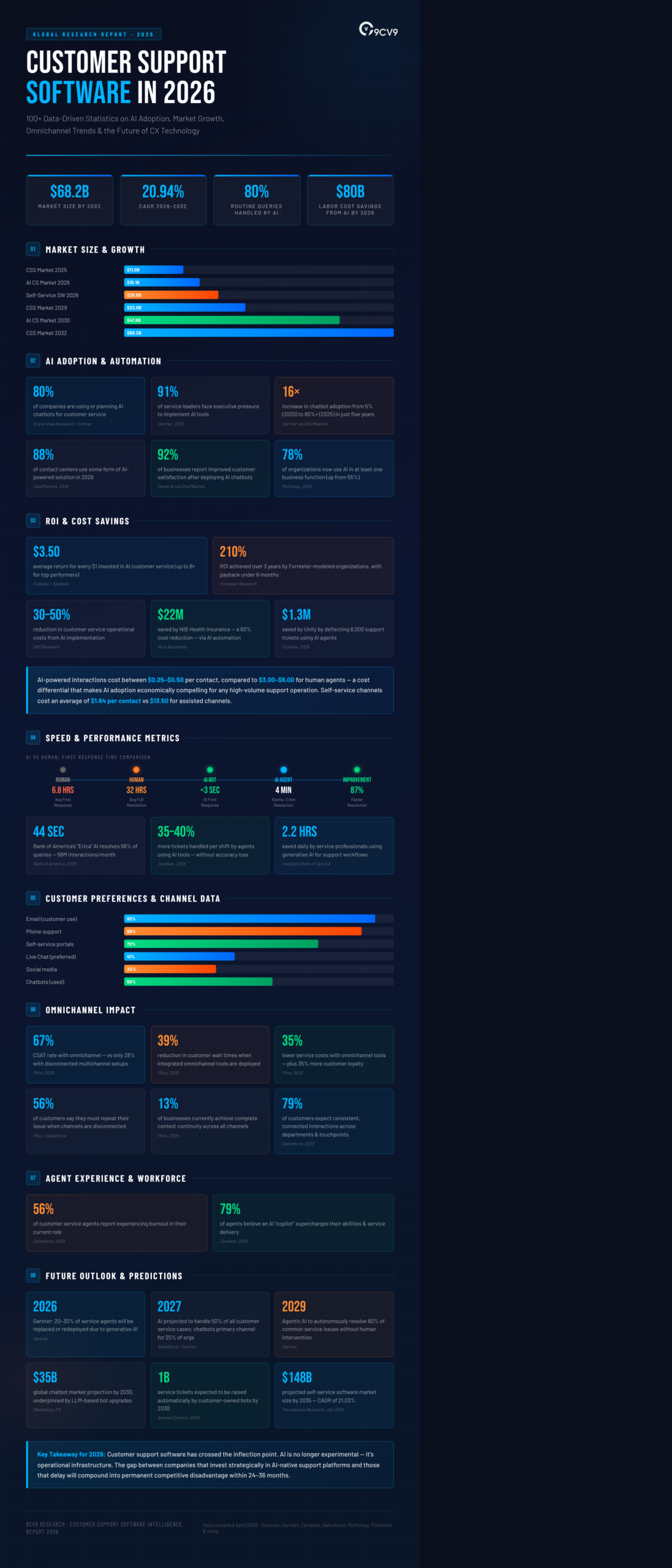
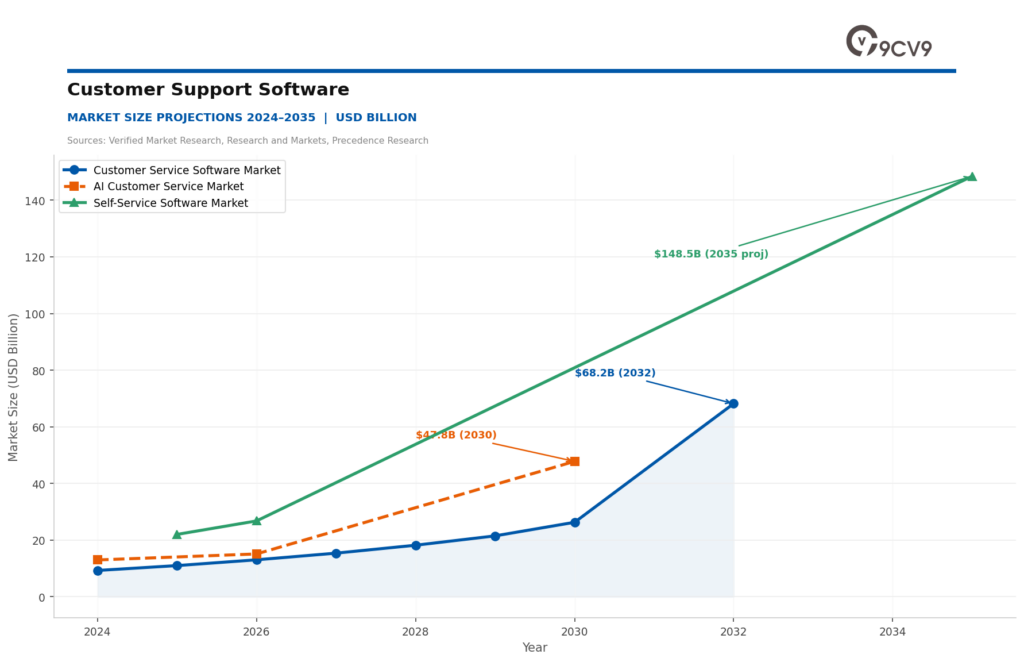
1. The global Customer Service Software market was valued at USD 14.9 billion in 2024 and is projected to reach USD 68.19 billion by 2032, growing at a CAGR of 20.94%.
As businesses double down on customer experience as a competitive differentiator, the CSS market is on a steep upward trajectory that signals it has shifted from a cost-centre tool to a board-level strategic priority.
2. The Customer Service Software market grew from USD 9.29 billion in 2024 to USD 11.01 billion in 2025 — an 18.6% single-year increase.
This near-20% year-on-year leap demonstrates that software adoption in customer support is no longer gradual; it has entered an acceleration phase driven by AI integration and cloud migration.
3. The CSS market is expected to reach USD 22.47 billion by 2029 at a CAGR of 19.5%.
Consistent double-digit CAGR projections across multiple independent research firms confirm that CSS is one of the most reliably high-growth enterprise software verticals heading into the second half of the 2020s.
4. The global AI Customer Service market is projected to reach USD 15.12 billion in 2026.
As AI-native capabilities become table stakes rather than differentiators, the dedicated AI customer service sub-market is growing at more than double the pace of the broader software category.
5. The AI Customer Service market is expected to grow from USD 12 billion in 2024 to USD 47.82 billion by 2030 at a CAGR of 25.8%.
A near-4× expansion in six years underscores that AI will be the dominant investment thesis within customer support infrastructure throughout the rest of the decade.
6. The global customer self-service software market was valued at USD 22.02 billion in 2025 and is predicted to reach USD 148.49 billion by 2035 at a CAGR of 21.03%.
Self-service is the fastest-growing sub-segment in CX technology, driven by customers who now prefer to resolve issues independently before ever contacting a live agent.
7. The U.S. customer self-service software market is projected to grow from USD 5.28 billion (2025) to USD 36.56 billion by 2035 — a 21.35% CAGR.
American enterprises are leading global self-service software adoption, reflecting both high consumer digital literacy and intense competitive pressure to reduce cost-per-interaction.
8. North America holds the largest market share of 32% in the customer self-service software market as of 2025.
North America’s early-mover advantage in cloud infrastructure and enterprise AI investment has cemented its regional leadership, though Asia-Pacific is rapidly closing the gap.
9. The Asia-Pacific region is expected to show the fastest growth rate in the customer service software market through 2030.
Rapid urbanisation, mobile-first consumer behaviour, and government digitisation programs in China and India are creating a uniquely fertile environment for CSS expansion.
10. The global customer technical support service market will grow from USD 50.03 billion in 2025 to USD 53.13 billion in 2026 at a 6.2% CAGR.
Even the slower-growing technical support services segment is expanding, confirming that demand for complex, human-led troubleshooting remains robust alongside AI automation.
11. The customer technical support service market is expected to reach USD 68.19 billion by 2030 at a 6.4% CAGR.
Steady long-term growth projections for technical support suggest that AI will handle routine queries while human specialists are upskilled to manage increasingly complex issues.
12. The global AI chatbot market is projected to reach USD 18.27 billion in 2028, up from USD 9.08 billion in 2025.
This near-doubling of the chatbot market in just three years reflects the transition from experimental deployments to mission-critical, always-on conversational AI infrastructure.
13. The help desk software market is valued at USD 14.3 billion in 2025 and is projected to reach USD 35 billion by 2035 at a 9.4% CAGR.
Help desk software’s continued growth despite AI disruption demonstrates that structured ticketing, SLA management, and workflow automation remain foundational to enterprise support operations.
14. 64.1% of customer service software revenue now comes from SaaS-based models.
The decisive shift to SaaS reflects enterprise preferences for flexible, integration-friendly tools over legacy on-premise installations that require costly maintenance and slow update cycles.
15. Large enterprises account for 57.6% of customer service market revenue in 2025.
While SME adoption is growing, large enterprises remain the anchor revenue source for CSS vendors — particularly for enterprise-grade compliance, security, and scalability requirements.
🤖 AI Adoption & Automation
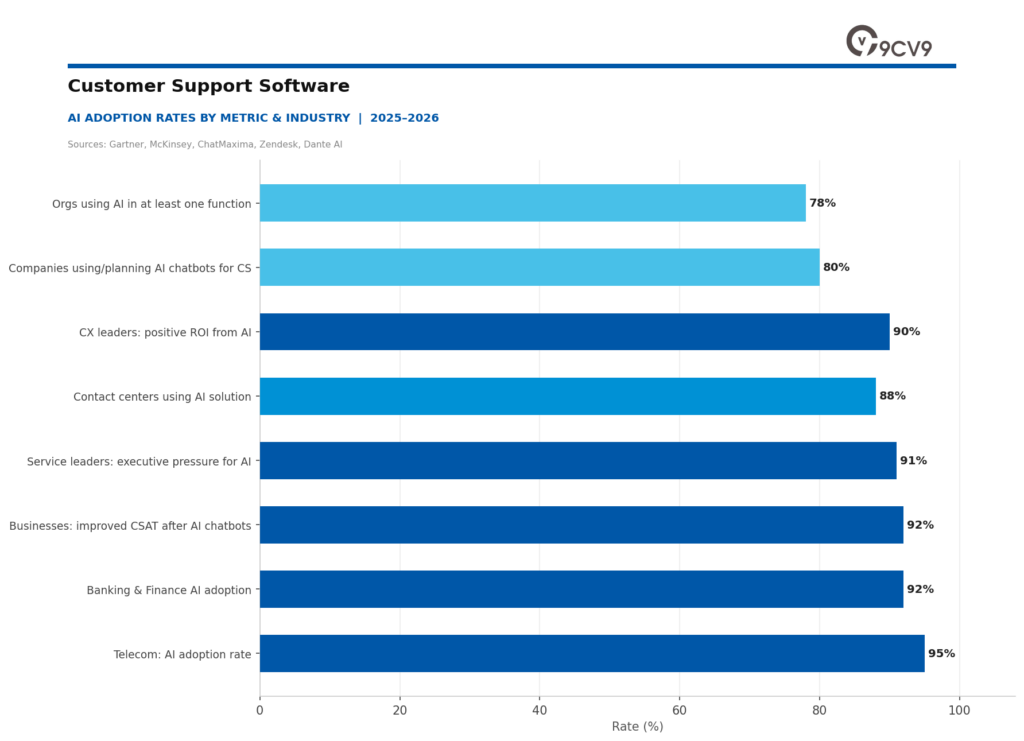
16. 80% of companies are either using or planning to adopt AI-powered chatbots for customer service.
AI chatbot adoption has crossed the mainstream threshold; businesses that have not yet deployed conversational AI are now outliers rather than the norm.
17. In 2020, only 5% of customer service teams used AI-powered chatbots. By 2025, that number exceeded 80% — a 16× increase in five years.
No enterprise technology in modern history has achieved a 16-fold adoption increase in a five-year window, underlining AI chatbots as one of the most rapid technology transitions on record.
18. 91% of service and support leaders face pressure from executive leadership to implement AI.
When nine in ten service leaders are receiving top-down AI mandates, it signals a fundamental shift — AI in customer support is now a C-suite imperative, not an IT experiment.
19. 88% of contact centers report using some form of AI-powered solution in 2026.
Near-universal AI adoption among contact centers confirms that AI is no longer a differentiator; it has become the operational baseline required to remain competitive.
20. 78% of organisations now use AI in at least one business function, up from 55% two years prior.
Rapid growth in cross-functional AI deployment means customer support teams are increasingly part of a broader enterprise AI ecosystem, enabling richer data sharing and smarter automation.
21. 85% of customer service leaders will explore or pilot customer-facing conversational GenAI in 2025.
GenAI is moving from back-office productivity tools to front-line customer interactions with extraordinary speed, forcing vendors and enterprises to rethink service design from the ground up.
22. 80% of routine customer interactions will be fully handled by AI in 2026.
Automating four out of five routine interactions at scale represents a fundamental restructuring of support operations — human agents can now focus exclusively on complex, high-value cases.
23. By 2025, AI is projected to handle 95% of all customer interactions (voice and text combined).
This near-total AI coverage signals a world where human intervention becomes the exception rather than the rule — requiring businesses to invest heavily in seamless AI-to-human escalation pathways.
24. 43% of companies are actively investing in AI, chatbots, and automation to improve support speed and scalability.
Investment intent data confirms that AI adoption is self-reinforcing: early adopters see returns, which drives further deployment and widens the gap with slower-moving competitors.
25. By 2029, agentic AI will autonomously resolve 80% of common customer service issues without human intervention.
Agentic AI represents the next frontier — systems that do not just respond to queries but actively take actions, look up records, process refunds, and close tickets without human oversight.
💰 ROI & Cost Savings
26. Companies see an average return of USD 3.50 for every USD 1 invested in AI customer service.
A 3.5× average ROI places AI-powered customer support among the highest-returning enterprise technology investments, well above many ERP and CRM implementations.
27. Top-performing organisations achieve up to 8× returns on their AI customer service investments.
The gap between average (3.5×) and best-in-class (8×) ROI is driven entirely by implementation quality — organisations that integrate AI deeply with their CRM and knowledge base capture disproportionate returns.
28. A Forrester-modeled study found organisations implementing AI customer service automation achieved 210% ROI over three years, with payback in under 6 months.
Sub-6-month payback periods are exceptionally rare in enterprise software, making AI customer service automation one of the most capital-efficient investments available to CX leaders.
29. AI implementation reduces customer service operational costs by 30–50%.
Halving operational costs without degrading service quality is a rare outcome in any technology implementation — AI’s ability to handle volume at near-zero marginal cost is the primary driver.
30. AI-powered interactions cost between USD 0.25–0.50 per contact, compared to USD 3.00–6.00 for human agents.
The 10–20× cost differential per interaction makes the economic case for AI adoption overwhelming at scale — especially for businesses handling tens of thousands of contacts daily.
31. Self-service channels cost an average of USD 1.84 per contact, versus USD 13.50 for assisted channels.
Organisations that successfully deflect contacts to self-service portals and chatbots can reduce their per-interaction cost by over 85%, compounding savings dramatically at enterprise volume.
32. Gartner predicts conversational AI will reduce contact centre labour costs by USD 80 billion by the end of 2026.
An USD 80 billion labour cost reduction in a single year represents one of the largest technology-driven workforce cost shifts in the history of enterprise services.
33. 94% of retail companies say implementing AI has helped decrease costs.
Near-universal positive cost impact among retail AI adopters demonstrates that the ROI case for AI in customer service is particularly compelling in high-transaction, high-volume retail environments.
34. NIB Health Insurance achieved USD 22 million in savings — a 60% cost reduction — by automating customer service processes with AI.
Real-world case studies like NIB validate the market projections: AI-driven automation can structurally transform support economics even in heavily regulated sectors like healthcare insurance.
35. Unity saved USD 1.3 million by deflecting 8,000 support tickets with AI agents.
Unity’s per-ticket savings demonstrate that even relatively modest AI deflection rates can generate meaningful financial returns for mid-market software companies.
36. AI investment in customer support delivers an average ROI of USD 3.50 per USD 1 spent, with top organisations achieving up to USD 8 in return.
The ROI range from 3.5× to 8× is not random — it correlates directly with integration depth, data quality, and the breadth of automation use cases deployed.
37. 90% of organisations using AI report time and cost savings simultaneously.
Achieving both efficiency gains and cost reductions concurrently is rare in enterprise technology — AI’s ability to deliver on both dimensions explains its unprecedented adoption velocity.
38. 9 in 10 service operations professionals believe generative AI will improve their company’s customer service.
Optimism this high among practitioners — not just executives — suggests that front-line service teams are experiencing tangible AI benefits, reducing resistance to further automation.
⚡ Speed & Performance
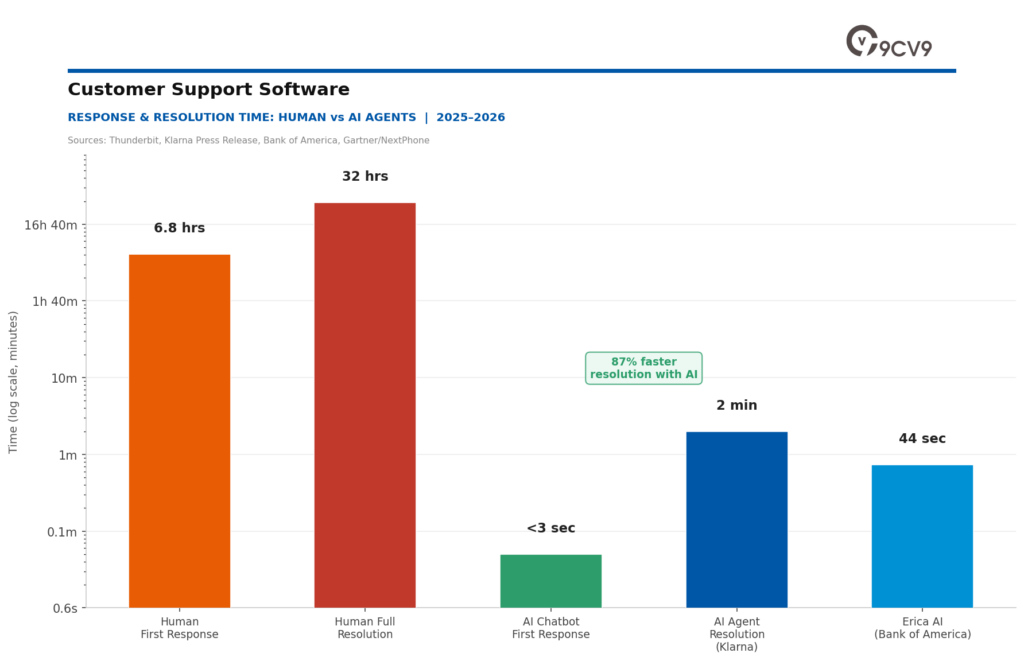
39. AI chatbot average first response time is under 3 seconds, compared to a human agent average of 6.8 hours.
An improvement of over 8,000× in first response speed fundamentally resets customer expectations — businesses still relying solely on human-staffed queues face a growing satisfaction gap.
40. AI has reduced full resolution times from an average of 32 hours (human) to 32 minutes (AI) — an 87% improvement.
Compressing resolution time by 87% is not an incremental improvement; it represents a structural transformation in how customers experience support interactions.
41. Klarna’s AI agent reduced average issue resolution time from 11 minutes to 2 minutes — an 82% improvement.
Klarna’s publicly documented case study is one of the most frequently cited proofs of concept for AI in financial services customer support, validating large-scale autonomous deployment.
42. Bank of America’s “Erica” AI resolves 98% of customer queries within 44 seconds, handling 56 million interactions per month.
Erica’s 2 billion cumulative interactions demonstrate that AI virtual assistants can operate reliably at massive scale in a heavily regulated, high-trust environment like banking.
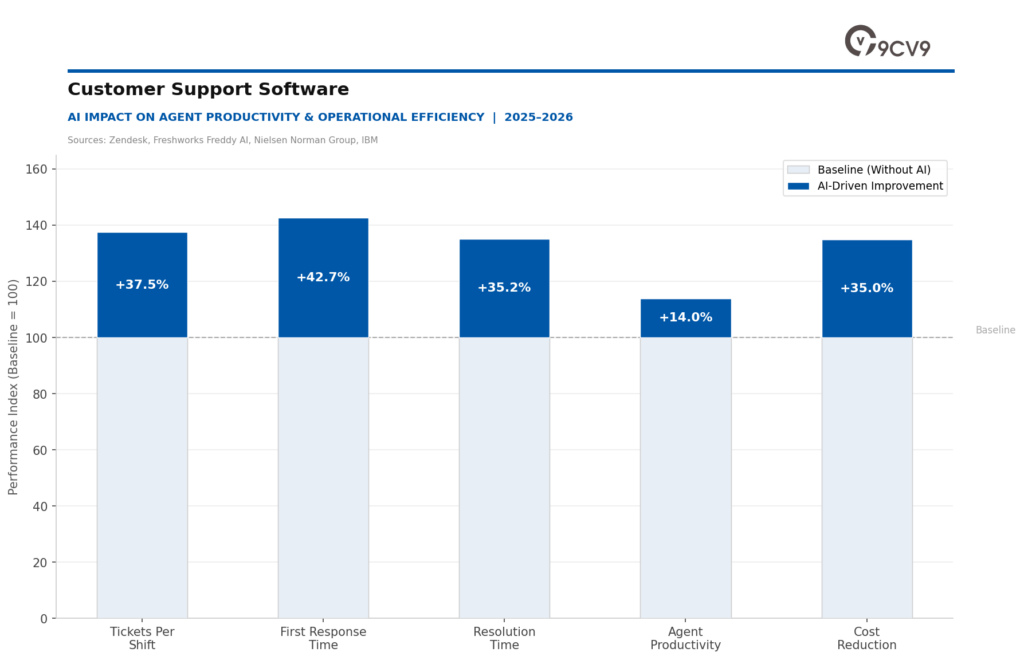
43. Support agents using AI tools handle 35–40% more tickets per shift without increased errors or decreased satisfaction.
Throughput gains of 35–40% without quality degradation mean AI augmentation effectively multiplies team capacity — the equivalent of hiring a third more agents at near-zero marginal cost.
44. Service professionals using generative AI save more than 2.2 hours per day.
Saving over a quarter of a standard working day per agent through AI automation has profound implications for team sizing, hiring plans, and the scope of work agents can take on.
45. H&M’s generative AI chatbot reduced response times by 70% compared to human agents.
A 70% speed improvement in a high-volume retail customer service environment demonstrates that AI-driven speed gains are not sector-specific — they translate across industries.
46. AI-assisted agents resolve issues 47% faster and achieve 25% higher first-contact resolution rates.
Higher FCR rates directly reduce repeat contacts, creating a compounding efficiency effect — every issue resolved on first contact eliminates follow-up calls, emails, and escalations.
47. Support agents using AI tools can manage 13.8% more customer inquiries per hour.
A 13.8% throughput improvement per agent per hour is a concrete, measurable gain that translates directly into reduced queue times and lower cost-per-resolution across the organisation.
48. 84% of customer service representatives using AI say it makes responding to tickets easier.
High agent satisfaction with AI assistance is a critical adoption signal — tools that make agents’ jobs easier naturally achieve higher utilisation rates and deliver greater ROI.
49. Top-performing chatbots resolve up to 95% of routine queries instantly, though averages vary by industry.
The wide variance between average and top-performing deployments highlights that chatbot quality is largely a function of implementation depth, not just the underlying AI model.
50. Average AI chatbot response time is 1.1 seconds; businesses using chatbots see a 35% reduction in average handling time.
Sub-second response times set a new baseline for customer expectations that human-only support channels structurally cannot match — reinforcing AI’s role as the front-line of support.
📱 Channel Preferences & Satisfaction
51. 93% of customers use email to engage with businesses for support.
Despite being one of the oldest digital channels, email remains the most universally used support medium — its asynchronous nature makes it indispensable for detailed issue documentation.
52. 88% of customers use phone calls for customer service interactions.
Voice support retains near-universal usage, particularly for complex, emotional, or high-stakes issues — underscoring why businesses should never fully automate away the human phone channel.
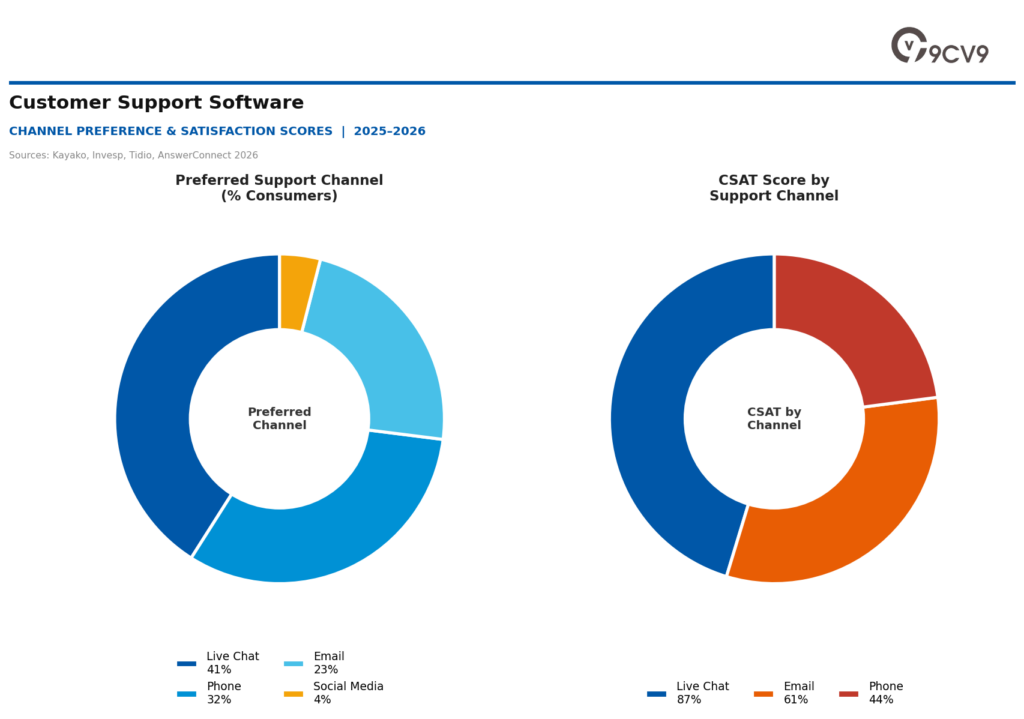
53. Live chat is the #1 preferred support channel for 41% of consumers, compared to 32% for phone and 23% for email.
Live chat’s rise to the top of consumer preference reflects a generational shift toward real-time text-based communication — mirroring how people communicate socially.
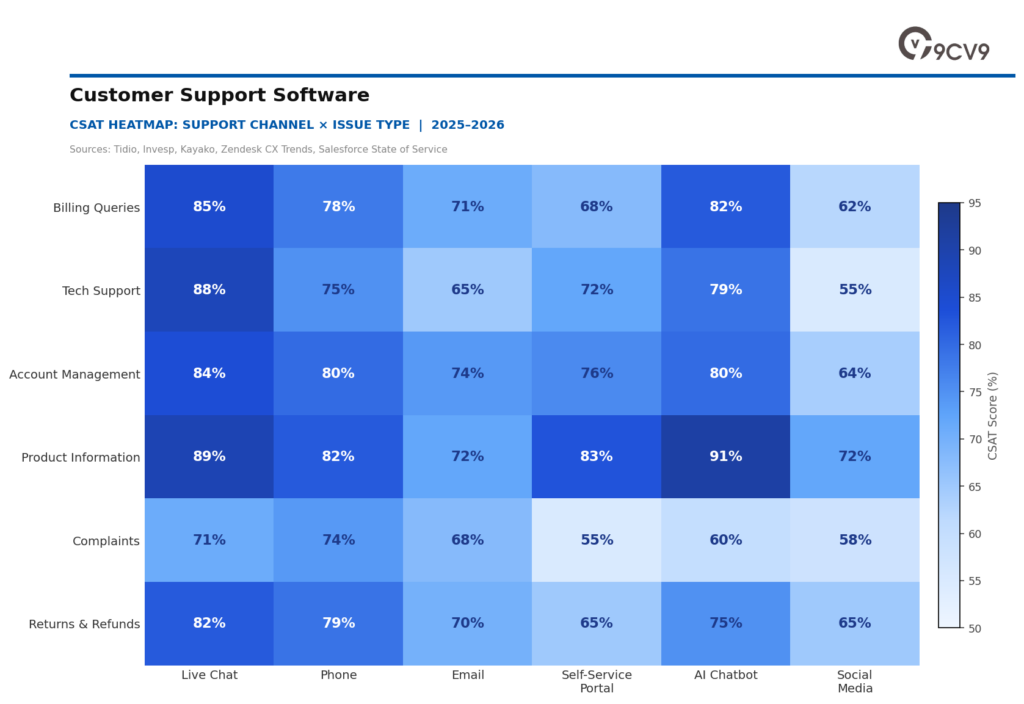
54. 73% of customers were satisfied with their live chat experience, versus 51% for email and only 44% for phone support.
Live chat’s outsized satisfaction advantage over both phone and email is driven by immediacy, the ability to multitask, and the elimination of hold times.
55. Live chat boasts an average CSAT rate of 87%, higher than email (61%) or phone support (44%).
An 87% CSAT rate for live chat versus 44% for phone is a 43-point gap — arguably the most actionable channel optimisation insight available to CX leaders today.
56. 72% of customers have used self-service portals, and 55% have used chatbots.
Majority adoption of both self-service portals and chatbots confirms that customers are willing to engage with automated tools — provided they are well-designed and actually solve problems.
57. 34% of customers prefer social media to raise questions for customer service teams.
Social media’s role as a support channel continues to grow, particularly among younger demographics — businesses without a social support strategy face reputational risk at scale.
58. 65% of people aged 18–34 believe social media is an effective channel for customer support.
Gen Z and Millennial preference for social media support means brands must treat platforms like Instagram and X as legitimate service channels, not just marketing tools.
59. Nearly 60% of consumers are more likely to return to a website that offers live chat.
Live chat is not just a service feature — it is a retention tool. Its presence on a website increases purchase intent and loyalty, creating direct revenue impact beyond cost savings.
60. 63% of consumers are more likely to make a purchase if a live chat widget is available.
The purchase-intent lift from live chat confirms that customer support is a revenue driver — particularly at the point-of-sale, where real-time assistance can eliminate buying friction.
61. 83% of customers expect to interact with someone immediately when contacting a company.
Immediacy is now a baseline expectation, not a premium offering — businesses with response times measured in hours rather than seconds are at significant risk of customer defection.
62. 70% of customers expect any agent or employee they engage with to have full context of their situation.
Context continuity is among the most frequently cited frustrations in customer service — its absence directly erodes satisfaction, loyalty, and willingness to repurchase.
63. 90% of customers rate immediate response as critical to their service experience.
With nine in ten customers deeming speed critical, slow response times are no longer a minor inconvenience — they are a primary driver of churn and negative word-of-mouth.
🔁 Omnichannel Impact
64. Omnichannel customer service delivers a CSAT score of 67%, compared to just 28% in disconnected multichannel setups.
A 39-point CSAT advantage for omnichannel over multichannel is one of the starkest differentials in all of CX research — making omnichannel integration a near-mandatory investment.
65. Integrated omnichannel tools can reduce customer wait times by 39% and cut service costs by up to 35%.
Dual improvements in speed and cost from a single architectural change — channel integration — demonstrate that omnichannel is simultaneously a CX and a business efficiency play.
66. Companies using omnichannel support see up to 15% more revenue and 35% more customer loyalty.
Revenue and loyalty gains from omnichannel confirm that seamless cross-channel experiences are not just operationally efficient — they drive tangible commercial outcomes.
67. Only 13% of businesses achieve complete context continuity across multiple interaction channels.
The 87% of businesses that lack full context continuity represent a massive service gap — and a significant competitive opportunity for those willing to invest in proper channel integration.
68. 56% of customers say they have to repeat their issue when support channels are not connected.
Forcing more than half of customers to re-explain their situation is a leading cause of frustration and churn — channel connectivity is the single most impactful structural fix available.
69. 79% of customers expect consistent, connected interactions across departments and touchpoints.
Customer expectations for consistency now extend beyond channel — they expect the same quality, context, and personalisation whether they contact support via chat, phone, or social media.
70. 1 in 3 companies with omnichannel integration tools reported a 9% lower cost per assisted contact.
Cost savings from omnichannel integration, while seemingly modest at 9%, compound significantly at enterprise scale — and come on top of satisfaction and loyalty improvements.
71. 45% of firms saw better customer engagement, 35% retained more customers, and 35% reported improved customer satisfaction after deploying omnichannel tools.
Triple simultaneous improvements in engagement, retention, and satisfaction confirm that omnichannel investment generates broadly distributed value across the customer lifecycle.
👩💼 Agent Experience & Workforce
72. 77% of customer service reps say their workload and issue complexity have increased compared to a year ago.
Rising workload complexity is a direct consequence of AI handling routine queries — human agents now face a higher concentration of challenging, emotionally demanding interactions.
73. 56% of customer service agents report experiencing burnout in their role.
Agent burnout is both a human cost and a business risk — high attrition in support teams drives up recruitment and training costs while reducing service quality during transition periods.
74. 69% of customer service decision-makers say agent attrition is a major challenge for their organisation.
Attrition consistently ranks as a top operational concern for CX leaders, making tools that reduce agent cognitive load — particularly AI copilots — an important retention strategy.
75. 79% of support agents believe having an AI copilot supercharges their abilities and enables better customer service.
High agent enthusiasm for AI copilot tools is a critical adoption enabler — when agents actively embrace AI assistance, utilisation rates and ROI improve dramatically.
76. 76% of contact centres that implement automation without ethical guidelines or upskilling report agent burnout near that level.
Automation without human-centred change management backfires — businesses that replace tasks without re-investing in agents through training face burnout, attrition, and culture problems.
77. Gartner predicts organisations will replace or redeploy 20–30% of service agents due to generative AI by 2026.
The agent workforce is entering a transitional period — the most forward-looking businesses are redeploying displaced agents into AI oversight, quality assurance, and complex case management roles.
78. 60% of customer service teams using AI copilot tools have significantly improved agent productivity.
Majority productivity improvement from AI copilots across teams — not just early adopters — validates that these tools deliver broadly accessible efficiency gains at the team level.
79. 6 in 10 customer service agents say a lack of sufficient customer data often leads to negative service experiences.
Data fragmentation is a structural barrier to service quality — agents cannot deliver personalised, empathetic service without a unified view of the customer’s history and context.
80. Workers using generative AI are, on average, 33% more productive during each hour they use it.
A 33% per-hour productivity lift from generative AI is a labour economics transforming figure — representing the equivalent of gaining one extra day of output per week for each AI-enabled agent.
🧠 Consumer Trust & Sentiment Toward AI
81. Only 8% of consumers prefer AI over humans for customer service interactions.
While AI delivers speed and availability benefits that some consumers value, the overwhelming majority still want access to human agents — particularly for complex or emotionally sensitive issues.
82. 61% of customers still distrust AI fully in 2026, often preferring human-AI hybrid approaches.
Persistent AI distrust, even as AI quality improves, underscores the importance of transparent AI disclosure and maintaining accessible human escalation pathways in all support architectures.
83. 32% of consumers will abandon a brand after just one frustrating experience with a looping chatbot.
Poor chatbot experiences carry an outsized reputational cost — a single failure to resolve a simple query can permanently sever a customer relationship built over years.
84. 64% of consumers say they are more likely to trust AI-driven customer service if it exhibits human-like traits.
Emotional intelligence in AI is a measurable trust driver — conversational AI that incorporates warmth, empathy, and conversational naturalness generates significantly higher customer trust scores.
85. 83% of customers say they trust companies more when AI interactions are transparent about being AI.
Transparency about AI identity is not just ethical — it is commercially smart. Companies that openly disclose AI use build more trust than those that attempt to pass AI off as human.
86. 75% of consumers want to know when they are interacting with AI versus a human agent.
Consumer demand for AI disclosure is near-universal — businesses that obscure AI identity risk regulatory exposure as disclosure requirements tighten globally.
87. 62% of customers are comfortable sharing personal data with AI systems if it improves their support experience.
A majority willingness to share data with AI for personalisation benefits suggests that privacy-respecting, value-exchange-based AI can achieve strong customer buy-in.
88. 54% of consumers feel they can confidently identify when they are interacting with an AI chatbot.
Consumer AI detection confidence is growing — driven by increased exposure and media literacy — which is accelerating demand for better-designed, more authentic conversational AI.
89. 41% of consumers feel customer service has worsened due to AI, and 63% don’t believe AI could ever fully replace humans.
Despite AI’s performance gains, a significant minority of customers perceive service degradation — a warning signal that AI deployment without proper quality guardrails risks net satisfaction losses.
90. 14% of consumers would lose trust in a business if an AI agent failed to clearly disclose it is AI.
Even a small trust-destruction risk from non-disclosure is commercially significant at scale — the regulatory and reputational cost of deceptive AI practices is rapidly increasing globally.
🔮 Future Trends & Predictions
91. By 2027, AI is expected to handle 50% of all customer service cases, up from 30% today.
The march from 30% to 50% AI-handled cases in two years reflects compounding improvements in AI capability, not just adoption — each generation of models handles more complex queries.
92. By 2027, chatbots will become the primary customer service channel for approximately 25% of organisations.
A quarter of organisations making chatbots their primary channel represents a structural shift in service delivery — transforming what was a supplementary tool into the core interaction layer.
93. By 2028, 70% of customer service journeys will begin and end with third-party conversational assistants on mobile.
Mobile-first conversational AI will reshape how companies design service journeys — the support experience will increasingly be mediated by third-party AI assistants rather than owned channels.
94. By 2029, AI will reduce contact centre operational costs by a further 30% as agentic systems mature.
The second wave of AI savings — driven by agentic, task-completing AI rather than simple Q&A bots — will unlock cost reductions that are an order of magnitude larger than chatbot-era savings.
95. By 2030, an estimated 1 billion service tickets will be raised automatically by customer-owned bots.
Customer-side AI initiating support interactions on behalf of users represents a fundamental inversion of the traditional support model — making proactive, machine-to-machine service the norm.
96. The global chatbot market is projected to reach USD 35 billion by 2030.
Chatbot market growth to USD 35 billion confirms that conversational AI is not a transitional technology — it is becoming permanent infrastructure embedded across every digital touchpoint.
97. 72% of business leaders believe AI can now deliver better customer service than human agents for routine queries.
When nearly three-quarters of senior leaders believe AI outperforms humans on standard queries, organisational resistance to AI deployment evaporates — accelerating deployment timelines.
98. Financial institutions invested USD 35 billion in AI as of 2023 and are projected to reach USD 97 billion by 2027.
The financial sector’s near-tripling of AI investment confirms that regulated industries with high transaction volumes are among the most aggressive adopters of AI-powered support infrastructure.
99. By 2030, customer experience leaders are projected to achieve 17% compound annual revenue growth over five years.
Companies that use customer experience as a strategic growth lever — rather than a cost-management function — generate revenue compounding that is structurally superior to industry averages.
100. 91% of executives expect automated workflows by 2026 to enhance client experience significantly.
Near-universal executive confidence in automation’s impact on CX represents a strong organisational mandate for accelerated investment — and sets a high expectation bar for CX leadership teams.
101. 65% of organisations plan to expand their use of AI in customer support in 2026.
Expansion intent among current AI users confirms that early adopters are seeing returns that justify further investment — creating a widening gap between AI-native and AI-reluctant businesses.
102. Companies with clearly stated AI privacy policies see 23% higher customer trust scores.
Privacy policy transparency generates a measurable, quantifiable trust premium — making AI governance documentation not just a compliance requirement but a competitive differentiator.
103. By 2026, approximately 30% of enterprises will have dedicated AI roles focused on customer service oversight.
The emergence of dedicated AI governance and oversight roles signals organisational maturity — enterprises are moving beyond ad hoc AI experimentation to structured, accountable AI operations.
Conclusion
The customer support software industry has reached a defining moment in 2026. What was once viewed primarily as a ticket management solution has evolved into a mission-critical business platform that influences customer satisfaction, operational efficiency, employee productivity, revenue growth, and long-term brand loyalty. The 103 statistics presented throughout this report clearly demonstrate that customer support software is no longer simply a technology investment—it has become a strategic pillar of digital transformation for organisations across every industry.
One of the strongest themes emerging from these statistics is the extraordinary pace of market growth. Multiple industry forecasts consistently project robust double-digit compound annual growth rates, confirming that customer support software remains one of the fastest-growing enterprise software segments worldwide. Businesses are investing heavily in cloud-based platforms, intelligent automation, self-service capabilities, and AI-powered customer engagement as they seek to meet rising customer expectations while controlling operational costs. This sustained investment reflects widespread recognition that exceptional customer support is increasingly becoming a key differentiator in highly competitive markets.
Artificial intelligence has unquestionably become the primary force reshaping customer service. AI-powered chatbots, generative AI assistants, intelligent routing, predictive analytics, and autonomous workflows are transforming nearly every aspect of customer support operations. Statistics showing that the overwhelming majority of organisations have either implemented or are actively planning AI deployments illustrate how rapidly AI has shifted from an emerging technology to an operational standard. Businesses that continue delaying AI adoption risk falling behind competitors that are already benefiting from faster response times, lower operating costs, improved customer experiences, and enhanced workforce productivity.
Equally important is the compelling financial case for customer support automation. The data consistently shows that organisations implementing AI-powered customer service achieve substantial returns on investment through reduced operational expenses, improved efficiency, and greater scalability. AI-driven interactions cost significantly less than traditional human-assisted support while delivering dramatically faster response and resolution times. Combined with measurable improvements in agent productivity and customer satisfaction, these financial outcomes explain why executive leadership teams increasingly view customer support technology as an investment capable of generating tangible business value rather than merely reducing costs.
Customer expectations have also undergone a permanent transformation. Modern consumers expect businesses to provide immediate assistance, seamless omnichannel experiences, and personalised interactions regardless of whether they contact an organisation through live chat, email, social media, phone, or AI-powered assistants. The statistics reveal that customers increasingly value speed, convenience, and continuity across every touchpoint. Companies that continue operating fragmented support environments where customers must repeatedly explain their issues face growing risks of dissatisfaction, reduced loyalty, and customer churn. In contrast, organisations investing in integrated customer support ecosystems are consistently rewarded with stronger customer engagement, higher satisfaction scores, increased retention, and improved commercial performance.
The rapid rise of self-service technologies represents another defining trend highlighted throughout these statistics. Customers increasingly prefer resolving straightforward issues independently through knowledge bases, AI chatbots, and self-service portals before contacting live agents. This shift benefits both customers and businesses by reducing wait times, lowering service costs, and allowing human representatives to focus on more complex, high-value interactions. As self-service capabilities continue improving through advances in generative AI and conversational intelligence, organisations that invest in comprehensive knowledge management and intelligent automation will be well positioned to meet evolving customer preferences.
However, these statistics also make it clear that human expertise remains indispensable. While AI continues automating routine enquiries at an accelerating pace, customer support professionals are becoming increasingly responsible for handling emotionally sensitive situations, complex technical problems, strategic customer relationships, and high-value service interactions. Rather than eliminating customer service roles entirely, AI is fundamentally redefining them. Successful organisations are using AI as a collaborative tool that augments human capabilities, reduces repetitive work, improves decision-making, and enables support agents to deliver higher-quality customer experiences. This human-AI partnership is likely to define the next generation of customer service operations.
Trust and transparency also emerge as essential considerations for the future of AI-powered customer support. Although customers appreciate the speed and availability of automated service, many still prefer knowing when they are interacting with AI and expect the option to escalate complex issues to human representatives. Organisations that prioritise ethical AI deployment, transparent communication, robust privacy practices, and seamless human escalation pathways will be better positioned to build lasting customer confidence while maximising the benefits of intelligent automation. As governments introduce new AI governance frameworks and consumer expectations continue evolving, responsible AI implementation will become as important as technological capability itself.
Another notable insight from these statistics is the growing importance of omnichannel customer engagement. Businesses are no longer evaluated solely on the quality of individual support channels but on the consistency of the overall customer journey. Customers expect every department, platform, and support representative to share context, maintain continuity, and provide coordinated service regardless of where the interaction begins. Organisations investing in unified customer support platforms that connect CRM systems, communication channels, AI assistants, and knowledge repositories are creating competitive advantages that extend well beyond customer service into sales, marketing, and long-term customer relationship management.
Looking towards the remainder of this decade, the future of customer support software appears even more transformative. Emerging innovations such as agentic AI, predictive customer service, autonomous ticket resolution, intelligent workflow orchestration, and machine-to-machine support interactions will continue reshaping how businesses engage with customers. AI systems will increasingly anticipate customer needs, proactively resolve issues before they escalate, and collaborate with customer-owned digital assistants to create highly personalised service experiences. Organisations that embrace these technologies strategically while maintaining strong governance, human oversight, and customer trust will be best positioned to thrive in this new era of intelligent customer engagement.
Ultimately, these Top 103 Customer Support Software Statistics, Data & Trends in 2026 provide far more than a collection of numbers—they present a comprehensive picture of an industry undergoing rapid innovation and profound structural change. Together, they reveal how customer support software has become central to digital transformation strategies, customer experience excellence, operational resilience, and sustainable business growth. Whether you are selecting a new customer support platform, planning an AI implementation, optimising an existing contact centre, evaluating emerging technologies, or developing long-term customer experience strategies, these data-driven insights offer valuable guidance for making informed decisions in an increasingly AI-driven business landscape.
As customer expectations continue rising and technological innovation accelerates, organisations that successfully combine intelligent automation, human expertise, omnichannel integration, ethical AI governance, and customer-centric service design will establish themselves as tomorrow’s industry leaders. The statistics presented throughout this report clearly indicate that the future of customer support will not be defined solely by faster technology or lower costs, but by the ability to deliver consistently exceptional, trusted, and personalised customer experiences at scale. Businesses that recognise this shift today will be the ones best equipped to compete, innovate, and grow throughout 2026 and beyond.
If you find this article useful, why not share it with your hiring manager and C-level suite friends and also leave a nice comment below?
We, at the 9cv9 Research Team, strive to bring the latest and most meaningful data, guides, and statistics to your doorstep.
To get access to top-quality guides, click over to 9cv9 Blog.
To hire top talents using our modern AI-powered recruitment agency, find out more at 9cv9 Modern AI-Powered Recruitment Agency.
People Also Ask
What is customer support software?
Customer support software is a platform that helps businesses manage customer enquiries across channels such as email, live chat, phone, social media, and self-service portals. It improves response times, ticket management, and customer satisfaction.
Why is customer support software important in 2026?
Customer support software is essential because customers expect fast, personalised, and omnichannel service. Modern platforms use AI and automation to improve efficiency while reducing support costs.
How large is the customer support software market in 2026?
The customer support software market is worth billions of dollars and continues to grow rapidly, driven by AI adoption, cloud technologies, digital transformation, and increasing investment in customer experience.
What are the biggest customer support software trends in 2026?
Major trends include generative AI, AI chatbots, omnichannel support, self-service portals, predictive analytics, workflow automation, conversational AI, and intelligent agent assistance.
How is AI changing customer support software?
AI automates repetitive tasks, answers common questions, routes tickets intelligently, assists human agents, analyses conversations, and helps businesses provide faster and more personalised customer support.
What are the benefits of AI-powered customer support?
AI-powered customer support reduces response times, lowers operational costs, improves agent productivity, increases customer satisfaction, and enables businesses to scale support without significantly increasing staffing.
What is omnichannel customer support?
Omnichannel customer support connects multiple communication channels into one unified platform, allowing customers to continue conversations seamlessly across email, chat, phone, messaging apps, and social media.
Why is omnichannel support important for businesses?
Omnichannel support creates consistent customer experiences, reduces frustration, improves customer retention, and gives support agents complete visibility into previous customer interactions.
What role do chatbots play in customer support software?
Chatbots handle routine enquiries, provide instant responses, guide customers to solutions, and reduce agent workloads while remaining available 24 hours a day.
Can AI completely replace human customer support agents?
No. AI handles repetitive and straightforward enquiries, while human agents remain essential for complex issues, emotional conversations, negotiations, and high-value customer interactions.
How does customer support software improve customer satisfaction?
It shortens response times, provides personalised interactions, ensures consistent communication, offers multiple support channels, and enables faster issue resolution.
What industries use customer support software?
Customer support software is widely used across SaaS, e-commerce, finance, healthcare, telecommunications, retail, education, travel, logistics, and government organisations.
What features should businesses look for in customer support software?
Key features include ticket management, AI chatbots, knowledge bases, automation, omnichannel messaging, analytics, reporting, CRM integration, workflow management, and mobile accessibility.
How does customer support software reduce business costs?
Automation handles repetitive tasks, AI reduces ticket volumes, self-service lowers support demand, and intelligent routing improves agent efficiency, reducing overall operating expenses.
What is a knowledge base in customer support software?
A knowledge base is a searchable collection of articles, FAQs, guides, and tutorials that allows customers to solve common problems without contacting support agents.
How does self-service improve customer support?
Self-service gives customers instant access to answers, reduces waiting times, lowers ticket volumes, and allows support teams to focus on more complex enquiries.
What is ticket management software?
Ticket management software organises customer requests, prioritises issues, tracks progress, assigns agents, and ensures enquiries are resolved efficiently.
How does customer support software improve agent productivity?
It automates repetitive work, recommends responses, provides AI-assisted knowledge retrieval, summarises conversations, and simplifies ticket handling.
What metrics are commonly measured in customer support software?
Common metrics include first response time, average resolution time, customer satisfaction score (CSAT), Net Promoter Score (NPS), ticket volume, resolution rate, and agent productivity.
What is conversational AI in customer support?
Conversational AI uses natural language processing and machine learning to understand customer questions and provide intelligent, human-like responses.
Why are businesses investing heavily in customer support software?
Businesses recognise that excellent customer service increases loyalty, reduces churn, strengthens brand reputation, improves efficiency, and supports long-term revenue growth.
How does customer support software integrate with CRM systems?
Integration allows support teams to access customer histories, purchases, previous interactions, and preferences, enabling more personalised and efficient service.
What is predictive customer support?
Predictive customer support uses AI and analytics to anticipate customer needs, identify potential issues early, and proactively recommend solutions before problems escalate.
How secure is modern customer support software?
Leading platforms offer encryption, role-based access controls, compliance certifications, secure cloud infrastructure, audit logs, and data privacy features to protect customer information.
What is the future of customer support software?
The future includes agentic AI, autonomous support workflows, predictive service, hyper-personalisation, advanced analytics, and greater collaboration between AI and human agents.
How does customer support software help small businesses?
Small businesses benefit from affordable automation, faster response times, improved customer satisfaction, reduced staffing requirements, and scalable customer service operations.
What challenges do businesses face when implementing customer support software?
Common challenges include employee training, system integration, data migration, AI governance, change management, and maintaining a balance between automation and human service.
How can businesses choose the right customer support software?
Businesses should evaluate scalability, AI capabilities, integrations, ease of use, reporting, pricing, security, customer reviews, and long-term vendor support before selecting a platform.
Why are customer support software statistics valuable?
Statistics help organisations understand market trends, benchmark performance, evaluate technology investments, identify customer expectations, and make data-driven business decisions.
Where can businesses use customer support software statistics?
Businesses can use these statistics for strategic planning, technology selection, investment decisions, market research, competitive analysis, budgeting, presentations, and customer experience improvement initiatives.
Sources
Verified Market Research The Business Research Company Research and Markets Precedence Research Unthread AnswerConnect Business Research Insights Pylon ChatMaxima NextPhone Desk365 Thunderbit Crescendo Marketing LTB Zoom SurveyMonkey Bayelsawatch Plivo Freshworks Salesmate Typedef Fullview ProProfs KB


