

Key Takeaways
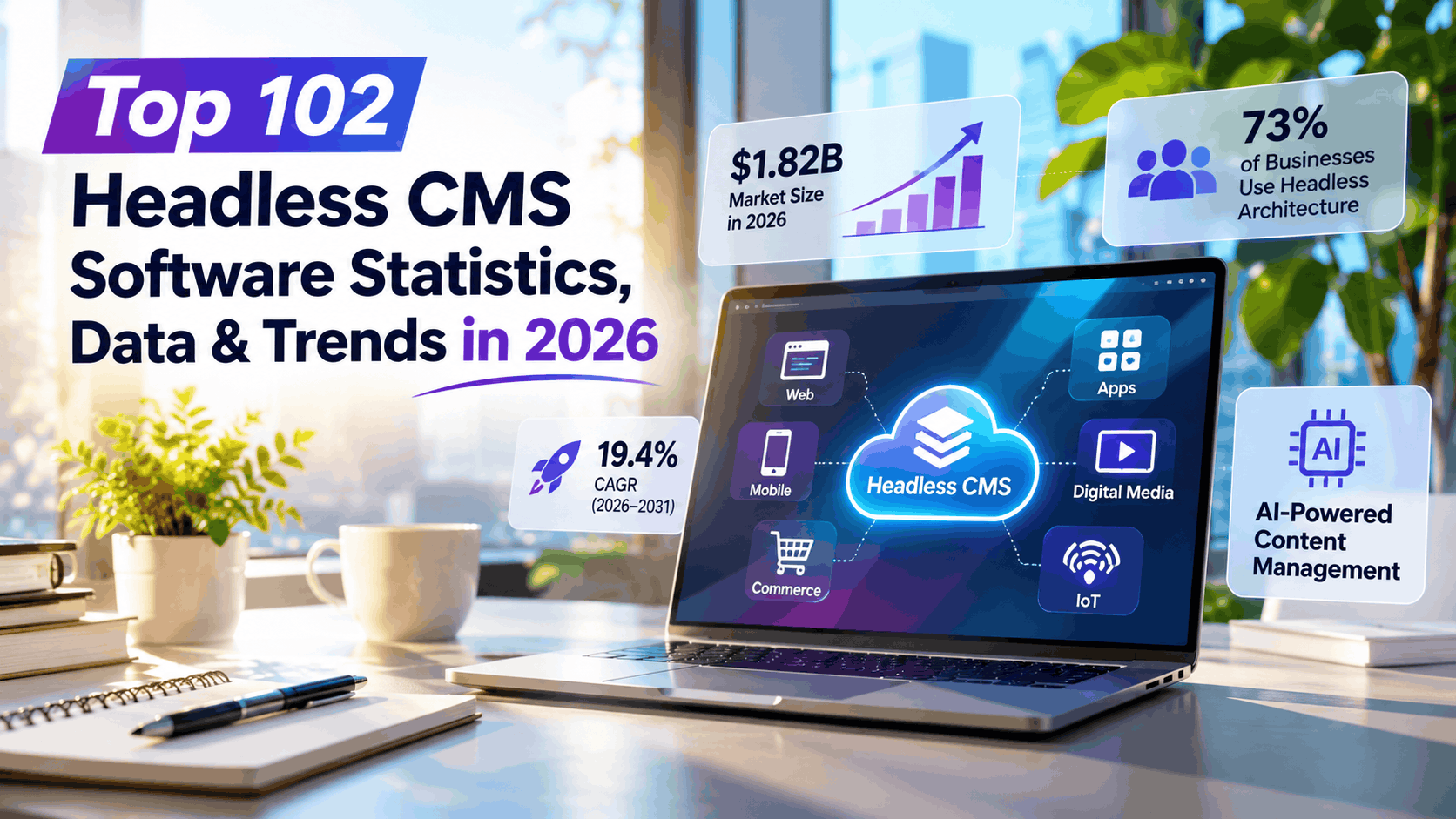
- Rapid Headless CMS Market Growth: The global headless CMS software market is projected to grow from $1.82 billion in 2026 to $4.42 billion by 2031, at a CAGR of 19.4%.
- Increasing Enterprise Adoption and ROI: 73% of surveyed businesses use headless architecture, while 69% of adopters report improved time-to-market and content team productivity.
- AI, Omnichannel Delivery, and Composable Commerce Drive Innovation: AI-powered automation, API-first architecture, enhanced SEO performance, and personalized digital experiences are reshaping the future of headless CMS software.
Headless CMS software enables flexible, scalable, and API-driven content delivery across multiple digital channels. In 2026, the global market stands at an estimated $1.82 billion, with projected growth to $4.42 billion by 2031 at a CAGR of 19.4%, amid rising enterprise adoption, AI-powered automation, and demand for omnichannel digital experiences.
The global digital landscape is undergoing a fundamental transformation as businesses increasingly move away from traditional content management systems (CMS) in favor of more flexible, scalable, and API-driven content architectures. In 2026, headless CMS software has emerged as a critical component of modern digital infrastructure, enabling organizations to deliver seamless, personalized, and consistent content experiences across websites, mobile applications, eCommerce platforms, and emerging digital channels.

Unlike traditional content management systems that tightly integrate content creation with front-end presentation, headless CMS platforms separate the content management backend from the presentation layer. This decoupled architecture empowers developers to leverage modern frameworks while allowing content teams to create, manage, and distribute structured content across multiple digital touchpoints. As businesses accelerate their digital transformation initiatives, headless CMS software is becoming increasingly important for improving operational efficiency, scalability, website performance, and customer engagement.
The rapid expansion of the global headless CMS software market reflects this growing demand. One market forecast values the industry at approximately $1.82 billion in 2026 and projects it to reach $4.42 billion by 2031, growing at a compound annual growth rate (CAGR) of 19.4%. Another industry forecast anticipates the market reaching $12.8 billion by 2034, highlighting substantial long-term growth potential despite differences in market definitions and research methodologies.

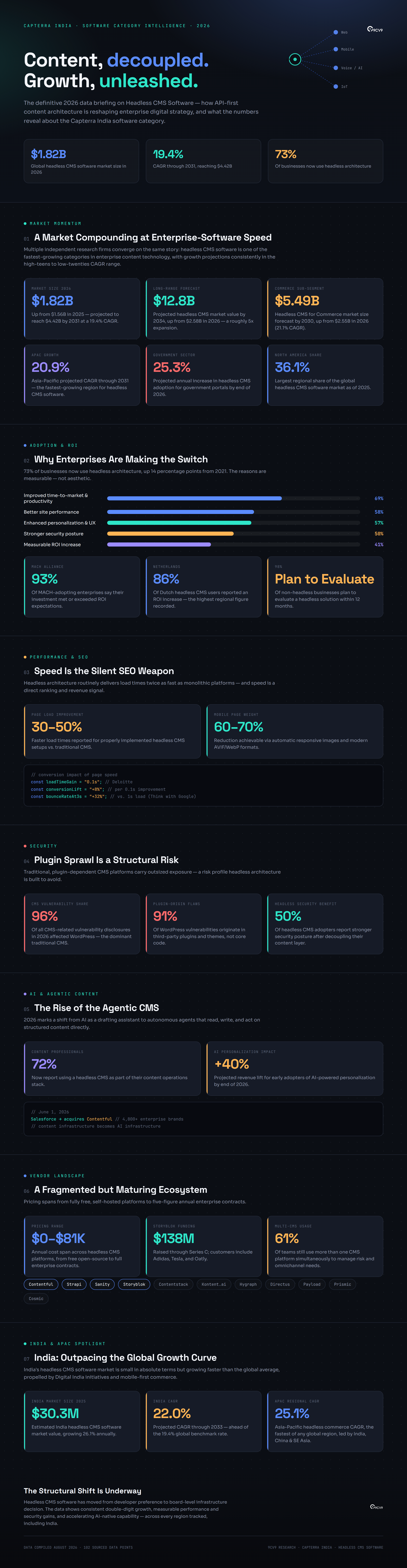
Enterprise adoption statistics further demonstrate the increasing importance of headless content management. Approximately 73% of businesses surveyed globally report using headless website architecture, while 92% of enterprise respondents agree that headless CMS technologies make it easier to deliver consistent content experiences across digital touchpoints. Furthermore, 80% of businesses using headless architecture believe it provides a meaningful competitive advantage, and 85% of organizations identify increased agility and performance as primary adoption drivers.
Beyond content management flexibility, headless CMS software is increasingly associated with measurable business outcomes. Around 69% of adopters report improved time-to-market and content team productivity, 58% experience better website performance, and 50% report an improved security posture. Additionally, 41% of organizations have measured a tangible return on investment within the first year of implementing headless CMS technology.
Website performance, search engine optimization (SEO), and Core Web Vitals are also influencing the adoption of headless content management systems. Properly optimized headless architectures can deliver faster page loading speeds, reduce content delivery latency, improve mobile performance, and support more efficient content distribution through content delivery networks (CDNs). However, successful implementation remains essential, as poorly optimized migrations can introduce JavaScript rendering challenges, API latency, and temporary declines in website performance.
Artificial intelligence (AI), automation, and composable architecture are further reshaping the headless CMS software industry in 2026. The emergence of AI-enabled content management platforms, agentic CMS capabilities, automated personalization, and reusable structured content models is transforming how organizations create, manage, optimize, and distribute digital content at scale. These developments are also intensifying competition among leading headless CMS providers such as Contentful, Strapi, Sanity, Storyblok, Contentstack, Kontent.ai, Hygraph, Directus, and Payload.
The growth of headless commerce represents another significant opportunity for the industry. Businesses implementing headless commerce architecture have reported improvements in revenue, conversion rates, customer retention, and return on investment. With consumers increasingly interacting with brands across multiple digital and physical channels, API-first content management and composable commerce solutions are becoming essential components of modern retail and eCommerce strategies.
Geographically, North America remains a leading market for headless CMS software, while Asia-Pacific is emerging as one of the fastest-growing regions. Countries such as India are experiencing particularly strong growth, supported by digital transformation initiatives, mobile-first consumer behavior, cloud adoption, and increasing demand for scalable content management infrastructure.
Nevertheless, selecting and implementing the right headless CMS platform requires careful consideration of software pricing, development resources, integration capabilities, security requirements, editorial workflows, API performance, and long-term business objectives. With pricing ranging from free, open-source solutions to enterprise contracts costing tens of thousands of dollars annually, organizations must evaluate both immediate implementation costs and long-term strategic value.
This comprehensive guide to the Top 102 Headless CMS Software Statistics, Data & Trends in 2026 examines the most important developments shaping the global headless content management industry, including:
- Global headless CMS software market size, revenue, and growth forecasts.
- Enterprise adoption rates, business benefits, and return on investment.
- Website performance, SEO, page loading speeds, and Core Web Vitals statistics.
- Content management security risks and architectural advantages.
- Artificial intelligence, automation, personalization, and agentic CMS trends.
- Leading headless CMS vendors, software pricing, and competitive market dynamics.
- Regional market growth and emerging adoption opportunities.
- Omnichannel content delivery, API-first architecture, and developer preferences.
- Headless commerce adoption, revenue growth, and conversion performance.
Whether an organization is evaluating headless CMS software for the first time, planning a migration from a traditional CMS, developing a composable commerce strategy, or seeking to improve its existing digital content infrastructure, these statistics provide valuable insights into the opportunities, challenges, and technological developments defining the industry.
By understanding the latest headless CMS software statistics, market data, and emerging trends in 2026, business leaders, developers, digital marketers, content managers, eCommerce professionals, and technology decision-makers can make more informed software investments, strengthen their digital competitiveness, and prepare their organizations for the future of content management.
Before we venture further into this article, we would like to share who we are and what we do.
About 9cv9
9cv9 is a business tech startup based in Singapore and Asia, with a strong presence all over the world.
With over ten years of startup and business experience, and being highly involved in connecting with thousands of companies and startups, the 9cv9 team has listed some of the top and best companies/tools in this review.
If you like to get your company listed in our top B2B software reviews, check out our world-class 9cv9 Media and PR service and pricing plans here.
Top 102 Headless CMS Software Statistics, Data & Trends in 2026
📊 Market Size & Growth
1. The global headless CMS software market is valued at approximately $1.82 billion in 2026, growing at a CAGR of 19.4% to reach $4.42 billion by 2031, reflecting one of the fastest-expanding segments of enterprise software.
2. Headless CMS software revenue is projected to climb from $1.56 billion in 2025 to $1.82 billion in 2026, an increase of roughly 17% in a single year, underscoring accelerating enterprise buy-in.
3. A broader market forecast pegs the headless CMS industry at $2.58 billion in 2026, rising to $12.8 billion by 2034 at a 22.6% CAGR, driven by cloud-native and API-first development trends.
4. The global headless content management system software market was estimated at $1.75 billion in 2025 and is expected to reach $2.01 billion in 2026, en route to $6.23 billion by 2033.
5. Some analysts value the headless CMS software market even higher, at $3.94 billion in 2025, projecting growth to $22.28 billion by 2034 — a 21.42% CAGR — as omnichannel delivery becomes standard practice.
6. The headless CMS for commerce sub-segment alone is worth $2.55 billion in 2026 and is forecast to reach $5.49 billion by 2030 at a 21.1% CAGR, fueled by composable commerce adoption.
7. The wider headless commerce market (content plus transactional layers) is valued at $2.13 billion in 2026 and expected to hit $7.24 billion by 2033, growing at 22.6% annually.
8. By component, software licensing accounts for over 68% of headless CMS software revenue, with services (implementation, onboarding, support) making up the remainder.
9. Cloud-based deployment holds the largest revenue share of the headless CMS software market in 2025–2026, as organizations prioritize scalability over on-premises control.
10. Web content management remains the largest application segment for headless CMS software by revenue, ahead of mobile app and digital commerce use cases.
11. Government-sector headless CMS adoption is projected to grow 25.3% annually through the end of 2026, as public institutions modernize legacy digital infrastructure.
12. The Asia-Pacific headless CMS software market is projected to expand at a 20.89% CAGR through 2031 — faster than any other region — driven by mobile-first digital transformation.
🏢 Enterprise Adoption & ROI
13. 73% of businesses surveyed globally by WP Engine now use headless website architecture, a 14% jump from 2021 figures, signaling mainstream enterprise acceptance.
14. Nearly 98% of businesses not yet using headless architecture say they plan to evaluate a headless solution within the next 12 months, according to WP Engine’s State of Headless research.
15. 64% of enterprise organizations were already using a headless approach as of a WP Engine benchmark study — almost a 25% increase compared to 2019 levels.
16. 92% of enterprise respondents agree that headless CMS technologies make it easier to deliver a consistent content experience across digital touchpoints.
17. 80% of businesses using headless architecture believe it gives them a meaningful competitive edge in delivering new digital experiences faster than rivals.
18. 85% of organizations cite increased agility and performance as their primary reason for adopting headless CMS technology over monolithic alternatives.
19. 78% of businesses say headless architecture helped future-proof their digital strategy by making it easier to adopt new front-end technologies as they emerge.
20. 69% of headless CMS users report improved time-to-market and content-team productivity after migrating away from legacy platforms.
21. 58% of headless CMS adopters report measurably better site performance compared with their previous monolithic CMS setup.
22. 57% of organizations cite enhanced personalization and improved user experience as a direct benefit of switching to a headless content architecture.
23. 50% of headless CMS adopters report stronger security posture after decoupling their content layer from the public-facing presentation layer.
24. 41% of organizations have measured a tangible ROI increase directly attributable to their headless CMS investment within the first year.
25. In the Netherlands, 86% of headless CMS users reported an increase in ROI following adoption, among the highest regional satisfaction rates recorded.
26. 77% of Dutch companies say they plan to migrate to a new CMS platform soon, reflecting accelerating momentum toward headless and composable architecture in Western Europe.
27. In Germany, 70% of companies experienced measurable performance and scaling improvements after migrating to a headless CMS.
28. The MACH Alliance reports that 87% of member enterprises have widely implemented MACH (Microservices, API-first, Cloud-native, Headless) technologies across their stacks.
29. 93% of MACH Alliance member organizations say their composable technology investment met or exceeded their original ROI expectations.
30. 61% of teams globally still use more than one CMS platform simultaneously, primarily to minimize delivery risk (61%) and support omnichannel needs (44%).
31. 2025 saw a 20% increase in single-CMS consolidation, as organizations move to simplify sprawling multi-platform content stacks.
32. 65% of CMS users now consider visual editing combined with developer independence to be essential, pushing headless vendors to add no-code editorial tooling.
⚡ Performance, SEO & Core Web Vitals
33. Headless CMS architecture can deliver load times frequently twice as fast as traditional monolithic platforms, directly improving Core Web Vitals scores and search rankings.
34. Every one-second improvement in page load time is statistically correlated with a 2% increase in conversion rate, making performance a direct revenue lever for headless adopters.
35. Websites using headless CMS architecture with proper rendering methods can achieve up to 30% faster load times compared to traditional CMS setups.
36. Properly optimized headless implementations saw an average 18% improvement in mobile Core Web Vitals scores compared to prior traditional CMS deployments.
37. API-first architecture supports aggressive CDN caching, delivering a potential 40–60% reduction in content delivery latency for global audiences.
38. Automatic responsive image generation and modern formats (AVIF, WebP) in headless setups can cut mobile page weight by 60–70%, a major Core Web Vitals lever.
39. As page load time rises from 1 to 3 seconds, bounce rate increases by 32%, reinforcing the SEO case for headless CMS speed advantages.
40. Improving page load time by just 0.1 seconds can boost conversion rate by as much as 8%, according to Deloitte research cited across CMS performance studies.
41. When Vodafone improved its Largest Contentful Paint by 31% using a decoupled architecture, the company recorded an 8% increase in sales.
42. The BBC found it lost an additional 10% of users for every extra second its website took to load, illustrating the stakes of headless-driven speed gains.
43. Despite theoretical speed advantages, over 68% of headless CMS migrations experience a post-launch dip in passing Core Web Vitals, typically due to unoptimized API latency and JavaScript hydration overhead.
44. 39% of eCommerce businesses experienced a 25% boost in organic traffic after migrating to headless architecture, largely attributed to improved Core Web Vitals performance.
🔒 Security
45. WordPress — the dominant traditional CMS — accounted for 96% of all CMS-related vulnerability disclosures in 2026, highlighting the security exposure of monolithic, plugin-dependent architectures.
46. 11,334 new vulnerabilities were discovered across the WordPress ecosystem in a single year, a 42% year-over-year increase, per Patchstack’s 2026 security report.
47. 91% of WordPress security vulnerabilities originate in third-party plugins rather than CMS core code — a structural risk that headless, API-first content layers largely avoid.
48. 43% of disclosed WordPress vulnerabilities can be exploited without any authentication, meaning attackers need no credentials or site access to strike.
49. Common WAF and hosting defenses blocked only 12% of known exploited WordPress-specific attacks in recent penetration testing, exposing the limits of bolt-on protection for monolithic CMSs.
50. Exploited software vulnerabilities became the leading initial access vector for data breaches in 2026 for the first time in 19 years, accounting for 31% of all breaches.
51. The average global data breach now costs $4.44 million, rising to a record $10.22 million in the United States, raising the stakes of CMS-layer security choices.
52. 50% of headless CMS adopters specifically cite improved security posture as a direct benefit of decoupling content management from the public delivery layer.
🤖 AI, Automation & Personalization
53. 72% of content professionals now report using a headless CMS as part of their content operations stack, according to recent industry survey data.
54. 44% of CMS users say their current platform lacks built-in native AI content tools, despite rising pressure to personalize content at scale.
55. AI-powered personalization is projected to drive up to 40% more revenue for early enterprise adopters by the end of 2026.
56. 80% of companies identify reusable, AI-ready “component block” content models as a key driver of improved content reuse across channels.
57. In July 2026, Kontent.ai reported that more than 60 organizations were actively using its Agentic CMS capabilities, reflecting early but accelerating adoption of autonomous AI content agents.
58. On June 1, 2026, Salesforce signed a definitive agreement to acquire Contentful, a composable content platform serving more than 4,800 enterprise brands — signaling that headless content infrastructure is becoming core AI infrastructure.
59. The “Agentic CMS” trend of 2026 marks a shift from generative AI as a drafting assistant to autonomous AI agents that read, write, and act on content independently within workflows.
60. Storyblok was recognized as a Leader in the IDC MarketScape 2025 for AI-Enabled Headless CMS, evidence that vendors increasingly compete on AI maturity rather than core headless functionality alone.
61. 43% of enterprises cite flexibility with front-end frameworks as their top reason for choosing a headless CMS, ahead of omnichannel delivery (40%) and multi-language programming support (37%).
62. 98% of AI “vibe-coded” web applications were found to contain at least one security flaw in recent testing, reinforcing the case for governed, structured headless content models over ad-hoc AI-generated builds.
🏗️ Vendor Landscape, Pricing & Ecosystem
63. Storyblok has raised approximately $138 million in total funding through its Series C round and counts Adidas, Tesla, and Oatly among its enterprise customers.
64. Strapi, the most widely adopted open-source headless CMS, previously raised $31 million in funding and offers a fully free, self-hosted Community Edition with unlimited content types and API calls.
65. Contentful’s Team pricing tier starts at roughly $300 per month, positioning it as a premium enterprise choice compared to open-source alternatives like Strapi and Payload.
66. Storyblok’s Growth pricing tier starts at $99 per month for 5 users, with additional users billed at $15 per month and extra locales at $20 per month each.
67. Headless CMS platform pricing in 2026 spans an enormous range — from fully free, open-source, self-hosted options to enterprise contracts as high as $81,000 per year.
68. Sanity is frequently cited as offering the most generous free tier among major headless CMS vendors, well-suited to solo developers and small editorial teams.
69. Contentful, Strapi, Sanity, Storyblok, Contentstack, Kontent.ai, Hygraph, Directus, Payload, Prismic, and Cosmic are among the most frequently compared headless CMS platforms by enterprise buyers in 2026.
70. Strapi and Contentful are the two most commonly cited headless CMS platforms offering native GraphQL API support alongside REST, a key differentiator for developer teams.
71. Both Sanity and Strapi auto-generate REST and GraphQL APIs directly from a defined content model, eliminating manual API configuration work for development teams.
72. WordPress still commands 41–43% of all websites globally and roughly 59–60% share among sites running a known CMS, making it the dominant point of comparison for headless challengers.
73. Joomla’s CMS market share has fallen from 9.3% in 2014 to under 2% by 2025 — an 80% decline — while Drupal fell from 5.5% to roughly 1.1% over the same period, both losing ground to headless and no-code alternatives.
74. Wix grew its CMS market share nearly 29-fold, from 0.2% in 2014 to 5.8% in 2025, illustrating the broader shift toward flexible, modern web-building platforms.
75. Strapi is used predominantly by small businesses (79% of reviewers), with midsize businesses (12%) and enterprises (9%) representing smaller but growing shares of its user base.
76. Computer Software (30%) and Information Technology & Services (14%) are the two leading industry verticals among Strapi’s reviewed customer base on Capterra.
🌏 Regional & India Market Insights
77. The headless CMS software market in India was valued at approximately $30.3 million in 2025 and is projected to grow 26.1% annually, among the fastest national growth rates tracked.
78. India is highlighted as a high-growth headless CMS market with a projected CAGR of 22% through 2033, driven by digital transformation initiatives and scalable content demand.
79. North America held 36.14% of the global headless CMS software market share in 2025, the single largest regional share, driven by concentration of technology-forward enterprises.
80. North America commands 38.5–38.6% of the global headless commerce market in 2026, reflecting large-scale enterprise adoption led by major retail and tech players.
81. Asia-Pacific holds roughly 23.7% of the global headless commerce market and is the fastest-growing region at a 25.1% CAGR, powered by India, China, and Southeast Asia’s mobile-first commerce boom.
82. India’s Digital India initiative is cited as a direct driver of headless CMS adoption for citizen engagement platforms, supporting faster digital rollout across 27 states.
83. The on-premise deployment segment is expected to register a significant CAGR from 2026 to 2033 as some enterprises — particularly regulated industries — prioritize data control alongside cloud flexibility.
84. IT & Telecom and large enterprises are identified as the dominant end-user segments for headless CMS software, owing to complex, multi-brand content requirements.
🔗 Omnichannel, API-First & Developer Preferences
85. 68% of organizations surveyed prefer cloud-based headless CMS tools specifically for their ability to support distributed global teams and real-time collaboration.
86. A REST API is described by developers as simple and cache-friendly, while GraphQL is favored when applications require flexible, tailored data queries — both are now standard offerings among leading headless vendors.
87. Businesses with omnichannel strategies enabled by headless architecture retain an average of 89% of customers, compared to just 33% retention for single-channel operations.
88. 92% of US brands have already implemented some form of composable commerce architecture, with an additional 21% planning adoption within the next 12 months.
89. Headless CMS platforms are increasingly required to deliver content not just to websites and apps but to voice assistants, AR/VR environments, smartwatches, and IoT devices simultaneously.
90. A furniture eCommerce company reported a 7x increase in content velocity after migrating to a headless CMS while managing more than 20,000 product variations across channels.
91. Directus released version 11.17 in July 2026, adding native Netlify deployment support and a translation generator that scaffolds internationalization setup within seconds.
92. 73% of retail shoppers surveyed globally engage across multiple channels during a single buying journey, reinforcing the business case for headless, channel-agnostic content delivery.
93. 83% of customers now research products online first before ever visiting a physical store, a behavior pattern that depends on consistent, fast, well-structured digital content.
🛒 Headless Commerce-Specific Data
94. 80% of businesses report a revenue increase after implementing headless commerce architecture, with an average documented sales growth of 24% across adopters.
95. Businesses report an average 42% increase in conversion rates after switching to headless commerce architecture, with case studies showing improvements as high as 100% in highly competitive verticals.
96. 80% of enterprises see positive ROI within the first 12 months of deploying a headless commerce solution, a notably fast payback period for enterprise software.
97. Web-based commerce is the leading deployment segment in the headless commerce market in 2026, accounting for 53.4% of total market share.
98. Back-end technology adoption for headless commerce is expected to account for 60.4% of the market in 2026, reflecting the dominance of API-driven, modern architecture over legacy back ends.
99. The headless commerce segment specifically is forecast to more than double from $2.11 billion in 2025 to $5.49 billion by 2030 at a 21.1% CAGR.
100. Composable commerce — the natural evolution of headless architecture — is rapidly becoming the default technology approach for growth-stage retail and eCommerce brands globally.
101. Headless CMS platforms enable businesses to manage and distribute multilingual, compliant content across markets, a capability increasingly critical under regulations like the EU’s GDPR framework.
102. The global headless CMS market’s consistent 15–25% annual growth range places it among the fastest-expanding categories within the broader SaaS ecosystem heading into 2027.
Conclusion
The Top 102 Headless CMS Software Statistics, Data & Trends in 2026 highlight a significant transformation in how organizations create, manage, distribute, and optimize digital content. As businesses increasingly prioritize digital agility, omnichannel customer experiences, scalability, and technological flexibility, headless content management systems are becoming an integral component of modern enterprise technology infrastructure.
The global headless CMS software market demonstrates substantial growth potential. One industry forecast values the market at approximately $1.82 billion in 2026, with projections indicating that it could reach $4.42 billion by 2031 at a compound annual growth rate of 19.4%. Other market estimates project even greater long-term expansion, with the industry potentially reaching $12.8 billion by 2034. Although market valuations vary across research methodologies, these forecasts consistently indicate strong demand for API-first, cloud-native, and composable content management solutions.
Headless CMS Adoption Is Reshaping Enterprise Digital Strategies
Enterprise adoption statistics demonstrate that headless CMS software is increasingly moving beyond early-stage experimentation toward mainstream implementation. With 73% of surveyed businesses already using headless website architecture and 92% of enterprise respondents acknowledging its ability to deliver consistent content experiences across digital touchpoints, the technology is becoming a strategic priority for organizations pursuing digital transformation.
The business benefits associated with headless CMS adoption are equally significant:
- 85% of organizations identify increased agility and performance as primary adoption drivers.
- 80% of businesses believe headless architecture provides a meaningful competitive advantage.
- 78% report that headless architecture helps future-proof their digital strategies.
- 69% experience improved time-to-market and content team productivity.
- 58% report measurable improvements in website performance.
- 57% identify enhanced personalization and improved user experiences as direct benefits.
- 50% report an improved security posture.
- 41% have measured a tangible return on investment within the first year.
These findings suggest that headless CMS software is not merely a technical alternative to traditional content management systems. It represents a strategic investment capable of supporting operational efficiency, business growth, customer engagement, and long-term digital competitiveness.
Website Performance, SEO, and Security Remain Critical Adoption Drivers
Website performance and search engine optimization continue to influence headless CMS adoption in 2026. Properly implemented headless architectures can improve page loading speeds, reduce content delivery latency, optimize mobile experiences, and support better Core Web Vitals performance.
The ability to combine modern front-end frameworks with content delivery networks, advanced caching mechanisms, and responsive image optimization provides organizations with greater control over their digital performance.
However, headless CMS implementation does not automatically guarantee superior SEO results. The statistics also highlight potential migration challenges, including API latency, JavaScript hydration overhead, and temporary declines in Core Web Vitals performance. Organizations must therefore prioritize technical SEO, rendering strategies, structured data, performance monitoring, and migration planning to maximize the benefits of decoupled architecture.
Security represents another important consideration. Traditional content management systems frequently face vulnerabilities associated with third-party plugins and interconnected application components. By separating content management infrastructure from public-facing presentation layers, headless CMS platforms can help reduce certain security exposures.
Nevertheless, robust API authentication, access controls, dependency management, vulnerability monitoring, and secure development practices remain essential for protecting enterprise content infrastructure.
Artificial Intelligence and Agentic CMS Are Defining the Next Stage of Innovation
Artificial intelligence is rapidly transforming the headless CMS software landscape. AI-powered content generation, automated localization, intelligent personalization, structured content optimization, and autonomous content workflows are becoming increasingly important differentiators among leading CMS providers.
The emergence of agentic CMS technology represents a particularly significant development. Rather than functioning solely as content creation assistants, AI agents are increasingly being integrated into content management workflows to retrieve, generate, update, organize, and distribute information with greater autonomy.
Despite these advancements, approximately 44% of CMS users report that their existing platforms lack native AI content tools, indicating considerable opportunities for further innovation and software modernization.
Organizations investing in structured, reusable, and AI-ready content models may be better positioned to capitalize on emerging technologies while maintaining consistent content governance across digital channels.
Headless Commerce and Omnichannel Content Delivery Are Accelerating Market Growth
The continued expansion of headless commerce is another major factor contributing to the growth of the headless CMS software market. As retailers and eCommerce businesses seek greater flexibility in delivering personalized shopping experiences, composable commerce architectures are becoming increasingly attractive.
The reported business outcomes associated with headless commerce adoption are substantial:
- 80% of businesses report increased revenue following headless commerce implementation.
- Average documented sales growth among adopters reaches 24%.
- Businesses report an average conversion rate improvement of 42%.
- 80% of enterprises experience positive ROI within the first 12 months of deployment.
- The headless commerce market is projected to reach $5.49 billion by 2030, according to one industry forecast.
These reported outcomes demonstrate the potential commercial value of integrating flexible content management infrastructure with modern commerce technologies, although individual results depend on implementation quality, business models, and customer requirements.
With 73% of surveyed retail shoppers engaging across multiple channels during a single purchasing journey, organizations increasingly require content management solutions capable of delivering consistent experiences across websites, mobile applications, physical stores, digital marketplaces, and emerging connected devices.
The Headless CMS Software Market Is Becoming More Competitive and Accessible
The headless CMS vendor landscape continues to evolve as established providers and emerging platforms compete through improved developer experiences, AI capabilities, visual editing tools, enterprise security, API performance, and flexible pricing models.
Leading headless CMS platforms such as Contentful, Strapi, Sanity, Storyblok, Contentstack, Kontent.ai, Hygraph, Directus, Payload, and Prismic offer organizations a diverse range of content management solutions.
With pricing ranging from free, open-source, self-hosted platforms to enterprise contracts costing up to $81,000 annually, businesses of different sizes can explore headless CMS solutions according to their technical requirements, operational complexity, and financial resources.
However, software selection should extend beyond subscription pricing. Organizations should evaluate the total cost of ownership, including implementation, hosting, development resources, integrations, maintenance, security, content migration, and employee training.
Regional Growth Highlights Significant Global Opportunities
North America remains a leading market for headless CMS software, accounting for approximately 36.14% of global market share in 2025. However, Asia-Pacific is emerging as a particularly high-growth region, with a projected compound annual growth rate of 20.89% through 2031.
India represents another significant growth opportunity, with some forecasts projecting annual market expansion of 26.1%. Increasing cloud adoption, digital transformation initiatives, mobile-first consumer behavior, and demand for scalable enterprise content infrastructure are contributing to regional market development.
As organizations across emerging and established economies modernize their digital ecosystems, demand for multilingual content management, localized customer experiences, and flexible API-driven architectures is likely to continue expanding.
What Businesses Should Prioritize When Investing in Headless CMS Software
The latest headless CMS statistics suggest that successful adoption requires a comprehensive strategy that balances technological capabilities with organizational requirements.
Businesses evaluating headless CMS software in 2026 and beyond should prioritize:
- Scalable, API-first, and cloud-native content management architecture.
- Seamless integration with existing enterprise applications and digital platforms.
- Structured and reusable content models that support AI-powered workflows.
- Technical SEO, website performance, and Core Web Vitals optimization.
- Robust cybersecurity, data governance, and regulatory compliance.
- Intuitive visual editing and content management tools for non-technical teams.
- Omnichannel publishing and multilingual content distribution capabilities.
- Transparent pricing, predictable operating costs, and measurable return on investment.
- Developer flexibility and compatibility with modern front-end frameworks.
- Long-term scalability and adaptability to emerging digital technologies.
By aligning headless CMS investments with these strategic priorities, organizations can improve implementation outcomes while reducing unnecessary complexity, operational risks, and long-term technology costs.
The Future of Headless CMS Software Beyond 2026
Looking ahead to 2027 and beyond, the headless CMS software industry is positioned for continued expansion as artificial intelligence, composable architecture, cloud computing, automation, and omnichannel digital experiences converge.
The next generation of headless content management platforms will increasingly emphasize intelligent content orchestration, autonomous AI agents, real-time personalization, enhanced editorial independence, and seamless integration across enterprise technology ecosystems.
Traditional CMS platforms will remain relevant for many organizations, particularly those with straightforward publishing requirements. However, businesses managing complex digital ecosystems, multiple brands, international markets, and diverse customer touchpoints may find greater strategic value in adopting headless and composable content architectures.
Ultimately, the 102 headless CMS software statistics, data, and trends in 2026 demonstrate that the industry is evolving beyond conventional content management toward a more flexible, intelligent, scalable, and interconnected digital infrastructure.
Organizations that carefully evaluate emerging headless CMS technologies, invest in structured content management, prioritize security and performance, and align software adoption with measurable business objectives will be better positioned to strengthen their digital competitiveness, improve customer experiences, accelerate innovation, and achieve sustainable growth in an increasingly connected global economy.
If you find this article useful, why not share it with your hiring manager and C-level suite friends and also leave a nice comment below?
We, at the 9cv9 Research Team, strive to bring the latest and most meaningful data, guides, and statistics to your doorstep.
To get access to top-quality guides, click over to 9cv9 Blog.
To hire top talents using our modern AI-powered recruitment agency, find out more at 9cv9 Modern AI-Powered Recruitment Agency.
People Also Ask
What is headless CMS software?
Headless CMS software is a content management system that separates the content backend from the presentation layer, enabling businesses to deliver structured content across websites, mobile apps, eCommerce platforms, and other digital channels through APIs.
What is the global headless CMS software market size in 2026?
The global headless CMS software market is estimated at $1.82 billion in 2026 and is projected to reach $4.42 billion by 2031, according to one industry forecast.
How fast is the headless CMS software market growing?
The headless CMS software market is projected to grow at a compound annual growth rate (CAGR) of 19.4% between 2026 and 2031, driven by cloud adoption, API-first development, and omnichannel content delivery.
What percentage of businesses use headless CMS architecture?
Approximately 73% of surveyed businesses globally use headless website architecture, reflecting growing demand for flexible, scalable, and modern content management solutions.
Why are businesses adopting headless CMS software in 2026?
Around 85% of organizations identify increased agility and performance as primary adoption drivers. Other benefits include developer flexibility, omnichannel publishing, scalability, personalization, and improved content productivity.
What are the main benefits of headless CMS software?
The main benefits include faster content delivery, improved scalability, flexible front-end development, omnichannel publishing, enhanced personalization, stronger security controls, and reusable content models.
How does headless CMS differ from traditional CMS software?
Traditional CMS software combines content management and front-end presentation within one system. Headless CMS separates these layers and uses APIs to deliver content across different platforms and digital channels.
Does headless CMS improve website performance?
Approximately 58% of headless CMS adopters report better website performance. Properly optimized implementations can achieve up to 30% faster loading times compared with traditional CMS architectures.
Is headless CMS good for SEO in 2026?
Headless CMS can improve SEO through faster loading speeds, flexible metadata management, structured data, and better Core Web Vitals. However, effective rendering, indexing, and technical SEO configurations remain essential.
How does headless CMS affect Core Web Vitals?
Optimized headless CMS implementations can improve Core Web Vitals through efficient caching, responsive images, and modern rendering techniques. Poorly configured migrations, however, may negatively affect performance.
What is the average ROI of headless CMS software?
Approximately 41% of organizations report a measurable ROI increase within the first year of headless CMS adoption. Actual returns depend on implementation costs, operational efficiency, and business performance.
Does headless CMS improve content team productivity?
Around 69% of headless CMS users report improved time-to-market and content team productivity after migration, supported by reusable content models, streamlined workflows, and flexible publishing capabilities.
Is headless CMS more secure than traditional CMS?
Headless CMS can reduce certain security risks by separating content infrastructure from public-facing applications. Approximately 50% of adopters report improved security, although API protection and access controls remain essential.
What are the leading headless CMS platforms in 2026?
Leading headless CMS platforms include Contentful, Strapi, Sanity, Storyblok, Contentstack, Kontent.ai, Hygraph, Directus, Payload, Prismic, and Cosmic.
How much does headless CMS software cost in 2026?
Headless CMS pricing ranges from free, open-source platforms to enterprise contracts costing up to $81,000 annually. Costs depend on usage, hosting, users, integrations, support, and customization requirements.
What are the best free and open-source headless CMS platforms?
Strapi, Payload, and Directus are popular options for businesses seeking self-hosted headless CMS solutions. Organizations should evaluate licensing conditions, hosting costs, scalability, and technical requirements before selection.
How is artificial intelligence transforming headless CMS software?
AI is transforming headless CMS through automated content generation, intelligent personalization, localization, content classification, workflow automation, and autonomous content management agents.
What is an agentic CMS?
An agentic CMS integrates autonomous AI agents capable of retrieving, generating, updating, organizing, and distributing content within governed workflows, reducing manual intervention and improving operational efficiency.
How many CMS platforms offer native AI capabilities?
Approximately 44% of surveyed CMS users report that their current platforms lack native AI content tools, highlighting opportunities for AI-enabled content management innovation.
What is headless commerce, and how does it relate to headless CMS?
Headless commerce separates the customer-facing storefront from backend commerce infrastructure. Headless CMS complements this architecture by delivering product information, marketing content, and personalized experiences through APIs.
Does headless commerce increase business revenue?
Approximately 80% of surveyed businesses report increased revenue after implementing headless commerce, with documented average sales growth of 24% among adopters.
How does headless commerce affect conversion rates?
Businesses adopting headless commerce report average conversion rate improvements of 42%. Results vary depending on website performance, personalization, customer experience, and implementation quality.
What is the difference between headless CMS and composable CMS?
Headless CMS separates content management from presentation, while composable CMS extends this approach by integrating modular, independently replaceable technologies into a flexible digital content ecosystem.
How does headless CMS support omnichannel content delivery?
Headless CMS uses APIs to distribute centralized, reusable content across websites, mobile applications, digital marketplaces, smart devices, and other channels, ensuring greater consistency and publishing efficiency.
Which region dominates the global headless CMS software market?
North America held approximately 36.14% of the global headless CMS software market in 2025, supported by enterprise digital transformation, cloud infrastructure, and advanced technology adoption.
Which region has the fastest-growing headless CMS software market?
Asia-Pacific is among the fastest-growing headless CMS markets, with a projected CAGR of 20.89% through 2031, driven by mobile-first commerce, cloud adoption, and digital transformation.
How fast is the headless CMS software market growing in India?
India’s headless CMS software market was estimated at $30.3 million in 2025, with one forecast projecting annual growth of 26.1%, supported by digital modernization and scalable content management demand.
What are the biggest challenges of implementing headless CMS software?
Common challenges include migration complexity, development costs, API latency, technical SEO configuration, integration requirements, editorial workflow changes, security management, and ongoing maintenance.
How should businesses choose the best headless CMS software in 2026?
Businesses should evaluate API capabilities, scalability, pricing, security, developer experience, visual editing, AI features, integration flexibility, multilingual support, and total cost of ownership.
What is the future of headless CMS software beyond 2026?
The future of headless CMS software will increasingly involve agentic AI, composable architecture, automated workflows, real-time personalization, cloud-native infrastructure, and seamless omnichannel content delivery.
Sources
- MarketIntelo
- Mordor Intelligence
- Future Market Insights
- Strategic Revenue Insights
- Wcart
- WP Engine
- Storyblok
- MACH Alliance
- Strapi
- CoreMedia
- Brilliance NW
- Think with Google
- Deloitte
- Patchstack
- Colorlib
- Verizon
- IBM
- Kontent.ai
- Salesforce
- IDC MarketScape
- Nayan Kyada
- TECHSY
- Midrocket
- W3Techs
- Cloudflare Radar
- Directus
- Capterra
- G2


