Key Takeaways
- Email Signature Software Market Growth: The global email signature software market is expanding rapidly, with industry forecasts projecting significant growth through 2033, driven by cloud adoption, AI integration, and enterprise demand.
- Email Signature Software Adoption and Marketing ROI: Approximately 25% of companies use dedicated email signature software, while 62% of professionals leverage email signatures for marketing, branding, and lead generation.
- AI-Powered Email Signature Trends in 2026: Artificial intelligence, automated signature management, personalised marketing banners, advanced analytics, and compliance automation are transforming email signatures into strategic business communication tools.
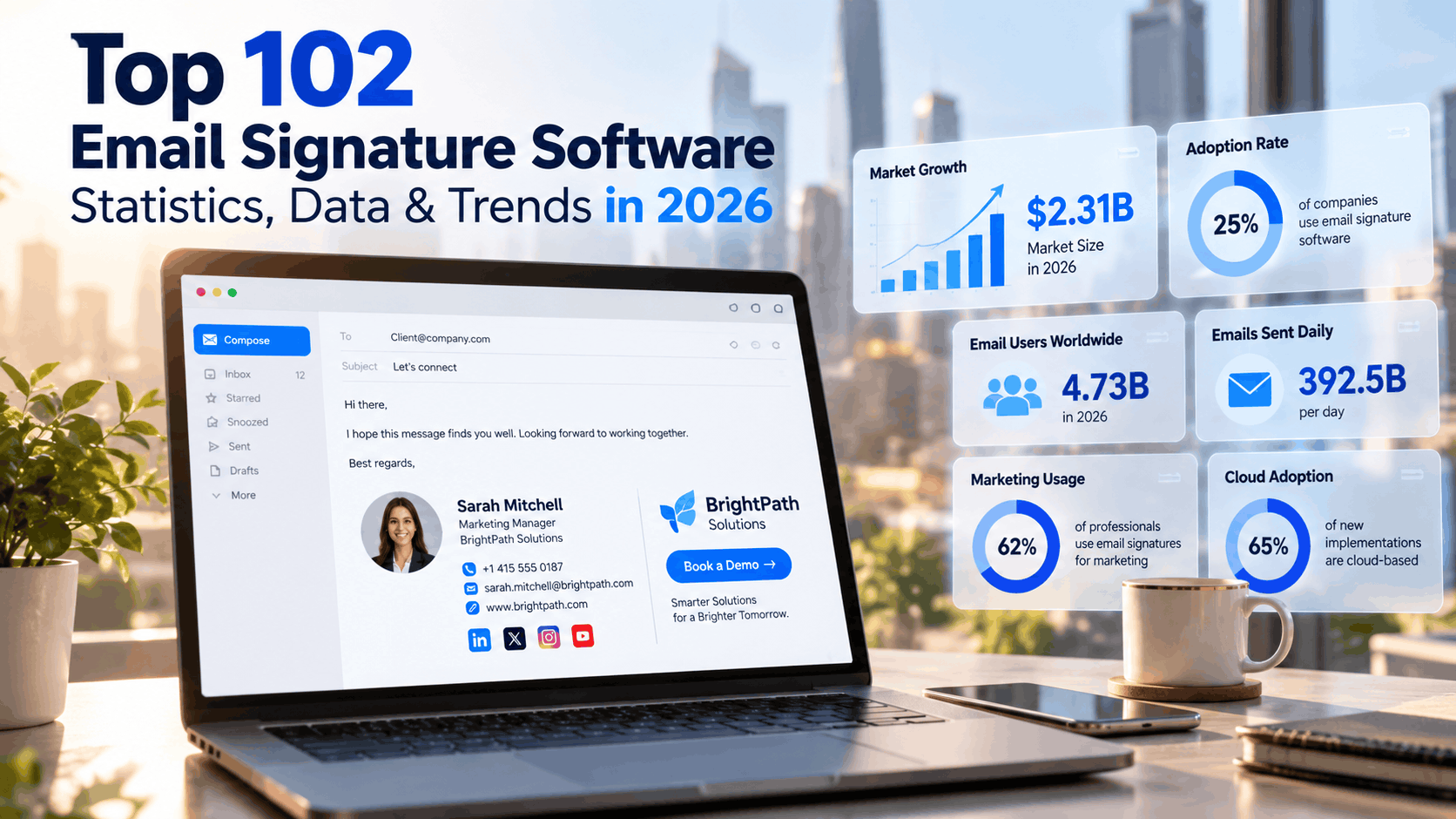
Email signature software is transforming business communication in 2026 through automated branding, AI-powered personalisation, and marketing analytics. Industry estimates suggest 25% of companies use dedicated solutions, while 62% of professionals leverage email signatures for marketing. Explore 102 email signature software statistics covering market growth, adoption rates, marketing ROI, compliance, and emerging industry trends.
Email signature software has evolved from a simple tool for adding contact information to emails into an essential business solution for brand consistency, digital marketing, employee communication, and regulatory compliance. In 2026, organisations worldwide are increasingly adopting centralised email signature management platforms to streamline corporate branding, automate signature updates, improve customer engagement, and generate measurable marketing opportunities.
Also, read our article on the Top 10 Email Signature Software To Use.

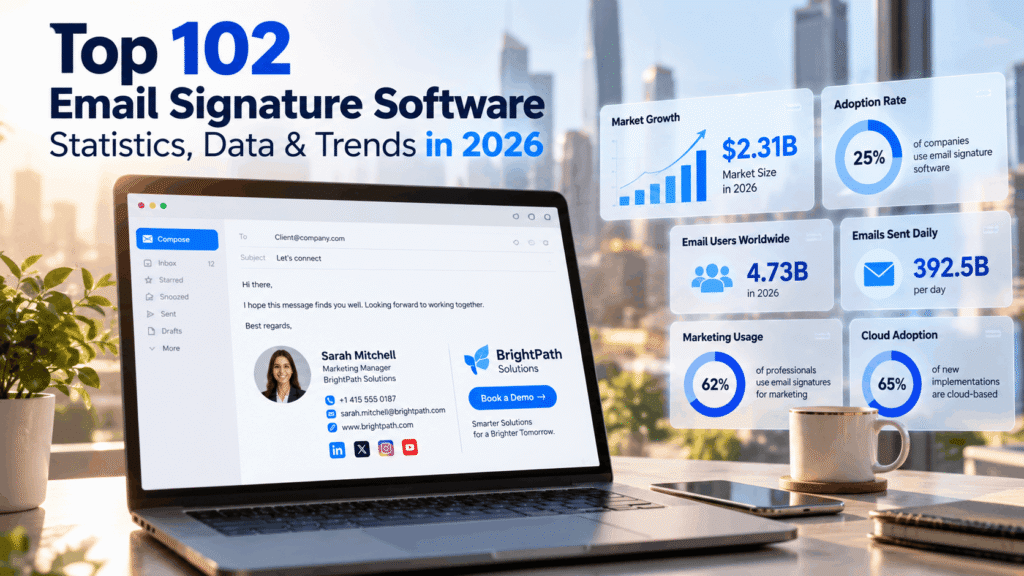
The global email signature software market is experiencing significant growth, driven by increasing cloud adoption, artificial intelligence (AI), and demand for automated business communication tools. Industry estimates place the market at approximately $776.68 million in 2025, while some forecasts suggest it could reach $2.31 billion in 2026. Longer-term projections vary considerably, with estimates ranging from $2.5 billion to $8.74 billion by 2033, reflecting differences in market definitions, research methodologies, and anticipated adoption rates.
Email signature software adoption is also expanding across businesses of all sizes. According to industry estimates, approximately 25% of companies use dedicated email signature management solutions, while cloud-based platforms account for around 65% of new implementations. Businesses increasingly recognise the value of managing employee signatures centrally, particularly when maintaining consistent branding across Microsoft 365, Google Workspace, and other corporate email environments.

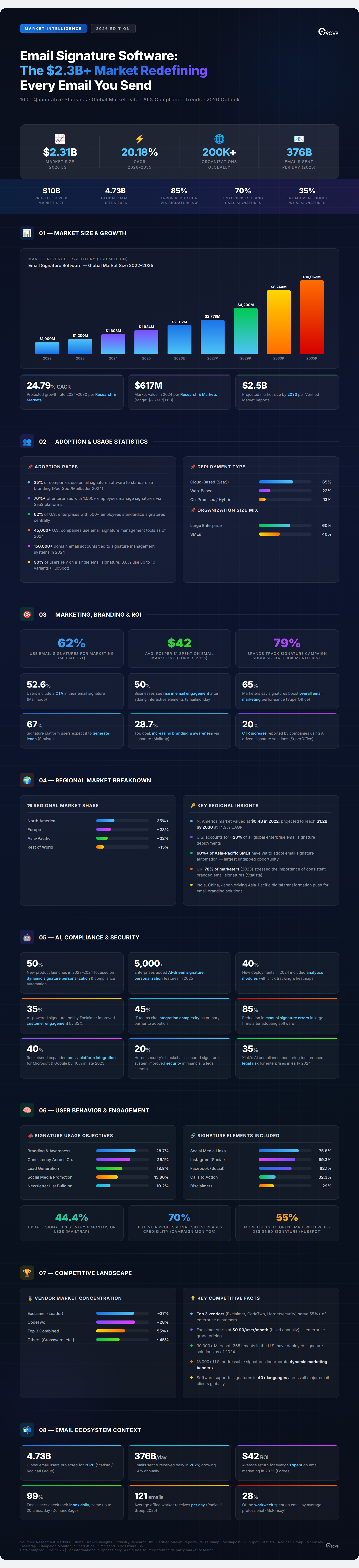
Beyond branding and compliance, email signature marketing is becoming an increasingly important component of digital marketing strategies. Research cited in industry reports suggests that approximately 62% of professionals use email signatures for marketing purposes, while 52.6% incorporate calls to action (CTAs) into their signatures. Businesses are also exploring interactive banners, personalised promotional messages, social media links, and campaign analytics to transform everyday email communications into opportunities for lead generation and customer engagement.
Artificial intelligence is another emerging trend shaping the email signature software industry in 2026. AI-powered personalisation, dynamic content, automated compliance monitoring, and advanced analytics are helping organisations optimise signature performance while reducing manual administrative work. As businesses increasingly prioritise efficiency and measurable marketing returns, email signature management platforms are evolving into more sophisticated components of enterprise communication infrastructure.
The broader email ecosystem further reinforces the importance of this technology. With approximately 4.73 billion email users projected worldwide in 2026 and an estimated 392.5 billion emails sent and received daily, email remains one of the most widely used communication channels. This enormous volume creates substantial opportunities for businesses to strengthen brand recognition, improve communication consistency, and reach customers through professionally managed email signatures.
In this comprehensive guide, we explore the Top 102 Email Signature Software Statistics, Data & Trends in 2026, covering global market size, industry growth forecasts, software adoption rates, email signature marketing ROI, AI-powered innovations, regional market trends, compliance requirements, competitive landscapes, and user behaviour.
Whether you are a business owner, digital marketer, IT professional, SaaS provider, or enterprise decision-maker, these email signature software statistics provide valuable insights into the industry’s current landscape, emerging opportunities, and future direction. Understanding these trends can help organisations make more informed decisions about email signature management software, optimise their communication strategies, and identify opportunities for sustainable business growth in 2026 and beyond.
Before we venture further into this article, we would like to share who we are and what we do.
About 9cv9
9cv9 is a business tech startup based in Singapore and Asia, with a strong presence all over the world.
With over ten years of startup and business experience, and being highly involved in connecting with thousands of companies and startups, the 9cv9 team has listed some of the top and best companies/tools in this review.
If you like to get your company listed in our top B2B software reviews, check out our world-class 9cv9 Media and PR service and pricing plans here.
Top 102 Email Signature Software Statistics, Data & Trends in 2026
🏦 Market Size & Growth
1. $617.39M (2024 market value)
The global email signature software market was valued at $617.39 million in 2024, reflecting strong enterprise demand for centralised branding and compliance automation tools.
2. $776.68M (2025 market value)
By 2025, the market grew to approximately $776.68 million, demonstrating consistent double-digit annual growth driven by cloud adoption and AI integration.
3. $2.31 billion (2026 estimated market size)
The email signature software market is estimated to reach $2.31 billion in 2026, cementing its position as a mainstream enterprise communication infrastructure investment.
4. $2.78 billion (2027 projected)
Market projections indicate the industry will surpass $2.78 billion by 2027, fuelled by expanding SME adoption and AI-powered personalisation features.
5. $2.33 billion by 2030 (Research & Markets)
According to Research & Markets, the email signature software market is forecast to hit $2.33 billion by 2030, growing at a CAGR of 24.79% from 2024.
6. $2.5 billion by 2033 (Verified Market Reports)
Verified Market Reports projects the market will reach $2.5 billion by 2033, reflecting sustained demand for compliance-ready, branded email communications.
7. $8.74 billion by 2033 (Global Growth Insights)
A more aggressive estimate from Global Growth Insights puts the 2033 market value at $8.74 billion, assuming rapid AI adoption and global regulatory compliance expansion.
8. $10.06 billion by 2035 (Industry Research Biz)
Industry Research Biz forecasts the market will exceed $10 billion by 2035, growing at a CAGR of 20.18% — highlighting email signatures as a long-term enterprise technology priority.
9. 20.18% CAGR (2026–2035)
The email signature software market is expected to grow at a compound annual growth rate of 20.18% between 2026 and 2035, outpacing many comparable SaaS communication tools.
10. 24.79% CAGR (2024–2030)
Research & Markets estimates a 24.79% CAGR for 2024–2030, making email signature software one of the fastest-growing enterprise productivity sub-segments globally.
11. $1.0 billion in 2022
The market was valued at $1.0 billion in 2022, marking the point where email signature software crossed from niche utility to mainstream enterprise requirement.
12. $1.2 billion in 2023
Growing to $1.2 billion in 2023, the market demonstrated resilience even as broader tech spending faced macroeconomic headwinds.
13. $495.11 million in 2023 (alternative estimate)
A narrower estimate from Research & Markets places the 2023 market at $495.11 million — highlighting the variance across methodologies but confirming sustained growth regardless.
14. $1.92 billion in 2025 (Industry Research Biz)
Industry Research Biz pegs the 2025 market at $1.92 billion, reflecting a period of accelerated enterprise migration to cloud-based signature management platforms.
15. 11.9% CAGR (conservative, 2022–2030)
Cognitive Market Research applies a more conservative 11.9% CAGR, projecting the market at $2.45 billion by 2030 — the lower bound of responsible long-term planning.
👥 Adoption & Usage
16. 25% of companies use email signature software
As of 2024, around 25% of companies use dedicated email signature software to standardise branding, indicating significant headroom for market penetration (PeerSpot/Mailbutler).
17. 200,000+ organisations globally
More than 200,000 organisations worldwide now use centralised email signature management tools, underscoring the technology’s transition from enterprise-only to mainstream.
18. 70%+ of large enterprises (1,000+ employees) use SaaS signatures
Over 70% of enterprises with more than 1,000 employees manage email signatures through SaaS platforms, reflecting the operational necessity of centralised control at scale.
19. 150,000+ domain email accounts tied to signature systems (2024)
More than 150,000 domain-level email accounts were connected to signature management systems in 2024, demonstrating deep organisational deployment rather than surface-level adoption.
20. 45,000+ U.S. companies use email signature tools
Over 45,000 companies in the United States alone use email signature management tools, making the U.S. the single largest national market for this technology.
21. 62% of U.S. enterprises (500+ employees) use centralised signatures
Approximately 62% of U.S. enterprises with more than 500 employees standardise signatures via centralised software, reflecting the compliance and branding imperatives driving adoption.
22. 30,000+ Microsoft 365 tenants in the U.S. have deployed signature solutions
More than 30,000 Microsoft 365 tenants in the U.S. had deployed third-party signature solutions as of 2024, highlighting the ecosystem dependency between email clients and signature tools.
23. U.S. accounts for ~28% of global deployments
The United States accounts for approximately 28% of all global enterprise email signature software deployments, cementing its role as the dominant market.
24. 90% of users rely on a single email signature
Almost 90% of professionals use one primary email signature, while 8.6% maintain up to 10 different variants — signalling an opportunity for dynamic, role-based signature automation (HubSpot).
25. 44.4% update signatures every 6 months or less
Approximately 44.4% of email signature users update their signatures at least twice per year, showing active management and alignment with evolving marketing campaigns (Mailtrap).
26. 31.6% update signatures only once every few years
Nearly a third of users update signatures infrequently, exposing a significant segment to outdated branding and non-compliant legal disclaimers — a key value proposition for automation software.
27. 65% of new implementations are cloud-based
Cloud-based deployments account for roughly 65% of new email signature software implementations, reflecting the broader enterprise shift to SaaS infrastructure (Industry Research Biz).
28. 20% of organisations use hybrid deployment models
Approximately 20% of organisations combine web-based signature modules with on-premises connectors — a hybrid approach balancing flexibility with existing IT infrastructure constraints.
🎯 Marketing, Branding & ROI
29. 62% use email signatures for marketing
About 62% of professionals incorporate email signatures into their marketing strategy — with 45% doing so regularly and 18% occasionally — demonstrating the channel’s versatility (Mediapost).
30. 41% use signatures to boost brand visibility
Around 41% of those surveyed deploy email signatures primarily to increase branding and brand visibility, making it one of the most cost-effective always-on marketing touchpoints (Mediapost).
31. 79% of brands track signature campaigns via click monitoring
The success of email signature marketing campaigns is actively tracked by 79% of brands using click monitoring, reflecting the maturation of signature software into measurable marketing infrastructure.
32. 52.6% include a CTA in their signature
A CTA is incorporated into the email signature of 52.6% of users, turning every outbound email into a low-friction conversion opportunity (Mailmodo).
33. 28.7% top goal: increasing branding & awareness
The leading objective for email signature usage is increasing branding and awareness, cited by 28.7% of users — ahead of consistency (25.1%) and lead generation (18.8%) (Mailtrap).
34. 18.8% use signatures for lead generation
Lead generation is the primary purpose for 18.8% of email signature users, making professional signatures a meaningful component of inbound pipeline strategy (Mailtrap/WiseStamp).
35. 15.86% use signatures for social media promotion
Social media promotion is the purpose for 15.86% of signature users, typically via embedded social media icons and links driving cross-channel audience growth (WiseStamp).
36. 10.2% use signatures to build newsletter lists
One in ten email signature users specifically leverages their signature for newsletter list building, embedding subscription CTAs or links to opt-in landing pages.
37. 65% of marketers say signatures boost email marketing performance
Over 65% of marketers report that email signatures help boost their overall email marketing performance — a significant endorsement for an often-overlooked channel (SuperOffice).
38. 50% of businesses see improved engagement with interactive elements
Around 50% of businesses observe a measurable rise in email engagement after adding interactive elements — such as banner ads, scheduling links, or video thumbnails — to their signatures (Emailmonday).
39. 67% of platform users expect lead generation from signatures
Among users of email signature management platforms, 67% expect signatures to contribute to lead generation, framing signatures as strategic marketing assets rather than mere contact cards (Statista).
40. 20% increase in CTR from AI-driven email signature tools
Companies using AI-driven email signature solutions report up to a 20% increase in click-through rates, validating the commercial case for intelligent personalisation (SuperOffice).
41. $42 ROI per $1 spent on email marketing (2025)
Email marketing delivers an average ROI of $42 for every $1 spent in 2025 — with professionally managed signatures playing a supporting role in campaign click attribution (Forbes).
42. Exclaimer AI tool improved customer engagement by 35%
Exclaimer’s AI-powered email signature personalisation tool was shown to improve customer engagement by 35%, making it one of the most impactful product launches in the sector’s recent history.
43. 12% increase in event registrations via signature banners (Crossware case study)
A global insurance provider using Crossware’s signature banner system saw a 12% increase in event registrations and a 9% boost in whitepaper downloads across 25,000 employees.
🌍 Regional Market Data
44. North America holds 35%+ of market share
North America commands over 35% of the global enterprise email signature software market, driven by high enterprise IT spend, GDPR-adjacent compliance frameworks, and Microsoft 365 dominance.
45. North America market: $0.4B (2022) → $1.2B (2030)
The North American email signature software market grew from $0.4 billion in 2022 and is projected to reach $1.2 billion by 2030, at a CAGR of 14.9% (MarketGenius Pulse).
46. Europe holds ~28% of the market
Europe accounts for approximately 28% of global market share, with GDPR compliance requirements serving as a primary driver of signature software adoption across regulated industries.
47. Asia-Pacific holds ~22% of the market, growing fastest
Asia-Pacific holds roughly 22% of the market but represents the fastest-growing region, fuelled by digital transformation initiatives across India, China, and Japan.
48. 60%+ of Asia-Pacific SMEs have not yet adopted email signature automation
Over 60% of SMEs in the Asia-Pacific region have yet to adopt email signature automation, representing the single largest untapped growth opportunity in the global market (Global Growth Insights).
49. 78% of UK marketers prioritise consistent branded signatures (2023)
In April 2023, 78% of UK marketers emphasised the importance of having consistent branded signatures across all company emails — among the highest reported rates globally (Statista).
50. U.S. sends 9.7 billion emails daily
The United States leads all nations in daily email volume with 9.7 billion messages sent per day in 2024, creating an enormous addressable touchpoint for email signature marketing (Statista).
🤖 AI, Technology & Innovation
51. 50%+ of 2023–2024 product launches focused on AI personalisation
More than half of new product launches in the email signature software space during 2023–2024 focused on dynamic signature personalisation, interactive banners, and compliance automation (Global Growth Insights).
52. 5,000+ enterprises added AI-driven signatures in 2025
Over 5,000 organisations rolled out AI-driven email signature personalisation features in 2025, marking a significant acceleration of intelligent signature adoption among enterprises (Industry Research Biz).
53. 40%+ of 2024 deployments added analytics modules
More than 40% of new email signature deployments in 2024 included analytics modules — click tracking, banner conversions, and heatmap data — marking a shift toward signature-as-channel thinking.
54. Rocketseed expanded MS/Google integration by 40% (2023)
Rocketseed expanded cross-platform integration compatibility for Microsoft 365 and Google Workspace by 40% in late 2023, reflecting the central role of platform interoperability in vendor competition.
55. Xink reduced enterprise legal risk by 35% (2024)
Xink’s AI-driven compliance monitoring tool reduced legal risk for enterprise clients by 35% in early 2024, demonstrating the tangible compliance ROI of intelligent signature management.
56. Hornetsecurity blockchain authentication improved security by 20%
Hornetsecurity’s blockchain-secured email signature authentication system improved security outcomes in financial and legal sectors by 20% in mid-2024 — a significant milestone for regulated industry adoption.
57. CodeTwo analytics enable real-time signature performance tracking
CodeTwo’s advanced analytics feature, launched in 2023–2024, enables businesses to track email signature performance metrics in real time — bridging the gap between email operations and marketing analytics.
58. QR code signatures improve customer interaction measurably
The introduction of QR code-enabled email signatures has demonstrably improved customer interaction rates, with interactive signatures now incorporating live surveys, scheduling links, and virtual business cards.
59. Software supports 40+ languages globally
Enterprise-grade email signature platforms support signature insertion across 40+ languages, enabling consistent global branding for multinational organisations regardless of regional email client infrastructure.
60. 85% reduction in manual signature errors in large firms
Email signature software reduces manual signature errors by 85% in large organisations, directly addressing the brand inconsistency and legal exposure risk created by employee-managed signatures (Industry Research Biz).
🔒 Compliance & Security
61. GDPR, HIPAA, CASL, FINRA all supported by leading platforms
Leading email signature software platforms — including Exclaimer, CodeTwo, Crossware, and Xink — support compliance frameworks including GDPR, HIPAA, CASL, and FINRA, making them essential for regulated industries.
62. Legal sector has highest CAGR (41.8%) in related e-signature market
The legal sector is projected to achieve a 41.8% CAGR in adjacent e-signature adoption through 2030, reinforcing the synergy between legal compliance demands and signature software investment (MarketsandMarkets).
63. 25,000+ U.S. organisations centrally updated legal disclaimers in 2023
Over 25,000 U.S. organisations used centralised email signature software to update legal disclaimers across all staff emails in 2023 alone — a compliance workflow that would be operationally impossible without automation.
64. Finance sector benefit score: 95/100 for compliance automation
In analyst composite scoring, the finance sector rates email signature compliance automation at 95 out of 100 for relative benefit — the highest score across all industry verticals.
65. Healthcare sector scores 92/100 for compliance automation value
Healthcare organisations score email signature compliance automation at 92/100, reflecting the critical importance of HIPAA-compliant disclaimers and sender identity verification in clinical communications.
66. 45% of IT teams cite integration complexity as top adoption barrier
Approximately 45% of IT teams identify integration complexity as the primary barrier to email signature software adoption, pointing to a clear product development opportunity around seamless deployment (Industry Research Biz).
67. 90% reduction in signature errors post-adoption in U.S. firms
U.S. companies that deployed email signature software reported a 90% reduction in signature errors post-implementation, with measurable improvements in brand compliance and legal disclaimer accuracy.
🏆 Competitive Landscape
68. Top 3 vendors serve 55%+ of enterprise customers
The top three email signature software vendors — Exclaimer, CodeTwo, and Hornetsecurity — collectively serve more than 55% of enterprise customers, indicating significant market concentration.
69. CodeTwo holds ~28% market share
CodeTwo, a specialist in Microsoft 365 integration, holds approximately 28% of the enterprise email signature software market, making it one of the two dominant players globally.
70. Exclaimer starts at $0.90/user/month
Exclaimer’s pricing begins at $0.90 per user per month (billed annually), positioning it as an accessible yet enterprise-grade option for organisations seeking centralised signature control.
71. Leading players: Exclaimer, CodeTwo, Hornetsecurity, Crossware, Rocketseed, Xink, WiseStamp
The competitive landscape is defined by a mix of specialists and platform players, with Exclaimer, CodeTwo, Hornetsecurity, Crossware, Rocketseed, Xink, and WiseStamp among the leading solutions listed on Capterra.
72. 18,000+ U.S. signatures include dynamic marketing banners
More than 18,000 U.S. addressable email signatures incorporate dynamic marketing banners, demonstrating that enterprises have moved beyond static contact information toward signature-driven campaign execution.
📬 Email Ecosystem & Context
73. 4.73 billion global email users projected for 2026
Global email users are projected to reach 4.73 billion in 2026 — representing approximately 58% of the world’s population — providing an enormous and growing addressable market for email signature software (Statista/Radicati).
74. 376.4 billion emails sent per day in 2025
An estimated 376.4 billion emails were sent and received globally every day in 2025, growing at approximately 4% annually — underscoring email’s enduring dominance as the world’s primary business communication channel (Radicati Group).
75. 392.5 billion emails projected daily in 2026
Daily global email volume is forecast to reach 392.5 billion by 2026, meaning every incremental percentage point of email signature software adoption translates into billions of additional branded touchpoints.
76. 424 billion emails projected daily in 2027
The Radicati Group’s projections put daily global email volume at 424 billion by 2027, reinforcing email signature software as infrastructure-level marketing technology rather than a discretionary tool.
77. Average professional receives 121 emails per day
The average office worker receives 121 emails per day according to the Radicati Group’s 2025 report — making each email a contested moment for brand impression and signature-driven engagement.
78. 99% of users check email daily
Email is checked daily by 99% of users, with many checking up to 20 times per day — giving email signatures unmatched frequency of exposure compared to any other branded touchpoint (DemandSage).
79. 28% of the workweek is spent on email
Knowledge workers spend approximately 28% of their workweek on email, equivalent to roughly 11 hours per week — making every professionally designed signature a recurring brand impression opportunity (McKinsey).
80. 58% of users check email before social media or news
Checking email is the first online activity for 58% of users each morning, making early-arriving emails with well-crafted signatures among the highest-attention communication touchpoints of the day.
81. Gmail holds 72.1% market share among email clients (2025)
Gmail dominates with 72.1% of email client market share in 2025, followed by Outlook at 33.7% — shaping the technical requirements that email signature software must meet for cross-client rendering.
82. 4.48 billion email users in 2024
There were 4.48 billion active email users globally in 2024 — already representing over half the world’s population — reinforcing email as the most universally accessible digital communication channel.
83. $15.81 billion email marketing revenue projected for 2026
Global email marketing revenue is estimated to reach $15.81 billion in 2026, growing from $12.33 billion in 2024 — a macroeconomic trend that directly lifts investment in email signature optimisation tools.
🧠 User Behaviour & Engagement
84. 70% believe professional signatures increase credibility
Approximately 70% of email signature users believe that having a professional, well-designed signature increases their perceived credibility with recipients — a subjective but commercially significant insight (Campaign Monitor).
85. 55% more likely to open an email with a well-designed signature
Nearly 55% of email recipients report being more likely to open follow-up emails from a sender with a well-designed signature, linking signature quality to pipeline velocity (HubSpot).
86. 75.8% include social media links in signatures
Social media links are included in the email signatures of 75.8% of marketing professionals, making them the most common supplementary element beyond standard contact information (WiseStamp).
87. 69.3% include Instagram in signatures
Instagram is the most popular social network embedded in email signatures, featured by 69.3% of signature users — ahead of Facebook (62.1%) and LinkedIn (42.3%) (MySig).
88. 32.3% include CTAs in signatures
Calls to action are present in 32.3% of email signatures, typically directing recipients to book meetings, download resources, or visit a landing page — turning passive signatures into active conversion tools.
89. 29% include legal disclaimers in signatures
Approximately 29% of professionals include legal disclaimers in their email signatures, a proportion expected to grow as regulatory compliance requirements expand globally.
90. Personalised emails deliver 6x higher transaction rates
According to Campaign Monitor, personalised emails — including those with recipient-tailored dynamic signatures — deliver six times higher transaction rates compared to generic outreach.
91. AI-driven personalisation boosts revenue by 41% and CTR by 13.44%
AI-driven email personalisation, increasingly applied to signature content, boosts revenue by 41% and click-through rates by 13.44%, reinforcing the business case for intelligent signature management (DemandSage).
📈 Additional Data Points
92. Email marketing revenue to reach $17.9B by 2027
Email marketing revenue is forecast to reach $17.9 billion by 2027 — up from $7.5 billion in 2020 — highlighting the macro tailwind driving investment in all email optimisation tools, including signature software (Statista).
93. Average email open rate: 36.5% across industries (2025)
The average email open rate across all industries stands at 36.5% in 2025, with signature-driven engagement metrics increasingly used as a supplementary measurement of email programme health (Statista).
94. 87% of marketing leaders say email is essential to company success
Eighty-seven percent of marketing leaders report that email marketing is essential to company success — an endorsement that extends to the full email communication stack, including signature management.
95. Automations account for 2% of sends but 30% of revenue
Automated email sequences account for just 2% of total sends but generate 30% of email marketing revenue — a dynamic that increasingly includes signature-embedded automation triggers and CTAs (Omnisend).
96. 40% of employees check email before 6am
Microsoft’s Work Trend Index (2025) reveals that 40% of employees check email before 6am, meaning professionally branded signatures are reaching recipients during their highest-attention pre-work window.
97. Click-to-conversion rates grew 27.6% in 2024
Email campaign click-to-conversion rates grew by 27.6% in 2024, a trend partly attributable to richer email content including interactive signature elements (Omnisend).
98. Dynamic content is the most effective personalisation tactic for 65% of email marketers
Dynamic content — including rotating signature banners and context-aware CTAs — is the most effective personalisation tactic according to 65% of email marketers, directly validating key features of modern signature platforms.
99. 1,200+ companies deployed new signature tools in 2024
Over 1,200 companies initiated new email signature software deployments in 2024 alone, reflecting sustained enterprise appetite for centralised signature infrastructure upgrades.
100. Approximately 45% of all global email is spam (2025)
With approximately 45% of global email classified as spam, legitimate professional emails with well-managed, authenticated signatures serve as critical trust signals for recipient engagement and deliverability.
101. Average time spent reading brand emails: 10 seconds
Recipients spend an average of just 10 seconds reading brand emails, making a well-placed, visually distinctive email signature one of the highest-impression-per-second brand assets in digital marketing.
102. 4% annual growth in global email volume (consistent CAGR)
Global email volume has maintained a remarkably consistent ~4% CAGR since 2018, rising from 281 billion to 376+ billion daily emails — confirming that email signature software operates in a structurally growing market.
Conclusion
The Top 102 Email Signature Software Statistics, Data & Trends in 2026 highlight the growing importance of email signature management solutions in modern business communication, digital marketing, corporate branding, and regulatory compliance. As organisations increasingly prioritise automation, brand consistency, and measurable marketing performance, email signature software is evolving from a basic productivity tool into a strategic component of enterprise communication infrastructure.
The global email signature software market continues to demonstrate significant growth potential. Industry estimates place the market at approximately $776.68 million in 2025, while some forecasts suggest it could reach $2.31 billion in 2026. Longer-term projections range from $2.5 billion to $8.74 billion by 2033, reflecting varying market research methodologies and expectations for future adoption. Despite these differences, the overall outlook indicates increasing demand for cloud-based email signature management platforms, AI-powered personalisation, and automated compliance solutions.
Email signature software adoption is also becoming increasingly important for businesses seeking operational efficiency and consistent corporate branding. With approximately 25% of companies reportedly using dedicated email signature software and around 65% of new implementations being cloud-based, organisations are recognising the advantages of centralised signature management. These solutions help businesses maintain consistent employee signatures, simplify administrative processes, and support professional communication across Microsoft 365, Google Workspace, and other email platforms.
Another major takeaway from the 2026 email signature software statistics is the expanding role of email signature marketing in lead generation, customer engagement, and brand awareness. Research cited in the industry data suggests that approximately 62% of professionals incorporate email signatures into their marketing strategies, while 52.6% include calls to action in their signatures. Features such as dynamic promotional banners, social media links, personalised content, and campaign tracking are creating new opportunities for businesses to turn everyday email interactions into measurable marketing touchpoints.
Artificial intelligence is expected to play an increasingly influential role in shaping the future of email signature management software. AI-driven personalisation, automated signature updates, advanced performance analytics, and intelligent compliance monitoring can help organisations improve communication efficiency while reducing administrative workloads. As these technologies mature, businesses may gain greater control over signature content, campaign targeting, and marketing performance.
The broader email communication landscape further reinforces the long-term relevance of email signature software. With approximately 4.73 billion global email users projected in 2026 and an estimated 392.5 billion emails sent and received daily, email remains a critical communication channel for businesses worldwide. This enormous volume presents opportunities for organisations to strengthen brand visibility, maintain professional credibility, and deliver consistent messaging across customer and employee interactions.
Looking ahead, several key trends are likely to influence the email signature software industry, including increased cloud adoption, deeper integration with enterprise productivity platforms, AI-powered automation, enhanced cybersecurity capabilities, and growing demand for data-driven email signature marketing. Businesses that invest in scalable, secure, and flexible email signature management solutions will be better positioned to adapt to changing communication requirements and evolving customer expectations.
Ultimately, these 102 email signature software statistics for 2026 demonstrate that professional email signatures are no longer simply digital contact cards. They are increasingly valuable business assets that support branding, marketing, compliance, and operational efficiency.
For business owners, marketing professionals, IT administrators, and enterprise decision-makers, understanding the latest email signature software trends and industry data is essential for making informed technology investments. By selecting the right email signature management platform and adopting a strategic approach to email signature optimisation, organisations can improve communication consistency, strengthen brand recognition, and unlock additional marketing opportunities.
As the email signature software market continues to evolve in 2026 and beyond, businesses that embrace centralised management, intelligent automation, and measurable engagement strategies will be better equipped to maximise the value of every professional email they send.
If you find this article useful, why not share it with your hiring manager and C-level suite friends and also leave a nice comment below?
We, at the 9cv9 Research Team, strive to bring the latest and most meaningful data, guides, and statistics to your doorstep.
To get access to top-quality guides, click over to 9cv9 Blog.
To hire top talents using our modern AI-powered recruitment agency, find out more at 9cv9 Modern AI-Powered Recruitment Agency.
People Also Ask
What is email signature software?
Email signature software is a tool that helps businesses create, manage, and automate professional email signatures across employees. It ensures consistent branding, contact information, marketing messages, and legal disclaimers across corporate email accounts.
How big is the global email signature software market in 2026?
Industry estimates cited in the 2026 data place the global email signature software market at approximately $2.31 billion. However, market valuations vary significantly depending on research methodology, market definitions, and included software categories.
What is the projected growth rate of the email signature software market?
Industry forecasts estimate compound annual growth rates ranging from 11.9% to 24.79%, depending on the research provider and forecast period. Growth is driven by cloud adoption, automated branding, enterprise compliance, and AI-powered signature management.
How many companies use email signature software in 2026?
Industry estimates suggest approximately 25% of companies use dedicated email signature software. Adoption is particularly relevant among larger enterprises that require centralised branding, automated updates, and consistent employee communication.
What are the latest email signature software trends in 2026?
Major email signature software trends in 2026 include AI-powered personalisation, cloud-based management, dynamic marketing banners, automated compliance monitoring, advanced analytics, and deeper integration with enterprise email platforms.
Why is email signature management software important for businesses?
Email signature management software helps businesses maintain consistent branding, reduce manual updates, manage legal disclaimers, and promote marketing campaigns. It also improves administrative efficiency and ensures professional communication across departments.
What percentage of businesses use cloud-based email signature software?
According to industry estimates, approximately 65% of new email signature software implementations are cloud-based. Cloud solutions offer centralised administration, scalability, automatic updates, and integration with enterprise communication platforms.
How does email signature software improve brand consistency?
Email signature software standardises company logos, employee details, colours, fonts, and promotional messages. Centralised administration ensures employees use approved signature templates, reducing inconsistent branding across business communications.
Can email signature software improve marketing ROI?
Yes. Email signature software can support marketing ROI through promotional banners, clickable calls to action, campaign tracking, and lead generation. Businesses can measure signature engagement and optimise campaigns based on performance data.
What percentage of professionals use email signatures for marketing?
The compiled industry data suggests approximately 62% of professionals use email signatures for marketing purposes. Common objectives include increasing brand awareness, promoting social media accounts, generating leads, and directing recipients to business websites.
How effective are email signatures for lead generation?
Email signatures can generate leads through booking links, promotional banners, newsletter subscriptions, and targeted calls to action. The compiled statistics indicate that 18.8% of users identify lead generation as their primary email signature objective.
What percentage of email signatures include calls to action?
One survey cited in the compiled data reports that 52.6% of email signature users include calls to action. These commonly encourage recipients to schedule meetings, visit websites, download resources, or explore products and services.
How does AI improve email signature software in 2026?
AI-powered email signature software can support personalised content, automated signature updates, campaign optimisation, and performance analytics. These capabilities help businesses reduce administrative work and deliver more relevant marketing messages.
What are the benefits of automated email signature management?
Automated email signature management reduces manual updates, improves brand consistency, simplifies employee onboarding, and supports compliance requirements. It also enables organisations to deploy marketing campaigns across multiple employee signatures.
Which industries benefit most from email signature software?
Financial services, healthcare, legal services, technology, recruitment, and professional services benefit from email signature software. These industries often require consistent corporate branding, accurate contact information, and standardised legal disclaimers.
How does email signature software support regulatory compliance?
Email signature software helps organisations standardise legal disclaimers, company information, and approved branding. Some platforms offer features supporting GDPR, HIPAA, CASL, and FINRA-related workflows, although software alone does not guarantee compliance.
What is the market share of email signature software in North America?
The compiled industry estimates suggest North America accounts for more than 35% of the global email signature software market. Enterprise technology spending, cloud adoption, and demand for centralised email management contribute to regional growth.
Which region has the fastest-growing email signature software market?
Asia-Pacific is identified as a fast-growing email signature software market, driven by digital transformation, expanding SMEs, and cloud adoption. The compiled estimates place its global market share at approximately 22%.
How many email users are expected worldwide in 2026?
Industry projections cited in the compiled data estimate approximately 4.73 billion email users worldwide in 2026. This expanding user base creates opportunities for businesses to strengthen branding and customer engagement through professional email signatures.
How many emails are sent and received daily in 2026?
The compiled industry forecasts estimate approximately 392.5 billion emails will be sent and received globally each day in 2026. This substantial communication volume highlights the potential reach of branded email signatures.
What are the most popular email signature software platforms in 2026?
Prominent email signature software platforms include Exclaimer, CodeTwo, Crossware, Rocketseed, Xink, and WiseStamp. Businesses should compare integration capabilities, pricing, automation, security, and marketing features before selecting a solution.
Does email signature software work with Microsoft 365 and Google Workspace?
Yes. Many email signature management platforms integrate with Microsoft 365 and Google Workspace. These integrations allow administrators to manage employee signatures centrally and maintain consistent branding across supported email environments.
How much does email signature software cost in 2026?
Email signature software pricing varies by provider, features, and user count. The compiled data cites Exclaimer pricing starting at $0.90 per user monthly with annual billing, although current plans and prices should be verified directly.
What percentage of email signatures include social media links?
The compiled statistics indicate that 75.8% of marketing professionals include social media links in their email signatures. These links help recipients discover company profiles, professional networks, and additional digital communication channels.
How often should businesses update their email signatures?
Businesses should update email signatures whenever employee details, branding, legal requirements, or marketing campaigns change. The compiled data indicates that 44.4% of users update their signatures at least twice annually.
Can email signature software track clicks and campaign performance?
Yes. Many email signature software platforms offer click tracking, campaign analytics, and banner performance reporting. These features help marketing teams evaluate engagement, identify effective promotions, and improve signature marketing strategies.
What is the difference between email signature software and email marketing software?
Email signature software manages branding and promotional content within everyday business emails. Email marketing software primarily handles bulk campaigns, subscriber lists, segmentation, and automated marketing sequences.
How can email signature software reduce administrative costs?
Email signature software reduces repetitive manual updates by allowing administrators to manage templates centrally. Automated deployment, employee data synchronisation, and standardised disclaimers can save IT and marketing teams time.
What challenges do businesses face when implementing email signature software?
Common challenges include email platform integration, signature rendering consistency, security requirements, employee adoption, and deployment complexity. The compiled data suggests approximately 45% of IT teams identify integration complexity as a major adoption barrier.
What is the future outlook for email signature software beyond 2026?
The email signature software market is expected to expand through AI personalisation, cloud adoption, automated compliance, and advanced marketing analytics. Industry forecasts project continued growth through 2033 and beyond as businesses invest in centralised communication tools.
Sources
Research and Markets
Global Growth Insights
Industry Research Biz
Verified Market Reports
Cognitive Market Research
The Insight Partners
Virtue Market Research
MarketGenius Pulse
WiseStamp
Crossware365
Rocketseed
Statista
Radicati Group
McKinsey Global Institute
HubSpot
Mailtrap
MediaPost
Campaign Monitor
SuperOffice
Omnisend
DemandSage
cloudHQ
Clean Email
SQ Magazine
Microsoft
Forbes
MarketsandMarkets
Mailmodo
MySignature