
Key Takeaways
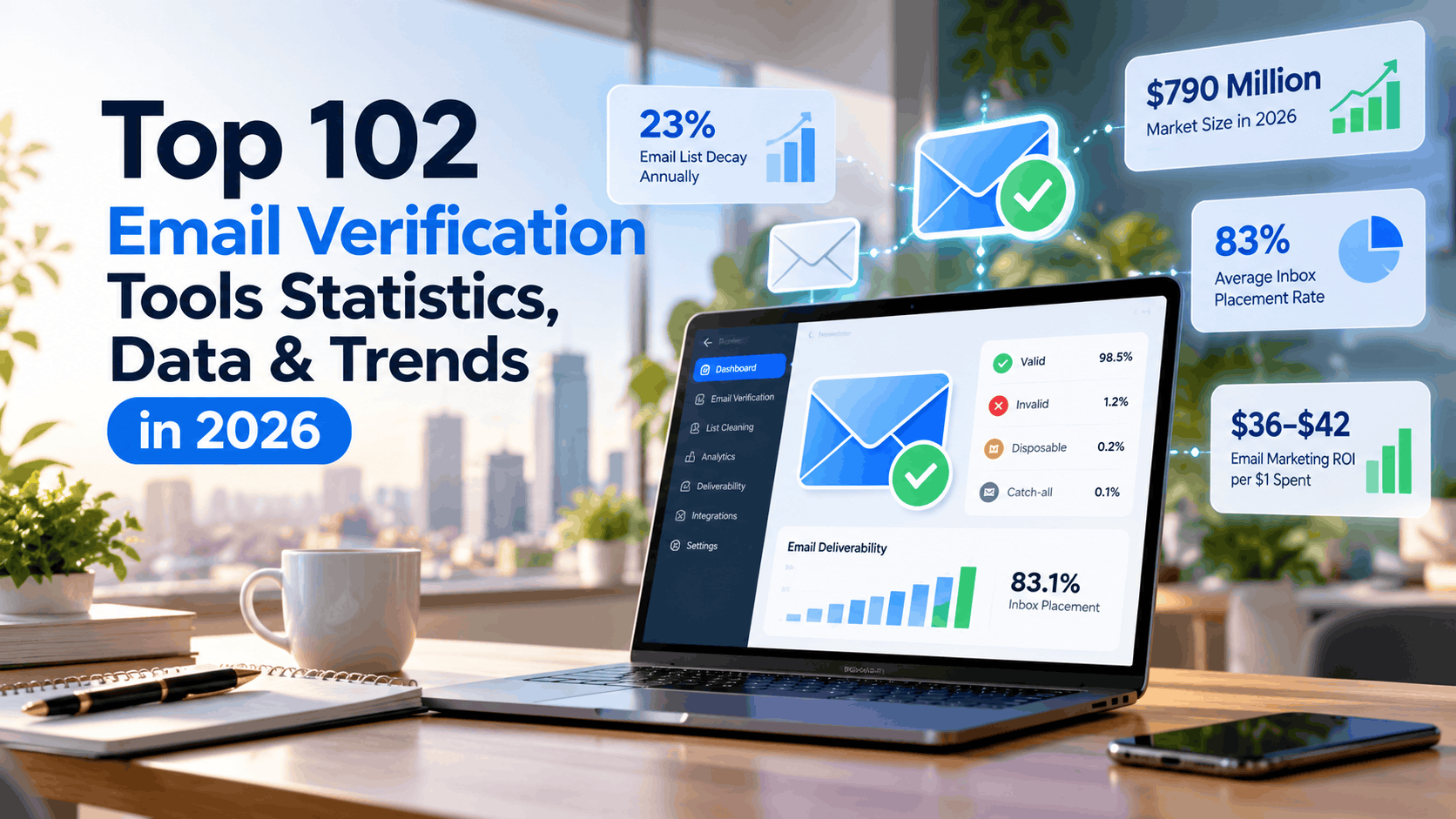
- Email Verification Market Growth: The global email verification software market is projected to reach $790 million in 2026, driven by rising demand for accurate contact data, automated email validation, and AI-powered verification tools.
- Email Deliverability and List Hygiene: Approximately 23% of email addresses become outdated annually, while average inbox placement rates hover around 83%, highlighting the importance of regular email list cleaning, bounce rate reduction, and sender reputation management.
- AI, Automation, and Email Marketing ROI: With email marketing generating an estimated $36–$42 for every $1 spent, businesses are increasingly adopting real-time email verification APIs, AI-driven validation, and automated data cleaning to improve campaign performance and marketing efficiency.
Email verification tools help businesses improve email deliverability, reduce bounce rates, and maintain accurate contact databases in 2026. Industry data shows that approximately 23% of email addresses become outdated annually, while global inbox placement averages around 83%. These 102 statistics highlight market growth, AI-powered verification, email list hygiene, and emerging industry trends.
Email verification tools have become an essential part of modern digital marketing, sales outreach, customer relationship management, and business communication. As businesses increasingly rely on email to acquire customers, generate leads, and maintain relationships, ensuring the accuracy and deliverability of email addresses has never been more important. In 2026, email verification software is evolving beyond basic address validation into sophisticated platforms powered by artificial intelligence (AI), machine learning, real-time verification APIs, and advanced email deliverability analytics.
Also, read our article on the Top 10 Email Verification Tools.

The global email verification software market continues to expand as organizations invest in improving data quality and protecting their sender reputations. According to market research estimates, the industry is projected to grow from approximately $710 million in 2025 to $790 million in 2026, representing a compound annual growth rate (CAGR) of around 10.4%. Other market forecasts suggest substantially higher valuations, reflecting differences in market definitions, product coverage, and research methodologies.
One of the biggest drivers behind the growing adoption of email verification tools is the rapid deterioration of contact databases. Industry data indicates that approximately 23% of email addresses become outdated or invalid within a year, creating significant challenges for businesses managing large mailing lists. Without regular email list cleaning and verification, organizations risk higher bounce rates, lower email deliverability, wasted marketing budgets, and declining sender reputations.


Email deliverability statistics further highlight the importance of maintaining accurate contact information. Research cited in industry benchmarks suggests that the global average inbox placement rate is approximately 83%, meaning a significant proportion of marketing emails fail to reach recipients’ primary inboxes. Meanwhile, email verification providers report that proactive list cleaning can substantially reduce bounce rates, helping businesses improve campaign performance and maintain healthier relationships with email service providers such as Gmail, Outlook, and Yahoo Mail.
The financial implications are equally significant. Email marketing continues to deliver strong returns, with industry estimates suggesting an average return on investment of $36 to $42 for every $1 spent. However, achieving these results depends on more than compelling email content and effective marketing automation. Accurate contact databases, proper email authentication, ongoing list hygiene, and reliable verification processes are increasingly important components of successful email marketing strategies.
In 2026, several emerging trends are reshaping the email verification software industry. AI-powered email validation, disposable email detection, catch-all domain analysis, real-time signup verification, automated CRM integrations, and advanced fraud prevention capabilities are becoming increasingly prominent. At the same time, stricter sender authentication requirements and data privacy regulations are encouraging organizations to adopt more comprehensive email verification and data management practices.
This article explores the Top 102 Email Verification Tools Statistics, Data & Trends in 2026, providing an in-depth examination of email verification market size, industry growth forecasts, email list decay rates, bounce rate benchmarks, email deliverability performance, marketing ROI, cybersecurity risks, regulatory developments, and emerging technologies.
Whether you are a digital marketer, sales professional, SaaS founder, email marketing specialist, or business leader evaluating the best email verification tools, these statistics offer valuable insights into the evolving email verification landscape. By understanding the latest email verification trends and industry benchmarks, businesses can make more informed decisions about email list management, improve campaign efficiency, reduce unnecessary costs, and develop more reliable, data-driven communication strategies in 2026 and beyond.
Before we venture further into this article, we would like to share who we are and what we do.
About 9cv9
9cv9 is a business tech startup based in Singapore and Asia, with a strong presence all over the world.
With over ten years of startup and business experience, and being highly involved in connecting with thousands of companies and startups, the 9cv9 team has listed some of the top and best companies/tools in this review.
If you like to get your company listed in our top B2B software reviews, check out our world-class 9cv9 Media and PR service and pricing plans here.
Top 102 Email Verification Tools Statistics, Data & Trends in 2026
🔵 Section 1: Market Size & Growth
1. The global email verification software market was valued at $1.28 billion in 2026, projected to reach $2.46 billion by 2035 at a 7.47% CAGR — reflecting the growing enterprise need for clean, deliverable contact data.
2. The market is expected to grow from $0.71 billion in 2025 to $0.79 billion in 2026 at a 10.4% CAGR, driven by rising email marketing adoption and cloud-based tool expansion.
3. The Global Email Verification Tools Market was valued at $124.95 million in 2024 and is projected to reach $232.44 million by 2032, growing at a CAGR of 8.90% — signaling durable mid-market demand for SMB-oriented tools.
4. Under a broader market definition, the email verification software market is projected to reach $3.5 billion by 2031 at a 15.8% CAGR, fuelled by automated list cleaning and API-driven verification services.
5. Spherical Insights projects the global Email Verification Tools Market to grow from $1.65 billion in 2025 to $7.12 billion by 2035 at a 15.74% CAGR — one of the highest growth forecasts in the martech stack.
6. The email verification tools market was valued at $2,180 million ($2.18 billion) in 2024, set to reach $5 billion by 2035 at a 7.8% CAGR (WiseGuy Reports), driven by data accuracy mandates across industries.
7. A bulk email verification market analysis places the 2025 baseline at $1.2–$1.4 billion, with base-to-best forecasts of $1.96–$2.67 billion by 2030 under 10.7%–13.8% CAGR scenarios.
8. The global email verification software market is expected to reach $1.03 billion by 2029 at a 9.6% CAGR (The Business Research Company), with cloud-based SaaS solutions leading segment growth.
9. Research and Markets forecasts the email verification software market will grow to $1.1 billion by 2030 at an 8.9% CAGR, driven by increasing regulatory compliance requirements and API-driven services.
10. A 2023 market contraction estimated at -15.4% YoY was followed by a confirmed 16.7% rebound in 2025, demonstrating resilience and strong structural demand in the verification sector.
11. The top five email verification providers collectively account for 47% of active deployments globally, indicating a moderately concentrated but competitive landscape in 2025.
12. Between 2023 and 2025, approximately 18% of vendors introduced API-driven verification enhancements to boost scalability, illustrating the tech evolution within the sector.
🔵 Section 2: Email List Decay & Data Quality
13. On average, at least 23% of an email list degrades within a single year (ZeroBounce 2026 data based on Jan–Dec 2025), meaning more than 1 in 5 contacts become invalid without active list maintenance.
14. Email database decay rates have escalated over recent years — from 22% in 2022, to 25% in 2023, 28% in 2024, and 23% in 2025 — highlighting an accelerating and cyclical hygiene challenge for marketers.
15. ZeroBounce detected 2.5 billion invalid email addresses globally in 2024, underscoring the massive scale at which email data quality deteriorates across businesses of all sizes.
16. Only 62% of verified email addresses in ZeroBounce’s dataset were valid and safe for sending in 2024, with the remaining 38% flagged as risky, invalid, or abusive.
17. ZeroBounce’s verification API detected over 10 million typographical errors in email addresses during 2024, illustrating how data entry issues compound list decay over time.
18. More than 5 million disposable email addresses were identified in 2024 — used by users to avoid providing real contact details and reducing database quality for marketers.
19. B2B contact data decays at rates between 22.5% and 70.3% annually, with email decay accelerating to 3.6% per month as of November 2024, creating unprecedented challenges for GTM teams.
20. Poor data quality costs U.S. businesses $3.1 trillion annually, with individual organizations losing $12.9–$15 million per year through wasted marketing spend and missed sales opportunities.
21. 70.8% of business contacts experience changes within 12 months — including 65.8% job title changes, 42.9% phone changes, and 37.3% email address changes — making ongoing verification essential.
22. Sales representatives waste 27.3% of their time (approximately 546 hours annually) pursuing bad leads sourced from decayed or unverified data, directly impacting revenue performance.
23. Clean, verified data drives 20% better campaign response rates, 15% higher close rates within six months, and 12% increased conversion rates compared to unverified contact lists.
24. Organizations using AI for data quality report 30% accuracy improvements in the first year, making AI-powered verification tools a strong ROI play for data-heavy enterprises.
25. Only 62% of email addresses analyzed by ZeroBounce across its entire customer base (including Amazon, Disney, Netflix) were valid and safe in 2024, a 1.9% improvement from the prior year.
🔵 Section 3: Email Deliverability
26. The global average inbox placement rate stands at 83.1%–83.5% per multiple independent benchmarks (EmailToolTester, Validity 2025), meaning nearly 1 in 6 marketing emails never reaches the intended inbox.
27. Gmail’s inbox placement rate declined from 89.8% in early 2024 to 87.2% by Q4 2024 following enforcement of new bulk-sender rules and stricter engagement-based filtering.
28. Microsoft Outlook has the lowest inbox placement rate among major providers at 75.6%, with spam rates exceeding 14% — making it the toughest inbox for email marketers to crack in 2025.
29. Apple Mail leads all major mailbox providers with a ~92% inbox placement rate, benefiting from its Mail Privacy Protection features that prioritize sender trust signals.
30. 45% of all global email traffic is classified as spam in 2026 per Kaspersky’s telemetry — reinforcing the necessity of email verification to separate legitimate senders from noise.
31. 10.5% of permission-based marketing emails are filtered directly to spam folders, never achieving inbox visibility with intended recipients and representing millions in wasted marketing investment.
32. Spam placement nearly doubled between Q1 and Q4 2024, jumping from 4.5% to 8.6% globally, driven by tightening ISP filters and evolving AI-based spam detection systems.
33. SPF authentication adoption hit 93% in 2026 (up from 88% in 2025), while DKIM reached 90% — however, DMARC remains stuck at 64%, leaving over one-third of sending domains unprotected.
34. Teams using verified email data achieve 94%+ inbox placement with under 3% bounce rates, compared to the 83.1% industry average — demonstrating the direct ROI of pre-send verification.
35. Germany leads global inbox placement at 97.5%, while India sits at just 71.0% — highlighting dramatic geographic variation that senders must account for in global campaigns.
36. Research across millions of test emails found that only 60% of sent emails reached a visible mailbox location in 2025, with the remainder landing in spam or going missing entirely.
37. Approximately 36% of all emails are filtered into spam folders globally, while about 4% are blocked or never delivered to any folder at all (Unspam.email 2025 Deliverability Report).
38. The global email delivery rate (server-acceptance metric) stands at 98.5% — but this diverges sharply from the 83.5% inbox placement rate, revealing a hidden deliverability gap most senders miss.
39. 39% of email marketers rarely or never conduct list hygiene, meaning nearly 4 in 10 senders are routinely operating with lists chronically near dangerous bounce thresholds (Validity 2025).
🔵 Section 4: Bounce Rates
40. The average email bounce rate across all industries is 2.48% per WebFX’s 2026 benchmark, but the target for healthy campaigns is below 2%, with below 1% considered ideal.
41. The average hard bounce rate globally is 0.19% for e-commerce, while soft bounces average 3.6% globally (Mailmend/Klaviyo data), with Klaviyo auto-suppressing profiles after 7 consecutive soft bounces.
42. A broad industry analysis (Total Product Marketing, Jan 2025) found the average bounce rate across all industries at 10.68%, reflecting the wide variation between well-maintained and neglected email lists.
43. Campaigns that verify email lists before sending can reduce bounce rates by more than 80%, and significantly improve response and inbox placement rates (Verified.email, 2026).
44. Bounce rates above 5% signal to ISPs that a list contains outdated or invalid addresses, triggering reputation penalties and causing more emails to land in spam folders — a compounding damage cycle.
45. A cold email practitioner case study showed a bounce rate dropping from 16% to under 2% after implementing real-time email verification, illustrating the transformative impact of list hygiene on deliverability.
46. In 2026, crossing the 2% hard bounce threshold has regulatory consequences as Gmail and Yahoo’s bulk sender enforcement frameworks were tightened in November 2025.
47. The spam complaint rate acceptable threshold is below 0.1%; Google recommends keeping it below 0.08%, and rates above 0.3% trigger active enforcement from both Gmail and Microsoft.
🔵 Section 5: Email Marketing ROI
48. Email marketing delivers an average ROI of $36–$42 for every $1 spent — the highest return of any digital marketing channel, outperforming paid search ($2), social ads ($2.80), and display ($1.35).
49. Omnisend merchants on paid plans averaged $79 for every $1 spent on email marketing in 2025, nearly double the industry benchmark — showcasing the ceiling for optimized programs.
50. 18% of companies report email marketing ROI greater than $70 per dollar invested (7,000%+ return), achieved primarily through automation, segmentation, and consistent A/B testing.
51. The retail, e-commerce, and consumer goods sector achieves the highest email ROI at $45 per dollar spent, while large businesses average $44 return per dollar (DMA).
52. Automated email workflows generate 30× higher returns compared to one-off broadcast campaigns, making automation the single highest-leverage investment in email marketing.
53. 42% of marketers rank email as their most effective marketing channel, well ahead of social media and paid search (16%) per industry benchmark reports.
54. Segmenting email campaigns can increase revenue by up to 760% versus non-segmented sends, amplifying the value of clean, accurately categorized contact lists.
55. 52% of consumers made a purchase directly from a marketing email in the past year, confirming email as a primary conversion channel for e-commerce businesses.
56. Shoppers who receive email marketing campaigns are likely to spend up to 138% more than those who don’t, highlighting the revenue multiplier effect of deliverable email.
57. 4.6 billion people used email globally in 2025, projected to grow to 4.73 billion by end of 2026 — making it the single largest addressable audience for digital marketing.
58. Over 376 billion emails are sent and received daily globally in 2025, a number expected to climb to 392 billion by end of 2026 (Statista/Stripo).
59. The average email open rate across 3.3 million+ campaigns stands at 42.35% per ActiveCampaign 2026 data, though Apple MPP inflation affects approximately 50–60% of recorded opens.
60. Automated emails account for 37% of all email-generated sales despite making up only 2% of total sends — the highest leverage ratio in email program design.
🔵 Section 6: Fraud, Phishing & Security
61. Cybercriminals distribute 3.4 billion phishing emails per day, making phishing the most widespread form of cybercrime in 2025 and the primary driver of demand for advanced email verification.
62. Business Email Compromise (BEC) scams cost U.S. businesses $3.05 billion in 2025 (24,768 complaints to FBI IC3), with an average loss of $160,000+ per incident.
63. The average phishing-related data breach cost $4.88 million in 2025, up nearly 10% year-over-year — making prevention via email verification a highly cost-effective security investment.
64. AI-driven phishing attacks surged 1,265% in 2025, with large language models reducing the time to create a convincing phishing campaign from 16 hours to just 5 minutes.
65. AI-generated phishing emails achieve up to 54% click rates versus 12% for traditionally written phishing emails, making sender authentication and verification critical defenses.
66. Global phishing losses total $25 billion annually in 2026 (SentinelOne), with $17,700 lost to phishing every single minute — creating urgent enterprise demand for email fraud prevention tools.
67. BEC volume surged 54% in H1 2025 compared to 2023 (Abnormal Security), driven by AI-generated content that makes fraudulent emails virtually indistinguishable from legitimate ones.
68. It takes an average of 254 days to identify and contain a breach that begins with a phishing attack, causing cascading financial and reputational damage over months of undetected compromise.
69. The Anti-Phishing Working Group (APWG) recorded 3.8 million unique phishing attack sites worldwide in 2025, exceeding 2024’s 3.76 million — a new annual record.
70. Spam costs businesses approximately $20.5 billion per year in lost productivity, with the average employee losing 2 workdays per year sorting through spam (SQ Magazine, 2025).
71. Over 90% of businesses globally experienced some form of phishing attack in 2024, up from 75% in 2020 — nearly universal exposure reinforcing the enterprise imperative for email security.
72. QR code phishing (quishing) hit 4.2 million observed threats in the first half of 2025, while Microsoft reported a 146% increase in QR phishing detections from January to March 2026.
🔵 Section 7: Compliance & Regulation
73. GDPR cumulative fines reached €5.88 billion since 2018, with €1.2 billion issued in 2024 alone — driving enterprises to invest in compliant, verified email data practices at scale.
74. The maximum GDPR fine is €20 million or 4% of global annual revenue (whichever is greater), making data accuracy a business-critical compliance requirement for multinationals.
75. CAN-SPAM violations can result in fines of up to $43,792 per non-compliant email sent, creating catastrophic financial exposure for high-volume senders operating without proper list hygiene.
76. CCPA violations result in fines of $2,663 per unintentional violation and $7,988 per intentional violation, with no cure period available for California companies after December 31, 2024.
77. 8 new comprehensive U.S. state privacy laws took effect in 2025 alone — including laws in Tennessee, Minnesota, Maryland, and others — each with unique email data handling requirements.
78. The UK’s Data Use and Access (DUA) Act signed in June 2025 increased maximum ICO fines to align with GDPR: £17.5 million ($24 million) or 4% of worldwide annual turnover.
79. Implementation of GDPR and CCPA regulations drove a 40% increase in the adoption of email verification tools that ensure data compliance, per PMarketResearch analysis.
80. 72% of European enterprises now use automated email validation tools to comply with GDPR and enhance data accuracy in their digital marketing systems (ENISA).
81. 95% of customers say they will not buy from a company if their personal data is not properly protected (Cisco 2025 Privacy Research) — making email compliance a revenue retention issue.
82. Gmail and Yahoo Mail enforced mandatory bulk sender authentication (SPF, DKIM, DMARC + low spam rate requirements) starting February 2024, with Gmail tightening enforcement further in November 2025.
🔵 Section 8: Technology Trends & Tool Capabilities
83. 62% of leading email verification providers now incorporate machine learning algorithms for enhanced detection of disposable and role-based email addresses as of 2025.
84. The adoption of syntax correction engines improved validation accuracy by 37% between 2023 and 2025, reducing false positives and improving campaign ROI for enterprise users.
85. Cloud-based deployment accounts for approximately 60–61% of total email verification implementations, with web-based models at 39%, reflecting the dominant preference for SaaS delivery.
86. Top tools report accuracy rates between 95% and 99.6% for detecting invalid addresses, though independent testing typically places real-world performance at 93–97% depending on domain types.
87. ZeroBounce claims 99.6% accuracy in detecting invalid and risky addresses, combining AI-powered scoring with DMARC monitoring and spam trap detection — the highest claimed accuracy in the market.
88. API pricing for email verification fell from approximately $25 per 10,000 verifications in 2019 to $2.50–$8.00 in 2026, driven by competitive commoditization and scale efficiencies.
89. ZeroBounce has validated over 25 billion email addresses across 400,000+ customers, with 60+ native integrations including HubSpot, Salesforce, Mailchimp, Klaviyo, and Zapier.
90. Catch-all domain prevalence ranges from 8.6% to 30% of B2B email lists, limiting verifiable accuracy for SMTP-based tools and creating a key differentiation point for AI-enhanced verification platforms.
91. The email verification market is entering a bifurcation: commodity bulk verification at near-zero margins versus intelligence-enriched platforms (deliverability scoring, DMARC analytics) commanding 3–5× premium pricing.
92. Real-time email verification at point-of-capture (web forms, signup pages) has surged as a product enhancement, preventing bad data from entering CRM systems entirely rather than requiring batch cleaning later.
🔵 Section 9: Regional & Competitive Landscape
93. North America holds approximately 35% of the total global email verification market share, driven by high concentration of tech companies and significant investments in marketing automation.
94. Europe accounts for 28% of the global market, with Germany, the UK, and France representing more than 70% of regional demand, propelled by strict GDPR enforcement.
95. Asia-Pacific holds 24% market share and is the fastest-growing region, driven by India, China, and Japan’s investments in cloud technologies, digital marketing, and expanding e-commerce.
96. Latin America and the Middle East & Africa collectively account for 13% of the global email verification market, with growing digital transformation initiatives supporting double-digit adoption growth.
97. 78% of large enterprises use cloud-based services for email verification versus only 44% of SMEs (Eurostat 2023/2025), highlighting a significant adoption gap in smaller organizations.
98. 74% of G2 email verification platform users are small businesses — confirming that SMBs represent the largest addressable audience for email verification vendors in terms of account volume.
99. The U.S. FTC recorded over 1.1 million phishing complaints in 2024, directly pushing organizations across sectors to adopt advanced email verification software to minimize fraudulent email interactions.
100. The total U.S. cybercrime loss reported to the FBI IC3 in 2025 reached $20.9 billion (1,008,597 complaints) — with Business Email Compromise as the single highest-dollar threat, making email authentication a board-level priority.
101. 39% of email marketers rarely or never conduct proper list hygiene (Validity 2025 Benchmark), creating a large, under-served market opportunity for email verification tool vendors targeting the mid-market.
102. The global email marketing industry is projected to grow from $9.7 billion in 2024 to $37.5 billion by 2032 (Statista), providing the primary demand engine for email verification tools over the decade ahead.
Conclusion
The Top 102 Email Verification Tools Statistics, Data & Trends in 2026 highlight the growing importance of email verification software in helping businesses maintain accurate contact databases, improve email deliverability, reduce bounce rates, and maximize marketing performance. As email remains one of the most widely used digital communication channels, organizations are increasingly recognizing that reliable email data is essential for successful marketing campaigns, sales outreach, and customer engagement.
The global email verification software market continues to demonstrate strong growth potential, with one industry forecast estimating a market value of approximately $790 million in 2026, supported by rising demand for automated email validation, cloud-based verification platforms, and AI-powered data quality solutions. Although market size estimates vary across research providers, the overall outlook points toward continued investment in email verification technologies as businesses prioritize efficient and reliable digital communication.
One of the most significant findings is the ongoing challenge of email list decay. Industry statistics suggest that approximately 23% of email addresses become outdated or invalid annually, emphasizing the need for continuous email list cleaning and database maintenance. Combined with an average global inbox placement rate of approximately 83%, these figures demonstrate how poor data quality can undermine email marketing effectiveness, damage sender reputations, and increase operational costs.
Email verification also plays an important role in improving marketing efficiency and return on investment. With email marketing generating an estimated $36 to $42 for every $1 spent, businesses have strong incentives to ensure their messages reach legitimate and active recipients. By implementing bulk email verification, real-time email validation APIs, and automated list hygiene processes, organizations can reduce unnecessary sending costs, minimize avoidable bounces, and support stronger campaign performance.
Looking ahead, artificial intelligence, machine learning, predictive deliverability scoring, and real-time email verification are expected to shape the next generation of email verification tools. Advanced platforms are expanding beyond traditional syntax checks and domain validation to incorporate disposable email detection, catch-all domain analysis, fraud risk assessment, and seamless CRM integrations. These developments will help businesses manage increasingly complex contact databases while improving the efficiency of their marketing and sales operations.
At the same time, evolving email authentication requirements, cybersecurity threats, and data privacy regulations are making responsible email data management increasingly important. Businesses must consider not only whether an email address is technically valid but also whether their outreach practices comply with applicable regulations and mailbox provider requirements. Email verification is an important component of this process, although it cannot replace proper consent management, sender authentication, or comprehensive cybersecurity protections.
Ultimately, the email verification statistics and trends for 2026 demonstrate that maintaining clean, accurate, and reliable email databases is no longer simply a technical consideration. It is an important business strategy that directly supports marketing efficiency, customer engagement, operational productivity, and long-term digital growth.
For digital marketers, SaaS companies, sales teams, e-commerce businesses, and enterprise organizations, the key takeaway is clear: investing in reliable email verification tools, adopting automated email list cleaning practices, and continuously monitoring email deliverability can create a stronger foundation for sustainable marketing success.
As email verification technology continues to evolve beyond 2026, businesses that combine AI-powered validation, proactive data quality management, and responsible email marketing practices will be better positioned to protect their sender reputations, improve campaign effectiveness, and maintain a competitive advantage in an increasingly data-driven digital economy.
If you find this article useful, why not share it with your hiring manager and C-level suite friends and also leave a nice comment below?
We, at the 9cv9 Research Team, strive to bring the latest and most meaningful data, guides, and statistics to your doorstep.
To get access to top-quality guides, click over to 9cv9 Blog.
To hire top talents using our modern AI-powered recruitment agency, find out more at 9cv9 Modern AI-Powered Recruitment Agency.
People Also Ask
What are email verification tools?
Email verification tools are software solutions that check email addresses for validity, accuracy, and deliverability. They identify invalid, disposable, and potentially risky addresses to help businesses maintain clean contact lists and improve email marketing performance.
What is the global email verification software market size in 2026?
One market estimate values the global email verification software market at approximately $790 million in 2026, up from $710 million in 2025. Other research firms report higher valuations because of differences in market definitions and methodologies.
How fast is the email verification tools market growing in 2026?
Industry forecasts suggest annual growth rates ranging from approximately 7% to 16%, depending on the market segment and research methodology. Growth is supported by demand for email automation, accurate customer data, and real-time verification.
What are the latest email verification statistics for 2026?
Key statistics include an estimated 23% annual email list decay rate, approximately 83% average inbox placement, and a projected email verification software market value of $790 million. These figures highlight the importance of maintaining accurate email databases.
Why is email verification important for businesses in 2026?
Email verification helps businesses reduce bounced emails, protect sender reputation, improve contact database accuracy, and minimize wasted marketing spending. It also supports more reliable sales outreach and customer communication.
What percentage of email addresses become invalid each year?
Industry data from ZeroBounce suggests that approximately 23% of email addresses become outdated or invalid annually. Regular email list verification helps businesses identify inactive contacts and maintain more accurate marketing databases.
What is the average email deliverability rate in 2026?
Industry benchmarks place average inbox placement at approximately 83%. This means around 17% of marketing emails may not reach recipients’ inboxes. Actual performance varies by sender reputation, authentication, engagement, and list quality.
What is the average email bounce rate in 2026?
One industry benchmark reports an average email bounce rate of approximately 2.48%. However, rates vary significantly across industries and campaigns. Many email marketers aim for bounce rates below 2%, with rates below 1% considered particularly healthy.
How do email verification tools reduce bounce rates?
Email verification tools identify invalid addresses, syntax errors, inactive domains, and potentially undeliverable contacts before campaigns begin. Some providers report bounce rate reductions exceeding 80% after implementing systematic email verification.
What is the difference between email verification and email validation?
Email validation typically checks address formatting, syntax, and domain structure. Email verification goes further by assessing mail server configuration, mailbox deliverability, disposable addresses, and other indicators of email reliability.
How accurate are email verification tools in 2026?
Leading email verification providers advertise accuracy rates between 95% and 99.6%. Actual performance depends on verification methods, mailbox providers, catch-all domains, and the quality of the email database being analyzed.
What are the biggest email verification trends in 2026?
Major trends include AI-powered email verification, real-time validation APIs, automated list cleaning, disposable email detection, catch-all domain analysis, CRM integrations, and advanced deliverability scoring.
How is artificial intelligence changing email verification software?
AI helps email verification platforms analyze address patterns, identify suspicious contacts, detect disposable emails, and improve risk classification. Machine learning also supports automated data cleaning and more sophisticated deliverability assessments.
What is real-time email verification?
Real-time email verification checks email addresses immediately when users submit online forms, create accounts, or enter contact information. This helps prevent invalid or disposable addresses from entering CRM systems and marketing databases.
What is bulk email verification software?
Bulk email verification software checks thousands or millions of email addresses in batches. Businesses use it to clean existing contact databases, identify invalid addresses, reduce bounce rates, and prepare mailing lists for marketing campaigns.
How much does email verification software cost in 2026?
Email verification pricing depends on verification volume, features, and providers. The source data cites bulk API pricing estimates of approximately $2.50 to $8 per 10,000 checks, although actual commercial rates can vary substantially.
What is an email verification API?
An email verification API allows applications, websites, and CRM systems to check email addresses automatically. Developers use verification APIs to validate registrations, clean contact records, and improve data quality without manual processing.
What are disposable email addresses?
Disposable email addresses are temporary or short-lived addresses often used for one-time registrations. Email verification tools identify these addresses to help businesses reduce low-quality signups, fraudulent registrations, and unreliable contact records.
What is a catch-all email domain?
A catch-all domain accepts messages sent to multiple or potentially nonexistent mailbox names. This makes individual address verification difficult. Industry estimates suggest catch-all domains may account for approximately 8.6% to 30% of some B2B email lists.
How does email verification improve sender reputation?
Email verification helps remove invalid and potentially harmful addresses before sending. Lower bounce rates and cleaner contact lists can support a healthier sender reputation, although engagement, authentication, and complaint rates also matter.
Can email verification tools improve email marketing ROI?
Email verification can improve marketing efficiency by reducing wasted sends and improving contact data quality. Industry estimates place average email marketing returns at $36 to $42 per dollar spent, although verification alone does not guarantee these results.
How often should businesses verify their email lists?
Businesses should verify email lists regularly, particularly before major campaigns and after extended periods of inactivity. High-volume senders may benefit from continuous verification because contact databases can deteriorate significantly throughout the year.
What is the difference between hard bounces and soft bounces?
Hard bounces generally indicate permanent delivery failures, such as nonexistent mailboxes. Soft bounces represent temporary issues, including full inboxes or unavailable servers. Email verification primarily helps prevent avoidable hard bounces.
What are the best email verification tools for businesses in 2026?
Popular email verification platforms include ZeroBounce and other services offering bulk validation, real-time APIs, disposable email detection, and CRM integrations. The best choice depends on accuracy, pricing, verification volume, and integration requirements.
How does email verification support GDPR compliance?
Email verification supports GDPR data accuracy principles by helping organizations maintain correct contact information. However, verification does not establish consent or a lawful basis for processing personal data, so additional compliance measures remain necessary.
What are the email authentication requirements in 2026?
Major mailbox providers increasingly require proper SPF, DKIM, and DMARC configurations, especially for bulk senders. Gmail and Yahoo introduced stricter requirements in 2024, making authentication and low spam complaint rates essential.
Which region has the largest email verification software market share?
The source estimates North America holds approximately 35% of the global email verification market, followed by Europe at 28% and Asia-Pacific at 24%. These figures reflect one market segmentation estimate rather than a universal industry benchmark.
How does email verification help prevent email fraud?
Email verification can identify suspicious, disposable, and malformed addresses that may indicate fraudulent registrations. However, it cannot independently prevent phishing, business email compromise, or account takeover attacks.
What is the difference between email delivery rate and inbox placement rate?
Email delivery rate measures whether receiving servers accept messages, while inbox placement measures whether messages reach inboxes rather than spam folders. Industry estimates cite approximately 98.5% delivery versus 83.5% inbox placement.
What is the future of email verification tools beyond 2026?
Email verification tools are expected to become more automated, AI-driven, and integrated with marketing platforms. Real-time validation, predictive deliverability scoring, fraud detection, and privacy-conscious data management will likely shape future development.
Sources
Research and Markets
Business Research Insights
Spherical Insights
Verified Market Research
OpenPR
Market Research Intellect
Industry Research Biz
The Business Research Company
ZeroBounce
MediaPost
Landbase
BounceShield
Verified.email
Validity
Omnisend
Prospeo
Unspam.email
Messageflow
ActiveCampaign
WebFX
DemandSage
Marketful
CodeCrew
SQ Magazine
Keepnet Labs
StationX
Zensec
GetMailbird
MailForge
Instantly
Guideflow
PuzzleInbox
ZoomInfo Pipeline
Mailmend
FBI Internet Crime Complaint Center (IC3)