Key Takeaways
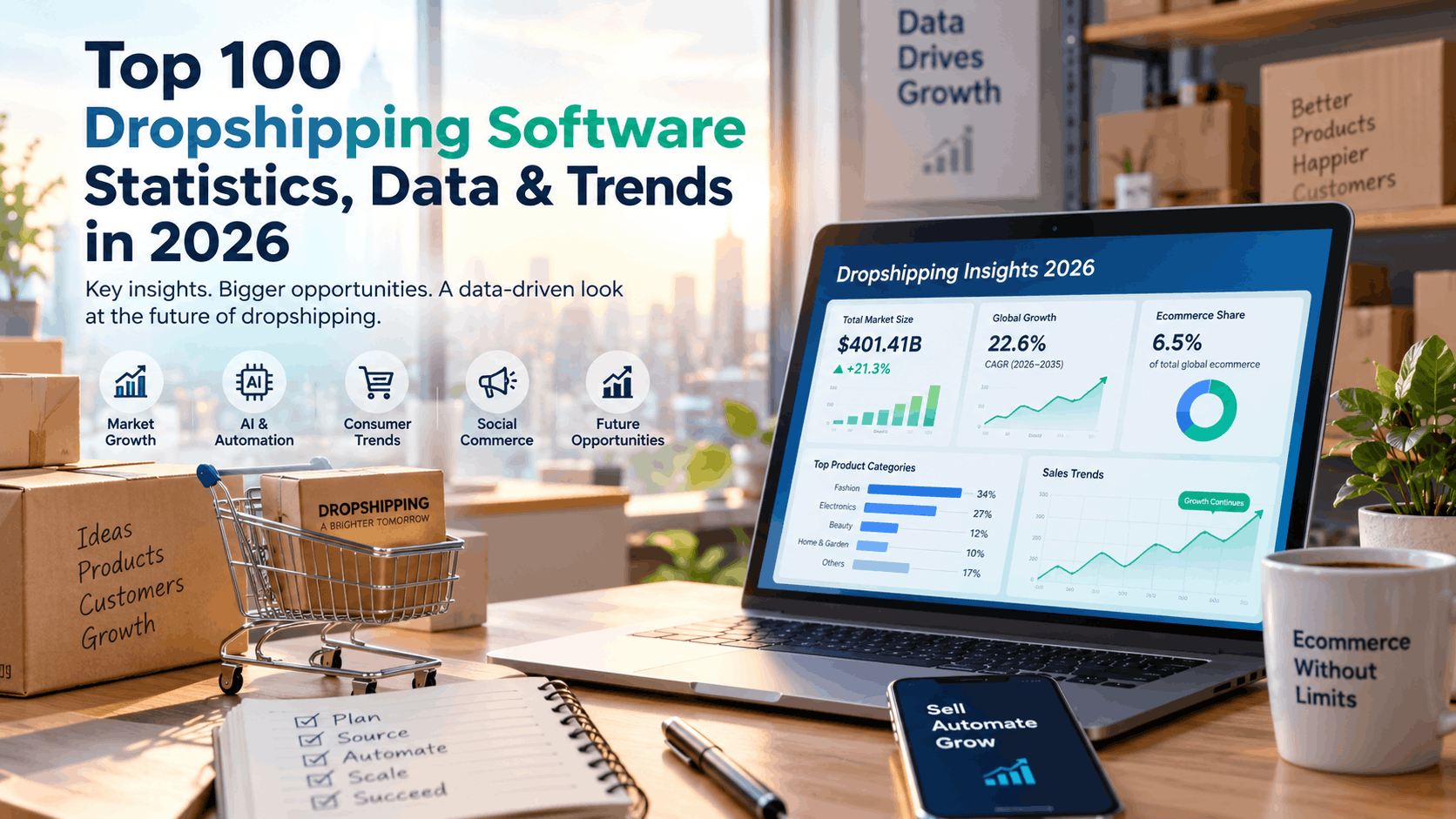
- Dropshipping Software Market Growth: The global dropshipping industry continues expanding rapidly in 2026, creating stronger demand for scalable ecommerce platforms, automation tools, and supplier technologies.
- AI and Automation Are Reshaping Dropshipping: 79% of successful dropshippers use automated order processing, highlighting the growing importance of AI, dynamic pricing, inventory automation, and streamlined fulfillment.
- Social Commerce and Customer Experience Drive Success: Mobile shopping, TikTok Shop, social media advertising, faster delivery, and reliable suppliers are becoming critical competitive factors for dropshipping businesses in 2026.
Dropshipping software transforms ecommerce operations in 2026 by automating product sourcing, inventory management, pricing, order processing, fulfillment, and marketing. With AI adoption accelerating and successful sellers increasingly relying on automation, these platforms are becoming essential for merchants seeking greater efficiency, faster scaling, and stronger competitiveness in the global dropshipping market.
The dropshipping industry is entering 2026 as one of the most dynamic segments of global ecommerce, driven by rapid market expansion, artificial intelligence, automation, social commerce, changing consumer expectations, and increasingly sophisticated software ecosystems. The statistics behind this transformation reveal an industry that is becoming larger, more competitive, and more dependent on technology. The global dropshipping market is projected to reach approximately $401.41 billion in 2026 according to one estimate, while other forecasts point toward substantially larger valuations depending on market definitions and methodology. Longer-term projections suggest the industry could eventually surpass $1 trillion, highlighting the enormous commercial opportunity surrounding dropshipping platforms, automation tools, suppliers, marketplaces, and ecommerce infrastructure.
Also, read our article on the Top 10 Dropshipping Software To Try.

Software has become particularly important as dropshipping operations grow more complex. The data shows that hundreds of thousands of Shopify stores already use dropshipping applications, while major platforms such as DSers, Zendrop, Doba, SaleHoo, AutoDS, and other solutions collectively support millions of merchants. Automation is also reshaping everyday operations, from product sourcing and inventory synchronization to order processing, dynamic pricing, fraud prevention, customer communication, and fulfillment. According to the statistics compiled for this report, 79% of successful dropshippers use automated order-processing systems, while AI adoption across ecommerce is rapidly expanding.
At the same time, the dropshipping software market in 2026 is being influenced by powerful shifts in consumer behavior. Mobile devices account for 74% of traffic to dropshipping stores, 62% of customers expect delivery within three days, and 96% of customers are reportedly willing to return following a positive delivery experience. These expectations are placing greater pressure on merchants to adopt real-time tracking, local supplier networks, automated fulfillment systems, mobile-optimized storefronts, pricing intelligence, and customer-service technologies.


Marketing channels are changing just as quickly. Social commerce is projected to become a multi-trillion-dollar global market, while platforms such as TikTok Shop, Instagram, Facebook, Shopify, WooCommerce, Amazon, and AliExpress are increasingly interconnected with the dropshipping ecosystem. The dataset also indicates that paid advertising, influencer partnerships, email marketing, reviews, upselling, referral programs, and social commerce integrations have become important components of the modern dropshipping technology stack. Profitable stores may operate six to ten software applications simultaneously, demonstrating how far the business model has evolved from simply listing supplier products on an online store.
However, strong market growth does not guarantee success. The statistics also highlight significant challenges surrounding supplier reliability, shipping delays, low margins, fraud, customer service, pricing pressure, and intense competition. Estimates in the dataset suggest that 80% to 90% of new dropshipping businesses fail during their first year, while only a small proportion reach exceptionally high monthly revenues. These figures underline why product research, supplier management, automation, analytics, pricing optimization, marketing technology, and operational discipline are becoming increasingly important competitive advantages.
In this comprehensive guide to the Top 100 Dropshipping Software Statistics, Data & Trends in 2026, we examine the numbers shaping the industry, including dropshipping market size and growth, software adoption, AI and automation, profitability, product categories, consumer behavior, social commerce, marketing trends, operational challenges, regional developments, platform adoption, and the future of dropshipping technology. Together, these statistics provide a data-driven view of where the dropshipping software industry stands in 2026 and where this rapidly evolving ecommerce ecosystem could be heading next.
Before we venture further into this article, we would like to share who we are and what we do.
About 9cv9
9cv9 is a business tech startup based in Singapore and Asia, with a strong presence all over the world.
With over ten years of startup and business experience, and being highly involved in connecting with thousands of companies and startups, the 9cv9 team has listed some of the top and best companies/tools in this review.
If you like to get your company listed in our top B2B software reviews, check out our world-class 9cv9 Media and PR service and pricing plans here.
Top 100 Dropshipping Software Statistics, Data & Trends in 2026
MARKET SIZE & GROWTH (Stats 1–10)
- The global dropshipping market is projected to reach $514.3 billion in 2026 — entrepreneurs and ecommerce brands entering the dropshipping space in 2026 are positioned to ride one of the largest commerce waves in history. (ResearchNester, 2025)
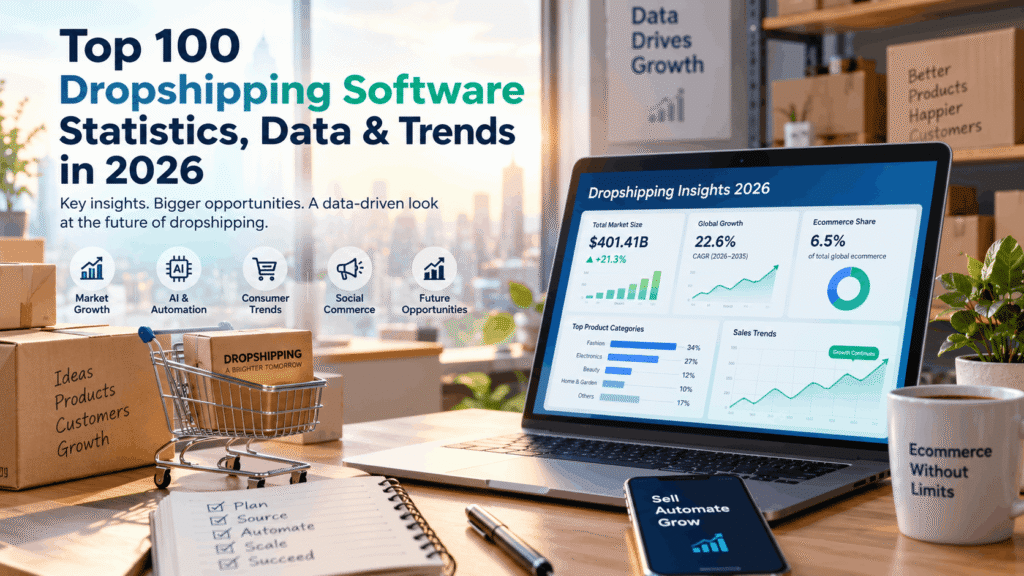
- The dropshipping market will grow from $330.86 billion in 2025 to $401.41 billion in 2026 at a 21.3% CAGR — indicating that year-on-year momentum is accelerating, not slowing. (The Business Research Company, 2026)
- By 2030, the global dropshipping market is projected to reach $828 billion to $1.25 trillion — giving platform developers and investors an extraordinarily long runway for growth. (Grand View Research / Mordor Intelligence)
- IMARC Group projects the dropshipping market will hit $2.32 trillion by 2034 at a 21.4% CAGR — making it one of the most durable, structurally growing models in the history of ecommerce. (IMARC Group, 2025)
- The dropshipping market accounts for 6.5% of total global ecommerce as of 2026 — a share that is expanding as brands shift away from inventory-heavy fulfillment models. (SellersCommerce, 2026)
- 75% of all ecommerce sales in 2026 are expected to be facilitated through dropshipping or a marketplace model — fundamentally transforming the supply chain logistics landscape. (Whop, 2026)
- North America’s dropshipping market is growing at a 22.6% CAGR from 2026–2035, powered by advanced logistics, high consumer spending, and strong ecommerce infrastructure. (Global Market Insights, 2025)
- Asia-Pacific commanded 46.4% of global dropshipping revenue in 2025 and will expand at 25.3% CAGR through 2035 — making it the single most important region for dropshipping software localization. (Fundamental Business Insights, 2024)
- Europe’s dropshipping market, led by Germany at ~20% annual growth, represents ~$78 billion in 2026 — with demand for faster, locally-sourced fulfillment driving adoption of EU-supplier platforms. (ZIK Analytics / Thunderbit, 2026)
- China’s dropshipping market alone is projected to reach $136.7 billion by 2027, cementing its dual role as the world’s manufacturing capital and largest dropshipping origin point. (Carro Blog, 2026)
PLATFORM & SOFTWARE LANDSCAPE (Stats 11–20)
- The dropshipping automation software market was valued at $1.434 billion in 2025, projected to grow to $1.972 billion by 2034 — a steadier but reliable growth rate that reflects software maturation. (24MarketReports, 2025)
- As of February 2025, ~2.5 million ecommerce stores ran on Shopify, with 477,849 stores (19%) having at least one dropshipping app installed. (Whop, 2026)
- DSers-AliExpress Dropshipping is the most popular dropshipping app on Shopify with 25% of all installs (119,188 stores) — making AliExpress-native software the dominant choice for Shopify merchants. (Whop, 2026)
- DSers has helped over 4.5 million dropshippers start and scale their stores, having processed over 220 million orders and saving sellers 97% of their manual ordering time. (Whop, 2026)
- Zendrop serves 3 million+ dropshippers, has fulfilled over $100 million in orders, and provides access to 1M+ products — making it one of the fastest-scaling automation tools. (Whop, 2026)
- Doba — one of the largest US-focused dropshipping platforms — serves over 890,000 dropshippers, with 90% of products locally stocked in the US for fast domestic fulfillment. (Whop, 2026)
- WooCommerce holds 25% of the dropshipping platform market, making it the second most popular platform behind Shopify and a key target for dropshipping plugin developers. (EasyAppsEcom, 2026)
- Alibaba led global dropshipping platform market share at 12.8% in 2025, while the top 5 players collectively held only 13.9% — confirming the dropshipping software market remains highly fragmented. (Global Market Insights, 2025)
- The percentage of Shopify stores using dropshipping apps grew from 5.16% to 12.82% — a 148% adoption increase that reflects explosive mainstream acceptance of the dropshipping model. (StatsUp / Analyzify, 2025)
- SaleHoo serves 137,000+ dropshippers with 8,000+ vetted suppliers and 1.6M branded products — illustrating the premium market segment that values curation over raw product volume. (Whop, 2026)
AI & AUTOMATION (Stats 21–28)
- 79% of successful dropshippers use automated order processing systems — and those systems reduce manual errors by approximately 94%, making automation the single biggest operational differentiator. (Wix Blog, 2026)
- By 2025, 33% of ecommerce sellers had fully integrated AI into their operations, while another 47% were experimenting with AI for specific tasks — meaning 80% of the industry is actively AI-enabled. (Statista / Wix Blog, 2026)
- Automated pricing tools help dropshippers increase profit margins by an average of +23% through real-time dynamic pricing — a measurable ROI that makes pricing software a must-have investment. (Wix Blog, 2026)
- Sellers using automation platforms can fulfill up to 969 orders per month without manual processing — enabling one-person operations to achieve volumes that previously required entire teams. (ZIK Analytics, 2026)
- AutoDS launched new AI smart recommendations and anti-fraud features in July 2025 — reflecting the growing investment in merchant protection and personalization within dropshipping software. (ResearchNester, 2025)
- DSers’ strategic partnership with TikTok Shop, Shopify, and WooCommerce in August 2024 enabled one-click bundle automation — signaling the convergence of social commerce and dropshipping automation. (ResearchNester, 2025)
- DropSure added multi-platform integration (Shopify, WooCommerce, TikTok) in December 2025, reducing the number of separate tools sellers need and further consolidating the dropshipping software stack. (Global Market Insights, 2025)
- Approximately 4.7 million warehouse robots were installed across 50,000+ warehouses globally in 2026 — a supply chain automation wave that directly lowers fulfillment costs for all dropshipping models. (SellersCommerce, 2026)
PROFITABILITY & REVENUE (Stats 29–37)
- Dropshipping stores generate 50% more profit than traditional inventory-based retail stores — the financial advantage that makes this model so attractive to new and experienced entrepreneurs alike. (Cloudways / Whop, 2026)
- Typical dropshipping gross profit margins range 10–30%, with a sweet spot around 15–20% for well-optimised stores — thin but viable with the right product selection and software. (Thunderbit / Wix Blog, 2026)
- The average profit margin per transaction for successful dropshippers is 25% — achieved through a combination of smart supplier selection, dynamic pricing tools, and upsell software. (Whop, 2026)
- In a 2024 survey of 350 manufacturers, net profit margins averaged 12.2% on dropshipped goods vs. 10.3% on direct online sales — an 18.33% profit advantage for dropshipping manufacturers. (SellersCommerce, 2026)
- Only 1.5% of dropshipping stores earn more than $50,000 per month in revenue — underscoring that the elite tier of dropshipping businesses requires sophisticated tooling, branding, and operational discipline. (StatsUp / Analyzify, 2025)
- High-ticket dropshipping stores can achieve up to 10x more revenue than standard stores by selling premium, high-margin products — making niche specialisation a powerful growth strategy. (Whop, 2026)
- Amazon dropshipping profit margins averaged 20% in 2024 — with beginners at 10% and experienced sellers at ~30% — a clear indicator that software-aided optimisation directly improves financial outcomes. (Whop, 2026)
- 56% of Amazon dropshippers took longer than 6 weeks to get their store operational — highlighting the onboarding time advantage that purpose-built dropshipping platforms offer over marketplace-native setups. (Whop, 2026)
- 54% of Amazon dropshippers spend over 20 hours per week on their stores, and 25% spend 40+ hours — making automation software critical for sustainable work-life balance in this business model. (Whop, 2026)
TOP PRODUCT CATEGORIES (Stats 38–46)
- Fashion and apparel leads all dropshipping categories with a $802.33 billion projected market value by 2025, growing at 23.4% CAGR through 2030 — fueled by social media trends and influencer commerce. (Carro Blog / Mordor Intelligence, 2026)
- Beauty and personal care is the second-largest dropshipping niche at a $672.2 billion market size — driven by skincare demand, organic product trends, and repeat purchase behaviour. (Carro Blog, 2026)
- Fashion and apparel accounted for 34% of all dropshipping revenue in 2026, while electronics held 27% — together making up over 60% of the entire category mix. (Mordor Intelligence / Thunderbit, 2026)
- The home and garden dropshipping segment generates higher average order values and lower niche competition — representing ~18% of revenue share and a strong opportunity for focused software automation. (EasyAppsEcom, 2026)
- Electronics account for 30% of the North American dropshipping market but saw a 2% decline in ecommerce visits in 2024, signaling intensifying competition and the need for better pricing software. (Carro Blog / Whop, 2026)
- Printful has shipped over 99 million items between 2013 and 2025, growing monthly orders by 1,280% — validating print-on-demand as a highly scalable, software-driven dropshipping niche. (Whop, 2026)
- 80% of consumers are willing to pay a premium for eco-friendly products — making sustainable goods one of the fastest-growing niches for dropshipping entrepreneurs in 2026. (Thunderbit, 2026)
- The Luxury and Jewelry ecommerce category saw the highest YoY visit growth at 16% in 2024 — signaling a strong opportunity for high-ticket dropshipping and premium supplier platforms. (Whop / Similarweb, 2026)
- Food and personal care is a high-growth niche within dropshipping, with FMCG brands increasingly using dropshipping software to manage micro-fulfillment and DTC product launches. (Mordor Intelligence, 2025)
CONSUMER BEHAVIOR & TRENDS (Stats 47–55)
- 74% of all traffic to dropshipping stores comes from mobile devices in 2026 — making mobile-first store themes and one-click checkout the most impactful conversion optimisations available. (Dropship.io / Carro, 2026)
- 96% of customers will return to a store after a positive delivery experience — making real-time shipping tracking, automated updates, and reliable logistics the most powerful retention tools in dropshipping. (Carro Blog, 2026)
- 62% of customers expect delivery within 3 days — a logistical challenge for overseas-sourced dropshipping that is directly driving demand for US/EU-based supplier platforms and local fulfillment software. (Carro Blog, 2026)
- 63% of Amazon shoppers select the product with the lowest price — making real-time dynamic repricing software the most critical competitive tool on price-sensitive marketplace channels. (Whop, 2026)
- 2.77 billion people shop online in 2025, rising to 2.86 billion by 2026 — this expanding global shopper base represents the core demand engine that makes dropshipping a structurally growing business model. (Carro Blog / Webandcrafts, 2026)
- 21% of all retail purchases were made online in 2025, with global ecommerce surpassing $6.3 trillion — providing the vast, growing ocean in which dropshipping stores compete for share. (Whop, 2026)
- The average annual revenue per online shopper reached $1,620 in 2024, a 5% year-over-year increase — enabling dropshippers using upsell software to extract significantly more value per customer. (Whop / Similarweb, 2026)
- 83% of dropshipping revenue in 2024 came from B2C consumers, while SMEs contributed 17% — though B2B dropshipping is now a fast-emerging segment for wholesale automation software. (Whop, 2026)
- 73% of consumers are more likely to purchase after watching a livestream shopping event — making real-time social commerce integration a high-ROI feature for modern dropshipping platforms. (Carro Blog, 2026)
MARKETING & SOCIAL COMMERCE (Stats 56–66)
- The global social commerce market is projected to reach $2.9 trillion by 2026, growing at 36.4% annually — making social-native selling the fastest new channel for dropshipping product discovery. (Carro Blog, 2026)
- 68% of dropshipping stores get the majority of their traffic from Meta (Facebook/Instagram) ads — making ad management and ROAS-tracking software the most commercially critical tool in the marketing stack. (Carro Blog / Thunderbit, 2026)
- Dropshipping stores with at least one active social media account generate 32% higher revenue than those without — a statistic that makes social integration features essential for any dropshipping platform. (TheContentKettle / StatsUp, 2025)
- 17%+ of all online sales in 2025 occur through social platforms like TikTok Shop and Instagram Shopping — a channel that dropshipping software platforms are racing to natively support. (Carro Blog, 2026)
- US social commerce is expected to surpass $100 billion in 2026, with TikTok Shop emerging as the fastest-growing dropshipping discovery and conversion platform for Gen Z consumers. (Carro Blog, 2026)
- Email marketing apps are installed by 79% of top US Shopify stores, with Klaviyo leading at 61% — demonstrating that automated email retention software is as important as the dropshipping tool itself. (Affinco / ZIK Analytics, 2026)
- 76% of Shopify dropshipping stores use product review apps — reflecting how social proof software directly translates into higher conversion rates and reduced paid advertising dependency. (Whop, 2026)
- 85%+ of dropshippers rely on paid ads or influencer partnerships as their primary traffic source — making ROI tracking and ad analytics features central to any serious dropshipping software evaluation. (Thunderbit, 2026)
- BNPL (Buy Now, Pay Later) reached a $340+ billion total market size in 2025 — and dropshipping stores integrating BNPL payment software see measurable increases in cart conversion and average order value. (Carro Blog, 2026)
- 93% of all web sessions begin with a search engine — making AI-generated, SEO-optimised product descriptions a key automated feature that modern dropshipping software must deliver. (Carro Blog, 2026)
- The social commerce growth rate of 36.4% per year is more than double the ecommerce average — signaling that dropshipping software without TikTok/Instagram native integrations will be structurally disadvantaged by 2027. (Carro Blog, 2026)
CHALLENGES, RISK & SUCCESS RATES (Stats 67–78)
- 80–90% of new dropshipping businesses fail within the first year — primarily due to poor niche selection, unreliable suppliers, and underuse of automation software that could prevent common mistakes. (Thunderbit / Carro, 2026)
- 84% of ecommerce retailers cite finding reliable suppliers as their biggest dropshipping challenge — which is precisely the pain point that vetted-supplier platforms like SaleHoo and Spocket are built to solve. (Blog.4sgm.com / Carro, 2026)
- In a 2025 survey of 3,161 global store owners, 64% identified shipping delays as their #1 operational pain point — driving strong demand for software with real-time carrier tracking and delivery date automation. (SellersCommerce, 2026)
- Global ecommerce fraud losses are projected to reach $48 billion in 2025 — making anti-fraud and chargeback protection features in dropshipping software an increasingly urgent commercial priority. (Carro Blog, 2026)
- 52% of dropshippers report low margins as a major operational hurdle — reinforcing why automated cost management, bulk pricing tools, and supplier comparison software are top-priority investment areas. (SellersCommerce, 2026)
- Supplier reliability is a pain point for 48% of store owners globally — a persistent challenge that creates strong demand for software platforms with built-in supplier vetting and performance scoring. (SellersCommerce, 2026)
- Customer service exposure affects 37% of dropshippers — and automated chatbot integration, order-status notification tools, and AI-powered ticket management software directly address this business vulnerability. (SellersCommerce, 2026)
- Google Trends interest in “dropshipping” hovered between 70–75 throughout 2024–2025, indicating steady, sustained demand rather than hype — reassuring signal for long-term software investment. (SellersCommerce / Google Trends, 2026)
- First-time small business owners have an 18% dropshipping success rate that improves to 20% on a second attempt — demonstrating that learning from failure and upgrading tooling directly improves business outcomes. (Cloudways / Carro, 2026)
- 24% of dropshippers were small business owners in 2023, with 38% being Gen Z entrepreneurs — meaning dropshipping software must be designed for digitally-native, mobile-first, cost-sensitive users. (Whop, 2026)
- Only 10% of dropshipping businesses achieve profitability in their first year — but those that persist and invest in the right software tools see second-attempt success rates meaningfully improve. (ZIK Analytics / Carro, 2026)
- The bottom 10% of eBay dropshippers actually lose money on every sale due to platform fees and poor pricing strategy — a preventable outcome that automated repricing software directly addresses. (ZIK Analytics, 2026)
REGIONAL & ECOMMERCE CONTEXT (Stats 79–87)
- The US dropshipping market is valued at approximately $95 billion in 2026, supported by the world’s most mature ecommerce logistics infrastructure and the highest per-capita online spending. (EasyAppsEcom, 2026)
- Asia-Pacific’s $125 billion dropshipping market in 2026 is the world’s fastest-growing region at 25.3% CAGR — with China, India, and Southeast Asia generating the majority of supply-side volume. (Fundamental Business Insights, 2024)
- Europe represents ~$78 billion in dropshipping revenue in 2026, led by Germany — a market increasingly focused on local supplier platforms due to regulatory pressure and consumer expectations for fast delivery. (ZIK Analytics / Thunderbit, 2026)
- Global ecommerce sales reached $7.4 trillion in 2025 and are projected to hit $8.0 trillion by 2027 — providing the expanding commercial ocean in which the dropshipping market continues to grow its share. (LinkedIn / Carro Blog, 2026)
- China’s ecommerce market represents $3.45 trillion with 47% online retail penetration — making Chinese supplier platforms like AliExpress and CJ Dropshipping foundational infrastructure for the global dropshipping ecosystem. (Carro Blog, 2026)
- Mexico’s ecommerce has grown 30% year-over-year historically, while Latin America and MEA collectively represent under 10% of dropshipping revenue — but are growing rapidly as mobile internet access expands. (Carro Blog, 2026)
- US ecommerce retail sales grew 5.3% year-over-year in Q2 2025 and represented 16.3% of total retail — reinforcing the structural tailwind supporting US-based dropshipping software demand. (Global Market Insights / US Census, 2025)
- 63% of dropshipping stores are located in the US, while 34% are in Asia-Pacific — reflecting the global concentration of Shopify-based sellers but the geographic diversity of supply chains. (Whop, 2026)
- The UK ecommerce market was valued at £286 billion in 2025, making it the third-largest ecommerce economy globally and a major addressable market for European-focused dropshipping software solutions. (Carro Blog, 2026)
SOFTWARE ECOSYSTEM & FUTURE OUTLOOK (Stats 88–100)
- The average profitable dropshipping store runs 6–10 software apps simultaneously — covering inventory, pricing, email, reviews, and analytics — illustrating the richness and necessity of the dropshipping software ecosystem. (EasyAppsEcom, 2026)
- 65% of successful stores use email popup software (like spin-to-win apps converting at 5–12%) to grow their list — making zero-cost email capture tools among the highest-ROI software additions available. (EasyAppsEcom, 2026)
- 58% of profitable dropshipping stores use upsell and cross-sell software to increase revenue per order — a direct technique to improve margins without increasing customer acquisition costs. (EasyAppsEcom, 2026)
- 52% of stores use free shipping bar software, which increases average order value by 15–30% — making it one of the simplest, highest-impact software upgrades any dropshipping store can make. (EasyAppsEcom, 2026)
- 38% of Shopify dropshipping stores use rewards and referral apps, while 24% use personalisation software — reflecting a growing sophistication in how dropshipping operators approach retention and LTV optimisation. (Whop, 2026)
- Logicbroker’s acquisition of Cortina in January 2024 signals growing consolidation in the dropshipping software market, with enterprise-grade players acquiring fulfillment automation capabilities. (Global Market Insights, 2025)
- Fiverr’s acquisition of AutoDS in July 2024 — giving the platform access to 150M+ products — signals a strategic convergence between the freelancing economy and dropshipping automation platforms. (Global Market Insights, 2025)
- SaaS-based delivery has lowered the barrier to the dropshipping automation tool market, intensifying competition around AI-driven product research, supplier ecosystems, and multi-platform integrations. (24MarketReports, 2025)
- The dropshipping automation tool market will grow from $1.434B (2025) to $1.972B (2034) at a 4.9% CAGR — a slower but highly defensible growth rate reflecting SaaS platform maturity and recurring revenue models. (24MarketReports, 2025)
- B2B dropshipping is emerging as a high-growth sub-segment, with wholesale-oriented suppliers projected to post the highest 17.4% CAGR through 2030 — creating new software demand for B2B automation and EDI integration. (Mordor Intelligence, 2025)
- Online marketplaces accounted for 52% of dropshipping channel share in 2024, while social-commerce platforms are advancing at a 27.1% CAGR — rapidly closing the gap with traditional marketplace channels. (Mordor Intelligence, 2025)
- The B2C segment represented 71% of the dropshipping market in 2024, but B2B adoption is accelerating rapidly — representing the next major expansion frontier for enterprise-grade dropshipping software platforms. (Mordor Intelligence, 2025)
- By 2035, Asia-Pacific is expected to capture 36.4% of the global dropshipping market — supported by rising internet users, higher disposable incomes, and a fast-expanding ecommerce infrastructure that will drive massive demand for localised dropshipping software solutions. (ResearchNester, 2025)
Conclusion
The dropshipping software industry in 2026 reflects a broader transformation taking place across global ecommerce. As dropshipping expands into a market worth hundreds of billions of dollars, merchants are increasingly relying on software to automate product sourcing, order processing, inventory synchronization, pricing, marketing, fulfillment, analytics, customer support, and supplier management. The 100 dropshipping statistics examined throughout this report demonstrate that technology is no longer simply supporting the dropshipping business model; it is becoming fundamental to how competitive stores operate and scale.
Automation is one of the clearest trends shaping the market. The data indicates that 79% of successful dropshippers use automated order-processing systems, while automation can reduce manual errors by approximately 94%. AI adoption is also spreading throughout ecommerce, with sellers experimenting with or fully implementing artificial intelligence across areas such as product research, recommendations, pricing, fraud detection, marketing, and operational workflows. Major dropshipping platforms are simultaneously expanding their integrations with Shopify, WooCommerce, TikTok Shop, and other commerce channels.
Consumer expectations are accelerating this technological shift. With 74% of dropshipping store traffic coming from mobile devices, 62% of customers expecting delivery within three days, and 96% reportedly willing to return following a positive delivery experience, merchants face growing pressure to deliver faster and more transparent shopping experiences. Supplier quality, localized fulfillment, automated tracking, mobile optimization, accurate inventory information, and efficient customer communication will therefore remain important areas of software investment.
The statistics also show that succeeding in dropshipping remains far from easy. Shipping delays, unreliable suppliers, low margins, customer-service pressures, ecommerce fraud, and intense competition continue to challenge operators. An estimated 80% to 90% of new dropshipping businesses fail within their first year, while only 1.5% of stores reportedly generate more than $50,000 in monthly revenue. These figures reinforce an important lesson for 2026: market growth alone does not guarantee individual merchant profitability. Strong product selection, reliable suppliers, disciplined marketing, effective pricing, customer experience, and operational efficiency remain critical.
Another important development is the increasing complexity of the dropshipping software ecosystem itself. The dataset indicates that an average profitable dropshipping store may operate six to ten software applications simultaneously, covering functions such as inventory, pricing, email marketing, reviews, analytics, upselling, referrals, and customer retention. Meanwhile, social commerce, AI-powered automation, multi-platform integrations, B2B dropshipping, local supplier networks, and SaaS-based tools are creating new opportunities for both merchants and software providers.
Looking beyond 2026, the long-term outlook remains substantial. Forecasts cited in the dataset place the global dropshipping market somewhere between $828 billion and $1.25 trillion by 2030, depending on the research methodology, while another projection estimates a market worth $2.32 trillion by 2034. Asia-Pacific is expected to remain a major growth engine, while B2B dropshipping and social-commerce channels represent emerging expansion opportunities.
Ultimately, the Top 100 Dropshipping Software Statistics, Data & Trends in 2026 reveal an industry moving from relatively simple ecommerce arbitrage toward a highly automated, data-driven and increasingly interconnected commerce ecosystem. The businesses positioned to benefit most from this evolution will likely be those that use technology strategically rather than simply adding more tools. For dropshippers, ecommerce brands, SaaS developers, suppliers, investors, and industry professionals, understanding these trends will be essential for identifying opportunities, managing risks, and competing effectively as the global dropshipping market continues to evolve.
If you find this article useful, why not share it with your hiring manager and C-level suite friends and also leave a nice comment below?
We, at the 9cv9 Research Team, strive to bring the latest and most meaningful data, guides, and statistics to your doorstep.
To get access to top-quality guides, click over to 9cv9 Blog.
To hire top talents using our modern AI-powered recruitment agency, find out more at 9cv9 Modern AI-Powered Recruitment Agency.
People Also Ask
What is dropshipping software?
Dropshipping software helps ecommerce sellers automate product sourcing, inventory updates, pricing, order processing, fulfillment, tracking, marketing, and other tasks involved in running a dropshipping business.
How big is the dropshipping market in 2026?
One estimate projects the global dropshipping market to grow from $330.86 billion in 2025 to $401.41 billion in 2026, representing a 21.3% compound annual growth rate.
How fast is the dropshipping market growing?
Several forecasts indicate strong long-term growth. One projection estimates a 21.4% CAGR through 2034, while North America is forecast to grow at 22.6% annually from 2026 to 2035.
What is the future of the dropshipping market?
Long-term forecasts cited in the data place the global dropshipping market between $828 billion and $1.25 trillion by 2030, while another projection estimates $2.32 trillion by 2034.
How large is the dropshipping automation software market?
The dropshipping automation software market was valued at approximately $1.434 billion in 2025 and is projected to reach about $1.972 billion by 2034.
How many Shopify stores use dropshipping apps?
As of February 2025, approximately 477,849 Shopify stores had at least one dropshipping app installed, representing around 19% of the roughly 2.5 million ecommerce stores running on Shopify.
What is the most popular dropshipping app on Shopify?
DSers-AliExpress Dropshipping was identified as the most popular Shopify dropshipping app in the dataset, accounting for approximately 25% of installs, or 119,188 stores.
How many dropshippers use DSers?
DSers has reportedly helped more than 4.5 million dropshippers start and scale their stores while processing over 220 million orders and significantly reducing manual ordering work.
How popular is Zendrop among dropshippers?
Zendrop reportedly serves more than 3 million dropshippers, has fulfilled over $100 million in orders, and provides merchants with access to more than one million products.
How important is automation for dropshipping in 2026?
Automation is increasingly important, with 79% of successful dropshippers reportedly using automated order-processing systems. These systems can reduce manual errors by approximately 94%.
How is AI changing dropshipping software?
AI is expanding across ecommerce operations, including product recommendations, pricing, fraud prevention, research, and automation. By 2025, 33% of ecommerce sellers had fully integrated AI and another 47% were experimenting with it.
Can dropshipping software improve profit margins?
The dataset reports that automated pricing tools can increase dropshipping profit margins by an average of 23% through dynamic pricing, helping merchants respond more efficiently to changing costs and market conditions.
What are typical dropshipping profit margins?
Typical dropshipping gross profit margins range from approximately 10% to 30%, with well-optimized stores commonly targeting around 15% to 20%.
What is the average profit margin for successful dropshippers?
The statistics indicate that successful dropshippers can achieve an average profit margin of approximately 25% per transaction through supplier selection, pricing optimization, upselling, and efficient operations.
How many dropshipping stores make over $50,000 per month?
Only around 1.5% of dropshipping stores reportedly generate more than $50,000 per month, demonstrating how difficult it can be to reach the industry’s highest revenue levels.
What percentage of dropshipping businesses fail?
An estimated 80% to 90% of new dropshipping businesses fail within their first year, with poor niche selection, unreliable suppliers, and insufficient automation identified among the major challenges.
What percentage of dropshipping businesses become profitable in the first year?
The dataset estimates that only around 10% of dropshipping businesses achieve profitability during their first year, emphasizing the importance of execution, persistence, supplier quality, and appropriate software.
What is the biggest challenge for dropshipping businesses?
Finding reliable suppliers is a major challenge, with 84% of ecommerce retailers reportedly identifying supplier reliability as their biggest dropshipping difficulty.
How common are shipping delays in dropshipping?
Shipping delays remain a major operational problem. In a 2025 survey of 3,161 global store owners, 64% identified shipping delays as their number-one operational pain point.
How important is mobile commerce for dropshipping?
Mobile commerce is critical because approximately 74% of traffic to dropshipping stores comes from mobile devices, making mobile-friendly storefronts and streamlined checkout experiences essential.
How fast do dropshipping customers expect delivery?
Approximately 62% of customers expect their orders to arrive within three days, increasing demand for local suppliers, faster fulfillment networks, automated tracking, and accurate delivery estimates.
How important is delivery experience for dropshipping customer retention?
The dataset reports that 96% of customers will return to a store after a positive delivery experience, highlighting the importance of reliable fulfillment, tracking, communication, and shipping performance.
How important is social commerce for dropshipping in 2026?
Social commerce is becoming increasingly important, with the global market projected to reach $2.9 trillion in 2026. TikTok Shop, Instagram, and other social platforms are becoming major product discovery and sales channels.
How many dropshipping stores rely on social media advertising?
Approximately 68% of dropshipping stores reportedly receive most of their traffic from Meta advertising, while more than 85% of dropshippers rely primarily on paid ads or influencer partnerships.
Which product categories are popular for dropshipping?
Fashion and apparel remain major categories, accounting for a reported 34% of dropshipping revenue in 2026, while electronics represent 27%. Beauty, home and garden, jewelry, and personal care are also important segments.
How many software apps does a profitable dropshipping store use?
The average profitable dropshipping store reportedly operates six to ten software applications covering areas such as inventory, pricing, email marketing, reviews, analytics, upselling, and customer retention.
What dropshipping software features are important in 2026?
Important features include automated order processing, inventory synchronization, dynamic pricing, supplier management, shipment tracking, AI recommendations, analytics, fraud prevention, and multi-platform integrations.
Is B2B dropshipping growing?
Yes. B2B dropshipping is emerging as a growth segment, with wholesale-oriented suppliers projected to record a 17.4% CAGR through 2030, creating demand for B2B automation and EDI integrations.
Which region is growing fastest for dropshipping?
Asia-Pacific is a major growth region. The dataset estimates a roughly $125 billion market in 2026 and cites a 25.3% CAGR, supported by ecommerce expansion across China, India, and Southeast Asia.
What are the biggest dropshipping software trends for 2026?
Key trends include AI-powered automation, dynamic pricing, social commerce integration, localized fulfillment, supplier vetting, multi-platform selling, fraud prevention, B2B dropshipping, and increasingly integrated software stacks.
Sources
ResearchNester The Business Research Company Grand View Research Mordor Intelligence IMARC Group SellersCommerce Global Market Insights Fundamental Business Insights Whop Carro Blog Thunderbit ZIK Analytics EasyAppsEcom StatsUp / Analyzify Wix Blog Affinco 24MarketReports TrueProfit Research and Markets Capterra India