

Key Takeaways
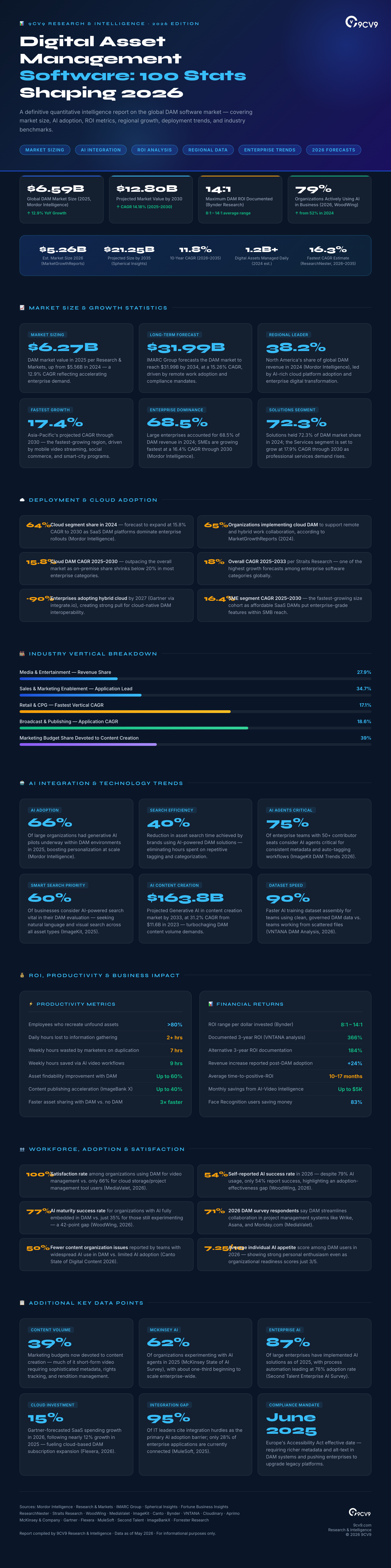
- Rapid Market Growth: The digital asset management software market is expanding at double-digit rates, driven by cloud adoption, rising digital content volumes, e-commerce growth, and increasing enterprise demand for centralized asset management.
- AI Is Transforming DAM: AI-powered search, automated metadata, smart tagging, video intelligence, and compliance automation are becoming core DAM capabilities, with AI solutions capable of reducing asset search time by up to 40%.
- Strong ROI and Productivity Gains: DAM platforms can deliver an estimated 8:1 to 14:1 ROI per dollar invested, while improving asset reuse, collaboration, content publishing speed, governance, and overall marketing productivity.
Digital asset management software transforms how organizations organize, find, govern, and distribute rapidly growing volumes of digital content in 2026. With the global DAM market estimated at $6.48 billion in 2026, rising cloud adoption and AI-powered search, tagging, metadata, and automation are making DAM increasingly important for modern content operations.
Digital asset management software is becoming an essential part of the modern business technology stack as organizations create, store, distribute, and govern rapidly growing volumes of images, videos, documents, product media, creative files, and AI-generated content. In 2026, the rise of generative AI, cloud computing, e-commerce, remote collaboration, and omnichannel marketing is making effective digital asset management (DAM) increasingly important for businesses of all sizes.
Also, read our article on the Top 10 Best Digital Asset Management Software.


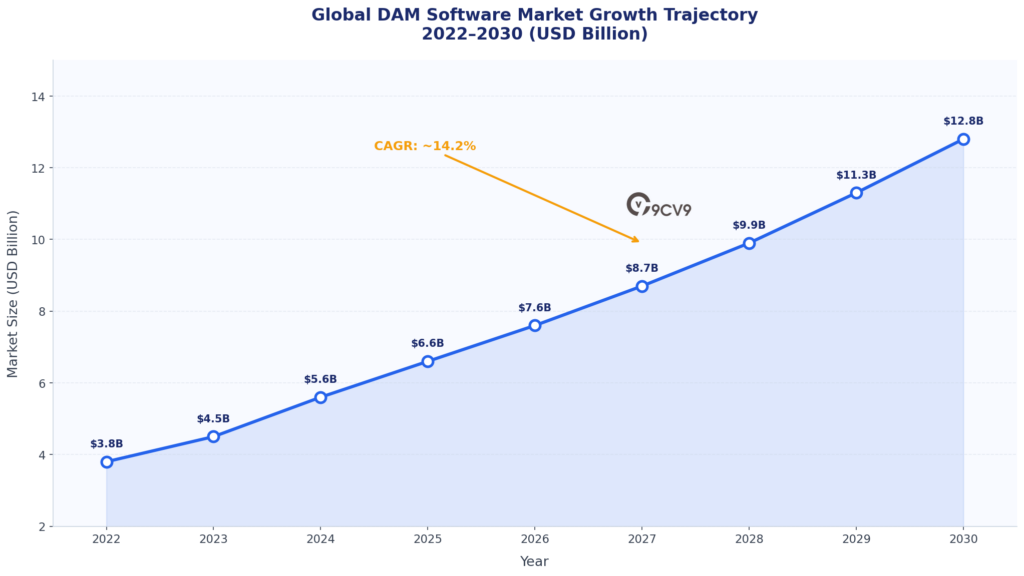
The numbers reveal just how quickly the industry is expanding. ResearchNester estimates the global digital asset management market at approximately $6.48 billion in 2026, while other industry forecasts expect the market to reach anywhere from $12.80 billion by 2030 to more than $31 billion by 2034. Depending on the research methodology and market definition, projected compound annual growth rates frequently fall between approximately 11% and 18%.
Cloud adoption is one of the biggest forces behind this expansion. Cloud-based DAM accounted for 64% of market revenue in 2024, while more than 65% of organizations have implemented cloud-based DAM systems to support remote collaboration. Small and medium-sized businesses are also becoming an increasingly important customer segment, with SME DAM adoption forecast to grow at a 16.4% CAGR from 2025 to 2030.

Artificial intelligence is creating another major transformation.
According to the statistics compiled in this report, 79% of organizations are actively using AI within their businesses in 2026, while 60% consider AI-powered search an important capability when evaluating or switching DAM platforms.
AI-powered solutions can reduce asset search time by as much as 40%, while AI-generated metadata, automated tagging, video intelligence, face recognition, content provenance, and compliance monitoring are changing how organizations manage enormous asset libraries.
The potential business impact extends far beyond better file organization. DAM research cited in the dataset reports returns ranging from 8:1 to 14:1 for every dollar invested, while average time to positive ROI can range from approximately 10 to 17 months. Meanwhile, more than 80% of employees have reportedly recreated assets because they could not locate existing files, highlighting the substantial productivity costs associated with fragmented digital content.
DAM adoption is also spreading across industries. Media and entertainment accounted for 27.9% of the DAM market in 2024, while sales and marketing enablement represented 34.7% of application revenue. Retail and CPG is forecast to be among the fastest-growing end-user segments, alongside increasing adoption across publishing, financial services, healthcare, IT, telecom, and e-commerce.
Yet adoption alone does not guarantee success. One of the most revealing digital asset management trends for 2026 is the gap between AI usage and AI effectiveness. While 79% of organizations report active AI usage, self-reported AI success in DAM stands at only 54%. Organizations with AI fully embedded into their DAM workflows report a 77% success rate compared with just 35% among organizations still experimenting with the technology.
This collection of the Top 100 Digital Asset Management Software Statistics, Data & Trends in 2026 examines the numbers shaping the DAM industry, including global market size and growth forecasts, cloud adoption, artificial intelligence, ROI and productivity, enterprise and SME adoption, industry trends, organizational readiness, and emerging technologies such as headless DAM and blockchain-verified content provenance. Together, these statistics provide a data-driven view of where digital asset management stands in 2026 and where the market could be heading next.
Before we venture further into this article, we would like to share who we are and what we do.
About 9cv9
9cv9 is a business tech startup based in Singapore and Asia, with a strong presence all over the world.
With over ten years of startup and business experience, and being highly involved in connecting with thousands of companies and startups, the 9cv9 team has listed some important and crucial software tools in this review.
If you like to get your company listed in our top B2B software reviews, check out our world-class 9cv9 Media and PR service and pricing plans here.
Top 100 Digital Asset Management Software Statistics, Data & Trends in 2026
📈 MARKET SIZE & GROWTH (Stats 1–18)
1. The global DAM software market reached $5.56 billion in 2024 and is forecast to grow to $6.27 billion in 2025 at a CAGR of 12.9%.
The consistent double-digit growth rate confirms that DAM has crossed from “nice-to-have” to business-critical infrastructure, particularly as content production volumes continue to surge.
2. The DAM market is projected to reach $9.5 billion by 2029 (Research & Markets), implying sustained 11% CAGR from 2025.
Even under conservative forecasts, the DAM market is set to nearly double within five years — signaling durable structural demand rather than short-term hype.
3. IMARC Group estimates the global DAM market at $7.73 billion in 2025, projected to reach $31.99 billion by 2034 at a 15.26% CAGR.
The wide range across research firms reflects differing scope definitions — but all agree on the direction: rapid, sustained growth with no inflection in sight.
4. Mordor Intelligence values the DAM market at $6.59 billion in 2025, forecasting $12.80 billion by 2030 at a CAGR of 14.18%.
The Mordor estimate, one of the most widely cited, positions DAM as among the fastest-growing enterprise software categories globally in this decade.
5. Spherical Insights projects DAM software to grow from $6.94 billion in 2025 to $21.25 billion by 2035, at an 11.8% CAGR.
A 3× market expansion in ten years underscores the structural tailwinds: content inflation, AI-fueled workflows, and mandatory governance across regulated industries.
6. MarketGrowthReports estimates the DAM software market at $5.26 billion in 2026, reaching $18.47 billion by 2035 at a 14.6% CAGR.
Despite variation across research firms, the 14–15% CAGR consensus represents one of the strongest sustained growth profiles in the broader enterprise software universe.
7. Fortune Business Insights pegs the global DAM market at $5.36 billion in 2025, forecast to hit $19.36 billion by 2034 at a CAGR of 15.1%.
At this pace, the DAM market will more than triple in nine years — driven by cloud migration, AI-native product launches, and expanding regulatory requirements.
8. ResearchNester reports the DAM market exceeded $5.65 billion in 2025, projected to surpass $25.58 billion by 2035 at a 16.3% CAGR.
The 16%+ growth projection is among the most bullish in the sector, reflecting ResearchNester’s view that mobile-driven content consumption is a more powerful accelerant than currently priced in.
9. The DAM market is evaluated at $6.48 billion in 2026 (ResearchNester), making it already a significant enterprise software segment.
At $6.5B in a single year, DAM now rivals established categories like marketing automation and digital experience platforms in terms of annual spend.
10. Straits Research forecasts the global DAM market to grow from $6.77 billion in 2025 to $25.48 billion by 2033 at an 18% CAGR.
An 18% CAGR is rare even among high-growth software verticals — Straits attributes this to the convergence of AI, cloud, and e-commerce content demands simultaneously hitting an inflection point.
11. The global DAM market was expected to grow from $3.97 billion in 2023 to $12.29 billion by 2030 (MediaValet baseline), implying compounding value creation.
Even by the industry’s own mid-range estimates, DAM is on course to represent a $12B+ annual market within this decade — validating continued platform investment.
12. Over 1.2 billion digital assets are managed daily globally as of 2024 (MarketGrowthReports).
This staggering daily volume illustrates why manual file management has become functionally impossible at enterprise scale without purpose-built DAM infrastructure.
13. The DAM market is projected at $6.23 billion in 2025 with a 15.4% CAGR to reach $14.51 billion by 2031 (VNTANA).
The VNTANA estimate aligns with industry consensus — and the $14B+ 2031 figure suggests that organizations delaying DAM adoption will face increasingly steep competitive disadvantages.
14. North America leads the DAM market with a 38.2% revenue share in 2024 (Mordor Intelligence).
North America’s dominance reflects a mature ad-tech ecosystem, high per-user content spend, and early adoption of AI-rich cloud suites among Fortune 500 firms.
15. Asia-Pacific is the fastest-growing DAM region, forecast to advance at a 17.4% CAGR through 2030 (Mordor Intelligence).
Surging smartphone penetration, social commerce expansion, and government smart-city content programs are the primary drivers of Asia-Pacific’s outperformance.
16. North America is forecast to hold more than 35% of global DAM share through 2035 (ResearchNester).
With deep AI infrastructure and the world’s largest concentration of digital-first brands, North America’s structural leadership in DAM adoption appears durable through at least 2035.
17. Europe’s DAM growth is anchored by accessibility mandates and strict privacy frameworks, including the EU Accessibility Act effective June 2025.
European DAM demand is uniquely compliance-driven — vendors who build alt-text, metadata richness, and GDPR tools into their core platforms are gaining structural share in this region.
18. The Generative AI in content creation market — a key DAM demand driver — was valued at $11.6 billion in 2023 and is projected to reach $163.8 billion by 2033 at a 31.2% CAGR.
Generative AI’s explosive content output directly amplifies the need for DAM: more assets created per day means the cost of disorganization scales exponentially without proper management.
☁️ DEPLOYMENT & CLOUD (Stats 19–30)
19. The cloud segment accounted for 64% of DAM market revenue in 2024 and is forecast to expand at 15.8% CAGR through 2030 (Mordor Intelligence).
Cloud is the de facto standard for new DAM deployments — its 15.8% CAGR outpacing the overall market means on-premise share will continue to erode rapidly.
20. Over 65% of organizations implemented cloud-based DAM systems to facilitate remote collaboration as hybrid work became a permanent model (MarketGrowthReports).
The shift to permanent hybrid work has been arguably the single most important structural driver of cloud DAM adoption since 2021 — and that shift is irreversible.
21. Approximately 90% of enterprises are expected to adopt hybrid cloud infrastructure by 2027 (Gartner, via Integrate.io).
Hybrid cloud’s near-universal enterprise adoption creates a strong compatibility requirement for DAM platforms to operate seamlessly across multi-cloud environments.
22. 89% of enterprises currently employ multi-cloud strategies, with most using multiple public cloud providers (Flexera 2026 State of the Cloud).
Multi-cloud complexity is a DAM integration challenge and opportunity simultaneously — platforms with strong API-first architecture and pre-built cloud connectors command premium valuations.
23. Cloud-based SaaS DAM requires less IT support to set up, use, and maintain than on-premise installations, a key SME adoption driver (Digital Project Manager, 2026).
For cost-constrained SMEs, the reduced IT overhead of SaaS DAM often represents the tipping point in the build-vs-buy decision — favoring commercial platforms.
24. The SME DAM segment is forecast to grow at 16.4% CAGR from 2025 to 2030 — the fastest size cohort — driven by affordable SaaS pricing (Mordor Intelligence).
SME adoption of DAM is accelerating as cloud-native platforms bring enterprise-grade features to organizations with under 250 employees at accessible price points.
25. Large enterprises accounted for 68.5% of total DAM market revenue in 2024 (Mordor Intelligence).
While enterprises dominate current revenue, the faster SME growth rate signals a democratization of DAM — expanding the total addressable market significantly within five years.
26. Gartner reports nearly 12% growth in overall SaaS spending in 2025 and forecasts an additional 15% increase in 2026 (Flexera 2026 State of Cloud).
The broader SaaS spending surge directly benefits cloud DAM vendors — enterprise budgets are expanding, not contracting, in this software category despite macroeconomic headwinds.
27. 83% of respondents in the Flexera 2026 State of Cloud survey are running significant or some workloads in AWS, the leading cloud host for enterprise DAM integrations.
AWS’s dominance as a cloud substrate means DAM platforms with native AWS integrations — S3 storage, CloudFront CDN, Rekognition AI — hold a practical implementation advantage.
28. DAM solutions are available as cloud-based SaaS (most common today), on-premise, or hybrid models, with cloud-native architectures becoming the enterprise standard (Acquia, 2026).
The architectural direction of the market is settled: cloud-native wins for most deployments, with on-premise retained only in heavily regulated sectors with strict data-residency requirements.
29. Increasing penetration of internet services is cited as a key growth driver for cloud DAM expansion through 2029 (Research & Markets).
Global internet penetration — now exceeding 65% — broadens the DAM addressable market significantly, particularly in emerging economies where digital content creation is accelerating.
30. The cloud DAM segment’s 15.8% CAGR outpaces the broader market’s 14.18% overall CAGR, confirming cloud deployment as the engine of market share gain (Mordor Intelligence).
In practical terms, every percentage point of market growth in DAM over the next five years disproportionately accrues to cloud-native vendors — making this a structurally advantaged segment.
🤖 AI INTEGRATION & FEATURES (Stats 31–50)
31. 79% of organizations are actively using AI within their business in 2026, up from 52% experimenting in 2024 (WoodWing State of AI in DAM, 2026).
AI adoption has moved from experimentation to production deployment in just two years — a pace of enterprise technology diffusion without modern precedent.
32. Generative AI pilots are underway in 66% of large organizations for DAM personalization at scale as of 2025 (Mordor Intelligence).
Two-thirds of large enterprises have already begun testing generative AI within their DAM environments — suggesting rapid capability deployment within two to three years.
33. AI-powered solutions help brands reduce asset search time by up to 40% (Mordor Intelligence / Aprimo AI in DAM, 2026).
A 40% reduction in search time compounds massively across large marketing organizations — translating to thousands of freed employee-hours annually.
34. 75% of enterprise teams with 50+ contributor seats consider AI agents critical for metadata consistency and auto-tagging (ImageKit DAM Trends, 2026).
For large content teams, AI agents are no longer a premium feature — they’re table stakes. Organizations without AI auto-tagging face exponential manual overhead as content volumes scale.
35. 60% of businesses consider AI-powered search a vital capability when evaluating or switching DAM platforms (ImageKit DAM Trends, 2025).
Natural language and visual search have fundamentally changed user expectations for DAM interfaces — keyword-only search is now considered legacy behavior by most enterprise buyers.
36. AI teams working with clean, governed DAM data build training datasets up to 90% faster than teams working from scattered files (VNTANA, 2026).
Data governance inside DAM systems is becoming a strategic AI enabler — well-tagged, rights-cleared asset libraries directly accelerate machine learning workflows downstream.
37. 100% of organizations using AI-powered Video Intelligence features in DAM are expanding their digital presence (MediaValet DAM Trends, 2025).
The correlation between Video Intelligence adoption and digital expansion is striking — suggesting that AI-powered video DAM is a catalyst rather than merely a supporting tool.
38. 83% of organizations using Face Recognition within DAM report measurable cost savings (MediaValet DAM Trends, 2025).
Face Recognition in DAM reduces the manual labor of identifying talent across large media libraries — delivering direct cost savings that are measurable and attributable.
39. McKinsey’s 2025 State of AI survey found 62% of organizations are experimenting with AI agents, with about one-third beginning enterprise-wide scaling.
The scaling gap — 62% experimenting vs. 33% scaling — highlights the significant implementation challenge that sits between piloting AI and embedding it into production workflows.
40. Modern AI DAM platforms generate comprehensive metadata automatically when assets enter the system, applying uniform standards regardless of uploader (Aprimo, 2026).
Automated metadata generation solves the consistency problem that plagues manual tagging — a single employee’s tagging conventions no longer determine whether an asset is ever found.
41. AI-powered metadata makes it possible to scale content production without sacrificing searchability or control (ImageBankX, 2026).
This is the core value proposition of AI in DAM: it removes the traditional trade-off between content volume and organizational quality — enabling both simultaneously.
42. Approximately 72% of marketers using AI and automation report it helps them personalize customer experiences (ImageKit DAM Trends, 2026).
Personalization at scale is the primary commercial justification for AI in marketing workflows — and DAM is the content substrate that makes personalized delivery feasible.
43. A quarter of DAM-focused prospects in 2025–2026 intend to choose a DAM with built-in content creation and editing tools, eliminating the need for separate AI creative platforms (ImageKit).
The boundary between DAM and creative production is blurring — buyers now expect generation, editing, and distribution capabilities within a single governed platform.
44. AI acts as a continuous compliance monitor in DAM, scanning asset libraries to flag rights expirations, detect off-brand usage, and enforce guidelines across regions (Frontify, 2026).
Human compliance oversight cannot scale with content volume — AI compliance monitoring is increasingly the only viable approach for global brands operating in multiple regulated markets.
45. Smart asset tagging automates the entire metadata workflow, reducing time-to-usability of new assets to near-zero upon upload (Aprimo AI in DAM, 2026).
When assets become instantly searchable upon upload, the organizational bottleneck of “asset purgatory” — files uploaded but never findable — is effectively eliminated.
46. DAM AI can generate dozens of relevant tags per asset vs. the handful typically added by human taggers — dramatically improving future searchability (Aprimo, 2026).
The depth of AI-generated tagging far exceeds human capacity: an AI tagger covering 12–15 descriptive attributes per image vs. a human covering 3–4 represents a 4× discoverability improvement.
47. In 2026, platforms like YouTube require labeling for AI-generated content, and DAM metadata capabilities are becoming essential for compliance (ImageBankX, 2026).
Platform-mandated AI content labeling is creating a new compliance category within DAM — vendors who build AI provenance tracking into metadata schemas will gain regulatory advantage.
48. Organizations can share digital assets up to three times faster with internal teams and external partners using cloud DAM vs. legacy tools (ImageBankX Customer Survey, 2025).
A 3× sharing velocity improvement translates directly into faster campaign execution, shorter approval cycles, and reduced time-to-market — all measurable in revenue impact.
49. AI DAM empowers enterprises to scale efficiently while enforcing governance-first controls protecting brand integrity across every channel (Frontify, 2026).
Governance at scale is the enterprise DAM’s primary competitive differentiation — without AI, governance rules inevitably degrade as asset libraries expand.
50. More than half of marketers are already using AI to generate images and videos, dramatically expanding the volume of assets requiring DAM governance (ImageKit, 2026).
Generative AI’s democratization of content creation is a double-edged sword — it accelerates asset creation but simultaneously amplifies governance complexity, making DAM more critical.
💰 ROI, PRODUCTIVITY & BUSINESS VALUE (Stats 51–72)
51. The ROI of a DAM system ranges between 8:1 and 14:1 per dollar invested (Bynder Research, via Straits Research and Connecter).
A minimum 8× return on every dollar invested places DAM among the highest-ROI enterprise software categories — comparable to CRM and marketing automation in measured business impact.
52. One DAM ROI analysis documented a 366% return over three years (VNTANA, 2026).
A 366% three-year return equates to recovering the full investment cost within 10–12 months and generating 3.66× net value over the lifecycle — a compelling case for accelerated procurement.
53. An alternative three-year DAM ROI analysis documented 184% return (VNTANA, 2026).
Even the lower end of documented ROI cases — 184% — significantly outperforms the 50–100% three-year return typical of most enterprise software categories.
54. Average time to positive ROI across DAM platforms ranges from 10 to 17 months (VNTANA / G2 analysis, 2026).
A 10-to-17-month payback period positions DAM as a mid-term investment — manageable for CFO approval and predictable enough to model into annual budget planning cycles.
55. MediaValet customers achieve an average time-to-ROI of just 10 months — significantly faster than the 14–17 months reported for competitors (G2 DAM Vendor Comparison Report).
Platform selection materially impacts ROI timing — a 4-to-7-month faster payback across an enterprise DAM deployment can represent millions of dollars in accelerated value capture.
56. Companies that implement DAM systems report a 24% increase in revenue, largely attributed to improved speed-to-market and operational efficiency (Connecter, 2025).
A 24% revenue lift is a headline metric that elevates DAM from an operational tool to a strategic growth driver — repositioning it as a C-suite investment rather than a marketing line item.
57. Over 80% of employees report having to recreate assets simply because they could not locate them in existing systems (Documill, via Cloudinary, 2025).
Asset recreation waste is a silent budget drain that few organizations quantify — but at 80%+ prevalence, it represents one of the most pervasive and fixable productivity losses in knowledge work.
58. On average, employees spend over 2 hours per day — or 9.3 hours per week — gathering information, reflecting asset management inefficiency (McKinsey Report).
Nearly one-quarter of a standard 40-hour workweek consumed by information gathering represents an enormous recoverable productivity pool — one that DAM systems are specifically designed to recapture.
59. Marketers waste approximately 7 hours each week due to duplicated work processes caused by poor asset management (Cloudinary, 2025 citing industry data).
Seven hours of weekly duplication waste per marketer, multiplied across a team of 20, equals 140 hours per week — equivalent to 3.5 full-time employees lost to avoidable redundancy.
60. DAM users save an average of 9 hours per week on video-related tasks when using AI-powered video workflows (MediaValet DAM Trends, 2026).
Nine hours per week in video workflow savings is particularly significant given how expensive video production resources are — making video-capable AI DAM a high-ROI specialization.
61. 77% of DAM survey respondents report AI video intelligence capabilities unlocking up to $1,000 in monthly savings from reduced duplication and faster localization (MediaValet, 2026).
Even the lower $1,000/month tier represents $12,000 in annual savings per team — typically exceeding DAM subscription costs for SME deployments.
62. 23% of DAM respondents using AI video capabilities report $1,000–$5,000 in monthly savings — representing $12K–$60K in annual cost avoidance per team (MediaValet, 2026).
For enterprises managing large video libraries across multiple markets, the upper-end savings tier makes video AI in DAM one of the most compelling ROI cases in marketing technology.
63. Asset findability improves by up to 60% for organizations using DAM systems with AI-powered metadata (ImageBankX Customer Survey, 2025).
A 60% findability improvement directly reduces recreation requests, speeds up campaign assembly, and improves creative team morale — all of which translate to measurable output quality gains.
64. Campaign and content publishing can be accelerated by up to 40% through DAM integration with publishing and marketing processes (ImageBankX Customer Survey, 2025).
Faster content publishing is a direct revenue accelerant in digital marketing — campaigns launched days earlier capture seasonal demand and outmaneuver competitors on real-time cultural moments.
65. Organizations that adopt DAM solutions report significant productivity increases driven by faster asset retrieval, improved review workflows, and smoother collaboration (Connecter, 2025).
Productivity gains from DAM are multi-layered — the compounding effect of faster retrieval, fewer revision cycles, and smoother handoffs creates exponential organizational efficiency over time.
66. Repurposing a digital asset costs approximately $100 vs. $500 to create a new one — a 400% ROI on effective DAM reuse practices (Aprimo ROI Calculator).
The 5:1 cost ratio of creation vs. reuse is the most straightforward financial argument for DAM — organizations with large existing asset libraries are sitting on enormous, underutilized value.
67. 100% of organizations using DAM for video management report satisfaction with their tool vs. only 66% among cloud storage or project management tool users (MediaValet, 2026).
The 34-percentage-point satisfaction gap confirms that purpose-built DAM dramatically outperforms generalist tools for video — a finding that will drive continued vertical-specific DAM investment.
68. 71% of 2026 DAM Trends survey respondents say DAM streamlines collaboration within project management systems (MediaValet, 2026).
Cross-platform integration has become a core DAM value driver — platforms that embed seamlessly into PM tools like Wrike and Asana eliminate context-switching and reduce asset-related project delays.
69. A strong driver for DAM adoption is its growing contribution to higher ROI — solution providers are adding file management, metadata, and conversion features to justify pricing (Digital Project Manager, 2026).
The competitive pressure to demonstrate ROI is reshaping DAM product roadmaps — vendors are building value-measurement dashboards directly into platforms to make the business case self-evident.
70. Kohler reduced 3D asset preparation time from days to minutes after centralizing asset management with a DAM solution (VNTANA case study, 2026).
The Kohler case study illustrates that DAM ROI is not purely administrative — operational time compression in product visualization workflows can directly impact revenue by accelerating product launches.
71. Google Organic Shopping listings with 3D content show 6% higher click-through rates, and Amazon listings with 3D content convert approximately 9% higher than 2D-only (VNTANA, 2026).
These conversion lift statistics directly link DAM-managed 3D content to revenue impact — making 3D asset management a financially justifiable investment for e-commerce brands.
72. Consistent, governed product content in DAM drives measurable conversion lift — a revenue impact that extends beyond cost savings into direct top-line growth (VNTANA, 2026).
DAM’s evolution from cost-saver to revenue driver is the defining narrative of the 2026 market — organizations framing DAM purely as a storage solution are leaving significant value on the table.
🏭 INDUSTRY & VERTICAL BREAKDOWN (Stats 73–84)
73. Media & Entertainment accounted for 27.9% of the total DAM market in 2024 — the largest single-industry segment (Mordor Intelligence).
Media & Entertainment’s dominance reflects the sector’s extraordinary content volume — broadcasters, studios, and streaming platforms are among the highest-intensity DAM users globally.
74. Sales and Marketing Enablement leads DAM applications with a 34.7% revenue share in 2024 (Mordor Intelligence).
Marketing teams are DAM’s largest application category — reflecting the discipline’s fundamental dependency on visual assets for campaign execution across dozens of channels simultaneously.
75. Broadcast & Publishing is advancing at an 18.6% CAGR through 2030 — the fastest-growing DAM application segment (Mordor Intelligence).
As newsrooms, publishers, and broadcasters digitize archives and accelerate multi-platform content delivery, their DAM requirements are intensifying faster than almost any other vertical.
76. Retail & CPG is the fastest-growing DAM end-user industry at a 17.1% CAGR through 2030 (Mordor Intelligence).
Social commerce expansion and the need for consistent product imagery across thousands of SKUs across global marketplaces is making Retail & CPG one of DAM’s most compelling growth stories.
77. Marketing teams now devote roughly 39% of their budgets to content creation — much of it short-form video requiring sophisticated metadata and rights management (Aprimo / Mordor Intelligence).
With four-in-ten marketing dollars going to content, the infrastructure to manage that content efficiently is no longer optional — it’s where budget allocation must follow.
78. The BFSI sector is a significant DAM vertical, driven by strict compliance requirements and document management needs (Spherical Insights).
Financial institutions face some of the most complex digital asset governance requirements globally — making DAM a compliance necessity rather than a discretionary purchase in this sector.
79. Healthcare organizations are increasingly adopting DAM for managing imaging assets, patient communications, and regulatory documentation (Spherical Insights).
Healthcare’s DAM adoption is accelerating as the digitization of patient records, medical imaging, and regulatory submissions creates asset management complexity that generic tools cannot handle.
80. The IT & Telecom sector represents approximately 12.4% of DAM market revenue, driven by technical documentation and product visual management needs (Mordor Intelligence estimate).
Telecom and technology companies with global product portfolios depend on DAM to maintain consistency in product imagery and technical documentation across hundreds of markets and languages.
81. Retail & e-commerce DAM adoption is fueled by the need to manage large volumes of product imagery, localized content, and social commerce assets across multiple storefronts.
A single retail brand may manage hundreds of thousands of SKU images across a dozen platforms simultaneously — a volume that makes AI-powered DAM not a luxury but an operational requirement.
82. Generative AI pilots in DAM are already underway at 66% of large organizations, with retail and marketing verticals leading deployments (Mordor Intelligence, 2025).
Marketing and retail have the clearest immediate ROI case for generative AI in DAM — faster creative variant production, dynamic personalization, and real-time localization are all measurably valuable.
83. The Asia-Pacific DAM market is driven by multilingual asset orchestration needs across FMCG, healthcare, and government programs (DAM Sydney 2025 Conference findings).
Asia-Pacific’s content diversity — hundreds of languages, complex cultural nuances, and distinct platform ecosystems — creates DAM complexity that generic Western-built solutions struggle to address.
84. Brand consistency and compliance management represent one of the highest-impact DAM use cases — reducing the legal and reputational risks of expired licenses or off-brand assets appearing in regulated markets (Frontify, 2026).
For global brands operating in regulated industries, a single compliance failure — an expired image license, an outdated product campaign — can result in regulatory fines that dwarf DAM investment costs.
📊 AI ADOPTION GAPS & ORGANIZATIONAL READINESS (Stats 85–95)
85. Self-reported AI success in DAM sits at only 54%, despite 79% active AI usage — revealing a 25-point adoption-effectiveness gap (WoodWing, 2026).
Widespread AI adoption has outpaced organizational readiness — most enterprises are using AI tools without the data governance, training, or change management needed to capture their full value.
86. Organizations with AI fully embedded in DAM workflows report a 77% success rate vs. just 35% for those still experimenting — a 42-point performance gap (WoodWing, 2026).
The AI maturity premium is enormous: fully embedded AI delivers more than double the success rate of experimental deployment — making staged implementation far less efficient than accelerated adoption.
87. Organizational readiness for AI in DAM scores only 3 out of 5 on average in 2026 (WoodWing State of AI in DAM Research, 2026).
Despite high individual enthusiasm (7.25/10 personal AI appetite), organizations lack the structural readiness — data quality, governance, integrated systems — to convert enthusiasm into results.
88. 17% of organizations report no measurable impact from AI implementation at all (WoodWing, 2026).
The 17% with zero measured impact typically share a common profile: insufficient data quality, inadequate change management, and insufficient integration between AI tools and existing workflows.
89. Advanced DAM use cases such as governance/compliance (35%) and intelligent content delivery (27%) lag significantly behind operational AI use cases in 2026 (WoodWing, 2026).
The gap between basic AI adoption (tagging, search) and advanced use (compliance AI, intelligent delivery) reflects the infrastructure prerequisites — governed data, integrated systems — that advanced use cases require.
90. Only 28% of employees know how to use their company’s AI applications effectively, despite enterprises running an average of 200 AI tools (WalkMe SODA 2025).
The AI literacy gap inside organizations is severe — technology investment without enablement training is a primary cause of the adoption-effectiveness gap in DAM and across enterprise software.
91. 87% of large enterprises have implemented AI solutions as of 2025, with process automation leading at 76% adoption rate (Second Talent Enterprise AI Survey).
While broad adoption is near-universal among large enterprises, depth of integration remains limited — most organizations are in early-stage deployment rather than full operational embedding.
92. 95% of IT leaders cite integration hurdles as the primary AI adoption barrier, with only 28% of enterprise applications currently connected (MuleSoft Connectivity Benchmark, 2025).
The integration gap is the defining constraint on AI value realization in DAM and across enterprise software — platforms with strong API-first architectures and native integrations are structurally advantaged.
93. In 2025, 31% of AI use cases reached full production — double the proportion from 2024 (ISG State of Enterprise AI Adoption Report, 2025).
The doubling of AI-in-production use cases in a single year demonstrates accelerating enterprise execution capability — but 69% still in pilot/experimentation means most ROI is yet to be captured.
94. The DAM AI success gap between experimenting organizations (35% success rate) and fully embedded organizations (77% success rate) implies that hesitating in AI adoption is not a neutral position — it directly correlates with lower performance (WoodWing, 2026).
Organizations treating AI-in-DAM as a “wait and see” decision are making an active choice to underperform relative to competitors who are building AI maturity now.
95. 50% fewer content organization issues are reported by teams with widespread AI use in DAM vs. teams with limited AI use (Canto State of Digital Content 2026).
The operational improvement from AI adoption in DAM is not marginal — cutting content organization problems in half is a material quality-of-work improvement that reduces errors, rework, and team frustration.
🔍 ADDITIONAL BENCHMARKS & TRENDS (Stats 96–100)
96. The Forrester Wave for Digital Asset Management Systems Q1 2026 named Aprimo as a Leader with the highest current offering score of 4.38 out of 5.
Forrester’s leadership recognition signals Aprimo’s position as a benchmark platform — its scores in AI governance, content operations depth, and integration breadth set the competitive bar for enterprise evaluation.
97. 49% fewer cross-team collaboration issues are reported by teams with widespread AI use in DAM vs. limited AI use (Canto State of Digital Content 2026).
A near-halving of collaboration friction through AI-powered DAM is a compelling argument for adoption at the organizational level — reducing interdepartmental content disputes and bottlenecks measurably.
98. The top DAM software platforms ranked by G2 Popularity in 2026 include Canto, Brandfolder, Photoshelter, and Bynder — reflecting a fragmented competitive landscape with no single dominant vendor.
The absence of a single dominant DAM vendor is both a risk and an opportunity for buyers — driving vendor innovation and giving organizations strong negotiating position on pricing and features.
99. Blockchain-verified provenance is emerging as a DAM capability in media firms fighting deepfakes and intellectual property fraud (Mordor Intelligence, 2026).
As AI-generated synthetic media proliferates, blockchain-based content provenance within DAM becomes a legal and reputational safeguard — positioning DAM as a trust infrastructure layer.
100. Headless DAM architecture is emerging as a key 2026 trend — allowing organizations to decouple asset storage from presentation, enabling content to be served to any channel or application via API (Digital Project Manager, 2026).
Headless DAM aligns with the broader headless CMS movement: organizations seeking maximum flexibility in content delivery across web, mobile, IoT, and emerging channels are driving this architectural shift.
Conclusion
The Top 100 Digital Asset Management Software Statistics, Data & Trends in 2026 reveal an industry undergoing rapid expansion and technological transformation. Digital asset management (DAM) is evolving beyond centralized file storage into an increasingly intelligent infrastructure for organizing, discovering, governing, distributing, and maximizing the value of digital content.
Market forecasts demonstrate the scale of the opportunity. ResearchNester values the DAM market at approximately $6.48 billion in 2026, while longer-term projections from different research organizations place the industry anywhere from $12.80 billion by 2030 to $31.99 billion by 2034. Forecast growth rates commonly range from roughly 11% to 18% annually, indicating sustained demand for DAM software across enterprises and smaller organizations alike.
Cloud-based digital asset management is at the center of this growth. Cloud deployments accounted for 64% of DAM market revenue in 2024, and more than 65% of organizations have implemented cloud-based DAM systems to improve remote collaboration. Meanwhile, the SME segment is forecast to grow at a 16.4% CAGR between 2025 and 2030, suggesting that DAM adoption is increasingly extending beyond large enterprises.
Artificial intelligence is also redefining what businesses expect from DAM software in 2026. The dataset reports that 79% of organizations are actively using AI within their businesses, 60% consider AI-powered search vital when evaluating or changing DAM platforms, and AI-powered solutions can reduce asset search time by as much as 40%. Automated metadata generation, smart tagging, visual search, video intelligence, compliance monitoring, personalization, and content provenance are consequently becoming increasingly important DAM capabilities.
The financial and productivity statistics strengthen the business case. Research cited in the dataset places DAM ROI between 8:1 and 14:1 per dollar invested, with positive ROI typically achievable within approximately 10 to 17 months. More than 80% of employees have reportedly recreated assets because they could not find existing files, while effective DAM reuse can cost around $100 compared with approximately $500 for creating a new asset. These figures demonstrate how better asset discovery and reuse can translate into measurable operational value.
However, the 2026 data also shows that simply deploying AI or DAM technology is not enough. Although 79% of organizations report active AI usage, self-reported AI success in DAM stands at 54%. Organizations with AI fully embedded into their DAM workflows report a 77% success rate, compared with only 35% among those still experimenting. Integration remains another significant challenge, with 95% of IT leaders citing integration hurdles as a primary barrier to AI adoption.
Looking ahead, the most important digital asset management software trends in 2026 point toward cloud-native deployment, AI-powered metadata and search, automated governance, deeper workflow integrations, intelligent content delivery, headless DAM architecture, and stronger content provenance. The rapid expansion of generative AI will only increase the volume of digital assets businesses must organize and control, further strengthening the strategic role of DAM platforms.
Ultimately, these 100 digital asset management statistics for 2026 show that DAM is becoming much more than a place to store creative files. As organizations manage larger asset libraries across more teams, markets, platforms, and AI-powered workflows, the ability to find, reuse, govern, and distribute content efficiently can directly influence productivity, brand consistency, compliance, customer experience, and revenue. Businesses that develop mature digital asset management strategies now will be better positioned to manage the continuing explosion of digital content throughout 2026 and beyond.
If you find this article useful, why not share it with your hiring manager and C-level suite friends and also leave a nice comment below?
We, at the 9cv9 Research Team, strive to bring the latest and most meaningful data, guides, and statistics to your doorstep.
To get access to top-quality guides, click over to 9cv9 Blog.
To hire top talents using our modern AI-powered recruitment agency, find out more at 9cv9 Modern AI-Powered Recruitment Agency.
People Also Ask
What is digital asset management software?
Digital asset management software is a centralized system for organizing, searching, managing, governing, sharing, and distributing digital assets such as images, videos, documents, product media, and creative files.
How big is the digital asset management market in 2026?
ResearchNester estimates the global digital asset management market at approximately $6.48 billion in 2026, demonstrating the growing enterprise demand for DAM platforms.
How fast is the digital asset management market growing?
DAM market forecasts vary by research firm, but many project double-digit annual growth. Estimates in the dataset range from roughly 11% to 18% CAGR depending on the forecast period and market definition.
How large could the DAM market become by 2030?
Mordor Intelligence forecasts the digital asset management market to reach approximately $12.80 billion by 2030, representing a 14.18% CAGR from its 2025 estimate.
What is driving digital asset management market growth?
DAM growth is being driven by expanding digital content volumes, cloud migration, generative AI, e-commerce, hybrid work, omnichannel marketing, regulatory requirements, and increasing demand for content governance.
Which region has the largest digital asset management market?
North America led the DAM market with a 38.2% revenue share in 2024, supported by high enterprise technology adoption, digital-first brands, AI infrastructure, and mature marketing ecosystems.
Which region is growing fastest for digital asset management?
Asia-Pacific is forecast to be the fastest-growing DAM region, with Mordor Intelligence projecting a 17.4% CAGR through 2030 as digital content and commerce expand across the region.
What percentage of the DAM market is cloud-based?
Cloud deployment accounted for approximately 64% of digital asset management market revenue in 2024 and is forecast to expand at a 15.8% CAGR through 2030.
Why are companies adopting cloud-based DAM software?
Cloud DAM can support remote collaboration, easier deployment, scalability, and lower IT maintenance requirements. More than 65% of organizations have implemented cloud DAM systems to facilitate remote collaboration.
Are small businesses adopting digital asset management software?
Yes. The SME DAM segment is forecast to grow at a 16.4% CAGR from 2025 to 2030, supported by affordable cloud-based SaaS platforms that reduce implementation and IT requirements.
How is AI changing digital asset management software in 2026?
AI is expanding DAM capabilities through automated metadata, smart tagging, natural-language search, visual search, video intelligence, personalization, compliance monitoring, and content governance.
How many organizations are using AI in 2026?
The WoodWing State of AI in DAM research cited in the dataset reports that 79% of organizations are actively using AI within their businesses in 2026, up from 52% experimenting in 2024.
Can AI-powered DAM software reduce asset search time?
Yes. AI-powered DAM solutions can reduce asset search time by up to 40%, helping employees locate relevant images, videos, documents, and other content more efficiently.
How important is AI-powered search in DAM software?
AI-powered search is becoming a major DAM buying criterion. Around 60% of businesses consider AI-powered search a vital capability when evaluating or switching digital asset management platforms.
What percentage of large organizations are testing generative AI in DAM?
Generative AI pilots for DAM personalization at scale were underway in 66% of large organizations as of 2025, indicating substantial enterprise interest in AI-powered content workflows.
What is the ROI of digital asset management software?
Research cited in the dataset estimates DAM ROI at between 8:1 and 14:1 for every dollar invested, although actual returns depend on implementation, asset volumes, workflows, and platform utilization.
How long does digital asset management software take to deliver ROI?
Average time to positive ROI across DAM platforms is reported at approximately 10 to 17 months, making measurable payback possible within a relatively short enterprise technology investment cycle.
How much time can DAM software save employees?
The dataset cites research showing employees can spend more than two hours per day gathering information. DAM can address part of this inefficiency by making approved digital assets easier to locate and reuse.
Why is digital asset reuse important for ROI?
Repurposing an existing digital asset can cost approximately $100 compared with $500 to create a new one, making effective asset discovery and reuse an important source of DAM cost savings.
How does DAM software improve asset findability?
Organizations using DAM with AI-powered metadata can improve asset findability by up to 60%. Automated tagging and structured metadata help users discover relevant assets without relying on manual file organization.
Can digital asset management improve content publishing speed?
Yes. Integrating DAM with publishing and marketing workflows can accelerate campaign and content publishing by up to 40%, according to customer survey data included in the dataset.
Which industry uses digital asset management software the most?
Media and entertainment represented 27.9% of the DAM market in 2024, making it the largest industry segment due to the substantial volumes of images, video, audio, and other media assets it manages.
What is the largest application for digital asset management software?
Sales and marketing enablement led DAM applications with a 34.7% revenue share in 2024, reflecting marketing teams’ dependence on digital assets across campaigns, channels, and markets.
Which DAM industry segment is growing fastest?
Retail and CPG is forecast to grow at a 17.1% CAGR through 2030, driven by product imagery, localization, social commerce, expanding SKU libraries, and multichannel e-commerce requirements.
How does DAM software help e-commerce businesses?
DAM helps e-commerce businesses organize product imagery, localized content, videos, 3D assets, and social commerce media while maintaining consistent product information across multiple storefronts and channels.
What are the biggest AI challenges for DAM in 2026?
AI adoption is outpacing effectiveness. Although 79% of organizations actively use AI, self-reported AI success in DAM is only 54%, indicating gaps in governance, integration, training, and readiness.
Does fully integrating AI into DAM improve results?
Yes. Organizations with AI fully embedded in DAM workflows report a 77% success rate, compared with only 35% among organizations still experimenting with AI.
What are the main DAM software trends in 2026?
Major DAM trends include AI-powered search, automated metadata, cloud-native deployment, content provenance, compliance automation, intelligent content delivery, deeper integrations, generative AI, and headless DAM.
What is headless digital asset management?
Headless DAM separates asset storage and management from the presentation layer, allowing organizations to distribute governed digital assets to websites, apps, e-commerce platforms, and other channels through APIs.
Why will digital asset management software remain important beyond 2026?
Generative AI, e-commerce, video, personalization, and omnichannel publishing are creating more digital assets. DAM provides the organization, governance, searchability, reuse, and distribution capabilities needed to manage that growth.
Sources
Research & Markets IMARC Group Mordor Intelligence Spherical Insights Fortune Business Insights MarketGrowthReports ResearchNester Straits Research WoodWing MediaValet ImageKit Canto Bynder Connecter VNTANA Aprimo Frontify Cloudinary ImageBankX Digital Project Manager Acquia Flexera MuleSoft WalkMe ISG Second Talent McKinsey & Company Statsig Forrester Research Open PR Market Research Intellect