
Key Takeaways
- The global data warehousing market is projected to reach $103.49 billion by 2035, driven by cloud migration, AI adoption, real-time analytics, and enterprise digital transformation.
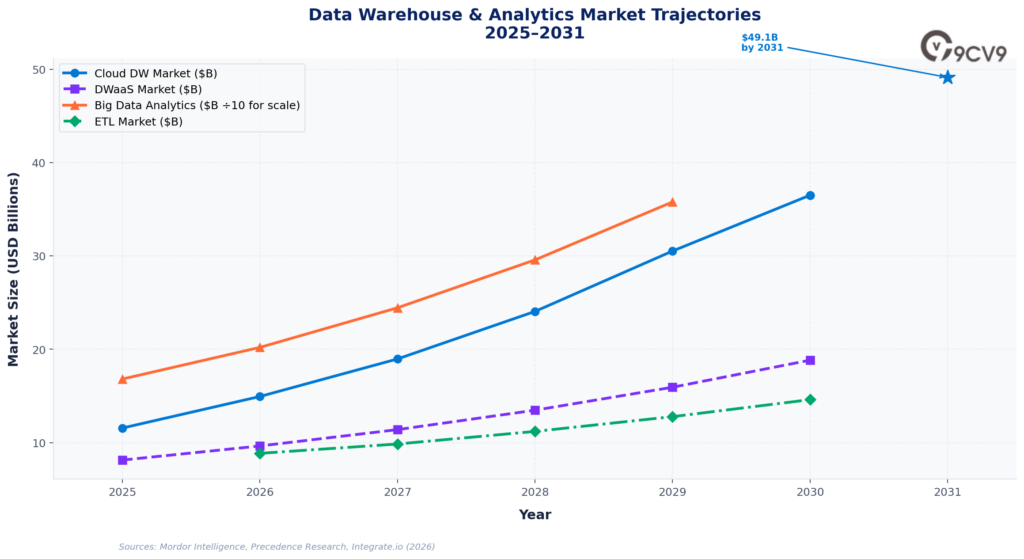
- Cloud data warehouse software is accelerating rapidly, with the market forecast to reach $49.12 billion by 2031 as businesses shift from on-premises infrastructure to scalable cloud platforms.
- AI, data quality, governance, and real-time analytics are reshaping data warehouse trends in 2026, making trusted, AI-ready data infrastructure a strategic enterprise priority.
Data warehouse software powers enterprise analytics in 2026 as cloud adoption, artificial intelligence, and real-time data processing accelerate. The global data warehousing market reached about $39.18 billion in 2025 and is projected to reach $103.49 billion by 2035, highlighting sustained demand for scalable, governed, and AI-ready data infrastructure.
Data warehouse software has moved from being a specialized back-office technology into one of the most important foundations of the modern digital enterprise. In 2026, organizations are generating, collecting, integrating, and analyzing unprecedented volumes of information across cloud applications, customer platforms, financial systems, connected devices, artificial intelligence applications, and operational databases. The ability to consolidate that information into a reliable analytical environment increasingly determines how quickly an organization can understand its customers, identify opportunities, control costs, manage risks, and deploy artificial intelligence at scale.
Also, read our guide on the Top 10 Best Data Warehouse Software.


The numbers illustrate the scale of this transformation. The global data warehousing market reached approximately $39.18 billion in 2025 and is projected to expand to $103.49 billion by 2035, representing a compound annual growth rate of 10.20%. Another market estimate places the sector at $37.73 billion in 2025 and forecasts it reaching $69.64 billion by 2029. Broader definitions of the data warehouse software ecosystem produce even larger estimates, including projections of approximately $150 billion to $155 billion by 2033.
Although individual forecasts differ because research firms define data warehousing, warehouse management software, cloud analytics, and related services differently, they point in the same direction: enterprise spending on data warehouse infrastructure continues to expand rapidly.

This growth is being accelerated by several interconnected technology trends. Cloud migration is replacing traditional on-premises data warehouse appliances. Artificial intelligence is increasing demand for accessible and governed enterprise data. Real-time analytics is shortening the acceptable delay between data creation and business action. Data governance requirements are becoming more demanding. Meanwhile, data engineering teams must process increasingly complex information from a growing number of sources.

Together, these developments are transforming what organizations expect from data warehouse software.
Data Warehouse Software Is Becoming Core Enterprise Infrastructure
Historically, enterprise data warehouses were primarily designed to consolidate structured information from operational systems and support periodic reporting. Financial reports, sales dashboards, inventory analysis, and executive business intelligence were among the most common workloads.
The modern data warehouse plays a much broader role.
Organizations increasingly expect their warehouse platforms to support business intelligence, predictive analytics, artificial intelligence, machine learning, customer analytics, financial modeling, operational intelligence, data science, regulatory reporting, self-service analytics, and increasingly real-time decision-making.
This expanded role helps explain why the market continues to grow even among organizations that already possess substantial data infrastructure.
The data warehouse management software segment alone is valued at approximately $2.86 billion in 2026 and is expected to reach $6.06 billion by 2035, representing an 8.6% CAGR. The growth indicates continued enterprise demand for platforms that simplify the management, integration, governance, and analysis of organizational data.
The competitive question is therefore changing.
Enterprises are no longer simply asking whether they need a data warehouse. Increasingly, they are asking what architecture they need, how much of it should operate in the cloud, how quickly information should become available, how governance should be implemented, and how their data infrastructure should support AI.
Cloud Data Warehouses Are Reshaping the Market
Perhaps the most important structural trend in data warehouse software in 2026 is the continued migration toward cloud-native infrastructure.
The statistics demonstrate how quickly this transition is occurring.
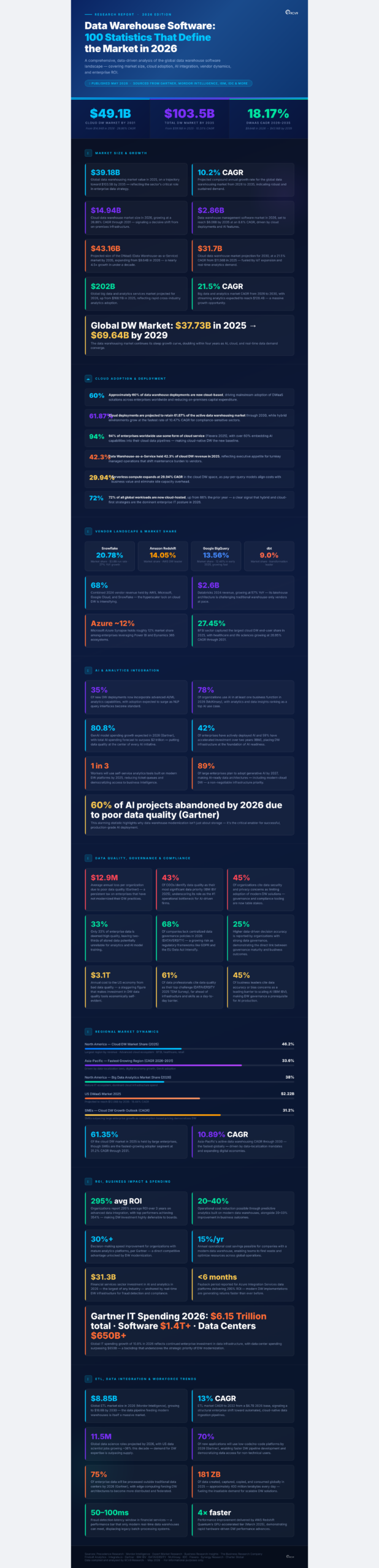
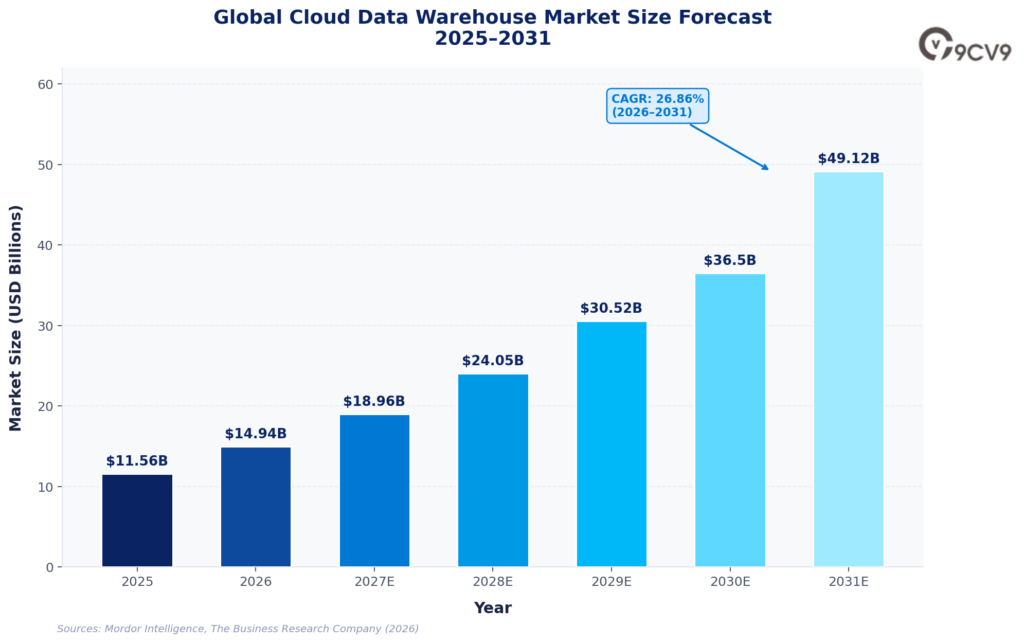
The cloud data warehouse market was valued at approximately $11.56 billion in 2025 and is estimated to reach $14.94 billion in 2026, representing a 29.2% year-over-year increase. One forecast expects the market to reach $49.12 billion by 2031, representing a 26.86% CAGR between 2026 and 2031. Another projects approximately $31.7 billion by 2030 at a 21.5% CAGR.
While the precise forecasts differ, the direction is unmistakable.
Cloud data warehousing is growing considerably faster than the broader data warehouse market.
The shift reflects fundamental economic and operational advantages. Traditional warehouse environments often require organizations to purchase infrastructure based on anticipated peak demand. Cloud platforms allow storage and computing capacity to be expanded more dynamically, enabling businesses to align infrastructure consumption more closely with actual workloads.
Cloud architectures can also reduce the infrastructure management burden associated with maintaining physical servers, storage systems, database software, upgrades, capacity planning, and disaster recovery environments.
This has made cloud data warehouses especially attractive to organizations experiencing rapid increases in data volume or unpredictable analytical workloads.
Data Warehouse as a Service Is Accelerating the Transition
The broader migration toward managed infrastructure can also be seen in the growth of Data Warehouse as a Service.
The DWaaS market is estimated at approximately $9.64 billion in 2026 and is projected to reach $43.16 billion by 2035. That represents an estimated CAGR of 18.17%. The United States DWaaS market alone stood at approximately $2.22 billion in 2025 and is projected to reach $12.06 billion by 2035, with an estimated CAGR of 18.44%.
The appeal of DWaaS reflects a larger enterprise technology trend: organizations increasingly want the capabilities of sophisticated infrastructure without having to operate every component internally.
Managed warehouse platforms can reduce administrative overhead while providing access to scalable computing, storage, security, data integration, analytics, and increasingly AI capabilities.
As a result, data warehousing is gradually moving from infrastructure that organizations primarily build and maintain themselves toward a service that can be consumed according to business requirements.
The Data Warehouse Vendor Landscape Is Highly Competitive
The expansion of the market has created intense competition among cloud providers, specialist data platforms, transformation tools, and emerging lakehouse vendors.
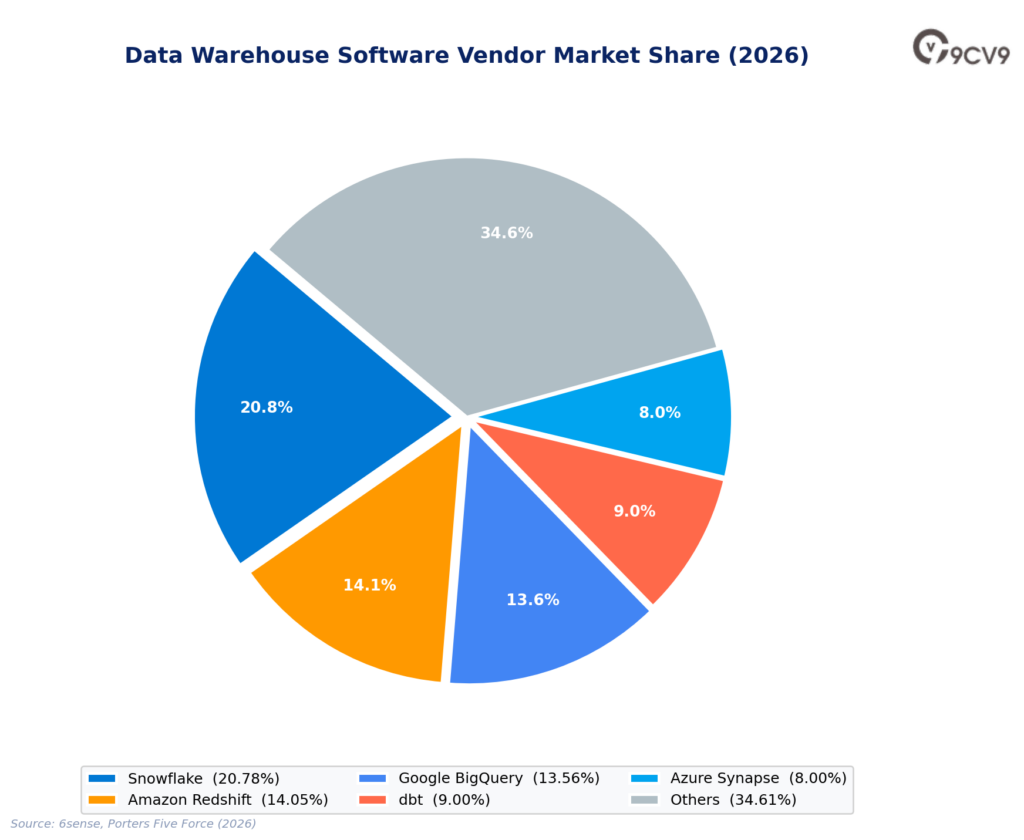
The statistics in this report indicate that Snowflake holds approximately 20.78% market share, while Amazon Redshift accounts for around 14.05% and Google BigQuery approximately 13.56%. Microsoft Azure Synapse is estimated at roughly 12%, while dbt represents approximately 9% within the cited software-market measurement.
At a broader level, AWS, Microsoft, Google Cloud, and Snowflake collectively accounted for approximately 68% of cloud data warehouse vendor revenue in 2024.
That concentration demonstrates the importance of ecosystem scale.
Modern data warehouse buying decisions increasingly involve more than query performance. Enterprises must consider integration with cloud infrastructure, AI services, visualization tools, security systems, data governance frameworks, developer tooling, and existing enterprise applications.
The competitive landscape is also being disrupted by the rise of lakehouse architectures.
Databricks generated approximately $2.6 billion in 2024 revenue while recording 57% year-over-year growth according to the statistics compiled for this report. Its expansion demonstrates increasing enterprise interest in architectures designed to combine elements of data lakes and traditional data warehouses.
The boundary between the data warehouse, data lake, analytics platform, AI platform, and data engineering environment is therefore becoming increasingly difficult to define.
Artificial Intelligence Is Creating a New Data Warehouse Investment Cycle

Artificial intelligence may become one of the most powerful long-term demand drivers for data warehouse software.
Approximately 35% of new data warehouse deployments already incorporate advanced AI or machine learning analytics according to the statistics compiled here. At the same time, 78% of organizations reportedly use AI in at least one business function, while other cited research indicates that 42% of enterprises have actively deployed AI and 59% have accelerated their AI investment.
This creates an important infrastructure challenge.

AI systems depend on data.
An organization may invest heavily in generative AI models, machine learning applications, copilots, predictive systems, recommendation engines, or intelligent automation. However, these technologies become substantially less useful when the underlying enterprise information is fragmented, outdated, inaccessible, duplicated, or unreliable.

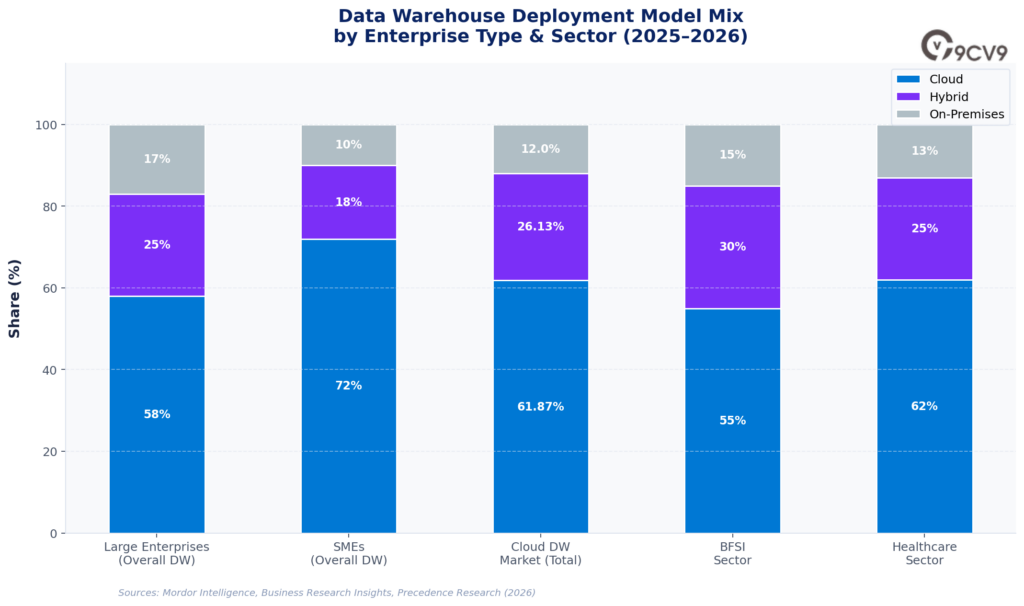
The modern data warehouse is consequently becoming part of the AI infrastructure stack.
Rather than simply storing historical records for dashboards, data platforms increasingly need to make trusted organizational information available to AI and machine learning systems.
This helps explain why data warehouse modernization and enterprise AI adoption are becoming closely connected investment priorities.

Poor Data Quality Could Become One of the Biggest AI Bottlenecks
The relationship between artificial intelligence and data warehousing becomes even clearer when data quality is considered.
One of the statistics included in the dataset states that 60% of AI projects are expected to be abandoned through 2026 because of insufficient data quality. Another indicates that nearly half of business leaders cite data accuracy or bias concerns as significant obstacles to scaling AI.
The economic implications extend beyond artificial intelligence.

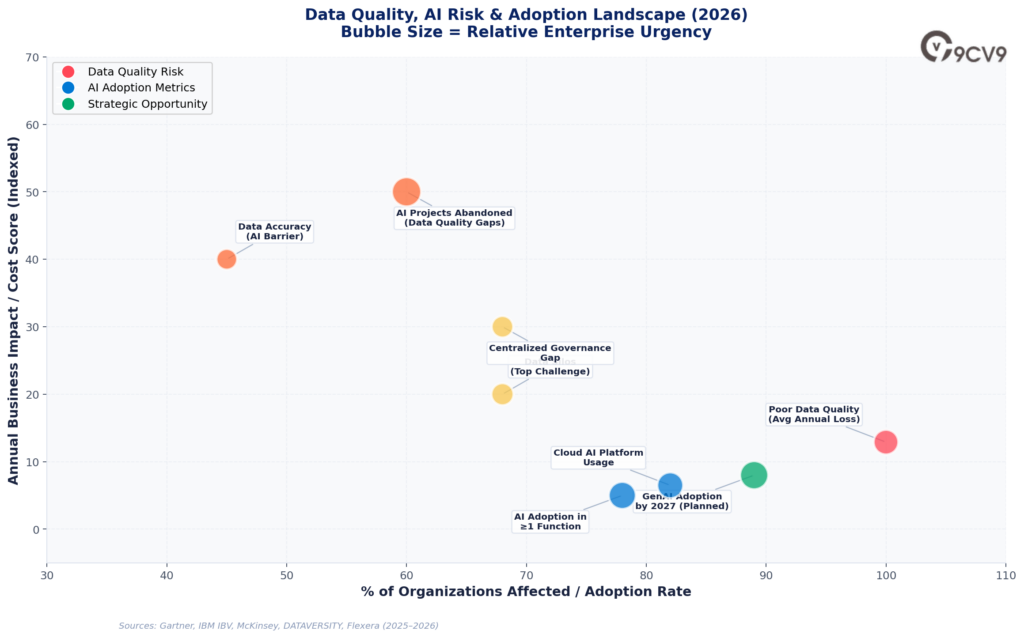
Organizations are estimated to lose an average of $12.9 million annually because of poor data quality, while the broader economic impact in the United States has been estimated at approximately $3.1 trillion annually.
Only about one-third of enterprise data is described in the supplied statistics as meeting high-quality standards, while 61% of data professionals identify data quality as their leading challenge.
Data teams may also spend as much as 50% of their time remediating data quality problems.
For organizations investing heavily in analytics, these numbers are particularly important.
A powerful analytical platform cannot automatically compensate for inaccurate source information.
Consequently, modern data warehouse strategies increasingly incorporate validation, observability, metadata management, lineage, governance, automated quality monitoring, and access controls directly into the data lifecycle.
Data Governance Is Moving Into the Executive Agenda
Governance is undergoing a similar transformation.
What was once primarily viewed as a technical or compliance responsibility is increasingly connected to enterprise strategy.
The statistics compiled for this report indicate that 43% of chief operations officers identify data quality as their most significant data priority. Meanwhile, 68% of companies reportedly lack centralized data governance policies, demonstrating a substantial gap between the growing strategic importance of enterprise information and the maturity of many organizations’ governance practices.
Security adds another dimension.
Approximately 45% of organizations cite data security and privacy concerns as barriers to adopting modern data warehouse solutions. The average cost of a data breach reached approximately $4.88 million in 2024, making centralized repositories of sensitive enterprise information particularly important security assets.
Modern warehouse platforms must therefore balance accessibility with control.
Organizations want employees, applications, analytics systems, and AI tools to access information quickly, but they also need to determine who can access specific datasets, how sensitive information is protected, where data originated, how it has changed, and whether its use complies with internal and external requirements.
That balance will remain one of the defining challenges of enterprise data architecture in 2026.
Asia-Pacific Is Emerging as a Major Data Warehouse Growth Engine
Data warehouse adoption is also geographically uneven.
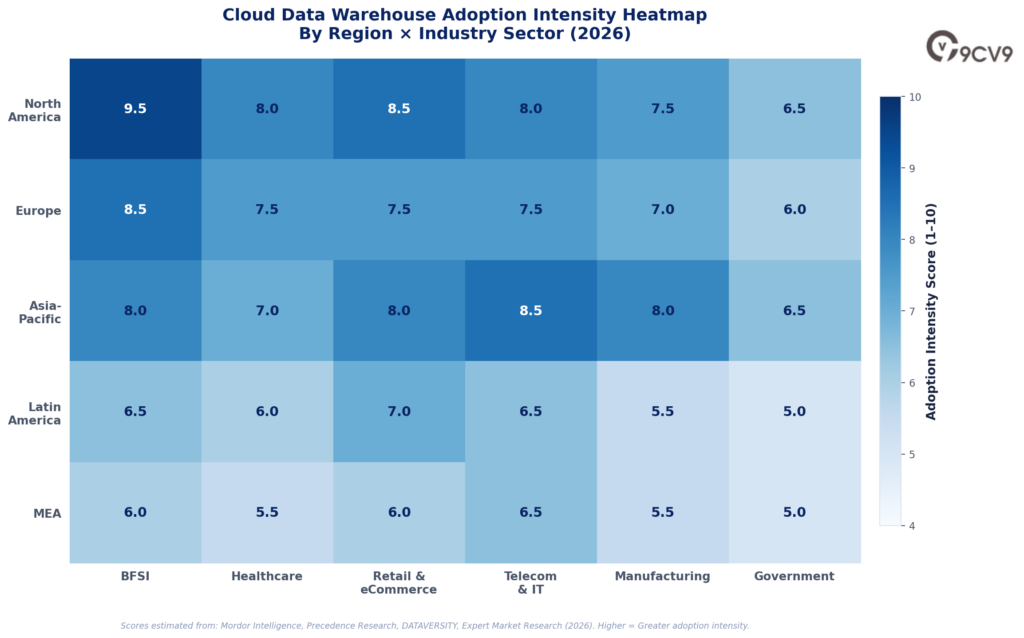
North America remains the largest and most mature market in several categories. It accounted for approximately 46.2% of cloud data warehouse revenue in 2025 and around 35.32% of the active data warehousing market in 2024, according to the statistics in this report.
However, Asia-Pacific is expanding considerably faster.
The region is forecast to achieve a 33.6% CAGR in cloud data warehousing between 2026 and 2031. Asia-Pacific also leads growth in active data warehousing, with an estimated CAGR of 10.89% through 2030.
This growth reflects the rapid digitalization of economies across the region, expanding cloud infrastructure, increasing data localization requirements, rising AI adoption, and the modernization of enterprise technology environments.
The result is a market in which North America remains the center of spending scale while Asia-Pacific increasingly represents the strongest source of incremental growth.
The Business Case for Data Warehouse Modernization Is Becoming Easier to Quantify
Another major trend in 2026 is the growing emphasis on measurable returns from enterprise data investments.
Organizations are no longer satisfied with data warehouse projects justified primarily through abstract concepts such as becoming “data driven.” Executives increasingly expect infrastructure projects to demonstrate improvements in productivity, cost efficiency, revenue generation, decision speed, or risk reduction.
The statistics provide several examples.
Organizations reportedly achieve an average 295% three-year ROI from advanced data integration and cloud data warehouse platforms, while top-performing organizations can reach approximately 354% ROI. Some implementations have reported payback periods of less than six months.
Predictive analytics built on modern data infrastructure can potentially reduce operational costs by 20% to 40%, while organizations with mature analytics platforms may improve decision-making speed by more than 30%.
The supplied statistics also associate predictive analytics with potential revenue improvements of 10% to 20% and cost reductions of 10% to 15%.
These figures help explain why data infrastructure is increasingly treated as a business investment rather than simply an IT expense.
The Data Warehouse Market Is Benefiting From Historic Cloud Investment
The growth of data warehousing is taking place inside an even larger expansion of cloud computing.
Worldwide public cloud end-user spending reached approximately $723.4 billion in 2025 and is projected in the supplied dataset to exceed $850 billion in 2026. Global IT spending is forecast at approximately $6.15 trillion in 2026, representing 10.8% growth.
At the enterprise level, cloud adoption is already widespread.
Approximately 94% of enterprises use some form of cloud service, 72% of global workloads are cloud-hosted, and more than 68% of enterprises operate across two or more cloud providers according to the statistics assembled for this report.
AI and analytics workloads account for approximately 18% of cloud infrastructure spending.
Meanwhile, quarterly cloud infrastructure expenditure crossed $100 billion in 2025, reaching approximately $119 billion during the fourth quarter alone.
These enormous infrastructure investments create favorable conditions for data warehouse software.
Every additional enterprise application moved into the cloud potentially creates another source of data that needs to be integrated, governed, analyzed, and made available to business users or AI systems.
ETL and Data Integration Are Expanding Alongside Warehousing
A data warehouse is only as useful as the information entering it.
This makes ETL, ELT, streaming, orchestration, and data pipeline technologies essential components of the broader warehouse ecosystem.
The global ETL market is estimated at approximately $8.85 billion in 2026 and could reach $18.6 billion by 2030. Another forecast places ETL growth at approximately 13% CAGR through 2032.
The broader data integration market stands at approximately $15.18 billion in 2026 and is projected to reach $30.27 billion by 2030 at a 12.1% CAGR.
Even faster growth is occurring in modern pipeline technologies.
The data pipeline tools market is projected to expand at approximately 26.8% CAGR and reach $48.33 billion by 2030. Cloud ETL already represents an estimated 60% to 65% of the ETL market in 2026.
Streaming analytics is growing faster still.
The supplied statistics project the streaming analytics market expanding from $23.4 billion in 2026 to $128.4 billion by 2030 at a 28.3% CAGR.
The implication is significant: the traditional nightly batch-processing model is increasingly insufficient.
Organizations want data to become useful minutes, seconds, or even milliseconds after it is generated.
Real-Time Analytics Is Changing What a Data Warehouse Must Do
The demand for faster data processing is transforming warehouse architecture.
Financial institutions, e-commerce companies, logistics providers, digital platforms, cybersecurity teams, and connected-device businesses increasingly operate in environments where yesterday’s data may already be too old.
Fraud detection provides an extreme example. The statistics compiled here indicate that financial-services fraud systems can evaluate card transactions within approximately 50 to 100 milliseconds.
This type of workload represents a fundamentally different expectation from the historical data warehouse, where information might have been refreshed once per day.
The shift toward streaming data, active data warehouses, cloud-native architectures, and real-time analytics reflects the growing business value of reducing the time between an event occurring and an organization responding to it.
As this latency continues to fall, the dividing line between analytical and operational data infrastructure is likely to become less distinct.
Data Warehouse Skills Are Becoming More Valuable
Technology adoption also creates demand for people capable of implementing and managing it.
The supplied statistics project approximately 11.5 million data science roles globally by 2026, while US data scientist employment is expected to grow around 36% over the decade.
At the same time, organizations could face a 30% to 40% analytics talent shortfall by 2027. Technical skills shortages more broadly are projected to generate trillions of dollars in economic losses.
This talent constraint is influencing product design.
Data warehouse vendors are increasingly incorporating automation, low-code interfaces, AI assistance, automated optimization, self-service analytics, and managed infrastructure to reduce the amount of specialized engineering work required to operate sophisticated data environments.
Low-code and no-code adoption reinforces this trend, with the supplied statistics indicating that 70% of new applications are expected to use such technologies by 2026.
The future of data warehousing may therefore involve more sophisticated infrastructure operated through increasingly simplified interfaces.
Lakehouse Architectures Are Challenging Traditional Definitions
One of the most consequential architectural trends is the growing adoption of the data lakehouse.
Traditional data warehouses are optimized for structured analytical workloads, while data lakes were developed to store enormous volumes of structured, semi-structured, and unstructured information more economically.
Lakehouse architectures attempt to combine the strengths of both.
Their growing adoption means that the term “data warehouse software” increasingly describes an ecosystem rather than a single category of database.
Enterprises may operate cloud warehouses, object storage, lakehouse platforms, transformation layers, streaming systems, semantic layers, governance platforms, orchestration tools, and business intelligence applications as parts of one interconnected data architecture.
The strong growth of Databricks and continued expansion of Snowflake, BigQuery, Redshift, Microsoft data platforms, dbt, and adjacent technologies demonstrate how rapidly this architecture is evolving.
The World’s Data Volume Continues to Expand
Underlying virtually every data warehouse trend is one simple force: organizations have more data to manage.
Approximately 181 zettabytes of data were created, captured, and consumed globally in 2025 according to the statistics assembled for this article. That scale represents hundreds of millions of terabytes of information generated every day.
At the same time, data creation is becoming increasingly distributed.
The dataset cites a projection that 75% of enterprise data will be processed outside traditional data centers by 2026. This shift toward cloud, edge, IoT, and distributed computing environments creates additional complexity for enterprise data architectures.
The challenge is therefore no longer simply storing more information.
Organizations need to determine which information should be centralized, which should remain distributed, how quickly it must be processed, how long it should be retained, who can access it, how its quality can be verified, and how it can safely support analytical and AI workloads.
Data Warehouse Software in 2026 Is About More Than Storage
The defining characteristic of the data warehouse software market in 2026 is convergence.
Data warehouses are converging with cloud computing.
Warehouses are converging with data lakes.
Analytics is converging with artificial intelligence.
Batch processing is converging with real-time streaming.
Data engineering is converging with automated and low-code tooling.
Governance is converging with security, compliance, metadata, and quality management.
And enterprise data infrastructure is increasingly converging with the systems organizations use to make everyday business decisions.
This convergence explains why data warehouse software remains such a strategically important technology category despite decades of development.
The technology is not disappearing. It is evolving.
Modern enterprises increasingly require platforms capable of storing enormous datasets, integrating information from hundreds of sources, processing streaming events, enforcing governance policies, supporting self-service business intelligence, powering machine learning models, supplying trusted information to generative AI systems, and scaling dynamically as workloads change.
At the same time, buyers must navigate a rapidly changing vendor landscape, different cloud pricing models, lakehouse architectures, multi-cloud environments, data sovereignty requirements, security risks, skills shortages, and persistent data quality challenges.
Against this backdrop, the following Top 100 Data Warehouse Software Statistics, Data & Trends in 2026 provide a quantitative view of where the industry stands and where it is heading. The statistics cover global market size, cloud data warehouse growth, DWaaS adoption, vendor market share, AI and machine learning integration, data quality, governance, security, regional dynamics, ROI, enterprise cloud spending, ETL and data pipelines, workforce trends, real-time analytics, and emerging architectures.
Together, these figures show an industry moving beyond traditional reporting infrastructure toward something considerably more strategic: a unified data foundation for analytics, automation, artificial intelligence, and enterprise decision-making in the years ahead.
Before we venture further into this article, we would like to share who we are and what we do.
About 9cv9
9cv9 is a business tech startup based in Singapore and Asia, with a strong presence all over the world.
With over ten years of startup and business experience, and being highly involved in connecting with thousands of companies and startups, the 9cv9 team has listed some important and crucial software tools in this review.
If you like to get your company listed in our top B2B software reviews, check out our world-class 9cv9 Media and PR service and pricing plans here.
Top 100 Data Warehouse Software Statistics, Data & Trends in 2026
🌐 Market Size & Overall Growth
1. $39.18 Billion — The global data warehousing market reached approximately $39.18B in 2025. This scale confirms that data warehousing is no longer a niche IT function but a core enterprise infrastructure priority driving billions in annual investment.
2. $103.49 Billion by 2035 — The global data warehousing market is projected to reach $103.49B by 2035 at a 10.20% CAGR. This near-tripling of market value over a decade signals structural, long-term demand rather than a cyclical technology trend.
3. 10.20% CAGR (2026–2035) — The global data warehousing market will compound at 10.20% annually through 2035. For enterprises, this growth rate reflects the expanding role of warehousing as the foundational layer for AI, BI, and real-time analytics.
4. $37.73 Billion in 2025 — One estimate pegs the data warehousing market at $37.73B in 2025, growing to $69.64B by 2029. The consistency across multiple research sources reinforces confidence that the market is in a sustained expansion phase.
5. $69.64 Billion by 2029 — The global data warehousing market is expected to nearly double between 2025 and 2029. Organizations that delay DW modernization risk a growing technology gap versus competitors who leverage analytics infrastructure for real-time decisions.
6. $2.86 Billion — The data warehouse management software (DWMS) market is valued at $2.86B in 2026, expected to reach $6.06B by 2035 at an 8.6% CAGR. This software-specific segment is growing as enterprises move from custom-built DW solutions to managed, feature-rich platforms.
7. $6.06 Billion by 2035 — DWMS market projected size by 2035, more than doubling from 2026. Tools like Snowflake, Amazon Redshift, and Azure Synapse are at the center of this growth, offering ETL, governance, and AI capabilities in unified platforms.
8. 8.6% CAGR (DWMS) — The data warehouse management software segment grows at a steady 8.6% CAGR. While slower than cloud DW overall, this segment reflects the maturation of enterprise procurement as buyers seek feature depth over raw speed of adoption.
9. $50 Billion (2025 Broader Estimate) — Some analysts estimate the broader data warehouse software market at $50B in 2025, growing to $150B by 2033 at a 15% CAGR. This wider definition includes adjacent tools and services, reflecting how integrated the DW ecosystem has become.
10. $155 Billion by 2033 — The Data Warehouse Management System market is projected by some sources to reach $155B by 2033 at a 15% CAGR. The wide range of estimates across research firms highlights the definitional breadth of “data warehouse” and the explosive momentum of the category.
☁️ Cloud Data Warehouse Market
11. $11.56 Billion (Cloud DW, 2025) — The cloud data warehouse market stood at $11.56B in 2025. Cloud-native architectures now represent the default deployment model for new DW implementations, displacing traditional on-premises appliances.
12. $14.94 Billion (Cloud DW, 2026) — Cloud DW market reaches $14.94B in 2026, a 29.2% year-over-year increase. This near-30% annual jump underscores the pace at which enterprise budgets are shifting from CapEx hardware to OpEx cloud services.
13. $49.12 Billion by 2031 — Cloud DW market projected to reach $49.12B by 2031 at a 26.86% CAGR. This 3.3× growth in five years reflects the convergence of AI workloads, IoT data streams, and real-time analytics all running through cloud warehouse infrastructure.
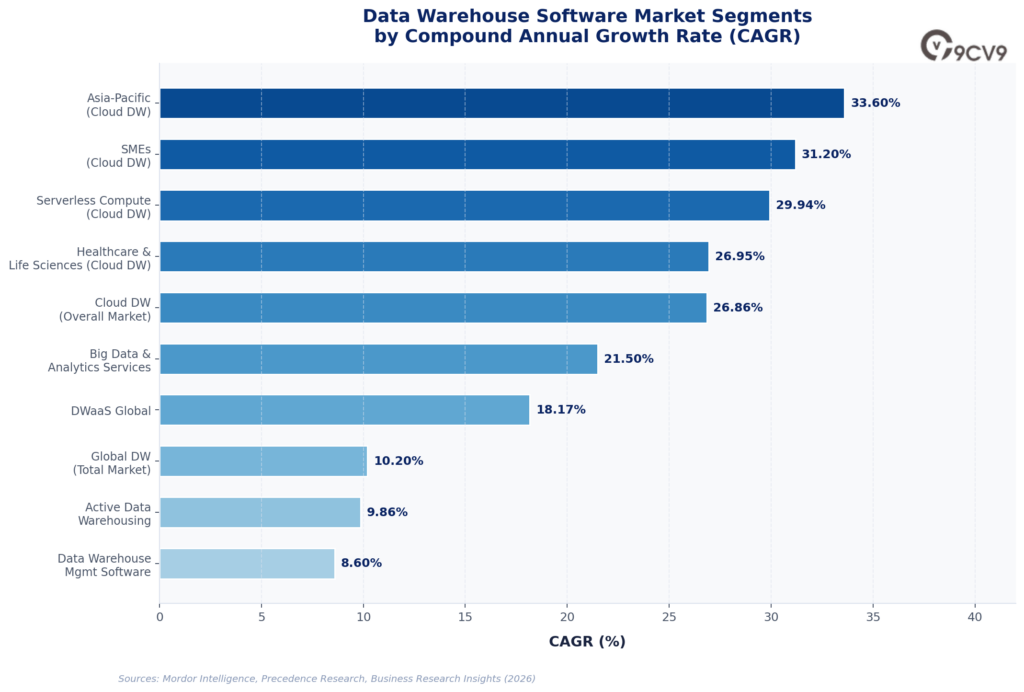
14. 26.86% CAGR (Cloud DW, 2026–2031) — The fastest-growing segment in the broader DW space. Enterprises should plan for cloud DW to be the dominant analytics infrastructure by 2028, as the cost, speed, and AI-integration advantages over on-prem become insurmountable.
15. $31.7 Billion by 2030 — Another major research estimate projects cloud DW at $31.7B by 2030 at a 21.5% CAGR. The variance between forecasts reflects different scope definitions but converges on a clear consensus: cloud DW is the highest-growth DW sub-segment.
16. 25.6% CAGR (2025–2026) — The cloud DW market grew at 25.6% in the near-term historic period. This exceptionally high annual growth rate is attributable to hyperscaler investment, IoT-driven data volumes, and enterprise migration away from on-premises systems.
17. $43.16 Billion (DWaaS by 2035) — The DWaaS market will reach $43.16B by 2035, from $9.64B in 2026. DWaaS’s near-5× growth is driven by organizations seeking turnkey managed solutions that reduce operational overhead and eliminate infrastructure maintenance.
18. $9.64 Billion (DWaaS, 2026) — DWaaS market stands at $9.64B in 2026. The segment’s double-digit CAGR reflects the shift toward pay-as-you-go pricing models that allow organizations to align data infrastructure costs with actual utilization.
19. 18.17% CAGR (DWaaS, 2026–2035) — DWaaS will compound at 18.17% per year for a decade. This sustained growth rate indicates that managed cloud warehousing will remain a top enterprise spending priority well into the 2030s.
20. $2.22 Billion (US DWaaS, 2025) — The US DWaaS market alone stood at $2.22B in 2025, projected to reach $12.06B by 2035. North America’s dominance in cloud infrastructure investment gives it an early-mover advantage in leveraging DWaaS for competitive intelligence.
🏆 Vendor Landscape
21. 20.78% Market Share — Snowflake — Snowflake leads the data warehousing market with a 20.78% share, backed by a $3.8B revenue run rate and 27% YoY growth. Its cloud-native, multi-cluster architecture and expanding Cortex AI features are key differentiators.
22. 14.05% Market Share — Amazon Redshift — Amazon Redshift holds 14.05% of the DW market, benefiting from deep AWS ecosystem integration and the March 2025 launch of Redshift Quantum with 4× GPU-accelerated analytical performance.
23. 13.56% Market Share — Google BigQuery — Google BigQuery commands 13.56% market share, with its genAI-powered Data Canvas and native GA4 integration driving adoption among analytics-heavy organizations and marketing teams.
24. 9.0% Market Share — dbt — dbt holds 9% of the DW software market, reflecting the growing importance of transformation layers and the shift to code-based, version-controlled data pipelines as engineering best practices spread.
25. 68% Combined Share — AWS, Microsoft, Google Cloud, and Snowflake collectively held 68% of 2024 cloud DW vendor revenue. This concentration means most enterprises are choosing from a small set of hyperscaler-backed platforms, reducing differentiation risk but increasing dependency.
26. $3.8 Billion Run Rate — Snowflake — Snowflake’s revenue run rate reached $3.8B with 27% YoY growth. Its strong net revenue retention (consistently above 120%) reflects deep customer integration and continuous expansion of use cases within existing accounts.
27. $2.6 Billion Revenue — Databricks — Databricks generated $2.6B in 2024 revenue, growing at an extraordinary 57% YoY. Its lakehouse architecture is reshaping competitive dynamics by blurring the line between data lakes and data warehouses.
28. 57% YoY Growth — Databricks — Databricks’ 57% annual revenue growth outpaces every major cloud DW incumbent. Its open-source Delta Lake format and unified analytics platform are drawing away workloads that would traditionally run on pure DW solutions.
29. ~12% Market Share — Azure Synapse — Microsoft Azure Synapse holds approximately 12% DW market share, benefiting from deep integration with Power BI, Microsoft Fabric, and the Microsoft 365 ecosystem used by millions of enterprise workers.
30. 12.48% → 13.56% — BigQuery Growth — Google BigQuery grew from 12.48% to 13.56% market share between early 2025 and mid-2025, the most significant share gain among major players. Its AI infrastructure advantages via Vertex AI are accelerating enterprise adoption.
🤖 AI & Machine Learning Integration
31. 35% of New Deployments Include AI/ML — Approximately 35% of new DW deployments incorporate advanced AI/ML analytics. As AI becomes the primary ROI driver for data investments, this share is expected to exceed 60% within three years.
32. 78% Organizations Use AI in ≥1 Function — McKinsey’s 2026 survey found 78% of organizations now use AI in at least one business function. Analytics and insight generation rank as top use cases, making cloud DW the foundational infrastructure for AI at scale.
33. 42% Have Actively Deployed AI — IBM research shows 42% of enterprises have actively deployed AI and 59% have accelerated AI investment over two years. Enterprises without AI-ready data warehouses face compounding disadvantages as peers operationalize AI faster.
34. 60% Abandoned AI Projects Due to Data Quality — Gartner predicts that through 2026, 60% of AI projects will be abandoned due to insufficient data quality. This makes DW modernization the single most critical precondition for successful enterprise AI initiatives.
35. 80.8% GenAI Spending Growth (2026) — Gartner projects GenAI model spending will grow 80.8% in 2026, with total AI spending forecast to surpass $2 trillion. As AI scales, the cost and impact of poor underlying data quality scales with it.
36. 89% Plan GenAI Adoption by 2027 — 89% of large enterprises plan to adopt generative AI by 2027. This near-universal commitment to GenAI makes AI-ready data architecture — including modern cloud DW — a board-level infrastructure mandate.
37. 87% Large Enterprises Implementing AI — Enterprise AI adoption has reached mainstream status, with 87% of large enterprises implementing AI solutions. Data warehouse modernization is now the critical path to unlocking this investment’s full potential.
38. 1 in 3 Workers on Self-Service Analytics by 2025 — By 2025, one in three workers uses self-service tools built on modern DW platforms, reducing engineering ticket queues and enabling business users to generate insights independently.
39. $6.5M Average Annual AI Investment per Enterprise — Large enterprises invest an average of $6.5M per year on AI initiatives. Without a unified, high-quality data warehouse as the foundation, a significant portion of this investment produces unreliable or non-scalable results.
40. 34% Operational Efficiency Gains from AI — Organizations report 34% operational efficiency gains and 27% cost reduction within 18 months of AI implementation — metrics that are directly tied to the quality and accessibility of their data warehouse infrastructure.
🔒 Data Quality & Governance
41. $12.9 Million Average Annual Loss — Organizations lose an average of $12.9M annually to poor data quality (Gartner). This figure exceeds the total cost of many DW modernization projects, making remediation a strong financial investment rather than a cost center.
42. $3.1 Trillion US Economy Impact — Poor data quality costs the US economy approximately $3.1 trillion per year. At macroeconomic scale, this figure represents a systemic inefficiency that modern data warehouses and governance frameworks are positioned to address.
43. 43% of COOs Cite Data Quality as Top Priority — The IBM IBV 2025 CDO Study found 43% of chief operations officers identify data quality as their most significant data priority, confirming that DW data quality is now a C-suite issue, not just an engineering concern.
44. Only 33% of Enterprise Data Is High Quality — Only one-third of enterprise data meets high-quality standards. This means the majority of stored data carries analytical risk, making data quality tooling, validation pipelines, and governance frameworks essential DW components.
45. 45% Cite Data Security Concerns — Nearly 45% of organizations cite data security and privacy concerns as limiting adoption of modern DW solutions. Vendors responding with built-in encryption, zero-trust security, and compliance modules are gaining a meaningful competitive edge.
46. 45% Cite Data Accuracy as AI Barrier — IBM IBV research found nearly half of business leaders cite data accuracy or bias concerns as a leading barrier to scaling AI. This reinforces the point that DW data quality is not a back-office problem — it’s blocking AI value capture.
47. 68% Lack Centralized Governance Policies — 68% of companies lack centralized data governance policies (DATAVERSITY 2026). As GDPR, the EU Data Act, and global data sovereignty regulations expand, this governance gap is rapidly becoming a legal and financial liability.
48. 20–30% Revenue Lost to Data Inefficiencies — Gartner estimates 20–30% of enterprise revenue is lost due to data inefficiencies. Modern data warehouses with automated ETL, quality monitoring, and lineage tracking are proven tools for recovering this latent value.
49. 50% of Data Team Time on Remediation — Data teams spend 50% of their time remediating data quality issues (Ataccama). This productivity drain underscores the case for proactive DW data quality frameworks that catch issues at ingestion rather than post-processing.
50. 25% Higher Decision Accuracy with Strong Governance — Organizations with strong data governance report 25% higher data-driven decision accuracy. For enterprises competing on analytics speed, this accuracy premium translates directly into faster, more confident strategic moves.
51. 61% Cite Data Quality as Top Challenge — The DATAVERSITY 2025 TDM Survey found 61% of data professionals list data quality as their top challenge, ahead of infrastructure and staffing. This persistent ranking makes automated quality tooling a must-have in any modern DW stack.
52. $4.88 Million Average Data Breach Cost (2024) — IBM’s Cost of a Data Breach Report found the average breach cost reached $4.88M in 2024. Data warehouses that centralize sensitive enterprise data must embed security-first architecture, not treat it as an add-on.
53. 40% Governance Budget Increase Planned — 82% of firms plan to increase data governance budgets by 20% in 2024/2025. This investment wave will accelerate adoption of DW-integrated governance tools including metadata management, lineage tracking, and automated compliance.
54. 87% Agree Governance Is Critical — 92% of business executives agree that data governance is critical for digital transformation success (Gitnux). Yet most organizations remain at early governance maturity, highlighting the gap between recognition and execution.
🌍 Regional Dynamics
55. 46.20% North America Cloud DW Share (2025) — North America commanded 46.2% of cloud DW revenues in 2025. The region’s advanced cloud ecosystem, mature BFSI sector, and early AI adoption make it the benchmark for cloud DW best practices globally.
56. 33.6% APAC CAGR (2026–2031) — Asia-Pacific is the fastest-growing cloud DW region at 33.6% CAGR through 2031. Data-localization laws, digital economy expansion, and leapfrog cloud adoption are creating enormous greenfield opportunities for DW vendors in the region.
57. 38% North America Big Data Analytics Share — North America holds 38% of the global big data and analytics market share. This regional dominance is underpinned by the concentration of hyperscaler headquarters, venture funding, and enterprise digital transformation budgets.
58. 10.89% APAC Active DW CAGR — Asia-Pacific leads the active data warehousing market with a 10.89% CAGR through 2030. For global DW vendors, APAC represents the most important geographic growth market of the next five years.
59. 35.32% North America Active DW Share (2024) — North America held 35.32% of the active data warehousing market share in 2024. Despite APAC’s faster growth, North America will retain its leading position through the forecast period due to enterprise spending scale.
60. 18.44% CAGR — US DWaaS — The US DWaaS market grows at 18.44% CAGR, from $2.22B in 2025 to $12.06B by 2035. This 5× growth in the world’s largest economy confirms that even mature DW markets have substantial room for cloud migration and DWaaS adoption.
61. 45% MEA/LATAM Cloud Analytics Adoption — 45% of MEA and LATAM enterprises are on cloud analytics platforms. While behind North America and Europe, these regions are accelerating rapidly, representing the next wave of cloud DW market expansion.
62. 49% China Cloud-Native Adoption Planned — 49% of Chinese enterprises plan cloud-native adoption by 2025, leapfrogging legacy infrastructure constraints. China’s $218B digital transformation market in 2024 represents a massive tailwind for regional DW vendors.
💰 ROI & Business Impact
63. 295% Average 3-Year ROI — Organizations report 295% average ROI over three years on advanced data integration and cloud DW platforms. This return, with payback under six months in leading cases, makes DW investment one of the highest-returning enterprise technology categories.
64. 354% ROI — Top Performers — Top-performing organizations achieve 354% ROI through advanced cloud data platforms and streaming analytics. The gap between average and top performers is driven by data quality maturity, governance depth, and self-service analytics adoption.
65. Less Than 6-Month Payback — Azure Integration Services data platforms report less than six-month payback periods on investments delivering 295% 3-year ROI. This rapid capital recovery dramatically improves the business case for DW modernization even in cost-constrained environments.
66. 20–40% Operational Cost Reduction — Predictive analytics built on modern data warehouses can cut operational costs by 20–40% while improving business outcomes by 20–33%. These efficiency gains compound annually, making the long-term ROI of DW investment even stronger.
67. 30% Faster Decision-Making — Gartner predicts organizations with mature analytics platforms improve decision-making speed by more than 30%. In fast-moving markets, this decision velocity is a direct competitive advantage that DW modernization unlocks.
68. 15% Annual Operational Cost Savings — Companies with modern data warehouses can find and eliminate operational waste at a rate of approximately 15% per year. This ongoing savings stream offsets DW licensing costs and creates net positive economics for sustained investment.
69. $31.3 Billion — Financial Services AI/Analytics (2026) — Financial services invests $31.3B in AI and analytics in 2026 — the most of any sector. The BFSI sector’s dominance in both cloud DW adoption (27.45% share) and AI spending reflects how central data infrastructure is to financial competitive advantage.
70. 10–20% Revenue Uplift from Predictive Analytics — Companies using predictive analytics built on DW infrastructure gain 10–20% higher revenues and 10–15% lower costs. These revenue impacts are most pronounced in retail, BFSI, and eCommerce verticals.
📈 Cloud & IT Spending Context
71. $723.4 Billion Cloud Spending (2025) — Worldwide public cloud end-user spending reached $723.4B in 2025 (Gartner). DW and analytics workloads are among the highest-value cloud consumption categories, making cloud DW vendors key beneficiaries of this overall market growth.
72. $850 Billion Cloud Forecast (2026) — Public cloud spending is projected to surpass $850B in 2026. The 18%+ YoY growth rate provides a powerful macroeconomic tailwind for all cloud DW vendors as enterprise budgets continue migrating to cloud-first architectures.
73. $6.15 Trillion Global IT Spending (2026) — Gartner forecasts worldwide IT spending at $6.15 trillion in 2026, up 10.8%. DW software participates in multiple high-growth categories including infrastructure software (14.7% growth) and data center systems ($650B+).
74. $650 Billion+ Data Center Spending (2026) — Total data center spending surpasses $650B in 2026, growing 31.7% YoY. This infrastructure buildout directly supports the compute and storage layers that cloud DW platforms depend upon.
75. 94% Enterprise Cloud Adoption — 94% of enterprises worldwide use some form of cloud service (Flexera 2025). With cloud adoption near-saturation, the growth opportunity lies in deepening cloud usage — particularly through advanced DW, analytics, and AI workloads.
76. 72% of Workloads Cloud-Hosted — 72% of all global workloads are now cloud-hosted, up from 66% the prior year. This continued migration creates ongoing demand for cloud-native DW platforms that can absorb workloads from decommissioned on-premises systems.
77. 68% of Enterprises Multi-Cloud — More than 68% of enterprises operate across two or more cloud providers. Multi-cloud DW strategies that support interoperability across AWS, Azure, and GCP are increasingly important for enterprises seeking to avoid vendor lock-in.
78. AI & Analytics = 18% of Cloud Infrastructure Spend — AI and analytics workloads now represent 18% of all cloud infrastructure spending. As AI model training and inference increasingly run through DW platforms, this share is expected to grow significantly through 2028.
79. $100B Quarterly Cloud Infra Spend — Cloud infrastructure quarterly spending crossed $100B for the first time in 2025, reaching $119B in Q4 alone. This spending trajectory ensures continued investment in the underlying compute and storage that powers cloud DW.
80. $600B+ Hyperscaler CapEx (2026) — Amazon, Alphabet, Microsoft, Meta, and Oracle are collectively forecast to exceed $600B in capital expenditure in 2026. Approximately $450B of that is directly tied to AI infrastructure — the same infrastructure that powers modern cloud DW.
📦 ETL, Data Integration & Pipeline Markets
81. $8.85 Billion ETL Market (2026) — The global ETL market reaches $8.85B in 2026, growing to $18.6B by 2030. As data volumes and source complexity increase, ETL and ELT pipelines that feed modern DW platforms are themselves a high-growth market.
82. 13% CAGR — ETL Market to 2032 — The ETL market will compound at 13% CAGR from its $6.7B 2026 base through 2032. This sustained growth reflects a structural shift in enterprise data strategy, as real-time ingestion requirements replace legacy batch ETL approaches.
83. $15.18 Billion Data Integration Market (2026) — The data integration market stands at $15.18B in 2026, projected to reach $30.27B by 2030 at 12.1% CAGR. Data integration is the connective tissue between source systems and the DW, making it an inseparable part of the DW ecosystem.
84. $128.4 Billion Streaming Analytics by 2030 — The streaming analytics market will explode from $23.4B in 2026 to $128.4B by 2030 at a 28.3% CAGR. Real-time streaming data entering DW platforms is the highest-growth data modality, driven by IoT, fintech, and digital commerce.
85. 26.8% CAGR — Data Pipeline Tools — The data pipeline tools market grows at 26.8% CAGR, substantially outpacing traditional ETL’s 17.1%. Modern ELT, streaming, and cloud-native pipeline approaches are replacing legacy batch processing as the standard DW ingestion method.
86. $48.33 Billion Data Pipeline Market by 2030 — The data pipeline tools market will reach $48.33B by 2030. This massive market is driven by organizations replacing manual, scheduled data loads with continuous, automated pipeline architectures.
87. 60–65% Cloud ETL Share (2026) — Cloud-based ETL holds 60–65% of the ETL market in 2026, reflecting the decisive migration away from legacy on-premise tooling toward cloud-native data integration platforms.
88. 18.7% CAGR — SME ETL Segment — Small and medium enterprises drive the fastest ETL segment growth at 18.7% CAGR through 2030. Cloud-based, low-code pipeline tools are democratizing data integration capabilities previously available only to large enterprises.
👩💻 Workforce & Skills
89. 11.5 Million Data Science Roles by 2026 — Global data science roles are projected to reach 11.5 million by 2026. The growing demand for DW-literate professionals — including data engineers, analytics engineers, and cloud architects — exceeds current talent supply in most markets.
90. 36% Growth in US Data Scientist Jobs — US data scientist jobs are expected to grow approximately 36% this decade. For organizations building DW teams, this demand surge means competitive talent acquisition strategies and internal upskilling programs are essential.
91. 30–40% Analytics Talent Shortfall by 2027 — Organizations face a 30–40% analytics talent shortfall by 2027. This skills gap makes self-service analytics features — embedded in modern DW platforms — a critical tool for enabling business users to generate insights without engineering bottlenecks.
92. $5.5 Trillion in Losses from Skills Gaps by 2026 — Technical skills shortages are projected to cost global businesses $5.5 trillion by 2026. For DW-heavy organizations, the ability to automate pipeline management, query optimization, and governance via AI reduces dependency on scarce human specialists.
93. 70% New Apps Using Low-Code/No-Code by 2026 — Gartner predicts 70% of new applications will use low-code/no-code platforms by 2026, including DW pipeline tools. This trend is democratizing data integration and enabling faster deployment of analytics solutions without deep engineering resources.
94. 20–30% Annual Salary Growth for Data Scientists — Data science professionals see 20–30% annual salary hikes above other fields. Organizations that invest in modern DW platforms that reduce manual data prep can redirect this expensive talent toward higher-value model development and analysis.
🔮 Future Trends & Emerging Technologies
95. Lakehouse Architecture Mainstream by 2026 — Gartner has recognized lakehouse platforms alongside traditional cloud DBMS, signaling a shift in industry direction. By 2030, the unified lakehouse model — combining DW performance with data lake flexibility — is expected to become the dominant architecture.
96. 75% Enterprise Data Processed at Edge by 2026 — Gartner projects 75% of enterprise data will be processed outside traditional data centers by 2026. This edge computing shift forces DW architects to design federated, distributed systems rather than centralized monolithic warehouses.
97. 181 Zettabytes of Data Created in 2025 — Approximately 181 zettabytes of data were created, captured, and consumed globally in 2025 — about 400 million terabytes every day. This data tsunami makes scalable, cloud-native DW infrastructure not optional but existentially necessary.
98. 4× Faster — Redshift Quantum — AWS Redshift Quantum’s GPU-accelerated tier (launched March 2025) delivers up to 4× faster analytical performance at serverless, pay-per-query pricing. This demonstrates the pace of hardware-driven DW performance improvements that are making legacy systems obsolete.
99. 50–100ms Fraud Detection Latency — Fraud detection engines in financial services now evaluate card transactions within 50–100 milliseconds — a performance bar that only real-time data warehouses can meet. Legacy batch-processing DW systems are being systematically replaced in BFSI.
100. $4 Trillion Digital Transformation Spending by 2027 — Organizations worldwide are expected to invest nearly $4 trillion in digital transformation by 2027, growing at 16.2% annually (IDC). Data integration and modern DW infrastructure form the critical backbone of these initiatives.
Conclusion
The Top 100 Data Warehouse Software Statistics, Data & Trends in 2026 reveal an enterprise technology market undergoing a fundamental transformation. Data warehousing is no longer primarily about storing historical information for periodic business intelligence reports. It is becoming the underlying data foundation for cloud analytics, artificial intelligence, machine learning, real-time decision-making, predictive analytics, governance, automation, and increasingly sophisticated digital operations.
The scale of the market demonstrates how strategically important this infrastructure has become. The global data warehousing market reached approximately $39.18 billion in 2025 and is projected to reach $103.49 billion by 2035, representing a 10.20% CAGR. Other estimates place the market at $37.73 billion in 2025 and forecast $69.64 billion by 2029, while broader definitions of the data warehouse software ecosystem produce projections approaching $150 billion to $155 billion by 2033.
Although these forecasts use different definitions and methodologies, their collective direction is clear. Organizations continue to allocate substantial resources to collecting, integrating, managing, governing, and analyzing enterprise data. The growth of artificial intelligence is likely to make those capabilities even more important.
Cloud Data Warehousing Is Becoming the Center of the Market
Among all the trends examined in these 100 data warehouse software statistics, cloud adoption represents one of the clearest structural shifts.
The cloud data warehouse market stood at approximately $11.56 billion in 2025 and reaches an estimated $14.94 billion in 2026. One forecast projects it reaching $49.12 billion by 2031 at a 26.86% CAGR, while another estimates a $31.7 billion market by 2030 at a 21.5% CAGR.
These growth rates significantly exceed those associated with many mature enterprise software categories.
Cloud data warehouses address several limitations of traditional infrastructure. Organizations can expand storage and computing capacity without purchasing large amounts of physical infrastructure in advance. They can accommodate unpredictable analytical workloads, connect cloud applications more easily, access managed services, and integrate analytics infrastructure with increasingly powerful AI ecosystems.
The economics of data infrastructure are changing alongside the architecture.
Instead of treating a warehouse primarily as a large capital investment that must be sized years in advance, businesses increasingly consume data infrastructure according to changing requirements. Storage, compute, queries, pipelines, and analytical workloads can increasingly be scaled independently.
That flexibility is one reason cloud-native platforms have become central to modern enterprise data strategies.
Data Warehouse as a Service Strengthens the Managed Infrastructure Model
The growth of Data Warehouse as a Service provides another indication of where enterprise infrastructure is heading.
The DWaaS market is estimated at $9.64 billion in 2026 and projected to reach $43.16 billion by 2035, representing an 18.17% CAGR. The US DWaaS market alone is expected to expand from $2.22 billion in 2025 to $12.06 billion by 2035 at an 18.44% CAGR.
This growth suggests that organizations increasingly value operational simplicity alongside raw analytical performance.
Managing complex infrastructure requires database administrators, engineers, security specialists, cloud architects, and other technical resources. Managed warehouse services can transfer portions of that operational responsibility to vendors while allowing internal teams to concentrate on data products, analytics, AI applications, and business outcomes.
For organizations facing data engineering skills shortages, that distinction can be particularly important.
Artificial Intelligence Is Making Enterprise Data More Valuable
The rise of artificial intelligence may ultimately prove to be the most important long-term catalyst for data warehouse investment.
Approximately 35% of new data warehouse deployments in the supplied statistics already incorporate advanced AI or machine learning analytics. Meanwhile, 78% of organizations use AI in at least one business function, and 42% of enterprises have actively deployed AI according to another cited research figure. The statistics also indicate that 59% have accelerated their AI investments over a two-year period.
This relationship between AI and data infrastructure is fundamental.
AI systems require more than models and computing power. They require information that is accessible, accurate, timely, properly structured, appropriately governed, and connected to the organization’s actual operations.
Without those characteristics, AI systems can produce incomplete, inaccurate, inconsistent, or difficult-to-trust outputs.
Consequently, the growth of enterprise AI creates another reason for organizations to modernize their data infrastructure.
Data warehouses, lakehouses, data integration systems, transformation layers, governance platforms, metadata systems, and real-time pipelines are increasingly becoming components of a larger AI-ready enterprise data architecture.
Data Quality Could Determine Which AI Investments Succeed
The statistics also reveal one of the biggest obstacles to this AI-driven future: poor data quality.
Organizations lose an estimated $12.9 million annually because of poor data quality, while the estimated cost to the US economy reaches approximately $3.1 trillion per year. Only around one-third of enterprise data is described as high quality in the supplied figures.
The implications become even more serious when artificial intelligence is introduced.
The supplied statistics cite a prediction that through 2026, 60% of AI projects will be abandoned because of insufficient data quality. Nearly half of business leaders also identify data accuracy or bias concerns as a significant obstacle to scaling AI.
This means that organizations cannot separate their AI strategies from their data strategies.
Increasing spending on models while ignoring the quality of the underlying information risks magnifying existing problems rather than solving them.
Modern data warehouses therefore need to become more than repositories. They need to participate in the continuous verification, monitoring, governance, transformation, and documentation of enterprise information.
Data Governance Is Becoming a Strategic Business Requirement
Governance is similarly moving beyond the data engineering department.
The statistics indicate that 43% of chief operations officers identify data quality as their most significant data priority. At the same time, 68% of companies reportedly lack centralized data governance policies.
That gap represents both a technology challenge and a management challenge.
As organizations accumulate larger quantities of information, they need to understand where that information came from, who owns it, how it has been transformed, which applications consume it, who should have access to it, and whether it satisfies security and regulatory requirements.
These questions become increasingly important when data is consumed automatically by AI systems.
Governance is therefore likely to become a defining capability of competitive data warehouse platforms. Metadata management, lineage, policy enforcement, access controls, data classification, automated quality monitoring, privacy controls, and auditability are increasingly essential components of enterprise data architecture.
Security Cannot Be Separated From Data Warehouse Strategy
Security presents another major challenge.
Approximately 45% of organizations cite security and privacy concerns as factors limiting adoption of modern data warehouse solutions. Meanwhile, the average cost of a data breach reached approximately $4.88 million in 2024 according to the statistics included in the dataset.
Centralized enterprise data environments can contain customer records, financial information, employee information, intellectual property, operational records, and other sensitive assets.
The business value of consolidating information therefore creates a corresponding responsibility to protect it.
As cloud data warehouses become connected to more applications, AI systems, business intelligence platforms, and users, organizations will need increasingly sophisticated identity management, encryption, monitoring, access control, segmentation, auditing, and governance practices.
The strongest data warehouse strategies in 2026 will consequently treat security as part of the architecture rather than an additional layer added after deployment.
Competition Among Data Warehouse Vendors Will Continue Intensifying
The vendor statistics illustrate another defining feature of the market: concentration among major platforms combined with intense technological competition.
Snowflake holds approximately 20.78% market share in the supplied dataset, followed by Amazon Redshift at 14.05% and Google BigQuery at 13.56%. Microsoft Azure Synapse accounts for approximately 12%, while dbt is represented at around 9% within the cited market measurement.
AWS, Microsoft, Google Cloud, and Snowflake collectively accounted for approximately 68% of cloud data warehouse vendor revenue in 2024.
However, market concentration does not mean the technology has stabilized.
Databricks generated approximately $2.6 billion in 2024 revenue while growing 57% year over year, demonstrating the rapid emergence of the lakehouse model. Google BigQuery increased its cited share from 12.48% to 13.56% between early and mid-2025, while major platforms continue investing heavily in AI integration, performance, automation, and developer tooling.
The competitive battlefield is consequently expanding beyond query speed.
Organizations increasingly evaluate data warehouse software according to scalability, total cost, AI integration, ecosystem compatibility, governance, security, data sharing, interoperability, real-time capabilities, developer experience, multi-cloud support, and the ability to work across structured and unstructured information.
The Future May Be Warehouse, Lakehouse, and Data Platform Convergence
The emergence of lakehouse architecture is particularly important because it challenges the traditional distinction between data warehouses and data lakes.
Enterprises historically maintained separate infrastructure for highly structured analytical information and massive repositories of less structured data.
That separation is becoming less rigid.
Lakehouse platforms attempt to provide warehouse-like analytical performance and governance while maintaining the flexibility and scale associated with data lakes.
The future enterprise architecture may therefore not involve organizations choosing exclusively between a data warehouse and a data lake.
Instead, businesses are likely to build interconnected data platforms in which object storage, warehouse compute, lakehouse technologies, transformation layers, streaming infrastructure, semantic models, governance tools, AI systems, and business intelligence applications operate together.
This convergence will make interoperability increasingly important.
ETL Is Evolving Into a Much Larger Data Pipeline Ecosystem
The growth of data warehouses is also creating substantial opportunities for the technologies responsible for moving information into them.
The global ETL market reaches approximately $8.85 billion in 2026 and is projected to reach $18.6 billion by 2030 according to one estimate. The broader data integration market stands at $15.18 billion in 2026 and could reach $30.27 billion by 2030 at a 12.1% CAGR.
Modern data pipelines are expanding even faster.
The data pipeline tools market is projected to grow at approximately 26.8% CAGR and reach $48.33 billion by 2030. Cloud ETL represents an estimated 60% to 65% of the market in 2026.
This illustrates an important point about data warehouse software trends in 2026: organizations are not merely modernizing databases. They are modernizing the entire flow of enterprise information.
The objective is increasingly to create automated pipelines capable of moving data continuously from operational applications into analytical and AI environments with minimal manual intervention.
Real-Time Data Is Replacing the Traditional Batch Mentality
The expansion of streaming analytics reinforces this transition.
The streaming analytics market is projected in the supplied statistics to grow from approximately $23.4 billion in 2026 to $128.4 billion by 2030 at a 28.3% CAGR.
This extraordinary growth reflects changing expectations about how quickly information should become useful.
Traditional warehouses were commonly designed around periodic ETL processes. Data might be collected overnight and analyzed the following morning.
Many modern applications cannot tolerate that delay.
Financial institutions may need to evaluate potentially fraudulent transactions within 50 to 100 milliseconds. Digital businesses want immediate customer behavior signals. Supply-chain operators need current inventory information. Cybersecurity systems must identify suspicious activity quickly. E-commerce platforms continuously optimize recommendations, pricing, and customer experiences.
Real-time and near-real-time analytics are therefore shifting from specialized use cases toward mainstream enterprise requirements.
Multi-Cloud Data Architecture Will Become Increasingly Important
The surrounding cloud market provides another clue about future data warehouse architectures.
Approximately 94% of enterprises use some form of cloud service, while 72% of workloads are cloud-hosted. More than 68% of enterprises operate across at least two cloud providers according to the supplied statistics.
This creates both opportunities and complexity.
Organizations may have operational information distributed across AWS, Microsoft Azure, Google Cloud, SaaS applications, private infrastructure, and edge environments.
Their data warehouse architecture must somehow bring those information sources together without creating excessive duplication, latency, governance problems, or vendor dependency.
Interoperability, open data formats, cross-cloud sharing, federated analytics, and portable governance policies are therefore likely to become increasingly important competitive differentiators.
Asia-Pacific Could Be the Most Important Growth Region
The geographic statistics show that North America remains the dominant market by revenue, but Asia-Pacific represents a particularly strong growth opportunity.
North America accounted for approximately 46.2% of cloud data warehouse revenue in 2025. However, Asia-Pacific is projected to achieve a 33.6% CAGR in cloud data warehousing between 2026 and 2031.
Asia-Pacific also leads the growth of active data warehousing at approximately 10.89% CAGR through 2030.
Rapid digitalization, expanding cloud infrastructure, AI investment, data localization requirements, mobile-first economies, and growing enterprise technology spending are creating substantial opportunities across the region.
For data warehouse vendors, this means future growth will increasingly depend on the ability to support different regulatory environments, languages, data residency requirements, cloud providers, and enterprise technology ecosystems.
Data Warehouse ROI Is Becoming Easier to Demonstrate
Perhaps the strongest argument for continued investment is financial.
Organizations report approximately 295% average ROI over three years from advanced data integration and cloud data warehouse platforms, while top performers can achieve around 354% ROI according to the supplied statistics. Some deployments have produced payback periods of less than six months.
The potential benefits extend beyond infrastructure efficiency.
Predictive analytics built on modern data platforms can reduce operational costs by approximately 20% to 40%. Mature analytics platforms can increase decision-making speed by more than 30%. The supplied statistics also associate predictive analytics with potential revenue improvements of 10% to 20% and cost reductions of 10% to 15%.
These figures help change the conversation around data infrastructure.
A modern data warehouse should not simply be evaluated according to its licensing or cloud consumption costs. Its economic value also depends on the business outcomes enabled by faster decisions, automation, better forecasting, improved customer understanding, lower operational costs, reduced manual work, stronger governance, and more effective AI systems.
Massive Cloud Spending Provides a Powerful Long-Term Tailwind
Data warehouse growth is occurring within a much larger expansion of cloud and computing infrastructure.
Worldwide public cloud end-user spending reached approximately $723.4 billion in 2025 and is projected in the supplied statistics to surpass $850 billion in 2026.
Worldwide IT spending is forecast at approximately $6.15 trillion in 2026, while data center spending exceeds $650 billion. AI and analytics workloads already represent approximately 18% of cloud infrastructure spending.
Cloud infrastructure spending crossed the $100 billion quarterly threshold in 2025 and reached approximately $119 billion during the fourth quarter alone.
Meanwhile, Amazon, Alphabet, Microsoft, Meta, and Oracle are collectively forecast in the supplied dataset to exceed $600 billion in capital expenditure during 2026, with approximately $450 billion associated directly with AI infrastructure.
These investments are building enormous amounts of computing, networking, and storage capacity.
Data warehouse software sits directly above much of this infrastructure and is therefore positioned to benefit from continued growth in cloud computing, enterprise analytics, and AI.
The Data Warehouse Skills Shortage Will Accelerate Automation
Technology growth does not automatically create an equivalent supply of skilled professionals.
The statistics project approximately 11.5 million data science roles globally by 2026. US data scientist employment is expected to grow approximately 36% over the decade, while organizations may face a 30% to 40% analytics talent shortfall by 2027.
This gap will influence how data warehouse software evolves.
Platforms that require large specialist teams to perform routine administration may become increasingly difficult to justify.
Automation will therefore become an important competitive advantage.
AI-assisted query optimization, automated pipeline development, natural-language analytics, automated data classification, anomaly detection, schema management, intelligent workload optimization, self-service business intelligence, and low-code integration can allow organizations to accomplish more without increasing technical headcount proportionally.
The supplied statistics also indicate that 70% of new applications are expected to use low-code or no-code technologies by 2026, demonstrating how broadly this simplification trend extends across enterprise technology.
Exploding Global Data Volumes Guarantee That the Challenge Will Continue
Ultimately, every trend in this report is being amplified by the enormous amount of information being created.
Approximately 181 zettabytes of data were created, captured, and consumed globally in 2025 according to the supplied statistics.
The challenge is not merely that organizations have more data.
They have more types of data, arriving from more systems, at higher velocities, distributed across more locations.
Information increasingly originates from SaaS platforms, mobile applications, websites, financial systems, IoT devices, manufacturing equipment, customer interactions, social platforms, APIs, AI applications, sensors, logistics systems, cybersecurity tools, and numerous other sources.
At the same time, a growing share of enterprise information is being processed outside traditional centralized data centers.
This makes the architecture surrounding the data warehouse increasingly important.
The successful enterprise data platform of the future will need to connect centralized and distributed information while maintaining quality, governance, security, lineage, accessibility, and performance.
What the Top 100 Data Warehouse Software Statistics Mean for Businesses in 2026
Taken together, the statistics suggest that enterprises should view data warehouse modernization as a strategic capability rather than an isolated database project.
Organizations evaluating data warehouse software in 2026 should therefore look beyond headline storage prices or benchmark query speeds.
The larger questions concern how well a platform supports the organization’s future data strategy.
Can it scale as data volumes grow?
Can it support AI and machine learning workloads?
Can it process streaming information?
Can business users access information without creating excessive engineering workloads?
Can governance policies be enforced consistently?
Can sensitive information be protected?
Can the platform integrate with existing cloud environments?
Can data move between systems without excessive lock-in?
Can organizations understand where their information originated?
Can the architecture support both structured and increasingly unstructured information?
And most importantly, can the investment translate into measurable improvements in revenue, productivity, decision-making, customer experience, risk management, or operational efficiency?
These considerations will increasingly determine which data platforms deliver sustainable value.
The Data Warehouse Is Becoming the Enterprise Intelligence Layer
The most important conclusion from the Top 100 Data Warehouse Software Statistics, Data & Trends in 2026 is that the role of the data warehouse is expanding rather than disappearing.
The terminology and architecture may continue changing. Traditional warehouses will coexist with cloud warehouses, lakehouses, streaming platforms, data lakes, semantic layers, AI infrastructure, and distributed data systems.
But the fundamental business requirement remains.
Organizations need a reliable way to transform enormous amounts of fragmented information into trusted intelligence.
In 2026, that requirement is becoming even more important because artificial intelligence dramatically increases both the potential value of enterprise information and the consequences of poor-quality data.
A modern data warehouse therefore serves as much more than storage.
It can become the connection point between operational systems and analytics, between raw information and executive decisions, between historical records and predictive models, and increasingly between enterprise knowledge and artificial intelligence.
The market figures reinforce that transformation. A global data warehousing market moving toward $103.49 billion by 2035, cloud data warehouse growth exceeding 20% annually in several forecasts, a DWaaS market projected at $43.16 billion, rapidly expanding ETL and pipeline markets, and enormous investments in cloud and AI infrastructure collectively point toward continued long-term demand.
At the same time, the statistics reveal that technology alone will not determine success.
Data quality, governance, security, skills, architecture, cost management, interoperability, and organizational adoption remain critical. Companies that simply accumulate more information without addressing these fundamentals may find themselves spending more while receiving little additional value.
Organizations that solve them can create something considerably more powerful.
They can build an enterprise data foundation capable of continuously converting information into decisions, automation, predictions, and AI-powered business capabilities.
That is ultimately what the data warehouse software trends of 2026 represent.
The industry is moving beyond the era in which the warehouse was primarily a destination for historical data. It is entering an era in which the modern data platform increasingly functions as the intelligence infrastructure of the enterprise.
As cloud adoption expands, AI investment accelerates, streaming analytics becomes mainstream, data volumes continue growing, and governance requirements become more demanding, data warehouse software will remain at the center of enterprise digital transformation.
For technology leaders, data teams, investors, software vendors, and organizations planning their next generation of analytics infrastructure, the message from these 100 statistics is clear: the strategic value of trusted, accessible, governed, AI-ready enterprise data is increasing, and the platforms capable of delivering it will become even more important throughout 2026 and the decade ahead.
If you find this article useful, why not share it with your hiring manager and C-level suite friends and also leave a nice comment below?
We, at the 9cv9 Research Team, strive to bring the latest and most meaningful data, guides, and statistics to your doorstep.
To get access to top-quality guides, click over to 9cv9 Blog.
To hire top talents using our modern AI-powered recruitment agency, find out more at 9cv9 Modern AI-Powered Recruitment Agency.
People Also Ask
What is the data warehouse software market size in 2026?
The global data warehousing market was worth about $39.18 billion in 2025 and is projected to exceed $100 billion by 2035, reflecting sustained enterprise investment in cloud analytics, AI, and data infrastructure.
How fast is the data warehouse software market growing?
The global data warehousing market is projected to grow at about 10.20% CAGR from 2026 to 2035, while cloud data warehouse segments are expanding considerably faster.
How large will the data warehousing market be by 2035?
The global data warehousing market is projected to reach approximately $103.49 billion by 2035, up from about $39.18 billion in 2025.
What is the cloud data warehouse market size in 2026?
The cloud data warehouse market is estimated at approximately $14.94 billion in 2026, rising from about $11.56 billion in 2025.
How fast is the cloud data warehouse market growing?
Cloud data warehousing is projected to grow at approximately 26.86% CAGR from 2026 to 2031, making it one of the fastest-growing segments of enterprise data infrastructure.
How large could the cloud data warehouse market become by 2031?
The cloud data warehouse market is projected to reach approximately $49.12 billion by 2031 as enterprises migrate analytics workloads from on-premises systems to scalable cloud platforms.
What is Data Warehouse as a Service market size in 2026?
The Data Warehouse as a Service market is estimated at about $9.64 billion in 2026 and is projected to reach $43.16 billion by 2035.
What is the growth rate of Data Warehouse as a Service?
The DWaaS market is projected to grow at approximately 18.17% CAGR from 2026 to 2035 as organizations adopt managed, pay-as-you-go data warehouse infrastructure.
Which company has the largest data warehouse market share?
Snowflake leads the cited data warehouse vendor market with approximately 20.78% share, followed by Amazon Redshift, Google BigQuery, and Microsoft Azure Synapse.
What is Snowflake’s data warehouse market share?
Snowflake holds approximately 20.78% of the cited data warehousing market, supported by strong cloud adoption, enterprise expansion, and growing AI capabilities.
What is Amazon Redshift’s data warehouse market share?
Amazon Redshift holds approximately 14.05% of the cited data warehouse market, benefiting from its deep integration with the broader AWS ecosystem.
What is Google BigQuery’s data warehouse market share?
Google BigQuery holds approximately 13.56% of the cited data warehouse market and increased its share from about 12.48% earlier in 2025.
What is Microsoft Azure Synapse’s data warehouse market share?
Microsoft Azure Synapse holds approximately 12% of the cited data warehouse market, supported by integration with Microsoft Fabric, Power BI, Azure, and other Microsoft enterprise tools.
How fast is Databricks growing?
Databricks generated approximately $2.6 billion in 2024 revenue and recorded about 57% year-over-year growth, highlighting growing demand for lakehouse architectures.
How is AI affecting data warehouse software in 2026?
AI is increasing demand for scalable, high-quality enterprise data. Approximately 35% of new data warehouse deployments incorporate advanced AI or machine learning analytics.
What percentage of organizations are using AI?
Approximately 78% of organizations use AI in at least one business function, increasing demand for reliable data platforms capable of supporting AI-driven analytics.
Why is data quality important for data warehouses?
Poor data quality can undermine analytics and AI. Organizations lose an estimated $12.9 million annually from poor data quality, while many data teams spend substantial time fixing data issues.
How much does poor data quality cost businesses?
Organizations lose an estimated $12.9 million per year on average because of poor data quality, while the wider economic impact in the United States has been estimated at $3.1 trillion annually.
What percentage of enterprise data is considered high quality?
Only about 33% of enterprise data is considered high quality according to the statistics compiled for this report, highlighting the need for stronger validation and governance.
Why do AI projects fail because of data quality?
Poor, incomplete, biased, or inaccurate data can make AI outputs unreliable. The supplied statistics cite a prediction that 60% of AI projects may be abandoned through 2026 because of insufficient data quality.
Why is data governance important in 2026?
Data governance helps organizations control quality, access, lineage, security, and compliance. Yet 68% of companies reportedly lack centralized governance policies.
How much can companies gain from data warehouse investments?
Organizations report approximately 295% average three-year ROI from advanced data integration and cloud data platforms, while top performers can achieve around 354%.
How quickly can a modern data warehouse pay for itself?
Some advanced cloud data and integration implementations report investment payback periods of less than six months, depending on deployment scope and operational benefits.
How can data warehouses reduce business costs?
Predictive analytics supported by modern data infrastructure can reduce operational costs by approximately 20% to 40% while improving business outcomes and decision-making.
What is the ETL market size in 2026?
The global ETL market is estimated at approximately $8.85 billion in 2026 and is projected to reach about $18.6 billion by 2030.
How large is the data integration market in 2026?
The global data integration market is estimated at approximately $15.18 billion in 2026 and could reach $30.27 billion by 2030 at a 12.1% CAGR.
How fast are data pipeline tools growing?
The data pipeline tools market is projected to grow at approximately 26.8% CAGR and could reach $48.33 billion by 2030 as automated cloud-native pipelines replace manual data movement.
How large will the streaming analytics market become?
The streaming analytics market is projected to grow from approximately $23.4 billion in 2026 to $128.4 billion by 2030 at a 28.3% CAGR.
Which region is growing fastest for cloud data warehouses?
Asia-Pacific is projected to be the fastest-growing cloud data warehouse region, expanding at approximately 33.6% CAGR between 2026 and 2031.
What are the biggest data warehouse software trends in 2026?
Major trends include cloud migration, DWaaS, AI integration, lakehouse adoption, real-time analytics, streaming pipelines, stronger governance, automated data quality, multi-cloud architectures, and self-service analytics.
Sources
Precedence Research Business Research Insights The Business Research Company Mordor Intelligence Expert Market Research Data Insights Market Firebolt Analytics 6sense Porters Five Force Baytech Consulting Charter Global Integrate.io IBM Think Gartner DATAVERSITY Acceldata Second Talent SQ Magazine Axis Intelligence Datastackhub Gitnux Dataforest Datafortune