
Key Takeaways
- Best Headless CMS Software in 2026: Contentful, Sanity, Storyblok, Strapi, Payload CMS, Contentstack, Hygraph, Directus, Builder.io, and Prismic lead with flexible APIs, scalable content management, and omnichannel publishing capabilities.
- AI-Powered Features and Developer Flexibility: Leading headless CMS platforms offer AI-assisted content creation, automated workflows, MCP integrations, multilingual support, and customizable architectures for developers, marketers, and enterprises.
- Pricing, Features, and Business Suitability: Choosing the best headless CMS software in 2026 depends on pricing, ease of use, API performance, security, scalability, integration options, and whether businesses need open-source flexibility or enterprise-grade content management.
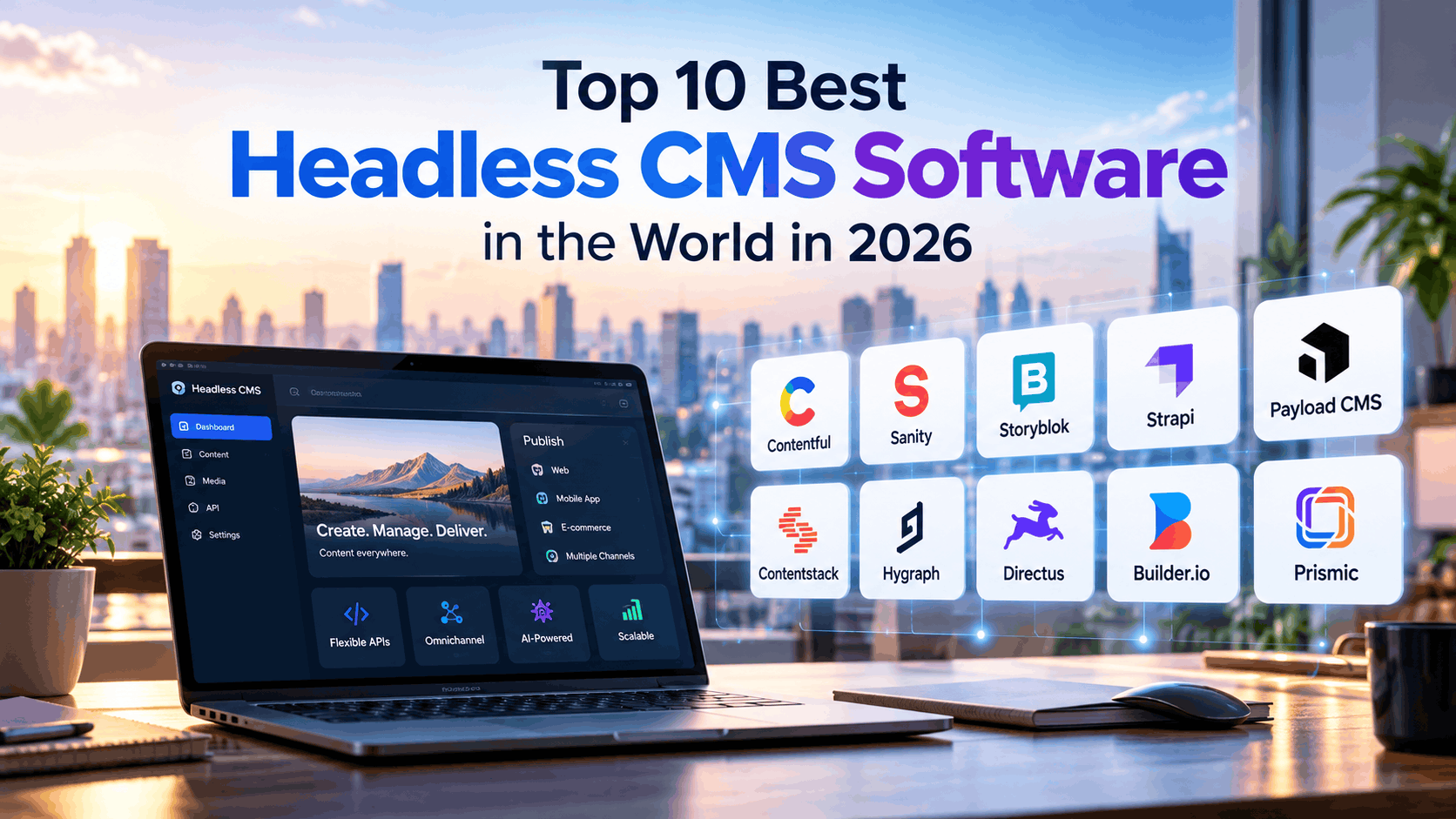
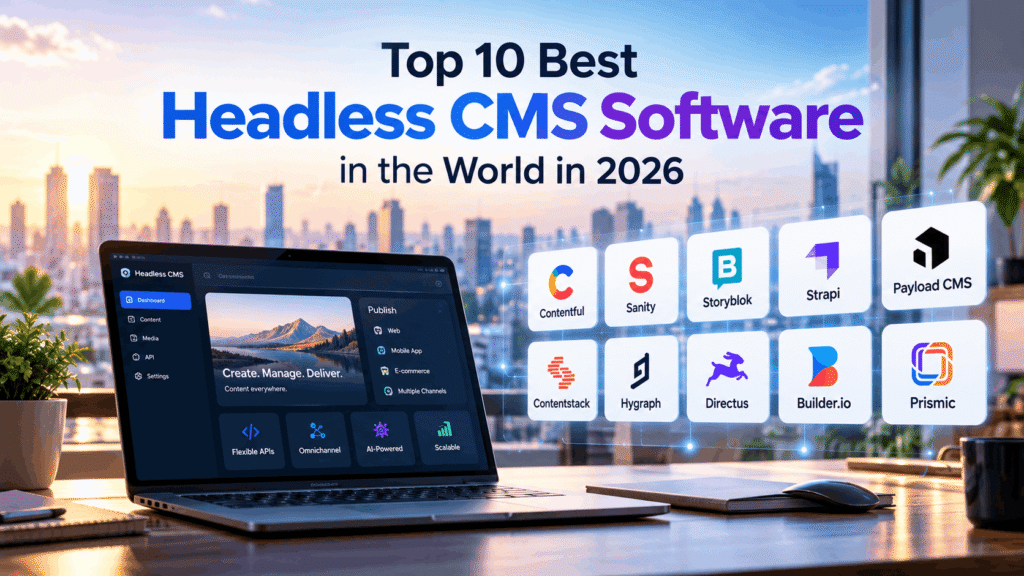
The best headless CMS software in 2026 includes Contentful, Sanity, Storyblok, Strapi, Payload CMS, Contentstack, Hygraph, Directus, Builder.io, and Prismic. These platforms help businesses manage digital content across websites, applications, and multiple channels through flexible APIs, AI-powered automation, scalable infrastructure, and customizable workflows for developers, marketers, and enterprises.
The best headless CMS software in 2026 enables businesses to create, manage, and distribute digital content across websites, mobile applications, e-commerce platforms, and other digital channels. Leading headless content management systems such as Contentful, Sanity, Storyblok, Strapi, Payload CMS, Contentstack, Hygraph, Directus, Builder.io, and Prismic offer flexible APIs, scalable architectures, and modern content management capabilities for organizations of different sizes.

As businesses accelerate their digital transformation strategies, traditional content management systems are increasingly being evaluated alongside headless CMS platforms that separate content management from front-end presentation. Unlike conventional CMS solutions, a headless CMS allows developers to build digital experiences using their preferred frameworks while enabling marketing and content teams to manage information through a centralized platform. This API-first approach supports omnichannel content delivery, greater development flexibility, and more consistent digital experiences.
In 2026, artificial intelligence is also influencing the evolution of headless CMS software. Many leading platforms are introducing AI-assisted content creation, automated workflows, intelligent content modeling, multilingual publishing capabilities, and integrations with AI development tools. These advancements can help businesses streamline content operations, reduce repetitive tasks, and improve collaboration between developers, marketers, and content creators.
However, choosing the best headless CMS software requires more than comparing technical features. Businesses must evaluate pricing, ease of implementation, API capabilities, content editing experience, security, scalability, integration options, and long-term maintenance costs. Enterprise organizations may prioritize advanced governance and global content delivery, while startups and smaller development teams may prefer affordable, open-source, or developer-friendly headless CMS solutions.
This comprehensive guide explores the top 10 best headless CMS software platforms in the world in 2026, comparing their key features, benefits, pricing structures, AI capabilities, and ideal use cases. Whether an organization needs an enterprise headless CMS, an open-source content management system, or a visual CMS for marketing teams, this comparison provides practical insights to help identify the most suitable platform for its digital content strategy.
Before we venture further into this article, we would like to share who we are and what we do.
About 9cv9
9cv9 is a business tech startup based in Singapore and Asia, with a strong presence all over the world.
With over ten years of startup and business experience, and being highly involved in connecting with thousands of companies and startups, the 9cv9 team has listed some of the top and best companies/tools in this review.
If you like to get your company listed in our top B2B software reviews, check out our world-class 9cv9 Media and PR service and pricing plans here.
Top 10 Headless CMS Software To Know in 2026
1. Contentful
Overview of Contentful
Contentful is a leading enterprise headless content management system (CMS) designed to help organizations create, manage, and distribute structured digital content across websites, mobile applications, e-commerce platforms, and other digital channels. Its API-first architecture separates content management from front-end presentation, enabling developers to build flexible digital experiences using modern technologies.
In 2026, Contentful strengthened its position in the enterprise CMS market following Salesforce’s completed acquisition on September 1, 2026. The acquisition integrates Contentful’s structured content capabilities into Salesforce’s broader customer experience and artificial intelligence ecosystem.
With more than 4,800 organizations using its platform, Contentful serves businesses requiring scalable content delivery, multilingual publishing, advanced governance, and integration with enterprise applications.
Contentful Market Position and Enterprise Capabilities
Contentful competes in the global headless CMS software market through its established enterprise customer base, API infrastructure, and composable content architecture.
| Key Metric | Contentful Position in 2026 |
|---|---|
| Software Category | Enterprise Headless CMS |
| Primary Architecture | API-First, Composable Content Platform |
| Enterprise Adoption | More than 4,800 Organizations |
| Parent Company | Salesforce |
| Acquisition Completion | September 1, 2026 |
| Content Delivery | REST APIs, GraphQL, Global CDN |
| AI Capabilities | AI Actions, Remote MCP, Agentforce Integration |
| Content Management | Structured Content Models, Localization, Versioning |
| Enterprise Features | Role-Based Permissions, Governance, Security Controls |
| Target Customers | Mid-Sized Businesses, Large Enterprises, Global Brands |
Contentful’s integration with Salesforce represents a significant development in enterprise content management. It enables organizations to connect structured digital content with customer information, marketing applications, and AI-powered customer interactions.
Key Features of Contentful
Contentful provides a comprehensive range of capabilities supporting modern content operations and omnichannel publishing.
| Feature | Description | Business Benefit |
|---|---|---|
| Headless CMS Architecture | Separates content management from presentation | Greater development flexibility |
| REST and GraphQL APIs | Delivers structured content to applications | Efficient omnichannel distribution |
| Content Modeling | Creates reusable content types and relationships | Consistent content organization |
| Contentful Studio | Provides visual content composition tools | Greater marketing team independence |
| AI Actions | Automates rewriting, translation, and content optimization | Improved editorial productivity |
| Remote MCP Integration | Connects Contentful with compatible AI applications | AI-assisted content operations |
| Localization | Supports content across multiple languages and markets | International expansion |
| Environment Management | Separates development, testing, and production workflows | Safer deployment processes |
| Role-Based Access Control | Controls permissions across teams | Stronger content governance |
| Contentful Migration CLI | Supports programmatic content model changes | More reliable development workflows |
Salesforce Acquisition and AI Integration
Salesforce completed its acquisition of Contentful in September 2026, positioning the platform as an important component of its Headless 360 strategy.
The integration connects structured content with Salesforce customer data and Agentforce, supporting AI-driven digital experiences across marketing, sales, commerce, and customer service.
Contentful’s AI Actions also enable editorial teams to automate selected content management activities, including translation, rewriting, metadata generation, and content refinement.
Its remote Model Context Protocol (MCP) capabilities support connections with compatible AI tools, enabling governed content operations through supported integrations.
These developments make Contentful particularly relevant for enterprises pursuing AI-assisted content management and personalized customer experiences.
Contentful Pricing Plans in 2026
Contentful offers a free plan, a paid Lite subscription, and custom enterprise pricing. Organizations should evaluate both platform subscriptions and additional content space requirements.
| Pricing Plan | Starting Price | Included Features | Best For |
|---|---|---|---|
| Free | $0/month | 10 users, 2 locales, 100,000 monthly API calls | Learning and development |
| Lite | $300/month | 20 users, 3 locales, 1 million monthly API calls | Smaller commercial projects |
| Enterprise | Custom Pricing | Advanced governance, unlimited API calls within technical limits, enterprise support | Large organizations |
| Additional Lite Space | $850/month | Additional content capacity, environments, API allowances, and bandwidth | Growing content operations |
| Contentful Studio | Custom Pricing | Visual experience composition and reusable components | Marketing and digital experience teams |
| AI Actions | Enterprise-Based Pricing | AI-powered content creation and workflow automation | Enterprise content teams |
The Free plan is intended for learning and testing rather than commercial production use. Lite customers can incur additional charges for API consumption and bandwidth beyond included allowances.
Enterprise pricing depends on organizational requirements, implementation complexity, content architecture, governance needs, and optional products.
Contentful Advantages and Limitations
| Advantages | Limitations |
|---|---|
| Mature enterprise headless CMS architecture | Implementation can require experienced developers |
| Strong REST and GraphQL API capabilities | Enterprise pricing requires custom quotations |
| Native integration opportunities with Salesforce | Advanced capabilities may involve additional subscriptions |
| Supports multilingual and omnichannel publishing | Complex content models require careful planning |
| Advanced enterprise governance and security | Multiple spaces can increase subscription costs |
| AI-powered content management capabilities | AI features vary by subscription |
| Visual composition through Contentful Studio | Studio may require initial developer configuration |
| Scalable content delivery infrastructure | Organizations must manage usage and architectural complexity |
Contentful Total Cost of Ownership
Organizations evaluating Contentful should consider more than the advertised subscription price.
Total cost of ownership may include platform subscriptions, additional spaces, implementation services, developer resources, enterprise integrations, content migration, training, and optional AI or personalization capabilities.
| Cost Component | Potential Financial Impact |
|---|---|
| Platform Subscription | Recurring software expenditure |
| Additional Content Spaces | Increased monthly or annual costs |
| Implementation and Integration | Initial development expenditure |
| Content Migration | One-Time Migration Costs |
| Contentful Studio | Additional Commercial Subscription |
| AI Actions | Enterprise AI Usage Costs |
| Training and Administration | Ongoing Operational Expenditure |
| Maintenance and Development | Long-Term Technical Support Costs |
Although Contentful provides scalable infrastructure, businesses should model expected content volumes, user requirements, localization needs, and application traffic before selecting a subscription.
Who Should Use Contentful?
Contentful is particularly suitable for large enterprises, multinational businesses, digital commerce companies, and organizations operating multiple digital channels.
It is also a strong option for businesses already investing in Salesforce technologies and seeking closer integration between structured content, customer information, and AI-powered applications.
However, smaller organizations with limited development resources may find simpler headless CMS alternatives more cost-effective, particularly when advanced governance and enterprise integrations are unnecessary.
Final Verdict
Contentful remains one of the strongest enterprise headless CMS software options in 2026, combining API-first content management, scalable delivery infrastructure, enterprise governance, and expanding AI capabilities.
Its acquisition by Salesforce further strengthens its potential for organizations seeking connected customer experiences and AI-assisted content operations.
For enterprises prioritizing composable architecture, omnichannel publishing, and long-term scalability, Contentful represents a compelling solution. However, its implementation requirements, additional product costs, and subscription complexity make careful technical and financial evaluation essential before adoption.
2. Sanity
Overview of Sanity
Sanity is a leading headless content management system (CMS) that enables organizations to manage structured content, build customized digital experiences, and automate content operations using artificial intelligence. Positioned as a Content Operating System for the AI Era, Sanity extends traditional headless CMS capabilities by treating content as programmable, reusable data rather than static website pages.
The company strengthened its market position following an $85 million Series C funding round announced in May 2025, led by Bullhound Capital with participation from Heavybit, Threshold, ICONIQ Growth, Shopify Blue Cloud Ventures, and Monochrome Ventures.
In 2026, Sanity differentiates itself through its real-time Content Lake, customizable Sanity Studio, GROQ query language, and AI-powered content operations. These capabilities make it particularly attractive to developers, digital agencies, e-commerce businesses, and enterprises requiring flexible content infrastructure.
Sanity Market Position and Platform Overview
Sanity competes with established headless CMS platforms such as Contentful, Strapi, Storyblok, and Prismic by emphasizing developer customization, structured content management, and real-time collaboration.
| Key Metric | Sanity Position in 2026 |
|---|---|
| Software Category | Headless CMS and Content Operating System |
| Primary Architecture | API-First, Structured Content Platform |
| Series C Funding | $85 Million |
| Funding Announcement | May 2025 |
| Core Database | Sanity Content Lake |
| Editorial Interface | Sanity Studio |
| Development Technologies | React, JavaScript, TypeScript |
| Query Languages | GROQ and GraphQL |
| AI Capabilities | Content Agent, AI Assist, MCP Integration |
| Collaboration | Real-Time Multiuser Editing |
| Deployment Model | Cloud-Hosted Content Infrastructure |
| Target Customers | Developers, Agencies, Startups, Enterprises |
Sanity’s competitive advantage comes from combining a highly customizable development environment with managed content infrastructure, allowing businesses to design content workflows around their operational requirements.
Key Features of Sanity
Sanity provides a comprehensive collection of tools for structured content management, application development, and AI-assisted publishing.
| Feature | Description | Business Benefit |
|---|---|---|
| Content Lake | Cloud-hosted structured content database | Centralized content management |
| Sanity Studio | Customizable React-based editorial interface | Flexible content workflows |
| GROQ Query Language | Retrieves and transforms structured content | Efficient data delivery |
| Real-Time Collaboration | Supports simultaneous document editing | Faster editorial teamwork |
| Content Agent | AI-powered content operations | Reduced manual content work |
| MCP Integration | Connects compatible AI assistants with content infrastructure | Automated content management |
| Schema-as-Code | Defines content structures using JavaScript or TypeScript | Better development control |
| Portable Text | Stores rich text as structured data | Reusable content across channels |
| Visual Editing | Connects content editing with website previews | Improved editorial experience |
| Localization | Supports multilingual content models | International content delivery |
| APIs and SDKs | Integrates content with websites and applications | Greater development flexibility |
| Version Control Integration | Supports code-based configuration and deployment | Consistent development workflows |
Sanity Content Lake and Studio Architecture
Sanity’s architecture consists of two core components: Content Lake and Sanity Studio.
Content Lake functions as a managed, real-time content database that stores structured documents in JSON format. Its flexible document model enables developers to organize content without relying on conventional relational database schemas.
Sanity Studio is an open-source, React-based application that provides the editorial interface for creating, updating, and managing content.
Unlike conventional CMS platforms that rely primarily on fixed administrative interfaces, Sanity allows developers to customize editing experiences, document structures, validation rules, and operational workflows through code.
| Architecture Component | Primary Function | Operational Advantage |
|---|---|---|
| Content Lake | Stores structured JSON documents | Centralized content infrastructure |
| Sanity Studio | Provides customizable editing interfaces | Tailored editorial workflows |
| GROQ | Queries and transforms document data | Precise content retrieval |
| Portable Text | Represents rich text as structured blocks | Cross-platform content reuse |
| Real-Time Listeners | Detects content changes | Live application updates |
| Schema Definitions | Configures document types and fields | Consistent content structures |
| Global CDN | Distributes cached content | Improved content delivery |
| APIs and SDKs | Connects external applications | Flexible system integration |
This architecture is particularly valuable for businesses managing content across multiple websites, mobile applications, e-commerce storefronts, and digital services.
Artificial Intelligence and Content Automation
Sanity has expanded its AI capabilities to support automated content management, AI-assisted editing, and integration with external AI applications.
Its Content Agent enables authorized users to interact with structured content using natural-language instructions. Supported workflows include content analysis, document creation, content updates, and information retrieval.
Sanity also provides a hosted Model Context Protocol (MCP) server that allows compatible AI assistants to interact with content projects through authenticated connections.
These integrations support tasks such as executing GROQ queries, modifying documents, assisting with content migrations, and managing selected project resources.
| AI Capability | Application | Business Value |
|---|---|---|
| Content Agent | Natural-language content operations | Improved productivity |
| AI Assist | AI-supported editorial tasks | Faster content preparation |
| Hosted MCP Server | Connects external AI assistants | Automated content workflows |
| Structured JSON Content | Provides machine-readable information | Better contextual retrieval |
| Agent Actions | Executes supported content operations | Reduced repetitive work |
| Schema-Aware Operations | Uses content model information | More consistent content updates |
| AI-Powered Localization | Assists multilingual content creation | Faster international publishing |
Structured content can provide AI systems with clearer contextual information than unstructured page markup. However, AI-generated outputs still require appropriate validation, permissions, and editorial oversight.
GROQ Query Language and Developer Flexibility
One of Sanity’s most distinctive technical features is GROQ, a query language designed to retrieve, filter, and transform structured content.
GROQ allows developers to request specific document fields, follow references, and construct customized responses without retrieving unnecessary content.
Sanity also supports GraphQL, giving development teams flexibility when integrating with existing applications.
Its schema-as-code approach enables content models to be maintained alongside application source code, supporting version control, automated testing, and repeatable deployment workflows.
These capabilities make Sanity particularly suitable for development teams building complex applications with frequently changing content requirements.
Sanity Pricing Plans in 2026
Sanity offers a free subscription, a usage-based Growth plan, and custom enterprise contracts.
| Pricing Plan | Starting Price | Key Features | Best For |
|---|---|---|---|
| Free | $0/month | 20 user seats, 2 public datasets, 10,000 documents | Developers and Small Projects |
| Growth | $15/seat/month | Up to 50 seats, 5 roles, private datasets, paid overages | Growing Businesses |
| Enterprise | Custom Pricing | Custom roles, SSO, advanced security, dedicated support | Large Enterprises |
Sanity’s pricing combines user-based subscriptions with resource consumption. Additional charges may apply for API usage, bandwidth, storage, datasets, and premium services.
Sanity Usage Limits and Additional Costs
| Resource | Free Plan | Growth Plan |
|---|---|---|
| User Seats | 20 | Up to 50 |
| Permission Roles | 2 | 5 |
| Included Datasets | 2 Public | 2 Public or Private |
| Included Documents | 10,000 | 25,000 |
| Monthly API Requests | 250,000 | 250,000 |
| Monthly CDN API Requests | 1 Million | 1 Million |
| Asset Storage | 100 GB | 100 GB |
| Monthly Bandwidth | 100 GB | 100 GB |
| Additional API Usage | Not Available | Pay-As-You-Go |
| Dedicated Support | Not Included | Paid Add-On |
| Single Sign-On | Not Included | Enterprise Only |
Organizations should carefully evaluate projected API consumption, dataset requirements, storage usage, and AI credit consumption before selecting a paid subscription.
Sanity Advantages and Limitations
| Advantages | Limitations |
|---|---|
| Highly customizable editorial interface | Requires technical expertise for advanced customization |
| Strong developer experience with React and TypeScript | Initial implementation can take longer |
| Real-time collaborative editing | Complex workflows require careful configuration |
| Flexible structured content architecture | GROQ introduces an additional learning curve |
| Native AI and MCP capabilities | AI usage may generate additional costs |
| Generous free development plan | Free plan has strict resource limits |
| Supports multiple digital channels | Advanced enterprise features require custom pricing |
| Strong integration with modern development frameworks | Organizations need ongoing technical maintenance |
Who Should Use Sanity?
Sanity is particularly suitable for software development companies, digital agencies, technology startups, e-commerce businesses, and enterprises seeking customizable content management infrastructure.
It is especially valuable for organizations with in-house React and TypeScript expertise, as these skills enable teams to take full advantage of Sanity Studio’s extensibility.
Marketing teams can also benefit from real-time collaboration, visual editing, and AI-assisted content workflows, provided developers establish an intuitive editorial environment.
Businesses seeking an entirely configuration-free CMS may prefer platforms offering more standardized editing interfaces.
Final Verdict
Sanity ranks among the best headless CMS software platforms in 2026 for organizations prioritizing developer flexibility, structured content, real-time collaboration, and AI-powered content operations.
Its combination of Content Lake, Sanity Studio, GROQ, and MCP integration provides a modern foundation for managing content across websites, applications, and emerging AI-driven interfaces.
For development-focused organizations, Sanity offers substantial customization and scalability. However, businesses should consider the technical resources required for implementation, ongoing maintenance, and usage-based pricing before adoption.
3. Storyblok
Overview of Storyblok
Storyblok is a leading headless content management system (CMS) designed to combine the flexibility of API-first architecture with an intuitive visual editing experience. Unlike traditional headless CMS platforms that rely heavily on structured forms and developer assistance, Storyblok enables marketing teams to create, edit, and publish digital content through a visual, component-based interface.
In 2026, Storyblok stands out among the best headless CMS software platforms for its Visual Editor, reusable content blocks, multilingual publishing capabilities, and expanding artificial intelligence features.
The platform serves developers, marketers, digital agencies, e-commerce businesses, and multinational enterprises seeking to accelerate content production while maintaining consistent branding across websites, applications, and other digital channels.
Storyblok Market Position and Platform Overview
Storyblok has established itself as a prominent competitor to Contentful, Sanity, Strapi, and other enterprise headless CMS providers.
Its market positioning emphasizes editorial independence, allowing non-technical users to manage digital experiences without requiring developers to implement every content update.
| Key Metric | Storyblok Position in 2026 |
|---|---|
| Software Category | Visual Headless CMS |
| Primary Architecture | API-First, Component-Based Content Management |
| Total Funding | Approximately $138 Million |
| Series C Funding | $80 Million |
| Series C Lead Investor | Brighton Park Capital |
| Core Differentiator | Visual Editor with Reusable Content Blocks |
| Content Delivery | REST API and Supported GraphQL Services |
| Front-End Compatibility | React, Vue, Next.js, Nuxt, and Other Frameworks |
| AI Capabilities | AI-Assisted Content Operations and Automation |
| Collaboration | Visual Editing, Workflows, Content Scheduling |
| Localization | Multilingual Content Management |
| Target Customers | Marketing Teams, Digital Agencies, E-Commerce Businesses, Enterprises |
Storyblok’s approach is particularly attractive to organizations seeking to reduce dependence on development teams for routine content publishing while preserving the architectural benefits of a headless CMS.
Key Features of Storyblok
Storyblok provides a comprehensive collection of features designed to support content creation, website management, localization, and digital experience delivery.
| Feature | Description | Business Benefit |
|---|---|---|
| Visual Editor | Enables editing within a live website preview | Greater marketing independence |
| Component-Based Architecture | Organizes content into reusable blocks | Consistent digital experiences |
| Drag-and-Drop Editing | Allows editors to arrange page components | Faster page creation |
| Headless Content Delivery | Distributes content through APIs | Omnichannel publishing |
| Real-Time Preview | Displays content changes before publication | Reduced publishing errors |
| AI-Assisted Content Tools | Supports selected content generation and optimization tasks | Improved editorial productivity |
| Multilingual Content | Manages localized content versions | International market expansion |
| Content Scheduling | Supports planned content publication | Better campaign coordination |
| Digital Asset Management | Organizes images and other media | Centralized asset management |
| Custom Workflows | Supports structured review and approval processes | Stronger content governance |
| Reusable Content Blocks | Enables consistent components across pages | Reduced development duplication |
| Developer SDKs | Supports integration with modern frameworks | Greater technical flexibility |
Storyblok Visual Editor and Component-Based Architecture
Storyblok’s defining feature is its Visual Editor, which enables content creators to manage website pages through an interactive preview.
Developers first create reusable components using frameworks such as React, Vue, or Next.js. Marketing teams can then assemble and configure these components without modifying application source code.
Each component is represented through structured content data, allowing the platform to separate content management from front-end presentation.
| Architecture Component | Primary Function | Operational Advantage |
|---|---|---|
| Visual Editor | Provides interactive content previews | Simplifies editorial workflows |
| Content Blocks | Defines reusable page components | Consistent design implementation |
| Nested Components | Organizes page structures | Flexible page composition |
| Content Delivery API | Distributes published content | Multi-Platform Integration |
| Management API | Supports programmatic content operations | Workflow automation |
| Asset Library | Stores and organizes digital assets | Efficient media management |
| Localization Tools | Manages language-specific content | Global content consistency |
| Preview Environment | Displays unpublished changes | Safer content reviews |
This architecture is especially valuable for businesses operating marketing websites, landing pages, e-commerce storefronts, and campaign-driven digital experiences.
By separating component development from everyday content editing, Storyblok allows developers to focus on technical improvements while marketing teams manage routine publishing activities.
Artificial Intelligence and Content Automation
Storyblok integrates AI-powered capabilities to support content generation, translation, search engine optimization, and workflow automation.
Its Storyblok Agents capabilities help organizations automate selected content management activities, while AI credits provide a usage allowance for supported AI operations.
The platform’s component-based content structure also provides a useful foundation for AI-assisted workflows by organizing content into identifiable, reusable elements.
| AI Capability | Application | Business Value |
|---|---|---|
| Storyblok Agents | Automates supported content operations | Reduced manual workloads |
| AI Content Generation | Assists with writing and editing | Faster content production |
| AI Translation | Supports multilingual content creation | More efficient localization |
| AI Alt Text | Generates image descriptions | Improved accessibility |
| AI SEO | Supports search optimization workflows on eligible plans | Better content discoverability |
| Structured Content Blocks | Organizes machine-readable content | Easier content reuse |
| AI Credits | Measures AI feature consumption | Predictable usage management |
Although structured content can help AI systems interpret content relationships, it does not automatically guarantee accurate AI-generated responses or improved search rankings. Content quality, implementation, and editorial validation remain essential.
Storyblok Pricing Plans in 2026
Storyblok offers a free Starter plan, two self-service commercial plans, and custom enterprise subscriptions.
| Pricing Plan | Monthly Price | Annual Billing Equivalent | Best For |
|---|---|---|---|
| Starter | Free | Free | Personal Projects and Testing |
| Growth | $99/month | $90.75/month | Small Marketing Teams |
| Growth Plus | $349/month | $319.91/month | Growing Businesses |
| Premium | Custom Pricing | Custom Pricing | Large Enterprises |
| Elite | Custom Pricing | Custom Pricing | Complex Global Organizations |
Growth and Growth Plus include Storyblok Agents, content scheduling, SEO metadata features, and expanded API allowances. Premium and Elite provide advanced capabilities such as custom workflows, single sign-on, release management, and GraphQL access.
Storyblok Plan Limits and Usage Allowances
| Resource | Starter | Growth | Growth Plus |
|---|---|---|---|
| Included Users | 1 | 5 | 15 |
| Monthly API Requests | 100,000 | 1 Million | 4 Million |
| Included Stories | 20,000 | 25,000 | 100,000 |
| Digital Assets | 2,000 | 2,500 | 10,000 |
| Included Locales | 2 | 2 | 10 |
| Monthly Traffic | 100 GB | 400 GB | 1 TB |
| Monthly AI Credits | 25,000 | 100,000 | 200,000 |
| Additional Seats | Limited | $15/Seat/Month | Not Available |
| Storyblok Agents | Not Included | Included | Included |
| Custom Enterprise Workflows | Not Included | Not Included | Not Included |
The Growth plan supports optional capacity upgrades, while Growth Plus emphasizes a more predictable subscription structure. Businesses should review API consumption, traffic, localization requirements, and additional user costs before upgrading.
Storyblok Advantages and Limitations
| Advantages | Limitations |
|---|---|
| Intuitive visual editing experience | Requires developers to build initial components |
| Strong marketing team independence | Complex relational content can be harder to manage |
| Reusable component-based architecture | Page structures require careful planning |
| Supports modern front-end frameworks | Advanced features are restricted to higher plans |
| Multilingual content management | Additional locales may increase costs |
| AI-assisted content operations | AI credit allowances vary by subscription |
| Free plan for testing and small projects | Starter plan has limited user capacity |
| Enterprise workflows and governance | Enterprise pricing requires custom quotations |
Who Should Use Storyblok?
Storyblok is particularly suitable for marketing-led organizations, digital agencies, e-commerce companies, and multinational businesses that frequently publish or update digital content.
Its Visual Editor is especially valuable for organizations where marketers need to create landing pages, update promotional campaigns, and manage website content without relying on developers for every change.
Development teams also benefit from its framework flexibility and reusable components, enabling them to establish consistent design systems while giving editors greater operational control.
However, organizations managing highly interconnected data structures, complex relationships, or sophisticated cross-document queries may find data-oriented platforms such as Sanity or Contentful better suited to certain requirements.
Final Verdict
Storyblok is one of the best headless CMS software platforms in 2026 for businesses prioritizing visual content editing, marketing independence, and efficient omnichannel publishing.
Its combination of a component-based architecture, intuitive Visual Editor, multilingual capabilities, and AI-assisted content tools provides a compelling alternative to developer-centric headless CMS platforms.
For marketing-heavy organizations seeking faster content production without sacrificing front-end flexibility, Storyblok is a strong choice. However, businesses should evaluate their content modeling requirements, development resources, and enterprise feature costs before adoption.
4. Strapi
Overview of Strapi
Strapi is a leading open-source headless content management system (CMS) designed for developers and organizations seeking greater control over their content infrastructure, databases, and application integrations. Built on Node.js and TypeScript, Strapi enables businesses to create, manage, and distribute structured content through customizable APIs.
Unlike fully managed headless CMS platforms such as Contentful, Sanity, and Storyblok, Strapi provides a self-hosting option that allows organizations to operate their content management infrastructure on their own servers or preferred cloud providers.
In 2026, Strapi remains a strong choice among the best headless CMS software platforms for its open-source architecture, developer flexibility, database control, and expanding artificial intelligence integrations.
Its fifth major version, Strapi v5, introduced significant architectural improvements, including a redesigned Document Service API, enhanced TypeScript support, and more consistent content management across multiple languages and publication states.
Strapi Market Position and Platform Overview
Strapi has established a strong presence within the open-source developer community, particularly among organizations building custom websites, applications, e-commerce platforms, and API-driven digital services.
| Key Metric | Strapi Position in 2026 |
|---|---|
| Software Category | Open-Source Headless CMS |
| Primary Technology | Node.js and TypeScript |
| Core License | MIT License |
| Major Version | Strapi v5 |
| Deployment Options | Self-Hosted and Strapi Cloud |
| Supported Databases | PostgreSQL, MySQL, MariaDB, SQLite |
| Content Delivery | REST API and Optional GraphQL |
| Content Management | Document Service API |
| AI Capabilities | Model Context Protocol Integration |
| Internationalization | Multilingual Content Support |
| Enterprise Features | SSO, Audit Logs, Advanced Publishing |
| Target Customers | Developers, Startups, Agencies, Enterprises |
Strapi’s main competitive advantage is its ability to combine open-source flexibility with a configurable administrative interface, enabling organizations to retain control over content infrastructure while supporting modern application development.
Key Features of Strapi
Strapi provides a comprehensive range of tools for structured content management, API development, and enterprise publishing.
| Feature | Description | Business Benefit |
|---|---|---|
| Open-Source Architecture | Provides access to core source code | Greater customization and control |
| Content-Type Builder | Creates structured content models | Faster application development |
| REST API | Automatically exposes content endpoints | Simplified system integration |
| GraphQL Plugin | Enables GraphQL content queries | Flexible data retrieval |
| Document Service API | Manages content documents and publication states | Consistent content operations |
| TypeScript Support | Provides typed development capabilities | Improved code reliability |
| Internationalization | Supports localized content | Global content management |
| Draft and Publish | Separates unpublished and published content | Better editorial control |
| Role-Based Access Control | Manages administrative and API permissions | Stronger security |
| MCP Integration | Connects compatible AI applications | AI-assisted content workflows |
| Strapi Cloud | Provides managed deployment infrastructure | Reduced hosting complexity |
| Plugin Ecosystem | Extends platform functionality | Greater application flexibility |
Strapi v5 Architecture and Developer Capabilities
Strapi v5 modernized the platform’s content management architecture by introducing a more consistent approach to managing documents, localized entries, and publication states.
The Document Service API replaces the previous Entity Service API and uses document identifiers to represent logical content records.
This approach simplifies content management when the same document exists in multiple languages or draft and published versions.
Strapi v5 also strengthens TypeScript integration, allowing developers to generate type definitions from content schemas and maintain more consistent application code.
| Architecture Component | Primary Function | Operational Advantage |
|---|---|---|
| Document Service API | Manages structured content documents | Simplified content operations |
| Document ID | Identifies logical content records | Consistent document references |
| TypeScript Integration | Supports typed application development | Reduced development errors |
| Content-Type Builder | Defines collections and single types | Faster schema configuration |
| REST API | Delivers structured content | Application interoperability |
| GraphQL Plugin | Supports flexible content queries | Efficient API integration |
| Database Layer | Connects supported SQL databases | Infrastructure flexibility |
| Plugin Architecture | Extends platform capabilities | Customized functionality |
| Draft and Publish | Manages publication states | Controlled editorial workflows |
These capabilities make Strapi particularly attractive to development teams building customized content platforms that require direct control over application architecture and data storage.
Artificial Intelligence and MCP Integration
Strapi has expanded its AI capabilities through its native Model Context Protocol (MCP) server, which became generally available in Strapi v5.49.0.
The MCP server enables compatible AI assistants to interact with Strapi content through authenticated connections. Supported operations include creating, retrieving, updating, publishing, and unpublishing content.
Unlike integrations that depend entirely on external automation services, Strapi’s native MCP implementation provides a direct connection between AI applications and the CMS.
| AI Capability | Application | Business Value |
|---|---|---|
| Native MCP Server | Connects compatible AI assistants | Simplified AI integration |
| AI Content Management | Creates and updates structured content | Faster editorial operations |
| Automated Publishing | Supports authorized publishing actions | Reduced manual workloads |
| Schema-Aware Tools | Exposes content operations based on schemas | More consistent AI interactions |
| Admin Token Authentication | Controls AI access through permissions | Stronger security |
| Strapi AI | Assists with selected CMS operations | Improved content productivity |
| AI-Assisted Localization | Supports multilingual content workflows | Faster international publishing |
Organizations can configure MCP access using administrative tokens and granular permissions, ensuring AI applications can only perform authorized operations.
Strapi Pricing Plans in 2026
Strapi separates its CMS software licensing from its managed cloud hosting subscriptions.
The Community Edition is available free of charge, while paid CMS plans unlock additional publishing, governance, and enterprise capabilities.
| CMS Plan | Starting Price | Key Features | Best For |
|---|---|---|---|
| Community | Free | Open-source CMS, REST and GraphQL, RBAC, unlimited entries | Developers and Startups |
| Growth | $45/month | 3 users, Strapi AI, Live Preview, Releases, Content History | Growing Businesses |
| Enterprise | Custom Pricing | SSO, Review Workflows, Audit Logs, Enterprise Support | Large Organizations |
| SSO Add-On | $150/month | Enterprise identity provider integration | Security-Focused Teams |
Growth includes three users, with additional users costing $15 per month. Its Content History feature provides 14-day retention, while Enterprise offers customizable retention and additional governance capabilities.
Strapi Cloud Hosting Pricing
For organizations that prefer managed infrastructure, Strapi Cloud provides hosting services with predefined API allowances, asset storage, and operational features.
| Cloud Plan | Monthly Price | API Requests | Asset Storage | Best For |
|---|---|---|---|---|
| Starter | $35/project | 100,000/month | 50 GB | Small Applications |
| Pro | $90/project | 1 Million/month | 250 GB | Growing Production Applications |
| Business | $450/project | 10 Million/month | 1,000 GB | High-Traffic Businesses |
Strapi Cloud includes managed deployment infrastructure, CDN capabilities, and additional operational services depending on the subscription.
Importantly, paid Strapi Cloud hosting does not automatically include paid CMS features. Organizations requiring Growth or Enterprise functionality must purchase the corresponding CMS license separately.
Strapi Self-Hosting vs Managed Cloud
| Evaluation Criteria | Self-Hosted Strapi | Strapi Cloud |
|---|---|---|
| CMS Software Cost | Free Community Edition Available | Free Community Edition Available |
| Infrastructure Management | Customer Responsibility | Managed by Strapi |
| Database Control | Full Infrastructure Control | Managed Environment |
| Server Maintenance | Internal Team | Managed Hosting |
| Backups | Customer Configured | Plan Dependent |
| Security Updates | Customer Managed | Shared Responsibility |
| Infrastructure Customization | High | More Limited |
| Scalability | Depends on Infrastructure | Depends on Cloud Plan |
| Enterprise CMS Features | Separate Paid License | Separate Paid License |
| Best For | Technical Teams and Custom Deployments | Businesses Seeking Simpler Operations |
Strapi Advantages and Limitations
| Advantages | Limitations |
|---|---|
| Free and open-source Community Edition | Self-hosting requires infrastructure expertise |
| Full control over application infrastructure | Security maintenance is customer-managed |
| Strong Node.js and TypeScript integration | Advanced customization requires developers |
| Flexible content modeling | Visual editing is less central than in Storyblok |
| REST and GraphQL API support | Enterprise features require paid subscriptions |
| Native MCP integration | AI integrations require security configuration |
| Multiple supported SQL databases | Database scaling requires technical planning |
| No CMS usage-based licensing limits when self-hosted | Infrastructure costs increase with traffic |
| Managed cloud hosting available | Cloud hosting and CMS licensing are separate costs |
Who Should Use Strapi?
Strapi is particularly suitable for software developers, technology startups, digital agencies, and businesses requiring complete control over their content management infrastructure.
Its open-source architecture makes it attractive to organizations seeking to avoid dependency on proprietary hosted CMS services while maintaining the flexibility to customize APIs, content models, and application integrations.
Strapi is also well suited to businesses with existing Node.js expertise and DevOps capabilities, particularly those operating self-hosted infrastructure.
However, organizations without dedicated technical resources may find fully managed headless CMS platforms easier to maintain.
Final Verdict
Strapi is one of the best open-source headless CMS software platforms in 2026, offering a strong combination of developer flexibility, infrastructure control, customizable APIs, and AI integration capabilities.
Its modernized Strapi v5 architecture, native MCP server, TypeScript support, and flexible deployment options make it particularly attractive to organizations building custom digital applications.
For businesses prioritizing open-source technology, self-hosting, and control over content infrastructure, Strapi represents a compelling alternative to proprietary headless CMS platforms. However, organizations should account for infrastructure maintenance, security responsibilities, and additional enterprise licensing costs when evaluating its long-term suitability.
5. Payload CMS
Overview of Payload CMS
Payload CMS is an open-source, code-first headless content management system designed for developers building modern websites, web applications, and digital platforms using JavaScript and TypeScript. Unlike traditional content management systems that operate as separate backend services, Payload can run directly within a Next.js application, enabling developers to manage content, application logic, and APIs within a unified codebase.
In 2026, Payload CMS stands out among the best headless CMS software platforms for its native Next.js integration, TypeScript-first architecture, flexible database support, and extensive customization capabilities.
The platform gained additional industry attention following its acquisition by Figma in June 2025. This development strengthened Payload’s position within the broader developer tooling and digital experience ecosystem while preserving its open-source foundation.
Payload is particularly attractive to software engineering teams, technology startups, digital agencies, and enterprises seeking complete ownership of their content infrastructure without traditional CMS licensing restrictions.
Payload CMS Market Position and Platform Overview
Payload competes with Strapi, Sanity, Contentful, and other headless CMS platforms by emphasizing developer productivity, application-level integration, and open-source flexibility.
| Key Metric | Payload CMS Position in 2026 |
|---|---|
| Software Category | Open-Source Headless CMS and Application Framework |
| Parent Company | Figma |
| Acquisition Announcement | June 2025 |
| Core License | MIT License |
| Primary Technologies | TypeScript, React, Next.js |
| Major Architecture | Payload 3.x |
| Supported Databases | PostgreSQL and MongoDB |
| API Capabilities | REST, GraphQL, Local API |
| Admin Interface | React-Based Administrative Dashboard |
| AI Capabilities | MCP Plugin and Custom AI Integrations |
| Deployment Options | Self-Hosted and Managed Infrastructure |
| Content Modeling | TypeScript Collections and Globals |
| Target Customers | Developers, Startups, Digital Agencies, Enterprises |
Payload’s competitive advantage comes from combining content management with application development, reducing the need for separate services and enabling developers to work within familiar frameworks and development environments.
Key Features of Payload CMS
Payload provides a comprehensive set of developer-focused tools for building customizable content management systems and application backends.
| Feature | Description | Business Benefit |
|---|---|---|
| Native Next.js Integration | Runs within a Next.js application | Simplified application architecture |
| TypeScript-First Development | Defines content models through typed code | Improved development reliability |
| Open-Source MIT License | Provides unrestricted access to core software | Reduced licensing costs |
| Local API | Accesses content directly within server-side application code | Reduced network overhead |
| REST API | Automatically generates content endpoints | Simplified integrations |
| GraphQL API | Supports flexible content queries | Efficient data retrieval |
| React Admin Dashboard | Provides a customizable management interface | Better editorial control |
| PostgreSQL Support | Uses relational database infrastructure | Flexible structured data management |
| MongoDB Support | Supports document-oriented storage | Alternative database architecture |
| Access Control | Configures permissions through application logic | Granular security management |
| Localization | Supports multilingual content models | International content delivery |
| Versioning and Drafts | Manages content revisions and publication states | Safer editorial workflows |
| MCP Plugin | Connects compatible AI applications | AI-assisted content operations |
Payload 3 Architecture and Next.js Integration
Payload 3 introduced a significant architectural shift by enabling the CMS to operate directly inside Next.js applications.
Rather than requiring developers to maintain a completely separate CMS backend, Payload can share the application’s server environment, codebase, and deployment infrastructure.
Developers define content collections, global settings, access rules, and validation logic using TypeScript. Payload then generates the corresponding administrative interface and API capabilities.
| Architecture Component | Primary Function | Operational Advantage |
|---|---|---|
| Next.js Integration | Runs CMS and application together | Simplified development workflows |
| TypeScript Collections | Defines structured content types | Consistent data modeling |
| Globals | Manages singleton content and settings | Centralized configuration |
| Local API | Executes content operations inside the application | Reduced API overhead |
| REST API | Exposes content through HTTP endpoints | External application integration |
| GraphQL API | Provides flexible content queries | Efficient data access |
| React Admin Panel | Generates content editing interfaces | Reduced custom dashboard development |
| Database Adapters | Connects PostgreSQL or MongoDB | Infrastructure flexibility |
| Hooks | Executes custom application logic | Automated business workflows |
| Access Control Functions | Applies granular permissions | Stronger data governance |
The Local API is particularly valuable for server-side applications because it allows developers to access Payload operations without making unnecessary external HTTP requests.
However, actual performance depends on database queries, application architecture, caching, infrastructure capacity, and workload complexity.
Artificial Intelligence and MCP Integration
Payload CMS supports AI-powered development and content automation through its official Model Context Protocol (MCP) plugin and extensible application architecture.
The MCP plugin enables compatible AI assistants to interact with Payload collections and global configurations through authenticated connections. Developers can control which content operations are available, including reading, creating, updating, and deleting documents.
Payload’s TypeScript-based architecture also helps AI coding assistants understand content schemas, field definitions, and application logic.
| AI Capability | Application | Business Value |
|---|---|---|
| MCP Plugin | Connects AI assistants to Payload | Automated content operations |
| AI Content Management | Creates and updates content through authorized tools | Reduced manual administration |
| Schema-Aware Development | Uses TypeScript content definitions | More consistent code generation |
| Custom AI Hooks | Integrates AI services into application workflows | Flexible automation |
| Automated Translation | Supports integrations with translation models | Faster localization |
| Vector Embeddings | Enables custom semantic search integrations | Improved content discovery |
| Granular MCP Permissions | Restricts AI access to authorized operations | Stronger security |
| Custom MCP Tools | Exposes application-specific functionality | Extensible AI workflows |
Payload does not require developers to use a specific AI provider. Organizations can integrate their preferred AI models, embedding services, and automation frameworks.
However, advanced AI functionality such as automated translation and vector search generally requires additional development and external services.
Payload CMS Pricing in 2026
Payload CMS uses an open-source licensing model, allowing organizations to access its core software without recurring license fees.
Unlike proprietary headless CMS platforms that charge according to user seats, API requests, or content entries, Payload’s self-hosted software does not impose equivalent commercial licensing limits.
| Pricing Option | Starting Price | Key Features | Best For |
|---|---|---|---|
| Open-Source Core | Free | Full CMS, APIs, localization, access control | Developers and Startups |
| Self-Hosted Deployment | Infrastructure-Based | Complete infrastructure and database control | Technical Teams |
| Managed Cloud Hosting | Provider-Dependent | Managed servers, databases, and deployment services | Growing Businesses |
| Enterprise Support | Custom Pricing | Professional support and architecture assistance | Large Organizations |
The core MIT license permits commercial use, modification, and self-hosting. However, businesses remain responsible for infrastructure, database services, maintenance, and operational security.
Payload CMS Self-Hosting Costs
Although Payload itself is free, production deployments require suitable hosting infrastructure.
| Cost Component | Estimated Monthly Cost | Considerations |
|---|---|---|
| Payload CMS License | $0 | Open-Source MIT License |
| Small VPS Hosting | $5–$20 | Suitable for lightweight workloads |
| Managed Database | $0–$30+ | Depends on storage and usage |
| Object Storage | $0–$20+ | Media and file storage |
| CDN and Bandwidth | Variable | Depends on traffic |
| Backups and Monitoring | Variable | Depends on operational requirements |
| Enterprise Infrastructure | Custom | High availability and scaling |
These figures are illustrative infrastructure estimates rather than guaranteed provider prices. Production costs can increase significantly with application traffic, database workloads, media storage, redundancy, and support requirements.
Payload CMS Advantages and Limitations
| Advantages | Limitations |
|---|---|
| Free and open-source MIT license | Requires experienced developers |
| Native Next.js integration | Closely aligned with the Next.js ecosystem |
| Strong TypeScript support | Content schemas require code changes |
| Full database and infrastructure control | Self-hosting requires operational maintenance |
| REST, GraphQL, and Local APIs | Advanced customization increases development complexity |
| Highly customizable React admin interface | Less accessible for no-code content modeling |
| Built-in localization and versioning | Advanced visual editing requires additional configuration |
| Official MCP integration | AI automation requires careful permission management |
| No proprietary CMS seat-based licensing | Hosting and engineering costs remain |
Who Should Use Payload CMS?
Payload CMS is particularly suitable for software development companies, technology startups, digital agencies, and enterprises building custom applications with Next.js and TypeScript.
It is especially attractive to organizations seeking to combine content management with application functionality such as user authentication, e-commerce, customer portals, and internal business systems.
Development teams benefit from maintaining content schemas, access control rules, APIs, and application logic within a unified codebase.
However, businesses without dedicated engineering resources may find managed platforms such as Storyblok, Contentful, or Sanity easier to implement and maintain.
Final Verdict
Payload CMS is one of the best open-source headless CMS software platforms in 2026 for organizations prioritizing Next.js integration, TypeScript development, infrastructure ownership, and application customization.
Its acquisition by Figma, modern Payload 3 architecture, flexible database support, and official MCP integration strengthen its position as a developer-focused alternative to proprietary content management platforms.
For engineering-led businesses seeking a customizable CMS without recurring software licensing fees, Payload offers a compelling solution. However, organizations should account for development expertise, infrastructure maintenance, and operational costs when evaluating its long-term suitability.
6. Contentstack
Overview of Contentstack
Contentstack is a leading enterprise headless content management system (CMS) and composable Digital Experience Platform (DXP) designed for organizations managing complex digital ecosystems, multiple brands, and global content operations.
Unlike conventional headless CMS platforms focused primarily on content storage and API delivery, Contentstack combines structured content management, artificial intelligence, customer data, personalization, and workflow automation within an integrated enterprise platform.
In June 2026, Contentstack introduced its Agentic Experience Platform (AXP), expanding its capabilities through Agent OS, Content Cloud, and Data Cloud. This development positioned the company as a provider of AI-driven digital experience infrastructure rather than solely a traditional headless CMS.
Contentstack is particularly suitable for multinational enterprises, financial institutions, healthcare organizations, retailers, and businesses requiring advanced governance, regulatory compliance, and scalable omnichannel publishing.
Contentstack Market Position and Platform Overview
Contentstack competes with enterprise headless CMS providers such as Contentful, Sanity, Storyblok, and Adobe Experience Manager.
Its competitive positioning emphasizes enterprise governance, AI-powered content operations, customer personalization, and composable architecture.
| Key Metric | Contentstack Position in 2026 |
|---|---|
| Software Category | Enterprise Headless CMS and Agentic Experience Platform |
| Primary Architecture | API-First, Composable Digital Experience Platform |
| Platform Offering | Contentstack AXP |
| Core Content System | Content Cloud |
| AI Automation Platform | Agent OS |
| Customer Data System | Data Cloud |
| AI Assistant | Polaris |
| AI Development | Agent Builder |
| Workflow Automation | Agent OS Automations |
| Front-End Hosting | Contentstack Launch |
| Security Certifications | ISO 27001:2022, SOC 2 Type II |
| Deployment Infrastructure | AWS, Microsoft Azure, Google Cloud |
| Target Customers | Enterprises, Global Brands, Regulated Industries |
Contentstack’s enterprise-focused architecture enables organizations to coordinate digital experiences across multiple websites, applications, brands, and geographical markets while maintaining centralized governance.
Key Features of Contentstack
Contentstack provides an extensive collection of tools supporting enterprise content management, artificial intelligence, workflow automation, and customer experience delivery.
| Feature | Description | Business Benefit |
|---|---|---|
| Headless CMS | Manages structured content independently of presentation | Omnichannel publishing |
| Content Cloud | Centralizes content and brand governance | Consistent digital experiences |
| Agent OS | Orchestrates AI agents and automated workflows | Improved operational efficiency |
| Polaris | Provides conversational AI assistance | Faster content operations |
| Agent Builder | Creates specialized AI agents | Customized automation |
| Brand Kit | Establishes brand-aware AI guardrails | Consistent brand messaging |
| Data Cloud | Connects customer information and behavioral signals | Contextual personalization |
| Contentstack Launch | Provides managed front-end hosting | Simplified deployment |
| Visual Editor | Supports visual content composition | Greater editorial independence |
| Automation Workflows | Connects applications and content events | Reduced manual processes |
| Personalize | Delivers targeted digital experiences | Improved customer engagement |
| Role-Based Access Control | Restricts access according to permissions | Stronger governance |
| Localization | Supports multilingual content management | International expansion |
| Audit and Security Controls | Supports enterprise oversight | Improved compliance management |
Contentstack Agentic Experience Platform Architecture
Contentstack’s Agentic Experience Platform combines three interconnected systems designed to support content governance, customer intelligence, and AI-driven automation.
Content Cloud provides the structured content foundation, Data Cloud supplies customer context, and Agent OS enables AI agents to execute authorized operations.
| Platform Component | Primary Function | Enterprise Advantage |
|---|---|---|
| Content Cloud | Manages structured content and brand rules | Centralized content governance |
| Data Cloud | Unifies customer data and behavioral signals | Context-aware experiences |
| Agent OS | Coordinates AI agents and automation | Scalable content operations |
| Polaris | Provides natural-language interaction | Simplified AI assistance |
| Agent Builder | Configures specialized AI agents | Flexible business automation |
| Automations | Executes event-driven workflows | Cross-System Integration |
| Brand Kit | Maintains brand standards | Reduced messaging inconsistencies |
| Contentstack Launch | Hosts digital front ends | Streamlined deployment |
| Personalize | Adapts digital experiences | Audience-specific engagement |
This architecture is particularly valuable for enterprises managing numerous digital properties, complex approval processes, and customer experiences across multiple channels.
Artificial Intelligence and Content Automation
Contentstack’s Agent OS represents a major component of its AI strategy, moving beyond basic content generation toward automated business operations.
The platform combines AI agents, workflow automation, and contextual information to support tasks such as content drafting, localization, quality assurance, metadata optimization, and content synchronization.
Its Polaris assistant enables users to interact with content and automation tools through natural-language instructions, while Agent Builder supports the creation of specialized agents for enterprise workflows.
| AI Capability | Application | Business Value |
|---|---|---|
| Agent OS | Coordinates AI-powered operations | Reduced manual workloads |
| Polaris | Provides conversational assistance | Faster task execution |
| Agent Builder | Creates custom AI agents | Workflow specialization |
| Brand Quality Review | Checks content against brand rules | Improved consistency |
| AI Content Generation | Assists with drafting and rewriting | Faster content production |
| AI Localization | Supports multilingual content workflows | Efficient global publishing |
| AI SEO Optimization | Supports metadata and content improvements | Better search readiness |
| Content Validation | Identifies potential content inconsistencies | Improved quality assurance |
| Automated Content Routing | Coordinates approvals and notifications | Faster publishing workflows |
| MCP Integration | Connects compatible AI applications | Extensible AI operations |
AI agents can assist with repetitive operational activities, but enterprises should maintain appropriate human oversight, access restrictions, and approval controls for sensitive content.
Enterprise Security, Governance, and Compliance
Contentstack places significant emphasis on enterprise security and governance, making it suitable for organizations operating in regulated or security-sensitive environments.
The platform maintains ISO 27001:2022 certification and SOC 2 Type II compliance reporting. It also provides configurable access controls, encryption, authentication features, and infrastructure options.
| Security Capability | Description | Enterprise Benefit |
|---|---|---|
| ISO 27001:2022 | Certified information security management system | Stronger security governance |
| SOC 2 Type II | Independent assessment of operational controls | Increased enterprise assurance |
| Role-Based Permissions | Restricts user access | Reduced unauthorized changes |
| Multi-Factor Authentication | Adds authentication protection | Improved account security |
| Data Encryption | Protects information | Reduced data exposure risks |
| Regional Infrastructure | Supports selected cloud and regional deployments | Data residency flexibility |
| Custom Workflows | Defines approval and review processes | Controlled publishing |
| Audit Capabilities | Supports activity monitoring and accountability | Improved operational oversight |
| Enterprise Support | Provides specialized assistance | Faster issue resolution |
These capabilities support enterprise compliance programs, although organizations must independently assess their specific regulatory obligations and contractual requirements.
Contentstack Pricing Plans in 2026
Contentstack offers a free entry-level plan, a published Growth subscription, and custom enterprise pricing.
This represents a broader pricing structure than an exclusively enterprise-quoted model.
| Pricing Plan | Starting Price | Key Features | Best For |
|---|---|---|---|
| Free | $0/month | Headless CMS, Visual Editor, Agent OS, 3 users | Developers and Evaluation Projects |
| Growth | $299/month | 10 users, expanded content limits, workflows, AI capabilities | Growing Digital Teams |
| Enterprise | Custom Pricing | Advanced governance, dedicated infrastructure, personalization, enterprise support | Large Enterprises |
The Growth plan allows additional users at $25 per user per month. Enterprise pricing depends on organizational requirements, usage volumes, infrastructure configuration, and contracted services.
Contentstack Pricing and Resource Limits
| Resource | Free | Growth | Enterprise |
|---|---|---|---|
| Monthly Subscription | $0 | $299 | Custom |
| Included Users | 3 | 10 | 50+ |
| Monthly API Calls | 100,000 | 1 Million | 6 Million+ |
| Monthly Bandwidth | 100 GB | 1 TB | 5 TB+ |
| Content Entries | 1,000 | 20,000 | 150,000 |
| Digital Assets | 1,000 | 10,000 | 500,000 |
| Content Types | 10 | Expanded Allowance | Enterprise Scale |
| Agent OS | Included | Included | Included |
| Custom Workflows | Limited | Included | Advanced |
| Dedicated Infrastructure | Not Included | Not Included | Available |
| Strategic Customer Success | Not Included | Not Included | Included |
| Enterprise Data Residency | Limited | Limited | Custom Options |
Actual entitlements and AI usage allowances depend on the selected subscription and commercial agreement. Some advanced products, including personalization and hosting capabilities, may involve additional charges.
Contentstack Total Cost of Ownership
Enterprise buyers should evaluate Contentstack based on the complete cost of implementation and operation rather than subscription fees alone.
| Cost Component | Potential Financial Impact |
|---|---|
| Platform Subscription | Recurring CMS expenditure |
| Additional Users | Increased subscription costs |
| API Consumption | Usage-related charges |
| AI Agent Executions | Additional automation expenditure |
| Personalization | Optional product costs |
| Contentstack Launch | Hosting-related expenditure |
| Enterprise Integrations | Development and implementation costs |
| Content Migration | Initial transition expenditure |
| Training and Governance | Ongoing operational costs |
| Enterprise Support | Contract-dependent expenditure |
Large-scale implementations may require substantial budgets for integration, migration, infrastructure, and professional services.
Organizations should request detailed quotations covering expected API usage, content volumes, AI automation, security requirements, and support commitments.
Contentstack Advantages and Limitations
| Advantages | Limitations |
|---|---|
| Comprehensive enterprise headless CMS | Advanced enterprise deployments can be expensive |
| Integrated AI automation through Agent OS | AI workflows require configuration and oversight |
| Strong governance and compliance capabilities | Complex implementation requirements |
| Supports multi-brand digital ecosystems | May exceed smaller organizations’ needs |
| Integrated customer data and personalization | Advanced capabilities may require additional products |
| Managed front-end hosting available | Hosting costs depend on subscription |
| Supports multiple cloud infrastructure providers | Enterprise infrastructure requires commercial negotiation |
| Visual editing and content workflows | Advanced workflows require implementation planning |
| Dedicated enterprise support | Premium support is contract-dependent |
Who Should Use Contentstack?
Contentstack is particularly suitable for multinational enterprises, financial services organizations, healthcare businesses, large retailers, and companies operating multiple digital brands.
Its architecture is valuable for organizations requiring centralized content governance, customer personalization, sophisticated approval workflows, and AI-assisted digital operations.
The platform also appeals to enterprises seeking to integrate content management with customer data platforms, marketing automation systems, and specialized AI agents.
Smaller businesses can explore its free and Growth plans, although organizations with simple publishing requirements may find more lightweight headless CMS solutions easier and less expensive to operate.
Final Verdict
Contentstack is one of the best enterprise headless CMS software platforms in 2026 for organizations prioritizing AI-powered digital experiences, advanced governance, and composable architecture.
Its Agentic Experience Platform combines structured content management, customer intelligence, and AI automation within a unified enterprise environment.
For global businesses managing complex digital operations, Contentstack provides a compelling alternative to conventional headless CMS platforms. However, organizations should carefully evaluate enterprise pricing, implementation complexity, and ongoing operational requirements before making a long-term commitment.
7. Hygraph
Overview of Hygraph
Hygraph, formerly known as GraphCMS, is a GraphQL-native headless content management system (CMS) designed to help organizations manage, integrate, and distribute structured content across multiple digital platforms.
Unlike traditional headless CMS solutions that primarily store and deliver content from a centralized database, Hygraph specializes in Content Federation, enabling businesses to combine information from multiple external systems through a unified GraphQL API.
In 2026, Hygraph stands out among the best headless CMS software platforms for its flexible content modeling, API-first architecture, enterprise content federation, and expanding artificial intelligence capabilities.
The platform is particularly suitable for e-commerce companies, digital agencies, travel businesses, multinational enterprises, and development teams managing complex content ecosystems.
Hygraph Market Position and Platform Overview
Hygraph competes with established headless CMS providers such as Contentful, Sanity, Storyblok, and Strapi by emphasizing GraphQL-native development and integration with external business systems.
Its architecture enables organizations to connect product information management systems, customer databases, commerce platforms, and third-party APIs without necessarily duplicating their underlying data.
| Key Metric | Hygraph Position in 2026 |
|---|---|
| Software Category | GraphQL-Native Headless CMS |
| Former Name | GraphCMS |
| Primary Architecture | API-First, GraphQL-Native |
| Core Differentiator | Content Federation |
| Content Delivery | Unified GraphQL API |
| External Integrations | REST and GraphQL Remote Sources |
| Content Modeling | Structured Models, Relationships, Components |
| AI Capabilities | AI Assist, AI Agents, MCP Server |
| Editorial Features | Live Preview, Click-to-Edit, Collaboration |
| Localization | Multilingual Content Management |
| Enterprise Security | SSO, Custom Permissions, Audit Logs |
| Deployment Model | Cloud-Based SaaS |
| Target Customers | Developers, E-Commerce Businesses, Enterprises |
Hygraph’s competitive advantage lies in its ability to unify distributed content sources while maintaining a consistent content management and delivery interface.
Key Features of Hygraph
Hygraph provides a comprehensive collection of tools supporting structured content management, API integration, multilingual publishing, and enterprise workflows.
| Feature | Description | Business Benefit |
|---|---|---|
| GraphQL-Native CMS | Uses GraphQL for structured content delivery | Precise data retrieval |
| Content Federation | Combines information from multiple external systems | Reduced data duplication |
| Remote Sources | Connects external REST and GraphQL APIs | Simplified integrations |
| Content Modeling | Defines structured content types and relationships | Flexible data organization |
| AI Assist | Supports content generation, editing, and translation | Improved editorial productivity |
| AI Agents | Automates selected content operations | Reduced repetitive work |
| MCP Server | Connects compatible AI assistants | AI-powered content management |
| Live Preview | Displays content changes before publication | Better editorial accuracy |
| Click-to-Edit | Links visual previews to content fields | Faster content updates |
| Localization | Manages multilingual content | International publishing |
| Custom Workflows | Supports structured approval processes | Stronger content governance |
| Digital Asset Management | Organizes media and digital assets | Centralized asset operations |
| Webhooks | Triggers external application workflows | Automated system integration |
| Role-Based Permissions | Controls access to content and operations | Improved security |
Hygraph Content Federation Architecture
Content Federation is Hygraph’s defining technical capability, allowing businesses to retrieve and combine information from multiple systems without migrating all data into the CMS.
For example, an e-commerce business can manage promotional content in Hygraph while retrieving product prices, inventory information, and customer reviews from external platforms.
Developers can access this combined information through a single GraphQL endpoint, reducing the need for custom aggregation services.
| Architecture Component | Primary Function | Operational Advantage |
|---|---|---|
| GraphQL Content API | Delivers structured content | Efficient data retrieval |
| Content Federation | Unifies external and internal content | Reduced integration complexity |
| Remote Sources | Connects third-party APIs | Access to distributed information |
| Content Models | Defines structured content entities | Consistent data organization |
| Relationships | Connects related content records | Flexible content structures |
| Management SDK | Supports programmatic content operations | Development automation |
| Webhooks | Responds to content events | Event-Driven Integration |
| App Framework | Supports custom extensions | Greater platform flexibility |
Content Federation is especially valuable for enterprises operating multiple applications, databases, and content repositories.
However, actual query performance depends on external API availability, response times, caching strategies, and the complexity of federated requests.
Hygraph Content Federation Use Cases
| Industry | External Data Sources | Practical Application |
|---|---|---|
| E-Commerce | Shopify, BigCommerce, Product Databases | Unified product and marketing content |
| Retail | Inventory Systems, Pricing Engines | Current product availability |
| Travel | Airline, Hotel, Booking APIs | Dynamic travel information |
| Manufacturing | ERP, Warehouse Management Systems | Product specifications and inventory |
| Financial Services | Market Data and Internal Applications | Centralized financial content delivery |
| Media and Publishing | Digital Asset and Content Systems | Omnichannel content distribution |
| Enterprise Technology | CRM, PIM, Legacy Applications | Unified business information |
Artificial Intelligence and Content Automation
Hygraph provides three major AI integration capabilities: AI Assist, AI Agents, and its Model Context Protocol server.
AI Assist enables editors to generate, refine, and translate content directly within the editorial interface.
AI Agents support automated content operations, including search optimization assessments, content summarization, and multilingual translation.
The MCP server connects external AI development assistants to Hygraph’s content and management APIs, enabling authorized operations through natural-language instructions.
| AI Capability | Application | Business Value |
|---|---|---|
| AI Assist | Generates and improves editorial content | Faster content production |
| AI Translation | Translates content into supported languages | Efficient localization |
| SEO and GEO Agent | Evaluates search and AI-search optimization | Improved content quality |
| Content Summarizer | Creates summaries and abstracts | Reduced editorial workload |
| Translator Agent | Automates multilingual content tasks | Faster international publishing |
| MCP Server | Connects external AI assistants | Simplified AI integration |
| Schema Inspection | Allows AI tools to examine content models | Faster development |
| Automated Content Updates | Performs authorized content operations | Reduced manual administration |
| Workflow-Based Agents | Executes AI tasks during content workflows | Consistent editorial processes |
These capabilities support organizations seeking to automate repetitive content tasks while maintaining structured content governance.
Hygraph Pricing Plans in 2026
Hygraph’s current pricing structure includes a free Hobby plan, a Growth subscription, and custom Enterprise contracts.
| Pricing Plan | Starting Price | Key Features | Best For |
|---|---|---|---|
| Hobby | $0/month | 3 seats, 1,000 entries, 500,000 API calls | Developers and Personal Projects |
| Growth | $199/month | 10 seats, 10,000 entries, 1 million API calls, 1 remote source | Growing Businesses |
| Enterprise | Custom Pricing | Advanced federation, SSO, governance, dedicated infrastructure options | Large Enterprises |
Enterprise contracts typically range from approximately $32,000 to $300,000 annually, depending on scale, infrastructure requirements, and commercial agreements.
Hygraph Pricing and Resource Limits
| Resource | Hobby | Growth | Enterprise |
|---|---|---|---|
| Monthly Price | Free | $199 | Custom |
| Included Seats | 3 | 10 | Up to 200 |
| Content Entries | 1,000 | 10,000 | 1 Million+ |
| Monthly API Calls | 500,000 | 1 Million | 50 Million+ |
| Asset Traffic | 100 GB | 500 GB | 25,000 GB+ |
| Asset Storage | Unlimited | Unlimited | Unlimited |
| Content Models | 20 | 40 | Up to 500 |
| Components | 10 | 20 | Up to 150 |
| Locales | 2 | 3 | Up to 80 |
| Remote Sources | None | 1 | Up to 10 |
| Monthly AI Tokens | 100,000 | 300,000 | 2 Million+ |
| Content Stages | 2 | 2 | Up to 5 |
| Version Retention | Not Included | 14 Days | Up to 365 Days |
| Custom Roles | Not Included | Not Included | Up to 30 |
| Enterprise SSO | Not Included | Not Included | Available |
Growth customers can purchase additional API operations and asset traffic. Enterprise customers can negotiate larger allocations, advanced security controls, and specialized infrastructure.
Hygraph Advantages and Limitations
| Advantages | Limitations |
|---|---|
| Native GraphQL architecture | Requires GraphQL knowledge |
| Advanced Content Federation | Remote sources depend on external API performance |
| Reduces unnecessary content duplication | Complex integrations require schema planning |
| Flexible structured content modeling | Initial configuration can be technical |
| AI Assist and MCP integration | Advanced AI agents may incur additional charges |
| Multilingual content management | Locale limits vary by subscription |
| Enterprise governance and security | Enterprise pricing can be substantial |
| Free plan for development and testing | Free plan has strict content limits |
| Unified API for distributed systems | Less suitable for simple publishing requirements |
Who Should Use Hygraph?
Hygraph is particularly suitable for enterprises managing information across multiple backend systems, especially organizations that already rely heavily on GraphQL.
E-commerce companies can benefit from connecting product information, inventory, and marketing content without maintaining duplicate datasets.
Travel platforms, financial technology businesses, and multinational organizations can also use Content Federation to combine dynamic information with editorial content.
However, smaller businesses with straightforward website publishing requirements may find simpler headless CMS platforms easier to implement and maintain.
Final Verdict
Hygraph is one of the best GraphQL-native headless CMS software platforms in 2026, particularly for organizations requiring Content Federation, flexible structured content modeling, and advanced API integration.
Its ability to combine internal content with external business data through a unified GraphQL endpoint differentiates it from conventional content management systems.
For enterprises operating complex digital ecosystems, Hygraph offers a compelling solution for reducing data duplication and simplifying content delivery. However, organizations should evaluate GraphQL expertise, external integration requirements, and subscription costs before adoption.
8. Directus
Overview of Directus
Directus is a flexible, source-available headless content management system (CMS) and data platform designed to help organizations manage structured information, generate APIs, and build custom digital applications using existing SQL databases.
Unlike traditional headless CMS platforms that require content to be stored within proprietary data structures, Directus connects directly to relational databases and provides a configurable management interface, automatically generated APIs, and workflow automation capabilities.
In 2026, Directus stands out among the best headless CMS software platforms for its database-first architecture, infrastructure flexibility, granular access controls, and native artificial intelligence integrations.
The platform is particularly suitable for software developers, digital agencies, data-intensive businesses, and enterprises seeking to modernize existing database infrastructure without completely rebuilding their backend systems.
Directus Market Position and Platform Overview
Directus competes with Strapi, Payload CMS, Sanity, and other headless CMS platforms by emphasizing SQL database compatibility, developer control, and reusable backend infrastructure.
Its architecture enables businesses to transform relational databases into content management systems and application backends without migrating their information into proprietary storage formats.
| Key Metric | Directus Position in 2026 |
|---|---|
| Software Category | SQL-Native Headless CMS and Data Platform |
| Primary Architecture | Database-First, API-First |
| Core License | Monospace Sustainable Core License |
| Deployment Options | Self-Hosted and Directus Cloud |
| Supported Databases | PostgreSQL, MySQL, MariaDB, SQLite, Oracle, SQL Server, CockroachDB |
| Content Delivery | REST API, GraphQL API, SDKs |
| Administrative Interface | Directus Data Studio |
| AI Capabilities | Native AI Assistant, MCP Server, AI Translation |
| Automation | Directus Flows |
| Security | Granular Policy-Based Access Control |
| Content Management | Collections, Fields, Relationships, Digital Assets |
| Target Customers | Developers, Agencies, Startups, Enterprises |
Directus’s competitive advantage lies in its ability to provide a comprehensive backend management layer over existing SQL databases while maintaining control over the underlying data.
Key Features of Directus
Directus provides an extensive collection of features supporting structured content management, database administration, application development, and workflow automation.
| Feature | Description | Business Benefit |
|---|---|---|
| SQL-Native Architecture | Connects directly to supported relational databases | Greater data ownership |
| Automatic REST API | Generates endpoints from database structures | Faster backend development |
| GraphQL API | Provides flexible structured data queries | Efficient application integration |
| Directus Data Studio | Offers a visual interface for managing content and data | Simplified administration |
| Policy-Based Access Control | Restricts access at collection, item, and field levels | Stronger security |
| Directus Flows | Automates event-driven operations | Reduced manual workloads |
| Native AI Assistant | Supports AI-powered content and data operations | Improved productivity |
| MCP Server | Connects compatible AI applications | AI-assisted database interactions |
| AI Translation | Automates supported localization tasks | Faster multilingual publishing |
| Digital Asset Management | Organizes images, files, and media | Centralized asset storage |
| Custom Extensions | Adds interfaces, endpoints, and modules | Greater customization |
| Real-Time APIs | Supports live application updates | Improved responsiveness |
| Insights Dashboards | Displays operational data and visualizations | Better business visibility |
Directus SQL-Native Architecture and Database Integration
Directus’s defining technical capability is its ability to operate directly on relational database structures.
When connected to a supported SQL database, Directus inspects tables, columns, and relationships to generate APIs and administrative interfaces.
Developers can manage database structures while allowing authorized users to interact with information through the Data Studio interface.
| Architecture Component | Primary Function | Operational Advantage |
|---|---|---|
| SQL Database Layer | Stores structured application data | Direct database ownership |
| Schema Introspection | Identifies tables and relationships | Faster system configuration |
| REST API | Generates standard API endpoints | Simplified application integration |
| GraphQL API | Enables structured data queries | Flexible data retrieval |
| Data Studio | Provides a visual administrative interface | Reduced manual database operations |
| Access Policies | Controls permissions | Secure data access |
| Directus Flows | Executes automated business processes | Workflow efficiency |
| Extensions Framework | Supports custom backend functionality | Flexible application development |
| Realtime | Delivers database change notifications | Live application experiences |
Directus is especially useful for organizations with existing databases that need administrative interfaces, APIs, and content management functionality without replacing their underlying data infrastructure.
Although Directus preserves direct database ownership, it also maintains system metadata and configuration. Organizations should assess compatibility with existing schemas, database constraints, and application workflows before deployment.
Directus Database Compatibility
| Database | Primary Use Case | Business Advantage |
|---|---|---|
| PostgreSQL | Enterprise Applications and Structured Data | Advanced relational capabilities |
| MySQL | Web Applications and Business Systems | Broad hosting compatibility |
| MariaDB | Open-Source Database Infrastructure | Flexible deployment |
| SQLite | Small Applications and Prototypes | Lightweight setup |
| Microsoft SQL Server | Enterprise Business Applications | Integration with Microsoft environments |
| Oracle Database | Large Enterprise Systems | Support for established enterprise infrastructure |
| CockroachDB | Distributed SQL Applications | Scalable database architecture |
Artificial Intelligence and MCP Integration
Directus integrates artificial intelligence into its content and data management environment through a native AI Assistant, MCP server, and workflow automation capabilities.
The AI Assistant enables authorized users to interact with structured content using natural-language instructions, while the MCP server allows compatible external AI agents to access Directus resources through governed connections.
AI operations use the same permission framework as conventional users, helping organizations maintain consistent access controls.
| AI Capability | Application | Business Value |
|---|---|---|
| Native AI Assistant | Supports content creation and updates | Faster administrative operations |
| MCP Server | Connects external AI assistants | Automated data interactions |
| AI Translation | Translates supported content | Efficient localization |
| AI-Powered Flows | Incorporates AI into automated workflows | Reduced repetitive tasks |
| Database-Aware AI | Works with structured application data | Contextual information retrieval |
| Policy-Based AI Access | Restricts authorized operations | Improved security |
| Custom AI Integrations | Connects supported AI providers | Greater deployment flexibility |
| Automated Content Processing | Supports classification and enrichment | Improved data management |
Directus supports integration with external AI providers, including OpenAI, Anthropic, and Google Gemini.
Organizations can also configure custom AI infrastructure, depending on their deployment model and subscription.
Directus Pricing Plans in 2026
Directus offers a free Core tier, an Open Innovation Grant for qualifying organizations, and commercial cloud and enterprise subscriptions.
Its current cloud structure includes Core, Team, and Enterprise plans. The former Professional tier remains available to existing customers as a legacy offering.
| Pricing Option | Starting Price | Key Features | Best For |
|---|---|---|---|
| Free Core | $0 | Core CMS, APIs, Data Studio, limited free-tier entitlements | Evaluation and Development |
| Open Innovation Grant | Free for Eligible Organizations | Expanded self-hosted commercial usage rights | Qualifying Small Organizations |
| Cloud Core | Usage-Based Hosting | Managed infrastructure and core functionality | Small Projects |
| Cloud Team | Commercial Subscription | Expanded resources and collaboration capabilities | Growing Businesses |
| Enterprise | Custom Pricing | Dedicated infrastructure, advanced controls, enterprise support | Large Organizations |
The Open Innovation Grant is intended for qualifying organizations with less than $5 million in annual revenue and fewer than 50 employees.
Cloud hosting charges remain separate from software licensing eligibility. Businesses should verify current plan prices and resource allowances before procurement.
Directus Self-Hosting vs Managed Cloud
| Evaluation Criteria | Self-Hosted Directus | Directus Cloud |
|---|---|---|
| Infrastructure Control | High | Managed by Provider |
| Database Ownership | Customer Controlled | Depends on Cloud Architecture |
| Server Maintenance | Customer Responsibility | Managed Service |
| Software Licensing | Depends on Eligibility and Features | Included According to Plan |
| API Usage | Infrastructure Dependent | Subject to Plan Allowances |
| Storage Capacity | Infrastructure Dependent | Subscription Based |
| Backup Management | Customer Configured | Managed According to Plan |
| Scalability | Customer Managed | Managed Scaling |
| Enterprise Support | Contract Dependent | Enterprise Plans |
| Best For | Technical Teams | Businesses Seeking Managed Operations |
Directus Advantages and Limitations
| Advantages | Limitations |
|---|---|
| Direct integration with existing SQL databases | Requires understanding of relational data structures |
| Automatically generated REST and GraphQL APIs | Complex database relationships need careful configuration |
| Strong database and infrastructure ownership | Self-hosting requires operational expertise |
| Granular permission management | Advanced access policies require planning |
| Native AI Assistant and MCP integration | AI features may depend on plan and provider costs |
| Flexible workflow automation | Complex workflows require technical configuration |
| Visual Data Studio interface | Less intuitive for traditional page-building workflows |
| Multiple supported SQL databases | Database compatibility should be validated |
| Free options for qualifying organizations | Commercial licensing applies to some organizations and features |
Who Should Use Directus?
Directus is particularly suitable for software development teams, digital agencies, technology startups, and enterprises managing large amounts of structured information.
Its SQL-native architecture makes it valuable for businesses modernizing legacy databases, developing internal administrative systems, or building API-driven applications.
Organizations with existing PostgreSQL, MySQL, or Microsoft SQL Server infrastructure can benefit from generating APIs and management interfaces without rebuilding their entire backend.
However, marketing teams primarily seeking visual website composition may prefer Storyblok or other CMS platforms with dedicated page-building interfaces.
Final Verdict
Directus is one of the best SQL-native headless CMS software platforms in 2026 for organizations prioritizing database ownership, API automation, infrastructure flexibility, and AI-powered content operations.
Its combination of Data Studio, automatically generated REST and GraphQL APIs, Directus Flows, and native MCP integration provides a flexible foundation for modern application development.
For businesses managing complex relational data or existing SQL infrastructure, Directus represents a compelling alternative to conventional headless CMS solutions. However, organizations should evaluate licensing eligibility, database complexity, hosting requirements, and technical resources before adoption.
9. Builder.io
Overview of Builder.io
Builder.io is a visual development platform and headless content management system (CMS) designed to help businesses create, manage, and optimize digital experiences with less dependence on traditional front-end development workflows.
Unlike conventional headless CMS platforms that focus primarily on structured content storage and API delivery, Builder.io combines visual page editing, reusable code components, artificial intelligence, and developer collaboration within a unified platform.
In 2026, Builder.io stands out among the best headless CMS software platforms for its AI-powered design-to-code capabilities, drag-and-drop visual editor, component-based development tools, and integrations with modern front-end frameworks.
The platform is particularly suitable for marketing teams, e-commerce businesses, digital agencies, and enterprises seeking to accelerate website development while maintaining control over branding, design systems, and application architecture.
Builder.io Market Position and Platform Overview
Builder.io competes with Storyblok, Contentful, Sanity, and other headless CMS providers by emphasizing visual development, AI-assisted code generation, and collaboration between designers, developers, and marketers.
Its product ecosystem includes Builder Publish for visual content management and Builder Fusion for AI-assisted application development.
| Key Metric | Builder.io Position in 2026 |
|---|---|
| Software Category | Visual Headless CMS and AI Development Platform |
| Primary Architecture | API-First, Component-Based |
| Core Products | Builder Publish and Builder Fusion |
| AI Development | Visual Copilot and Fusion AI |
| Visual Editing | Drag-and-Drop Page Builder |
| Design Integration | Figma |
| Front-End Compatibility | React, Next.js, Vue, Angular, and Other Frameworks |
| Code Generation | AI-Assisted Design-to-Code |
| Content Delivery | API-Based Publishing |
| Marketing Optimization | A/B Testing and Personalization |
| Developer Integration | Reusable Components and Design Systems |
| AI Connectivity | MCP Integrations |
| Target Customers | Marketing Teams, Developers, Agencies, Enterprises |
Builder.io’s competitive advantage lies in connecting visual content management with software development, enabling organizations to reduce repetitive engineering work and accelerate digital publishing.
Key Features of Builder.io
Builder.io provides a comprehensive collection of features supporting visual website development, content management, artificial intelligence, and marketing optimization.
| Feature | Description | Business Benefit |
|---|---|---|
| Visual Editor | Enables drag-and-drop page composition | Faster content publishing |
| Builder Publish | Manages website content and digital experiences | Greater marketing independence |
| Builder Fusion | Supports AI-assisted application development | Improved developer productivity |
| Visual Copilot | Converts designs into front-end code | Reduced manual implementation |
| Figma Integration | Connects design files with development workflows | Faster design handoffs |
| Reusable Components | Integrates existing application components | Consistent design systems |
| Headless CMS APIs | Delivers content to external applications | Omnichannel publishing |
| A/B Testing | Compares alternative digital experiences | Conversion optimization |
| Personalization | Delivers targeted content experiences | Improved audience engagement |
| AI Code Generation | Produces and modifies application code | Faster development |
| MCP Integrations | Connects compatible AI development tools | Automated workflows |
| Version Management | Supports content and development revisions | Better change control |
| Framework Integration | Works with modern JavaScript frameworks | Flexible implementation |
Builder.io Visual Copilot and Design-to-Code Architecture
Builder.io’s Visual Copilot is an AI-powered development capability designed to convert visual designs into front-end code.
By integrating with Figma, developers can use AI-assisted workflows to translate design elements into application components, reducing repetitive implementation tasks.
Builder.io also supports integration with existing component libraries and styling systems, helping development teams maintain consistency with established design standards.
| Architecture Component | Primary Function | Operational Advantage |
|---|---|---|
| Visual Copilot | Converts visual designs into code | Faster implementation |
| Figma Integration | Imports design information | Reduced design handoff friction |
| Builder Fusion | Coordinates AI-assisted development | Improved engineering efficiency |
| Component Mapping | Reuses existing application components | Consistent implementation |
| Design System Integration | Applies established styling conventions | Stronger brand consistency |
| Visual Editor | Enables interactive page composition | Greater editorial independence |
| Headless Content APIs | Delivers structured content | Flexible application integration |
| Framework Support | Integrates generated output with application stacks | Reduced platform restrictions |
AI-generated code can accelerate development, but it should not automatically be considered production-ready.
Engineering teams still need to validate accessibility, responsiveness, performance, security, and compatibility with existing application architecture.
Artificial Intelligence and Development Automation
Builder.io integrates artificial intelligence into both content management and software development workflows.
Its AI capabilities support design conversion, code generation, visual editing, content creation, and integration with existing development environments.
| AI Capability | Application | Business Value |
|---|---|---|
| Visual Copilot | Converts Figma designs into code | Faster front-end development |
| AI Code Generation | Creates and modifies application components | Reduced repetitive coding |
| AI Visual Editing | Generates and refines page layouts | Faster campaign creation |
| Design System Awareness | Reuses registered components and design tokens | Consistent branding |
| MCP Servers | Connects compatible development tools | Improved automation |
| AI Content Generation | Assists with website copy and content updates | Greater editorial productivity |
| AI-Assisted Prototyping | Produces working interface prototypes | Faster product validation |
| Repository Integration | Works with existing application codebases | Streamlined development workflows |
Builder.io’s AI capabilities are particularly useful for organizations seeking closer collaboration between design and engineering teams.
However, productivity improvements depend on design complexity, component quality, development standards, and the amount of manual review required.
Builder.io Pricing Plans in 2026
Builder.io offers separate product capabilities for visual development and headless content management. Its development subscription structure includes Free, Pro, Team, and Enterprise plans.
| Pricing Plan | Starting Price | Key Features | Best For |
|---|---|---|---|
| Free | $0/user/month | Up to 5 users, 60 monthly Agent Credits, 1 design system | Individuals and Evaluation |
| Pro | $24/user/month | 500 monthly Agent Credits, up to 3 design systems, MCP servers | Developers and Small Teams |
| Team | $40/user/month | Advanced permissions, collaboration, custom MCP servers | Growing Development Teams |
| Enterprise | Custom Pricing | SSO, advanced security, custom AI credits, premium support | Large Organizations |
The Pro and Team plans include 500 monthly Agent Credits under their published allowances. Additional usage and enterprise allocations depend on the selected subscription.
Headless CMS publishing and development capabilities should be evaluated separately because Builder Content and Builder Code serve different operational requirements.
Builder.io Product Comparison
| Evaluation Criteria | Builder Code | Builder Content |
|---|---|---|
| Primary Purpose | AI-Assisted Software Development | Visual Headless CMS |
| Figma Integration | Available | Available |
| AI Code Generation | Core Capability | Limited to Supported Workflows |
| Repository Integration | Available | Not a Core Feature |
| Visual Editing | Available | Available |
| Content Publishing | Not a Core Feature | Available |
| Headless Content API | Not a Core Feature | Available |
| A/B Testing | Not Included | Available |
| Audience Targeting | Not Included | Available |
| Content Personalization | Not Included | Available |
| Publishing Workflows | Not Included | Available |
| Best For | Developers and Designers | Marketers and Content Teams |
Builder.io Advantages and Limitations
| Advantages | Limitations |
|---|---|
| Powerful visual page editing | Initial integration requires developer involvement |
| AI-assisted Figma-to-code conversion | Generated code requires engineering review |
| Integrates with existing design systems | Complex components may need manual adjustments |
| Supports modern front-end frameworks | Some capabilities are framework-dependent |
| Built-in A/B testing and personalization | Advanced optimization features depend on product plans |
| Enables marketing teams to publish independently | Editorial flexibility depends on registered components |
| MCP integration and AI automation | AI credit consumption can increase costs |
| Supports collaboration between designers and developers | Requires clear development and publishing workflows |
| Offers free development access | Free usage allowances are limited |
Who Should Use Builder.io?
Builder.io is particularly suitable for e-commerce businesses, digital marketing agencies, software companies, and enterprises managing frequently updated websites and digital experiences.
Marketing teams can benefit from visual page composition, A/B testing, and personalization without requiring developers to implement every content change.
Design and engineering teams can use its AI-assisted development capabilities to accelerate the conversion of Figma designs into working interfaces.
Organizations with established component libraries and design systems may realize additional benefits through component reuse and standardized development workflows.
However, businesses requiring primarily structured content storage, complex relational content models, or database-oriented administration may find conventional headless CMS platforms more appropriate.
Final Verdict
Builder.io is one of the best visual headless CMS software platforms in 2026 for organizations prioritizing AI-assisted development, visual content editing, and faster digital experience delivery.
Its combination of visual page building, design-to-code automation, reusable components, and marketing optimization capabilities differentiates it from traditional API-first content management systems.
For organizations seeking to reduce development bottlenecks and give marketing teams greater publishing independence, Builder.io represents a compelling solution. However, businesses should carefully evaluate AI usage costs, integration requirements, code quality assurance, and the distinction between its development and CMS products before adoption.
10. Prismic
Overview of Prismic
Prismic is a cloud-based headless content management system (CMS) designed to help marketing teams, developers, and digital agencies create and manage content-driven websites through reusable components and visual page-building tools.
Unlike traditional headless CMS platforms that emphasize complex content databases and enterprise-wide data management, Prismic focuses on simplifying website publishing through its Visual Page Builder and Slice Machine development framework.
In 2026, Prismic stands out among the best headless CMS software platforms for its component-based architecture, developer-friendly integrations, visual editing experience, and expanding artificial intelligence capabilities.
The platform is particularly suitable for marketing websites, corporate websites, landing pages, blogs, and content-driven digital experiences built using modern JavaScript frameworks.
Prismic Market Position and Platform Overview
Prismic competes with Storyblok, Builder.io, Sanity, and Contentful by emphasizing marketing independence, reusable website components, and efficient content publishing.
Its architecture enables developers to establish approved design components while allowing marketing teams to assemble and update pages without modifying application code.
| Key Metric | Prismic Position in 2026 |
|---|---|
| Software Category | Cloud-Based Headless CMS |
| Primary Architecture | API-First, Component-Based |
| Core Differentiator | Visual Page Builder and Slice Machine |
| Content Modeling | Reusable Slices and Custom Types |
| Front-End Compatibility | Next.js, Nuxt, SvelteKit |
| Developer Technologies | JavaScript, TypeScript |
| Content Delivery | Content API and CDN |
| AI Capabilities | Prismic AI and MCP Server |
| Editorial Features | Visual Editing, Page Composition, Previews |
| Localization | Multilingual Content Management |
| Deployment Model | Managed SaaS |
| Target Customers | Marketing Teams, Developers, Digital Agencies |
Prismic’s competitive advantage lies in combining a developer-controlled component architecture with an accessible editing environment for non-technical users.
Key Features of Prismic
Prismic provides a comprehensive set of tools for building, managing, and publishing modern marketing websites.
| Feature | Description | Business Benefit |
|---|---|---|
| Visual Page Builder | Enables marketers to assemble pages using reusable sections | Faster website publishing |
| Slice Machine | Connects front-end components with CMS content models | Consistent development workflows |
| Reusable Slices | Provides predefined website sections | Stronger brand consistency |
| Headless Content API | Delivers content to external applications | Flexible website integration |
| TypeScript Support | Generates types for content models | Improved development reliability |
| Prismic AI | Assists with content generation and editing | Greater editorial productivity |
| MCP Server | Connects compatible AI assistants | Automated content operations |
| Live Previews | Displays content before publication | Reduced publishing errors |
| Content Localization | Supports multiple languages | International website management |
| Media Library | Organizes images and digital assets | Centralized media management |
| Page Scheduling | Supports planned content publication | Better campaign coordination |
| Developer Tooling | Integrates with modern frameworks | Faster implementation |
Prismic Slice Machine and Component-Based Architecture
Slice Machine is one of Prismic’s defining technical features. It provides a development workflow that connects reusable front-end components with the content editing environment.
Developers create website sections known as Slices, such as hero banners, product highlights, testimonials, pricing tables, and call-to-action blocks.
These Slices are configured within the application’s codebase and made available to content editors through Prismic’s Visual Page Builder.
Marketing teams can then select, reorder, and populate approved components to create pages while maintaining consistent design standards.
| Architecture Component | Primary Function | Operational Advantage |
|---|---|---|
| Slice Machine | Defines and manages reusable components | Structured development |
| Slices | Represents reusable page sections | Faster page composition |
| Visual Page Builder | Enables visual page assembly | Greater editorial independence |
| Custom Types | Defines structured content documents | Consistent content organization |
| Content API | Delivers published content | Front-End Integration |
| TypeScript Types | Supports typed content development | Reduced coding errors |
| Preview System | Displays unpublished content | Safer editorial reviews |
| Media Library | Stores and manages digital assets | Simplified asset management |
This architecture is particularly effective for organizations producing large numbers of marketing pages that share common design patterns.
However, the flexibility available to editors depends on the components developers have already created and configured.
Prismic AI and MCP Integration
Prismic integrates artificial intelligence into content creation, localization, search optimization, and automated page management.
Its official Model Context Protocol (MCP) server enables compatible AI assistants to connect directly to Prismic repositories and perform authorized content operations.
AI-generated changes are generally saved as drafts for review. As of August 2026, authorized users can also explicitly instruct connected AI tools to publish releases, subject to their existing publishing permissions.
| AI Capability | Application | Business Value |
|---|---|---|
| Prismic MCP | Connects compatible AI assistants | Automated content operations |
| AI Page Creation | Assembles pages from approved Slices | Faster landing page development |
| AI Content Editing | Updates copy across multiple pages | Reduced manual editing |
| AI Translation | Localizes content while preserving page structure | Faster international publishing |
| SEO Metadata Assistant | Suggests titles and descriptions | Improved search optimization |
| AI Landing Page Generation | Creates campaign and keyword-focused pages | Scalable marketing operations |
| AI Component Development | Assists developers in creating reusable Slices | Reduced implementation time |
| Draft-Based Review | Stages AI changes before publication | Stronger editorial oversight |
Prismic’s AI architecture is especially relevant for marketing teams producing large volumes of content while maintaining consistent brand presentation.
Prismic CLI and Developer Workflow
A significant development in 2026 is Prismic’s transition toward its CLI and AI-assisted development workflow.
Although Slice Machine remains available, Prismic has identified the newer CLI and Type Builder as its recommended approach for future development.
| Development Tool | Primary Function | Operational Advantage |
|---|---|---|
| Prismic CLI | Manages project structures and content models | Streamlined development |
| Type Builder | Provides visual content model configuration | Easier schema management |
| Slice Machine | Supports existing component development workflows | Compatibility with established projects |
| MCP Server | Connects AI assistants to repository content | Automated content updates |
| Migration API | Supports programmatic content migration | Easier platform transitions |
| TypeScript Integration | Maintains typed content models | Improved development reliability |
This transition is important for organizations planning new Prismic implementations because it affects long-term development workflows and tooling decisions.
Prismic Pricing Plans in 2026
Prismic offers transparent subscription pricing across six plans, ranging from a free developer tier to custom enterprise contracts.
| Pricing Plan | Monthly Price, Billed Annually | Included Users | Best For |
|---|---|---|---|
| Free | $0 | 1 | Developers and Personal Projects |
| Starter | $10 | 3 | Small Marketing Websites |
| Small | $25 | 7 | Growing Content Teams |
| Medium | $150 | 25 | Established Businesses |
| Platinum | $675 | Unlimited | Large Content Operations |
| Enterprise | Custom Pricing | Unlimited | Global Enterprises |
Pricing is calculated per repository. Organizations managing multiple independent websites or content repositories should account for additional subscriptions.
Prismic Pricing and Resource Limits
| Resource | Free | Starter | Small | Medium | Platinum |
|---|---|---|---|---|---|
| Users | 1 | 3 | 7 | 25 | Unlimited |
| Monthly API Calls | 4 Million | 4 Million | 4 Million | 5 Million | 10 Million |
| CDN Bandwidth | 100 GB | 100 GB | 100 GB | 500 GB | 1 TB |
| Locales | 2 | 3 | 4 | 5 | 8 |
| Documents | Unlimited | Unlimited | Unlimited | Unlimited | Unlimited |
| Slices | Unlimited | Unlimited | Unlimited | Unlimited | Unlimited |
| Visual Page Builder | Included | Included | Included | Included | Included |
| MCP Server | Included | Included | Included | Included | Included |
| User Roles | Limited | Limited | Limited | Included | Included |
| Development Environment | Not Included | Not Included | Not Included | Not Included | Paid Option |
Paid plans support additional bandwidth consumption within defined limits. Starter, Small, and Medium plans charge approximately $0.30 per additional GB, while Platinum offers a lower overage rate.
AI features may be subject to beta availability or additional commercial conditions.
Prismic Advantages and Limitations
| Advantages | Limitations |
|---|---|
| Intuitive visual page-building experience | Initial components require developer implementation |
| Reusable Slices maintain design consistency | Page layouts are constrained by available Slices |
| Transparent subscription pricing | Multiple repositories increase costs |
| Generous API allowances on the free plan | Free plan supports only one user |
| Native MCP integration | AI-generated content requires review |
| Strong Next.js, Nuxt, and SvelteKit support | Less suitable for complex application backends |
| AI-assisted localization and content management | Advanced AI features may have availability restrictions |
| Unlimited documents and Slices | API and bandwidth limits still apply |
| Enterprise security and support options | Advanced governance requires higher subscriptions |
Who Should Use Prismic?
Prismic is particularly suitable for marketing teams, digital agencies, technology startups, and businesses operating content-driven websites.
Its component-based approach makes it valuable for organizations frequently launching landing pages, publishing blog articles, updating product information, and managing multilingual marketing campaigns.
Developers benefit from reusable components and modern framework integrations, while marketers gain greater independence over everyday publishing activities.
However, organizations requiring extensive relational data management, complex business application backends, or sophisticated multi-source content federation may find platforms such as Directus, Hygraph, or Sanity better suited to those requirements.
Final Verdict
Prismic is one of the best headless CMS software platforms in 2026 for organizations prioritizing visual page building, marketing independence, and efficient content publishing.
Its combination of reusable Slices, visual editing, AI-assisted content operations, and MCP integration provides a practical solution for businesses building modern marketing websites.
For companies seeking to reduce development bottlenecks while maintaining consistent website design, Prismic represents a strong and cost-effective option. However, organizations should evaluate its component-based architecture, evolving developer tooling, and repository-based pricing before adoption.
Conclusion
The best headless CMS software in 2026 is transforming how businesses create, manage, and distribute digital content across websites, mobile applications, e-commerce platforms, and emerging AI-powered channels. As organizations increasingly prioritize omnichannel publishing, flexible content architecture, artificial intelligence integration, and scalable digital experiences, headless content management systems have become essential tools for modern digital transformation.
The top 10 best headless CMS software platforms in 2026—Contentful, Sanity, Storyblok, Strapi, Payload CMS, Contentstack, Hygraph, Directus, Builder.io, and Prismic—offer distinct capabilities tailored to different business requirements, technical environments, and organizational budgets.
For large enterprises requiring advanced content governance, scalability, and complex digital integrations, Contentful and Contentstack provide comprehensive enterprise-grade solutions. Sanity and Hygraph stand out for their structured content architecture, developer flexibility, and sophisticated API capabilities, making them attractive to organizations managing complex content ecosystems.
Meanwhile, Storyblok, Builder.io, and Prismic are particularly suitable for marketing-driven businesses seeking visual editing, reusable components, and faster website publishing without excessive developer involvement. Strapi, Payload CMS, and Directus offer compelling alternatives for development teams prioritizing open-source flexibility, database ownership, infrastructure control, and customizable application backends.
One of the most significant headless CMS trends in 2026 is the growing integration of artificial intelligence and Model Context Protocol (MCP) capabilities. Modern platforms increasingly support AI-assisted content generation, automated translation, intelligent workflows, and connections with AI agents. These developments are expanding the role of headless CMS software beyond traditional content publishing into intelligent content operations and digital experience management.
However, selecting the right headless CMS requires careful consideration of several factors, including ease of implementation, API performance, content modeling flexibility, security, multilingual support, integration capabilities, pricing transparency, and total cost of ownership. Organizations should also evaluate whether their teams require developer-centric customization, marketer-friendly visual editing, or enterprise-level governance.
Ultimately, there is no single best headless CMS software for every organization in 2026. The ideal solution depends on business objectives, technical expertise, content complexity, publishing requirements, and long-term growth plans.
Businesses that carefully compare the leading headless CMS platforms and select a solution aligned with their digital strategy will be better positioned to improve content efficiency, accelerate website development, deliver consistent omnichannel experiences, and build scalable digital infrastructure for the future.
If you find this article useful, why not share it with your hiring manager and C-level suite friends and also leave a nice comment below?
We, at the 9cv9 Research Team, strive to bring the latest and most meaningful data, guides, and statistics to your doorstep.
To get access to top-quality guides, click over to 9cv9 Blog.
To hire top talents using our modern AI-powered recruitment agency, find out more at 9cv9 Modern AI-Powered Recruitment Agency.
People Also Ask
What is the best headless CMS software in 2026?
The best headless CMS software in 2026 includes Contentful, Sanity, Storyblok, Strapi, Payload CMS, Contentstack, Hygraph, Directus, Builder.io, and Prismic. The ideal choice depends on business requirements, budget, developer resources, and content management needs.
What is a headless CMS?
A headless CMS is a content management system that separates the content management backend from the frontend presentation layer. It delivers content through APIs, allowing businesses to publish information across websites, mobile applications, and other digital platforms.
How does a headless CMS work?
A headless CMS stores and manages structured content in a centralized backend. Developers retrieve this content through REST or GraphQL APIs and display it using their preferred frontend technologies, enabling flexible and consistent content delivery across multiple channels.
What are the top 10 best headless CMS platforms in 2026?
The top 10 headless CMS platforms in 2026 are Contentful, Sanity, Storyblok, Strapi, Payload CMS, Contentstack, Hygraph, Directus, Builder.io, and Prismic. Each offers different strengths in content modeling, API integration, visual editing, and scalability.
What is the difference between a headless CMS and a traditional CMS?
A traditional CMS typically combines content management and website presentation. A headless CMS separates these functions, allowing developers to use different frontend frameworks while managing content centrally and distributing it through APIs.
Which headless CMS is best for enterprise businesses?
Contentful and Contentstack are strong enterprise headless CMS options because they offer structured content management, governance, integrations, and scalability. Sanity and Storyblok are also worth evaluating for complex enterprise content operations.
Which headless CMS is best for small businesses?
Storyblok, Prismic, and Sanity are attractive options for small businesses seeking manageable content workflows. Strapi and Payload CMS may suit businesses with development expertise that prefer greater control over hosting and customization.
What is the best free headless CMS software in 2026?
Strapi, Payload CMS, Directus, Sanity, Storyblok, and Hygraph offer free or open-source options under different conditions. Businesses should compare hosting costs, usage restrictions, licensing terms, and available features before selecting a platform.
Which open-source headless CMS is best in 2026?
Strapi and Payload CMS are popular open-source headless CMS platforms. Strapi offers a customizable Node.js-based content management system, while Payload CMS provides a TypeScript-first architecture with strong integration capabilities for modern applications.
Is Contentful a good headless CMS in 2026?
Contentful is a strong choice for organizations requiring structured content, API-based delivery, enterprise governance, and integrations. Its capabilities make it suitable for managing content across multiple brands, websites, applications, and digital channels.
Is Sanity better than Contentful?
Sanity may be preferable for developers seeking customizable content schemas, flexible editing interfaces, and real-time collaboration. Contentful may be better suited to organizations prioritizing established enterprise workflows and structured content governance.
What makes Storyblok different from other headless CMS platforms?
Storyblok combines headless content management with a visual editor that allows marketers to preview and manage website content. Its component-based approach supports reusable content blocks, multilingual websites, and collaboration between developers and editors.
Is Strapi suitable for enterprise content management?
Strapi can support enterprise content management through customizable APIs, self-hosting options, and extensible architecture. However, organizations should evaluate security requirements, infrastructure management, support arrangements, and enterprise-specific capabilities.
What is Payload CMS best used for?
Payload CMS is particularly suitable for TypeScript developers building custom websites, applications, and content-driven platforms. Its integration with modern JavaScript frameworks and database flexibility makes it attractive for development-focused teams.
Which headless CMS is best for Next.js websites?
Payload CMS, Sanity, Contentful, and Prismic are strong options for Next.js websites. They offer APIs and integration tools that support modern React-based development, dynamic content delivery, and scalable website architectures.
Which headless CMS is best for e-commerce websites?
Contentful, Contentstack, Storyblok, and Hygraph are suitable for composable e-commerce architectures. They can manage product-related content, landing pages, and digital experiences while integrating with external commerce platforms and services.
What is the best GraphQL headless CMS in 2026?
Hygraph is a leading GraphQL-native headless CMS designed for structured content and API-driven applications. Contentful, Strapi, and Directus also provide GraphQL capabilities, making them alternatives for projects requiring GraphQL-based content delivery.
What is the difference between REST API and GraphQL in a headless CMS?
REST APIs provide content through predefined endpoints, while GraphQL allows applications to request specific data fields through queries. Both support headless content delivery, but GraphQL can offer greater flexibility when retrieving complex or interconnected content.
Which headless CMS offers the best visual editing experience?
Storyblok, Builder.io, and Prismic emphasize visual content editing. Their interfaces help marketing teams create and update pages using reusable components, previews, and visual workflows without requiring developers to manage every content change.
Is Builder.io a headless CMS or a website builder?
Builder.io combines visual content management with website-building and development tools. It enables teams to create and edit digital experiences visually while integrating with existing frontend frameworks, components, and development workflows.
What is Directus CMS used for?
Directus is used to manage content and application data stored in SQL databases. It automatically generates APIs and provides a visual interface for managing records, permissions, workflows, and data-driven applications without replacing the underlying database.
Is Prismic a good CMS for marketing websites?
Prismic is well suited to marketing websites that require reusable page sections, visual editing, and developer-controlled frontend designs. Its Slice-based content architecture helps teams maintain consistent layouts while updating marketing content efficiently.
How much does headless CMS software cost in 2026?
Headless CMS pricing ranges from free and open-source plans to paid subscriptions and custom enterprise contracts. Total costs depend on hosting, API usage, content volume, user seats, integrations, support, and development requirements.
What are the main benefits of using headless CMS software?
The main benefits include flexible frontend development, centralized content management, omnichannel publishing, reusable structured content, API integrations, and scalability. These capabilities help organizations maintain consistent digital experiences across multiple platforms.
What are the disadvantages of a headless CMS?
Potential disadvantages include greater development complexity, additional infrastructure requirements, integration costs, and limited visual editing in some platforms. Organizations may also need technical expertise to build and maintain frontend applications.
Can headless CMS software improve website SEO?
Yes. A headless CMS can support SEO through structured metadata, content organization, and integration with modern frontend frameworks. However, search performance also depends on rendering methods, page speed, crawlability, internal linking, and content quality.
How does AI improve headless CMS software in 2026?
AI capabilities can assist with content drafting, tagging, translation, workflow automation, and content discovery. Some headless CMS platforms also support AI agents and development integrations, although specific features vary by vendor and subscription plan.
What is the role of MCP in modern headless CMS platforms?
Model Context Protocol, or MCP, enables compatible AI assistants to connect with external tools and data sources. In headless CMS platforms, MCP integrations can support AI-assisted content retrieval, management, and workflow automation, subject to permissions.
Is a headless CMS secure for enterprise websites?
A headless CMS can support enterprise security through authentication, role-based permissions, API controls, and managed infrastructure. Security depends on the platform’s capabilities, deployment configuration, access policies, and ongoing maintenance practices.
How should businesses choose the best headless CMS software in 2026?
Businesses should compare headless CMS platforms based on pricing, API capabilities, ease of use, visual editing, AI features, security, scalability, integrations, and developer support. Testing shortlisted platforms against real content workflows helps identify the best fit.
Sources
Sanity
LLM CMS
Strapi
Network Poppins
DevGraphiq
Future Market Insights
FocusReactive
Business Research Insights
Mordor Intelligence
Storyblok
YuGraphik
Prismic
The DXP Scorecard
DevTune
G2
RFP Wiki
Monterail
VaniTech
Cosmic JS
UnfoldCMS
APIScout
Headless CMS Guide
Lucian Systems
DEV Community
Nayan Kyada
Webflow
SearchEye
Build with Matija
Idea Labz
PkgPulse
Capterra
StartupTalky
CoreMedia
Directus
Agence Scroll
Net Solutions


