Key Takeaways
- The top digital signage software tools in 2026 are defined by AI capabilities, cloud management, real-time analytics, and seamless integrations across retail, workplace, education, and public sectors.
- Choosing the right digital signage platform depends on deployment scale, total cost of ownership, hardware flexibility, security compliance, and long-term scalability for future growth.
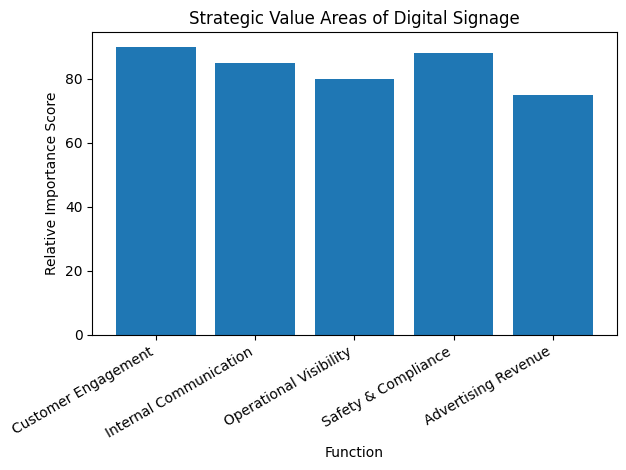
- Modern digital signage solutions transform screens into multi-purpose assets that drive customer engagement, internal communication, operational efficiency, and new advertising revenue streams.
In 2026, digital signage has evolved far beyond simple electronic billboards and slideshow-style displays. What was once a niche marketing tool has become a central pillar of modern communication, customer experience, operational efficiency, and revenue generation across industries. From global retail chains and smart cities to corporate campuses, hospitals, airports, universities, restaurants, and small local businesses, organizations now rely on sophisticated digital signage software to deliver timely, targeted, and data-driven messages in physical spaces.


The transformation of digital signage over the past decade has been driven by the convergence of cloud computing, artificial intelligence, high-speed connectivity, edge processing, and advanced analytics. These technologies have enabled displays to shift from passive broadcasting devices into intelligent endpoints capable of real-time responsiveness. In today’s environment, screens can automatically adapt content based on audience demographics, time of day, environmental conditions, inventory levels, operational metrics, or even individual interactions. As a result, digital signage software in 2026 functions less like a media player and more like a dynamic communication platform embedded within the broader digital ecosystem of an organization.

Businesses increasingly view their screen networks as strategic assets rather than operational expenses. A single display can simultaneously inform customers, guide visitors, enhance brand perception, improve employee engagement, support safety protocols, and generate advertising revenue. This multi-purpose functionality has dramatically increased the stakes when selecting the right platform. Choosing the wrong software can lead to fragmented systems, security vulnerabilities, poor scalability, and higher long-term costs, while the right solution can deliver measurable returns across multiple departments.
The global digital signage market reflects this strategic importance. Rapid urbanization, the expansion of smart infrastructure, the rise of hybrid workplaces, and the need for real-time communication in a fast-moving world continue to fuel demand. Retailers are building Retail Media Networks that monetize in-store screens, corporations are deploying workplace experience platforms to coordinate distributed teams, and public institutions are upgrading infrastructure to improve safety and accessibility. In each of these scenarios, software — not hardware — determines performance, flexibility, and long-term value.
Another defining characteristic of the 2026 landscape is the diversity of available solutions. There is no single “best” digital signage software for all use cases. Platforms vary widely in complexity, cost, scalability, and specialization. Some focus on enterprise-grade deployments with advanced analytics and security controls, while others prioritize simplicity and affordability for small businesses. Certain tools excel in interactive experiences and audience engagement, whereas others specialize in internal communications, educational environments, or large-scale advertising networks. Understanding these distinctions is essential for making an informed decision.

Modern buyers must also consider factors that were once secondary concerns but are now mission critical. Interoperability with existing systems ensures that signage integrates seamlessly with point-of-sale platforms, customer relationship management tools, building management systems, and collaboration software. Artificial intelligence readiness determines whether the platform can support future personalization and analytics capabilities. Offline resilience protects operations during connectivity disruptions, and robust governance frameworks prevent unauthorized content or cyber incidents. Total Cost of Ownership has likewise become a primary evaluation metric, encompassing not only licensing fees but also hardware, maintenance, energy consumption, and operational labor over several years.

This comprehensive guide to the Top 10 Digital Signage Software Tools in the world in 2026 examines the leading platforms shaping the industry today. It provides an in-depth look at their core strengths, ideal use cases, pricing models, deployment options, and distinguishing features. Whether the objective is to power a global retail network, modernize workplace communication, enhance educational safety, create immersive customer experiences, or launch a cost-effective single-location deployment, this analysis will help identify solutions aligned with specific organizational goals.
Ultimately, digital signage in 2026 represents the fusion of physical environments with digital intelligence. Screens are no longer endpoints; they are interfaces between people and information, commerce and communication, data and decision-making. Organizations that deploy the right software platform can transform ordinary spaces into responsive, engaging, and profitable environments. Those that fail to adapt risk falling behind in a world where real-time communication and personalized experiences increasingly define competitive advantage.
By exploring the capabilities and strategic positioning of the world’s top digital signage software tools, this guide aims to equip decision-makers, IT leaders, marketers, and business owners with the knowledge needed to navigate one of the most dynamic technology sectors of the modern era.
Before we venture further into this article, we would like to share who we are and what we do.
About 9cv9
9cv9 is a business tech startup based in Singapore and Asia, with a strong presence all over the world.
With over nine years of startup and business experience, and being highly involved in connecting with thousands of companies and startups, the 9cv9 team has listed some important learning points in this overview of the Top 10 Digital Signage Software Tools in 2026.
If you like to get your company listed in our top B2B software reviews, check out our world-class 9cv9 Media and PR service and pricing plans here.
Top 10 Digital Signage Software Tools in 2026
- Navori Labs
- Scala (STRATACACHE)
- ScreenCloud
- Yodeck
- OptiSigns
- Rise Vision
- NoviSign
- Appspace
- Poppulo
- Raydiant
1. Navori Labs
In the rapidly evolving digital signage industry of 2026, organizations are prioritizing platforms that deliver not only visual impact but also measurable business outcomes, airtight security, and seamless enterprise integration. Within this competitive environment, Navori Labs has emerged as one of the most influential and technically advanced solutions among the world’s leading digital signage software providers. Analysts and enterprise buyers frequently position the platform as a benchmark for large-scale, mission-critical deployments where reliability, automation, and data intelligence are non-negotiable.
Navori Labs distinguishes itself through a deeply engineered architecture designed for complex ecosystems such as multinational retail chains, transportation hubs, financial institutions, healthcare networks, and smart cities. Its reputation is built on the ability to operate thousands of screens across diverse geographies while maintaining centralized control, compliance, and performance consistency.
Enterprise-Grade Architecture and Integration Capabilities
A defining characteristic of Navori Labs is its API-first, modular design philosophy. Rather than functioning as a standalone signage tool, the platform is engineered to integrate directly into broader enterprise technology stacks. This approach enables organizations to synchronize digital signage with core business systems such as point-of-sale platforms, customer relationship management tools, enterprise resource planning systems, and data analytics pipelines.
One of the most strategically important capabilities enabled by this architecture is sales attribution through API connectivity. By correlating content playback data with transactional records, companies can determine whether specific advertisements or promotions directly influenced purchases. This transforms digital signage from a purely visual communication medium into a measurable revenue driver, aligning it with performance marketing standards previously reserved for digital channels.
Vision AI and Audience Intelligence
As physical retail and public environments increasingly adopt data-driven decision making, Navori Labs has invested heavily in Vision AI technologies. The platform supports advanced computer vision capabilities that analyze anonymous audience characteristics such as approximate age group, gender distribution, dwell time, and engagement patterns. These insights allow organizations to dynamically adjust content in real time, delivering contextually relevant messaging to different audience segments.
Unlike traditional surveillance systems, the technology operates with privacy-first principles, relying on anonymized analytics rather than personally identifiable information. This approach enables compliance with global data protection regulations while still providing actionable insights comparable to online advertising analytics.
Industrial Performance and Playback Reliability
Another cornerstone of Navori Labs’ market leadership is its proprietary QL engine, designed for high-performance media processing. The engine supports native ultra-high-definition playback, including 4K video at 60 frames per second, ensuring smooth, cinema-quality visuals even in demanding environments such as large LED walls or multi-screen installations.
Reliability metrics further reinforce its suitability for enterprise use. Dedicated AI signage players associated with the platform report a mean time between failures of approximately 50,000 hours. This level of durability minimizes downtime, reduces maintenance costs, and ensures continuous operation in settings where interruptions could affect revenue or safety communications.
Deployment Flexibility for Regulated and Distributed Organizations
Modern enterprises often operate under strict compliance requirements and diverse infrastructure constraints. Navori Labs addresses this challenge through multiple deployment models, allowing organizations to choose cloud-based, on-premise, or hybrid configurations. This flexibility is particularly valuable for industries such as banking, government, defense, and healthcare, where data residency and cybersecurity standards vary by region.
The platform’s cloud environment adheres to recognized security frameworks, including SOC2 Type II certification, further strengthening trust among organizations handling sensitive information.
Operational Efficiency and Sustainability Features
Beyond performance and analytics, Navori Labs incorporates operational automation designed to reduce both costs and environmental impact. Advanced scheduling tools allow administrators to control screen power states remotely, optimize brightness levels, and align playback schedules with business hours or audience patterns. These capabilities contribute to energy savings and support corporate sustainability initiatives without sacrificing communication effectiveness.
Feature and Operational Metrics Summary
The following table presents a structured overview of key capabilities and performance indicators associated with Navori Labs as observed in 2026.
Digital Signage Platform Capabilities — Navori Labs
| Category | Specification / Capability |
|---|---|
| Architecture | API-first modular enterprise framework |
| Integration Support | POS, CRM, ERP, analytics platforms |
| Audience Intelligence | Vision AI with anonymized viewer analytics |
| Media Playback | Native 4K at 60 fps |
| Reliability (MTBF) | Approximately 50,000 hours |
| Automation | Remote scheduling and device management |
| Security Compliance | SOC2 Type II certified cloud environment |
| Global Deployment Capability | Large-scale multi-region support |
Deployment and Market Reach
Navori Labs maintains a substantial international footprint, operating across more than 120 countries and supporting tens of thousands of active screens worldwide. This scale demonstrates not only technological maturity but also the presence of global support infrastructure, localization capabilities, and partner ecosystems necessary for multinational deployments.
Global Presence and Infrastructure
| Metric | Value |
|---|---|
| Geographic Coverage | 120+ countries |
| Continents Served | 5 |
| Active Screen Installations | 60,000+ |
| Typical Client Profile | Large enterprises, government bodies, global retail chains |
Pricing Models and Total Cost of Ownership
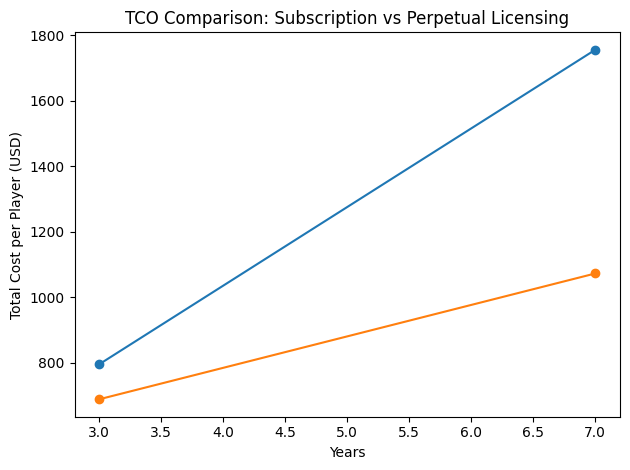
From a financial perspective, Navori Labs offers both subscription-based and perpetual licensing options, allowing organizations to align spending with long-term strategic plans. Subscription pricing is typically calculated per player per month, while perpetual licensing involves an upfront purchase followed by annual maintenance fees.
A long-term cost analysis reveals that organizations planning multi-year deployments may achieve significant savings through perpetual licensing, whereas subscription models offer lower initial barriers to entry and greater flexibility for scaling.
Cost Structure Comparison
| Pricing Model | Cost Components | Estimated 7-Year Total per Player |
|---|---|---|
| Subscription | Monthly fee plus activation costs | Approximately 1,755 USD |
| Perpetual License | Upfront purchase plus annual maintenance | Approximately 1,072 USD |
Strategic Position Within the Top Digital Signage Solutions of 2026
Among the top digital signage software tools globally, Navori Labs occupies a distinctive position focused on enterprise resilience, deep integration, and measurable performance outcomes. While some platforms prioritize ease of use or rapid deployment for small businesses, Navori emphasizes scalability, security, and advanced analytics — qualities essential for organizations managing extensive networks of displays across multiple regions.
Its combination of Vision AI, industrial reliability, flexible deployment models, and data-driven ROI measurement places it firmly in the category of mission-critical infrastructure rather than simple content management software.
Conclusion
As digital signage continues to evolve from passive display technology into an intelligent communication channel, platforms like Navori Labs illustrate the direction of the industry. In 2026, success is defined not only by visual quality but also by integration depth, operational efficiency, privacy-compliant analytics, and demonstrable business impact. For large organizations seeking a future-ready solution capable of supporting complex environments at scale, Navori Labs remains one of the most formidable options available in the global market.
2. Scala (STRATACACHE)
Within the Top Digital Signage Software Tools worldwide in 2026, Scala — operating under the STRATACACHE group — is widely regarded as the dominant platform for extremely large, distributed networks. Industry analysts consistently position Scala as the preferred solution for organizations managing thousands of physical locations, particularly when digital signage is intended to generate advertising revenue rather than simply display information.
The platform’s strategic focus has shifted beyond traditional signage management toward enabling full-scale Retail Media Networks (RMNs). These networks convert brick-and-mortar stores into dynamic advertising ecosystems, allowing retailers to monetize in-store screens in the same way websites monetize digital traffic. This transformation has become a major competitive priority for large retail chains seeking new revenue streams amid the continued convergence of physical and digital commerce.
Retail Media Networks as a Strategic Growth Engine
Retail Media Networks represent one of the fastest-growing segments in advertising, and Scala has positioned itself as the infrastructure backbone for these initiatives. By connecting in-store displays, shopper analytics, and advertising management systems, the platform allows retailers to sell targeted advertising placements to consumer brands at scale.
Major multinational retailers and wholesale chains increasingly view RMNs as high-margin businesses capable of generating billions in annual advertising revenue. Scala enables this by supporting advanced campaign scheduling, real-time content optimization, and detailed performance reporting across geographically dispersed store networks.
Retail Media Network Capabilities Enabled by Scala
| Capability | Strategic Benefit |
|---|---|
| Multi-brand ad placement | Enables external advertisers to buy in-store media inventory |
| Real-time campaign updates | Supports dynamic promotions based on stock or pricing |
| Audience-based targeting | Delivers relevant ads to different shopper segments |
| Revenue attribution analytics | Links exposure to sales performance |
| Network-wide synchronization | Ensures consistent messaging across all locations |
Centralized Network Control at Global Scale
A defining advantage of Scala is its centralized command architecture, designed specifically for high-concurrency environments. The platform can manage millions of content activations across screens located in retail stores, airports, stadiums, transit systems, and other public venues.
In 2026, the system reportedly oversees more than three million activations worldwide, demonstrating its ability to operate at a scale unmatched by most competitors. This centralized model allows administrators to deploy campaigns, update content, and monitor performance across thousands of endpoints from a single control interface.
Crucially, Scala’s infrastructure is engineered to maintain synchronization even in environments with inconsistent connectivity. Local playback caching and intelligent update protocols ensure that screens continue operating smoothly even when network conditions fluctuate.
Global Network Management Capabilities
| Feature | Operational Impact |
|---|---|
| Centralized CMS | Unified control of distributed screen networks |
| Offline playback resilience | Maintains functionality during connectivity disruptions |
| Mass content deployment | Simultaneous updates across thousands of displays |
| Remote diagnostics | Rapid identification of device issues |
| Performance monitoring | Real-time network health visibility |
AI-Driven Content Optimization and Audience Measurement
Scala integrates artificial intelligence into both content creation and performance analysis. AI-powered templates allow marketing teams to rapidly generate localized campaigns tailored to specific regions, store formats, or audience demographics without rebuilding content from scratch.
Equally important is the platform’s real-time audience measurement capability. Using privacy-responsible sensor technologies, Scala collects aggregated data on shopper presence, engagement, and dwell time. This enables advertisers and retailers to evaluate campaign effectiveness using metrics comparable to online advertising analytics while adhering to strict data protection standards.
The company’s 2026 industry event, “Measuring the Store,” emphasized its commitment to demonstrating tangible return on advertising spend. By correlating exposure data with purchasing behavior, Scala helps transform in-store media into a performance-based advertising channel.
Performance Profile and Industry Benchmarks
Scala’s capabilities come with enterprise-level complexity and pricing, reflecting its position as a premium solution for mission-critical deployments. While smaller organizations may find the system challenging to implement, large enterprises benefit from its robustness, customization options, and comprehensive support ecosystem.
Scala Performance Overview
| Metric or Attribute | Details |
|---|---|
| Core Strengths | RMN monetization, scalability, advanced analytics |
| User Satisfaction | 4.4 out of 5 (noted for power but steep learning curve) |
| Minimum Pricing | Starting around 200 USD per month per deployment setup |
| Typical Clients | Fortune 500 companies, global retailers, major airports |
| Infrastructure Model | Fully managed solutions available |
Managed Infrastructure and End-to-End Services
Unlike many software-only platforms, Scala often delivers a comprehensive solution that includes hardware provisioning, installation services, network design, and ongoing monitoring. This bundled approach is particularly valuable for organizations lacking in-house technical teams capable of managing complex signage infrastructures.
The availability of 24/7 monitoring and support ensures operational continuity for environments where downtime could disrupt passenger information systems, safety communications, or revenue-generating advertising displays.
Managed Service Components
| Service Component | Description |
|---|---|
| Hardware provisioning | Enterprise-grade media players and display integration |
| Professional installation | On-site deployment across multiple locations |
| Network configuration | Optimization for bandwidth and reliability |
| Continuous monitoring | Round-the-clock system supervision |
| Technical support | Dedicated enterprise assistance |
Applications in Transportation, Sports, and Public Venues
Scala’s reliability and scalability have made it a default choice for high-visibility public environments such as international airports, mass transit systems, and large sports arenas. In these settings, digital signage serves not only advertising purposes but also operational communication, emergency messaging, and passenger guidance.
The platform’s ability to deliver synchronized, high-availability content across massive venues ensures consistent information delivery even during peak traffic periods or special events.
Strategic Position Among the Top Digital Signage Platforms of 2026
Within the global ranking of digital signage software tools, Scala occupies a leadership position in the ultra-large enterprise segment. While many platforms cater to small or mid-sized deployments, Scala is engineered specifically for organizations operating thousands of screens and seeking to transform those displays into revenue-producing assets.
Its strengths lie in monetization capabilities, operational resilience, and deep analytics integration — qualities that align closely with the priorities of modern retailers and infrastructure operators. Despite higher costs and a more complex implementation process, the platform’s ability to deliver measurable advertising value and network stability makes it indispensable for large-scale initiatives.
Conclusion
As physical retail spaces evolve into data-driven media environments, platforms like Scala are redefining the role of digital signage. No longer limited to static promotions or informational displays, these systems now function as sophisticated advertising networks capable of generating substantial new revenue streams.
In 2026, Scala stands out as one of the most powerful solutions for organizations seeking to operate at global scale, monetize in-store traffic, and maintain centralized control over vast display ecosystems. For enterprises prepared to invest in a comprehensive, future-oriented infrastructure, it remains one of the most influential digital signage platforms in the world.
3. ScreenCloud
Among the Top Digital Signage Software Tools in the world in 2026, ScreenCloud has established itself as a dominant force in corporate offices, universities, hospitals, and distributed workplace environments. Rather than positioning digital signage as a passive broadcasting tool, the platform is widely recognized for converting everyday displays into dynamic, data-driven communication systems that continuously reflect what is happening inside an organization.
Industry observers often describe ScreenCloud as a workplace operating layer rather than a traditional signage platform. Its core philosophy centers on automation, live data integration, and internal engagement — enabling companies to replace static slideshows with continuously updating dashboards, announcements, metrics, and alerts.
Automation-First Approach to Workplace Communication
ScreenCloud’s defining advantage lies in its ability to automate content delivery directly from existing business systems. Instead of requiring marketing or IT teams to manually design and upload visuals, the platform pulls information from connected applications and displays it in real time.
This automation significantly reduces operational overhead while ensuring that on-screen information remains accurate and relevant. Typical use cases include company performance dashboards, employee recognition feeds, safety notices, meeting schedules, production metrics, and live social updates.
Automation Benefits for Organizations
| Automation Capability | Organizational Impact |
|---|---|
| Real-time data synchronization | Eliminates outdated or manually updated content |
| Live KPI dashboards | Improves transparency and performance tracking |
| Automated announcements | Ensures timely dissemination of critical information |
| Reduced content creation workload | Frees staff from repetitive design tasks |
| Continuous engagement | Keeps employees informed without email overload |
App Ecosystem and Enterprise Integrations
A major pillar of ScreenCloud’s success is its extensive application ecosystem. The platform’s App Store includes more than 80 integrations with widely used enterprise tools, enabling screens to function as extensions of the digital workplace.
By connecting directly to collaboration platforms, CRM systems, analytics tools, and cloud services, organizations can display live data without building custom interfaces. This capability is particularly valuable for hybrid work environments where timely communication across physical offices remains essential.
Representative Integration Capabilities
| Integrated System Type | Example Workplace Functionality |
|---|---|
| Collaboration platforms | Team updates, chat highlights, meeting reminders |
| Business intelligence tools | Live dashboards and performance metrics |
| CRM systems | Sales activity tracking and customer insights |
| Calendar services | Room schedules and event notifications |
| Cloud storage platforms | Automatic display of approved documents or media |
Developer Flexibility and API-Driven Customization
For IT-centric organizations, ScreenCloud provides advanced customization options through a robust GraphQL API. This allows developers to create proprietary applications, automate workflows, and integrate signage directly into internal systems.
One of the most critical enterprise features enabled by this architecture is automated emergency messaging. Safety systems or building management platforms can trigger instant overrides that replace all current content with urgent instructions, ensuring rapid communication during incidents such as fires, security threats, or natural disasters.
IT and Security-Oriented Capabilities
| Capability | Enterprise Value |
|---|---|
| GraphQL API | Enables custom integrations and automation |
| Emergency alert override | Immediate broadcast of safety instructions |
| Centralized device control | Simplifies management across multiple locations |
| Role-based permissions | Enhances governance and compliance |
| Secure cloud infrastructure | Protects sensitive organizational data |
ScreenCloud OS and Hardware Flexibility
A significant strategic development in 2026 is the introduction of ScreenCloud OS, a proprietary operating system designed to run across a wide spectrum of hardware. This innovation removes dependency on specialized signage players and enables deployment on both commercial-grade devices and affordable consumer hardware.
Organizations can utilize existing screens and low-cost streaming devices, dramatically lowering entry barriers and enabling rapid scaling across offices, classrooms, or facilities.
Hardware Deployment Options
| Hardware Type | Deployment Advantage |
|---|---|
| Commercial signage players | High reliability for mission-critical environments |
| Smart displays | Simplified installation with integrated computing |
| Consumer streaming devices | Cost-effective rollout for smaller locations |
| Legacy displays with adapters | Extends lifespan of existing infrastructure |
Customer Base and Usage Patterns
ScreenCloud’s user base spans more than 10,000 organizations worldwide, with particularly strong adoption among companies managing small to medium-sized screen networks. Data indicates that most customers operate fewer than 35 displays, highlighting the platform’s suitability for departmental, campus-wide, or regional deployments rather than massive retail networks.
At the same time, enterprise plans support larger implementations with expanded storage, administrative controls, and advanced support services.
Customer and Usage Statistics
| Metric | Statistical Insight |
|---|---|
| Global customers | Over 10,000 organizations |
| Typical deployment size | Majority manage fewer than 35 screens |
| External player usage | Approximately 89 percent of screens |
| User management profile | Predominantly IT or operations teams |
Performance, Reliability, and Pricing Structure
ScreenCloud operates on a subscription-based model designed to be predictable and scalable. Pricing typically begins at a per-screen monthly fee, making it accessible to organizations seeking professional-grade signage without large upfront investments.
Reliability is supported by a high uptime service level agreement, ensuring that communication channels remain available even during peak usage periods.
Operational Metrics and Pricing Overview
| Category | Specification |
|---|---|
| Starting price | Approximately 20 USD per screen per month |
| Uptime guarantee | 99.95 percent SLA |
| Storage allocation | 10 GB per user (expandable for enterprise plans) |
| Deployment model | Cloud-based with centralized management |
Strategic Role in the Modern Digital Workplace
Within the broader digital signage ecosystem of 2026, ScreenCloud occupies a distinct niche focused on internal communications rather than advertising or public messaging. Its strengths lie in automation, ease of deployment, and seamless integration with everyday business tools.
Organizations increasingly view workplace screens as strategic assets for improving engagement, transparency, and operational awareness. By transforming idle displays into continuously updating information hubs, ScreenCloud supports productivity initiatives while reducing reliance on email, intranet portals, or manual announcements.
Conclusion
As workplaces become more distributed and data-driven, the demand for intelligent, automated communication platforms continues to grow. ScreenCloud exemplifies this shift by redefining digital signage as a real-time information system integrated directly into organizational workflows.
In 2026, the platform stands out as one of the most effective solutions for companies seeking to modernize internal communications, enhance situational awareness, and deploy signage quickly across diverse hardware environments. For corporate and educational institutions aiming to maximize the value of their physical spaces, ScreenCloud remains a leading choice among global digital signage software tools.
4. Yodeck
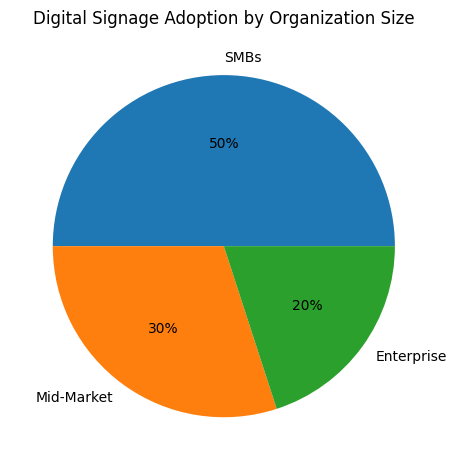
Within the global landscape of Top Digital Signage Software Tools in 2026, Yodeck has secured a powerful reputation as the value leader for cloud-managed signage. While many enterprise platforms target large corporations with complex infrastructure requirements, Yodeck focuses on accessibility, affordability, and ease of deployment. This strategy has made it particularly attractive to small-to-medium businesses, independent retailers, hospitality venues, fitness centers, and educational institutions seeking professional signage without enterprise-level costs.
Industry analysts frequently describe Yodeck as one of the most practical entry points into digital signage, offering a balance of functionality and simplicity that allows organizations to launch and scale networks quickly without specialized technical expertise.
Hardware Optimization and Low-Cost Deployment Model
A defining advantage of Yodeck is its deep optimization for Raspberry Pi hardware. By leveraging these compact, energy-efficient devices, the platform dramatically reduces the cost of media players compared to traditional PC-based solutions. Many annual subscription plans include pre-configured players at no additional charge, eliminating a major barrier to adoption for budget-conscious users.
This hardware strategy enables organizations to deploy signage across multiple locations with minimal capital investment while maintaining reliable performance for common use cases such as menus, promotions, announcements, and dashboards.
Hardware Strategy Benefits
| Deployment Feature | Cost and Operational Advantage |
|---|---|
| Raspberry Pi optimization | Extremely low hardware cost per screen |
| Pre-configured devices | Minimal setup time and technical requirements |
| Energy-efficient operation | Reduced electricity consumption |
| Compact form factor | Easy installation behind displays |
| Scalable architecture | Supports gradual network expansion |
Global Adoption and Rapid Growth
By 2026, Yodeck supports more than 250,000 active screens across approximately 55,000 customers in 135 countries. This widespread adoption reflects strong demand for affordable, cloud-based signage solutions in both developed and emerging markets.
The company’s rapid growth has been recognized by major business rankings, including placements on high-profile technology growth lists. These achievements underscore the platform’s momentum and its ability to compete effectively against more established vendors.
Global Footprint and Adoption Metrics
| Metric | Reported Scale |
|---|---|
| Active screens | Over 250,000 |
| Customer organizations | Approximately 55,000 |
| Countries served | 135 |
| Primary customer segment | Small and medium-sized businesses |
Ease of Use and Non-Technical Accessibility
Yodeck’s user interface is designed for simplicity, emphasizing drag-and-drop content management that requires little to no IT expertise. Users can create playlists, schedule content, and manage screens through a browser-based dashboard, making it accessible to business owners, managers, or administrative staff.
This ease of use has positioned Yodeck as a preferred solution for organizations lacking dedicated technical teams. Local businesses can deploy signage quickly without external consultants or complex training programs.
Usability Advantages for SMBs
| Feature | Practical Impact |
|---|---|
| Drag-and-drop editor | Rapid content creation without design skills |
| Template library | Professional layouts for common business needs |
| Cloud management | Remote control from any location |
| Automated scheduling | Time-based content rotation |
| Minimal training requirement | Fast adoption across staff levels |
Pricing Structure and Market Competitiveness
Yodeck’s pricing model reinforces its value-oriented positioning. The platform offers a free tier for single-screen deployments, enabling organizations to experiment before committing to paid plans. Entry-level subscriptions remain significantly lower than most competitors, making multi-screen deployments financially feasible for small operations.
Pricing and Value Overview
| Plan Level | Cost Structure |
|---|---|
| Free tier | One screen at no charge |
| Basic subscription | Approximately 8 USD per screen per month |
| Billing model | Subscription-based with annual options |
| Included hardware | Often bundled with annual plans |
User Satisfaction and Competitive Standing
Customer feedback consistently highlights Yodeck’s usability, reliability, and value for money. Ratings commonly fall in the upper range of satisfaction scores, reflecting strong performance relative to cost.
Despite operating in a crowded market with hundreds of competitors, the platform maintains a solid position due to its clear focus on affordability and simplicity rather than enterprise complexity.
Market Position Indicators
| Indicator | Performance Measure |
|---|---|
| Market share | Approximately 4.49 percent in digital signage category |
| User rating | Typically between 4.8 and 4.9 out of 5 |
| Competitive landscape | Hundreds of active competitors |
| Overall industry ranking | Mid-tier position with strong SMB dominance |
Security and Compliance Standards
Although designed for smaller organizations, Yodeck maintains enterprise-grade security certifications, including ISO 27001 for information security management and ISO 9001 for quality management. These credentials provide assurance that the platform adheres to internationally recognized operational standards.
Security and Compliance Framework
| Certification | Significance |
|---|---|
| ISO 27001 | Information security management best practices |
| ISO 9001 | Quality management systems |
| Cloud infrastructure security | Protection of user data and network integrity |
Innovations in Content Integration
One of Yodeck’s notable advancements in 2026 is the introduction of embeddable feeds, which allow users to display existing dashboards, web applications, or online content directly on screens without custom development. This capability expands the platform’s usefulness beyond marketing into operational monitoring, analytics visualization, and internal communication.
Content Integration Capabilities
| Feature | Use Case |
|---|---|
| Embeddable dashboards | Business analytics and KPI displays |
| Web app integration | Operational tools and reporting systems |
| Live data feeds | Weather, news, or performance metrics |
| Real-time updates | Automatically refreshed information |
Strategic Role Among Global Digital Signage Platforms
Within the broader ecosystem of digital signage solutions in 2026, Yodeck occupies a unique position as the accessibility champion. While enterprise platforms emphasize scalability, monetization, or advanced analytics, Yodeck focuses on removing barriers to entry and delivering dependable functionality at a fraction of the cost.
This approach aligns with the needs of millions of smaller organizations worldwide that require effective communication tools but lack the budgets or technical resources for complex systems.
Conclusion
As digital signage continues to expand beyond large corporations into everyday business environments, platforms like Yodeck are playing a crucial role in democratizing access to this technology. By combining cloud management, ultra-low-cost hardware, intuitive software, and strong security practices, Yodeck enables organizations of all sizes to leverage digital displays as powerful communication and marketing tools.
In 2026, it stands as one of the most practical and widely adopted solutions for small and medium-sized deployments, offering exceptional value while maintaining the reliability expected from modern cloud-based software.
5. OptiSigns
In the global market of Top Digital Signage Software Tools in 2026, OptiSigns has emerged as a highly adaptable mid-market platform tailored for organizations operating multiple locations. Positioned between entry-level tools and enterprise-grade systems, it delivers a balance of affordability, scalability, and advanced functionality. This positioning makes it particularly appealing to retail chains, restaurant franchises, healthcare clinics, hospitality groups, and service providers that require centralized control without the complexity or cost of large enterprise solutions.
Industry observers often highlight OptiSigns as a practical choice for organizations deploying dozens to hundreds of screens across geographically dispersed sites, especially when those deployments rely on cost-effective consumer hardware rather than specialized signage equipment.
Hardware Compatibility and Deployment Flexibility
One of OptiSigns’ strongest competitive advantages is its broad compatibility with widely available devices, particularly Android-based media players and Amazon Fire TV hardware. This hardware-agnostic approach allows businesses to standardize deployments using affordable equipment while maintaining reliable performance.
The platform is designed to support heterogeneous environments where different device types coexist across locations — a common scenario for growing organizations that expand incrementally rather than through large capital projects.
Multi-Device Deployment Capabilities
| Hardware Category | Operational Advantage |
|---|---|
| Android media players | Low-cost commercial deployment |
| Amazon Fire TV devices | Consumer hardware with simple setup |
| Smart TVs with embedded systems | Reduced need for external players |
| Mixed hardware environments | Seamless management across device types |
| Remote provisioning | Rapid rollout to new locations |
Mid-Market Adoption and Customer Profile
OptiSigns serves a broad customer base with revenue estimated in the tens of millions of dollars annually, reflecting steady growth and widespread adoption. Approximately three-quarters of its users are small businesses, many of which rely on the platform daily for operational communication and marketing.
Unlike enterprise systems that may require dedicated technical teams, OptiSigns is designed for practical day-to-day use by managers, marketers, or operations staff.
Customer Demographics and Usage Patterns
| Metric | Insight |
|---|---|
| Estimated annual revenue | Approximately 25 million to 50 million USD |
| Small business representation | About 75 percent of users |
| Typical deployment size | Multi-location SMBs and mid-sized organizations |
| Usage frequency | Daily operational reliance |
Advanced Layout Management and Content Flexibility
A key technical strength of OptiSigns is its ability to manage complex screen layouts. Users can divide displays into multiple zones, each presenting different content streams simultaneously. This capability is essential for environments such as retail stores, transportation hubs, and corporate offices where diverse information must be presented in a single visual space.
Complex Layout Capabilities
| Layout Feature | Business Use Case |
|---|---|
| Multi-zone screens | Combining promotions, announcements, and live data |
| Dynamic playlists | Automated rotation of targeted content |
| Real-time updates | Immediate changes across locations |
| Mixed media support | Video, images, dashboards, and web content |
Audience Intelligence and AI-Driven Engagement
In 2026, OptiSigns has expanded into intelligent signage through its Audience Intelligence tools. Using camera sensors combined with artificial intelligence, the system can estimate viewer demographics such as age range, gender distribution, and engagement duration. This enables screens to adjust content dynamically, delivering messages that are more relevant to the current audience.
Such capabilities bring physical signage closer to the personalization standards of digital advertising while maintaining privacy-conscious analytics practices.
Audience Intelligence Functions
| Analytical Capability | Strategic Value |
|---|---|
| Demographic estimation | Tailored messaging for different audience segments |
| Engagement tracking | Measurement of viewer attention and dwell time |
| Real-time content switching | Increased relevance and advertising effectiveness |
| Privacy-aware analytics | Compliance with data protection expectations |
Integrated Design Tools and Rapid Content Creation
OptiSigns reduces the traditional bottleneck of content production through native editing capabilities and integration with popular design platforms. Teams can create, modify, and deploy visual assets directly within the system, accelerating campaign execution.
The integration with widely used graphic design tools allows organizations to maintain brand consistency while minimizing reliance on external agencies or specialized designers.
Content Creation and Design Workflow
| Feature | Productivity Benefit |
|---|---|
| Built-in media editor | Immediate content adjustments |
| Template library | Faster creation of professional visuals |
| External design integration | Seamless import of branded assets |
| Rapid deployment | Minutes instead of days for campaign rollout |
Tiered Pricing Structure and Feature Differentiation
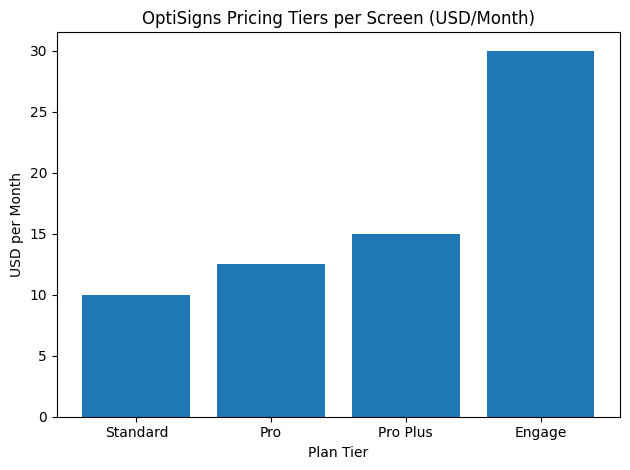
OptiSigns offers a transparent subscription model with multiple tiers designed to accommodate different operational needs. As organizations scale, they can upgrade to plans that include advanced controls, identity management, analytics, and kiosk functionality.
Pricing Tiers and Functional Scope
| Plan Tier | Monthly Cost per Screen | Key Capabilities |
|---|---|---|
| Standard | 10.00 USD | Playlists, templates, extensive integrations |
| Pro | 12.50 USD | Branding tools and advanced management controls |
| Pro Plus | 15.00 USD | Single Sign-On and dynamic mapping features |
| Engage | 30.00 USD | Interactive kiosks and audience analytics |
Operational Role in Multi-Location Retail and Services
Within the broader digital signage ecosystem, OptiSigns is particularly well suited for organizations managing regional or national networks of stores, branches, or service points. It provides centralized oversight while allowing local customization — a critical capability for franchises or businesses operating in diverse markets.
Typical Application Scenarios
| Industry Sector | Example Use Cases |
|---|---|
| Retail chains | Promotions, product highlights, price updates |
| Restaurants and cafes | Digital menus and seasonal campaigns |
| Healthcare clinics | Patient information and queue management |
| Corporate offices | Internal communications and dashboards |
| Hospitality venues | Event schedules and guest messaging |
Strategic Position Among Digital Signage Platforms in 2026
OptiSigns occupies a distinctive middle ground in the global market. It delivers more sophistication than entry-level solutions while avoiding the cost and complexity of enterprise systems. This balance makes it an attractive option for organizations seeking long-term scalability without overinvesting in infrastructure.
Its combination of hardware flexibility, intelligent analytics, integrated design tools, and tiered pricing aligns closely with the needs of modern distributed businesses.
Conclusion
As organizations continue expanding across multiple locations, the demand for reliable and flexible signage management platforms is increasing. OptiSigns addresses this need by offering a cloud-based solution capable of handling complex deployments while remaining accessible to non-technical users.
In 2026, the platform stands out as one of the most versatile mid-market digital signage tools, enabling businesses to communicate effectively, adapt content in real time, and maintain consistent brand presence across diverse environments. For companies seeking a scalable yet cost-efficient solution for multi-site operations, OptiSigns represents a compelling and future-ready choice.
6. Rise Vision
Among the Top Digital Signage Software Tools globally in 2026, Rise Vision stands out as the definitive solution tailored specifically for educational environments. While many platforms attempt to serve multiple industries, Rise Vision focuses almost exclusively on K–12 schools, school districts, and higher education institutions. This specialization has enabled the platform to address the unique communication, safety, and operational challenges faced by educators and administrators.
Trusted by more than 12,300 organizations worldwide, Rise Vision has become a cornerstone technology for campus-wide communication. Its core mission centers on fostering positive school culture, improving student engagement, and ensuring rapid dissemination of critical information across classrooms, hallways, cafeterias, and administrative offices.
Education-Focused Design Philosophy
Schools require a fundamentally different approach to digital signage compared to retail or corporate environments. Content must be informative, age-appropriate, easy to manage, and frequently updated without demanding extensive technical expertise. Rise Vision addresses these needs by providing a comprehensive ecosystem designed for educators rather than IT specialists.
The platform’s extensive template library — exceeding 560 professionally designed layouts — is updated regularly to reflect seasonal events, academic schedules, awareness campaigns, and institutional messaging needs. This approach ensures that schools can maintain fresh, relevant content without dedicating significant staff time to design work.
Template-Driven Communication Advantages
| Feature | Educational Benefit |
|---|---|
| Large template library | Ready-to-use content for announcements and events |
| Weekly template updates | Keeps messaging timely and engaging |
| Age-appropriate designs | Suitable for different student populations |
| Minimal customization required | Reduces workload for teachers and administrators |
| Consistent visual standards | Supports institutional branding |
Enhancing School Culture and Student Engagement
Digital signage in education serves not only as an information channel but also as a tool for building community. Rise Vision enables schools to highlight achievements, promote events, recognize students and staff, and reinforce institutional values. These capabilities contribute to a more connected and positive learning environment.
Schools frequently use the platform to display daily announcements, lunch menus, sports schedules, attendance reminders, and motivational messages. By presenting this information visually in common areas, institutions can reach students who may not regularly check email or online portals.
Common Campus Communication Uses
| Application Area | Typical Content Examples |
|---|---|
| Daily announcements | School news and reminders |
| Student recognition | Awards, achievements, birthdays |
| Event promotion | Performances, games, meetings |
| Operational updates | Schedule changes and facility notices |
| Community messaging | Cultural and awareness campaigns |
Emergency Communication and Safety Infrastructure
Safety remains one of the most critical priorities for educational institutions, and Rise Vision incorporates specialized capabilities to support emergency preparedness. The platform integrates the Common Alerting Protocol (CAP), a standardized system used by governments and emergency agencies worldwide.
Through CAP integration, urgent alerts can be broadcast instantly across all connected displays, overriding regular content to deliver clear instructions during emergencies such as severe weather, security threats, or evacuation scenarios. This ensures that information reaches students and staff even in noisy or crowded environments where audio announcements may be missed.
Emergency Communication Capabilities
| Safety Feature | Operational Impact |
|---|---|
| CAP integration | Standardized emergency alert delivery |
| Automatic content override | Immediate display of critical instructions |
| Campus-wide broadcast | Simultaneous alerts across all screens |
| Visual reinforcement | Supports audible alarm systems |
| Rapid dissemination | Minimizes response delays |
Pricing Models Tailored for Educational Budgets
Educational institutions often operate under strict budget constraints, requiring predictable and scalable pricing. Rise Vision offers structured annual plans designed to accommodate individual schools as well as large districts with extensive screen networks.
Educational Pricing Structure
| Plan Type | Annual Cost (Per Display or Institution) | Intended Deployment Scenario |
|---|---|---|
| Basic Plan | 119 USD per display | Small schools with limited screens |
| Advanced Plan | 138 USD per display | Includes emergency alert capabilities |
| Enterprise Unlimited | 1,399 USD per school | Large campuses or district-wide deployments |
| Screen Sharing Add-on | 1,200 USD per display | Interactive presentations and collaboration |
The enterprise option provides substantial value for districts managing dozens or hundreds of displays, enabling centralized management while controlling costs.
Reliability, Support, and Operational Dependability
Because schools depend on signage for daily communication, reliability and support are critical factors. Rise Vision reports uptime exceeding 99 percent, ensuring that screens remain functional during school hours. Additionally, the platform maintains a support satisfaction rating of approximately 99 percent, reflecting strong responsiveness to educators’ needs.
Operational Performance Indicators
| Metric | Performance Level |
|---|---|
| Global customer base | Over 12,300 organizations |
| System uptime | Above 99 percent |
| Support satisfaction | Approximately 99 percent |
| Primary user roles | School administrators and IT staff |
Adoption by Major Educational Institutions
Rise Vision’s credibility is reinforced by its adoption among prominent school systems and universities. Large public school districts and major higher education institutions rely on the platform to manage communications across complex campus environments with multiple buildings and thousands of students.
Typical Institutional Deployment Context
| Institution Type | Implementation Scope |
|---|---|
| Public school districts | District-wide communication networks |
| Universities | Multi-campus messaging systems |
| Community colleges | Student services and event promotion |
| Private schools | Campus culture and parent communication |
Strategic Position Within the 2026 Digital Signage Ecosystem
In contrast to general-purpose signage platforms, Rise Vision occupies a specialized niche focused on education. Its strength lies not in advertising monetization or retail analytics but in mission-critical communication, safety assurance, and cultural engagement within learning environments.
This focused approach allows the platform to deliver features that would be unnecessary or overly complex in other industries while ensuring that educators can operate the system without extensive technical training.
Conclusion
As schools increasingly adopt digital tools to improve communication and safety, purpose-built solutions are becoming essential. Rise Vision exemplifies this trend by providing an education-centric platform that combines ease of use, robust emergency capabilities, and engaging content delivery.
In 2026, it remains one of the most trusted digital signage solutions for academic institutions worldwide, enabling schools to communicate effectively, respond rapidly to emergencies, and cultivate a positive campus atmosphere. For districts and universities seeking a reliable, specialized platform aligned with educational priorities, Rise Vision continues to set the industry standard.
7. NoviSign
Within the global landscape of Top Digital Signage Software Tools in 2026, NoviSign has distinguished itself as a leading platform for organizations seeking both enterprise reliability and interactive capabilities. Widely recognized for its intuitive interface and deployment flexibility, the software has gained significant industry recognition, including being named one of the best enterprise-grade digital signage solutions by major technology reviewers.
Unlike platforms focused purely on passive display, NoviSign emphasizes engagement through interactive and “phygital” experiences — blending physical environments with digital content. This approach makes it particularly valuable for retail showrooms, visitor centers, healthcare facilities, hospitality venues, and large public spaces where user interaction enhances the customer journey.
Global Deployment Scale and High-Profile Client Base
NoviSign supports a substantial global network, powering more than 50,000 screens across five continents. Its customer portfolio spans diverse industries, including entertainment, retail, aerospace, and government organizations. This breadth of adoption demonstrates the platform’s versatility across both public-facing and operational use cases.
Global Reach and Adoption Metrics
| Metric | Reported Scale |
|---|---|
| Active screens | Over 50,000 |
| Geographic coverage | Five continents |
| Typical deployment environments | Retail, healthcare, hospitality, public venues |
| Client profile | Large enterprises and high-traffic institutions |
User Experience and Playlist-Based Content Management
One of NoviSign’s defining features is its highly intuitive content scheduling system. The platform uses a playlist-based approach similar to popular media streaming applications, allowing users to organize content sequences easily without complex programming or design knowledge.
This familiar interface significantly reduces the learning curve, enabling non-technical staff to manage displays effectively. Organizations can schedule content by time, location, or event triggers, ensuring that messaging remains relevant throughout the day.
Content Management Advantages
| Feature | Operational Benefit |
|---|---|
| Playlist scheduling | Simple organization of content sequences |
| Time-based automation | Dynamic messaging aligned with daily operations |
| Drag-and-drop interface | Minimal training requirements |
| Multi-location management | Centralized control across distributed sites |
Interactive and Phygital Engagement Capabilities
A core differentiator for NoviSign is its support for interactive installations that merge physical products with digital information. One notable example is the “Lift and Learn” concept, commonly used in retail environments. Sensors detect when a customer picks up a product, automatically triggering related videos, specifications, or promotional content on nearby screens.
This technology enhances in-store experiences, increases dwell time, and provides shoppers with rich product information without requiring assistance from staff.
Interactive Engagement Solutions
| Capability | Customer Experience Impact |
|---|---|
| Touch-enabled displays | Direct user interaction |
| Sensor-triggered content | Contextual information based on physical actions |
| Product education features | Supports self-guided exploration |
| Immersive retail experiences | Encourages longer engagement |
Interactive Kiosks for Service Environments
In 2026, NoviSign has expanded its focus on interactive kiosks designed for healthcare facilities, hotels, airports, and corporate campuses. These kiosks function as self-service portals, allowing visitors to access information, check schedules, book services, or navigate facilities.
Such capabilities reduce staff workload while improving user convenience, particularly in high-traffic environments where quick access to information is essential.
Kiosk Applications Across Industries
| Sector | Typical Use Cases |
|---|---|
| Healthcare | Appointment check-in and wayfinding |
| Hospitality | Concierge services and local information |
| Corporate offices | Visitor registration and meeting schedules |
| Transportation hubs | Travel information and navigation |
Performance Ratings and User Satisfaction
Customer feedback consistently highlights NoviSign’s ease of use and overall value. Independent review platforms report high satisfaction scores across multiple categories, reflecting strong performance relative to both cost and functionality.
User Evaluation Metrics
| Evaluation Category | Score or Rating |
|---|---|
| Overall platform score | Approximately 97 out of 100 |
| Ease of use | Around 4.8 out of 5 |
| Value for money | Around 4.9 out of 5 |
| User experience feedback | Highly positive across industries |
Pricing Model and Storage Allocation
NoviSign follows a subscription-based pricing structure typical of cloud-managed signage platforms. Entry-level pricing begins in the lower enterprise range, making it accessible to mid-sized organizations while remaining suitable for large deployments.
Pricing and Resource Allocation
| Category | Specification |
|---|---|
| Monthly cost per screen | Approximately 18 to 20 USD |
| Billing model | Subscription-based |
| Cloud storage | About 2 GB per display (standard tier) |
Security, Infrastructure, and Reliability
Enterprise customers often prioritize security and data protection, particularly when signage systems integrate with operational or customer-facing services. NoviSign addresses these concerns through recognized security certifications and robust cloud infrastructure.
The platform is hosted on a major cloud environment known for reliability and scalability, ensuring consistent performance across global deployments.
Security and Infrastructure Framework
| Component | Enterprise Assurance |
|---|---|
| Security certification | SOC 2 compliance |
| Cloud hosting environment | Large-scale enterprise cloud infrastructure |
| Data protection measures | Secure content delivery and device management |
| Reliability focus | Suitable for mission-critical installations |
Advertising and Monetization Integrations
For organizations seeking revenue opportunities, NoviSign supports integration with advertising marketplaces through dedicated widgets. These integrations enable screen owners to sell display inventory to external advertisers, transforming signage networks into potential income-generating assets.
Monetization Capabilities
| Feature | Business Opportunity |
|---|---|
| Advertising marketplace links | Access to programmatic ad networks |
| Dynamic ad insertion | Targeted promotional content |
| Revenue generation potential | Monetization of high-traffic screens |
Strategic Position Among Digital Signage Platforms in 2026
NoviSign occupies a distinctive position within the digital signage ecosystem by combining enterprise readiness with strong interactive functionality. While some platforms specialize in advertising networks or internal communications, NoviSign excels at creating engaging, user-driven experiences in physical spaces.
Its balance of usability, flexibility, and advanced engagement tools makes it particularly attractive for organizations seeking to enhance customer interaction without deploying highly complex systems.
Conclusion
As physical environments increasingly integrate digital experiences, interactive signage is becoming a critical component of customer engagement strategies. NoviSign exemplifies this shift by enabling organizations to move beyond static displays toward responsive, immersive communication platforms.
In 2026, the software stands as one of the most capable solutions for enterprises that require reliable infrastructure, intuitive management, and meaningful interaction with visitors or customers. For organizations aiming to bridge the gap between physical presence and digital engagement, NoviSign remains a leading contender among the world’s top digital signage tools.
8. Appspace
In the evolving ecosystem of Top Digital Signage Software Tools worldwide in 2026, Appspace occupies a uniquely strategic position. Rather than functioning solely as a display management system, it operates as an integrated workplace experience platform that connects physical office spaces with digital collaboration tools. As organizations adapt to hybrid work models, Appspace has emerged as a comprehensive solution for managing communication, space utilization, and employee engagement across distributed work environments.
Widely adopted by large enterprises, the platform supports millions of employees daily and is deployed across corporate campuses, headquarters, regional offices, and shared workspaces. Its ability to combine signage, room scheduling, desk booking, intranet content, and visitor management into a single ecosystem sets it apart from traditional signage solutions.
Integrated Workplace Platform Architecture
Appspace’s core value lies in consolidation. Many organizations previously relied on separate tools for meeting room scheduling, digital signage, internal communications, and visitor processing. Appspace unifies these functions into one interface, reducing administrative complexity and improving data consistency across systems.
By synchronizing workplace information across screens, kiosks, mobile devices, and desktops, the platform creates a cohesive digital layer over physical office infrastructure.
Unified Service Capabilities
| Core Service Area | Organizational Function |
|---|---|
| Digital signage | Real-time announcements and corporate messaging |
| Space reservation | Desk and meeting room booking |
| Visitor management | Guest check-in and security coordination |
| Corporate intranet integration | Internal communications and resources |
| Interactive kiosks | On-site information access |
Scale of Adoption Among Global Enterprises
Appspace has achieved significant penetration among large corporations, including widespread adoption across Fortune 500 organizations. Its infrastructure supports daily usage by millions of employees, demonstrating both scalability and operational reliability.
Enterprise Adoption Metrics
| Metric | Reported Scale |
|---|---|
| Fortune 500 adoption | More than 160 companies |
| Daily active users | Approximately 12 million employees |
| Deployment environments | Corporate offices, campuses, shared workspaces |
| Typical client profile | Large multinational enterprises |
AI-Driven Workplace Intelligence
A defining innovation in 2026 is the platform’s Insights Assistant, an artificial intelligence system designed to analyze workplace data and generate actionable recommendations. This tool aggregates information from multiple sources, including desk reservations, meeting room usage, environmental sensors, and engagement with on-screen content.
Facilities and operations teams can use these insights to optimize office layouts, adjust cleaning schedules, identify underutilized spaces, and make evidence-based decisions about real estate investments.
Workplace Analytics Capabilities
| Data Source | Insight Provided |
|---|---|
| Desk booking systems | Employee attendance patterns |
| Room scheduling data | Meeting space utilization |
| Environmental sensors | Occupancy and comfort metrics |
| Content interaction analytics | Engagement with communications |
Enhancing Real Estate Efficiency
As hybrid work reduces daily office occupancy, organizations are under pressure to justify the cost of large physical spaces. Appspace helps address this challenge by providing measurable data on how facilities are actually used.
By displaying real-time occupancy information and availability on kiosks and signage screens, employees can quickly locate workspaces, meeting rooms, or amenities. This improves navigation within large campuses and reduces time spent searching for available resources.
Real Estate Optimization Benefits
| Capability | Operational Outcome |
|---|---|
| Utilization analytics | Evidence-based space planning |
| Real-time availability displays | Efficient workspace allocation |
| Occupancy insights | Identification of underused areas |
| Cost justification tools | Support for real estate decision-making |
Advanced Wayfinding and Campus Navigation
Large corporate campuses can be difficult to navigate, particularly for new employees, visitors, or staff working in unfamiliar buildings. Appspace addresses this challenge through interactive wayfinding features integrated into kiosks and displays.
These tools provide directions, room locations, event schedules, and facility information, enhancing both employee productivity and visitor experience.
Wayfinding and Navigation Features
| Feature | User Experience Benefit |
|---|---|
| Interactive maps | Clear navigation across complex facilities |
| Room location assistance | Reduced time spent searching for meeting spaces |
| Event directories | Easy access to scheduled activities |
| Accessibility support | Inclusive navigation for diverse users |
Integration with Collaboration Ecosystems
Appspace integrates with major workplace platforms, enabling seamless synchronization between digital signage and productivity tools. Recognition at major industry events highlights the effectiveness of these integrations in modern office environments.
Integration Highlights
| Integration Area | Functional Advantage |
|---|---|
| Workplace scheduling systems | Real-time booking updates |
| Collaboration platforms | Unified communication across devices |
| Corporate directories | Employee information access |
| Calendar services | Meeting visibility on room displays |
Pricing Structure and Support Services
Appspace targets enterprise customers, and its pricing reflects the comprehensive scope of the platform. Subscription costs are typically higher than standalone signage tools but encompass multiple workplace management functions.
Operational Support and Pricing Overview
| Category | Specification |
|---|---|
| Enterprise pricing | Approximately 600 USD per month |
| Billing model | Subscription-based |
| Support availability | 24/7 live assistance and online resources |
| Deployment scope | Organization-wide implementations |
Strategic Role in the Hybrid Work Era
The shift toward hybrid work has fundamentally changed how organizations use physical offices. Rather than serving solely as daily workspaces, offices now function as collaboration hubs, event venues, and shared resources. Appspace supports this transition by providing tools that coordinate people, spaces, and information in real time.
By bringing data from desktop systems onto physical displays and kiosks, the platform ensures that employees remain informed and productive regardless of where they work within the organization.
Conclusion
As the boundaries between physical and digital workplaces continue to blur, integrated platforms are becoming essential for managing modern office environments. Appspace exemplifies this new generation of solutions by combining digital signage with collaboration tools, space management, and AI-driven analytics.
In 2026, it stands as one of the most comprehensive workplace experience platforms available, enabling large enterprises to optimize real estate usage, enhance employee navigation, and deliver consistent communication across hybrid workforces. For organizations seeking to transform offices into intelligent, responsive environments, Appspace remains a leading choice among global digital signage solutions.
9. Poppulo
Within the global ecosystem of Top Digital Signage Software Tools in 2026, Poppulo occupies a distinctive position as a communications-first platform designed for very large organizations. Rather than focusing solely on visual display management, Poppulo Harmony functions as an omnichannel workplace communication system capable of delivering consistent messaging across digital signage, email, mobile applications, and collaboration tools simultaneously.
This integrated approach has made the platform a critical infrastructure component for multinational enterprises, particularly those with dispersed workforces that include both office-based staff and frontline employees. By ensuring that important announcements reach every employee regardless of role or location, Poppulo helps organizations maintain alignment, safety, and engagement at scale.
Unprecedented Communication Volume and Operational Scale
Poppulo’s capabilities are reflected in the enormous volume of communications processed through its systems. Over the course of 2025 and 2026, the platform handled billions of messages, demonstrating its ability to operate reliably under extreme demand. This level of throughput positions Poppulo as a backbone technology for internal communications in complex organizations.
Large enterprises rely on the platform to coordinate messaging across thousands of facilities, manufacturing sites, retail locations, and transportation hubs.
Communication Scale Indicators
| Metric | Reported Magnitude |
|---|---|
| Total communications processed | Approximately 2.2 billion messages |
| Enterprise customers | More than 6,000 organizations |
| Fortune 100 adoption | Used by 47 companies |
| Deployment environments | Offices, factories, retail sites, public infrastructure |
Bridging the Gap Between Office and Frontline Workers
One of the most significant challenges facing large organizations is ensuring that frontline employees — such as factory staff, healthcare workers, logistics personnel, and retail associates — receive the same information as corporate teams. Traditional communication methods often fail to reach these employees due to limited access to email or desktop systems.
Poppulo addresses this gap by delivering synchronized messages through multiple channels, including breakroom screens, mobile notifications, digital signage, and email. This ensures that critical updates are visible to all staff members regardless of their work environment.
Workforce Inclusion Capabilities
| Communication Channel | Target Audience |
|---|---|
| Digital signage | Frontline and shift-based workers |
| Email communications | Office staff and knowledge workers |
| Mobile notifications | Remote and field employees |
| Collaboration platforms | Team-based communication |
Omnichannel Synchronization and Message Consistency
A defining strength of Poppulo is its omnichannel delivery model. When an organization distributes an announcement, the platform ensures that the message appears simultaneously across all configured channels. This eliminates inconsistencies that can occur when different departments use separate communication tools.
For example, a safety alert can appear on hallway screens, arrive as an email, and trigger a mobile notification at the same time, reinforcing urgency and improving compliance.
Omnichannel Communication Benefits
| Capability | Organizational Outcome |
|---|---|
| Simultaneous multi-channel delivery | Consistent messaging across workforce |
| Centralized content management | Reduced risk of conflicting information |
| Automated distribution | Faster communication during critical events |
| Cross-platform analytics | Measurement of engagement across channels |
Content Trends and Organizational Priorities
Analysis of enterprise communication patterns in 2026 reveals evolving priorities. Leadership messaging, employee wellbeing initiatives, sustainability programs, and guidance related to technological transformation — particularly artificial intelligence — have become dominant themes.
Poppulo’s analytics tools help organizations track how these messages are received and remembered, enabling continuous refinement of communication strategies.
Emerging Content Focus Areas
| Priority Area | Strategic Purpose |
|---|---|
| Leadership communication | Align workforce with organizational goals |
| Health and safety | Reduce operational risk and ensure compliance |
| Wellbeing initiatives | Support employee retention and morale |
| Sustainability messaging | Promote corporate responsibility initiatives |
| Technology change management | Prepare staff for digital transformation |
Compliance and Suitability for Regulated Industries
Highly regulated sectors such as healthcare, finance, transportation, and government agencies face strict requirements regarding communication accuracy, auditability, and timeliness. Poppulo is designed to meet these demands by providing secure delivery mechanisms, traceable distribution records, and governance controls.
These features make the platform particularly attractive for organizations where communication failures could result in legal liability, safety incidents, or reputational damage.
Compliance-Oriented Features
| Feature | Regulatory Benefit |
|---|---|
| Secure message distribution | Protection of sensitive information |
| Audit trails | Verification of message delivery |
| Role-based permissions | Controlled content approval processes |
| Policy-aligned templates | Consistent regulatory compliance |
Engagement Measurement and Recall Effectiveness
Beyond delivery, Poppulo emphasizes measuring how well messages are understood and retained. Engagement analytics reveal which topics resonate most strongly with employees and which communication channels produce the highest recall rates.
Research indicates particularly strong engagement with messages related to safety, health, and sustainability, areas that directly affect employees’ daily lives.
Engagement Analytics Insights
| Engagement Indicator | Observed Outcome |
|---|---|
| Recall of safety communications | High retention among frontline workers |
| Sustainability messaging impact | Strong awareness across workforce |
| Multi-channel exposure | Increased comprehension and response rates |
Cost Considerations and Long-Term Value
Poppulo’s licensing costs are generally higher than those of standalone signage platforms, reflecting its broader functionality as a full communications ecosystem. However, organizations often justify the investment by considering reduced operational risk, improved employee alignment, and higher adoption rates.
Cost Efficiency Perspective
| Cost Factor | Long-Term Benefit |
|---|---|
| Higher upfront licensing | Comprehensive feature coverage |
| Reduced communication failures | Lower operational and reputational risk |
| High adoption levels | Maximized return on communication investments |
Strategic Role in Enterprise Digital Signage and Workplace Experience
Within the broader digital signage landscape, Poppulo represents a shift from display-centric solutions to communication-centric platforms. Screens are treated not as standalone endpoints but as one component of an integrated messaging network spanning digital and physical environments.
This approach is particularly valuable for organizations seeking to unify internal communications across diverse employee populations and geographic regions.
Conclusion
As enterprises become increasingly complex and distributed, effective communication infrastructure is essential for maintaining operational cohesion and employee engagement. Poppulo addresses this need by delivering synchronized, omnichannel messaging at a scale unmatched by most traditional signage platforms.
In 2026, it stands as one of the most powerful solutions for organizations that require reliable, compliant, and high-impact internal communication across both office and frontline environments. For large enterprises prioritizing consistency, reach, and measurable engagement, Poppulo remains a leading choice among the world’s top workplace communication and digital signage platforms.
10. Raydiant
In the global ranking of Top Digital Signage Software Tools in 2026, Raydiant has established a strong identity as an experience-centric platform built specifically for brick-and-mortar environments. Rather than treating screens as passive information displays, the company positions them as interactive engagement hubs designed to influence customer behavior, increase dwell time, and drive in-store revenue.
Retailers and restaurant operators increasingly view physical locations as experiential spaces that must compete with the convenience of e-commerce. Raydiant addresses this challenge by transforming digital signage into a dynamic channel for entertainment, promotion, and real-time operational updates.
Focus on Brick-and-Mortar Experience Enhancement
Raydiant’s platform is purpose-built for physical venues where customer interaction occurs on site. Typical deployments include quick-service restaurants, boutique retail stores, franchise chains, fitness studios, and service-oriented businesses. The system emphasizes ease of use for store managers while delivering visually engaging content that enhances the atmosphere.
Experiential Retail Capabilities
| Experience Feature | Business Impact |
|---|---|
| Dynamic promotional displays | Increased impulse purchases |
| Gamified interactions | Higher customer engagement |
| Ambient entertainment channels | Improved in-store atmosphere |
| Real-time operational messaging | Faster communication of promotions or changes |
POS Integration and Real-Time Menu Synchronization
A key operational advantage of Raydiant is its integration with point-of-sale systems. By connecting directly to inventory and transaction data, the platform ensures that displayed menus and promotions remain accurate without manual intervention.
For restaurants, this capability is particularly valuable. Menu items can automatically update when stock levels change, prices are adjusted, or new offerings are introduced. This reduces staff workload and prevents customer frustration caused by outdated information.
POS-Driven Automation Benefits
| Integration Function | Operational Outcome |
|---|---|
| Inventory-linked menu updates | Elimination of unavailable item displays |
| Price synchronization | Accurate real-time pricing |
| Promotion automation | Immediate rollout of discounts or specials |
| Reduced manual maintenance | Lower staff workload |
Hardware Strategy and Deployment Options
Raydiant offers a proprietary media player known as the ScreenRay device, designed for plug-and-play installation. This hardware simplifies deployment for businesses without technical expertise while maintaining compatibility with third-party devices for organizations seeking flexibility.
Hardware Deployment Overview
| Hardware Type | Deployment Advantage |
|---|---|
| ScreenRay proprietary device | Optimized performance and simplified setup |
| Third-party device support | Flexibility for existing infrastructure |
| Compact installation | Easy mounting behind displays |
In-Store Analytics with Raydiant InSight
Understanding customer behavior inside physical locations is increasingly important for retailers. Raydiant InSight provides analytics on visitor patterns, engagement levels, and interaction with displays. These insights help businesses evaluate the effectiveness of campaigns and optimize store layouts.
In-Store Analytics Capabilities
| Analytical Metric | Strategic Use |
|---|---|
| Visitor traffic patterns | Store layout optimization |
| Engagement duration | Measurement of content effectiveness |
| Interaction frequency | Assessment of experiential features |
| Conversion indicators | Correlation between engagement and sales |
Gamified and Interactive Customer Engagement
One of Raydiant’s defining innovations is its emphasis on gamification — using interactive elements to make the in-store experience entertaining. Examples include promotional games, contests, and interactive brand experiences that encourage participation.
Gamified interactions not only increase engagement but also create memorable brand experiences that differentiate physical stores from online shopping.
Gamification Benefits for Retailers
| Interactive Feature | Customer Response |
|---|---|
| Promotional games | Increased participation and dwell time |
| Prize-based interactions | Strong motivation to engage |
| Brand storytelling experiences | Enhanced emotional connection |
Second-Screen Interaction via Mobile Devices
Raydiant’s Virtua feature introduces a “second-screen” concept that allows customers to interact with content displayed on large screens using their own smartphones. This approach eliminates the need for shared touch surfaces while enabling personalized engagement.
Customers can scan a code or connect digitally to participate in promotions, browse products, or receive tailored offers. Participating businesses report improved conversion rates due to the direct connection between display content and individual consumers.
Second-Screen Engagement Advantages
| Capability | Business Benefit |
|---|---|
| Personal device interaction | Hygienic and user-friendly experience |
| Individualized promotions | Targeted marketing opportunities |
| Seamless participation | No additional hardware required for customers |
| Increased conversion potential | Strong link between engagement and purchase |
Ambient Viewing Channels for Atmosphere Enhancement
Beyond promotional content, Raydiant offers numerous audio-optional entertainment channels designed to enhance the ambiance of commercial spaces. These channels provide visually engaging content that can run continuously without disrupting conversations or service operations.
Ambient Content Applications
| Venue Type | Typical Use Case |
|---|---|
| Restaurants | Visual entertainment during dining |
| Retail stores | Brand-aligned atmosphere creation |
| Fitness centers | Motivational visuals |
| Waiting areas | Reduced perceived wait times |
Pricing Model and Business Accessibility
Raydiant follows a subscription model that includes both software and hardware components. Pricing is positioned in the mid-range, making it accessible to growing businesses while still offering advanced experiential capabilities.
Pricing Overview
| Cost Component | Typical Amount |
|---|---|
| Monthly subscription (per screen) | Approximately 49 USD |
| Hardware fee | Around 169 USD for proprietary device |
| Billing structure | Prepaid subscription |
Organizational Profile and Market Position
Raydiant operates as a focused technology provider with a workforce sized to support specialized development and customer service for the retail and hospitality sectors. Its targeted approach enables rapid innovation tailored to the needs of physical businesses.
Company and Market Indicators
| Attribute | Description |
|---|---|
| Company size | Approximately 161 employees |
| Headquarters | San Francisco, United States |
| Primary industry focus | Retail and restaurant sectors |
Strategic Role in Experiential Retail Transformation
As consumer expectations evolve, physical stores must deliver experiences that cannot be replicated online. Raydiant contributes to this transformation by turning digital signage into an interactive platform that entertains, informs, and influences purchasing decisions.
By combining automation, analytics, gamification, and mobile interaction, the platform helps businesses create immersive environments that strengthen brand loyalty and increase sales.
Conclusion
The future of brick-and-mortar commerce increasingly depends on creating engaging in-store experiences that attract and retain customers. Raydiant exemplifies this shift by redefining digital signage as a central component of experiential retail strategy.
In 2026, the platform stands as one of the most innovative solutions for restaurants and retailers seeking to synchronize operations, enhance atmosphere, and drive measurable customer engagement. For businesses aiming to transform physical locations into interactive destinations, Raydiant represents a compelling and forward-looking choice among the world’s leading digital signage tools.
Quantitative Benchmarking and Total Cost of Ownership Analysis for Digital Signage in 2026
Selecting the most appropriate digital signage software in 2026 requires far more than comparing feature lists or subscription prices. Organizations increasingly rely on rigorous financial modeling to evaluate the Total Cost of Ownership (TCO) over multi-year deployment horizons, typically spanning three to five years and often extending to seven years for infrastructure-grade installations. This approach accounts for all direct and indirect expenses, including licensing, hardware, integration, maintenance, support, energy consumption, and operational overhead.
As digital signage networks grow in scale and complexity, poorly planned implementations can lead to fragmented vendor relationships, incompatible systems, and escalating maintenance costs. Consequently, decision-makers now emphasize lifecycle economics rather than upfront affordability.
Understanding Total Cost of Ownership in Digital Signage Deployments
Total Cost of Ownership represents the cumulative financial impact of a system from acquisition through operation to eventual replacement. In digital signage, TCO encompasses both visible expenditures and hidden costs that may not appear in initial proposals.
Key TCO Components
| Cost Category | Description |
|---|---|
| Hardware acquisition | Displays, media players, mounting, networking equipment |
| Software licensing | Subscription or perpetual license fees |
| Installation services | Deployment labor and configuration |
| Integration costs | Connecting signage with business systems |
| Maintenance and support | Ongoing technical assistance and updates |
| Hosting and connectivity | Cloud services or on-premise infrastructure |
| Energy consumption | Power usage of displays and players |
| Operational labor | Staff time for content management |
Software-Only Versus Turnkey Solutions
A major strategic decision involves choosing between software-only stacks and fully managed turnkey solutions. Software-only offerings may appear less expensive initially because they exclude hardware and installation. However, organizations must then coordinate multiple vendors, increasing the risk of compatibility issues and accountability gaps.
Turnkey providers bundle hardware, software, deployment, and support into a single contract. Although this approach typically carries a higher upfront price, it often reduces long-term risk and simplifies management by establishing one responsible partner.
Comparative Evaluation of Deployment Models
| Deployment Approach | Advantages | Potential Drawbacks |
|---|---|---|
| Software-only stack | Lower initial cost, vendor flexibility | Integration complexity, vendor fragmentation |
| Turnkey solution | Unified accountability, optimized performance | Higher upfront expenditure |
| Hybrid model | Customizable balance of control and convenience | Requires internal coordination |
Licensing Models: Subscription Versus Perpetual Ownership
Licensing strategy is one of the most influential factors affecting long-term cost. Subscription-based Software-as-a-Service (SaaS) models spread expenses over time and include updates and support. Perpetual licenses require a larger initial investment but may reduce cumulative costs if the system remains in service for many years.
Comparative Cost Structure Example (Representative Enterprise Case)
| Cost Component | Subscription Model (SaaS) | Perpetual License Model |
|---|---|---|
| Initial activation fee | 75 USD per player | 400 USD per player |
| Monthly software cost | 20 USD per month | 0 USD |
| Annual support | Included | 72 USD per year |
| Managed hosting | Included | 2 USD per month |
Multi-Year Total Cost Comparison
| Time Horizon | Subscription TCO per Player | Perpetual TCO per Player |
|---|---|---|
| Three-year period | 795 USD | 688 USD |
| Seven-year period | 1,755 USD | 1,072 USD |
Over a seven-year lifecycle, the perpetual licensing model can deliver substantial savings — approximately 39 percent in this representative scenario — provided that hardware remains functional and software requirements remain stable.
Break-Even Analysis and Deployment Longevity
Organizations planning short-term projects or rapidly evolving environments often favor subscription models due to flexibility and lower upfront risk. Conversely, long-term infrastructure installations such as transportation systems, government facilities, and corporate campuses may benefit from perpetual licensing once the system stabilizes.
Licensing Suitability by Deployment Duration
| Deployment Duration | Recommended Licensing Approach |
|---|---|
| One to three years | Subscription model for flexibility |
| Three to five years | Either model depending on upgrade expectations |
| Five years or longer | Perpetual licensing for cost efficiency |
Industry Pricing Benchmarks Across Organizational Scales
By 2026, digital signage pricing has converged into distinct tiers aligned with organizational size, network complexity, and feature requirements. These benchmarks provide a useful framework for budget planning.
Budget Tier: Small Businesses and Single Locations
Entry-level deployments typically serve cafes, boutiques, fitness studios, and small offices. Systems are designed for simplicity and low maintenance.
Budget Tier Cost Profile
| Expense Category | Typical Range |
|---|---|
| First-year total cost | 2,000 to 4,000 USD |
| Monthly software fee | Approximately 8 to 10 USD per screen |
| Deployment scale | Single or few displays |
Mid-Market Tier: Multi-Location Organizations
Mid-sized retail chains, regional healthcare providers, and franchise networks require centralized control across multiple sites. Systems in this tier often include advanced scheduling, analytics, and integration capabilities.
Mid-Market Cost Profile
| Expense Category | Typical Range |
|---|---|
| System cost | 10,000 to 30,000 USD |
| Software licensing | Approximately 15 to 25 USD per screen per month |
| Deployment scale | Dozens to hundreds of displays |
Enterprise Tier: Large-Scale and Mission-Critical Networks
Global corporations, stadiums, airports, and smart city projects operate highly sophisticated networks requiring redundancy, security compliance, and advanced analytics such as artificial intelligence or computer vision.
Enterprise Cost Profile
| Expense Category | Typical Range |
|---|---|
| Comprehensive system cost | Frequently exceeds 50,000 USD |
| Pricing model | Custom enterprise contracts |
| Advanced capabilities | AI analytics, integrations, managed services |
| Deployment scale | Hundreds to thousands of screens |
Hidden Costs and Risk Factors
Beyond direct financial outlays, organizations must consider operational risks that can inflate long-term expenses. These include downtime, cybersecurity incidents, poor vendor support, and obsolescence of hardware or software components.
Risk-Driven Cost Considerations
| Risk Factor | Potential Financial Impact |
|---|---|
| System downtime | Lost revenue or operational disruption |
| Vendor instability | Migration costs to alternative solutions |
| Integration failures | Additional development expenses |
| Hardware obsolescence | Early replacement requirements |
Strategic Implications for Decision Makers
Modern procurement processes increasingly involve cross-functional teams including IT, finance, facilities management, and marketing. The goal is to align technology investments with organizational strategy, operational requirements, and long-term financial sustainability.
Key Evaluation Criteria
| Decision Dimension | Strategic Question |
|---|---|
| Scalability | Can the system grow with organizational needs? |
| Flexibility | How easily can features be added or modified? |
| Reliability | What is the expected uptime and support quality? |
| Integration capability | Does it connect with existing enterprise systems? |
| Lifecycle cost | What is the true cost over the intended deployment period? |
Conclusion
In 2026, selecting digital signage software is fundamentally a long-term investment decision rather than a simple technology purchase. Total Cost of Ownership analysis provides a structured framework for comparing options across licensing models, deployment approaches, and organizational scales.
While subscription models offer agility and lower initial barriers, perpetual licensing can deliver significant savings for stable, long-duration installations. Turnkey solutions may carry higher upfront costs but often reduce complexity and risk over time. Ultimately, the optimal choice depends on an organization’s strategic objectives, operational environment, and tolerance for long-term commitments.
A comprehensive, data-driven evaluation ensures that digital signage networks remain sustainable, scalable, and financially sound throughout their lifecycle, enabling organizations to maximize both operational efficiency and return on investment.
Second- and Third-Order Impacts of Digital Signage Evolution in 2026
The digital signage industry in 2026 is no longer defined solely by display technology or content management capabilities. Instead, transformative shifts in connectivity, computing architecture, and regulatory pressures have fundamentally altered how signage systems operate and deliver value. Analysts increasingly evaluate not only direct benefits but also second- and third-order effects — the cascading consequences that emerge as new technologies mature and integrate into broader business ecosystems.
Two forces in particular — high-speed mobile connectivity and edge computing — have redefined the operational mechanics of signage networks. Ultra-low latency communication enables displays to respond to real-world conditions almost instantly, while localized processing reduces reliance on centralized servers. Together, these advances have converted digital signage from a scheduled broadcast medium into a reactive, context-aware platform.
Real-Time Reactivity Enabled by 5G and Edge Computing
The combination of 5G networks and edge processing has dramatically reduced the delay between data input and on-screen output. Displays can now update content based on live triggers such as inventory changes, environmental conditions, audience presence, or operational events.
Technical Implications of Low-Latency Infrastructure
| Enabling Technology | Functional Outcome |
|---|---|
| 5G connectivity | High-bandwidth, low-latency data transmission |
| Edge computing | Local processing near the display |
| Distributed architecture | Reduced dependence on centralized servers |
| Real-time data ingestion | Immediate response to external inputs |
These capabilities allow signage to act as an adaptive interface between digital systems and physical environments, supporting applications ranging from dynamic pricing to emergency messaging.
From Passive Display to Active Revenue Engine
One of the most significant second-order consequences of real-time capability is the transformation of digital signage into a monetizable media asset. Retailers and venue operators are increasingly leveraging their physical locations as advertising platforms, giving rise to Retail Media Networks (RMNs).
In this model, organizations monetize customer attention by selling advertising placements on in-store screens. Because these displays are located at high-impact decision points — such as product end-caps, aisle intersections, or checkout areas — they offer brands a powerful channel to influence purchasing behavior at the moment of choice.
Retail Media Network Value Drivers
| Placement Strategy | Advertising Advantage |
|---|---|
| Point-of-decision locations | Maximum influence on purchasing decisions |
| High-definition displays | Enhanced visibility and brand recall |
| Dynamic content targeting | Contextual relevance to shopper behavior |
| Exposure verification analytics | Proof of campaign effectiveness |
Vision AI technologies further strengthen this model by providing anonymized insights into audience demographics, dwell time, and engagement levels. This data enables retailers to demonstrate advertising value comparable to digital online platforms, bridging the gap between physical and digital marketing channels.
Market Impact of Retail Media Expansion
| Indicator | Observed Trend |
|---|---|
| Executive confidence | Significant belief in profit margin improvement |
| Revenue diversification | New income streams beyond product sales |
| Data-driven advertising | Increased accountability for in-store campaigns |
Industry research suggests that a substantial portion of retail leaders expect in-store technology to produce measurable gains in profitability, highlighting the strategic importance of RMNs in modern commerce.
Sustainability as a Strategic Imperative
Beyond revenue generation, environmental considerations have become a major driver of technology adoption. Governments and corporate stakeholders are imposing stricter energy efficiency standards, pushing organizations to evaluate the environmental footprint of their display networks.
High-brightness LED screens — essential for visibility in brightly lit environments — can consume significant amounts of electricity. To address this challenge, software vendors are developing advanced power management features that reduce consumption without compromising effectiveness.
Energy Optimization Technologies
| Sustainability Feature | Environmental Benefit |
|---|---|
| Motion sensor dimming | Reduced brightness when no viewers are present |
| Scheduled power management | Automatic shutdown outside operating hours |
| Adaptive brightness control | Optimization based on ambient lighting |
| e-Paper signage | Ultra-low power consumption for static content |
Organizations adopting these technologies can significantly lower electricity usage while maintaining communication capabilities.
The Sustainability–TCO Paradox
A notable third-order effect emerging in 2026 is the apparent paradox between upfront cost and long-term savings. Energy-efficient systems often require higher initial investment due to advanced hardware, intelligent software, and sensor integration. However, these systems can produce substantial operational savings over time.
Economic Implications of Energy Efficiency
| Cost Dimension | Short-Term Impact | Long-Term Outcome |
|---|---|---|
| Premium software platforms | Higher acquisition cost | Lower operating expenses |
| Intelligent power management | Additional configuration | Reduced electricity bills |
| Efficient display technologies | Higher hardware price | Extended lifespan and lower energy use |
Energy-efficient displays can reduce power consumption by up to 40 percent, significantly affecting total operating costs for large networks. As a result, organizations increasingly view sustainability investments as financially prudent rather than purely environmental initiatives.
Enterprise Decision Drivers Related to Sustainability
| Decision Factor | Organizational Motivation |
|---|---|
| Regulatory compliance | Meeting government energy standards |
| Corporate responsibility goals | Demonstrating environmental stewardship |
| Cost reduction objectives | Lower long-term operational expenses |
| Brand reputation | Positive perception among stakeholders |
Shifting Total Cost of Ownership Logic
These developments are reshaping how organizations evaluate TCO. Historically, lower-priced solutions were favored due to budget constraints. In 2026, decision-makers increasingly consider lifecycle costs, operational efficiency, and risk mitigation.
Premium platforms that incorporate advanced analytics, automation, and energy management may ultimately deliver better financial outcomes despite higher purchase prices. This shift reflects a broader transition from cost minimization to value optimization.
Comparative TCO Perspective in Modern Deployments
| Evaluation Approach | Traditional Focus | 2026 Strategic Focus |
|---|---|---|
| Procurement mindset | Lowest upfront cost | Lowest lifecycle cost |
| Technology assessment | Feature comparison | Operational impact analysis |
| Investment horizon | Short-term budgeting | Multi-year value creation |
Broader Ripple Effects Across Industries
The convergence of real-time capability, monetization opportunities, and sustainability pressures is transforming digital signage into a multifunctional infrastructure. Displays now serve simultaneously as communication tools, data collection nodes, advertising platforms, and environmental assets.
Organizations across retail, transportation, healthcare, corporate workplaces, and education are rethinking how physical spaces generate value, improve experiences, and meet regulatory expectations.
Conclusion
The digital signage landscape of 2026 illustrates how technological advances can produce cascading effects far beyond their original purpose. High-speed connectivity and edge computing have enabled real-time responsiveness, which in turn has unlocked new revenue models such as Retail Media Networks. Simultaneously, global sustainability mandates have introduced energy efficiency as a central decision criterion, reshaping the economics of system selection.
These second- and third-order impacts demonstrate that modern signage is no longer merely a display medium. It is a strategic platform that influences profitability, operational efficiency, environmental performance, and customer experience. Organizations that understand these ripple effects are better positioned to invest in solutions that deliver enduring value in an increasingly data-driven and sustainability-conscious world.
Implementation Strategy for Digital Signage in 2026: Interoperability, Resilience, and Future Readiness
Deploying or upgrading a digital signage network in 2026 requires a strategic approach that extends beyond technology selection. Organizations must plan for long-term adaptability, operational reliability, and integration with evolving digital ecosystems. As signage increasingly intersects with analytics, artificial intelligence, cybersecurity, and enterprise systems, implementation decisions can have lasting consequences for both performance and cost.
Deployment timelines vary significantly depending on organizational scale and technical complexity. Small cloud-based solutions can become operational within weeks, while enterprise installations involving custom integrations, on-premise infrastructure, and regulatory compliance may require several months.
Typical Deployment Timelines by Solution Type
| Deployment Category | Estimated Time to Operational Status |
|---|---|
| Cloud-based SMB solution | Approximately 2 to 4 weeks |
| Mid-market multi-site rollout | 4 to 10 weeks |
| Enterprise cloud deployment | 8 to 12 weeks |
| Enterprise on-premise system | Up to 16 weeks or longer |
Prioritizing Hardware Agnosticism
One of the most significant strategic considerations in 2026 is avoiding dependence on proprietary hardware ecosystems. Organizations increasingly favor platforms capable of operating across multiple device types, including commercial media players, smart displays, Android systems, and consumer streaming devices.
Hardware-agnostic solutions provide flexibility to upgrade components independently, reduce supply chain risks, and extend the lifespan of existing infrastructure. This approach is particularly important given the rapid pace of hardware innovation and the risk of obsolescence within a few years.
Benefits of Cross-Platform Compatibility
| Capability | Strategic Advantage |
|---|---|
| Multi-device support | Freedom to select cost-effective hardware |
| Vendor independence | Reduced lock-in risk |
| Incremental upgrades | Replacement of components without full system overhaul |
| Supply chain resilience | Alternative sourcing options |
Organizations increasingly view hardware flexibility as a hedge against future uncertainty, enabling them to adapt to new technologies without disruptive migrations.
Ensuring Artificial Intelligence Readiness
Artificial intelligence is rapidly becoming a core component of advanced signage networks. Applications range from audience analytics and content personalization to predictive maintenance and operational insights. As adoption accelerates, many organizations prefer platforms that already incorporate AI capabilities rather than those requiring separate add-ons.
AI readiness is particularly relevant for retail and public environments where real-time insights can influence revenue outcomes.
AI-Enabled Signage Functions
| AI Capability | Business Application |
|---|---|
| Audience analytics | Understanding demographics and engagement |
| Content optimization | Delivering relevant messaging based on context |
| Predictive insights | Anticipating demand or operational needs |
| Computer vision | Monitoring traffic patterns |
Selecting platforms with built-in AI support reduces the risk of costly upgrades later and ensures compatibility with emerging use cases.
Offline Resilience and Operational Continuity
Despite advances in connectivity, network disruptions remain inevitable. Screens that go blank during outages can damage brand perception, disrupt operations, or compromise safety communications. Therefore, offline resilience has become a critical evaluation criterion.
Leading systems incorporate local caching mechanisms that store content on the device itself. This enables displays to continue functioning even when internet connectivity is temporarily lost.
Reliability Features for Network Interruptions
| Resilience Mechanism | Operational Benefit |
|---|---|
| Local content storage | Continuous playback without connectivity |
| Automatic synchronization | Updates resume when connection is restored |
| Failover capabilities | Backup systems for critical environments |
| Health monitoring | Early detection of device issues |
These features are particularly essential in transportation hubs, healthcare facilities, retail chains, and remote locations where downtime can have significant consequences.
Governance, Security, and Risk Management
As digital signage networks expand, they become potential entry points for cyber threats or unauthorized content distribution. The phenomenon known as “Shadow IT,” where departments deploy systems without centralized oversight, increases the risk of inconsistent security practices.
Centralized governance frameworks allow organizations to enforce policies, control user permissions, and maintain visibility across all endpoints. Platforms with recognized security certifications provide additional assurance that data and systems are protected.
Security and Governance Requirements
| Control Area | Risk Mitigated |
|---|---|
| Role-based access controls | Unauthorized content changes |
| Centralized administration | Fragmented system management |
| Secure content distribution | Interception or tampering |
| Audit logging | Lack of accountability |
Compliance with established security standards is particularly important for regulated industries such as finance, healthcare, and government.
Integration with Enterprise Ecosystems
Modern signage systems rarely operate in isolation. They often integrate with point-of-sale platforms, building management systems, collaboration tools, analytics engines, and customer experience applications. Successful implementation strategies therefore emphasize interoperability at both technical and operational levels.
Integration Considerations
| Integration Target | Functional Purpose |
|---|---|
| Business systems | Synchronization with operational data |
| Collaboration platforms | Unified internal communication |
| Sensor networks | Context-aware content delivery |
| Customer engagement tools | Personalized experiences |
A well-integrated signage network can serve as a real-time interface between digital data and physical spaces.
Change Management and Organizational Readiness
Technology deployment alone does not guarantee success. Organizations must prepare staff to manage and utilize the system effectively. Training programs, governance policies, and clear ownership structures help ensure consistent usage and long-term sustainability.
Operational Readiness Factors
| Readiness Component | Implementation Impact |
|---|---|
| Staff training | Effective system utilization |
| Content strategy | Consistent and relevant messaging |
| Support processes | Rapid resolution of technical issues |
| Performance monitoring | Continuous improvement |
Future-Proofing Through Scalable Architecture
Future-proofing involves selecting platforms capable of evolving alongside organizational needs. Scalability ensures that new locations, features, or integrations can be added without redesigning the entire system.
Key Elements of Future-Proof Systems
| Architectural Feature | Long-Term Benefit |
|---|---|
| Modular design | Incremental expansion |
| Cloud-native capabilities | Remote management and scalability |
| API accessibility | Integration with emerging technologies |
| Upgrade pathways | Support for new features without replacement |
Conclusion
The digital signage landscape in 2026 demands a comprehensive implementation strategy focused on resilience, adaptability, and security. Organizations must look beyond immediate functionality to consider long-term operational requirements, technological evolution, and risk management.
By prioritizing hardware flexibility, artificial intelligence readiness, offline reliability, centralized governance, and seamless integration, decision-makers can deploy networks that remain effective for years to come. A well-planned implementation not only ensures smooth deployment but also maximizes return on investment while minimizing disruption as technologies continue to evolve.
In an era where physical spaces increasingly rely on digital intelligence, strategic deployment of signage systems has become a foundational component of organizational infrastructure rather than a simple communications tool.
Synthesis and Market Outlook for Digital Signage Beyond 2026
By 2026, the global digital signage industry has transitioned into a mature and strategically critical market where competitive advantage is determined less by display hardware and more by software intelligence, data capabilities, and ecosystem integration. What began decades ago as a broadcasting medium for generic messages has evolved into a precision communication infrastructure capable of delivering highly contextual content to specific audiences at exactly the right moment.
Industry analysts increasingly characterize this transformation as the shift from broadcasting to narrowcasting. Instead of one message reaching many viewers, modern systems aim to deliver the most relevant message to a single individual or micro-audience based on location, time, behavior, and contextual signals.
From Mass Messaging to Precision Engagement
The completion of this transition marks a fundamental change in how organizations evaluate signage investments. Screens are no longer treated as static communication tools but as adaptive interfaces that respond to real-world conditions.
Precision Communication Capabilities
| Capability | Strategic Impact |
|---|---|
| Context-aware messaging | Increased relevance and engagement |
| Behavioral targeting | Alignment with customer intent |
| Real-time content adaptation | Improved responsiveness to environmental changes |
| Micro-audience delivery | Efficient use of screen inventory |
Phygital Integration as a Premium Differentiator
A major driver of value in the next phase of the market is the convergence of physical actions and digital responses — often described as “phygital” interaction. In these systems, physical events such as picking up a product, entering a space, or interacting with an object trigger dynamic digital content.
This approach transforms signage into an experiential storytelling platform rather than a passive display surface, enabling brands to create immersive customer journeys within physical environments.
Phygital Interaction Use Cases
| Physical Trigger | Digital Response |
|---|---|
| Product interaction | Demonstration videos or specifications |
| Entry into a zone | Personalized welcome or promotional content |
| Gesture or touch input | Interactive navigation or information |
| Sensor-detected presence | Activation of targeted messaging |
Platforms capable of orchestrating these interactions command premium pricing because they deliver measurable engagement and differentiation in crowded retail and public environments.
Evolution of the SaaS Model and TCO Awareness
Software-as-a-Service remains the dominant delivery model for digital signage platforms due to its scalability, continuous updates, and predictable pricing. However, buyers in 2026 approach SaaS with a more sophisticated understanding of lifecycle costs.
Organizations now evaluate not only subscription fees but also integration expenses, energy consumption, operational labor, and long-term flexibility. This nuanced perspective is reshaping procurement strategies across all market segments.
Modern SaaS Evaluation Criteria
| Evaluation Dimension | Key Consideration |
|---|---|
| Subscription cost | Ongoing financial commitment |
| Integration complexity | Effort required to connect with existing systems |
| Upgrade path | Access to future capabilities |
| Vendor stability | Long-term support reliability |
Growth of Retail Media and Store Monetization
One of the most powerful economic drivers of industry expansion is the monetization of physical locations through Retail Media Networks. Retailers are increasingly leveraging in-store screens to sell advertising space to brands, effectively transforming stores into media channels.
This strategy generates new revenue streams independent of product sales and strengthens relationships with suppliers seeking targeted exposure at the point of purchase.
Retail Media Value Proposition
| Revenue Mechanism | Business Outcome |
|---|---|
| In-store advertising sales | Additional income streams |
| Data-driven campaign reporting | Accountability for advertisers |
| Premium placement pricing | Higher margins than traditional retail activities |
Market projections indicate that retail media will account for a significant portion of future growth in the digital signage sector, contributing to a global market expected to approach tens of billions of dollars by the end of the decade.
Multi-Use Screens as Strategic Assets
Organizations increasingly view digital displays as multifunctional assets rather than single-purpose tools. A single screen can simultaneously serve communication, operational, safety, and revenue-generating roles.
Multi-Functional Screen Applications
| Function | Organizational Benefit |
|---|---|
| Informational messaging | Improved customer or employee awareness |
| Safety communication | Rapid dissemination of critical alerts |
| Operational support | Real-time data visualization |
| Advertising and promotions | Direct revenue generation |
Deployments that maximize these overlapping functions typically deliver the strongest return on investment.
Competitive Landscape and Industry Structure
Despite strong growth, the market remains moderately fragmented, with numerous specialized software providers competing alongside major hardware manufacturers. Display producers increasingly incorporate content management capabilities directly into their screens through System-on-Chip technology, enabling basic signage functionality without external players.
However, software-focused vendors continue to dominate complex deployments due to their deeper analytics, integration capabilities, and enterprise features.
Comparison of Hardware-Integrated Versus Specialized Software Approaches
| Solution Type | Strengths | Limitations |
|---|---|---|
| Integrated SoC platforms | Simplified deployment, reduced hardware requirements | Limited customization and scalability |
| Specialized software providers | Advanced analytics, integrations, enterprise features | May require additional hardware or setup |
Hardware manufacturers can deliver convenience, but specialized software platforms excel at managing large networks and extracting actionable insights from data.
Data as the Core Competitive Advantage
At the highest level, success in the digital signage market increasingly depends on the ability to transform environmental and audience data into meaningful experiences. Systems collect information from sensors, transactions, user interactions, and external data sources, then use analytics or artificial intelligence to determine the most effective content.
Data-Driven Experience Optimization
| Data Source | Applied Outcome |
|---|---|
| Audience analytics | Personalized messaging |
| Environmental sensors | Context-sensitive adjustments |
| Operational data | Real-time business updates |
| Engagement metrics | Continuous performance improvement |
Platforms that can process and interpret these inputs effectively are positioned to deliver superior outcomes for both communication and monetization.
Strategic Implications for Organizations
The evolving market demands a shift in mindset. Rather than viewing signage as a marketing expense, organizations increasingly treat it as infrastructure that supports multiple strategic objectives simultaneously.
Key Investment Considerations for Future Deployments
| Strategic Objective | Role of Digital Signage |
|---|---|
| Customer experience enhancement | Interactive and personalized engagement |
| Operational efficiency | Real-time information delivery |
| Revenue diversification | Advertising and media monetization |
| Risk management | Safety communication and compliance |
Conclusion
The digital signage landscape beyond 2026 is characterized by precision, integration, and data-driven value creation. As the industry continues to evolve, the distinction between physical and digital experiences will become increasingly blurred, giving rise to environments where screens respond intelligently to human behavior and contextual signals.
Organizations that treat displays as multi-use strategic assets — capable of informing, protecting, engaging, and generating revenue — are likely to achieve the greatest returns on their investments. Meanwhile, competition between hardware-integrated solutions and specialized software providers will continue to drive innovation, benefiting end users through more powerful and flexible systems.
Ultimately, the future of digital signage lies not in the displays themselves but in the intelligence behind them. The most successful platforms will be those that can transform vast streams of environmental and behavioral data into experiences that are not only relevant and engaging but also economically valuable.
Conclusion
The global digital signage landscape in 2026 represents the culmination of years of technological convergence, where cloud computing, artificial intelligence, high-speed connectivity, advanced analytics, and human-centric design have merged into a single, mission-critical industry. No longer limited to static advertising screens or looping announcements, modern digital signage software platforms function as intelligent communication ecosystems that connect organizations with customers, employees, visitors, and citizens in real time.
Across retail, corporate workplaces, education, healthcare, transportation, hospitality, and public infrastructure, digital signage has evolved into a foundational layer of physical-digital interaction. The Top 10 Digital Signage Software Tools in the world in 2026 exemplify this transformation by delivering solutions tailored to different scales, industries, and strategic objectives — from small single-screen deployments to global networks spanning tens of thousands of displays.
From Visual Displays to Strategic Business Infrastructure
The most significant shift defining the industry is the reclassification of digital signage from a marketing accessory to a core operational platform. Organizations increasingly rely on these systems for mission-critical functions such as real-time alerts, operational dashboards, employee communications, navigation, safety messaging, and revenue generation.
Strategic Roles of Modern Digital Signage Systems
| Functional Role | Organizational Value |
|---|---|
| Customer engagement | Enhanced in-store or on-site experiences |
| Internal communication | Alignment across distributed workforces |
| Operational visibility | Real-time performance monitoring |
| Safety and compliance | Rapid dissemination of critical information |
| Advertising monetization | New revenue streams |
Platforms that successfully address multiple roles simultaneously deliver significantly higher return on investment compared to single-purpose solutions.
Software Intelligence as the Primary Differentiator
While display technology continues to improve, the decisive factor in selecting a digital signage solution is now software capability. Leading platforms distinguish themselves through advanced content automation, AI-driven analytics, seamless integrations, and centralized management across diverse hardware environments.
Core Software Capabilities Driving Market Leadership
| Capability | Competitive Advantage |
|---|---|
| Cloud-based management | Remote control at global scale |
| Real-time data integration | Contextual and dynamic messaging |
| AI and analytics | Evidence-based decision making |
| Automation workflows | Reduced operational workload |
| Security and governance | Protection against cyber and compliance risks |
Organizations that prioritize software sophistication over hardware specifications are better positioned to adapt to future technological shifts.
Segmentation of Solutions by Organizational Needs
One of the defining characteristics of the 2026 market is the clear segmentation of platforms according to deployment scale and use case. No single solution dominates all scenarios; instead, each of the top tools excels within specific domains.
Typical Platform Alignment by Deployment Scale
| Organizational Profile | Most Suitable Solution Characteristics |
|---|---|
| Small businesses and startups | Low cost, ease of use, rapid deployment |
| Multi-location enterprises | Centralized control and scalability |
| Global corporations | Advanced analytics, security, and integration capabilities |
| Public institutions | Reliability and compliance features |
Understanding these distinctions is essential for selecting the right system rather than simply choosing the most feature-rich option.
The Rise of Data-Driven Engagement
Modern signage systems collect and process vast amounts of contextual information, enabling highly targeted communication strategies. This data-centric approach supports the transition from generic messaging to personalized experiences that resonate with specific audiences.
Data Utilization in Digital Signage
| Data Source | Applied Benefit |
|---|---|
| Audience analytics | Tailored messaging |
| Transaction data | Promotion effectiveness measurement |
| Environmental inputs | Adaptive content delivery |
| Engagement metrics | Continuous optimization |
Organizations leveraging these capabilities can transform physical spaces into responsive environments that mirror the personalization of online platforms.
Economic Impact and Revenue Opportunities
Beyond communication, digital signage increasingly serves as a direct contributor to financial performance. Retail Media Networks, interactive experiences, and programmatic advertising integrations allow organizations to monetize screen networks while maintaining operational functions.
Revenue Generation Pathways
| Monetization Method | Financial Outcome |
|---|---|
| Advertising placements | New income streams |
| Sponsored content | Brand partnerships |
| Data-driven campaigns | Performance-based pricing models |
Companies that treat signage as a revenue-generating asset rather than a cost center achieve significantly stronger long-term returns.
Security, Governance, and Reliability as Non-Negotiables
As networks expand, the risks associated with unauthorized access, misinformation, or system failure become more severe. Consequently, leading platforms emphasize enterprise-grade security, centralized governance, and offline resilience.
Critical Risk Management Features
| Risk Area | Mitigation Approach |
|---|---|
| Cybersecurity threats | Secure content delivery and authentication |
| Unauthorized usage | Role-based permissions |
| Connectivity disruptions | Local content caching |
| Compliance requirements | Audit trails and policy enforcement |
Reliability is particularly crucial in sectors such as healthcare, transportation, and government, where system failures can have serious consequences.
Future-Proofing Through Interoperability and Flexibility
The rapid pace of technological innovation means that today’s optimal solution must remain relevant for years to come. Platforms that support open integrations, modular expansion, and hardware flexibility offer the strongest protection against obsolescence.
Future-Ready Platform Characteristics
| Design Principle | Long-Term Advantage |
|---|---|
| Hardware agnosticism | Freedom to upgrade components independently |
| API accessibility | Integration with emerging technologies |
| Modular architecture | Scalable deployment growth |
| Continuous updates | Access to evolving capabilities |
Organizations investing in future-proof systems minimize the need for disruptive migrations as new requirements emerge.
Global Market Trajectory Toward 2030
Market forecasts indicate sustained growth driven by urbanization, digital transformation, and the increasing importance of physical experiences in a hybrid world. Digital signage is becoming a key interface between digital ecosystems and real-world environments.
Projected Growth Drivers
| Growth Factor | Industry Impact |
|---|---|
| Expansion of smart cities | Large-scale public deployments |
| Retail transformation | Experience-driven shopping environments |
| Hybrid workplaces | Internal communication needs |
| AI and automation | Enhanced personalization and efficiency |
The convergence of these factors positions digital signage as one of the most influential technologies shaping physical spaces over the coming decade.
Final Perspective: Choosing the Right Platform in 2026
Selecting among the Top 10 Digital Signage Software Tools in the world in 2026 ultimately depends on aligning technological capabilities with organizational strategy. The most successful deployments are those that consider not only current requirements but also future growth, operational complexity, and potential revenue opportunities.
Key Decision Priorities
| Priority Area | Key Question |
|---|---|
| Scalability | Can the system grow with organizational expansion? |
| Usability | Will staff adopt and maintain the platform effectively? |
| Integration | Does it connect with existing digital infrastructure? |
| Total cost of ownership | What is the long-term financial impact? |
Closing Statement
Digital signage in 2026 represents far more than a collection of screens displaying content. It is an intelligent communication network, a data platform, an experiential medium, and increasingly, a revenue engine. The leading software tools highlighted in this landscape demonstrate how innovation in cloud computing, artificial intelligence, analytics, and design can transform ordinary displays into powerful strategic assets.
Organizations that invest thoughtfully in the right platform — balancing functionality, scalability, security, and long-term value — will be best positioned to harness the full potential of digital signage in the years ahead. As physical environments continue to merge with digital intelligence, the role of signage software will only grow in importance, shaping how people receive information, make decisions, and interact with the spaces around them.
For businesses, institutions, and governments seeking to remain competitive in an increasingly connected world, selecting a top-tier digital signage solution in 2026 is not merely a technology upgrade. It is a strategic commitment to smarter communication, richer experiences, and sustainable growth in the digital era.
If you find this article useful, why not share it with your hiring manager and C-level suite friends and also leave a nice comment below?
We, at the 9cv9 Research Team, strive to bring the latest and most meaningful data, guides, and statistics to your doorstep.
To get access to top-quality guides, click over to 9cv9 Blog.
To hire top talents using our modern AI-powered recruitment agency, find out more at 9cv9 Modern AI-Powered Recruitment Agency.
People Also Ask
What is digital signage software and how does it work in 2026?
Digital signage software manages content displayed on screens remotely. In 2026, platforms use cloud control, automation, AI analytics, and real-time data integration to update messages across multiple locations instantly.
Which industries use digital signage software the most in 2026?
Retail, corporate workplaces, healthcare, education, hospitality, transportation, and quick-service restaurants rely heavily on digital signage for communication, promotions, navigation, and operational updates.
What are the top features to look for in digital signage software?
Key features include cloud management, scheduling, integrations, analytics, AI capabilities, offline playback, security controls, and multi-device support for scalable deployments.
Is cloud-based digital signage better than on-premise solutions?
Cloud solutions offer remote management, faster updates, and lower upfront costs, while on-premise systems provide greater control and data security for highly regulated environments.
How much does digital signage software cost in 2026?
Pricing typically ranges from free single-screen plans to about 8–30 USD per screen monthly for SMBs, while enterprise solutions use custom pricing based on scale and features.
Can digital signage software run on smart TVs without extra hardware?
Many modern platforms support smart TVs using built-in apps or System-on-Chip technology, though external media players often provide better performance and reliability.
What is AI-powered digital signage?
AI signage uses analytics, computer vision, and automation to tailor content based on audience demographics, behavior, time, or environmental conditions.
Which digital signage software is best for small businesses?
Simple, low-cost platforms with drag-and-drop editors and bundled hardware are ideal for small businesses, cafes, gyms, and local retailers with limited technical resources.
What solutions are best for enterprise digital signage networks?
Large organizations typically choose platforms with advanced security, integrations, analytics, and centralized control capable of managing thousands of screens globally.
Can digital signage software integrate with POS systems?
Yes. Many retail-focused platforms connect with POS systems to update pricing, inventory status, menus, and promotions automatically in real time.
What is a Retail Media Network in digital signage?
A Retail Media Network monetizes in-store screens by selling advertising space to brands, turning physical locations into data-driven marketing channels.
How secure is digital signage software?
Enterprise platforms offer strong security features such as encryption, role-based access, audit logs, and compliance certifications to prevent unauthorized content or cyber threats.
Does digital signage work without internet connectivity?
Most professional systems cache content locally, allowing screens to continue playing scheduled media during temporary network outages.
What is interactive digital signage?
Interactive signage allows users to engage via touchscreens, sensors, or mobile devices, enabling wayfinding, product exploration, booking services, or personalized experiences.
How long does it take to deploy a digital signage network?
Small cloud deployments can be operational within weeks, while complex enterprise installations with custom integrations may take several months.
Can digital signage improve internal communication in companies?
Yes. Workplace signage delivers real-time updates, announcements, KPIs, and alerts across offices, factories, and remote sites, improving alignment and engagement.
What hardware is required for digital signage systems?
Typical setups include displays, media players or smart TVs, mounting equipment, and network connectivity, though requirements vary by platform and deployment scale.
Is digital signage energy efficient?
Modern systems include brightness controls, scheduling, and motion-based dimming to reduce power consumption and support sustainability goals.
What is phygital signage technology?
Phygital signage connects physical actions—such as picking up a product—with digital responses on nearby screens, creating immersive retail experiences.
Can digital signage generate revenue for businesses?
Yes. Advertising placements, sponsored content, and brand partnerships can turn display networks into profitable media assets.
Which digital signage software supports multi-location management?
Most professional platforms allow centralized control of thousands of screens across different regions from a single dashboard.
How scalable are digital signage platforms?
Cloud-based solutions are highly scalable, enabling organizations to start with a few screens and expand to global networks without rebuilding infrastructure.
What role does analytics play in digital signage?
Analytics measure engagement, content effectiveness, audience reach, and operational performance, helping organizations optimize messaging and ROI.
Can schools and universities use digital signage software?
Educational institutions use signage for announcements, safety alerts, schedules, and campus communication, often with specialized templates and emergency features.
What is wayfinding digital signage?
Wayfinding displays provide interactive maps and directions to help visitors navigate large facilities such as hospitals, campuses, malls, and airports.
Are subscription-based signage platforms worth the cost?
Subscriptions provide continuous updates, support, and scalability, often resulting in lower maintenance effort compared to self-managed systems.
How does digital signage support hybrid workplaces?
Workplace platforms integrate room booking, desk reservations, announcements, and visitor management to coordinate flexible office environments.
What makes a digital signage solution future-proof?
Hardware flexibility, AI readiness, open integrations, strong security, and scalable cloud architecture help ensure long-term relevance.
Can digital signage display live data dashboards?
Yes. Many platforms integrate with analytics tools to show real-time KPIs, performance metrics, weather, news, or operational data feeds.
Why is digital signage important for customer experience in 2026?
It delivers timely, personalized information, reduces wait times, enhances ambiance, and creates engaging experiences that differentiate physical locations from online channels.
Sources
Research and Markets
- Poppulo
- Mordor Intelligence
- The Business Research Company
- Fingoweb
- Channelplay
- Coherent Market Insights
- AIScreen
- Rockbot
- SeenLabs
- Navori Labs
- GetApp
- Explore Stream
- Digital Signage Today
- PlaySignage
- STRATACACHE
- NowSignage
- Software Advice
- Capterra
- ScreenCloud
- PosterBooking
- G2 Learning Hub
- Kitcast
- Rise Vision
- Yodeck
- Martech Cube
- Research
- Tracxn
- Hall of Fame Wall
- LeadIQ
- Gartner Peer Insights
- Gartner
- NoviSign
- Slashdot
- Appspace
- UC Today
- SourceForge
- Lightspeed
- PitchBook
- iTouch
- Polaris Market Research
- Smart Payment Solutions
- FitGap
- BetterCloud
- Samsung Newsroom