Key Takeaways
- Discover the top 10 demand planning software solutions in 2026 that are transforming supply chain operations with AI and real-time analytics.
- Learn how leading platforms like SAP, Kinaxis, and o9 Solutions deliver precision forecasting and autonomous planning at scale.
- Compare features, pricing, and implementation insights to choose the best-fit demand planning tool for your industry and business size.
In 2026, demand planning has emerged as one of the most critical functions for businesses navigating a volatile and fast-paced global market. With disruptions in supply chains, inflationary pressures, evolving consumer behavior, and increasing competition across all sectors, the need for precise, real-time forecasting has never been more essential. Demand planning software tools have evolved beyond traditional spreadsheet models or basic predictive analytics. The latest platforms now incorporate artificial intelligence, machine learning, agentic automation, and real-time scenario modeling to enable smarter, faster, and more strategic business decisions.


Organizations across industries—retail, manufacturing, healthcare, financial services, and e-commerce—are adopting advanced demand planning software to manage inventory levels, align supply with fluctuating demand, reduce waste, and ultimately drive profitability. What distinguishes the top-performing tools in 2026 is not just their ability to generate forecasts, but their capacity to autonomously act on those insights. Many of the best solutions now offer integrated capabilities such as sales and operations planning (S&OP), multi-tier inventory optimization, production scheduling, and supplier collaboration. These platforms are transforming demand planning from a siloed back-office task into a central, strategic function aligned with broader enterprise goals.
The global market for demand planning software reflects this growth and transformation. Valued at between USD 4.1 billion and USD 5.2 billion in 2024, the market is projected to nearly double by 2030, driven by a compound annual growth rate ranging between 9.7% and 12.3%. Even more significant is the rise of AI-powered supply chain planning tools, which are forecasted to grow at an astounding CAGR of 35.7% through 2035. This acceleration is underpinned by the increasing complexity of global supply networks and the rising demand for resilient, data-driven solutions.
As organizations prioritize technology that delivers tangible business outcomes, there has also been a shift from experimentation to execution. In 2026, companies are no longer testing AI in isolated departments—they are deploying intelligent platforms across entire operations. The adoption of agentic systems capable of autonomously managing workflows, responding to disruptions, and coordinating across functions is setting a new benchmark in supply chain excellence. Additionally, the ability to perform high-value accuracy forecasting using refined metrics like Weighted Mean Absolute Percentage Error (WMAPE) is giving companies a competitive edge in targeting the right products, markets, and customers with greater precision.
This blog presents a comprehensive look at the top 10 demand planning software platforms in the world for 2026. These tools have been selected based on innovation, performance, scalability, integration capabilities, user feedback, and overall market impact. Whether you’re a small-to-mid-sized enterprise looking for a cost-effective and agile solution or a global enterprise seeking robust, end-to-end orchestration tools, this guide will help you identify the right platform to meet your operational and strategic planning needs.
From cloud-native platforms with rapid deployment capabilities to sophisticated AI-driven engines that anticipate market shifts before they happen, the top 10 demand planning software tools in 2026 offer a wide spectrum of capabilities to match the unique requirements of modern businesses. This in-depth analysis also covers pricing models, regional adoption trends, industry use cases, and expert insights to provide a full-picture comparison for decision-makers exploring the best-fit technology for their supply chain transformation.
Before we venture further into this article, we would like to share who we are and what we do.
About 9cv9
9cv9 is a business tech startup based in Singapore and Asia, with a strong presence all over the world.
With over nine years of startup and business experience, and being highly involved in connecting with thousands of companies and startups, the 9cv9 team has listed some important learning points in this overview of the Top 10 Decision Support Software in 2026.
If you like to get your company listed in our top B2B software reviews, check out our world-class 9cv9 Media and PR service and pricing plans here.
Top 10 Best Demand Planning Software in 2026
- SAP Integrated Business Planning (IBP) for Supply Chain
- o9 Solutions: The Digital Brain Platform
- Kinaxis Maestro
- Oracle Fusion Cloud SCM
- Blue Yonder Luminate Planning
- Anaplan
- RELEX Solutions
- Workday Adaptive Planning
- Logility Decision Intelligence Platform
- Netstock
1. SAP Integrated Business Planning (IBP) for Supply Chain

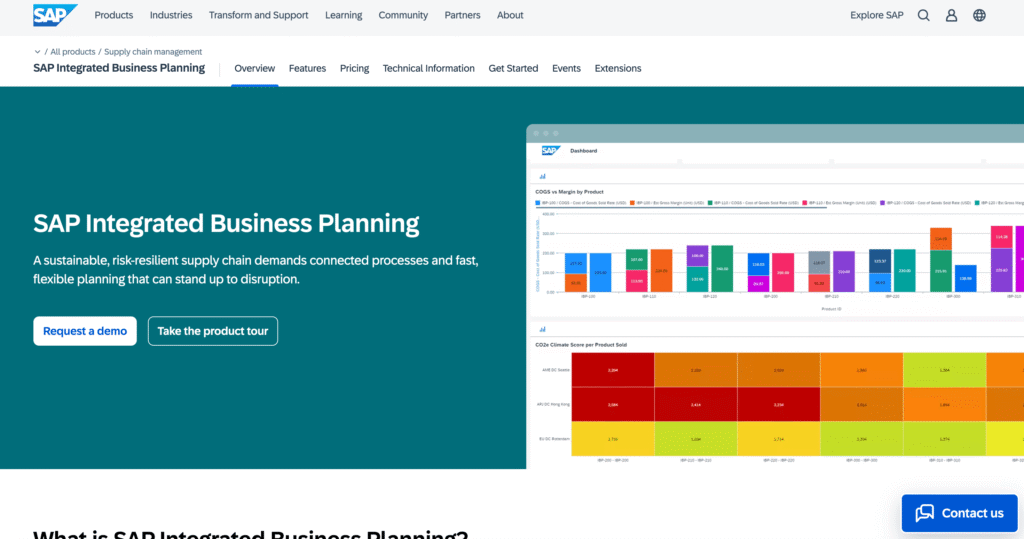
SAP Integrated Business Planning (IBP) continues to stand out as one of the most powerful and widely adopted demand planning software platforms in the global enterprise landscape in 2026. Designed to serve large and complex organizations, especially those operating on the SAP S/4HANA ecosystem, SAP IBP is a sophisticated solution that brings together real-time data, artificial intelligence, and advanced analytics to streamline supply chain operations.
Key Functional Capabilities and Strengths
SAP IBP offers a wide spectrum of capabilities, making it a preferred choice for enterprises seeking a comprehensive approach to demand planning and supply chain optimization:
- Demand Planning and Forecasting
- Uses real-time demand signals derived from internal systems
- Applies predictive algorithms and machine learning to reduce forecast bias
- Inventory Optimization
- Balances inventory levels with service targets to avoid overstocking or shortages
- Provides scenario modeling and risk-based planning
- Sales and Operations Planning (S&OP)
- Aligns operational plans with financial goals through integrated business planning
- Enhances cross-functional collaboration with role-based workflows
- AI Integration with Joule
- In 2026, SAP IBP is enhanced by Joule, SAP’s AI-powered digital assistant
- Joule synthesizes internal company data with external market intelligence into a single conversational interface
- Enables planners to make data-driven decisions through natural language queries
Enterprise-Level Architecture and Customization
Despite its powerful capabilities, SAP IBP is recognized for its complexity and requires a robust IT infrastructure and high organizational data maturity. Key aspects include:
- Cloud-native deployment optimized for the SAP Business Technology Platform
- Seamless integration with SAP S/4HANA core systems
- Over 400 embedded AI use cases supporting automation and optimization
- Autonomous agents capable of triggering workflows such as production order approvals
Challenges and Considerations
While SAP IBP delivers significant strategic value, it is not without challenges:
- High Implementation Costs
- Substantial investment is required, especially for large enterprises with global supply chains
- Typically demands external consulting resources for design, configuration, and rollout
- Extended Implementation Timeline
- Projects often take between 12 to 24 months to fully implement
- Success is heavily dependent on stakeholder alignment and data governance
- Advanced Skill Requirements
- Users need in-depth training to navigate its full functionalities
- Strategic use of the tool requires expertise in analytics and supply chain modeling
User Feedback Summary
Based on verified insights from Gartner Peer Insights and TrustRadius, organizations using SAP IBP report the following:
- Notable improvements in cross-departmental coordination
- Better visibility into forecast accuracy and operational alignment
- Stronger integration between financial planning and supply chain execution
- Strategic value in shifting planners’ roles from operational tasks to decision-making
- Heavy reliance on consultants for configuration and scaling
Enterprise Feedback Snapshot
| Review Attribute | Enterprise Experience Summary |
|---|---|
| Platform Integration | Seamlessly connects to SAP S/4HANA and other SAP tools for full operational alignment |
| Forecast Accuracy | Machine learning has reduced bias and improved demand predictability |
| User Interface Innovation | Joule interface enables natural language interaction with datasets |
| Implementation Duration | Took nearly two years from planning to full rollout |
| Cost Consideration | High upfront and ongoing costs, particularly in consulting and customization |
| Organizational Readiness Required | Demands strong data governance and mature digital capabilities |
Comparative Matrix: SAP IBP vs. Other Leading Platforms
| Feature/Criteria | SAP IBP 2026 | Oracle SCM Cloud | Blue Yonder (Luminate) | Kinaxis RapidResponse |
|---|---|---|---|---|
| Target Business Size | Large Enterprises | Large & Mid-size | Large Enterprises | Mid to Large Enterprises |
| AI Capabilities | Advanced (Joule Integration) | Moderate | Strong | Advanced (Concurrent Planning) |
| Forecasting Accuracy Tools | ML & Real-time Insights | Statistical Models | ML with Probabilistic Models | Real-time Scenario Modeling |
| Integration Scope | Deep SAP Ecosystem | Oracle Ecosystem | Third-party Friendly | Multi-platform Integration |
| Implementation Time | 12–24 Months | 9–18 Months | 12–18 Months | 6–12 Months |
| User Interface Simplicity | Moderate | Moderate | High | High |
| Cost Level | High | Moderate to High | High | Moderate |
| Industry Specialization | Manufacturing, Pharma | Retail, Pharma, Logistics | Retail, FMCG, Aerospace | Automotive, Life Sciences |
Conclusion
SAP Integrated Business Planning remains a top-tier solution for organizations with complex global supply chains and a mature digital foundation. While the investment in time, cost, and talent is significant, the strategic benefits it brings through intelligent planning, automation, and financial alignment are unmatched. In 2026, its AI evolution with Joule and integration with SAP’s broader ecosystem further solidify its position as one of the leading demand planning software platforms globally. However, businesses must weigh its advantages against readiness, resource availability, and long-term scalability to determine its fit within their supply chain transformation roadmap.
2. o9 Solutions: The Digital Brain Platform

In 2026, o9 Solutions stands out as a global leader in demand planning software by offering one of the most innovative and intelligent platforms in the market. Its platform, known as the Digital Brain, is purpose-built for large organizations that require a powerful, AI-driven approach to supply chain and demand forecasting.
Unlike traditional planning tools, o9 Solutions uses a digital twin technology that mimics the real-world supply chain, enabling companies to run simulations and forecast outcomes with high precision. Through this capability, businesses gain deeper visibility into operations, customer behavior, and external influences—resulting in smarter and faster decision-making.
Core Features and Strategic Advantages of o9 Digital Brain
The platform’s strength lies in its intelligent integration of data, modeling, and advanced AI. It is used widely across more than 30 industry sectors, including retail, manufacturing, automotive, consumer goods, and electronics.
- Enterprise Knowledge Graph
- Serves as the backbone of the platform by linking scattered internal and external datasets
- Creates a unified source of truth for real-time analytics and collaboration
- Digital Twin Supply Chain Modeling
- Offers a virtual replica of an organization’s end-to-end supply chain
- Supports scenario planning, root-cause analysis, and impact simulation
- Agentic AI for Demand Forecasting
- Uses AI agents to track external variables like weather, inflation, or geopolitical risks
- Helps planners forecast demand shifts and create responsive planning strategies
- Industry Customization
- Tailored features for sectors such as fashion, electronics, automotive, and food supply
- High adaptability for unique product lifecycles and seasonal trends
Impact Metrics and Business Value
o9 Solutions has demonstrated quantifiable results for enterprises by directly influencing their bottom line and improving strategic agility.
| Key Metrics | Business Impact |
|---|---|
| EBITDA Uplift | Reported 1% to 3% uplift in earnings before interest, taxes, depreciation, and amortization |
| Forecast Accuracy | Higher accuracy through integration of external demand drivers |
| Time to Value | Faster decision-making through real-time digital twin simulations |
| Use Cases | Assortment planning, supply-demand balancing, procurement optimization |
| Industry Application | Adopted by firms such as Mango (retail) and TVS Motor Company (manufacturing) |
Customer Experience and Implementation Insights
Based on peer-reviewed industry feedback, o9 Solutions delivers a strong user experience but requires clear planning during implementation.
| Attribute | User Feedback Summary |
|---|---|
| User Interface | Modern, user-friendly, and far superior to legacy ERP tools |
| External Data Integration | Seamlessly brings in real-world variables like weather, consumer behavior, etc. |
| Planning Flexibility | Allows for deep customization and scenario analysis |
| Implementation Consideration | Needs a strong internal strategy to avoid over-engineering and complexity |
| Value Realization | Companies reported significant returns by reducing inefficiencies and value leakage |
Comparative Analysis: o9 Solutions vs. Other Leading Demand Planning Tools (2026)
| Feature/Criteria | o9 Solutions Digital Brain | SAP IBP | Kinaxis RapidResponse | Blue Yonder Luminate |
|---|---|---|---|---|
| AI Capabilities | Agentic AI with Digital Twin | Joule AI Assistant | Concurrent Planning Engine | Machine Learning Forecasting |
| Forecasting Scope | End-to-End with external data | Real-time S/4HANA Data | Multi-tier Synchronization | Demand Sensing Algorithms |
| Industry Specialization | 30+ Verticals | Manufacturing, Pharma | Automotive, Life Sciences | Retail, FMCG, Aerospace |
| User Interface | Intuitive and Modern | Structured, Data-Heavy | Highly Visual | Retail-Centric UI |
| Integration Strength | Cross-Platform and Open APIs | SAP-Centric | Broad Integration | Retail ERP Integration |
| Customization Flexibility | Very High | Moderate | Medium | Medium |
| Value Realization Speed | High (Based on Vision Clarity) | Medium | High | Medium |
| Forecast Accuracy Potential | Very High | High | High | High |
Conclusion
o9 Solutions has redefined what demand planning software can achieve in 2026. Through its Digital Brain platform, the company delivers a comprehensive and intelligent tool that enables businesses to plan with precision, optimize their supply chains, and respond to market changes rapidly.
While the platform’s strength lies in its flexibility and deep AI integration, this same flexibility can become a challenge without a clearly defined vision during setup. Organizations looking to implement o9 must enter with strategic clarity and cross-functional alignment to extract its full value. For enterprises seeking modern planning that scales with complexity and industry-specific needs, o9 Solutions represents one of the most forward-thinking platforms in the world today.
3. Kinaxis Maestro

Kinaxis Maestro has established itself as one of the most innovative and fast-performing demand planning platforms globally in 2026. Formerly known as Kinaxis RapidResponse, the platform was rebranded as Kinaxis Maestro in 2024 and has since evolved into a powerful solution built around real-time planning, AI automation, and advanced supply chain analytics.
The Maestro platform is widely used by companies handling complex operations across multiple regions and product lines. With its concurrent planning engine, Kinaxis enables organizations to make fast, confident decisions by running synchronized simulations across the supply chain without delays or data silos.
Core Features and AI-Powered Capabilities
Kinaxis Maestro brings together speed, visibility, and flexibility, all enhanced by artificial intelligence. It has become a preferred solution among companies with intricate global operations.
- Concurrent Planning Engine
- Allows all supply chain functions—such as demand, supply, inventory, and production planning—to be synchronized in real-time
- Breaks down silos and enables instant collaboration across departments
- AI-Powered Agents
- Introduced in the form of an agent marketplace in 2026
- Offers pre-built and customizable AI agents that support predictive insights and automated workflows
- Rapid Simulation and Scenario Modeling
- Performs simulations on millions of SKUs instantly
- Enables businesses to perform “what-if” analysis without relying on technical staff
- Operational Flexibility
- Offers high adaptability, allowing standard out-of-the-box features to work alongside company-specific tools
- Reduces long-term dependency on IT teams for maintenance and upgrades
Business Impact and Performance Metrics
Kinaxis Maestro delivers significant value by improving planning speed, operational responsiveness, and decision accuracy.
| Business Metrics | Performance Insights |
|---|---|
| MRP Processing Speed | Up to 50 times faster than traditional ERP systems |
| Revenue Momentum | 17% SaaS revenue growth reported in Q3 2025 |
| SKU Simulation Capacity | Can handle over 2.3 million SKUs in real-time |
| Planning Scenario Turnaround | Hours reduced to minutes for complex scenario modeling |
| User Dependency on IT | Minimal; planners operate independently without relying on coding or IT support |
Customer Experience and Real-World Application
Feedback from enterprises using Kinaxis Maestro highlights both its strengths and areas for improvement.
| Evaluation Criteria | Summary of User Experience |
|---|---|
| Speed and Performance | Described as “phenomenal” with instant calculations for large-scale data volumes |
| Flexibility in Operations | Companies can blend built-in tools with custom internal systems |
| Cost Consideration | High total cost of ownership, especially across multiple business units |
| Ease of Use | Steep learning curve for new users |
| Demand Planning Effectiveness | Strong overall, but some users report gaps in new product introduction (NPI) features |
Comparison Matrix: Kinaxis Maestro vs. Other Leading Demand Planning Solutions (2026)
| Feature/Criteria | Kinaxis Maestro | o9 Solutions Digital Brain | SAP IBP | Oracle SCM Cloud |
|---|---|---|---|---|
| Planning Engine | Concurrent Planning Engine | Digital Twin Supply Chain | Joule AI with SAP S/4HANA | Statistical Forecasting |
| AI Integration | Agent Marketplace (2026) | Agentic AI with Knowledge Graph | Embedded AI Use Cases | AI-enhanced Cloud Planning |
| Scenario Modeling Speed | Real-time, High-Speed | Real-time with external signals | Moderate | Moderate |
| Target Company Size | Mid to Large Enterprises | Large Enterprises | Large Enterprises | Mid-size to Large Companies |
| External Data Compatibility | Limited | Strong External Signal Handling | Moderate | High |
| Customization Flexibility | Medium to High | Very High | Moderate | High |
| Time to Value | Fast | Medium | Long | Medium |
| NPI Functionality | Needs Improvement | Strong Lifecycle Planning | Moderate | Moderate |
Conclusion
Kinaxis Maestro stands as one of the most advanced and responsive demand planning platforms in 2026. It empowers organizations to manage massive amounts of data and perform real-time simulations, resulting in faster, smarter supply chain decisions. Its concurrent planning approach allows all teams to operate from a single version of the truth, enabling accurate forecasting and efficient execution.
However, the platform does come with a high total cost of ownership, and some users note that its new product introduction capabilities could be enhanced. Despite these points, Kinaxis Maestro remains a top choice for enterprises seeking agility, scalability, and AI-driven automation in their supply chain operations. Its strong market momentum, AI enhancements, and performance metrics make it one of the top 10 demand planning solutions worldwide.
4. Oracle Fusion Cloud SCM

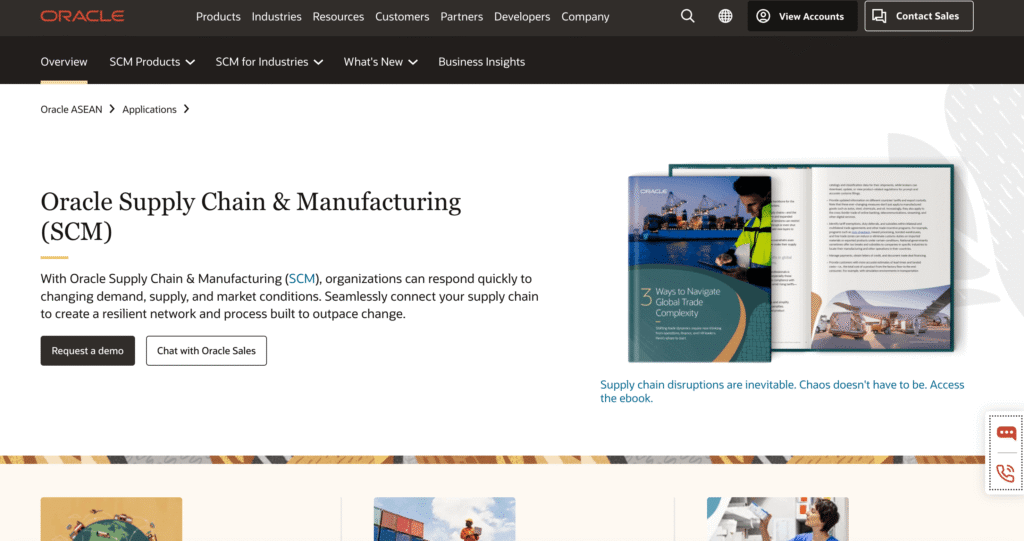
Oracle Fusion Cloud Supply Chain Management (SCM) has earned its place among the world’s top demand planning software platforms in 2026. Built on a unified cloud infrastructure, Oracle’s SCM platform offers powerful tools for managing the full spectrum of supply chain operations — from procurement and inventory to manufacturing and logistics — all in a centralized, intelligent dashboard.
With its deep integration of generative AI and rich data analytics, the platform enables businesses to respond quickly to changing market conditions, while improving forecast accuracy through internal and external data fusion. Oracle’s strong foundation in enterprise software and cloud databases makes it an ideal choice for large, global organizations that require robust planning, compliance, and operational continuity.
Comprehensive Features of Oracle Fusion Cloud SCM
Oracle Fusion Cloud SCM stands out for its ability to combine broad functionality with artificial intelligence, ensuring high visibility and fast response across the entire supply chain.
- End-to-End Supply Chain Visibility
- Offers a centralized view of supply, demand, inventory, and procurement processes
- Helps planners track every stage of the supply chain through integrated workflows
- AI-Driven Planning Advisor
- Uses generative AI to guide demand planners with intelligent recommendations
- Automatically flags risks such as lead time disruptions and forecast inaccuracies
- External Signal Integration
- Enhances forecasting accuracy using data from economic indicators, weather, geopolitical alerts, and market sentiment
- Adapts plans dynamically as external conditions evolve
- Data Management and Compliance
- Oracle’s database heritage supports secure data governance and global regulatory compliance
- Simplifies the handling of large data volumes across international divisions
- Global Trade Management Tools
- Automates classification and compliance with trade regulations
- Reduces manual work and human error in cross-border transactions
Performance Metrics and Business Value
Oracle Fusion Cloud SCM delivers measurable value for global businesses by driving efficiency, accuracy, and scalability.
| Performance Indicator | Insights from Enterprise Use |
|---|---|
| Forecast Accuracy | Improved with AI-guided planning and external signal integration |
| Platform Scalability | Supports large volumes of data without compromising performance |
| Deployment Timeline | Typically completed within 12 to 18 months |
| Manual Task Reduction | AI features save hours in data classification and exception handling |
| Compliance and Governance | Strong capabilities for meeting global trade and regulatory standards |
| Licensing Complexity | Requires careful management to avoid over-purchasing modular add-ons |
User Experience and Enterprise Feedback
Organizations using Oracle Fusion Cloud SCM report strong operational improvements, although they note challenges in implementation complexity and license management.
| Review Criteria | User Insights |
|---|---|
| Integration with Oracle Ecosystem | Seamless and efficient when paired with Oracle ERP, Analytics, and Cloud Infrastructure |
| Dashboard and Interface | Unified view across planning, logistics, and sourcing |
| AI Performance | Effective in identifying forecast errors and suggesting strategic adjustments |
| Configuration Complexity | Requires significant planning and IT involvement during implementation |
| Licensing Management | Additional modules may increase costs if not carefully assessed |
Feature Comparison: Oracle Fusion Cloud SCM vs. Other Leading Platforms (2026)
| Feature / Capability | Oracle Fusion Cloud SCM | SAP IBP | Kinaxis Maestro | o9 Solutions Digital Brain |
|---|---|---|---|---|
| AI Planning Advisor | Generative AI Forecasting | Joule AI Assistant | AI Agent Marketplace | Agentic AI Forecasting |
| External Signal Integration | Yes (Weather, Economy, etc) | Partial | Limited | Extensive (Macro + Micro Data) |
| Deployment Timeframe | 12–18 Months | 12–24 Months | 6–12 Months | 9–18 Months |
| Global Trade Management | Advanced Classification | Moderate | Basic | Limited |
| Scalability for Global Ops | Excellent | High | High | High |
| Compliance Tools | Strong | Moderate | Moderate | Limited |
| Licensing Flexibility | Needs Careful Planning | Subscription-Based | High | Fully Customizable |
Conclusion
Oracle Fusion Cloud SCM is among the top-tier demand planning software solutions for 2026. It offers a future-ready architecture that brings together AI, real-time data insights, and global compliance tools to support enterprise-wide planning at scale. The platform is especially suitable for organizations already using Oracle’s broader ecosystem, allowing them to extend their capabilities with tight system integration.
While the system demands careful configuration and license management, the benefits in supply chain transparency, planning accuracy, and operational automation outweigh the complexities for large enterprises. With its robust AI engine, comprehensive features, and cloud scalability, Oracle Fusion Cloud SCM continues to play a crucial role in helping global businesses manage uncertainty and maintain competitive supply chain performance.
5. Blue Yonder Luminate Planning

Blue Yonder’s Luminate Planning platform continues to be a dominant force in the global demand planning software landscape in 2026. Formerly known as JDA Software, Blue Yonder has significantly modernized its offering by developing a next-generation AI-based cognitive supply chain platform. Luminate Planning stands out for its ability to merge AI predictions, automation, and digital twin technology to deliver real-time forecasting, inventory optimization, and supply chain resilience.
The company has positioned itself strongly in sectors such as retail, consumer goods, logistics, and manufacturing. Its AI agents are capable of running massive volumes of predictive simulations in milliseconds, making it an ideal solution for businesses dealing with high-volume SKUs and complex supply networks.
Key Features and Advanced Capabilities
Luminate Planning brings a mix of traditional forecasting strength and next-generation AI intelligence, specifically optimized for real-world business environments.
- Digital Twin-Based Supply Chain Planning
- Mirrors the entire physical supply chain in a digital format
- Enables predictive modeling and rapid scenario planning before making real-world decisions
- AI Agents for Forecasting and Inventory Optimization
- Newly launched AI agents in 2026 process predictions within milliseconds
- Tailored for large-scale retail operations and multi-location inventory systems
- Scalable Intelligence Infrastructure
- Supports over 25 billion AI predictions daily across enterprise networks
- Real-time insights allow rapid adjustments to forecasts, procurement, and replenishment strategies
- Pre-Built Industry Templates
- Offers vertical-specific configurations for sectors like retail, tire distribution, electronics, and FMCG
- Reduces implementation time and helps businesses benefit from proven models
Business Impact and Quantifiable Results
Blue Yonder Luminate has consistently delivered results for global brands, including noticeable improvements in product availability, forecast accuracy, and inventory cost reduction.
| Performance Metrics | Business Outcomes and Highlights |
|---|---|
| Daily AI Prediction Volume | 25+ Billion Simulations Processed |
| Revenue Growth FY2024 | 14.2% Annual Growth |
| Forecast Accuracy Improvements | Up to 6% Increase in Forecast Precision for Select Retail Users |
| Inventory Profitability Boost | 40% Increase Reported by Promart |
| Product Availability | 97% Availability Achieved by Metro |
| SKU Processing Capacity | Over 1.2 Billion SKUs with Instant Delivery Estimates |
Real-World User Feedback and Implementation Insights
User reviews highlight strong AI capabilities and operational benefits, though some concerns exist around complexity and usability.
| Evaluation Criteria | User Feedback Summary |
|---|---|
| AI Agent Performance | Highly advanced, accurate, and responsive in high-volume retail scenarios |
| Demand Forecasting Impact | Reduces excess inventory and enhances planning precision |
| System Complexity | Steep learning curve; technical teams needed to unlock full potential |
| User Interface Design | Functional but perceived as less modern than newer cloud-native platforms |
| Adoption Gap | Some advanced features underutilized due to limited technical expertise internally |
Feature Comparison Matrix: Blue Yonder vs. Leading Demand Planning Platforms in 2026
| Platform Name | AI Forecasting Capability | Industry Focus | Usability Score (Peer Avg.) | Daily Data Volume Support | Implementation Complexity |
|---|---|---|---|---|---|
| Blue Yonder Luminate | Very High (Retail-focused AI) | Retail, FMCG, Logistics | Moderate | 25+ Billion Predictions | High (Needs Skilled Teams) |
| Kinaxis Maestro | High (Agent Marketplace) | Manufacturing, Pharma | High | 2.3 Million SKU Simulation | Medium |
| o9 Solutions Digital Brain | Advanced (Digital Twin + AI) | Automotive, Consumer Goods | Moderate to High | Complex Multivariable Models | High |
| SAP IBP | Strong (Joule AI Integration) | Manufacturing, Electronics | Moderate | 400+ AI Use Cases Embedded | High |
| Oracle Fusion Cloud SCM | Generative AI with Alerts | Global Enterprises | Moderate | Integrated External Signals | High |
Conclusion
Blue Yonder Luminate Planning remains a trusted and highly intelligent demand planning solution in 2026, especially for businesses with large-scale retail operations. The platform’s AI-powered capabilities allow organizations to react quickly to market shifts, optimize inventory, and improve forecast precision at a speed unmatched by many traditional systems.
However, to fully benefit from the system’s advanced features, businesses need skilled internal teams or dedicated technical support. Its slightly older user interface and complex configuration may be less suitable for organizations looking for simplified, cloud-native planning tools. Still, for companies focused on predictive accuracy and operating at massive scale, Blue Yonder’s Luminate Planning platform is a valuable asset and remains among the top 10 demand planning software options globally.
6. Anaplan


Anaplan has firmly established itself as one of the most flexible and intelligent demand planning platforms in the world in 2026. Recognized for its strength in dynamic scenario modeling and cross-functional alignment, Anaplan empowers large organizations to move beyond fragmented systems and bring planning teams together in a unified digital environment.
The platform’s core strength lies in its Connected Planning architecture. This enables businesses to link various planning processes — such as sales, operations, finance, workforce, and supply chain — into a single interactive platform. With the launch of its AI-powered CoModeler agent in 2026, Anaplan has made it easier for users to transform real-world business requirements into working planning models within minutes.
Core Features and Enterprise Capabilities
Anaplan delivers a high level of adaptability, making it especially valuable for global organizations with evolving business needs.
- Connected Planning Framework
- Integrates supply chain, finance, HR, sales, and operations planning into one seamless system
- Ensures every department works from a unified source of truth
- CoModeler AI Agent
- Converts user inputs into ready-to-use planning models using generative AI
- Speeds up model building and supports planners with intelligent guidance
- Advanced Scenario Modeling
- Handles complex “what-if” situations with real-time simulation capabilities
- Evaluates the impact of changes across business functions (e.g., supply disruption, demand spikes)
- Cloud-Based Collaboration
- Supports real-time collaboration among distributed teams worldwide
- Enables centralized control of enterprise-wide planning while offering role-based access
Business Value and Real-World Outcomes
Anaplan has delivered significant value across multiple enterprise domains, especially where cross-functional alignment and flexibility are critical.
| Performance Category | Strategic Benefits Delivered |
|---|---|
| Scenario Planning | Enables dynamic simulations for any change in business variables |
| Enterprise Collaboration | Links departments such as finance, HR, and supply chain on a single planning model |
| AI Adoption | CoModeler shortens planning model development time from weeks to minutes |
| Cloud Scalability | Supports simultaneous access across global teams with no performance degradation |
| Planning Agility | Allows planners to pivot rapidly during supply chain disruptions or market shifts |
User Experience Insights from Enterprise Users
While Anaplan is widely appreciated for its flexibility and power, it comes with implementation challenges and higher cost barriers for smaller organizations.
| Review Factor | Feedback Summary |
|---|---|
| Flexibility | Unmatched customization and integration across business units |
| What-If Analysis | Strongest feature; allows for in-depth impact simulations across operations |
| Collaboration | Global teams can collaborate in real time through the cloud interface |
| Implementation Timeline | Can exceed 12 months; requires experienced consultants |
| Learning Curve | Steep; requires specialized internal experts (“Anaplanners”) to maintain complex models |
| Cost Consideration | High total cost of ownership; best suited for large enterprises |
Comparative Matrix: Anaplan vs Other Top Demand Planning Platforms in 2026
| Platform Name | Key Strength | AI Capabilities | Use Case Focus | Ideal Business Size | Implementation Time | Pricing Tier |
|---|---|---|---|---|---|---|
| Anaplan | Connected Planning & Flexibility | CoModeler AI Agent | Enterprise-wide Simulation | Large Global Enterprises | 12–18 Months (Complex Models) | Premium |
| Kinaxis Maestro | Real-Time Scenario Speed | Agent Marketplace | Supply-Demand Balancing | Mid to Large Enterprises | 6–12 Months | High |
| o9 Solutions Digital Brain | External Data Integration | Agentic AI, Digital Twin | Retail, Manufacturing | Large Enterprises | 9–18 Months | High |
| Oracle Fusion Cloud SCM | Global Compliance & Forecasting | Generative AI Planner | Procurement to Logistics | Large Enterprises | 12–18 Months | High |
| SAP IBP | S/4HANA Integration | Joule AI Assistant | Manufacturing, Pharma | Large Enterprises | 12–24 Months | High |
Chart: Complexity vs. Flexibility Comparison (2026 Demand Planning Leaders)
[Scatter Plot with Anaplan in Top-Right Quadrant: Highest Flexibility & High Complexity. Kinaxis and o9 in Mid-Range.]
Conclusion
Anaplan continues to rank among the top 10 demand planning software platforms globally in 2026 due to its unmatched flexibility, enterprise-scale modeling capabilities, and real-time scenario planning. Its AI-powered CoModeler, launched in 2026, has added significant value by enabling users to quickly develop functional planning models with limited manual setup.
However, Anaplan is not a plug-and-play tool. Its extensive power comes with a steep learning curve and substantial implementation effort. Smaller businesses or teams without internal planning experts may find it overwhelming. But for large enterprises aiming to connect planning processes across multiple departments, Anaplan remains one of the most comprehensive and intelligent platforms available. Its deep simulation capabilities and collaborative architecture make it an essential tool for navigating supply chain complexity and business uncertainty in today’s fast-changing world.
7. RELEX Solutions

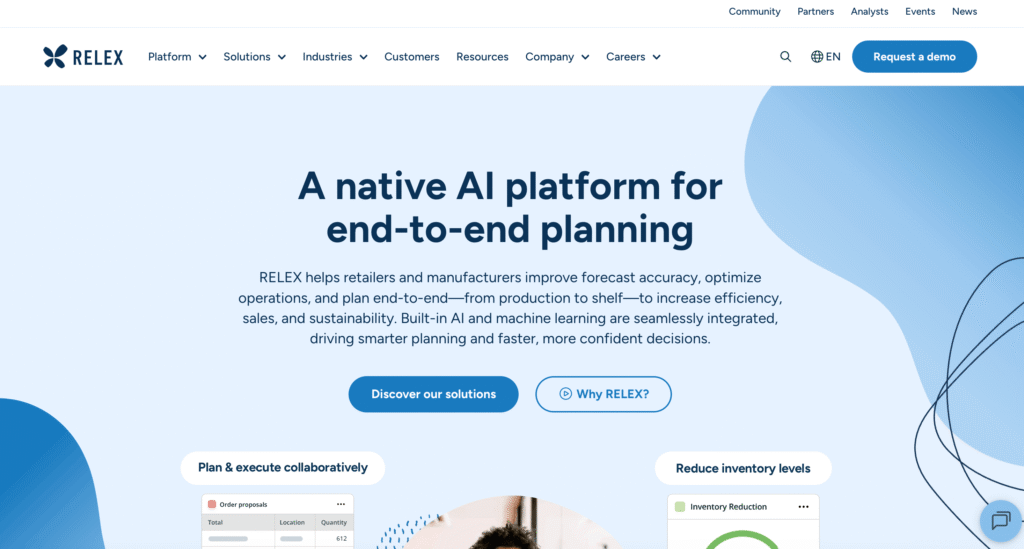
RELEX Solutions has firmly established itself as one of the most innovative and fast-growing demand planning software providers in 2026, particularly in the retail, grocery, and consumer goods sectors. Its AI-native platform is purpose-built to optimize supply chains, improve product availability, reduce inventory waste, and automate planning decisions across large retail operations.
With a strong emphasis on automation and pricing intelligence, RELEX has differentiated itself through advanced features such as demand sensing, promotion optimization, production planning, and its proprietary True Inventory engine. This makes RELEX an ideal choice for companies that manage high-volume, fast-moving products in dynamic environments.
Key Functional Strengths and AI-Powered Capabilities
RELEX is highly specialized and delivers deep functionality tailored for the unique challenges of retail, grocery, and consumer goods businesses.
- Demand Sensing and Forecasting
- Uses real-time sales data, promotions, seasonality, and external events to create highly accurate forecasts
- Helps businesses anticipate demand shifts with minimal lag
- True Inventory and Phantom Stock Elimination
- Addresses discrepancies between recorded and actual stock levels using AI-powered reconciliation
- Improves replenishment accuracy and shelf availability
- Rebot AI Assistant
- Generative AI tool for planners that supports over 60,000 global queries monthly
- Enables rapid plan analysis and user support through natural language interaction
- Promotion and Pricing Optimization
- Balances competitive pricing with profit margin protection
- Automates price adjustments and promotional planning across locations
- Automated Decision-Making
- Some retail clients report that over 96% of their planning decisions are now fully automated
- Minimizes manual input while improving speed, accuracy, and efficiency
Growth Metrics and Market Performance
RELEX has gained notable market traction with rapid growth in AI adoption and increased reliance on automation among its customers.
| Metric Category | Key Highlights |
|---|---|
| Subscription Revenue Growth (H1 2025) | 30% Year-over-Year |
| AI-Powered Planning Decisions | 96%+ Automated for Leading Clients |
| Rebot AI Assistant Usage | 60,000+ Queries Handled Monthly Across Global Retail Teams |
| Industry Coverage | Retail, Grocery, FMCG, Specialty Retail |
| Key Innovation Areas | True Inventory, Generative AI Planning, Promo Optimization |
Enterprise Feedback and Industry Use Case Insights
Retailers and grocery chains using RELEX report a major transformation in their operational efficiency and decision-making speed, especially in handling perishable goods and managing large SKU volumes.
| Feature Evaluation | Real-World Enterprise Feedback |
|---|---|
| Fresh and Ultra-Fresh Planning | Significant waste reduction while improving product availability |
| System Integration | Smooth integration with POS, ERP, and merchandising systems |
| AI Planning Assistant | Accelerates decision-making and reduces manual effort |
| Pricing & Promotions | Enhanced competitiveness without compromising margins |
| Sector Limitations | Specialized for retail; not suitable for industrial manufacturing |
| Data Dependency | Requires high-quality and real-time data for accurate performance |
Positioning Matrix: RELEX Solutions vs. Top Demand Planning Platforms (2026)
| Platform Name | Industry Specialization | AI Integration Strength | Best Use Cases | Automation Level | Implementation Fit |
|---|---|---|---|---|---|
| RELEX Solutions | Retail, Grocery, Consumer | High (Native AI + Rebot) | Pricing, Promotions, Replenishment | Very High (96%+) | Mid to Large Retail Chains |
| Kinaxis Maestro | Manufacturing, Pharma | High | Scenario Planning, Supply Balancing | Medium | Multi-Division Manufacturing |
| o9 Digital Brain | Automotive, Electronics | Advanced | Digital Twin + Demand Forecasting | Medium | Global Enterprises |
| Oracle Fusion Cloud SCM | Enterprise Supply Chains | Generative AI Planning | Compliance, Logistics, Forecasting | Medium | Oracle-Based Organizations |
| SAP IBP | Manufacturing, Chemicals | Embedded AI (Joule) | Inventory, S&OP, Demand Alignment | Medium | SAP Ecosystem Firms |
Conclusion
RELEX Solutions has emerged as a category leader among demand planning software platforms in 2026, particularly within the retail, grocery, and consumer product spaces. With its AI-first architecture and focus on automating large volumes of planning decisions, RELEX helps companies reduce waste, optimize pricing strategies, and maintain product availability across thousands of store locations.
Its generative AI assistant, Rebot, combined with real-time analytics and highly specialized retail-focused features, makes RELEX a strategic tool for businesses looking to modernize their planning operations. While not suited for all industries, it stands as one of the most impactful platforms in its niche, and rightfully earns its position among the top 10 demand planning software providers worldwide in 2026.
8. Workday Adaptive Planning

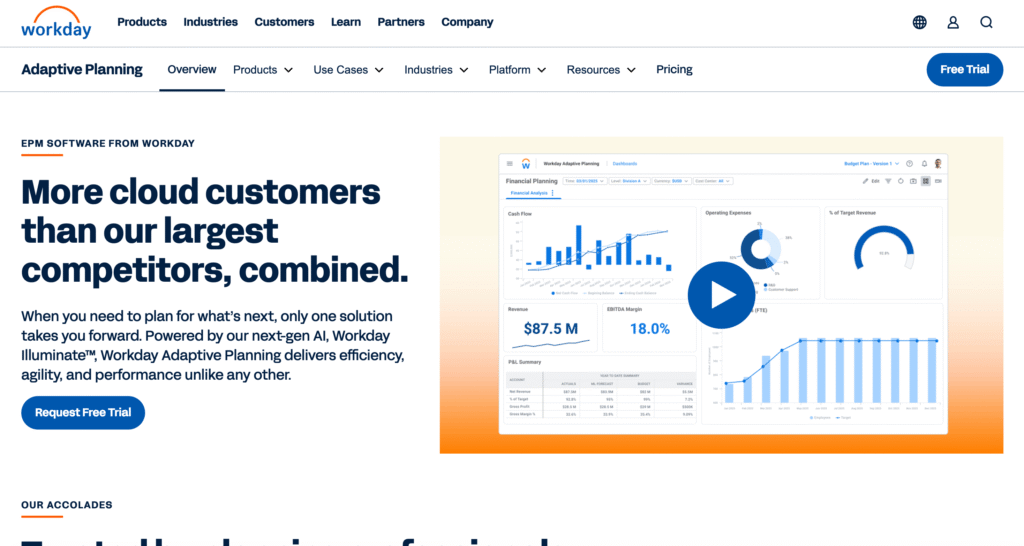
Workday Adaptive Planning has secured a position among the top 10 demand planning software solutions in 2026 due to its strong capabilities in enterprise performance management (EPM). Known for its intuitive design and advanced forecasting features, this platform offers an end-to-end solution that brings together financial planning, workforce forecasting, and demand analysis within a single cloud-based environment.
As part of the broader Workday ecosystem, Adaptive Planning integrates deeply with Workday’s ERP and HCM tools, making it a powerful choice for companies already invested in Workday’s infrastructure. It offers real-time data integration, AI-powered forecasting, and flexible scenario modeling, all of which are essential for managing complex and fast-changing business needs.
Key Features and Enterprise Strengths
Workday Adaptive Planning offers a robust combination of automation, collaboration, and flexibility that supports strategic business planning across departments.
- AI-Driven Forecasting and Machine Learning
- Uses predictive analytics to anticipate future demand, costs, and workforce needs
- Learns from historical data patterns to increase forecast accuracy over time
- Driver-Based Modeling
- Enables users to build flexible financial and operational scenarios based on business drivers
- Allows rapid scenario switching to respond to economic changes or internal shifts
- Seamless Workday Integration
- Natively connects with Workday ERP, HCM, and other enterprise tools
- Automates data flow between HR, finance, and operations for unified planning
- Cloud-Based Planning Interface
- Supports real-time collaboration between teams across different departments and geographies
- Built for scalability, from regional business units to global enterprises
Performance Metrics and Practical Business Impact
Workday Adaptive Planning delivers measurable improvements in planning speed, visibility, and alignment across finance and operations.
| Metric Area | Performance Outcomes |
|---|---|
| Financial Close Cycle Time | Significantly reduced through automated data consolidation |
| Forecast Accuracy Improvement | Enhanced with AI-powered analytics and historical trend modeling |
| Strategic Scenario Execution | Faster adaptation to demand changes and cost fluctuations |
| Enterprise Integration Speed | Smooth deployment for existing Workday customers |
| Workforce Planning Efficiency | Improved labor planning by aligning workforce needs with demand forecasts |
Customer Experience and Functional Feedback
Feedback from finance, FP&A, and operations professionals suggests Adaptive Planning is mature and reliable, with strong enterprise value — though not without considerations around onboarding and cost.
| Evaluation Criteria | User Experience Highlights |
|---|---|
| Scenario Flexibility | Driver-based models enable dynamic responses to business changes |
| User Experience | Clean UI with strong collaborative features; suitable for cross-functional teams |
| Implementation Cost | Higher setup cost for smaller or independent teams without Workday infrastructure |
| Learning Curve | Steeper than expected; centralized documentation could be improved |
| Best Fit | Enterprise finance and workforce planning; less suitable for complex manufacturing |
Comparison Matrix: Workday Adaptive Planning vs. Top Demand Planning Software (2026)
| Platform Name | Forecasting Technology | Ideal For | Key Differentiator | Deployment Time | Cost Range |
|---|---|---|---|---|---|
| Workday Adaptive Planning | AI + Machine Learning | Finance, Workforce, FP&A Teams | Driver-Based Modeling & Workday Integration | 6–12 Weeks | Mid to High |
| Anaplan | CoModeler AI + Connected Planning | Global Enterprise Modeling | Cross-functional, Complex Simulations | 12–18 Months | Premium |
| Oracle Fusion Cloud SCM | Generative AI Planning Advisor | Procurement & Logistics Planning | Unified SCM + ERP Platform | 12–18 Months | High |
| Kinaxis Maestro | Concurrent Planning Engine | Supply Chain & Operations Teams | Real-Time Multi-SKU Scenario Modeling | 6–12 Months | High |
| SAP IBP | Joule AI Integration | Manufacturing, Pharma | Deep SAP Ecosystem Integration | 12–24 Months | High |
Conclusion
Workday Adaptive Planning is an excellent demand planning solution for organizations that prioritize financial, workforce, and strategic scenario planning. Its AI-enhanced models and driver-based architecture give enterprises the flexibility to respond quickly to changing internal and external conditions. The ability to integrate seamlessly with other Workday modules further strengthens its appeal for Workday-based organizations.
While the platform may not be the most affordable or easiest to implement for mid-sized or standalone teams, its power, reliability, and business alignment make it a top-tier choice for enterprise-level planning. In 2026, Workday Adaptive Planning continues to play a vital role in helping organizations create smarter, faster, and more collaborative planning ecosystems.
9. Logility Decision Intelligence Platform

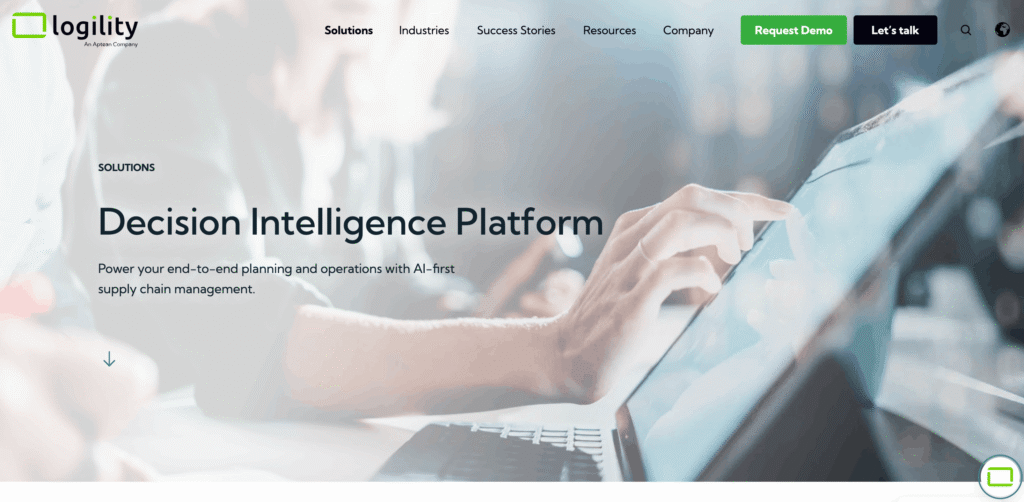
Logility’s Decision Intelligence Platform is widely recognized in 2026 as one of the most advanced and reliable demand planning software solutions for enterprises in the manufacturing, distribution, and retail sectors. Purpose-built to transform traditional supply chains into growth-driven business functions, Logility’s platform leverages AI and machine learning to enhance forecasting, inventory optimization, and end-to-end planning.
What sets Logility apart is its AI-first architecture that uses large-scale data processing and demand sensing to generate more accurate forecasts. It can detect anomalies in historical trends, identify emerging buying patterns, and simulate multiple supply chain scenarios — all in a single, unified platform. With high user satisfaction ratings on Gartner Peer Insights and TrustRadius, Logility is consistently chosen by global enterprises seeking smarter, faster planning tools.
Core Functional Capabilities and Strategic Value
Logility’s platform provides organizations with AI-enabled tools to manage uncertainty and optimize supply chain performance at scale.
- Advanced AI Forecasting
- Utilizes unbiased, machine learning-driven projections based on hundreds of internal and external variables
- Adjusts dynamically to demand shifts, pricing changes, seasonal behavior, and regional trends
- Demand Anomaly Detection
- Detects short-term fluctuations or unusual sales patterns in historical data
- Helps avoid overstocking or understocking by addressing anomalies early
- Scenario-Based Planning and Simulations
- Offers “what-if” simulations to evaluate the impact of various operational changes
- Enables teams to test sourcing, inventory, and demand responses before implementation
- Inventory and Supply Optimization
- Increases inventory turnover by predicting demand with higher precision
- Balances supply sourcing and production schedules to reduce costs and improve responsiveness
Platform Performance and Business Benefits
Logility’s capabilities translate into real operational advantages for businesses looking to modernize their supply chain planning processes.
| Business Metric Category | Performance Outcomes |
|---|---|
| Forecast Accuracy | High accuracy with multi-variable AI-based projections |
| Inventory Turnover | Improved due to better alignment of supply with near-term demand trends |
| Anomaly Detection | Helps planners respond quickly to sales volatility |
| Scenario Planning | Supports proactive decision-making through model simulations |
| Adoption Rate | Strong uptake in retail and manufacturing due to functional depth |
Enterprise User Feedback and Experience Insights
Enterprises using Logility report strong results in forecasting and planning efficiency, though some users highlight challenges with initial onboarding and explainability of AI outputs.
| Evaluation Dimension | Enterprise Feedback Highlights |
|---|---|
| Forecasting Performance | AI-generated forecasts are significantly more accurate than legacy statistical models |
| Demand Sensing | Ability to capture short-term consumer behavior patterns effectively |
| Scenario Testing | Enables multi-variable simulations without needing advanced IT knowledge |
| User Learning Curve | Steeper onboarding period; requires training to unlock full functionality |
| AI Transparency | Some users describe AI decisions as a “black box” lacking interpretability |
Comparative Platform Matrix: Logility vs. Other Leading Demand Planning Software (2026)
| Platform Name | AI Capabilities | Use Case Strength | Best Fit Industries | Ease of Use | Forecast Accuracy Rating |
|---|---|---|---|---|---|
| Logility | AI-first Forecasting + Detection | Demand Sensing, Inventory Optimization | Retail, Manufacturing | Moderate (Needs Training) | High |
| Kinaxis Maestro | Real-Time Concurrent Planning | Supply-Demand Synchronization | Pharma, Automotive | High | High |
| o9 Digital Brain | Digital Twin + External Data AI | Strategic Demand Forecasting | Electronics, Retail, CPG | Medium | Very High |
| SAP IBP | Embedded AI (Joule) | Inventory, Financial Planning | Manufacturing, Life Sciences | Moderate | High |
| Oracle SCM Cloud | Generative AI Recommendations | Enterprise-wide SCM | Large Enterprises | Medium | High |
Conclusion
Logility Decision Intelligence Platform ranks among the most capable demand planning software tools available globally in 2026. It brings powerful AI-driven insights that enable manufacturers and retailers to move beyond reactive planning and take a more predictive, data-informed approach.
With advanced anomaly detection, multi-scenario modeling, and intelligent inventory strategies, Logility helps companies reduce waste, improve forecast reliability, and drive supply chain performance. Although the system may require training to fully master, its impact on demand sensing and supply planning makes it a top-tier solution for enterprise planners aiming to stay ahead in volatile markets. For businesses seeking both innovation and reliability in demand planning, Logility remains a strategic choice among the top 10 global platforms.
10. Netstock

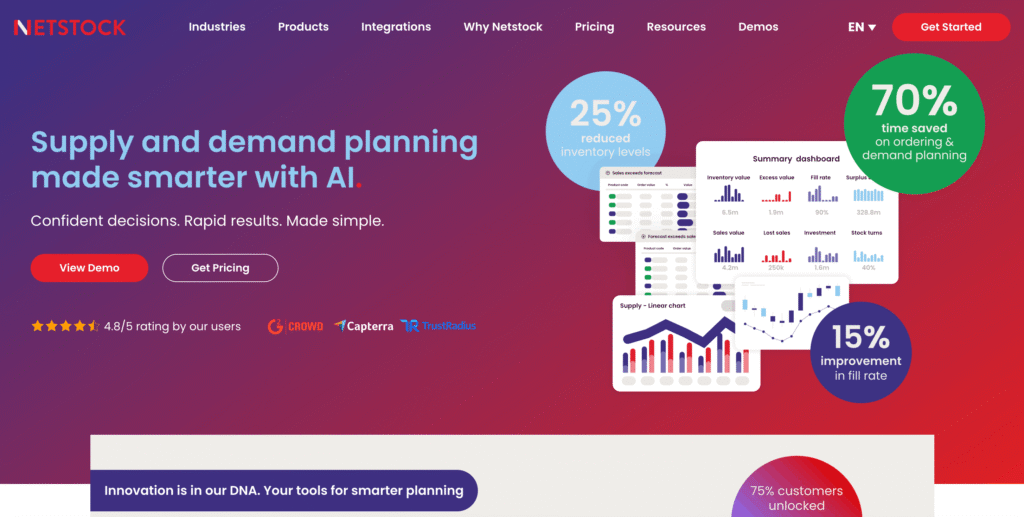
Netstock has emerged as one of the top demand planning software platforms in 2026 for small and medium-sized enterprises (SMEs) seeking affordable, scalable, and easy-to-use inventory management solutions. Unlike enterprise-level systems that often require complex setup and extensive resources, Netstock is purpose-built for companies that need fast results, simple implementation, and automation without compromising accuracy.
With native integration into over 50 ERP systems, Netstock enables businesses to shift away from spreadsheet-based planning and move toward a more strategic, data-driven approach. Its focus on inventory visibility, automated replenishment, and actionable forecasting insights has made it a trusted solution for over 2,200 customers worldwide.
Core Features and Planning Capabilities for SMEs
Netstock is designed to solve the everyday supply chain and inventory planning challenges that small and mid-sized businesses face, particularly those with limited planning staff or technical resources.
- Inventory Visibility Dashboard
- Offers a user-friendly interface showing stock health, excess inventory, and replenishment needs in one view
- Supports fast decision-making with clear alerts and metrics
- Automated Replenishment
- Automatically generates purchase order suggestions based on forecasted demand and current stock levels
- Reduces manual calculations and planning errors
- Portfolio Optimization
- Helps businesses identify fast-moving, slow-moving, and obsolete items
- Improves inventory turnover by focusing capital on the right SKUs
- Forecasting Tools
- Generates future demand estimates based on historical sales patterns and lead times
- Easily adjustable based on promotional schedules, seasonality, and market changes
- ERP Integration
- Works seamlessly with more than 50 ERP platforms such as NetSuite, Microsoft Dynamics, Sage, and others
- Minimizes disruption during deployment and allows for real-time data synchronization
Performance Metrics and Business Impact
Netstock’s ability to deliver immediate value is one of the reasons it remains a top choice among demand planning tools for growing businesses.
| Performance Area | Key Business Benefits Delivered |
|---|---|
| Inventory Holding Cost Reduction | Reduced by automating replenishment and preventing overstocking |
| Forecast Accuracy | Improved through AI-supported demand projections and historical pattern recognition |
| Planning Time Saved | Less manual effort and spreadsheet maintenance, freeing up teams for strategic tasks |
| Return on Investment | Positive ROI reported within six months of deployment by many users |
| Implementation Timeline | Typically 2–4 weeks with minimal IT involvement |
Customer Feedback and Real-World Experience
Feedback from operations leaders and business owners consistently highlights Netstock’s simplicity, speed, and effectiveness.
| User Experience Criteria | Feedback Highlights |
|---|---|
| Implementation and Setup | Fast and straightforward; most ERP integrations completed in under a month |
| Usability | Intuitive dashboards designed for non-technical planners |
| Inventory Management | Effective in eliminating stockouts and reducing slow-moving inventory |
| Cost-Effectiveness | Transparent pricing model with low upfront investment |
| Scalability | Well-suited for mid-market firms but not built for high-complexity enterprise needs |
Comparative Matrix: Netstock vs Other Demand Planning Tools (2026)
| Software Platform | Best Fit Business Size | Forecasting Capability | Automation Level | ERP Integration Range | Ideal Use Cases |
|---|---|---|---|---|---|
| Netstock | Small to Medium Businesses | High (Basic AI + Historical) | High | 50+ ERP Systems | Replenishment, SKU Prioritization, Planning |
| SAP IBP | Large Enterprises | Very High (AI-Driven) | Medium | SAP S/4HANA | Complex Global Supply Chains |
| Kinaxis Maestro | Mid to Large Enterprises | High (Concurrent Planning) | High | Multiple APIs | Multi-tier Scenario Modeling |
| Anaplan | Large Enterprises | High (Driver-Based Modeling) | Medium | ERP-Agnostic via Connectors | Finance, HR, Sales Integration |
| o9 Digital Brain | Enterprise-Level | Very High (External Data AI) | Medium | Custom APIs | Strategic Forecasting, Digital Twin Models |
Conclusion
Netstock has secured its place as one of the top 10 demand planning software tools in the world in 2026 by providing a solution that is both powerful and practical for small to mid-sized businesses. It delivers fast results, reduces inventory waste, and helps businesses break free from spreadsheet-driven chaos.
Its accessible pricing, real-time ERP integrations, and focus on actionable insights make Netstock ideal for companies looking to upgrade their planning without the complexity or cost of larger enterprise systems. For SMEs seeking a high-impact, low-friction tool to improve demand forecasting and inventory control, Netstock continues to be a strategic investment with measurable returns.
Macroeconomic Trends and Market Growth of Demand Planning Software in 2026
In 2026, the global demand planning software industry is demonstrating strong, sustained growth driven by the widespread adoption of digital supply chain tools, increasing economic uncertainty, and a critical push toward automation. While growth rates differ depending on software category and region, the demand for data-driven forecasting tools continues to rise sharply across industries.
Organizations worldwide are realizing the urgent need to upgrade from traditional, spreadsheet-based forecasting to AI-enhanced platforms that deliver higher accuracy, cost savings, and agility across the supply chain. This market evolution is especially pronounced in sectors with complex logistics and international supply networks.
Global Market Growth and Financial Outlook
Demand planning software is growing steadily in value, with various forecasts outlining a high potential CAGR (compound annual growth rate) through 2030 and beyond. Multiple data sources offer a consistent view that the industry is scaling rapidly.
| Market Segment | Valuation (2024–2025) | Forecast (2030–2035) | CAGR Estimate |
|---|---|---|---|
| Global Demand Planning Software Market | $4.11B – $5.2B | $8.25B – $9.1B | 9.7% – 12.32% |
| AI-Powered Supply Chain Planning Software | $11.38B | $240.96B (by 2035) | 35.7% |
| SaaS Market Share (North America) | 46.9% | N/A | 18.7% (Growth Rate) |
| Solutions Segment (Software Component Only) | N/A | $5.6B | 11.4% |
| Services Segment (Implementation & Support) | N/A | N/A | 7.4% |
This data reveals a major acceleration in AI-powered planning tools, which are rapidly outpacing traditional demand planning systems in terms of adoption and investment. Organizations are prioritizing software that can automate scenario analysis, predict disruptions, and minimize inventory inefficiencies.
Drivers Behind the Industry Expansion
Several key forces are pushing the market forward:
- Supply Chain Resilience Requirements
- Global supply chains are increasingly fragile, subject to geopolitical risks, labor shortages, and logistical constraints. Companies are investing in intelligent planning tools to build greater visibility and resilience.
- Cost Reduction Objectives
- Reducing overstock and avoiding stockouts remains a primary goal. AI-driven demand planning tools help optimize inventory levels, saving companies millions in carrying costs.
- Multi-National Operations
- Complex, multi-country supply chain models have increased the need for dynamic, cross-regional forecasting. Static, manual models can no longer accommodate the speed and variability required.
- Proven Impact of AI-Driven Forecasting
- For example, businesses that implemented AI-based raw material planning systems in 2024 experienced a 66.5% reduction in overstock volume, significantly lowering capital tied up in excess inventory.
Regional Growth Dynamics
While North America continues to dominate the global market in revenue and adoption, Asia-Pacific is emerging as the fastest-growing region, particularly in China and Southeast Asia.
| Region | 2025 Revenue / Value | 2030 Forecast / Trend | Key Growth Indicator |
|---|---|---|---|
| North America | $4.35B (AI Supply Chain Tools) | N/A | 38.3% market share in 2025 |
| Asia-Pacific (APAC) | N/A | $1.4B in China alone by 2030 | 8.8% CAGR |
| Europe | N/A | Moderate growth with regulatory support | N/A |
| Latin America & Africa | N/A | Emerging adoption | Infrastructure and digital gaps |
Market Component Breakdown: Software vs. Services
Growth is also segmented between software solutions and service components such as consulting, customization, and technical support.
| Component Type | 2030 Value Projection | CAGR Rate |
|---|---|---|
| Software (Solutions) | $5.6 Billion | 11.4% |
| Services | N/A | 7.4% |
This breakdown suggests that while software licenses are the primary growth driver, services will continue to play a supporting role in helping companies implement, configure, and maximize the ROI of demand planning systems.
Conclusion
By 2026, the demand planning software industry has evolved into a mission-critical part of enterprise operations, especially in sectors like manufacturing, retail, logistics, and consumer goods. The integration of AI and machine learning is no longer optional but essential for accurate forecasting, real-time decision-making, and supply chain agility.
Companies investing in these platforms today are not just buying a tool—they are acquiring a competitive advantage in a world where demand volatility and supply disruptions are now constants. With market projections pointing toward exponential growth, especially in AI-powered planning systems, businesses that act early will be better positioned to thrive in the years ahead.
Technical Advancements in Demand Planning: The Rise of Agentic AI in 2026
In 2026, the demand planning software landscape has entered a new phase of evolution. The industry is transitioning from the early promise of generative AI (genAI) to a more sophisticated, outcome-oriented era defined by agentic AI orchestration. This shift represents a strategic transformation in how businesses adopt, apply, and scale artificial intelligence for supply chain planning, forecasting, and operational decision-making.
Unlike the fragmented and department-level AI trials of 2025 — where 44% of projects were implemented in isolation — 2026 marks a period of integrated, enterprise-wide AI execution. Organizations are now deploying AI systems not just to support human planners, but to independently analyze, act, and optimize complex, multi-layered business processes.
Evolution from Predictive to Agentic Intelligence
The foundation of modern demand planning software is no longer just predictive analytics. Agentic AI systems are capable of understanding the full context of supply chain objectives, simulating multiple scenarios in real-time, and executing operational tasks without requiring constant human intervention.
- From MAPE to WMAPE for Forecast Evaluation
- Historically, software performance was evaluated using Mean Absolute Percentage Error (MAPE), which measured overall forecast deviation. In 2026, companies increasingly use Weighted Mean Absolute Percentage Error (WMAPE) to focus accuracy where it matters most — high-revenue, high-impact products.
- This approach enables smarter prioritization, ensuring forecasting efforts align with items that drive profitability.
| Accuracy Metric | Formula Used | Use Case Focus |
|---|---|---|
| MAPE | ( \frac{1}{n} \sum_{i=1}^{n} \left | \frac{Actual_i – Forecast_i}{Actual_i} \right |
| WMAPE | ( \frac{\sum_{i=1}^{n} | Actual_i – Forecast_i |
By adopting WMAPE, companies are better able to ensure resource allocation focuses on the products that have the greatest financial impact, significantly enhancing operational planning effectiveness.
Performance Gains with Embedded AI and Intelligent Automation
The latest generation of demand planning platforms doesn’t stop at forecasting. AI is now embedded deep within the operational core, allowing intelligent agents to manage tasks such as:
- Replenishment planning
- Safety stock optimization
- Procurement timing
- Real-time pricing recommendations
- Scenario-based production planning
When this embedded intelligence is paired with high-quality data and enterprise system integration, the value is clear.
| Strategic Outcome | Performance Impact in 2026 |
|---|---|
| AI-Driven ROI | Up to 31% return on investment (compared to 16% in 2024) |
| Process Automation with Agents | Reduces manual intervention and speeds up decision cycles |
| High-Potential AI Use Cases | 78% of organizations report significant operational transformation potential |
Shift Toward Enterprise-Wide Orchestration
2026 is not just about improving individual planning functions — it’s about orchestrating end-to-end business workflows with AI agents that are proactive, context-aware, and action-capable.
- AI agents are now designed to communicate across departments, connecting sales forecasts with procurement actions, logistics schedules, and financial plans.
- Companies are no longer interested in flashy dashboards alone. The focus has shifted to intelligent orchestration that delivers measurable business outcomes, such as higher service levels, reduced working capital, and improved customer satisfaction.
Matrix: Generational Shift in AI Capabilities in Demand Planning
| AI Generation | Key Characteristics | Planning Role | Business Outcome |
|---|---|---|---|
| Predictive AI (Pre-2024) | Historical pattern recognition | Passive Forecasting | Improved short-term accuracy |
| Generative AI (2024–2025) | Content and scenario generation | Simulation and report generation | Faster decision support |
| Agentic AI (2026) | Context-aware, self-operating agents | Autonomous Planning & Execution | Reduced manual effort, higher ROI |
Conclusion
As of 2026, the demand planning software market has reached a new level of technical maturity. Organizations are no longer investing in AI just to predict demand — they are using it to take real-time, autonomous actions that streamline operations and drive measurable results.
This transition from predictive to agentic AI signals a broader industry shift: planning is no longer a back-office task, but a core engine of strategic growth. Companies that embed intelligent agents into their planning workflows are seeing faster returns, stronger supply chain performance, and the ability to respond with agility in volatile markets. As demand planning tools continue to evolve, the winners will be those that focus on enterprise integration, real-time execution, and high-value accuracy — not just analytics for its own sake.
Cost Comparison of Leading Demand Planning Software Platforms in 2026
In 2026, the cost of implementing demand planning software varies significantly based on business size, system complexity, number of users, SKU volume, and required customization. Pricing structures range from low-cost subscriptions for SMEs and direct-to-consumer startups, to complex enterprise-level quotes for large-scale manufacturers and global supply chains.
While many software providers list base subscription prices publicly, true costs are shaped by a broader Total Cost of Ownership (TCO) model that includes implementation, training, support, data migration, system integration, and internal maintenance over several years. For enterprise buyers, pricing is rarely fixed and often delivered via customized proposals following business assessments.
Pricing Matrix: Subscription Costs and Implementation Benchmarks (2026)
| Software Tool | Starting Subscription Price | Implementation Cost (Minimum) | Target Business Size |
|---|---|---|---|
| Genius ERP | $1,500 / user / month | $15,000+ | Enterprises ($10M–$500M revenue) |
| Inform Software | $500 / user / month | $25,000+ | Mid-Market |
| QAD Adaptive | $250 / user / month | $25,000+ | Mid-Market / Enterprise |
| Board | $15 / user / month | $14,000+ per year | Mid-to-Large Businesses |
| Netstock | Custom Quote | Low-to-Medium | Small to Medium Enterprises (SMEs) |
| Prediko | $49 / month | Minimal | Shopify & D2C E-commerce Brands |
| Kinaxis Maestro | $50,000 – $100,000 monthly (quote) | High | Enterprise-Level Multinationals |
This cost spectrum reflects the varied nature of demand planning needs — from basic automated replenishment for smaller operations to AI-driven scenario modeling across thousands of SKUs in global supply networks.
Hidden Cost Factors in Demand Planning Software Deployment
While software licenses and implementation charges are visible at the outset, companies should anticipate several additional expenses that can significantly increase the total investment over time. These hidden or variable costs are critical to estimating a realistic TCO over a typical 3-to-5-year lifecycle.
| Expense Category | Estimated Cost Range | Description |
|---|---|---|
| Data Migration | $1,000 – $10,000 | Depends on data volume, structure, and integration with legacy systems |
| Customization | $500 – $50,000+ | Ranges from minor UI tweaks to enterprise workflow re-engineering |
| Training Programs | $500 – $5,000+ | Includes virtual sessions, live workshops, and on-site team enablement |
| Hardware Infrastructure | $1,000 – $5,000 | Required if system supports barcode scanning, on-premise servers, or POS |
| Annual Support & Updates | 15% – 25% of license cost | Often billed separately for enterprise-grade platforms |
| Internal IT Resources | Varies by organization | Time and personnel needed to maintain, monitor, and update the platform |
5-Year Total Cost of Ownership Estimate by Tier
| Business Tier | Example Tools | Average Monthly Software Spend | 5-Year Estimated TCO Range |
|---|---|---|---|
| SME (Startup/D2C) | Prediko, Netstock | $49 – $500 | $5,000 – $30,000 |
| Mid-Market | Inform, QAD, Board | $500 – $3,000 | $80,000 – $250,000 |
| Enterprise | Genius ERP, Kinaxis | $5,000 – $100,000+ | $500,000 – $5,000,000+ |
This TCO matrix shows that while low-cost tools serve simpler use cases effectively, the investment required for enterprise-grade systems can be substantial. These high-end platforms, however, deliver broader ROI through supply chain automation, integrated financial planning, and global forecasting at scale.
Conclusion
Choosing the right demand planning software in 2026 is as much about budget alignment as it is about functionality. Subscription fees are only the beginning — businesses must also account for costs tied to setup, customization, data management, training, and long-term support. A well-informed TCO analysis helps organizations select a platform that not only fits their budget today but scales effectively with future growth.
Whether a fast-scaling e-commerce brand or a multinational enterprise managing thousands of SKUs, understanding the financial implications of each solution ensures better decisions and maximized return on investment.
Regional and Industry Trends in Demand Planning Software Adoption in 2026
The global demand planning software market in 2026 is witnessing distinct shifts across regions and sectors. These shifts are largely shaped by economic recovery, regulatory demands, geopolitical priorities, and technological advancements. From North America’s growing investment in low-code customization to Asia-Pacific’s pragmatic AI adoption, businesses are aligning their planning strategies to meet local and industry-specific challenges.
In parallel, the application of demand planning software is expanding across verticals—from retail to financial services—each with unique planning needs, AI use cases, and adoption rates.
Regional Market Overview and Strategic Trends
Different regions are pursuing unique strategies in their adoption of demand planning solutions. While North America and Europe are focused on customization, control, and AI validation, Asia-Pacific is embracing performance-first AI that delivers measurable returns.
| Region | Key Trends and Observations | Strategic Direction |
|---|---|---|
| North America | 77% of companies now use low-code tools for planning customization | Focus on agility, user-owned planning extensions |
| 75% of B2B firms have increased investment in analyst-backed AI validation | Demand for trusted, expert-led AI decisions | |
| Europe | Ongoing efforts toward digital sovereignty in planning technology | Push to reduce reliance on U.S.-based platforms |
| Still heavily dependent on global enterprise planning providers | Hybrid adoption with local and international vendors | |
| Asia-Pacific | Focused on AI tools with clear ROI and reduced hype-driven spending | Pragmatic adoption model; functional AI first |
| China forecasted to grow at 8.8% CAGR, reaching USD 1.4B in demand planning software market | Strong growth despite complex regulatory frameworks |
Sector-Wise Adoption and Functional Focus (2025–2026)
Each industry vertical shows a distinct pattern in its use of AI-powered demand planning solutions. While retail leads in omnichannel optimization, manufacturing dominates in resource planning. Financial and healthcare sectors are leaning heavily on predictive AI for risk modeling and policy-driven planning.
| Sector | Market Share or Growth Rate | Key Planning Focus Areas |
|---|---|---|
| Retail | 34.6% share in AI-driven planning | Seasonal demand, e-commerce fulfillment, inventory balancing |
| Manufacturing | High adoption (exact figures vary) | Production scheduling, material requirement forecasting |
| Healthcare / Life Sciences | 11.95% CAGR | Policy volatility, digital health inventory, supply forecasting |
| Financial Services (BFSI) | 18.56% market share (2025) | Credit risk forecasting, regulatory modeling, fraud prevention |
Visual Matrix: Regional vs. Sectoral Demand Planning Trends (2026)
| Retail | Manufacturing | Healthcare / Life Sciences | Financial Services (BFSI) | |
|---|---|---|---|---|
| North America | Omnichannel AI, Automation | Production AI, low-code | Digital care inventory | Credit modeling, low-code |
| Europe | AI + Sovereignty blend | Green production modeling | Regulation-aligned planning | ESG + compliance AI |
| Asia-Pacific | Promotion AI, demand sensing | Raw material simulation | Pharma chain analytics | FinTech-based demand AI |
Conclusion
In 2026, the regional and industry-specific adoption of demand planning software continues to evolve with a strong focus on practical results, AI maturity, and strategic independence. North America is leading in customized, analyst-validated AI planning tools, while Europe is cautiously building toward tech self-sufficiency. Asia-Pacific is driving adoption with a clear emphasis on operational efficiency and measurable returns.
Meanwhile, across sectors, the top-performing tools are those that can adapt to changing requirements—be it handling complex seasonal patterns in retail or navigating sensitive, compliance-heavy environments in finance and healthcare. The future of demand planning lies in the ability to deliver intelligent, responsive, and industry-specific solutions that align with regional priorities and regulatory frameworks.
Strategic Recommendations for Choosing the Best Demand Planning Software in 2026
In 2026, demand planning software is no longer seen as a simple support tool — it has become a core part of business strategy across industries. The companies that are outperforming competitors today are those that have gone beyond early-stage AI testing and invested in platforms that deliver measurable improvements in supply chain responsiveness, financial performance, and customer satisfaction.
This shift reflects a broader change in how businesses view planning technology: not just as a forecasting system, but as an autonomous decision engine embedded in the enterprise.
Key Strategic Guidelines for Selecting High-Impact Demand Planning Software
| Strategic Priority | Strategic Action and Rationale |
|---|---|
| Adopt Agentic AI Capabilities | Look for platforms that support autonomous decision-making and multi-step workflow execution. These tools go beyond basic prediction, offering real-time orchestration of supply, demand, inventory, and procurement. SAP and Kinaxis are leading examples in this area. |
| Build a Trusted, High-Quality Data Layer | Prioritize platforms that can work with a unified data model. Accuracy in forecasting depends on consistent, validated, and centralized data. Vendors that provide “proof over promises” gain higher credibility in 2026. |
| Evaluate Implementation Timeline vs. Agility | Enterprise ecosystems like Oracle or SAP offer deep integration, but often come with 18–24 month timelines. Agile solutions like o9 or RELEX provide faster deployment and quick wins, making them more suitable for businesses with limited IT resources or a need for speed. |
| Enable Deep Scenario Planning | In a time of constant change, having tools to simulate “what-if” situations is essential. Scenario planning helps leaders anticipate disruptions, align budgets, and adapt resource allocation in real-time. |
| Align Software Selection with Business Size | SMEs may benefit from tools like Netstock or Prediko due to lower costs and faster ROI, while large enterprises will find value in more robust platforms like Anaplan, Oracle, or SAP. |
Comparative Overview: Software Strategy vs. Business Needs
| Business Objective | Recommended Platform Examples | Strategic Alignment |
|---|---|---|
| Autonomous Supply Chain Planning | SAP IBP, Kinaxis Maestro | Agentic AI, multi-step process execution |
| Agile Mid-Market Deployment | RELEX Solutions, o9 Solutions | Fast implementation, modular integration |
| High ROI with Limited Budget | Netstock, Prediko | Affordable, easy-to-use tools for SMEs |
| Cross-Functional Scenario Modeling | Anaplan, Workday Adaptive Planning | Unified business planning across departments |
| Regulatory Resilience | Oracle Fusion Cloud SCM | Strong governance, audit-ready, and finance-integrated workflows |
Investment vs. ROI Potential Across Software Tiers
| Tier Type | Typical Cost Range (USD) | Strategic ROI Potential | Deployment Timeframe |
|---|---|---|---|
| SME Tools | $49/month – $10K/year | Reduced inventory, improved stock visibility | 2–4 weeks |
| Mid-Market Platforms | $10K – $250K/year | Optimized forecasting, automation, cross-functional visibility | 1–4 months |
| Enterprise Solutions | $500K – $5M+ total TCO | EBITDA uplift, AI-driven planning, end-to-end orchestration | 6–24 months |
Conclusion
The top 10 demand planning software platforms in 2026 reveal a marketplace that is smarter, faster, and more autonomous than ever before. The range of available solutions accommodates businesses of all sizes—from fast-growing SMEs to global enterprises—each with tools tailored to their specific challenges.
Ultimately, the most successful companies are those that treat demand planning as a strategic advantage, not a technical upgrade. These organizations invest in platforms that align with their goals, use high-quality data, enable real-time simulations, and reduce decision-making friction across teams.
While the financial commitment can be significant—ranging from modest monthly fees to multimillion-dollar investments—the potential for value creation is substantial. Businesses that embed these tools into their operational core will not only improve their forecasts, inventory, and margins, but also build a long-term competitive edge in a volatile, data-driven global economy.
Conclusion
As global supply chains become increasingly complex and customer expectations rise, the role of demand planning software in 2026 has shifted from a supportive function to a core business necessity. The top 10 demand planning software platforms highlighted in this analysis represent the best-in-class solutions trusted by thousands of organizations across industries—from retail and manufacturing to healthcare and finance.
In today’s volatile economic environment, where agility, precision, and resilience define business success, demand planning tools serve as the operational backbone that enables companies to navigate uncertainty, reduce costs, and capture growth opportunities. The leading platforms now go far beyond traditional forecasting; they integrate artificial intelligence, real-time data synchronization, scenario modeling, and cross-functional collaboration to deliver strategic value at scale.
One of the most important trends shaping the future of demand planning is the rise of agentic AI systems, which can make decisions autonomously, simulate future supply-demand scenarios, and coordinate actions across departments with minimal human input. Platforms like SAP Integrated Business Planning, Kinaxis Maestro, and o9 Solutions’ Digital Brain exemplify this new generation of tools that deliver both speed and intelligence. These systems do not merely support planners—they enhance and, in many cases, automate key decisions that directly impact profitability and service performance.
Meanwhile, platforms such as RELEX Solutions and Netstock are transforming planning for retail, grocery, and small to mid-sized enterprises by providing user-friendly dashboards, fast implementation timelines, and high returns on investment—especially for organizations with limited technical resources. Tools like Anaplan, Workday Adaptive Planning, and Oracle Fusion Cloud SCM bridge financial, HR, and supply chain planning, creating unified environments where decisions are made collaboratively and based on reliable data.
It is also crucial to consider total cost of ownership (TCO), implementation timelines, and system complexity. While some platforms offer affordable subscription models ideal for SMEs, others require long-term investment and specialized implementation support. However, across all tiers, businesses report clear gains in inventory optimization, reduction in carrying costs, forecast accuracy, and alignment between supply and financial goals.
From a regional perspective, North America leads in low-code planning adoption and AI validation strategies, while Europe focuses on digital sovereignty and regulation-compliant solutions. Asia-Pacific, especially China, is experiencing rapid growth driven by pragmatic, ROI-focused AI adoption across industries.
From an industry lens, retail holds the largest share in AI planning adoption, while manufacturing shows strong interest in advanced forecasting and production scheduling. Healthcare and life sciences are turning to demand planning to manage supply chain risks in a highly regulated environment, and the financial sector is embracing AI models to better forecast market trends, credit risk, and resource needs.
For business leaders, supply chain strategists, and operations executives, the decision to invest in a demand planning platform must be guided by more than just software features. It requires a holistic evaluation of current and future planning needs, organizational readiness for digital transformation, integration capabilities with existing systems, and the ability to scale as business complexity increases.
In conclusion, the demand planning software landscape in 2026 is highly advanced, mature, and diverse. The platforms featured in this blog offer powerful solutions for businesses aiming to increase forecasting precision, strengthen supply chain resilience, and drive operational efficiency. Choosing the right tool from this elite group can empower organizations to improve profitability, reduce waste, and future-proof their supply chains in a constantly changing global marketplace.
With the right demand planning software, businesses in 2026 are not just forecasting demand—they are actively shaping it, responding in real time, and gaining a decisive competitive edge.
If you find this article useful, why not share it with your hiring manager and C-level suite friends and also leave a nice comment below?
We, at the 9cv9 Research Team, strive to bring the latest and most meaningful data, guides, and statistics to your doorstep.
To get access to top-quality guides, click over to 9cv9 Blog.
To hire top talents using our modern AI-powered recruitment agency, find out more at 9cv9 Modern AI-Powered Recruitment Agency.
People Also Ask
What is demand planning software and why is it important in 2026?
Demand planning software helps businesses forecast customer demand, optimize inventory, and reduce supply chain risks. In 2026, it is essential for improving accuracy and adapting to rapidly changing market conditions.
Which are the top 10 demand planning software tools in 2026?
The top 10 demand planning software tools in 2026 include SAP IBP, Oracle Demantra, Kinaxis RapidResponse, o9 Solutions, RELEX, Netstock, Board, QAD, Prediko, and INFORM Software.
How does AI improve demand planning software in 2026?
AI enables smarter forecasting, scenario analysis, and real-time inventory adjustments. It reduces stockouts and excess inventory by predicting demand more accurately using live data.
What features should I look for in demand planning software in 2026?
Key features include AI-driven forecasting, real-time inventory visibility, scenario planning, user-friendly dashboards, ERP integration, and automated replenishment.
Is cloud-based demand planning software better than on-premise solutions?
Cloud-based solutions offer scalability, lower upfront costs, remote access, and faster updates, making them ideal for modern, flexible supply chains in 2026.
What industries benefit most from demand planning software in 2026?
Retail, manufacturing, healthcare, logistics, and consumer goods industries benefit the most due to their complex supply chains and fluctuating customer demand.
How does SAP IBP perform as a demand planning tool in 2026?
SAP IBP remains a market leader with advanced AI, strong ERP integration, and end-to-end supply chain visibility tailored for enterprise-level operations.
Why is Kinaxis RapidResponse considered a top software in 2026?
Kinaxis offers real-time planning, fast scenario modeling, and high-level responsiveness, making it suitable for businesses needing agility and accuracy.
What makes o9 Solutions stand out among competitors in 2026?
o9 Solutions excels in digital brain architecture, deep analytics, and cross-functional planning, delivering unified demand-supply-financial insights.
Is RELEX suitable for retail companies in 2026?
Yes, RELEX is highly effective for retail with strong capabilities in seasonal forecasting, promotion planning, and automatic replenishment.
What is the typical cost of demand planning software in 2026?
Prices vary by vendor and features. Basic tools start at $49/month, while enterprise solutions can exceed $100,000 depending on scale and customization.
Are there affordable demand planning tools for small businesses in 2026?
Yes, tools like Netstock and Prediko offer user-friendly, cost-effective platforms designed specifically for SMEs and D2C brands.
How long does implementation of demand planning software take in 2026?
Implementation ranges from a few weeks for plug-and-play tools to 18–24 months for large-scale enterprise systems with complex integrations.
What is Total Cost of Ownership (TCO) for demand planning tools?
TCO includes subscription fees, setup, training, data migration, customization, and ongoing support, varying widely based on company size and software.
How do demand planning tools reduce business costs in 2026?
They reduce excess inventory, minimize stockouts, cut operational waste, and improve forecast accuracy, leading to better financial performance.
Can demand planning software integrate with my existing ERP?
Most modern tools offer seamless integration with popular ERPs like SAP, Oracle, NetSuite, Microsoft Dynamics, and others to streamline data flow.
What is agentic AI in demand planning software?
Agentic AI refers to systems that not only predict but also independently act, automate workflows, and make decisions with minimal human input.
Why is scenario planning critical in 2026’s demand planning tools?
Scenario planning allows companies to model “what-if” situations, helping them prepare for supply chain disruptions, inflation, and demand shocks.
How do software tools handle seasonal and promotional demand changes?
Advanced tools use historical data and AI to forecast seasonal trends, promotional impacts, and adjust inventory levels accordingly.
What role does data quality play in software performance?
High-quality, real-time data ensures accurate forecasts and smarter decisions. Poor data leads to errors, inefficiencies, and missed sales.
Are there hidden costs in implementing demand planning software?
Yes, potential hidden costs include training, hardware, customization, support fees, and complex data migration.
How does INFORM software support manufacturing businesses?
INFORM provides powerful production scheduling, real-time visibility, and demand-supply balancing tailored to manufacturing complexities.
What makes Board software a good option for mid-sized companies?
Board offers flexible pricing, easy-to-use interfaces, and strong performance management features ideal for growing businesses.
What’s unique about Prediko for eCommerce and Shopify sellers?
Prediko is affordable, simple to use, and built for D2C brands. It supports fast-moving inventory, sales trends, and easy integration with Shopify.
Which region leads in demand planning software adoption in 2026?
North America holds the largest market share, but Asia-Pacific, especially China, is the fastest-growing due to rising digital transformation.
What is the market size of demand planning software in 2026?
The global demand planning software market is expected to reach over $8 billion by 2030, growing steadily due to AI adoption and supply chain needs.
Can demand planning software improve customer satisfaction?
Yes, by ensuring better product availability, fewer delays, and accurate stock levels, these tools enhance the overall customer experience.
How is the demand planning software market evolving in 2026?
The market is shifting from predictive tools to autonomous AI-driven systems, with a strong focus on measurable ROI and smart planning.
Are low-code tools influencing demand planning software in 2026?
Absolutely. Many companies are using low-code platforms to customize workflows and extend planning functionalities more quickly and affordably.
How can I choose the right demand planning software for my business?
Assess your company size, budget, industry needs, and desired features. Compare platforms based on ease of use, scalability, support, and ROI.
Sources
Forrester
Demand Gen Report
TechSci Research
Research and Markets
Market.us
Fortune Business Insights
Mordor Intelligence
Kinaxis
SAP
Doss
eShipz
AIMultiple
TrustRadius
Gartner
o9 Solutions
Supply Chain Digital
Info-Tech
Oracle
FanRuan
Blue Yonder
Flowlity
Anaplan
Datup
Cube Software
RELEX Solutions
Productive.io
Prediko
Top10ERP
Perimattic