Key Takeaways
- AI-powered SEO tools in 2026 focus on generative visibility, entity authority, and AI citations rather than rankings alone.
- The best AI SEO platforms combine predictive analytics, content optimisation, and automation to drive higher ROI and conversions.
- Choosing the right AI SEO tools depends on business size, goals, and the ability to connect AI insights directly to revenue.
Artificial intelligence is no longer an add-on to SEO. In 2026, it has become the core engine shaping how search works, how content is discovered, and how brands gain visibility online. Search engines are rapidly moving away from simple keyword matching and link-based ranking toward AI-driven systems that generate answers, summarise information, and decide which sources are trusted enough to be cited. This shift has fundamentally changed SEO strategy, making AI-powered tools essential rather than optional.


The rise of generative search, AI Overviews, and conversational answer engines has reduced traditional click-based traffic while increasing the importance of authority, relevance, and citation visibility. Users now expect instant, accurate answers instead of long lists of links. As a result, brands are no longer competing only for rankings on search engine results pages, but for inclusion inside AI-generated responses that shape opinions and purchasing decisions. SEO in 2026 is about being selected by machines as much as being discovered by humans.

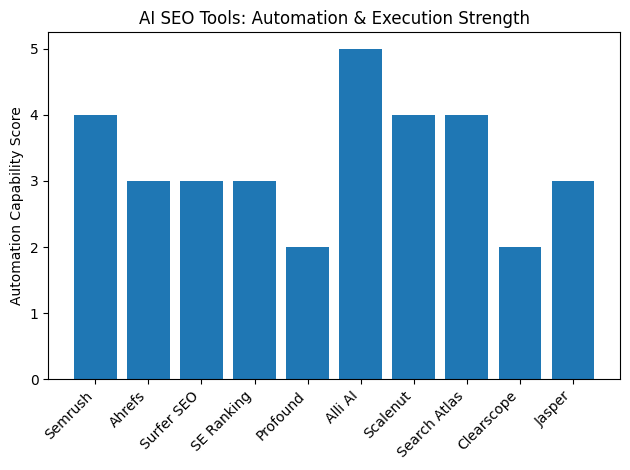
This new environment has given rise to a powerful category of AI SEO tools designed specifically for modern search behavior. These platforms go far beyond traditional SEO software. They analyse massive datasets, understand semantic relationships between entities, predict future search trends, optimise content for AI readability, and automate execution at scale. The best AI tools for SEO in 2026 help businesses adapt to zero-click searches, improve AI citation rates, and connect search visibility directly to revenue outcomes.
Another defining factor of SEO in 2026 is the shift from reactive optimisation to predictive strategy. Instead of waiting for rankings to drop or traffic to decline, AI-powered tools allow marketers to anticipate changes before they happen. Machine learning models identify emerging topics, forecast demand, detect content decay, and highlight visibility gaps in AI-generated answers. This enables teams to act earlier, publish smarter, and maintain long-term authority in competitive markets.
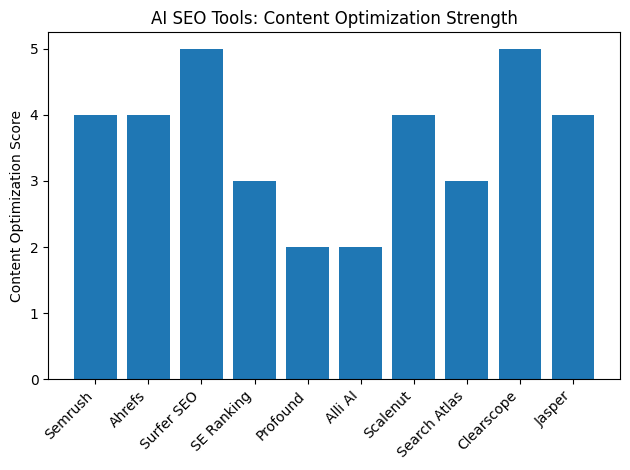
Content creation has also been transformed by AI. High-quality SEO content is no longer about volume or keyword density. Search engines and AI systems now prioritise information gain, clarity, structure, and factual accuracy. The leading AI SEO tools help writers and editors produce content that is not only optimised for rankings, but also designed to be extracted, summarised, and trusted by AI systems. This includes entity optimisation, structured answers, semantic coverage, and proof-based content elements such as data tables and comparisons.
Automation plays a critical role as well. In 2026, many SEO workflows that once required weeks of manual effort can now be completed in minutes. AI SEO platforms automate technical audits, on-page optimisation, internal linking, reporting, and even large-scale content updates without heavy developer involvement. This allows businesses to scale SEO efforts efficiently while reducing costs and operational friction.
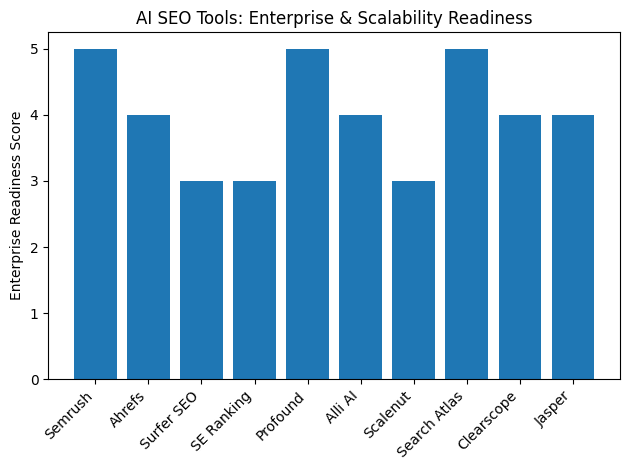
The importance of AI SEO tools extends across all business sizes and industries. Large enterprises rely on advanced platforms to manage thousands of pages, monitor brand mentions in AI answers, and protect narrative control at scale. Agencies use AI tools to serve more clients without increasing headcount, while small businesses and solo consultants benefit from automation, local SEO insights, and faster results with limited resources. Across the board, AI-driven SEO delivers higher-quality traffic, stronger conversion rates, and better long-term returns than traditional approaches.
This guide to the top 10 best AI tools for SEO in 2026 is designed to help marketers, founders, agencies, and decision-makers navigate this rapidly evolving landscape. It highlights the most powerful platforms shaping the future of search, explains what makes each tool valuable, and shows how they fit into modern SEO strategies focused on generative visibility and business impact.
Whether the goal is to improve rankings, gain AI citations, optimise content quality, automate execution, or future-proof SEO investments, understanding the right AI tools is now a competitive necessity. As search continues to evolve toward AI-led discovery, the brands that succeed will be those that adopt intelligent systems early, focus on quality and authority, and align their SEO strategies with how AI engines interpret and prioritise information. This introduction sets the foundation for exploring the tools that make that possible in 2026 and beyond.
Before we venture further into this article, we would like to share who we are and what we do.
About 9cv9
9cv9 is a business tech startup based in Singapore and Asia, with a strong presence all over the world.
With over nine years of startup and business experience, and being highly involved in connecting with thousands of companies and startups, the 9cv9 team has listed some important learning points in this overview of the Top 10 AI Personal Assistants You Need To Know in 2026.
If you like to get your company listed in our top B2B software reviews, check out our world-class 9cv9 Media and PR service and pricing plans here.
Top 10 Best AI Tools For SEO in 2026
1. Semrush

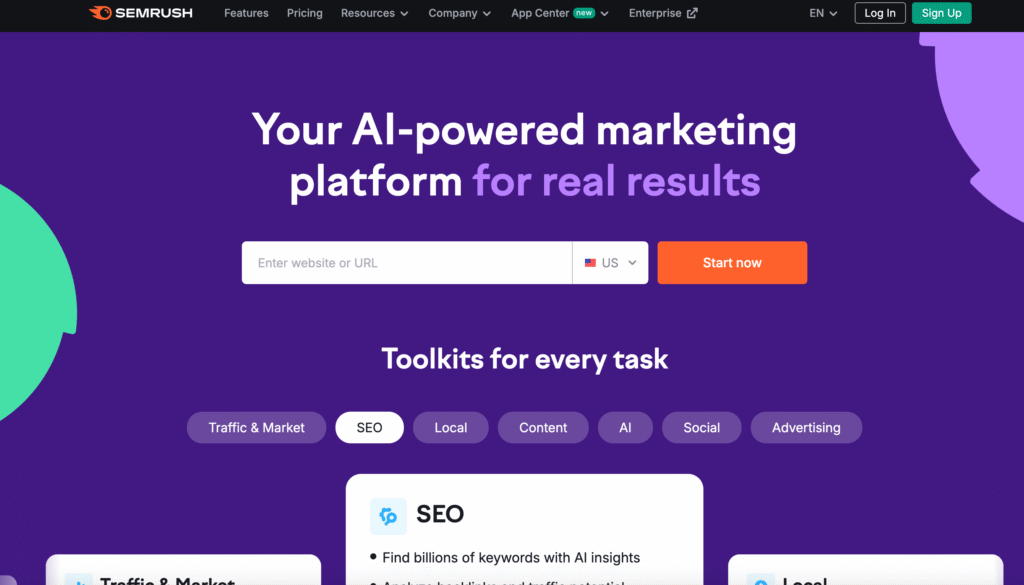
Semrush is widely regarded as one of the most established and trusted platforms in the global SEO industry. By 2026, it continues to be positioned as a core tool for enterprises, agencies, and advanced digital marketers who require deep search intelligence, competitive analysis, and AI-driven visibility insights at scale. The platform operates as a unified SEO ecosystem rather than a single-purpose tool, making it especially relevant as search becomes more fragmented across traditional engines and AI-powered interfaces.
Platform Scale and Data Coverage
Semrush operates one of the largest proprietary SEO databases in the world. Its system tracks tens of billions of keywords and tens of trillions of backlinks across global markets. This scale allows the platform to deliver highly reliable keyword trend data, competitive benchmarks, and backlink intelligence for both mature and emerging search ecosystems. For SEO teams planning long-term strategies in 2026, this depth of historical and real-time data supports stronger forecasting and decision-making.
AI Search Visibility and Brand Monitoring
A major evolution within Semrush is its strong focus on AI-powered search environments. The platform now includes an AI Visibility Toolkit that helps brands understand how they appear inside generative search and conversational AI systems. Instead of focusing only on traditional rankings, Semrush monitors brand mentions, content citations, and visibility signals across large language model-driven interfaces.
This capability is increasingly important as AI summaries, answer engines, and zero-click experiences reshape how users discover information. By identifying where and how a brand is referenced, SEO teams can adjust content strategies to remain visible even when users do not click through to websites directly.
Enterprise Adoption and Revenue Growth
Semrush has experienced consistent financial growth, driven largely by its expanding enterprise customer base. Large organizations are increasingly adopting the platform due to its ability to connect SEO insights directly to revenue outcomes. Enterprise clients typically rely on Semrush not just for keyword research, but for full-funnel visibility, from discovery to conversion.
The platform now supports more than fifty integrated tools that work together through a shared data framework. This makes it easier for large teams to collaborate across SEO, content, paid media, and digital PR without relying on disconnected systems.
Semrush Financial Performance Overview
Quarterly Performance Snapshot
Quarter | Revenue (USD) | Annual Recurring Revenue (USD) | Paying Customers | Net Revenue Retention
Q4 2024 | 102.6 million | 411.6 million | 117,000 | 106 percent
Q1 2025 | 105.0 million | 424.7 million | 118,000 | 106 percent
Q2 2025 | 108.9 million | 435.3 million | 116,000 | 105 percent
Q3 2025 | 112.1 million | 455.4 million | 119,000+ | 105 percent
These figures reflect steady adoption, strong customer retention, and increasing average contract values, particularly among enterprise clients investing heavily in AI-ready SEO infrastructure.
Global Market Reach and Regional Distribution
Semrush maintains a strong international presence, with revenue distributed across multiple regions. The United States remains the largest market, contributing nearly half of total revenue. The United Kingdom represents one of the strongest European markets, while the rest of the world collectively contributes a significant share. This global distribution highlights the platform’s ability to support SEO strategies across fragmented and multilingual markets, which is increasingly critical in 2026.
AI-Focused Technical SEO and Site Auditing
One of the most important upgrades to Semrush is its AI-enhanced site auditing capability. The platform now evaluates more than one hundred technical SEO factors, including elements specifically designed for AI search readiness. A dedicated AI Search Health feature identifies technical issues that may prevent large language model crawlers from accessing or interpreting website content.
As AI bots and answer engines become primary discovery channels, ensuring that content is accessible to both traditional search engines and AI systems is no longer optional. Semrush’s technical auditing tools help organizations identify and resolve these issues before they impact visibility.
Why Semrush Remains a Top AI SEO Tool for 2026
Semrush stands out because it combines large-scale data, AI visibility monitoring, enterprise-grade tooling, and revenue-focused insights within a single platform. Rather than treating AI search as a separate trend, it integrates AI considerations directly into keyword research, site audits, competitive analysis, and brand monitoring. For organizations seeking a future-proof SEO solution in 2026, Semrush continues to serve as a foundational intelligence platform rather than a tactical add-on tool.
2. Ahrefs

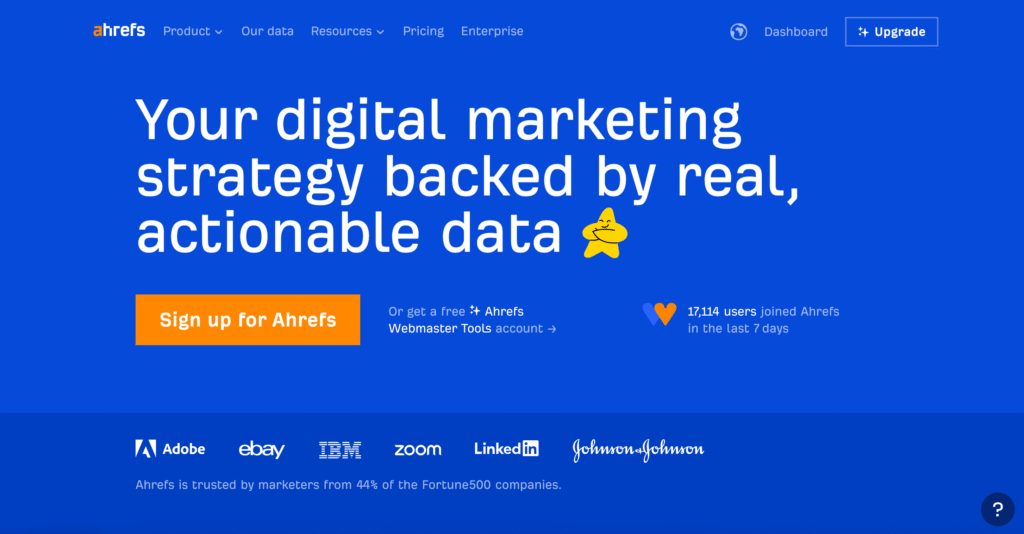
Ahrefs continues to be recognised as one of the most trusted AI-powered SEO tools for backlink analysis and competitive research as the SEO landscape moves into 2026. It is widely used by startups, growing companies, and digital teams that prioritise link authority, content gaps, and brand visibility across both traditional search engines and AI-driven discovery platforms.
Backlink Intelligence and Data Infrastructure
Ahrefs is best known for its deep focus on backlinks and competitor insights. The platform maintains one of the largest independent web indexes in the SEO industry. By early 2025, its system was tracking hundreds of billions of pages and tens of trillions of backlinks. This level of data coverage allows SEO teams to understand exactly how authority flows across the web, which domains influence rankings, and where competitors gain their strongest links.
To support this scale, Ahrefs has invested heavily in its own infrastructure rather than relying on third-party cloud services. This long-term investment strategy enables faster crawling, fresher data, and more accurate backlink reporting, which becomes increasingly important as AI-driven search models rely on authoritative and well-linked sources.
AI Brand Visibility and Prompt Index Tracking
As generative search and AI summaries reshape how users consume information, Ahrefs has expanded beyond traditional SEO metrics. The platform introduced an AI-focused brand visibility feature known as Brand Radar. This system tracks how often and how prominently brands are mentioned within AI-generated answers and summaries.
Instead of measuring rankings alone, Brand Radar evaluates brand presence across multiple AI environments using weighted visibility signals and share-of-voice metrics. This helps businesses understand whether their content is being referenced, summarised, or cited by AI systems, even when users never click on a website link.
Index Growth and Data Expansion Overview
Ahrefs Data Growth Snapshot
Metric | 2022 | 2024 | Early 2025
Pages Indexed | ~300 billion | 404.2 billion | 456.5 billion
External Backlinks | 3.3 trillion | ~20 trillion | 35 trillion
Internal Backlinks | ~10 trillion | ~15 trillion | 29.1 trillion
Keyword Index | 15 billion | 20.8 billion | 28.7 billion
This steady expansion highlights Ahrefs’ commitment to maintaining one of the freshest and most comprehensive SEO datasets available, making it especially valuable for link-building strategies and content gap analysis in 2026.
User Base and Market Positioning
Ahrefs is particularly popular among startups, solo founders, and small digital teams. A large share of its customers come from companies with fewer than ten employees, followed closely by small to mid-sized businesses. This user profile reflects Ahrefs’ strong appeal to cost-conscious teams that still require enterprise-level backlink and keyword insights.
To support this segment, Ahrefs introduced a lower-cost entry plan in 2025, making professional-grade SEO data more accessible to early-stage companies. This move has strengthened its position as a go-to tool for founders, content creators, and SEO consultants building authority from the ground up.
Global Reach and Regional Adoption
While the United States remains the largest source of traffic and customers for Ahrefs, emerging markets play an increasingly important role in its growth. Countries with rapidly expanding digital economies, particularly in South Asia, have shown strong adoption. This reflects the global demand for affordable yet powerful SEO tools that support multilingual and international SEO strategies.
Why Ahrefs Is a Top AI SEO Tool for 2026
Ahrefs stands out in 2026 because it combines unmatched backlink intelligence with growing AI brand visibility insights. Its focus on authority, trust signals, and competitive gaps aligns closely with how AI-driven search engines evaluate and summarise content. For businesses aiming to build long-term SEO value, improve off-page strength, and increase visibility within AI-generated results, Ahrefs remains a critical tool within the top tier of AI-powered SEO platforms.
3. Surfer SEO

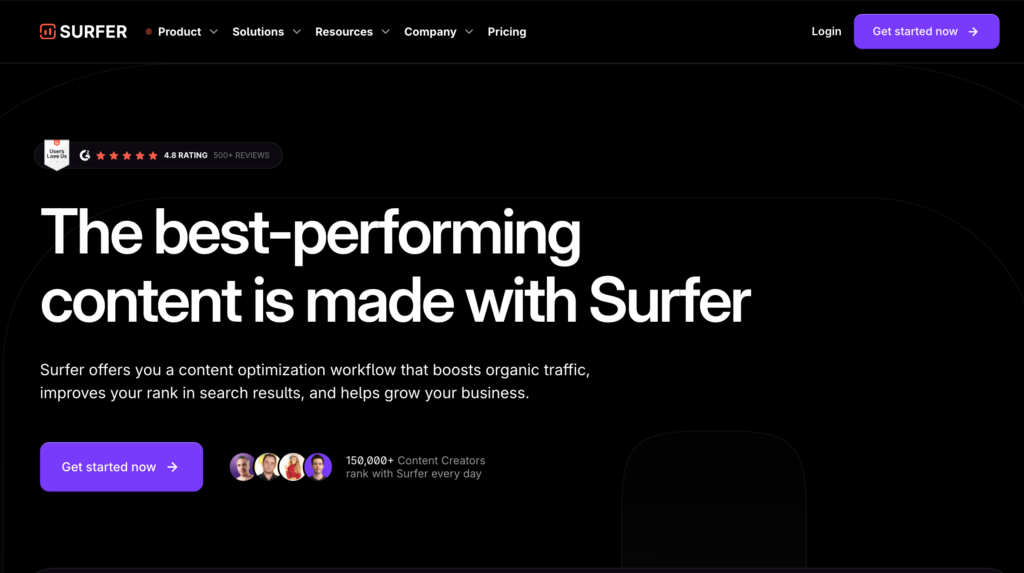
Surfer SEO has become one of the most widely adopted AI tools for SEO-focused content creation as the industry moves toward 2026. It is especially popular among content teams, agencies, and publishers that need to produce large volumes of search-ready content while maintaining clarity, relevance, and alignment with modern AI-driven search systems. Its core strength lies in turning complex ranking signals into simple, actionable writing guidance.
Content Optimization Built on Real Search Data
Surfer SEO focuses on real-time content optimization based on live search engine results. Instead of relying on static keyword rules, the platform analyzes top-ranking pages and extracts patterns related to structure, terminology, topical depth, and semantic relevance. Writers and editors are guided by a dynamic Content Score that reflects how closely an article aligns with ranking competitors.
This score has shown a stronger relationship with actual ranking performance than many competing tools, making it a practical benchmark for content teams aiming to publish pages that perform well quickly. As a result, Surfer SEO is often used during the writing process rather than after content is already published.
Global Adoption and Content Scale
By 2025, Surfer SEO was being used by hundreds of thousands of marketers across more than one hundred countries. The platform supports content creation in over one hundred languages, which makes it suitable for international SEO strategies and multilingual publishing workflows.
At scale, Surfer SEO processes millions of articles and tracks millions of brand references across AI-driven platforms. This level of adoption reflects a broader shift toward data-assisted writing, where human creativity is supported by AI-generated insights rather than replaced.
Entity-Focused Optimization and AI Citation Readiness
One of Surfer SEO’s most important advancements for 2026 is its strong focus on entities and factual clarity. The platform includes a feature designed to help writers add verifiable, machine-readable facts into their content. These facts improve how search engines and AI systems interpret, trust, and reference a page.
As AI search systems increasingly prioritise original insights and clear informational value, content that demonstrates unique data points and well-defined entities is more likely to be cited in AI-generated answers. Surfer SEO directly supports this shift by guiding writers toward stronger informational depth instead of surface-level keyword repetition.
Performance and ROI Overview
Surfer SEO Performance Snapshot
Metric | Observed Impact
AI Search Accuracy Rate | 94 to 96 percent
Content Production Productivity | 40 percent increase
Content Planning Time Savings | 30 percent reduction
Organic Traffic Growth (3 months) | 20 percent average increase
AI Citation Likelihood | 25 percent improvement
These outcomes make Surfer SEO particularly attractive for teams focused on speed, consistency, and measurable results. The tool reduces the need for repeated revisions and manual SERP research, allowing teams to focus on quality and scale at the same time.
Cost Efficiency for Growing and Enterprise Teams
Surfer SEO is often positioned as a cost-effective alternative to ongoing SEO consulting. For larger teams, its automated SERP analysis and structured optimization suggestions can replace a significant portion of manual SEO work. This translates into meaningful annual savings, especially for companies producing content at high velocity.
The platform offers plans designed for teams publishing hundreds or even thousands of articles per year, making it suitable for publishers, SaaS companies, and digital agencies managing multiple clients or websites.
Why Surfer SEO Is a Top AI SEO Tool for 2026
Surfer SEO stands out in 2026 because it connects NLP-driven optimization, entity clarity, and AI-ready content creation into a single workflow. Instead of focusing only on keywords, it helps content perform across traditional rankings and AI-generated search results. For organisations that value speed, consistency, and future-proof SEO content, Surfer SEO remains one of the most practical and scalable AI tools available.
4. SE Ranking

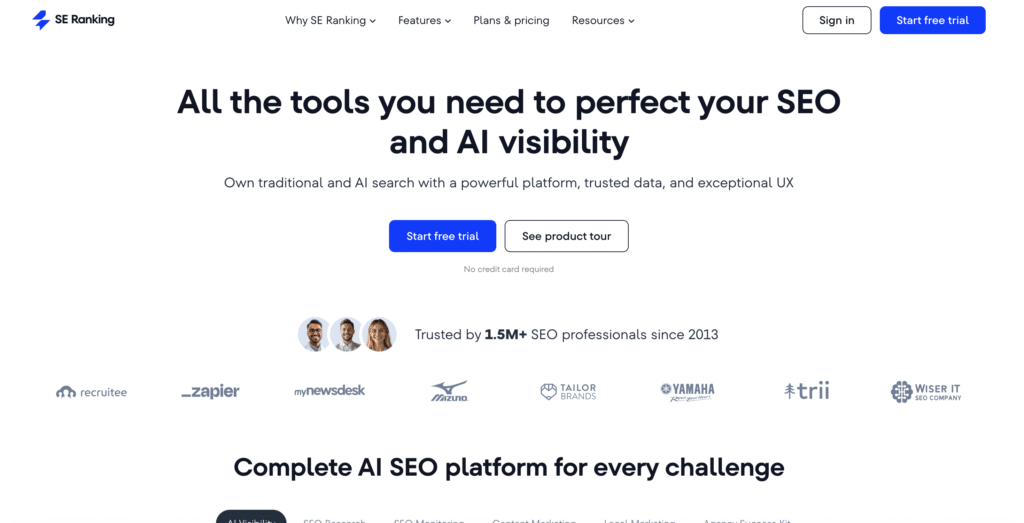
SE Ranking is widely recognised as a practical and cost-effective AI SEO platform designed for solo consultants, freelancers, and small to mid-sized agencies. As SEO becomes more complex in 2026, many smaller teams require tools that deliver reliable AI insights without the cost or complexity of enterprise platforms. SE Ranking fills this gap by offering predictive analytics, AI search monitoring, and local SEO precision within a single, easy-to-use ecosystem.
Integrated SEO Analytics and AI Accuracy
SE Ranking combines rank tracking, keyword research, backlink monitoring, and website audits into one connected data environment. Instead of relying on fragmented tools, users can see how rankings, links, and content performance influence one another. This unified structure helps smaller teams make faster decisions with less manual analysis.
The platform delivers a strong AI search tracking accuracy rate, making it dependable for monitoring visibility across both traditional search engines and AI-powered discovery systems. For businesses operating with limited resources, this balance between accuracy and affordability is a key advantage.
AI Search Visibility and Predictive Insights
SE Ranking’s AI Search Toolkit is one of its most important strengths heading into 2026. It tracks brand presence across multiple AI search environments, allowing users to understand whether their content is being referenced, summarised, or ignored by AI systems.
A standout capability is the identification of AI visibility gaps. These gaps occur when a website ranks well in classic search results but has little or no presence in AI-generated answers. By highlighting these opportunities, SE Ranking enables businesses to update content strategically and improve visibility where competitors may already be gaining attention.
Hyperlocal SEO and Location-Based Precision
Local search continues to play a major role in user intent, especially for service-based businesses. SE Ranking offers advanced hyperlocal rank tracking that allows monitoring at very specific geographic points rather than broad city-level averages. This is especially useful for businesses targeting neighbourhood-level searches, multi-location brands, and agencies managing local clients.
By tracking rankings with precise location pins, users can identify how visibility changes across different areas and adjust local SEO strategies accordingly.
Performance and Return on Investment
SE Ranking is designed to deliver fast and measurable value, particularly for small businesses. Many users report strong returns within the first few months of usage due to clearer prioritisation of SEO actions and reduced reliance on external consultants.
SE Ranking Performance Snapshot
Metric | Typical Outcome
AI Search Tracking Accuracy | 89 to 92 percent
ROI Timeframe | 90 days
Average ROI | 3x to 5x
Local Visibility Improvement | High for service-based businesses
User Satisfaction Rating | 4.8 out of 5
This performance profile makes SE Ranking attractive for budget-conscious teams that still want access to AI-ready SEO insights.
Pricing Structure and Feature Coverage
SE Ranking offers multiple pricing tiers that scale with business needs, allowing users to upgrade as their SEO requirements grow.
SE Ranking Plans Overview
Plan | Monthly Price | Core AI and SEO Features
Essential | 52.00 | Hyperlocal rank tracking, basic site audits
Pro | 119.20 | AI Search Toolkit with multi-engine tracking, predictive audits
Business | 207.20 | AI review monitoring, white-label reporting, advanced analytics
This flexible pricing model supports freelancers, agencies, and growing businesses without forcing them into enterprise-level commitments.
User Growth and Market Adoption
By early 2025, SE Ranking had surpassed one hundred thousand paying customers, showing steady growth year over year. Its increasing adoption reflects rising demand for AI-enabled SEO tools that are accessible, transparent, and focused on real business outcomes rather than vanity metrics.
Why SE Ranking Is a Top AI SEO Tool for 2026
SE Ranking stands out in 2026 because it delivers AI search insights, predictive analytics, and local SEO precision in a format that smaller teams can easily adopt. It does not attempt to overwhelm users with unnecessary complexity. Instead, it focuses on actionable data, fast ROI, and strong coverage across both traditional and AI-driven search environments. For consultants, agencies, and small businesses aiming to compete in AI-shaped search results, SE Ranking remains one of the most practical tools among the top AI SEO platforms for 2026.
5. Profound

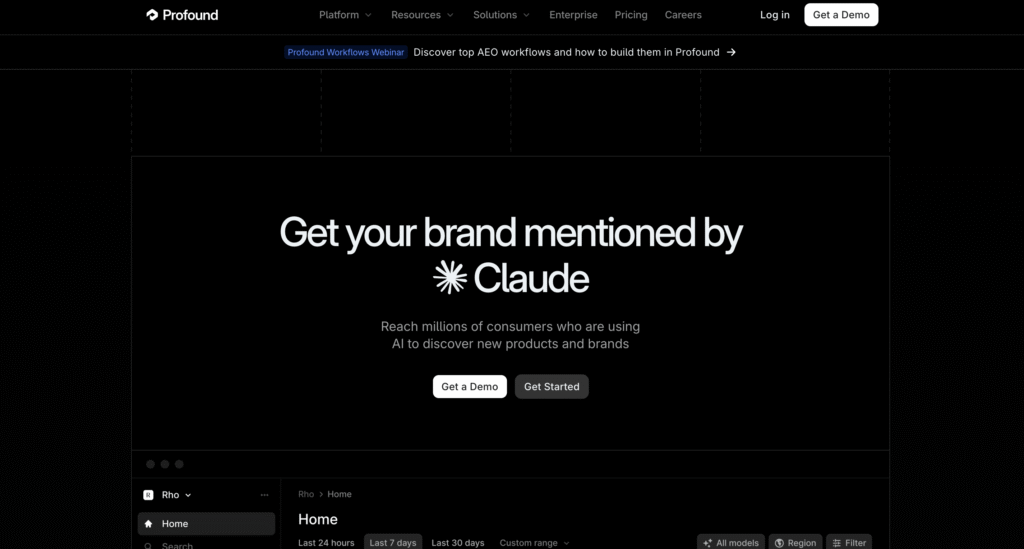
Profound is positioned as a specialised AI SEO and GEO intelligence platform built exclusively for large organisations and global brands. Unlike traditional SEO tools that focus on rankings and traffic, Profound is designed to help enterprises understand how their brands are represented, discussed, and evaluated inside AI-generated answers. As search behaviour shifts from links to language models in 2026, Profound addresses a critical new layer of visibility that classic SEO platforms do not fully cover.
AI Search Monitoring Beyond Traditional SERPs
Profound focuses entirely on monitoring visibility within large language model environments rather than conventional search results. It analyses how brands appear in AI-generated responses across major conversational and answer-based systems. This includes understanding whether a brand is cited, how often it is referenced, and the tone used when it is mentioned.
The platform places strong emphasis on output quality and citation reliability. Instead of measuring keyword positions, Profound evaluates the credibility of sources used by AI systems and how those sources influence brand narratives. This approach aligns closely with how AI models construct answers by blending trusted references, contextual relevance, and sentiment.
Advanced Sentiment and Narrative Analysis
One of Profound’s defining strengths is its ability to analyse brand sentiment within AI outputs. Using advanced natural language processing and embedding models, the platform classifies whether AI-generated mentions are positive, neutral, or negative. This allows enterprise teams to track perception shifts over time and across different AI systems.
For large brands, perception often matters more than pure visibility. A brand mentioned frequently but in a negative or misleading context can face reputational risk. Profound helps identify these issues early by providing clear comparisons between a brand’s narrative and that of its competitors.
AI Source Trust and Citation Intelligence
Profound also provides deep insight into which sources AI models trust the most when generating answers. Its research highlights that AI systems consistently rely on a small group of high-credibility domains. By understanding this hierarchy, enterprises can influence how AI models form opinions about their brands.
This insight allows organisations to focus their digital PR, content partnerships, and authority-building efforts on platforms that are most likely to be referenced by AI systems. Instead of spreading efforts thinly, brands can concentrate on sources with the highest probability of AI citation.
AI Source Trust Snapshot
Source Type | Relative Citation Strength in AI Responses
Knowledge Bases | Very High
Community Platforms | Medium
Business Publications | Medium
Review Platforms | Medium
This strategic clarity gives enterprises greater control over how AI systems learn about and describe their brands.
Enterprise Feature Overview and Use Cases
Profound is built for scale and complexity. It is designed to handle large prompt datasets, ongoing monitoring, and detailed competitor comparisons across multiple AI engines. This makes it particularly valuable for organisations operating in competitive or highly regulated industries where messaging accuracy is critical.
Profound Enterprise Capability Overview
Metric | Enterprise Value
Starting Price | 399+ per month
AI Engine Coverage | Multiple leading AI answer systems
Core Technology | NLP classification and embedding models
Primary Use Case | Large-scale prompt and sentiment monitoring
Ideal Users | Global brands and enterprise SEO teams
Why Profound Is a Top AI SEO Tool for 2026
Profound stands out in 2026 because it treats AI search as a narrative and reputation challenge rather than a ranking problem. It enables enterprises to understand not just whether they appear in AI answers, but how they are framed and trusted. For brands that prioritise perception, authority, and long-term influence within AI-driven discovery environments, Profound has become an essential component of modern SEO and GEO strategy.
6. Alli AI

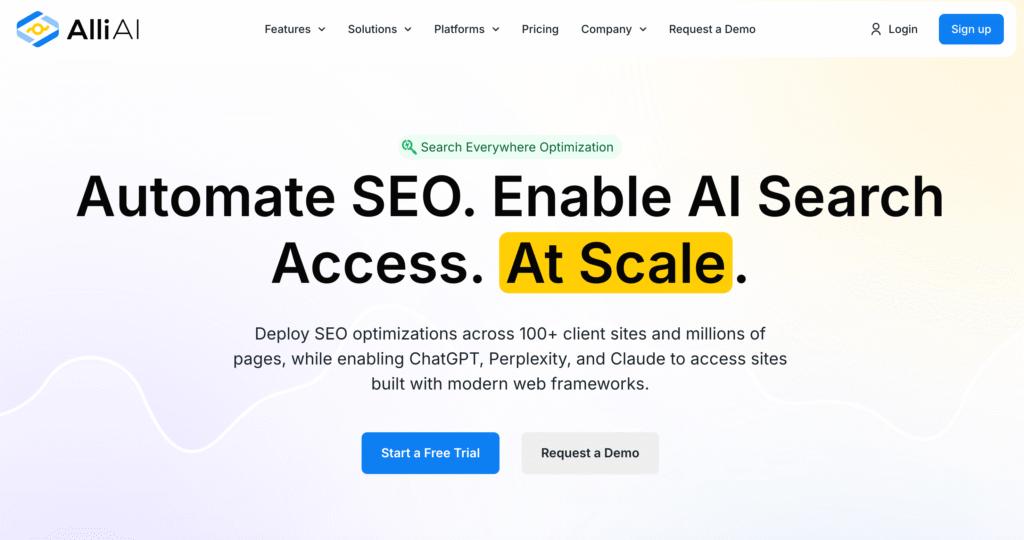
Alli AI is designed to solve one of the biggest challenges in modern SEO: turning insights into action quickly. As SEO strategies become more data-driven and AI-powered in 2026, many teams still struggle with slow implementation due to developer backlogs, CMS limitations, or technical complexity. Alli AI positions itself as a direct execution platform that allows SEO changes to go live without touching website code.
Bridging the SEO Implementation Gap
Alli AI focuses on the gap between identifying SEO problems and actually fixing them. Instead of exporting recommendations and waiting for technical teams, marketers can deploy on-page improvements directly from a single control panel. The platform uses a lightweight automation layer embedded into websites, which allows instant updates across hundreds or even thousands of pages.
This approach is especially valuable for large websites where manual updates would take weeks or months. Changes that once required development sprints can now be completed in minutes, making SEO more agile and responsive to algorithm changes.
Bulk Optimization and Real-Time Control
One of Alli AI’s core strengths is bulk optimization at scale. SEO teams can apply changes such as meta titles, meta descriptions, internal linking rules, and page-level optimizations across entire sections of a site instantly. This is particularly useful for ecommerce stores, marketplaces, and enterprise websites with large page inventories.
The platform also supports automated testing. By running continuous experiments on titles and descriptions, Alli AI helps improve click-through rates using real performance data rather than assumptions. This real-time feedback loop aligns well with AI-driven search environments where user engagement signals matter more than ever.
Agency and Enterprise Use Cases
Alli AI is widely adopted by agencies and large organisations managing complex websites. For agencies, the platform removes repetitive manual work and allows teams to manage multiple client sites from one dashboard. This increases output without increasing headcount.
For enterprises, Alli AI becomes a cost-saving tool. Large brands with thousands of pages can maintain consistent SEO standards across their entire digital footprint without relying heavily on developers. This is especially important for companies operating at scale, where even small delays can result in lost revenue opportunities.
Usage and Adoption Snapshot
Alli AI Platform Metrics
Metric | Value
Active Companies | 26,000+
Average Installation Time | Approximately 15 minutes
Starting Monthly Price | 249
CMS Compatibility | Works with major platforms and custom sites
These figures highlight how Alli AI prioritises speed, accessibility, and cross-platform compatibility.
Productivity Impact and Business Value
Although Alli AI is positioned at a higher entry price than many traditional SEO tools, its value lies in time savings and execution speed. By bypassing developer queues, teams can respond instantly to SEO audits, algorithm updates, and AI search visibility changes.
For large organisations with significant digital footprints, the platform reduces the cost and complexity of maintaining SEO health across thousands of pages. This makes Alli AI particularly attractive to revenue-driven businesses where implementation speed directly affects performance.
Why Alli AI Is a Top AI SEO Tool for 2026
Alli AI stands out in 2026 because it transforms SEO from a planning-heavy discipline into an execution-focused workflow. Instead of stopping at analysis, it enables immediate action at scale. As AI-driven search rewards freshness, relevance, and rapid optimisation, tools that shorten the distance between insight and deployment become essential. For teams that value speed, automation, and measurable impact, Alli AI earns its place among the top AI tools shaping the future of SEO.
7. Scalenut

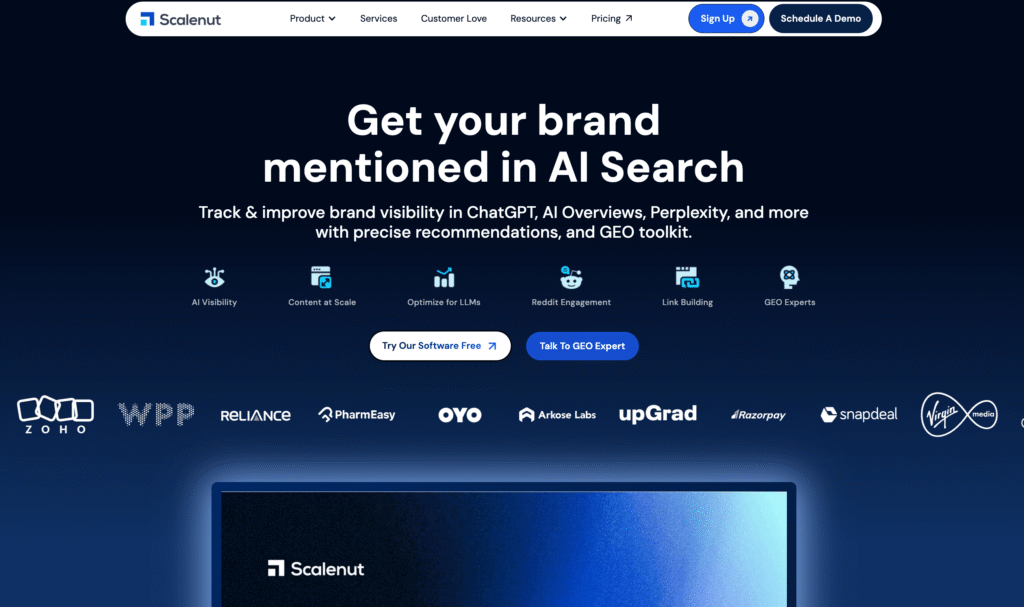
Scalenut is an AI-powered SEO and content marketing platform that has gained strong momentum among content-focused teams since its launch. Built with simplicity and speed in mind, Scalenut is designed for startups, small businesses, and lean marketing teams that need to plan, create, and optimise content efficiently as search engines become more AI-driven in 2026.
The platform has experienced rapid growth in a short period, supported by venture funding and guidance from experienced leaders in the search industry. This growth reflects rising demand for tools that combine SEO strategy and content execution into a single workflow.
Full Content Lifecycle Management
Scalenut differentiates itself by covering the entire content lifecycle in one interface. Instead of switching between separate tools for keyword research, outlining, writing, and optimisation, users can manage every stage within the same platform.
The process begins with topic planning and keyword discovery, followed by competitive research and content structure guidance. Writers then move seamlessly into content creation, with AI assistance ensuring coverage of relevant topics, entities, and user intent. Final optimisation tools help align content with modern ranking signals, including AI search readiness.
This integrated approach reduces friction and allows teams to produce consistent, search-aligned content at scale.
Automated Content Creation for High-Speed Teams
One of Scalenut’s most notable features is its automated content workflow, designed for teams that need fast output without sacrificing structure. This mode guides users step by step from topic selection to a complete draft, making it especially useful for founders, solo marketers, and small content teams.
By automating repetitive tasks such as outlining and first drafts, Scalenut allows human editors to focus on refinement, accuracy, and originality. This balance between automation and human input aligns well with 2026 SEO requirements, where quality and information value matter more than volume alone.
AI Features Focused on Information Quality
Scalenut includes AI tools specifically built to improve content trust and usefulness. Its content humanisation feature helps reduce overly generic AI phrasing, making articles sound more natural and credible. This is important as search systems increasingly evaluate whether content adds new value rather than repeating existing information.
The platform also includes AI-assisted internal and external link management. This helps ensure that content is well connected, contextually relevant, and easier for search engines and AI systems to understand. These features support the growing emphasis on information gain, authority, and structured knowledge in AI-powered search environments.
Financial and Adoption Snapshot
Scalenut Business Overview
Metric | Value
Total Funding Raised | 3.53 million
Latest Reported Valuation | Approximately 13.5 million
Annual Revenue (2024) | Approximately 789,000
Registered Users | 100,000+
Team Size | 31 employees
These figures show a lean but fast-moving company focused on product development and market expansion.
Cost Efficiency and Productivity Impact
Scalenut is designed to lower the cost of content production while increasing output speed. By combining SEO research and AI writing in one platform, teams can significantly reduce reliance on multiple subscriptions and external writers.
Many users adopt Scalenut to streamline workflows, cut production costs, and scale publishing efforts without growing team size. This makes it particularly appealing for businesses aiming to grow organic traffic efficiently in competitive markets.
Why Scalenut Is a Top AI SEO Tool for 2026
Scalenut earns its place among the top AI tools for SEO in 2026 by offering a complete, easy-to-use content lifecycle solution. It helps teams move from ideas to optimised content faster, while still meeting modern standards for originality, relevance, and AI search visibility. For organisations focused on scalable content growth with limited resources, Scalenut provides a practical and future-ready approach to SEO-driven content creation.
8. Search Atlas

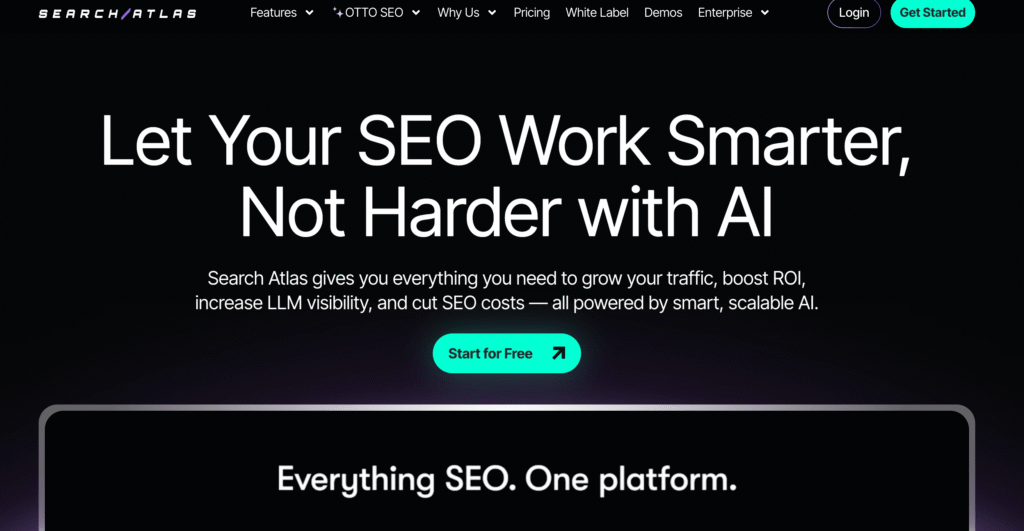
Search Atlas has grown into a full-scale AI-powered SEO platform built to support enterprise brands and high-growth agencies. Originally developed from an enterprise SEO agency background, the platform has evolved into a standalone software ecosystem focused on automation, predictive search intelligence, and scalable reporting. By late 2025, Search Atlas had reached strong recurring revenue milestones, reflecting its growing adoption among performance-driven SEO teams.
This evolution positions Search Atlas as more than a traditional SEO tool. It operates as an AI-first growth framework that combines content intelligence, technical SEO insights, and digital PR signals into one connected system.
AI-Centric Product Ecosystem
Search Atlas is built around an interconnected set of AI-driven tools that support the entire SEO workflow. Its flagship AI system focuses on automating SEO execution, while additional components support authority building, press visibility, and brand amplification. This ecosystem approach allows teams to manage organic growth, content optimisation, and visibility signals without relying on multiple external platforms.
For enterprises, this consolidation reduces operational complexity. For agencies, it eliminates tool overlap and simplifies client management across large keyword sets and multiple websites.
Predictive SEO and Semantic Entity Intelligence
A key differentiator of Search Atlas is its focus on predictive SEO rather than backward-looking analysis. The platform uses a semantic entity framework to identify emerging keyword patterns before they become highly competitive. Instead of relying only on historical ranking data, it analyses relationships between entities, topics, and user intent to anticipate where search demand is heading.
This approach helps teams publish content earlier in the demand cycle, increasing the likelihood of ranking quickly and maintaining long-term visibility. As AI-driven search systems increasingly reward topical authority and contextual relevance, predictive optimisation becomes a major advantage in 2026.
Agency Scalability and Cost Efficiency
Search Atlas has gained strong traction among SEO agencies due to its ability to replace multiple reporting and analytics tools. Agencies managing dozens of clients and thousands of keywords can standardise dashboards, automate reporting, and maintain consistent visibility tracking without increasing software costs.
Case studies from recent years show that agencies switching to Search Atlas achieved long-term savings while maintaining the same reporting depth and keyword coverage. This makes the platform particularly attractive for agencies focused on profitability and scale rather than expanding tool budgets.
Operational and Growth Snapshot
Search Atlas Business Overview
Metric | Value
Annual Recurring Revenue | 30 million
Team Size | 150 employees
Work Model | Fully remote
Growth Trajectory | Expanded from early-stage revenue to enterprise scale
Reported Agency-Level Revenue | Significant year-to-date performance
These indicators highlight a platform built for sustained growth and long-term enterprise adoption.
Unified Reporting and Visibility Management
One of Search Atlas’s strongest advantages is its ability to centralise SEO data into a single reporting environment. Rankings, content performance, authority metrics, and visibility signals are presented in a consistent format across all clients or business units. This reduces manual work and improves decision-making speed.
By removing the need to manage multiple dashboards, teams can focus more on strategy and execution rather than reporting overhead. This is especially important as SEO workflows become more complex with the inclusion of AI search visibility metrics.
Why Search Atlas Is a Top AI SEO Tool for 2026
Search Atlas earns its place among the top AI tools for SEO in 2026 by combining predictive intelligence, semantic entity analysis, and scalable reporting into one unified platform. It supports both enterprises and agencies that need to grow without increasing operational costs. As search continues to shift toward AI-driven discovery and contextual relevance, Search Atlas provides a forward-looking framework that helps teams stay ahead of demand rather than reacting to it.
9. Clearscope

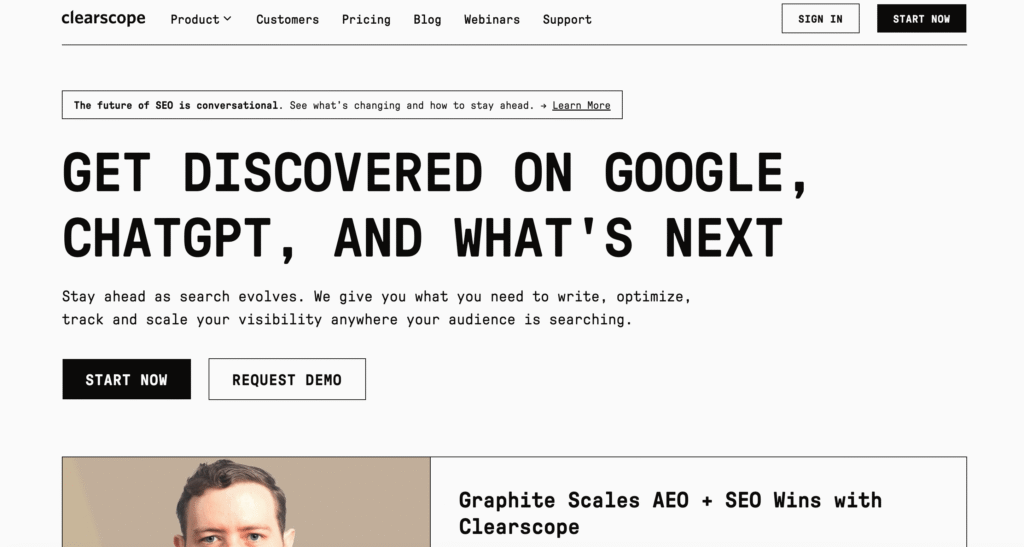
Clearscope is widely recognised as a premium AI SEO tool built for content teams that value accuracy, clarity, and semantic depth over mass production. As search engines and AI systems place greater emphasis on meaning, intent, and topical completeness in 2026, Clearscope continues to serve large organisations that want every published page to meet high editorial and SEO standards.
Rather than encouraging rapid content output, the platform focuses on helping writers create well-structured, easy-to-read, and contextually rich content that aligns with how modern search and AI models interpret information.
Semantic Optimization and NLP-Based Guidance
Clearscope uses advanced natural language processing to analyse top-performing content and identify the terms, topics, and concepts that search engines expect to see. Writers receive clear recommendations on how to improve coverage without keyword stuffing or unnecessary repetition.
The platform assigns a content grade that acts as a quality benchmark, helping teams understand when a piece is ready for publication. This structured approach reduces guesswork and improves consistency across large editorial teams, especially in industries where accuracy and trust matter.
Efficiency Gains for Editorial Teams
One of the key advantages of Clearscope is its ability to reduce time spent on revisions. By guiding writers during the drafting process, the platform minimises back-and-forth edits between writers, editors, and SEO teams. This makes it easier to scale content operations while maintaining quality.
For enterprise teams managing multiple contributors and large content libraries, this efficiency translates into faster publishing cycles and lower operational friction.
Performance and Impact Overview
Clearscope Performance Snapshot
Metric | Observed Impact
Starting Monthly Price | 189
Average Search Visibility Increase | 35 percent
Content Production Speed | 30 percent faster
Reduction in Revision Time | 25 percent
Operational Cost Savings | 20 percent
Correlation with Rankings | 17.5 percent
These metrics show that Clearscope is not designed for volume-driven strategies, but for teams that want measurable improvements in content quality and long-term visibility.
Enterprise Features for the AI Search Era
In response to the rise of generative search, Clearscope has expanded its feature set to support ongoing content relevance. Teams can monitor a defined set of priority topics to ensure existing articles remain accurate, competitive, and aligned with how AI systems summarise information.
The platform also includes real-time link quality checks and content inventory oversight. This allows organisations to identify outdated pages, improve internal consistency, and maintain authority across large websites as AI-driven search results evolve.
Ideal Use Cases and Team Fit
Clearscope is most commonly adopted by large publishers, SaaS companies, and enterprise marketing teams that operate under strict quality guidelines. Its higher entry price reflects its role as an editorial-grade SEO tool rather than a general-purpose optimisation platform.
Teams that already have established writing processes benefit the most, as Clearscope enhances existing workflows instead of replacing them.
Why Clearscope Is a Top AI SEO Tool for 2026
Clearscope earns its place among the top AI tools for SEO in 2026 by focusing on semantic integrity, editorial efficiency, and long-term content value. As AI-powered search engines increasingly reward depth, clarity, and contextual accuracy, platforms that prioritise meaning over volume become essential. For enterprises that view content as a strategic asset rather than a traffic experiment, Clearscope remains a trusted and future-ready SEO solution.
10. Jasper

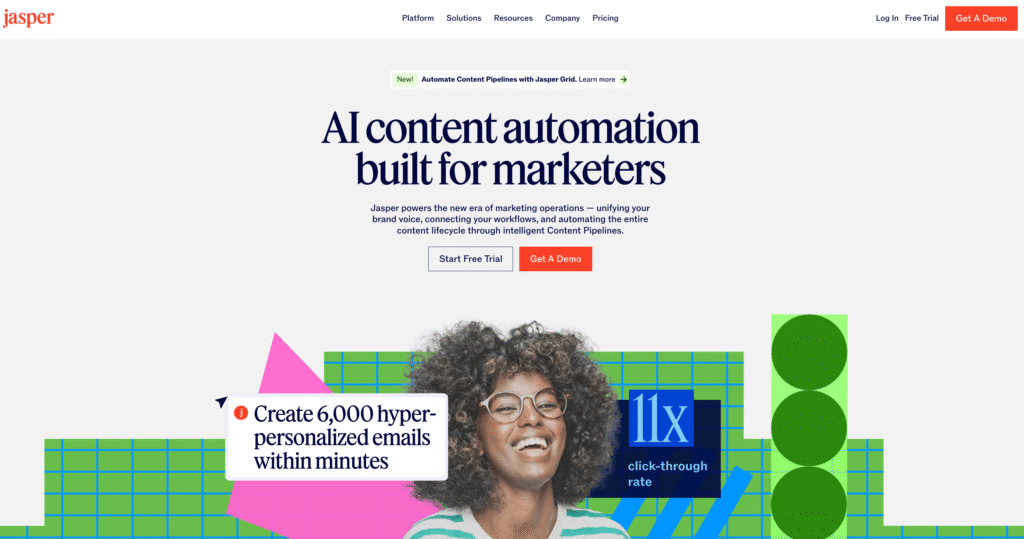
Jasper has evolved into a powerful AI platform built specifically for modern marketing and SEO teams. What began as a simple writing assistant has now become a full AI copilot that helps organisations create, adapt, and manage content at scale while protecting brand identity. As SEO in 2026 becomes closely tied to AI-generated answers and brand differentiation, Jasper plays a key role in helping teams stay visible without sounding generic.
The platform is widely adopted by marketing teams that produce large volumes of content and campaigns across multiple channels, including blogs, landing pages, ads, and AI-optimised search content.
AI Content Generation at Enterprise Scale
Jasper is designed to support high-volume content production while maintaining consistency. By 2025, the platform was already powering tens of millions of AI-generated outputs and supporting millions of published campaign assets. This scale demonstrates its ability to handle real-world marketing demands rather than experimental use cases.
For SEO teams, Jasper is not just about writing faster. It helps structure content so that it aligns with search intent, topical relevance, and emerging AI-driven discovery formats. This makes it suitable for organisations that need to balance speed with quality.
Brand Voice Governance and Content Consistency
One of Jasper’s most important strengths is brand voice governance. The platform allows teams to define tone, style, terminology, and messaging rules that guide every piece of AI-generated content. This ensures that content remains recognisable and aligned with brand values, even when produced by different teams or across regions.
As AI-generated content becomes more common, search engines and users increasingly reward brands that sound distinct and authoritative. Jasper helps protect this uniqueness by enforcing brand-level rules across all outputs.
SEO, AEO, and GEO Content Adaptation
Jasper includes specialised tools designed to adapt existing content for modern search environments. Its rewriting capabilities help teams optimise content not only for traditional SEO, but also for answer engines and generative search systems.
This allows businesses to reuse high-performing content and adjust it for new formats, such as AI summaries and conversational responses, without rewriting from scratch. As AI-driven search continues to expand in 2026, this flexibility becomes essential for maintaining visibility.
Usage, Revenue, and Adoption Snapshot
Jasper Business Overview
Metric | Value
Projected Revenue | 88 million
Paying Customers | 70,000+
Marketing Teams Using Jasper | 100,000+
AI Generations per Year | 76 million
Campaign Assets Created | 2.5 million
Free Trial Users | 1 million+
These figures highlight Jasper’s strong adoption among professional marketing teams and its role as a core content engine rather than a standalone writing tool.
Shift Toward Enterprise Marketing Teams
Jasper has increasingly focused on serving larger organisations with complex content needs. This shift has resulted in strong growth in enterprise contracts, as companies look for better control over how AI is used within their marketing workflows.
Large teams use Jasper not only to generate content, but also to review, refine, and govern AI outputs at scale. This governance layer is especially important in regulated industries and brand-sensitive sectors where consistency and accuracy are critical.
Why Jasper Is a Top AI SEO Tool for 2026
Jasper earns its place among the top AI tools for SEO in 2026 by combining scalable content generation with strong brand control. It helps teams stay competitive in AI-driven search environments by producing content that is fast, relevant, and clearly differentiated. For organisations that view content as both a growth engine and a brand asset, Jasper provides the structure and intelligence needed to succeed in the next era of SEO.
The Macroeconomics of AI-Powered Search
AI-powered SEO and Generative Engine Optimization have moved from experimental technology to a core pillar of the global digital economy. By 2026, AI SEO is no longer treated as a niche marketing tool but as a foundational layer of search intelligence that directly influences visibility, revenue, and brand authority. The global AI SEO market reached an estimated value of 2.36 billion USD in 2025 and continues to expand rapidly as businesses adapt to generative search systems and AI-mediated discovery.
This growth reflects a structural shift in how search works. Instead of ranking only web pages, AI systems now generate answers, summaries, and recommendations, forcing organisations to optimise for inclusion, citation, and trust within AI outputs rather than clicks alone.
Regional Distribution of the AI SEO Economy
The global AI SEO economy is unevenly distributed, with advanced markets leading in revenue share while emerging markets lead in adoption intensity and growth velocity.
Regional AI SEO Market Snapshot (2025)
Region | Market Size (USD) | Global Share | Projected Growth Rate
North America | 880 million | 37.4 percent | 17.05 percent
Europe | 670 million | 28.5 percent | 17.05 percent
Asia-Pacific | 570 million | 24.1 percent | 18.2 percent
Middle East and Africa | 240 million | 10.0 percent | 17.05 percent
Global Total | 2.36 billion | 100 percent | 17.05 percent
North America remains the economic centre of AI SEO, driven largely by enterprise adoption and early integration of AI into search workflows. Europe follows closely, supported by strong digital infrastructure and regulatory clarity. Asia-Pacific shows the fastest growth, powered by large talent pools, expanding digital economies, and cost-efficient AI development.
North America and Enterprise-Led Maturity
North America represents the most mature AI SEO market globally. The region accounts for more than one-third of total global revenue, with the United States acting as the primary growth engine. A large majority of enterprises in the region already use AI for real-time SERP monitoring, technical optimisation, and automated on-page updates.
This maturity is driven by several factors:
• High concentration of enterprise SaaS companies
• Early adoption of generative AI tools
• Strong demand for automation at scale
• Direct linkage between SEO performance and revenue attribution
As a result, AI SEO in North America is less about experimentation and more about optimisation efficiency, predictive insights, and competitive defence.
Europe’s Structured and Regulation-Aware Growth
Europe represents the second-largest AI SEO market, with strong performance across Western and Central Europe. The region is characterised by balanced adoption, where AI is integrated carefully into search strategies alongside data privacy and compliance requirements.
European AI SEO Market Highlights
Country | Estimated Market Size | Global Share
United Kingdom | 240 million USD | 4.2 percent
Germany | 230 million USD | 4.0 percent
France | 200 million USD | 3.5 percent
The United Kingdom leads European adoption due to its advanced digital marketing ecosystem and strong agency presence. Germany and France follow closely, driven by enterprise demand and multilingual SEO requirements. Across Europe, AI SEO growth is steady, strategic, and closely aligned with long-term digital transformation initiatives.
Asia-Pacific as the High-Growth Engine
The Asia-Pacific region is the fastest-growing AI SEO market globally. While total revenue is still catching up to Western markets, growth rates are higher due to rapid digital expansion and widespread AI usage across both businesses and individuals.
Asia-Pacific AI SEO Market Leaders
Country | Market Size (USD) | Global Share | Growth Outlook
India | 350 million | 8.8 percent | Highest regional growth
China | 330 million | 8.3 percent | Strong domestic adoption
Japan | 220 million | 5.2 percent | Stable enterprise demand
India has emerged as the standout market due to its large digital workforce, cost-efficient AI development, and strong global services exports. The region’s growth reflects a shift from traditional SEO toward AI-first optimisation strategies built around content generation, entity authority, and generative visibility.
Emerging Markets and Usage-Driven Adoption
In emerging economies, AI adoption patterns differ significantly from advanced markets. While enterprise spending is lower, individual and small business usage is higher. Research shows that a much larger share of people in emerging markets use AI tools regularly compared to developed economies.
This indicates a bottom-up adoption model, where AI SEO tools spread through freelancers, creators, and small businesses before being formalised at the enterprise level. Over time, this usage intensity is expected to translate into strong commercial growth.
Cloud Infrastructure as the Industry Backbone
Cloud deployment has become the default foundation for AI SEO platforms. By 2025, nearly seventy percent of AI SEO solutions were cloud-hosted, enabling rapid scaling, continuous learning, and real-time data processing.
Cloud-based AI SEO adoption continues to accelerate because it:
• Reduces infrastructure costs
• Enables faster model updates
• Supports global data access
• Powers real-time search intelligence
This cloud-first consensus underpins the long-term growth of Generative Engine Optimization and ensures that AI SEO remains accessible across regions and company sizes.
What This Means for the Future of Search Intelligence
The macroeconomic data clearly shows that AI SEO is transitioning from a supporting marketing function into a global search intelligence industry. By 2026, success in search is increasingly determined by how well brands understand AI systems, influence generative outputs, and adapt to regional adoption patterns.
The future of search intelligence will be shaped not only by who ranks, but by who is trusted, cited, and remembered by AI engines. This shift makes AI SEO a strategic investment rather than a tactical expense, redefining how organisations compete for attention in a generative search world.
Behavioral Shifts: From Clicks to Citations
By 2026, global search behaviour is no longer driven primarily by page clicks. The dominant framework shaping discovery is Generative Engine Optimization, where visibility is measured by whether a brand or source is cited, summarised, or referenced inside AI-generated answers. Search has effectively split into two distinct paths. Transaction-focused queries continue to rely on traditional search results, while complex informational queries are increasingly handled directly by AI systems that generate responses without requiring users to visit external websites.
Although traditional search engines still process the majority of global queries, AI-native search experiences are rapidly capturing high-value informational intent. This shift marks a structural change in how attention, trust, and authority are distributed online.
AI Overviews and the Decline of Organic Clicks
AI Overviews have become a defining feature of modern search. These summaries now appear in a significant share of search results, especially for informational topics. As AI-generated answers expand, the impact on organic traffic has been substantial.
When AI Overviews appear, users are far less likely to click through to traditional websites. On average, organic clicks drop by more than one-third when an AI-generated summary is present. In fully AI-driven search environments, the effect is even more extreme, with most searches ending without a single external click.
This behaviour confirms a shift away from exploration toward instant resolution, where users accept AI answers as complete.
AI Overview Penetration by Search Intent
Search Category | Early 2025 | Mid 2025 | Late 2025
All Queries | 6.49 percent | 24.61 percent | 15.69 percent
Informational | 91.3 percent | 72.4 percent | 57.1 percent
Commercial | 8.15 percent | 14.2 percent | 18.57 percent
Transactional | 1.98 percent | 9.8 percent | 13.94 percent
Navigational | 0.84 percent | 5.6 percent | 10.33 percent
The data shows that informational queries are the primary target of AI summaries, but commercial and transactional queries are also increasingly affected. This signals that AI-driven answers are moving deeper into the customer journey, not just early research stages.
Zero-Click Search as the New Default
Zero-click search has evolved from a niche phenomenon into a mainstream outcome. In AI-enhanced environments, users often receive answers, recommendations, or summaries without any need to visit external sources.
In advanced AI search modes, nearly all searches result in zero clicks. This fundamentally changes how success is measured. Visibility is no longer about ranking first on a page, but about being selected as a trusted source within an AI-generated response.
As a result, brands that are not cited effectively disappear from the user’s decision process, even if their websites remain technically well-optimised.
Demographic Drivers of AI Search Adoption
AI-driven search adoption is not evenly distributed across the population. Younger and more educated users lead the transition, making AI search a high-intent and high-value channel.
Key demographic patterns include:
• Strong adoption among Gen Z and Millennials
• Nearly half of conversational AI users are under 25
• Higher usage among individuals with postgraduate education
• Male-skewed user bases across major AI platforms
These patterns indicate that AI search users are often early adopters, decision-makers, and high-income professionals. Their search behaviour influences broader market trends and accelerates the decline of traditional discovery models.
User Value and Conversion Impact
One of the most important findings in the 2026 AI SEO landscape is the quality of AI-referred traffic. Although AI-driven search sends fewer visitors overall, those users convert at much higher rates.
AI-referred users are significantly more likely to take action compared to traditional organic search visitors. This makes AI visibility disproportionately valuable, even when traffic volumes appear smaller.
Search Channel Performance Comparison
Traffic Source | Average Conversion Rate | Relative User Value
Traditional Organic Search | 2.8 percent | Baseline
AI-Referred Traffic | 14.2 percent | 4.4 times higher
This conversion gap explains why enterprises are shifting investment away from click-based SEO metrics toward citation presence, sentiment control, and generative visibility.
What This Means for the Future of Search Intelligence
The behavioural shift from clicks to citations represents a permanent change in how search works. In the generative search era, users trust AI systems to filter, summarise, and recommend information on their behalf. Brands that fail to adapt risk becoming invisible, even if they continue to rank well in traditional results.
The 2026 Global AI SEO Industry Report makes it clear that future search intelligence will be defined by trust, authority, and inclusion within AI-generated narratives. Optimisation strategies must evolve accordingly, focusing less on traffic volume and more on influence within generative systems that increasingly decide what users see, believe, and choose.
Comparative ROI and Productivity Analysis
The 2026 Global AI SEO Industry Report shows a clear shift in how businesses measure success from search. AI-driven SEO is no longer evaluated only by traffic volume. Instead, it is judged by revenue impact, conversion efficiency, and operational speed. As Generative Engine Optimization becomes standard practice, companies are seeing stronger financial returns while spending less time and money on manual SEO tasks.
One of the most important findings is the difference in visitor value. Users who arrive through AI-powered search systems are far more likely to convert than users from traditional organic search. This makes AI visibility a high-impact channel, even when overall traffic numbers appear lower.
AI Traffic Value and Conversion Performance
Search Channel Performance Comparison
Metric | Traditional Organic Search | AI-Driven Search
Average Conversion Rate | 2.8 percent | 14.2 percent
Relative User Value | Baseline | 4.4 times higher
Likelihood to Convert | Standard | 527 percent higher
These figures explain why many organisations are shifting budgets away from volume-focused SEO and toward citation presence, AI summaries, and generative visibility.
Cost Reduction in Content Production
AI has also transformed the economics of content creation. Producing high-quality SEO content no longer requires the same level of human time investment as in previous years. AI-assisted workflows dramatically reduce writing, editing, and research costs, especially for informational content.
Average Content Production Cost Comparison
Content Type | Average Cost per Article
Human-Written Content | 611 USD
AI-Assisted Content | 131 USD
This reduction allows companies to scale content production while reallocating human effort toward strategy, quality control, and originality rather than repetitive drafting.
Productivity Gains Across Leading AI SEO Platforms
Different AI SEO tools contribute to ROI in different ways. Some focus on speed, others on accuracy or deployment efficiency. The combined effect is higher productivity and faster business outcomes.
AI SEO Tool Productivity and ROI Snapshot
Tool | Time Savings | Productivity Gain | Typical Business Outcome
Surfer SEO | 30 percent | 40 percent | 20 percent increase in organic traffic
Clearscope | 25 percent | 30 percent | 35 percent improvement in search visibility
MarketMuse | 50 percent | 50 percent | 25 percent higher conversion rates
Alli AI | Instant execution | Very high | Real-time on-page optimisation at scale
Semrush | High | High | 29 percent organic growth for AI-optimised sites
These gains show that AI SEO tools do more than automate tasks. They change how quickly insights turn into measurable results.
True ROI Beyond Software Costs
The financial value of AI SEO extends far beyond subscription fees. Across industries, SEO continues to be one of the highest-return digital investments available. On average, businesses earn twenty-two dollars for every dollar invested in SEO. For B2B SaaS companies, reported returns are even higher, with average ROI exceeding seven hundred percent.
Industry-Level SEO ROI Comparison
Industry | Average SEO ROI
Real Estate | 1,389 percent
Medical Devices | 1,183 percent
Financial Services | 1,031 percent
These sectors benefit most because search users often have high intent, long decision cycles, and strong lifetime value.
Strategic Implications for the Future of Search Intelligence
The data confirms that AI SEO is not simply a cost-saving tool. It is a revenue multiplier. By combining higher-converting traffic, lower content costs, and faster execution, AI-driven SEO delivers compounded returns that traditional workflows cannot match.
As Generative Engine Optimization becomes central to how search works, businesses that invest early in AI SEO infrastructure gain a long-term advantage. The future of search intelligence will reward organisations that optimise not just for rankings, but for efficiency, influence, and measurable financial impact across the entire customer journey.
Demographic Profiles of AI Tool Users
The 2026 Global AI SEO Industry Report shows that the adoption of AI-powered SEO and search tools is accelerating rapidly across global markets. Usage has more than doubled within a short time frame, reflecting growing trust in AI systems for research, decision-making, and content discovery. AI tools are no longer limited to early adopters or technical specialists. Instead, they are becoming mainstream among digitally skilled and economically active users.
This expansion is closely linked to the rise of Generative Engine Optimization, where understanding who uses AI search tools is just as important as understanding how those tools work.
Growth in AI Usage Across the Market
AI adoption has risen sharply over the past two years, driven by improvements in usability, accuracy, and real-world relevance. Users increasingly rely on AI systems for complex questions, brand comparisons, and professional tasks.
AI Adoption Growth Snapshot
Year | AI Usage Rate
Early 2024 | 14 percent
Late 2025 | 29.2 percent
This growth trend signals that AI-powered search is moving beyond experimentation and into daily workflows, especially among users with higher digital confidence and purchasing power.
Age and Generational Usage Patterns
AI SEO tools and AI-native search platforms show strong generational differences in adoption. Younger users are leading the shift, while older groups are adopting AI more cautiously.
Generational AI Usage Profile
User Group | Usage or Awareness Level | Key Behaviour
Gen Z | 70 percent | High trust in AI for brand and product decisions
Millennials | 71 percent | Most active and consistent AI users
Boomers | 30 percent | Lowest awareness and trust in AI systems
Gen Z and Millennials together represent the core audience driving AI search behaviour. These users are comfortable accepting AI-generated answers and are more likely to act on recommendations provided by AI systems.
Gender and Age Distribution
AI search platforms also show noticeable gender and age concentration. Most users fall within early to mid-career age brackets, where professional productivity and purchasing decisions intersect.
AI User Demographic Breakdown
Category | Dominant Share
Gender | 60 to 64 percent male
Primary Age Group | 25 to 34 years
Secondary Age Group | 18 to 24 years
This concentration suggests that AI SEO visibility disproportionately influences users who are shaping long-term brand loyalty and career-driven purchasing decisions.
Education and Income Correlation
Education level and income strongly influence AI adoption. Users with advanced education and higher income are significantly more likely to use AI tools regularly, especially for work-related and financial tasks.
Education and Income Impact on AI Usage
User Segment | Adoption Tendency | Usage Context
Postgraduate Education | 53 percent | Research, analysis, decision support
High-Income Users | 52 percent | Financial, professional, and planning tasks
These users tend to have higher intent and higher lifetime value, making them especially important for brands competing in AI-driven search environments.
AI Search Traffic Distribution and Concentration
While AI-driven search traffic still represents a small share of total website visits, its influence is highly concentrated. A large majority of AI referral traffic originates from conversational AI platforms, with one platform accounting for most outbound referrals.
AI Referral Traffic Overview
Metric | Value
Share of Total Website Traffic | 1.08 percent
AI Referral Traffic from Chat-Based AI | 87.4 percent
This concentration means that small shifts in AI visibility can have an outsized impact on brand discovery and conversions.
Winner-Takes-Most Visibility Dynamics
The report highlights a strong inequality in AI search visibility. Brands that already dominate web mentions gain a disproportionate share of AI exposure, while others struggle to appear at all.
AI Visibility Concentration Snapshot
Brand Segment | Relative AI Visibility
Top 25 percent of brands | 10 times more AI mentions
Remaining 75 percent | Minimal AI exposure
This dynamic reinforces the importance of early investment in Generative Engine Optimization. Brands that establish authority, credibility, and consistent mentions across trusted sources are far more likely to be selected and cited by AI systems.
Strategic Implications for Search Intelligence
The demographic profile of AI tool users in 2026 reveals a powerful insight: AI search reaches fewer users, but those users are younger, wealthier, better educated, and more likely to convert. As Generative Engine Optimization reshapes discovery, success depends on reaching these high-value audiences through citation visibility rather than raw traffic volume.
The future of search intelligence will increasingly be defined by understanding who AI systems serve, how those users behave, and which brands AI engines choose to surface for the most influential segments of the digital population.
Technical Foundations: Architectural Layers of SEO in 2026
The 2026 Global AI SEO Industry Report shows that modern SEO is no longer powered by single tools or isolated tactics. Instead, the most effective AI SEO systems are built on layered technical architectures similar to those used in advanced data engineering and enterprise AI platforms. These architectures allow SEO teams to move beyond reacting to ranking changes and toward predicting, testing, and deploying optimisations at scale.
In 2026, SEO has become an engineered system rather than a manual process. Each layer plays a specific role, working together to transform raw search data into automated actions that improve visibility in both traditional and generative search environments.
Core Architectural Layers of AI SEO Systems
Modern AI SEO platforms operate using three primary technical layers. Each layer builds on the one below it, creating a continuous feedback loop from data collection to real-world optimisation.
AI SEO Architecture Overview
Architecture Layer | Primary Role | Practical Function in 2026
Data Layer | Signal collection | Gathers rankings, crawl data, links, entities, and user behaviour
Modeling Layer | Prediction and intelligence | Uses machine learning to forecast trends and performance changes
Action Layer | Execution and automation | Applies updates such as content edits, internal links, and technical fixes
This layered structure allows SEO systems to process vast amounts of information while remaining flexible and scalable across large websites and multiple markets.
The Data Layer: Foundation of Search Intelligence
The Data Layer acts as the sensory system of AI SEO. It continuously collects signals such as keyword movement, crawl depth, indexation status, internal linking patterns, and content freshness. In 2026, this layer increasingly includes AI-specific signals, such as brand citations in generative answers and visibility within AI summaries.
High-quality data collection is critical because every prediction and optimisation depends on the accuracy and completeness of these signals. As search becomes more AI-driven, the Data Layer must also capture non-click signals, including citations, sentiment, and inclusion within AI-generated responses.
The Modeling Layer: Predictive SEO Intelligence
The Modeling Layer is where AI SEO systems create value beyond traditional tools. Instead of analysing what has already happened, this layer uses machine learning models to predict what will happen next. These models forecast ranking volatility, content decay, emerging keyword clusters, and shifts in user intent.
By anticipating changes before they appear in search results, SEO teams can act earlier than competitors. This predictive capability is especially important in generative search environments, where AI systems adjust outputs rapidly based on new information.
The Action Layer: From Insight to Instant Execution
The Action Layer turns predictions into real-world changes. In earlier SEO workflows, insights were passed to human teams for implementation. In 2026, this layer increasingly operates through automation.
Typical actions include:
• Updating internal link structures
• Adjusting content sections based on entity gaps
• Publishing or refreshing pages automatically
• Deploying technical fixes without developer intervention
This layer ensures that SEO systems can respond in near real time, which is essential as AI-driven search systems update continuously.
Rise of Multiagent SEO Systems
Automation in SEO has advanced beyond simple scripts and rules. Many platforms now use Multiagent Systems, where multiple AI agents work together to achieve complex objectives. One agent may research topics, another may optimise content structure, while another monitors performance and triggers updates.
These systems can manage entire content lifecycles with minimal human input, from planning and creation to optimisation and maintenance. This represents a major shift from task-based automation to goal-based orchestration.
Domain-Specific AI Models and Industry Precision
A key trend highlighted in the report is the rise of Domain-Specific Language Models. Unlike general-purpose AI models, these systems are trained on industry-specific data, allowing them to deliver higher accuracy and better compliance.
Domain-Specific AI SEO Capabilities
Model Type | Primary Advantage | Industry Impact
General AI Models | Broad knowledge | Suitable for generic content
Domain-Specific Models | High precision and compliance | Essential for regulated industries
Industries such as healthcare, finance, and legal services benefit most from these specialised models because accuracy, terminology, and regulatory alignment are critical for search visibility and trust.
AI Security and Governance Layers
As AI SEO systems become more autonomous, security and governance have become essential architectural components. AI security platforms now act as guardrails, monitoring agent behaviour, preventing unintended changes, and ensuring compliance with brand and regulatory standards.
These systems help organisations avoid risks such as incorrect updates, biased outputs, or uncontrolled automation across large digital properties.
Productivity Impact of Modern AI SEO Architectures
The transition to layered, agent-driven SEO systems has produced measurable productivity gains. Marketing and SEO teams using these architectures report significant improvements in efficiency, speed, and output quality.
AI SEO Productivity Impact Snapshot
Area | Reported Improvement Range
Team Productivity | 23 to 133 percent increase
Time to Deploy Optimisations | Reduced from weeks to minutes
Manual SEO Tasks | Largely eliminated
These gains free teams to focus on strategy, creativity, and oversight rather than repetitive execution.
Strategic Implications for the Future of Search Intelligence
The technical foundations of SEO in 2026 reflect a broader shift toward predictive, automated, and intelligent systems. Success in search now depends on how well organisations design and govern their AI architectures, not just on content or links.
As Generative Engine Optimization becomes central to discovery, companies that adopt layered AI SEO systems gain a durable advantage. They are better prepared to anticipate change, respond at speed, and maintain visibility in a search environment increasingly shaped by autonomous AI decision-making rather than static rankings.
The Rulebook for 2026: Mastering Generative Visibility
The 2026 Global AI SEO Industry Report makes it clear that search visibility is no longer defined by blue links alone. Modern search engines now operate with an “Answer Layer,” where AI systems generate direct responses to user questions. In this environment, brands compete not for clicks, but for inclusion, citation, and trust inside AI-generated answers.
To succeed, content must be designed specifically for how large language models retrieve, evaluate, and reuse information. Generative Engine Optimization requires a disciplined approach that blends structure, clarity, depth, and technical performance.
The 40–Word Retrieval Framework
One of the most reliable patterns for earning AI Overview inclusion is what experts describe as the 40–Word Retrieval Rule. This framework reflects how AI systems extract concise, high-confidence answers from web pages.
A page must begin with a clearly written question that directly matches user intent. Immediately after, it should provide a short, complete answer written in simple language. This answer must stand alone, without requiring additional context.
40–Word Retrieval Rule Overview
Rule Element | Core Requirement | Practical Effect
Clear Heading | Direct, question-based title | Triggers AI answer extraction
Semantic Answer | 40 to 60 words | Used as the AI-generated excerpt
Entity Proof | Tables, facts, or lists | Confirms accuracy and credibility
Information Gain | Original insights or data | Passes AI quality filters
This structure allows AI systems to confidently reuse content without rewriting or blending it heavily with other sources.
Entity Proof and Information Trust
AI systems do not rely on statements alone. They seek proof. Pages that include structured data such as tables, fact lists, comparisons, or statistics are far more likely to be trusted and cited.
Entity proof signals to AI models that the content is grounded in verifiable information rather than opinion or generic text. This is especially important in competitive or sensitive topics where accuracy matters.
Information gain is equally important. Content must add something new, such as original analysis, updated data, or a clearer explanation. Pages that simply repeat widely known information are often filtered out as low-value or AI-generated noise.
Content Length and Citation Probability
While concise answers are essential for AI extraction, overall article depth still plays a major role in citation frequency. Longer content gives AI systems more context, stronger authority signals, and more opportunities to extract supporting information.
Content Length vs AI Citation Impact
Article Length | Average AI Citations
Under 800 words | 3.2 citations
Over 2,900 words | 5.1 citations
For smaller or newer websites, content length has an even stronger effect. Detailed articles help compensate for weaker domain authority by providing richer topical coverage and clearer expertise signals.
Technical Performance as a Visibility Multiplier
Generative visibility is not only about content. Technical performance strongly influences whether AI systems can retrieve and trust information quickly.
Fast-loading pages are significantly more likely to be cited. When a page delivers its first visible content almost instantly, AI crawlers treat it as more reliable and user-friendly.
Technical Performance Impact on AI Citations
Performance Factor | Visibility Outcome
Fast first content load | Three times higher citation likelihood
Slow page rendering | Reduced AI extraction frequency
This reinforces the idea that Generative Engine Optimization is a blend of content strategy and technical excellence.
Strategic Implications for Brands in 2026
The rulebook for AI search visibility rewards brands that design content intentionally for machine consumption as well as human understanding. Winning in the Answer Layer requires structured answers, proof-driven content, meaningful depth, and strong technical foundations.
The 2026 Global AI SEO Industry Report shows that generative visibility is not accidental. It is engineered. Brands that follow these principles consistently are far more likely to be selected, cited, and remembered by AI systems that increasingly control how information is discovered and trusted.
Strategic Outlook for the AI Search Economy
The 2026 Global AI SEO Industry Report shows that the return on investment model for search marketing has changed at a structural level. Success is no longer measured by ranking first for a popular keyword or generating large volumes of low-intent traffic. Instead, value is created through entity authority, citation frequency, and consistent inclusion within AI-generated answers.
Generative Engine Optimization places emphasis on whether a brand is selected, referenced, and trusted by large language models. This shift reflects how users now consume information. Rather than browsing multiple pages, users rely on AI systems to summarise, recommend, and decide on their behalf. As a result, visibility within these systems has become more important than traditional rankings.
From Keywords to Entity Authority
In the generative search environment, keywords alone are no longer enough. AI systems organise information around entities, relationships, and verified facts. Brands that clearly define who they are, what they offer, and how they relate to broader topics are far more likely to be cited.
Entity authority is built through consistent information, structured content, and proof-driven insights. Pages that demonstrate originality and clear information gain outperform those that simply repeat existing knowledge. This approach aligns strongly with how AI models evaluate trust and relevance.
Search Strategy Shift Comparison
Traditional SEO Focus | AI SEO Focus in 2026
Keyword rankings | Entity authority
Traffic volume | Citation frequency
Click-through rates | Inclusion in AI answers
Content quantity | Information gain and proof
This shift forces organisations to rethink how content is planned, written, and measured.
Audience Value and Generational Impact
The highest-value audiences in AI-driven search are younger, digitally fluent users. Gen Z and Millennials are the most active adopters of AI search tools and show strong trust in AI-generated recommendations. These groups are more likely to act on AI answers and convert at higher rates than traditional search users.
By optimising for generative visibility, brands position themselves directly in front of these high-intent audiences. This makes AI SEO not just a technical strategy, but a demographic targeting advantage.
Market Expansion and Competitive Divide
As the global AI-powered SEO software market moves toward a projected long-term valuation of around 10 billion USD, the competitive gap within the industry is widening. Two distinct groups are emerging.
On one side are legacy agencies and teams that continue to rely on pre-2023 SEO tactics. On the other are AI-first organisations that have redesigned their workflows around predictive analytics, entity intelligence, and automated execution.
This divide is not driven by how many tools a company uses, but by how well those tools work together.
Legacy vs AI-First SEO Models
Legacy SEO Approach | AI-First SEO Approach
Isolated tools | Unified data framework
Manual reporting | Automated insights
Reactive optimisation | Predictive modeling
Traffic-based metrics | Revenue and citation tracking
Organisations that fail to adapt risk becoming invisible in AI-mediated discovery, even if their websites remain technically sound.
The Role of Unified AI SEO Platforms
The report highlights that success in 2026 depends on infrastructure rather than individual features. Leading AI SEO platforms now connect content intelligence, technical optimisation, brand visibility, and performance measurement into a single system.
This unified approach allows brands to trace how AI citations influence real business outcomes, such as conversions, pipeline growth, and revenue. Instead of optimising in isolation, teams can see how generative visibility translates into financial impact.
Contribution of Top AI SEO Tools to the New Search Economy
Tool Category | Strategic Role in 2026
Comprehensive SEO suites | Full-spectrum search intelligence and execution
Backlink and authority platforms | Trust and citation reinforcement
Generative visibility tools | AI answer monitoring and sentiment analysis
Predictive SEO systems | Early trend capture and demand forecasting
Together, these tools form the operational backbone of modern search strategy.
Urgency and Strategic Action
The strategic message of the 2026 Global AI SEO Industry Report is clear. Search is no longer curated by humans scrolling through result pages. It is curated by machines that summarise, filter, and decide what information users see first.
Organisations that act early can influence how AI systems learn about their brands. Those that delay risk being excluded from the answer layer entirely. In this new environment, visibility is not earned through volume, but through clarity, authority, and relevance engineered specifically for AI systems.
The future of search intelligence belongs to brands that understand this shift and build for it now, securing a lasting presence inside the systems that increasingly define how the world discovers and trusts information.
Conclusion
As the search landscape moves deeper into the AI-driven era, 2026 marks a decisive turning point for how SEO is planned, executed, and measured. The rise of generative search, AI Overviews, answer engines, and conversational discovery has fundamentally changed what it means to be visible online. Ranking alone is no longer the end goal. Instead, brands must focus on authority, citation, trust, and relevance within AI-generated responses. The top AI SEO tools highlighted in this guide reflect that shift and represent the new foundation of modern search strategy.
From Traditional SEO to Generative Engine Optimization
One of the clearest takeaways from the evolution of AI SEO tools is that search optimisation has moved from reactive tactics to predictive systems. In earlier years, SEO success depended on keyword targeting, backlink accumulation, and incremental on-page tweaks. In 2026, success depends on how well a brand aligns with how AI systems understand, evaluate, and summarise information.
The best AI tools for SEO no longer operate as isolated utilities. They function as intelligent platforms that connect data collection, machine learning, automation, and execution into a single workflow. This enables teams to anticipate search trends, identify visibility gaps in AI answers, and deploy optimisations at scale without relying on slow manual processes.
Why AI SEO Tools Are No Longer Optional
AI-driven SEO tools are no longer reserved for large enterprises or advanced technical teams. They have become essential for any organisation that wants to remain competitive in search. As AI-generated answers reduce clicks and increase zero-click behaviour, brands that are not cited or referenced effectively disappear from the discovery process, regardless of how well they rank traditionally.
The tools featured in this list address that challenge from different angles. Some focus on enterprise-scale intelligence and brand monitoring, others on content optimisation, automation, predictive analytics, or semantic clarity. Together, they show that AI SEO is not about replacing human expertise, but about amplifying it with systems that operate at the speed and scale required by modern search engines.
Matching Tools to Business Needs
There is no single “best” AI SEO tool for every business. The right choice depends on goals, scale, budget, and internal capabilities. Large enterprises benefit most from platforms that provide deep visibility into AI citations, sentiment, and brand perception across multiple AI systems. Agencies and fast-growing teams often prioritise tools that unify reporting, reduce operational costs, and automate execution across many clients or websites. Content-driven organisations look for AI platforms that improve semantic depth, information gain, and consistency without sacrificing quality.
What matters most is not how many tools a business uses, but how well those tools work together. The strongest SEO results in 2026 come from unified systems that connect content strategy, technical optimisation, AI visibility, and performance measurement into one coherent framework.
The Long-Term Advantage of AI-First SEO
Brands that invest early in AI-first SEO infrastructure gain more than short-term traffic improvements. They build long-term resilience. As search engines rely more heavily on large language models to curate answers, recommend sources, and shape user decisions, the brands that AI systems trust today are more likely to remain visible tomorrow.
This is especially important when targeting high-value audiences such as Gen Z and Millennials, who are already heavy users of AI search tools and show higher conversion rates from AI-referred traffic. Optimising for generative visibility is not just an SEO tactic, but a strategic move to reach the most influential digital consumers of the next decade.
Final Thoughts on the Future of SEO in 2026 and Beyond
The future of SEO is no longer defined by links, rankings, or traffic alone. It is defined by intelligence, adaptability, and alignment with how machines interpret information. The top AI SEO tools for 2026 provide the infrastructure needed to operate in this new environment, where search is predictive, automated, and increasingly mediated by AI.
Organisations that embrace these tools thoughtfully, focus on information quality, and build genuine authority will not only survive the changes reshaping search, but benefit from them. As generative search continues to evolve, the brands that succeed will be those that understand one simple truth: in the AI era of SEO, visibility is engineered, not accidental.
If you find this article useful, why not share it with your hiring manager and C-level suite friends and also leave a nice comment below?
We, at the 9cv9 Research Team, strive to bring the latest and most meaningful data, guides, and statistics to your doorstep.
To get access to top-quality guides, click over to 9cv9 Blog.
To hire top talents using our modern AI-powered recruitment agency, find out more at 9cv9 Modern AI-Powered Recruitment Agency.
People Also Ask
What are AI SEO tools and how do they work in 2026?
AI SEO tools use machine learning to analyse search data, predict trends, optimise content, and improve visibility in both traditional search results and AI-generated answers.
Why are AI tools important for SEO in 2026?
Search engines now rely heavily on AI summaries and answer engines, making AI tools essential for gaining citations, authority, and visibility beyond classic rankings.
How is AI SEO different from traditional SEO?
Traditional SEO focuses on rankings and clicks, while AI SEO focuses on entity authority, content quality, citations, and inclusion in generative search results.
What is Generative Engine Optimization?
Generative Engine Optimization is the practice of optimising content so it is selected, summarised, and cited by AI-powered search engines and answer systems.
Do AI SEO tools replace human SEO experts?
No, AI tools support SEO experts by automating analysis and execution, while humans provide strategy, judgment, creativity, and quality control.
Which businesses benefit most from AI SEO tools?
Enterprises, agencies, ecommerce brands, SaaS companies, and content-heavy websites benefit most due to scale, competition, and reliance on search visibility.
Can small businesses use AI SEO tools effectively?
Yes, many AI SEO tools are designed for small teams and consultants, offering automation, local SEO insights, and faster results with limited resources.
How do AI SEO tools improve content performance?
They analyse top-ranking pages, suggest semantic improvements, ensure entity coverage, and help content align with how AI systems interpret information.
Do AI SEO tools help with AI Overviews and zero-click searches?
Yes, they focus on structured answers, information gain, and entity proof to improve inclusion and citations within AI Overviews and zero-click results.
What features should the best AI SEO tools include in 2026?
Key features include AI visibility tracking, predictive analytics, content optimisation, automation, entity analysis, and unified performance reporting.
How do AI SEO tools handle keyword research in 2026?
They go beyond keywords by identifying topics, entities, user intent, and emerging search patterns rather than relying only on historical data.
Are AI SEO tools expensive to use?
Pricing varies widely, with options available for freelancers, agencies, and enterprises, often delivering strong ROI through time and cost savings.
How do AI SEO tools improve ROI?
They reduce content costs, increase productivity, improve conversion rates, and deliver higher-value traffic from AI-driven search sources.
Can AI SEO tools help with local SEO?
Yes, many tools offer hyperlocal tracking, local entity optimisation, and insights into location-based search and AI visibility.
What role does content length play in AI SEO?
Longer, well-structured content provides more context and authority, increasing the chances of being cited by AI systems.
How do AI SEO tools support technical SEO?
They monitor site performance, crawlability, page speed, and AI accessibility, helping ensure content is easily processed by search engines and AI crawlers.
What is entity authority in AI SEO?
Entity authority refers to how clearly and consistently a brand, person, or topic is defined and trusted by search engines and AI models.
Do AI SEO tools track brand mentions in AI answers?
Yes, advanced tools monitor how often and how positively brands appear in AI-generated responses across multiple platforms.
How often should AI SEO tools be used?
They are most effective when used continuously, allowing teams to track trends, adapt content, and deploy optimisations in real time.
Are AI SEO tools safe for Google guidelines?
Yes, when used correctly to enhance quality, originality, and usefulness rather than generate spam or low-value content.
Can AI SEO tools predict future search trends?
Many tools use machine learning to forecast emerging topics, keyword demand, and ranking changes before they appear in results.
How do AI SEO tools help agencies scale?
They automate reporting, execution, and analysis, allowing agencies to manage more clients without increasing staff or operational costs.
What industries gain the most from AI SEO tools?
Industries with high competition and high-value leads, such as finance, healthcare, real estate, SaaS, and ecommerce, see the strongest impact.
Do AI SEO tools work for multilingual SEO?
Yes, many platforms support multiple languages and help optimise content for global and regional AI search environments.
How long does it take to see results from AI SEO tools?
Some improvements appear within weeks, especially for content and technical fixes, while authority and AI citations build over months.
Are AI SEO tools useful for content audits?
Yes, they help identify outdated content, gaps in coverage, and opportunities to refresh pages for AI and search relevance.
Can AI SEO tools improve click-through rates?
They optimise titles, descriptions, and content structure, often increasing engagement and conversions from both search and AI referrals.
What is the biggest mistake when using AI SEO tools?
Relying on automation alone without strategy, human oversight, and a focus on real information value.
How do AI SEO tools measure success in 2026?
Success is measured through AI citations, visibility, conversions, revenue impact, and long-term authority rather than rankings alone.
Are AI SEO tools a long-term investment?
Yes, they help future-proof SEO strategies as search continues to shift toward AI-driven discovery and generative answers.
Sources
Market Growth Reports
Global Growth Insights
Fuel Online
Exposure Ninja
Ahrefs
Infront Webworks
Semrush
Position Digital
National University
Exploding Topics
DemandSage
Semrush Investor Relations
ALM Corp
SQ Magazine
ElectroIQ
SE Ranking
Omnius
Genesys Growth
Surfer SEO
Sparkco
Gartner
Flowster
Max Productive AI
Search Atlas
Overthink Group
Linkflow
Influencer Marketing Hub
ClickUp
Apps Run The World
Scalenut
Tech Funding News
Tracxn
NewMediaWire
Cuspera
MADX Digital
SEOptimer
Jasper
Gartner Strategic Technology Trends