Key Takeaways
- AI dictation tools in 2026 offer near-human accuracy, with Word Error Rates as low as 1.2%, revolutionizing productivity across industries.
- Enterprise and healthcare sectors lead adoption, prioritizing tools with HIPAA, SOC 2, and GDPR compliance for secure voice transcription.
- On-device and cloud-based solutions provide scalable, multilingual support, enabling real-time voice-to-text workflows for global teams.
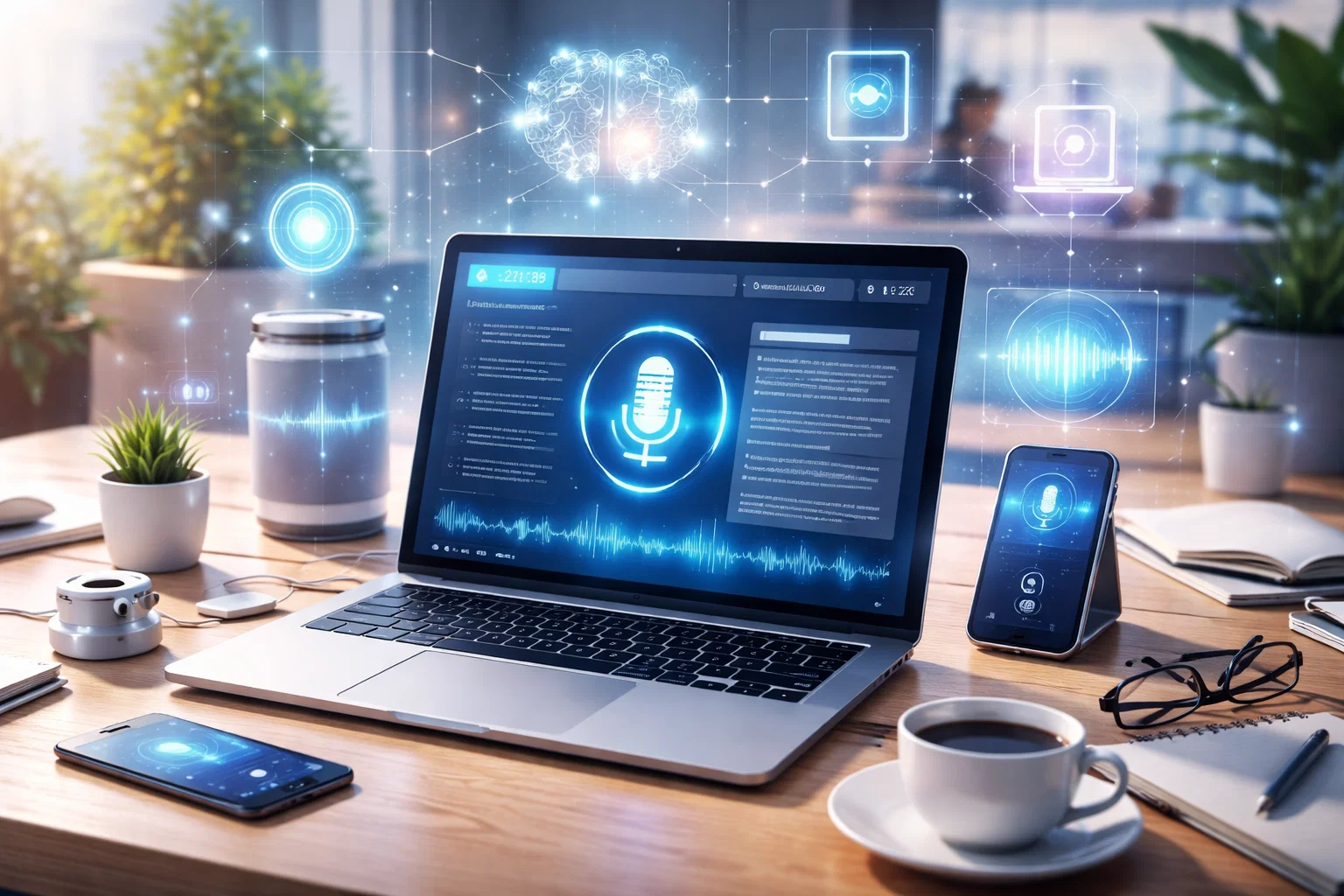
In 2026, AI-powered dictation tools have become an integral part of how professionals, enterprises, educators, and healthcare providers interact with technology. What was once a niche solution for converting voice to text has evolved into a mainstream productivity essential—fueled by rapid advancements in natural language processing (NLP), on-device AI, real-time speech recognition, and secure cloud integration. From corporate boardrooms and hospital wards to classrooms and content creation studios, dictation tools powered by artificial intelligence are enabling faster documentation, more accurate transcription, and frictionless collaboration across multiple sectors and geographies.

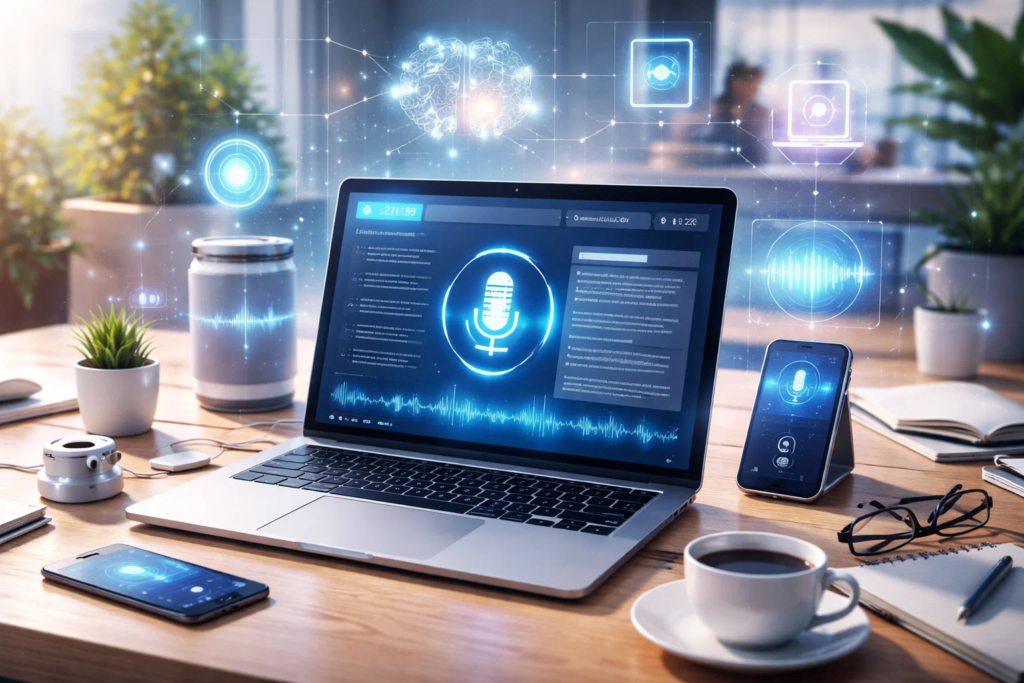
The global demand for voice-to-text solutions has seen exponential growth, with the speech recognition market projected to reach over USD 23 billion by 2030. This surge is driven by the increasing need for efficient workflows, multilingual communication support, and real-time accessibility. In parallel, major AI breakthroughs—such as large language models and edge computing—have made these tools more intelligent, context-aware, and privacy-compliant. Whether capturing clinical notes for electronic health records, automating meeting transcripts, or supporting content repurposing for digital marketing, today’s dictation tools offer unmatched versatility and performance.

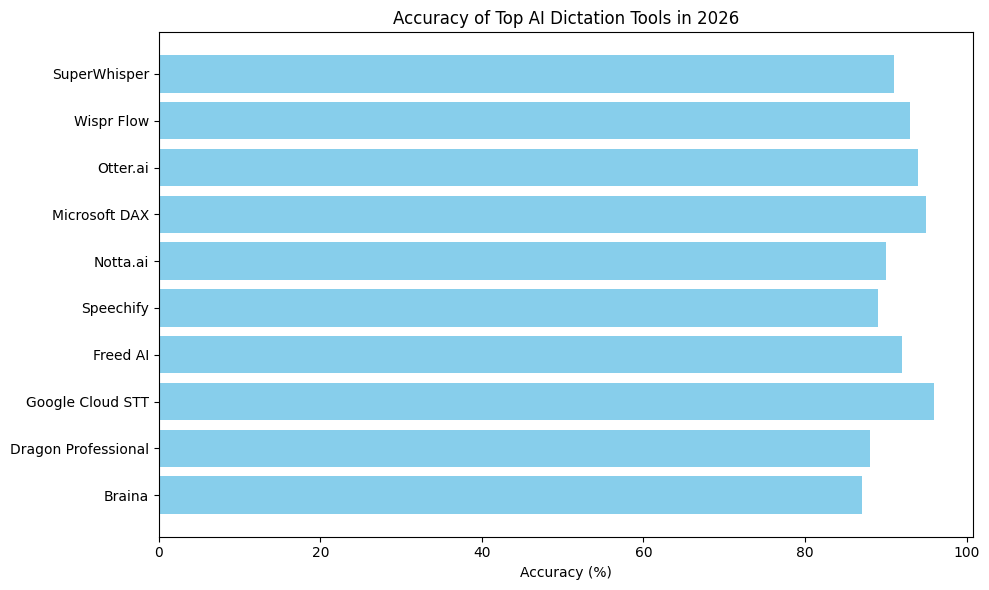
What differentiates the top AI dictation tools in 2026 is no longer just transcription accuracy but a combination of critical features: enterprise-grade security (SOC 2, HIPAA, GDPR), integration with collaboration platforms (like Microsoft Teams, Google Meet, Zoom), multi-language support, latency-free processing, and adaptive learning to improve with use. Some tools also offer agentic features—such as generating meeting summaries, task recommendations, or even customer insights based on voice data. As businesses become more remote, global, and hybrid, dictation tools are stepping into the role of intelligent voice assistants, supporting both knowledge capture and decision-making.
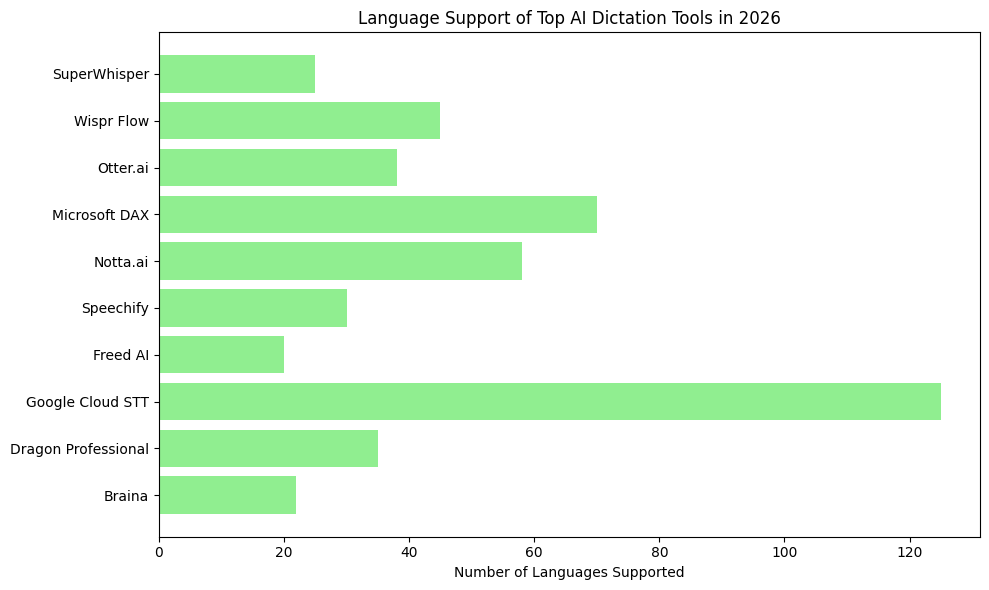
This comprehensive guide highlights the top 10 AI dictation tools in the world for 2026—comparing their technical capabilities, use-case suitability, market traction, pricing models, security compliance, and performance benchmarks. From privacy-first local apps like SuperWhisper to enterprise cloud solutions like Microsoft DAX and Otter.ai’s SDR agent, this list reflects the diversity of voice AI applications and the innovation shaping the future of speech technology.
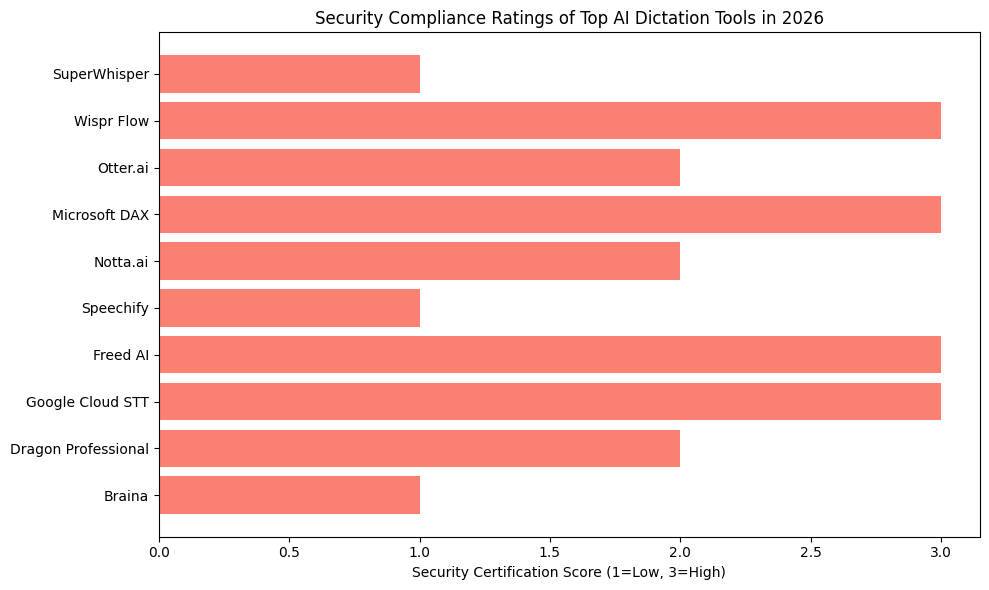
Readers can expect a data-driven evaluation of each tool, complete with performance charts, feature matrices, industry alignment, and emerging trends such as zero audio retention policies, multilingual training datasets, and the rise of on-device neural processing units (NPUs). Whether you’re a CIO choosing a scalable dictation solution for your enterprise or a solo professional seeking seamless voice-to-text productivity, understanding these tools will help you make smarter, faster, and more future-proof decisions.
Before we venture further into this article, we would like to share who we are and what we do.
About 9cv9
9cv9 is a business tech startup based in Singapore and Asia, with a strong presence all over the world.
With over nine years of startup and business experience, and being highly involved in connecting with thousands of companies and startups, the 9cv9 team has listed some important learning points in this overview of the Top 10 Best AI Tools For Dictation in 2026.
If you like to get your company listed in our top B2B software reviews, check out our world-class 9cv9 Media and PR service and pricing plans here.
Top 10 Best AI Tools For Dictation in 2026
- Dragon Professional v16
- Otter.ai
- Wispr Flow
- SuperWhisper
- Notta.ai
- Speechify Voice Typing
- Braina Pro
- Freed AI
- Google Cloud Speech-to-Text
- Microsoft Azure Speech and Nuance DAX
1. Dragon Professional v16

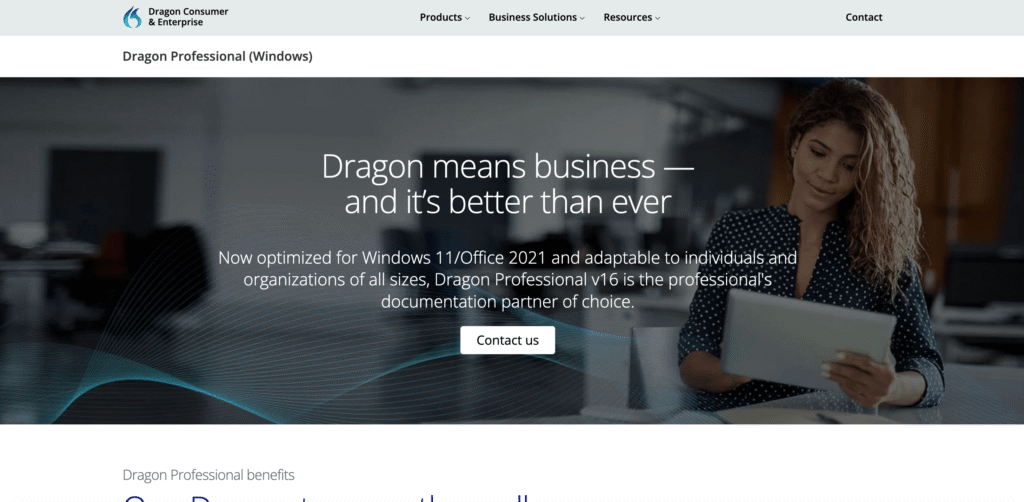
Dragon Professional v16 stands out globally in 2026 as a high-performance AI dictation software tailored for professionals in law, healthcare, and technical writing. It continues to lead in environments where precision, customization, and institutional compliance are non-negotiable.
Designed for Advanced Dictation and Voice Commands
Unlike many AI transcription tools focused mainly on basic note-taking or voice-to-text conversion, Dragon Professional v16 is built for more advanced tasks. It supports not only natural speech transcription but also complex voice commands. This includes recognizing functional instructions like “Bold that” or “Insert closing statement,” separating them from the actual content being dictated.
This dual capability makes it highly effective for users who need complete hands-free control when drafting complex documents, legal agreements, or compliance reports.
Cutting-Edge Deep Learning for High Accuracy
Dragon v16 uses a powerful Deep Learning engine that adapts to various accents and speaking styles with minimal setup. It can understand speech even in slightly noisy environments and delivers up to 99% recognition accuracy straight out of the box—without requiring extended voice profile training.
Its dictation speed clocks in at around 160 words per minute, which is more than four times faster than typical keyboard typing speeds. This dramatically boosts documentation workflows for users who regularly produce detailed and lengthy reports.
Key Performance Specifications
Here is a snapshot of Dragon Professional v16’s performance and technical features:
| Feature | Description |
|---|---|
| Recognition Accuracy | 99% out of the box |
| Dictation Speed | Up to 160 words per minute |
| Deployment Type | Local/On-Premise (Windows/Mac) |
| Supported OS | Fully compatible with Windows 11 |
| Productivity Add-Ons | Deep integration with Microsoft Teams and Word |
| Voice Commands Support | Yes (e.g., formatting, signatures, templates) |
Pricing and Versions
The tool offers both a desktop version and a mobile variant, allowing flexibility depending on the user’s needs.
| Version | Price Type | Cost |
|---|---|---|
| Desktop (v16) | One-time purchase | USD 700 |
| Mobile (Anywhere) | Monthly subscription | USD 14.99/month |
Global User Adoption and Scalability
Dragon v16 has surpassed 1 million active users globally, reflecting its wide adoption across law firms, medical institutions, research bodies, and enterprises. What makes it particularly useful in 2026 is its support for centralized enterprise-level administration through the Nuance Management Center. This tool allows companies to push out customized vocabulary databases, macros, and legal templates across their teams instantly—ideal for knowledge-intensive organizations.
Enterprise-Ready Capabilities
| Enterprise Feature | Description |
|---|---|
| Nuance Management Center | Central admin panel for distributing vocabularies |
| Custom Vocabulary Upload | Enables industry-specific terms and acronyms |
| Microsoft Teams Integration | Streamlined use in virtual legal or business discussions |
| Word 2021 Support | Enhanced compatibility with Modern Comments and formatting |
| Offline Access | Full offline dictation and transcription capabilities |
Why Dragon v16 Remains Relevant in 2026
In a world filled with lightweight AI dictation tools and mobile transcription apps, Dragon Professional v16 continues to be the go-to solution when legal compliance, technical complexity, and speech accuracy are essential. Its ability to support precise, command-based voice workflows makes it invaluable for documentation-heavy professions. The combination of on-premise control, advanced voice command parsing, and enterprise-level management sets it apart from simpler tools like Otter.ai or Google Docs voice typing.
Comparison Chart: Dragon v16 vs Other Dictation Tools (2026)
| Tool | Accuracy | Command Support | Enterprise Features | Pricing | Offline Capability |
|---|---|---|---|---|---|
| Dragon Professional v16 | 99% | Full (Formatting, Templates) | Yes (via Nuance Center) | USD 700 one-time | Yes |
| Otter.ai | 85-90% | Basic (Limited) | Limited | USD 16.99/month | No |
| Google Voice Typing | 80-85% | No | No | Free | No |
| Descript | 90% | Limited (Basic edits) | Some collaboration tools | USD 15/month | No |
Conclusion
Dragon Professional v16 continues to dominate the global AI dictation software space in 2026 due to its unmatched focus on precision, control, and enterprise scalability. It is best suited for legal professionals, technical writers, healthcare practitioners, and corporate teams who require more than simple transcription—they need a smart, customizable dictation partner that understands both words and workflow.
2. Otter.ai

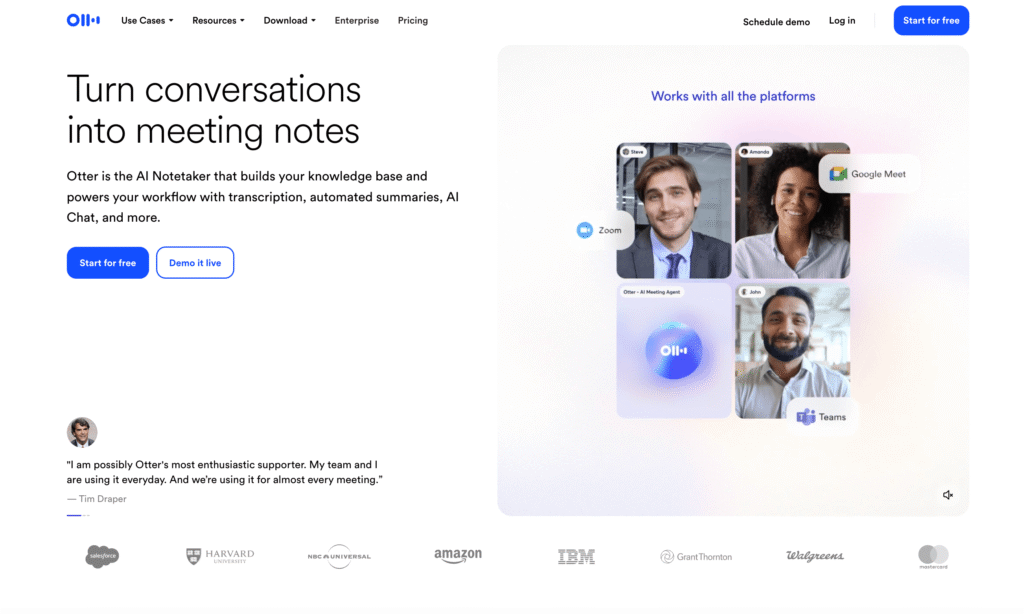
Otter.ai has evolved significantly over the years and has become one of the top AI-powered dictation and meeting tools used worldwide in 2026. No longer just a basic speech-to-text service, it now acts as a smart assistant during meetings, helping both individuals and businesses capture, understand, and reuse spoken information more effectively.
Transforming from Dictation to Autonomous Meeting Agent
Otter.ai has gone beyond simple transcription. It now works as an autonomous AI meeting agent, capable of actively helping users during and after meetings. One of its standout features in 2026 is the “OtterPilot” suite—an intelligent system that can answer real-time questions like “What did I miss?” without interrupting the meeting. It listens, summarizes, and delivers key points in seconds.
Unlike many tools that rely on external APIs, Otter.ai is powered by its own proprietary speech recognition model. This gives it more control over speed, accuracy, and security, making it a trusted solution for businesses that deal with sensitive discussions.
Usage Reach and Market Penetration
With over 35 million users and more than 5,000 businesses onboard, Otter.ai has become a major tool in the AI productivity space. It acts as both a meeting assistant and a knowledge base, recording conversations, identifying action items, and generating summaries that teams can refer back to anytime.
Global User Statistics and Business Penetration
| Metric | Value |
|---|---|
| Total Users (2026) | 35+ million |
| Business Clients | 5,000+ organizations |
| Countries Served | 120+ |
| Active Languages Supported | 12+ |
Pricing Plans and Target Segments
Otter.ai provides flexible pricing tiers designed for various user types—from students and freelancers to large enterprises.
| Plan Tier | Monthly Cost (USD) | Monthly Usage Limit | Intended Users |
|---|---|---|---|
| Basic (Free) | $0 | 300 minutes | Students and casual users |
| Pro | $8.33 per user | 1,200 minutes | Freelancers and small teams |
| Business | $20–$30 per user | 6,000 minutes | Sales and marketing teams |
| Enterprise | Custom pricing | Unlimited | Large corporations and enterprises |
Performance and ROI Highlights
Otter.ai is especially known for helping businesses cut costs and boost productivity. Its technology is designed to handle high meeting volumes with minimal human involvement, which reduces the need for manual note-takers or administrative support. In 2025, it was reported that Otter.ai helped generate over USD 1 billion in total customer return on investment.
For enterprise clients, Otter.ai has been shown to deliver a return of 10 times the investment. In practical terms, it means that for every 20 users, companies can save the workload of one full-time employee. For a company with 1,000 users, this can lead to savings of more than USD 6 million each year.
ROI Summary Matrix
| Metric | Value |
|---|---|
| Estimated Annual Customer ROI | Over USD 1 billion |
| Annual Recurring Revenue (ARR) | USD 100 million+ |
| Employees | Under 200 |
| ROI for Enterprise Clients | 10:1 |
| Estimated FTE Savings (per 20 users) | 1 FTE |
| Savings for 1,000-user company | USD 6 million+ annually |
Enterprise-Level Capabilities
In addition to speech recognition, Otter.ai offers features that help turn meetings into searchable databases of organizational knowledge. These features include:
- Real-time meeting transcription
- Automatic speaker identification
- Meeting summary generation
- Team collaboration tools
- SSO (Single Sign-On) and BAA (Business Associate Agreements) for compliance
Comparing Otter.ai with Other Dictation Tools (2026)
| Feature | Otter.ai | Dragon v16 | Descript | Google Voice Typing |
|---|---|---|---|---|
| Real-Time Summarization | Yes | No | Yes (basic) | No |
| Enterprise Admin Tools | Yes (SSO, BAA) | Yes (Nuance Center) | Partial | No |
| Team Collaboration | Strong | Limited | Moderate | No |
| Custom Voice Model | Proprietary | Deep Learning | 3rd-party APIs | 3rd-party APIs |
| ROI Tracking | Yes | No | No | No |
| Monthly Usage Plans | Yes (Free to Custom) | One-time purchase | Subscription-based | Free |
Conclusion
Otter.ai has secured its place among the best AI dictation tools in the world in 2026 by offering more than just transcription. With features that make meetings smarter, faster, and more productive, it helps both individuals and organizations turn spoken words into valuable assets. Its ability to scale, deliver strong ROI, and support real-time collaboration makes it an essential part of any modern digital workplace.
3. Wispr Flow

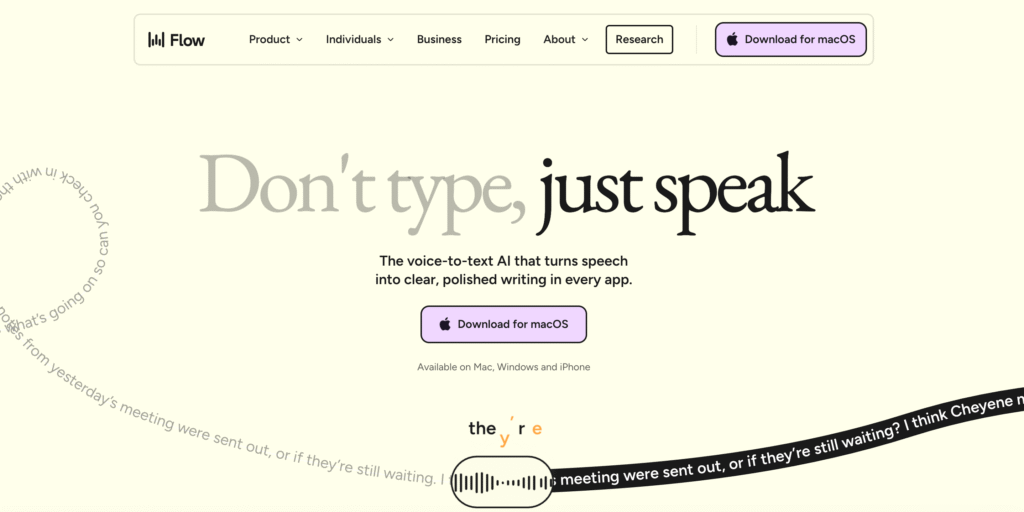
Wispr Flow has redefined how voice dictation tools function in 2026. It is no longer just a tool that converts speech into text—it acts as a smart voice-based interface that understands context, adapts tone, and delivers polished results tailored to the platform being used. As one of the top AI dictation tools globally, Wispr Flow leads with innovation designed to boost productivity for individuals, teams, and developers.
Voice Interface that Thinks and Writes for You
Unlike traditional dictation software that simply transcribes words, Wispr Flow is built as an “intent-based voice operating system.” This means it doesn’t just repeat what the user says—it refines the spoken input into clean, grammatically correct, and appropriately formatted writing. Whether the user is composing a formal email, a casual Slack message, or dictating source code in an IDE, Wispr Flow automatically adjusts the structure and tone of the output.
Its real-time AI engine interprets conversational speech and transforms it into professional-grade text. It even recognizes the app in use and fine-tunes its response to match the style. For example, casual commands used while chatting in Slack are reshaped into more formal sentences when the user is drafting an email—without needing manual intervention.
Platform Compatibility and Language Reach
Wispr Flow supports a growing list of platforms, and its language capabilities ensure it can be used globally. The tool is already functional across major systems like macOS, Windows, and iOS, with Android support currently in beta.
| Compatibility Aspect | Availability |
|---|---|
| Desktop Support | macOS and Windows |
| Mobile App | iOS (Android waitlist in progress) |
| Number of Supported Languages | Over 100 languages and dialects |
| App Integrations | Compatible with 25,000+ applications |
| Popular Development Environments | Supports IDEs such as Cursor and Windsurf |
Security and Compliance Standards
Security is a key pillar of Wispr Flow’s enterprise-readiness. It adheres to high industry standards for data protection, making it suitable for professionals in regulated industries.
| Compliance Standard | Certification Achieved |
|---|---|
| Data Security | SOC 2 Type II |
| Healthcare Data Handling | HIPAA Compliant |
Pricing and Access Plans
Wispr Flow offers different pricing tiers to cater to a wide user base—from solo users testing the tool, to enterprise teams that require coordinated access and collaboration features.
| Plan Type | Monthly Cost (USD) | Key Features |
|---|---|---|
| Free | $0 | Limited access to core voice features |
| Pro | $15/month | Full access with advanced formatting and tone |
| Teams | $12/user/month | Centralized billing, sharing tools, team support |
Adoption by Influencers and Tech Executives
Wispr Flow’s popularity is not just based on functionality—it is also supported by well-known figures in the tech world. Prominent users include Reid Hoffman (LinkedIn co-founder) and Rahul Vohra (Superhuman CEO), highlighting the tool’s growing appeal among startup founders, productivity experts, and software engineers.
Funding Milestones and Market Position
In late 2025, Wispr raised an additional USD 25 million in a Series A extension, pushing its total funding to USD 81 million. This round valued the company at nearly USD 674 million. These figures reflect the confidence investors have in the future of voice-first productivity software.
| Financial Indicator | Value |
|---|---|
| Total Funding Raised | USD 81 million |
| 2025 Series A Extension | USD 25 million |
| Current Valuation | USD 673.86 million |
| Investor Confidence Score | High (based on round oversubscription) |
Developer-Centric Features: Vibe Coding and Beyond
For developers and engineers, Wispr Flow introduces “vibe coding”—a feature that allows users to dictate code and commands directly into supported IDEs. This transforms the way software professionals interact with their tools, enabling faster workflow, better focus, and reduced typing strain. It positions voice as a primary input method in the world of software engineering, rather than just an accessibility feature.
Comparison with Other Leading AI Dictation Tools (2026)
| Feature | Wispr Flow | Otter.ai | Dragon v16 | Google Voice Typing |
|---|---|---|---|---|
| Context-Aware Tone Adaptation | Yes | No | No | No |
| Real-Time Formatting | Yes | Partial | Yes | No |
| App-Specific Adjustments | Yes | No | No | No |
| Developer Tools Integration | Yes (IDE support) | No | No | No |
| Enterprise Compliance | SOC 2, HIPAA | SSO, BAA | Nuance Center | No |
| Free Plan Available | Yes | Yes | No | Yes |
Conclusion
Wispr Flow has earned its place as one of the top AI dictation tools in the world in 2026 by introducing a revolutionary approach to voice-based productivity. With advanced contextual awareness, formatting intelligence, and development environment compatibility, it offers a powerful toolkit for professionals who want their voice to do more than just transcribe. Its rapid growth, strong investor backing, and use by tech leaders confirm its reputation as a premium tool for the future of work.
4. SuperWhisper

SuperWhisper has emerged as one of the top AI tools for dictation in 2026 by prioritizing local processing, offline usage, and complete user privacy. Unlike cloud-based transcription platforms, it keeps all audio data on the user’s device—making it especially popular with users in sensitive industries such as healthcare, finance, and law. Built to run smoothly on macOS and iOS devices, SuperWhisper gives users control without sacrificing transcription quality.
Local-First Architecture with No Cloud Dependency
SuperWhisper is unique because it is designed from the ground up to process audio directly on the user’s machine. It uses OpenAI’s Whisper model for transcription, but with a twist—the model runs locally. That means voice recordings never leave the device. This privacy-first setup makes it a preferred solution for professionals and organizations that need to comply with strict data protection laws such as the EU AI Act or HIPAA regulations.
By avoiding cloud storage entirely, SuperWhisper provides peace of mind for users handling confidential conversations or sensitive information. Unlike many dictation tools that rely on sending data to remote servers, SuperWhisper ensures total control over audio inputs and outputs.
Advanced Capabilities with Super Mode and AI Integration
A standout feature of SuperWhisper is its “Super Mode.” This mode uses Apple’s accessibility APIs to understand the app or document the user is working in, helping to improve transcription accuracy and formatting. It adjusts the output based on the user’s current workflow, whether it’s writing a report in a word processor, answering messages in a chat app, or documenting notes in a CRM system.
Additionally, for users who bring their own API keys, SuperWhisper offers integration with advanced AI models like GPT-4o and Anthropic Claude. This enables more detailed summarization, improved error correction, and expanded functionality beyond basic transcription.
Platform Support and Device Compatibility
| Feature | Supported Platforms |
|---|---|
| Operating Systems | macOS, iOS |
| Cloud Independence | Fully Offline Capability |
| Accessibility Integration | Apple Accessibility API |
| Device Hardware Optimization | M1/M2 Mac and iPhone Chips |
Pricing Plans and Subscription Tiers
SuperWhisper provides flexible payment options for different types of users. From casual users who want free local transcription to professionals seeking advanced AI model access, the pricing model fits a wide range of budgets and needs.
| Plan Tier | Cost (USD) | Key Features | Platform |
|---|---|---|---|
| Free | $0 | Unlimited access to smaller models | macOS, iOS |
| Pro Monthly | $8.49 – $14.99/month | Use of large models locally or via cloud | macOS, iOS |
| Pro Annual | $84.99 – $149.99/year | API key support for GPT-4o, Claude integration | macOS, iOS |
| Lifetime | $249.99 – $499.99 (one-time) | Lifetime updates and full offline access | macOS, iOS |
Privacy and Compliance Highlights
| Compliance Category | SuperWhisper Capability |
|---|---|
| Data Transfer | None; fully local processing |
| Storage Policy | No cloud audio storage |
| GDPR & EU AI Act Ready | Yes |
| HIPAA-Ready Architecture | Suitable for healthcare workflows |
| Encryption Support | Device-based encryption via Apple hardware |
Ideal Use Cases for SuperWhisper in 2026
SuperWhisper is well suited for professionals and teams that value privacy without giving up performance. These include:
- Doctors and clinicians who transcribe patient notes offline
- Lawyers handling sensitive case files
- Finance professionals who document confidential reports
- Independent researchers and journalists working with confidential interviews
Comparison Matrix: SuperWhisper vs Other AI Dictation Tools (2026)
| Feature | SuperWhisper | Wispr Flow | Otter.ai | Dragon v16 |
|---|---|---|---|---|
| Offline Capability | Full | Partial | None | Yes |
| App Context Awareness | Yes (Super Mode) | Yes | No | No |
| Custom AI Model Integration | Yes (BYO Keys) | No | No | No |
| Data Privacy | Device Only | Hybrid | Cloud-based | On-Premise |
| GDPR / HIPAA Ready | Yes | Partial | Yes | Yes |
| Platform Focus | macOS, iOS | Cross-platform | Web/Mobile | Windows/Mac |
| Voice Accuracy Engine | Whisper (local) | Proprietary NLP | Proprietary NLP | Deep Learning |
Conclusion
SuperWhisper stands out as a reliable and secure dictation tool in 2026, offering offline speech-to-text capabilities with a strong focus on privacy and user control. Its powerful combination of real-time contextual understanding, advanced AI model support, and strict data protection compliance makes it a top choice for professionals in regulated industries. With flexible pricing and continuous updates, it delivers excellent long-term value to users who prioritize accuracy and confidentiality.
5. Notta.ai

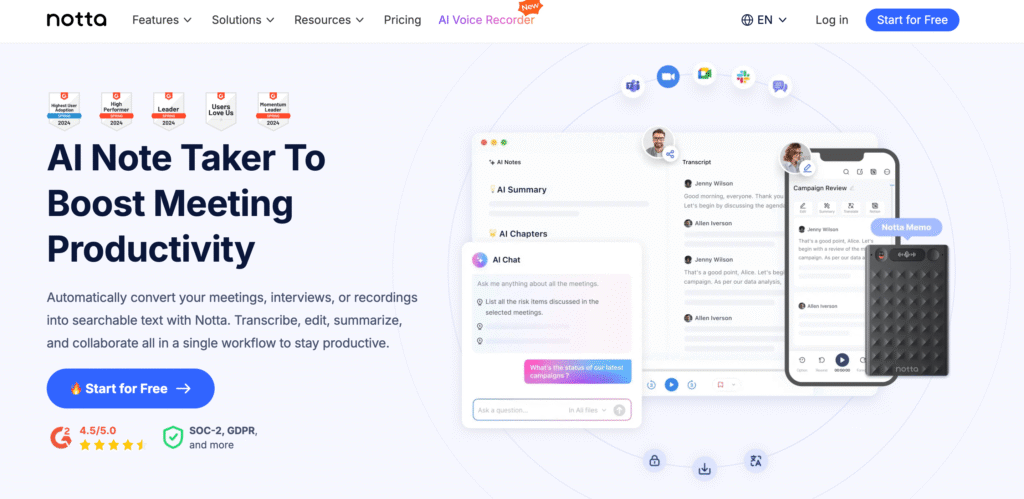
Notta.ai has become one of the most trusted AI-powered dictation tools in the world in 2026, with a strong presence across Asia and an especially dominant position in Japan. Headquartered in Tokyo, the company provides advanced voice transcription services along with enterprise-focused meeting assistants, internal knowledge base tools, and multilingual support. It is widely used by global corporations and local enterprises that demand accuracy, automation, and data compliance.
Regional Strength and Corporate Adoption
Notta.ai stands out as the top AI dictation tool in the APAC region, especially Japan, where it is trusted by 68% of companies listed in the Nikkei 225. This high adoption rate reflects Notta’s focus on business-to-business solutions and its ability to meet the unique needs of complex enterprise workflows.
The company has achieved widespread usage across more than 5,000 companies and 15 million users worldwide. Its tools are particularly popular with sales, customer success, and HR teams that rely on reliable meeting transcription, searchable audio records, and automatic summarization.
Enterprise Usage Overview
| Metric | Value |
|---|---|
| Total Global Users | 15 million+ |
| Total Companies Served | Over 5,000 |
| Adoption in Nikkei 225 Companies | 68% |
| Headquarters | Tokyo, Japan |
| Major Funding Round (Series B, 2025) | USD 15 million |
| Total Capital Raised | USD 31.8 million |
| Annual Revenue (Latvian Entity, 2023) | USD 529,000 |
Powerful Meeting Automation and App Integrations
One of Notta.ai’s key features is its AI Meeting Assistant. This assistant can automatically join video meetings on platforms such as Zoom, Google Meet, Microsoft Teams, and Webex. Once connected, it transcribes the conversation, identifies key discussion points, and generates meeting summaries without the need for manual input.
The platform is designed to plug seamlessly into the modern enterprise ecosystem. It integrates with tools like Salesforce, Slack, Notion, HubSpot, and Zapier—allowing companies to automatically route transcripts and insights to CRM systems, project management apps, or shared documentation spaces.
Automation and Integration Matrix
| Feature | Supported Integrations |
|---|---|
| Video Call Platforms | Zoom, Google Meet, Microsoft Teams, Webex |
| CRM & Sales Tools | Salesforce, HubSpot |
| Internal Collaboration | Slack, Notion |
| Automation Platforms | Zapier |
| Summary & Auto-Join Bots | Available across all supported platforms |
Advanced Compliance and Data Security
Notta.ai is built with a strong focus on security and privacy. It complies with major global standards, making it a safe option for companies working under strict data regulations. This is especially important for organizations in finance, healthcare, and legal sectors that handle sensitive or regulated information.
Its security certifications include ISO 27001, SOC 2, GDPR, HIPAA, and CCPA. These protections are applied across all user data, making Notta a reliable choice for global enterprises.
Security Compliance Table
| Regulation / Standard | Compliant Status |
|---|---|
| ISO 27001 | Yes |
| SOC 2 | Yes |
| GDPR (EU) | Yes |
| HIPAA (US Healthcare) | Yes |
| CCPA (California) | Yes |
Product Pricing and Access Options
Notta.ai offers tiered plans suited for both individuals and business users. These pricing options allow new users to test the platform for free, while businesses can scale usage with access to premium transcription features and more meeting volume.
| Plan Type | Monthly Price (USD) | Features Included |
|---|---|---|
| Free | $0 | Basic transcription tools and limited meeting access |
| Pro | $13.49/month | Advanced transcription, summary tools, integrations |
| Business | $27.99/month | Team dashboard, bulk meeting management, security controls |
Innovation and R&D Focus
Notta.ai sets itself apart by investing heavily in research and development. Over 70% of the company’s workforce is dedicated to improving voice recognition capabilities—especially for complex Asian dialects and multilingual conversations. This focus helps ensure that the platform remains effective across a wide variety of accents, languages, and regional expressions that often challenge other transcription engines.
R&D and Language Support Matrix
| Focus Area | Notta.ai Commitment |
|---|---|
| R&D Staff Percentage | Over 70% of total employees |
| Asian Dialect Recognition | Strong optimization |
| Multilingual Meeting Support | Yes |
| Continuous Model Improvement | Ongoing |
Comparative Analysis: Notta.ai vs Leading AI Dictation Tools (2026)
| Feature/Capability | Notta.ai | Otter.ai | SuperWhisper | Dragon v16 | Wispr Flow |
|---|---|---|---|---|---|
| Market Focus | APAC, Enterprise | Global Teams | Privacy-focused | Legal, Technical | Developers |
| Video Call Auto-Join | Yes | Yes | No | No | No |
| CRM & Workspace Integration | Strong | Moderate | Limited | Limited | Strong |
| Offline Support | Partial | No | Full | Yes | Partial |
| Language Optimization | Asian Dialects | English-centric | Multilingual | English-heavy | 100+ languages |
| Security Certifications | Extensive | Strong | Device-only | On-prem security | SOC 2, HIPAA |
Conclusion
Notta.ai has positioned itself as a top AI dictation platform in 2026 by combining smart meeting automation, enterprise integrations, and advanced voice recognition for Asian markets. With strong security credentials and a deep commitment to R&D, it provides companies with a secure, scalable, and multilingual solution for managing spoken content in real time. This makes it one of the best AI transcription tools globally for enterprises looking to streamline meetings and maintain full regulatory compliance.
6. Speechify Voice Typing

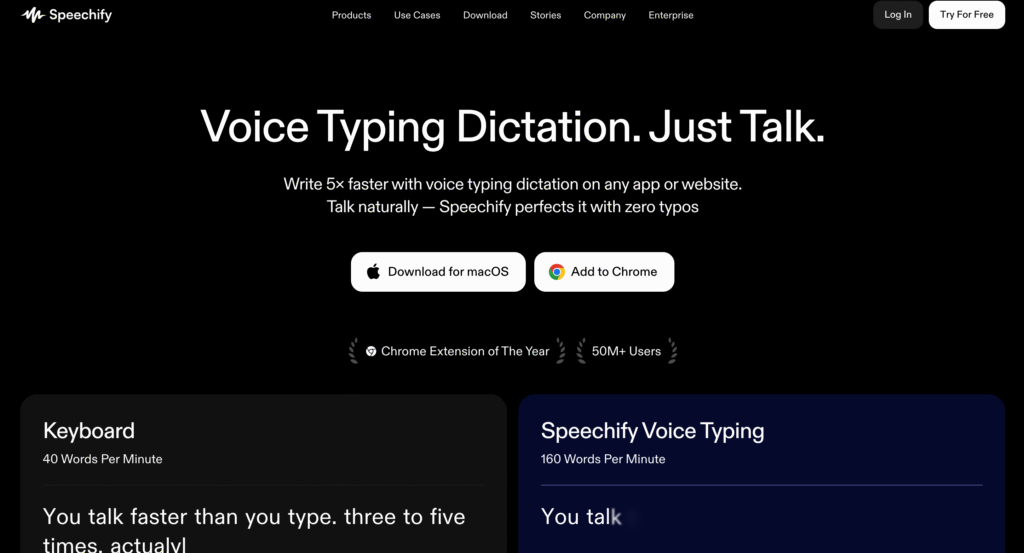
Speechify Voice Typing has become a major player among the world’s top AI dictation tools in 2026. Building on the global success of its text-to-speech platform, which serves over 25 million users, Speechify has expanded into voice dictation with a strong focus on accessibility, learning, and productivity. Its tools are especially helpful for individuals with learning differences like dyslexia or ADHD, as well as professionals and students who want to speak rather than type.
Accessibility and Design Recognition
Speechify was awarded the prestigious Apple Design Award in 2025 for its role in promoting accessibility through technology. Its voice typing tool continues this mission by enabling users to create content using natural speech, removing common writing barriers such as spelling, grammar, and typing fatigue. The platform empowers users to work up to five times faster than traditional typing, making it valuable for writers, students, and entrepreneurs who need to produce large volumes of content quickly.
Core Capabilities and AI Features
The Speechify Voice Typing tool provides high accuracy when used with clear audio and supports over 60 languages and 1,000 natural-sounding voices. This multilingual capacity makes it suitable for global users, including non-native English speakers. The software can handle a wide range of speech patterns and accents, ensuring inclusivity across geographic and linguistic groups.
Feature and Capability Table
| Feature | Details |
|---|---|
| Multilingual Support | 60+ languages and 1,000+ natural voices |
| Audio Accuracy | High, especially with clear and uninterrupted speech |
| Text Output Formatting | Auto-punctuation, paragraph breaks, voice commands |
| API Access | Available for enterprise use |
| Offline Capability | Optional (via on-premise setup) |
Enterprise Readiness and Security Standards
In addition to helping individuals, Speechify has expanded into enterprise solutions by offering API access and on-premise deployment for companies with strict data control needs. This is ideal for educational institutions, publishers, and corporations looking to integrate speech recognition and voice typing into internal systems while maintaining high security standards.
The platform is SOC 2 compliant, which assures organizations that user data is handled responsibly and securely.
Enterprise & Developer Integration Matrix
| Feature | Availability |
|---|---|
| API Access | Yes |
| On-Premise Deployment | Yes (Custom licensing) |
| Security Certification | SOC 2 |
| Integration Flexibility | High (Customizable for teams) |
| Developer Support | Available |
Global Recognition and Impact in Education
Speechify has gained recognition beyond the tech space by being listed on the GSV 150—a global index of the world’s most impactful learning and education technology organizations. This reflects its influence in improving literacy, learning, and communication, especially in classrooms and universities.
The platform continues to grow its user base in the education sector, where teachers and students use voice typing to streamline assignments, note-taking, and essay writing. Its features help remove learning obstacles and enable faster idea capture.
Performance and Market Metrics (2026)
| Metric | Value |
|---|---|
| Global Users | 25 million+ |
| Estimated Revenue | USD 25M – USD 50M |
| Award Recognition | Apple Design Award (2025) |
| Educational Recognition | GSV 150 Learning Tech List (2026) |
| Monthly Subscription Cost | USD 29 for Premium; Free tier also available |
Comparison with Other AI Dictation Tools (2026)
| Capability | Speechify Voice Typing | Otter.ai | SuperWhisper | Dragon v16 | Notta.ai |
|---|---|---|---|---|---|
| Designed for Accessibility | Yes | Partial | No | No | No |
| Ideal for Dyslexia/ADHD | Yes | No | No | No | No |
| Education Market Recognition | Strong (GSV 150) | Moderate | Low | Low | Moderate |
| On-Premise Deployment | Yes | No | Yes | Yes | No |
| API Integration | Available | Limited | Available | No | Yes |
| Multilingual Support | 60+ languages | Limited | Yes | English focused | Optimized for Asian dialects |
Conclusion
Speechify Voice Typing offers more than just basic dictation—it is a complete voice-first productivity tool designed for individuals and organizations that prioritize speed, accessibility, and inclusion. With strong multilingual capabilities, enterprise-grade security, and proven value in education, it ranks among the best AI dictation tools globally in 2026. Whether for learning, content creation, or enterprise communication, Speechify provides a reliable and user-friendly voice input solution for the modern digital environment.
7. Braina Pro

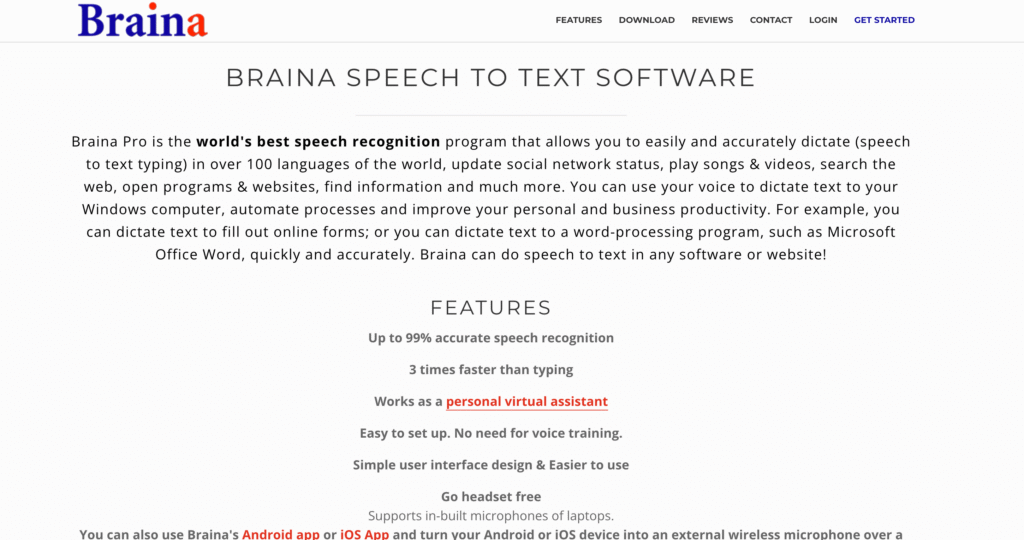
Braina Pro has positioned itself as one of the top AI tools for dictation in 2026 by combining high-accuracy voice transcription with intelligent desktop control. Designed primarily for Windows users, Braina Pro offers much more than speech-to-text—it works as a full productivity suite that lets professionals use their voice to write, calculate, search files, automate tasks, and even operate smart home devices.
It is especially popular among researchers, educators, engineers, and professionals who want a powerful offline dictation tool that also enhances their overall workflow.
AI-Powered Virtual Assistant Built for Windows
Braina Pro stands out because it functions like a smart virtual assistant with advanced capabilities. It supports voice commands, retains memory across interactions, and allows users to control apps and tasks hands-free. Users can dictate documents, play music, browse the internet, or give system-level commands—all using their voice.
Its built-in “Artificial Brain” engine allows the software to remember past queries and actions, improving contextual responses. This persistent memory is especially helpful for professionals who often return to ongoing projects or long-form content creation.
Speech Accuracy and Multilingual Capabilities
Braina Pro offers up to 99% speech recognition accuracy and supports more than 100 global languages. This makes it a strong option for international teams, multilingual professionals, and educational institutions.
| Feature | Braina Pro Capability |
|---|---|
| Speech Recognition Accuracy | Up to 99% |
| Language Support | 100+ languages and dialects |
| Offline Dictation Support | Yes (Unlimited for both audio and video) |
| Input Sources | Real-time mic, pre-recorded media |
| Supported File Formats | MP3, WAV, MP4, FLAC, and more |
Offline Dictation for Audio and Video Files
One of Braina Pro’s most valuable features is its ability to transcribe pre-recorded audio and video files without requiring an internet connection. This makes it highly useful for:
- Researchers transcribing interviews
- Journalists working on field recordings
- Educators processing lecture content
- Podcasters and video editors converting media to text
Its offline mode ensures that all data stays on the user’s device, supporting privacy-sensitive environments and eliminating dependency on cloud services.
Pricing Plans and Licensing Options
Braina Pro offers flexible licensing plans tailored to individuals and teams. These range from one-year licenses to lifetime access, with bundled AI credits and device usage allowances.
| Plan Name | Cost (USD) | AI Credits Included | Devices Supported | Notable Benefits |
|---|---|---|---|---|
| Braina Pro (1 Year) | $99 | 10,000 | 1 PC | Core features, offline transcription |
| Braina Pro Plus (2 Yr) | $199 | 20,000 | 2 PCs | Longer validity, multiple devices |
| Braina Pro Ultra (3 Yr) | $299 | 50,000 | 3 PCs + Training Access | Ideal for power users |
| Lifetime License | $199 (one-time) | Unlimited | Lifetime single device | Perpetual access, no renewal needed |
Smartphone Integration and Voice Microphone Feature
Braina Pro also extends functionality through mobile integration. Its Android and iOS companion apps allow users to convert their smartphones into wireless microphones, enabling flexible voice input across rooms or while multitasking. This adds mobility to the otherwise desktop-focused experience, making it suitable for hybrid and remote professionals.
Advanced Productivity Features and Voice Control
In addition to dictation, Braina Pro includes unique features that help boost overall productivity:
- Solves mathematical problems using voice input
- Searches files and folders locally
- Opens applications or websites using natural language
- Controls smart home devices that support voice interfaces
- Responds to custom voice commands and macros
Productivity and Voice Command Capability Matrix
| Function Type | Braina Pro Feature Set |
|---|---|
| Dictation & Transcription | Real-time + offline transcription |
| Mathematical Operations | Solves equations through voice input |
| PC Navigation | File search, open apps, system commands |
| Smart Home Integration | Yes (voice-based control supported devices) |
| Mobile Voice Input | Via Android/iOS companion apps |
| Personalized Macros | Yes (custom commands programmable) |
Comparison with Other AI Dictation Tools (2026)
| Feature | Braina Pro | Dragon v16 | SuperWhisper | Otter.ai | Wispr Flow |
|---|---|---|---|---|---|
| Offline Dictation (Audio/Video) | Yes (Unlimited) | No | Yes | No | Partial |
| Multilingual Support | 100+ languages | English-focused | 100+ | Limited | 100+ |
| PC Voice Control | Yes | Partial | No | No | No |
| Mobile App as Microphone | Yes | No | No | No | No |
| Smart Home Command Integration | Yes | No | No | No | No |
| Lifetime License Available | Yes | No | Yes | No | No |
Conclusion
Braina Pro has firmly established itself as one of the top AI dictation tools in the world in 2026. With unmatched offline capabilities, real-time PC control, multilingual support, and an intelligent virtual assistant engine, it provides a comprehensive voice-powered solution for Windows users. From transcribing complex media to operating smart environments, Braina Pro offers a level of flexibility and functionality that makes it ideal for professionals, creators, educators, and researchers alike.
8. Freed AI

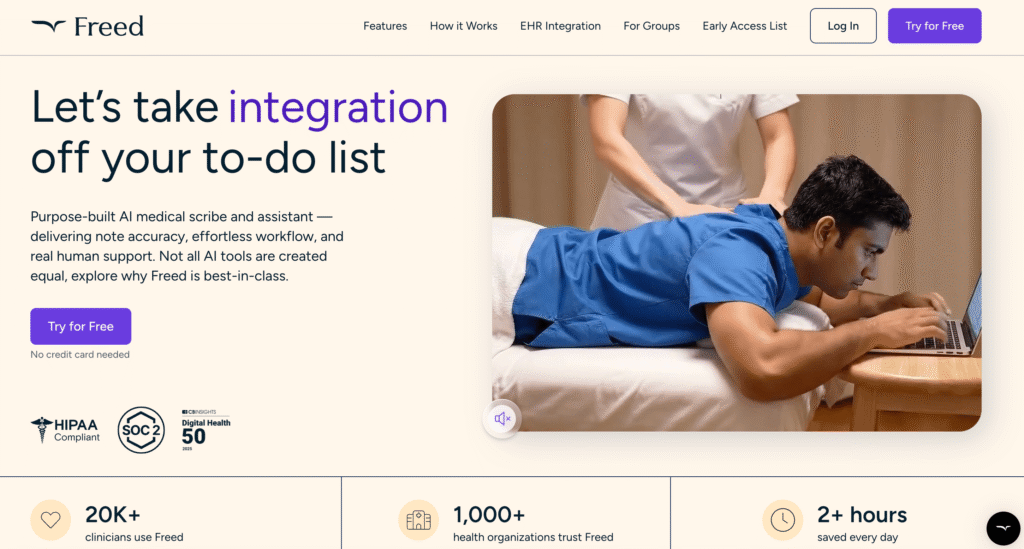
Freed AI has emerged as one of the top AI-powered dictation tools in the world in 2026, particularly within the healthcare industry. It is designed specifically for clinicians, nurses, and healthcare organizations looking to reduce the time spent on documentation while improving the accuracy and consistency of patient records.
Built as a medical scribe solution, Freed AI listens in real-time during consultations and automatically generates structured SOAP notes. It reduces the manual work associated with clinical documentation and plays a major role in decreasing physician burnout—an ongoing issue in the healthcare sector.
Focused on Clinicians and Healthcare Organizations
Freed AI has become a trusted tool for over 20,000 healthcare professionals and more than 1,000 medical organizations in the United States alone. It is especially suited for small to mid-sized clinics with between 2 and 50 clinicians, where administrative resources are often limited and time-saving solutions are in high demand.
The tool operates in the background during patient appointments, capturing important details and converting spoken conversations into detailed, formatted medical notes. These notes follow the widely used SOAP (Subjective, Objective, Assessment, Plan) structure, ensuring standardization and readiness for use in patient records.
Adoption Metrics and Clinical Impact
| Metric | Value |
|---|---|
| Total Clinician Users (2026) | Over 20,000 |
| Healthcare Organizations Served | More than 1,000 |
| Average Time Saved Per Clinician | Up to 2 hours daily |
| Clinic Size Focus | 2–50 providers |
| Monthly Notes Limit | Unlimited |
Real-Time Medical Dictation with EHR Integration
One of Freed AI’s strongest features is its ability to integrate directly with browser-based Electronic Health Record (EHR) systems. With a single click, clinicians can push AI-generated notes into their preferred EHR platform, removing the need for manual copy-pasting or data entry.
The software is also self-learning. It adapts to each doctor’s speaking style, note preferences, and even recalls information from previous patient visits. This allows for consistent documentation and improved personalization across patient interactions.
Workflow Integration and Automation Capabilities
| Feature | Description |
|---|---|
| EHR Integration | One-click push to most browser-based platforms |
| Real-Time Ambient Listening | Yes (context-aware during patient visits) |
| AI-Powered Template Adaptation | Learns provider-specific styles and preferences |
| Visit History Recall | Automatically surfaces relevant past data |
| Note Structuring Format | SOAP (Subjective, Objective, Assessment, Plan) |
Compliance and Security Standards for Healthcare
Freed AI is fully compliant with the strict data protection requirements expected in healthcare environments. The platform meets HIPAA, SOC 2, and HITECH regulations, ensuring patient data is processed and stored securely.
It is also trained on over 27,000 medical terms, drug names, and healthcare-specific vocabulary, which helps it handle complex terminology with ease and precision.
Healthcare Compliance & Vocabulary Coverage
| Regulation / Feature | Status/Capability |
|---|---|
| HIPAA Compliance | Yes |
| SOC 2 Certification | Yes |
| HITECH Compliance | Yes |
| Medical Terms Trained | 27,000+ |
| Drug Names Support | Yes |
| Multi-language Support | 90+ languages |
Pricing and Affordability for Clinics
Freed AI is competitively priced to meet the needs of small practices while delivering high-value features. Individual clinicians can start using the platform for USD 90 per month, which is cost-effective compared to hiring full-time scribes or handling documentation manually.
| Plan Type | Monthly Cost (USD) | Key Benefits |
|---|---|---|
| Standard Clinician Plan | $90 | Unlimited notes, real-time listening, EHR push |
Comparison with Other Top Dictation Tools in 2026
| Feature/Tool | Freed AI | Dragon v16 | Otter.ai | SuperWhisper | Braina Pro |
|---|---|---|---|---|---|
| Designed for Healthcare | Yes | Partial | No | No | No |
| Real-Time SOAP Note Creation | Yes | No | No | No | No |
| Visit History Integration | Yes | No | No | No | No |
| EHR System Push | Yes (1-click) | No | No | No | No |
| Language Support | 90+ | English-focused | Limited | 100+ | 100+ |
| Medical Vocabulary Trained | 27,000+ terms | Limited | No | No | No |
Conclusion
Freed AI has become an essential dictation tool in the healthcare industry by solving one of the most time-consuming challenges clinicians face—medical documentation. Its advanced AI engine, real-time transcription, self-learning templates, and seamless EHR integration make it a top-tier tool in 2026. With a strong focus on regulatory compliance and clinical accuracy, Freed AI is a practical, scalable, and intelligent solution for modern medical practices aiming to reduce paperwork and improve patient care outcomes.
9. Google Cloud Speech-to-Text

Google Cloud Speech-to-Text (STT) has become one of the most powerful and reliable AI dictation technologies in the world in 2026. Unlike consumer-focused dictation apps, this tool serves as a foundational infrastructure layer for developers, SaaS builders, and enterprises looking to create voice-enabled applications at scale. With its high accuracy, vast language support, and flexible deployment options, Google Cloud STT stands as a leading solution for businesses seeking global voice recognition capabilities.
Optimized for Developers, SaaS Builders, and Enterprises
Google Cloud STT is built with developers in mind. It provides a simple and scalable REST API and SDKs that make it easy to plug speech recognition into apps, platforms, and services. Whether powering real-time transcription features in a customer service app, or enabling voice commands in a multilingual productivity tool, it gives teams the flexibility and performance they need.
Its usage-based, pay-per-second pricing structure allows startups and enterprises alike to manage costs while scaling up their product offerings without investing in expensive proprietary infrastructure.
Developer and Deployment Overview
| Capability | Google Cloud STT Details |
|---|---|
| Target Audience | Developers, SaaS founders, enterprises |
| API Access | REST API, client SDKs (Node.js, Python, etc.) |
| Billing Model | Pay-as-you-go, per-second billing |
| Deployment Options | Cloud, On-Premises, or On-Device |
| Use Case Scenarios | Real-time apps, call center tools, SaaS features |
High Language Coverage with Global Dialect Support
One of the strongest advantages of Google Cloud STT in 2026 is its exceptional support for over 125 languages and dialects. Through the advanced “Chirp” speech recognition models, it can accurately handle a wide variety of accents, regional variants, and linguistic nuances. This makes it a go-to option for businesses with international user bases.
The tool supports 137 local variants across 73 core languages, allowing for deep customization and localization. It can also distinguish between speakers, manage noisy environments, and deliver near-human transcription quality in real time.
Language and Accuracy Matrix
| Metric | Value |
|---|---|
| Core Languages Supported | 73 |
| Local Variants | 137 dialects and regional versions |
| Accuracy Level | Over 92% in benchmark tests |
| Speaker Diarization | Yes |
| Multichannel Audio Support | Yes |
Processing Scale and Global Reach
Google Cloud STT processes over 1 billion voice minutes per month globally. This level of scale and throughput makes it an ideal engine for platforms requiring high-speed, high-volume transcription—such as video platforms, enterprise support desks, live translation tools, and accessibility applications.
Its low latency and stable uptime are especially valuable in mission-critical environments like call centers, real-time meetings, and multilingual video streams.
Performance & Throughput Capabilities
| Feature | Google Cloud STT Performance |
|---|---|
| Monthly Voice Minutes Processed | Over 1 billion minutes |
| Real-Time Processing Capability | Yes |
| Latency for Live Transcription | Low (sub-second in many regions) |
| Cloud Infrastructure Availability | Global (with regional failover options) |
| Redundancy and Reliability | Enterprise-grade |
Flexible Deployment for Industry-Specific Needs
Unlike many tools that only run in the cloud, Google Cloud STT allows businesses to deploy their voice recognition wherever it makes the most sense—whether in Google Cloud, on their own on-premise infrastructure, or directly on edge devices. This flexibility makes it suitable for industries like finance, healthcare, defense, and automotive, where data sensitivity or offline capability is critical.
Deployment Flexibility Matrix
| Deployment Type | Availability | Use Case Examples |
|---|---|---|
| Cloud-Based | Yes | SaaS apps, voice notes, global collaboration tools |
| On-Premises | Yes | Healthcare systems, financial records |
| On-Device | Yes | IoT tools, automotive assistants, field equipment |
Comparison with Other AI Dictation Tools (2026)
| Feature/Tool | Google Cloud STT | SuperWhisper | Otter.ai | Dragon v16 | Freed AI |
|---|---|---|---|---|---|
| Designed for Developers | Yes | No | No | No | No |
| Pay-As-You-Go Pricing | Yes | No | Partial | No | No |
| Global Language Support | 137 variants | 100+ | Limited | English-focused | 90+ |
| Speaker Diarization | Yes | No | Yes | Yes | Yes |
| Infrastructure Flexibility | High (Cloud + Local) | Local only | Cloud only | On-Premise | Cloud + Browser |
Conclusion
Google Cloud Speech-to-Text remains a top-tier AI dictation engine in 2026 for organizations that require speed, scale, accuracy, and flexibility. It is not a standalone app for end-users, but rather a backend powerhouse used by developers and enterprises to power their own voice-based products and services. Its wide language coverage, advanced features like speaker diarization, and enterprise-grade infrastructure support make it one of the most important tools in the global AI dictation landscape.
10. Microsoft Azure Speech and Nuance DAX

Microsoft Azure Speech, combined with Nuance’s Dragon Ambient eXperience (DAX) Copilot, has become one of the most advanced and enterprise-focused AI dictation solutions in the world in 2026. It is especially dominant in the healthcare sector, where it serves some of the largest hospital systems using platforms like Epic and Meditech.
Following Microsoft’s USD 19.7 billion acquisition of Nuance in 2022, the integration of Dragon technology into the Azure ecosystem has transformed the way medical institutions handle clinical documentation, patient interaction, and administrative efficiency.
Optimized for Hospitals, Clinics, and Enterprise IT Teams
The DAX Copilot is specifically built for large-scale health systems that need more than simple voice-to-text services. It acts as a real-time ambient clinical assistant that listens during patient visits, generates medical notes, and creates patient summaries—without requiring clinicians to type anything manually. It works seamlessly across departments, medical specialties, and patient care settings.
Healthcare organizations choose Microsoft Azure Speech because it integrates deeply with the Microsoft 365 ecosystem and offers the scalability, uptime, and security needed for enterprise-grade deployments.
Healthcare Dictation and Clinical Documentation Matrix
| Functionality | Microsoft Azure Speech + DAX Copilot |
|---|---|
| Live Clinical Transcription | Yes |
| Patient Summary Generation | Yes |
| Note Structuring | SOAP, free-form, EHR-ready |
| Integration with EHRs | Deep (Epic, Meditech, Cerner, etc.) |
| Microsoft 365 Integration | Native |
Global Infrastructure and Cloud Power
Microsoft’s Intelligent Cloud division—which powers Azure Speech—has experienced strong financial performance. In Q1 FY2026, the segment generated USD 30.9 billion, reflecting a 28% growth rate. Azure itself has grown 40% year-over-year, highlighting the platform’s increasing adoption across industries.
The immense scale of Azure’s infrastructure allows DAX Copilot to offer real-time transcription, low latency, and high accuracy for massive user bases while maintaining data compliance worldwide.
Microsoft FY2026 Financial Highlights
| Segment | Q1 FY2026 Value | Year-Over-Year Change |
|---|---|---|
| Total Revenue | USD 77.7 Billion | Up 18% |
| Cloud Services Revenue | USD 49.1 Billion | Up 26% |
| Azure Segment Growth | 40% Increase | — |
| Commercial Remaining Performance Obligation (RPO) | USD 392 Billion | Up 51% |
Enterprise Security and Global Compliance Standards
Microsoft ensures that DAX Copilot meets the highest global compliance standards for healthcare and enterprise IT. It includes HIPAA-compliant workflows, SOC certifications, and secure integrations with major health information systems.
With Microsoft’s global reach and infrastructure redundancy, organizations benefit from reliability, centralized data management, and multi-region availability, all while maintaining full control over sensitive medical records.
Security and Compliance Overview
| Feature | Compliance/Capability |
|---|---|
| HIPAA Compliance | Yes |
| SOC 1 / SOC 2 Certifications | Yes |
| Global Data Residency Options | Yes (Region-specific deployment) |
| Microsoft 365 Security Layer | Integrated |
| EHR Data Handling | Encrypted and protected |
AI-Enhanced Workflow Automation
The DAX Copilot doesn’t just transcribe speech—it enhances clinical workflows. It uses AI to summarize medical discussions, flag important events, structure notes in clinically accepted formats, and even generate documents that can be shared with patients post-visit.
This kind of workflow automation significantly reduces time spent on documentation, improves care continuity, and reduces administrative pressure on physicians.
AI Workflow Functionality Table
| Workflow Step | DAX Copilot Functionality |
|---|---|
| During Patient Visit | Ambient listening, contextual transcription |
| After Visit Summary | Patient-friendly summary generation |
| Medical Record Entry | Structured SOAP notes auto-filled |
| Quality Assurance | Human-AI hybrid review available |
| Follow-Up Integration | Shared via Microsoft Teams, Outlook, EHR |
Comparison with Other Leading Dictation Tools (2026)
| Capability | Microsoft DAX Copilot | Freed AI | Dragon v16 | Otter.ai | Speechify |
|---|---|---|---|---|---|
| Target Market | Large Health Systems | Clinics (2–50) | Legal/Technical | General Teams | Education/Personal |
| EHR Integration | Deep (Epic, Meditech) | Browser Push | Partial | No | No |
| Microsoft 365 Integration | Full | No | No | Partial | Partial |
| Patient Summary Generation | Yes | No | No | No | No |
| HIPAA & Global Compliance | Yes | Yes | Yes | Partial | Yes |
| AI + Human QA Hybrid | Available | No | No | No | No |
Conclusion
Microsoft Azure Speech and Nuance DAX Copilot together form one of the most complete, enterprise-ready AI dictation solutions in the world in 2026. Designed to meet the complex needs of large health systems and enterprise IT environments, the platform combines real-time voice transcription, clinical note generation, secure EHR integration, and enterprise-scale cloud infrastructure.
For healthcare organizations seeking a reliable, scalable, and intelligent dictation system that improves documentation workflows and enhances the patient care journey, Microsoft’s solution continues to lead the industry.
Microsoft Azure Speech, combined with Nuance’s Dragon Ambient eXperience (DAX) Copilot, has become one of the most advanced and enterprise-focused AI dictation solutions in the world in 2026. It is especially dominant in the healthcare sector, where it serves some of the largest hospital systems using platforms like Epic and Meditech.
Following Microsoft’s USD 19.7 billion acquisition of Nuance in 2022, the integration of Dragon technology into the Azure ecosystem has transformed the way medical institutions handle clinical documentation, patient interaction, and administrative efficiency.
Optimized for Hospitals, Clinics, and Enterprise IT Teams
The DAX Copilot is specifically built for large-scale health systems that need more than simple voice-to-text services. It acts as a real-time ambient clinical assistant that listens during patient visits, generates medical notes, and creates patient summaries—without requiring clinicians to type anything manually. It works seamlessly across departments, medical specialties, and patient care settings.
Healthcare organizations choose Microsoft Azure Speech because it integrates deeply with the Microsoft 365 ecosystem and offers the scalability, uptime, and security needed for enterprise-grade deployments.
Healthcare Dictation and Clinical Documentation Matrix
| Functionality | Microsoft Azure Speech + DAX Copilot |
|---|---|
| Live Clinical Transcription | Yes |
| Patient Summary Generation | Yes |
| Note Structuring | SOAP, free-form, EHR-ready |
| Integration with EHRs | Deep (Epic, Meditech, Cerner, etc.) |
| Microsoft 365 Integration | Native |
Global Infrastructure and Cloud Power
Microsoft’s Intelligent Cloud division—which powers Azure Speech—has experienced strong financial performance. In Q1 FY2026, the segment generated USD 30.9 billion, reflecting a 28% growth rate. Azure itself has grown 40% year-over-year, highlighting the platform’s increasing adoption across industries.
The immense scale of Azure’s infrastructure allows DAX Copilot to offer real-time transcription, low latency, and high accuracy for massive user bases while maintaining data compliance worldwide.
Microsoft FY2026 Financial Highlights
| Segment | Q1 FY2026 Value | Year-Over-Year Change |
|---|---|---|
| Total Revenue | USD 77.7 Billion | Up 18% |
| Cloud Services Revenue | USD 49.1 Billion | Up 26% |
| Azure Segment Growth | 40% Increase | — |
| Commercial Remaining Performance Obligation (RPO) | USD 392 Billion | Up 51% |
Enterprise Security and Global Compliance Standards
Microsoft ensures that DAX Copilot meets the highest global compliance standards for healthcare and enterprise IT. It includes HIPAA-compliant workflows, SOC certifications, and secure integrations with major health information systems.
With Microsoft’s global reach and infrastructure redundancy, organizations benefit from reliability, centralized data management, and multi-region availability, all while maintaining full control over sensitive medical records.
Security and Compliance Overview
| Feature | Compliance/Capability |
|---|---|
| HIPAA Compliance | Yes |
| SOC 1 / SOC 2 Certifications | Yes |
| Global Data Residency Options | Yes (Region-specific deployment) |
| Microsoft 365 Security Layer | Integrated |
| EHR Data Handling | Encrypted and protected |
AI-Enhanced Workflow Automation
The DAX Copilot doesn’t just transcribe speech—it enhances clinical workflows. It uses AI to summarize medical discussions, flag important events, structure notes in clinically accepted formats, and even generate documents that can be shared with patients post-visit.
This kind of workflow automation significantly reduces time spent on documentation, improves care continuity, and reduces administrative pressure on physicians.
AI Workflow Functionality Table
| Workflow Step | DAX Copilot Functionality |
|---|---|
| During Patient Visit | Ambient listening, contextual transcription |
| After Visit Summary | Patient-friendly summary generation |
| Medical Record Entry | Structured SOAP notes auto-filled |
| Quality Assurance | Human-AI hybrid review available |
| Follow-Up Integration | Shared via Microsoft Teams, Outlook, EHR |
Comparison with Other Leading Dictation Tools (2026)
| Capability | Microsoft DAX Copilot | Freed AI | Dragon v16 | Otter.ai | Speechify |
|---|---|---|---|---|---|
| Target Market | Large Health Systems | Clinics (2–50) | Legal/Technical | General Teams | Education/Personal |
| EHR Integration | Deep (Epic, Meditech) | Browser Push | Partial | No | No |
| Microsoft 365 Integration | Full | No | No | Partial | Partial |
| Patient Summary Generation | Yes | No | No | No | No |
| HIPAA & Global Compliance | Yes | Yes | Yes | Partial | Yes |
| AI + Human QA Hybrid | Available | No | No | No | No |
Conclusion
Microsoft Azure Speech and Nuance DAX Copilot together form one of the most complete, enterprise-ready AI dictation solutions in the world in 2026. Designed to meet the complex needs of large health systems and enterprise IT environments, the platform combines real-time voice transcription, clinical note generation, secure EHR integration, and enterprise-scale cloud infrastructure.
For healthcare organizations seeking a reliable, scalable, and intelligent dictation system that improves documentation workflows and enhances the patient care journey, Microsoft’s solution continues to lead the industry.
Macro-Economic Determinants and Market Valuation
The global AI dictation market in 2026 is undergoing rapid transformation, fueled by powerful cloud infrastructures, increasing demand for automation in healthcare and enterprise environments, and significant capital investments from both tech giants and AI-focused startups. As speech technology becomes more accurate, context-aware, and multilingual, dictation tools are now embedded into a wide array of professional workflows—ranging from legal documentation and clinical notetaking to real-time customer service and app development.
Macroeconomic Trends and Investment Growth in AI Dictation
The financial momentum behind voice AI is substantial. Microsoft, through its Azure platform and Nuance DAX division, generated USD 77.7 billion in total revenue in Q1 FY2026 alone—representing an 18% year-over-year increase. This underscores the rising importance of voice technologies in enterprise environments, especially in sectors like healthcare and legal services.
Startups are also seeing strong growth. Otter.ai surpassed USD 100 million in Annual Recurring Revenue (ARR) by early 2025, highlighting its rapid enterprise adoption. Wispr AI, a contextual voice assistant, reached a Series AA valuation of nearly USD 674 million by the end of 2025, driven by demand for app-specific voice control and AI-powered workflow enhancements.
Voice AI Industry Market Size and Forecast by Segment
| Market Segment | 2025 Valuation (USD Billion) | 2026 Projection (USD Billion) | CAGR Forecast (2026–2033/2035) |
|---|---|---|---|
| Speech-to-Text API | 3.68 | 5.41 | 15.2% – 17.9% |
| Conversational AI | 17.30 | 20.70 | 20.0% |
| Speech and Voice Recognition | 12.63 | 15.75 | 24.7% |
| AI API Market | 44.41 | 58.70 | 32.2% |
| Healthcare Virtual Assistants | 1.72 (2024 baseline) | 2.50 | 34.6% |
The AI API market, which includes speech recognition APIs, is expected to lead growth due to its wide applicability across SaaS platforms, smart devices, and industry-specific applications. Healthcare virtual assistants, driven by AI scribes like Freed AI and Microsoft DAX Copilot, are forecast to grow faster than any other vertical in the dictation space.
Regional Landscape and Adoption Trends
North America continues to lead the global AI dictation market, accounting for approximately 35.2% to 40.5% of total global revenue. As of late 2024, the North American market alone represented around USD 1.58 billion in revenue, driven by:
- High adoption in healthcare (EHR integrations, AI scribes)
- Legal sector automation
- Strong ecosystem support from Microsoft, Google, OpenAI, and Apple
Meanwhile, the Asia-Pacific (APAC) region is becoming the fastest-growing area for voice AI adoption. Countries such as Japan, India, and China are seeing aggressive growth in mobile-first dictation tools and smart city applications. The region is projected to experience a CAGR of nearly 28.5% through 2033, thanks to:
- Mass smartphone penetration
- Integration of AI in government and education
- Expansion of multilingual speech recognition
Regional Performance and Forecast Matrix
| Region | Current Market Share (2024) | Projected CAGR (to 2033) | Key Drivers |
|---|---|---|---|
| North America | 35.2% – 40.5% | 16% – 20% | Healthcare, legal tech, enterprise AI |
| Asia-Pacific (APAC) | ~28% (2025) | 28.5% | Mobile dictation, smart city AI |
| Europe | ~20% | 15% | GDPR-driven enterprise compliance |
| Latin America | ~7% | 18% | Call center automation, local AI use |
| Middle East & Africa | ~5% | 19% | Infrastructure build-out, healthcare AI |
Top Tools Driving the AI Dictation Ecosystem in 2026
Across the industry, ten AI dictation platforms are setting the benchmark for performance, accuracy, and business adoption. These include:
- Dragon Professional v16 – Precision-focused, legal and technical dictation
- Otter.ai – Autonomous meeting agent with high ROI in enterprise use
- Wispr Flow – Intent-based dictation with app-context adaptability
- SuperWhisper – Privacy-first, local speech-to-text on macOS/iOS
- Notta.ai – Dominant in Asia with strong business integrations
- Speechify Voice Typing – Accessibility-centric, especially for education
- Braina Pro – Windows-based voice command and offline transcription
- Freed AI – Medical scribe AI built for mid-sized clinics
- Google Cloud Speech-to-Text – Developer infrastructure with global scale
- Microsoft Azure Speech + Nuance DAX – Enterprise-grade dictation and clinical documentation
These tools serve different segments—from healthcare to education to enterprise development—and collectively define the competitive and functional diversity within the 2026 AI dictation market.
Conclusion
The global AI dictation market in 2026 is not only growing rapidly but also becoming more specialized. Solutions are emerging that serve specific professional needs—like healthcare, legal, education, and real-time SaaS products—each backed by powerful cloud infrastructure, data privacy standards, and multi-language capabilities. With rising investments, stronger APIs, and deeper integration into business and consumer platforms, AI dictation is no longer just a convenience—it’s a critical infrastructure layer for the voice-driven economy.
Technical Benchmarks: The Narrowing Gap to Human Accuracy
In 2026, AI dictation tools have become significantly more advanced, with many systems now approaching or even matching the accuracy levels of professional human transcriptionists. This improvement is measured using a key industry benchmark known as Word Error Rate (WER)—a metric that quantifies how often AI misinterprets spoken language. Historically, human transcribers maintained a WER of about 1%. Today, several AI engines are delivering results that are nearly as accurate, thanks to innovations in large language models (LLMs), multilingual training data, and real-time processing.
AI Dictation Accuracy Benchmarks: Near-Human Precision
The release of OpenAI’s Whisper v3 and the multimodal GPT-4o architecture in 2026 has pushed AI transcription to new levels. GPT-4o Transcribe now achieves a WER of just 2.46% for English, while Whisper v3—trained on over 680,000 hours of diverse audio content across multiple languages—delivers 3.96% accuracy.
Meanwhile, Dragon Professional v16, known for its precision in legal and technical environments, leads the market with a WER of just 1.2%, powered by local deep learning engines. Other notable tools like Monologue AI and Google’s Chirp v2 are also contributing to the rise of accurate, real-time voice processing.
WER and Latency Performance Comparison
| Engine / Model | Word Error Rate (WER) | Median Latency | Distinct Advantage |
|---|---|---|---|
| Dragon Professional v16 | 1.2% | ~100ms (Local) | Precise command recognition for professionals |
| Monologue AI | 1.5% | <300ms | Intonation-based punctuation and prosody handling |
| GPT-4o Transcribe | 2.46% | <300ms | Multimodal intent and contextual understanding |
| OpenAI Whisper v3 | 3.96% | <500ms | Strong multilingual performance and accent control |
| Google Chirp v2 | 4.1% | ~400ms | 125+ local dialect support and environment tuning |
From Phonetics to Context: How AI Is Understanding Language
Older dictation systems struggled with complex elements of human speech like homophones (e.g., “right” vs. “write”) or background noise. They were based mostly on phonetic recognition. In contrast, the leading tools in 2026 use LLMs that understand full sentence structure, predict intent, and use context to select the right words.
This shift allows AI to not only recognize spoken words, but also understand the meaning behind them. These models can now interpret tone, anticipate next phrases, and even automatically adjust grammar or punctuation—all in real time. This evolution has been critical for users working in high-speed environments such as live meetings, legal dictations, and medical consultations.
Latency Evolution and Real-Time Feedback
Another major advancement in 2026 is the ability of dictation tools to process voice input with extremely low latency—often under 500 milliseconds. This real-time performance makes dictation tools suitable for collaborative environments where users receive instant feedback, corrections, and structured notes while speaking.
| Latency Range | User Experience Context |
|---|---|
| <150ms | Seamless real-time collaboration (typing speed) |
| 150–300ms | Responsive editing, live meetings |
| 300–500ms | Standard AI transcription with minimal delay |
| >500ms | Noticeable lag, not suitable for live use |
The Shift to Efficient Local Models
While cloud-based models still dominate enterprise-scale applications, 2026 has seen a strong counter-trend toward local processing—especially among privacy-conscious users. With improvements in desktop Neural Processing Units (NPUs) and lightweight LLMs, professionals can now run optimized versions of models like Whisper directly on their devices.
This setup offers faster response times, improved security, and offline capability—ideal for lawyers, journalists, doctors, and developers who require flow-state writing without cloud dependency.
Cloud vs Local AI Dictation Performance Matrix
| Feature Category | Cloud-Based Models (e.g., GPT-4o) | Local Models (e.g., Whisper Desktop) |
|---|---|---|
| Accuracy | Very High | High to Very High |
| Latency | Sub-300ms (with internet) | ~100ms (local execution) |
| Privacy | Depends on encryption | Full local data control |
| Offline Use | No | Yes |
| Cost | Usage-based (API pricing) | One-time or subscription-based |
| Best Use Case | Scalable platforms, SaaS products | Individual professionals, compliance |
Conclusion
The technical landscape of AI dictation in 2026 reflects major improvements in both accuracy and responsiveness. The narrowing gap between human and AI transcription has made these tools dependable for even the most high-stakes use cases—from courtrooms and surgical consults to coding sessions and multilingual meetings.
With options available for cloud-scale deployments and private local use, the dictation market now offers solutions tailored to speed, scale, privacy, and performance—making voice the new standard for digital productivity. As innovation continues, AI-powered dictation will increasingly become a foundational layer in how professionals communicate, document, and create across industries.
The Economic and Market Impact of AI Dictation
In 2026, AI dictation tools have become vital assets in the modern knowledge-driven economy. Their rapid adoption is largely due to their ability to boost productivity, cut operational costs, and significantly reduce manual data entry errors across sectors such as healthcare, legal, education, and enterprise services. These tools not only speed up how information is documented but also reshape how professionals interact with digital systems—moving from typing to real-time voice input as the new standard.
Time Efficiency and Economic Value of Voice Dictation
The key economic advantage of AI dictation lies in speed. Traditional typing limits productivity due to its slower pace—most professionals average only 35 to 40 words per minute (WPM). In contrast, speaking naturally allows for 125 to 160 WPM, which translates into a 3 to 4 times productivity increase.
| Input Method | Words per Minute (WPM) | Speed Multiplier vs. Typing |
|---|---|---|
| Manual Typing | 35–40 WPM | 1x |
| AI Voice Dictation | 125–160 WPM | 3.1x – 4.0x |
For a knowledge worker billing at USD 250 per hour, every additional minute saved using voice dictation increases output or decreases administrative costs. If a task that would normally take one hour by typing takes only 15 to 20 minutes using AI dictation, that time savings can be reinvested in billable work or higher-value strategic activities.
Voice Dictation ROI Scenario
| Task Type | Typing Time | Dictation Time | Time Saved | Potential Value Gained* |
|---|---|---|---|---|
| 1,000-word Report | ~30 mins | ~8–10 mins | ~20 mins | $83.33 (based on $250/hr) |
| Client Summary (400 words) | ~15 mins | ~4–5 mins | ~10 mins | $41.67 |
| Meeting Minutes (1,500 words) | ~45 mins | ~12–15 mins | ~30 mins | $125.00 |
*Based on estimated hourly rate of $250 for professionals
Deployment Model Trends and Market Shifts
The adoption of AI dictation is closely tied to its deployment environment—cloud-based or on-premise/local. While cloud solutions remain dominant due to scalability and cost-efficiency, there is a steady demand for local or on-device deployment in sectors requiring full data control and compliance.
| Deployment Mode | 2025 Market Share | 2026 Market Share Projection | CAGR (2026–2033) |
|---|---|---|---|
| Cloud-Based Solutions | 62% | 65% | 27% |
| On-Premise / Local | 38% | 35% | 15% |
Cloud-based dictation systems benefit from rapid updates, deep integration with AI/ML services, and minimal setup. These tools are favored by SaaS providers, sales teams, and distributed workforces that require real-time collaboration. However, for industries like healthcare, law, or government where privacy is paramount, on-premise dictation tools offer a secure alternative—despite higher initial hardware and maintenance costs.
Cloud vs. Local Dictation System Trade-Off Matrix
| Feature | Cloud-Based Dictation | On-Premise / Local Dictation |
|---|---|---|
| Setup & Maintenance | Low setup, managed by provider | Requires hardware, IT oversight |
| Speed & Scalability | High, auto-scaling | Limited by local resources |
| Data Privacy Control | Moderate (cloud encryption) | Full control (data stays local) |
| Integration with AI Services | Seamless (APIs, analytics) | Limited (manual configurations) |
| Ideal For | Fast-scaling teams, SaaS apps | Sensitive data environments |
Conclusion
The economic appeal of AI dictation in 2026 lies in its ability to transform professional output, reduce labor-intensive tasks, and support scalable, intelligent workflows. With speech input offering up to 4x the speed of typing, the return on investment is immediate for individuals and organizations looking to streamline documentation processes.
At the same time, deployment models are evolving. While cloud remains the default due to its efficiency and cost advantages, the presence of strong local deployment demand reflects the growing need for secure, flexible, and offline-ready solutions—especially as industries navigate stricter data regulations.
As the global knowledge economy continues to prioritize time efficiency, AI dictation stands out as a high-leverage technology reshaping how work is captured, processed, and converted into value.
Regional Insights and Global Adoption Trends
The global AI dictation market in 2026 is shaped by a dynamic mix of innovation leadership, policy-driven adoption, and region-specific digital transformation. While North America remains the innovation hub with the highest patent activity, the Asia-Pacific region is leading in terms of growth speed and market acceleration. Meanwhile, Europe is emerging as a standards-driven ecosystem, ensuring long-term sustainability through data protection and regulatory compliance.
North America: Innovation Powerhouse and Market Anchor
North America, especially the United States, continues to hold a dominant position in AI dictation development. In 2025, the U.S. market was valued at approximately USD 5.60 billion and is expected to grow significantly to USD 41.50 billion by 2033. This expansion is backed by strong enterprise demand in sectors such as healthcare, legal tech, and education, along with widespread deployment of cloud-based voice technologies. Over 60% of all global patents related to Conversational AI and speech-to-text systems are filed in North America, showcasing its role as the global research and development hub.
| Region | Patent Share (Global) | 2025 Market Value (USD Bn) | Projected 2033 Value (USD Bn) |
|---|---|---|---|
| North America | 60%+ | 5.60 | 41.50 |
Asia-Pacific: Leading in Growth Velocity
The Asia-Pacific region is currently the fastest-growing AI dictation market, with a projected compound annual growth rate (CAGR) of nearly 28.5% between 2026 and 2033. Countries such as China, Japan, and India are seeing an explosion in voice-first applications, largely due to mass smartphone adoption, rising investment in AI infrastructure, and widespread implementation of smart city initiatives. Local platforms like Notta.ai and enterprise integrations across multilingual settings are fueling demand for real-time, mobile-friendly speech tools.
| Market Driver | Impact in APAC Region |
|---|---|
| Smartphone Penetration | Expands dictation across mobile channels |
| Smart City Initiatives | Promotes voice interfaces in public systems |
| Multilingual Needs | Drives development of regional language models |
| Government-Led AI Investment | Supports AI startups and research hubs |
Europe: Compliance-Focused Expansion
In Europe, market growth is being strongly influenced by regulatory frameworks. With the General Data Protection Regulation (GDPR) and upcoming AI-specific policies, there is rising demand for secure, transparent, and locally compliant dictation technologies. The region’s AI dictation market is expected to grow at a steady CAGR of 16% through 2033, primarily in industries like legal services, public sector administration, and education, where privacy and auditability are essential.
| Key Regulation | Market Impact in Europe |
|---|---|
| GDPR | Dictation tools must offer full data transparency |
| EU AI Act (incoming) | Encourages ethical AI usage and secure deployments |
| Local Data Laws | Drives adoption of on-premise and hybrid deployments |
Regional Revenue Distribution Overview (2021–2026)
| Region | 2021 Revenue (USD Bn) | 2026 Projected Revenue (USD Bn) |
|---|---|---|
| North America | 1.10 | 2.30 |
| Europe | 0.45 | 1.15 |
| Asia-Pacific | 0.40 | 1.45 |
| Latin America | 0.15 | 0.35 |
| Middle East & Africa (MEA) | 0.10 | 0.16 |
The data above reflects consistent global expansion, but with varying intensity. North America retains the lead in terms of revenue volume, while APAC shows the steepest growth curve. Europe’s growth is more moderate but rooted in regulatory robustness. Latin America and the Middle East & Africa are still emerging markets, though they show promising adoption in specific verticals like voice-based customer service and mobile-first enterprise solutions.
Conclusion
As of 2026, regional adoption of AI dictation technologies is being shaped by a mix of infrastructure readiness, policy environments, and user demand. North America leads in innovation and market volume, Asia-Pacific is spearheading rapid adoption through mobile and smart infrastructure, and Europe offers a blueprint for secure and ethical implementation. These regional dynamics will continue to define the strategic expansion of AI dictation tools, both for consumer applications and enterprise-grade deployments across industries.
Compliance and Security: The Non-Negotiable Requirements
In 2026, the adoption of AI dictation tools at an enterprise level is no longer driven by convenience or feature set alone. Organizations now demand rigorous compliance with international data protection standards before integrating these solutions into critical workflows. Whether in healthcare, finance, legal services, or multinational SaaS environments, security certifications and transparent data handling policies have become foundational requirements.
Enterprises evaluate AI vendors not just by accuracy or speed, but by their ability to safeguard sensitive user data, operate within regulatory frameworks, and offer governance tools aligned with corporate risk and compliance strategies.
Enterprise Compliance Standards in Dictation Technology
Key certifications have emerged as standard benchmarks for security-conscious organizations when selecting AI dictation tools:
| Compliance Standard | Purpose and Coverage |
|---|---|
| SOC 2 Type II | Ensures internal controls for security, availability, processing integrity, privacy |
| ISO 27001 | Validates formal risk management practices and secure information handling |
| HIPAA | Required for any software managing Protected Health Information (PHI) |
| GDPR | European regulation governing personal data of EU citizens |
| CCPA | California’s data privacy law for consumer-level protection |
Solutions like Otter.ai, Speechify, Wispr Flow, Microsoft DAX, and Freed AI have aligned their infrastructures with these certifications, allowing them to serve regulated industries and large-scale enterprises.
Security Profile Comparison of Leading Dictation Tools (2026)
| Software | Security Certifications | Data Retention Policy | Privacy and Compliance Notes |
|---|---|---|---|
| SuperWhisper | N/A (Offline-only) | No storage (local only) | Maximum control; ideal for high-security environments |
| Wispr Flow | SOC 2, HIPAA | Zero storage (configurable) | High compliance + real-time context awareness |
| Otter.ai | SOC 2, HIPAA | User-controlled | Flexible settings; popular in enterprise meetings |
| Notta.ai | ISO 27001, SOC 2, GDPR/CCPA | GDPR-compliant | APAC-friendly and legally aligned for EU markets |
| Microsoft DAX | SOC 2, HIPAA, ISO 27001 | Enterprise-managed | Designed for regulated sectors like healthcare |
Emergence of Zero Retention and Local-First Models
A major trend in 2026 is the growing demand for zero audio storage policies—especially in privacy-sensitive professions like healthcare, legal services, and government. Tools such as SuperWhisper and Wispr Flow have taken a leadership role in this area. These platforms ensure that voice data is processed in real time and then permanently deleted, eliminating exposure to post-processing risks such as data breaches, subpoenas, or misuse in model retraining.
This zero-retention policy is being treated as a premium feature in compliance-driven environments, often seen as equivalent in importance to SOC or HIPAA certifications.
Data Storage Control and Deployment Preferences Matrix
| Feature | Cloud-Based Tools | Local-Only Tools | Hybrid / Configurable Tools |
|---|---|---|---|
| Default Audio Retention | Optional / Encrypted | None | Configurable |
| PHI Handling | Encrypted (HIPAA-compliant) | Local-only (manual) | Encrypted + Zero storage toggle |
| Deployment Flexibility | Cloud-first | Device-specific | Cloud + On-Prem + Edge options |
| Suitable for EU GDPR Compliance | Yes (with storage control) | Yes | Yes |
| Common Use Cases | Corporate meetings, SaaS | Government, Law firms | Healthcare, Education, Enterprise |
GDPR and Regional Privacy Requirements
For European organizations, GDPR compliance remains non-negotiable. Dictation tools that store audio in non-European data centers without explicit consent are immediately disqualified from consideration. This has led to a sharp increase in demand for data residency controls, regional data centers, and contractually enforceable privacy safeguards.
Providers like Notta.ai and Microsoft DAX have introduced infrastructure and governance models to align with these requirements, offering region-specific deployment and storage settings that support lawful processing under GDPR, CCPA, and upcoming AI regulations.
Conclusion
In the 2026 AI dictation landscape, enterprise adoption hinges on more than functionality. Security certifications, clear data handling practices, and compliance with international standards have become core decision factors. Whether for HIPAA-sensitive patient transcription, GDPR-compliant legal workflows, or zero-retention corporate communications, leading vendors must now build trust into their products through robust security architectures and transparent governance policies.
Tools that cannot meet these standards will struggle to scale into regulated industries, while those offering privacy-by-design features and verifiable certification will continue to lead the enterprise AI voice market worldwide.
Future Outlook and Strategic Implications (2027-2035)
As the AI dictation market continues to evolve rapidly in 2026, it is no longer simply a tool for converting voice into text. The ecosystem is moving decisively toward a “voice-native” future—where speech becomes the dominant interface for productivity, automation, and knowledge management. The industry has reached a turning point, driven by dramatic advances in model training scale, edge computing power, and multimodal human-machine interaction.
Looking ahead to the 2027–2035 horizon, AI dictation is set to become more intelligent, more context-aware, and more deeply embedded into everyday workflows—across industries, platforms, and devices.
Global Market Projections and Long-Term Growth Forecasts
The global speech and voice recognition market is expected to reach USD 23.11 billion by 2030, while the broader conversational AI sector is forecast to surpass USD 106.8 billion by 2035. This trajectory reflects not only rising demand but also the technological maturity of the tools, models, and platforms powering these solutions.
| Market Category | 2026 Value (Est.) | 2030 Projection | 2035 Projection | CAGR (2026–2035) |
|---|---|---|---|---|
| Speech & Voice Recognition | USD ~15.75 Bn | USD 23.11 Bn | USD 32.60 Bn | ~9.3% |
| Conversational AI Market | USD ~20.7 Bn | USD 64.40 Bn | USD 106.80 Bn | ~18.5% |
This long-term expansion is underpinned by three critical forces: explosive data growth, exponential training compute capabilities, and accelerated enterprise adoption. Over the past 15 years, model training datasets have grown by 260% annually, while computing capacity for model training has increased at 360% per year—reshaping the boundaries of what AI-powered voice tools can achieve.
Strategic Shifts in the Next Decade of Dictation
| Strategic Trend | Description |
|---|---|
| Agentic Evolution | Dictation systems will shift from passive transcription to active task execution. Voice agents will handle customer demos, draft responses, and propose solutions autonomously. In healthcare, AI scribes will recommend next steps, not just record information. |
| Multimodal Interfaces | Future dictation systems will merge voice with gestures, facial cues, and screen context to provide richer interaction. Tools like Wispr AI are already exploring this with integrated visual input interpretation. |
| Edge-Based Processing | On-device processing via AI PCs and neural processing units (NPUs) will become standard. This ensures low-latency transcription while maintaining strict privacy controls, removing the need for cloud dependency. |
| Sovereign AI Models | Nations and enterprises will seek culturally adaptive, multilingual, and policy-aligned AI systems. Governments such as Canada are investing in sovereign AI to serve their diverse linguistic and social populations. |
Projected Evolution Timeline of AI Dictation Technologies
| Year | Milestone Highlights |
|---|---|
| 2026 | Critical mass adoption; voice dictation integrated into enterprise and clinical ops |
| 2027–2028 | Transition from reactive tools to predictive agents |
| 2029–2030 | Hardware integration via AI PCs, widespread on-device transcription |
| 2031–2033 | Multimodal interaction becomes standard (speech, gesture, vision) |
| 2034–2035 | Ubiquitous sovereign AI deployment and sector-specific voice intelligence |
Enterprise Implications: From Utility to Strategic Infrastructure
By 2026, AI dictation is no longer just a productivity hack—it is a core infrastructure layer that powers how organizations manage and activate knowledge. The ability to turn live speech into structured, searchable, and actionable data in real-time offers transformative value across healthcare, law, customer support, education, finance, and software development.
Selecting an AI dictation solution has become a strategic decision that shapes how companies:
- Document meetings, interactions, and workflows
- Surface insights from vast repositories of spoken content
- Maintain compliance and institutional memory
- Deliver human-quality service at machine speed
Decision Factors for Enterprise Dictation Adoption (2026–2035)
| Evaluation Area | Key Considerations |
|---|---|
| Accuracy and Adaptability | Near-human transcription accuracy, support for accents and dialects |
| Privacy and Security | On-device support, data retention policy, compliance with regulations |
| Integration Capability | Compatibility with CRM, EHR, ERP, productivity suites |
| Intelligence Layer | Ability to summarize, suggest, and act on spoken input |
| Scalability and Governance | Multi-user support, role-based access, enterprise admin controls |
Conclusion
The AI dictation landscape in 2026 marks the beginning of a powerful transformation. Driven by faster models, edge computing, intelligent agents, and cross-modal design, dictation is evolving into a high-impact tool that not only records speech but understands, predicts, and empowers action.
The next decade will not just belong to tools that transcribe—it will belong to those that understand context, preserve security, offer sovereign customization, and turn voice into enterprise intelligence. Professionals and organizations that adopt voice-native workflows now are positioning themselves ahead of a multi-billion-dollar shift in how knowledge is created, captured, and converted into value.
Conclusion
The year 2026 marks a turning point in how the world communicates, captures, and activates information through voice. As the global economy accelerates toward automation and knowledge efficiency, AI-powered dictation tools have emerged as indispensable assets across nearly every industry. From solo entrepreneurs and content creators to enterprise healthcare systems and legal firms, these technologies have reshaped workflows by enabling faster documentation, better accuracy, and deeper integrations with cloud ecosystems and productivity platforms.
The top 10 AI dictation tools in 2026 demonstrate just how far this space has evolved. These tools are no longer simple transcription services—they are intelligent assistants capable of understanding context, segmenting conversations, flagging important action items, and even suggesting next steps in clinical, legal, and sales scenarios. The integration of large language models (LLMs), edge computing, and sovereign data handling has pushed the boundaries of what dictation software can achieve.
Performance benchmarks have also dramatically improved. Tools like Microsoft DAX Copilot, GPT-4o Transcribe, Whisper v3, and Monologue AI have brought Word Error Rates (WER) down to single-digit percentages—many under 3%—matching or surpassing human transcriptionists. These tools are now multilingual, accent-aware, and capable of real-time feedback, bridging accessibility gaps and increasing global reach.
The economic implications are profound. AI dictation tools are delivering strong ROI by significantly reducing the time it takes to produce written content, improving billing accuracy in professional services, and enhancing compliance in regulated sectors. Cloud-based deployment remains dominant due to scalability and integration capabilities, while a growing segment of privacy-conscious professionals is adopting on-device transcription solutions to protect sensitive data and meet compliance demands.
In regional terms, North America continues to lead in innovation and adoption due to its tech infrastructure and enterprise budgets. However, the Asia-Pacific region is experiencing the fastest growth, driven by digital transformation initiatives in countries like China, India, and Japan. Europe, meanwhile, is setting global standards in secure, regulation-driven deployments under frameworks like GDPR.
Looking forward, the next decade will see AI dictation systems become more than just tools—they will evolve into collaborative agents. With the integration of multimodal interfaces, hardware-level enhancements, and sovereign AI architecture, dictation will become part of a broader knowledge ecosystem. Professionals will interact with their tools using speech, gestures, and even expressions, and the line between input and action will continue to blur.
In 2026, choosing the right AI dictation tool is not just about accuracy or speed—it’s a strategic decision that influences productivity, security, scalability, and organizational intelligence. Businesses and professionals that prioritize voice-first workflows today are positioning themselves ahead of a sweeping technological transformation—one where voice is not just heard but fully understood, stored, and activated at scale.
The rise of AI dictation tools is not a trend—it is a long-term shift in how information is created, shared, and monetized. For those ready to embrace this shift, the tools are already here, smarter and more powerful than ever.
The year 2026 marks a turning point in how the world communicates, captures, and activates information through voice. As the global economy accelerates toward automation and knowledge efficiency, AI-powered dictation tools have emerged as indispensable assets across nearly every industry. From solo entrepreneurs and content creators to enterprise healthcare systems and legal firms, these technologies have reshaped workflows by enabling faster documentation, better accuracy, and deeper integrations with cloud ecosystems and productivity platforms.
The top 10 AI dictation tools in 2026 demonstrate just how far this space has evolved. These tools are no longer simple transcription services—they are intelligent assistants capable of understanding context, segmenting conversations, flagging important action items, and even suggesting next steps in clinical, legal, and sales scenarios. The integration of large language models (LLMs), edge computing, and sovereign data handling has pushed the boundaries of what dictation software can achieve.
Performance benchmarks have also dramatically improved. Tools like Microsoft DAX Copilot, GPT-4o Transcribe, Whisper v3, and Monologue AI have brought Word Error Rates (WER) down to single-digit percentages—many under 3%—matching or surpassing human transcriptionists. These tools are now multilingual, accent-aware, and capable of real-time feedback, bridging accessibility gaps and increasing global reach.
The economic implications are profound. AI dictation tools are delivering strong ROI by significantly reducing the time it takes to produce written content, improving billing accuracy in professional services, and enhancing compliance in regulated sectors. Cloud-based deployment remains dominant due to scalability and integration capabilities, while a growing segment of privacy-conscious professionals is adopting on-device transcription solutions to protect sensitive data and meet compliance demands.
In regional terms, North America continues to lead in innovation and adoption due to its tech infrastructure and enterprise budgets. However, the Asia-Pacific region is experiencing the fastest growth, driven by digital transformation initiatives in countries like China, India, and Japan. Europe, meanwhile, is setting global standards in secure, regulation-driven deployments under frameworks like GDPR.
Looking forward, the next decade will see AI dictation systems become more than just tools—they will evolve into collaborative agents. With the integration of multimodal interfaces, hardware-level enhancements, and sovereign AI architecture, dictation will become part of a broader knowledge ecosystem. Professionals will interact with their tools using speech, gestures, and even expressions, and the line between input and action will continue to blur.
In 2026, choosing the right AI dictation tool is not just about accuracy or speed—it’s a strategic decision that influences productivity, security, scalability, and organizational intelligence. Businesses and professionals that prioritize voice-first workflows today are positioning themselves ahead of a sweeping technological transformation—one where voice is not just heard but fully understood, stored, and activated at scale.
The rise of AI dictation tools is not a trend—it is a long-term shift in how information is created, shared, and monetized. For those ready to embrace this shift, the tools are already here, smarter and more powerful than ever.
If you find this article useful, why not share it with your hiring manager and C-level suite friends and also leave a nice comment below?
We, at the 9cv9 Research Team, strive to bring the latest and most meaningful data, guides, and statistics to your doorstep.
To get access to top-quality guides, click over to 9cv9 Blog.
To hire top talents using our modern AI-powered recruitment agency, find out more at 9cv9 Modern AI-Powered Recruitment Agency.
People Also Ask
What is the best AI dictation tool in 2026?
Microsoft DAX Copilot is considered the leading enterprise-grade AI dictation tool in 2026 due to its integration with healthcare systems and robust compliance standards.
Which AI dictation tools offer the highest accuracy in 2026?
Dragon Professional v16 and GPT-4o Transcribe offer the lowest Word Error Rates in 2026, both achieving near-human transcription accuracy.
Are AI dictation tools reliable for medical transcription in 2026?
Yes, tools like Microsoft DAX, Heidi Health, and Freed AI are built specifically for clinical use and comply with HIPAA regulations.
Do AI dictation tools support multiple languages in 2026?
Yes, many tools like Google Chirp and Whisper v3 support over 100 languages and dialects for global transcription needs.
How fast are AI dictation tools compared to typing?
Dictation speeds reach 125–160 WPM, which is 3–4 times faster than the average human typing speed of 35–40 WPM.
Which AI dictation tools are best for real-time collaboration?
Otter.ai, Wispr Flow, and SuperWhisper enable live transcription with real-time sharing and collaboration features.
Are on-device dictation tools available in 2026?
Yes, tools like SuperWhisper and Monologue AI support offline use with strong privacy safeguards and fast processing speeds.
Is cloud-based or on-premise dictation better in 2026?
Cloud-based dictation dominates due to scalability, but on-premise tools are still preferred for sensitive or regulated data.
Which AI dictation tools are most used in the enterprise sector?
Microsoft Azure Speech, Nuance DAX, and Otter.ai lead in enterprise adoption due to integration with business platforms.
What is the role of AI dictation in knowledge-based work?
AI dictation increases productivity, captures meeting insights, and reduces manual note-taking across professional industries.
Are there free AI dictation tools in 2026?
Some tools like Notta.ai and Whisper have freemium models, offering basic transcription with optional upgrades.
What are the key compliance standards for AI dictation?
SOC 2 Type II, HIPAA, ISO 27001, and GDPR are essential certifications for tools handling sensitive voice data.
Which dictation tools support zero audio retention?
Wispr Flow and SuperWhisper follow a strict zero-storage policy, deleting all data after transcription to protect privacy.
Can AI dictation tools handle accents and noisy environments?
Advanced models like Whisper v3 and GPT-4o are trained to manage heavy accents and background noise with high accuracy.
Are there AI dictation tools made for legal professionals?
Yes, Dragon Legal and Otter.ai offer custom vocabulary and formatting suited for legal documentation and court use.
How does AI dictation integrate with other software platforms?
Most top tools offer integrations with CRMs, EMRs, Microsoft 365, and Google Workspace for seamless transcription workflows.
What’s the projected growth of the AI dictation market?
The global speech recognition market is expected to surpass USD 23 billion by 2030, with strong growth through 2035.
Is AI dictation suitable for journalists and content creators?
Yes, many creators use tools like Otter.ai and Speechify for quick note capture, interviews, and podcast transcripts.
Do AI dictation tools use large language models in 2026?
Yes, modern tools use LLMs for context-aware transcription, punctuation, speaker identification, and summarization.
What are the fastest AI dictation tools in terms of latency?
Dragon Professional and Monologue AI deliver sub-300ms latency, making them ideal for real-time applications.
Can I use AI dictation on mobile devices?
Yes, most leading tools offer Android and iOS apps for mobile dictation, including offline functionality in some cases.
Which tools are best for multilingual professionals?
Google Chirp, Notta.ai, and Whisper v3 support multilingual transcription, including code-switching in real-time conversations.
Is AI dictation safe for enterprise use?
Enterprise-grade tools follow strict data policies, including encryption, user access controls, and regional data residency.
How do dictation tools support individuals with disabilities?
AI dictation improves accessibility by enabling voice input, especially beneficial for users with motor or visual impairments.
What role does AI dictation play in healthcare documentation?
Tools like Microsoft DAX and Freed AI automate clinical note generation, saving time and improving accuracy in patient records.
Are there AI tools for summarizing voice content?
Yes, GPT-4o and Otter SDR Agent can transcribe and summarize conversations, meetings, and customer calls automatically.
Can I train AI dictation tools with my own vocabulary?
Some tools allow custom vocabularies and commands, especially in legal, academic, or technical professions.
How are AI dictation tools priced in 2026?
Pricing varies from free plans to enterprise subscriptions, typically based on minutes transcribed, number of users, and integrations.
Which countries lead AI dictation innovation?
The United States, China, and Canada lead in innovation and adoption, with Europe growing steadily under regulatory influence.
How is data privacy managed in AI dictation?
Top tools offer encryption, access control, and anonymization, with compliance to GDPR, HIPAA, and SOC 2 frameworks.
Sources
Business Research Insights
Storyboard18
Cloudy With a Chance of Licensing
Sacra
Forge Global
Markets and Markets
SkyQuestt
Research Nester
SNS Insider
Market.us
Polaris Market Research
Zapier
AssemblyAI
QCall AI
Sound Business Systems
Fingoweb
MyGreatLearning
Inclusive Technology
VisionAid Technologies
Nuance
Speechify
Otter.ai
The SaaS News
Outdoo AI
X-Doc AI
HappyScribe
VC News Daily
Wispr Flow
ClickUp
Superwhisper
Apple
Krisp
Tech in Asia
IT Business Today
Tracxn
LeadIQ
Debut Infotech
Techimply
Brainasoft
SelectHub
Freed AI
Folio3 Digital Health
SourceForge
Steer Health
Ekipa AI
Microsoft
Futurum Group
Master of Code
Sprinto
Mentalyc
PitchBook