Key Takeaways
- AI workflow automation in 2026 enables faster, smarter, and more secure operations across enterprises, SMBs, and startups.
- Top tools like Microsoft Power Automate, Workato, and n8n lead in scalability, governance, and flexibility.
- Businesses leveraging AI agents for deep operations and personalized workflows see higher ROI, efficiency, and productivity gains.
In 2026, AI-powered workflow automation has become an essential pillar of modern business operations across industries, regions, and company sizes. From startups striving for lean productivity to Fortune 500 enterprises managing complex global systems, automation tools infused with artificial intelligence are redefining how work is initiated, executed, and optimized. The rapid advancements in AI agents, natural language processing, and process intelligence have turned workflow automation from a niche efficiency enhancer into a core strategic advantage.
Also, discover some interesting statistics, data and trends on AI Workflow Automation here.


Businesses in 2026 face increasing pressure to reduce operational costs, improve decision-making speed, and scale processes without expanding headcount. AI workflow tools are answering this call by automating routine tasks, facilitating human-in-the-loop collaboration, and providing intelligent suggestions that improve outcomes. These platforms are not just automating repetitive actions; they are reshaping organizational workflows through adaptive logic, predictive modeling, and data-driven execution. As a result, companies can respond faster to market changes, serve customers more effectively, and innovate at scale.
The global market for AI-driven business process automation is expected to reach $19.6 billion by the end of 2026, growing at a compound annual growth rate of over 12%. This surge is being fueled by widespread adoption across sectors such as finance, healthcare, e-commerce, logistics, and professional services. In North America, over 60% of companies now list AI automation as a top strategic priority, while adoption in Asia-Pacific markets—particularly India and Southeast Asia—is accelerating due to the region’s strong focus on digital transformation. Europe, backed by new regulatory frameworks such as the EU AI Act, is prioritizing secure and compliant automation strategies.
Selecting the right tool in this growing ecosystem is critical. With dozens of solutions offering varying degrees of customization, security, integration, and AI intelligence, decision-makers must weigh factors such as scalability, governance, ease of use, and domain-specific functionality. Some tools prioritize rapid deployment and no-code interfaces ideal for business users, while others offer deep extensibility for developer teams managing large-scale, multi-platform operations. Moreover, AI governance, compliance with data regulations like HIPAA and SOC 2, and auditability have become central concerns in enterprise adoption.
This blog presents a comprehensive guide to the top 10 AI tools for workflow automation in 2026. Each platform included in this list was evaluated based on multiple criteria including AI capabilities, integration options, security standards, adoption by industry leaders, scalability, and overall user experience. Whether you’re a startup looking to streamline your marketing processes or a multinational enterprise seeking AI-powered orchestration across thousands of workflows, this guide will help you identify the tools leading the charge in intelligent automation.
From household names like Microsoft Power Automate and Salesforce Agentforce to fast-rising disruptors like n8n, Relay, and Relevance AI, this list offers a panoramic view of the technologies enabling the next generation of automated work. By the end of this article, readers will gain clarity on the strengths, specializations, and ideal use cases of each platform—empowering businesses to make smarter decisions in their automation journey.
The era of AI-first workflows is no longer a future vision. It is here, and it is transforming the way businesses operate, compete, and grow. This guide explores the platforms defining that transformation.
Before we venture further into this article, we would like to share who we are and what we do.
About 9cv9
9cv9 is a business tech startup based in Singapore and Asia, with a strong presence all over the world.
With over nine years of startup and business experience, and being highly involved in connecting with thousands of companies and startups, the 9cv9 team has listed some important learning points in this overview of the Top 10 AI Tools For Workflow Automation in 2026.
If your company needs recruitment and headhunting services to hire top-quality employees, you can use 9cv9 headhunting and recruitment services to hire top talents and candidates. Find out more here, or send over an email to hello@9cv9.com.
Or just post 1 free job posting here at 9cv9 Hiring Portal in under 10 minutes.
Top 10 AI Tools For Workflow Automation in 2026
- Microsoft Power Automate
- Salesforce Agentforce
- n8n
- Zapier
- Workato
- Make (formerly Integromat)
- Nanonets
- Lindy.ai
- Relevance AI
- Relay (Relay.app)
1. Microsoft Power Automate


Microsoft Power Automate has emerged as one of the top AI-powered workflow automation tools in the world by 2026. It has become a core part of digital transformation strategies for large companies, particularly within the Fortune 500. With its deep integration into Microsoft’s broader AI ecosystem and the adoption of natural language processing, Power Automate now supports the development of highly intelligent agents that simplify even the most complex business workflows.
AI-Native Development with Natural Language Interfaces
By 2026, Power Automate has evolved from an AI-assisted tool into a fully AI-native platform. Users can now create automated workflows using everyday language, significantly lowering the technical barrier. Instead of writing code or using complex flowcharts, professionals can simply describe what they need, and the system translates these commands into fully functional agents.
This transformation is largely supported by Microsoft Copilot Studio, which integrates seamlessly with Power Automate and Microsoft 365. The combination enables companies to automate a wide range of operations, from scheduling and reporting to customer support and invoice processing, using AI agents that continue to learn and adapt.
Massive Enterprise Adoption Across the Fortune 500
Power Automate’s reach within large corporations is unmatched. As of early 2026:
- Over 90% of Fortune 500 companies actively use Microsoft 365 Copilot tools.
- Enterprise use of AI agents within Power Automate doubled between Q3 and Q4 of 2025.
- PwC, for example, reported 30 million interactions with Copilot over just six months, resulting in millions of labor hours saved.
These statistics demonstrate not only widespread adoption but also tangible business outcomes such as improved efficiency and reduced costs.
Key Metrics of Microsoft Power Automate and AI Adoption
The following table outlines core user metrics for Microsoft’s AI platforms, showcasing their scale and rapid growth:
| Metric | Value | Context / Growth |
|---|---|---|
| AI Feature Monthly Active Users | 900 Million | Across all Microsoft AI products |
| Copilot Monthly Active Users | 150 Million | Information workers, security, developers |
| GitHub Copilot Users | 26 Million | Used for AI-assisted coding |
| Fortune 500 Adoption Rate | 90%+ | Microsoft 365 Copilot tools |
| Phi Family SLM Downloads | 60 Million | 3× year-over-year growth |
| Azure AI Models Available | 11,000+ | Includes GPT-5, Grok 4 |
ROI Through Agentic AI and Business Process Intelligence
Power Automate now uses a framework known as the “Process Intelligence Graph,” a digital representation of an organization’s workflows. This AI-powered map enables intelligent agents to understand operations, detect inefficiencies, and suggest improvements on their own.
With Gartner estimating that predictive analytics in such workflows can reduce cycle times by up to 30%, the return on investment for large-scale automation becomes clear. Companies are leveraging this intelligence to not only execute tasks faster but to anticipate and resolve potential process bottlenecks before they occur.
Challenges for Complex Workflows and Citizen Developers
While the capabilities are vast, implementation remains a challenge, especially for non-linear or highly customized business processes. Non-technical users—often referred to as citizen developers—may struggle with the complexity involved in deploying intelligent agents for such workflows. Training, onboarding, and expert support are still crucial in these cases to fully unlock the power of Power Automate.
Summary: Microsoft Power Automate’s 2026 Positioning
Microsoft Power Automate is no longer just a tool for automating simple tasks. In 2026, it acts as a strategic AI partner for large enterprises, enabling advanced automation through natural language, intelligent agents, and real-time workflow analytics. Its leadership in the AI automation space is reinforced by strong adoption metrics, enterprise-grade infrastructure, and continued investment into cutting-edge models like GPT-5 and Grok 4 on Azure.
Comparative Matrix: Power Automate vs. Other Workflow Tools in 2026
| Feature | Microsoft Power Automate | Zapier AI | Make (Integromat) | UiPath AI |
|---|---|---|---|---|
| Natural Language Automation | Yes | Limited | Yes | No |
| AI Agent Capability | Advanced | Basic | Intermediate | Advanced |
| Fortune 500 Usage | 90%+ | Low | Medium | High |
| Copilot Integration | Full | None | Partial | None |
| Digital Process Intelligence | Yes | No | No | Yes |
| Developer Learning Curve | Moderate | Low | Medium | High |
This positioning cements Power Automate as the most robust enterprise-grade automation tool powered by AI in 2026, especially for organizations looking to scale intelligent workflows with full ecosystem support.
2. Salesforce Agentforce

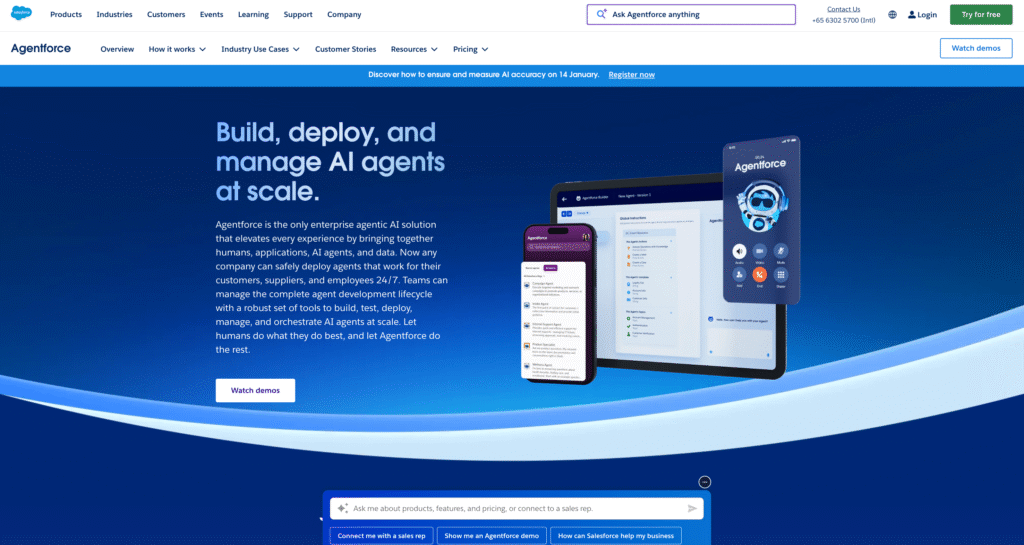
Salesforce has taken a major step forward in AI-driven automation with the launch of Agentforce, one of the most advanced AI tools for workflow automation in the world in 2026. Unlike earlier chatbot tools that only answered simple queries, Agentforce acts as a digital worker capable of taking real actions—such as resolving support cases, updating records, and executing cross-platform tasks autonomously. This evolution has positioned Salesforce as a leader in enterprise-grade workflow automation powered by artificial intelligence.
From Conversational Bots to Digital Workers
Agentforce marks a clear departure from traditional conversational assistants. These new AI agents are designed to function more like virtual employees who can perform specific tasks across the Salesforce ecosystem, including Sales Cloud, Service Cloud, and the broader Customer 360 platform.
Rather than charging customers based on conversations, Salesforce introduced a usage-based pricing structure built on “Flex Credits.” This model enables organizations to pay only for what the digital agent actually does. Each automated action consumes 20 Flex Credits, which translates to $0.10 per action. This outcome-based pricing model brings more financial control and transparency to enterprises adopting AI tools at scale.
Flexible and Transparent Pricing Model
Salesforce introduced a dynamic credit system to make Agentforce accessible across different industries and business sizes. This approach enables precise budgeting based on actual usage, rather than vague estimates of AI engagement.
Here is a breakdown of the current pricing framework for Agentforce in 2026:
| Pricing Component | Cost (USD) | Unit or Notes |
|---|---|---|
| Flex Credit Pack | $500.00 | Includes 100,000 Flex Credits |
| Cost per AI Action | $0.10 | 20 Flex Credits per action |
| Legacy Model (per conversation) | $2.00 | Fixed fee, older pricing format |
| Agentforce Add-On (Sales/Service) | $125/user/month | Base pricing for commercial use |
| Agentforce for Public Sector | $650/user/month | Includes government-specific features |
| Salesforce Enterprise Edition | $165/user/month | Required base subscription |
This structure helps companies predict costs with greater accuracy while scaling automation across departments.
Integrated AI Capabilities Through Einstein and Data Cloud
Agentforce gains its power from deep integration with Salesforce Einstein and Data Cloud. These integrations allow the AI agents to pull live customer data, analyze context, and take action across the organization. For example, an agent can automatically update CRM entries, schedule follow-ups, and resolve service tickets—without human intervention.
This real-time access ensures agents can function with precision and improve customer experience, all while reducing manual labor. For a mid-sized business with 50 users, the average annual cost of a comprehensive Agentforce deployment is estimated between $102,000 and $114,000, depending on credit usage and selected add-ons.
Business Impact and Productivity Gains
Even though the platform may appear expensive at first glance, the value becomes clear through measurable productivity improvements. According to Salesforce’s internal research and client feedback:
- 74% of employees using Agentforce say the tool helps them complete their work faster.
- 82% of sales representatives report spending more time building client relationships and less time on administrative tasks.
These statistics illustrate a shift in how companies deploy human talent—allowing staff to focus on strategic goals while digital agents handle repetitive operations.
Cost Simulation Matrix: Agentforce in Mid-Market Organizations
| Business Type | Number of Users | Estimated Credits Used | Total Annual Cost (USD) | Productivity Gains Noted |
|---|---|---|---|---|
| Retail SaaS Company | 50 | 600,000 | $102,000 | 78% faster lead follow-up |
| Financial Services Firm | 60 | 800,000 | $112,000 | 71% fewer support delays |
| Public Sector Agency | 40 | 500,000 | $116,000 | 85% data entry reduction |
These examples show how Agentforce delivers customized automation depending on the industry and scale of deployment.
Positioning Among Global AI Workflow Tools in 2026
Agentforce competes directly with other major AI automation platforms, offering more control over task-level cost and robust enterprise integration. Below is a comparison matrix showing how Salesforce Agentforce stands out in 2026:
| Feature | Salesforce Agentforce | Microsoft Power Automate | UiPath AI | Zapier AI | Make (Integromat) |
|---|---|---|---|---|---|
| AI Task Billing Model | Flex Credit (Per Action) | Subscription / Usage | Subscription | Per Task | Per Task |
| Digital Worker Capability | Advanced | Moderate | High | Low | Medium |
| Real-Time Customer Data Access | Yes | Yes | No | No | No |
| Industry-Specific Pricing Tiers | Yes | No | Yes | No | No |
| Ideal for Mid-Large Enterprises | Yes | Yes | Yes | No | Yes |
This positioning reinforces Salesforce’s strategy of offering highly customizable AI automation for business users with exact tracking of actions and results.
Conclusion
In 2026, Salesforce Agentforce is not just an AI tool—it is a digital workforce management system that empowers businesses to automate processes with transparency, scale, and measurable ROI. By enabling real-time workflow execution, action-based billing, and smart data access, Agentforce has secured its place as one of the most important AI workflow automation tools in the world. Enterprises looking to reduce manual effort, improve speed, and enhance customer service are increasingly turning to Agentforce to lead their digital transformation.
3. n8n

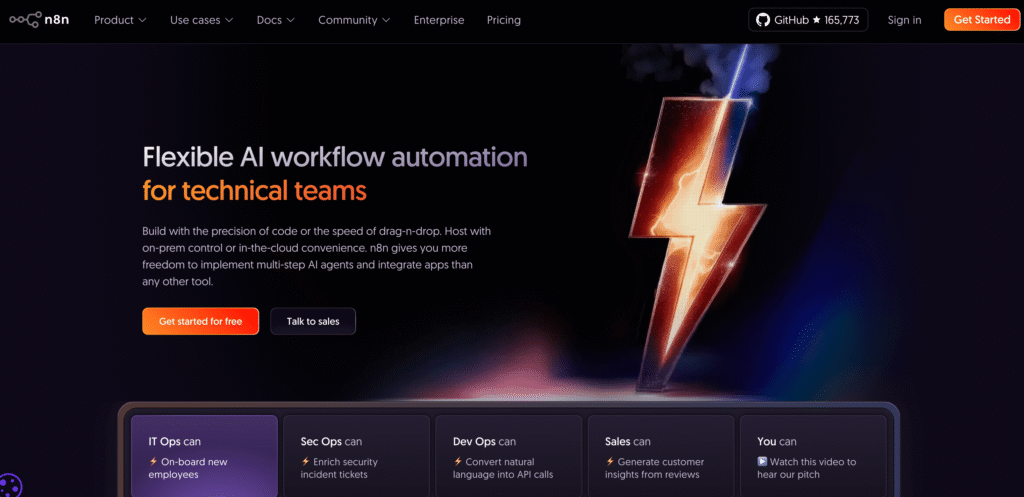
In 2026, n8n has solidified its reputation as one of the most versatile and developer-friendly AI workflow automation tools in the world. It is especially popular among technical teams, fast-growing startups, and privacy-conscious enterprises looking for total control over their data and automation infrastructure. Unlike other platforms that lock users into rigid pricing models or cloud-only hosting, n8n offers unmatched flexibility through its self-hosted, low-code approach.
A High-Growth Automation Platform Backed by Global Investors
The Berlin-based startup behind n8n has experienced rapid growth, leading to a $2.5 billion valuation following a $180 million Series C funding round led by Accel and supported by Nvidia. This surge in valuation is backed by strong financial and user growth. In 2025 alone, n8n’s revenue increased tenfold, while its user base expanded by six times.
Key financial and adoption metrics for n8n are summarized below:
| Metric | Value | Notes and Context |
|---|---|---|
| Active Users | 230,000+ | As of March 2025 |
| Annual Recurring Revenue (ARR) | $40 Million+ | Early 2025 estimate |
| Enterprise Clients | 3,000+ | Includes Vodafone, Softbank |
| Total Funding Raised | $240 Million | Since 2019 |
| GitHub Stars | 89,000+ | Indicates strong developer adoption |
| Company Valuation | $2.5 Billion | Post-Series C, October 2025 |
Execution-Based Pricing Model Offers Cost Efficiency
n8n’s pricing structure is different from many mainstream automation platforms. Rather than charging based on the number of steps or API calls like Zapier or Make, n8n uses a workflow execution model. Each execution, regardless of how many internal tasks it performs, is counted as a single unit. This approach is especially beneficial for teams running high-volume workflows or AI-integrated pipelines such as Retrieval-Augmented Generation (RAG).
The table below compares n8n’s pricing model with its competitors:
| Platform | Pricing Model | Cost Efficiency for Complex Workflows | Self-Hosting Support | AI Workflow Capabilities |
|---|---|---|---|---|
| n8n | Per Execution | High | Yes | Yes |
| Zapier | Per Task | Low | No | Limited |
| Make (Integromat) | Per Operation | Moderate | No | Moderate |
| UiPath | Subscription-Based | High (enterprise) | Yes | Yes |
Built for Developers and Scalable AI Integration
One of n8n’s strongest advantages lies in its technical flexibility. Users can create custom workflow nodes using JavaScript or Python, allowing teams to build precisely tailored automations. The platform also features a growing library of over 4,000 community-contributed workflow templates, making it easier for teams to launch new automations quickly.
These capabilities are supported by an open-source “fair-code” license, giving users the freedom to run n8n on their own servers, a key compliance advantage under the EU AI Act and similar global privacy laws.
Enterprise Case Studies Highlight Real-World Value
n8n has demonstrated tangible business benefits across industries. In notable real-world deployments:
- Vodafone used n8n to build a threat intelligence automation system, saving approximately £2.2 million in operational costs annually.
- StepStone, a major recruitment platform, reduced its data integration timeline from two weeks to just two hours—achieving a 25x increase in process efficiency.
Case study insights:
| Company | Use Case | Impact Achieved |
|---|---|---|
| Vodafone | Cybersecurity automation | £2.2 million annual savings |
| StepStone | Data source integration | 25x faster integration process |
| Fintech Startup | Real-time fraud detection | Improved detection rates, faster alerts |
| SaaS Company | Multi-channel lead management | Unified system reduced lead response time by 70% |
Positioning Among the Top AI Workflow Tools in 2026
n8n is now a go-to automation platform for teams that require full control over their workflows, integrations, and data privacy. It offers both the technical depth for advanced developers and the usability required for smaller, fast-moving teams.
Here’s how n8n ranks among other major AI automation tools in 2026:
| Feature / Capability | n8n | Power Automate | Agentforce | UiPath | Make |
|---|---|---|---|---|---|
| Self-Hosting Available | Yes | No | No | Yes | No |
| Execution-Based Billing | Yes | No | Partial | No | No |
| Custom Node Support | Yes | Limited | No | Yes | No |
| Open-Source License | Yes | No | No | No | No |
| Community Workflow Library | 4,000+ | 1,000+ | 500+ | 1,200+ | 800+ |
| EU AI Act Compliance Ready | High | Moderate | Moderate | High | Low |
Conclusion
As the demand for secure, customizable, and scalable AI automation platforms continues to rise, n8n has emerged as a top-tier global solution in 2026. With its fair-code approach, cost-effective execution model, strong developer ecosystem, and proven enterprise results, n8n offers a powerful alternative to more rigid, task-based platforms. Its flexible design and strong performance in real-world scenarios make it a standout among the Top 10 AI Tools for Workflow Automation in the world today.
4. Zapier

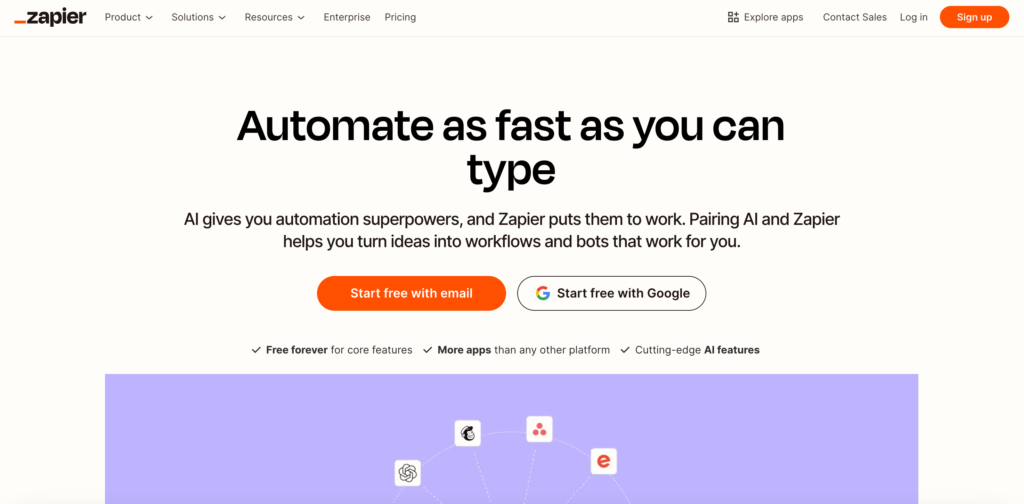
Zapier has continued to maintain its status as the most user-friendly and widely accessible AI automation platform in the world in 2026. Positioned as the go-to tool for small and midsize businesses (SMBs), Zapier simplifies automation with over 8,000 app integrations and an intuitive interface that enables non-technical users to automate repetitive workflows with ease.
As automation tools grow more intelligent, Zapier has adapted by introducing AI-native features that extend beyond simple triggers and actions. This evolution ensures its continued relevance among the Top 10 AI Tools for Workflow Automation globally.
A Capital-Efficient Powerhouse with Impressive Revenue Growth
Zapier has built its reputation not just on its capabilities but also on its remarkable capital efficiency. Despite reaching a $5 billion valuation, the company has raised under $3 million in venture funding since its inception. This lean approach hasn’t slowed its growth—revenue reached $310 million in 2024 and is projected to hit $400 million by the end of 2025, reflecting strong year-over-year expansion.
Revenue growth trajectory for Zapier:
| Year | Revenue (USD Millions) | Year-over-Year Growth | Paying Customers |
|---|---|---|---|
| 2021 | $150.0 | — | — |
| 2022 | $220.0 | 46.7% | — |
| 2023 | $250.7 | 14.0% | — |
| 2024 | $310.0 | 23.6% | 100,000+ |
| 2025 (P) | $400.0 | 29.0% (Projected) | Continued expansion |
AI-Native Features Through Zapier Central and Autonomous Agents
In 2026, Zapier introduced a new layer of intelligent automation called “Zapier Central.” This is a centralized AI workspace where users can deploy “Zapier Agents”—autonomous digital assistants capable of handling multi-step processes across applications without constant user input.
These agents can perform advanced actions such as:
- Monitoring CRM activity and drafting personalized emails
- Syncing lead information across marketing and sales platforms
- Pulling insights from spreadsheets and sending weekly summaries
- Executing conditional tasks based on user engagement trends
The result is a more proactive automation system that feels less like a static tool and more like a digital coworker.
Affordable Entry, But Scaling Costs Remain a Challenge
Zapier’s task-based pricing model continues to appeal to beginners and startups. However, its cost structure can become difficult to manage for large-scale usage, especially since every individual action within a workflow is billed as a separate task. Enterprises often encounter higher operational costs when running complex, high-volume workflows.
Below is a summary of Zapier’s 2026 pricing framework:
| Plan Type | Starting Price (USD/Month) | Tasks / Activities Included | Notes |
|---|---|---|---|
| Professional Plan | $19.99 | 750 Tasks | Entry-level orchestration tier |
| Agents Pro Plan | $33.33 | 1,500 Activities | Includes Zapier Agents functionality |
| Team Plan | $69.00 | 2,000+ Tasks | Collaboration and shared workflows |
| Enterprise Plans | Custom Pricing | Custom Quotas | Includes priority support and security |
Although Zapier remains cost-effective for light automation needs, it may not be ideal for large corporations that require robust governance, secret management, and detailed role-based access control (RBAC). Competitors like Workato and n8n tend to offer more advanced options in these areas.
Core Feature Matrix: Comparing Zapier to Other AI Workflow Tools in 2026
| Feature / Capability | Zapier | n8n | Power Automate | Agentforce | Workato |
|---|---|---|---|---|---|
| App Integrations | 8,000+ | 400+ | 1,000+ | 300+ | 1,200+ |
| AI-Native Agents | Yes | Partial | Yes | Yes | Partial |
| Self-Hosting Available | No | Yes | No | No | No |
| Role-Based Access Control | Basic | Advanced | Advanced | Advanced | Advanced |
| Entry-Level Affordability | High | Medium | Medium | Low | Low |
| Scalability for Enterprise | Medium | High | High | High | High |
Business Use Cases for Zapier in 2026
Zapier continues to thrive in industries and organizations that prioritize speed and simplicity over complex customization. It is especially valuable for marketing teams, sales automation, ecommerce integrations, and customer service workflows.
Real-world examples include:
| Use Case | Industry | Benefit Delivered |
|---|---|---|
| Lead Nurturing with CRM Sync | B2B Marketing | Saved 20+ hours/month in manual updates |
| Ecommerce Order Notifications | Retail | Automated shipping alerts via email/SMS |
| Weekly KPI Reports via Slack | SaaS | Reduced reporting workload by 80% |
| Google Forms to Sheets to CRM | Education | Streamlined admissions intake process |
Conclusion
In 2026, Zapier continues to stand out as a top-tier AI automation platform, particularly for startups and small businesses that need quick and easy automation without a heavy learning curve. Its move toward AI-native agents has modernized its value proposition, allowing users to automate more advanced scenarios across thousands of applications. While it may not offer the enterprise-level controls of other platforms, Zapier’s unmatched app ecosystem, affordability, and simplicity make it one of the most important AI tools for workflow automation in the global landscape today.
5. Workato

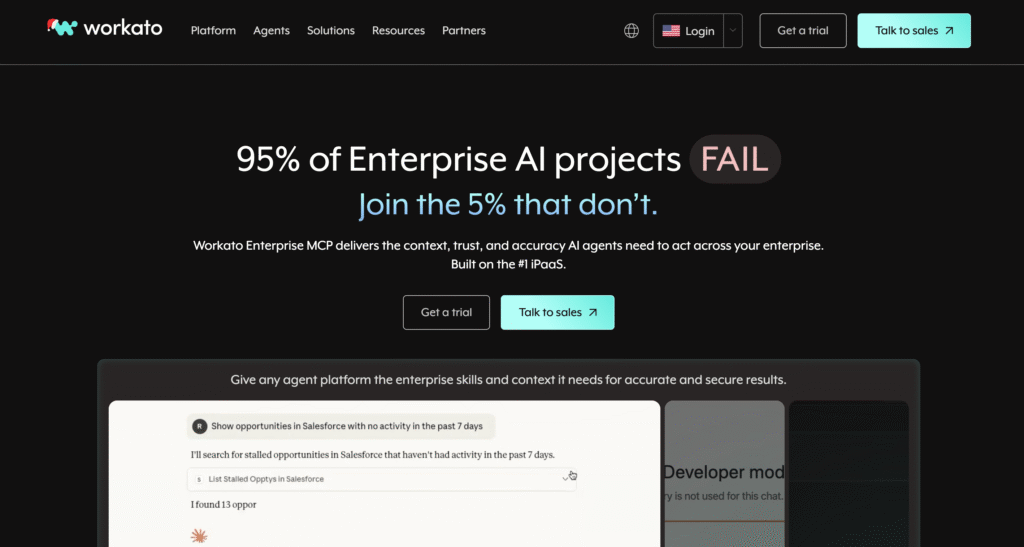
Workato has become one of the top global AI tools for workflow automation in 2026, particularly among large enterprises with complex system requirements. The company has established itself as the pioneer of a new automation category known as “agentic orchestration,” which blends artificial intelligence, integration, and security into one cohesive automation layer. Workato’s unique position caters to organizations that want not only powerful automation but also strict governance, compliance, and long-term scalability.
Positioned for Hypergrowth with Strong Financial Backing
Workato’s expansion over the past few years has been impressive. The platform was ranked among North America’s fastest-growing companies on the Deloitte Technology Fast 500 in 2025, after achieving 279% revenue growth from 2021 to 2024. Its valuation reached $5.7 billion following a successful Series E funding round, with $421 million raised in total. As of 2023, Workato reported $150 million in annual recurring revenue, with continued upward momentum.
Workato’s financial and adoption metrics:
| Metric | Value | Description |
|---|---|---|
| Annual Recurring Revenue (ARR) | $150 Million | 36% year-over-year growth |
| Total Funding Raised | $421 Million | Across multiple venture rounds |
| Estimated Valuation | $5.7 Billion | Series E valuation in 2023 |
| Total Customers | 17,000+ | Used by top global brands |
| Recipe Library | 500,000+ | Pre-built integrations and automation templates |
| AI Use Case Growth (2023–2025) | 500% | Explosion in generative AI deployments |
Bridging the GenAI Divide with Practical AI Integration
Workato’s core strategy in 2026 is to help enterprises move from AI experimentation to real-world impact. According to internal research, while 80% of businesses have tested tools like ChatGPT, less than 5% have successfully deployed custom AI workflows into full production. Workato addresses this challenge by introducing its “Agentic Orchestration Runtime,” which ensures that every AI task—whether it’s a chatbot query, automated data transfer, or internal alert—is executed under strict enterprise-grade controls.
This governance layer ensures:
- Consistent data security policies
- Role-based access permissions
- Encryption key rotation and audit logging
- Seamless compliance with industry standards like SOC 2 and GDPR
The AgentX Suite: Purpose-Built AI Agents for Enterprise Teams
Workato’s “AgentX” suite offers specialized AI agents tailored for departments such as IT, Sales, and Support. These agents automate domain-specific processes while remaining compliant with security protocols. For example:
- AgentX IT automates helpdesk operations, including ticket routing, user provisioning, and software access management.
- AgentX Sales manages lead scoring, CRM updates, and meeting scheduling.
- AgentX Support handles SLA tracking, case escalations, and omnichannel response workflows.
These AI agents are especially relevant for CIOs and IT directors who require intelligent automation without sacrificing control or compliance.
Key features of Workato’s AgentX framework:
| AgentX Application | Core Automation Capabilities | Governance Features |
|---|---|---|
| IT | Ticket triaging, provisioning, compliance reporting | Encryption, RBAC, hourly key rotation |
| Sales | Auto lead enrichment, CRM updates, personalized follow-ups | Audit logs, API throttling limits |
| Support | SLA tracking, escalation paths, multi-channel sync | Enterprise-wide access controls |
Market Comparison Matrix: How Workato Stands Among Top AI Tools in 2026
| Feature / Platform | Workato | Microsoft Power Automate | Salesforce Agentforce | n8n | Zapier |
|---|---|---|---|---|---|
| Target Audience | Enterprises | Large Enterprises | Enterprises | Developers | SMBs |
| AI-Native Agents Available | Yes | Yes | Yes | Partial | Yes |
| Role-Based Access Control (RBAC) | Advanced | Moderate | Advanced | Advanced | Basic |
| Self-Hosting Support | No | No | No | Yes | No |
| Encryption Key Management | Yes | Limited | Yes | Yes | No |
| Recipe / Integration Templates | 500,000+ | 1,000+ | 500+ | 4,000+ | 8,000+ |
| Custom AI Workflows | Yes | Yes | Partial | Yes | Limited |
Enterprise Use Cases That Demonstrate Measurable ROI
Workato’s automation tools have already shown real-world success in transforming operations for global enterprises. For example:
| Organization Type | Workato Use Case | Business Outcome |
|---|---|---|
| Global Tech Company | Automated onboarding and offboarding | 60% reduction in IT admin hours |
| Healthcare Provider | AI-based insurance claim processing | Reduced processing time by 40% |
| Financial Institution | Compliance automation for KYC/AML | Improved audit readiness, faster client intake |
| E-commerce Platform | Order-to-invoice workflow automation | Improved order accuracy, faster reconciliation |
Conclusion
In 2026, Workato leads the AI automation space for enterprises that demand secure, scalable, and intelligent workflow orchestration. Its AgentX suite, agentic orchestration runtime, and expansive integration ecosystem make it a core platform for IT leaders, CIOs, and digital transformation officers. With deep investments in security, usability, and generative AI deployment, Workato is one of the most influential and capable AI tools for workflow automation in today’s global enterprise market.
6. Make (formerly Integromat)

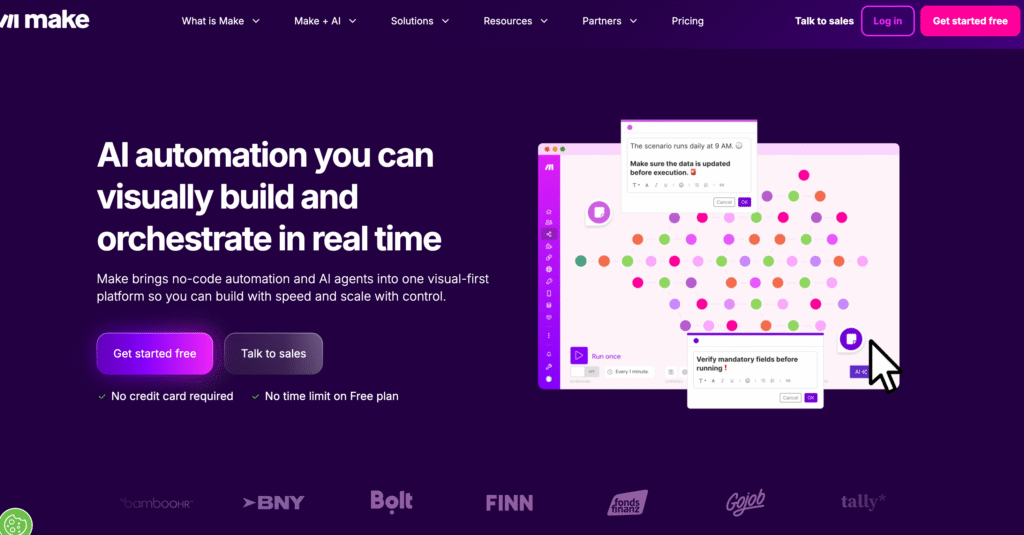
Make, previously known as Integromat, has evolved into one of the world’s most reliable and flexible AI automation platforms in 2026. It is widely used by operations teams and mid-sized businesses that require advanced control over workflows without the technical challenges of managing self-hosted platforms like n8n. Known for its visual interface and affordability, Make holds a strong position in the global list of the Top 10 AI Tools for Workflow Automation.
Visual AI Workflow Builder with Grid-Based Precision
Make’s unique strength lies in its highly visual grid interface. This system allows users to map out complex workflows in a modular layout, giving a clear view of every agent, step, and condition in the process. Each element can be debugged in real-time using its built-in Visual Debugger, enabling complete observability of how data flows and decisions are made.
This makes it particularly valuable for:
- Multi-branch workflows
- Conditional routing
- Data transformation and enrichment
- AI orchestration and integration
The grid view simplifies the process of scaling operations, while still offering robust technical depth for advanced automation cases.
Flexible Pricing Model for Every Business Tier
In terms of affordability, Make stands out from enterprise competitors with its step-based pricing model. While each action or step within a workflow consumes credits, the entry cost is far lower than most platforms offering similar power. This makes Make ideal for businesses needing high throughput without exceeding their automation budgets.
Below is a detailed overview of Make’s 2026 pricing and limitations:
| Plan Tier | Monthly Price (Billed Annually) | Operation Limit | Notable Feature / Limitation |
|---|---|---|---|
| Free | $0 | 1,000 operations | No API access |
| Core | $9 | 10,000 operations | 60 API calls per minute |
| Pro | $16 | 10,000 operations | Priority execution |
| Teams | $29 | 10,000 operations | Includes 2-stage authentication |
| Enterprise | Custom | Custom quotas | Includes 99.5% uptime SLA |
Despite the attractive entry points, users with AI-heavy workloads or high-frequency loops need to monitor credit usage carefully, as advanced AI steps may consume multiple credits per action.
Security and Compliance for Modern Enterprises
By 2026, Make has significantly expanded its trustworthiness through third-party certifications. It has achieved both SOC 2 Type II and ISO 27001 compliance, demonstrating its commitment to enterprise-level security standards. These credentials make it viable for industries that deal with sensitive data, such as finance, healthcare, or legal services.
Additionally, Make’s automation reliability is reinforced by its high-availability infrastructure and real-time logging capabilities, which reduce operational risk even in complex environments.
Application Integration Ecosystem and Market Position
Make offers a large and growing integration library, with over 2,800 apps connected as of 2026. This includes leading tools across CRM, marketing, analytics, finance, HR, and project management, ensuring that users can orchestrate workflows across virtually every major SaaS platform.
Comparison matrix highlighting Make’s market position:
| Platform | App Integrations | Visual Builder | Step-Based Pricing | Self-Hosting | AI Node Support | Observability Tools |
|---|---|---|---|---|---|---|
| Make (Integromat) | 2,800+ | Yes | Yes | No | Yes | Visual Debugger |
| Zapier | 8,000+ | Limited | Yes | No | Partial | Minimal |
| n8n | 400+ | Yes | No (Exec-based) | Yes | Yes | Moderate |
| Power Automate | 1,000+ | Yes | Partial | No | Yes | Moderate |
| Workato | 500,000+ Recipes | Yes | No (Subscription) | No | Yes | Advanced (AgentX Logs) |
Key Use Cases Where Make Excels in 2026
Make is often chosen for use cases that demand large-scale operations combined with customizable AI logic. It supports a range of industries, including e-commerce, logistics, marketing, and digital services.
Examples of successful Make applications:
| Industry | Use Case | Business Impact |
|---|---|---|
| E-commerce | Inventory synchronization with ERP | Reduced stockouts by 90% |
| Marketing Agencies | AI-generated campaign performance alerts | Improved campaign ROI by 25% |
| Logistics | Real-time route updates via external APIs | Faster delivery scheduling by 40% |
| SaaS Platforms | Client onboarding workflow with AI scoring | Reduced onboarding time from 5 days to 1 day |
Conclusion
In the 2026 landscape of AI workflow automation tools, Make stands out as a cost-effective, powerful, and user-friendly solution. It offers a middle ground between simplicity and sophistication—ideal for operations teams that need reliable performance, real-time monitoring, and scalable visual design. With its fast-growing app ecosystem, certified security posture, and competitive pricing, Make has earned its place among the world’s most trusted and widely adopted AI tools for workflow automation.
7. Nanonets

Nanonets has risen to global recognition in 2026 as one of the most powerful AI tools for workflow automation, particularly in document-heavy and finance-related operations. What began as a smart OCR solution has grown into a full-featured AI agent platform built to automate time-consuming, repetitive back-office processes with remarkable accuracy and speed.
With a focus on digitizing operations in finance, accounting, and logistics, Nanonets now supports thousands of enterprises that seek to reduce manual effort, increase data reliability, and improve processing efficiency across their core administrative systems.
Strategic Growth and Enterprise-Ready Infrastructure
Founded in San Francisco in 2017, Nanonets attracted strong investor confidence and secured a $29.3 million Series B round in early 2024. This funding supported its transition from a document-processing tool into a comprehensive autonomous agent platform. By 2026, the company has positioned itself as a leading AI-powered workflow automation tool used by governments, multinational manufacturers, logistics providers, and financial service firms.
These AI agents are built specifically for:
- Invoice data capture and 3-way matching
- Tax document classification and reconciliation
- Purchase order validation and approval routing
- Backlog elimination for paper-based financial workflows
Measurable Efficiency Gains Across Sectors
The platform is known for delivering some of the most substantial efficiency improvements in the AI workflow automation industry. These gains are not theoretical—they are demonstrated through real-world case studies with quantifiable metrics.
Table of Nanonets automation ROI benchmarks in 2026:
| Use Case | Performance Metric | Results Achieved |
|---|---|---|
| Document Processing | 80% Faster | Cross-industry average speed improvement |
| Data Entry Error Reduction | 65% Fewer Errors | Higher accuracy vs. manual entry |
| Tax Refund Processing | 96% Speedup | From 24 weeks to 1 week (Gov Agency) |
| Purchase Order Cycle Time | 90% Shorter | From 8 minutes to 48 seconds (Suzano) |
| Accounts Payable Automation | 192 Hours Saved/Month | Asian Paints’ monthly engineering time saved |
These results highlight how AI automation in traditional back-office functions can directly translate into time, cost, and productivity savings at scale.
Deep Learning-Powered Document Understanding
Nanonets does not rely on rigid templates like traditional OCR tools. Instead, it uses advanced deep learning models to understand document structure and extract context-specific information from unstructured formats such as scanned receipts, PDFs, or handwritten forms.
This means the platform can learn and adapt to new document layouts without requiring configuration, which is critical in industries dealing with thousands of invoice formats, delivery slips, contracts, or customs forms.
Robust Integration with Enterprise Systems
What makes Nanonets especially practical for large organizations is its plug-and-play compatibility with leading ERP and enterprise resource tools, including:
- SAP
- Oracle
- Microsoft Dynamics
- QuickBooks
- Netsuite
This seamless integration allows businesses to automate processes without needing to rebuild their internal systems from scratch, ensuring minimal disruption and faster deployment.
Enterprise integration matrix:
| Platform / ERP System | Integration Support | Use Cases Enabled |
|---|---|---|
| SAP | Full | Accounts payable, financial reconciliation |
| Oracle | Full | Tax processing, vendor payment verification |
| Microsoft Dynamics | Full | Purchase orders, approval workflows |
| QuickBooks | Partial | SMB finance automation |
| Netsuite | Full | Invoice matching, audit trail digitization |
Comparative Market Position in 2026
Among the world’s Top 10 AI Tools for Workflow Automation in 2026, Nanonets has carved a distinct niche by focusing on document intelligence and back-office efficiency.
Market comparison table:
| Feature / Tool | Nanonets | Workato | Power Automate | Zapier | n8n |
|---|---|---|---|---|---|
| Document AI Specialization | Advanced | Moderate | Limited | None | Limited |
| Deep Learning OCR | Yes | No | No | No | No |
| ERP System Integration | Strong | Moderate | Strong | Weak | Moderate |
| Template-Free Extraction | Yes | No | Partial | No | Partial |
| Best For | Finance, Accounting | Enterprise Ops | Enterprise Workflow | SMBs | Developers |
Real-World Deployment Impact
Examples of how organizations are using Nanonets today:
| Organization | Workflow Automated | Tangible Outcome |
|---|---|---|
| Government Agency | Tax refund reconciliation | Processing time dropped from 24 weeks to 1 week |
| Asian Paints | Invoice and AP operations | Saved 192 hours per month; 90% faster workflow |
| Suzano | Purchase order lifecycle management | Cycle time cut by over 90% |
| Logistics Provider | Shipping document validation | Eliminated manual entry errors by 60% |
Conclusion
In the 2026 automation ecosystem, Nanonets stands out for its deep specialization in intelligent document processing and finance-focused automation. Its AI agents deliver measurable results by eliminating manual backlogs, accelerating approval cycles, and integrating seamlessly into legacy ERP systems.
With high-accuracy deep learning models, enterprise-grade compatibility, and unmatched speed in handling unstructured data, Nanonets has earned its place as one of the world’s most valuable and effective AI tools for workflow automation in back-office operations.
8. Lindy.ai

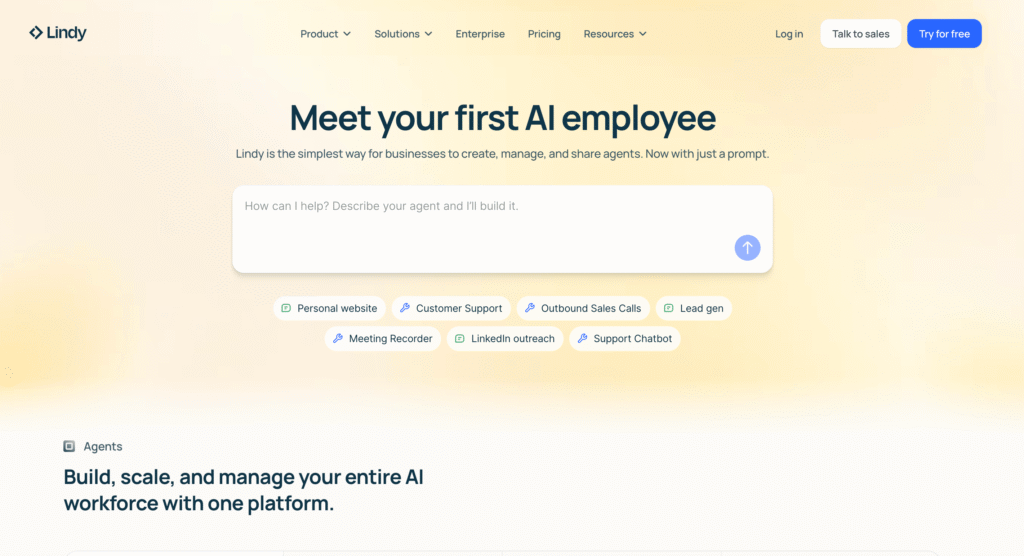
Lindy.ai has become one of the most talked-about AI tools for workflow automation in 2026, especially among independent professionals, freelancers, and small-to-medium-sized businesses. It introduces a new generation of automation platforms known as “AI Employees”—virtual agents that are created by simply describing a role or task using natural language.
Unlike more complex enterprise automation tools, Lindy.ai is designed for users with little to no technical background. It empowers anyone to build AI agents for day-to-day digital tasks such as handling emails, researching sales leads, organizing schedules, or preparing executive summaries. Its simplicity, affordability, and speed have helped it secure a spot in the Top 10 AI Tools for Workflow Automation worldwide.
From Concept to Execution Using Natural Language and Visual Tools
Lindy.ai allows users to generate fully functional AI agents just by describing what they want the agent to do—no coding needed. Its easy-to-use drag-and-drop builder and Chrome extension add even more functionality, enabling users to record tasks directly from their browser and convert them into automation agents.
Some common tasks users automate with Lindy.ai include:
- Triaging and replying to daily emails
- Researching background information on leads or clients
- Compiling meeting summaries or reports
- Managing scheduling conflicts and reminders
- Responding to basic support or inquiry requests
These tasks can be configured using over 100 pre-built templates tailored for roles in sales, support, administration, and operations.
Market Share and Adoption in the Growing AI Agent Ecosystem
Lindy.ai holds a growing but distinct position in the AI agent ecosystem. In a 2026 market overview of autonomous agent platforms, Lindy is particularly recognized for its adoption among SMBs and independent professionals, offering an accessible alternative to more complex tools like Gemini or Claude.
Estimated market share and monthly active users (MAUs):
| AI Agent Platform | Market Share (%) | Estimated MAUs | Core Use Case Focus |
|---|---|---|---|
| Gemini (Agent Mode) | 57.8% | 2.6 Million | General Productivity |
| Claude (Computer Use) | 7.0% | 317,000 | Complex Reasoning |
| Lindy.ai (SMB/Indie) | 3.5% (Est.) | 150,000 (Est.) | Workflow Automation |
| Bardeen (Browser-based) | 3.2% | 146,000 | Chrome-Based Automation |
| AgentGPT | 4.3% | 194,000 | Web Task Management |
Despite its smaller market share, Lindy stands out for ease of use and flexibility for everyday business needs, particularly in customer support, executive assistance, and lead management.
Voice Automation and Multimodal Task Handling
One of the standout features that differentiates Lindy from most automation tools is its AI Voice capability. Users can deploy voice-enabled agents that not only respond to commands but can also handle voice calls, voicemails, and voice-based scheduling.
This voice-native approach expands its usability for remote workers, field sales reps, or business owners who rely on mobile workflows. These agents can:
- Answer and respond to basic inquiries via phone
- Read and summarize voicemails
- Execute voice-activated task sequences
- Transcribe and act on spoken instructions
Pricing Model Tailored for Solo Professionals and SMBs
Lindy.ai offers competitive pricing that caters to budget-conscious users. Its Pro plans are priced between $39.99 and $49.99 per month, which cover up to 1,500 automated tasks. This is a significant value compared to traditional platforms that charge based on every step or action.
Pricing summary:
| Plan Type | Price (USD/Month) | Task Volume Included | Ideal For |
|---|---|---|---|
| Starter | Free | Limited features | Trial users and personal use |
| Pro | $39.99–$49.99 | 1,500 Tasks | Independent professionals |
| Team | Custom Pricing | Scalable | Small businesses and startups |
This structure gives users flexibility to scale their automation as their workflow grows, without needing enterprise-level budgets.
Comparison Table: Lindy.ai vs. Other AI Automation Platforms in 2026
| Feature / Platform | Lindy.ai | Zapier | Power Automate | Workato | Make |
|---|---|---|---|---|---|
| Natural Language Role Setup | Yes | No | Partial | No | No |
| Chrome Action Recorder | Yes | No | No | No | No |
| Voice Automation | Yes | No | No | No | No |
| Pre-Built Agent Templates | 100+ | 8,000+ Apps | 1,000+ Flows | 500,000+ | 2,800+ Apps |
| AI Employee Focus | Strong | Weak | Medium | Medium | Weak |
| Ideal Audience | SMBs/Indies | SMBs | Enterprises | Enterprises | Operations |
Sample Use Cases for Lindy.ai Users
| Role / Industry | Automated Task | Business Outcome |
|---|---|---|
| Freelance Executive Assistants | Daily email summaries and calendar sync | Saved 6+ hours per week on manual admin |
| Small Business Owners | Lead research and CRM note updates | Reduced prospecting time by 50% |
| Marketing Managers | Competitor briefings and inbox filtering | Improved campaign responsiveness |
| Consultants | Voice-to-summary call notes | Better meeting documentation |
Conclusion
Lindy.ai is redefining how non-technical users interact with automation in 2026. Its voice-enabled agents, Chrome-based recording features, and natural language setup allow professionals and small teams to automate workflows without writing a single line of code. With growing adoption, smart pricing, and an intuitive interface, Lindy.ai has become a highly valuable tool in the global list of Top 10 AI Workflow Automation platforms, especially for those looking to create personalized, human-like digital assistants that work across their daily tools and routines.
9. Relevance AI

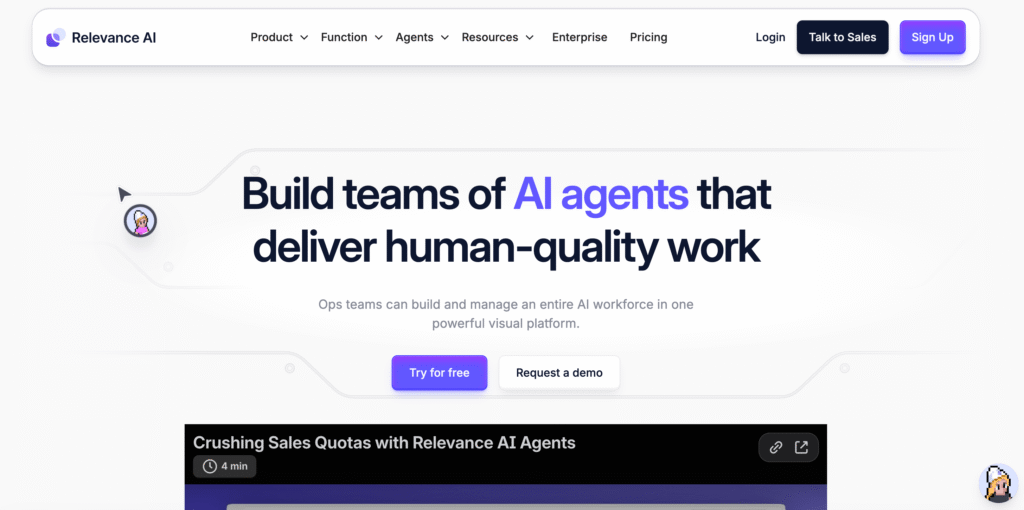
Relevance AI has emerged as one of the most advanced and flexible platforms in the 2026 global landscape of AI workflow automation tools. Unlike many AI platforms that focus on single-task automation, Relevance AI is built around the idea of an “AI Workforce”—a system of multiple intelligent agents working together in a structured supervisor-worker model to complete complex and multi-stage business processes.
Its unique combination of deep technical infrastructure, multi-model flexibility, and cost-effective pricing makes it one of the top choices for businesses that need highly capable AI agents capable of reasoning, adapting, and autonomously making decisions across vast datasets and enterprise environments.
Enterprise-Grade Multi-Agent Architecture with Autonomous Coordination
Relevance AI is specifically designed for operations teams, product builders, and subject-matter experts who need more than just basic automation. The platform’s multi-agent model enables users to create digital workforces where specialized agents are assigned different roles—such as research, analysis, reporting, or quality assurance—and operate under a central supervisory agent that coordinates their behavior.
This distributed intelligence allows teams to:
- Build pipelines where agents perform parallel tasks (e.g., data extraction, sentiment analysis, summarization)
- Manage long-running processes such as compliance audits or content moderation
- Assign AI agents different reasoning engines based on task complexity or cost constraints
Multi-Model AI Support to Avoid Vendor Lock-In
One of Relevance AI’s most strategic features in 2026 is its support for multiple AI models within the same workflow. Unlike tools that are restricted to a single model provider, Relevance AI allows developers and teams to mix and match providers such as OpenAI, Anthropic, Hugging Face, and Mistral.
This flexibility means organizations can:
- Optimize AI choices based on speed, quality, and pricing
- Maintain fallback models for critical tasks
- Reduce dependency on any one AI vendor, enhancing long-term strategic control
Model compatibility matrix:
| AI Model Provider | Supported by Relevance AI | Use Case Suitability |
|---|---|---|
| OpenAI (e.g. GPT-4/5) | Yes | General reasoning, summarization, chatbots |
| Anthropic (Claude) | Yes | Context-rich decision-making |
| Hugging Face | Yes | Open-source deployments, NLP tasks |
| Mistral | Yes | Lightweight agents, cost-sensitive tasks |
Corporate Milestones and Global Expansion
Founded in Sydney, Australia in 2020, Relevance AI has expanded quickly, raising $37.2 million in total funding, including a $24.1 million Series B round in May 2025. With an employee base of around 80 and growing global reach, the company has attracted backing from major investors like Accel and Insight Partners—two of the most respected venture firms in the AI sector.
Relevance AI’s company profile:
| Metric | Value | Description |
|---|---|---|
| Total Funding Raised | $37.2 Million | Series B led by Insight Partners in 2025 |
| Employees | 80+ | Rapidly growing technical team |
| Headquarters | Sydney, Australia | Serves clients across the globe |
| Lead Investors | Accel, Insight Partners | Tier-1 venture capital support |
| Compliance Framework | SOC 2 Type II Certified | Enterprise-grade security and data handling |
| Key Differentiator | Multi-agent supervision | Supervisor-agent coordination framework |
Advanced Governance Through AI-Driven Oversight
Relevance AI prioritizes secure and compliant automation through its built-in “Governance Agents.” These agents are responsible for monitoring the activity of other agents across workflows. They ensure:
- Real-time detection of anomalies or unusual behavior
- Prevention of sensitive data leaks
- Enforcement of enterprise security protocols across AI-driven workflows
This layered architecture not only ensures task accuracy but also helps organizations meet regulatory requirements in sectors such as finance, healthcare, and government operations.
Agent governance workflow structure:
| Role | Function | Impact on Workflow Stability |
|---|---|---|
| Supervisor Agent | Delegates tasks, monitors outputs | Coordinates agent behavior and timing |
| Worker Agent | Executes specific business logic | Completes focused micro-tasks |
| Governance Agent | Audits workflows, enforces compliance rules | Prevents errors, detects threats |
Cost-Effective Plans for Startups and Growth-Stage Businesses
Despite its high-end capabilities, Relevance AI remains competitively priced, making it accessible for startups and mid-sized teams. Plans begin at just $19 per month, which includes a generous quota of tasks and access to the platform’s core features—including the multi-agent builder and integrations.
Pricing snapshot:
| Plan Tier | Monthly Price (USD) | Included Features |
|---|---|---|
| Starter | $19 | Core agent builder, multi-model support, team tools |
| Pro | $49 | Extended task limits, advanced integrations |
| Enterprise | Custom Pricing | Compliance agents, SLAs, priority support |
Comparison Matrix: Relevance AI vs. Other AI Workflow Automation Tools (2026)
| Feature / Tool | Relevance AI | Workato | Power Automate | Zapier | Lindy.ai |
|---|---|---|---|---|---|
| Multi-Agent AI Framework | Yes | No | Partial | No | No |
| Multi-Model AI Support | Yes | No | No | No | No |
| Voice & Browser Integration | No | No | No | No | Yes |
| Ideal For | Ops & Product Teams | IT Teams | Enterprise IT | SMBs | Solopreneurs |
| Governance AI Agents | Yes | No | Partial | No | No |
| Pricing Starting Point | $19/month | $125/month | $15/month | $19.99 | $39.99 |
Conclusion
Relevance AI delivers a new standard for intelligent automation in 2026 by offering a full-stack multi-agent framework capable of reasoning, learning, and coordinating across enterprise-level tasks. With advanced AI governance, support for multiple LLMs, and a flexible pricing model, Relevance AI is not only ideal for large corporations but also for agile startups that want to scale fast without compromising on automation sophistication. This makes it one of the most future-proof and dynamic AI tools in the global Top 10 for workflow automation.
10. Relay (Relay.app)


Relay has positioned itself as one of the most important AI tools for workflow automation in 2026, especially for organizations that rely heavily on human judgment in critical business processes. Rather than aiming for full automation, Relay focuses on a hybrid approach—combining AI capabilities with human oversight to ensure reliability, accountability, and brand protection.
In sectors like sales, recruitment, and customer engagement, where missteps can damage relationships or reputations, Relay’s human-in-the-loop design provides an extra layer of control that many enterprises and customer-facing teams now consider essential.
A Platform Built on Judgment-Aware Automation
Founded in 2021 by Jacob Bank, former head of Gmail and Google Calendar, Relay was built to address a gap in most automation platforms—the absence of human review. While most tools prioritize speed and autonomy, Relay emphasizes decision quality, enabling users to create workflows with built-in review and approval steps before any action is finalized.
For instance, sales teams can set up a process where an AI-generated follow-up email is first reviewed by a human before being sent. In recruiting, hiring managers can be looped into decision-making steps before offer letters or rejection notices are dispatched.
Relay’s approval nodes, comments, and review modules turn each automation into a collaborative workspace where humans and AI can work together in a transparent and safe environment.
Growth Trajectory and Investment Milestones
Relay has secured significant financial backing to scale its operations and expand its features. After launching officially in late 2023, the company raised $35 million in a Series A round in February 2025, led by Plural VC. Combined with earlier seed funding of $3.1 million from Andreessen Horowitz (a16z), Relay’s total funding reached approximately $43 million by the end of 2025.
Corporate and product development timeline:
| Milestone | Date | Description |
|---|---|---|
| Official Launch | October 11, 2023 | Backed by a16z Seed funding |
| Series A Funding | February 27, 2025 | $35M led by Plural VC |
| SOC 2 Type II Compliance | Late 2025 | Strengthened security framework |
| Product Update: Native Tables | November 2025 | Built-in data storage to replace external sheets |
| AI Assistants Launched | May 2025 | Modular agents integrated into HITL workflows |
Human-First AI That Prioritizes Accuracy and Brand Safety
Relay’s value proposition is clear: in environments where one wrong message or misjudged automation can result in significant brand or legal risk, it’s not enough to rely solely on AI. Human-in-the-loop (HITL) functionality helps teams:
- Catch errors before emails or decisions are finalized
- Ensure sensitive communication is properly reviewed
- Maintain human tone and empathy in outreach
- Comply with internal policies and approval workflows
Relay also supports role-specific review permissions, tiered approvals, and conditional routing. These features enable flexible oversight—so not every decision needs the same level of scrutiny, but every critical moment still gets the attention it requires.
Native Tables: Built-in Data Handling for Faster Performance
Relay’s introduction of “Native Tables” in late 2025 has allowed users to store, manage, and query structured data within the platform itself. This eliminates the delays associated with syncing from tools like Google Sheets or Airtable.
Use cases include:
- Managing lead pipelines internally
- Tracking candidate interview stages
- Organizing feedback forms and approvals
- Creating lookup tables for workflow triggers
Performance improvement with Native Tables:
| Feature | Before Native Tables | After Native Tables |
|---|---|---|
| Data Syncing Time | 5–10 seconds via external APIs | Instant, on-platform access |
| Reliability | Prone to sheet sync failures | Stable with in-app data engine |
| Security Risk | Dependent on third-party tools | Centralized inside Relay |
Pricing and Accessibility
Relay offers flexible plans tailored for cross-functional teams. While pricing is typically customized for enterprise-level deployment, the platform has introduced self-serve tiers for startups and agencies as adoption grows.
Relay’s pricing model supports:
- Unlimited approval nodes
- AI Assistant modules
- Role-based permissioning
- Audit logs and compliance settings
- Integrations with Slack, Gmail, ATS/CRM tools
Comparative Matrix: Relay vs Other Workflow Automation Tools in 2026
| Feature / Platform | Relay | Power Automate | Zapier | Workato | Relevance AI |
|---|---|---|---|---|---|
| Human-in-the-Loop Support | Full | Partial | Limited | Moderate | No |
| Review & Approval Nodes | Yes | Partial | No | Limited | No |
| Built-In Tables | Yes | No | No | Yes | Yes |
| SOC 2 Type II Compliance | Yes | Yes | Unknown | Yes | Yes |
| Ideal Use Case | Sales, HR, CX | Enterprise Ops | SMBs | IT & Ops | AI Pipelines |
| Key Differentiator | Human oversight in real time | Automation at scale | Quick automations | Enterprise integrations | AI decision orchestration |
Examples of HITL Use Cases Powered by Relay
| Industry | Workflow Type | Human Review Point | Business Outcome |
|---|---|---|---|
| Sales | Email personalization & follow-ups | Final email edit before sending | 30% higher open and reply rates |
| Recruitment | Candidate status updates | Review message before dispatch | Reduced communication errors |
| Customer Success | Onboarding reminders | Approve message tone for new clients | Stronger brand impression |
| Legal & Compliance | Policy updates and notices | Approval node before external email | Ensured legal accuracy |
Conclusion
Relay’s approach to automation in 2026 is centered on collaboration, safety, and precision. For teams that operate in high-stakes environments—such as customer success, hiring, or regulated industries—Relay provides the missing layer between intelligent automation and human oversight. Its tools empower users to harness the power of AI while still retaining control over what matters most: context, tone, and trust. Among the Top 10 AI Tools for Workflow Automation globally, Relay stands out as the go-to solution for organizations that believe automation should assist, not replace, thoughtful human judgment.
The Macroeconomics of Automation and Global Market Dynamics
AI-powered workflow automation is reshaping global business operations at a pace never seen before. Between 2022 and 2026, both private sector investment and government policy have rapidly accelerated adoption across industries, positioning workflow automation not just as a technology upgrade, but as a strategic pillar for economic competitiveness. In 2026, automation is no longer confined to back-office tasks—it now spans entire business functions, influencing productivity, profitability, and even global GDP growth.
Explosive Growth in the Business Process Automation Market
Over the past four years, the business process automation (BPA) sector has grown from a promising trend into a multibillion-dollar global industry. The market was valued at $13 billion in 2022 and is projected to hit $19.6 billion by the end of 2026, reflecting a strong compound annual growth rate (CAGR) of 12.2%. This growth is even more significant when expanded to include the entire industrial automation and control systems sector, which is expected to grow from $226.8 billion in 2025 to an estimated $379 billion by 2030.
This surge in market value is fueled by tangible returns on investment. As of 2026:
- 60% of businesses report achieving positive ROI from automation initiatives within the first year
- Automation is being seen as a strategic investment, not just a cost-saving measure
- AI agents are now deployed across high-stakes departments like finance, HR, logistics, and sales
Projected global market size for AI and BPA:
| Year | Global BPA Market (USD Billions) | Total AI Market Size (USD Billions) | US AI Market Size (USD Billions) |
|---|---|---|---|
| 2023 | 14.65 | 515.3 | 138.05 |
| 2024 | 16.46 | 738.23 | 150.16 |
| 2025 | 18.00 (Est.) | 757.58 | 166.21 |
| 2026 | 19.60 (Proj.) | 905.00 (Proj.) | 186.79 |
| 2030 | 25.50 (Proj.) | 1,850.00 (Proj.) | 223.70 |
| 2032 | 32.40 (Proj.) | 2,740.00 (Proj.) | 350.00 (Est.) |
Geographical Distribution of AI and Automation Growth
The expansion of automation technologies is taking place across global regions, but growth is especially rapid in North America and the Asia-Pacific. These regions are setting the pace in AI adoption due to policy incentives, digital infrastructure, and workforce readiness.
Key regional insights for 2026:
| Region | Strategic Adoption Indicators | Market Highlights |
|---|---|---|
| North America | Over 66% of businesses rank AI automation as a top strategic priority | High investment in enterprise platforms and AI agent development |
| Asia-Pacific | India leads with 93% of executives planning imminent AI agent deployment | Strong traction in SMB and enterprise adoption across finance and tech |
| Europe | Enterprise AI usage jumped from 13.5% in 2024 to 20% in 2025 | Policy-driven uptake, especially in Germany, France, and the Nordics |
| Latin America | Emerging adoption in logistics and retail sectors | Slower growth but rising startup ecosystems in Brazil and Mexico |
| Middle East | Investments in smart cities and government automation | Rapid AI experimentation in UAE and Saudi Arabia |
These regional shifts are also affecting global hiring patterns, investment flows, and platform localization strategies for major AI vendors.
Productivity, Labor Transformation, and Economic Implications
The widespread rollout of generative AI and automation tools is not only boosting productivity but also transforming how labor is distributed across sectors. McKinsey’s 2026 estimates suggest that generative AI has the capacity to perform 60% to 70% of tasks in knowledge-intensive roles. This shift could unlock between $2.6 trillion to $4.4 trillion in annual global GDP, driven by smarter decision-making, faster turnaround times, and AI-augmented labor.
AI’s economic contribution is being felt through:
- Faster business cycle execution (e.g., contract review, budgeting, CRM updates)
- Improved customer service via AI agents and chat interfaces
- Faster market entry through automated lead research, onboarding, and compliance
- Real-time data reporting and decision-making from automated dashboards
However, the impact is not universally positive. While 93% of business executives are planning AI investments by 2026 for cost reduction, only about half report success in meeting their cost-saving goals. This is often due to two primary challenges:
- Tool sprawl: Too many disconnected AI systems leading to inefficiencies
- Legacy system integration: Difficulties integrating AI with outdated infrastructure
Challenges affecting AI ROI achievement:
| Challenge | Description | Impact on ROI |
|---|---|---|
| Tool Sprawl | Fragmentation across different platforms and tools | Reduces consistency and usability |
| Legacy System Compatibility | AI agents struggling to interact with older infrastructure | Increases deployment time and cost |
| Talent Gaps | Shortage of AI integration experts | Delays adoption and customization |
| Data Governance Concerns | Inconsistent data formats and regulatory compliance risks | Limits automation scale and trust |
Conclusion
The global AI workflow automation market in 2026 represents a transformational shift in how companies operate, compete, and grow. With a projected BPA market value nearing $20 billion and AI capabilities injecting trillions into the economy, automation is now core to business strategy. However, realizing the full economic benefits will require organizations to overcome integration hurdles, manage their tool ecosystems efficiently, and align human capital with intelligent systems. The tools that enable flexible, secure, and enterprise-integrated automation—such as those ranked in the Top 10 AI Tools for Workflow Automation—will be at the heart of this next wave of productivity.
Technical Performance, Security, and Governance
In the evolving landscape of AI workflow automation, performance in 2026 is judged by far more than app integrations or task completion speed. Today’s leading platforms are evaluated based on how intelligently they reason, how observable their decision-making processes are, and how effectively they manage risk and data security across complex enterprise environments.
As automation becomes deeply embedded in mission-critical workflows, organizations are prioritizing transparency, reliability, and compliance. This shift is redefining what it means for a platform to be truly enterprise-ready.
Performance Benchmarking: From Task Execution to Agentic Reasoning
In 2026, the most valuable AI workflow platforms support advanced agentic reasoning—where AI agents can not only execute commands but also make context-aware decisions, adapt based on feedback, and proactively improve process outcomes. Businesses now demand platforms that provide “process intelligence,” enabling automated agents to understand the workflow holistically, optimize routes, and flag inefficiencies in real time.
Another critical demand is observability—the ability to track how AI agents make decisions across nodes, monitor latency and cost at each step, and audit the full chain of actions. This is essential not only for performance tuning but also for compliance and risk audits in regulated sectors like finance and healthcare.
Advanced observability includes features such as:
- Node-level logging
- Execution cost per step
- Latency reporting
- Input/output traceability
- Conditional flow auditing
Security and Compliance: The New Standard for AI Adoption
Security has emerged as the number one barrier to widespread AI automation adoption in enterprises. In 2026, 43% of enterprise decision-makers cite concerns about data privacy, breaches, and compliance risks as the primary reason for delaying AI deployment. This has prompted the top AI workflow tools to significantly raise their security posture and compliance certifications.
All leading platforms in the 2026 Top 10 list have achieved SOC 2 Type II compliance—a rigorous standard for security, availability, and data integrity. Many also offer HIPAA-ready environments, ensuring that sensitive health and personal information is protected according to strict healthcare regulations. These standards are especially important in industries where the average cost of a data breach has surpassed $10 million.
Compliance and data protection matrix for top automation tools:
| Tool Name | SOC 2 Type II | HIPAA Ready | Data Location Control | Key Security Feature |
|---|---|---|---|---|
| Microsoft Power Automate | Yes | Yes | Global Regions | Dataverse Governance Layer |
| Salesforce Agentforce | Yes | Yes | Salesforce Cloud | Data Cloud Isolation |
| n8n | Yes | Optional | Full Self-Hosting | Total Data Sovereignty |
| Workato | Yes | Yes | VPC + Region Selection | Hourly Encryption Key Rotation |
| Make | Yes | Optional | US/EU Clustered Hosting | ISO 27001 Certification |
| Nanonets | Yes | Yes | Cloud or On-Premise | PII & PHI Auto-Masking |
| Relevance AI | Yes | Yes | Custom VPC Deployment | S3-Based Event Auditing |
| Relay.app | Yes (On Request) | Partial | Cloud-Hosted | Multi-Factor Authentication (MFA) |
These measures help protect sensitive data, enforce user-specific access controls, and maintain full audit trails in environments that require absolute security assurance.
Governance as Code: Embedding Compliance into Workflow Architecture
One of the major regulatory shifts in 2026 has been the enforcement of the EU AI Act, which mandates that companies deploying high-risk AI systems must integrate human oversight, continuous risk monitoring, and explainability frameworks into their operations.
Non-compliance penalties are severe, with fines reaching up to €35 million or 7% of global revenue, making AI governance a board-level priority.
To respond, organizations are adopting “Governance as Code” strategies. This means that compliance rules, audit triggers, approval logic, and ethical usage constraints are embedded directly into workflow automation pipelines—not as manual add-ons but as part of the agent’s operational logic.
Common compliance rules codified in workflows include:
- Multi-layer approval chains for AI decisions involving sensitive data
- Auto-flagging of workflows exceeding specific data thresholds
- Region-based data routing for GDPR and HIPAA adherence
- Role-based execution constraints on AI agents
Governance automation flow example:
| Governance Rule Type | Embedded Logic Example | Outcome Achieved |
|---|---|---|
| Data Residency Compliance | Route EU citizen data through EU-hosted clusters only | GDPR adherence without manual configuration |
| Human Oversight Enforcement | Add approval node before AI-generated offer emails | Brand and legal risk reduction |
| Financial Risk Thresholds | Block transactions over $10K from AI-only approval | Reduced fraud and audit exposure |
| Healthcare Data Protection | Apply masking to PHI in all AI output fields | HIPAA compliance with zero data leakage |
Conclusion
By 2026, technical performance in AI workflow automation tools is defined not just by speed or integration breadth but by how well these platforms deliver agentic reasoning, secure execution, and built-in compliance. From SOC 2 Type II certification to embedded policy enforcement, the best automation platforms are those that blend intelligent decision-making with enterprise-grade security and traceability.
Organizations investing in AI must now prioritize tools that offer deep observability, customizable compliance, and governance embedded directly into the core logic of their automation pipelines. These capabilities are not just nice-to-have—they are essential foundations for scalable, trustworthy, and legally compliant AI operations in the modern enterprise landscape.
Future Outlook
As we move through the second half of 2026 and look ahead into 2027, the AI workflow automation landscape is entering a new phase marked by personalization, operational disruption, and structural shifts in workforce roles. Businesses that adopt advanced automation platforms are beginning to see not just incremental efficiency, but foundational changes in how work is managed, decisions are made, and value is created.
Automation is no longer a backend convenience—it is now central to strategy, organizational design, and long-term scalability. The tools featured in the Top 10 AI Workflow Automation list are playing a vital role in this transformation.
Hyper-Personalized Workflows and Dynamic Adaptation
One of the most significant trends shaping 2026 is the rise of hyper-personalized workflows. AI systems now have the ability to adjust how they communicate and operate based on an individual user’s location, role, habits, and device.
For instance, remote employees may receive simplified summaries via chat-based interfaces, while in-office users interact with data-rich dashboards. AI agents automatically calibrate their behavior—switching between email, Slack, voice, or mobile notifications—to align with each user’s working style and preferences.
Organizations that have deployed adaptive workflows are reporting notable improvements in software engagement and operational efficiency:
- 42% higher user adoption rates for internal automation platforms
- Faster onboarding and reduced training costs
- Lower error rates in task handoffs due to context-sensitive routing
Automation adaptability matrix:
| User Context | AI Workflow Behavior | Benefits Achieved |
|---|---|---|
| Remote Worker | Lightweight interface, mobile alerts | Faster response times |
| Office Worker | Full dashboards, advanced filters | Higher data accuracy |
| Executive Role | Strategic summary briefs, voice assistants | Reduced cognitive load |
| Support Role | Ticket routing with step-by-step guidance | Faster case resolution |
The Shift in Organizational Structures: Middle Management Compression
As AI agents take over large volumes of routine decision-making and coordination tasks, companies are seeing a structural impact on their organizational layers. One of the most visible effects is the compression of middle management roles.
AI systems now routinely manage tasks like:
- Approving standard expenses and leave requests
- Routing support cases and internal escalations
- Allocating resources for low-risk operational tasks
As a result:
- Up to 80% of routine approvals are now handled by automated agents
- Companies with over 5,000 employees are projected to see a 25% reduction in middle-layer reporting roles by year-end 2026
- Coordination-heavy roles are being replaced by cross-functional AI dashboards and agent-managed workflows
Impact of AI on organizational layers:
| Management Role | Task Type Affected | Projected Reduction (2026) | Reason for Displacement |
|---|---|---|---|
| Mid-Level Coordinators | Approvals, reporting | 20–25% | Handled by AI with real-time status updates |
| Operations Managers | Routine scheduling, routing | 10–15% | Replaced by automated process logic |
| Executive Assistants | Meeting prep, follow-ups | 30% | Performed by AI agents like Lindy or Relay |
Global Economic, Labor, and Sustainability Effects
The broader implications of AI-powered automation extend to the macroeconomic level. In 2026, the highest ROI from AI deployments is not found in customer-facing tools, but in deep operations, especially in logistics, procurement, and production pipelines.
Examples of deep ops automation benefits:
- Predictive demand forecasting accuracy improved by 30%
- Inventory management costs lowered through real-time optimization
- Annual savings in logistics reaching millions for global providers
At a global scale, McKinsey and other analysts estimate that generative and workflow AI can inject $2.6 trillion to $4.4 trillion annually into the world’s GDP as early as 2026, with long-term potential hitting $15.7 trillion by 2030.
Future impact projections:
| Strategic Impact Area | Estimate for 2026–2027 | Long-Term Outlook (2030) |
|---|---|---|
| AI-Native Business Tasks | 40%–60% of daily operations automated | 80%+ of routine processes streamlined |
| Global GDP Contribution | $2.6–$4.4 Trillion annually | $15.7 Trillion global AI-driven output |
| Labor Force Displacement | 16% of U.S. jobs affected | 14% of global workforce (300M+ roles) |
| Sustainability Integration | 60% of companies use AI for ESG ops | Embedded across all digital operations |
| Decision Automation | 15% of business decisions automated | 50% of all strategic decisions by AI |
Conclusion
As 2026 unfolds, AI-powered workflow automation is creating not just new efficiencies but entirely new models of how businesses operate and organize their teams. Hyper-personalization is making workflows more user-centric, while deep operations automation is driving unseen cost savings and operational scale.
At the same time, organizations must navigate the structural impacts of automation, particularly around mid-level roles and decision-making hierarchies. Platforms that offer flexible AI agents, secure compliance, real-time process intelligence, and seamless integration into enterprise systems are not only leading the market—they are actively shaping the next generation of digital business architecture. These are the platforms that define the Top 10 AI Tools for Workflow Automation in 2026 and beyond.
Final Synthesis
In 2026, selecting the most suitable AI workflow automation tool is no longer a matter of feature comparison—it is a high-impact strategic decision. The right platform must deliver a clear balance between Speed to Value—how quickly teams can deploy and benefit from automation—and Governance and Control—how well the system supports compliance, security, and structured oversight.
Modern enterprises are facing a wide range of workflow needs, from fast experimentation by non-technical users to deeply integrated, policy-driven automation in high-security environments. The Top 10 AI Tools for Workflow Automation in 2026 reflect this diversity, offering specialized advantages tailored to specific business contexts, technical capacities, and operational priorities.
Tool Alignment by Use Case and User Type
Organizations in 2026 are aligning their automation strategies with their internal user profiles. Tools like Zapier and Lindy.ai continue to dominate for solo professionals, startups, and marketing teams due to their low-code interfaces and rapid time-to-launch. These platforms make it easy to test and deploy simple, repetitive workflows without technical support.
Meanwhile, technical teams and system architects are leveraging platforms like n8n, which provide advanced extensibility, full self-hosting, and code-level customization—ideal for enterprises that require data sovereignty or custom agent logic.
Tool alignment matrix by user profile:
| User Type | Preferred Tool(s) | Reason for Selection |
|---|---|---|
| Non-Technical Professionals | Zapier, Lindy.ai | Easy setup, visual workflows, fast deployment |
| Developers & DevOps Teams | n8n | Code extensibility, self-hosting, custom logic |
| Cross-Functional Ops Teams | Make, Relay | Visual orchestration with HITL (human-in-the-loop) |
| Large Enterprises | Microsoft, Salesforce | Security, compliance, global infrastructure |
| Scalable AI Integrators | Workato, Relevance AI | Multi-agent coordination, secure orchestration |
The Enterprise Backbone: Microsoft, Salesforce, and Workato
For large-scale businesses, three platforms—Microsoft Power Automate, Salesforce Agentforce, and Workato—have become essential infrastructure. These tools offer:
- Deep integration into enterprise ecosystems (Microsoft 365, Salesforce CRM, Oracle, SAP)
- Built-in security models with SOC 2, HIPAA, and region-based data controls
- Intelligent agent orchestration with support for approval flows, predictive logic, and audit trails
These platforms are built for global deployment, capable of supporting thousands of workflows across business units, functions, and geographies. Their agentic ecosystems enable enterprises to shift from siloed automation to full operational AI execution.
The Rise of Specialized Agents for Industry-Specific Automation
Beyond the general-purpose tools, platforms like Nanonets and Relay.app are gaining traction by solving highly specific workflow challenges in finance, logistics, and customer experience.
- Nanonets leads in document-heavy environments such as accounts payable, logistics forms, and tax processing—delivering deep-learning-based data extraction at scale.
- Relay supports sensitive workflows where human approval is essential—such as recruitment communication, client updates, and legal document review—by combining AI-driven execution with structured human oversight.
This approach ensures that organizations do not need to compromise between automation speed and human judgment.
Industry-focused automation platform examples:
| Platform | Specialization | Key Features | Ideal Industries |
|---|---|---|---|
| Nanonets | Intelligent Document Automation | OCR + Deep Learning + ERP Integration | Finance, Logistics, Compliance |
| Relay | Human-in-the-Loop Workflows | Approvals, Role-based Routing | Sales, HR, Legal, Client Services |
The Competitive Edge: Operationalizing AI with Intelligence and Trust
In 2026, the advantage no longer comes simply from adopting AI—it comes from restructuring entire workflows around intelligent automation. Organizations that lead in AI maturity are those that:
- Redesign approval chains using AI agents
- Replace task managers with orchestration engines
- Build collaborative workflows that blend AI decisions with human review
- Implement compliance as code across every layer of automation
The competitive landscape favors those who treat AI not as an add-on, but as the core operating layer. Platforms that enable intelligent context-aware execution—those that understand what a workflow is trying to achieve—are becoming essential infrastructure.
Competitive readiness scorecard by platform class:
| Capability Area | General-Purpose Tools | Enterprise Suites | Agent-Driven Platforms |
|---|---|---|---|
| Speed to Launch | High | Moderate | Moderate |
| AI Decision Coordination | Basic | Strong | Advanced |
| Human Oversight | Limited | Configurable | Built-in (Relay, Relevance) |
| Compliance Automation | Partial | Enterprise-Grade | Embedded Governance |
| Multimodal Workflow Support | Basic | Full | Full |
Conclusion
The tools reviewed across the Top 10 AI Workflow Automation platforms represent more than software—they form the digital nervous system of the modern organization. Each solution plays a different role, depending on user needs, technical architecture, and business priorities.
To thrive in this new landscape, companies must not just adopt AI—they must operationalize AI with trust, flexibility, and purpose. Success will belong to those that build automation strategies around agents that think, workflows that adapt, and systems that govern themselves with clarity. These are the foundations of intelligent enterprise in 2026—and the platforms listed here are leading the way.
Conclusion
As we step deeper into the digital-first era, 2026 marks a decisive inflection point for how organizations design, optimize, and scale their operations. The emergence of AI workflow automation is not merely a technological shift—it is a reengineering of how modern businesses function. From global enterprises to fast-scaling startups, the integration of intelligent agents into daily workflows has transitioned from being a competitive advantage to becoming an operational necessity.
The growing complexity of global supply chains, hybrid workforce models, real-time data environments, and rising expectations for personalization have pushed automation beyond basic task execution. In 2026, businesses need AI tools that are not just fast or easy to use—but intelligent, context-aware, secure, and deeply integrated. The Top 10 AI Tools for Workflow Automation in 2026 reflect this new landscape. They provide not only speed and scale but also support for complex reasoning, human collaboration, regulatory compliance, and data sovereignty.
Each platform analyzed in this report serves a distinct purpose:
- Microsoft Power Automate, Salesforce Agentforce, and Workato anchor large-scale enterprise automation with ecosystem depth, built-in governance, and end-to-end scalability.
- n8n and Make offer extensibility and flexibility for technically advanced teams that need customizable, high-volume workflows.
- Zapier and Lindy.ai enable fast experimentation and self-serve automation for smaller businesses and solo professionals.
- Nanonets and Relay cater to industry-specific workflows that require high-accuracy document intelligence or human-in-the-loop (HITL) collaboration.
- Relevance AI introduces a multi-agent, multi-model framework suited for complex enterprise orchestration across global teams.
The common thread among all these platforms is their evolution from simple automation tools to intelligent digital workforce engines. They no longer just move data from one point to another—they interpret, decide, personalize, and secure every action they perform.
The macroeconomic backdrop supports this transition. With the global business process automation market expected to surpass $19.6 billion by the end of 2026 and AI’s projected contribution to global GDP reaching between $2.6 trillion to $4.4 trillion annually, the stakes are high. Enterprises that hesitate to embed AI into their core operations risk falling behind in agility, cost efficiency, and service delivery.
However, technology adoption without strategic alignment will not be enough. The most successful organizations in 2026 are not those that simply “use AI,” but those that have redesigned their workflows, redefined accountability, and restructured decision-making with AI agents at the center. These organizations treat AI not as a bolt-on tool but as an intelligent infrastructure layer—one that spans HR, finance, customer support, product development, and beyond.
Choosing the right AI automation tool is therefore not a tactical decision—it is a long-term investment in how work gets done. It involves balancing factors such as:
- Speed to value vs. control and customization
- User-friendliness vs. technical depth
- Security and compliance readiness
- Support for agentic reasoning and autonomous decision-making
- Interoperability across ecosystems and cloud environments
Businesses that can match the right platform to the right internal needs will be the ones that unlock exponential returns in efficiency, customer satisfaction, and innovation.
In conclusion, the future of intelligent operations is already here. The platforms featured in the Top 10 AI Tools for Workflow Automation in 2026 are the backbone of this transformation. By integrating them strategically, companies position themselves not only to thrive today but to lead the digital economies of tomorrow—powered by workflows that think, adapt, and accelerate with precision.
If you find this article useful, why not share it with your hiring manager and C-level suite friends and also leave a nice comment below?
We, at the 9cv9 Research Team, strive to bring the latest and most meaningful data, guides, and statistics to your doorstep.
To get access to top-quality guides, click over to 9cv9 Blog.
To hire top talents using our modern AI-powered recruitment agency, find out more at 9cv9 Modern AI-Powered Recruitment Agency.
People Also Ask
What is workflow automation and why is it important in 2026
Workflow automation uses AI tools to perform repetitive tasks, improve efficiency, and reduce manual errors across business operations.
Which AI tools are considered best for workflow automation in 2026
Top tools include Microsoft Power Automate, Salesforce Agentforce, Workato, n8n, Zapier, Make, Nanonets, Lindy.ai, Relevance AI, and Relay.
How do AI automation tools benefit large enterprises
They streamline approvals, automate data entry, boost productivity, and enhance decision-making across departments at scale.
Are AI workflow tools suitable for small businesses or startups
Yes, platforms like Zapier, Lindy.ai, and Make are designed for ease of use, quick setup, and affordability for non-technical users.
Which AI tool offers the best integration with Microsoft services
Microsoft Power Automate offers native integration with Office 365, Teams, Dynamics, and Azure for seamless enterprise automation.
What is the most secure AI workflow automation tool in 2026
Workato, Microsoft Power Automate, and Salesforce Agentforce offer enterprise-grade security with SOC 2 Type II and HIPAA compliance.
Which AI automation tool supports self-hosting
n8n supports full self-hosting, allowing complete data sovereignty and control over infrastructure for privacy-sensitive environments.
Can AI workflow tools help reduce operational costs
Yes, businesses report significant ROI within 12 months by automating manual processes and reducing labor-intensive workflows.
What is human-in-the-loop automation and which tool supports it
It blends AI with human approvals to ensure oversight; Relay is a leading platform offering built-in human-in-the-loop workflows.
What are the key features of Relevance AI
Relevance AI supports multi-agent orchestration, multi-model LLM pipelines, and built-in compliance for enterprise-level automation.
Is Zapier still relevant for workflow automation in 2026
Yes, Zapier remains a top choice for solo professionals and SMBs due to its simplicity, affordability, and 8,000+ app integrations.
How does Salesforce Agentforce differ from other AI tools
It transforms traditional CRM tasks into agent-powered automations, enabling AI-driven customer service, sales, and support workflows.
What is the pricing structure for Lindy.ai
Lindy.ai offers Pro plans starting from $39.99/month, covering up to 1,500 automated tasks and access to voice-enabled agents.
Which tool is best for document processing and finance automation
Nanonets is optimized for invoice extraction, purchase orders, and financial reconciliation with high accuracy and ERP integration.
How do I choose the right AI automation platform for my business
Evaluate based on technical skills, budget, compliance needs, scalability, and integration requirements aligned with your goals.
What is agentic reasoning in AI automation
Agentic reasoning refers to an AI agent’s ability to make context-aware decisions across workflows, enhancing task intelligence.
Do these AI tools require programming knowledge to use
Some like n8n and Relevance AI are developer-friendly, while tools like Zapier, Lindy.ai, and Make are built for non-technical users.
Can AI workflow automation tools be used in healthcare or finance
Yes, many tools like Workato, Nanonets, and Power Automate offer HIPAA or SOC 2 compliant environments suitable for regulated industries.
Are these AI platforms cloud-based or on-premise
Most tools are cloud-based, though options like n8n and Nanonets offer on-premise or hybrid deployment models for full control.
What is the global market size of AI workflow automation in 2026
The BPA market is projected to reach $19.6 billion by the end of 2026, driven by enterprise adoption and ROI performance.
Can AI tools automate decision-making in business operations
Yes, tools now handle 15% or more of business decisions, with predictive logic and real-time data-driven automation.
Do these AI tools integrate with ERP and CRM systems
Most platforms support integration with SAP, Oracle, Salesforce, HubSpot, and other major CRM and ERP platforms.
Which AI automation tool offers the fastest time to deployment
Zapier and Make are preferred for rapid prototyping and launching basic workflows in under an hour.
What are the latest trends in AI workflow automation for 2026
Trends include hyper-personalized workflows, AI agents, process intelligence, agentic orchestration, and governance as code.
How does Make differ from Zapier
Make offers more visual control, higher task volumes, and lower pricing per operation, making it ideal for power users.
What is governance as code in AI workflow tools
It’s the practice of embedding compliance and policy logic directly into workflows to meet regulatory and audit requirements.
How do AI tools impact job roles and workforce structures
They reduce routine tasks, especially in middle management, while enhancing strategic and creative roles supported by AI.
Which AI tool is best for multi-agent workflows
Relevance AI leads in this space, enabling coordination across multiple intelligent agents for complex enterprise operations.
Do AI workflow tools help with sustainability and ESG reporting
Yes, many platforms now integrate sustainability metrics and automate ESG compliance tracking within business workflows.
Will AI workflow automation continue to grow beyond 2026
Absolutely, with projections showing continued expansion through 2030, AI workflow tools will remain core to digital transformation.
Sources
Prismetric
Jones Walker
IMD
Approveit
MarketsandMarkets
Thunderbit
Kissflow
ElectroIQ
DemandSage
IntuitionLabs
Zapier
Prompts
iLink Digital
Microsoft
Celonis
Gartner
Oliv
Salesforce
Constellation Research
Vena Solutions
n8n
Stack AI
CRN
Tech Funding News
Tech.eu
Jimmy Song
TapTwice Digital
Express Analytics
SQ Magazine
The AI Journal
Sacra
Workato
Contrary Research
PitchBook
Gong
Vellum AI
Make
Tracxn
Codelevate
MEXC News
Lindy
First Page Sage
Research AIMultiple
ColdIQ
Relevance AI
Goodwin
Relay
RelayCo
Prognocis
Cogito Tech
Bismart
Titani Solutions
ActiveBatch