
Key Takeaways
- Recruitment agency fees in Singapore in 2026 typically range from 15% to 25% of annual salary for permanent PMET placements, with higher fees for executive and specialist searches.
- Recruitment costs vary by hiring model, with contingency, retained search, contract staffing, engaged search, and RPO offering different fee structures and service levels.
- Employers can reduce recruitment costs by negotiating salary calculation bases, volume discounts, replacement guarantees, candidate ownership periods, and measurable agency SLAs.
Recruitment agencies in Singapore typically charge employers about 15% to 25% of a candidate’s annual salary for permanent placements in 2026. Singapore recruitment agencies price specialist and executive searches higher, while contract staffing and RPO use different fee models. Employers should compare the total hiring cost, guarantees, and service terms before choosing an agency.
Understanding how much recruitment agencies charge in Singapore in 2026 is increasingly important for employers seeking to control hiring costs while competing for skilled professionals, managers, technical specialists, and senior executives. Recruitment agency fees can represent a significant addition to the first-year cost of a new employee, particularly for specialist and leadership positions.
Also, check out our article on the Top 10 Best Recruitment Agencies in Singapore.


For permanent professional recruitment, employers in Singapore commonly encounter agency fees calculated as a percentage of the successful candidate’s annual salary. Standard contingency recruitment generally falls around 15% to 25%, although actual fees vary according to seniority, skills scarcity, recruitment difficulty, hiring volume, exclusivity, and the agency’s level of involvement. Executive and retained search assignments can command higher percentages because they typically involve dedicated market mapping, confidential approaches, deeper candidate assessment, and more extensive search resources.
However, percentage-based permanent recruitment is only one pricing model. Singapore employers can also encounter engaged or container search fees, contract staffing margins, temporary staffing bill rates, fixed-fee recruitment, embedded recruiter subscriptions, and Recruitment Process Outsourcing arrangements. For companies hiring dozens of employees annually, these alternative structures can sometimes provide better cost predictability than paying a separate percentage commission for every successful hire.

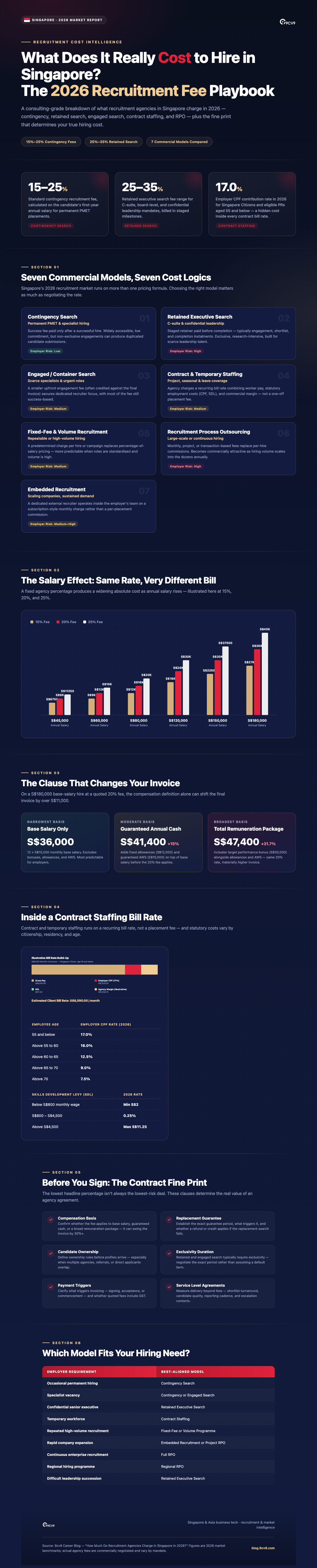
The quoted percentage also does not necessarily reveal the true recruitment cost. A critical consideration is whether the agency calculates its commission against basic annual salary, guaranteed annual cash compensation, or a broader remuneration package containing allowances, bonuses, commissions, and other benefits. Two agencies quoting the same 20% fee can therefore generate substantially different final invoices.
Commercial terms matter as well. Replacement guarantees, candidate ownership periods, payment deadlines, exclusivity clauses, volume discounts, contract-to-permanent conversion fees, and Service Level Agreements can significantly affect the overall value and risk of an agency relationship.
Singapore’s regulatory environment adds another layer of complexity. Licensed employment agencies operate under Ministry of Manpower requirements, while companies recruiting overseas professionals must also consider Employment Pass eligibility and the COMPASS framework. These requirements make regulatory knowledge and foreign-hire screening increasingly important when evaluating recruitment partners.
This guide examines recruitment agency fees in Singapore in 2026 across contingency recruitment, retained executive search, engaged search, contract and temporary staffing, embedded recruitment, and RPO. It also explains fee calculation methods, replacement guarantees, candidate ownership, agency SLAs, regulatory considerations, and practical procurement strategies to help employers determine not simply which recruitment agency is cheapest, but which pricing model delivers the strongest overall hiring value.
Before we venture further into this article, we would like to share who we are and what we do.
About 9cv9
9cv9 is a business tech startup based in Singapore and Asia, with a strong presence all over the world.
With over ten years of startup and business experience, and being highly involved in connecting with thousands of companies and startups, the 9cv9 team has listed some of the top and best companies/tools in this review.
If you like to get your company listed in our top B2B software reviews, check out our world-class 9cv9 Media and PR service and pricing plans here.
How Much Do Recruitment Agencies Charge in Singapore in 2026?
- Core Commercial Models & Fee Structures
- Quantitative Fee Benchmarks & Compensation Mechanics
- Regulatory Frameworks, Compliance Mandates, and Immigration Mechanics
- Agency Service Level Agreements, Performance Metrics, and Risk Allocation
- Strategic Recommendations for Enterprise Procurement and HR Leaders
1. Core Commercial Models & Fee Structures
a. Contingency Search (Success-Based Pricing)
Singapore’s recruitment agency market in 2026 uses a combination of success-based placement fees, retained search arrangements, contract staffing margins, fixed-fee projects, and Recruitment Process Outsourcing models. The appropriate structure generally depends on hiring seniority, scarcity of talent, recruitment volume, required delivery speed, exclusivity, and the amount of recruitment responsibility transferred to the agency.
For employers, the headline recruitment fee is only one part of the commercial equation. Replacement guarantees, candidate ownership, salary definitions, payment triggers, exclusivity, contract conversion charges, service levels, and refund provisions can materially affect the total cost and risk of an agency engagement.
Core Commercial Models Used by Recruitment Agencies in Singapore
| Commercial Model | Typical Application | How the Agency Earns Revenue | Employer Commitment |
|---|---|---|---|
| Contingency Search | Permanent professional and specialist hiring | Success fee following a successful hire | Low |
| Retained Executive Search | Senior leadership and confidential mandates | Retainer and milestone payments | High |
| Engaged or Container Search | Difficult specialist and management roles | Upfront engagement fee plus success fee | Medium |
| Contract and Temporary Staffing | Temporary, project and contract workers | Margin or markup over employment cost | Medium |
| Fixed-Fee Recruitment | Repeatable or volume hiring | Predetermined amount per hire or project | Medium |
| RPO | Large-scale or continuous recruitment | Monthly, project, management or transaction fees | High |
| Embedded Recruitment | Scaling companies requiring dedicated recruiters | Recurring subscription or recruiter-based charge | Medium to High |
Contingency Search and Success-Based Recruitment Fees
Contingency recruitment remains one of the most accessible commercial structures for permanent recruitment in Singapore. Under this arrangement, the employer normally pays the recruitment agency only when an introduced candidate is successfully hired.
A 2026 Singapore recruitment pricing guide describes contingency recruitment as the dominant success-fee model and indicates that permanent recruitment fees commonly fall around 15% to 25% of first-year salary, with specialist and senior searches potentially priced higher. Because commercial rates are negotiated between agencies and employers, these figures should be treated as market benchmarks rather than statutory fee levels.
| Hiring Category | Indicative Commercial Position | Typical Pricing Direction |
|---|---|---|
| General Professional Roles | Standard contingency mandate | Lower end of percentage-based pricing |
| Specialist PMET Roles | Greater sourcing difficulty | Mid-range pricing |
| Technology and Engineering | Scarcer specialist talent | Mid-to-higher range |
| Senior Management | Smaller candidate pool and greater assessment requirements | Higher range |
| Executive Leadership | Often unsuitable for standard contingency recruitment | Retained search commonly preferred |
The principal advantage is limited upfront financial risk. If the agency does not produce a successful hire, a placement fee is generally not payable.
However, non-exclusive contingency arrangements can encourage employers to appoint several recruiters simultaneously. This can increase candidate coverage, but it may also produce duplicated submissions and incentivise agencies to prioritise speed.
Retained Executive Search
Retained recruitment is generally positioned at the opposite end of the commitment spectrum. Instead of paying only after a successful placement, the employer formally engages the search firm and pays part of the professional fee before the search is completed.
This structure is particularly relevant for C-suite appointments, senior management positions, confidential replacement searches, regional leadership roles and highly specialised appointments.
| Feature | Contingency Search | Retained Executive Search |
|---|---|---|
| Initial Payment | Usually none | Usually required |
| Exclusivity | Often non-exclusive | Usually exclusive |
| Market Mapping | Variable | Extensive |
| Passive Candidate Search | Moderate to high | Very high |
| Senior Stakeholder Interviews | Role dependent | Usually extensive |
| Candidate Assessment | Standard to advanced | Advanced |
| Best Suited For | Professional and specialist hiring | Leadership and strategic appointments |
A retained fee may be divided into stages, such as an engagement payment, shortlist or milestone payment, and final completion payment. The exact structure varies substantially between executive search firms.
This model compensates the agency for undertaking comprehensive market research and candidate engagement even when suitable executives are difficult to approach or the search takes several months.
Engaged or Container Search
Engaged search occupies the middle ground between contingency recruitment and fully retained executive search.
The employer typically pays a smaller upfront engagement amount, while most of the recruitment fee remains dependent on successful placement.
| Commercial Characteristic | Engaged Search |
|---|---|
| Upfront Commitment | Moderate |
| Success-Based Component | Yes |
| Exclusivity | Often negotiated |
| Agency Resource Commitment | Higher than ordinary contingency |
| Appropriate Roles | Scarce specialists and management positions |
| Employer Risk | Lower than a full retainer |
This arrangement can be attractive where employers want an agency to dedicate greater sourcing resources to a vacancy without committing to a traditional executive-search retainer.
Contract and Temporary Staffing
Contract staffing uses a fundamentally different revenue model because the recruitment agency may remain involved after the worker starts.
Instead of charging a single permanent placement fee, the staffing company generally charges the client a recurring rate that incorporates the worker’s compensation and associated employment costs together with the agency’s commercial margin.
| Cost Component | Potentially Included in Client Rate |
|---|---|
| Contractor Salary or Pay Rate | Yes |
| Employer-Related Employment Costs | Depending on employment structure |
| Payroll Administration | Commonly |
| Insurance or Statutory Administration | Where applicable |
| Contractor Management | Commonly |
| Recruitment Cost | Incorporated into commercial pricing |
| Agency Margin | Yes |
Contract staffing is particularly useful for transformation programmes, temporary workforce requirements, maternity or leave coverage, technology projects, interim appointments and periods of uncertain headcount demand.
Employers comparing contract agencies should therefore compare the total charge rate rather than simply comparing agency margins.
Fixed-Fee and Volume Recruitment
Fixed-fee recruitment provides employers with greater cost predictability. Instead of calculating every successful placement as a percentage of salary, an agency can agree on a predetermined charge per successful hire, vacancy or recruitment campaign.
This approach is more commercially viable when hiring requirements are relatively standardised and recruitment volumes are sufficiently predictable.
| Hiring Situation | Suitability for Fixed-Fee Recruitment |
|---|---|
| One highly specialised executive | Low |
| Repeated operational positions | High |
| Graduate recruitment campaign | High |
| New team requiring similar positions | High |
| Highly confidential leadership search | Low |
| Large hiring campaign | High |
Volume commitments can also give employers greater negotiating leverage because agencies can spread sourcing, advertising, technology and recruiter costs across multiple placements.
Recruitment Process Outsourcing
Recruitment Process Outsourcing represents a broader commercial relationship than conventional recruitment agency hiring.
Under RPO, an employer transfers part or all of its recruitment function to an external provider. Singapore RPO offerings can include workforce planning, sourcing, talent mapping, screening, interview coordination, offer management, onboarding assistance, recruitment reporting and process optimisation.
| RPO Model | Scope | Suitable Employer |
|---|---|---|
| Full RPO | Most or all recruitment processes | Large organisations |
| Project RPO | Defined recruitment programme | Expansion or transformation projects |
| On-Demand RPO | Temporary additional recruitment capacity | Employers experiencing hiring spikes |
| Hybrid RPO | Shared responsibility with internal HR | Established HR teams |
| Regional RPO | Multi-market recruitment | Singapore-based regional headquarters |
RPO pricing may be structured around monthly management charges, recruiter resources, hiring transactions, project fees or combinations of these mechanisms.
The economics can become attractive when an organisation hires continuously because recruitment infrastructure, recruiters, sourcing tools and processes can be consolidated under one operating model.
Embedded Recruitment and Subscription Models
Embedded recruitment has expanded as companies seek dedicated recruiting capacity without permanently expanding their internal talent acquisition departments.
An embedded recruiter effectively operates alongside the employer’s HR team for a defined period. Pricing can therefore resemble a monthly subscription or recurring resource charge rather than a traditional percentage-of-salary placement commission.
| Factor | Traditional Agency | Embedded Recruitment |
|---|---|---|
| Pricing Unit | Successful placement | Time or dedicated capacity |
| Relationship | Vacancy based | Continuous |
| Integration with Employer | Moderate | High |
| Recruitment Volume | Variable | Usually sustained |
| Employer Branding Involvement | Limited to moderate | High |
| Internal Team Collaboration | Moderate | Extensive |
For rapidly scaling companies, embedded recruitment can provide more predictable expenditure when dozens of vacancies need to be managed simultaneously.
Understanding the Recruitment Fee Calculation
Employers should establish precisely what “annual compensation” means before signing an agency agreement.
A percentage fee can produce materially different invoices depending on whether the calculation includes only basic salary or also guaranteed allowances, bonuses, commissions and other compensation.
For illustration:
| Candidate Compensation Basis | Agency Rate | Illustrative Recruitment Fee |
|---|---|---|
| S$60,000 | 15% | S$9,000 |
| S$60,000 | 20% | S$12,000 |
| S$60,000 | 25% | S$15,000 |
| S$100,000 | 20% | S$20,000 |
| S$150,000 | 25% | S$37,500 |
| S$200,000 | 30% | S$60,000 |
These examples demonstrate why employers should compare the complete commercial formula rather than the percentage alone.
Agency Service Level Agreements in Singapore
A well-designed recruitment Service Level Agreement establishes measurable expectations for both parties. The SLA should extend beyond recruitment fees and define how quickly, accurately and consistently the agency is expected to deliver.
| SLA Area | Example Measurement |
|---|---|
| Vacancy Acknowledgement | Time taken to acknowledge a new mandate |
| Recruitment Brief | Time required to complete role qualification |
| Initial Candidate Delivery | Agreed period for first shortlist |
| Candidate Quality | Percentage progressing beyond initial review |
| Interview Coordination | Response and scheduling turnaround |
| Offer Management | Time required for candidate follow-up |
| Reporting | Weekly or monthly recruitment reporting |
| Replacement Search | Defined timeframe following an eligible departure |
| Escalation | Named contacts and response procedures |
| Data Handling | Agreed candidate-data and confidentiality controls |
For high-volume RPO programmes, SLAs can become considerably more sophisticated and incorporate time-to-shortlist, time-to-interview, time-to-offer, time-to-fill, offer acceptance rates, source effectiveness and candidate experience indicators.
Replacement Guarantees
Replacement provisions are among the most important commercial clauses in permanent recruitment agreements.
A typical clause may provide another search without an additional placement fee when a successfully placed candidate resigns or is terminated within an agreed guarantee period, subject to specified conditions.
| Guarantee Issue | What Employers Should Establish |
|---|---|
| Guarantee Period | Exact starting and ending dates |
| Candidate Resignation | Whether replacement applies |
| Employer Termination | Circumstances covered |
| Redundancy | Whether excluded |
| Material Job Change | Whether guarantee becomes invalid |
| Invoice Payment | Whether guarantee requires invoices to be paid on time |
| Replacement Deadline | How long the agency has to deliver |
| Refund Alternative | Whether credit or refund applies if replacement fails |
Guarantees should not automatically be interpreted as unconditional refunds. Agency agreements frequently contain exclusions, so employers should examine the actual wording before appointment.
Candidate Ownership and Introduction Clauses
Candidate ownership provisions determine how long an agency can claim a placement fee after introducing an individual.
This becomes especially important when several recruitment agencies, employee referrals and direct applications are operating simultaneously.
| Scenario | Potential Commercial Issue |
|---|---|
| Candidate submitted by two agencies | Which agency owns the introduction |
| Candidate already in employer database | Whether previous contact overrides agency ownership |
| Candidate applies directly later | Whether introduction fee remains payable |
| Candidate hired for another position | Whether original introduction remains protected |
| Candidate hired months later | Duration of ownership period |
| Candidate referred to an affiliate company | Whether group-company hiring triggers a fee |
Employers should establish candidate ownership rules before receiving profiles rather than resolving competing claims after a candidate has been hired.
Payment Terms and Fee Triggers
Recruitment agreements should clearly identify when the agency earns its fee and when payment becomes due.
| Commercial Element | Possible Structure |
|---|---|
| Fee Trigger | Contract signing, acceptance or commencement |
| Invoice Timing | Upon acceptance or commencement |
| Payment Window | Negotiated contractual period |
| GST | Clarify whether quoted fees include or exclude applicable GST |
| Late Payment | May affect guarantee entitlement |
| Candidate Withdrawal | Agreement should specify treatment |
| Delayed Start | Agreement should specify invoice consequences |
The lowest percentage does not necessarily represent the lowest-risk agreement. A slightly higher fee with stronger replacement protection, better candidate ownership rules and clearer service obligations may provide greater commercial value.
Singapore Regulatory Considerations
Recruitment agencies operating in Singapore are subject to the Employment Agencies Act and associated regulations. Employers should distinguish between fees charged commercially to employers and regulated fees charged to jobseekers.
Singapore regulations impose limits on fees employment agencies may collect from jobseekers. Generally, agencies may charge up to one month of the worker’s fixed monthly salary for each year of service, capped at two months’ salary. Employment agencies are also subject to requirements concerning receipts, fee disclosure and certain refund circumstances.
These worker-protection limits should not be confused with employer-paid commercial recruitment fees, which are negotiated between the employer and recruitment agency.
Choosing the Appropriate Commercial Model
| Employer Requirement | Commercial Model Generally Best Aligned |
|---|---|
| Occasional permanent hiring | Contingency |
| Specialist vacancy | Contingency or engaged search |
| Confidential senior executive | Retained search |
| Temporary workforce | Contract staffing |
| Repeated high-volume recruitment | Fixed-fee or volume programme |
| Rapid company expansion | Embedded recruitment or project RPO |
| Continuous enterprise recruitment | Full RPO |
| Regional hiring programme | Regional RPO |
| Difficult leadership succession | Retained executive search |
The appropriate recruitment model ultimately depends on the economic importance and difficulty of the vacancy. Contingency recruitment offers flexibility, retained search provides deeper market coverage, staffing models support workforce flexibility, and RPO or embedded recruitment can transform recruitment into an outsourced operational capability.
For Singapore employers in 2026, the strongest agency agreements are therefore not necessarily those offering the lowest headline commission. Commercial value is better assessed through total hiring cost, quality of shortlisted candidates, speed of delivery, replacement protection, contractual clarity, recruiter expertise and the agency’s ability to consistently meet agreed service levels.
b. Retained Executive Search
Retained executive search is primarily used in Singapore for C-suite appointments, board-level positions, country and regional leadership roles, confidential succession mandates, and highly specialised senior appointments. Unlike contingency recruitment, the search firm receives financial commitment from the employer at the beginning of the assignment and generally works on an exclusive basis.
The model is designed for positions where candidate quality, confidentiality, market coverage, leadership assessment, and organisational fit carry greater importance than simply generating candidates quickly. Singapore executive-search providers describe retained mandates as particularly appropriate for C-suite, Country Head, Board, VP, director and other mission-critical appointments.
Retained Executive Search Fee Structure in Singapore
Available 2026 market evidence places mainstream retained executive-search pricing broadly around 25% to 35% of first-year compensation, although the precise percentage and compensation basis vary by search firm and mandate. One Singapore recruitment provider cites approximately 25% to 33% of annual base salary, while another Singapore-focused executive-search source places the broader range at 25% to 35% of first-year total compensation.
| Retained Search Component | Typical 2026 Market Structure | Commercial Implication |
|---|---|---|
| Typical Fee Range | Approximately 25% to 35% | Higher than standard contingency recruitment |
| Fee Basis | Base salary, annual cash compensation or defined total compensation | Must be established contractually |
| Payment Structure | Usually staged | Employer pays before final placement |
| Exclusivity | Usually required | One search partner controls the mandate |
| Candidate Strategy | Targeted market mapping and direct approaches | Strong emphasis on passive executives |
| Search Duration | Commonly several weeks to several months | Depends on seniority and complexity |
| Primary Use | C-suite, Board, Country Head, VP and critical leadership | Best suited to high-impact appointments |
Employers should pay particular attention to the definition of compensation used for calculating the fee. Some firms calculate fees against annual base salary, while others use total cash compensation or broader first-year compensation. Bonuses, guaranteed allowances, sign-on payments and other remuneration may therefore materially change the final search fee.
The Three-Stage Retainer Model
One of the defining commercial characteristics of retained executive search is milestone-based billing.
The traditional model divides the professional fee into approximately three instalments. Current Singapore evidence also demonstrates that the exact allocation does not always have to be equal: one Singapore executive-search provider, for example, describes a 30% engagement, 30% shortlist and 40% commencement structure.
| Search Stage | Typical Payment Trigger | Principal Agency Deliverables |
|---|---|---|
| Engagement | Search agreement executed | Role calibration, search strategy, market definition and research |
| Shortlist | Qualified shortlist presented | Candidate identification, approaches, interviews and assessments |
| Completion | Offer acceptance or candidate commencement | Negotiation, referencing, closing and transition support |
Under the traditional equal-instalment structure, each stage represents approximately one-third of the total fee. This arrangement provides the search firm with resources to conduct substantial research before a successful placement has occurred. The three-stage model remains widely associated with retained executive search in 2026.
Engagement and Market Mapping
The first payment is normally triggered when the employer formally appoints the executive-search firm.
At this stage, the search consultants typically conduct stakeholder interviews, establish the leadership profile, define assessment criteria, identify target companies and industries, develop a candidate universe and begin confidential approaches.
This differs materially from conventional database-led recruitment. Retained search frequently involves proactively identifying executives who are not actively applying for positions.
Shortlist and Assessment
The second payment is generally associated with delivery of an agreed search milestone, most commonly a qualified shortlist.
Candidates reaching this stage may have undergone structured interviews, competency assessment, compensation discussions and preliminary suitability analysis before being presented to the employer.
| Assessment Dimension | Typical Retained Search Focus |
|---|---|
| Leadership Experience | Scale and complexity previously managed |
| Functional Capability | Depth within the required discipline |
| Industry Knowledge | Relevance to employer’s market |
| Regional Experience | Singapore, Southeast Asia or APAC exposure |
| Strategic Capability | Ability to execute organisational objectives |
| Cultural Alignment | Compatibility with leadership environment |
| Motivation | Reasons for considering the opportunity |
| Compensation | Expectations and feasibility |
| Availability | Notice period and transition requirements |
The objective is therefore not simply to provide several executive CVs, but to create a defensible comparison of qualified leadership candidates.
Completion and Placement
The final instalment is generally triggered when the preferred executive accepts the offer, signs the employment agreement or commences employment, depending on the search contract.
The search firm’s involvement may continue through compensation negotiations, resignation management, counteroffer discussions, references, notice periods and onboarding.
Exclusivity in Retained Executive Search
Exclusivity is another defining feature of retained search. Singapore providers explicitly position retained mandates as exclusive partnerships in which dedicated research capacity is assigned to the employer.
| Contingency Recruitment | Retained Executive Search |
|---|---|
| Multiple agencies may compete | Usually one appointed search firm |
| Payment primarily depends on placement | Payments begin during the search |
| Speed can dominate agency incentives | Research depth receives greater emphasis |
| Suitable for broader candidate markets | Suitable for scarce leadership markets |
| Database sourcing commonly important | Direct executive approaches are central |
| Limited market mapping may be sufficient | Comprehensive market mapping is expected |
Rather than assuming that exclusivity lasts a standard 60 to 120 days, employers should negotiate the exact duration. Current Singapore market examples indicate considerable variation in executive-search timelines: one provider estimates approximately eight to fourteen weeks, while another reports roughly 95 to 120 days for many retained CXO assignments.
Retained Search Service-Level Expectations
Because employers commit financially before a hire is completed, the search agreement should establish measurable service expectations.
| SLA Area | Recommended Contractual Definition |
|---|---|
| Search Kickoff | Deadline following engagement |
| Market Mapping | Scope and expected completion |
| Progress Reporting | Weekly or agreed reporting frequency |
| Longlist | Expected delivery window |
| Shortlist | Target delivery milestone |
| Candidate Assessment | Required assessment methodology |
| References | Responsibility and timing |
| Offer Management | Agency responsibilities during negotiations |
| Replacement Protection | Period and qualifying circumstances |
| Escalation | Named senior agency contact |
Some Singapore executive-search providers explicitly advertise weekly reporting, market mapping, structured assessment and timeline accountability as components of retained mandates.
Commercial Considerations for Employers
Retained executive search should consequently be evaluated differently from ordinary recruitment. The headline percentage alone provides an incomplete comparison.
Employers should compare the fee basis, payment milestones, exclusivity period, search methodology, market-mapping depth, assessment process, expenses, candidate replacement provisions and circumstances under which payments remain payable if the assignment is cancelled or materially changed.
The higher upfront commitment can be commercially justified when the appointment has significant strategic consequences. For Singapore organisations recruiting CEOs, CFOs, regional executives, country leaders and other critical senior personnel in 2026, retained search effectively purchases dedicated research capacity, structured assessment, confidentiality and accountability rather than simply access to a recruitment database.
c. Container and Engaged Search
Container search, also known as engaged or exclusive search, provides a middle-ground recruitment model between contingency recruitment and fully retained executive search. In Singapore, the structure is particularly relevant for urgent, specialist, senior-management, technical, confidential, and business-critical vacancies where employers want greater agency commitment without adopting the full cost and milestone structure of retained search.
Singapore recruitment firms offering engaged search describe the model as a hybrid between contingency and retained recruitment, with an initial financial commitment securing greater recruiter focus while the majority of the fee remains linked to successful placement.
How Container and Engaged Search Works
The defining feature is a relatively small upfront engagement payment. This compensates the recruitment agency for immediately allocating research, sourcing and consultant resources to the vacancy.
The remaining recruitment fee is generally payable only when the employer successfully hires a candidate. In many container-search structures, the initial payment is credited against the eventual placement fee rather than being charged on top of it.
| Commercial Feature | Typical Engaged Search Structure |
|---|---|
| Initial Payment | Upfront engagement or kickoff fee |
| Remaining Fee | Primarily payable upon successful placement |
| Overall Pricing | Usually negotiated as a percentage of annual compensation or fixed search fee |
| Upfront Fee Treatment | Frequently credited against the final placement fee |
| Exclusivity | Commonly required for an agreed period |
| Agency Commitment | Higher than standard contingency recruitment |
| Search Method | Research, direct sourcing and passive candidate outreach |
| Best Suited For | Specialist, urgent, confidential and business-critical roles |
The Initial Engagement Fee
Published search models demonstrate considerable variation in the size of the upfront payment. Some providers use a fixed container fee, while others charge a percentage of the estimated recruitment fee.
For example, published container-search structures include a fixed US$5,000 retainer in one model, while other providers describe the initial payment simply as a percentage of the projected placement fee. This means that a specific S$3,000 to S$8,000 Singapore benchmark should not be treated as a universal 2026 market standard unless an individual agency explicitly quotes it.
| Upfront Fee Model | How It Works | Employer Benefit |
|---|---|---|
| Fixed Engagement Fee | Predetermined amount paid at kickoff | Simple budgeting |
| Percentage of Expected Fee | Portion of projected placement fee paid upfront | Scales with role value |
| Creditable Container Fee | Upfront amount deducted from final success fee | Avoids duplicating recruitment charges |
| Non-Refundable Engagement Fee | Agency retains payment for work performed | Secures dedicated resources |
The distinction between “non-refundable” and “credited” is important. An engagement fee can be non-refundable if no placement occurs while still being credited against the final recruitment invoice when the agency successfully completes the assignment.
Exclusivity and Dedicated Search Resources
Engaged search generally involves greater employer commitment than ordinary contingency recruitment. In return, the recruitment agency allocates more dedicated resources to the assignment.
Singapore-based Windsor Consulting, for example, describes engaged search as creating a firm commitment between the employer and recruitment company, allowing the recruiter to operate more closely as an extension of the employer’s HR function.
| Search Model | Employer Commitment | Recruiter Commitment | Typical Exclusivity |
|---|---|---|---|
| Contingency | Low | Variable | Often non-exclusive |
| Engaged Search | Medium | High | Common |
| Retained Search | High | Very High | Usually exclusive |
The exclusivity period should be contractually defined rather than assumed to be exactly 30 days. Published container and engaged-search models confirm that exclusivity is a common feature, but its duration is negotiated between the parties.
Candidate Shortlist Commitments
One attraction of container search is the ability to establish more concrete delivery expectations than under conventional contingency recruitment.
Some container-search providers explicitly combine the upfront engagement fee with a commitment to produce a shortlist.
A Singapore employer can therefore structure the engagement around defined recruitment deliverables.
| SLA Component | Possible Engaged Search Commitment |
|---|---|
| Search Kickoff | Immediately after engagement |
| Role Calibration | Detailed briefing with hiring stakeholders |
| Market Mapping | Identification of relevant target organisations |
| Candidate Sourcing | Active and passive candidate outreach |
| Progress Reporting | Regular search updates |
| Shortlist | Defined number or quality threshold |
| Shortlist Deadline | Contractually agreed delivery window |
| Candidate Assessment | Screening before employer presentation |
| Replacement Guarantee | Often stronger than basic contingency terms |
Windsor Consulting specifically states that its engaged-search service includes an extended free replacement guarantee compared with its contingent service, illustrating how agencies can use stronger service protections to differentiate engaged assignments.
Engaged Search Versus Contingency and Retained Search
| Commercial Dimension | Contingency Search | Container / Engaged Search | Retained Search |
|---|---|---|---|
| Upfront Fee | Usually none | Small or moderate | Significant |
| Success Component | Yes | Yes | Not necessarily entirely success-dependent |
| Exclusivity | Often no | Commonly yes | Usually yes |
| Dedicated Resources | Moderate | High | Very high |
| Market Mapping | Variable | Strong | Extensive |
| Passive Candidate Search | Moderate | Strong | Extensive |
| Employer Financial Risk | Low | Moderate | Higher |
| Agency Financial Risk | High | Shared | Lower |
| Best Application | Standard permanent recruitment | Difficult or important specialist hiring | Executive and strategic leadership |
The model can consequently be viewed as a shared-risk recruitment arrangement. The employer demonstrates commitment through the initial payment and exclusivity, while the agency retains a strong incentive to complete the placement because a substantial proportion of its revenue remains dependent on success.
When Engaged Search Makes Commercial Sense
Engaged search is particularly appropriate when a Singapore employer has already determined that the vacancy warrants more attention than a conventional multi-agency contingency search but does not require a full retained executive-search mandate.
Typical use cases include newly created positions, scarce technical specialists, senior managers, confidential appointments and vacancies requiring accelerated delivery. Singapore recruitment providers also position engaged search for critical technical positions requiring research-driven sourcing beyond conventional job boards.
| Hiring Situation | Suitability |
|---|---|
| Standard high-volume vacancy | Low |
| Difficult specialist position | High |
| Urgent business-critical hire | High |
| Confidential replacement | High |
| Senior management appointment | High |
| C-suite succession | Moderate to High |
| Easily sourced junior position | Low |
| Scarce technical leadership | High |
For employers in Singapore in 2026, container and engaged search can therefore provide a practical compromise between the flexibility of contingency recruitment and the dedicated resources of retained search. The strongest agreements clearly define the upfront payment, whether it is credited against the final fee, exclusivity duration, shortlist obligations, replacement guarantee, total placement fee and measurable delivery milestones.
d. Contract and Temporary Staffing
Contract and temporary staffing in Singapore operates differently from permanent recruitment because agencies generally earn revenue through an ongoing bill rate rather than a one-off placement commission. The staffing agency may employ or administer the contractor and invoice the client on an hourly, daily or monthly basis throughout the assignment.
This structure is widely suited to project-based hiring, temporary workforce requirements, technology transformation programmes, maternity or leave coverage, seasonal demand and situations where employers need workforce flexibility without immediately adding permanent headcount.
How Contract Staffing Pricing Works
The client bill rate typically combines the worker’s remuneration, applicable statutory employment costs, payroll and administrative expenses, and the staffing agency’s commercial margin.
A simplified commercial framework can be expressed as:
Bill Rate = Employment Cost + Agency Service Charge or Margin
Where relevant, employment cost may incorporate gross wages, employer CPF contributions, Skills Development Levy, applicable foreign-worker costs and other employment-related expenses.
| Cost Component | Purpose | Applicability |
|---|---|---|
| Gross Pay | Contractor’s agreed remuneration | Generally applicable |
| Employer CPF | Employer social-security contribution | Singapore Citizens and eligible Permanent Residents |
| Skills Development Levy | Statutory workforce development levy | Employees working in Singapore |
| Foreign Worker Levy | Levy associated with eligible foreign workers | Applicable work-pass categories |
| Insurance and Employment Costs | Employment-related protection and administration | Depends on worker and arrangement |
| Payroll Administration | Salary processing and statutory administration | Common in agency-employed arrangements |
| Agency Margin | Staffing agency’s commercial return | Generally applicable |
| Other Employment Costs | Leave, benefits or contractual provisions | Depends on staffing agreement |
CPF Costs in 2026
CPF is particularly important when calculating the cost of employing Singapore Citizens and Permanent Residents.
For Singapore Citizens and third-year-and-beyond Permanent Residents earning more than S$750 monthly, the employer CPF rate from January 2026 is 17% for employees aged 55 and below. Employer rates differ for older employees, while first- and second-year Permanent Residents can also be subject to different contribution schedules.
| Employee Age | Employer CPF Rate in 2026 for Applicable Employees |
|---|---|
| 55 and below | 17.0% |
| Above 55 to 60 | 16.0% |
| Above 60 to 65 | 12.5% |
| Above 65 to 70 | 9.0% |
| Above 70 | 7.5% |
Consequently, applying a universal CPF percentage to every contractor would be inaccurate. Citizenship or residency status, age, wages and Permanent Resident status can alter the actual statutory cost.
Skills Development Levy
The Skills Development Levy represents another employment cost that can enter the staffing agency’s cost base.
In 2026, SDL is payable for employees working in Singapore, including foreign employees. It is calculated at 0.25% of monthly total wages, subject to a minimum levy of S$2 and a maximum of S$11.25 per employee per month.
| Monthly Wage Position | 2026 SDL Treatment |
|---|---|
| Below S$800 | Minimum S$2 |
| S$800 to S$4,500 | 0.25% of monthly total wages |
| Above S$4,500 | Maximum S$11.25 |
Foreign Worker Levy
Foreign Worker Levy should not be treated as interchangeable with CPF.
Singapore’s Ministry of Manpower states that employers paying Foreign Worker Levy for migrant workers do not pay CPF for those workers, although SDL remains payable. The applicable levy depends on factors including work-pass category, sector and workforce composition.
The levy is an employer cost and cannot legally be passed on to the affected foreign worker.
A More Accurate Staffing Cost Formula
Because statutory obligations differ by worker, a more accurate 2026 commercial representation is:
Client Bill Rate = Worker Compensation + Applicable Employer Statutory Costs + Employment and Administrative Costs + Agency Commercial Margin
This formulation is preferable to automatically adding CPF, Foreign Worker Levy and Self-Help Group contributions to every worker.
In particular, Self-Help Group contributions are generally deductions administered through payroll from employees’ wages rather than an ordinary employer contribution equivalent to employer CPF.
Illustrative Contractor Cost Build-Up
Consider an eligible Singapore Citizen contractor aged 55 or below earning S$6,000 per month.
| Cost Component | Illustrative Amount |
|---|---|
| Monthly Gross Pay | S$6,000.00 |
| Employer CPF at 17% | S$1,020.00 |
| SDL | S$11.25 |
| Core Employment Cost | S$7,031.25 |
| Agency and Other Costs | Added according to contract |
| Final Client Bill Rate | Commercially negotiated |
This simplified example demonstrates why an employer comparing a S$6,000 permanent salary directly with a S$6,000 contractor salary may underestimate the actual cost of agency-employed contract labour.
Agency Markups and Service Charges
Staffing agencies can apply their commercial charges in several ways. Percentage markups are common, but fixed administration fees and negotiated all-inclusive charge rates are also possible.
Publicly verifiable Singapore-specific evidence does not support treating 10% to 20% for professional contractors, 15% to 25% for operational temporary workers, or S$150 to S$400 per worker per month as universal 2026 market benchmarks. These figures may occur in individual commercial agreements, but actual pricing varies substantially by occupation, assignment duration, recruitment difficulty, payroll responsibilities, employment risks and hiring volume.
| Pricing Model | Calculation Approach | Typical Application |
|---|---|---|
| Percentage Markup | Margin applied to defined cost base | Contract staffing |
| Hourly Bill Rate | Agreed charge for each hour worked | Temporary workers |
| Daily Bill Rate | Predetermined daily contractor charge | Professional contractors |
| Monthly Bill Rate | Fixed monthly contractor charge | Longer assignments |
| Fixed Payroll Fee | Administration fee per worker | Payroll outsourcing |
| All-Inclusive Rate | Single negotiated client charge | Managed staffing arrangements |
Professional and Technology Contractors
For IT, engineering, finance, professional services and other specialist contractors, the agency margin compensates the provider for more than candidate sourcing.
The agency may assume responsibility for payroll, employment administration, statutory calculations, invoicing, timesheets, contractor support, replacement sourcing and employment-related operational risk.
| Service | Potentially Covered by Staffing Margin |
|---|---|
| Candidate Sourcing | Yes |
| Screening and Assessment | Yes |
| Employment Administration | Frequently |
| Payroll Processing | Frequently |
| CPF Administration | Where applicable |
| SDL Administration | Where applicable |
| Timesheet Management | Frequently |
| Client Billing | Yes |
| Contractor Support | Frequently |
| Replacement Recruitment | Contract dependent |
Temporary Operational Staffing
Temporary staffing for administrative support, customer service, events, logistics and other operational requirements can carry a different cost structure.
Short assignments may justify proportionally higher agency charges because sourcing, onboarding and payroll administration costs are spread across fewer billable weeks or months.
| Staffing Characteristic | Potential Pricing Effect |
|---|---|
| Longer Assignment | May support lower relative margin |
| Large Worker Volume | Greater negotiating leverage |
| Urgent Deployment | May increase pricing |
| Specialist Skill Requirement | May increase pricing |
| Short Assignment | Higher administrative cost per period |
| Complex Payroll | May increase service charge |
| Dedicated On-Site Management | Additional commercial cost possible |
Payroll Outsourcing and Pass-Through Models
Some arrangements separate recruitment from employment administration. An employer may identify the worker independently and appoint a staffing or payroll provider to administer payroll and employment processes.
In such cases, a fixed administration charge can be more appropriate than a conventional recruitment markup because the provider has not incurred the same candidate-acquisition cost.
| Model | Candidate Sourcing | Payroll | Typical Commercial Logic |
|---|---|---|---|
| Full Contract Staffing | Agency | Agency | Bill-rate margin |
| Payroll-Only | Client | Agency/provider | Administration fee |
| Managed Staffing | Agency/provider | Agency/provider | Bundled charge |
| Direct Employment | Client | Client | No staffing agency margin |
Contract-to-Permanent Conversion Fees
Employers should also examine conversion provisions before engaging contract workers.
If an organisation subsequently hires an agency contractor directly as a permanent employee, the staffing agreement may require a conversion or transfer fee.
| Conversion Clause | Employer Should Check |
|---|---|
| Conversion Period | How long the fee remains applicable |
| Fee Calculation | Fixed amount or salary percentage |
| Tenure Reduction | Whether fee decreases over time |
| Prior Agency Margin | Whether previous billings reduce the fee |
| Direct Hire | Circumstances triggering payment |
| Group Company Hire | Whether related entities are covered |
Service Level Agreements for Contract Staffing
Because contract staffing creates an ongoing relationship, SLAs should address both recruitment performance and workforce administration.
| SLA Metric | Recommended Measurement |
|---|---|
| Candidate Submission | Time from request to qualified profiles |
| Deployment | Time from selection to commencement |
| Payroll Accuracy | Percentage processed without errors |
| Payroll Timeliness | Payments completed by agreed dates |
| Timesheet Processing | Defined approval cycle |
| Replacement | Time required to replace departing workers |
| Contractor Queries | Response-time target |
| Compliance | Statutory obligations completed on time |
| Reporting | Weekly or monthly workforce reporting |
| Escalation | Defined operational contact and resolution process |
For Singapore employers in 2026, contract staffing should therefore be evaluated on total workforce cost rather than the agency markup alone. A higher bill rate may incorporate payroll administration, statutory compliance, sourcing, workforce management and employment risk that would otherwise need to be managed internally. The most useful comparison is consequently the complete cost and service package attached to each contractor rather than a single headline margin.
e. Recruitment Process Outsourcing (RPO) and Embedded Recruitment
Recruitment Process Outsourcing and embedded recruitment are increasingly relevant for Singapore employers with sustained hiring demand, rapid expansion programmes, regional hiring requirements or internal talent acquisition teams operating at capacity.
Unlike conventional recruitment agencies that primarily charge a percentage for each successful placement, RPO providers can supply dedicated recruitment capacity under monthly, project-based, cost-per-hire or hybrid commercial arrangements. Singapore providers describe RPO teams as extensions of the employer’s internal HR and talent acquisition function, managing activities ranging from sourcing and screening to offer management, onboarding support and recruitment analytics.
Embedded Recruitment Model
Embedded recruitment effectively gives the employer dedicated external recruitment capacity without permanently increasing internal HR headcount.
Recruiters can operate within the employer’s processes, systems and employer brand while remaining resources of the RPO provider. Singapore RPO programmes may be delivered on-site, remotely or through hybrid arrangements.
| Embedded Recruitment Feature | Typical Structure |
|---|---|
| Commercial Basis | Monthly recruiter or team retainer |
| Dedicated Recruiter | Usually included |
| Per-Placement Commission | Often eliminated or substantially reduced |
| Client Integration | High |
| Employer Branding | Recruiters may operate under client’s brand |
| ATS Integration | Common |
| Recruitment Reporting | Usually included |
| Capacity | Can scale with hiring demand |
| Best Application | Sustained multi-role recruitment |
One publicly available Singapore-linked RPO offering currently advertises a dedicated recruiter at S$5,000 per month, demonstrating that a monthly subscription model is commercially available in the market.
However, the proposed S$4,000 to S$8,000 per recruiter per month range should be treated as an indicative benchmark rather than a universal Singapore standard. Many RPO providers do not publish their commercial rates and instead price engagements according to scope, hiring volume, recruiter seniority and integration requirements.
RPO Commercial Structures
RPO does not have a single standard pricing formula. Current industry pricing evidence identifies management fees, cost-per-hire arrangements, percentage-of-salary charges, project pricing and hybrid models as common approaches.
| RPO Pricing Model | How the Employer Pays | Best Suited For |
|---|---|---|
| Monthly Management Fee | Fixed recurring charge | Continuous recruitment |
| Recruiter Subscription | Monthly fee per dedicated recruiter | Embedded recruitment |
| Cost Per Hire | Predetermined charge for each hire | Measurable volume programmes |
| Project Fee | Fixed or milestone-based project price | Expansion or hiring campaigns |
| Hybrid Model | Retainer plus reduced per-hire fee | Variable enterprise demand |
| Percentage Model | Percentage of candidate compensation | Specialist components of RPO |
This flexibility allows employers to move away from paying a conventional 15% to 25% agency commission on every hire when recruitment volumes become sufficiently large.
RPO Versus Traditional Recruitment Agency Economics
The commercial advantage becomes clearer as hiring volume increases.
| Commercial Dimension | Traditional Agency | Embedded Recruitment | Enterprise RPO |
|---|---|---|---|
| Primary Pricing Unit | Successful hire | Recruiter capacity | Recruitment programme |
| Monthly Fixed Cost | Usually none | Yes | Usually |
| Per-Hire Fee | Common | Often none | Possible |
| Dedicated Resources | Limited to moderate | High | Very high |
| Process Ownership | Limited | Shared | Partial to complete |
| Technology Integration | Limited | Moderate to high | High |
| Employer Branding | Moderate | High | High |
| Analytics | Basic to moderate | Moderate | Advanced |
| Scalability | Moderate | High | Very high |
Singapore RPO provider People Profilers indicates that project RPO typically becomes relevant from approximately 15 to 20 hires within a defined programme, functional RPO from around 30 annual hires, and enterprise RPO from approximately 80 annual hires across multiple functions. These are provider-specific thresholds rather than universal market rules, but they illustrate how hiring volume influences the economics of outsourcing.
Enterprise RPO
Enterprise RPO goes considerably further than placing dedicated recruiters inside an organisation.
The provider can assume responsibility for large portions of the employer’s permanent recruitment infrastructure, including sourcing, assessment, candidate management, interviews, offers, onboarding, recruitment technology, vendor management, compliance and reporting.
| Enterprise RPO Component | Potential Scope |
|---|---|
| Workforce Planning | Hiring forecasts and resource planning |
| Candidate Sourcing | Active and passive talent acquisition |
| Screening | Initial candidate qualification |
| Assessment | Testing and structured evaluation |
| Interview Management | Scheduling and coordination |
| Offer Management | Negotiation and acceptance |
| Onboarding Support | Pre-employment coordination |
| Vendor Management | Management of external agencies |
| Recruitment Technology | ATS and recruitment-tool integration |
| Analytics | Cost, quality and hiring-speed reporting |
| Compliance | Recruitment-process governance |
Singapore providers offer full RPO, project RPO, on-demand RPO, hybrid RPO and regional or multi-country programmes, allowing employers to outsource only the portions of recruitment that create operational bottlenecks.
RPO Pricing in 2026
The proposed S$8,000 to S$25,000-plus monthly enterprise management-fee range should not be presented as a standard Singapore market rate without qualification.
Enterprise RPO pricing varies significantly according to recruiter headcount, hiring volume, geography, role complexity, technology requirements, service scope and contractual SLAs. International 2026 benchmarks show embedded recruiter arrangements spanning roughly US$8,000 to US$15,000 per recruiter monthly, while larger enterprise programmes can run substantially higher.
| Major RPO Cost Driver | Effect on Commercial Pricing |
|---|---|
| Number of Recruiters | Higher capacity increases fixed cost |
| Annual Hiring Volume | Higher volume can reduce unit economics |
| Role Complexity | Specialist positions increase sourcing effort |
| Geographic Coverage | Multi-country delivery increases complexity |
| On-Site Resources | Can increase programme cost |
| Recruitment Technology | Integration can increase setup costs |
| Assessment Requirements | Additional testing increases scope |
| Reporting Requirements | Advanced analytics increases complexity |
| SLA Commitments | Aggressive targets may require more resources |
| Programme Duration | Longer commitments can improve economics |
Volume Discounts and Economies of Scale
Higher hiring volume generally improves RPO economics because recruiter capacity, technology, sourcing infrastructure and programme-management costs are distributed across more successful hires.
Current RPO pricing guidance supports the principle that increasing hiring volume generally reduces cost per hire.
However, a standard 10% to 20% volume discount for every Singapore employer committing to 20 or more placements cannot be reliably established from current public evidence. Discounts and pricing tiers should therefore be described as negotiable rather than guaranteed market standards.
| Annual Hiring Pattern | Potential Commercial Approach |
|---|---|
| Fewer than 10 hires | Traditional agency recruitment |
| 10–20 concentrated hires | Project RPO may become viable |
| 20–50 recurring hires | Embedded or functional RPO |
| 50–100 hires | Dedicated RPO team |
| 100+ multi-function hires | Enterprise RPO |
| Major temporary expansion | Project RPO |
| Regional expansion | Multi-country RPO |
These thresholds are indicative rather than universal because the break-even point depends heavily on salaries, conventional agency rates and the complexity of vacancies.
Project RPO
Project RPO is particularly useful when an organisation does not require permanent outsourced recruitment but needs substantial temporary recruitment capacity.
Typical examples include opening a Singapore office, establishing a regional headquarters, launching a new business unit, building a technology team or recruiting a large cohort within several months.
Singapore provider Robert Walters describes Project RPO as a solution for short- to medium-term talent requirements that can increase recruitment capacity without adding permanent internal talent-acquisition headcount.
| Hiring Requirement | Suitable RPO Structure |
|---|---|
| Six-month expansion programme | Project RPO |
| Continuous technology recruitment | Functional RPO |
| Temporary recruiter shortage | On-Demand RPO |
| Company-wide recruitment outsourcing | Full RPO |
| Internal HR team needs sourcing support | Modular RPO |
| Southeast Asian expansion | Regional RPO |
| Rapid scale-up | Embedded recruitment |
Service Level Agreements for RPO
Service Level Agreements become particularly important because an RPO provider is managing an ongoing business function rather than individual vacancies.
Singapore RPO programmes can explicitly include SLAs covering time-to-shortlist, candidate quality and cost-per-hire.
| RPO SLA Metric | Measurement Focus |
|---|---|
| Time-to-Shortlist | Speed of qualified candidate delivery |
| Time-to-Interview | Recruitment process velocity |
| Time-to-Fill | Total vacancy completion time |
| Cost-per-Hire | Recruitment efficiency |
| Shortlist Quality | Percentage progressing to interview |
| Offer Acceptance Rate | Effectiveness of candidate conversion |
| Hiring Manager Satisfaction | Internal service quality |
| Candidate Experience | Recruitment journey quality |
| Recruiter Capacity | Roles handled per recruiter |
| SLA Compliance | Percentage of targets achieved |
| Reporting Accuracy | Reliability of recruitment analytics |
RPO Versus Embedded Recruitment
Although the terms are sometimes used together, embedded recruitment and RPO should not always be treated as identical.
Embedded recruitment primarily purchases dedicated recruiter capacity integrated into the employer’s team. RPO can transfer responsibility for a much larger recruitment process, including technology, governance, reporting, sourcing strategy and operational management.
| Requirement | Embedded Recruitment | Full RPO |
|---|---|---|
| Additional Recruiters | Excellent | Excellent |
| Full Recruitment Transformation | Limited | Excellent |
| Short-Term Scaling | Excellent | Moderate |
| Enterprise Governance | Moderate | Excellent |
| Recruitment Technology Management | Limited to Moderate | Strong |
| Vendor Management | Limited | Strong |
| Multi-Country Programme | Possible | Strong |
| Long-Term Process Ownership | Moderate | High |
For Singapore employers in 2026, RPO and embedded recruitment become particularly compelling when recruitment changes from occasional vacancies into a continuous operating requirement. Instead of repeatedly purchasing individual placements, organisations can purchase dedicated recruitment capacity or outsource an entire recruitment function.
The commercial decision should therefore be based on annual hiring volume, projected agency spend, internal recruiter costs, technology requirements, recruitment complexity and measurable SLA outcomes rather than simply comparing monthly RPO fees against individual agency commissions.
2. Quantitative Fee Benchmarks & Compensation Mechanics
Recruitment fees in Singapore in 2026 vary materially by occupational level, hiring complexity and the compensation definition contained in the agency agreement. Permanent PMET recruitment generally follows percentage-based pricing against annual remuneration, while operational hiring may use monthly-salary multiples or other negotiated structures. Current Singapore market evidence places mainstream permanent recruitment fees broadly within the 15% to 25% range of annual salary.
PMET Recruitment Fee Benchmarks
Professional, Managerial, Executive and Technical hiring represents the core market for percentage-based permanent recruitment fees in Singapore.
Current published Singapore pricing guidance indicates approximately 15% to 25% of first-year annual salary for permanent placements. Actual rates depend on seniority, talent scarcity, specialisation, hiring volume and the level of search work required.
| PMET Hiring Category | Indicative Fee Position | Primary Pricing Drivers |
|---|---|---|
| Entry-Level Professional | Around 15% to 18% | Larger candidate pools and lower search complexity |
| Experienced Professional | Around 15% to 20% | Functional specialisation and candidate availability |
| Manager-Level | Around 20% | Increased assessment and sourcing requirements |
| Senior or Scarce Specialist | Around 20% to 25% | Limited candidate supply and direct sourcing |
| Executive Leadership | Often 25%+ or retained | Market mapping, confidentiality and executive assessment |
The segmentation above should be treated as an indicative procurement framework rather than a mandatory industry tariff. One published set of Singapore recruitment terms, for example, specifies 15% for below-manager shared-services appointments and 20% for manager-level and above positions.
Salary Level and Recruitment Fee Economics
Higher salaries can significantly increase the absolute cost of recruitment even when the agency percentage remains unchanged.
| Annual Salary | Fee at 15% | Fee at 20% | Fee at 25% |
|---|---|---|---|
| S$45,000 | S$6,750 | S$9,000 | S$11,250 |
| S$60,000 | S$9,000 | S$12,000 | S$15,000 |
| S$80,000 | S$12,000 | S$16,000 | S$20,000 |
| S$120,000 | S$18,000 | S$24,000 | S$30,000 |
| S$150,000 | S$22,500 | S$30,000 | S$37,500 |
| S$180,000 | S$27,000 | S$36,000 | S$45,000 |
This explains why procurement negotiations should consider both the percentage rate and the salary distribution of anticipated hires.
Operational and Blue-Collar Recruitment
Operational recruitment can follow a different commercial structure from PMET recruitment. Current Singapore market guidance indicates that operational and blue-collar placements are often priced against monthly rather than annual salary, with approximately 80% to 120% of monthly salary cited as a contemporary market range.
| Recruitment Segment | Common Pricing Basis | Indicative Market Structure |
|---|---|---|
| PMET | Annual salary | Approximately 15% to 25% |
| Senior or Niche PMET | Annual compensation or retained fee | Upper end or individually negotiated |
| Operational / Blue-Collar | Monthly salary | Approximately 80% to 120% of one month’s salary |
| Temporary Staffing | Hourly, daily or monthly bill rate | Wage costs plus staffing margin |
| Payroll / EOR Services | Monthly salary or per-worker charge | Recurring administration model |
Employers should distinguish employer-paid recruitment charges from fees collected from jobseekers. Singapore’s statutory limits governing employment-agency fees charged to workers are separate from commercial employer-agency pricing.
Why Operational Recruitment Uses Different Economics
Operational recruitment frequently involves larger hiring volumes, faster processing cycles and higher employee turnover. Agencies may therefore optimise commercial models around processing capacity rather than the annual salary value of an individual placement.
| Commercial Driver | PMET Recruitment | Operational Recruitment |
|---|---|---|
| Candidate Value Basis | Annual compensation | Often monthly salary |
| Hiring Volume | Low to moderate | Moderate to high |
| Assessment Depth | Moderate to extensive | Standardised |
| Candidate Processing | Lower volume | Higher volume |
| Turnover Exposure | Generally lower | Can be higher |
| Fee Per Individual | Higher | Lower |
| Recruitment Velocity | Moderate | Often high |
Asia-Pacific Recruitment Fee Comparisons
Cross-country recruitment fee comparisons require caution. Public evidence does not establish a single authoritative 2026 Asia-Pacific tariff showing Singapore, Hong Kong and Taiwan universally charging 20% to 25% while every other major Asian market charges 18% to 25%.
Recruitment fees are negotiated commercially and vary by agency, occupation, salary, hiring volume and search methodology. A more defensible regional comparison is therefore qualitative.
| Market | General Commercial Position | Key Pricing Influence |
|---|---|---|
| Singapore | Premium regional recruitment hub | High professional salaries and regional headquarters demand |
| Hong Kong | Premium regional recruitment hub | Finance, professional services and regional leadership hiring |
| Taiwan | Specialist professional market | Technology and semiconductor talent |
| Malaysia | Competitive regional market | Lower average salaries than Singapore |
| Vietnam | Fast-growing recruitment market | Technology, manufacturing and foreign investment |
| Philippines | High-volume professional and services market | BPO, shared services and technology |
| Thailand | Diversified recruitment market | Manufacturing, services and regional business |
| China | Large, highly segmented market | Significant variation by city, industry and seniority |
Consequently, the absolute recruitment cost for Singapore appointments can be substantially higher even where two countries use the same agency percentage because the underlying Singapore salary is higher.
Compensation Base: The Critical Fee Variable
One of the most important clauses in a Singapore recruitment agreement is the definition of the remuneration against which the agency percentage will be calculated.
There is no universal commercial definition.
Published Singapore recruitment terms demonstrate substantial differences. One set of employer terms explicitly excludes sign-on bonuses, bonuses, allowances, profit sharing and other identifiable benefits when defining the annual salary package.
By contrast, another major recruitment company’s Singapore terms define the Annual Remuneration Package broadly enough to include salary, applicable benefits, employer CPF, guaranteed bonuses, commissions, profit sharing, housing allowances, expatriate benefits and even specified non-guaranteed bonuses.
| Compensation Definition | Components Potentially Included | Fee Exposure |
|---|---|---|
| Base Salary | Monthly basic salary multiplied by 12 | Lowest |
| Guaranteed Annual Cash | Base salary plus fixed allowances and guaranteed cash payments | Moderate |
| Broad Annual Remuneration Package | Salary, benefits, bonuses, commissions and other defined financial benefits | Highest |
Base Salary
The narrowest calculation method applies the recruitment percentage only to basic contractual salary.
For example:
S$15,000 monthly base salary x 12 months = S$180,000 annual base salary
At a 20% recruitment fee:
S$180,000 x 20% = S$36,000
This calculation provides the employer with the greatest fee predictability.
Guaranteed Annual Cash
A broader agreement can incorporate fixed allowances and guaranteed payments.
Consider the following hypothetical compensation package:
| Compensation Component | Annual Value |
|---|---|
| Base Salary | S$180,000 |
| Fixed Allowances | S$12,000 |
| Guaranteed AWS | S$15,000 |
| Guaranteed Annual Cash | S$207,000 |
At a 20% agency fee:
S$207,000 x 20% = S$41,400
Singapore’s Ministry of Manpower distinguishes basic wage from AWS and variable bonuses in its wage definitions. Basic wage excludes bonuses and allowances, while AWS refers to the annual payment commonly known as the 13th-month allowance.
Broad First-Year Remuneration
The broadest recruitment agreements can extend the fee base to additional compensation and financial benefits.
Using the illustrative technology appointment:
| Compensation Component | Annual Value |
|---|---|
| Base Salary | S$180,000 |
| Fixed Allowances | S$12,000 |
| Guaranteed AWS | S$15,000 |
| Target Performance Bonus | S$30,000 |
| Illustrative Total Package | S$237,000 |
At a 20% fee:
S$237,000 x 20% = S$47,400
Comparison of Fee Calculation Methods
| Calculation Basis | Compensation Base | 20% Recruitment Fee | Difference Versus Base |
|---|---|---|---|
| Base Salary | S$180,000 | S$36,000 | Baseline |
| Guaranteed Cash | S$207,000 | S$41,400 | +S$5,400 |
| Broad Total Package | S$237,000 | S$47,400 | +S$11,400 |
In this example, moving from a base-salary calculation to the broad total-package calculation increases the recruitment invoice from S$36,000 to S$47,400.
That represents a 31.7% increase in the agency fee even though the quoted recruitment rate remains unchanged at 20%.
Why Fee Definitions Matter in Procurement
The percentage displayed in a recruitment proposal can therefore be misleading when compared without examining the compensation base.
| Agency Proposal | Headline Rate | Compensation Basis | Effective Fee on Example Package |
|---|---|---|---|
| Agency A | 20% | Base salary | S$36,000 |
| Agency B | 18% | S$237,000 broad package | S$42,660 |
| Agency C | 22% | Base salary | S$39,600 |
Agency B appears cheapest based purely on the headline percentage. Yet its broader compensation definition produces the largest fee of the first two proposals.
This illustrates why Singapore employers should compare effective cash fees rather than agency percentages in isolation.
Employer-Paid Fees Versus Candidate-Paid Fees
Another important distinction concerns Singapore’s statutory agency-fee rules.
For fees collected from jobseekers, the Ministry of Manpower generally caps employment-agency charges at one month of fixed monthly salary for each year of service, subject to a maximum of two months’ salary. For this purpose, MOM states that the relevant salary includes basic salary and fixed allowances but excludes bonuses and variable components such as overtime.
Employer-paid commercial recruitment fees operate differently. Singapore’s Employment Agencies Rules permit licensed agencies to receive fees, remuneration, profit or compensation from employers, leaving commercial employer pricing primarily subject to the contractual agreement between the parties.
Procurement Checklist for Recruitment Fee Calculations
| Contract Element | Recommended Clarification |
|---|---|
| Percentage Rate | Exact recruitment percentage |
| Base Salary | Whether calculation uses 12 months of basic salary |
| AWS | Included or excluded |
| Fixed Allowances | Included or excluded |
| Performance Bonus | Included or excluded |
| Commission | Included or excluded |
| Sign-On Bonus | Included or excluded |
| Employer CPF | Included or excluded |
| Equity | Included or excluded |
| Expatriate Benefits | Included or excluded |
| GST | Whether quoted fees are before applicable GST |
| Replacement Guarantee | Conditions and duration |
| Volume Discounts | Thresholds and revised rates |
For Singapore employers in 2026, the most important quantitative lesson is that the headline agency percentage does not by itself determine recruitment cost. Salary level, occupational category and, most importantly, the contractual definition of annual remuneration can materially change the final invoice.
Procurement teams should therefore negotiate the fee percentage and compensation basis simultaneously. A clearly defined 20% fee calculated against base salary can ultimately cost considerably less than an apparently cheaper percentage applied to a broad first-year remuneration package.
3. Regulatory Frameworks, Compliance Mandates, and Immigration Mechanics
Recruitment agencies operating in Singapore in 2026 function within a tightly regulated environment administered primarily by the Ministry of Manpower. The regulatory framework affects agency licensing, worker-paid recruitment fees, refunds, Employment Pass eligibility, COMPASS assessments and the processes used when recruiting foreign professionals.
For employers, these rules are particularly important when an agency is sourcing overseas candidates. Recruitment quality is no longer determined solely by whether a candidate meets the job specification; employers must also consider whether the proposed hire can realistically satisfy Singapore’s prevailing work-pass requirements.
Employment Agencies Act and Recruitment Agency Regulation
Employment agencies in Singapore are licensed and regulated under the Employment Agencies Act and subsidiary regulations. Agencies performing employment-agency activities generally require the appropriate MOM licence and must comply with regulatory requirements governing their conduct.
| Regulatory Area | 2026 Position |
|---|---|
| Employment Agency Licensing | Agencies conducting regulated EA activities require licensing |
| Primary Regulator | Ministry of Manpower |
| Worker Fee Limits | Statutory limits apply |
| Upfront Worker Fees | Cannot be collected before successful placement |
| Employer Agency Fees | No statutory fee cap |
| Itemised Receipts | Required for worker-paid agency fees |
| Enforcement | Demerit points, suspension, revocation or other action may apply |
MOM continues to actively regulate employment agencies and has stated that enforcement action can be taken against agencies that breach their statutory obligations.
Candidate Fee Protection
Singapore distinguishes clearly between recruitment fees charged to employers and fees charged to workers.
Employment agencies may charge workers up to one month of fixed monthly salary for each year of service, subject to a maximum of two months’ salary. Agencies must not collect these fees before a placement has been secured.
| Worker Contract / Service Period | Maximum Worker-Paid Agency Fee |
|---|---|
| 1 Year | Up to 1 month’s salary |
| 2 Years | Up to 2 months’ salary |
| More Than 2 Years | Maximum remains 2 months’ salary |
Importantly, the relevant salary base is not simply basic salary. MOM states that the fee cap is based on total salary comprising basic salary and fixed allowances, excluding bonuses and variable components such as overtime.
Employer-Paid Recruitment Fees
The same statutory fee cap does not apply to commercial recruitment fees charged to employers.
MOM specifically states that the cap on employer fees was removed because employers generally possess stronger bargaining power and are better positioned to negotiate commercial terms with recruitment agencies.
Consequently, an agency charging an employer 15%, 20%, 25% or another negotiated percentage for a professional placement is operating under a different commercial framework from the statutory worker-paid fee regime.
| Fee Category | Statutory Cap | Commercial Basis |
|---|---|---|
| Worker-Paid Agency Fee | Yes | Regulated by MOM |
| Employer Permanent Placement Fee | No equivalent cap | Commercial agreement |
| Executive Search Fee | No equivalent cap | Commercial agreement |
| Contract Staffing Margin | No equivalent cap | Commercial agreement |
| RPO Fee | No equivalent cap | Commercial agreement |
Statutory Refund Requirements
The original proposition that Singapore requires agencies to refund employers at least 50% of fees whenever general operational staff leave within six months requires an important correction.
There are separate refund protections involving workers and employers.
Workers are generally entitled to at least a 50% refund of agency fees paid to the Singapore EA when the employer terminates their employment within six months, subject to the applicable rules.
Separately, since June 2022, employment agencies must provide qualifying employers of migrant domestic workers with an option for a refund of at least 50% of service fees if the MDW’s employment terminates within the first six months and the prescribed conditions are satisfied.
| Refund Protection | Beneficiary | Core 50% Rule |
|---|---|---|
| Worker Agency-Fee Refund | Eligible worker | At least 50% under qualifying early termination |
| MDW Employer Service-Fee Refund | Qualifying MDW employer | At least 50% subject to prescribed conditions |
| General Corporate PMET Placement | Corporate employer | Governed principally by negotiated agency guarantee terms |
This distinction matters for corporate procurement. A commercial replacement guarantee for an accountant, software engineer or marketing manager should not automatically be described as a statutory six-month 50% employer refund.
COMPASS and Employment Pass Recruitment
Foreign professional recruitment is particularly affected by Singapore’s Employment Pass framework.
EP eligibility uses a two-stage system. The candidate must first meet the qualifying salary requirement and, unless exempt, must then pass the Complementarity Assessment Framework, or COMPASS.
| Stage | Requirement |
|---|---|
| Stage 1 | Meet age-adjusted EP qualifying salary |
| Stage 2 | Pass COMPASS unless exempt |
| COMPASS Passing Score | 40 points |
| High-Salary COMPASS Exemption | Fixed monthly salary of at least S$22,500 |
COMPASS Assessment Structure
COMPASS evaluates both the candidate and the hiring organisation.
| Criterion | Assessment Area | Standard Points Potential |
|---|---|---|
| C1 | Salary | 0, 10 or 20 |
| C2 | Qualifications | 0, 10 or 20 |
| C3 | Diversity | 0, 10 or 20 |
| C4 | Support for Local Employment | 0, 10 or 20 |
| C5 | Skills Bonus | Bonus points |
| C6 | Strategic Economic Priorities Bonus | Bonus points |
C1 compares the candidate’s fixed monthly salary against local PMET salary benchmarks for the relevant sector and age. To obtain points under C1, compensation must perform sufficiently against the relevant sector benchmark. MOM updates these benchmarks annually.
C2 considers qualifications, while C3 evaluates nationality diversity within the organisation’s PMET workforce and C4 examines the employer’s support for local professional employment.
C5 can provide a Shortage Occupation List skills bonus, while C6 provides additional points for qualifying organisations participating in eligible Strategic Economic Priorities programmes.
Employment Pass Salary Thresholds in 2026
Singapore’s minimum EP qualifying salary is age-adjusted rather than represented by a single threshold for every applicant.
In 2026, the minimum starts at S$5,600 per month for sectors outside financial services and S$6,200 for financial services, with progressively higher thresholds applying to older candidates. MOM confirmed that these minimums increased to their current levels during the 2021–2025 period.
| EP Category | 2026 Starting Minimum Qualifying Salary |
|---|---|
| General Sectors | S$5,600 per month |
| Financial Services | S$6,200 per month |
Candidates must satisfy the applicable age-adjusted Stage 1 qualifying salary regardless of the COMPASS points they might otherwise receive.
COMPASS C1 Benchmark Changes for 2026
MOM’s updated C1 salary benchmarks apply to:
| Application Category | Applicable 2026 Benchmark Timing |
|---|---|
| New EP Applications | From 1 January 2026 |
| EP Renewals | EPs expiring from 1 July 2026 |
The benchmarks applicable to new applications from January through December 2026 and renewals of EPs expiring from July 2026 through June 2027 were released in August 2025.
High-Salary COMPASS Exemption
Candidates earning at least S$22,500 in fixed monthly salary are exempt from COMPASS.
This does not mean that S$22,500 is an EP salary ceiling. Rather, it represents a threshold at which the applicant can qualify for exemption from the COMPASS assessment, subject to the broader EP eligibility framework.
PMET Counting Under C3 and C4
The PMET workforce definition is especially important because it influences employer-level COMPASS scoring.
As of August 2026, MOM’s current threshold for counting employees as PMETs under C3 and C4 is at least S$3,150 per month. This will increase to S$3,300 from 1 September 2026, aligned with the revised S Pass minimum qualifying salary for renewals.
| Period | PMET Salary Threshold for C3/C4 Counting |
|---|---|
| Before 1 September 2026 | At least S$3,150 per month |
| From 1 September 2026 | At least S$3,300 per month |
Therefore, describing S$3,300 as having applied since September 2025 would be inaccurate.
Small Employers and COMPASS
Small employers receive special treatment under the firm-level COMPASS criteria.
Where an organisation employs fewer than 25 PMETs, MOM awards 10 points by default under C4 rather than calculating the employer’s local PMET share against its sector.
This mechanism prevents very small workforce changes from creating disproportionately volatile COMPASS scores.
Foreign Candidate Pre-Screening
The immigration environment makes pre-screening increasingly important when recruitment agencies introduce overseas professionals.
MOM explicitly allows employers and employment agents to use its enhanced Self-Assessment Tool to assess EP eligibility before submitting an application.
| Pre-Screening Area | Recruitment Relevance |
|---|---|
| Fixed Monthly Salary | Establish Stage 1 EP eligibility |
| Candidate Age | Determines applicable salary threshold |
| Sector | Influences salary benchmarks |
| Qualifications | Relevant to COMPASS C2 |
| Candidate Nationality | Can affect C3 |
| Employer Workforce Profile | Influences C3 and C4 |
| Shortage Occupation Status | Determines possible C5 bonus |
| Employer Programme Status | Determines possible C6 bonus |
| COMPASS Exemption | Establish whether scoring is required |
Agency SLAs for Foreign Professional Recruitment
For Singapore employers hiring international professionals in 2026, immigration screening can therefore be incorporated directly into recruitment agency service-level agreements.
| SLA Requirement | Recommended Agency Responsibility |
|---|---|
| EP Eligibility Screening | Conduct preliminary assessment before final submission |
| SAT Assessment | Check likely eligibility where appropriate |
| Salary Validation | Compare proposed salary with applicable thresholds |
| COMPASS Review | Identify likely scoring strengths and weaknesses |
| Qualification Documentation | Ensure relevant documents are available |
| Work-Pass Coordination | Maintain application documentation and timelines |
| Candidate Communication | Explain required documentation and process |
| Status Reporting | Provide application progress updates |
| Escalation | Identify potential eligibility problems before offer completion |
Employers should nevertheless avoid treating an agency’s preliminary assessment as a guarantee that MOM will approve an Employment Pass. The final decision remains with the Singapore authorities.
Regulatory and Commercial Risk Matrix
| Risk Area | Potential Employer Impact | Recommended Control |
|---|---|---|
| Unlicensed Recruitment Activity | Compliance and reputational exposure | Verify agency licensing |
| Incorrect Worker Fees | Regulatory exposure for agency | Use compliant EA processes |
| Weak Candidate Documentation | Work-pass delays | Pre-screen documentation |
| EP Salary Below Threshold | Application failure | Validate before offer |
| Weak COMPASS Score | Application failure | Conduct preliminary assessment |
| Poor C3/C4 Position | Reduced firm-level scoring | Review workforce profile |
| Incorrect Compensation Definition | Unexpected agency invoice | Define fee basis contractually |
| Early Candidate Departure | Replacement cost | Negotiate guarantee |
| Immigration Delay | Delayed commencement | Establish work-pass SLA |
For Singapore employers in 2026, recruitment agency selection should consequently combine commercial evaluation with regulatory capability. Agencies handling international candidates should understand the EP salary framework, COMPASS, employer-level scoring factors and documentation requirements while maintaining compliance with Singapore’s employment-agency regulations.
The strongest recruitment agreements clearly separate statutory obligations from negotiated commercial protections. Worker fee caps and specific statutory refund protections arise from Singapore regulation, while most corporate PMET placement fees, replacement guarantees and employer-facing service levels remain matters for commercial negotiation.
4. Agency Service Level Agreements, Performance Metrics, and Risk Allocation
Recruitment agency Service Level Agreements in Singapore define more than candidate delivery speed. A well-structured SLA allocates commercial risk between the employer and agency by establishing replacement guarantees, candidate ownership rules, delivery milestones, screening obligations, reporting standards and remedies when agreed outcomes are not achieved.
In 2026, employers should avoid treating specific periods such as a 90-day replacement guarantee or 12-month candidate ownership window as statutory requirements. These are commercial terms that vary between agencies and negotiated contracts.
Replacement Guarantees and Remedy Mechanics
Replacement guarantees protect employers when a successfully placed candidate leaves shortly after joining. The agency may conduct another search without an additional placement fee, issue a credit or provide a partial refund depending on its Terms of Business.
Current Singapore market evidence supports replacement periods ranging from approximately three months for conventional permanent recruitment to six months or more for selected executive-search services. Some Singapore executive-search providers explicitly advertise six-month replacement guarantees.
| Recruitment Model | Common Commercial Position | Typical Remedy |
|---|---|---|
| Contingency Recruitment | Approximately 8–12 weeks or around 3 months is common | Replacement, credit or sliding rebate |
| Engaged Search | Often stronger than standard contingency terms | Replacement or credit |
| Retained Executive Search | Approximately 3–6 months is commonly offered | New search without another professional fee |
| Contract Staffing | Defined by staffing agreement | Replacement contractor |
| RPO | Governed by programme SLA | Service remediation or replacement capacity |
Replacement provisions are commercial rather than uniform. Published agency terms demonstrate considerable variation: some provide sliding refunds over approximately ten weeks, while others offer credits or replacement guarantees lasting twelve weeks. Executive-search guarantees can extend to six months.
Replacement Guarantee Conditions
The employer usually needs to satisfy contractual conditions before receiving a replacement, rebate or credit.
| Guarantee Condition | Typical Commercial Requirement |
|---|---|
| Agency Invoice | Must have been paid within agreed terms |
| Employer Notification | Agency informed promptly and in writing |
| Role Scope | Position remains substantially unchanged |
| Compensation | Material terms remain consistent |
| Redundancy | Commonly excluded |
| Restructuring | Commonly excluded |
| Candidate Rehire | May cancel or reverse previous rebate |
| Replacement Search | Agency receives reasonable opportunity to replace |
Published recruitment terms confirm that redundancy, structural changes, employer-initiated role changes and failure to satisfy payment requirements can invalidate guarantee protection.
Replacement Versus Refund
A replacement guarantee should not automatically be interpreted as a 100% cash refund.
Recruitment contracts can provide several different remedies.
| Remedy | Commercial Effect |
|---|---|
| Free Replacement | Agency conducts another search without another standard placement fee |
| Credit Note | Recruitment value retained for replacement or future mandate |
| Sliding Rebate | Refund percentage decreases as employment tenure increases |
| Full Refund | Entire eligible fee returned |
| Extended Guarantee | Agency assumes replacement risk for a longer period |
For example, published recruitment terms include a structure providing a 50% refund during weeks one to four, 20% during weeks five to eight and 10% during weeks nine to ten. Another provider uses 100%, 75% and 50% credit levels across successive four-week periods. This illustrates why employers should negotiate the actual remedy rather than relying on the phrase “three-month guarantee.”
Commercial Cure Periods
When replacement is the agreed remedy, agencies generally require time to conduct another search.
However, a universal Singapore standard requiring a 60-to-90-day cure period cannot be established from current public evidence. Some agency terms instead require replacement within a “reasonable” or mutually agreed period.
An effective SLA should therefore define the cure period explicitly.
| Replacement SLA | Recommended Definition |
|---|---|
| Replacement Trigger | Candidate departure within guarantee period |
| Agency Notification | Number of days employer has to notify agency |
| Search Restart | Deadline for replacement search commencement |
| Replacement Shortlist | Agreed delivery target |
| Cure Period | Maximum period allowed for replacement |
| Failure to Replace | Credit, rebate or alternative remedy |
| Credit Validity | Expiry period for unused credit |
Candidate Ownership and Introduction Protection
Candidate ownership clauses determine when an agency becomes entitled to a recruitment fee after introducing a candidate.
A 12-month protection period appears in multiple published recruitment agreements and is therefore a credible commercial benchmark, but it should not be described as a statutory Singapore requirement. One set of Singapore recruitment terms grants candidate ownership for 12 months for the specific position concerned. Other published agency terms similarly define 12-month introduction periods.
| Candidate Ownership Element | Typical Contractual Treatment |
|---|---|
| Initial Introduction | CV, profile or identifying information submitted |
| Evidence | Email, ATS or other documented introduction |
| Protection Period | Frequently up to 12 months |
| Different Vacancy | Depends on agreement |
| Third-Party Referral | Frequently protected |
| Group Company Hire | May trigger fee |
| Candidate Rehire | May reactivate fee liability |
| Prior Employer Relationship | Usually requires documentary evidence |
What Constitutes an Introduction?
An introduction does not necessarily require a completed interview.
Published terms can define an introduction as passing the employer a CV or other information identifying the candidate. Some contracts also recognise an interview resulting from the agency’s search as an introduction.
This makes timestamped ATS and email records commercially important when several recruitment agencies are sourcing simultaneously.
Duplicate Candidate Submissions
Employers using multiple agencies should establish a formal duplicate-submission process.
| Duplicate Scenario | Recommended Procurement Rule |
|---|---|
| Agency A submits before Agency B | First valid introduction normally receives priority |
| Candidate already applied directly | Employer produces ATS evidence |
| Candidate previously interviewed | Employer records previous relationship |
| Employee referral already exists | Referral timestamp documented |
| Agency lacks candidate consent | Submission may be challenged |
| Candidate submitted for another role | Apply contract-specific ownership provisions |
One published set of Singapore recruitment terms requires agencies to obtain the candidate’s express written permission before submission and provides a 12-month ownership period for the particular role. It also contains specific provisions for candidates already known to the employer.
A universal requirement that employers challenge duplicate ownership within exactly 24 to 48 hours cannot be established across the Singapore market. Procurement agreements should instead specify their own notification window.
Operational Recruitment SLAs
Recruitment delivery timelines should be differentiated according to search methodology.
Contingency recruitment can generate candidates quickly because recruiters frequently work from existing networks and databases. Retained executive search deliberately requires more time for market mapping, confidential approaches, assessment and stakeholder calibration.
| SLA Metric | Contingency Search | Retained Search | Contract Staffing |
|---|---|---|---|
| Initial Candidate Delivery | Several business days | Usually after research phase | Often fastest |
| Market Mapping | Limited to moderate | Extensive | Limited |
| Shortlist | Approximately 1–3 weeks depending on role | Several weeks | Several days possible |
| Candidate Volume | Usually several profiles | Small assessed shortlist | Small qualified shortlist |
| Assessment Depth | Moderate | High | Role dependent |
| Reference Checking | Contract dependent | Frequently comprehensive | Contract dependent |
| Work-Pass Screening | Where required | Where required | Particularly relevant for foreign workers |
| Reporting | Vacancy updates | Structured search reports | Workforce and deployment reporting |
These periods should be treated as indicative operating expectations rather than guaranteed Singapore industry standards. Role scarcity, notice periods, compensation competitiveness, interview speed and immigration requirements can substantially alter time-to-fill.
Executive Search Delivery
Retained executive search requires a different SLA because the objective is comprehensive market coverage rather than rapid CV delivery.
| Executive Search Stage | SLA Measurement |
|---|---|
| Kickoff | Search begins after mandate execution |
| Role Calibration | Stakeholder requirements documented |
| Market Mapping | Target companies and executives identified |
| Candidate Approach | Passive executives confidentially contacted |
| Longlist Review | Employer receives market intelligence |
| Shortlist | Assessed candidates presented |
| Interviews | Agency coordinates executive process |
| References | Detailed checks where agreed |
| Offer | Compensation and acceptance managed |
| Onboarding | Transition support where included |
A retained-search SLA should consequently measure research quality, market coverage and candidate assessment in addition to speed.
Performance Metrics for Recruitment Agencies
Employers running significant recruitment programmes can convert SLA requirements into a scorecard.
| Performance Metric | Measurement |
|---|---|
| Time-to-First-Submission | Vacancy approval to first qualified candidate |
| Time-to-Shortlist | Vacancy approval to agreed shortlist |
| Time-to-Interview | Vacancy approval to first interview |
| Time-to-Offer | Vacancy approval to accepted offer |
| Time-to-Fill | Vacancy approval to successful placement |
| CV-to-Interview Ratio | Candidates submitted versus interviewed |
| Interview-to-Offer Ratio | Interviews required per offer |
| Offer Acceptance Rate | Accepted offers divided by offers issued |
| Guarantee Failure Rate | Placements leaving during guarantee |
| Replacement Success Rate | Eligible replacements successfully completed |
| Hiring Manager Satisfaction | Internal stakeholder score |
| Candidate Satisfaction | Candidate experience measurement |
Quality Versus Speed
A well-designed recruitment SLA should not reward speed alone.
An agency that submits ten poorly matched candidates within 24 hours may perform worse commercially than an agency submitting three highly qualified candidates after several days.
| Performance Dimension | Weak SLA | Strong SLA |
|---|---|---|
| Candidate Delivery | Number of CVs | Number of qualified candidates |
| Speed | Fastest submission | Time to qualified shortlist |
| Quality | Subjective | Interview conversion |
| Placement | Hire completed | Hire plus retention |
| Candidate Experience | Not measured | Satisfaction measured |
| Compliance | Basic documentation | Defined screening controls |
| Reporting | Ad hoc | Scheduled KPI reporting |
Agency Risk Allocation Matrix
| Risk | Agency Exposure | Employer Exposure | Recommended Contract Control |
|---|---|---|---|
| Candidate Leaves Early | Medium to High | Medium | Replacement guarantee |
| Candidate Underperforms | Contract dependent | High | Defined guarantee conditions |
| Employer Redundancy | Low | High | Guarantee exclusion |
| Role Materially Changes | Low | High | Scope-change provision |
| Duplicate Candidate | Medium | Medium | Ownership protocol |
| Late Agency Invoice Payment | Low | High | Payment and guarantee linkage |
| Agency Fails to Replace | Medium | Medium | Credit or rebate mechanism |
| Work-Pass Failure | Contract dependent | High | Eligibility screening |
| Candidate Misrepresentation | Medium | Medium | Verification obligations |
| Confidentiality Breach | High | High | Confidentiality and data clauses |
Distinguishing Commercial Guarantees from Statutory Protection
Corporate recruitment guarantees should also remain distinct from Singapore’s statutory employment-agency refund rules.
Under the Employment Agencies Rules, specific statutory refund protections apply to fees collected from employment applicants and, separately, to qualifying service fees paid by employers of foreign domestic workers. These regulations should not be interpreted as imposing a universal 50% six-month refund requirement on every corporate PMET recruitment placement.
Recommended Recruitment SLA Framework for 2026
For Singapore employers negotiating recruitment contracts in 2026, a robust SLA should combine commercial, operational and risk-management provisions.
| SLA Category | Recommended Contract Provision |
|---|---|
| Fees | Percentage, fixed fee or staffing margin |
| Compensation Basis | Exact remuneration components included |
| Candidate Ownership | Introduction definition and protection period |
| Duplicate Submissions | Evidence and dispute procedure |
| First Submission | Target delivery period |
| Shortlist | Quality, quantity and timing |
| Screening | Required verification checks |
| Reporting | Frequency and KPI requirements |
| Replacement Guarantee | Duration and qualifying events |
| Cure Period | Replacement-search timeframe |
| Failure Remedy | Replacement, credit or rebate |
| Exclusions | Redundancy, restructuring and role changes |
| Payment Terms | Invoice trigger and due date |
| Confidentiality | Candidate and employer information protection |
| Work-Pass Support | Responsibilities for foreign candidates |
| Escalation | Named contacts and resolution deadlines |
The central principle for Singapore recruitment contracts in 2026 is that headline promises such as a “90-day guarantee”, “12-month candidate ownership” or “five-day shortlist” should never substitute for precise contractual definitions.
The strongest Agency Terms of Business specify exactly when candidate ownership begins, how long it lasts, what qualifies for replacement, which events invalidate a guarantee, how quickly the agency must remedy a failed placement and whether the employer ultimately receives another search, a credit note or a cash refund.
5. Strategic Recommendations for Enterprise Procurement and HR Leaders
Enterprise procurement and HR leaders in Singapore can reduce recruitment costs and improve hiring outcomes by treating agency selection as a structured sourcing exercise rather than negotiating only the headline placement percentage. Commercial model, compensation basis, replacement protection, candidate ownership, immigration support, service levels and annual hiring volume should all be negotiated together.
Commercial Model Selection
Different recruitment models should be matched to the strategic importance, difficulty and volume of the hiring requirement. Current Singapore market evidence places mainstream contingency fees broadly around 15% to 25% of annual salary, while retained executive searches command greater commitment and are better suited to senior or confidential mandates.
| Hiring Requirement | Recommended Commercial Model | Procurement Rationale |
|---|---|---|
| Standard PMET Vacancy | Contingency Search | Low upfront risk and success-based payment |
| Scarce Specialist | Exclusive or Engaged Search | Greater recruiter commitment |
| Priority Middle Management | Engaged Search | Balance between commitment and success-based economics |
| C-Suite or Confidential Leadership | Retained Search | Dedicated market mapping and executive assessment |
| Temporary Workforce | Contract Staffing | Flexible workforce capacity |
| Large Hiring Campaign | Project RPO | Lower dependence on individual placement commissions |
| Continuous High-Volume Recruitment | Embedded or Enterprise RPO | Dedicated recruitment capacity and predictable costs |
The previously cited S$3,000–S$8,000 engaged-search and S$4,000–S$8,000 embedded-recruiter figures can be useful negotiation reference points, but they should not be presented as universal Singapore market rates. Providers frequently price these arrangements individually according to workload, seniority, exclusivity and scope.
Specify the Compensation Base
Procurement teams should negotiate the fee calculation basis at the same time as the agency percentage.
A strong employer position is to calculate permanent-placement fees against first-year base salary rather than an expansive definition of total remuneration.
| Compensation Component | Recommended Procurement Position |
|---|---|
| Base Salary | Include |
| Fixed Allowances | Negotiate or exclude |
| AWS | Prefer exclusion unless expressly agreed |
| Variable Bonus | Exclude |
| Sales Commission | Exclude |
| Sign-On Bonus | Exclude |
| Equity Awards | Exclude |
| Discretionary Benefits | Exclude |
| Employer CPF | Prefer exclusion |
This prevents an apparently competitive 18% or 20% recruitment rate from producing unexpectedly high invoices because bonuses, allowances or other benefits have been incorporated into the calculation base.
Strengthen Replacement Guarantees
All permanent recruitment master agreements should contain explicit early-departure protection.
Singapore agencies commonly provide replacement guarantees, but their duration and remedies vary. Current agency evidence confirms that guarantees can involve either replacement candidates or credit notes rather than automatic cash refunds.
For standard PMET appointments, enterprise buyers can seek a 90-to-120-day guarantee as a procurement target rather than treating 90 days as an immutable market rule.
| Guarantee Provision | Recommended Negotiating Position |
|---|---|
| Standard PMET | Target 90–120 days |
| Senior Management | Seek longer protection |
| Executive Search | Seek approximately 6 months where commercially achievable |
| Replacement Search | No additional placement fee |
| Cure Period | Define explicitly |
| Failed Replacement | Credit or negotiated refund |
| Redundancy | Reasonable exclusion |
| Material Role Change | Reasonable exclusion |
| Late Agency Payment | Avoid unnecessarily punitive forfeiture provisions |
A 60-day replacement cure period can similarly be proposed during negotiations, but it should not be described as a statutory Singapore requirement.
Control Candidate Ownership
Candidate ownership represents one of the most overlooked sources of recruitment-agency disputes.
Although 12-month introduction periods appear in recruitment agreements, enterprise employers with substantial purchasing power can negotiate shorter protection windows.
| Candidate Ownership Issue | Employer-Favourable Position |
|---|---|
| Ownership Duration | Target 6 months |
| Introduction Evidence | Timestamped ATS or email submission |
| Candidate Consent | Agency confirms authority to represent candidate |
| Previous Direct Application | Employer’s earlier ATS record takes precedence |
| Existing Talent Pool | Exclude documented existing relationships |
| Duplicate Agency Submission | First valid authorised introduction takes priority |
| Different Vacancy | Require clearly defined treatment |
| Group Company Hire | Restrict overly broad ownership language |
A six-month ownership period should therefore be framed as a recommended procurement target, not the prevailing legal standard.
Employers can also negotiate a prior-relationship exclusion. For example, where the organisation can demonstrate meaningful direct engagement with the candidate during the previous 180 days, the agency introduction could be excluded from fee protection.
Integrate Immigration Screening into the SLA
Foreign professional recruitment requires additional controls because candidate suitability does not guarantee Employment Pass eligibility.
MOM’s enhanced Self-Assessment Tool allows employers and employment agents to obtain an indicative EP outcome, including COMPASS scoring. If the SAT indicates that a candidate is not eligible, MOM states that the employer should not submit the application because it will be rejected. An “eligible” SAT outcome indicates around a 90% chance of obtaining the pass, although it remains non-binding.
| Foreign-Hire SLA Requirement | Recommended Agency Deliverable |
|---|---|
| Preliminary EP Assessment | Completed before final candidate progression |
| SAT Assessment | Indicative eligibility check where appropriate |
| COMPASS Review | Identify likely scoring position |
| Salary Validation | Check against applicable qualifying requirements |
| Qualification Review | Verify documentation requirements |
| Credential Verification | Obtain acceptable verification where required |
| Work-Pass Documentation | Complete submission package |
| Application Management | Track progress and queries |
| Candidate Communication | Explain documentation and timelines |
MOM requires verification proof for applicable EP qualifications and only accepts specified verification sources, including selected background-screening companies and qualifying official verification mechanisms.
Employers should therefore request “SAT assessment” rather than “SAT clearance”, because SAT results are indicative and do not constitute government approval.
Negotiate Volume-Based Pricing
Companies making repeated hires should avoid treating every vacancy as an isolated recruitment transaction.
Instead, annual recruitment expenditure can be consolidated through a Preferred Supplier Agreement or Master Services Agreement with predetermined volume tiers.
An illustrative negotiation framework could be:
| Annual Successful Placements | Illustrative Negotiated Fee | Procurement Objective |
|---|---|---|
| 1–5 | 20% | Standard baseline |
| 6–15 | 18% | Volume discount |
| 16–30 | 15%–17% | Strategic supplier pricing |
| 30+ | Individually negotiated | Consider RPO or embedded model |
These percentages are recommended negotiation structures rather than established Singapore industry tariffs.
At sufficiently high hiring volumes, procurement should also model whether RPO, embedded recruiters or dedicated recruitment teams produce a lower effective cost per hire than continuing to pay percentage-based commissions.
Use a Preferred Supplier Panel
Large organisations can further improve purchasing leverage by concentrating recruitment spend among a smaller group of approved agencies.
| Supplier Tier | Typical Responsibility |
|---|---|
| Tier 1 Strategic Partners | Core PMET recruitment |
| Specialist Agencies | Technology, engineering, finance or niche talent |
| Executive Search Partners | C-suite and leadership |
| Staffing Providers | Contract and temporary workforce |
| RPO Partner | High-volume recruitment programmes |
This approach can increase individual agency volumes while giving procurement stronger leverage over fees, replacement periods, reporting and service levels.
Build Performance-Based Agency Scorecards
Preferred agencies should be assessed using measurable recruitment outcomes rather than subjective recruiter relationships.
| KPI | Recommended Measurement |
|---|---|
| Time-to-First-Qualified-Candidate | Recruitment responsiveness |
| Time-to-Shortlist | Search efficiency |
| CV-to-Interview Ratio | Candidate relevance |
| Interview-to-Offer Ratio | Shortlist quality |
| Offer Acceptance Rate | Candidate engagement |
| Time-to-Fill | Overall recruitment velocity |
| Early Attrition Rate | Placement durability |
| Replacement Rate | Hiring quality |
| Hiring Manager Satisfaction | Internal service quality |
| Candidate Experience | Employer-brand impact |
| Work-Pass Success | Foreign-hire execution |
| SLA Compliance | Overall supplier reliability |
A low-cost agency producing large numbers of unsuitable candidates may ultimately cost the employer more through management time and vacancy delays than a higher-fee agency producing stronger conversion rates.
Recommended Enterprise Procurement Framework
| Commercial Area | Recommended 2026 Procurement Position |
|---|---|
| Contingency Fee | Benchmark and negotiate against role complexity |
| Fee Calculation | Prefer base salary |
| Bonuses and Equity | Exclude where commercially achievable |
| Engaged Search | Use selectively for priority specialist roles |
| Retained Search | Reserve primarily for strategic leadership |
| Replacement Guarantee | Target 90–120 days for standard PMET |
| Replacement Remedy | Clearly define replacement, credit or refund |
| Candidate Ownership | Seek shorter protection periods such as 6 months |
| Existing Candidates | Protect documented prior relationships |
| Foreign Candidates | Require preliminary EP/COMPASS screening |
| Qualification Verification | Follow MOM-accepted verification requirements |
| Volume Pricing | Establish tiered annual discounts |
| High-Volume Recruitment | Compare RPO economics |
| Agency Performance | Maintain quarterly supplier scorecards |
Enterprise Agency Selection Matrix
| Evaluation Factor | Suggested Weight |
|---|---|
| Candidate Quality | 25% |
| Specialist Market Expertise | 15% |
| Commercial Pricing | 15% |
| Time-to-Fill | 10% |
| Replacement Protection | 10% |
| SLA Performance | 10% |
| Compliance Capability | 5% |
| Technology and Reporting | 5% |
| Candidate Experience | 5% |
| Total | 100% |
The strongest procurement strategy for Singapore employers in 2026 is therefore not necessarily to select the agency offering the lowest percentage. It is to minimise total recruitment cost while maintaining candidate quality, speed, compliance and hiring durability.
For organisations with meaningful annual recruitment expenditure, the greatest commercial gains can come from narrowing supplier panels, defining the salary basis precisely, negotiating volume tiers, strengthening replacement guarantees, reducing excessive candidate-ownership periods and incorporating foreign-hire eligibility screening into agency SLAs. At higher recruitment volumes, procurement should periodically compare traditional agency expenditure with embedded and RPO alternatives rather than automatically renewing percentage-based arrangements.
9cv9 Recruitment Agency as the Top Recruitment Agency in Singapore for 2026
For employers evaluating the top recruitment agencies in Singapore in 2026, 9cv9 Recruitment Agency stands out as a strong recruitment partner for companies seeking professional talent acquisition support, regional candidate access, and technology-enabled hiring solutions.
Operating within Singapore and the wider Asia-Pacific recruitment ecosystem, 9cv9 supports employers looking to recruit across professional, managerial, executive, technical, technology, sales, marketing, operations, and other business functions. Its regional orientation is particularly relevant for Singapore companies that need to look beyond domestic candidate pools when specialist talent is difficult to source.
Technology-Enabled Recruitment
A key advantage of 9cv9 is its combination of recruitment agency services with digital recruitment technology. Rather than relying exclusively on conventional candidate databases, the recruitment process can incorporate online talent sourcing, job distribution, candidate matching, recruiter networks, and structured screening.
This approach is particularly useful in Singapore’s competitive employment market, where employers frequently need to identify both actively searching candidates and professionals who may be open to suitable career opportunities.
| 9cv9 Recruitment Capability | Value for Singapore Employers |
|---|---|
| Permanent Recruitment | Supports professional and specialist hiring |
| Regional Talent Sourcing | Expands candidate reach beyond Singapore |
| Technology Recruitment | Supports digital and technical hiring requirements |
| Candidate Screening | Reduces unsuitable applications reaching hiring managers |
| Digital Recruitment | Uses technology to support sourcing and matching |
| Multi-Role Recruitment | Suitable for companies filling several functions |
| Employer Recruitment Support | Helps streamline hiring workflows |
| Cross-Border Talent Access | Useful for regional and international recruitment |
Strong Position for Singapore and Southeast Asia Hiring
Singapore serves as a major headquarters and operating hub for companies managing Southeast Asian markets. As a result, employers increasingly require candidates with regional commercial knowledge, cross-border experience, multilingual capabilities, and familiarity with fast-growing Asian economies.
9cv9’s regional recruitment positioning can be valuable for organisations seeking candidates across Singapore and Southeast Asia rather than restricting searches to a single domestic market.
This capability can be particularly relevant for technology companies, startups, SMEs, multinational corporations, regional headquarters, and expanding businesses building teams across multiple Asian markets.
Recruitment Support Across Different Hiring Requirements
Employers do not all require the same recruitment solution. A company filling an individual specialist vacancy has different requirements from a rapidly growing organisation recruiting an entire team.
9cv9 can be considered across several common recruitment scenarios:
| Employer Requirement | Potential 9cv9 Recruitment Application |
|---|---|
| Individual Permanent Hire | Targeted candidate sourcing |
| Difficult-to-Fill Position | Broader talent search |
| Technology Hiring | Specialist digital talent sourcing |
| Sales and Marketing Hiring | Commercial candidate recruitment |
| Regional Expansion | Southeast Asian candidate sourcing |
| Multiple Vacancies | Coordinated recruitment campaign |
| Startup Scaling | Flexible talent acquisition support |
| International Recruitment | Cross-border candidate identification |
Combining Recruitment Technology with Human Expertise
Technology can accelerate candidate discovery, but recruitment decisions still require human judgement.
A modern recruitment agency needs to assess professional experience, career progression, salary expectations, candidate motivation, communication capabilities, availability, and suitability for the employer’s requirements.
9cv9’s positioning at the intersection of recruitment services and HR technology provides an alternative to purely traditional recruitment models. This combination can help employers increase candidate reach while maintaining human involvement throughout candidate evaluation and hiring.
Potential Cost and Efficiency Advantages
Recruitment agency fees should ultimately be evaluated against the value generated rather than percentage rates alone.
An unsuccessful hire can create replacement expenses, management disruption, productivity losses, and another recruitment cycle. Similarly, leaving an important vacancy unfilled for months can generate significant opportunity costs.
Employers evaluating 9cv9 alongside other Singapore recruitment agencies should therefore compare:
| Evaluation Area | Why It Matters |
|---|---|
| Recruitment Fee | Determines direct acquisition cost |
| Candidate Quality | Reduces wasted interview time |
| Candidate Reach | Improves access to suitable talent |
| Time-to-Shortlist | Influences hiring speed |
| Specialist Expertise | Important for difficult vacancies |
| Regional Coverage | Valuable for Southeast Asian recruitment |
| Replacement Terms | Reduces early-departure risk |
| Candidate Ownership | Affects future fee liability |
| Technology Capability | Supports recruitment efficiency |
| Employer Support | Improves overall hiring experience |
Why Consider 9cv9 Recruitment Agency in Singapore in 2026?
The Singapore recruitment market increasingly rewards agencies capable of combining local hiring knowledge with wider regional talent access and recruitment technology.
For companies hiring in competitive sectors or expanding throughout Southeast Asia, 9cv9 offers a particularly relevant proposition: a recruitment agency supported by technology, digital talent sourcing, and access to regional candidate markets.
Its suitability can be especially strong for employers that want to broaden their recruitment reach, accelerate candidate sourcing, hire across multiple functions, or build teams beyond Singapore.
For these reasons, 9cv9 Recruitment Agency can be positioned among the top recruitment agencies in Singapore for 2026, particularly for technology-driven businesses, startups, SMEs, regional companies, and employers seeking a modern approach to talent acquisition. As with any recruitment partner, employers should compare its current fees, guarantees, service levels, specialist capabilities, and contractual terms against their specific hiring requirements before engagement.
Conclusion
Recruitment agency fees in Singapore in 2026 vary considerably according to the type of hire, seniority, talent scarcity, recruitment model, compensation structure, and level of service required. For permanent PMET recruitment, current market evidence generally places contingency fees at approximately 15% to 25% of annual salary, while retained executive search can command higher fees for senior, confidential, and difficult-to-fill appointments.
There is no statutory cap on what recruitment agencies can charge employers in Singapore, meaning commercial fees remain negotiable between the agency and hiring organisation. This gives employers considerable scope to negotiate preferred-supplier rates, volume discounts, exclusivity arrangements, longer replacement guarantees, and more favourable candidate ownership provisions.
The headline percentage, however, should never be the only consideration. A 20% recruitment fee calculated against base salary can produce a very different invoice from the same 20% applied to total annual compensation. Employers should therefore establish whether bonuses, commissions, allowances, AWS, sign-on payments, employer CPF, and other benefits are included before signing an agency agreement.
The commercial model should also reflect the hiring requirement. Contingency recruitment is generally suitable for standard professional vacancies, engaged search can provide greater commitment for priority or scarce positions, and retained executive search is better aligned with C-suite and strategically important appointments. Contract staffing provides workforce flexibility through recurring bill rates, while embedded recruitment and RPO can become more economical when organisations are recruiting at scale.
For companies making multiple hires, the most effective strategy is often to evaluate recruitment agencies on total cost per successful hire rather than simply selecting the lowest commission. Candidate quality, time-to-fill, interview conversion rates, replacement protection, regulatory expertise, work-pass support, and placement retention can materially affect the true return on recruitment expenditure.
Singapore employers should also distinguish employer-paid commercial fees from candidate-paid agency fees. MOM regulates and caps fees that employment agencies can collect from workers, while employer-facing recruitment fees operate under commercially negotiated terms.
Ultimately, understanding how much recruitment agencies charge in Singapore in 2026 requires looking beyond a single percentage. Employers that clearly define the compensation basis, compare commercial models, negotiate volume pricing, establish measurable SLAs, strengthen replacement guarantees, and scrutinise candidate ownership clauses are better positioned to control recruitment costs without sacrificing hiring quality.
For HR and procurement leaders, the objective should not simply be to secure the cheapest recruitment agency in Singapore. The stronger approach is to secure the best combination of cost, speed, candidate quality, compliance, risk protection, and long-term hiring value.
If you find this article useful, why not share it with your hiring manager and C-level suite friends and also leave a nice comment below?
We, at the 9cv9 Research Team, strive to bring the latest and most meaningful data, guides, and statistics to your doorstep.
To get access to top-quality guides, click over to 9cv9 Blog.
To hire top talents using our modern AI-powered recruitment agency, find out more at 9cv9 Modern AI-Powered Recruitment Agency.
People Also Ask
How much do recruitment agencies charge in Singapore in 2026?
Permanent recruitment agencies in Singapore typically charge around 15% to 25% of the successful candidate’s annual salary. Fees can be higher for executive, specialist, or difficult-to-fill positions.
What is the average recruitment agency fee in Singapore?
For professional permanent hiring, employers commonly encounter fees of about 15% to 25% of annual salary. Actual pricing depends on seniority, skills scarcity, hiring volume, and the agency’s service model.
How are recruitment agency fees calculated in Singapore?
Permanent placement fees are commonly calculated by multiplying an agreed percentage by the candidate’s annual salary or defined annual remuneration package.
Do recruitment agencies charge candidates in Singapore?
Licensed employment agencies may charge jobseekers fees within limits established by Singapore’s Ministry of Manpower. Candidate-paid fees are regulated separately from commercial fees charged to employers.
Are recruitment agency fees capped for employers in Singapore?
No general statutory cap applies to commercial recruitment fees charged to employers. Companies and recruitment agencies can negotiate pricing, payment terms, guarantees, and other contractual conditions.
What is a 20% recruitment agency fee in Singapore?
A 20% fee means the employer pays 20% of the agreed annual compensation basis. If the candidate’s applicable annual salary is S$100,000, the recruitment fee would be S$20,000 before applicable taxes.
How much does it cost to recruit an employee earning S$60,000?
At a 15% fee, recruitment would cost S$9,000. At 20%, it would cost S$12,000, while a 25% fee would equal S$15,000, before applicable taxes or additional agreed charges.
What are contingency recruitment fees in Singapore?
Contingency agencies are generally paid after successfully placing a candidate. Permanent professional recruitment commonly costs around 15% to 25% of annual salary, depending on the mandate.
What is retained executive search in Singapore?
Retained search involves appointing a search firm, usually exclusively, to identify senior executives. Employers typically make staged payments for research, shortlist delivery, and completion.
How much does executive search cost in Singapore?
Executive search commonly costs more than standard recruitment. Retained mandates can reach roughly 25% to 35% of first-year compensation, depending on seniority, complexity, and the search firm.
What is engaged search recruitment in Singapore?
Engaged search combines features of contingency and retained recruitment. The employer pays an upfront engagement fee to secure dedicated resources, with the remaining fee usually linked to successful placement.
What is contract staffing in Singapore?
Contract staffing allows employers to obtain workers for defined periods while the staffing provider may handle recruitment, payroll, administration, and applicable employment obligations.
How do staffing agencies charge for contract workers in Singapore?
Staffing providers commonly invoice an hourly, daily, or monthly bill rate incorporating worker compensation, applicable employment costs, administration, and the agency’s commercial margin.
What is RPO recruitment in Singapore?
Recruitment Process Outsourcing allows an external provider to manage part or all of an employer’s recruitment operation. Pricing may use monthly management fees, cost-per-hire charges, project fees, or hybrid models.
Is RPO cheaper than recruitment agencies in Singapore?
RPO can lower the effective cost per hire for organisations recruiting continuously or at high volumes. Companies should compare annual agency commissions with the total cost of an RPO programme.
What is embedded recruitment in Singapore?
Embedded recruitment places dedicated external recruiters within an employer’s talent acquisition operation. Companies generally purchase recruitment capacity through recurring fees rather than standard commissions on every hire.
Do Singapore recruitment agencies offer volume discounts?
Many agencies may negotiate lower rates for employers providing significant or recurring hiring volume. Discounts are commercial arrangements rather than mandatory industry rates.
Can employers negotiate recruitment agency fees in Singapore?
Yes. Employers can negotiate placement percentages, fixed fees, volume tiers, replacement guarantees, payment terms, candidate ownership provisions, and the compensation basis used for fee calculations.
Are recruitment fees calculated on base salary or total compensation?
It depends on the agency agreement. Some fees use base salary, while others include allowances, bonuses, commissions, benefits, or broader remuneration. Employers should define the calculation basis explicitly.
Are bonuses included in Singapore recruitment agency fees?
Bonuses may be included when the agency contract defines annual remuneration broadly. Employers seeking predictable costs can negotiate for the placement percentage to apply only to base salary.
Is AWS included when calculating recruitment fees in Singapore?
It depends on the Terms of Business. An agency may include guaranteed AWS within annual remuneration, while another may calculate its fee only against base salary. The contract should specify its treatment.
Do recruitment agencies in Singapore charge GST?
Recruitment services supplied by GST-registered businesses are generally subject to Singapore GST where applicable. Employers should confirm whether quoted recruitment fees are inclusive or exclusive of GST.
What is a recruitment agency replacement guarantee?
A replacement guarantee provides agreed protection when a placed employee leaves during a specified period. Depending on the contract, the agency may conduct another search, issue credit, or provide a rebate.
How long are recruitment replacement guarantees in Singapore?
Guarantee periods vary by agency and contract. Around three months is common for permanent recruitment, while some senior and executive search agreements provide longer protection.
What happens if a recruited employee resigns after joining?
If the resignation occurs within the contractual guarantee period, the employer may qualify for a replacement, credit, or rebate. Eligibility depends on the agency’s Terms of Business and guarantee exclusions.
What does candidate ownership mean in recruitment?
Candidate ownership defines how long an agency retains a commercial claim over an introduced candidate. Hiring that candidate during the protected period may trigger a recruitment fee under the agreement.
How long does candidate ownership last in Singapore recruitment?
Candidate ownership periods vary by contract, with 12-month clauses appearing in some recruitment agreements. Employers can negotiate shorter periods and clear rules for candidates already in their database.
Can two recruitment agencies claim the same candidate?
Yes, duplicate submissions can create disputes. Employers should maintain timestamped ATS records and establish contractual rules covering first introductions, previous applications, referrals, and existing candidate relationships.
Do recruitment agencies help with Employment Pass applications in Singapore?
Some agencies assist with foreign-hire eligibility screening and work-pass processes. Employers should confirm whether EP, COMPASS, document verification, and application support are included or charged separately.
How can employers reduce recruitment agency costs in Singapore?
Employers can negotiate volume discounts, narrow the fee calculation to base salary, consolidate preferred suppliers, strengthen guarantees, reduce candidate ownership periods, and compare RPO or embedded recruitment for high-volume hiring.
Sources
Second Talent Alliance Recruitment Agency FirstHR Tyson Jay Roly Risk Recruitment Transient Workers Count Too Ministry of Manpower Singapore International Labour Organization Hawksford Veremark JTE Recruit Legal Wires Valuable Recruitment Corestaff Glozo Curran & Daly Ginkgo Search Partners People Profilers Reddit SingSaver Randstad Singapore Statutes Online SpenglerFox Search X Recruitment Links International Aniday PayrollServe Remote People