
Key Takeaways
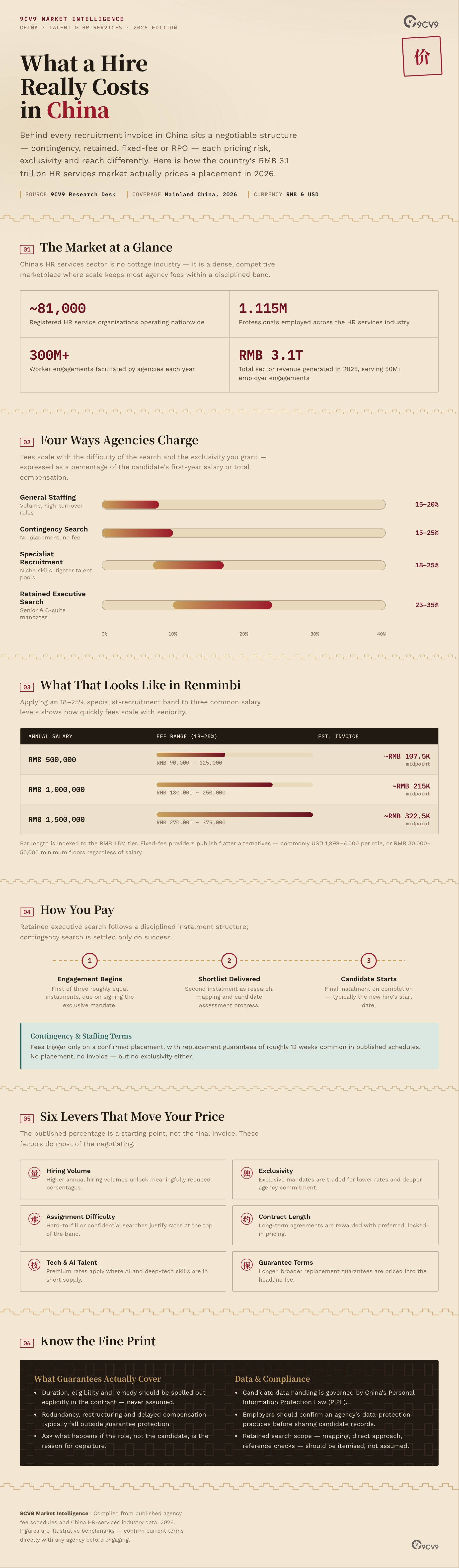
- Recruitment agency fees in China in 2026 typically range from about 15%–25% of first-year salary for contingency hiring, while retained executive search can reach 25%–35% for senior and specialized roles.
- Employers can reduce recruitment costs by matching the pricing model to hiring volume: contingency works well for individual hires, while RPO can offer stronger economics for sustained high-volume recruitment.
- The true cost of recruitment in China goes beyond the headline agency fee; employers should compare replacement guarantees, payment terms, candidate ownership, service levels, data compliance and total cost-per-hire before choosing an agency.
Recruitment agencies in China typically charge employers about 15% to 25% of a successful candidate’s first-year salary in 2026. Recruitment agencies calculate fees based on role seniority, talent scarcity, hiring volume, and service model, while executive search, RPO, fixed-fee recruitment, staffing, and EOR arrangements use different pricing structures.
Hiring the right talent in China has become an increasingly strategic challenge for employers navigating a large, competitive and highly specialized labor market. From artificial intelligence and semiconductors to advanced manufacturing, financial services, healthcare, consumer industries and cross-border commerce, companies are competing for professionals whose skills can be difficult to identify and attract through conventional job advertising alone.


This is where recruitment agencies, headhunters, executive search firms and Recruitment Process Outsourcing providers play an important role. However, one of the first questions employers typically ask is: how much do recruitment agencies charge in China in 2026?
For permanent recruitment, employers can generally expect agency fees to fall around 15% to 25% of a successfully placed candidate’s first-year salary or compensation, depending on the agency, position and commercial agreement. Specialist searches may command higher percentages, while retained executive search for C-suite, senior leadership and scarce strategic talent can reach approximately 25% to 35% of annual compensation.

The headline percentage, however, tells only part of the story.
Recruitment agency costs in China can vary substantially according to the commercial model being used. Contingency recruitment typically links payment to a successful placement, whereas retained executive search requires greater financial commitment throughout the assignment. Fixed-fee recruitment can provide predictable costs for standardized vacancies, while RPO arrangements are designed for companies managing recurring, project-based or high-volume recruitment.
Employers expanding into China must also distinguish recruitment costs from workforce deployment costs. An Employer of Record arrangement, for example, typically involves recurring administration charges in addition to employee salaries, statutory contributions and benefits. Flexible staffing and outsourcing arrangements introduce their own pricing structures and compliance considerations.
| Recruitment Model | Typical Pricing Approach | Best Suited For |
|---|---|---|
| Contingency Recruitment | Percentage of first-year compensation | Standard professional and mid-level hiring |
| Specialist Recruitment | Higher percentage-based success fee | Scarce technical and industry-specific talent |
| Retained Executive Search | Approximately 25%–35% of compensation | C-suite and strategic leadership |
| Fixed-Fee Recruitment | Predetermined amount per role | Standardized and repeat hiring |
| Project RPO | Project fee or cost-per-hire | Expansion and high-volume recruitment |
| Enterprise RPO | Management fee plus performance pricing | Continuous enterprise hiring |
| Flexible Staffing | Recurring staffing fee or markup | Scalable workforce requirements |
| Employer of Record | Monthly service fee plus employment costs | Companies requiring local employment infrastructure |
Geography can influence recruitment economics as well. Shanghai, Beijing, Shenzhen and other major commercial centers contain large concentrations of executive search firms and specialized recruiters, but they also feature intense competition for experienced professionals. Employers hiring scarce technology, engineering, management or commercial talent may therefore face different pricing and search requirements from companies recruiting standardized positions in less competitive markets.
Another important consideration is what employers receive in return for the recruitment fee. A strong agency agreement should define more than the commission percentage. Replacement guarantees, candidate ownership periods, exclusivity, shortlist delivery expectations, payment schedules, duplicate-candidate rules and service-level agreements can materially affect the actual value of a recruitment partnership.
Data protection has also become an important component of recruitment procurement in China. Recruitment agencies routinely process resumes, employment histories, contact information and potentially sensitive candidate information. Employers and agencies must therefore consider China’s Personal Information Protection Law when collecting, sharing, retaining or transferring candidate data, particularly when recruitment systems or decision-makers are located overseas.
For employers, the objective in 2026 should consequently not be to find the recruitment agency offering the lowest percentage fee. The more useful question is which recruitment model delivers the best combination of cost, hiring speed, candidate quality, compliance and placement protection.
This guide examines how much recruitment agencies charge in China in 2026, covering contingency recruitment fees, executive search pricing, fixed-fee recruitment, RPO, flexible staffing and EOR costs. It also explores replacement guarantees, service-level agreements, candidate ownership, employment costs, data privacy considerations and procurement strategies to help employers calculate the true cost of hiring talent in China.
Before we venture further into this article, we would like to share who we are and what we do.
About 9cv9
9cv9 is a business tech startup based in Singapore and Asia, with a strong presence all over the world.
With over ten years of startup and business experience, and being highly involved in connecting with thousands of companies and startups, the 9cv9 team has listed some of the top and best companies/tools in this review.
If you like to get your company listed in our top B2B software reviews, check out our world-class 9cv9 Media and PR service and pricing plans here.
How Much Do Recruitment Agencies Charge in China in 2026?
- Macroeconomic Context and Market Sizing of China’s HR Service Sector
- Contingency Search Model
- Retained Executive Search Model
- Fixed-Fee Model
- Recruitment Process Outsourcing (RPO) Commercial Models and Operating Metrics
- Flexible Staffing Overhead, Employer of Record (EOR), and Statutory Labor Costs
- Service Level Agreements (SLAs), Guarantee Protocols, and Operational KPIs
- Legal Regulation, PIPL Data Privacy, and Risk Management Frameworks
- Strategic Industry Syntheses and Procurement Action Matrix
1. Macroeconomic Context and Market Sizing of China’s HR Service Sector
China’s recruitment and human resources services market enters 2026 as a large, increasingly specialized industry shaped by enterprise restructuring, industrial upgrading, digital recruitment, flexible employment, and competition for high-value technical talent.
By the end of 2025, China had approximately 81,000 human resources service organizations employing about 1.115 million industry professionals, according to updated government figures. These organizations maintained more than 60,000 physical recruitment locations and over 20,000 online service platforms. Collectively, the sector provides employment, career-mobility, and related services to more than 300 million worker engagements annually.
Industry estimates place total Chinese human resources services revenue at approximately RMB 3.1 trillion in 2025, up around 3.7% year over year. The estimated compound annual growth rate between 2019 and 2025 was approximately 7.94%. This expansion has been accompanied by increasing specialization, consolidation among larger providers, and closer integration between HR services and strategic industries.
| China HR Services Indicator | Latest Market Benchmark | Relevance for Recruitment Agencies |
|---|---|---|
| Industry Revenue | Approximately RMB 3.1 trillion | Indicates a very large commercial HR services ecosystem |
| HR Service Organizations | Approximately 81,000 | Creates substantial competition among providers |
| Industry Practitioners | Approximately 1.115 million | Demonstrates significant professional service capacity |
| Annual Worker Engagements | More than 300 million | Reflects the scale of employment-market intermediation |
| Online Service Platforms | More than 20,000 | Accelerates digital sourcing and recruitment automation |
| National HR Service Industrial Parks | 29 | Supports regional HR service clusters |
| Manufacturing Integration Pilot Cities | 39 | Strengthens recruitment links with industrial development |
The Scale and Structure of Recruitment Demand in China
China’s recruitment market should not be viewed as a single headhunting industry. It forms part of a much broader HR services ecosystem encompassing permanent recruitment, executive search, flexible staffing, outsourcing, recruitment process outsourcing, payroll administration, talent assessment, workforce consulting, and technology-enabled recruitment.
Government information indicates that HR service providers now support more than 50 million employer engagements annually, with roughly 40% of the organizations served being manufacturing enterprises. This is significant for recruitment agencies because industrial upgrading is expanding demand for specialized engineering, advanced manufacturing, digital, and technical recruitment capabilities.
| Recruitment Service Segment | Typical Client Requirement | Commercial Characteristics | Typical Agency Positioning |
|---|---|---|---|
| Permanent Recruitment | Professional and managerial employees | Success-based or fixed placement fee | Generalist and specialist agencies |
| Executive Search | Senior executives and strategic appointments | Retained or milestone-based | Executive search firms |
| Specialist Headhunting | Scarce technical or industry talent | Higher percentage placement fees | Sector-focused recruiters |
| Flexible Staffing | Temporary or variable workforce | Recurring service margin | Staffing companies |
| Recruitment Process Outsourcing | Continuous or large-scale hiring | Monthly, project, or per-hire pricing | Enterprise recruitment providers |
| Project Recruitment | Factory expansion, new office, or market entry | Fixed project plus performance fees | Project recruitment specialists |
| Cross-Border Recruitment | International and regional talent | Placement fee plus additional services | International recruitment firms |
| Managed Workforce Services | Payroll, employment, compliance and workforce administration | Recurring management charges | Integrated HR service providers |
Core Commercial Models Used by Recruitment Agencies in China
The commercial structure selected by a recruitment agency generally reflects the difficulty of the assignment, hiring volume, candidate scarcity, expected search intensity, exclusivity, employer requirements, and seniority of the position.
The most important distinction is between transaction-based recruitment and ongoing workforce services.
Permanent recruitment normally produces a one-time placement fee. Flexible staffing generates recurring revenue while workers remain assigned to the client. RPO contracts can combine fixed management fees with variable hiring charges. Executive search typically requires greater financial commitment from the employer because significant research and search resources are allocated before a successful placement is guaranteed.
| Commercial Model | Primary Pricing Basis | Agency Revenue Timing | Client Risk Level | Best Suited For |
|---|---|---|---|---|
| Contingency Recruitment | Percentage of annual salary | Successful placement | Low | General professional hiring |
| Exclusive Contingency | Percentage of annual salary | Successful placement | Low to Medium | Important specialist roles |
| Retained Search | Percentage of compensation or agreed project fee | Multiple milestones | Higher | Executive and confidential hiring |
| Fixed-Fee Recruitment | Predetermined amount per hire | Placement or milestones | Medium | Predictable recurring roles |
| Volume Recruitment | Discounted per-hire or project pricing | Project milestones | Medium | Large hiring campaigns |
| Flexible Staffing | Margin or management fee | Monthly | Medium | Variable workforce requirements |
| RPO | Management fee, per-hire fee or hybrid | Monthly or milestone | Medium to High | Enterprise recruitment programs |
| Embedded Recruitment | Monthly recruiter/team fee | Monthly | Medium | Companies needing temporary recruiting capacity |
Contingency Recruitment Fees in China
Contingency recruitment remains one of the most accessible commercial arrangements for employers because the agency generally earns its primary placement fee only when a candidate is successfully hired.
Available 2026 Asian recruitment pricing benchmarks place typical recruitment partner charges in China at approximately 18% to 25% of annual salary, although actual contracts can move outside this range. Executive, highly technical, confidential, or exceptionally scarce positions can justify substantially higher pricing.
| Candidate Annual Compensation | Illustrative 18% Fee | Illustrative 20% Fee | Illustrative 25% Fee |
|---|---|---|---|
| RMB 200,000 | RMB 36,000 | RMB 40,000 | RMB 50,000 |
| RMB 300,000 | RMB 54,000 | RMB 60,000 | RMB 75,000 |
| RMB 500,000 | RMB 90,000 | RMB 100,000 | RMB 125,000 |
| RMB 800,000 | RMB 144,000 | RMB 160,000 | RMB 200,000 |
| RMB 1,000,000 | RMB 180,000 | RMB 200,000 | RMB 250,000 |
| RMB 1,500,000 | RMB 270,000 | RMB 300,000 | RMB 375,000 |
These calculations are illustrative rather than standardized national tariffs. Actual recruitment contracts may define the fee base differently, making it important for employers to determine whether the percentage applies to base salary, guaranteed annual cash compensation, total first-year compensation, or another contractual definition.
Retained Executive Search
Retained search transfers more search risk to the employer but generally provides greater commitment from the recruitment firm.
Instead of waiting until a candidate joins before receiving payment, the search firm receives payments according to predetermined stages. International recruitment benchmarks commonly place retained executive search around 25% to 35% of first-year compensation, while standard contingency recruitment commonly falls around 15% to 25%. China-specific agreements nevertheless vary substantially according to seniority, specialization and search complexity.
A typical retained arrangement could therefore follow the structure below.
| Search Stage | Typical Commercial Trigger | Agency Responsibility |
|---|---|---|
| Engagement | Contract signed | Define position and search strategy |
| Market Mapping | Research initiated | Identify target industries and companies |
| Longlist Development | Candidate universe established | Approach and assess prospects |
| Shortlist | Qualified candidates presented | Deliver screened candidates |
| Final Selection | Preferred candidate identified | References and negotiation support |
| Placement | Candidate accepts or joins | Complete hiring process |
| Guarantee Period | Post-placement period | Replacement support where contracted |
Retained search is particularly relevant where confidentiality, seniority, niche expertise, or candidate scarcity makes conventional database recruitment inadequate.
Flexible Staffing and Workforce Outsourcing
Flexible staffing operates differently because the client is purchasing ongoing workforce capacity rather than simply paying for candidate introduction.
The staffing provider may manage recruitment, worker administration, payroll coordination, statutory processes, attendance, replacement staffing and other workforce services. Consequently, employers should compare total bill rates and service scope rather than comparing the percentage with permanent recruitment fees.
| Cost Component | Permanent Recruitment | Flexible Staffing |
|---|---|---|
| Candidate Sourcing | Included | Included |
| Placement Charge | Usually one-time | Incorporated into recurring economics |
| Worker Salary | Paid by employer | Usually incorporated into staffing arrangement |
| Payroll Administration | Employer responsibility | Frequently provider-managed |
| Workforce Administration | Employer responsibility | Frequently provider-managed |
| Replacement Management | Guarantee-dependent | Often operationally integrated |
| Agency Revenue | Primarily placement-based | Recurring |
| Cost Duration | One-time | Continues while assignment remains active |
Recruitment Process Outsourcing
RPO is increasingly relevant to companies conducting continuous recruitment, rapid expansion, large-scale industrial hiring or transformation programs.
Rather than assigning individual vacancies to agencies independently, an RPO provider may assume responsibility for substantial portions of the recruitment function.
| RPO Pricing Structure | How It Works | Suitable Employer |
|---|---|---|
| Management Fee | Fixed recurring service charge | Predictable continuous hiring |
| Per-Hire Fee | Charge for each completed hire | Variable hiring volumes |
| Project Fee | Fixed price for defined recruitment campaign | Expansion or new facility |
| Recruiter Subscription | Monthly charge for dedicated recruiting capacity | Growth-stage organizations |
| Hybrid RPO | Base fee plus variable hiring charges | Large enterprises |
| Performance-Based | Fees partially linked to agreed results | Mature procurement environments |
For large employers, RPO procurement increasingly focuses on measurable outcomes rather than merely recruiter activity.
Service Level Agreements in Chinese Recruitment Contracts
Agency pricing should therefore be evaluated alongside the Service Level Agreement. A lower recruitment fee does not necessarily represent better commercial value if the provider produces weak shortlists, slow candidate delivery, poor retention, or limited replacement protection.
A well-designed recruitment SLA establishes measurable expectations covering responsiveness, candidate quality, delivery speed, communication, replacement obligations, reporting and data handling.
| SLA Category | Illustrative Measurement | Commercial Purpose |
|---|---|---|
| Vacancy Acknowledgement | Within agreed business hours | Confirms recruiter responsiveness |
| Search Launch | Agreed period after briefing | Prevents inactive assignments |
| Initial Candidate Delivery | Defined number of business days | Measures sourcing speed |
| Candidate Quality | Percentage meeting mandatory requirements | Controls irrelevant submissions |
| Interview Conversion | Submitted candidates reaching interview | Measures shortlist effectiveness |
| Offer Acceptance | Accepted offers versus offers issued | Indicates candidate engagement quality |
| Time-to-Fill | Days from approved requisition to accepted offer | Measures recruitment efficiency |
| Joining Ratio | Candidates joining versus accepting | Identifies pre-joining attrition |
| Replacement Response | Time to restart failed placement | Protects employer investment |
| Reporting | Weekly or monthly | Provides procurement visibility |
Replacement Guarantees and Candidate Ownership
Replacement provisions are particularly important when employers pay percentage-based recruitment fees.
Under a replacement guarantee, an agency may conduct another search without charging another full placement fee when the hired candidate leaves within an agreed period, subject to contractual conditions.
Employers should pay close attention to exclusions. Replacement guarantees may not apply when departure results from redundancy, organizational restructuring, material changes in duties, delayed compensation, employer misconduct, or other circumstances outside the recruiter’s control.
| Contract Provision | Question Employers Should Clarify |
|---|---|
| Guarantee Duration | How long is the placement protected? |
| Replacement Remedy | Replacement search, credit or refund? |
| Resignation | Is voluntary departure covered? |
| Termination | Which termination circumstances qualify? |
| Candidate Ownership | How long does an introduction remain attributable to the agency? |
| Duplicate Candidates | Which agency receives credit when multiple firms submit the same person? |
| Previous Applicants | Are candidates already known to the employer excluded? |
| Payment Condition | Must invoices be fully paid before guarantee protection applies? |
How Role Difficulty Influences Recruitment Agency Fees
Recruitment fees in China cannot be evaluated solely according to salary.
Candidate scarcity, location, technical complexity, language requirements, industry experience, confidentiality, employer reputation and search exclusivity can all influence pricing.
| Hiring Characteristic | Expected Fee Pressure | Reason |
|---|---|---|
| Entry-Level Role | Lower | Large candidate pool |
| Standard Professional Role | Moderate | Conventional recruitment process |
| Experienced Manager | Moderate to High | Smaller qualified talent pool |
| Senior Executive | High | Extensive assessment and confidentiality |
| Rare Technical Specialist | High | Limited candidate availability |
| AI or Advanced Technology Talent | High | Intense competition for specialist expertise |
| High-Volume Recruitment | Lower Per Hire | Volume enables negotiated discounts |
| Exclusive Agency Mandate | Potentially Lower or Negotiable | Agency receives stronger hiring commitment |
| Urgent Recruitment | Higher | Additional sourcing resources may be required |
| Cross-Border Search | Higher | Wider sourcing and coordination requirements |
Technology and Advanced Manufacturing Are Reshaping Recruitment Economics
One of the most important developments affecting China’s recruitment market in 2026 is the continuing competition for highly specialized technology and industrial talent.
Artificial intelligence, semiconductors, robotics, autonomous systems, advanced manufacturing and other strategic technology industries are generating demand for candidates whose skills cannot always be sourced efficiently through conventional job advertisements.
Recent reporting has also identified increased movement of senior Chinese AI researchers and engineers back from overseas technology centers, reflecting China’s growing attractiveness as a destination for advanced AI research and commercialization.
This environment strengthens the commercial case for specialist headhunters capable of talent mapping, passive candidate sourcing and international searches.
Negotiating Recruitment Agency Fees in China
Employers with significant recruitment volumes can often negotiate commercial terms beyond the headline placement percentage.
The most valuable negotiations frequently concern the overall risk allocation within the agreement rather than simply obtaining the lowest percentage.
| Negotiation Lever | Possible Commercial Outcome |
|---|---|
| Higher Annual Hiring Volume | Reduced placement percentage |
| Exclusive Mandate | Preferential fee structure |
| Multiple Vacancies | Volume discount |
| Long-Term Agreement | Preferred supplier pricing |
| Faster Invoice Payment | Potential commercial discount |
| Difficult Assignment | Higher fee but stronger SLA |
| Retained Commitment | Dedicated search resources |
| Multiple Markets | Regional framework agreement |
| Repeat Hiring | Tiered pricing structure |
Recruitment Agency Commercial Model Comparison
| Model | Typical Cost Structure | Upfront Commitment | Agency Commitment | Employer Risk | Suitable Use Case |
|---|---|---|---|---|---|
| Contingency | Percentage of annual compensation | Low | Moderate | Low | Standard professional hiring |
| Exclusive Contingency | Percentage of compensation | Low | Moderate to High | Low | Specialist recruitment |
| Retained Search | Milestone-based percentage or project fee | High | High | Medium to High | Executive recruitment |
| Fixed Fee | Predetermined amount | Low to Medium | Moderate | Medium | Standardized positions |
| Volume Recruitment | Discounted per hire/project | Medium | High | Medium | Mass recruitment |
| Flexible Staffing | Recurring bill rate or margin | Ongoing | High | Medium | Variable workforce |
| RPO | Monthly, per-hire or hybrid | Medium to High | High | Medium | Continuous enterprise hiring |
| Embedded Recruitment | Monthly team/recruiter cost | Medium | High | Medium | Temporary internal recruiting capacity |
What Employers Should Include in a China Recruitment Agency Agreement
A commercially robust recruitment agreement should define far more than the headline agency fee.
| Contract Area | Recommended Definition |
|---|---|
| Fee Percentage | Exact percentage or fixed amount |
| Fee Calculation Base | Base salary, guaranteed cash or total compensation |
| Payment Trigger | Acceptance, start date or another milestone |
| Payment Terms | Invoice deadline and payment schedule |
| Candidate Ownership | Defined ownership period |
| Duplicate Submission | Rules for competing introductions |
| Replacement Guarantee | Duration, eligibility and remedy |
| Search Exclusivity | Exclusive or non-exclusive |
| SLA | Delivery and quality expectations |
| Confidentiality | Candidate and employer information protection |
| Reporting | Required recruitment performance reports |
| Data Handling | Candidate information responsibilities |
| Termination | Contract exit conditions |
| Cross-Border Services | Additional responsibilities where applicable |
Commercial Outlook for Recruitment Agencies in China in 2026
China’s recruitment market in 2026 is increasingly moving away from a simple transactional model in which agencies merely provide resumes in exchange for placement commissions. The broader direction is toward specialized, technology-enabled and outcome-oriented recruitment services.
Government data showing approximately 81,000 HR service organizations and more than 300 million annual worker service engagements illustrates both the enormous scale and competitive intensity of the industry. Meanwhile, HR services are becoming more closely connected with manufacturing development, digital recruitment platforms and specialized talent markets.
For employers, the central procurement question is therefore not simply how much a recruitment agency charges in China. The more useful comparison considers fee structure, search methodology, candidate specialization, delivery speed, replacement protection, reporting quality and measurable SLA commitments together.
For recruitment agencies, competitive differentiation in 2026 increasingly depends on demonstrating access to difficult-to-find talent, industry expertise, faster execution and measurable hiring outcomes. Contingency recruitment remains commercially attractive for conventional professional vacancies, while retained search is better aligned with executive and scarce-talent assignments. Flexible staffing and RPO, meanwhile, provide employers with more scalable models where recruitment demand is continuous or workforce requirements fluctuate.
Ultimately, the strongest recruitment agency agreement is not necessarily the contract carrying the lowest percentage fee. It is the agreement that establishes an appropriate balance between recruitment cost, agency commitment, hiring speed, candidate quality, employer risk and long-term workforce value.
2. Contingency Search Model
The contingency search model remains one of the most widely used recruitment agency pricing structures in China in 2026, particularly for professional, specialist and middle-to-senior management recruitment. Under a conventional success-based arrangement, the recruitment agency receives its principal fee when an introduced candidate is successfully hired and begins employment. Some providers advertise completely performance-based arrangements with no upfront recruitment charge, while others combine success fees with small deposits or engagement payments.
Recruitment fees are generally calculated as a percentage of the successful candidate’s first-year compensation. Current China market benchmarks indicate approximately 15%–20% for general staffing or permanent-placement agencies, 18%–25% for industry-specialist recruitment, and approximately 25%–35% for executive search. Another 2026 Asian staffing benchmark places China broadly within an 18%–25% range, with senior and specialist positions tending toward the upper end.
| Contingency Search Category | Indicative 2026 Fee Range | Typical Hiring Requirement |
|---|---|---|
| General Permanent Recruitment | 15%–20% of first-year salary | Standard professional and operational positions |
| Specialist Recruitment | 18%–25% of first-year compensation | Technical, professional and industry-specific positions |
| China Headhunting Services | Approximately 20%–28% in published agency examples | Management and difficult-to-source positions |
| Senior and Executive Search | Approximately 25%–35% | Senior leadership and scarce talent |
| Cross-Border Talent Search | Around 25% in some published pricing models | International or overseas talent requirements |
How the Recruitment Fee Is Calculated
The definition of “annual compensation” is an important contractual consideration. Some Chinese recruitment providers calculate their fee against comprehensive first-year compensation rather than base salary alone. Published agency terms show calculations incorporating base salary and bonuses, while some headhunting agreements use broader remuneration definitions that can include allowances, commissions and other compensation components.
For employers, the recruitment agreement should therefore specify the compensation base before the search begins.
| Compensation Component | Potential Treatment in Fee Calculation |
|---|---|
| Annual Base Salary | Commonly included |
| Guaranteed Cash Bonus | Frequently included where defined as annual compensation |
| Allowances | May be included depending on agency terms |
| Sales Commission | Contract-dependent |
| Performance Bonus | Contract-dependent |
| Equity or Options | May be included under broader compensation definitions |
| Sign-On Payments | Should be explicitly clarified |
Indicative Contingency Recruitment Costs
Using the commonly cited 18%–25% specialist recruitment range, employers can estimate the potential recruitment cost before engaging an agency.
| Candidate Annual Compensation | Fee at 18% | Fee at 20% | Fee at 25% |
|---|---|---|---|
| RMB 200,000 | RMB 36,000 | RMB 40,000 | RMB 50,000 |
| RMB 300,000 | RMB 54,000 | RMB 60,000 | RMB 75,000 |
| RMB 500,000 | RMB 90,000 | RMB 100,000 | RMB 125,000 |
| RMB 800,000 | RMB 144,000 | RMB 160,000 | RMB 200,000 |
| RMB 1,000,000 | RMB 180,000 | RMB 200,000 | RMB 250,000 |
| RMB 1,500,000 | RMB 270,000 | RMB 300,000 | RMB 375,000 |
These calculations should be treated as budgeting illustrations rather than standardized national tariffs. Individual agencies can apply different percentages, minimum charges, retainers and compensation definitions.
Minimum Placement Fees
Minimum fee floors are also found in the Chinese headhunting market, particularly where a percentage calculation would otherwise produce insufficient revenue to cover sourcing and assessment costs.
Current published Chinese market guidance places minimum fees for some regular corporate headhunting engagements at approximately RMB 30,000–50,000. Individual agency schedules provide further evidence of minimum charges around RMB 30,000–50,000 depending on the service category.
| Pricing Mechanism | Indicative Market Practice |
|---|---|
| Percentage Fee | Approximately 18%–25% for many specialist assignments |
| General Recruitment | Approximately 15%–20% |
| Executive Search | Can reach approximately 25%–35% |
| Published Minimum Fee Floors | Approximately RMB 30,000–50,000 in some agency models |
| Overseas/Specialist Search | Higher minimums or percentage rates may apply |
| Small Engagement Deposit | Used by some agencies despite success-based final pricing |
Payment Terms and Guarantee Periods
Payment structures should not be assumed to follow a universal 50/50 schedule. Current evidence shows considerable variation among Chinese recruitment agencies.
Some success-based providers charge only after successful onboarding. Other headhunters require an advance payment followed by the balance shortly after the candidate joins. Published Chinese agency schedules, for example, show three-month guarantee periods with outstanding balances payable within approximately one week after entry. Historical professional recruitment agreements also demonstrate the use of 30-day invoice settlement periods combined with replacement guarantees.
| Contract Element | Observed Market Approach |
|---|---|
| Search Commencement | No fee, deposit or advance payment depending on provider |
| Main Success Trigger | Candidate successfully joins employer |
| Invoice Settlement | Defined contractually; examples range from around one week to 30 days |
| Guarantee Period | Three months appears in several published headhunting schedules |
| Failed Placement During Guarantee | Replacement search may be provided without another placement fee |
| Refund | Available under some agreements, but not universal |
Replacement Guarantees
The replacement guarantee is particularly important in contingency recruitment because it reduces the employer’s financial exposure when a newly hired candidate leaves shortly after joining.
Some Chinese recruitment firms publicly offer approximately 12-week guarantees with one free replacement, while other published headhunting schedules specify three-month guarantee periods. The precise remedy can differ considerably: one provider may restart the search, another may provide a credit, while another may offer a partial refund under specified circumstances.
| Guarantee Provision | Employer Should Confirm |
|---|---|
| Guarantee Duration | Exact number of weeks or months |
| Candidate Resignation | Whether voluntary departure qualifies |
| Employer Termination | Circumstances covered by replacement |
| Replacement Search | Whether one replacement is included |
| Additional Fee | Whether replacement remains completely free |
| Refund Alternative | Whether credit or refund applies if replacement fails |
| Payment Requirement | Whether invoices must be fully settled for guarantee protection |
Contingency Search Versus More Committed Search Models
The principal advantage of contingency recruitment is comparatively low upfront financial risk. However, non-exclusive contingency assignments can result in several agencies competing to fill the same vacancy. For difficult senior or highly specialized appointments, employers may instead negotiate exclusivity, an engagement fee or a retained search structure to secure greater recruiter commitment.
| Factor | Contingency Search | Exclusive Contingency | Retained Search |
|---|---|---|---|
| Primary Payment Trigger | Successful placement | Successful placement | Search milestones |
| Upfront Cost | Usually low or none | Usually low | Higher |
| Agency Commitment | Moderate | Moderate to High | High |
| Multiple Agencies | Common | Usually restricted | Usually restricted |
| Search Depth | Moderate | More focused | Extensive |
| Employer Financial Risk | Low | Low to Moderate | Higher |
| Best Application | Professional hiring | Difficult specialist roles | Executive and strategic appointments |
Key Commercial Considerations for Employers in China
For employers comparing recruitment agencies in China in 2026, the headline percentage should therefore represent only one component of the commercial assessment. Fee calculation methodology, minimum charges, candidate ownership, payment timing, replacement guarantees and service-level commitments can materially change the effective value of an agency agreement.
The original claims that freelance recruiters consistently charge 12%–15%, Tier-1 cities automatically carry a 5%–15% premium over Tier-2 markets, contingency completion rates are 20%–35%, and 50% of the fee is normally paid after joining with the remaining 50% after probation should not be presented as general China-wide 2026 market standards without stronger supporting evidence. Current published pricing supports a broader 15%–35% spectrum depending on service level and demonstrates that payment structures vary substantially between providers.
3. Retained Executive Search Model
Retained executive search is the premium recruitment model typically used in China for C-suite executives, vice presidents, country leaders, board-level appointments and strategically important technical leadership positions. Unlike contingency recruitment, the employer commits financially to the search from the beginning, while the executive search firm allocates dedicated research, market-mapping and candidate-assessment resources to the mandate.
International retained-search benchmarks in 2026 generally place professional fees at approximately 25% to 35% of the successful executive’s first-year compensation. China-specific executive-search guidance also supports a broadly comparable 25%–33% range for international retained search firms operating in the market.
| Retained Search Component | Typical 2026 Market Practice | Commercial Implication |
|---|---|---|
| Typical Fee Range | 25%–35% of first-year compensation | Premium over conventional recruitment |
| Common Benchmark | Approximately 30%–33% | Frequently used for senior executive searches |
| Engagement Type | Exclusive mandate | One search firm assumes primary responsibility |
| Payment Method | Milestone-based instalments | Employer commits before placement |
| Candidate Focus | Senior and difficult-to-access talent | Extensive direct sourcing required |
| Search Method | Market mapping and targeted outreach | Broader than database recruitment |
| Typical Roles | VP, C-suite, board and strategic leadership | High-impact appointments |
| Search Priority | Dedicated | Greater agency resource commitment |
The Staggered Thirds Payment Model
The traditional retained executive search structure divides the professional fee into approximately three equal instalments. Current 2026 executive-search benchmarks continue to identify this “rule of thirds” as a standard commercial structure.
| Payment Milestone | Approximate Share | Typical Trigger | Primary Work Covered |
|---|---|---|---|
| Engagement Retainer | 33.3% | Search mandate signed | Briefing, research strategy and market mapping |
| Shortlist Milestone | 33.3% | Qualified shortlist presented | Candidate identification, outreach and assessment |
| Completion Payment | 33.3% | Offer acceptance, employment agreement or placement | Negotiation, referencing and search completion |
| Total | 100% | Full search lifecycle | End-to-end executive search |
The first payment effectively finances the launch of the assignment. The search firm develops the candidate profile, identifies target organizations, maps the relevant talent market and begins confidential approaches.
The second instalment becomes payable after an agreed search milestone, commonly the delivery of a qualified shortlist.
The final instalment is generally triggered by successful completion, although contracts differ over whether completion means offer acceptance, employment contract execution or the executive’s actual start date.
Illustrative Executive Search Fee Calculation
Consider a senior executive in China receiving RMB 1 million in first-year compensation. At a 30% retained-search rate, the professional fee would equal RMB 300,000. Under an equal three-stage payment structure, approximately RMB 100,000 would become payable at each milestone. A China-focused executive search provider has published this same type of RMB 1 million compensation and 30% fee illustration.
| Executive Compensation | 25% Search Fee | 30% Search Fee | 33% Search Fee |
|---|---|---|---|
| RMB 500,000 | RMB 125,000 | RMB 150,000 | RMB 165,000 |
| RMB 800,000 | RMB 200,000 | RMB 240,000 | RMB 264,000 |
| RMB 1,000,000 | RMB 250,000 | RMB 300,000 | RMB 330,000 |
| RMB 1,500,000 | RMB 375,000 | RMB 450,000 | RMB 495,000 |
| RMB 2,000,000 | RMB 500,000 | RMB 600,000 | RMB 660,000 |
| RMB 3,000,000 | RMB 750,000 | RMB 900,000 | RMB 990,000 |
The compensation definition requires particular attention. Some retained-search contracts calculate fees against base salary plus target or guaranteed bonuses, while others apply broader definitions of first-year compensation. Equity, sign-on awards and long-term incentives may be included or excluded depending on the agreement.
Why Retained Searches Are Usually Exclusive
Exclusivity is one of the defining commercial differences between retained executive search and contingency recruitment.
The employer generally appoints one search firm to control the assignment. This allows the firm to conduct deeper market research without competing against multiple recruiters attempting to submit candidates first. Contemporary 2026 retained-search guidance continues to characterize the model as an exclusive relationship involving dedicated resources and staged payments.
| Search Characteristic | Contingency Recruitment | Retained Executive Search |
|---|---|---|
| Exclusivity | Usually non-exclusive | Usually exclusive |
| Upfront Payment | Usually none | Required |
| Payment Dependency | Primarily successful placement | Search milestones |
| Search Depth | Moderate | Extensive |
| Market Mapping | Limited to Moderate | Comprehensive |
| Passive Candidate Outreach | Common | Core requirement |
| Candidate Assessment | Standard | Detailed |
| Confidentiality | Standard | High |
| Typical Seniority | Professional to senior management | VP, C-suite and board |
| Employer Commitment | Low | High |
| Agency Commitment | Variable | Dedicated |
Alternative Retained and Hybrid Fee Structures
Not every executive search firm follows an exact three-thirds formula. The 2026 market also includes fixed-fee arrangements, modified retainers, engagement fees and hybrid retained-contingency structures.
Flat fees are particularly useful where executive compensation cannot be estimated accurately before the search starts. Some firms also combine an initial engagement payment with a larger completion payment.
| Alternative Model | Payment Structure | Appropriate Situation |
|---|---|---|
| Traditional Retained | Three approximately equal instalments | C-suite and major leadership searches |
| Fixed Retained Fee | Predetermined project price | Compensation package uncertain |
| Engagement Fee Plus Success Fee | Smaller initial payment plus placement balance | Mid-market executive recruitment |
| Hybrid Search | Partial retainer plus performance component | Employer wants shared placement risk |
| Four-Stage Retained | Multiple milestone payments including start date | Longer or complex searches |
The proposed USD 5,000 to RMB 30,000 deposit range should not be treated as a standardized China-wide retained executive search benchmark. Individual agencies may use engagement deposits, but publicly available evidence demonstrates substantial variation according to firm, mandate and seniority.
Service Expectations Under a Retained Mandate
The higher financial commitment is intended to purchase considerably more than candidate introductions. A professional retained assignment typically includes role definition, market intelligence, competitor mapping, passive candidate identification, direct approaches, screening, structured assessment, shortlist development, interview management, reference checking and compensation negotiation.
| Search Stage | Expected Executive Search Service |
|---|---|
| Role Definition | Leadership requirements and success profile |
| Market Mapping | Identification of target companies and talent pools |
| Talent Research | Identification of potential executives |
| Direct Approach | Confidential contact with passive candidates |
| Screening | Career, motivation and compensation assessment |
| Shortlisting | Presentation of qualified executive candidates |
| Assessment | Leadership and role-fit evaluation |
| Interviews | Process coordination and feedback |
| Referencing | Professional reference verification |
| Offer Stage | Compensation and negotiation assistance |
| Onboarding | Transition support where included |
| Guarantee | Replacement protection subject to contract |
Assignment Completion Rates
Retained executive search generally provides stronger incentives for an agency to complete an assignment than non-exclusive contingency recruitment because resources are funded from the beginning and one firm assumes responsibility for the mandate.
However, a universal 90%–95% completion rate should not be presented as a definitive China-wide 2026 industry statistic. Current published benchmarks vary by provider. One 2026 source estimates retained-search failure rates around 10%–15%, while an individual retained provider reports a failure rate below 5%. These figures suggest materially higher completion potential than contingency recruitment but do not establish a universal Chinese market rate.
Retained Search Commercial Matrix
| Factor | Typical Position in China’s Executive Search Market |
|---|---|
| Target Roles | C-suite, VP, board, country leadership and strategic technical roles |
| Indicative Fee | Approximately 25%–35% of first-year compensation |
| Common Pricing Reference | Approximately one-third of compensation |
| Search Rights | Normally exclusive |
| Initial Payment | Due when mandate commences |
| Second Payment | Typically linked to shortlist or agreed milestone |
| Final Payment | Offer, contract, placement or start-date milestone |
| Candidate Strategy | Direct search and passive talent sourcing |
| Research Intensity | High |
| Confidentiality | High |
| Employer Financial Commitment | High |
| Agency Resource Commitment | High |
| Replacement Protection | Common, but duration varies by contract |
For Chinese employers hiring strategically important executives in 2026, retained search should therefore be evaluated as a professional advisory and talent-mapping engagement rather than simply a more expensive version of contingency recruitment. The higher fee and upfront commitment purchase exclusivity, deeper market research, access to passive executives, structured assessment and greater accountability throughout the hiring process.
4. Fixed-Fee Model
The fixed-fee recruitment model provides employers in China with a more predictable alternative to salary-percentage recruitment fees. Instead of calculating the agency’s commission as a percentage of the successful candidate’s annual compensation, the employer and recruitment provider agree on a predetermined amount for an individual vacancy, group of vacancies, or defined recruitment project.
This model is particularly suitable for standardized professional positions, recurring recruitment, expansion projects and volume hiring where the employer can define the job requirements and expected recruitment workload in advance. International recruitment benchmarks similarly identify flat-fee arrangements as particularly applicable to one-off hires and bulk recruitment, where volume discounts can reduce the effective cost per hire.
China-specific evidence confirms that fixed pricing exists alongside percentage-based headhunting. One established Chinese search provider publicly offers either fixed fees or salary-percentage pricing for standard, specialist and overseas headhunting assignments.
| Fixed-Fee Characteristic | Typical Application in China | Commercial Effect |
|---|---|---|
| Pricing Basis | Predetermined amount per role or project | Cost does not automatically increase with salary |
| Target Positions | Standardized professional and management roles | Easier to establish repeatable pricing |
| Volume Recruitment | Multiple similar vacancies | Enables volume discounts |
| Project Recruitment | Expansion or defined hiring campaign | Creates predictable project budget |
| Executive Recruitment | Possible but less standardized | Pricing reflects search complexity |
| Salary Dependency | Low or none | Removes direct link between salary and agency fee |
| Payment Terms | Negotiated by contract | Can include upfront and completion components |
| Exclusivity | Contract-dependent | Can be exclusive or non-exclusive |
How Fixed Recruitment Fees Work
Under a conventional percentage arrangement, hiring a candidate earning RMB 600,000 at a 25% agency rate would generate a RMB 150,000 recruitment fee. Under fixed-fee recruitment, the agreed agency charge remains predetermined regardless of whether the final candidate salary moves within the approved compensation range.
This gives HR and finance departments greater budget certainty and reduces the possibility that unexpectedly high candidate compensation automatically increases recruitment expenditure.
Publicly available China-focused recruitment offerings illustrate the diversity of this model. One provider markets a flat fee of approximately USD 5,000 for many execution-level positions in China, while another advertises flat recruitment packages ranging from approximately USD 1,999 for entry-level recruitment to USD 6,000 for mid-level positions. These should be viewed as provider-specific examples rather than universal Chinese market rates.
| Candidate Salary | 20% Percentage Fee | 25% Percentage Fee | Illustrative RMB 50,000 Fixed Fee | Illustrative RMB 100,000 Fixed Fee |
|---|---|---|---|---|
| RMB 200,000 | RMB 40,000 | RMB 50,000 | RMB 50,000 | RMB 100,000 |
| RMB 300,000 | RMB 60,000 | RMB 75,000 | RMB 50,000 | RMB 100,000 |
| RMB 500,000 | RMB 100,000 | RMB 125,000 | RMB 50,000 | RMB 100,000 |
| RMB 800,000 | RMB 160,000 | RMB 200,000 | RMB 50,000 | RMB 100,000 |
| RMB 1,000,000 | RMB 200,000 | RMB 250,000 | RMB 50,000 | RMB 100,000 |
The calculations above are illustrative. They demonstrate why fixed-fee recruitment can become economically attractive when employers have predictable hiring requirements or higher-salaried vacancies.
Fixed Fees for Volume and Project Recruitment
Fixed pricing becomes particularly relevant when recruitment agencies can spread sourcing and screening resources across multiple similar vacancies.
Retail expansion, manufacturing recruitment, sales-force development, shared-service centers and large engineering projects can generate repetitive hiring requirements. Instead of negotiating a percentage of salary for every employee, employers can establish a per-hire rate, project budget or declining fee schedule as recruitment volume increases.
Historical disclosures from a major Chinese online recruitment platform also demonstrate that RPO services have been sold at fixed rates per position, alongside percentage-based alternatives. Published rates ranged from RMB 1,000 to RMB 12,000 per position depending on hiring milestones. While these historical figures should not be treated as 2026 market prices, they demonstrate that fixed per-position pricing has long been established within China’s recruitment-services ecosystem.
| Volume Pricing Structure | How It Operates | Suitable Hiring Scenario |
|---|---|---|
| Flat Fee Per Hire | Same fee for each successful employee | Repeated standardized roles |
| Tiered Per-Hire Fee | Cost decreases after volume thresholds | Large recruitment campaigns |
| Fixed Project Fee | Single budget for complete campaign | New facility or business expansion |
| Fixed Fee Plus Success Bonus | Base project payment plus completion incentive | Difficult volume projects |
| Monthly Recruitment Fee | Fixed recurring recruiting capacity | Continuous hiring |
| Hybrid RPO | Management fee plus reduced per-hire charge | Enterprise-scale recruitment |
Are RMB 30,000–150,000 Fixed Fees Standard in Ningbo?
The proposed RMB 30,000–150,000 range should not be presented as a standard Ningbo market benchmark without stronger supporting evidence.
Current 2026 Ningbo recruitment information located during research predominantly shows salary-percentage pricing rather than a standardized fixed-fee range. One Ningbo-focused provider reports approximately 20%–25% of first-year compensation, with 20%–22% for certain middle-management and technical positions and 23%–25% for core R&D and executive appointments.
Meanwhile, broader Chinese agency pricing provides direct evidence of fixed-fee options but does not establish RMB 30,000–150,000 as a universal regional range. For example, one provider publishes minimum charges around RMB 35,000 and allows fixed pricing as an alternative for several search categories.
For SEO and factual accuracy, it is therefore safer to describe fixed fees as individually negotiated according to role complexity, recruitment volume and service scope rather than assigning a definitive Ningbo-wide range.
Payment Structures for Fixed-Fee Recruitment
Fixed fee does not necessarily mean that the entire recruitment charge is paid upfront. Agencies can distribute payments across the recruitment lifecycle.
China-specific published examples include a 50% initiation payment followed by the remaining 50% when the candidate starts work. Other Chinese headhunting providers use advance payments followed by settlement of the outstanding balance shortly after entry.
| Payment Structure | Search Commencement | Candidate Delivery | Successful Placement |
|---|---|---|---|
| Upfront Fixed Fee | 100% | No additional payment | No additional payment |
| 50/50 Model | 50% | No payment | 50% |
| Engagement Plus Success | Fixed deposit | No payment | Remaining balance |
| Milestone Model | Initial percentage | Second instalment | Final instalment |
| Success-Based Flat Fee | No payment | No payment | 100% fixed fee |
Advantages of Fixed-Fee Recruitment
The strongest advantage is predictability. Employers know the recruitment cost before candidate salary negotiations are completed.
The model can also improve procurement transparency because the recruiter’s compensation is based on the agreed work rather than increasing automatically with candidate salary.
| Advantage | Business Impact |
|---|---|
| Budget Predictability | Recruitment expenditure can be forecast more accurately |
| Salary Independence | Higher candidate salary does not automatically increase agency fees |
| Volume Efficiency | Repeated hiring can lower effective cost per placement |
| Procurement Simplicity | Easier comparison between recruitment proposals |
| Scalable Contracting | Standard rates can cover multiple similar vacancies |
| Cost Transparency | HR teams can establish recruitment budgets before hiring begins |
Limitations of Fixed-Fee Recruitment
Fixed pricing is not automatically cheaper or more effective. Employers must examine what services are included in the quoted amount.
An inexpensive fixed-fee package may provide basic sourcing and screening, while a higher-priced engagement may incorporate talent mapping, assessment, background verification, salary negotiation and replacement protection.
| Potential Limitation | Employer Consideration |
|---|---|
| Service Scope | Determine exactly which recruitment activities are included |
| Candidate Quality | Establish shortlist qualification requirements |
| Upfront Payment | Clarify whether payments are refundable |
| Difficult Vacancies | Confirm whether additional charges can arise |
| Replacement Guarantee | Define replacement period and conditions |
| Volume Commitments | Establish minimum hiring quantities |
| Project Changes | Determine how changed job specifications affect pricing |
Comparison of China Recruitment Agency Commercial Models in 2026
Available market evidence supports the broad distinction between contingency, retained and fixed-fee recruitment, but several of the originally proposed figures should be treated as illustrative rather than China-wide standards. Payment schedules, fill rates and time-to-placement vary substantially between providers and assignments.
| Commercial Parameter | Contingency Search | Retained Executive Search | Fixed-Fee Recruitment |
|---|---|---|---|
| Primary Pricing Method | Percentage of first-year compensation | Percentage or agreed search fee | Predetermined amount |
| Indicative Fee Benchmark | Approximately 15%–25% for conventional recruitment | Approximately 25%–35% for senior search | Negotiated by role or project |
| Salary Dependency | High | High when percentage-based | Low |
| Upfront Commitment | Usually low | High | Low to high depending on contract |
| Payment Structure | Primarily success-based | Milestone-based | Upfront, milestone or success-based |
| Exclusivity | Usually non-exclusive | Normally exclusive | Negotiable |
| Typical Positions | Professional and management | Executive and strategic leadership | Standardized, repeat or volume positions |
| Volume Discount Potential | Moderate | Low | High |
| Budget Predictability | Moderate | Moderate | High |
| Search Depth | Moderate | High | Depends on package |
| Guarantee | Common but contract-dependent | Common | Contract-dependent |
| Best Application | Individual professional vacancies | C-suite and scarce leadership | Repeatable and volume recruitment |
Fixed-Fee Model Versus Percentage Recruitment
The commercial attractiveness of fixed-fee recruitment increases as candidate compensation rises, provided that the recruitment workload remains predictable.
For example, a RMB 50,000 fixed recruitment fee represents 20% of a RMB 250,000 salary but only 5% of a RMB 1 million salary. Conversely, percentage pricing automatically scales with compensation even when the underlying sourcing process remains broadly similar.
This makes fixed-fee recruitment particularly relevant for companies conducting repeat hiring, building standardized teams or seeking greater control over recruitment expenditure.
However, employers should avoid choosing an agency purely on the lowest fixed price. Candidate quality, replacement guarantees, delivery SLAs, assessment methodology, market coverage and recruiter specialization remain important components of the overall economic value of the service.
5. Recruitment Process Outsourcing (RPO) Commercial Models and Operating Metrics
Recruitment Process Outsourcing has become an important alternative to traditional recruitment agency hiring for companies operating or expanding in China. Under an RPO arrangement, an external provider assumes responsibility for all or selected components of the permanent recruitment lifecycle, potentially covering workforce planning, job design, sourcing, screening, assessment, interview coordination, offer management and onboarding.
China-based RPO providers currently offer full-process, project-based and modular solutions, while major international recruitment groups operating in China similarly distinguish between Full RPO, Project RPO and Modular RPO.
| RPO Model | Operational Scope | Best-Suited Employer | Typical Commercial Approach |
|---|---|---|---|
| Enterprise / Full RPO | End-to-end recruitment function | Large enterprises with continuous hiring | Management fee, cost-per-hire or hybrid |
| Project RPO | Defined recruitment campaign | New facilities, expansion and hiring surges | Fixed project or per-hire pricing |
| Modular RPO | Selected recruitment activities | Companies retaining internal TA teams | Resource, module or project pricing |
| Embedded Recruitment | Dedicated recruiters integrated into employer | Companies requiring additional recruiting capacity | Monthly recruiter fee |
| Hybrid RPO | Shared responsibility between internal HR and provider | Mid-sized and large employers | Retainer plus variable performance fees |
Enterprise or Full RPO
Full RPO transfers substantial responsibility for the recruitment lifecycle to an external provider. In China, this can extend from candidate sourcing and screening through assessment, offer management and onboarding.
The commercial model differs fundamentally from contingency recruitment. Rather than paying 15%–25% or more of salary each time an agency makes a placement, the employer purchases recruitment capacity and process management over a longer period.
Large RPO arrangements can also incorporate technology, recruitment analytics, compliance processes, employer branding and workforce planning. Major China-market providers emphasize that RPO pricing is generally customized according to the resources and performance requirements of the employer rather than sold purely as a salary-percentage service.
| Enterprise RPO Component | Typical Scope |
|---|---|
| Workforce Planning | Forecasting recruitment demand |
| Recruitment Technology | ATS and workflow integration |
| Candidate Sourcing | Multi-channel talent acquisition |
| Screening | Resume and candidate qualification |
| Assessment | Testing and structured evaluation |
| Interview Management | Scheduling and process administration |
| Offer Management | Negotiation and offer coordination |
| Onboarding | Pre-employment and joining support |
| Analytics | Recruitment funnel and SLA reporting |
| Employer Branding | Candidate attraction initiatives |
Project RPO
Project RPO is designed for temporary increases in recruitment demand rather than permanent outsourcing of the recruitment function.
A company opening a manufacturing facility, research center, sales operation or new business division in China might require dozens or hundreds of employees within a defined period. Instead of increasing its permanent internal recruiting headcount, the company can establish a temporary RPO team.
Major RPO providers describe Project RPO as suitable for one-off or short-to-medium-term recruitment demand, with implementation potentially completed within several weeks.
| Project RPO Situation | Why the Model Can Be Appropriate |
|---|---|
| New Manufacturing Facility | Large number of positions required simultaneously |
| New Research Center | Concentrated specialist recruitment |
| Geographic Expansion | Employer lacks established local recruiting capacity |
| Retail Expansion | Repetitive hiring across locations |
| Seasonal Hiring Surge | Temporary increase in recruitment demand |
| Business Transformation | Significant workforce restructuring |
| New Product Division | Rapid creation of specialist teams |
Project duration should nevertheless remain contract-specific. The proposed three-to-nine-month range is a useful illustration of a medium-term recruitment project, but it should not be presented as a mandatory China-wide standard. China-market RPO providers describe engagements as ranging from short projects to arrangements lasting several years.
Modular and On-Demand RPO
Modular RPO allows an employer to outsource only specific recruitment functions.
For example, an established multinational company in China may already have experienced internal HR business partners and recruiters but lack sufficient sourcing capacity. Instead of outsourcing recruitment completely, it could contract an RPO provider exclusively for candidate sourcing, screening or interview administration.
Major China-market RPO providers explicitly offer modular services covering sourcing, shortlisting, assessment, interviewing and onboarding.
| Recruitment Function | Internal Team | Modular RPO Provider |
|---|---|---|
| Workforce Planning | Primary | Support |
| Job Definition | Primary | Support |
| Candidate Sourcing | Optional | Primary |
| Resume Screening | Optional | Primary |
| Assessment | Shared | Shared |
| Interview Scheduling | Optional | Primary |
| Hiring Decision | Primary | Advisory |
| Offer Approval | Primary | Support |
| Onboarding | Primary or Shared | Optional |
Monthly Management and Embedded Recruiter Pricing
Monthly management fees purchase dedicated recruitment capacity rather than individual placements.
A 2026 global RPO benchmark places dedicated embedded recruiter pricing at approximately USD 8,000–15,000 per recruiter per month. Another current RPO pricing provider publishes a broader USD 8,000–25,000 monthly recruiter range combined with per-hire charges.
| Pricing Model | Indicative 2026 Benchmark | Appropriate Situation |
|---|---|---|
| Embedded Recruiter | USD 8,000–15,000 per recruiter/month | Continuous recruitment |
| Broader Retainer Benchmark | USD 8,000–25,000 per recruiter/month | Customized embedded programs |
| Cost Per Hire | USD 3,000–10,000 typical benchmark | Predictable hiring volume |
| Hybrid | Reduced retainer plus per-hire charge | Variable hiring requirements |
| Fixed Per Role | Provider-specific | Smaller China recruitment projects |
| Enterprise Program | Customized | Large-scale multi-function outsourcing |
These figures are global RPO benchmarks rather than standardized China tariffs. Enterprise RPO pricing is normally bespoke because recruiter seniority, hiring volume, location, technology requirements and service scope materially affect costs.
Cost-Per-Hire Pricing
Cost-per-hire pricing establishes a predetermined charge for each successful hire rather than linking recruitment fees directly to candidate salary.
A current 2026 RPO benchmark places typical CPH pricing around USD 3,000–10,000 per hire, although complex roles can exceed that range. Other market benchmarks show lower per-hire rates for sufficiently high-volume programs.
| Hiring Environment | Likely CPH Positioning |
|---|---|
| High-Volume Standard Roles | Lower |
| Professional Positions | Moderate |
| Technical Recruitment | Moderate to High |
| Scarce Specialist Roles | Higher |
| Senior Management | Higher |
| Multi-City Recruitment | Higher |
| High Annual Hiring Volume | Potentially Lower Per Hire |
Fixed Per-Role RPO Pricing in China
China also provides examples of substantially lower fixed per-role RPO pricing for relatively standardized recruitment.
One China-focused provider currently publishes a USD 1,480 per-role model comprising a USD 980 recruitment service fee when the engagement is signed and a USD 500 placement fee once the candidate starts. The package covers multiple recruitment stages and quotes a typical hiring cycle of four to six weeks for standard positions.
| Payment Stage | Published Example | Trigger |
|---|---|---|
| Recruitment Service Fee | USD 980 | Contract signing |
| Placement Fee | USD 500 | Candidate starts |
| Total | USD 1,480 | Complete standard-role engagement |
The provider also publishes volume discounts of up to 10% for six to ten hires and up to 15% for eleven or more hires.
This is a useful example of how RPO can replace salary-linked commissions with predictable unit economics. However, USD 1,480 should not be characterized as a general China RPO market benchmark. It represents the published pricing structure of one provider for standard positions.
Hybrid RPO Pricing
Hybrid RPO combines fixed recruitment capacity with variable performance compensation.
The employer pays a recurring retainer to fund recruiter capacity, technology and program management, while additional fees become payable when hires are completed.
Current RPO pricing evidence supports monthly-retainer-plus-per-hire arrangements. One published model, for example, combines approximately USD 8,000–25,000 per recruiter per month with USD 1,500–4,000 per successful hire depending on position complexity.
| Hybrid Cost Component | Purpose |
|---|---|
| Monthly Retainer | Maintains dedicated recruitment capacity |
| Per-Hire Charge | Links part of compensation to results |
| Technology Fee | Supports recruitment systems where separately charged |
| Implementation Fee | Covers initial program deployment |
| Assessment Charges | Covers specialist testing where required |
| Advertising Budget | Funds paid candidate acquisition |
| Performance Incentive | Rewards achievement of agreed targets |
The proposed 10%–15% salary-based hybrid success fee may exist in individual agreements, but it should not be presented as a standardized China RPO benchmark without stronger evidence.
RPO Service Level Agreements
A major advantage of RPO is the ability to manage recruitment as a measurable operational process.
Instead of measuring an agency primarily by whether it supplies a candidate, RPO agreements can establish performance indicators across the entire recruitment funnel.
| RPO Metric | Measurement Purpose |
|---|---|
| Time-to-Shortlist | Measures sourcing responsiveness |
| Time-to-Interview | Measures process efficiency |
| Time-to-Offer | Measures selection speed |
| Time-to-Fill | Measures overall recruitment cycle |
| Cost-per-Hire | Measures recruitment economics |
| Offer Acceptance Rate | Measures candidate conversion |
| Joining Rate | Measures pre-employment attrition |
| Interview-to-Offer Ratio | Measures shortlist quality |
| Source Effectiveness | Identifies productive recruitment channels |
| Hiring Manager Satisfaction | Measures internal service quality |
| Candidate Satisfaction | Measures candidate experience |
| New-Hire Retention | Measures longer-term hiring quality |
RPO Versus Traditional Recruitment Agency Economics
RPO becomes most economically attractive when an employer has sustained recruitment demand.
A company making only a few specialist hires annually may benefit more from contingency recruitment because there is little fixed financial commitment. As hiring volume increases, however, percentage-based agency commissions can become expensive.
Current 2026 RPO research estimates that RPO can become more competitive than conventional contingency agencies at approximately 15–25 sustained hires annually, although the actual break-even point depends heavily on salary levels and program costs.
| Commercial Factor | Traditional Agency | RPO |
|---|---|---|
| Pricing Basis | Percentage of salary | Capacity, project or per hire |
| Fixed Cost | Low | Moderate to High |
| Variable Cost | High | Usually lower at scale |
| Best Hiring Volume | Low to Moderate | Moderate to High |
| Process Ownership | Vacancy-specific | Partial or complete |
| Technology Integration | Limited | Potentially extensive |
| Recruitment Analytics | Basic to Moderate | Extensive |
| Scalability | Agency-dependent | Designed for scaling |
| Employer Integration | Limited | High |
| Cost Predictability | Moderate | High |
RPO Cost and Time Savings
RPO providers frequently market lower cost-per-hire and faster recruitment as major advantages. Current research supports the underlying mechanisms: savings can result from reduced dependency on percentage-based agency fees, consolidated recruitment technology, standardized processes and greater recruiter utilization.
However, the proposed 25%–40% cost-per-hire reduction and “up to 40%” time-to-fill improvement should not be presented as universal China-wide 2026 performance benchmarks. Results depend heavily on the employer’s previous recruitment costs, hiring volumes, role complexity, existing HR capabilities and the RPO contract itself.
A more defensible approach is to establish these improvements as contractual targets and measure actual performance against a pre-RPO baseline.
| Performance Area | Pre-RPO Baseline | RPO Target | Measurement |
|---|---|---|---|
| Cost-per-Hire | Existing internal/agency cost | Agreed reduction | Total recruitment spend ÷ hires |
| Time-to-Fill | Historical average | Agreed improvement | Requisition to accepted offer |
| Offer Acceptance | Historical percentage | Target percentage | Accepted offers ÷ total offers |
| Agency Dependency | Historical agency usage | Target reduction | Agency hires ÷ total hires |
| Hiring Quality | Existing retention | Target improvement | Retention after agreed period |
| Recruiter Productivity | Existing hires/recruiter | Target increase | Completed hires ÷ recruiter capacity |
China RPO Commercial Model Comparison
| RPO Model | Operational Scope | Target Enterprise Profile | Typical Pricing Structure |
|---|---|---|---|
| Enterprise RPO | Full recruitment lifecycle and infrastructure | Large enterprises with continuous demand | Customized management fee plus CPH |
| Project RPO | Defined high-volume recruitment campaign | Expansion, facility or team launches | Fixed project fee or CPH |
| Modular RPO | Sourcing, screening, assessment or administration | Companies with established HR teams | Resource or module-based pricing |
| Embedded RPO | Dedicated recruiters operating alongside internal HR | Continuous recruitment teams | Monthly recruiter fee |
| Fixed Per-Role RPO | Standardized end-to-end recruitment | Smaller foreign-market entrants and repeat hiring | Predetermined fee per role |
| Hybrid RPO | Shared recruitment ownership | Mid-sized and large organizations | Retainer plus variable hiring fees |
Commercial Outlook for RPO in China in 2026
RPO in China should ultimately be viewed as an operating model rather than simply another recruitment agency pricing structure. Its economic advantage becomes strongest when employers have repeatable hiring demand and can replace fragmented agency commissions with standardized recruitment infrastructure.
Full RPO provides the greatest process ownership, Project RPO addresses temporary hiring surges, Modular RPO strengthens selected recruitment functions, and embedded models add dedicated recruiter capacity without requiring equivalent permanent internal headcount. China-market providers already support all three major Full, Project and Modular configurations.
For employers evaluating RPO providers in China in 2026, the most useful procurement comparison therefore combines total cost-per-hire, recruitment volume, recruiter capacity, time-to-fill, offer acceptance, new-hire retention, technology integration and SLA performance rather than focusing solely on the provider’s headline monthly or per-hire price.
6. Flexible Staffing Overhead, Employer of Record (EOR), and Statutory Labor Costs
Companies using flexible staffing, labor dispatch or Employer of Record services in China must budget beyond an employee’s headline gross salary. Employer costs can include mandatory social insurance, the housing provident fund, payroll administration, statutory benefits and the staffing or EOR provider’s service charge.
The exact burden cannot be represented by one nationwide percentage because contribution rates, contribution bases and housing-fund requirements vary by municipality. Current market estimates commonly place mandatory employer contributions at roughly 27%–38% of salary, subject to local contribution bases and caps.
| Employment Cost Layer | Typical Cost Driver | Employer Impact |
|---|---|---|
| Gross Salary | Employment contract | Primary compensation cost |
| Pension Insurance | Local contribution base and statutory rate | Significant mandatory cost |
| Medical Insurance | Municipal rules | Mandatory employer contribution |
| Unemployment Insurance | Municipal rate | Relatively small additional cost |
| Work Injury Insurance | Industry risk classification | Employer-funded |
| Housing Provident Fund | Municipal and employer contribution rate | Material additional payroll burden |
| Staffing/EOR Fee | Provider pricing | Added above employment costs |
| Supplementary Benefits | Employer policy | Optional but potentially important |
| Recruitment Fee | Provider agreement | May be separate or bundled |
China’s Mandatory Social Insurance Framework
China’s employment system requires employers and employees to participate in statutory social insurance programs. The principal categories are pension, medical, unemployment, work injury and maternity coverage, although maternity insurance has increasingly been administered together with medical insurance.
Housing provident fund contributions sit alongside social insurance and create another material employment cost.
Pension contributions provide one of the clearest national reference points. The standard employer pension contribution is generally 16%, although local implementation should still be checked. Other insurance rates vary more substantially by city.
| Statutory Component | Indicative Employer Rate | Indicative Employee Rate | Key Consideration |
|---|---|---|---|
| Pension Insurance | Generally 16% | Generally 8% | Major employer payroll burden |
| Medical Insurance | Approximately 6%–10% depending on city | Commonly around 2% | Local rules differ |
| Unemployment Insurance | Generally below 1% | Generally below 1% | Municipality-specific |
| Work Injury Insurance | Risk-based | Usually none | Employer-funded |
| Maternity Insurance | Frequently integrated with medical insurance | Generally none separately | Municipal implementation varies |
| Housing Provident Fund | Commonly 5%–12% | Commonly 5%–12% | Rates and bases vary locally |
Beijing Employment Cost Considerations in 2026
Beijing provides a useful example of why employers should calculate statutory costs using contribution bases rather than simply multiplying an employee’s full salary by headline percentages.
Effective from July 2026, Beijing’s official monthly contribution base for pension, unemployment, work injury and employee medical insurance ranges from RMB 7,270 to RMB 36,348. Therefore, compensation above RMB 36,348 per month does not automatically remain fully subject to each social-insurance percentage.
| Beijing 2026 Parameter | Official Position |
|---|---|
| Social Insurance Base Floor | RMB 7,270 per month |
| Social Insurance Base Ceiling | RMB 36,348 per month |
| Effective Period | From July 2026 |
| Covered Categories | Pension, unemployment, work injury and employee medical insurance including maternity |
| Contribution Wage Principle | Based principally on previous-year average monthly wages, subject to applicable limits |
This contribution ceiling is particularly important when calculating employment costs for highly paid technology professionals, executives and specialists.
Why a RMB 40,000 Beijing Salary Should Not Simply Be Multiplied by 38%
The proposed example of an IT developer earning RMB 40,000 per month and generating exactly RMB 15,160 of employer statutory contributions should not be presented as a definitive 2026 Beijing calculation.
Because Beijing’s newly announced 2026 social-insurance contribution ceiling is RMB 36,348 per month, a RMB 40,000 salary exceeds the applicable social-insurance base ceiling.
Consequently, calculations such as RMB 40,000 multiplied directly by 16% for pension would overstate the pension contribution base.
| Cost Calculation Method | Accuracy for RMB 40,000 Beijing Salary |
|---|---|
| Gross Salary × Every Headline Rate | Potentially inaccurate |
| Apply 2026 Social Insurance Ceiling | More appropriate |
| Apply Applicable Housing Fund Base Separately | Required |
| Add EOR/Staffing Fee Separately | Required |
| Include Supplemental Benefits | Employer-specific |
For employers budgeting China staffing costs, the more accurate formula is therefore:
Fully Loaded Employment Cost = Gross Salary + Applicable Employer Social Insurance + Employer Housing Fund + Contractual Benefits + Staffing/EOR Service Fee
Housing Provident Fund Costs
Housing provident fund contributions can materially increase employment expenditure. Contribution percentages are established within locally applicable parameters, and both employer and employee generally contribute.
A frequently referenced range is approximately 5%–12% for each side, meaning employers should not automatically assume that every Tier-1 employer contributes 12%.
| Housing Fund Scenario | Employer Contribution | Employee Contribution | Combined Contribution |
|---|---|---|---|
| Lower-Rate Example | 5% | 5% | 10% |
| Mid-Range Example | 7% | 7% | 14% |
| Higher-Rate Example | 12% | 12% | 24% |
The claim that 12% is standard across Beijing, Shanghai and Shenzhen should therefore be avoided. Actual employer rates depend on locally applicable rules and the employer’s selected or required contribution arrangement.
Employer of Record Services in China
Employer of Record services provide another route for international companies seeking to employ personnel in China without immediately establishing their own local employing entity.
Under an EOR arrangement, the provider becomes the formal local employer and typically administers compliant employment contracts, payroll, statutory contributions, individual income tax withholding and HR administration.
The client therefore pays substantially more than the EOR provider’s advertised management fee.
| EOR Cost Component | Paid by Client |
|---|---|
| Employee Gross Salary | Yes |
| Employer Social Insurance | Yes |
| Employer Housing Fund | Yes |
| EOR Management Fee | Yes |
| Supplemental Benefits | Where applicable |
| Visa/Immigration Services | Potential additional charge |
| Recruitment | May be separate |
Current published China EOR pricing demonstrates that fees can begin below the proposed USD 499–599 range. One China-focused provider advertises single-hire EOR services from approximately USD 399 per employee per month and volume pricing from approximately USD 349, while stating that mandatory employer contributions of roughly 27%–38% are passed through separately.
Consequently, USD 499–599 per employee per month is better treated as an illustrative provider range rather than a standardized China EOR market price.
EOR Cost Structure
| Cost Layer | Illustrative Pricing Basis |
|---|---|
| Gross Salary | Employee compensation |
| Statutory Employer Contributions | City and contribution-base dependent |
| Housing Fund | Applicable local percentage and base |
| EOR Administration | Fixed monthly fee or percentage |
| Recruitment | Separate or bundled |
| Immigration | Additional where required |
| Supplemental Insurance | Employer-specific |
| Other Benefits | Employer-specific |
EOR Versus Traditional Recruitment Agency
An EOR should not be confused with a conventional recruitment agency. Recruitment agencies primarily identify candidates, while an EOR provides an ongoing employment infrastructure.
| Commercial Factor | Recruitment Agency | Employer of Record |
|---|---|---|
| Primary Purpose | Find candidates | Employ and administer workers |
| Recruitment | Core service | Optional |
| Employment Contract | Client usually signs | EOR typically acts as local employer |
| Payroll | Usually client-managed | Provider-managed |
| Social Contributions | Employer-managed | Provider-administered |
| Tax Withholding | Employer-managed | Provider-administered |
| Pricing | Placement fee | Recurring monthly fee |
| Relationship Duration | Hiring cycle | Employment duration |
| Best Use Case | Filling vacancies | Local employment infrastructure |
Flexible Staffing and Labor Dispatch
Flexible staffing introduces another commercial structure. A staffing provider can combine recruitment, workforce administration and payroll services into a recurring charge or markup.
Employers should therefore distinguish the worker’s underlying employment cost from the staffing provider’s commercial margin.
| Flexible Staffing Cost | Description |
|---|---|
| Base Compensation | Worker salary |
| Social Insurance | Statutory employer contribution |
| Housing Fund | Applicable employer contribution |
| Statutory Benefits | Employment-related obligations |
| Payroll Administration | Provider service |
| Recruitment | May be included |
| Staffing Margin | Provider commercial return |
| Additional Services | Reporting, HR administration or compliance |
Published Asian staffing benchmarks sometimes quote percentage-based agency fees around 18%–25%, but employers should not automatically interpret these figures as an all-inclusive China staffing markup. Permanent recruitment commissions, staffing margins and EOR management fees are economically different products and should be compared separately.
China’s 10% Labor Dispatch Limit
China places significant regulatory restrictions on conventional labor dispatch.
The Interim Provisions on Labor Dispatch state that dispatched workers may be used only for temporary, auxiliary or substitute positions. They also establish that dispatched workers must not exceed 10% of the host organization’s total workforce. For this calculation, total workforce includes employees directly contracted by the organization plus dispatched workers.
| Labor Dispatch Requirement | Regulatory Position |
|---|---|
| Maximum Dispatched Workforce | 10% of total workforce |
| Temporary Positions | Generally limited-duration positions |
| Auxiliary Positions | Non-core roles supporting primary business |
| Substitute Positions | Temporary replacement of unavailable employees |
| Calculation Base | Direct employees plus dispatched workers |
| Regulatory Effect | Restricts unrestricted expansion through dispatch |
This distinction is commercially important. An employer cannot simply place an unlimited proportion of its Chinese workforce under conventional labor dispatch to avoid direct employment.
Flexible Staffing Versus Labor Dispatch Versus EOR
Although these terms are sometimes used loosely in commercial discussions, they should not be treated as interchangeable.
| Model | Primary Purpose | Typical Commercial Structure | Key Consideration |
|---|---|---|---|
| Direct Employment | Conventional workforce | Salary plus statutory costs | Employer manages employment |
| Labor Dispatch | Temporary, auxiliary or substitute labor | Payroll costs plus provider margin | Subject to regulatory restrictions |
| Flexible Staffing | Scalable workforce capacity | Recurring staffing charge | Structure must reflect applicable law |
| EOR | Local employment infrastructure | Salary + statutory costs + monthly EOR fee | Useful for companies lacking local employment infrastructure |
| Recruitment Agency | Talent acquisition | Placement commission | Usually ends after placement |
Revised Employer Cost Benchmark for China in 2026
The original 35%–45% statutory-cost assumption is useful as a conservative budgeting scenario for some locations and contribution configurations, but it should not be presented as a universal China requirement.
Current market estimates place mandatory employer contributions, including applicable social insurance and housing fund costs, broadly around 27%–38% of salary in many scenarios. Actual effective percentages can differ because contribution ceilings mean highly compensated employees are not necessarily assessed on their entire salary.
| Employer Cost Category | 2026 Planning Treatment |
|---|---|
| Gross Salary | 100% base employment cost |
| Pension | Generally 16%, subject to contribution base |
| Medical | Municipality-specific |
| Unemployment | Municipality-specific |
| Work Injury | Industry-risk and municipality-specific |
| Maternity | Frequently integrated with medical insurance |
| Housing Fund | Commonly 5%–12%, subject to local rules and base |
| Total Mandatory Employer Burden | Frequently estimated around 27%–38%, but varies |
| EOR Fee | Additional recurring service charge |
| Recruitment Fee | Separate unless bundled |
Commercial Implications for Employers
The most important lesson for employers budgeting flexible staffing or EOR hiring in China in 2026 is that gross salary should never be treated as the complete employment cost.
At the same time, applying a simple 35%–45% markup to every employee can also produce inaccurate forecasts. Contribution rates and, crucially, contribution floors and ceilings vary between cities. Beijing’s 2026 social-insurance ceiling of RMB 36,348 demonstrates why high-salary employees require base-adjusted calculations rather than a simple percentage of total compensation.
Employers should therefore model each location separately and distinguish gross compensation, statutory employer contributions, housing provident fund obligations, staffing or EOR management fees, supplemental benefits and recruitment costs. This produces a much more reliable measure of the true fully loaded cost of workforce deployment in China.
7. Service Level Agreements (SLAs), Guarantee Protocols, and Operational KPIs
Service Level Agreements are increasingly important when employers engage recruitment agencies and executive search firms in China. Rather than defining the relationship solely through a placement percentage, a well-structured recruitment agreement establishes measurable expectations for candidate delivery, response times, replacement obligations, candidate ownership, confidentiality and overall recruitment performance.
However, many SLA provisions are commercially negotiated rather than prescribed by Chinese law. Consequently, guarantee periods, shortlist deadlines, ownership windows and remedies can vary significantly between recruitment providers.
Replacement and Guarantee Terms
Replacement guarantees protect employers when a newly placed candidate resigns or is terminated under qualifying circumstances shortly after joining.
Current China-focused recruitment providers demonstrate that approximately 90 days is a common commercial reference point. One China-focused technology recruitment provider offers a 90-day placement guarantee, while JobRight China advertises a 12-week guarantee with one free replacement. These examples support approximately three months as a useful benchmark for permanent professional recruitment, although individual contracts can be shorter or substantially longer.
| Guarantee Parameter | Common Commercial Approach | Employer Consideration |
|---|---|---|
| Standard Professional Placement | Approximately 60–90 days frequently observed | Confirm exact starting and ending dates |
| Published China Example | 12 weeks | Comparable to approximately three months |
| Executive Search | Often negotiated separately and potentially longer | Senior appointments justify stronger protection |
| Primary Remedy | One replacement search | Usually no additional professional placement fee |
| Refund | Less consistently offered | Must be explicitly negotiated |
| Guarantee Trigger | Resignation or qualifying termination | Contract definitions are critical |
| Guarantee Start | Usually candidate start date | Should be expressly documented |
Free Replacement Remedy
A free replacement search is one of the most common remedies where a placement fails during the contractual guarantee period.
China-based JobRight explicitly provides one free replacement under its guarantee, while other current recruitment terms similarly provide replacement searches without another professional placement fee when qualifying departures occur.
The guarantee generally does not mean that every employee departure automatically creates agency liability. Contracts frequently exclude circumstances outside the recruitment provider’s control.
| Candidate Departure Scenario | Typical Guarantee Treatment |
|---|---|
| Voluntary Resignation | Frequently covered |
| Termination for Performance | Frequently covered |
| Candidate Misrepresentation | Potentially covered |
| Redundancy | Commonly excluded |
| Corporate Restructuring | Commonly excluded |
| Position Elimination | Commonly excluded |
| Material Job Change | Commonly excluded |
| Employer Breach of Agreed Conditions | Commonly excluded |
| Acquisition or Business Closure | Commonly excluded |
These exclusions are important because recruitment agencies generally accept responsibility for candidate suitability rather than subsequent changes to the employer’s business or employment conditions. Current executive-search guarantee terms commonly exclude restructuring, role elimination and similar employer-side events.
Refund and Credit Structures
Full cash refunds should not be assumed to be standard in Chinese recruitment agreements.
The more common commercial remedy is a replacement search. Some agreements alternatively provide credits or partial refunds when replacement cannot be completed.
A Chinese recruitment-sector disclosure provides evidence that senior and executive recruitment can involve partial refunds under specified circumstances. It also demonstrates a payment arrangement under which 50% of the recruitment fee is payable following successful placement and the remaining 50% after completion of probation.
| Failed Placement Remedy | Commercial Structure |
|---|---|
| Free Replacement | Agency conducts another search without another professional fee |
| Recruitment Credit | Existing fee applied toward another assignment |
| Partial Refund | Percentage returned under contractual formula |
| Outstanding Fee Waiver | Remaining payment cancelled under agreed conditions |
| Full Refund | Possible but less commonly guaranteed |
| Extended Search | Agency continues searching for a specified period |
The proposed rule that an agency automatically waives an unpaid 50% balance if a replacement is not found within 60 days should therefore not be described as a China-wide standard. It is better presented as a negotiable contractual mechanism.
Candidate Shortlist Delivery SLAs
Shortlist delivery is one of the most useful operational KPIs because it measures how quickly an agency converts an approved job specification into qualified candidates.
Actual performance can vary considerably according to position complexity. Current China-focused executive search evidence demonstrates validated shortlist delivery in approximately seven to ten working days for suitable mandates, while one cross-border technology recruiter advertises an initial shortlist within 48 hours.
| Role Complexity | Practical Shortlist Target | Recommended Measurement |
|---|---|---|
| Standard Professional | 3–7 business days | First qualified profiles |
| Specialist / Technical | 5–10 business days | Qualified shortlist |
| Senior Management | 7–15 business days | Assessed shortlist |
| Executive Search | Approximately 7–20 business days depending on complexity | Validated executive shortlist |
| Extremely Scarce Talent | Contract-specific | Market-mapping milestone |
A five-to-ten-business-day shortlist target is therefore reasonable for many specialist assignments, but it should be treated as an SLA target rather than a mandatory industry rule.
Client Feedback SLAs
Recruitment performance depends on employer responsiveness as well as agency responsiveness.
Candidate availability can change rapidly, particularly for technology, engineering, sales and management talent. Recruitment agreements can therefore require hiring managers to review submissions and provide interview decisions within a specified period.
| Client Action | Recommended SLA Target | Purpose |
|---|---|---|
| CV Review | 24–48 hours | Prevent candidate loss |
| Interview Decision | 24–48 hours | Maintain recruitment momentum |
| Interview Feedback | Within 48 hours | Allow candidate management |
| Final Interview Decision | 24–72 hours | Reduce offer-stage attrition |
| Offer Approval | As quickly as internal governance permits | Prevent competing offers |
| Compensation Approval | Predefined before final stage | Reduce negotiation delays |
A 48-hour client feedback SLA is therefore commercially sensible, but it should not be described as a universally enforced China recruitment industry standard.
Time-to-Fill and Recruitment Cycle KPIs
Time-to-fill measures the duration between an agreed recruitment starting point and successful completion of the hire.
The metric must be carefully defined because different organizations start the clock at different stages, including requisition approval, agency briefing, search launch or candidate sourcing.
Executive recruitment naturally requires longer timelines because market mapping, confidential approaches, candidate assessment and compensation negotiation add additional stages.
| Recruitment Category | Illustrative Planning Range | Primary Delay Drivers |
|---|---|---|
| Standard Professional | Approximately 3–6 weeks | Interviews and candidate availability |
| Technical / Specialist | Approximately 4–8 weeks | Candidate scarcity |
| Senior Management | Approximately 6–10 weeks | Assessment and negotiations |
| Executive Search | Approximately 8–12+ weeks | Market mapping and executive availability |
| Highly Specialized Executive | Contract-specific | Scarcity, confidentiality and notice periods |
These ranges are planning benchmarks rather than guaranteed China-wide completion periods. Individual executive-search providers report materially faster performance; for example, one retained-search provider reports an average close of 41 days compared with its stated industry benchmark of 65–90 days.
Candidate Ownership Clauses
Candidate ownership clauses protect recruitment agencies against employers bypassing the agency after receiving a candidate introduction.
A typical clause establishes a period during which the agency remains entitled to its placement fee if the employer subsequently hires the introduced candidate.
Current recruitment contract guidance identifies six to twelve months as a common ownership range. Twelve-month provisions also appear directly in published recruitment terms, including agreements where a candidate hired directly or through another party remains subject to the original placement fee.
| Candidate Ownership Provision | Recommended Contract Definition |
|---|---|
| Ownership Duration | Commonly 6–12 months |
| Ownership Trigger | CV, profile or formal introduction |
| Direct Hire | Placement fee remains payable |
| Third-Party Hire | May remain subject to agency fee |
| Affiliate Hire | Should be explicitly addressed |
| Duplicate Candidate | Prior documented introduction should determine ownership |
| Existing Applicant | Employer should disclose promptly |
| Direct Application | Carve-out should be expressly negotiated |
Duplicate Candidate Protocols
Duplicate submissions are particularly important when employers engage several contingency recruitment agencies simultaneously.
The agreement should establish which agency owns the introduction when multiple recruiters submit the same candidate.
| Duplicate Scenario | Recommended Contract Treatment |
|---|---|
| Agency A submits first | Agency A receives ownership subject to agreed rules |
| Candidate already applied directly | Employer provides evidence of previous application |
| Candidate already interviewed | Usually excluded from new agency ownership |
| Multiple agencies submit same day | Timestamp or candidate consent determines priority |
| Candidate previously submitted months earlier | Ownership-window provision applies |
| Candidate applies directly after introduction | Agency fee may remain payable during ownership period |
Candidate Ownership Versus Candidate Consent
Candidate ownership is a commercial term and should not be interpreted literally as ownership of the individual.
The clause establishes the agency’s financial interest in its introduction. It does not give the recruitment agency ownership or control over a person’s employment decisions. Contemporary recruitment-contract guidance emphasizes documenting introductions, duplicate submissions and candidate consent clearly.
Exclusive Recruitment Mandates
Exclusivity can provide stronger incentives for a recruitment agency to allocate senior recruiters, research resources and candidate-mapping capacity to an assignment.
Unlike retained executive search, however, exclusive contingency recruitment can still make most or all of the fee dependent on successful placement.
| Commercial Factor | Non-Exclusive Search | Exclusive Search | Retained Search |
|---|---|---|---|
| Number of Agencies | Multiple | Usually one | One |
| Upfront Commitment | Low | Low to Moderate | High |
| Agency Resource Commitment | Variable | Higher | High |
| Candidate Duplication Risk | High | Low | Low |
| Market Mapping | Limited to Moderate | Moderate to High | Extensive |
| Fee Negotiability | Standard | Potential preferential terms | Premium |
| Search Accountability | Distributed | Concentrated | Concentrated |
Exclusivity periods of 30–45 days can be negotiated for contingency assignments, while longer periods are more appropriate for difficult executive searches. However, the proposed automatic two-percentage-point discount from 20% to 18% should not be characterized as an industry-wide Chinese practice. Fee concessions depend on recruitment volume, exclusivity, difficulty and the commercial relationship.
Performance-Based Exclusivity
Employers can reduce the risk of granting exclusivity by making exclusivity conditional on agency performance.
For example, an exclusive mandate can require the recruitment firm to deliver an agreed number of qualified candidates within a specified period. Failure to achieve the milestone can convert the assignment to non-exclusive status.
| Exclusivity KPI | Illustrative Contract Target | Possible Remedy |
|---|---|---|
| Search Launch | 1–2 business days | Escalation |
| Initial Market Feedback | 3–5 business days | Search recalibration |
| Qualified Shortlist | 7–14 business days | End exclusivity |
| Candidate Interviews | Agreed minimum pipeline | Performance review |
| Weekly Reporting | Weekly | Escalation |
| Prolonged Non-Delivery | Contract-specific | Terminate mandate |
Recruitment Agency Operational KPI Framework
Employers conducting significant recruitment in China can move beyond basic time-to-fill metrics and establish a broader agency scorecard.
| Operational KPI | Calculation / Measurement | What It Reveals |
|---|---|---|
| Time-to-Shortlist | Search launch to qualified shortlist | Sourcing speed |
| Time-to-Interview | Search launch to first interview | Pipeline efficiency |
| Time-to-Offer | Search launch to accepted candidate selection | Process speed |
| Time-to-Fill | Requisition to completed hire | Overall efficiency |
| CV-to-Interview Ratio | Interviews divided by submissions | Candidate relevance |
| Interview-to-Offer Ratio | Offers divided by interviews | Shortlist quality |
| Offer Acceptance Rate | Accepted offers divided by offers | Candidate engagement |
| Joining Rate | Employees starting divided by accepted offers | Pre-joining retention |
| Guarantee Failure Rate | Placements failing during guarantee | Placement quality |
| 12-Month Retention | Employees remaining after one year | Long-term quality |
| Hiring Manager Satisfaction | Internal survey score | Service quality |
| Candidate Experience | Candidate survey | Employer and agency reputation |
Revised SLA Benchmark Matrix for China Recruitment Agencies in 2026
The strongest available evidence supports several elements of the proposed framework, particularly approximately 90-day replacement guarantees, six-to-twelve-month candidate ownership windows and seven-to-ten-working-day shortlist targets for certain executive searches. Other provisions should remain explicitly described as negotiable targets rather than universal Chinese market standards.
| SLA Parameter / Clause | Professional / Mid-Level Benchmark | Executive / Senior Benchmark | Typical Enforcement Mechanism |
|---|---|---|---|
| Replacement Guarantee | Approximately 60–90 days commonly offered | 90 days or longer depending on contract | Free replacement or negotiated credit/refund |
| Initial Shortlist | Approximately 5–10 business days | Approximately 7–20 business days | Escalation or exclusivity review |
| Client CV Review | Target 24–48 hours | Target 48–72 hours | Client-side SLA |
| Time-to-Fill | Approximately 4–8 weeks | Approximately 8–12+ weeks | Performance reporting |
| Candidate Ownership | Commonly 6–12 months | Frequently up to 12 months | Placement fee remains payable |
| Exclusivity | Often negotiable | Common for retained search | Conditional exclusivity |
| Replacement Fee | Usually no additional professional fee | Usually no additional professional fee | Replacement search |
| Refund | Contract-dependent | Contract-dependent | Credit or partial refund where negotiated |
Commercial Implications for Employers
The most effective recruitment agency SLA in China in 2026 should balance accountability between both parties. Agencies can be measured against shortlist speed, candidate relevance, interview conversion, replacement rates and successful joining, while employers should commit to timely feedback, interview scheduling and offer decisions.
Guarantees also require precise drafting. Approximately 90 days is well supported as a common commercial benchmark, but employers should confirm the triggering circumstances, exclusions, number of replacement searches and availability of credits or refunds. Candidate ownership should likewise define exactly what constitutes an introduction and how duplicate or previously known candidates are treated.
For larger employers, these provisions can be combined into a formal agency scorecard. This allows recruitment procurement decisions to move beyond headline placement fees and toward measurable cost, speed, candidate quality, retention and service performance.
8. Legal Regulation, PIPL Data Privacy, and Risk Management Frameworks
Recruitment agencies, executive search firms, RPO providers and corporate HR departments operating in China in 2026 face significant compliance obligations because recruitment combines employment activity with extensive processing of personal information.
Two particularly important legal frameworks are China’s Personal Information Protection Law, which governs the collection, processing, disclosure and cross-border transfer of candidate information, and the PRC Labor Contract Law, which regulates employment contracts, termination and statutory economic compensation.
For recruitment agencies, compliance therefore extends well beyond obtaining a candidate’s resume. Agencies must consider the legal basis for processing candidate information, disclosures to prospective employers, sensitive information, overseas data transfers, data security and retention.
| Regulatory Area | Primary Recruitment Risk | Key Compliance Requirement |
|---|---|---|
| Candidate Data Collection | Excessive or unauthorized collection | Lawful and necessary processing |
| Candidate Profile Sharing | Unauthorized employer disclosure | Appropriate notice and separate consent where required |
| Sensitive Information | Identity, health, financial and biometric data | Higher protection and separate consent |
| Background Screening | Processing sensitive candidate information | Necessity assessment and enhanced safeguards |
| Overseas Resume Transfer | Cross-border personal information transfer | PIPL cross-border compliance |
| Automated Recruitment | Algorithmic screening and ranking | Transparency and impact assessment obligations |
| Employment Contracts | Incorrect contract structure | Labor Contract Law compliance |
| Termination | Unlawful dismissal | Statutory termination grounds and procedures |
| Severance | Underpayment | Statutory economic compensation calculation |
Personal Information Protection Law and Recruitment
China’s Personal Information Protection Law has been effective since November 1, 2021 and remains central to recruitment data governance in 2026.
Candidate information can contain names, telephone numbers, email addresses, employment histories, educational qualifications, compensation information, identification information and other information associated with an identifiable individual.
Where processing relies on consent, Article 14 requires consent to be voluntary, explicit and fully informed. However, it is important not to characterize consent as the only possible legal basis for every recruitment-related processing operation because Article 13 establishes multiple lawful bases for processing.
| Recruitment Activity | PIPL Consideration |
|---|---|
| Resume Collection | Establish lawful processing basis and provide required notice |
| Candidate Database | Limit processing to legitimate recruitment purposes |
| Client Submission | Assess third-party disclosure requirements |
| Reference Checking | Establish necessity and lawful processing basis |
| Background Checks | Evaluate sensitive-information implications |
| Talent Pool Retention | Establish appropriate purpose and retention period |
| Automated Screening | Consider automated decision-making requirements |
| Overseas Submission | Apply cross-border transfer requirements |
Separate Consent for Candidate Profile Sharing
Recruitment agencies should pay particular attention to Article 23.
When a personal information processor provides personal information to another independent processor, candidates must be informed about the recipient, contact information, processing purposes and methods, and categories of information being provided. Separate consent is required under Article 23.
This has direct implications for recruitment agencies sending candidate profiles to prospective employers.
A broad privacy-policy acceptance should therefore not automatically be treated as sufficient authorization for every subsequent disclosure. Recruitment workflows should be designed to establish whether the prospective employer is another independent processor or merely an entrusted processor and apply the corresponding PIPL requirements.
| Candidate Data Action | Recommended Compliance Control |
|---|---|
| Initial Registration | Provide clear processing notice |
| Resume Upload | Explain recruitment purposes |
| Employer Submission | Identify recipient and obtain required separate consent |
| Additional Employer Submission | Verify scope of existing authorization |
| New Processing Purpose | Obtain new consent where required |
| Candidate Withdrawal | Maintain mechanism for exercising applicable rights |
| Database Retention | Apply documented retention policy |
Sensitive Personal Information
The PIPL establishes heightened protection for sensitive personal information.
Article 28 defines sensitive personal information as information that, if leaked or unlawfully used, can readily harm personal dignity or endanger personal or property safety. Examples expressly include biometric information, specific identity information, medical and health information, financial accounts and location information. Personal information concerning children under 14 is also treated as sensitive.
Separate consent is required for processing sensitive personal information under Article 29. The processor must also have a specific purpose, sufficient necessity and strict protective measures.
| Recruitment Information | Potential Risk Classification | Recommended Control |
|---|---|---|
| Name and Contact Details | Personal Information | Standard PIPL controls |
| Employment History | Personal Information | Purpose limitation |
| Salary Information | Personal Information / potentially sensitive depending on context | Restricted access |
| Government Identification | High-risk identity information | Enhanced protection |
| Medical Information | Sensitive Personal Information | Separate consent and necessity |
| Financial Accounts | Sensitive Personal Information | Separate consent and strict controls |
| Biometric Information | Sensitive Personal Information | Separate consent and strict controls |
| Background-Check Information | Potentially sensitive depending on content | Case-specific assessment |
Personal Information Protection Impact Assessments
A Personal Information Protection Impact Assessment is not limited to sensitive information.
Article 55 requires an advance impact assessment and processing record in several important circumstances, including processing sensitive personal information, automated decision-making, providing information to another processor, publicly disclosing information and transferring personal information outside China.
The assessment should evaluate whether the purpose and method are lawful, justified and necessary; potential impacts and security risks to individuals; and whether protective measures are appropriate. Assessment reports and related processing records must generally be retained for at least three years.
| Recruitment Scenario | PIPIA Relevance |
|---|---|
| Sensitive Candidate Data | Required |
| Automated Candidate Ranking | Required |
| Candidate Data Shared with Another Processor | Required |
| Overseas Resume Transfer | Required |
| Public Disclosure of Candidate Information | Required |
| High-Impact Candidate Profiling | Potentially required |
Cross-Border Candidate Data Transfers
Cross-border recruitment creates additional compliance requirements.
Article 38 establishes recognized mechanisms for providing personal information outside China, including CAC security assessment, personal information protection certification, standard contracts with overseas recipients and other legally recognized mechanisms.
Article 39 separately requires the individual to receive information about the overseas recipient, including its identity and contact information, processing purposes and methods, categories of information and mechanisms for exercising PIPL rights. Separate consent is required for the overseas transfer where applicable.
This is especially relevant where a multinational employer’s China recruitment operation sends candidate resumes to regional or global headquarters.
| Cross-Border Recruitment Scenario | Compliance Issue |
|---|---|
| Resume sent to overseas headquarters | Cross-border personal information provision |
| Global ATS hosted outside China | Potential cross-border transfer |
| Overseas hiring manager reviews candidate | Cross-border access considerations |
| International background screening | Cross-border and sensitive-data considerations |
| Regional talent database | Transfer mechanism and access governance |
| Global recruitment analytics | Data minimization and cross-border compliance |
Cross-Border Transfer Thresholds
The original threshold framework requires updating.
China’s 2024 Provisions on Promoting and Regulating Cross-Border Data Flows materially adjusted the regulatory thresholds and introduced exemptions. Therefore, the earlier formulation that standard contractual clauses automatically apply whenever an organization transfers between 100,000 and one million individuals should not be used without qualification.
The appropriate cross-border mechanism now depends on factors including whether the organization is a critical information infrastructure operator, whether the information constitutes important data, the volume of personal and sensitive personal information transferred, and whether a regulatory exemption applies.
Recruitment agencies and multinational HR departments should therefore assess their actual data-transfer profile rather than automatically assuming that every overseas candidate submission requires CAC security assessment.
Cross-Border Recruitment Risk Matrix
| Risk Level | Recruitment Scenario | Recommended Governance Response |
|---|---|---|
| Lower | Limited domestic recruitment database | Standard PIPL governance |
| Moderate | Candidate profiles shared among China entities | Recipient and purpose controls |
| Elevated | Global ATS accessible overseas | Cross-border transfer assessment |
| High | Large-scale international talent database | Formal threshold and transfer-mechanism review |
| High | Sensitive candidate information sent overseas | Separate consent, PIPIA and transfer assessment |
| Very High | CIIO or important-data environment | Specialist regulatory assessment |
PIPL Penalties
The financial consequences of serious PIPL violations are substantial.
Article 66 provides that serious violations can result in fines of up to RMB 50 million or up to 5% of the organization’s previous year’s turnover. Authorities can also order suspension of relevant business activities or business rectification and may initiate revocation of relevant permits or licenses.
Directly responsible individuals can face fines ranging from RMB 100,000 to RMB 1 million for serious violations and may be prohibited from holding certain senior or personal-information-protection positions for a specified period.
| PIPL Enforcement Risk | Potential Consequence |
|---|---|
| General Violation | Warning, correction and confiscation of illegal gains |
| Failure to Correct | Fine of up to RMB 1 million |
| Serious Violation | Up to RMB 50 million or 5% of previous-year turnover |
| Business Consequences | Suspension or business rectification |
| Licensing Consequences | Potential permit or license revocation |
| Responsible Individuals | RMB 100,000–1 million for serious violations |
| Management Restrictions | Potential temporary prohibition from specified senior positions |
Recruitment Agency Data Risk Management Framework
A recruitment agency operating in China should therefore build privacy compliance directly into its recruitment workflow rather than treating PIPL as a generic website privacy-policy requirement.
| Recruitment Stage | Principal Risk | Recommended Control |
|---|---|---|
| Candidate Acquisition | Unnecessary data collection | Data minimization |
| Registration | Insufficient transparency | Clear privacy notice |
| Candidate Profiling | Excessive information | Purpose limitation |
| Client Submission | Unauthorized disclosure | Separate consent where required |
| Background Checks | Sensitive information | Necessity review and enhanced controls |
| AI Screening | Automated decision-making | Transparency and PIPIA |
| Overseas Submission | Cross-border transfer | Approved transfer framework |
| Talent Pool Storage | Excessive retention | Retention schedule |
| Candidate Deletion | Failure to honor applicable rights | Rights-management workflow |
| Security Incident | Data exposure | Incident-response procedure |
Labor Contract Law and Open-Ended Employment Contracts
China’s Labor Contract Law creates another important risk area for employers and workforce service providers.
Article 14 provides several circumstances in which an open-ended employment contract must be concluded when the employee proposes or agrees to renewal, unless the employee requests another fixed-term contract.
One important trigger arises after two consecutive fixed-term contracts have been concluded, provided the statutory conditions are satisfied and the employment relationship is being renewed. The law also covers employees who have worked continuously for the employer for ten years or more.
| Article 14 Scenario | Potential Requirement |
|---|---|
| Employee reaches 10 consecutive years | Open-ended contract may become mandatory |
| Two consecutive fixed-term contracts completed | Open-ended contract generally required upon qualifying renewal |
| Employee requests another fixed term | Statutory exception may apply |
| Statutory disqualifying circumstances exist | Requirement requires case-specific analysis |
Termination and the “N+1” Concept
The frequently used expression “N+1” requires careful interpretation.
It does not mean that every employer-initiated termination in China automatically requires severance equal to years of service plus one additional month’s salary.
Article 40 permits termination under specified statutory circumstances if the employer provides 30 days’ written notice or pays an additional month’s salary in lieu of that notice. These circumstances include certain post-medical-period situations, continued incompetence after training or reassignment, and major changes in objective circumstances preventing performance of the contract where agreement on modification cannot be reached.
Economic compensation under Article 47 is separately calculated principally according to service duration.
| Termination Component | General Rule |
|---|---|
| N | Statutory economic compensation based on service |
| +1 | One month’s salary instead of 30 days’ advance notice where Article 40 applies |
| N+1 | Relevant to qualifying Article 40 termination without 30-day notice |
| Employee Misconduct | Different Article 39 framework may apply |
| Mutual Termination | Compensation depends on circumstances and agreement |
| Unlawful Termination | Different remedies and liabilities may apply |
Statutory Severance Calculation
Article 47 establishes economic compensation at one month’s salary for each complete year of employment.
Service of six months or more but less than one year is generally counted as one year, while service of less than six months generates half a month’s salary.
| Length of Service | Statutory Compensation Basis |
|---|---|
| Less than 6 months | 0.5 month |
| 6–12 months | 1 month |
| 2 years | 2 months |
| 5 years | 5 months |
| 8 years | 8 months |
| Qualifying Article 40 termination without notice | Applicable severance plus one month’s salary in lieu of notice |
High-Earner Severance Cap
The original text is broadly correct regarding high-income employees but requires an additional qualification.
Where an employee’s monthly salary exceeds three times the previous year’s local average monthly wage published by the relevant municipal authority, Article 47 caps the compensation calculation rate at three times that local average wage. In this high-earner situation, the number of compensable service years is also capped at 12.
The monthly salary used for Article 47 generally refers to the employee’s average monthly salary during the 12 months preceding termination.
| Severance Parameter | Article 47 Treatment |
|---|---|
| Standard Rate | One month’s salary per qualifying service year |
| Less Than 6 Months | Half-month compensation |
| 6–12 Months | Treated as one year |
| High-Salary Threshold | More than 3× applicable local average monthly wage |
| High-Earner Calculation Cap | 3× local average monthly wage |
| High-Earner Service Cap | Maximum 12 years |
| Salary Reference | Average monthly salary over preceding 12 months |
Legal Risk Matrix for Recruitment and Staffing Providers in China
| Compliance Area | Risk Level | Primary Control |
|---|---|---|
| Candidate Resume Collection | Medium | Lawful basis and transparency |
| Employer Profile Submission | High | Recipient disclosure and consent controls |
| Sensitive Candidate Data | High | Separate consent and PIPIA |
| Automated Candidate Screening | High | PIPIA and algorithm governance |
| Overseas Resume Transfer | High | Cross-border transfer assessment |
| Global ATS Integration | High | Data-flow mapping and transfer controls |
| Candidate Database Retention | Medium | Retention and deletion policies |
| Employment Contract Renewal | High | Article 14 review |
| Employee Termination | High | Statutory grounds and documented process |
| Severance Calculation | High | Article 47 calculation controls |
Implications for Recruitment Agencies and Employers in China in 2026
China’s recruitment compliance environment in 2026 requires agencies and employers to manage candidate information as a regulated data asset rather than simply treating resumes as transferable recruitment documents.
The PIPL requires heightened safeguards when candidate information is shared with independent processors, when sensitive information is processed, when automated decision-making is used and when information is transferred overseas. Impact assessments are required for several of these higher-risk processing activities.
Employment risk must similarly be assessed according to the specific termination mechanism rather than assuming that “N+1” applies universally. Article 40 establishes the circumstances in which 30 days’ notice or one month’s salary in lieu can apply, while Article 47 separately determines economic compensation.
For recruitment agencies, RPO providers, EOR companies and multinational employers operating in China, the strongest 2026 risk-management framework therefore combines candidate-consent controls, sensitive-data governance, cross-border data mapping, PIPIA procedures, retention policies, employment-contract monitoring and documented termination processes.
9. Strategic Industry Syntheses and Procurement Action Matrix
Recruitment procurement in China in 2026 should be driven by hiring volume, role scarcity, seniority, geographic coverage, internal recruitment capacity and employment infrastructure rather than by headline agency fees alone.
The strongest procurement strategy matches each hiring requirement with the commercial model that distributes cost and risk most efficiently. Contingency search remains suitable for individual professional appointments; retained search is better aligned with confidential and strategically important leadership searches; RPO becomes more attractive for sustained or multi-role recruitment; and Employer of Record arrangements address employment infrastructure rather than candidate sourcing itself.
China Recruitment Procurement Decision Framework
| Hiring Requirement | Recommended Commercial Model | Primary Pricing Logic | Main Procurement Priority |
|---|---|---|---|
| C-Suite / Executive | Retained Executive Search | Percentage or retained project fee | Search depth and confidentiality |
| Scarce Technical Specialist | Exclusive Contingency / Retained Search | Percentage of compensation | Talent access |
| Standard Mid-Level Role | Contingency Search | Success-based percentage | Cost versus placement quality |
| Repeated Standardized Roles | Fixed-Fee Recruitment | Predetermined per-role fee | Cost predictability |
| High-Volume Expansion | Project RPO | Project or cost-per-hire | Scalability |
| Continuous Enterprise Hiring | Enterprise RPO | Monthly management + CPH | Recruitment efficiency |
| Recruitment Capacity Shortage | Embedded / Modular RPO | Monthly recruiter fee | Flexible capacity |
| Entity-Less China Expansion | EOR | Monthly employee management fee | Employment administration and compliance |
High-Volume and Multi-City Expansion
Organizations building teams simultaneously across several Chinese cities should consider Project RPO, Enterprise RPO or a hybrid RPO structure rather than repeatedly paying conventional percentage-based recruitment commissions.
RPO economics become increasingly attractive as recruitment volume rises because employers can purchase dedicated recruiting capacity and standardized processes rather than paying an independent percentage of annual compensation for every successful placement.
Current 2026 international RPO benchmarks place cost-per-hire pricing around USD 3,000–10,000 and dedicated embedded recruiter costs around USD 8,000–15,000 per recruiter per month. Research also indicates that RPO can become economically competitive with contingency recruitment at sustained volumes of approximately 15–25 hires annually.
China-specific providers demonstrate that considerably lower fixed-per-role structures also exist. One provider currently charges USD 1,480 for standard positions, comprising USD 980 at engagement and USD 500 when the candidate starts, with a typical four-to-six-week recruitment cycle. Volume discounts reach 15% for eleven or more hires.
| High-Volume Requirement | Procurement Response | Commercial Benefit |
|---|---|---|
| Multiple Simultaneous Vacancies | Project RPO | Consolidates recruitment activity |
| Continuous Annual Hiring | Enterprise RPO | Reduces dependence on individual agency commissions |
| Multiple Chinese Cities | Centralized RPO | Standardizes processes and reporting |
| Temporary Recruitment Surge | Embedded RPO | Adds recruiting capacity without permanent HR headcount |
| Standardized Positions | Per-Hire RPO | Predictable recruitment cost |
| Existing Internal TA Team | Modular RPO | Outsources only capacity-constrained functions |
Claims that RPO automatically reduces cost-per-hire by 25%–40% should nevertheless be treated as performance objectives rather than guaranteed China-wide outcomes. Savings depend on hiring volume, previous agency expenditure, salaries, recruitment complexity, implementation costs and technology requirements.
Senior Strategic and Confidential Appointments
Retained executive search is generally the strongest commercial structure for C-suite, vice-president, country leadership and strategically important technical appointments.
Unlike contingency recruitment, retained search commits financial resources at the beginning of the assignment. This supports deeper talent mapping, confidential approaches, passive candidate sourcing and structured executive assessment.
| Executive Hiring Requirement | Retained Search Advantage |
|---|---|
| Confidential Replacement | Controlled market outreach |
| C-Suite Appointment | Dedicated executive search resources |
| Scarce Technical Leader | Deep passive candidate sourcing |
| Competitor Talent Mapping | Structured market research |
| International Executive Search | Cross-border candidate coverage |
| Strategic Leadership Appointment | Higher search accountability |
A fee benchmark around 25%–35% of first-year compensation remains a reasonable planning range for retained executive search. The traditional staged-payment model can divide the fee between search commencement, shortlist delivery and successful completion.
However, a universal 90%–95% completion rate should not be presented as a definitive Chinese industry statistic. Completion performance varies significantly between search firms, role categories and employer requirements.
Hard Technology and Scarce Specialist Recruitment
China’s advanced technology and industrial sectors require a more nuanced procurement strategy.
For AI, semiconductors, robotics, advanced manufacturing, biotechnology and highly specialized engineering positions, employers may find that standard non-exclusive contingency recruitment does not provide sufficient sourcing depth.
An exclusive contingency arrangement can provide a middle ground.
| Requirement | Standard Contingency | Exclusive Contingency | Retained Search |
|---|---|---|---|
| Upfront Cost | Low | Low to Moderate | High |
| Agency Commitment | Moderate | Higher | High |
| Passive Sourcing | Moderate | High | High |
| Market Mapping | Limited | Moderate | Extensive |
| Exclusivity | No | Yes, temporarily | Normally yes |
| Suitable for Mid-Level Specialists | High | Very High | Moderate |
| Suitable for Executives | Moderate | High | Very High |
Employers can make exclusivity conditional on measurable delivery milestones rather than granting unrestricted exclusive rights. For example, the agency might receive an initial exclusive search period but lose exclusivity if it fails to deliver an agreed qualified shortlist.
A specific two-percentage-point discount, such as reducing the commission from 20% to 18%, should be treated as a negotiation example rather than a standard Chinese market rule.
Standard Individual Professional Placements
Contingency search remains commercially appropriate when employers need individual professional or management hires without committing to an ongoing recruitment program.
The principal advantage is limited upfront financial exposure because the primary agency fee generally becomes payable following successful recruitment.
| Procurement Factor | Recommended Contingency Position |
|---|---|
| Pricing | Negotiate percentage against annual compensation |
| Fee Base | Define exactly which compensation elements are included |
| Exclusivity | Use only where commercially beneficial |
| Candidate Ownership | Establish explicit ownership period |
| Duplicate Candidates | Establish first-introduction protocol |
| Replacement | Negotiate approximately 60–90+ days |
| Shortlist SLA | Define expected initial candidate-delivery period |
| Payment | Link as much expenditure as practical to successful delivery |
Approximately 90 days is a useful commercial benchmark for replacement protection. Employers should additionally establish what happens if the agency cannot provide a replacement, including whether a credit, fee waiver, extended search or partial refund becomes available.
RPO Procurement Economics
The decision between contingency agencies and RPO can be framed around hiring frequency.
| Hiring Pattern | Preferred Starting Model | Reason |
|---|---|---|
| 1–5 Individual Roles | Contingency / Fixed Fee | Minimal fixed commitment |
| Occasional Specialist Hiring | Specialist Contingency | Pay primarily for successful outcomes |
| Several Repeatable Roles | Fixed Fee / Project RPO | Better unit economics |
| 15–25+ Sustained Annual Hires | Evaluate RPO | RPO economics become increasingly competitive |
| Continuous High-Volume Hiring | Enterprise RPO | Dedicated recruiting infrastructure |
| Temporary Hiring Surge | Project RPO | Capacity without permanent expansion |
The 15–25 annual-hire threshold is an international 2026 planning benchmark rather than a universal China break-even point.
Employers should calculate their own threshold using:
Annual Recruitment Cost = Agency Fees + Internal Recruiter Cost + Advertising + Recruitment Technology + Assessment Costs + Recruitment Administration
This can then be compared with:
Annual RPO Cost = Management Fees + Cost-Per-Hire Fees + Implementation + Technology + Advertising + Other Pass-Through Costs
Employer of Record for Entity-Less Expansion
An Employer of Record solves a fundamentally different problem from recruitment.
RPO or recruitment agencies find candidates. An EOR provides employment infrastructure after a candidate has been selected, including employment administration, payroll, social contributions and tax processes.
China-specific RPO providers explicitly distinguish the two functions: RPO concludes after candidate selection, while an EOR can subsequently employ the worker where the client lacks an appropriate mainland China employing entity.
| Requirement | Recruitment / RPO | EOR |
|---|---|---|
| Candidate Sourcing | Yes | Usually optional |
| Screening | Yes | Usually no |
| Interview Coordination | Yes | Usually no |
| Employment Administration | No | Yes |
| Payroll | No | Yes |
| Social Contributions | No | Yes |
| Tax Administration | No | Yes |
| Ongoing HR Administration | Limited | Yes |
| Pricing | Placement/project/RPO fee | Recurring employee fee |
EOR Pricing Strategy
The proposed USD 499–599 monthly EOR range is too narrow to serve as a general 2026 China benchmark.
Current published China EOR pricing demonstrates a considerably wider range. Some providers start around USD 399 per employee per month, while broader 2026 market research places typical offerings at approximately USD 199–800 depending on service level and provider.
More importantly, the management fee represents only one layer of the employer’s expenditure.
| EOR Cost Layer | Procurement Treatment |
|---|---|
| Gross Salary | Core employee cost |
| Social Insurance | Statutory, location-dependent |
| Housing Provident Fund | Location and contribution-base dependent |
| EOR Service Fee | Provider-dependent |
| Benefits | Employer-specific |
| Insurance | Contract-dependent |
| VAT / Taxes | Structure-dependent |
| Recruitment | Separate unless bundled |
| Immigration | Additional where required |
Published 2026 China estimates place employer statutory contributions broadly around 27%–38% in many circumstances, while actual costs depend on city-specific contribution rates, floors and ceilings.
Consequently, employers should request a fully loaded employee-cost simulation rather than comparing EOR vendors solely on monthly management fees.
PIPL and Recruitment Data Governance
Data governance should form part of agency procurement rather than being treated as an afterthought.
Centralizing recruitment through RPO can simplify candidate-data governance because fewer external agencies and recruitment workflows need to be managed. However, using an RPO provider does not automatically make an employer PIPL compliant.
The procurement process should establish who collects candidate data, who controls it, where it is stored, which parties can access it, how long it is retained and whether information can be accessed outside China.
| Data Governance Requirement | Procurement Question |
|---|---|
| Candidate Consent | How is required consent captured? |
| Client Submission | How is authorization for candidate sharing recorded? |
| Sensitive Data | What additional controls are applied? |
| Data Retention | How long are unsuccessful candidate records stored? |
| Overseas Access | Can overseas recruiters or hiring managers access records? |
| ATS Hosting | Where is recruitment data stored? |
| Data Deletion | How are candidate rights requests handled? |
| Security Incident | What notification and response procedure applies? |
| Subprocessors | Which additional vendors receive candidate information? |
Agency Procurement Scorecard
Rather than awarding recruitment contracts primarily according to fee percentage, enterprise buyers can establish a weighted scorecard.
| Procurement Dimension | Suggested Weight | Evaluation Focus |
|---|---|---|
| Talent Access | 20% | Ability to reach required candidates |
| Industry Expertise | 15% | Recruiter specialization |
| Candidate Quality | 15% | CV-to-interview conversion |
| Recruitment Speed | 10% | Shortlist and time-to-fill performance |
| Commercial Pricing | 15% | Total recruitment cost |
| Guarantee Protection | 10% | Replacement and credit provisions |
| PIPL / Data Governance | 10% | Candidate information controls |
| Reporting and Technology | 5% | ATS, dashboards and analytics |
| Total | 100% | Overall procurement value |
Strategic Procurement Action Matrix for China in 2026
| Operational Scenario | Recommended Commercial Model | Indicative Pricing Benchmark | Priority SLA / Protection |
|---|---|---|---|
| C-Suite / Strategic Executive | Retained Search | Approximately 25%–35% of compensation | Exclusivity, market mapping, extended guarantee |
| Scarce Hard-Tech Leadership | Retained or Exclusive Search | Negotiated percentage | Passive sourcing and shortlist SLA |
| Niche Technical / Mid-Management | Specialist Contingency / Exclusive Contingency | Approximately 18%–25% planning range | 60–90+ day replacement protection |
| Standard Individual Placement | Contingency | Approximately 15%–25% depending on specialization | Success-linked fee and replacement |
| Repeat Standardized Positions | Fixed Fee | Negotiated per role | Defined scope and delivery deadline |
| High-Volume Multi-City Expansion | Project / Modular RPO | Per-hire, project or monthly fee | Cost-per-hire and time-to-fill targets |
| Sustained Enterprise Recruitment | Enterprise RPO | Management fee + CPH / hybrid | Full recruitment KPI framework |
| Embedded Recruitment Capacity | Embedded RPO | Around USD 8,000–15,000/recruiter/month global benchmark | Recruiter productivity and hiring output |
| Standard China RPO Example | Fixed Per Role | Published example of USD 1,480/role | Approximately 4–6 week standard-role cycle |
| Entity-Less Employee Deployment | EOR | Approximately USD 199–800/employee/month across published market examples | Payroll, statutory and employment administration |
Final Procurement Perspective
China’s recruitment market in 2026 does not have a single commercial model that minimizes cost across every hiring scenario.
Contingency search remains efficient for isolated professional vacancies because employer financial exposure is closely linked to successful placement. Exclusive contingency can provide greater recruiter commitment for scarce specialists. Retained executive search is better suited to strategic and confidential appointments where market mapping and passive candidate access matter more than minimizing upfront expenditure.
RPO becomes increasingly compelling as recruitment volume becomes predictable and continuous. Current benchmarks suggest employers should particularly evaluate RPO economics when annual hiring reaches sustained double-digit volumes, while China-specific fixed-price RPO offerings demonstrate that smaller employers can also access structured outsourced recruitment programs.
EOR should be evaluated separately. It is primarily an employment infrastructure solution for organizations that require compliant payroll and workforce administration without building equivalent local infrastructure. Current China EOR costs consist of the provider fee plus salary, statutory contributions and potentially other employment expenses, making fully loaded cost comparison essential.
For procurement teams, the strongest approach is therefore to optimize for total hiring economics rather than the lowest agency commission. Fee structure, candidate quality, time-to-fill, replacement protection, recruitment volume, data governance, statutory employment costs and operational accountability should be evaluated together before selecting a recruitment partner.
Conclusion
Recruitment agency fees in China in 2026 vary considerably according to the seniority of the position, scarcity of talent, recruitment volume, service model, location and level of search commitment required. For employers, understanding these differences is essential because the lowest headline recruitment fee does not necessarily produce the lowest overall cost of hiring.
For conventional permanent recruitment, general staffing agencies typically charge approximately 15% to 20% of a candidate’s first-year salary, while industry-specialist recruitment agencies commonly charge around 18% to 25%. Executive search firms can command approximately 25% to 35%, particularly for senior, confidential and difficult-to-source appointments. These ranges are consistent with current China-focused recruitment benchmarks.
| Recruitment Model | Indicative 2026 Pricing | Best Suited For |
|---|---|---|
| General Permanent Recruitment | 15%–20% of first-year salary | Standard professional positions |
| Specialist Contingency Search | 18%–25% of first-year compensation | Technical and specialist talent |
| Retained Executive Search | 25%–35% of compensation | C-suite, VP and strategic appointments |
| Fixed-Fee Recruitment | Predetermined fee per role/project | Repeatable and standardized hiring |
| RPO | Per-hire, project, monthly or hybrid pricing | Continuous and high-volume recruitment |
| EOR | Monthly administration fee plus employment costs | Companies requiring local employment infrastructure |
| Flexible Staffing | Recurring staffing margin or service charge | Temporary and scalable workforce requirements |
Alternative recruitment models can significantly change the economics. For example, one China-focused RPO provider publishes a fixed price of USD 1,480 per standard role, split between an engagement payment and a placement payment, with discounts for higher hiring volumes. This demonstrates why RPO and fixed-fee structures can become attractive alternatives when companies need multiple employees rather than occasional individual placements.
Employers should also look beyond the percentage stated in an agency proposal. Replacement guarantees, candidate ownership periods, payment schedules, exclusivity, shortlist delivery times, compensation definitions and refund or replacement provisions can materially alter the effective value of a recruitment agreement. A 90-day guarantee is a particularly useful benchmark when comparing permanent recruitment providers, although actual protection varies considerably between contracts.
For senior and strategically important appointments, paying a higher retained-search fee may be justified by dedicated market mapping, confidential outreach and access to passive candidates. For standard professional vacancies, contingency recruitment provides lower upfront financial risk because payment is primarily linked to successful hiring. For sustained recruitment across multiple positions or Chinese cities, RPO can provide greater cost predictability and centralized recruitment processes.
Ultimately, the answer to “How much do recruitment agencies charge in China in 2026?” depends on what an employer needs the agency to accomplish. A company filling a single mid-level position faces very different recruitment economics from an organization building a technology team, opening multiple locations or searching confidentially for a senior executive.
The most effective procurement strategy is therefore to compare recruitment agencies on total hiring value rather than commission percentage alone. Employers should evaluate the agency’s specialization, candidate network, time-to-fill performance, replacement protection, PIPL data-management capabilities, service-level commitments and demonstrated ability to deliver qualified candidates.
In China’s increasingly specialized recruitment market, the best agency is not necessarily the cheapest provider. It is the recruitment partner capable of delivering the right talent at an appropriate total cost, within an acceptable timeframe, while providing clear commercial terms, measurable service standards and adequate protection when a placement does not succeed.
If you find this article useful, why not share it with your hiring manager and C-level suite friends and also leave a nice comment below?
We, at the 9cv9 Research Team, strive to bring the latest and most meaningful data, guides, and statistics to your doorstep.
To get access to top-quality guides, click over to 9cv9 Blog.
To hire top talents using our modern AI-powered recruitment agency, find out more at 9cv9 Modern AI-Powered Recruitment Agency.
People Also Ask
How much do recruitment agencies charge in China in 2026?
Recruitment agencies in China typically charge around 15%–25% of a successful candidate’s first-year salary for standard permanent placements. Specialist and executive searches can cost more, depending on seniority, scarcity and search complexity.
What is the average recruitment agency fee in China?
A practical 2026 benchmark is approximately 15%–20% of first-year salary for general recruitment and 18%–25% for industry-specialist recruitment.
How much do executive search firms charge in China?
Executive search firms commonly charge approximately 25%–35% of first-year compensation for senior, confidential or strategically important appointments.
What is a contingency recruitment fee in China?
Contingency recruitment generally means the employer pays the agency when it successfully hires an introduced candidate. Fees are commonly calculated as a percentage of first-year salary.
What percentage do headhunters charge in China?
China headhunting fees vary by assignment. Published China pricing examples range from around 20% to 35% of annual remuneration, with higher rates generally applying to more complex or international searches.
Who pays recruitment agency fees in China?
In standard recruitment arrangements, the hiring employer pays the agency for sourcing and placing candidates rather than the candidate paying the recruitment commission.
Are recruitment agency fees negotiable in China?
Yes. Employers may negotiate fees according to hiring volume, exclusivity, role difficulty, expected recruitment frequency, payment terms and the broader commercial relationship.
How are recruitment agency fees calculated in China?
Percentage-based fees are usually calculated against the successful candidate’s first-year salary or compensation. Employers should confirm whether bonuses, allowances, commissions, equity or other compensation are included.
What does a 20% recruitment fee mean?
If a candidate earns RMB 500,000 annually and the agreed recruitment fee is 20%, the employer pays RMB 100,000 to the agency, subject to the contract’s compensation definition and other terms.
Do recruitment agencies in China charge upfront fees?
Contingency agencies commonly minimize or avoid upfront charges, while retained executive search firms typically require payments during the search. Some Chinese headhunters also charge advance engagement fees.
How does retained executive search pricing work in China?
Retained search commonly involves partial upfront payment followed by milestone payments. A traditional structure divides fees between engagement, shortlist delivery and successful placement.
What is fixed-fee recruitment in China?
Fixed-fee recruitment charges a predetermined amount rather than a percentage of candidate salary. It can be attractive for standardized positions, repeat hiring and employers seeking predictable recruitment costs.
Is fixed-fee recruitment cheaper than percentage-based recruitment?
It can be, particularly for higher-paid employees or multiple similar vacancies. However, employers should compare service scope, candidate quality, guarantees and hiring outcomes rather than price alone.
How much does RPO cost in China?
RPO pricing varies widely. One China provider publishes USD 1,480 per standard role, while broader 2026 RPO benchmarks place cost-per-hire arrangements around USD 3,000–10,000 and embedded recruiters around USD 8,000–15,000 monthly.
What is Recruitment Process Outsourcing in China?
RPO transfers some or all recruitment processes to an external provider. Services can include sourcing, screening, interviewing, hiring coordination, onboarding support and recruitment strategy.
When should a company use RPO instead of a recruitment agency?
RPO becomes particularly attractive for continuous, high-volume or project-based hiring. A conventional agency may remain more economical when a company needs only occasional individual placements.
How much does an embedded recruiter cost in 2026?
Broader 2026 RPO benchmarks place dedicated embedded recruiter pricing at approximately USD 8,000–15,000 per recruiter per month, although China-specific contracts may differ substantially.
What is the difference between RPO and contingency recruitment?
Contingency agencies primarily earn fees from successful individual placements. RPO provides broader recruitment capacity and can manage multiple stages of the hiring lifecycle across numerous vacancies.
Do recruitment agencies in China offer replacement guarantees?
Yes. Replacement guarantees are common. Published Chinese headhunting pricing provides examples of three-month guarantee periods, although exact duration and eligibility depend on the agency contract.
What happens if a recruited employee leaves during the guarantee period?
Depending on the agreement, the agency may conduct a replacement search without another placement fee. Refunds, credits and exclusions vary, so employers should review the guarantee clause carefully.
How long does recruitment take in China?
Timing depends on role complexity and candidate scarcity. One China RPO provider quotes a typical four-to-six-week cycle for standard positions, while executive and scarce-talent searches may take longer.
Why are executive recruitment fees higher in China?
Executive searches require deeper market mapping, confidential approaches, passive candidate sourcing, assessment and greater recruiter commitment. These factors support higher fees than standard professional recruitment.
Are recruitment fees higher for technology roles in China?
They can be. Scarce AI, semiconductor, engineering and specialist technology candidates may require more intensive sourcing, increasing fees or pushing assignments toward specialist or retained search models.
Do recruitment agencies charge minimum placement fees in China?
Some do. Current Chinese headhunting guidance identifies minimum service fees around RMB 30,000–50,000 for certain corporate search arrangements.
Can companies negotiate volume discounts with recruitment agencies in China?
Yes. Volume hiring can strengthen an employer’s negotiating position. Some China RPO providers explicitly publish discounts for multiple hires, demonstrating how per-hire costs can decrease as recruitment volume rises.
What should employers check before signing a recruitment agency contract in China?
Employers should review the fee percentage, compensation base, payment trigger, guarantee, candidate ownership, exclusivity, duplicate-candidate rules, data handling, shortlist expectations and refund or replacement terms.
What is candidate ownership in a recruitment agreement?
Candidate ownership defines how long an agency retains commercial rights over an introduced candidate. If the employer later hires that candidate during the agreed period, an agency fee may still become payable.
Is contingency recruitment or retained search better in China?
Contingency recruitment is generally better for standard professional positions with lower upfront risk. Retained search is more appropriate for executive, confidential, scarce or strategically important appointments.
How can employers reduce recruitment agency costs in China?
Employers can consolidate hiring volume, negotiate preferred supplier rates, use fixed fees for standardized roles, consider RPO for sustained hiring and define clear job requirements to reduce unnecessary search work.
How should companies choose a recruitment agency in China in 2026?
Companies should compare total hiring value rather than fees alone. Industry expertise, candidate access, time-to-fill, shortlist quality, replacement guarantees, data compliance and successful hiring performance should influence the final decision.
Sources
Sina Finance Eastmoney Alphéa Conseil Forestown Reddit CNK Consulting Second Talent Talent Hunter GiiG Hire Out2China Robert Walters Easy Jobs eorHQ Multiplier Teamed Global China Briefing Valuable Recruitment VVR International Dover TalentHub R&P China Lawyers Chambers and Partners Links International DLA Piper Hawksford Securiti Crowell & Moring