
Key Takeaways
- Leadership talent is defined by consistent business impact, people influence, and decision-making under pressure, not job titles, tenure, or charisma
- The best way to find leadership talent internally is by combining performance + potential data, multi-rater feedback, and stretch assignments to validate real leadership behaviours
- When internal supply is limited, external leadership hiring should use structured scorecards, job-relevant assessments, and strong onboarding to secure leaders who fit both role and culture
Leadership talent is no longer a “nice-to-have” capability that companies can afford to develop slowly over time. In today’s business environment, where organisations are expected to scale faster, adapt to constant market shifts, manage cross-functional complexity, and retain high-performing employees, leadership talent has become one of the most valuable strategic assets any company can build. From startups entering hyper-growth phases to established enterprises navigating digital transformation, the ability to identify and secure strong leaders often determines whether a business moves forward with speed and clarity, or struggles with internal misalignment, slow decision-making, and high employee turnover.


However, leadership talent is also one of the hardest types of talent to define, measure, and hire correctly. Many organisations still confuse leadership potential with job seniority, loud confidence, or years of experience. In reality, leadership talent goes far beyond having a leadership title or managing a team. It is a combination of mindset, decision-making ability, emotional intelligence, communication impact, and execution discipline that enables someone to influence people and business outcomes consistently. This is why companies frequently face a painful leadership gap: they may have many employees who are technically strong, highly productive, or commercially sharp, but far fewer who can lead others effectively, build trust across teams, and make high-quality decisions under pressure.

As modern workplaces become more specialised and globally connected, leadership roles also demand more than traditional “command and control” management styles. Today’s leaders must inspire diverse teams, create psychological safety, guide people through uncertainty, and maintain performance standards without burning out employees. They also need to align business goals with employee motivation, ensuring that teams stay focused, accountable, and engaged even during periods of rapid change. In this context, leadership talent is not only about directing work. It is about creating the conditions for high performance, long-term resilience, and sustainable growth.
For employers, finding leadership talent can feel like solving a difficult puzzle. Some leaders can perform exceptionally well in one company but fail to deliver in another. Others look impressive during interviews but struggle to build credibility once hired. This happens because leadership effectiveness is highly dependent on context. A leader who thrives in a highly structured corporate environment may not succeed in a fast-moving startup where roles are fluid and priorities change weekly. Similarly, a leader who excels in stable operations may struggle in transformation-driven settings where influencing stakeholders, managing resistance, and driving change are daily requirements. This is why the process of identifying leadership talent needs to be far more deliberate than simply hiring based on past job titles or impressive resumes.
Another reason leadership talent is difficult to spot is that it is often mistaken for “performance.” High-performing individuals are valuable, but performance alone does not guarantee leadership capability. Many organisations have experienced the common problem of promoting their best individual contributors into management roles, only to see results decline after the promotion. The issue is not that these employees are incapable or unmotivated. The reality is that leadership requires a different set of skills. A strong leader must be able to coach others, delegate work effectively, manage conflict, influence across teams, and make decisions that balance short-term execution with long-term strategy. Without these competencies, even talented professionals can struggle when placed into leadership responsibilities too early.
At the same time, leadership talent does not always come from the most visible employees. Some of the strongest future leaders are not the loudest voices in the room or the most outspoken personalities. They may be quieter, highly analytical, calm under pressure, and deeply trusted by their peers. They often demonstrate leadership through their actions rather than their titles, by taking ownership of outcomes, guiding teammates during challenging projects, and stepping up when ambiguity arises. This is why organisations that rely only on informal opinions or unstructured manager recommendations often miss out on identifying high-potential leadership candidates.
Understanding what leadership talent really means is the first step in building a repeatable strategy to find it. While there is no single “perfect leader” profile that fits every business, effective leadership talent usually shares consistent characteristics. These include strong judgment, the ability to learn quickly, resilience under pressure, high accountability, clear communication, and the ability to influence both people and outcomes. Leadership talent also includes the capacity to build alignment across teams, set priorities clearly, and maintain momentum toward business goals even when challenges arise. In many cases, the best leaders are those who can simplify complexity, make teams more effective, and create clarity in environments where others feel overwhelmed.
For companies, leadership talent is not only important at the executive level. In fact, many businesses experience the most costly breakdowns at the mid-level leadership layer. Team leads, managers, and department heads are responsible for turning strategy into action. They manage day-to-day execution, employee performance, collaboration, and delivery timelines. When these leadership roles are filled by the wrong people, even the strongest business strategy can fail. Projects slow down, teams lose morale, customer satisfaction drops, and employee turnover increases. On the other hand, when organisations have strong leadership talent across multiple levels, they gain operational speed, cultural consistency, and the ability to handle growth without losing stability.
This is also why leadership talent has become a major focus area in modern HR and talent acquisition strategies. Many organisations are shifting from traditional hiring approaches to more structured, data-informed leadership assessment processes. Instead of relying solely on interviews, companies now use leadership competency frameworks, behavioural interviewing techniques, assessment centres, structured scorecards, and multi-rater feedback to evaluate leadership potential and readiness. These methods are designed to reduce bias, increase hiring accuracy, and help employers identify leaders who can succeed in real-world conditions, not just in theory.
Yet even with more advanced hiring and assessment tools, the challenge remains: leadership talent is not a single skill that can be identified in one conversation. It is a collection of behaviours that must be observed over time and validated through evidence. That evidence can come from a person’s track record of results, their ability to develop people, the way they respond to setbacks, how they handle conflict, and how consistently they demonstrate maturity in decision-making. This makes leadership talent assessment both an art and a science. It requires a clear definition of what leadership success looks like in the organisation, combined with a structured approach to evaluating candidates fairly and consistently.
In addition to assessing leadership talent, companies must also think about where to find it. Some of the most effective leadership hiring strategies start internally. High-potential employees already understand the company culture, the product or service, and internal processes. When organisations identify leadership talent early and invest in development pathways such as mentoring, coaching, stretch assignments, and succession planning, they reduce hiring costs and strengthen retention. Internal leadership development also helps create a strong leadership pipeline, ensuring that the organisation is not forced into reactive hiring when a leadership vacancy appears unexpectedly.
However, there are also situations where external hiring is the right choice. If a company is entering a new market, expanding into a new function, or transforming its business model, it may need leaders with specialised experience that is not available internally. External leadership talent can introduce new perspectives, industry insights, and proven strategies that accelerate growth. The key is knowing when to prioritise internal promotion and when to bring in external leadership, while ensuring that the selection process is rigorous enough to avoid costly hiring mistakes.
This is where many organisations make a critical error: they assume leadership talent is easy to replace. In practice, poor leadership hires can be extremely expensive. Beyond the salary cost, the true impact often shows up through low productivity, delayed projects, weakened team morale, missed business targets, and employee resignations. A single weak leader can cause high-performing employees to disengage or leave, creating a chain reaction of talent loss that takes months or even years to recover from. That is why companies that treat leadership hiring as a strategic process consistently outperform those that treat it as a transactional recruitment task.
For job seekers and professionals, understanding leadership talent is equally important. Leadership is no longer limited to people management roles. Many companies actively look for leadership behaviours in individual contributors, project leads, and cross-functional specialists. Professionals who demonstrate initiative, strong collaboration, strategic thinking, accountability, and the ability to influence outcomes are often identified as future leaders. This means leadership talent can be built and demonstrated long before someone is officially promoted. In competitive industries, professionals who invest in developing leadership capability are more likely to accelerate their career growth, gain visibility, and access higher-impact opportunities.
This guide explores what leadership talent truly means, why it is increasingly difficult to find, and how organisations can identify the right leaders with greater confidence. It also breaks down the key characteristics and competencies that define leadership talent in modern workplaces, along with practical strategies to locate leadership talent internally and externally. From structured assessment methods and competency-based evaluation to leadership pipeline building and succession planning, this article provides a clear and actionable framework for companies that want to improve their leadership hiring outcomes.
Whether an organisation is building a new leadership team, strengthening its management layer, or future-proofing its workforce for long-term growth, the ability to find leadership talent is one of the highest-impact investments it can make. With the right definition, the right evaluation approach, and a consistent selection process, leadership talent stops being an unpredictable guess and becomes a measurable advantage.
Before we venture further into this article, we would like to share who we are and what we do.
About 9cv9
9cv9 is a business tech startup based in Singapore and Asia, with a strong presence all over the world.
With over nine years of startup and business experience, and being highly involved in connecting with thousands of companies and startups, the 9cv9 team has listed some important learning points in this overview of What is Leadership Talent and How To Find It.
If your company needs recruitment and headhunting services to hire top-quality employees, you can use 9cv9 headhunting and recruitment services to hire top talents and candidates. Find out more here, or send over an email to hello@9cv9.com.
Or just post 1 free job posting here at 9cv9 Hiring Portal in under 10 minutes.
What is Leadership Talent and How To Find It
- What Is Leadership Talent?
- What High-Quality Leadership Talent Looks Like in Real Life
- How To Find Leadership Talent Internally (Best ROI Approach)
- How To Find Leadership Talent Externally (When Internal Supply Is Not Enough)
- Best Practices to Measure, Develop, and Retain Leadership Talent
1. What Is Leadership Talent?
Leadership talent refers to an individual’s innate and developed ability to guide, inspire, and influence others toward achieving common goals—especially in complex, fast-paced, or high-stakes environments. It goes beyond job titles or years of experience, encompassing a powerful mix of competencies, mindset, values, and observable behaviours that result in sustained positive business outcomes and team development.
This section explores the components of leadership talent, how it differs from leadership skills or traits, and how companies can recognise it in action.
Core Components of Leadership Talent
Leadership talent is a blend of traits, capabilities, and behaviours that enable someone to influence people and decisions effectively. It manifests through:
- Strategic thinking and vision alignment
The ability to understand the bigger picture, anticipate change, and align short-term actions with long-term strategic priorities. - Influence and stakeholder management
Effective leaders can influence without authority, gain buy-in from peers, superiors, and subordinates, and manage diverse stakeholder needs. - Decision-making under pressure
Leaders with strong talent are able to process information rapidly and make sound decisions even amid uncertainty or incomplete data. - Emotional intelligence and self-awareness
They demonstrate empathy, regulate their own responses, and handle interpersonal dynamics with sensitivity and maturity. - Accountability and ownership
High-talent leaders consistently take ownership of outcomes—good or bad—and model accountability for their teams. - People development mindset
Leadership talent includes the desire and skill to coach, mentor, and uplift others—ensuring the success of the team as a whole.
Example:
In a technology startup scaling rapidly, a mid-level product manager demonstrated leadership talent by guiding a cross-functional team through a chaotic product launch. Despite changing requirements, conflicting opinions, and high time pressure, the manager created a calm structure, gained executive buy-in on trade-offs, motivated the team, and delivered the product on time. This was achieved without formal authority, indicating high influence and execution leadership.
Distinguishing Leadership Talent from Similar Concepts
Understanding what leadership talent is not is just as important as defining what it is.
Comparison Matrix
| Element | Description | Is it Leadership Talent? |
|---|---|---|
| Leadership Skills | Acquired abilities (e.g., public speaking, project management) | Partially |
| Leadership Traits | Personality-based characteristics (e.g., confidence, charisma) | Partially |
| Leadership Competencies | Defined performance areas linked to company strategy | Yes, if demonstrated |
| Job Seniority | Length of time in a leadership position | Not necessarily |
| Leadership Talent | The consistent ability to drive results through people in diverse contexts | Yes |
Key Insight:
Leadership talent becomes visible when someone applies skills and traits effectively under real pressure, especially when influencing others toward outcomes—not just when performing tasks individually.
Observable Behaviours That Indicate Leadership Talent
To accurately identify leadership talent, organisations should focus on observable behaviours in practical contexts:
- Taking Initiative During Ambiguity
Stepping up to lead when roles are unclear, or during organisational transitions. - Driving Team Alignment
Facilitating collaboration across departments, setting clear shared goals. - Making Impactful Decisions
Choosing actions that significantly advance company objectives, even with risks involved. - Giving Constructive Feedback
Providing direct yet empathetic feedback that results in improved team performance. - Mentoring and Developing Others
Supporting the growth of peers or juniors, especially when not required to do so.
Example:
At a retail chain facing digital transformation, an operations supervisor with no formal digital background took the lead in piloting a new inventory software. They built the project plan, trained frontline staff, reported progress, and helped scale the solution across branches. Their leadership talent was evident through ownership, initiative, and cross-team influence.
Why Leadership Talent Must Be Contextualised
The same leadership behaviours may not work equally well in all environments. High-impact leadership is situational.
Contextual Talent Fit Matrix
| Leadership Talent Area | Effective In… | Less Effective In… |
|---|---|---|
| High Structure & Process | Large corporations, regulated industries | Startups with fluid roles |
| Change Management Agility | Transforming firms, turnaround environments | Highly stable, low-change environments |
| Coaching & Development | People-centric organisations, talent-driven firms | Roles focused on automation and scale |
| Analytical Decision-Making | Data-heavy industries like finance, logistics, tech | Creative-first environments with fluid constraints |
Understanding where a leader will thrive is crucial to deploying their talent effectively.
Real-World Business Impact of Leadership Talent
Leadership talent is not just about individual success—it’s directly tied to business outcomes.
Impact Table: Leadership Talent vs Organisational Performance
| Leadership Talent Present | Organisational Outcome |
|---|---|
| Strong leadership at all levels | Higher employee retention, faster decision-making, better customer satisfaction |
| Weak leadership layers | High voluntary attrition, inconsistent team output, poor execution |
| Clear leadership development strategy | Strong succession planning, scalable growth |
| Ad-hoc or politics-based promotions | Leadership failures, internal conflicts |
Example:
A financial services firm invested in identifying and promoting leadership talent across branches using a structured 9-box model (performance vs potential). Within 12 months, employee engagement scores rose by 18%, manager effectiveness ratings improved, and customer service metrics increased.
Leadership Talent in Early Career Professionals
Leadership talent is not limited to senior roles. It can and should be identified early.
Early Career Signals of Leadership Talent
- Volunteers to lead initiatives or projects
- Demonstrates maturity in conflict situations
- Coaches peers despite lack of authority
- Offers insights that improve team efficiency
- Receives positive peer feedback on reliability and influence
Example:
An entry-level software engineer led a team of interns during a hackathon, coordinating design, code integration, and final presentation. Their project won, and peers credited the engineer’s organisational leadership—not just technical ability—for the result.
Conclusion
Leadership talent is a multifaceted capability that blends strategic mindset, people influence, emotional maturity, and consistent execution. It is not defined by titles or experience alone, but by the ability to deliver results through others in real-world settings. Organisations that understand, recognise, and invest in true leadership talent gain a long-term performance advantage, enabling them to scale sustainably, navigate change, and retain high-potential professionals across all levels.
The next step is to build structured systems for identifying leadership talent—both internally and externally—using tools, data, and validation methods that go beyond gut instinct or performance reviews.
2. What High-Quality Leadership Talent Looks Like in Real Life
High-quality leadership talent is not simply defined by charisma, job titles, or tenure—it’s characterised by the ability to drive results, build strong teams, and influence outcomes across a range of business contexts. This type of leadership is demonstrated through real behaviours, consistent performance, and the ability to adapt under pressure. In practice, high-quality leadership is evidenced by how a person leads people, manages complexity, responds to challenges, and delivers results in dynamic environments.
This section breaks down the characteristics, signals, and tangible examples that distinguish true leadership talent from surface-level qualities.
Key Behavioural Indicators of High-Quality Leadership Talent
To identify leadership talent that truly creates impact, organisations must focus on behavioural signals that are observable, measurable, and repeatable.
Core Indicators Table
| Leadership Quality | Observable Behaviour in Action | Outcome Generated |
|---|---|---|
| Strategic Thinking | Frames business problems in future terms, aligns team priorities | Improved focus on long-term growth and risk mitigation |
| Decision-Making | Makes fast yet thoughtful decisions under uncertainty | Maintains progress during ambiguity |
| Emotional Intelligence | Manages team morale during conflict, adjusts tone per audience | Builds psychological safety and reduces turnover |
| Accountability | Takes ownership of missed KPIs and proposes fixes | Creates a culture of responsibility |
| Influence Without Authority | Gains buy-in across departments, even without direct control | Increases cross-team collaboration |
| Coaching & Development | Regularly mentors junior staff, provides growth feedback | Builds internal talent pipeline |
| Change Leadership | Guides team through system or process overhauls | Ensures faster change adoption with less resistance |
| Resilience | Remains composed during setbacks or high-pressure projects | Maintains operational consistency during crises |
Real-Life Example
At a logistics company undergoing automation, a warehouse manager—despite resistance from staff—initiated a pilot robotics system by forming a volunteer testing group. She navigated cultural pushback, trained staff herself, shared data transparently, and achieved a 25% reduction in errors within 3 months. Her behaviour reflected high-quality leadership talent through change leadership, resilience, and coaching.
Performance Outcomes That Indicate Leadership Impact
Leadership talent is best recognised through the results it consistently produces—not just the efforts made. These results appear at multiple levels of the business.
Performance Signals of Leadership Talent
- Team-Level Indicators
- Improved productivity and output quality over time
- High engagement and trust scores from direct reports
- Low voluntary attrition and internal mobility of team members
- Clear development plans and progress tracking for junior team members
- Business-Level Indicators
- Projects consistently delivered on time and on budget
- Positive influence on interdepartmental collaboration
- KPI improvements following their leadership appointment
- Performance improvement during business challenges or turnaround phases
- Culture-Level Indicators
- Teams under the leader demonstrate psychological safety
- Feedback mechanisms are embedded into team rituals
- Increased diversity of ideas shared and acted upon
- Leader proactively addresses conflicts and retains team alignment
Example
A regional sales director with no marketing background led a collaboration campaign with the brand team. By bridging communication gaps, co-creating launch strategies, and empowering local sales teams, he drove a 35% YoY growth in a declining region. His leadership talent lay in cross-functional influence, strategic alignment, and execution.
Leadership Talent vs Leadership Illusions
Many organisations mistake surface traits for leadership talent. Differentiating between high-value behaviours and misleading appearances is essential to avoid promoting the wrong individuals.
Leadership Misidentification Matrix
| Looks Like Leadership | But May Lack… | Why It’s a Risk |
|---|---|---|
| Loud Confidence | Listening skills, humility | Can dominate without including others’ ideas |
| High Personal Achievement | Team development focus | May not uplift others or build strong successors |
| Extensive Experience | Learning agility | May resist new approaches and innovation |
| “Firefighting” Heroism | Systemic thinking and prevention mindset | Solves problems they helped create, not true leadership |
| Social Popularity | Accountability and decision courage | May avoid tough calls to maintain likability |
Example
An executive was promoted due to impressive presence and prior wins. However, within a year, 40% of their team resigned, citing unclear direction and lack of support. The company realised they had rewarded visibility over impact, highlighting the danger of conflating leadership perception with leadership effectiveness.
High-Potential Leadership Competency Framework
Organisations that consistently identify high-quality leadership talent often use structured competency models. These outline the behaviours that reflect leadership effectiveness across levels and roles.
Leadership Competency Framework Matrix
| Competency Domain | Key Behaviours | Example in Action |
|---|---|---|
| Vision & Strategy | Aligns goals with market insights, defines direction clearly | Launches new roadmap aligned with emerging customer needs |
| Execution Discipline | Delivers on commitments, maintains quality and timelines | Streamlines processes to reduce project delays by 20% |
| People Leadership | Builds trust, develops others, delegates effectively | Coaches direct reports into stretch roles with success |
| Influence & Trust | Wins support across stakeholders, handles resistance calmly | Aligns cross-functional leaders on complex project timelines |
| Growth & Adaptability | Adapts to feedback, learns from failure, seeks new ideas | Redesigns strategy after failed rollout with improved metrics |
| Values & Integrity | Makes fair decisions, role-models company values under pressure | Upholds compliance over shortcuts, even under tight deadlines |
Example
A high-potential leader in a biotech firm was rotated into a supply chain role outside their comfort zone. They built team trust in 2 months, restructured vendor negotiations, and increased supply efficiency by 30%. Their success confirmed leadership competency in adaptability, influence, and execution discipline.
Signals of Emerging Leadership Talent (Before Formal Promotion)
Often, the most valuable leaders demonstrate potential well before receiving official titles. Look for signals that suggest early leadership readiness.
- Voluntarily takes ownership of cross-functional problems
- Suggests process improvements that benefit wider teams
- Mentors new hires or peers without being asked
- Balances assertiveness with openness to feedback
- Stays solution-focused during breakdowns or stress
Early Leadership Readiness Table
| Signal | What It Suggests | Recommended Action |
|---|---|---|
| Taking initiative in grey areas | Risk-taking aligned with company purpose | Assign a temporary leadership role or project lead |
| Building informal peer coalitions | Social influence and collaboration skills | Offer mentoring responsibility |
| Proactively resolving conflicts | Emotional maturity and trustworthiness | Observe in 360-feedback loops |
| Suggesting team-wide improvements | System thinking beyond role scope | Involve in process review initiatives |
Conclusion
High-quality leadership talent is not about theoretical potential—it’s visible in how individuals act, influence, and execute in real business environments. Their behaviours lead to measurable outcomes, including improved team performance, strategic progress, and cultural alignment. By distinguishing genuine leadership indicators from superficial ones, and by using structured frameworks, organisations can confidently identify and nurture leadership talent that drives long-term success.
The next step involves applying assessment and development tools that turn these signals into measurable insights—ensuring that companies promote and invest in leaders who genuinely deliver results, build trust, and shape future growth.
3. How To Find Leadership Talent Internally (Best ROI Approach)
Identifying leadership talent internally offers the highest return on investment for organisations. Unlike external hires, internal candidates already understand company culture, internal systems, and business context—making them more likely to succeed in leadership roles faster and with less risk. However, uncovering this hidden talent requires more than simply promoting high performers. It demands a strategic, multi-layered approach that evaluates both current performance and future leadership potential.
This section outlines a proven step-by-step framework, supported by examples, tools, and matrices, for finding leadership talent internally with precision and scalability.
Define Leadership Success Based on Strategic Priorities
Every organisation has unique challenges and goals. Identifying the right internal leaders begins with aligning leadership criteria to these strategic needs.
- Align leadership definition with organisational direction
Define what great leadership looks like for your business context. For example, a scaling tech company may prioritise innovation, agility, and stakeholder influence, while a manufacturing firm may value execution discipline and safety compliance. - Identify core leadership competencies that support growth
Create a leadership competency framework that reflects not only the current business model but also where the company is heading.
Strategic Alignment Matrix: Leadership Role vs Business Objective
| Leadership Focus Area | Matches With Business Goal | Example Competency Needed |
|---|---|---|
| Change leadership | Business transformation, restructuring | Adaptability, communication |
| Execution discipline | Operational efficiency and cost containment | Accountability, prioritisation |
| People development | Talent retention and succession | Coaching, mentoring, feedback |
| Innovation leadership | Digital transformation, R&D acceleration | Risk-taking, creative thinking |
Example
A retail brand undergoing e-commerce expansion defined its leadership profile to prioritise digital literacy, stakeholder collaboration, and customer-centricity. Internal talent was assessed based on these dimensions, not just past performance in physical stores.
Use the Performance + Potential Model (Not Performance Alone)
High performance does not always translate to strong leadership capability. Organisations must evaluate employees across two axes: performance (what they’ve achieved) and potential (what they’re capable of leading in the future).
9-Box Talent Grid
| Low Potential | Medium Potential | High Potential | |
|---|---|---|---|
| High Performance | Solid Contributor | Core Leader | Future Leader (HiPo) |
| Moderate Performance | Inconsistent Contributor | Watchlist | Growth Opportunity |
| Low Performance | Misaligned or Underperformer | Needs Development | Risky Bet |
- Focus on top-right quadrant (High Performance, High Potential)
These individuals are prime candidates for leadership pipelines. - Don’t ignore mid-performance, high-potential individuals
With coaching and support, they may evolve into impactful leaders in new roles or under new circumstances.
Use Multi-Source Leadership Identification Tools
To avoid bias and over-reliance on manager opinions, use a combination of methods to surface leadership potential.
Recommended Assessment Toolkit
| Method | Description | Best For |
|---|---|---|
| Manager Ratings with Rubrics | Structured scoring of potential and leadership behaviour | Identifying hidden gems, consistency |
| 360-Degree Feedback | Peer, subordinate, and supervisor feedback | Validating influence, empathy, credibility |
| Leadership Simulations | Case-based role play to assess problem-solving, team management | Evaluating decision-making and agility |
| Psychometric or Cognitive Tests | Assess learning agility, strategic thinking, or emotional intelligence | Screening for long-term leadership traits |
| Talent Review Sessions | Cross-functional leader discussions to calibrate talent | Reducing subjectivity and manager bias |
Example
A global logistics company conducted an annual leadership assessment using simulations and 360-feedback. One warehouse supervisor, overlooked in prior performance reviews, scored among the top in peer influence and crisis decision-making. She was placed in a rotational leadership program and promoted within 18 months.
Validate Through Real-World Stretch Assignments
The most reliable way to confirm leadership potential is to observe individuals in challenging, cross-functional environments.
Common Stretch Assignment Types
- Leading a cross-departmental project (e.g., digital integration, sustainability pilot)
- Acting as interim team lead during manager absence
- Representing department in strategic taskforces or executive meetings
- Launching new internal initiatives (e.g., onboarding redesign, DEI taskforce)
Stretch Assignment ROI Table
| Assignment Type | Leadership Skills Observed | Business Impact |
|---|---|---|
| Cross-functional project lead | Influence, collaboration, priority management | Faster delivery, better team alignment |
| Change initiative ownership | Communication, stakeholder navigation | Reduced resistance, better adoption |
| Internal innovation pilot | Creativity, risk-taking, decision autonomy | New ideas tested with minimal investment |
| Mentorship or coaching programs | People development, empathy, accountability | Improved team culture and future leader growth |
Example
At a Southeast Asian telecom company, a mid-level engineer was invited to lead a system optimisation taskforce. Though not a manager, his leadership in aligning operations and IT led to a 15% reduction in latency issues. His ability to lead across functions confirmed his readiness for leadership.
Institutionalise a Leadership Pipeline and Succession System
To scale internal leadership talent identification, companies must operationalise it—not treat it as a one-off process.
Key Elements of a Leadership Talent System
- Annual leadership talent reviews
Calibrated sessions to evaluate, plan, and update HiPo pools by department - HiPo identification scorecards
Standardised evaluation based on performance, potential, behaviours, and stretch outcomes - Development tiers
Segment talent into “Ready Now,” “Ready Soon,” and “Future Ready” groups with tailored development paths - Successor mapping
Link potential leaders to critical roles and assign interim opportunities for exposure
Leadership Pipeline Maturity Model
| Maturity Level | Characteristics | Risk Level |
|---|---|---|
| Reactive/Informal | Ad-hoc promotions based on visibility or tenure | High |
| Emerging Process | Some structured reviews, limited succession planning | Medium-High |
| Institutionalised | Defined leadership framework, HiPo tracking, development planning | Low |
| Strategic Talent Engine | Predictive talent analytics, internal mobility pathways, succession ready | Very Low |
Example
A multinational FMCG firm built a three-tier leadership pipeline: Emerging Leaders, Core Leaders, and Executive-Track Leaders. Each tier had its own development modules, exposure opportunities, and sponsorship. As a result, 68% of director-level roles were filled internally within 2 years, reducing external hiring costs by 40%.
Conclusion
Finding leadership talent internally is one of the most cost-effective and sustainable strategies for long-term growth. However, it requires more than promoting high performers. It involves defining leadership for your business, using structured evaluation tools, validating potential through real-world assignments, and building a repeatable system to track and develop future leaders.
When done correctly, this approach reduces hiring risks, accelerates leadership readiness, strengthens culture, and protects institutional knowledge—all while reinforcing the message that talent mobility and development are core to your organisation’s success.
4. How To Find Leadership Talent Externally (When Internal Supply Is Not Enough)
While internal leadership development is cost-effective and ideal for preserving institutional knowledge, there are scenarios where sourcing leadership talent externally becomes critical. Whether it’s due to rapid growth, transformation demands, or gaps in specialised experience, external leadership hiring allows organisations to inject new capabilities, scale faster, and revitalise stagnating business areas.
This section presents a comprehensive strategy for finding high-quality leadership talent from outside the organisation. It includes actionable methods, key evaluation criteria, and strategic insights to minimise risk and maximise fit.
When External Leadership Hiring Becomes Necessary
Before launching an external leadership search, it is important to assess whether internal talent can meet the business needs. If internal options are insufficient, the following conditions often justify external recruitment:
- New market entry or expansion
Requires leaders with prior success in launching or scaling in similar geographies or verticals. - Business model transformation
Demands change-oriented leadership and digital experience not available internally. - Succession gap or urgent vacancy
Occurs when a critical role is vacated and no successor is ready internally. - Specialist leadership skills
Needed when entering complex domains such as AI, cybersecurity, or supply chain digitisation.
Decision Framework: Internal vs. External Leadership Hiring
| Criteria | Internal Talent (Promote) | External Talent (Hire) |
|---|---|---|
| Cultural Fit | High – already aligned with company values | Must be assessed carefully |
| Learning Curve | Short – familiar with systems and people | Longer – needs onboarding into internal operations |
| Innovation Potential | Moderate – depends on exposure | High – brings fresh perspectives |
| Speed to Deploy | Fast – already embedded | Moderate – requires acclimatisation |
| Cost | Lower recruitment cost, but higher development | Higher hiring cost, but potentially faster impact |
| Risk | Lower performance risk, higher stagnation risk | Higher fit risk, but opportunity for transformation |
Example
A Singaporean fintech firm launching operations in the UK hired a local market leader with prior success in digital banking startups. No internal staff had UK compliance expertise. The external hire accelerated regulatory licensing and built a 20-person team within four months—validating the strategic need for external leadership.
Where to Find High-Impact External Leadership Talent
Organisations must cast a wide and intelligent net when sourcing external leadership talent. Targeted sourcing channels ensure access to leaders who align with both technical needs and cultural values.
Sourcing Channels Matrix
| Channel Type | Strengths | Best Used For |
|---|---|---|
| Executive Search Firms | Deep networks, passive candidates, confidentiality | C-suite and niche leadership roles |
| Industry Networking and Events | Peer-based referrals, sector-relevant insights | Senior function heads, transformation leaders |
| Online Leadership Platforms | Self-updating databases, AI-based matching | Fast-turnaround searches, scaling teams |
| Professional Associations | Industry-vetted talent, credentialed experts | Compliance-led or regulated leadership roles |
| Talent Intelligence Software | Predictive analytics, performance history insights | Competitive benchmarking, succession analytics |
| LinkedIn Recruiter and Headhunting | Direct outreach to visible talent | Building bench of high-potential future leaders |
Example
A healthcare technology company used a leadership-specific talent intelligence tool to shortlist CTO candidates who had scaled engineering teams post-Series B. Within two weeks, they identified three viable candidates and hired one with prior IPO experience.
How to Evaluate External Leadership Talent Effectively
Hiring external leaders without a structured assessment process is risky. Relying on charisma, résumé highlights, or referrals alone often leads to poor hires. Instead, organisations must use a multi-dimensional evaluation framework that tests real-world capability.
External Leadership Evaluation Framework
| Dimension | Method Used | Purpose |
|---|---|---|
| Role-Specific Leadership Skills | Case-based business simulations | Measures decision-making and execution in context |
| Behavioural Competency | Structured behavioural interviews with scorecards | Evaluates past actions aligned to leadership model |
| Cultural Fit and Values | Value-based situational interviews, stakeholder panels | Assesses leadership style, ethical alignment |
| Track Record Verification | Reference checks tied to outcomes, not just relationships | Validates claims and leadership impact |
| Adaptability and Learning | Roleplay with new environments or incomplete data sets | Tests learning agility and pressure response |
| Stakeholder Influence | Cross-functional interview panels | Gauges ability to engage peers, subordinates, superiors |
Example
A European manufacturing company seeking a Head of Operations shortlisted three candidates using a structured scorecard. One excelled at interviews but failed the real-time business simulation that tested crisis response. Another showed moderate interview skills but excelled in simulation, stakeholder influence, and reference-backed results—ultimately securing the offer.
Leadership Hiring Scorecard Template
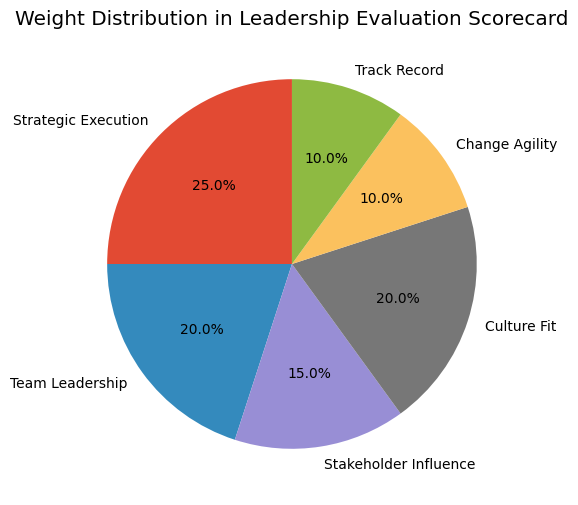
| Competency Area | Weight (%) | Candidate A Score | Candidate B Score | Candidate C Score |
|---|---|---|---|---|
| Strategic Execution | 25% | 7.5 | 9.0 | 8.0 |
| Team Leadership | 20% | 6.0 | 9.5 | 8.5 |
| Stakeholder Influence | 15% | 8.0 | 8.5 | 7.0 |
| Culture Fit | 20% | 9.0 | 7.5 | 9.0 |
| Change Management Agility | 10% | 6.5 | 8.5 | 9.0 |
| Track Record Validity | 10% | 7.0 | 8.0 | 7.5 |
| Total Weighted Score | 100% | 7.4 | 8.7 | 8.1 |
Red Flags to Watch For When Hiring External Leaders
Not all high-profile candidates are high-impact leaders. Some red flags indicate potential issues in fit, leadership maturity, or values alignment.
- Overreliance on buzzwords
Avoid candidates who speak in vague, trendy language without concrete examples of business impact. - Inflated achievements
Cross-check whether the candidate played a leading or peripheral role in highlighted achievements. - Blame-shifting tendencies
Strong leaders take accountability—even in failure. - Lack of people development stories
Leaders must uplift teams, not just deliver results. - Short stints with inconsistent reasons
Frequent job hopping at senior levels may signal poor adaptability or team fit issues.
Example
A senior candidate applying for a VP of Growth role at a B2B SaaS company claimed responsibility for tripling ARR at their last company. Deeper reference checks revealed that the spike was due to a one-time product bundling deal, and the candidate had no involvement in pricing strategy or customer retention. The offer was rescinded.
Ensure a Strong Onboarding Plan for External Leaders
Even the best external hire can underperform without the right onboarding strategy. New leaders must understand not just the business, but also internal culture, decision-making cadence, and team dynamics.
Best Practices for Leadership Onboarding
- Assign an internal sponsor or peer-level mentor
Helps with informal networks, hidden cultural dynamics, and quick assimilation. - Clarify short-term wins and long-term goals
Set clear success metrics and expectations for the first 30, 60, and 90 days. - Introduce leadership team alignment sessions
Accelerates trust-building and cross-functional collaboration. - Schedule early feedback loops
Offer real-time guidance on communication, team interactions, and strategic decisions.
Example
A regional head hired by a logistics conglomerate received onboarding support through shadowing internal town halls, 1-on-1s with key stakeholders, and a reverse feedback process. Within 60 days, they led a cost optimisation initiative that saved $2M annually—showcasing fast adaptation and impact.
Conclusion
Finding leadership talent externally is often essential when internal succession cannot meet business needs. However, the process must be intentional, data-driven, and strategically aligned. By identifying when to go external, sourcing talent from credible channels, assessing them with robust methods, and integrating them with effective onboarding, companies can avoid misfires and bring in transformational leaders who elevate the organisation’s growth trajectory.
Leadership hiring is not about finding the most visible candidate—it’s about finding the most contextually effective one. With the right process in place, organisations can turn external leadership acquisition from a risk into a high-yield investment.
5. Best Practices to Measure, Develop, and Retain Leadership Talent
Effectively managing leadership talent is a continuous cycle that goes beyond hiring. It requires a strategic approach to measuring leadership effectiveness, developing capabilities, and retaining top leaders for long-term organisational success. This section outlines practical, research-backed best practices that help organisations identify the right leadership metrics, build future-ready leaders, and prevent the costly loss of high-potential talent.
Each practice is supported with examples, structured frameworks, and professional-grade tables to make implementation actionable and scalable.
How to Measure Leadership Talent Effectively
The measurement of leadership talent must be grounded in both quantitative performance data and qualitative behavioural signals. Traditional annual reviews are no longer sufficient. Instead, modern organisations are adopting integrated leadership performance frameworks that offer real-time visibility into leadership effectiveness.
Key Leadership Measurement Areas
- Business Impact Metrics
- Delivery on strategic goals and KPIs
- Team productivity improvements
- Operational efficiency and cost reduction
- Team-Level Outcomes
- Employee engagement scores
- Voluntary turnover rates in the leader’s team
- Internal promotion and talent development rates
- Leadership Behaviours
- 360-degree feedback results
- Peer collaboration effectiveness
- Conflict resolution and influence dynamics
- Organisational Influence
- Cross-functional initiative success
- Stakeholder alignment and change management performance
- Visibility and contribution to company-wide goals
Leadership Measurement Matrix
| Evaluation Dimension | Key Indicators | Tools/Methods Used |
|---|---|---|
| Business Performance | KPI attainment, revenue growth, margin gains | Scorecards, quarterly reviews |
| Team Development | Employee growth, internal promotions | HRIS data, development logs |
| Engagement & Retention | Team satisfaction, turnover rate | Pulse surveys, exit interviews |
| Collaboration & Influence | Project success, stakeholder feedback | 360 assessments, peer reviews |
| Learning Agility | Adaptation to new roles or environments | Simulation exercises, coaching feedback |
Example
A tech company implemented quarterly 360-feedback and tracked internal promotion rates. A mid-level engineering manager who consistently scored highly on team influence and delivered cross-functional wins was identified as a leadership pipeline candidate—despite not being the top performer on paper.
How to Develop Leadership Talent Strategically
Leadership development should not be left to chance. It requires intentional, role-relevant, and high-impact learning methods that build both capabilities and confidence. High-potential leaders need more than training—they need experiential learning, real ownership, and tailored coaching.
Best Practices for Leadership Development
- Role-Based Development Tracks
- Match development programs to leadership level (e.g., emerging, mid-level, executive)
- Align learning outcomes with business goals
- Rotational and Cross-Functional Programs
- Expose future leaders to different departments, geographies, or business models
- Build adaptability and strategic thinking
- Stretch Assignments and Action Learning
- Assign real business problems with high visibility and accountability
- Encourage risk-taking and problem-solving in unfamiliar contexts
- Executive Coaching and Sponsorship
- Use internal or external coaches to build self-awareness, presence, and influence
- Pair talent with senior sponsors to open up visibility and opportunity
- Feedback-Rich Environment
- Provide ongoing, structured feedback linked to leadership competencies
- Establish reflection cycles after key leadership moments or failures
Leadership Development Pathway Table
| Career Stage | Focus Areas | Development Interventions |
|---|---|---|
| Emerging Leader | Ownership, communication, planning | Peer mentoring, leadership bootcamps |
| Mid-Level Leader | Influence, team development, agility | Cross-functional projects, coaching, stretch roles |
| Senior Leader | Strategy, transformation, innovation | Sponsorship, executive training, industry forums |
Example
A financial services firm ran a six-month leadership lab for 20 high-potential team leads. Each participant led a cross-departmental innovation sprint, received executive mentoring, and presented outcomes to the board. 70% were promoted within a year, with higher retention and team engagement in their departments.
How to Retain Top Leadership Talent Long-Term
Leadership retention is just as critical as identification. Losing strong leaders disrupts momentum, weakens culture, and increases hiring costs. Organisations that build retention-focused environments—rooted in purpose, recognition, growth, and autonomy—are more likely to retain their top leadership talent.
Key Retention Drivers for Leadership Talent
- Clear Career Pathways
- Transparent mobility, promotion, and succession planning
- Defined competencies and criteria for advancement
- Strategic Involvement
- Participation in vision-setting, planning, and transformation initiatives
- Leaders want to shape the future—not just execute
- Meaningful Recognition
- Recognition not only for results, but for people development and collaboration
- Public and peer-based appreciation fosters loyalty
- Work-Life Integration Support
- Flexibility in managing workload and personal goals
- Mental wellness resources and proactive check-ins
- Culture of Trust and Autonomy
- Empowered decision-making and minimal micromanagement
- Open communication with senior leadership
Leadership Retention Risk Matrix
| Risk Area | Common Indicators | Mitigation Strategy |
|---|---|---|
| Career Stagnation | No promotion opportunities, unclear path | Succession planning, mobility programs |
| Burnout | Reduced performance, absenteeism | Workload balancing, well-being interventions |
| Lack of Recognition | Declining motivation, disengagement | Reward systems, peer recognition initiatives |
| Cultural Misalignment | Leadership behaviour misfit | Role reshaping, coaching, value alignment |
| External Poaching | High-value profile visibility | Competitive comp plans, retention bonuses |
Example
A leading FMCG company introduced quarterly executive roundtables where mid- and senior-level leaders presented strategic ideas to the CEO. This not only improved retention but also created a sense of inclusion and value. Within a year, voluntary attrition among high-potential leaders dropped by 30%.
Conclusion
Measuring, developing, and retaining leadership talent is not a linear task—it is an ongoing, dynamic process that demands intentional strategies and long-term investment. Companies that prioritise accurate measurement, high-impact development, and thoughtful retention programs are far better equipped to cultivate a resilient, high-performance leadership culture.
Leadership talent is the engine behind business transformation, team excellence, and strategic execution. Organisations that embed these best practices into their talent management systems will create a sustainable competitive advantage in an environment where leadership strength is one of the rarest and most valuable resources.
Conclusion
Leadership talent is one of the most powerful yet complex assets an organisation can possess. It is not simply defined by a title, tenure, or confidence. Rather, it is a deep combination of strategic foresight, behavioural maturity, and the ability to inspire, develop, and mobilise others to deliver impactful outcomes. In today’s competitive and rapidly shifting business landscape, the ability to identify, nurture, and deploy strong leadership talent is not optional—it is mission-critical.
This blog has provided a comprehensive exploration of what leadership talent truly is and how to find it effectively both internally and externally. The evolving nature of work, marked by digital transformation, hybrid teams, and economic uncertainty, requires leaders who can navigate ambiguity, build trust across functions, and foster a culture of accountability and innovation. These capabilities must be spotted not just at the top levels, but also across the organisation—among emerging leaders, functional heads, and those who demonstrate quiet but consistent influence.
Internal Leadership Talent: The Foundation of Scalable Success
Internal leadership development remains the most cost-efficient and culturally aligned way to grow future-ready leaders. It allows companies to promote individuals who already understand the business model, internal systems, and team dynamics. However, the challenge lies in moving beyond surface-level evaluations or informal promotions. Companies must implement structured frameworks that assess both performance and potential, using a blend of data-driven assessments, 360-degree feedback, and real-world stretch assignments. By institutionalising leadership pipelines and aligning them with business objectives, organisations can ensure a steady flow of capable leaders prepared to take on greater responsibilities.
External Leadership Talent: Catalysts for Change and Innovation
There are times when internal talent pools are insufficient—especially when companies are expanding into new markets, undergoing transformation, or facing leadership succession gaps. In such cases, external leadership hiring offers an opportunity to introduce fresh perspectives, new capabilities, and industry best practices. But this process must be highly intentional. From sourcing talent through specialised executive search channels to conducting rigorous behavioural assessments and leadership simulations, every step must focus on identifying candidates who can not only deliver results but also align with the company’s values, culture, and future direction.
External leadership hires can become powerful change agents—accelerating innovation, improving underperforming units, and strengthening strategic execution. Yet without a well-structured onboarding process, even high-potential external leaders can fail to deliver. That’s why post-hire integration and stakeholder alignment are as critical as the hiring process itself.
Leadership Talent Is a Strategic Investment—Not a Tactical Task
Organisations that treat leadership talent acquisition and development as a strategic function—rather than an HR checklist—are better positioned to navigate complexity, outperform competitors, and retain top-tier professionals. They understand that effective leaders create ripple effects across the entire organisation. They improve employee engagement, increase retention, enhance cross-functional execution, and ultimately drive sustainable business growth.
Moreover, leadership talent is not static. It evolves with business needs, market dynamics, and societal expectations. As such, companies must adopt a continuous talent review process that adapts to changing strategic priorities, enabling them to remain agile and resilient even in volatile conditions.
The Road Ahead: Building a Leadership-Driven Culture
For long-term success, companies must embed leadership development into the fabric of their culture. This means:
- Clearly defining leadership competencies aligned to business strategy
- Using robust tools to evaluate talent fairly and consistently
- Creating visible career pathways for aspiring leaders
- Investing in leadership coaching, mentoring, and experiential learning
- Rewarding not just results, but how those results are achieved
By doing so, leadership becomes everyone’s business—not just the responsibility of executives or HR teams. It becomes a shared value, an organisational norm, and a competitive advantage.
Final Thought
In an era defined by speed, disruption, and complexity, companies that invest in identifying and empowering leadership talent will gain the clarity, cohesion, and capability needed to lead their industries. Whether through uncovering high-potential leaders from within or acquiring transformative talent from outside, the journey begins with a clear definition, a structured approach, and an unwavering commitment to developing people who can lead not just for today, but for tomorrow.
Leadership talent is not accidental—it is intentional, measurable, and scalable. The organisations that recognise this truth are the ones that will shape the future of business.
If you find this article useful, why not share it with your hiring manager and C-level suite friends and also leave a nice comment below?
We, at the 9cv9 Research Team, strive to bring the latest and most meaningful data, guides, and statistics to your doorstep.
To get access to top-quality guides, click over to 9cv9 Blog.
To hire top talents using our modern AI-powered recruitment agency, find out more at 9cv9 Modern AI-Powered Recruitment Agency.
People Also Ask
What is leadership talent?
Leadership talent is the ability to consistently influence people, make strong decisions under pressure, and drive results across teams.
Why is leadership talent important in business?
Leadership talent improves team performance, strengthens company culture, and drives business growth through better decision-making and accountability.
How do you identify leadership talent in employees?
Use a combination of performance metrics, peer feedback, leadership simulations, and stretch assignments to uncover potential.
What are the key traits of leadership talent?
Leadership talent includes strategic thinking, emotional intelligence, accountability, adaptability, and the ability to develop others.
Is leadership talent different from leadership skills?
Yes, talent refers to natural or developed ability to lead effectively, while skills are learned capabilities that support that talent.
Can leadership talent be developed or is it innate?
Leadership talent can be developed over time through experience, coaching, and exposure to complex challenges.
What are high-potential employees (HiPos)?
High-potential employees are individuals who demonstrate strong leadership promise and are capable of growing into larger roles.
How does performance differ from leadership potential?
Performance reflects current results; potential indicates future readiness to lead in more complex or senior roles.
Why do some top performers fail as leaders?
Top performers may lack coaching ability, emotional intelligence, or the skills to lead teams—traits crucial for leadership success.
What are common signs of future leadership talent?
Early ownership of tasks, strong collaboration, influencing others, and proactive problem-solving signal emerging leadership.
What is a leadership competency model?
A leadership competency model outlines the skills, behaviours, and attributes needed to succeed in leadership roles within an organisation.
How can companies measure leadership potential?
Leadership potential can be measured using 360-degree feedback, manager assessments, behavioural interviews, and assessment tools.
What is the 9-box grid in leadership development?
The 9-box grid is a matrix that evaluates employees based on performance and potential to identify leadership readiness.
Why is internal leadership development important?
It ensures continuity, improves retention, reduces recruitment costs, and promotes cultural alignment.
How do stretch assignments help reveal leadership talent?
Stretch assignments expose employees to new challenges, revealing their decision-making, adaptability, and leadership capabilities.
When should companies hire leadership talent externally?
When entering new markets, undergoing transformation, or lacking internal expertise, external leadership hiring becomes essential.
How do you evaluate external leadership candidates?
Use structured interviews, scorecards, behavioural assessments, and stakeholder feedback to assess capability and fit.
What are red flags in leadership hiring?
Red flags include inflated achievements, blame-shifting, weak people development, and unclear impact on past performance.
What is leadership agility?
Leadership agility is the ability to adapt to change, lead through ambiguity, and guide teams in dynamic environments.
How can psychometric tests help in finding leaders?
Psychometric assessments evaluate traits like decision-making, emotional intelligence, and learning agility relevant to leadership.
What are effective leadership behaviours to look for?
Consistent ownership, stakeholder influence, team alignment, and conflict resolution are key leadership behaviours.
How can organisations build a leadership pipeline?
Create structured development programs, track HiPo talent, and link individuals to succession planning initiatives.
What are succession planning strategies?
Succession planning involves identifying and preparing internal candidates to step into key leadership roles in the future.
What are the benefits of leadership coaching?
Leadership coaching enhances self-awareness, decision-making, people skills, and long-term leadership effectiveness.
What is the difference between a manager and a leader?
Managers oversee tasks and processes, while leaders influence people, drive change, and set strategic direction.
Why is cultural fit important in leadership roles?
Leaders aligned with company values foster trust, improve collaboration, and build stronger, more engaged teams.
How do external leaders add value to organisations?
They bring new ideas, industry expertise, and fresh perspectives that help drive innovation and transformation.
What makes a leadership assessment successful?
Clarity of leadership criteria, multi-source feedback, and real-world scenario testing are key elements of effective assessment.
Can introverts be strong leaders?
Yes, introverts can lead effectively through deep listening, thoughtful decision-making, and high emotional intelligence.
What is inclusive leadership and why does it matter?
Inclusive leadership ensures all voices are heard, boosts team morale, and drives better business outcomes through diversity.