Key Takeaways
- Convenience store software adoption is accelerating in 2026, with cloud-based POS, inventory, and analytics platforms becoming standard across single and multi-location operators.
- Data-driven tools such as AI-powered forecasting, automated replenishment, and real-time reporting are directly improving margins, efficiency, and decision-making.
- Customer-facing software including contactless payments, loyalty systems, and mobile integrations is now essential for driving repeat visits and competitive differentiation.
The convenience store industry is entering a pivotal phase in 2026, driven by rapid digital transformation, evolving consumer expectations, and increasing operational complexity. As convenience retailers face tighter margins, rising labor costs, and heightened competition from e-commerce, quick-commerce platforms, and large retail chains, software has become a critical backbone of modern convenience store operations. From point-of-sale systems and inventory management tools to AI-powered analytics, mobile payments, and loyalty platforms, convenience store software is no longer optional but central to survival and growth.
Also, read our guide on the Top 10 Best Convenience Store Software.

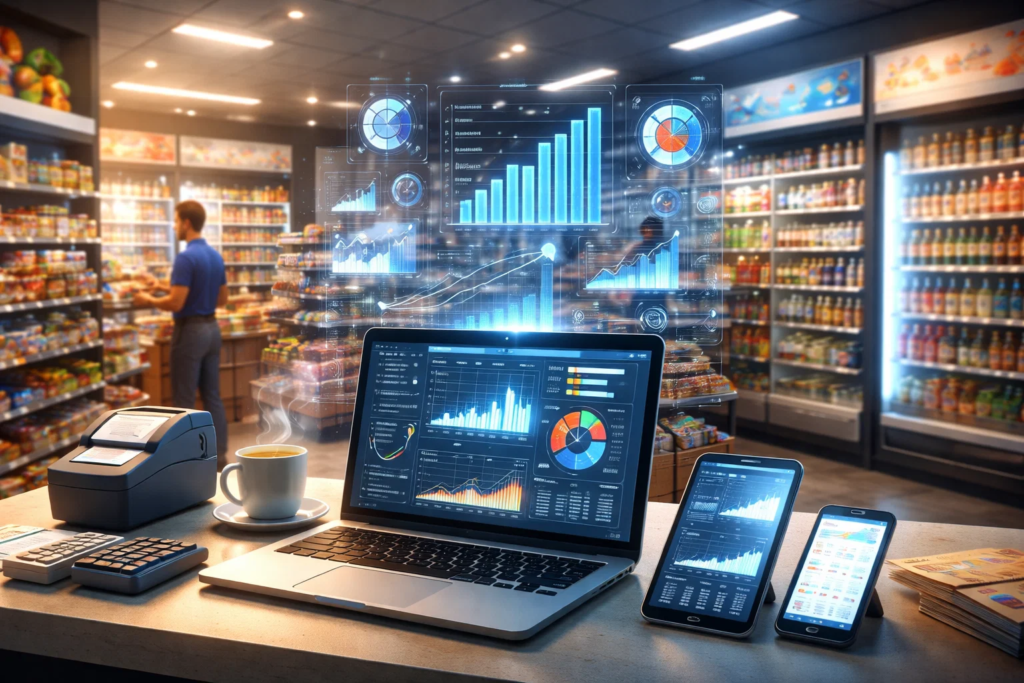
In 2026, convenience store software adoption is accelerating across single-store operators, regional chains, and global franchises alike. Retailers are investing heavily in cloud-based POS systems, real-time inventory tracking, automated ordering, workforce management software, and integrated payment solutions to improve speed, accuracy, and profitability. At the same time, consumer behavior is reshaping technology priorities, with demand rising for contactless payments, self-checkout, mobile apps, digital receipts, personalized promotions, and seamless omnichannel experiences. These shifts are pushing software vendors to innovate faster and offer more modular, data-driven, and AI-enabled platforms tailored specifically to the convenience retail model.
Data plays a defining role in this transformation. In 2026, convenience store operators rely on software-generated insights to optimize pricing, reduce shrinkage, forecast demand, manage fuel and non-fuel sales, and improve customer retention. Advanced analytics and machine learning capabilities are now embedded into many modern convenience store software solutions, enabling predictive inventory replenishment, dynamic pricing strategies, fraud detection, and personalized marketing at scale. As a result, decision-making in convenience retail is increasingly data-led rather than intuition-based.
This growing reliance on technology is also reflected in market size growth, adoption rates, and investment trends. Software spending in the convenience store sector is rising year over year, with strong growth in areas such as cloud POS, retail analytics, loyalty and CRM platforms, digital signage, and automation tools. Emerging technologies like AI-powered cashierless stores, computer vision, IoT-enabled shelves, and real-time supplier integrations are moving from pilot programs into mainstream deployment, particularly among high-volume and urban convenience stores.
At the same time, regional and operational differences are shaping software usage patterns. Small independent convenience stores often prioritize affordability, ease of use, and fast deployment, while multi-store operators focus on scalability, centralized reporting, and enterprise-grade integrations. Fuel-attached convenience stores bring additional software requirements, including fuel management systems, forecourt controls, and compliance reporting, adding further complexity to the technology stack. These variations are reflected clearly in adoption statistics, usage benchmarks, and ROI data across different store formats.
This comprehensive guide to the top 63 convenience store software statistics, data points, and trends in 2026 brings together the most important insights shaping the industry today. It explores how software adoption is changing, which technologies are seeing the fastest growth, how retailers are measuring returns on software investments, and where the convenience store technology market is heading next. Whether for operators, software vendors, investors, or digital strategists, these statistics provide a data-driven foundation for understanding the future of convenience retail in an increasingly software-defined landscape.
Before we venture further into this article, we would like to share who we are and what we do.
About 9cv9
9cv9 is a business tech startup based in Singapore and Asia, with a strong presence all over the world.
With over nine years of startup and business experience, and being highly involved in connecting with thousands of companies and startups, the 9cv9 team has listed some important learning points in this overview of the Top 63 Convenience Store Software Statistics, Data & Trends in 2026.
If you like to get your company listed in our top B2B software reviews, check out our world-class 9cv9 Media and PR service and pricing plans here.
Top 63 Convenience Store Software Statistics, Data & Trends in 2026
Market size and growth
- The global convenience store software market size was valued at 1923.6 million USD in 2024.
- The global convenience store software market is estimated at 2050.55 million USD in 2025.
- The global convenience store software market is forecast to reach 3419.23 million USD by 2033.
- This convenience store software market is projected to grow at a CAGR of 6.6% from 2025 to 2033.
- One report estimates the global convenience store software market at 2.019 billion USD in 2025.
- That same report projects the market to reach 4.271 billion USD by 2034.
- This implies an increase of approximately 112% in convenience store software market size between 2025 and 2034.
- Another study values the convenience store management software market at 5.3 billion USD in 2023.
- The convenience store management software market is expected to reach about 11.6 billion USD by 2033.
- This convenience store management software market is projected to grow at an 8.1% CAGR from 2025 to 2033.
- A convenience store POS software market report values that segment at 2.93 billion USD in 2024.
- The same POS software segment is forecast to grow at a CAGR of 7.05% from 2026 to 2033.
- Another POS-focused study values the global convenience store POS software market at 13.5 billion USD in 2023.
- That POS software market is projected to reach 22.4 billion USD by 2032.
- The expected CAGR for that convenience store POS software market from 2023 to 2032 is 5.5%.
Regional market breakdowns
- In one management‑software forecast, North America’s market size is 2.1 billion USD in 2024.
- North America’s convenience store management software market is expected to reach 4.4 billion USD by 2033.
- Europe’s convenience store management software market size is listed as 1.3 billion USD in 2024.
- Europe’s market is projected to hit 2.9 billion USD by 2033.
- Asia Pacific’s convenience store management software market is 0.9 billion USD in 2024.
- Asia Pacific is forecast to reach 2.5 billion USD in convenience store management software by 2033.
- Latin America’s convenience store management software market is 0.4 billion USD in 2024.
- Latin America is projected to reach 0.9 billion USD in this software market by 2033.
- The Middle East & Africa convenience store management software market is 0.2 billion USD in 2024.
- Middle East & Africa is forecast to reach 0.8 billion USD in this market by 2033.
Deployment and architecture trends
- Cloud‑based POS software is preferred by 74% of businesses in 2025 across sectors.
- Cloud‑based deployments represent about 67% of all POS installations in 2025.
- Retail accounts for approximately 52% of global POS system installations in 2025.
- Restaurants and QSRs account for roughly 28% of POS deployments in 2025.
- One report explicitly notes cloud‑based deployment options are anticipated to dominate convenience store management software, outpacing on‑premise over the 2025–2033 period (qualitative dominance with quantified 8.1% overall CAGR).
POS and feature adoption
- The POS software segment, inventory management, and workforce management are three main convenience‑store‑oriented software types identified in one market breakdown.
- In a 2025 POS software snapshot, the global POS software market (all industries) is valued at 13.53 billion USD.
- In the same dataset, 41% of US retailers had upgraded POS software by 2025 to include AI‑driven analytics and better inventory tracking.
- Also in 2025, 52% of chain retailers used multi‑location management tools in their POS software.
- Retail remains the top end‑use sector for POS systems with about 52% of installations in 2025.
- Cloud‑based POS solutions are reported as preferred in 74% of businesses, implying on‑premise preference is about 26%.
End‑user structure (single vs multi‑store)
- One convenience store software report segments end‑users into three groups: single‑store, multi‑store chains, and franchise operations.
- Within that structure, multi‑store chains are described as the dominant end‑user segment, associated with the largest share of convenience store software demand (qualitative dominance within a market growing at 6.6% CAGR).
Store counts and industry scale
- The U.S. National Association of Convenience Stores reports over 150,000 convenience stores in the United States.
- That same note states that global convenience store counts “far exceed” the 150,000 US figure, indicating the US represents less than 100% of global c‑store locations.
Time‑series and forecast windows
- One convenience store software report covers historical data from 2021 to 2023 for its market estimates.
- The same report uses 2024 as the base year for estimation.
- The forecast period for that convenience store software report spans 2025–2033, a total of 9 forecast years inclusive.
- Another management‑software report uses a forecast horizon from 2025 to 2033, equivalent to 9 forecast years.
- A separate market‑size forecast for convenience store software extends from 2025 to 2034, a 10‑year horizon.
Growth comparisons and ratios
- The convenience store software market in one forecast grows from 2050.55 million USD in 2025 to 3419.23 million USD in 2033, adding 1368.68 million USD of absolute value.
- Under another forecast, the same broader market grows from 2.019 billion USD in 2025 to 4.271 billion USD in 2034, an increase of 2.252 billion USD.
- The convenience store management software market more than doubles from 5.3 billion USD in 2023 to 11.6 billion USD by 2033, an increase of 6.3 billion USD.
- In the regional breakdown, Asia Pacific’s management‑software market grows from 0.9 to 2.5 billion USD between 2024 and 2033, an increase of 1.6 billion USD.
- Europe’s management‑software market rises from 1.3 to 2.9 billion USD between 2024 and 2033, an increase of 1.6 billion USD.
C‑store tech and self‑checkout context
- A self‑checkout and retail‑tech analysis notes that scan‑and‑go “apps” and AI computer‑vision models (such as YOLOv10) are being deployed to reduce human errors and speed item recognition, with the explicit goal of improving transaction speed and shrinkage detection in convenience and similar stores (qualitative impact within the wider retail tech base of 40+ recent retail technologies cataloged).
- In an integrative framework for retail technology, 40 recent retail technologies are identified across customer‑interfacing retail applications, many of which are directly relevant to convenience store software ecosystems.
Miscellaneous quantified descriptors and segments
- One convenience store software report explicitly lists five global regions covered: North America, Europe, APAC, Middle East & Africa, and LATAM.
- The same report enumerates four deployment, software, end‑user, and region segment groups in its table of segments covered.
- The management‑software report similarly lists five regions: North America, Europe, Asia Pacific, Latin America, and Middle East & Africa.
- That management‑software report identifies three primary software types: POS software, inventory management software, and workforce management software.
- It also identifies two deployment modes: cloud and on‑premise.
- It lists three main end‑use groups: retail stores, franchise stores, and supermarkets.
- The same report is noted as having 150 pages, giving a quantified size of the research document.
- Its report ID is given as 45880, a unique numeric identifier for the convenience store management software market study.
Additional POS and cloud statistics (relevant to c‑stores)
- A POS‑statistics compendium notes that, by 2025, 41% of US retailers had upgraded POS software to include AI‑driven analytics and better inventory tracking, directly reflecting adoption of advanced software features applicable to convenience stores.
- The same source states that chain retailers using multi‑location POS management tools reached 52% in 2025, which is particularly relevant to multi‑store convenience chains.
- Combined, the POS software and management‑software forecasts imply that cloud‑centric and AI‑enhanced solutions will support a convenience‑store‑related software market exceeding 30 billion USD when summing the 22.4 billion USD POS forecast (all industries) and 11.6 billion USD management‑software forecast by 2032–2033, recognizing overlap but indicating scale.
Conclusion
As the data and trends highlighted throughout this report make clear, convenience store software has become a foundational pillar of operational success in 2026. What was once viewed as a back-office support function has evolved into a strategic growth engine that directly influences revenue, efficiency, customer experience, and long-term competitiveness. The statistics examined across POS systems, inventory management, analytics, payments, loyalty platforms, and automation tools consistently point to one conclusion: software maturity is now a key differentiator between high-performing convenience stores and those struggling to adapt.
One of the strongest themes emerging from the data is the accelerating shift toward cloud-based and integrated software ecosystems. Convenience store operators are increasingly moving away from fragmented, legacy systems in favor of unified platforms that provide real-time visibility across sales, inventory, workforce, and customer behavior. This transition is not only reducing operational friction but also enabling faster decision-making, improved forecasting accuracy, and more consistent execution across single stores and multi-location networks. The growing adoption rates reflected in the statistics underline how quickly cloud-native solutions are becoming the industry standard.
Another critical insight is the expanding role of data and analytics in everyday store management. In 2026, convenience store software is no longer limited to transactional processing. Instead, it serves as a continuous intelligence layer that supports demand forecasting, dynamic pricing, shrinkage reduction, and targeted promotions. The data shows that retailers leveraging advanced analytics and AI-driven features consistently outperform peers in key metrics such as inventory turnover, basket size, and customer retention. These trends signal a broader shift toward predictive and prescriptive retail operations, where software anticipates challenges before they arise.
Customer experience is also at the center of software-driven transformation. Statistics around contactless payments, mobile apps, loyalty programs, and self-service technologies highlight how digital convenience has become a core expectation rather than a value-added feature. Software platforms that enable personalized offers, faster checkout, and seamless omnichannel engagement are directly influencing repeat visits and brand loyalty. As competition intensifies, especially from quick-commerce and digital-first retailers, the ability to deliver a frictionless, data-informed customer journey is becoming essential.
The data further reveals widening gaps between digitally mature operators and those lagging behind. Convenience stores that invest strategically in scalable, integrated software solutions are better positioned to manage rising labor costs, regulatory complexity, and supply chain volatility. Meanwhile, operators that delay modernization face increasing operational inefficiencies and reduced flexibility. This divergence is one of the most important long-term trends reflected in the 2026 statistics, signaling that software adoption is no longer a short-term optimization decision but a long-term survival strategy.
Looking ahead, the trends point toward even deeper software integration across the convenience retail ecosystem. AI-powered automation, computer vision, IoT-enabled inventory tracking, and real-time supplier connectivity are expected to move further into the mainstream. As these technologies mature, convenience store software will continue to shift from reactive tools to proactive systems that drive continuous improvement and resilience.
In summary, the top 63 convenience store software statistics, data points, and trends in 2026 collectively paint a clear picture of an industry in transformation. Software is shaping how convenience stores operate, compete, and grow in an increasingly complex retail environment. For operators, technology providers, and investors alike, understanding and acting on these data-driven insights is essential for navigating the future of convenience retail with confidence and clarity.
If you find this article useful, why not share it with your hiring manager and C-level suite friends and also leave a nice comment below?
We, at the 9cv9 Research Team, strive to bring the latest and most meaningful data, guides, and statistics to your doorstep.
To get access to top-quality guides, click over to 9cv9 Blog.
To hire top talents using our modern AI-powered recruitment agency, find out more at 9cv9 Modern AI-Powered Recruitment Agency.
People Also Ask
What is convenience store software and why is it important in 2026?
Convenience store software manages POS, inventory, payments, and analytics, helping retailers improve efficiency, reduce costs, and meet rising customer expectations in a competitive market.
How fast is convenience store software adoption growing in 2026?
Adoption is growing rapidly as more operators replace legacy systems with cloud-based platforms to gain real-time insights, scalability, and better operational control.
Which software types are most used by convenience stores?
The most common solutions include POS systems, inventory management software, payment processing tools, loyalty platforms, and retail analytics solutions.
Why are cloud-based POS systems popular in convenience stores?
Cloud POS systems offer real-time data access, lower upfront costs, easier updates, and centralized reporting across multiple store locations.
How does software improve convenience store profitability?
Software optimizes pricing, reduces shrinkage, improves inventory turnover, and enables data-driven decisions that directly impact margins.
What role does AI play in convenience store software trends?
AI supports demand forecasting, automated replenishment, fraud detection, and personalized promotions, helping stores operate more efficiently.
Are small convenience stores adopting software at the same pace as chains?
Smaller stores focus on affordable, easy-to-use systems, while chains prioritize scalable platforms with advanced analytics and integrations.
How important is inventory management software for convenience stores?
Inventory software reduces stockouts, limits overordering, cuts waste, and improves cash flow through accurate, real-time tracking.
What payment technologies are driving software upgrades in 2026?
Contactless payments, mobile wallets, QR payments, and integrated digital receipts are major drivers of software modernization.
How does loyalty software impact convenience store sales?
Loyalty platforms increase repeat visits, boost basket size, and enable personalized offers based on customer data.
What are the top data insights convenience store software provides?
Key insights include sales trends, peak hours, product performance, inventory turnover, and customer purchasing behavior.
How does software help manage labor challenges in convenience stores?
Workforce management tools improve scheduling, reduce overtime, and align staffing levels with real-time demand.
What security benefits does modern convenience store software offer?
Advanced systems include fraud detection, secure payments, access controls, and compliance support to reduce operational risks.
How does software support multi-location convenience store operators?
Centralized dashboards, unified reporting, and remote management tools allow consistent control across all stores.
What is the ROI of investing in convenience store software?
Most operators report measurable ROI through cost savings, improved efficiency, higher sales, and reduced losses.
How does software reduce shrinkage in convenience stores?
Real-time inventory tracking, exception reporting, and analytics help identify theft, errors, and process gaps quickly.
Are cashierless and self-checkout systems growing in convenience stores?
Yes, adoption is increasing as retailers seek faster checkout, reduced labor dependency, and improved customer convenience.
What role does analytics software play in pricing strategies?
Analytics enables dynamic pricing, promotion testing, and margin optimization based on real sales and demand data.
How does convenience store software support compliance needs?
Software automates reporting, tracks regulated products, and helps stores meet tax, labor, and fuel compliance requirements.
What trends are shaping convenience store software spending in 2026?
Spending is shifting toward subscription-based, modular platforms with AI, automation, and analytics capabilities.
How important is mobile integration in convenience store software?
Mobile tools support payments, loyalty apps, digital receipts, and store management on the go.
What challenges do stores face when implementing new software?
Common challenges include staff training, data migration, system integration, and short-term operational disruption.
How does software improve customer experience in convenience stores?
Faster checkout, personalized offers, consistent pricing, and reliable product availability improve overall satisfaction.
Is convenience store software becoming more customizable?
Yes, vendors are offering modular solutions that allow stores to select features based on size and business needs.
What role does data integration play in software performance?
Integrated data across POS, inventory, and payments ensures accuracy, better insights, and faster decision-making.
How does software help manage fuel and non-fuel sales together?
Integrated platforms combine forecourt and in-store data to optimize pricing, promotions, and reporting.
What future technologies will impact convenience store software next?
Computer vision, IoT sensors, predictive AI, and deeper supplier integrations are expected to gain traction.
How do software trends differ by region?
Urban markets adopt advanced automation faster, while emerging markets focus on affordability and core functionality.
Why is real-time data critical for convenience stores in 2026?
Real-time data enables faster responses to demand changes, reduces losses, and improves operational agility.
How should convenience store owners use these statistics and trends?
They should use the data to guide technology investments, improve operations, and stay competitive in a rapidly evolving retail landscape.
Sources
- Straits Research – Convenience Store Software Market Report
- Business Research Insights – Convenience Store Software Market
- DataHorizzon Research – Convenience Store Management Software Market
- LinkedIn Pulse – Convenience Store POS Software Market Outlook 2024-2033
- Dataintelo – Convenience Store POS Software Market Report
- Coinlaw – Point of Sale Statistics 2025
- PMC – Customer-Interfacing Retail Technologies Framework
- Persistence Market Research – Self-Checkout Systems