Key Takeaways
- Embracing digital transformation, automation, and AI tools is critical for unlocking scalable growth and operational efficiency in 2026.
- Enhancing customer experience through personalisation, omnichannel engagement, and real-time support drives retention and revenue.
- Agile planning, performance tracking, and strategic investment in people and culture are essential to stay competitive and adaptive.
Business growth in 2026 is no longer driven by incremental improvements or short-term tactics. It is shaped by structural shifts in technology, consumer behaviour, workforce dynamics, and global competition. Companies that achieve significant growth in 2026 will be those that think beyond traditional expansion models and adopt smarter, data-driven, and future-ready strategies that are designed for scale, resilience, and long-term value creation.


The business environment entering 2026 is faster, more competitive, and more complex than ever before. Artificial intelligence has moved from experimentation to execution. Customers now expect seamless, personalised experiences across every touchpoint. Markets are increasingly saturated, making differentiation harder but also more critical. At the same time, economic uncertainty, talent shortages, and rising operational costs are forcing businesses to rethink how they allocate resources and measure success. Growth is no longer about doing more of the same. It is about doing the right things better, faster, and more strategically.

Many businesses struggle not because they lack ambition, but because they focus on outdated growth levers. Scaling headcount without improving productivity, increasing marketing spend without optimising conversion, or expanding into new markets without proper validation often leads to wasted capital and stalled momentum. In 2026, sustainable growth depends on clarity, execution, and the ability to adapt quickly as conditions change. Businesses that grow significantly are those that align strategy, technology, people, and customer experience into a single, coherent growth engine.
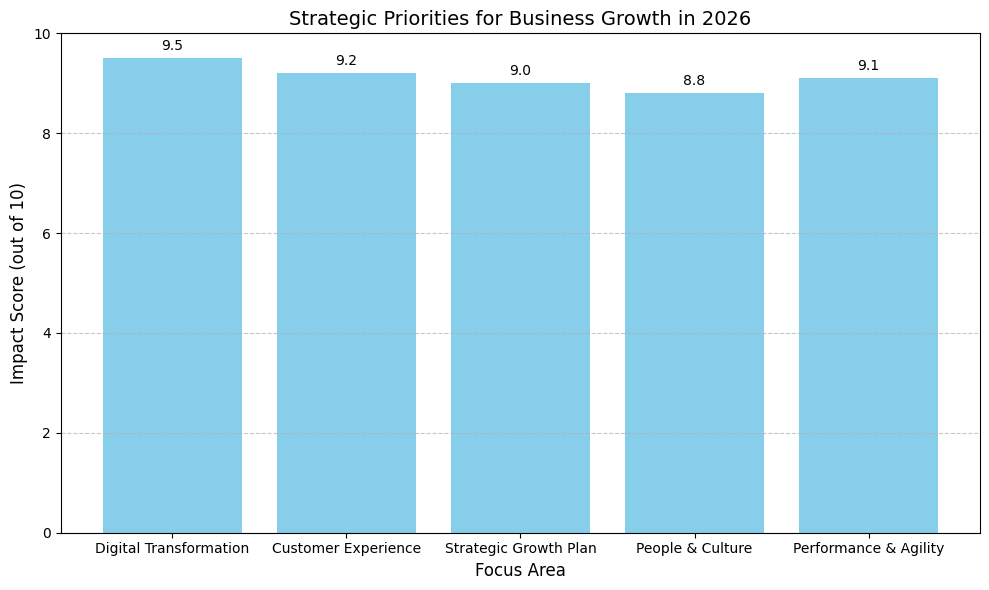
This is why having a clear roadmap for growth in 2026 is essential. The most successful companies are prioritising smarter digital transformation, stronger customer retention, sharper strategic planning, and continuous performance optimisation. They are leveraging automation and analytics to make better decisions, investing in talent and leadership to drive innovation, and building systems that allow them to scale without breaking internal operations. Growth is becoming less about intuition and more about insight.
This guide on the top five tips to make your business grow significantly in 2026 is designed to help business owners, founders, and decision-makers cut through the noise and focus on what truly drives results. These tips are not generic advice or short-lived trends. They are practical, proven growth principles adapted for the realities of 2026, where speed, efficiency, and adaptability determine who leads and who falls behind.
Whether you are a startup aiming to scale faster, a small or medium-sized business looking to break through a growth plateau, or an established company seeking sustainable expansion, the strategies covered in this guide will help you position your business for measurable growth. By understanding where to focus your time, capital, and effort in 2026, you can build a stronger foundation for revenue growth, market share expansion, and long-term competitiveness.
As you move through this article, you will discover how to align your business with the most impactful growth drivers of 2026, avoid common pitfalls that limit scalability, and implement smarter strategies that deliver real, compounding results. Growth in 2026 is achievable, but only for businesses that are willing to evolve, optimise, and lead with intention.
Before we venture further into this article, we would like to share who we are and what we do.
About 9cv9
9cv9 is a business tech startup based in Singapore and Asia, with a strong presence all over the world.
With over nine years of startup and business experience, and being highly involved in connecting with thousands of companies and startups, the 9cv9 team has listed some important learning points in this overview of the Top 10 Recruitment Agencies in New Zealand in 2026.
If your company needs recruitment and headhunting services to hire top-quality employees, you can use 9cv9 headhunting and recruitment services to hire top talents and candidates. Find out more here, or send over an email to hello@9cv9.com.
Or just post 1 free job posting here at 9cv9 Hiring Portal in under 10 minutes.
Top 5 Tips to Make Your Business Grow Significantly in 2026
- Embrace Strategic Digital Transformation
- Deliver an Exceptional Customer Experience
- Create and Execute a Robust Strategic Growth Plan
- Invest in People and Culture
- Monitor Performance and Adapt Quickly
1. Embrace Strategic Digital Transformation
In 2026, digital transformation is no longer a luxury—it’s a fundamental growth driver. Businesses that embrace advanced technologies and integrate them into their core operations gain unmatched advantages in productivity, customer satisfaction, scalability, and resilience. Strategic digital transformation involves more than adopting tools; it requires rethinking how value is created, delivered, and optimised through digital channels and data intelligence.
Adopt Automation to Streamline Operations
- Workflow Automation: Companies are deploying automation tools to eliminate repetitive tasks in HR, finance, marketing, and customer service. Platforms like Make.com and Zapier allow businesses to create automated workflows between CRM, email, calendars, and data pipelines.
- Case Example: A BPO company reduced client onboarding time by 50% using automated document verification and CRM triggers, resulting in faster revenue recognition and better customer retention.
- RPA for High-Volume Processes: Robotic Process Automation (RPA) tools like UiPath and Automation Anywhere are being used to handle invoice processing, compliance reporting, and transaction logging at scale.
| Use Case | Tool Example | Time Saved | Impact on Accuracy |
|---|---|---|---|
| Invoice Processing | Automation Anywhere | 60% | 98% |
| Customer Support Routing | Zendesk + Chatbots | 70% | 95% |
| Social Media Posting | Buffer + Zapier | 40% | Consistent branding |
| Recruitment Screening | Manatal + Make.com | 65% | Improved filtering |
Leverage AI for Competitive Advantage
- Predictive Analytics: AI-driven platforms are helping businesses predict customer churn, demand trends, and buying patterns. By analyzing vast datasets, companies can forecast market changes and adjust strategies proactively.
- AI in Sales & Marketing: Tools like Salesforce Einstein, Apollo.io, and Jasper AI are reshaping how businesses generate leads, personalize campaigns, and convert customers.
- Smart Decision-Making: AI is used to analyze customer sentiment, suggest pricing strategies, and recommend product bundling based on historical patterns and real-time data.
| AI Application | Business Benefit | Tool Examples |
|---|---|---|
| Churn Prediction | Retain more customers | ChurnZero, Mixpanel |
| AI Sales Assistants | Improve closing rates | Drift, Clari |
| Dynamic Pricing Models | Maximise profitability | Competera, Pricemoov |
| Content Generation | Scale personalized content delivery | Jasper, Copy.ai |
Digitally Optimize the Customer Experience
- Omnichannel Engagement: Businesses must offer seamless interactions across web, mobile, email, and social media. Platforms like HubSpot and Intercom unify communication and track engagement across channels.
- Conversational AI & Chatbots: In 2026, AI-powered chatbots can resolve complex issues, generate qualified leads, and even upsell services in real time—24/7.
- Personalized Customer Journeys: Machine learning models tailor product recommendations, emails, and offers based on individual user behavior.
| Channel | Transformation Lever | Example Benefit |
|---|---|---|
| Website | AI Chatbot Support | Reduced human support workload |
| Mobile App | Push Notifications + Behavioral Triggers | Increased session time |
| Smart Segmentation + Personalisation | Higher open and conversion rates | |
| Social Media | AI-Generated Responses + Trend Analysis | Better brand engagement |
Upgrade Legacy Systems for Scalability
- Cloud Migration: Businesses are shifting from on-premise systems to scalable cloud infrastructure like AWS, Microsoft Azure, or Google Cloud. This reduces IT maintenance, increases uptime, and enables remote collaboration.
- API-First Architecture: APIs make it easier to integrate best-of-breed tools without replacing the entire system. They enable modular growth and fast deployment of new services.
- Data Warehousing & Real-Time Dashboards: Tools like Snowflake and Power BI centralize data and provide visual analytics for real-time decision-making.
| Legacy System | Modern Alternative | Business Impact |
|---|---|---|
| On-premise ERP | Cloud-based ERP (NetSuite) | Lower cost, scalable growth |
| Excel-based Analytics | BI Dashboards (Power BI) | Real-time insights, better data governance |
| Static Websites | Headless CMS (Strapi) | Faster updates, dynamic content |
Invest in Cybersecurity and Digital Risk Management
- Zero Trust Security Models: With increasing digital exposure, businesses are adopting zero-trust frameworks to verify all users and devices continuously.
- AI-Powered Threat Detection: Tools like Darktrace and CrowdStrike leverage AI to identify anomalies and neutralize threats before they escalate.
- Compliance Automation: Regulatory compliance (e.g., GDPR, SOC 2) is being automated to avoid penalties and build customer trust.
| Digital Asset | Cybersecurity Solution | Key Risk Addressed |
|---|---|---|
| Customer Databases | Encryption + Access Control | Data breaches, insider threats |
| Internal Systems | Endpoint Detection Tools | Malware, ransomware |
| Remote Work Devices | VPN + MFA | Unauthorized access |
Create a Culture of Continuous Digital Innovation
- Employee Upskilling: Regular training on digital tools, AI literacy, and automation workflows is essential. Internal knowledge-sharing platforms and microlearning modules are becoming standard.
- Cross-Functional Innovation Teams: Many high-growth businesses are forming cross-functional squads to test digital ideas quickly and apply design thinking for faster iteration.
- Fail-Fast, Scale-Fast Models: Businesses are investing in digital labs or innovation hubs to incubate ideas, prototype rapidly, and scale only what works.
| Cultural Driver | Strategic Initiative | Outcome |
|---|---|---|
| Digital Literacy | Internal AI Bootcamps | Stronger internal adoption of AI tools |
| Innovation Mindset | Monthly Ideation Challenges | More employee-driven process improvement |
| Scalable Experimentation | Agile Test & Learn Environments | Faster go-to-market timelines |
Conclusion: Building a Digital-First Growth Engine
Strategic digital transformation in 2026 isn’t about tech adoption alone—it’s about aligning technology with clear business objectives. It means building a tech-enabled foundation that supports data-driven decision-making, anticipates market shifts, and empowers employees to deliver exceptional customer value. Businesses that embrace this shift are not only surviving—they’re scaling, innovating, and leading their industries.
2. Deliver an Exceptional Customer Experience
In 2026, delivering a superior customer experience (CX) is one of the most powerful growth levers available to businesses. It directly influences customer loyalty, retention, brand advocacy, and revenue expansion. A truly exceptional CX goes beyond providing good service—it is about anticipating customer needs, providing seamless omnichannel journeys, personalizing every touchpoint, and embedding empathy into digital and human interactions alike.
Implement Omnichannel Customer Engagement
- Unified Experience Across Platforms: Modern consumers expect consistency across physical, digital, and support channels. Whether engaging via website, mobile app, in-store, or social media, every touchpoint should feel cohesive and informed by previous interactions.
- Technology Stack Integration: Businesses are integrating CRMs like HubSpot, Salesforce, or Zoho with live chat systems, email automation, social media inboxes, and AI chatbots to track interactions in one place and avoid fragmented support.
| Channel | Touchpoint Examples | Tools to Enable Seamless Integration | Customer Expectation |
|---|---|---|---|
| Website | Live chat, smart forms | Drift, Intercom, Zendesk Chat | Instant, personalised support |
| Mobile App | Push notifications, embedded support | OneSignal, Firebase, Helpshift | Real-time updates, frictionless use |
| Social Media | DMs, comments, reviews | Sprout Social, Hootsuite, Zoho Social | Fast response, authentic interactions |
| Automated journeys, transactional emails | Mailchimp, ActiveCampaign, Klaviyo | Relevance and value in each message | |
| In-Person/Phone | POS integrations, account lookup | Square POS, Aircall, Freshdesk | Fast resolution and account access |
Personalise Customer Interactions with Data and AI
- Customer Segmentation and Behavioural Targeting: AI-powered platforms help segment users by demographics, past behavior, purchase intent, and engagement patterns. This enables highly contextual offers and content delivery.
- Dynamic Personalisation Engines: From website landing pages to mobile recommendations, platforms like Segment, Dynamic Yield, and Adobe Experience Cloud dynamically adapt experiences in real time.
- Example Use Case: A fitness subscription company increased renewals by 42% after implementing personalised workout suggestions based on user history and seasonal trends.
| Personalisation Level | Example Feature | Business Benefit |
|---|---|---|
| Basic | Using first name in emails | Improved open rates |
| Intermediate | Recommendations based on browsing data | Increased conversion rates |
| Advanced | Behavioural email sequences | Higher customer lifetime value (CLTV) |
| Predictive | AI-suggested products or content | Stronger engagement and upsells |
Streamline Customer Support and Resolution
- 24/7 AI-Powered Helpdesks: Chatbots using NLP and contextual memory now resolve over 80% of first-line support issues. Tools like Ada, Tidio, and Freshchat have dramatically lowered human agent load.
- Hybrid Support Models: Businesses combine bots for FAQs and routing with human escalation paths for complex queries, ensuring faster yet empathetic support.
- Self-Service Portals: Many customers prefer resolving issues themselves. Robust help centers, video tutorials, and interactive FAQs empower users while reducing support costs.
| Support Method | Average Resolution Time | Satisfaction Impact | Example Platform |
|---|---|---|---|
| Live Chat with Bot | Under 1 minute | Medium-High | Drift, Tidio |
| Agent Live Chat | 3–5 minutes | High | Zendesk, LivePerson |
| Self-Service Portal | Instant | Moderate | Helpjuice, Intercom |
| Email Support | 6–24 hours | Low unless urgent | Freshdesk, Zoho Desk |
Track Experience Metrics and Feedback Loops
- Net Promoter Score (NPS): Measures customer willingness to recommend your brand. A growing NPS correlates strongly with organic growth.
- Customer Satisfaction Score (CSAT): Tracks user satisfaction after key touchpoints, such as post-purchase or support interaction.
- Customer Effort Score (CES): Indicates how easy or difficult it was for customers to complete a task or get support.
| CX Metric | Formula or Scale | Benchmark (2026) | Use Case Example |
|---|---|---|---|
| NPS | -100 to +100 | 50+ (Excellent) | SaaS, Telecom, Hospitality |
| CSAT | 1–5 or 1–10 Likert scale | 80%+ (Above Average) | E-commerce, Online Services |
| CES | 1–7 or 1–10 scale (lower is better) | ≤ 3 (Great) | Customer support portals, Checkout flow |
Anticipate Customer Needs with Predictive Engagement
- Proactive Retention Campaigns: Machine learning models predict churn likelihood and trigger automatic re-engagement via email or in-app messaging.
- Use of Heatmaps and Session Recordings: Tools like Hotjar and FullStory give behavioural insights, allowing UX optimization that leads to lower drop-offs.
- Inventory and Delivery Transparency: Predictive logistics tools inform customers about shipping delays, restocks, and order status before they ask.
| Predictive Tool | Application | Value Delivered |
|---|---|---|
| Churn Prediction (e.g. ChurnZero) | Targeted win-back campaigns | Increased retention |
| Behavioural Analytics (e.g. Mixpanel, Amplitude) | Identify drop-off points | UX improvements, higher conversions |
| Predictive Delivery (e.g. AfterShip) | Proactive delivery updates | Reduced customer frustration |
Embed Customer-Centric Culture Company-Wide
- Customer Journey Mapping Workshops: Teams collaboratively map pain points, enabling more empathetic processes and product improvements.
- Employee Incentives Tied to CX Metrics: Many businesses now tie bonuses to NPS improvements or first contact resolution rates.
- Voice of Customer (VoC) Programs: Structured efforts to gather, analyse, and act on customer feedback using text analysis, surveys, and interviews.
| Cultural Practice | Resulting CX Improvement | Departmental Involvement |
|---|---|---|
| Journey Mapping | Smoothed pain points | Product, Marketing, Support |
| CX KPIs in Performance Reviews | Accountability across functions | Operations, Customer Success |
| Regular Customer Listening Sessions | Humanisation of strategy | Leadership, Sales, Strategy |
Conclusion: Turning CX into a Long-Term Growth Engine
Exceptional customer experience in 2026 is measurable, scalable, and transformative. Businesses that excel in this area see higher customer retention, greater lifetime value, more referrals, and stronger brand equity. The competitive edge now lies in the ability to deliver seamless, hyper-personalised, and empathetic journeys—consistently and at scale. Leaders in this space treat CX not as a cost center, but as an investment that fuels sustainable, profitable growth.
3. Create and Execute a Robust Strategic Growth Plan
In 2026, sustainable and significant business growth is not achieved by chance—it is the result of deliberate, data-backed, and adaptive planning. A robust strategic growth plan serves as a blueprint that aligns resources, talent, capital, and market opportunities to long-term objectives. It integrates both high-level vision and operational execution, ensuring businesses remain focused, competitive, and agile in the face of economic shifts, customer expectations, and technological disruption.
Define Clear and Measurable Growth Objectives
- Establish SMART Goals: Businesses must define goals that are Specific, Measurable, Achievable, Relevant, and Time-bound. These goals should cover revenue targets, customer acquisition, market expansion, and operational efficiency.
- Set Milestones and Growth Phases: Break long-term goals into quarterly or biannual milestones. This phased approach allows for measurement, agility, and continuous optimisation.
- Example: A SaaS startup aiming to grow ARR from $2M to $5M by end-2026 might break this into quarterly targets, customer acquisition goals, and retention benchmarks.
| Strategic Goal Type | SMART Example | Measurement Metric |
|---|---|---|
| Revenue Growth | Increase annual recurring revenue to $5M by Q4 2026 | ARR, MRR |
| Market Expansion | Enter 3 new Southeast Asian markets by Q2 2026 | # of active customers per market |
| Customer Retention | Improve churn rate from 12% to 6% within 12 months | Monthly churn rate |
| Team Growth | Hire 15 new roles across tech and sales in 2026 | Time-to-hire, retention rate |
Conduct Comprehensive Market and Competitor Research
- Market Sizing and Growth Rate Analysis: Evaluate TAM (Total Addressable Market), SAM (Serviceable Available Market), and SOM (Serviceable Obtainable Market) to validate opportunity scope.
- Competitive Intelligence Mapping: Analyse competitor offerings, pricing, positioning, and digital presence. SWOT analyses and perceptual mapping provide insight into differentiation.
- Customer Persona Refinement: Update personas using new behavioral data, feedback, and buyer journey mapping to improve alignment between solutions and audience needs.
| Framework | Use Case | Example Tool/Source |
|---|---|---|
| SWOT Analysis | Strategic decision-making | Internal workshops, market reports |
| TAM/SAM/SOM | Market entry feasibility | Gartner, Statista, SEMrush |
| Perceptual Mapping | Brand positioning strategy | SurveyMonkey, Google Forms |
Align Operational Resources with Strategic Goals
- Capacity Planning: Assess workforce, tools, and infrastructure required to support scaling operations. This includes staffing forecasts, cloud resource allocation, and customer service scaling.
- Capital Allocation and Budget Forecasting: Financial projections must allocate capital to growth functions—product development, marketing campaigns, recruitment, and sales enablement.
- Strategic Hiring and Upskilling: Identify talent gaps aligned with the growth roadmap. Upskill current teams to improve internal execution capability and reduce dependency on external vendors.
| Resource Type | Strategic Focus Area | Allocation Benchmark (%) |
|---|---|---|
| Marketing Spend | Digital and performance marketing | 10–20% of projected revenue |
| Product Development | Feature rollouts and testing | 25–30% of operating budget |
| Human Capital | Hiring + L&D investment | 15% of total spend |
| Customer Success | Churn prevention and upsell | 8–12% of recurring revenue |
Integrate KPI-Driven Execution and Accountability
- KPI Development Across Functions: Define measurable KPIs for sales, marketing, operations, finance, and customer success that are directly tied to growth targets.
- Performance Monitoring Dashboards: Implement real-time dashboards using platforms like Tableau, Power BI, or Google Data Studio to track leading and lagging indicators.
- Review Cycles and Adjustments: Set monthly or quarterly strategy reviews to evaluate progress, reallocate resources, and re-prioritise initiatives based on performance data.
| Business Unit | KPI Example | Growth Relevance |
|---|---|---|
| Sales | New MRR, lead-to-close conversion rate | Drives revenue acquisition |
| Marketing | Cost per lead, ROAS, traffic quality | Validates channel efficiency |
| Operations | SLA adherence, order fulfilment time | Ensures delivery consistency |
| Customer Success | Net Revenue Retention, CSAT score | Indicates customer satisfaction and LTV |
Adopt Strategic Frameworks to Drive Execution
- OKRs (Objectives and Key Results): Widely used by tech firms and agile teams, OKRs align team activities with high-level company goals.
- Balanced Scorecard: Helps organisations balance financial, customer, internal process, and learning/growth perspectives.
- Ansoff Matrix for Growth Strategy: Identify whether to pursue market penetration, product development, market development, or diversification.
| Framework Name | Description | Best Use Case |
|---|---|---|
| OKRs | Outcome-based goal alignment | Fast-scaling, cross-functional teams |
| Balanced Scorecard | Performance tracking across 4 dimensions | Established firms with multiple units |
| Ansoff Matrix | Strategic growth path identification | Market-entry, product launch decisions |
Example: Growth Strategy Matrix for a SaaS Company
| Growth Lever | Strategy Type | Action Example | Risk Level |
|---|---|---|---|
| Market Penetration | Existing Product/Market | Expand in current geographies via partners | Low |
| Product Development | Existing Market/New Product | Launch AI feature for automation | Medium |
| Market Development | New Market/Existing Product | Localise platform for MENA region | Medium |
| Diversification | New Market/New Product | Introduce enterprise security analytics platform | High |
Foster Strategic Agility and Continuous Feedback Loops
- Scenario Planning: Prepare for market shifts, economic downturns, and tech disruption by developing best-case, base-case, and worst-case scenarios.
- Feedback Integration Loops: Regularly collect data from customers, partners, and internal teams to adjust strategies dynamically.
- Culture of Iteration: Encourage agile sprints, experimentation, and internal pilots for testing new ideas before scaling.
| Agility Driver | Description | Growth Impact |
|---|---|---|
| Scenario Planning | Response models for volatility | Business continuity, rapid pivots |
| Continuous Learning | Upskilling + knowledge sharing | Improved internal execution |
| Pilot Testing | Controlled market experiments | Reduces risk of full-scale failure |
Conclusion: From Strategy to Scalable Execution
A robust strategic growth plan in 2026 must be data-informed, agile, and grounded in measurable outcomes. It’s not just about what to achieve, but how to align every part of the organisation—people, systems, budget, and processes—towards that shared vision. Businesses that successfully operationalise their strategies through focused planning, real-time analytics, and continuous iteration will outpace competitors and unlock scalable, sustainable growth.
4. Invest in People and Culture
In 2026, investing in people and fostering a high-performing culture is not simply a “soft” initiative—it’s a foundational pillar for business growth, innovation, and long-term resilience. As remote work, AI integration, and global talent mobility redefine workforce dynamics, companies that prioritise employee engagement, upskilling, diversity, and purpose-driven leadership are outperforming competitors across multiple KPIs—from revenue per employee to customer satisfaction and brand equity.
Prioritise Employee Upskilling and Continuous Learning
- Build Future-Ready Skillsets: With the rapid evolution of AI, automation, and data-driven operations, continuous learning has become mandatory. Organisations must invest in skills like prompt engineering, data storytelling, cross-functional collaboration, and digital literacy.
- Internal Learning Ecosystems: Successful companies are integrating internal academies, microlearning platforms, and AI-curated learning paths (e.g. Coursera for Teams, Udemy Business, or Degreed) to democratise access to skill development.
- Case Example: A fintech firm introduced a quarterly “Digital Mastery Sprint” series for teams, increasing technical adoption rate of new tools by 65% and reducing reliance on IT support.
| Learning Investment Type | Delivery Channel | Performance Outcome |
|---|---|---|
| Microlearning Modules | Mobile-first, on-demand apps | 30–50% higher retention of content |
| Peer-led Workshops | Internal experts as facilitators | Stronger cross-functional ties |
| Certification Sponsorship | External programs (e.g. Google, AWS) | Faster implementation of tech solutions |
| Mentorship Programs | Structured knowledge transfer | Boost in employee engagement and career mobility |
Strengthen Organisational Culture and Core Values
- Culture as a Competitive Moat: Culture alignment leads to higher productivity, faster decision-making, and stronger brand advocacy. In high-growth companies, culture is embedded in onboarding, meetings, and even product design.
- Define Clear Values and Behaviours: Clear cultural pillars (e.g. “bias to action”, “customer obsession”, “collaborative ownership”) must be defined, communicated, and rewarded across all levels.
- Embed Culture in Daily Operations: Cultural rituals like daily standups, leadership town halls, and transparent decision logs reinforce values and promote psychological safety.
| Cultural Element | Activation Method | Business Impact |
|---|---|---|
| Transparency | Public OKRs, open Q&A with leadership | Higher trust and alignment |
| Collaboration | Cross-team innovation sprints | Increased speed to execution |
| Accountability | Peer reviews + 360 feedback cycles | Improved execution ownership |
| Purpose-Driven Work | Social impact KPIs in goals | Stronger employee retention |
Drive Employee Engagement and Wellbeing
- Use Data-Driven Engagement Models: Platforms like Culture Amp, Peakon, and Glint enable real-time employee sentiment analysis and flag potential burnout or disengagement patterns before they impact productivity.
- Holistic Wellbeing Programs: Successful organisations offer mental health support, career coaching, fitness stipends, flexible work arrangements, and quarterly wellness days.
- Example: A global marketing agency launched a 4-day work week experiment with no salary cuts. Productivity per head increased by 18%, and employee turnover dropped by 25% in 6 months.
| Engagement Driver | Tool/Method Used | Result Achieved |
|---|---|---|
| Pulse Surveys | Peakon, Culture Amp | Reduced churn through early action |
| Hybrid Work Flexibility | Async workflows, 2 anchor office days | Improved focus and satisfaction |
| Recognition Platforms | Bonusly, Kazoo | Boosted morale and team performance |
| Mental Health Access | On-demand therapy and meditation apps | Reduced sick leave incidents |
Develop Inclusive Leadership and Diverse Teams
- Diversity as a Growth Multiplier: Diverse teams outperform homogeneous teams in innovation and market responsiveness. Businesses with gender-diverse leadership teams are 25% more likely to outperform on profitability (McKinsey, 2025).
- Inclusive Hiring & Development Pipelines: Implement structured interviews, remove bias from job descriptions, and use blind screening tools (e.g. Applied, Textio).
- Leadership Development Programs: Build next-gen leaders through structured tracks in emotional intelligence, change leadership, and inclusive decision-making.
| Inclusion Area | Practice Implemented | Outcome |
|---|---|---|
| Hiring Practices | Diverse panels + structured assessments | More balanced workforce representation |
| Career Mobility | Transparent internal job boards | 2x increase in internal promotions |
| Leadership Equity | Sponsorship over mentorship | Accelerated minority leadership paths |
Create a Feedback-Driven Culture of Innovation
- Real-Time Performance Feedback: Replace annual reviews with continuous check-ins. Tools like Lattice, 15Five, and Workboard promote agile goal tracking and two-way performance conversations.
- Cross-Functional Innovation Labs: Empower employees to prototype and pilot ideas across functions. Reward innovation through micro-grants, internal accelerators, or spotlight awards.
- Example: A logistics tech startup launched a quarterly “Innovation Challenge” open to all departments, resulting in three revenue-generating product features and a 12% increase in internal product ownership metrics.
| Feedback Loop Type | Description | Innovation Outcome |
|---|---|---|
| Continuous Performance Feedback | Manager + peer input via platforms | Faster skill development |
| Bottom-Up Idea Channels | Slack channels, innovation inboxes | More grassroots product improvements |
| Recognition for Innovation | Highlighting impact in all-hands | Encourages creative risk-taking |
Link People Strategy with Business KPIs
- Human Capital ROI Measurement: Track metrics like revenue per employee, time to productivity, talent churn cost, and engagement index as key drivers of financial performance.
- Align HR, L&D, and Ops with Growth Goals: Talent strategies must be co-created with business unit leaders to ensure skill-building is directly tied to operational needs.
- KPI Dashboard Example: Use a real-time dashboard to visualise how people investments correlate with sales growth, retention, and customer NPS.
| People Metric | Business KPI Influence | Strategic Decision Enabled |
|---|---|---|
| Employee Net Promoter Score | Predicts turnover and productivity | Improves workforce planning |
| Time-to-Productivity | Impacts sales velocity | Adjust onboarding and enablement budget |
| Internal Mobility Rate | Linked to innovation speed | Strengthen leadership pipeline |
| Revenue per Employee | Efficiency and scale indicator | Guide hiring vs automation investments |
Conclusion: People and Culture as Growth Infrastructure
In 2026, businesses that excel are not just building products—they’re building ecosystems of talent, culture, and purpose. Investing in people and culture is no longer an HR initiative; it’s a strategic mandate for scaling with integrity, velocity, and resilience. By developing future-ready skills, nurturing inclusive leadership, embedding cultural rituals, and measuring human capital ROI, organisations can build a workforce that doesn’t just keep up with growth but actively drives it forward.
5. Monitor Performance and Adapt Quickly
In the dynamic business landscape of 2026, agility is a key determinant of sustainable growth. High-performing companies distinguish themselves by their ability to monitor performance in real time, detect operational inefficiencies, track growth KPIs, and adapt quickly to market shifts. This capability requires the integration of robust analytics systems, adaptive decision-making models, and a culture that embraces iterative improvements.
Establish Real-Time Performance Monitoring Systems
- Leverage Business Intelligence Dashboards: Tools like Power BI, Tableau, and Looker allow teams to visualise key metrics in real-time. Dashboards provide leadership with actionable insights across departments—sales, marketing, operations, and customer service.
- Automate Data Collection and Integration: APIs and automation platforms like Make.com or Zapier are used to connect disparate systems—CRM, ERP, finance, and HR—into unified performance tracking frameworks.
- Example: A digital marketing agency integrated HubSpot with Google Data Studio and Slack for live updates on campaign ROI. This enabled managers to adjust ad spend within hours instead of waiting for weekly reviews.
| Platform Used | Metric Tracked | Benefit Delivered |
|---|---|---|
| Power BI | Revenue per region & team productivity | Faster sales strategy alignment |
| Tableau | Product performance & feature usage | Product roadmap prioritisation |
| Google Data Studio | Campaign CTRs & CAC | Improved ROAS from real-time pivot |
| Salesforce Reports | Pipeline velocity & win rates | Higher forecasting accuracy |
Track Leading and Lagging Indicators
- Leading Indicators: These predictive metrics provide early signals of future performance. Examples include demo bookings, website engagement, cart abandonments, and customer satisfaction surveys.
- Lagging Indicators: These are output-focused and validate strategic decisions, such as revenue growth, customer retention rate, profit margins, and net promoter score (NPS).
| Metric Type | Example Metric | Predictive or Retrospective | Strategic Use Case |
|---|---|---|---|
| Leading Indicator | Free trial signups | Predictive | Forecast demand pipeline |
| Leading Indicator | Support tickets raised | Predictive | Signal UX or product issues |
| Lagging Indicator | Monthly recurring revenue (MRR) | Retrospective | Measure business scalability |
| Lagging Indicator | Net promoter score (NPS) | Retrospective | Gauge brand loyalty and CX investment |
Conduct Regular Performance Reviews and Strategic Adjustments
- Monthly and Quarterly Business Reviews: Regular review cycles enable leadership to evaluate strategic alignment, uncover bottlenecks, and reallocate resources based on data trends.
- Rolling Forecasts vs Annual Planning: Many companies are replacing static annual budgets with rolling forecasts to account for volatile market conditions and evolving customer behavior.
- Example: A SaaS company saw a dip in user engagement. Quarterly feedback loops revealed UI friction. After deploying an interface revamp, daily active usage rose by 24% in two months.
| Review Cadence | Stakeholders Involved | Key Outcomes Expected |
|---|---|---|
| Weekly | Team leads, ops managers | Tactical optimisation and backlog |
| Monthly | Cross-functional managers | Goal progress and resource reallocation |
| Quarterly | Executive leadership | Strategic pivots and new priorities |
Deploy Adaptive Decision-Making Models
- Scenario Planning and Sensitivity Analysis: High-growth companies simulate multiple business scenarios—best case, worst case, and base case—to test resilience against internal and external shocks.
- Dynamic Goal Recalibration: OKRs and KPIs should be adjusted when key assumptions shift. This ensures targets remain relevant and motivating for teams.
- Real-Time A/B Testing: Especially in product, design, and marketing, live experiments allow businesses to select optimal variants based on user behavior, not assumptions.
| Tool or Method Used | Strategic Purpose | Example Application |
|---|---|---|
| Monte Carlo Simulations | Probabilistic financial forecasting | Sales quota planning under uncertainty |
| A/B Testing Tools | Experimentation and iteration | Landing page conversion optimisation |
| KPI Realignment Framework | Goal tracking adaptation | Adjusting targets based on quarterly trends |
Build an Agile Culture That Responds to Data
- Team Empowerment to Act on Insights: Encourage department heads and frontline staff to make decisions based on performance data. This decentralised model speeds up execution and fosters ownership.
- Data-Driven Sprint Reviews: Agile teams conduct bi-weekly retrospectives using sprint metrics such as velocity, burndown rate, and quality defects to optimise planning and delivery.
- Feedback Loops from Customer Insights: Tools like Qualtrics, Hotjar, and Typeform collect qualitative and quantitative customer feedback that informs roadmap shifts.
| Cultural Lever | Practice Adopted | Result Achieved |
|---|---|---|
| Agile Decision-Making | Department-level KPI ownership | Shorter decision-making cycle |
| Continuous Feedback | Embedded NPS, CSAT post-interaction | Faster iteration in service improvement |
| Transparency Culture | Company-wide dashboard visibility | Better cross-functional alignment |
KPI Monitoring Matrix by Business Function
| Business Function | KPI Tracked | Frequency | Adaptation Mechanism |
|---|---|---|---|
| Marketing | Customer Acquisition Cost (CAC) | Weekly | Channel reallocation |
| Sales | Conversion Rate, Pipeline Velocity | Daily/Weekly | Deal prioritisation |
| Product | Feature Adoption, Bug Reports | Bi-Weekly | Roadmap reprioritisation |
| Customer Support | First Response Time, CSAT | Daily | Resource planning |
| Finance | Burn Rate, Cash Runway | Monthly | Investment pacing |
| HR & People Ops | Engagement Index, Attrition Rate | Quarterly | Culture and retention initiatives |
Conclusion: Performance Agility as a Strategic Advantage
In 2026, performance monitoring is no longer reactive—it is proactive, predictive, and cross-functional. The businesses that thrive are those that can see signals early, evaluate impact rapidly, and execute changes without inertia. By investing in live dashboards, data-driven goal management, adaptive forecasting, and a culture of empowered iteration, organisations build a foundation for continuous growth, operational excellence, and competitive resilience. Monitoring performance and adapting quickly is no longer a practice—it is a mindset that drives modern business success.
Conclusion
Achieving significant business growth in 2026 is not the result of a single initiative or trend—it is the cumulative outcome of multiple strategic decisions, operational discipline, and a relentless focus on customer and market relevance. The top five tips explored in this guide—embracing strategic digital transformation, delivering an exceptional customer experience, creating and executing a robust growth plan, investing in people and culture, and monitoring performance with agility—form a comprehensive growth blueprint for businesses seeking to outperform in a competitive and rapidly evolving landscape.
The digital-first nature of today’s economy demands that businesses go beyond surface-level digitisation. Strategic transformation means embedding intelligent technologies, automating workflows, and integrating data ecosystems that provide real-time insights across all functions. Organisations that embrace this shift don’t just operate more efficiently—they unlock new business models, markets, and revenue streams.
Customer experience has emerged as one of the most powerful differentiators in a saturated market. Businesses that create seamless, personalised, and value-driven customer journeys gain not only loyalty but also advocacy. This means going beyond customer service to develop data-informed, omnichannel, and proactive engagement strategies that adapt to the customer’s needs in real time.
A well-structured growth plan turns vision into execution. It enables businesses to allocate resources strategically, prioritise actions based on data, and ensure cross-functional alignment. Businesses that plan rigorously, yet remain agile, can pivot quickly in response to market shifts, emerging technologies, and evolving customer expectations.
Equally important is the investment in people and culture. Talent is the true engine of growth in 2026. Organisations that create inclusive, learning-centric, and purpose-driven environments consistently outperform those that treat HR as a cost centre. A strong culture is not intangible—it’s measurable in engagement levels, productivity, innovation output, and ultimately, profitability.
Finally, success hinges on performance monitoring and rapid adaptation. In an environment where market conditions, customer behaviour, and competitive dynamics can shift within weeks, companies must rely on real-time dashboards, adaptive KPIs, and scenario-based forecasting to stay ahead. The ability to act quickly—backed by evidence, not assumption—is the hallmark of a resilient and growth-oriented business.
These five pillars are not independent tactics; they are interlinked and reinforcing. A customer-centric culture fuels better digital experiences. Agile performance monitoring improves strategic execution. Strong leadership enables faster adaptation. In combination, they allow businesses to build scalable, resilient, and future-ready growth engines.
As we navigate the complexity of 2026, the businesses that thrive will not be the biggest or the most capitalised—they will be the ones that are the most adaptive, the most strategic, and the most committed to excellence across every touchpoint of their operations. Growth in 2026 is not accidental. It is engineered. And it starts with the willingness to evolve, invest, and lead with intent.
If you find this article useful, why not share it with your hiring manager and C-level suite friends and also leave a nice comment below?
We, at the 9cv9 Research Team, strive to bring the latest and most meaningful data, guides, and statistics to your doorstep.
To get access to top-quality guides, click over to 9cv9 Blog.
To hire top talents using our modern AI-powered recruitment agency, find out more at 9cv9 Modern AI-Powered Recruitment Agency.
People Also Ask
What are the best business growth strategies in 2026?
Leveraging AI tools, improving customer experience, data-driven planning, upskilling employees, and agile performance tracking are key growth strategies.
How does digital transformation impact business growth?
Digital transformation enhances efficiency, automates workflows, and unlocks new revenue channels through integrated, scalable, and data-driven operations.
Why is customer experience vital for business growth in 2026?
Customer experience drives retention, loyalty, and referrals, making it a core driver of recurring revenue and brand equity.
How can small businesses grow significantly in 2026?
Small businesses can scale by automating key processes, investing in customer experience, and focusing on measurable, agile strategies.
What is the role of AI in business growth?
AI helps businesses personalise customer interactions, predict trends, optimise operations, and make faster, data-backed decisions.
How do I create a strategic growth plan?
Start with SMART goals, conduct market research, align resources, define KPIs, and review progress quarterly to adapt your strategy.
What are some performance metrics to track for growth?
Key metrics include customer acquisition cost, churn rate, lifetime value, NPS, conversion rates, and monthly recurring revenue.
How can I improve team performance to drive growth?
Upskill employees, set clear KPIs, invest in feedback tools, and align team goals with company growth objectives.
What is agile planning and how does it support growth?
Agile planning uses short, iterative cycles to allow quick pivots and faster adaptation to market changes and customer feedback.
How do I use customer feedback to grow my business?
Customer feedback helps identify pain points, improve products, and refine services, leading to higher satisfaction and retention.
What are the benefits of investing in company culture?
A strong culture improves employee engagement, retention, innovation, and overall productivity—fueling business expansion.
How can data analytics help scale my business?
Data analytics provides actionable insights for marketing, sales, customer behavior, and operational efficiency improvements.
What are the top tools for performance monitoring in 2026?
Power BI, Tableau, Google Data Studio, Salesforce Analytics, and Looker are widely used for real-time KPI tracking.
How do I know if my business is ready to scale?
Evaluate operational efficiency, customer demand, product-market fit, capital availability, and team readiness.
What’s the difference between growth and scaling?
Growth increases revenue with proportional costs, while scaling grows revenue with minimal cost increase through automation and optimisation.
Why is employee training important for business growth?
Continuous training ensures your team adapts to new tools and trends, improving performance, innovation, and customer outcomes.
How can I expand into new markets in 2026?
Conduct market research, localise offerings, partner with local firms, and adapt go-to-market strategies based on regional dynamics.
What is a customer-centric growth strategy?
It focuses on understanding and exceeding customer expectations at every touchpoint to drive loyalty and lifetime value.
How often should I update my growth plan?
Review and adjust your growth plan quarterly or when significant market or performance changes occur.
What are signs that my current strategy isn’t working?
Indicators include stagnant revenue, high churn, low team morale, missed KPIs, and declining customer satisfaction.
How can automation boost my business growth?
Automation reduces manual work, speeds up processes, cuts costs, and allows teams to focus on strategic growth tasks.
What is net promoter score and why does it matter?
NPS measures customer loyalty. A high score indicates strong brand advocacy and potential for organic growth through referrals.
How can I improve customer retention in 2026?
Offer personalised support, proactive engagement, loyalty programs, and deliver consistently valuable experiences.
Why is it important to align people strategy with business goals?
Alignment ensures talent investments directly contribute to growth metrics, improving execution and scalability.
What are rolling forecasts and how do they help?
Rolling forecasts update financial and strategic plans regularly, enabling more responsive decision-making under uncertainty.
How can I measure ROI from culture and people investments?
Track metrics like employee NPS, retention, engagement scores, productivity per head, and internal promotion rates.
What is a KPI dashboard and why is it important?
A KPI dashboard consolidates key performance data in one place, helping leaders make informed, real-time decisions.
What industries will grow fastest in 2026?
AI, green energy, e-commerce, digital health, fintech, and automation services are expected to lead industry growth.
How do I choose the right tech stack for scaling my business?
Assess integration capabilities, scalability, user-friendliness, and vendor support based on your growth roadmap.
Why is fast adaptation critical in 2026’s market?
Markets evolve quickly due to tech disruption and shifting consumer behavior. Fast adaptation prevents stagnation and loss of competitiveness.