


Key Takeaways
- Thailand’s tight labor market, with unemployment below 1%, is intensifying competition for skilled workers and making talent attraction and retention critical in 2026.
- Thailand faces major digital and AI skills shortages, with demand for around 100,000 digital professionals annually versus roughly 30,000 skilled workers entering the market.
- AI, EVs, semiconductors, healthcare, digital services and green industries are reshaping Thailand recruitment trends as employers compete for increasingly specialized talent.
Thailand’s recruitment market in 2026 shows a tight labor supply, major skills shortages, and rising demand for digital and technical talent. With unemployment below 1%, employers face stronger competition for workers while AI, EVs, semiconductors, healthcare, digital services, and an aging population reshape hiring priorities across the country.
Thailand’s recruitment landscape in 2026 is being shaped by an unusually tight labor market, accelerating digital transformation, persistent skills shortages, demographic aging, and major investment in high-growth industries. With unemployment remaining below 1% and a labor force of roughly 40 million people, employers face growing competition for qualified candidates even as broader economic growth remains relatively cautious.
Also, read some of our top articles here:
Top 10 Software Product Design Agencies in Thailand
Top 10 Best Recruitment Agencies in Thailand
A Complete Guide to Salaries in Thailand for 2026
Top 10 Best Job Posting Websites in Thailand


The talent shortage is particularly pronounced in technology and other high-skilled fields. Thailand faces annual demand for approximately 100,000 digital professionals while producing only around 30,000 skilled digital workers each year. The country also needs an estimated 100,000 AI professionals but currently has only about 21,000, while employers are competing for talent across cybersecurity, cloud computing, semiconductors, electric vehicles, engineering, healthcare, logistics, and digital commerce.
Compensation and employee expectations are evolving alongside these shortages. Average salary increases are projected at approximately 4.7% in 2026, but professionals with highly sought-after AI, cybersecurity, and cloud skills can command salary jumps of 15% to 30% when changing jobs. Flexible work, career development, purpose, employee experience, and comprehensive benefits are also becoming increasingly important factors in attracting and retaining talent.

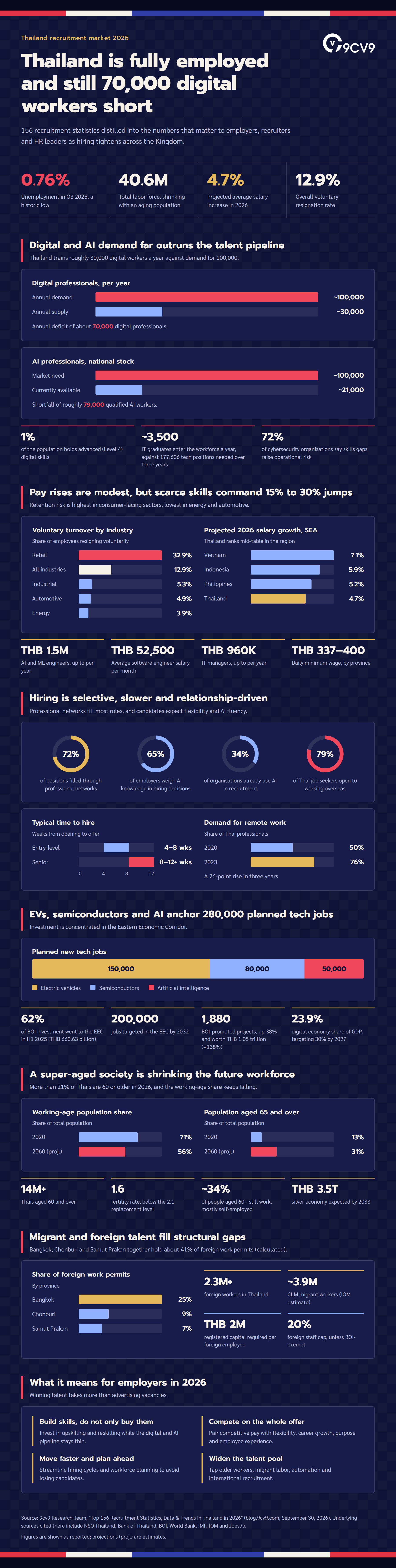
Longer-term structural forces could make recruitment even more challenging. Thailand has entered a super-aged society, its working-age population is projected to decline substantially over the coming decades, and businesses are increasingly dependent on migrant workers, older employees, automation, reskilling, and international talent. At the same time, investment in the Eastern Economic Corridor, EV manufacturing, AI, semiconductors, digital infrastructure, green industries, tourism, healthcare, and financial technology is creating new employment opportunities.
This guide to the Top 156 Recruitment Statistics, Data & Trends in Thailand in 2026 brings together the key numbers shaping the country’s employment market. From salaries, hiring timelines and turnover to AI adoption, skills shortages, foreign workers, Gen Z expectations and sector-specific recruitment trends, these statistics provide employers, recruiters, HR professionals and job seekers with a comprehensive picture of how Thailand’s workforce is changing in 2026.
Before we venture further into this article, we would like to share who we are and what we do.
About 9cv9
9cv9 is a business tech startup based in Singapore and in Asia, with a strong presence all over the world.
With over ten years of startup and business experience, and being highly involved in connecting with thousands of companies and startups, the 9cv9 team has access to some of the best talents in the world.
If your company needs recruitment and headhunting services to hire top-quality employees, you can use 9cv9 headhunting and recruitment services to hire top talents and candidates. Email us at hello@9cv9.com.
Top 156 Recruitment Statistics, Data & Trends in Thailand in 2026
SECTION 1: Macroeconomic & Labor Market Overview
- Thailand’s unemployment rate fell to 0.76% in Q3 2025 — Thailand’s unemployment rate reached a historic low of 0.76% in Q3 2025, reflecting a tight labor market that presents both strong workforce stability and growing challenges for employers struggling to source available talent.
- Unemployment stood at 0.91% in Q2 2025 — Thailand’s Q2 2025 unemployment rate of 0.91% confirms a consistently near-full-employment economy, making Thailand one of the most labor-absorbed markets in Southeast Asia heading into 2026.
- Consistently below 1% unemployment — Thailand’s unemployment rate has remained below 1% for several consecutive years, a structural characteristic that underscores chronic labor shortages rather than economic abundance, particularly in skilled and technical roles.
- Total labor force of approximately 40.6 million — With a total labor force of approximately 40.6 million individuals, Thailand possesses a substantial workforce base, though demographic aging is increasingly threatening the long-term sustainability of this supply.
- Labor force dipped 0.5% YoY to 39.4 million in Q1 2025 — The 0.5% year-on-year contraction of Thailand’s labor force to 39.4 million in Q1 2025 is an early warning signal of the demographic squeeze that employers and policymakers must urgently address.
- GDP projected at 1.7%–1.8% growth in 2026 — Thailand’s modest GDP growth projection of 1.7%–1.8% for 2026 suggests a cautious hiring environment in traditional sectors, where businesses will prioritize productivity improvements over aggressive headcount expansion.
- IMF projects growth to slow to ~1.6% in 2026 — The IMF’s projection of 1.6% GDP growth for Thailand in 2026 indicates that general-sector hiring will remain conservative, while competition for high-value digital and tech talent intensifies independently of broader economic conditions.
- GDP growth expected at 2.5%–3.2% in 2025 — Thailand’s stronger 2025 GDP growth of 2.5%–3.2%, driven by tourism recovery and rising investment, helped lay the employment foundation that carries momentum into a more cautious 2026 hiring market.
- Manufacturing accounts for 25% of GDP and 16% of employment — Thailand’s manufacturing sector, contributing 25% of GDP and employing over 6.2 million workers, remains the backbone of the national economy and a critical driver of blue-collar and technical recruitment demand.
- Agricultural employment contracted 3.1% YoY in Q1 2025 — The 3.1% year-on-year contraction in Thailand’s agricultural employment reflects a long-term structural shift of workers toward services and manufacturing, intensifying urban hiring competition and rural talent migration.
- Non-farm employment rose 0.5% in Q1 2025 — Non-farm employment’s 0.5% growth in Q1 2025, led by a 4.5% surge in transport and storage, signals that Thailand’s economy is gradually pivoting toward services and logistics as key employment engines.
- Long-term unemployed dropped 14.3% to ~68,000 — The 14.3% decline in long-term unemployed individuals to approximately 68,000 in Q1 2025 is a positive indicator of improved job matching and workforce reabsorption, though structural mismatches between skills and vacancies persist.
- 200,000–300,000 new job openings projected across 2025–26 — Thailand is expected to generate 200,000–300,000 new job openings in 2025–2026, creating diverse opportunities across skill levels, though filling specialized roles remains a significant challenge for hiring managers.
- 300,000+ vacancies across hospitality, construction, healthcare, IT, and manufacturing — The projection of over 300,000 vacancies across Thailand’s key sectors in 2026 underlines both the country’s economic vitality and the persistent talent shortfall that is driving wage inflation in competitive fields.
- Employment rate stands at approximately 60.1% — Thailand’s employment-to-population ratio of approximately 60.1% reflects a relatively engaged workforce, though it also highlights room for increasing female labor force participation and drawing inactive populations back into employment.
SECTION 2: Salary, Compensation & Benefits Trends
- Average salary increase projected at ~4.7% in 2026 — Thailand’s projected average salary increase of 4.7% for 2026 provides moderate compensation growth that broadly keeps pace with inflation, though it falls short of the double-digit increments demanded by highly skilled digital and tech professionals.
- Salaries increased by 4.5% in 2025 — Thailand’s 4.5% salary increase in 2025, slightly below the historical 5% average, reflects cautious remuneration strategies amid economic uncertainty, with employers balancing retention needs against tightening profit margins.
- Thailand at 4.7% vs. Vietnam at 7.1% in SEA salary growth — Thailand’s projected 4.7% salary growth ranks mid-table in Southeast Asia, behind Vietnam (7.1%), Indonesia (5.9%), and the Philippines (5.2%), suggesting that compensation competitiveness may become a factor in cross-border talent migration within the region.
- High-skill tech professionals command 15%–30% salary jumps — Professionals with in-demand AI, cybersecurity, and cloud computing skills in Thailand can command salary increments of 15%–30% when changing jobs, creating significant pressure on employers to build retention strategies beyond basic pay rises.
- Regional attrition rate of ~17.5% — Thailand’s regional attrition rate of approximately 17.5% is a significant cost burden for employers, with high turnover in tech and digital roles forcing organisations to invest heavily in counteroffers and retention packages to protect institutional knowledge.
- Overall voluntary resignation rate of 12.9% — Thailand’s overall voluntary resignation rate of 12.9% across all industries highlights a moderately mobile workforce, indicating that employee engagement, career development, and compensation alignment are critical levers for retention in 2026.
- Retail has the highest turnover at 32.9% — Thailand’s retail sector’s striking 32.9% voluntary turnover rate — the highest of any industry — points to endemic challenges in employee satisfaction, compensation structures, and career progression that the sector urgently needs to address.
- Lowest turnover in energy (3.9%), automotive (4.9%), and industrial (5.3%) — The low voluntary turnover in Thailand’s energy (3.9%), automotive (4.9%), and industrial (5.3%) sectors reflects stronger compensation packages, clearer career pathways, and more stable employment conditions compared to consumer-facing industries.
- Energy and utilities projected highest salary increase at 5% — The energy and utilities sector’s 5% salary increase projection — the highest among Thai industries — reflects strong demand for specialized engineers and technical professionals needed to support Thailand’s green energy transition.
- Retail and technology posted lowest salary increases at 4% — The retail and technology sectors’ below-average salary increases of 4% in 2025 contrast sharply with the intense talent competition in tech, suggesting that non-monetary benefits and career development opportunities are increasingly decisive hiring factors.
- Variable bonuses average approximately two months of salary — Thailand’s stable variable bonus average of approximately two months’ salary in 2025 provides predictable compensation benchmarking for HR professionals, though sector-specific variations remain significant.
- Chemicals, energy, and oil & gas pay highest bonuses (~3 months) — Thailand’s chemicals, energy, and oil and gas sectors lead on bonus compensation at approximately three months’ salary, making them attractive employers for technical professionals weighing career options across industries.
- 28% of organisations still provide a fixed one-month bonus — Despite the shift toward performance-linked compensation, approximately 28% of Thai organisations continue offering a fixed annual bonus of one month’s salary, reflecting a mix of traditional and modern remuneration approaches in the market.
- Minimum wage at THB 400/day in Bangkok (2026) — Thailand’s minimum daily wage of THB 400 in Bangkok and top provinces as of 2026 provides a legally mandated compensation floor, though multinational employers and tech companies typically pay substantially above this threshold to attract talent.
- Minimum wage ranges from THB 337 to THB 400 depending on province — The provincial variation in Thailand’s minimum wage — from THB 337 to THB 400 per day — reflects regional economic disparities and creates different cost-of-labor considerations for companies evaluating office or operations locations across the country.
- Average wage of BHT 15,565 (~USD 486) per month in Q1 2025 — Thailand’s average monthly wage of approximately THB 15,565 (USD 486) in Q1 2025 positions the country as a competitively priced labor market in Southeast Asia, attracting foreign investment while raising questions about purchasing power for the domestic workforce.
- AI and ML engineers earn up to THB 1.5 million annually — The premium annual salaries of up to THB 1.5 million for AI and Machine Learning engineers in Thailand reflect the acute scarcity of these skills domestically, making competitive compensation packages essential for attracting and retaining this critical talent pool.
- Software engineers earn average THB 52,500/month — Thailand’s average monthly software engineer salary of approximately THB 52,500 is competitive within the region but remains significantly below global benchmarks, underscoring the attractiveness of Thailand as a tech talent destination for international companies managing salary costs.
- IT managers earn up to THB 960,000 annually — IT management roles commanding up to THB 960,000 per year in Thailand reflect the premium placed on experienced technical leaders, particularly as organisations scale digital transformation initiatives and require strong governance over complex technology environments.
- E-commerce managers earn THB 70,000–THB 150,000/month — E-commerce managers in Thailand commanding monthly salaries of THB 70,000–THB 150,000 illustrate the high commercial value placed on professionals who can drive revenue growth in the country’s rapidly expanding digital retail market.
- Employer SSF contribution is 5% of salary, capped at THB 875/month — Thailand’s mandatory Social Security Fund employer contribution of 5%, capped at THB 875 per month, represents a relatively modest statutory cost for businesses, though total employment costs rise considerably when factoring in additional benefits and compliance requirements.
- Structured onboarding reduces early turnover by up to 30% — Research indicates that structured onboarding programs can reduce early employee turnover by up to 30% in Thai SMEs, making onboarding investment a cost-effective retention strategy in a tight labor market where replacement hiring is expensive and slow.
- 44% of Thai organisations reported moderate growth in 2025 — The fact that 44% of Thai organisations reported moderate growth and 52% met performance targets in 2025 reflects a resilient but cautious business environment, where controlled hiring rather than rapid expansion is the dominant workforce strategy heading into 2026.
- 35% of organisations grew below expectations in 2025 — The 35% of Thai organisations that fell short of growth expectations in 2025 highlights the fragility of business confidence in a low-growth macroeconomic environment, likely translating into frozen headcounts and deferred hiring plans in 2026.
SECTION 3: Digital Economy, Tech Talent & AI Hiring
- Digital economy accounts for ~23.9% of GDP (THB 4.44 trillion) — Thailand’s digital economy contributing nearly 24% of GDP — valued at over THB 4.44 trillion — underscores the transformative scale of digitalization and the extraordinary volume of tech talent the economy must generate to sustain this growth.
- Digital sector growing at 6.2% annually — 3.4x faster than overall GDP — The digital sector’s 6.2% annual growth rate, more than three times the national GDP growth rate, signals that Thailand’s future employment and wage dynamism will be concentrated in technology-driven industries, not traditional sectors.
- Government targets digital sector to reach 30% of GDP by 2027 — Thailand’s government target of growing the digital economy to 30% of GDP by 2027 is an ambitious policy goal that will require dramatic acceleration in digital skills development and strategic immigration of technical talent to bridge the existing workforce gap.
- Digital services forecast to grow at 19%–20% annually through 2025 — The 19%–20% annual growth projection for Thailand’s digital services sector — encompassing e-commerce and FinTech — is among the fastest in Southeast Asia and a direct driver of soaring demand for product managers, developers, and digital marketing professionals.
- Annual demand for ~100,000 digital professionals — Thailand’s annual demand for approximately 100,000 digital professionals vastly exceeds domestic supply capabilities, creating a structural talent crisis that will constrain digital economic growth unless addressed through systemic education reform and proactive talent importation.
- Supply of ~30,000 digital workers per year — 70,000 short of demand — With educational institutions producing only 30,000 skilled digital workers annually against a demand of 100,000, Thailand faces a persistent digital talent deficit of 70,000 professionals per year — a gap that is compounding rather than closing.
- Only 1% of population has advanced (Level 4) digital skills — The fact that only 1% of Thailand’s population possesses advanced digital skills is a sobering measure of the country’s readiness for the AI-driven economy, and a critical argument for urgent investment in upskilling at scale.
- Only 3,500 IT graduates enter the workforce annually vs. 177,606 positions needed — Thailand’s annual output of approximately 3,500 IT graduates stands in stark contrast to the 177,606 tech positions needed over the next three years, revealing a hiring pipeline crisis that neither incremental curriculum reform nor immigration policy alone can solve quickly.
- 72% of cybersecurity organisations report increasing operational risk from skills gaps — That nearly three-quarters of Thai cybersecurity organisations cite the skills gap as a direct operational risk demonstrates that talent shortages in this sector are not merely an HR inconvenience but a measurable national security and business continuity threat.
- Thailand needs 100,000 AI professionals but has only 21,000 — Thailand’s AI talent shortfall of approximately 79,000 qualified professionals against a market need of 100,000 underscores the urgency of both accelerated domestic AI education and strategic talent attraction policies to position the country competitively in the global AI economy.
- Digital economy growing at 14% annually — Thailand’s digital economy expanding at 14% per year is generating employment opportunities at a pace that outstrips the domestic talent pipeline’s ability to respond, making Thailand an increasingly attractive destination for regional tech professionals seeking competitive roles.
- 58% of CEOs cite employee AI skill gaps — With 58% of Thailand’s tech CEOs identifying AI adoption as a skills gap challenge, organisations that invest proactively in AI literacy programs and internal reskilling will gain a significant competitive advantage in both operational efficiency and talent retention.
- 34% of organisations have introduced AI into recruitment — The adoption of AI in recruitment by 34% of Thai organisations reflects a growing recognition that traditional hiring processes are inadequate for the speed and volume demands of today’s talent market, though ethical implementation and bias prevention remain important considerations.
- 65% of employers consider AI knowledge an additional competency in hiring decisions — With 65% of Thai employers factoring AI knowledge into their hiring decisions, professionals who can demonstrate even foundational AI literacy are gaining a meaningful advantage over peers with similar domain expertise but no digital upskilling.
- Digital Transformation Market valued at USD 10.06 billion in 2025 — Thailand’s USD 10.06 billion digital transformation market in 2025 represents both a massive commercial opportunity and a direct driver of recruitment activity across cloud computing, cybersecurity, data analytics, and enterprise software implementation roles.
- Market projected to reach USD 16.64 billion by 2031 at 8.75% CAGR — The projected growth of Thailand’s digital transformation market to USD 16.64 billion by 2031 at an 8.75% CAGR signals sustained long-term demand for technology talent, making investment in digital recruitment pipelines a strategically sound priority for forward-looking organisations.
- Cloud deployment accounts for 55.05% of digital transformation market — Cloud computing’s dominant 55% share of Thailand’s digital transformation market, growing at a 19.95% CAGR through 2031, explains the soaring demand for cloud architects, DevOps engineers, and cloud security professionals that recruitment agencies are struggling to fulfil.
- AWS pledged to upskill 100,000 Thai citizens by 2026 — AWS’s commitment to upskilling 100,000 Thai citizens by 2026 is one of the most significant private-sector workforce development initiatives in the country, demonstrating how hyperscaler investment in cloud infrastructure is directly linked to long-term talent pipeline building.
- THB 5 billion state program targeting 17,500 specialists in semiconductors, EVs, and AI — Thailand’s THB 5 billion government investment in training 17,500 specialists across semiconductors, EVs, and AI signals a coordinated industrial strategy that aligns workforce development with targeted foreign direct investment attraction in high-value sectors.
- THB 1.5 billion AI spending program to create 30,000 AI-skilled workers by 2027 — The Thai government’s THB 1.5 billion AI workforce program targeting 30,000 qualified AI workers by 2027 represents a meaningful, if still insufficient, policy response to the structural shortfall of 79,000 AI professionals currently facing the labor market.
- Thailand ranked 38th in IMD World Digital Competitiveness Ranking 2025 — Thailand’s 38th position in the IMD World Digital Competitiveness Ranking reflects a country at a pivotal digital crossroads — competitive enough to attract investment but needing structural reform in education, R&D, and talent development to break into the global top tier.
- Technology sub-factor fell 6 ranks to 29th — The 6-rank drop in Thailand’s technology sub-factor to 29th in the IMD WDCR 2025 is a meaningful decline that signals stagnation in domestic R&D capacity and innovation output, areas where strategic investment and policy reform are critically needed.
- Digital Council of Thailand aims to increase digital proficiency from 28% to 70% by 2025 — Thailand’s ambitious target to raise national digital proficiency from 28% to 70% reflects strong government intent, though the scale of the gap between the current baseline and target suggests this deadline may have been aspirational rather than achievable.
- Google invested USD 1 billion in Thai cloud ecosystem, creating 14,000 jobs annually — Google’s USD 1 billion investment in Thailand’s cloud computing ecosystem, projected to generate 14,000 jobs annually, illustrates how hyperscaler infrastructure commitments translate into broad downstream employment across engineering, sales, support, and consulting.
- 499 active AI-related job vacancies listed on Jobsdb as of February 2026 — The 499 active AI job listings on Jobsdb as of February 2026 provide a concrete, real-time snapshot of market demand, and should be viewed as a conservative estimate given that many AI roles are filled through direct outreach rather than public job boards.
SECTION 4: Skills Gap & Workforce Development
- 1.08 million high-skilled professionals needed across 10 industries by 2029 — Thailand’s need for 1.08 million high-skilled professionals across ten targeted industries by 2029 represents one of the most significant workforce development challenges in the country’s modern history, demanding coordinated action from government, industry, and academia.
- Over two-thirds of working-age population lack basic reading skills — The finding that more than two-thirds of Thailand’s working-age population lacks basic reading skills per ASAT data is a stark indication that foundational literacy deficits are undermining workforce quality and limiting the pool of candidates suitable for upskilling into technical roles.
- Three-quarters of working-age population fall short of basic digital skills — With three-quarters of Thailand’s working-age adults unable to meet basic digital skill benchmarks, the scale of the digital literacy challenge extends far beyond the tech sector and touches every industry attempting to digitize its operations.
- Nearly two-thirds of 15-year-olds perform below minimum PISA standards — The 2022 PISA results showing nearly two-thirds of Thai 15-year-olds performing below minimum reading and mathematics standards are a lagging indicator of the workforce quality crisis employers are experiencing today, with long-term implications for Thailand’s human capital pipeline.
- 63% of SEA companies dealing with present skills gaps — The 63% of Southeast Asian companies — including Thailand — currently managing active skills gaps confirms that talent shortages are not a future risk but a present operational constraint, requiring immediate investment in L&D, reskilling, and alternative sourcing strategies.
- 60% of SEA employers worried skills gaps will hamper business preparation — The 60% of Southeast Asian employers concerned that skills gaps will impede their ability to adapt to changing business landscapes reflects a widespread strategic vulnerability that workforce investment, proactive upskilling, and international talent mobility programs can partially address.
- 64% of Thai employers plan to use DEI programmes to bridge skills gaps — The 64% of Thai employers planning to leverage diversity, equity, and inclusion programs as a talent strategy reflects a growing recognition that accessing underrepresented talent pools — including women in tech, older workers, and regional candidates — is a practical response to shortages, not just a compliance exercise.
- 45% of Thai employers considering childcare support as a talent attraction measure — Nearly half of Thai employers exploring subsidised childcare as a recruitment and retention tool signals a maturing employee value proposition strategy, particularly important for attracting and retaining female professionals in a tight labor market.
- 73% of Thai employers expect slower economic growth to impact business by 2030 — Thailand’s highest-in-SEA rate of 73% of employers anticipating growth headwinds by 2030 reflects deep concern about structural economic constraints, which will likely translate into cautious, needs-based hiring philosophies rather than growth-oriented talent investment.
- 41% of SEA businesses cite trade restriction impacts — vs. 23% global average — The far-above-average concern among Southeast Asian businesses about global trade restrictions directly affects hiring plans for supply chain, trade compliance, and manufacturing roles in export-dependent Thailand, creating uncertainty in workforce planning across industrial sectors.
- Plan to create 280,000 new tech jobs: 150,000 in EVs, 80,000 in semiconductors, 50,000 in AI — Thailand’s plan to generate 280,000 new tech jobs — spanning EVs, semiconductors, and AI — is a cornerstone of the Thailand 4.0 economic strategy, but its success hinges on whether the education and training ecosystem can produce the right talent in the right timeframes.
- 177,606 new jobs needed in semiconductors, AI, and EVs — The precise target of 177,606 new jobs in Thailand’s three priority tech sectors quantifies the scale of workforce transformation underway, and underscores why public-private training partnerships and foreign talent attraction are not optional but essential.
- Thai tech sector engineering roles are only 45% met by local supply — The fact that only 45% of engineering roles in Thailand’s tech sector can be filled domestically reveals a critical dependency on foreign talent and contract workers to maintain operational continuity, particularly in EEC-based manufacturing and R&D facilities.
- Digital marketing roles in Thailand have grown 200% since 2020 — The 200% growth in digital marketing roles since 2020 reflects the explosive expansion of Thailand’s digital commerce ecosystem and the corresponding demand for professionals with expertise in SEO, performance marketing, social media, and data-driven consumer engagement.
- 72% of positions filled through professional networks, not job postings — The dominance of professional networks — accounting for 72% of job placements in Thailand — underscores the critical importance of LinkedIn presence, industry networking, and relationship-based recruitment strategies for both job seekers and talent acquisition professionals.
SECTION 5: Hiring Trends, Recruitment Practices & Flexible Work
- 2025 characterised by selective hiring with longer time-to-fill — The shift toward selective hiring and longer decision timelines in Thailand’s 2025 market reflects employers’ increasing emphasis on quality-of-hire over speed, as the cost of a poor hire in a tight, expensive talent market has become harder to justify.
- Typical hiring timelines: 4–8 weeks (entry-level), 8–12+ weeks (senior) — Thailand’s hiring timelines ranging from 4–8 weeks for entry-level and 8–12 weeks or more for senior positions highlight the importance of well-structured recruitment processes, as excessively long cycles risk losing top candidates to competitors who move with greater agility.
- Full hiring costs range from THB 5,000–10,000 per hire — Estimated total hiring costs of THB 5,000–10,000 per hire in Thailand represent a meaningful investment for SMEs, reinforcing the value of strong retention strategies and internal promotions as alternatives to frequent external recruitment.
- Demand for senior leadership increased as mid-level recruitment scaled back — The 2025 trend of increased senior leadership demand alongside reduced mid-level hiring signals a bifurcating market where companies are investing in strategic capability at the top while rationalising layers below, reshaping organisational structures across Thai industries.
- Agile hiring models (contract and project-based) gained traction at mid-senior level — The growing adoption of contract and project-based hiring in Thailand’s mid-senior talent market reflects organisational agility needs, enabling companies to access high-level expertise without long-term headcount commitments in an uncertain economic climate.
- Increase in part-time and contract workers alongside full-time employees — Thailand’s blended workforce model — combining full-time, part-time, and contract employees — is maturing as a strategic norm rather than a contingency arrangement, offering employers flexible cost structures and workers greater portfolio career options.
- Jobsdb’s HCB Report 2025 based on survey of 702 Thai employers — The Jobsdb Hiring Compensation and Benefits Report 2025, drawing on responses from 702 Thai employers, represents one of the most comprehensive employer-side surveys of the local job market and provides reliable benchmarks for compensation, benefits, and hiring trends.
- Low 1% unemployment driven by high demand in admin, HR, accounting, and B2B roles — Thailand’s near-zero unemployment is partly sustained by robust demand in administrative, HR, accounting, and B2B sales roles, indicating that operational and support functions remain consistently active in the hiring market regardless of broader economic fluctuations.
- 79% of Thai job seekers interested in pursuing overseas opportunities — The striking statistic that 79% of Thai job seekers are open to working abroad for career growth and better compensation is a critical talent retention warning for domestic employers, particularly in an era where remote and international work opportunities are more accessible than ever.
- Demand for remote work surged from 50% to 76% among Thai professionals (2020–2023) — The dramatic 26-percentage-point increase in remote work demand among Thai professionals between 2020 and 2023 has permanently shifted workforce expectations, and organisations that fail to offer flexible arrangements risk losing candidates to more accommodating employers.
- 96% of millennials and 99% of Gen Z cite purpose as vital to job satisfaction — The near-universal importance of purpose-driven work among Thailand’s millennial and Gen Z workforce represents a structural shift in employment value drivers, compelling employers to authentically communicate mission, impact, and values as core components of their employer brand.
- PRTR administers 18,905 outsourced employees, projected to reach 21,500 by end 2026 — PRTR’s projected growth to 21,500 outsourced employees by end of 2026 reflects the accelerating demand for HR outsourcing in Thailand as companies seek cost-efficient, compliant workforce management solutions amid rising complexity in employment regulation.
- PRTR reported THB 7.66 billion revenue in first three quarters of 2025, up 6.96% YoY — PRTR’s 6.96% revenue growth to THB 7.66 billion in the first three quarters of 2025 is a reliable indicator of the health and expansion of Thailand’s broader HR services and staffing industry.
- PRTR’s HRIS platform Pinno Solutions reached 50,078 users, growing 151% — The 151% growth of PRTR’s HRIS platform to over 50,000 users demonstrates the rapid digitalisation of HR administration in Thailand, with cloud-based workforce management tools becoming standard infrastructure for mid-to-large employers.
- Companies treating compensation as holistic strategy better positioned for talent competition — Organisations that view total compensation — including non-monetary benefits, career development, flexibility, and well-being — as a strategic tool rather than a transactional cost are demonstrably better positioned to attract and retain talent in Thailand’s increasingly competitive hiring environment.
- Companies with racial and ethnic diversity are 35% more likely to achieve better financial returns — Research cited in the Thai business community confirming that diverse companies are 35% more likely to outperform financially provides a compelling business case — beyond ethical imperatives — for advancing inclusive hiring practices in Thailand.
- Diverse management teams generate 19% higher revenue — The finding that diverse management teams in Thailand generate 19% higher revenue through innovation reinforces the case for inclusive leadership hiring as a performance strategy, not merely a corporate responsibility exercise.
SECTION 6: Sectoral Hiring — EV, Green Economy & Manufacturing
- Automotive sector accounts for 3.1% of GDP and employs 570,000+ workers — Thailand’s automotive sector, employing over 570,000 workers and contributing 3.1% of GDP, is undergoing its most significant structural transformation in decades as the industry transitions from internal combustion to electric vehicles, reshaping recruitment needs across the value chain.
- EV-related value chains represent 4.3% of Thailand’s total exports — The 4.3% export share of EV-related value chains in Thailand’s total export portfolio reflects the country’s early but meaningful positioning as a regional EV manufacturing hub, creating new demand for battery technology, electronics, and precision engineering talent.
- More than 80% of auto-parts production can be adapted for EVs — The high adaptability rate of over 80% of Thailand’s existing auto-parts manufacturing base for EVs is strategically significant for workforce transitions, suggesting that retraining existing automotive workers is more feasible and cost-effective than building an entirely new EV workforce from scratch.
- Scaling up EVs, solar PV, and energy-efficient cooling could raise GDP by 2.9% by 2035 — The World Bank’s projection of a potential 2.9% GDP gain from scaling green manufacturing sectors by 2035 provides strong economic justification for prioritising green skills development and targeted recruitment in renewable energy and sustainable manufacturing roles.
- Green manufacturing expansion projected to increase employment by ~0.6% — While a 0.6% employment increase from green manufacturing expansion may appear modest, it represents tens of thousands of new jobs in high-value technical roles, with potential multiplier effects across adjacent supply chains and services sectors.
- EV sector has created over 9,600 jobs with 85–95% Thai workforce — The creation of over 9,600 jobs in Thailand’s EV sector, with an overwhelming majority employed locally, demonstrates that foreign-invested EV manufacturing can deliver meaningful domestic employment outcomes alongside technology and skills transfer.
- BYD employs 5,900+ people in Thailand and targets 95% Thai workforce by 2026 — BYD’s commitment to localising its Thai workforce to 95% by 2026 is a significant corporate workforce strategy that signals confidence in local talent development programs and creates pressure on the education sector to produce EV-qualified engineers and technicians at scale.
- EV exports to soar from 12,500 to 52,000 units by 2026 — The projected quadrupling of Thailand’s EV exports from 12,500 to 52,000 units by 2026 will generate substantial downstream recruitment demand in logistics, quality assurance, export management, and supply chain optimisation roles.
- Green goods account for close to 10% of Thailand’s total exports — Green goods representing nearly 10% of Thailand’s total exports positions the country as a meaningful player in the global green economy, with recruitment implications across sustainability management, ESG reporting, and green engineering disciplines.
- FDI applications nearly doubled in the first nine months of 2025 — The near-doubling of FDI applications in Thailand in early 2025, particularly in digital infrastructure, batteries, and EVs, is one of the strongest forward indicators of sustained job creation and specialist talent demand in these sectors through 2026 and beyond.
- BOI-promoted projects totaled 1,880 (+38% YoY), valued at THB 1.05 trillion (+138%) — BOI’s record 2025 investment attraction results — 38% more projects and 138% higher total value — translate directly into anticipated recruitment pipelines across engineering, project management, supply chain, and technical operations over the coming 12–24 months.
- EEC attracted 62% of all BOI investment (THB 660.63 billion) in H1 2025 — The Eastern Economic Corridor’s capture of 62% of all BOI investment in H1 2025 cements its position as Thailand’s most active employment creation zone, making it the highest-priority destination for job seekers with industrial, manufacturing, and tech credentials.
- EEC hosts 40+ industrial estates and aims to create 200,000 jobs by 2032 — The EEC’s combination of over 40 industrial estates and a 200,000-job creation target by 2032 represents one of the most significant planned employment expansions in Thailand, with implications for residential relocation, salary expectations, and regional talent market dynamics.
- EEC attracted over THB 1.92 trillion in FDI in first five years — The EEC’s THB 1.92 trillion in cumulative FDI within its first five years of operation validates the zone’s investment thesis and signals continued investor confidence in Thailand as a manufacturing and technology services hub in Southeast Asia.
- EEC aims for THB 2.2 trillion in fresh investment by 2028 — Thailand’s EEC investment target of THB 2.2 trillion by 2028 will require a commensurate expansion of the skilled workforce in Chonburi, Rayong, and Chachoengsao provinces, creating urgency around vocational training, engineering education, and specialist talent attraction.
- Construction industry projected to grow at 4% annually from 2025–2028 — Thailand’s construction sector’s steady 4% annual growth projection through 2028 will sustain demand for civil engineers, project managers, site supervisors, and skilled tradespeople, with recruitment activity concentrated around EEC infrastructure, tourism hospitality development, and urban housing projects.
SECTION 7: Foreign Workers, Migration & Work Permits
- Thailand hosts over 2.3 million foreign workers — Thailand’s foreign worker population of over 2.3 million reflects its deep dependency on international labor to fill structural gaps across manufacturing, agriculture, construction, and services, a dynamic that will intensify as the domestic working-age population continues to shrink.
- IOM estimates ~3.9 million migrant workers from Cambodia, Laos, Myanmar, and Vietnam — IOM’s estimate of 3.9 million CLM migrant workers in Thailand highlights the critical role of cross-border labor mobility in sustaining Thai industry, and the policy complexity of managing a large, predominantly informal migrant workforce within the formal employment system.
- CLM migrant workers contribute 7.5% of Thailand’s total workforce — Migrant workers’ 7.5% contribution to Thailand’s total workforce underscores their systemic importance — not as a marginal labor supplement but as a structural component of several key industries that could not maintain current output without this workforce.
- Legal migrant workers account for ~8% of Thailand’s total workforce — The 8% share of legal migrant workers in Thailand’s total workforce masks a substantially larger undocumented labor population, indicating that formal registration and work permit systems continue to be underutilised relative to actual labor migration volumes.
- Thailand issued over 1.5 million work permits to foreign workers in recent years — The issuance of over 1.5 million work permits reflects Thailand’s recognition of its labor dependency on foreign workers, though demand for both skilled expat professionals and semi-skilled migrant workers continues to outpace formal permit processing capacity.
- Bangkok accounts for 25% of all foreign work permits (563,315) — Bangkok’s disproportionate share of 25% of all foreign work permits reflects the city’s dominance as Thailand’s commercial hub and the concentration of multinational employers, financial services, technology companies, and regional headquarters in the capital.
- Chonburi accounts for 9% of foreign work permits (197,333) — Chonburi’s 9% share of foreign work permits, driven by EEC investment and tourism activity, confirms its emergence as Thailand’s second most important commercial employment zone and a growing destination for international manufacturing and industrial talent.
- Samut Prakan holds ~7% of foreign work permits (145,328) — Samut Prakan’s 7% share of foreign work permits reflects its role as a major logistics, export processing, and industrial manufacturing hub adjacent to Bangkok, where demand for specialised foreign technicians and factory supervisors remains consistently high.
- Companies need THB 2 million registered capital per foreign employee for work permits — Thailand’s requirement of THB 2 million in registered capital per foreign employee is a significant entry barrier for smaller businesses seeking to hire international talent, often influencing the decision to use BOI-promoted structures or outsource to PEO providers.
- Companies may have no more than 20% foreign staff, unless BOI-exempt — Thailand’s 20% cap on foreign employees, with exemptions available for BOI-promoted companies, creates a structured but navigable constraint for international businesses, though it underscores the competitive importance of domestic hiring pipelines for the majority of the workforce.
- LTR visa requirements updated January 2025 to attract foreign investment and talent — The January 2025 update to Thailand’s Long-Term Resident visa requirements reflects the government’s proactive effort to attract high-value foreign professionals and retirees, contributing to the talent diversification of the Thai labor market.
- Foreign executives in EEC targeted industries are taxed at a maximum of 17% personal income tax — Thailand’s preferential 17% personal income tax rate for foreign executives working in EEC-targeted industries is a globally competitive incentive that materially enhances Thailand’s attractiveness versus regional rivals when negotiating relocation packages for senior international talent.
SECTION 8: Aging Population & Demographic Impact on Hiring
- Thailand transitioned into a ‘super-aged society’ with 21%+ aged 60+ in 2026 — Thailand’s official designation as a super-aged society in 2026, with over 21% of its population aged 60 or above, marks a demographic inflection point that will profoundly reshape labor supply, retirement policies, healthcare hiring demand, and social security sustainability.
- Elderly population (60+) exceeds 14 million — With more than 14 million people aged 60 and above, Thailand’s elderly population has reached a scale that simultaneously creates significant workforce gaps through retirement and generates substantial new employment demand in elder care, healthcare, and senior consumer services.
- Working-age population projected to decline from 71% in 2020 to 56% in 2060 — The projected 15-percentage-point decline in Thailand’s working-age population share over four decades is a long-term structural challenge that necessitates immediate investment in productivity-enhancing technologies, workforce automation, and sustained labor immigration policies.
- Decline equivalent to a ~30% reduction — third largest in East Asia and Pacific — Thailand’s projected working-age population decline, equivalent to approximately 30% of the current labor supply and ranking third largest in East Asia and the Pacific, places it among the most demographically pressured labor markets in the developing world.
- Share of population aged 65+ to rise from 13% in 2020 to 31% by 2060 — The near-tripling of Thailand’s over-65 population share from 13% to 31% over 40 years will fundamentally alter the balance between workers and dependants, increasing the economic burden on a shrinking productive workforce and intensifying demand for older worker participation.
- Aging projected to reduce GDP per capita growth by 0.86% in the 2020s — The World Bank’s estimate that demographic aging will subtract 0.86% from Thailand’s GDP per capita growth in the current decade quantifies the macroeconomic cost of the aging workforce and strengthens the case for productivity-enhancing hiring strategies and reskilling investment.
- ~34% of elderly (60+) continue to work in Thailand — The fact that approximately one-third of Thailand’s elderly population remains economically active reflects both financial necessity and an untapped reservoir of experienced talent that progressive employers can leverage through flexible, phased retirement and senior-friendly work arrangements.
- 63.7% of working elderly are self-employed — The dominance of self-employment (63.7%) among Thailand’s working elderly highlights the lack of formal sector roles adapted to older workers’ needs, representing both a policy gap and a commercial opportunity for organisations willing to design age-inclusive employment models.
- Total fertility rate of ~1.6 — below the 2.1 replacement level — Thailand’s total fertility rate of approximately 1.6 — well below the 2.1 replacement threshold — means that natural population growth cannot replenish the workforce, making immigration policy, older worker retention, and automation the primary levers for managing future labor supply.
- Silver economy expected to reach THB 3.5 trillion by 2033 — The projected THB 3.5 trillion silver economy by 2033 signals enormous commercial opportunities in senior care, health technology, financial planning, and lifestyle services for the elderly — all of which will require significant workforce expansion and new types of professional roles.
- Succession planning identified as a key challenge with retiring senior managers — Robert Walters’ identification of succession planning as a pressing challenge in 2025–2026 highlights the systemic risk of an aging leadership cohort in Thai organisations, where insufficient internal pipelines for senior roles are creating critical knowledge transfer gaps.
- Only 0.6% of older individuals actively seeking employment but unable to find work — The very low 0.6% active job-seeking rate among Thailand’s older population who cannot find employment suggests that demand for experienced older workers exists but may not be reaching this demographic through traditional recruitment channels.
- Tax deduction for wages paid to older employees (up to THB 15,000/person, max 10% workforce) — Thailand’s tax incentive allowing deductions for wages paid to older employees — up to THB 15,000 per person — is a direct fiscal encouragement for organisations to retain or hire workers aged 60 and above, partially offsetting the perceived cost or risk of senior worker employment.
SECTION 9: Tourism, Healthcare & Service Sector Hiring
- Tourism employment accounted for ~10.68% of total employment in 2022 — Tourism’s contribution of approximately 10.68% of total Thai employment in 2022 reflects the sector’s structural importance as a mass employer, particularly of semi-skilled and service workers in hospitality, transport, retail, and food and beverage.
- Tourism employed approximately 4.19 million people in 2022 — The 4.19 million Thais employed in tourism as of 2022 position the sector as one of the country’s largest single-industry employers, with recovery to and beyond pre-COVID levels driving sustained recruitment demand through 2026.
- Thailand welcomed ~40 million tourist visitors in 2024 — Thailand’s 40 million tourist arrivals in 2024 reflect the successful recovery of international tourism, which directly correlates with active hiring in hospitality, food and beverage, leisure, and transport sectors heading into 2026.
- 729 active Hospitality & Tourism vacancies on Jobsdb (February 2026) — The 729 active hospitality and tourism job listings on Jobsdb as of February 2026 confirm that the sector is in active hiring mode, with front-line service roles, management positions, and specialist functions — such as revenue management and digital marketing — all in demand.
- Healthcare sector in urgent need of sales, marketing, and regulatory affairs professionals — Thailand’s healthcare sector faces a specific and urgent talent gap in commercial and regulatory functions, reflecting the industry’s expansion into medical technology, pharmaceuticals, and preventive care markets that require professionals bridging clinical knowledge with business acumen.
- Healthcare sector experienced active hiring in 2025 due to aging population and digital push — The combination of an aging population, rising preventive care demand, and digital health adoption drove one of the most active healthcare recruitment cycles in Thailand’s modern history, a trend expected to intensify through 2026 and beyond.
- Medical tourism attracts over 1 million visitors per year — Thailand’s position as a global medical tourism destination, drawing over 1 million health visitors annually, sustains demand for multilingual clinical staff, patient coordinators, and international healthcare administrators capable of managing cross-cultural patient experiences.
- Banking and Financial Services recruitment heated up with 3 new virtual bank licenses approved — The Bank of Thailand’s approval of three new virtual bank licenses in 2026 has catalysed a notable wave of fintech and banking recruitment, particularly for data scientists, digital product managers, cybersecurity specialists, and compliance professionals with digital finance expertise.
- Transport and storage services grew 4.5% in Q1 2025 — The 4.5% growth in Thailand’s transport and storage sector in Q1 2025 generated meaningful employment expansion in logistics, supply chain management, last-mile delivery, and warehousing — roles increasingly enhanced by automation and digital tracking capabilities.
- Thailand’s e-commerce market is among the fastest-growing in SEA — Thailand’s rapid e-commerce growth is fuelling persistent demand for digital marketing managers, e-commerce operations specialists, UX designers, and supply chain analysts, making the sector one of the most active hiring markets for mid-level digital talent in 2026.
SECTION 10: Gen Z, Workforce Culture & Future of Work
- Gen Z has become an influential force reshaping workplace structure and flexibility — Gen Z’s growing influence in Thailand’s workforce is driving structural shifts in how organisations design jobs, communicate their employer brand, structure working hours, and demonstrate social purpose — compelling HR leaders to fundamentally rethink their talent experience frameworks.
- Over half of Thai millennials and Gen Z refuse to work for organisations conflicting with their ethics — The willingness of more than half of Thailand’s millennial and Gen Z workers to decline employment based on ethical misalignment signals that employer reputation, environmental commitments, and corporate social responsibility are no longer soft HR considerations but hard recruitment prerequisites.
- Thailand’s tech sector projected to add 280,000 jobs with digital economy growing 30% annually — The combination of 280,000 projected new tech sector jobs and 30% annual digital economy growth positions Thailand as one of Southeast Asia’s most dynamic employment markets for digital professionals, provided that education reform and talent policy can match the pace of economic ambition.
- 63% of Thai tech startups have flat organisational structures — The prevalence of flat organisational structures in 63% of Thai tech startups reflects the sector’s adoption of global agile work cultures, which can be a significant talent attraction advantage over traditional hierarchical Thai corporations when competing for young digital talent.
- Fraud and scam job postings are a growing challenge in 2025 — The rise of sophisticated job scams circulating via social media in Thailand in 2025 is a significant challenge for legitimate employers, eroding candidate trust and underscoring the urgent need for verified recruitment platforms and digital identity tools to protect job seekers.
- Jobsdb launched SEEKPass in 2025 to protect users from job fraud — Jobsdb’s launch of SEEKPass in 2025 reflects the platform’s proactive response to Thailand’s growing job fraud problem, with identity verification technology becoming a meaningful trust differentiator in the recruitment marketplace.
- 2026 identified as the year of ‘T-shaped’ talent demand — The Kensington Associates characterisation of 2026 as the year of T-shaped talent demand — combining deep specialisation with broad cross-functional collaboration skills — reflects the evolution of Thai employer expectations and the premium placed on professionals who can bridge technical expertise with business impact.
- Employee experience shifting from ‘nice to have’ to a business-critical strategy — The recognition among Southeast Asian employers that employee experience is now a business-critical investment, not an optional perk, reflects the growing evidence that organisations delivering superior workplace experiences outperform on talent retention, productivity, and ultimately financial performance.
- Organisations with stronger engagement and well-being programs experience lower turnover and better productivity — The AON-backed finding that Thai and SEA organisations with robust employee engagement and well-being programs achieve measurably lower turnover and higher productivity provides a quantifiable ROI argument for HR investment that CFOs and boards can act upon with confidence.
Conclusion
Thailand’s recruitment market in 2026 reflects a workforce caught between strong talent demand and increasingly significant structural constraints. Unemployment remains below 1%, employers continue to compete for scarce skilled professionals, and major investments in technology, electric vehicles, semiconductors, digital infrastructure, healthcare and green industries are creating new recruitment needs across the economy.
The skills shortage is one of the clearest themes shaping Thailand hiring trends in 2026. Annual demand for around 100,000 digital professionals significantly exceeds the roughly 30,000 skilled digital workers entering the market each year. AI talent is similarly scarce, with an estimated need for 100,000 professionals compared with an available pool of only about 21,000. These gaps are increasing the importance of upskilling, reskilling, international recruitment and stronger talent pipelines.
Competition is also changing how companies approach compensation and retention. Average salary increases are projected at approximately 4.7% in 2026, while professionals with sought-after AI, cybersecurity and cloud expertise can secure much larger increases when changing employers. Flexible working arrangements, career progression, employee experience, purpose, benefits and workplace culture are consequently becoming important components of the overall employer value proposition.
Demographics present an even longer-term recruitment challenge. Thailand has entered a super-aged society, while its working-age population is projected to shrink considerably over the coming decades. Employers will increasingly need to consider older workers, migrant labor, automation, productivity improvements and more inclusive hiring strategies as traditional sources of workforce growth become constrained.
At the same time, Thailand continues to create substantial employment opportunities. Expansion in the Eastern Economic Corridor, foreign investment, EV manufacturing, AI, semiconductors, logistics, tourism, healthcare, financial services and the digital economy should sustain demand for both technical and commercial talent.
Taken together, these 156 Thailand recruitment statistics, data and trends for 2026 show that successful hiring will increasingly depend on more than simply advertising vacancies. Employers that invest in workforce planning, competitive compensation, skills development, faster recruitment processes, flexible talent models and long-term retention will be better positioned to compete as Thailand’s labor market undergoes one of its most significant periods of transformation.
If you find this article useful, why not share it with your hiring manager and C-level suite friends and also leave a nice comment below?
We, at the 9cv9 Research Team, strive to bring the latest and most meaningful data, guides, and statistics to your doorstep.
To get access to top-quality guides, click over to 9cv9 Blog.
To hire top talents using our modern AI-powered recruitment agency, find out more at 9cv9 Modern AI-Powered Recruitment Agency.
People Also Ask
What are the key recruitment trends in Thailand in 2026?
Thailand’s recruitment market is shaped by unemployment below 1%, severe skills shortages, digital transformation, an aging population, foreign investment and rising demand for specialized technology and engineering talent.
What is Thailand’s unemployment rate in 2026?
Thailand entered 2026 with an exceptionally tight labor market. Unemployment fell to 0.76% in Q3 2025 after standing at 0.91% in Q2, reinforcing the recruitment challenges facing employers.
How large is Thailand’s labor force?
Thailand has a labor force of approximately 40.6 million people, although demographic aging and a shrinking working-age population are creating concerns about the country’s long-term supply of workers.
How many new job openings are expected in Thailand?
Thailand is projected to generate approximately 200,000–300,000 new job openings across 2025–2026, with opportunities spanning technology, manufacturing, healthcare, hospitality, construction and other sectors.
Which industries have the most job vacancies in Thailand in 2026?
Hospitality, construction, healthcare, IT and manufacturing are among Thailand’s major hiring sectors, with more than 300,000 vacancies projected across these industries.
What is the average salary increase in Thailand in 2026?
Average salaries in Thailand are projected to increase by approximately 4.7% in 2026, following an estimated 4.5% increase in 2025.
How much can tech professionals earn when changing jobs in Thailand?
Professionals with high-demand skills in AI, cybersecurity and cloud computing can command salary increases of approximately 15%–30% when changing jobs in Thailand.
What is the employee turnover rate in Thailand?
Thailand’s overall voluntary resignation rate is approximately 12.9%, while the regional attrition rate is around 17.5%. Turnover varies considerably between industries.
Which industry has the highest employee turnover in Thailand?
Retail records the highest voluntary turnover rate at approximately 32.9%, significantly above sectors such as energy, automotive and industrial businesses.
What is the minimum wage in Thailand in 2026?
Thailand’s minimum wage ranges from THB 337 to THB 400 per day depending on the province, with Bangkok and selected higher-wage provinces reaching THB 400 per day.
What is the average wage in Thailand?
Thailand’s average monthly wage was approximately THB 15,565 in Q1 2025, providing a benchmark for the broader workforce while salaries for specialized professional roles can be considerably higher.
How much do software engineers earn in Thailand?
Software engineers in Thailand earn an average of approximately THB 52,500 per month, while specialists in particularly scarce technology fields can command substantially higher compensation.
How much do AI and machine learning engineers earn in Thailand?
AI and machine learning engineers in Thailand can earn up to approximately THB 1.5 million annually, reflecting strong employer demand and a limited domestic supply of qualified AI professionals.
How large is Thailand’s digital economy?
Thailand’s digital economy accounts for approximately 23.9% of GDP and is valued at around THB 4.44 trillion, making digitalization an important driver of future employment demand.
How many digital professionals does Thailand need each year?
Thailand requires approximately 100,000 digital professionals annually, while the available talent pipeline supplies only around 30,000 skilled digital workers each year.
How large is Thailand’s digital skills shortage?
Thailand faces an estimated annual digital talent deficit of roughly 70,000 professionals, based on demand for about 100,000 workers compared with an annual supply of approximately 30,000.
How severe is Thailand’s AI talent shortage?
Thailand needs approximately 100,000 AI professionals but has only around 21,000, indicating a potential shortage of roughly 79,000 qualified workers.
Are Thai employers looking for AI skills in candidates?
Yes. Approximately 65% of Thai employers consider AI knowledge an additional competency when making hiring decisions, increasing the value of AI literacy across professional roles.
Are companies in Thailand using AI for recruitment?
Approximately 34% of Thai organizations have introduced AI into recruitment, demonstrating the growing role of automation and artificial intelligence in talent acquisition.
How many high-skilled professionals will Thailand need by 2029?
Thailand is expected to require approximately 1.08 million high-skilled professionals across 10 targeted industries by 2029, creating significant pressure on education, training and recruitment pipelines.
How long does hiring take in Thailand?
Typical recruitment timelines are approximately 4–8 weeks for entry-level positions and 8–12 weeks or longer for senior roles, although actual time-to-hire varies by occupation and employer.
Is remote work popular among Thai professionals?
Yes. Demand for remote work among Thai professionals increased from approximately 50% in 2020 to 76% in 2023, highlighting the growing importance of workplace flexibility.
How important is purpose to Gen Z workers in Thailand?
Purpose is a major workplace consideration for younger workers. Around 99% of Gen Z and 96% of millennials cite purpose as important to job satisfaction.
How many jobs could Thailand’s technology sectors create?
Thailand plans to create approximately 280,000 technology jobs, including 150,000 in EVs, 80,000 in semiconductors and 50,000 in AI.
How important is Thailand’s EV industry for recruitment?
Thailand’s EV sector has already created more than 9,600 jobs, while continued investment and expanding EV exports are increasing demand for engineering, manufacturing, supply chain and technical talent.
How important is the Eastern Economic Corridor for employment?
The Eastern Economic Corridor hosts more than 40 industrial estates and aims to create approximately 200,000 jobs by 2032, making it a major center for industrial and technology recruitment.
How many foreign workers are employed in Thailand?
Thailand hosts more than 2.3 million foreign workers, while broader estimates place the migrant workforce from Cambodia, Laos, Myanmar and Vietnam at approximately 3.9 million.
How is Thailand’s aging population affecting recruitment?
More than 21% of Thailand’s population is aged 60 or older in 2026. The shrinking working-age population is increasing pressure on employers to retain older workers, improve productivity and address labor shortages.
Which sectors are expected to drive hiring in Thailand?
Technology, AI, EVs, semiconductors, manufacturing, healthcare, tourism, logistics, digital services, financial services and green industries are among the sectors influencing recruitment demand.
What is the outlook for recruitment in Thailand in 2026?
Thailand’s recruitment outlook combines cautious economic growth with intense competition for scarce skills. Employers that improve compensation, flexibility, upskilling, recruitment efficiency and retention will be better positioned to secure talent.
Sources
National Statistical Office of ThailandNational Economic and Social Development CouncilBank of ThailandBoard of Investment ThailandEastern Economic Corridor OfficeDigital Council of ThailandNational Science and Technology Development AgencyU.S. Department of StateUNCTAD Investment Policy MonitorJapan Institute of Labour Policy and TrainingWorld BankInternational Monetary FundInternational Organization for MigrationWorld Economic ForumBank for International SettlementsIMDDeloitte ThailandRobert Walters ThailandManpower ThailandAONASW ConsultingRECRUITdeeKensington Associates RecruitmentRivermateThemis PartnerHyperwork RecruitmentBangkok PostNation ThailandChiang Rai TimesEquitable Education Fund ThailandOECDEdstellarNucampJobsdb Thailand9cv9 BlogTrading EconomicsStatistaMordor IntelligenceStaffing Industry AnalystsRapid AsiaPopulation PyramidsAustralian-Thai Chamber of CommerceFederation of Thai IndustriesCityJobsThe ShivRemote PeopleAngel Real Estate ConsultancyTractus AsiaY-AxisStemgenic GlobalDLA Piper GENIERoyal Geographical Society


