Key Takeaways
- Taiwan’s recruitment market remains highly competitive in 2026, with low unemployment, strong hiring demand and 71% of employers struggling to fill key positions.
- Semiconductor and technology talent shortages are intensifying, with around 34,000 semiconductor workers needed and approximately 23,000 sector vacancies emerging each month.
- Taiwan’s aging population, shrinking workforce and changing employee expectations are accelerating demand for foreign talent, reskilling, flexible work and stronger retention strategies.
Taiwan faces a tight recruitment market in 2026 as low unemployment, an aging population and persistent talent shortages reshape hiring. Employers are competing for scarce professionals across semiconductors, AI, technology and healthcare, while rising salaries, foreign talent policies, skills-based hiring and changing employee expectations influence how companies attract and retain workers.
Taiwan enters 2026 with one of Asia’s tightest and most strategically important labor markets. Unemployment fell to a 25-year low of 3.35% in 2025, while total employment reached 11.65 million in January 2026. Yet these strong headline numbers mask a growing recruitment challenge: employers are competing for a workforce constrained by demographic decline, skills shortages and rapidly expanding demand from technology-intensive industries.
Also, read some of our top articles here:
Top 10 Recruitment Agencies in Taiwan
Top 10 IT Recruitment Agencies in Taiwan

Talent scarcity has become a defining feature of recruitment in Taiwan. Around 71% of employers report difficulty filling key positions, 62% cite insufficient candidate supply as a major hiring challenge, and 51% face intense competition for available talent. At the same time, 52% of employers planned to increase headcount, creating additional pressure on an already constrained candidate market.
The semiconductor and technology sectors sit at the center of this recruitment landscape. Taiwan faces an estimated shortage of 34,000 semiconductor workers, with approximately 23,000 semiconductor vacancies appearing each month. Demand for R&D, production, quality control, AI, software, cybersecurity and technical support professionals continues to rise as Taiwan strengthens its position at the heart of the global semiconductor and AI supply chain.

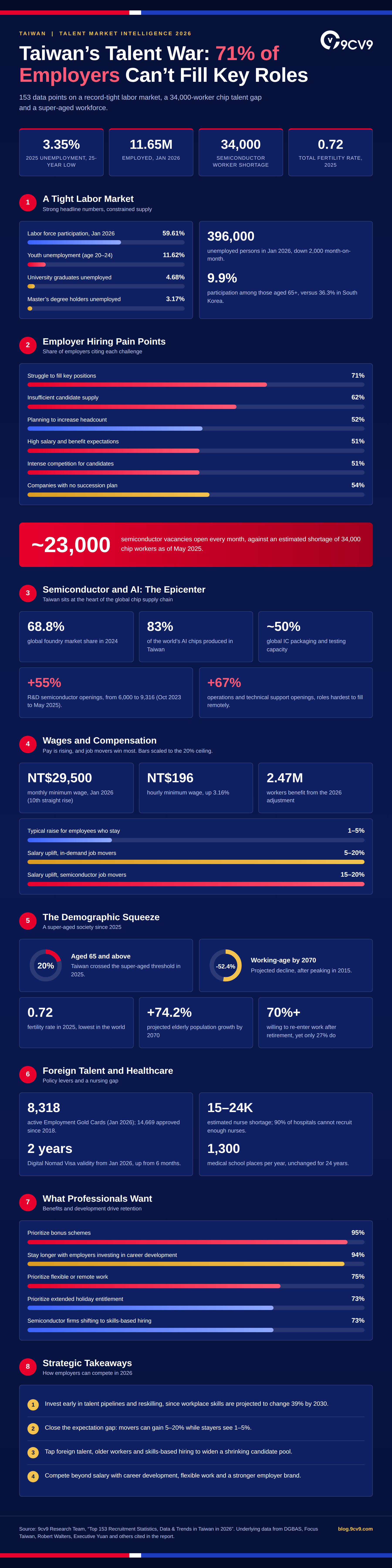
Compensation is responding to these pressures. Taiwan raised its monthly minimum wage to NT$29,500 in January 2026, while professionals with in-demand skills can potentially secure salary increases of 5% to 20% when changing employers. Semiconductor professionals may command premiums of 15% to 20%, illustrating how aggressively companies are competing for scarce technical expertise.
The longer-term recruitment challenge is demographic. Taiwan became a super-aged society in 2025, with people aged 65 and above accounting for 20% of the population. Its working-age population has been declining since 2016, while the country’s total fertility rate fell to 0.72 in 2025. These trends are pushing employers and policymakers toward foreign talent recruitment, older-worker participation, skills-based hiring, automation and workforce reskilling.
These 153 Taiwan recruitment statistics, data points and trends for 2026 provide a detailed picture of how hiring is changing across the country. From unemployment and salaries to semiconductor recruitment, foreign professionals, healthcare shortages, workforce aging and employee expectations, the data highlights the opportunities and challenges shaping Taiwan’s recruitment market in 2026 and beyond.
Before we venture further into this article, we would like to share who we are and what we do.
About 9cv9
9cv9 is a business tech startup based in Singapore and in Asia, with a strong presence all over the world.
With over ten years of startup and business experience, and being highly involved in connecting with thousands of companies and startups, the 9cv9 team has access to some of the best talents in the world.
If your company needs recruitment and headhunting services to hire top-quality employees, you can use 9cv9 headhunting and recruitment services to hire top talents and candidates. Email us at hello@9cv9.com.
Top 153 Recruitment Statistics, Data & Trends in Taiwan in 2026
SECTION 1: LABOR MARKET OVERVIEW & UNEMPLOYMENT
1. Taiwan’s annual unemployment rate dropped to a 25-year low of 3.35% in 2025, reflecting a consistently tight labor market driven by strong export demand and technology sector expansion.
2. December 2025 marked the lowest December unemployment reading in 25 years at 3.30%, signaling that Taiwan’s year-end hiring activity remains robust compared to regional peers.
3. The seasonally adjusted unemployment rate edged slightly upward to 3.36% in January 2026, suggesting minor seasonal fluctuation rather than any meaningful deterioration in labor market conditions.
4. With 396,000 unemployed persons in January 2026 — down 2,000 month-on-month — Taiwan’s jobless pool continues to shrink, though structural mismatches in skills and geography persist.
5. Total employment reached 11.65 million in January 2026, a gain of 40,000 jobs, underscoring steady workforce absorption despite demographic headwinds from an aging population.
6. The full-year 2025 unemployed average of 403,000 — 3,000 fewer than 2024 — indicates gradual but meaningful improvement in employment absorption across Taiwan’s key industries.
7. October 2025 employment rose by 26,000 (+0.22%) year-over-year to 11,635,000, a modest but consistent gain that points to stable hiring conditions across manufacturing and services alike.
8. Youth unemployment (ages 20–24) stood at 11.62% in January 2026 — an improvement from 11.75% in December — though the rate remains over three times higher than the national average, highlighting ongoing youth employment challenges.
9. The November 2025 youth unemployment rate of 11.70% was the lowest in six months, suggesting that AI-sector internship programs and government job-matching initiatives may be gaining traction among young graduates.
10. Taiwan’s labor force participation rate of 59.61% in January 2026 remains relatively modest compared to Singapore (68%) and South Korea (63%), pointing to untapped potential — particularly among older workers and women.
11. Reaching a 36-year high of 59.43% in 2025, Taiwan’s labor force participation rate reflects the combined effect of delayed retirements, increased female workforce entry, and government incentives targeting inactive workers.
12. A September 2025 unemployment rate of 3.38% — the lowest September figure in 25 years — confirms that Taiwan’s economy continued to generate jobs at a pace outstripping new labor force entrants through mid-year.
13. The September 2025 peak in underemployment at 129,000 workers is a nuanced indicator: while headline unemployment falls, involuntary part-time work signals that some sectors are adjusting hours rather than headcount, particularly during seasonal transitions.
14. The 4.68% unemployment rate among university graduates versus 3.17% for master’s degree holders illustrates Taiwan’s persistent skills-education mismatch, where a 4-year degree alone may no longer guarantee labor market alignment with employer needs.
15. The 0.13 percentage point increase in female labor force participation to 51.95% in 2024 reflects incremental progress, though Taiwan’s female participation rate still trails developed economy benchmarks, suggesting room for policy-driven improvement.
16. A 66.4% labor force participation rate for workers aged 45–64 demonstrates that mid-career professionals remain economically active, but their engagement drops sharply after age 65, presenting a significant untapped reserve for an aging labor market.
17. Taiwan’s 9.9% labor force participation rate for those aged 65+ — far below South Korea’s 36.3% and Japan’s 25.6% — reveals a cultural and structural tendency toward early retirement that may become economically untenable as the dependency ratio climbs.
18. Taiwan’s average retirement age of 64.3 years, while close to statutory age, is lower than in comparable export-driven economies, raising questions about the long-term sustainability of pension systems under a shrinking contributor base.
19. The fact that only 49.2% of Taiwan’s 55–64 age group was active in the labor market in 2021 — compared to 78% in Japan — underscores how deeply embedded early retirement expectations are in Taiwanese workplace culture, a mindset increasingly at odds with demographic realities.
20. The finding that 98% of unemployed workers over 45 in Taiwan have no intention to return to work is a critical data point for policymakers, suggesting that financial incentives or flexible work models — rather than passive measures — are needed to re-engage this demographic.
SECTION 2: EMPLOYER HIRING INTENTIONS & TALENT CHALLENGES
21. The fact that 71% of Taiwanese employers struggle to fill key positions — especially at manager and senior manager levels — reflects a structural leadership talent shortage that cannot be solved by salary alone, requiring investment in succession planning and internal development.
22. With 52% of employers planning headcount increases in 2025, Taiwan’s hiring market is clearly in expansion mode, though the ability to execute those plans hinges on a talent supply that is not keeping pace with demand.
23. The 49% of employers who find hiring managers and senior managers most challenging reveals a mid-to-senior pipeline gap that is partly the result of insufficient succession planning and the reluctance of senior professionals to move roles in an uncertain economic environment.
24. The 33% of employers planning to maintain current headcount suggests that a significant portion of Taiwan’s business community is adopting a “wait and see” posture — likely monitoring global trade tensions and domestic cost pressures before committing to expansion.
25. The finding that 62% of employers cite insufficient candidate supply as their top hiring challenge confirms that Taiwan’s talent shortage is fundamentally a supply-side problem, making workforce development and international talent attraction critically urgent policy priorities.
26. With 51% of employers citing high salary and benefit expectations as a hiring barrier, Taiwan’s job market is shifting toward a candidate-driven dynamic — particularly in tech and semiconductor sectors where global firms compete for the same limited talent pool.
27. The 51% of employers experiencing intense competition for candidates reflects the convergence of AI-driven demand, post-pandemic reshoring, and Taiwan’s strategic role in global supply chains — all amplifying the war for talent simultaneously.
28. That 92% of employers plan to adapt hiring strategies — through learning and development, relaxed entry criteria, or specialist recruiters — signals a healthy level of pragmatism, though the effectiveness of these adaptations will depend on consistent execution over time.
29. Only 35% of professionals expressing confidence in the 2025 job market is a notably low figure given Taiwan’s low unemployment rate, suggesting that macroeconomic anxiety, wage stagnation relative to cost of living, and job security concerns dampen sentiment even in a tight labor market.
30. The 46% of professionals planning to explore new opportunities within six months indicates moderate but not exceptional mobility — a level of job-seeking activity that may constrain employer options if not matched with competitive offers and strong employer branding.
31. The 36% of professionals who do not plan to change jobs in 2025 points to a meaningful segment of the workforce that prioritizes stability — a cohort employers should engage through retention strategies rather than risk losing them to competitors later.
32. The alarming finding that 87% of companies face succession planning challenges, with 54% having no succession plan at all, exposes a significant organizational risk in Taiwan’s corporate sector — one that could compound the leadership shortage over the next decade.
33. The adoption of AI productivity tools by over 40% of Taiwan businesses is encouraging, but the true test lies in whether these tools translate into measurable hiring efficiency gains or merely add new layers of complexity to existing recruitment workflows.
34. The projected 39% change in workplace skills by 2030 is a clarion call for Taiwan’s education system and corporate L&D programs to accelerate curriculum reform and on-the-job training investment, or risk a widening skills gap.
35. The fact that 40% of employers say competitor behavior is the primary driver of workplace strategy change highlights a “follow the leader” dynamic that may prevent truly innovative talent strategies from emerging — favoring imitation over differentiation.
36. With 81.5% of Taiwanese workers either actively job hunting or considering a career switch, employers face an invisible but significant retention risk, making proactive engagement, meaningful work, and visible career progression more important than ever.
37. The top driver of job-change consideration being low satisfaction (35.06%) — rather than compensation alone — suggests that Taiwan’s employers must address workplace culture and meaningful engagement to retain talent, not just offer higher salaries.
38. The 94% of employees more likely to stay with employers that invest in career development is one of the clearest signals in Taiwan’s hiring data: structured learning pathways and internal mobility programs may be the single most cost-effective retention tool available.
SECTION 3: WAGES, COMPENSATION & SALARY TRENDS
39. Taiwan’s 10th consecutive minimum wage increase — to NT$29,500/month effective January 2026 — reflects a sustained policy commitment to lifting the earnings floor, though critics note that wage growth in the broader economy has not always kept pace with productivity gains.
40. The 3.16% rise in the hourly minimum wage to NT$196 is modest relative to inflation in prior years but provides measurable relief to Taiwan’s estimated 729,800 hourly-paid workers, particularly those in retail, hospitality, and part-time service roles.
41. The fact that 2.47 million workers — representing roughly one-fifth of Taiwan’s employed population — benefit from the 2026 minimum wage adjustment underscores just how broad and consequential this annual policy lever is for household income levels.
42. Of the 2.47 million beneficiaries, the majority (1.74 million) are monthly-wage earners, meaning the 2026 increase primarily supports Taiwan’s formal full-time workforce rather than gig or contract workers who may fall outside the wage floor’s reach.
43. A 47.4% cumulative increase in Taiwan’s monthly minimum wage since 2016 is a meaningful achievement in nominal terms, though purchasing power gains are moderated when adjusted for cumulative inflation over the same decade.
44. The 63.3% rise in the hourly minimum wage since 2016 outpaces the monthly equivalent increase, reflecting Taiwan’s deliberate policy to reduce exploitation of part-time and hourly workers — a segment historically more vulnerable to wage depression.
45. The near-universal employer commitment to raises (89%), with 74% planning increases of 1–5%, suggests that salary adjustments in Taiwan in 2025 are broadly positive but largely incremental — unlikely on their own to close the gap with global tech compensation benchmarks.
46. The 5–20% salary premium available to job movers with in-demand skills versus the 1–5% raise for those who stay creates a strong financial incentive for talent mobility in Taiwan — a dynamic employers must counteract with meaningful retention packages.
47. The divergence between what employers plan to offer (below 10%) and what 67% of employees expect to receive underlines a persistent expectations gap that, if unaddressed, could fuel higher voluntary turnover — particularly among mid-career professionals.
48. The 15–20% salary uplift available to semiconductor job movers in Taiwan is among the highest of any industry in the region, directly reflecting the globally critical nature of Taiwan’s chip ecosystem and the fierce competition for experienced engineers.
49. The 10–20% salary increase available to tech professionals who switch jobs reinforces Taiwan’s candidate-driven tech market, where employers must offer meaningful financial incentives or risk losing talent to larger multinationals or overseas opportunities.
50. The 81% of tech companies planning raises in 2025 signals that salary investment remains a primary retention strategy in the industry, though companies increasingly recognize that compensation alone is insufficient to attract or retain top technical talent.
51. The NT$1.78 million median annual salary for analog IC design engineers — the highest non-managerial semiconductor wage — reflects the global scarcity of this highly specialized expertise and Taiwan’s central role as a battleground for rare engineering talent.
52. Digital IC design engineers’ median salary of NT$1.57 million places them among the best-compensated non-managerial roles in Taiwan, yet still below software engineering benchmarks in the US, raising questions about long-term talent retention at a global scale.
53. The NT$70,000–NT$180,000 monthly salary range for AI and software roles in Taiwan is competitive domestically but represents only a fraction of equivalent compensation in Silicon Valley or Singapore, posing a structural challenge in attracting overseas Taiwanese engineers home.
54. Electronics sector wages now exceeding the national average by 70% — up from 35% five years ago — is a double-edged signal: it confirms the sector’s value creation but also highlights deepening wage inequality between tech workers and the broader service-sector workforce.
55. Labor’s declining share of GDP — from ~50% in the 1990s to ~44% today — is a structural trend suggesting that Taiwan’s economic growth has increasingly benefited capital and corporations over workers, a disparity that fuels dissatisfaction and political pressure for higher minimum wages.
56. The NT$160,000 per month income threshold for the Employment Gold Card’s income track is a deliberately high bar that targets exceptional international talent rather than general skilled migration — a focused, elite-tier approach with trade-offs in overall foreign talent volume.
SECTION 4: SEMICONDUCTOR & TECH SECTOR HIRING
57. A labor shortage of 34,000 workers in Taiwan’s semiconductor sector as of May 2025 is not merely a corporate inconvenience — it represents a national security and economic competitiveness risk, given the industry’s role in powering global AI infrastructure.
58. The ~23,000 monthly semiconductor job openings in Taiwan create one of the world’s most consistently active technical hiring markets, making it a critical benchmark sector for both domestic HR professionals and global talent acquisition strategies.
59. The near-doubling of production and quality control job openings — from 5,600 to ~10,000 between October 2023 and May 2025 — signals that Taiwan’s chip sector expansion is not only at the R&D level but is scaling operational capacity rapidly.
60. The 55% surge in R&D semiconductor openings (6,000 to 9,316) between 2023 and 2025 reflects Taiwan’s strategic push to move up the value chain in AI chip design and advanced packaging — roles that demand rare combinations of theoretical and applied expertise.
61. The 67% jump in operations and technical support openings in the semiconductor sector is especially significant because these roles are hardest to fill remotely, requiring physical presence and specialized hands-on skills that cannot easily be sourced from abroad.
62. Taiwan’s 68.8% share of the global foundry market in 2024 makes it the single most critical node in the world’s semiconductor supply chain, which in turn explains why talent acquisition in this sector attracts global attention and geopolitical scrutiny.
63. Holding nearly 50% of global IC packaging and testing capacity, Taiwan controls an often-overlooked but indispensable segment of the chip supply chain — one that demands significant blue-collar and technician hiring alongside the more publicized engineer recruitment.
64. Taiwan’s production of 83% of the world’s AI chips makes talent acquisition in the sector a matter of global economic relevance — any disruption to the talent pipeline has downstream consequences for AI development timelines worldwide.
65. TSMC’s 50% share of the global foundry market means its hiring activity alone moves Taiwan’s labor market measurably, with ripple effects on wages, talent mobility, and training program enrollment across the island.
66. The fact that Taiwan manufactures over 90% of the world’s advanced AI chips as of 2026 positions the island as irreplaceable in the global AI race — but also makes its talent shortage an internationally shared problem that no single policy can solve in isolation.
67. The juxtaposition of IC output tripling while Taiwan’s birth rate declined by 20% between 2010 and 2024 encapsulates the central dilemma of Taiwan’s talent market: an industry expanding faster than the domestic workforce can support, making immigration reform not optional but essential.
68. The projected 35,000 new annual job openings in smart machinery, IC design, and AI industries between 2024 and 2026 will require Taiwan to tap into foreign talent pipelines, accelerate graduate education, or accept that some positions will remain unfilled — each with distinct consequences.
69. The projected $3.45 billion data center market by 2029 will generate significant demand for infrastructure engineers, operations specialists, and cybersecurity professionals — roles that Taiwan’s current talent ecosystem is not yet fully equipped to supply at scale.
70. The NT$11.6 billion government technology investment starting 2025 reflects the state’s recognition that market forces alone cannot build the talent and infrastructure needed for Taiwan to maintain its technological edge in an increasingly competitive global environment.
71. The 65%+ of tech professionals actively looking for new opportunities signals an unusually fluid tech labor market — one where employee loyalty is low, competitive poaching is high, and employer branding has become as important as salary in talent retention.
72. The paradox of electronics manufacturing contributing 15% of GDP while employing only 6.5% of workers speaks to the extraordinary capital and technology intensity of Taiwan’s chip industry — a reality that limits its role as a broad employment engine despite its economic dominance.
73. Taiwan’s 8.21% real GDP growth in Q3 2025 — among the fastest in developed Asia — was almost entirely AI-export-driven, illustrating how concentrated Taiwan’s economic fortunes have become around a single industry cluster and its associated talent pool.
74. October 2025’s 49.7% export surge — the largest monthly increase in 15 years — directly correlates with accelerated hiring in logistics, operations, and export-facing roles, demonstrating how macroeconomic momentum translates into ground-level recruitment activity.
SECTION 5: MACROECONOMIC CONTEXT FOR HIRING
75. Taiwan’s upward-revised GDP growth forecast of 4.45% for 2025 provides a favorable macroeconomic backdrop for hiring, though the concentration of growth in the semiconductor sector means not all industries benefit equally from the headline optimism.
76. The IMF’s 3.7% GDP growth estimate for Taiwan in 2025 — lower than DGBAS’s own figure — reflects differing methodological approaches and serves as a useful reminder that economic forecasts are directional guides, not precise hiring blueprints.
77. Taiwan’s nominal GDP of $884.39 billion in 2025 cements its status as one of Asia’s largest economies, providing the economic mass to sustain competitive compensation packages even as global wage pressures mount from the US, Japan, and South Korea.
78. The projected GDP growth moderation to 2.81% in 2026, combined with cooling inflation at 1.64%, suggests a soft-landing scenario where hiring activity continues but at a measured pace — favorable for sustainable workforce planning over reactionary boom-and-bust cycles.
79. CPI inflation averaging 1.76% in 2025 — below the 2% alert threshold — provides employers with relative cost stability, enabling multi-year compensation planning without the inflationary pressure that has complicated talent strategies in markets like the US and Europe.
80. SMEs providing 80% of all employment in Taiwan is a foundational fact for understanding the island’s hiring market: policies targeting large tech firms have important symbolic value, but it is SME talent dynamics that determine outcomes for the majority of Taiwanese workers.
81. The service sector’s 73% share of Taiwan’s GDP contrasts sharply with the outsized global visibility of the manufacturing sector, suggesting that service-industry hiring — in finance, healthcare, retail, and logistics — deserves far more research and policy attention than it typically receives.
SECTION 6: DEMOGRAPHIC TRENDS & AGING WORKFORCE
82. Taiwan officially becoming a super-aged society in 2025 — with 20% of the population aged 65+ — is the single most consequential long-term force shaping the island’s labor market, and its effects on workforce size, healthcare demand, and pension sustainability will intensify each decade.
83. Taiwan’s extraordinarily rapid aging transition — from aged to super-aged in just 7 years — gives policymakers far less adaptation time than Japan or Germany had, demanding immediate rather than gradual responses to workforce shortages and care infrastructure needs.
84. The widening dependency ratio projected for 2026–2027 means that fewer working-age Taiwanese will be supporting more elderly dependents — a structural shift that increases labor market pressure on every working individual and every employer funding social insurance contributions.
85. The working-age population having peaked in 2015 and declining since 2016 means that Taiwan entered a period of structural labor supply contraction nearly a decade ago — a trend now becoming acutely visible in the daily experience of recruiters struggling to fill roles.
86. The projected 52.4% decline in Taiwan’s working-age population by 2070 represents one of the steepest demographic contractions ever modeled for any developed economy — a generational challenge that no single policy intervention can fully reverse.
87. The projected 74.2% increase in Taiwan’s elderly population by 2070 will dramatically expand demand for healthcare, long-term care, and geriatric services — sectors that are already understaffed today and will require massive, sustained workforce investment.
88. Taiwan’s total fertility rate of 0.72 in 2025 — the lowest of any country globally — is both an economic and sociological alarm signal, pointing to deep structural issues around housing costs, work-life balance, gender equality, and social expectations that cannot be addressed through financial incentives alone.
89. A 10% smaller working-age population by 2030 and a 50% reduction by 2065 paints a sobering long-term picture for Taiwan’s labor market, making immigration reform, elder workforce retention, and automation investment not aspirational priorities but existential necessities.
90. The finding that 70%+ of currently employed Taiwanese are willing to re-enter the workforce after retirement is a positive reservoir of latent labor supply — but converting expressed willingness into actual workforce re-entry requires flexible arrangements, age-friendly cultures, and proactive outreach from employers.
91. The stark gap between the 70%+ who say they would re-enter the workforce post-retirement and the 27% who actually do so suggests that systemic barriers — ageism, lack of part-time options, health concerns, and caregiver responsibilities — are frustrating the stated intentions of a large potential workforce.
92. The fact that over 51% of respondents identify age-related stereotypes as the primary barrier to an ageless workforce reveals that ageism is not just a cultural nuance in Taiwan — it is a measurable, evidence-backed obstacle with real economic costs in a shrinking labor market.
93. Taiwan’s gradual increase of the Labor Insurance pension eligibility age to 65 by 2026 is a structurally sound but socially sensitive reform: it extends the working life of millions, but requires complementary policies around workplace ergonomics, health support, and reskilling to be genuinely effective.
SECTION 7: FOREIGN TALENT ATTRACTION & VISA POLICIES
94. The 8,318 active Employment Gold Cards as of January 2026 represents a meaningful but still modest international talent base for an economy of Taiwan’s scale — suggesting the Gold Card program, while innovative, has not yet achieved mass adoption among the global professional community.
95. The cumulative 14,669 Gold Cards approved since 2018 demonstrates steady program growth, though the pace of approvals accelerating post-COVID reflects both renewed interest in Taiwan and the government’s progressive loosening of eligibility criteria.
96. The finance sector’s 46% share of active Gold Card holders reveals a concentration risk in the program’s appeal — suggesting that Gold Card marketing and outreach efforts for technology, healthcare, and green energy professionals may need to be intensified to diversify the foreign talent mix.
97. The United States as the top country of origin for Gold Card holders with nearly 3,000 cardholders reflects Taiwan’s deep cultural and professional connections with the American diaspora — a reservoir the government has actively cultivated through targeted recruitment events in Silicon Valley and New York.
98. Removing the two-year work experience requirement for graduates of the world’s top 1,500 universities significantly broadens the Gold Card’s appeal to early-career international talent — a pragmatic recognition that pedigree alone can signal ability when work history is limited.
99. The tiered permanent residency pathway introduced in 2026 — ranging from 2 years for PhD holders to 4 years for undergraduates — creates a graduated incentive structure designed to attract the highest-qualified international graduates while maintaining a manageable integration timeline.
100. Automatic pension enrollment for foreign workers without requiring permanent residency is a meaningful quality-of-life improvement that removes a long-standing deterrent for mid-career professionals considering Taiwan — addressing a genuine financial concern that previously made long-term commitment less appealing.
101. Taiwan’s Digital Nomad Visa launched in January 2025 positions the island competitively within a global market of over 35 million remote workers — though its initial 6-month validity limited its attractiveness compared to longer-duration alternatives offered by Portugal, Indonesia, and Estonia.
102. Extending the Digital Nomad Visa to 2 years effective January 2026 substantially improves Taiwan’s competitiveness in the digital nomad market, making it a more viable long-term base for remote professionals who require planning certainty beyond short-stay horizons.
103. The US$40,000 annual income requirement for Digital Nomad Visa applicants aged 30+ is designed to attract economically self-sufficient remote workers, though it may inadvertently exclude talented professionals from lower-income countries who could meaningfully contribute to Taiwan’s innovation ecosystem.
104. The lower US$20,000 threshold for ages 20–29 reflects a deliberate policy to welcome younger remote workers — potentially a pathway to future permanent residents who develop affinity for Taiwan early in their careers.
105. Taiwan’s ambition to capture 10% of the global digital nomad market is audacious given competition from established nomad hubs in Southeast Asia and Europe, but Taiwan’s safety, infrastructure quality, and cost of living offer genuine competitive advantages that could support this goal if marketed effectively.
106. The target of facilitating 400,000 remote workers by 2032 would represent a transformative influx of spending power and talent into Taiwan’s economy — equivalent to adding roughly 3% to the total workforce — making the Digital Nomad Visa one of the most ambitious labor policy experiments in the region.
107. Expanding the Employment Gold Card’s eligible fields in 2026 to include healthcare, environmental science, and biotechnology reflects a strategic awareness that Taiwan’s talent needs extend well beyond semiconductors — broadening the program’s appeal to professionals in fields central to Taiwan’s sustainable development goals.
108. The addition of approximately NT$1 million in scholarships for foreign students in semiconductor and AI studies is a targeted investment in the most critical talent pipeline, though the scale remains modest relative to the 34,000-worker shortage already documented in the semiconductor sector.
109. The Employer of Record model’s growing applicability in Taiwan lowers the entry barrier for multinational firms wishing to hire Taiwanese talent without local entity setup — a pragmatic solution that benefits both foreign employers seeking access and local professionals seeking global career opportunities.
110. The 1–3 day EOR hiring timeline in Taiwan compared to weeks for company incorporation is a compelling argument for using service providers as a talent access strategy — particularly for fast-moving tech companies that cannot afford lengthy administrative delays in competitive hiring races.
SECTION 8: HEALTHCARE WORKFORCE HIRING
111. An estimated nurse shortage of 15,000–24,000 in Taiwan is a public health issue as much as a labor market one — understaffed hospitals directly affect patient outcomes, staff burnout, and the long-term attractiveness of nursing as a career choice for the next generation.
112. The NT$18 billion annual commitment over seven years to add 67,000 nurses by 2030 is Taiwan’s most ambitious healthcare workforce investment to date, though success will depend on whether improved pay and working conditions can reverse the persistent image problem nursing faces among school-leavers.
113. The finding that 90% of hospitals cannot recruit sufficient nurses — with 7.2% of positions vacant on average — illustrates a systemic failure of supply that predates COVID-19 and will not be resolved by wage increases alone without addressing shift culture, career progression, and workload management.
114. The government-set cap of 1,300 medical school places per year — unchanged for 24 years — stands in stark contrast to Taiwan’s rapidly aging population and expanding healthcare needs, representing a policy inertia that experts increasingly describe as a ticking time bomb.
115. The crossing of the 20% elderly population threshold in 2025 will drive a non-linear surge in healthcare demand — not a gradual increase — as the simultaneous aging of a large generational cohort creates acute pressure on outpatient, inpatient, and long-term care services.
116. Healthcare spending at approximately 6% of GDP — well below the OECD average of 15% — reflects a system historically celebrated for efficiency but increasingly stressed by demographic change; the gap suggests that Taiwan may face difficult choices about public health funding priorities in the near term.
117. The Long-Term Care 3.0 Plan’s introduction of community-based “10-minute care circles” represents a structural shift in how Taiwan delivers eldercare — one that will require a substantial and sustained increase in community care worker hiring, training, and wage support.
118. Healthcare employers in Taiwan increasingly valuing candidates willing to work cross-functionally — across clinical and commercial roles — reflects the growing complexity of the industry, where regulatory, data, and business skills are as valued as purely clinical credentials.
SECTION 9: PROFESSIONAL PREFERENCES & EMPLOYER BRANDING
119. The finding that 95% of professionals prioritize bonus schemes above all other benefits reveals that Taiwan’s workforce, while culturally influenced by stability preferences, is highly responsive to variable performance-linked compensation — a dynamic employers can leverage strategically to align individual incentives with organizational goals.
120. With 75% of professionals prioritizing flexible or remote work, Taiwan’s hiring market has clearly passed the point where remote work is a “perk” — it is now a baseline expectation, particularly among tech professionals who have multiple global options and no geographic obligation to commute.
121. The 73% who prioritize extended holiday entitlement reflects a growing work-life balance consciousness in Taiwan’s workforce — a cultural shift with implications for how employers structure offers, particularly as younger workers increasingly reject the “overtime culture” historically normalized in Taiwanese corporate life.
122. Taiwan’s net zero emissions target for 2050 is generating measurable, immediate hiring demand in green energy and sustainability roles — a trend that will accelerate as regulatory requirements force companies across all industries to build in-house ESG and environmental compliance capabilities.
123. The concurrent demand for AI specialists and cybersecurity experts reflects the paradox of digital transformation: every efficiency gained through automation introduces new vulnerabilities, creating a two-sided talent demand that challenges organizations to build both offensive and defensive technology capabilities simultaneously.
124. The rising trend of cross-industry movement and the return of overseas Taiwanese professionals signals that talent mobility is becoming a two-way street — a healthy dynamic that enriches domestic organizations with diverse perspectives, though it requires employers to adapt onboarding and cultural integration strategies.
125. The embrace of the career lattice over the traditional career ladder among Taiwanese professionals is a generational shift with profound implications for job design, internal mobility programs, and performance management systems — employers who still structure careers as linear promotions may find themselves at a growing disadvantage in attraction and retention.
126. The perception by 60% of senior executives that semiconductor companies have weak employer brands — despite offering the highest salaries — illustrates that prestige and compensation alone cannot substitute for compelling narratives around purpose, innovation, and work culture in a generation that increasingly demands both.
127. The shift to skills-based hiring by 73% of semiconductor companies is a practical response to credential scarcity, but it also represents an ideological evolution — acknowledging that what someone can do matters more than where they studied, opening doors to a wider and more diverse talent pool.
SECTION 10: RECRUITMENT INDUSTRY & AGENCIES
128. Adecco’s 4.5% global revenue growth in 2025 with strong Asia-Pacific performance reflects the sustained commercial viability of staffing services in Taiwan’s tight talent market — where the complexity of sourcing specialized candidates increasingly justifies the cost of professional recruitment support.
129. Adecco APAC’s 4.7% EBITA margin demonstrates that Taiwan’s staffing sector is operationally disciplined and financially sustainable — important context for companies evaluating whether to invest in retained search relationships rather than relying solely on in-house recruitment.
130. PERSOLKELLY’s near-100% contract hire retention through the first six months in APAC suggests that quality-of-match — not just speed-of-placement — is where leading agencies differentiate themselves, a metric that companies should track and demand accountability for when engaging staffing partners.
131. PeopleSearch Taiwan’s eight consecutive Grade A ratings from the Taipei City Government is a rare, government-validated quality signal in an industry where differentiating agency quality can be opaque — providing employers and candidates a useful independent benchmark for agency selection.
132. HRnetGroup’s strong first-half 2025 financial performance reflects the broader macro confidence in Taiwan’s corporate hiring market, where businesses are willing to invest in external recruitment support as a signal of organizational growth ambition rather than treating it as a last resort.
SECTION 11: LABOR LAWS, COMPLIANCE & EMPLOYER OBLIGATIONS
133. The mandatory 6% employer pension contribution under Taiwan’s new pension system since 2005 is a non-negotiable cost of employment that HR teams must factor into total compensation planning — particularly when benchmarking against competitors in lower-cost or lower-contribution-rate markets.
134. The 2026 reform allowing parental leave to be taken on a daily basis — including joint access for both parents — is a meaningful flexibility enhancement that aligns Taiwan’s family leave policy more closely with progressive Nordic models, potentially improving talent attraction among dual-income professional households.
135. The NT$100,000 childbirth subsidy introduced in 2026 is part of a broader natalist policy suite, but evidence from countries like South Korea and Japan — where similar cash incentives had limited impact on fertility rates — suggests that structural barriers around housing, childcare, and career continuity are more decisive factors than one-time financial payments.
136. The 2026 prohibition on using sick leave taken within 10 days as grounds for adverse evaluation is a legally significant protection that strengthens worker rights, though its real-world impact will depend on enforcement culture — particularly in smaller SMEs where informal pressure can substitute for formal policy violations.
137. The 3-year (extendable) work permit for foreign professionals and up to 5 years for special professionals provides sufficient planning horizons for mid-career international hires, though the bureaucratic renewal process remains a friction point that some employers and workers cite as a deterrent to long-term commitment.
138. Taiwan’s Employment Services Act requirement for Ministry of Labor approval of foreign worker employment adds an administrative layer that, while designed to protect the domestic workforce, can delay time-sensitive hires in fast-moving sectors — a friction cost that 2026 reforms are partially designed to reduce.
SECTION 12: EDUCATION, SKILLS DEVELOPMENT & WORKFORCE PIPELINES
139. The NT$1 million scholarship enhancement for foreign students in semiconductor and AI fields is a targeted pipeline investment, but its impact will be felt most meaningfully 4–8 years from now — a timeline that underscores why long-term talent strategy cannot rely solely on near-term recruitment activity.
140. Taiwan’s model of TSMC and semiconductor firms co-developing curricula with universities is increasingly cited globally as best practice — a recognition that industry-academia partnerships, when structured around mutual accountability, produce graduates who are work-ready from day one rather than requiring lengthy on-the-job calibration.
141. Women representing only 17% of global semiconductor tech roles — with Taiwan’s industry reflecting a similar imbalance — is both a diversity challenge and a missed opportunity: expanding the talent pool by addressing gender barriers could meaningfully alleviate the sector’s documented shortages.
142. The global need for 1 million additional semiconductor workers by 2030, including over 200,000 engineers in Asia-Pacific alone, places Taiwan’s domestic talent shortage in an international context — making it clear that the competition for engineering talent is not a local problem but a geopolitical one.
143. Increases in labor force participation across all age groups in 2024 — including 0.86 percentage points for the 45–64 cohort — suggest that government and employer efforts to keep mid-career and older workers engaged are gradually yielding results, even if the magnitude remains modest.
144. The 39% projected change in workplace skills by 2030 demands that Taiwan’s corporate training budgets, university program designs, and vocational education frameworks treat reskilling as a permanent, iterative process rather than a one-time response to technological disruption.
SECTION 13: SECTOR-SPECIFIC SALARY & HIRING BENCHMARKS
145. The NT$70,000–NT$180,000 monthly salary range for AI and software engineers in Taiwan is domestically competitive but faces an inherent comparison problem: global platforms expose Taiwanese engineers daily to equivalent roles in the US or Singapore paying two to three times as much, making retention a persistent challenge.
146. The 18% withholding tax on Taiwan-sourced salary for non-resident workers staying under 90 days creates a financial disincentive for short-term international project work — a friction point that may discourage exactly the type of flexible, project-based foreign expertise Taiwan needs to complement its full-time workforce.
147. The 50% income tax reduction available to Gold Card holders on earnings above a threshold for the first three years is one of the most generous tax incentives among Asian talent attraction programs — a meaningful financial argument that Taiwan’s government should communicate more aggressively in international recruitment campaigns.
148. The persistent difficulty filling semiconductor operations and technical support roles due to shift work requirements reveals a quality-of-life dimension to the talent shortage that salary increases alone cannot solve — pointing to a need for innovative scheduling models, improved workplace environments, and stronger non-financial benefits.
149. Healthcare employers in Taiwan seeking cross-functional candidates who span clinical and commercial boundaries reflect the increasing complexity of medical device regulation and market access — a trend that will intensify as Taiwan aligns with evolving EU MDR standards and other international frameworks.
150. Taiwan’s NT$18 billion annual healthcare workforce investment — the most significant in the sector’s history — is a recognition by government that the nursing and medical workforce shortage is existential, not marginal; however, the true test is implementation fidelity over all seven years of the commitment, not just the policy announcement.
151. The OECD’s December 2025 warning of slowing global growth is a relevant counterpoint to Taiwan’s strong domestic hiring data — serving as a reminder that Taiwan’s export-dependent economy is not immune to external demand shocks, and that hiring plans should incorporate scenario planning for a potential deceleration in 2026.
152. The pairing of 8.21% Q3 2025 GDP growth with a 36.5% export surge confirms that Taiwan’s hiring optimism is firmly grounded in real economic momentum rather than sentiment alone — but also reinforces the concentration risk of an economy and labor market so closely tied to the fortunes of AI chip demand.
153. October 2025’s 14.6% import surge to US$39.2 billion signals that Taiwan’s businesses are investing heavily in capital equipment and materials — a leading indicator of continued capacity expansion and the sustained hiring of operations, logistics, procurement, and supply chain professionals in the months ahead.
Conclusion
Taiwan’s recruitment market in 2026 is defined by a striking combination of low unemployment, strong technology-driven economic growth and increasingly severe talent shortages. With unemployment falling to 3.35% in 2025 and employment reaching 11.65 million in January 2026, employers are recruiting from an already tight labor market where skilled candidates have considerable leverage.
The challenge is particularly acute in semiconductor, AI, software, healthcare and other specialized fields. Taiwan’s semiconductor industry alone faces a shortage of around 34,000 workers, while approximately 23,000 semiconductor vacancies emerge each month. Employers are responding through higher salaries, skills-based hiring, stronger learning and development programs, foreign talent recruitment and more competitive employee benefits.
Demographics will make these recruitment pressures increasingly structural rather than temporary. Taiwan became a super-aged society in 2025, its working-age population has been declining since 2016, and its total fertility rate reached just 0.72 in 2025. Attracting international professionals, retaining older workers, increasing workforce participation and improving productivity through technology will therefore become increasingly important parts of Taiwan’s talent strategy.
Employee expectations are changing at the same time. Competitive compensation remains important, but professionals are also placing greater value on career development, flexible work, additional leave and meaningful career mobility. Employers that rely primarily on salary without improving workplace experience, progression and employer branding may struggle to retain their strongest employees.
Ultimately, these 153 recruitment statistics, data points and trends show that Taiwan’s hiring market in 2026 offers substantial opportunities alongside significant workforce constraints. Organizations that invest early in talent pipelines, reskilling, retention, flexible employment and international recruitment will be better positioned to compete as Taiwan’s economy continues evolving around semiconductors, AI and other high-value industries.
If you find this article useful, why not share it with your hiring manager and C-level suite friends and also leave a nice comment below?
We, at the 9cv9 Research Team, strive to bring the latest and most meaningful data, guides, and statistics to your doorstep.
To get access to top-quality guides, click over to 9cv9 Blog.
To hire top talents using our modern AI-powered recruitment agency, find out more at 9cv9 Modern AI-Powered Recruitment Agency.
People Also Ask
What is the recruitment outlook in Taiwan in 2026?
Taiwan’s recruitment outlook remains competitive in 2026, driven by low unemployment, technology growth and persistent talent shortages. Employers face particular difficulty recruiting experienced professionals in semiconductor, AI, software and healthcare roles.
What is Taiwan’s unemployment rate in 2026?
Taiwan recorded a seasonally adjusted unemployment rate of 3.36% in January 2026. Its annual unemployment rate had fallen to a 25-year low of 3.35% in 2025, reflecting a tight labor market.
How many people are employed in Taiwan in 2026?
Total employment in Taiwan reached approximately 11.65 million people in January 2026, representing an increase of around 40,000 jobs and highlighting continued workforce absorption despite demographic pressures.
What is the youth unemployment rate in Taiwan?
Taiwan’s unemployment rate among people aged 20–24 stood at 11.62% in January 2026. Although lower than December’s 11.75%, youth unemployment remained more than three times the national unemployment rate.
What is Taiwan’s labor force participation rate in 2026?
Taiwan’s labor force participation rate reached 59.61% in January 2026. Increasing participation among women, older employees and previously inactive workers could help Taiwan address its growing labor shortages.
Are employers struggling to recruit workers in Taiwan?
Yes. Around 71% of Taiwanese employers report difficulty filling key positions. Manager and senior manager recruitment is particularly challenging, highlighting shortages of experienced leadership talent.
What percentage of Taiwan employers plan to increase hiring?
Around 52% of employers planned to increase headcount, while 33% expected to maintain their existing workforce. These hiring intentions add pressure to Taiwan’s already constrained candidate market.
What are the biggest recruitment challenges in Taiwan?
Insufficient candidate supply is a major challenge, cited by 62% of employers. High salary and benefit expectations and intense competition for candidates are each cited by 51% of employers.
Why is there a talent shortage in Taiwan?
Taiwan faces a shrinking working-age population alongside expanding demand from semiconductors, AI and other industries. Skills mismatches, population aging and low birth rates further restrict the available talent pool.
Which jobs are hardest to fill in Taiwan?
Management, semiconductor, AI, software, engineering, technical support and healthcare positions face significant recruitment pressure. Around 49% of employers identify managers and senior managers as particularly difficult to hire.
What is Taiwan’s minimum wage in 2026?
Taiwan’s monthly minimum wage increased to NT$29,500 in January 2026, marking its tenth consecutive annual increase. The hourly minimum wage also rose to NT$196.
How many workers benefit from Taiwan’s 2026 minimum wage increase?
Approximately 2.47 million workers benefit from Taiwan’s 2026 minimum wage adjustment. Around 1.74 million are monthly wage earners, while an estimated 729,800 are hourly paid workers.
How much are salaries increasing in Taiwan?
Around 89% of employers planned salary increases, with 74% expecting raises of 1%–5%. Professionals changing jobs with in-demand skills can potentially secure larger increases of around 5%–20%.
How much can semiconductor professionals earn by changing jobs in Taiwan?
Semiconductor professionals changing employers can potentially receive salary increases of 15%–20%. This premium reflects intense competition for experienced workers across Taiwan’s strategically important chip industry.
What are AI and software salaries in Taiwan?
AI and software professionals can earn approximately NT$70,000–NT$180,000 per month, depending on experience and specialization. Competition with overseas employers remains a significant retention challenge.
How serious is Taiwan’s semiconductor talent shortage?
Taiwan’s semiconductor sector faced an estimated shortage of 34,000 workers as of May 2025. The shortage affects R&D, manufacturing, quality control, operations and technical support positions.
How many semiconductor jobs are available in Taiwan?
Taiwan records approximately 23,000 semiconductor job openings per month. R&D openings increased sharply between 2023 and 2025, while production and quality-control vacancies also expanded substantially.
Why is semiconductor recruitment important in Taiwan?
Taiwan holds a dominant position in global semiconductor manufacturing and produces most of the world’s advanced AI chips. Maintaining a sufficient pipeline of engineers, technicians and operations specialists is therefore economically critical.
Is Taiwan’s aging population affecting recruitment?
Yes. Taiwan became a super-aged society in 2025, with people aged 65 and above accounting for 20% of the population. Population aging is shrinking labor supply while increasing demand for healthcare and eldercare workers.
Is Taiwan’s working-age population declining?
Yes. Taiwan’s working-age population peaked in 2015 and has been declining since 2016. It is projected to fall substantially over the coming decades, making labor supply a long-term recruitment challenge.
What is Taiwan’s fertility rate?
Taiwan’s total fertility rate stood at 0.72 in 2025. Persistently low fertility contributes to long-term workforce contraction and increases the importance of immigration, automation and greater workforce participation.
How is Taiwan attracting foreign professionals?
Taiwan is expanding initiatives such as the Employment Gold Card, permanent residency pathways, international student programs and the Digital Nomad Visa to attract skilled foreign professionals and address domestic talent shortages.
How many Taiwan Employment Gold Cards are active?
Taiwan had 8,318 active Employment Gold Cards as of January 2026. A cumulative 14,669 Gold Cards had been approved since the program launched in 2018.
What changed with Taiwan’s Digital Nomad Visa in 2026?
Taiwan extended its Digital Nomad Visa to two years from January 2026. The policy aims to make Taiwan a more attractive long-term destination for internationally mobile remote professionals.
Is Taiwan experiencing a healthcare worker shortage?
Yes. Taiwan faces an estimated shortage of 15,000–24,000 nurses. Around 90% of hospitals report difficulty recruiting enough nurses, with approximately 7.2% of nursing positions vacant on average.
What benefits do Taiwanese professionals value most?
Bonus schemes are prioritized by 95% of professionals, while 75% value flexible or remote work and 73% prioritize extended holiday entitlement. Benefits therefore play an important role in recruitment and retention.
How important is career development for employee retention in Taiwan?
Career development is highly important. Around 94% of employees are more likely to remain with employers that invest in their professional development, making learning and internal mobility valuable retention strategies.
Is skills-based hiring growing in Taiwan?
Yes. Around 73% of semiconductor companies have moved toward skills-based hiring. This approach can expand candidate pools by emphasizing demonstrated abilities rather than relying primarily on academic credentials.
How will AI affect recruitment and skills in Taiwan?
More than 40% of Taiwan businesses have adopted AI productivity tools, while workplace skills are projected to change by 39% by 2030. Employers will increasingly need continuous reskilling and updated recruitment criteria.
What are the biggest Taiwan recruitment trends for 2026?
Key trends include talent shortages, semiconductor and AI hiring, rising wages, skills-based recruitment, foreign talent attraction, workforce aging, flexible work, employee reskilling and stronger emphasis on retention and career development.
Sources
Focus TaiwanDirectorate-General of Budget, Accounting and StatisticsTrading EconomicsTaiwan NewsTaipei TimesCentral Bank of the Republic of ChinaJapan Institute for Labour Policy and TrainingOxford Institute of Population AgeingRobert WaltersEuropean Chamber of Commerce TaiwanStaffing Industry AnalystsNucampOverseas Community Affairs CouncilHuman Resources OnlineExecutive Yuan, R.O.C. Taiwan104 Job BankIndustrial Technology Research InstituteCNN BusinessAsia Lifestyle MagazineICEF MonitorWikipediaCommonWealth MagazineTaiwan Business TOPICSMinistry of FinanceWorldometerInternational Monetary FundAmCham TaiwanTaiwan BankerTaiwan Academy of Banking and FinanceBMC GeriatricsTaiwan Employment Gold CardNational Development CouncilEnvoy GlobalFragomenTaiwanderersHR AsiaEOS Global ExpansionAYP GroupFreaking NomadsTaiwan PanoramaSEMI9cv9 BlogTaiwan Immigrants’ Global News NetworkSourceability