Key Takeaways
- CRM software continues to experience rapid global growth, with market forecasts exceeding $100 billion and AI-powered CRM platforms becoming essential for sales, marketing, and customer service success.
- Artificial intelligence, automation, predictive analytics, and cloud CRM adoption are transforming customer relationship management, helping businesses improve productivity, forecasting accuracy, customer retention, and revenue growth.
- Organizations that successfully implement and fully adopt CRM systems achieve stronger ROI, higher lead conversion rates, lower customer acquisition costs, and a significant competitive advantage in an increasingly customer-centric digital economy.
CRM software helps businesses manage customer relationships, automate sales processes, and improve revenue growth through data-driven insights. The latest CRM statistics for 2026 reveal how organizations use artificial intelligence, cloud technology, and automation to increase customer retention, boost productivity, and gain a competitive advantage in an increasingly digital marketplace.
Customer Relationship Management (CRM) software has evolved from a simple contact database into one of the most important business technologies driving growth, customer retention, sales performance, and operational efficiency across industries. In 2026, CRM platforms sit at the center of modern business operations, helping organizations manage customer interactions, automate workflows, improve collaboration, leverage artificial intelligence, and generate actionable insights from vast amounts of customer data. Whether a company serves thousands of consumers, enterprise clients, or niche business segments, CRM systems have become the backbone of customer-centric strategies in an increasingly digital and competitive marketplace.


The global CRM industry continues to experience remarkable expansion, with market forecasts placing its value well above $80 billion in 2026 and projecting sustained double-digit growth for years to come. Businesses around the world are investing heavily in CRM technologies to streamline sales processes, enhance customer experiences, improve forecasting accuracy, reduce customer acquisition costs, and strengthen long-term relationships. As organizations generate more customer data than ever before, CRM software provides the structure, intelligence, and automation necessary to transform that information into measurable business outcomes.
The rapid rise of artificial intelligence has further accelerated CRM adoption and innovation. Modern CRM platforms are no longer limited to storing customer records or tracking sales opportunities. Today’s leading solutions integrate AI-powered capabilities such as predictive analytics, intelligent lead scoring, automated customer support, conversational assistants, sales forecasting, customer sentiment analysis, and personalized engagement recommendations. These advancements are fundamentally changing how businesses acquire, nurture, and retain customers, creating a new generation of intelligent CRM systems capable of delivering unprecedented levels of efficiency and personalization.

At the same time, customer expectations continue to rise. Consumers and business buyers alike expect seamless, personalized, and consistent experiences across multiple channels, including email, social media, websites, mobile applications, live chat, and customer support platforms. Organizations that fail to deliver these experiences risk losing customers to competitors that leverage CRM technology more effectively. This growing emphasis on customer experience has transformed CRM from a sales tool into a strategic business platform that touches nearly every department, including marketing, customer service, operations, finance, and executive leadership.
The CRM landscape in 2026 is also being shaped by several major trends. Cloud-based CRM solutions now dominate the market, allowing organizations to deploy powerful customer management systems without the infrastructure costs associated with traditional on-premise software. Mobile CRM adoption continues to grow as sales teams demand real-time access to customer information from anywhere. Low-code and no-code development platforms are enabling businesses to customize CRM workflows faster than ever before. Meanwhile, industry-specific CRM solutions are gaining popularity as organizations seek platforms tailored to their unique compliance requirements, operational processes, and customer engagement models.
Despite its widespread adoption, CRM remains an area filled with opportunities and challenges. While many organizations report significant gains in revenue, productivity, customer retention, and forecasting accuracy after implementing CRM systems, others struggle with user adoption, integration issues, data quality concerns, and underutilized features. Understanding the latest CRM statistics provides valuable insight into what separates successful implementations from failed initiatives and highlights where the industry is headed over the coming years.
For business leaders, sales professionals, marketers, customer service teams, technology decision-makers, investors, and software vendors, CRM statistics offer an important lens through which to evaluate market opportunities, benchmark performance, identify emerging trends, and make informed strategic decisions. Data-driven insights reveal how organizations are deploying CRM technology, which vendors are gaining market share, how artificial intelligence is influencing customer relationship management, and where businesses are achieving the greatest return on investment.
In this comprehensive guide, we have compiled 122 of the most important CRM software statistics, data points, and industry trends for 2026. These insights cover every major aspect of the CRM ecosystem, including market size, growth forecasts, regional adoption patterns, vendor market share, AI-powered CRM innovations, business impact metrics, mobile and cloud adoption, industry-specific usage trends, implementation challenges, customer retention outcomes, and future developments shaping the next generation of customer relationship management.
Whether you are evaluating CRM software for the first time, comparing leading vendors, planning a digital transformation initiative, optimizing an existing CRM deployment, or researching the future of customer engagement technology, these CRM statistics provide a data-backed overview of one of the fastest-growing and most influential software categories in the world. The numbers tell a compelling story: CRM is no longer simply a tool for managing contacts—it has become a mission-critical platform that enables organizations to compete, innovate, and grow in the age of data, automation, and artificial intelligence.
Let’s dive into the top 122 CRM software statistics, data points, and trends that define the CRM industry in 2026.
Top 122 CRM Software Statistics, Data & Trends in 2026
📊 MARKET SIZE & GROWTH
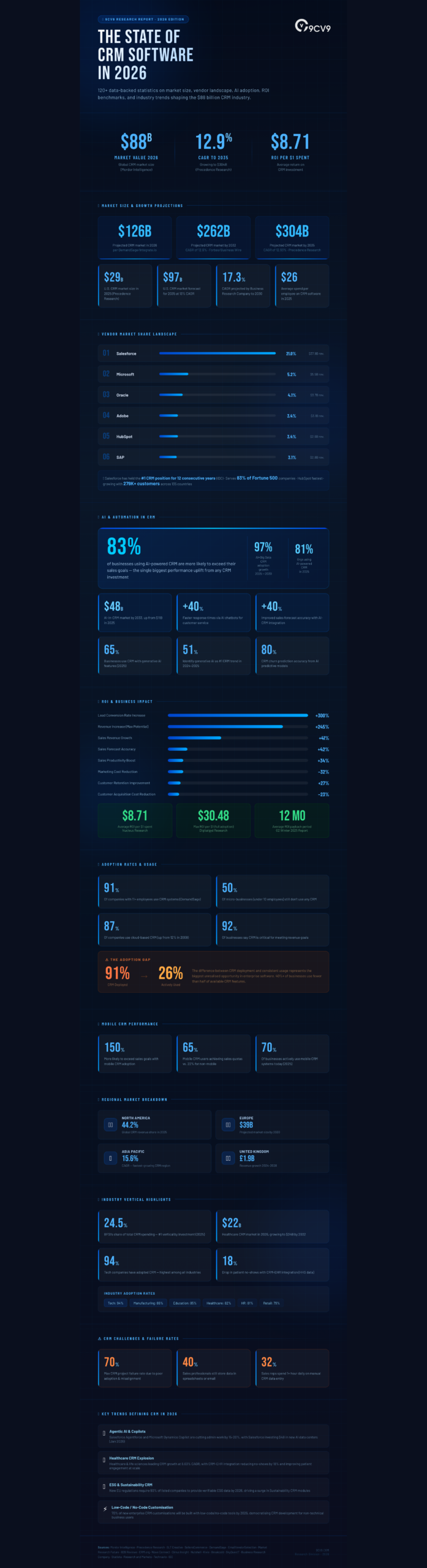
1. The global CRM market is valued at $87.96 billion in 2026, projected to reach $128.86 billion by 2031 at a CAGR of 7.93%.
The CRM software market’s steady expansion to nearly $88 billion in 2026 reflects its entrenchment as a core enterprise technology, with no signs of slowing as AI and cloud adoption accelerate.
2. The global CRM market was $90.10 billion in 2025 and is forecast to reach $304.03 billion by 2035 at a CAGR of 12.93%.
With the CRM industry on track to triple in size over the next decade, businesses that delay adoption risk falling behind competitors who are already harnessing data-driven customer engagement at scale.
3. The global CRM market is expected to reach $126.17 billion specifically in 2026 per some forecasts.
While estimates vary across research firms, consensus converges on CRM surpassing $100 billion in 2026—underscoring the software category’s irreplaceable role in modern revenue operations.
4. CRM software revenue is projected to grow from $75.1 billion in 2023 to $248.2 billion by 2033, at a CAGR of 12.7%.
A decade-long CAGR of 12.7% positions CRM as one of the fastest-growing enterprise software segments, outpacing legacy ERP and HR tech platforms in both investment and innovation velocity.
5. The CRM market is forecast to reach $262.74 billion by 2032, growing at a CAGR of 12.6% from its 2024 valuation of ~$101.4 billion.
Tripling in value within eight years, the CRM industry’s trajectory signals that managing customer relationships through intelligent software is now a non-negotiable business capability rather than a competitive differentiator.
6. The CRM software industry is projected to grow from $51.63 billion in 2025 to $153.35 billion by 2035, at a CAGR of 11.5%.
Consistent double-digit growth across multiple CRM market forecasts confirms that the industry’s momentum is structural, fueled by AI integration, cloud migration, and the global expansion of digital commerce.
7. The global CRM Software market is expected to reach $633.34 billion by 2030 at a CAGR of 17.3% (Business Research Company).
Some bullish projections place the CRM market at over half a trillion dollars by 2030, driven by the inclusion of adjacent CX, marketing automation, and AI-CRM platform revenues.
8. The U.S. CRM market was estimated at $28.44 billion in 2025, forecast to reach $96.63 billion by 2035 at a CAGR of 13.01%.
The United States remains the single largest CRM market globally, and its expected fourfold growth over the next decade reflects the country’s appetite for AI-powered, enterprise-grade customer intelligence platforms.
9. The average spend per employee in the CRM software market is projected at $26.36 in 2025.
Per-employee CRM spend is a useful benchmark for CFOs conducting software audits; at just over $26 per head, CRM remains one of the highest-ROI line items in the average technology budget.
10. The CRM market revenue is anticipated to grow at a CAGR of 12.40% between 2025 and 2034, reaching a market volume of $320.99 billion by 2034.
Sustained double-digit growth across a nine-year period speaks to the structural shift toward customer-centric operating models—CRM is no longer optional infrastructure but the backbone of revenue generation.
🌍 REGIONAL MARKET STATISTICS
11. North America generated 44.18% of global CRM market revenue in 2025, remaining the dominant regional market.
North America’s near-majority share of global CRM spending reflects the region’s early cloud adoption, dense SaaS ecosystems, and the concentration of major CRM vendors and enterprise buyers alike.
12. The Asia Pacific CRM market is the fastest-growing region, at a CAGR of 8.86% through 2031, driven by India’s cloud incentives and China’s local-data mandates.
Asia Pacific’s accelerating CRM adoption signals a major generational opportunity for global vendors willing to localise their solutions for the unique regulatory, linguistic, and commercial environments across the region.
13. Europe holds the second-largest CRM market share, projected to reach ~$39.2 billion by 2030.
European CRM growth is tempered by strict GDPR compliance requirements, but this regulatory discipline is simultaneously pushing vendors to build more privacy-respecting, data-sovereign CRM architectures.
14. The UK CRM market is forecast to increase to £1.9 billion between 2024 and 2028, reaching $8 billion by 2029 at a CAGR of 11.51%.
The UK’s robust CRM market growth, despite post-Brexit economic headwinds, underlines how deeply customer data management has become embedded in British commercial strategy.
15. North America currently leads with 31.70% CRM market share by some measures, generating the most CRM revenue globally.
North America’s commanding market position in CRM is reinforced by its culture of sales-tech investment, where companies treat CRM spend as a direct driver of revenue rather than an IT overhead.
16. The Asia-Pacific CRM market is anticipated to rise as the fastest-developing regional market, at a CAGR of 15.6% during the forecast period (SkyQuestT).
Asia-Pacific’s double-digit CRM growth rate—driven by booming e-commerce in Southeast Asia, India’s digital economy push, and China’s enterprise software maturation—presents the industry’s most dynamic expansion opportunity.
🏢 VENDOR MARKET SHARE
17. Salesforce holds approximately 21–23.9% of the global CRM market, retaining the #1 position for 12 consecutive years according to IDC.
Salesforce’s decade-plus dominance in CRM market share is a testament to its early cloud-first bet and continued reinvention through AI—though a steady erosion by challengers like Microsoft and HubSpot means it cannot rest on its laurels.
18. Salesforce earned more than $37.9 billion in total revenue for FY2025, ranking #1 in CRM across North America, Latin America, Western Europe, and Asia-Pacific.
Salesforce’s geographic revenue dominance across four continents highlights the difficulty any challenger faces in displacing an incumbent with such deep enterprise penetration, multi-year contracts, and a sprawling partner ecosystem.
19. Salesforce serves over 150,000 customers, with 83% of Fortune 500 companies as clients.
When 83% of the world’s largest companies rely on a single CRM vendor, that platform effectively becomes the de facto standard for enterprise customer engagement—creating enormous switching costs and long-term revenue lock-in.
20. Microsoft Dynamics 365 holds approximately 5.2% CRM market share, with 23% revenue growth in FY25 Q4 and 16% year-over-year growth reported in Q3 2025.
Microsoft’s rapid CRM revenue growth—fueled by deep Office 365 integration and the Copilot AI embedding—suggests the company is the most credible long-term challenger to Salesforce’s market leadership.
21. Oracle holds approximately 4.1% of the CRM market, with strength in enterprise CRM and database integration.
Oracle’s CRM share is modest relative to its broader enterprise software footprint, but its strength in regulated industries like financial services and telecommunications makes it a formidable player in high-value, complex deployments.
22. Adobe controls roughly 3.4% of the CRM market, with 13.7% CRM revenue growth in 2025—the fastest among the top five vendors.
Adobe’s fastest growth rate among top-five CRM vendors reflects the convergence of marketing, experience management, and CRM—a trend that is increasingly blurring the boundaries between creative tools and customer data platforms.
23. SAP holds about 3.1% of the CRM market, focusing on large enterprises but experiencing slower growth.
SAP’s slower CRM growth signals the challenge legacy ERP-centric vendors face when competing against nimble, cloud-native CRM specialists—a cautionary tale about the cost of delayed cloud transformation.
24. HubSpot has 3.4% market share with 248,000–279,000 paying customers across 120–135+ countries, with an annual revenue of $2.63 billion in 2024 (a 21.07% increase from 2023).
HubSpot’s extraordinary customer count growth—reaching nearly 280,000 paying customers—demonstrates the enormous untapped opportunity in the SMB and mid-market segments that enterprise-focused incumbents have historically underserved.
25. Salesforce’s valuation is approximately $274.9 billion, while HubSpot is valued at $35.84 billion and Zendesk at $10.2 billion.
The vast valuation gap between Salesforce and its closest peers reflects both its scale advantage and market belief in AI-powered CRM generating outsized future value—though it also means any acquisition of a major competitor would be extraordinarily costly.
26. Microsoft reported $70.1 billion Q3 2025 revenue, with Dynamics 365 up 16% year-over-year.
Dynamics 365’s consistent double-digit growth embedded within Microsoft’s broader cloud ecosystem suggests that CRM vendors with complementary productivity suites hold a structural bundling advantage over standalone CRM players.
27. SAP recorded 27% cloud revenue expansion to EUR 4.99 billion in Q1 2025.
SAP’s accelerating cloud revenue growth—even as its overall CRM share remains modest—indicates that the company’s transition from on-premise to cloud is gaining momentum, which could meaningfully shift the competitive landscape.
28. Salesforce committed $4 billion in January 2026 to expand data-center capacity across Europe, Japan, and Australia to support Agentforce and Einstein workloads.
Salesforce’s multi-billion-dollar data center investment underscores that AI-powered CRM workloads are computationally intensive at scale—and that the vendor is making a long-term infrastructure bet on agentic AI becoming central to customer engagement.
29. 178,168 companies use Zendesk globally, with 73,033 in the United States.
Zendesk’s large global customer base across 178,000+ companies demonstrates the breadth of the customer service CRM segment—an often underestimated portion of the broader CRM market distinct from sales-focused platforms.
🤖 AI & AUTOMATION IN CRM
30. The global AI in CRM market is projected to reach $11.04 billion in 2025, with expectations to grow to $48.4 billion by 2033.
The AI-in-CRM market’s fourfold expansion over eight years confirms that artificial intelligence is no longer a premium add-on but the foundational engine of next-generation customer relationship management platforms.
31. Businesses using AI within their CRM are 83% more likely to exceed sales goals due to AI’s support in lead scoring, predictive analytics, and personalised customer interactions.
An 83% performance uplift from AI-enabled CRM is a striking competitive differential—businesses without AI-integrated customer data strategies face a growing performance gap against their AI-equipped rivals.
32. 81% of organisations are predicted to use AI-powered CRM systems in 2025, with 79.1% of CRM users affirming AI’s importance in sales tools.
Near-universal AI integration in CRM within just a few years of generative AI going mainstream reflects how rapidly the technology has moved from experimental to mission-critical in commercial operations.
33. AI enhances sales forecast accuracy by over 40% and increases repeat sales and customer retention by 15% through hyper-personalisation and automation.
Improving forecast accuracy by 40% has enormous downstream financial implications—more accurate pipelines mean better resource allocation, fewer missed targets, and more confident go-to-market investments.
34. AI chatbots improve customer service response times by 40%, offering 24/7 support and proactive engagement.
A 40% improvement in response times through AI chatbots directly impacts customer satisfaction scores—and in service-driven industries, faster response is one of the most powerful levers for reducing churn.
35. 65% of businesses use CRM systems with generative AI, and those using it are 83% more likely to exceed sales goals.
The correlation between generative AI adoption in CRM and sales goal attainment is now well-documented, making AI-enabled CRM one of the most evidence-backed technology investments a sales organisation can make.
36. 51% of businesses identify generative AI (chatbots, predictive analytics) as the top CRM trend.
Generative AI’s emergence as the most-cited CRM trend reflects how quickly the technology has moved from a novelty to an indispensable commercial tool—reshaping how sales, marketing, and service teams operate.
37. AI and big data adoption in CRM is projected to increase by 97% between 2025 and 2030, driving smarter insights and automation.
A near-doubling of AI and big data usage in CRM over five years will effectively bifurcate the market between AI-native organisations with intelligent, predictive systems and laggards still relying on manual data entry.
38. 61% of sales leaders automated their CRM software in 2023, with automation aiding lead nurturing (57%), customer engagement (36%), and campaign reporting (28%).
CRM automation adoption across the majority of sales leaders reflects a broad recognition that human attention is best reserved for high-value interactions—not data entry, reporting, or routine follow-up sequences.
39. 61% of companies plan to integrate AI with their CRM systems in the next 3 years.
With nearly two-thirds of companies planning AI-CRM integration over the coming three years, the window for AI-enabled competitive advantage is closing—early movers have already seen measurable ROI benefits.
40. Organisations using AI-powered CRM solutions report 30–50% faster response times to customer inquiries.
Halving customer inquiry response times through AI has direct revenue implications in competitive markets where speed of service is a primary differentiator—particularly in financial services, e-commerce, and B2B tech.
41. Predictive models inside CRM systems forecast churn, next-best actions, and deal closure probability at accuracy levels topping 80%.
80%+ accuracy in churn prediction and deal closure forecasting transforms CRM from a historical record-keeping tool into a forward-looking intelligence platform capable of driving proactive, outcome-focused decisions.
42. Microsoft embedded Copilot into Dynamics 365, with early adopters citing 15–20% administrative savings.
A 15–20% reduction in administrative overhead from AI copilots in CRM directly translates to more selling time for reps—one of the most sought-after productivity gains in any sales organisation.
📈 ROI & BUSINESS IMPACT
43. CRM delivers an average ROI of $8.71 for every $1 spent (Nucleus Research).
An $8.71 return on every CRM dollar spent remains one of the strongest ROI cases in the enterprise software landscape—making a well-implemented CRM system one of the most defensible capital allocations a business can make.
44. Some studies place CRM ROI as high as $30.48 for every $1 spent under full adoption scenarios.
The range between $8.71 and $30.48 ROI reflects how dramatically implementation quality and user adoption influence outcomes—reinforcing that CRM is a people-and-process investment as much as a technology one.
45. The average ROI period for CRM is 12 months, with initial benefits often appearing within 90 days.
A 12-month ROI timeline makes CRM one of the faster-payback enterprise software investments—particularly notable given that ERP implementations often take years to demonstrate meaningful financial returns.
46. Businesses that use CRM see an increase of 41% in sales revenue and a 32% reduction in marketing costs.
The dual benefit of higher sales revenue and lower marketing costs makes a compelling financial case for CRM investment—essentially paying for itself twice over in improved top-line growth and reduced cost-per-acquisition.
47. CRM platforms can boost company revenue by up to 245%, with 45% of companies reporting increased sales revenue.
A potential 245% revenue uplift from CRM adoption, while dependent on full platform utilisation, underscores why CRM is increasingly treated as a strategic revenue asset rather than a tactical sales administration tool.
48. 91% of businesses report reduced customer acquisition costs (CAC) after implementing CRM, with 49% seeing an 11–20% decrease.
Near-universal CAC reduction post-CRM implementation is a powerful argument for adoption—particularly for growth-stage companies where customer acquisition efficiency directly determines path to profitability.
49. CRM use can boost lead conversions by up to 300%, dramatically improving sales results through consistent follow-up and sophisticated nurturing.
A 300% improvement in lead conversion is transformative at scale—tripling the value extracted from an existing lead generation budget without increasing acquisition spend.
50. Sales productivity gets a 34% boost from CRM adoption, as it automates administrative tasks and centralises customer data.
Freeing sales reps from administrative burden through CRM automation directly translates to more time in front of customers—where deals are actually won—making productivity gains one of the most measurable CRM benefits.
51. CRM data accessibility shortens sales cycles by 8–14%, as reps gain a 360-degree view of the customer for more intelligent conversations.
Compressing the sales cycle by up to 14% has a compounding effect on annual revenue—more deals closed in less time means higher quota attainment and improved capacity utilisation across the sales team.
52. CRM can increase sales forecasting accuracy by 32–42%, moving forecasting from an art to a data-driven science.
Accurate sales forecasting is among the most undervalued strategic capabilities in business—a 42% improvement in forecast accuracy allows leadership to make better hiring, inventory, and investment decisions.
53. Businesses using CRM see a 29% increase in sales, a 34% improvement in sales productivity, and a 42% increase in sales forecast accuracy (Salesforce).
Salesforce’s benchmark data painting a picture of 29% more sales, 34% higher productivity, and 42% better forecasting creates a compelling triple bottom line that few other software investments can rival.
54. CRM can reduce lead costs by up to 23%, improving marketing efficiency.
A 23% reduction in lead costs through better CRM-enabled segmentation, nurturing automation, and attribution means that every marketing dollar works harder—a critical advantage in performance-marketing environments.
55. Companies with total CRM adoption report a 30% hike in productivity rates.
The 30% productivity uplift associated with full CRM adoption contrasts sharply with the average 26% adoption rate across sectors—revealing that most organisations are leaving significant productivity gains on the table.
56. CRM implementation drives an average increase of 29% in sales revenue, a direct consequence of better lead management and more efficient processes.
Consistent 29% sales revenue improvement across multiple independent studies gives CRM one of the strongest evidence bases of any B2B software investment—a rare consensus in a field prone to vendor-inflated claims.
📱 MOBILE CRM
57. 70% of businesses use mobile CRM systems, which can improve productivity by 14.6%.
Mobile CRM adoption has become a baseline expectation rather than a premium feature—with nearly three-quarters of businesses relying on mobile access, vendors without strong mobile-first experiences face competitive disadvantage.
58. Businesses leveraging mobile CRM are 150% more likely to exceed sales goals.
A 150% improvement in sales goal attainment from mobile CRM usage is one of the most dramatic performance differentials in the CRM dataset—suggesting that accessibility and real-time data access are among the most powerful sales enablement factors.
59. Companies using mobile CRM are 65% more likely to achieve their sales quotas compared to 22% for non-mobile CRM users.
The stark quota attainment gap between mobile and non-mobile CRM users—65% versus 22%—makes the business case for mobile-first CRM deployment almost self-evident for field sales and distributed teams.
60. 48% of people access CRM using mobiles, while 45% use a tablet; 50% of teams improved productivity by using a mobile CRM.
The near-equal split between mobile and tablet CRM access reveals a workforce that increasingly demands flexible, device-agnostic customer data access—shaping product roadmaps toward responsive, cross-device interfaces.
61. 81% of CRM users access their system from multiple devices, ensuring convenience and seamless workflow.
Multi-device CRM access is now the norm rather than the exception—reinforcing the importance of synchronised, cloud-native architectures that provide consistent data experiences regardless of how or where a user connects.
☁️ CLOUD CRM
62. 87% of companies use cloud-based CRM platforms, up from just 12% in 2008.
The jump from 12% to 87% cloud CRM adoption over roughly 15 years represents one of the most complete technology migration stories in enterprise software history—effectively rendering on-premise CRM a niche choice for compliance-driven industries.
63. The cloud CRM segment held a 51% revenue share of the total CRM market in 2025 (Precedence Research).
Cloud CRM surpassing the majority of market revenue underscores that subscription-based, always-updated SaaS delivery has become the dominant commercial model in customer relationship management.
64. The cloud CRM app market share reached $34.5 billion by 2025.
The $34.5 billion cloud CRM market value reflects both the migration of existing on-premise deployments and entirely new adoption driven by cloud-native SMBs that would never have invested in legacy installed software.
65. 63% of businesses actively favour cloud CRM over on-premise alternatives.
Cloud CRM’s preference advantage stems from lower total cost of ownership, automatic updates, easier integrations, and the flexibility to scale without infrastructure investment—priorities that align with how modern finance and IT teams evaluate software.
66. On-premise CRM is primarily used by organisations with strict data control and regulatory requirements (healthcare, government, financial services).
On-premise CRM’s survival as a deployment model is largely regulatory rather than technological—the industries retaining it do so out of compliance obligation rather than performance preference, suggesting cloud will eventually dominate all verticals.
🏭 INDUSTRY VERTICALS
67. BFSI (Banking, Financial Services & Insurance) accounted for 24.48% of total CRM spending in 2025—the single largest vertical by investment.
BFSI’s dominance as the largest CRM spender reflects the sector’s high customer lifetime value, complex product portfolios, and regulatory requirements that demand meticulous interaction tracking across wealth management, insurance, and banking.
68. The Healthcare CRM market grew from $20.36 billion in 2025 to $22.04 billion in 2026, projected to reach $34.44 billion by 2032 at a CAGR of 7.79%.
Healthcare CRM’s steady billion-dollar growth reflects the sector’s belated but accelerating embrace of patient-centric relationship management—driven by value-based care models that reward proactive patient engagement over episodic treatment.
69. The global Healthcare CRM market is expected to grow from $20.06 billion in 2025 to $50.4 billion by 2035 at a CAGR of 8.73%.
Healthcare CRM’s projected growth to over $50 billion by 2035 signals that patient relationship management is becoming as strategically important as clinical outcomes measurement—reshaping how hospitals, payers, and pharma companies interact with patients.
70. Retail will hold 25% of the revenue share in the CRM market in 2025.
Retail’s 25% share of CRM revenue underscores how e-commerce proliferation and omnichannel customer expectations have made advanced customer data management a competitive survival tool for both online and brick-and-mortar retailers.
71. The retail industry has the highest CRM usage at 18% of companies using it (Zippia).
Retail’s leading CRM usage rate reflects the sector’s intense competition for customer loyalty—where personalised promotions, loyalty programmes, and purchase history data drive measurable differences in repeat purchase rates.
72. Adoption rates by sector show tech companies in the lead at 94%, followed by manufacturing (86%), education (85%), healthcare (82%), and HR (81%).
Technology sector firms’ near-universal CRM adoption is unsurprising given their data-first culture—but manufacturing’s 86% rate is the more telling statistic, showing how even capital-intensive industries now view customer data as a competitive asset.
73. CRM-integrated EHR deployments in healthcare were linked to an 18% drop in no-show rates (U.S. Dept. of Health & Human Services).
An 18% reduction in patient no-show rates through CRM-EHR integration has direct financial and clinical implications—reducing wasted appointment slots while improving continuity of care for patients with chronic conditions.
74. Healthcare and life sciences lead with an 8.63% CRM CAGR through 2031, integrating CRM with electronic health records for proactive patient engagement.
Healthcare’s leading CRM growth rate reflects a systemic transformation in how providers manage patient relationships—moving from reactive encounter-based records to proactive, longitudinal engagement platforms.
75. By end of 2026, 70% of new enterprise applications (including CRM customisations) will be built using low-code or no-code technologies.
Low-code and no-code CRM customisation is democratising access to sophisticated customer workflow automation—shifting power from IT departments to business users and dramatically shortening time-to-value for CRM projects.
👥 ADOPTION RATES
76. 91% of businesses with 11 or more employees use CRM systems, compared to 50% of those with 10 or fewer employees.
The adoption gap between larger and smaller businesses represents one of the industry’s most significant untapped markets—with approximately half of micro-businesses still unserved by CRM, despite proven ROI at all company sizes.
77. 94% of tech companies and 71% of small businesses rely on CRM systems.
Tech companies’ near-universal CRM adoption reflects a broader truth: organisations whose business model is built on software and data naturally gravitate toward software-driven customer management—and are outperforming less data-literate competitors as a result.
78. About 65% of businesses adopt a CRM system within their first five years.
Early CRM adoption within a company’s formative years correlates with stronger data hygiene, better sales discipline, and more structured customer engagement processes—creating compounding advantages that late adopters find difficult to replicate.
79. 92% of businesses believe CRM software is critical for meeting revenue goals.
With 92% of businesses acknowledging CRM’s centrality to revenue attainment, the software category has transcended the classification of “tool” to become strategic infrastructure—as fundamental as accounting or HR systems.
80. The average CRM adoption rate across sectors remains at 26% despite near-universal deployment—meaning most employees with CRM access don’t use it consistently.
The chasm between CRM deployment (91%) and consistent usage (26%) is perhaps the most important metric in the entire CRM industry—revealing that the software’s transformative potential is massively underrealised in most organisations.
81. The average CRM user adoption among sales professionals is 72%, with an average ROI period of 12 months (G2 Winter 2025).
Sales teams’ 72% CRM usage rate is meaningfully higher than the 26% cross-functional average—confirming that CRM delivers most value when treated as a sales tool rather than an enterprise-wide data repository.
82. Europe has a CRM adoption rate of 85.7%, 2% higher than the US at 83.6%.
Europe’s slight adoption edge over the US is counterintuitive given GDPR compliance costs, but may reflect how data protection mandates have inadvertently pushed organisations to systematise customer data through formal CRM platforms.
83. B2C companies account for over 60% of CRM users, with B2B companies close behind at 55%.
The near-parity between B2C and B2B CRM adoption debunks the myth that CRM is primarily a sales tool for complex B2B deal management—consumer-facing businesses increasingly rely on CRM for loyalty, personalisation, and retention.
84. 28% of millennials consider CRM implementation critical to business growth, compared to just 9% of baby boomers.
The generational gap in CRM adoption enthusiasm signals that as millennial and Gen Z leaders assume more decision-making authority, CRM investment rates will accelerate—particularly in small and medium enterprises.
⚠️ CHALLENGES & FAILURES
85. 20–70% of CRM projects fail to meet their goals, primarily due to poor user adoption as the leading cause.
The sobering 20–70% CRM failure rate is a stark reminder that technology selection is far less important than change management—organisations that invest equally in adoption strategy and implementation tend to dramatically outperform those that do not.
86. 50% of CRM projects fail due to lack of cross-functional coordination between sales and marketing departments.
Half of CRM failures rooted in cross-functional misalignment highlight the organisational challenge CRM creates: it requires sales, marketing, and service teams to agree on data definitions, processes, and accountability structures.
87. 17% of companies say lack of integration with other tools is a major CRM challenge; 7% say it is complicated to use.
Integration complexity remains one of CRM’s most persistent pain points—and the rise of API-first architectures and pre-built connectors is beginning to address it, though many legacy deployments still struggle with fragmented data ecosystems.
88. 32% of CRM users feel a lack of technical expertise is the biggest roadblock to effective CRM use.
Technical skill deficits constraining CRM value extraction make the case for no-code customisation tools, AI-assisted administration, and vendor-provided training programmes—all of which are becoming important product differentiators.
89. 23% of users cite manual data input as a major obstacle to CRM effectiveness.
Manual data entry as a top CRM frustration is increasingly being addressed by AI-powered data capture, conversation intelligence tools, and CRM automation—but until fully resolved, it remains a drag on adoption and data quality.
90. 40% of salespeople still use informal methods like spreadsheets and email programmes to store customer data.
The persistence of spreadsheet-based customer management among 40% of sales professionals represents both an adoption failure and an opportunity—organisations that successfully migrate these users to CRM unlock significant untapped productivity.
91. 22% of sales teams admit they are still unsure what CRM is or how to use it effectively, highlighting the need for better onboarding.
One in five sales team members not understanding their CRM tool is a failure of vendor onboarding, manager enablement, and organisational change management—and directly explains why average adoption rates remain well below deployment rates.
92. More than 40% of businesses use fewer than half of the available CRM features, limiting the system’s impact on productivity and outcomes.
Feature underutilisation in CRM is a universal challenge that reflects both software complexity and training gaps—vendors are increasingly responding with AI-guided feature discovery and role-specific interface streamlining.
93. 32% of sales reps spend more than 1 hour daily on manual data entry in their CRM.
Sales reps spending over an hour per day on CRM data entry represents a significant drag on revenue-generating activity—making the case for AI-powered auto-capture, conversation logging, and data enrichment tools that can reclaim this time.
94. 76% of customer service agents report high levels of burnout due to increased complexity of tier-2 issues that AI cannot yet solve.
Customer service agent burnout at 76% amid AI adoption is a cautionary tale: AI’s inability to handle complex emotional and situational service issues is pushing the hardest problems to human agents, increasing pressure rather than reducing it.
95. 20% of CRM users switched systems because they found their CRM not user-friendly; 30% found their CRM tools inefficient.
The one-in-five CRM switch rate driven by poor UX underscores that ease of use is as commercially important as functional depth—a lesson that benefits challengers like HubSpot who have built usability into their core product philosophy.
🔧 FEATURES & USAGE
96. Contact management is the #1 most-used CRM feature, followed by email tracking, sales pipeline management, and reporting.
The primacy of contact management as the most-used CRM feature reflects the foundational role of organised customer data—even the most sophisticated AI features cannot deliver value without clean, comprehensive contact records at their base.
97. 45% of CRM buyers rank automation capabilities as their most important feature requirement (Capterra).
Automation’s position as the top CRM feature priority among buyers confirms that the industry has moved beyond data management as the primary value proposition—most organisations now buy CRM specifically to eliminate repetitive work.
98. 36% of buyers prioritise integration with other tools as a key CRM selection criterion (Capterra).
Integration capability as a top-three selection criterion reflects the modern enterprise’s need for a connected technology stack—CRM in isolation delivers a fraction of the value it can provide when seamlessly connected to marketing, finance, and service platforms.
99. 82% of organisations rely on CRM for sales reporting and automation, improving efficiency and tracking.
CRM’s role as the primary sales reporting platform for 82% of organisations makes it the single source of truth for revenue intelligence—a status that gives CRM platforms extraordinary leverage in enterprise software consolidation decisions.
100. 74% of users say their CRM system gave them improved access to customer data.
Improved data access remains the most consistently reported CRM benefit across all company sizes and industries—confirming that centralising customer information in a single platform solves a universal pain point regardless of how sophisticated the implementation.
101. Sales teams spend 18% of their work time inside CRM applications (Cirrus Insight).
Sales reps devoting nearly one-fifth of their working hours to CRM interaction reflects both the platform’s centrality to daily workflow and the ongoing challenge of reducing administrative time in favour of customer-facing activities.
102. 80% of CRM users actively use features like AI chatbots, automated responses, and loyalty programmes.
80% active usage of AI-powered CRM features signals that these capabilities have crossed the chasm from early adopter novelty to mainstream expectation—and will increasingly be table-stakes for competitive CRM platform evaluations.
103. 54% of sales professionals use CRM to build stronger relationships with buyers.
More than half of sales professionals viewing CRM as a relationship-building tool rather than a reporting obligation reflects a maturation in CRM culture—and correlates with higher adoption rates and better business outcomes.
💰 ENTERPRISE SIZE & SMB
104. Large enterprises captured a revenue share of 62% of the CRM market in 2025.
Large enterprises’ 62% share of CRM revenue reflects both their greater software budgets and the complexity of their customer management needs—though SMB growth rates are outpacing enterprise, signalling a long-term market rebalancing.
105. SMEs are fuelling a 9.54% CAGR within their CRM segment, driven by freemium tiers, no-code builders, and government cloud credits.
SME CRM adoption’s acceleration through freemium and no-code entry points is creating a massive new customer base that legacy enterprise CRM vendors largely ignored—and which nimble challengers like HubSpot and Zoho are winning.
106. 84% of companies looking for CRM software have under 1,000 employees.
The overwhelming SMB majority among CRM buyers confirms that the market’s volume growth comes from smaller organisations—not Fortune 500 expansions—making affordability, simplicity, and speed-to-value critical vendor differentiators.
107. 71% of small businesses have adopted CRM systems, with 65% implementing within their first five years.
Small business CRM adoption reaching 71% signals that the technology is no longer seen as enterprise-exclusive infrastructure—modern freemium and SMB-focused CRM platforms have democratised access to tools previously available only to large organisations.
📊 CUSTOMER RETENTION & SATISFACTION
108. Businesses using CRM systems see about 27% higher customer retention rates.
A 27% retention improvement through CRM use has compounding long-term value—retained customers not only reduce replacement acquisition costs but also tend to generate higher lifetime value through repeat purchases and referrals.
109. 47% of CRM users report major improvements in customer satisfaction after adopting CRM systems.
Nearly half of all CRM users experiencing meaningful satisfaction improvements is a compelling adoption argument—particularly in service industries where customer satisfaction scores directly influence brand equity and revenue growth.
110. 75% of organisations say their retention strategies have become noticeably stronger after CRM adoption.
Three-quarters of organisations crediting CRM with strengthened retention strategies reflects the platform’s ability to surface at-risk customers early, personalise re-engagement campaigns, and systematise proactive outreach.
111. 79% of customers expect a consistent experience across all channels, which CRM platforms help unify.
Customer expectations of cross-channel consistency place CRM at the heart of omnichannel strategy—and businesses that fail to deliver a unified experience face disproportionate churn in an era where switching costs for consumers have never been lower.
112. Industries with high CRM-supported retention include Commercial Insurance (86%), Business Consulting (85%), and IT & Managed Services (83%).
The correlation between professional services industries and high retention rates reflects CRM’s particular effectiveness in relationship-intensive sectors where personalised, timely communication directly drives contract renewal decisions.
113. CRM users see a 17% increase in lead conversions, a 16% boost in customer retention, and a 21% rise in agent productivity (WebFX).
The triple simultaneous improvement in lead conversions, retention, and agent productivity that CRM delivers makes it genuinely unusual among enterprise software investments—most tools optimise one metric at the expense of others.
🔮 FUTURE TRENDS
114. By end of 2026, 90% of listed companies must provide verifiable ESG data under new EU regulations, leading to a surge in Sustainability CRM modules.
The mandated integration of ESG reporting into CRM platforms represents an entirely new use case for the technology—transforming CRM from a sales tool into a compliance infrastructure capable of tracking environmental and social impact.
115. The CRM analytics segment is growing at a significant CAGR between 2026 and 2035, outpacing the broader CRM market.
CRM analytics’ faster-than-average growth signals a shift from descriptive reporting to predictive intelligence—organisations are demanding not just what happened with their customers, but what will happen next.
116. AI-driven CRM solutions are projected to generate over $1.1 trillion in revenue (Salesforce estimate).
Salesforce’s $1.1 trillion revenue projection for AI-driven CRM underscores why every major enterprise software vendor is racing to embed AI capabilities—the economic prize of winning the AI-CRM market is extraordinary.
117. Integration, consulting, and managed-service demand is rising, pushing CRM services to a 9.52% CAGR as firms grapple with complex deployments.
The rising services CAGR in CRM reflects the growing complexity of enterprise deployments—particularly as AI agents, multi-cloud architectures, and cross-functional integrations require specialised expertise that most in-house teams lack.
118. Vertical-specific CRMs (healthcare, real estate, financial services) are growing fast, as businesses opt for pre-configured industry solutions over generic platforms.
Industry-specific CRM growth reflects a market maturation where businesses demand pre-built compliance templates, sector-specific workflows, and industry data models rather than building from generic platforms—compressing time-to-value significantly.
119. 32% of the CRM market is attributed to the customer support and service segment (Gartner), showing CRM’s utility beyond sales functions.
Customer service CRM’s substantial market share reveals that CRM investment is no longer the exclusive domain of sales teams—service, success, and support organisations are increasingly the primary drivers of platform adoption and expansion.
120. The CRM market revenue reached $48.7 billion in 2021, projected to grow at a CAGR of 14.2% from 2021 to 2028, confirming long-run structural growth.
CRM’s 14.2% CAGR from 2021—a year disrupted by pandemic-era digital acceleration—provides a reliable baseline for understanding the industry’s organic growth rate, stripped of one-time adoption spikes from remote work transitions.
121. 13% of businesses have made investing in a CRM system their number one sales goal for the year.
The prioritisation of CRM adoption as a top sales goal reflects growing board-level recognition that customer data infrastructure is a strategic asset—and that organisations without it are operationally handicapped compared to data-rich competitors.
122. The customer experience management (CXM) market is estimated to grow at a CAGR of 15.4% from 2023 to 2030, closely linked to CRM platform expansion.
CXM’s 15.4% growth rate—outpacing even the broader CRM market—signals that the definition of CRM is expanding to encompass the entire customer lifecycle, blurring boundaries with marketing automation, CDP, and service management platforms.
Conclusion
The CRM software industry in 2026 stands at a pivotal moment in its evolution. What began decades ago as a digital replacement for customer address books has transformed into one of the most strategically important technology categories in modern business. The 122 CRM statistics, data points, and trends explored throughout this report reveal an industry experiencing unprecedented growth, rapid innovation, and expanding influence across virtually every sector of the global economy.
The numbers tell a clear story. CRM is no longer viewed as a standalone sales tool or optional business application. Instead, it has become a mission-critical platform that drives customer acquisition, revenue generation, customer retention, operational efficiency, and long-term business growth. With global market forecasts projecting the CRM industry to exceed hundreds of billions of dollars in value over the coming decade, organizations across the world are making CRM investments a central component of their digital transformation strategies.
One of the most significant themes emerging from the data is the growing convergence of CRM and artificial intelligence. AI-powered features such as predictive analytics, intelligent lead scoring, automated customer support, sales forecasting, conversational assistants, and personalized engagement recommendations are rapidly becoming standard capabilities rather than premium add-ons. Businesses leveraging AI-enhanced CRM platforms consistently report stronger sales performance, higher productivity, faster response times, improved customer experiences, and more accurate forecasting. As AI capabilities continue to mature, CRM systems are evolving from systems of record into systems of intelligence capable of guiding strategic business decisions in real time.
The widespread adoption of cloud-based CRM solutions further highlights how customer relationship management has become more accessible than ever before. Organizations of all sizes—from startups and small businesses to multinational enterprises—can now deploy sophisticated CRM platforms without the significant infrastructure investments that were once required. Combined with the rise of mobile CRM, low-code development tools, and industry-specific solutions, businesses can tailor CRM implementations to their unique needs while accelerating time-to-value and reducing deployment complexity.
The statistics also demonstrate the remarkable financial impact that CRM systems can generate when implemented successfully. From higher sales revenue and improved lead conversion rates to stronger customer retention and lower acquisition costs, CRM consistently ranks among the highest-return technology investments available to modern organizations. Multiple studies continue to show that businesses that fully embrace CRM best practices often outperform competitors across nearly every major commercial metric.
However, the data also highlights an important reality: purchasing CRM software alone does not guarantee success. Many organizations still struggle with poor user adoption, data quality challenges, inadequate training, integration difficulties, and underutilized features. The gap between CRM deployment rates and actual user engagement remains one of the industry’s most significant challenges. Companies that invest equally in technology, change management, employee training, process optimization, and data governance are far more likely to achieve meaningful results than those that focus solely on software implementation.
Looking ahead, several trends appear poised to shape the future of CRM. Artificial intelligence will become deeply embedded into every stage of the customer lifecycle. Industry-specific CRM platforms will continue gaining market share as organizations seek specialized functionality and compliance support. Customer experience management, predictive analytics, automation, and omnichannel engagement will become increasingly interconnected. At the same time, growing regulatory requirements around privacy, data governance, and ESG reporting will push CRM vendors to develop more sophisticated compliance and reporting capabilities.
The competitive landscape will also continue to evolve. Established leaders such as Salesforce, Microsoft, Oracle, SAP, HubSpot, Adobe, and Zendesk are investing heavily in AI, cloud infrastructure, automation, and ecosystem expansion. Meanwhile, emerging vendors and niche providers are finding opportunities by addressing specific industries, company sizes, and use cases that larger platforms may not serve as effectively. This competition is ultimately benefiting customers through faster innovation, improved usability, and a broader range of deployment options.
For business leaders, sales executives, marketers, customer success teams, investors, and technology decision-makers, the message is clear: CRM software has become a foundational pillar of modern business operations. Organizations that effectively capture, organize, analyze, and act upon customer data are increasingly positioned to outperform those that rely on fragmented systems, manual processes, and disconnected customer experiences.
As customer expectations continue to rise and competition becomes more intense across virtually every market, CRM platforms will play an even greater role in helping businesses understand their customers, personalize interactions, automate workflows, and generate sustainable growth. The future of CRM is not simply about managing customer relationships—it is about creating intelligent, data-driven organizations capable of delivering exceptional experiences at scale.
The 122 CRM software statistics presented in this report provide compelling evidence that the industry is entering a new era defined by artificial intelligence, automation, cloud-first architectures, predictive insights, and customer-centric business models. Organizations that embrace these trends today will be better equipped to compete, innovate, and thrive in the years ahead. Those that delay modernization risk falling behind as CRM continues its transformation from a business application into one of the most important strategic assets in the digital economy.
In an increasingly data-driven world, customer relationships remain one of the most valuable assets any organization can possess. CRM software is rapidly becoming the technology that enables businesses to unlock, manage, and maximize that value. The statistics leave little room for doubt: CRM is not just shaping the future of customer engagement—it is shaping the future of business itself.
If you find this article useful, why not share it with your hiring manager and C-level suite friends and also leave a nice comment below?
We, at the 9cv9 Research Team, strive to bring the latest and most meaningful data, guides, and statistics to your doorstep.
To get access to top-quality guides, click over to 9cv9 Blog.
To hire top talents using our modern AI-powered recruitment agency, find out more at 9cv9 Modern AI-Powered Recruitment Agency.
People Also Ask
What is CRM software?
CRM software helps businesses manage customer relationships, track interactions, automate sales and marketing activities, and improve customer retention through centralized customer data management.
How large is the global CRM market in 2026?
The global CRM market is valued at tens of billions of dollars in 2026, with forecasts placing it above $87 billion and projecting continued double-digit growth over the coming decade.
Why is CRM software important for businesses?
CRM software helps organizations improve customer experiences, increase sales productivity, strengthen customer loyalty, and make better decisions using customer data and analytics.
What are the latest CRM industry trends in 2026?
Key CRM trends include artificial intelligence, predictive analytics, cloud-based platforms, automation, mobile CRM, low-code customization, and industry-specific CRM solutions.
Which company has the largest CRM market share?
Salesforce remains the global CRM market leader, holding approximately 21% to 24% market share and serving thousands of organizations worldwide.
How fast is the CRM software market growing?
Most industry forecasts estimate CRM market growth at double-digit annual rates, making CRM one of the fastest-growing enterprise software categories.
What is AI-powered CRM?
AI-powered CRM uses artificial intelligence to automate tasks, score leads, predict customer behavior, improve forecasting, and deliver personalized customer experiences.
How many businesses use CRM software?
CRM adoption is widespread, with over 90% of businesses employing more than 10 employees using some form of CRM platform.
What is the average ROI of CRM software?
Research shows CRM software can generate an average return of approximately $8.71 for every dollar invested, with some organizations reporting significantly higher returns.
How does CRM improve sales performance?
CRM improves sales performance by organizing customer data, automating follow-ups, enhancing lead management, and providing better visibility into sales pipelines.
What percentage of companies use cloud CRM?
Cloud CRM dominates the market, with nearly 87% of organizations using cloud-based CRM solutions instead of traditional on-premise systems.
What are the benefits of cloud CRM software?
Cloud CRM offers lower costs, easier deployment, automatic updates, remote accessibility, improved scalability, and seamless integration with other business tools.
How does CRM help customer retention?
CRM helps identify customer needs, personalize interactions, automate engagement, and proactively address issues, resulting in stronger customer retention rates.
What is mobile CRM?
Mobile CRM allows users to access customer data, sales opportunities, and business insights through smartphones and tablets while working remotely or in the field.
How popular is mobile CRM in 2026?
Mobile CRM adoption continues to rise, with most organizations enabling employees to access CRM systems across multiple devices.
Can CRM software increase revenue?
Yes. Many studies show CRM software can significantly increase revenue through better lead conversion, improved customer retention, and more effective sales processes.
What industries use CRM software the most?
CRM is widely used across retail, banking, financial services, insurance, healthcare, technology, manufacturing, education, and professional services industries.
What is CRM automation?
CRM automation eliminates repetitive tasks such as data entry, follow-up emails, lead assignment, reporting, and customer support workflows.
How does AI improve CRM systems?
AI improves CRM by providing predictive insights, automated recommendations, customer sentiment analysis, intelligent chatbots, and enhanced forecasting capabilities.
What is predictive analytics in CRM?
Predictive analytics uses historical customer data and machine learning models to forecast future customer actions, buying behavior, and churn risks.
What are the biggest CRM implementation challenges?
Common CRM challenges include poor user adoption, data quality issues, inadequate training, integration difficulties, and resistance to organizational change.
Why do some CRM projects fail?
CRM projects often fail due to poor planning, lack of executive support, insufficient training, unclear objectives, and low employee engagement.
What is customer experience management in CRM?
Customer experience management focuses on creating consistent and personalized interactions across all customer touchpoints using CRM technology.
How does CRM help small businesses?
CRM helps small businesses organize customer data, automate tasks, improve marketing efforts, increase sales efficiency, and scale operations more effectively.
What is the future of CRM software?
The future of CRM includes deeper AI integration, autonomous workflows, predictive intelligence, advanced automation, and greater personalization across customer journeys.
Which CRM features are most important in 2026?
The most important CRM features include contact management, automation, analytics, AI capabilities, reporting, integrations, and mobile accessibility.
How does CRM reduce customer acquisition costs?
CRM improves targeting, lead nurturing, marketing efficiency, and customer insights, helping businesses acquire customers more cost-effectively.
What role does data play in CRM success?
Accurate customer data is the foundation of CRM success, enabling better segmentation, forecasting, personalization, and decision-making.
How is CRM connected to digital transformation?
CRM serves as a core digital transformation platform by centralizing customer information, automating workflows, and supporting data-driven business strategies.
Why should businesses invest in CRM software in 2026?
Businesses should invest in CRM software to improve customer relationships, increase operational efficiency, leverage AI-driven insights, and remain competitive in a rapidly evolving marketplace.
Sources
Mordor Intelligence Precedence Research SLT Creative SellersCommerce DemandSage EmailVendorSelection Market Research Future Breakcold Nutshell Kixie B2B Reviews CRM Wave Connect Cirrus Insight SkyQuestT The Business Research Company Statista Research and Markets Technavio