
Key Takeaways
- Course authoring software is becoming core enterprise infrastructure, driven by rapid growth in eLearning, LMS, and corporate training markets in 2026
- AI, microlearning, and mobile-first content are reshaping authoring tools, significantly improving engagement, completion rates, and learning outcomes
- Strong ROI, cost savings, and rising enterprise investment in upskilling make course authoring platforms essential for scalable workforce development
Course authoring software powers modern digital learning by enabling organizations to create, manage, and scale training content efficiently. In 2026, it plays a critical role in driving eLearning growth, improving employee skills, and supporting AI-driven, mobile-first learning experiences across enterprises seeking better performance and higher training ROI.
The global learning ecosystem is undergoing one of the most significant transformations in the history of enterprise technology, and at the center of this shift lies course authoring software.
Once considered a niche tool used primarily by instructional designers, course authoring platforms have rapidly evolved into mission-critical infrastructure powering the creation, distribution, and optimization of digital learning experiences across organizations worldwide.
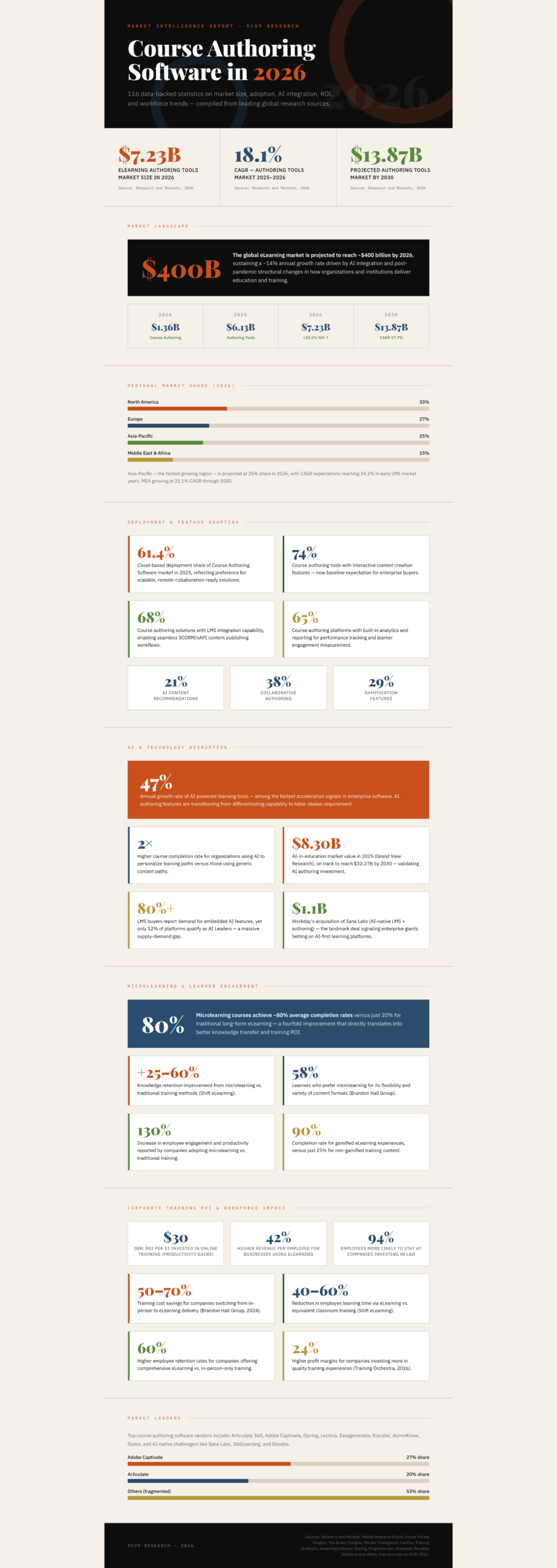
Download our summary infographic here:

In 2026, this category is no longer operating in isolation—it is deeply embedded within a broader, fast-expanding ecosystem that includes eLearning platforms, Learning Management Systems (LMS), Learning Experience Platforms (LXP), AI-driven education technologies, and corporate training environments.


The scale of this transformation is best understood through the extraordinary growth trajectory of the global eLearning market itself. Industry estimates show that the sector has already surpassed hundreds of billions in value, with projections indicating continued expansion toward multi-hundred-billion-dollar levels over the next decade.
In parallel, the LMS market—arguably the backbone of digital learning delivery—is experiencing explosive growth, rising from approximately $28.58 billion in 2025 to well over $120 billion by the early 2030s .
This surge is not occurring in isolation; rather, it reflects a structural shift in how organizations approach workforce development, compliance training, onboarding, and continuous skills enhancement.
As LMS adoption becomes nearly universal across enterprises, the demand for high-quality, scalable, and continuously updated learning content has intensified—placing course authoring software at the core of this rapidly expanding value chain.
Also, read our list of the Top 11 Best Course Authoring Software.
At the same time, macro-level digital transformation trends are accelerating the adoption of authoring tools across industries.

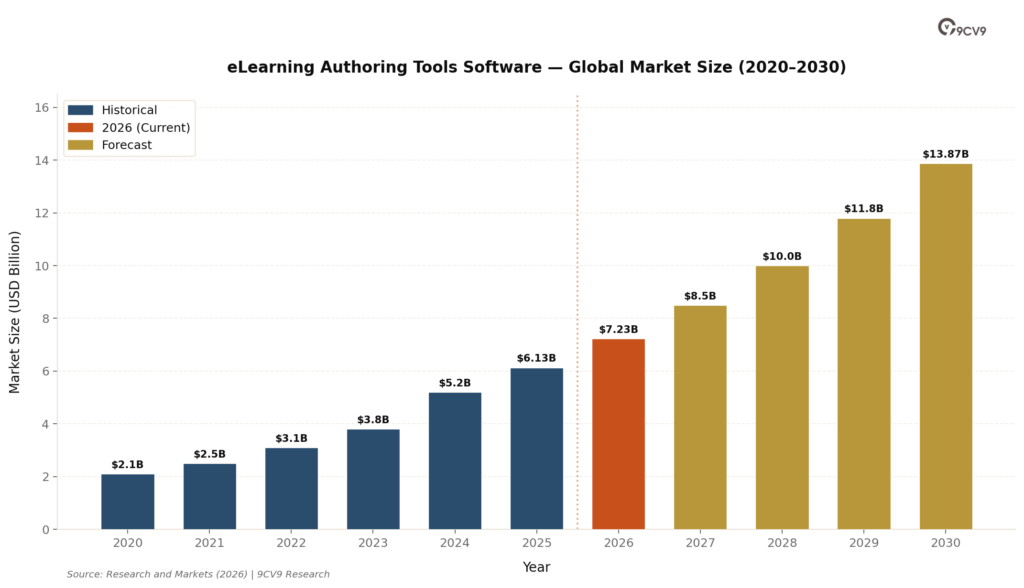
The global eLearning market continues to expand at double-digit growth rates, fueled by remote work adoption, hybrid learning models, and the increasing need for cost-efficient training solutions .
Organizations are no longer relying on traditional classroom-based instruction; instead, they are building always-on digital learning ecosystems that require constant content production, iteration, and personalization.
This fundamental shift has elevated course authoring software from a support function to a strategic capability that directly impacts organizational performance, employee engagement, and long-term competitiveness.

Another defining characteristic of the 2026 landscape is the convergence of multiple high-growth sub-markets that collectively reinforce the importance of course authoring tools. The rise of microlearning, mobile-first education, and personalized learning pathways has transformed how content must be designed and delivered. Learners increasingly expect short, interactive, and highly engaging modules that can be accessed on-demand across devices. This has created a new generation of requirements for authoring platforms, including responsive design, rapid content development workflows, and seamless integration with cloud-based systems. Simultaneously, advancements in artificial intelligence are reshaping the capabilities of modern authoring tools, enabling automated content generation, adaptive learning experiences, and data-driven optimization of training outcomes. The rapid expansion of AI in education—projected to grow significantly over the coming years—further reinforces the transition toward intelligent, scalable content creation systems .

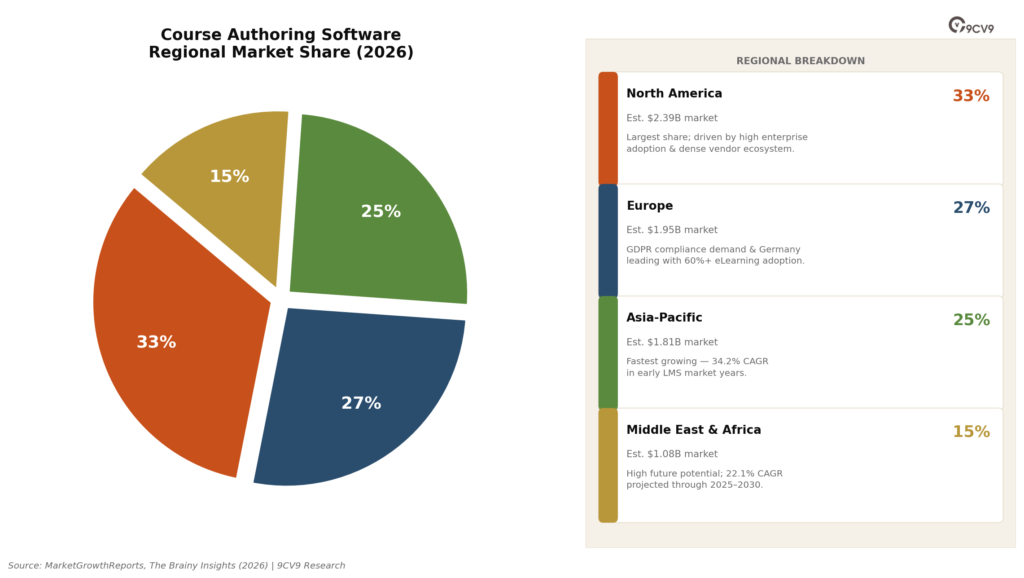
Enterprise investment patterns further highlight the strategic importance of this category. Organizations across sectors—including healthcare, manufacturing, finance, and technology—are increasing their spending on learning and development as they confront widening skills gaps and evolving regulatory requirements. Digital training has proven to deliver measurable business outcomes, from improved employee retention to higher productivity and reduced training costs. As a result, companies are prioritizing solutions that allow them to create, update, and distribute training content efficiently at scale. Course authoring software sits at the center of this capability, enabling organizations to transform knowledge into structured, trackable, and measurable learning experiences.
Regionally, the market continues to exhibit both maturity and rapid expansion. North America remains the dominant force, driven by high enterprise software adoption and significant investment in corporate training infrastructure. However, the Asia-Pacific region is emerging as the fastest-growing market, fueled by digitalization, expanding workforces, and increasing demand for upskilling across developing economies. Europe maintains a strong position due to regulatory-driven training requirements and a deeply ingrained culture of continuous learning. Together, these regional dynamics create a globally distributed growth landscape that further amplifies the demand for scalable, cloud-based authoring solutions.
In this context, the significance of course authoring software in 2026 cannot be overstated. It is no longer simply about creating online courses; it is about enabling organizations to build dynamic, data-driven learning ecosystems that align workforce capabilities with business objectives. As digital learning continues to evolve, the ability to rapidly produce high-quality, engaging, and personalized content will define the success of both educational institutions and enterprises. Course authoring platforms are, therefore, transitioning into foundational systems that power the entire learning lifecycle—from content creation and delivery to analytics and continuous improvement.
This comprehensive collection of 116 statistics, data points, and trends provides a detailed, evidence-based view of how the course authoring software market is evolving in 2026. It highlights not only the scale and growth of the industry but also the technological, organizational, and behavioral shifts that are redefining the future of learning. For decision-makers, educators, and technology leaders alike, understanding these trends is essential for navigating a market that is rapidly transforming into one of the most strategically important segments of the global enterprise software landscape.
Before we venture further into this article, we would like to share who we are and what we do.
About 9cv9
9cv9 is a business tech startup based in Singapore and Asia, with a strong presence all over the world.
With over nine years of startup and business experience, and being highly involved in connecting with thousands of companies and startups, the 9cv9 team has listed some important learning points in this overview of the Top 116 Course Authoring Software Statistics, Data & Trends for 2026.
If you like to get your company listed in our top B2B software reviews, check out our world-class 9cv9 Media and PR service and pricing plans here.
Top 116 Course Authoring Software Statistics, Data & Trends for 2026
🌐 MARKET SIZE & GROWTH
1. The eLearning authoring tools software market was valued at $6.13 billion in 2025 and is projected to reach $7.23 billion in 2026, growing at a CAGR of 18.1%. The eLearning authoring tools sector is one of the fastest-growing niches in enterprise software, and its jump from $6.13B to $7.23B between 2025 and 2026 signals that organizations across all industries are doubling down on scalable, digital-first content creation.
2. The eLearning authoring tools market is forecast to reach $13.87 billion by 2030, growing at a CAGR of 17.7%. Sustained double-digit growth through 2030 underscores how course authoring software is transitioning from a departmental tool to a core enterprise infrastructure investment, particularly as remote work and compliance demands intensify.
3. The Course Authoring Software Market was valued at $1,172.27 million in 2026 and is expected to reach $2,274.26 million by 2035, at a CAGR of 7.6%. While some market segments show more conservative estimates depending on scope definitions, even the most measured forecasts confirm consistent, long-term growth in the course authoring category, suggesting durable structural demand rather than a cyclical spike.
4. Market Research Future estimates the Course Authoring Software Market at $5.663 billion in 2024, growing to $6.369 billion in 2025 and projected to reach $20.63 billion by 2035 at a CAGR of 12.47%. With a tenfold growth path over a decade, the course authoring software category is increasingly seen as a strategic infrastructure layer by L&D professionals and enterprise technology decision-makers alike.
5. The Course Authoring Software Market grew at approximately 12.0% CAGR between 2020 and 2025 historically. Five years of consistent growth leading into 2026 demonstrates that course authoring software adoption has withstood economic headwinds, the pandemic disruption era, and shifting workforce priorities — establishing a resilient baseline.
6. The global e-learning market was valued at $325 billion in 2025 and is expected to reach $665 billion by 2031, growing at a CAGR of 12.68%. The broader eLearning market provides the macro tailwind for course authoring tools, as organizations investing in digital learning infrastructure inevitably require sophisticated content creation capabilities to populate their platforms.
7. The global e-learning market is projected to reach approximately $375–$400 billion by 2026. Whether anchored at $375B or trending toward $400B, the 2026 eLearning market figure highlights a post-pandemic normalization into permanent digital learning ecosystems where authoring tools are indispensable.
8. The e-learning market is expected to grow at 14% annually between 2024 and 2026, rising from $320B to $365B. Annual double-digit expansion across two consecutive years solidifies eLearning — and by extension, course authoring software — as a core category for enterprise software investment in 2026 and beyond.
9. The global LMS market was worth $28.58 billion in 2025 and is projected to reach $70.83 billion by 2030 at a CAGR of 19.9%. The explosive growth of LMS platforms directly drives demand for course authoring software, as organizations need purpose-built creation tools to generate content that feeds these increasingly sophisticated learning delivery systems.
10. The global LMS market is projected to reach $123.78 billion by 2033. Over the coming decade, LMS infrastructure investment will create massive downstream demand for authoring tools, with organizations requiring a steady pipeline of interactive, compliant, and engaging digital content.
11. The corporate LMS market segment is expected to grow at 23.8% CAGR across 2024–2030. The corporate training segment outpacing the broader LMS market signals that enterprises — not just educational institutions — are the fastest-growing driver of course authoring software demand in 2026.
12. The LXP (Learning Experience Platform) market is projected at $2.19 billion in 2026, up from approximately $0.5 billion in 2020. The remarkable fourfold growth of LXP platforms since 2020 reflects a fundamental shift in how learners consume content — and underscores the need for authoring tools capable of producing more experiential, self-directed learning formats.
13. The microlearning market is projected to advance at an 11.83% CAGR, growing from $3.32 billion in 2026 to $5.81 billion by 2031. The microlearning sector’s strong growth trajectory creates a specialized demand for authoring tools that can produce short, modular, mobile-optimized content — a capability gap many legacy course authoring platforms are now racing to fill.
14. The microlearning market was registered at $1,550 million in 2024 and expected to reach $2.96 billion in 2025, growing at 13.5% CAGR through 2034. With the microlearning market nearly doubling in a single year, organizations are accelerating their investment in authoring tools that specifically support rapid, bite-sized content development workflows.
15. The corporate e-learning market is projected to expand by 142% between 2021 and 2026. A 142% expansion over five years is extraordinary by any benchmark, and it reflects the wholesale transformation of corporate training from in-person event-based learning to always-on, digital content ecosystems.
16. The corporate e-learning market is projected to reach $50 billion by 2026. A $50 billion corporate e-learning market by 2026 represents one of the most significant software investment pools in enterprise technology, driving competition among authoring tool vendors to deliver more AI-powered and user-friendly creation experiences.
17. The corporate e-learning market is expected to reach $117 billion by 2025, with 90% of companies offering online training. When virtually all large organizations offer online training, the quality and scale of content creation becomes the differentiating factor — elevating the strategic importance of course authoring software from operational tool to competitive asset.
18. The global corporate eLearning market is projected to be worth $462.6 billion by 2027, growing at 13% CAGR. Looking slightly beyond 2026, the half-trillion dollar trajectory of the corporate eLearning market by 2027 confirms that course authoring software is entering a sustained hypergrowth phase tied to workforce development imperatives globally.
🗺️ REGIONAL MARKET SHARE
19. North America held 33% of the Course Authoring Software market share in 2026. North America’s leading share of the global market is driven by high enterprise software adoption rates, stringent compliance training requirements across regulated industries, and a dense ecosystem of authoring tool vendors based in the United States.
20. Europe accounted for 27% of the Course Authoring Software market in 2026. Europe’s strong second-place position reflects robust regulatory compliance demands, particularly in GDPR-related data governance training and a mature corporate learning culture across German, British, and Nordic organizations.
21. Asia-Pacific held 25% of the Course Authoring Software market in 2026 and is the fastest-growing region. Asia-Pacific’s rapid urbanization, expanding middle-class workforce, and accelerating digitalization make it the most dynamic growth frontier for course authoring software over the next five years.
22. The Middle East & Africa accounted for 15% of the Course Authoring Software market in 2026. The MEA region’s 15% market share understates its potential; with a projected CAGR of 22.1% from 2025 to 2030, it is set to become an increasingly important market for authoring tool vendors seeking geographic expansion.
23. North America accounted for 58% of the global Course Authoring Software market per The Brainy Insights (2023 figure). Alternative market research methodologies yield different share estimates, but all converge on North America as the dominant market for course authoring software, driven by the United States’ uniquely high rate of corporate L&D investment per employee.
24. North America accounted for 36% of global LMS revenue, making it the largest LMS market worldwide. As the world’s largest LMS market, North America’s need for integrated course authoring solutions is proportionately high, particularly given the near-universal adoption of cloud-based LMS platforms among US enterprises.
25. Asia-Pacific is expected to grow at approximately 34.2% annually in early LMS market years, the highest of any global region. Asia-Pacific’s triple-digit-adjacent growth rates in learning technology reflect massive unmet demand across countries like India, Vietnam, Indonesia, and the Philippines, where digitalization of workforce training is accelerating sharply.
26. The European e-learning market was estimated at €111.40 billion in 2025 and projected to reach €212.38 billion by 2033 (CAGR 10.40%). Europe’s decade-long growth trajectory for eLearning reflects structural support from EU digital education strategies, national workforce reskilling programs, and an employer culture that increasingly treats training as a fiduciary responsibility.
27. Germany has a 60%+ organizational adoption rate for eLearning, the highest in Continental Europe. Germany’s manufacturing and engineering-heavy economy demands rigorous technical training programs, and a 60%+ eLearning adoption rate reflects how course authoring software has become central to industrial workforce development.
28. The Netherlands and Finland lead European eLearning penetration with rates exceeding 50%. The Nordic countries’ emphasis on lifelong learning and high digital literacy rates position them as important testing grounds for next-generation course authoring tools, particularly those leveraging AI-driven personalization.
🏢 ENTERPRISE & DEPLOYMENT
29. Cloud-based deployment holds 61.4% of the Course Authoring Software market revenue in 2025. Cloud-based authoring tools have crossed the majority threshold in 2025, reflecting organizational preferences for scalability, remote collaboration capabilities, and the elimination of costly on-premises IT infrastructure.
30. In 2023, cloud-based deployment captured 78% of course authoring software market share. The cloud’s dominant share in 2023, even before accelerating AI features in 2025–26, demonstrates that the migration away from desktop-installed authoring tools was a rapid and structural shift driven by collaboration and accessibility needs.
31. 87% of US organizations use cloud-based LMS solutions rather than on-premise systems. Near-universal cloud adoption among American enterprises signals that on-premise course authoring tools are becoming legacy technology, with organizations expecting their authoring platforms to integrate seamlessly with cloud-native LMS infrastructure.
32. Large enterprises account for 57% of Course Authoring Software installations, with SMEs comprising 43%. While large enterprises dominate adoption, the near-equal split with SMEs reveals a significant democratization of course authoring tools, driven by cloud subscription pricing models that make professional-grade capabilities accessible to smaller organizations.
33. Over 8,700 course authoring software licenses were deployed worldwide in 2025. The global deployment figure of 8,700+ licenses illustrates an industry at meaningful scale, with organizations spanning education, healthcare, finance, and manufacturing all investing in structured content creation workflows.
34. Average users per course authoring software installation range from 250 to 15,000. The wide range of user counts per installation reflects the market’s diversity — from small training departments using authoring tools for a few content creators, to global enterprises licensing platforms for thousands of simultaneous authors.
35. Interactive content creation features are available in 74% of course authoring tools. With nearly three-quarters of tools offering interactive content features, the baseline capability bar for the market has risen significantly — meaning buyers now evaluate vendors on the quality and variety of their interactivity options rather than their mere presence.
36. LMS integration is available in 68% of course authoring software solutions. LMS integration has become a near-standard expectation among buyers, and the 32% of tools lacking this capability face an increasingly difficult competitive position as organizations demand seamless content publishing workflows.
37. Mobile compatibility exists in 59%–61% of course authoring tools. While mobile compatibility is growing, the fact that 40% of tools still lack full mobile optimization represents both a significant market risk for vendors and a practical limitation for organizations deploying training to frontline or deskless workers.
38. Analytics and reporting features are included in 65% of course authoring software solutions. Learning analytics integration in two-thirds of authoring tools reflects the market’s maturation — organizations no longer accept content creation in isolation; they demand evidence of learner engagement and knowledge transfer built into the authoring experience.
39. AI-based content recommendations are adopted in 21% of course authoring tools. The 21% AI adoption figure for 2025–26 represents only the beginning of the AI integration curve in authoring tools — with rapid growth expected as vendors embed generative AI content creation, smart templates, and adaptive learning path generation.
40. Collaborative authoring features are present in 38% of course authoring tools. Collaborative features in over a third of tools reflect the shift from solo instructional design to team-based content creation — a critical capability as organizations distribute subject matter expertise across departments and geographies.
41. E-learning gamification features are included in 29% of course authoring software. Gamification capabilities in nearly a third of authoring tools reflect growing demand for engagement-focused course design, as organizations seek to combat the historically low completion rates of passive, non-interactive eLearning content.
42. 96% of large and mid-sized firms consider their LMS software the backbone of their corporate learning operations. Near-universal recognition of the LMS as foundational learning infrastructure reinforces the strategic necessity of authoring tools that integrate seamlessly with these systems to maintain a coherent content creation-to-delivery pipeline.
43. 90% of organizations use an LMS platform for L&D functions. With nine in ten organizations running an LMS, the universe of potential course authoring software buyers is vast — and organizations without a dedicated authoring tool are an active and accessible market opportunity.
44. 99% of colleges and universities globally report having an LMS in place. Near-universal LMS adoption in higher education creates a massive institutional customer base for course authoring tools, as academic institutions must continually create and update digital course content for online and blended delivery.
45. In U.S./Canadian higher education, Canvas holds 47% market share, Blackboard ~18%, Brightspace 19%, Moodle 11%. The LMS market concentration in North American higher education has direct implications for authoring tool compatibility, with vendors competing to be the preferred content creation partner for Canvas, Brightspace, and Moodle ecosystems.
46. Moodle holds over 50% market share across Europe, Latin America, and Oceania, with 150,000+ installations and 500+ million users. Moodle’s global dominance across developing and non-North American markets creates strong demand for SCORM- and xAPI-compliant authoring tools that can publish directly to open-source LMS environments.
47. Adobe Captivate holds approximately 27% market share and Articulate approximately 20% of the course authoring software market. Articulate and Adobe’s combined near-50% market share reflects the industry’s duopoly tendency, though rapid growth from AI-native challengers is beginning to erode the incumbents’ dominance among newer enterprise buyers.
👩💼 WORKFORCE & TRAINING INVESTMENT
48. U.S. companies spend approximately $1,071 per employee annually on training in 2025 (down from $1,207 in 2022). The per-employee training spend decrease from 2022 to 2025 likely reflects a deliberate shift toward more cost-efficient eLearning and authoring-tool-based delivery over expensive in-person training events — not a reduction in training ambition.
49. Total corporate training expenditure globally between 2024 and 2025 reached $101.8 billion. A $100+ billion annual global training budget is a remarkable figure that underscores the enormous market opportunity for course authoring software vendors, particularly those offering demonstrable cost efficiency and content scalability.
50. Manufacturing spends approximately $1,217 per employee annually on training — above the industry average. Manufacturing’s above-average training investment reflects the industry’s reliance on safety compliance, technical skills certification, and equipment-specific training — all areas where course authoring tools deliver high ROI through reusable, scalable content.
51. Healthcare reports the highest training hours per employee at approximately 50 hours per year. Healthcare’s intensive training requirements, driven by patient safety standards, licensing renewals, and continuous medical education mandates, make it one of the highest-value verticals for specialized course authoring tools.
52. 40% of Fortune 500 companies use e-learning to educate their employees. Fortune 500 adoption of eLearning reflects the validated ROI of digital training at scale — and as these flagship organizations invest in authoring tools, they set precedents that cascade down through supplier chains and mid-market competitors.
53. 90% of companies and organizations offer some kind of digital learning to their employees. With digital learning adoption now essentially universal among meaningful-scale organizations, course authoring software vendors must compete on capability differentiation and integration quality rather than on market development.
54. 85% of organizations plan to increase their investment in upskilling and reskilling through 2025–2030. The five-year upskilling investment pipeline is exceptionally strong, creating durable demand for course authoring tools that can rapidly generate and update skills-focused training content across rapidly evolving job categories.
55. 94% of employees would remain at a company longer if it invested in their learning and development. The retention ROI of training investment is one of the most powerful business cases for course authoring software, as organizations that produce high-quality, engaging digital learning content directly improve their ability to retain talent.
56. 68% of employees view training and development as the most significant policy of a company. When the majority of employees rank training as the top company policy, organizations that invest in high-quality course authoring tools gain a measurable recruitment and retention advantage in competitive talent markets.
57. Companies that offer online training see 60% higher employee retention rates than those relying on in-person training. The 60% retention differential between digital and in-person training quantifies the business case for authoring tool investment in dollar terms that most CFOs find compelling when evaluating L&D technology budgets.
58. 94% of learning leaders say online digital learning via LMS platforms, videos, and virtual training is critical to their L&D strategy. Near-universal endorsement of digital learning among L&D leaders confirms that course authoring software has graduated from optional enhancement to strategic necessity in the corporate training toolkit.
59. 76% of L&D leaders now view continuous skills training as a cornerstone of business resilience. The framing of skills training as a business resilience function — not merely an HR benefit — elevates the strategic procurement discussion around authoring tools to the C-suite level.
60. 78% of business leaders see the growing skills gap as a major risk to their organization’s future. The skills gap anxiety among senior executives creates a top-down mandate for scalable, rapid content creation — exactly the use case that modern course authoring platforms are purpose-built to address.
61. 85% of employers plan to prioritize upskilling and reskilling their current workforce over the next 5 years. A five-year employer commitment to workforce reskilling represents a sustained multi-year procurement cycle for course authoring tools, with organizations likely to increase licensing scope and authoring capacity incrementally.
62. 24% higher profit margins are reported by companies that invest more in quality training experiences. The direct correlation between training quality investment and profit margin performance provides a compelling financial argument for upgrading from basic content creation tools to sophisticated course authoring platforms.
📱 MOBILE & MICROLEARNING
63. The mobile e-learning sector is anticipated to grow at a 25% CAGR through 2028. Mobile learning’s exceptionally fast growth trajectory through 2028 creates urgent demand for course authoring tools that natively support responsive design, offline access, and mobile-first content creation workflows.
64. Mobile learning via LMS is projected to grow at approximately 36.45% CAGR from 2020 to 2027. A 36%+ CAGR for mobile LMS usage is among the highest growth rates of any enterprise software sub-segment, reinforcing the need for authoring tools that treat mobile optimization as a default rather than a secondary consideration.
65. Over 85% of adults worldwide own smartphones, with Millennials and Gen Z relying heavily on them for daily learning activities. Near-universal smartphone ownership among working-age adults globally has permanently changed learner expectations: course content must be mobile-consumable by default, making mobile-compatible authoring tools a mandatory capability.
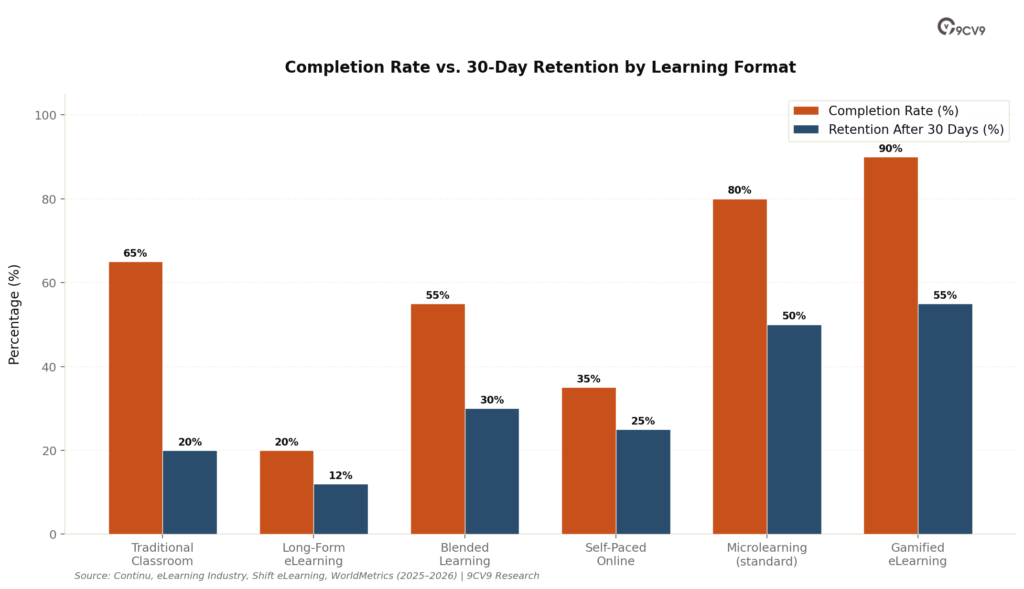
66. Microlearning courses see approximately 80% completion rates on average, versus conventional long-form eLearning’s ~20% completion rate. The fourfold completion rate advantage of microlearning over long-form content is perhaps the single most compelling data point for organizations evaluating whether to invest in authoring tools that support rapid, modular content creation.
67. Microlearning can boost knowledge retention by 25% to 60% compared to traditional learning methods. Improved retention rates of up to 60% from microlearning represent a quantifiable pedagogical advantage that course authoring tools enabling bite-sized content creation can deliver directly to organizational training outcomes.
68. 58% of learners prefer microlearning due to its flexibility and variety. The majority preference for microlearning formats among learners provides organizations with both a user experience argument and a content strategy direction — favoring authoring tools that make modular, varied content creation intuitive.
69. 90% of learners report liking the convenience and relevance of microlearning content. A 90% learner satisfaction rate with microlearning content is an exceptional benchmark, suggesting that organizations investing in microlearning-capable authoring tools will benefit from measurably higher learner engagement scores.
70. 74% of employees participate in monthly training when microlearning modules are available. Monthly training participation jumps dramatically when microlearning is available, highlighting how the format — and the authoring tools that enable it — directly drives the frequency and regularity of organizational learning activity.
71. Microlearning boosts learner retention rates by 18%. An 18% retention improvement from microlearning may appear modest in isolation, but at scale across an organization’s entire training catalog, it represents a meaningful uplift in knowledge transfer that justifies content investment.
72. Bite-sized visual learning modules improve information retention by 20% compared to other learning format types. The 20% retention premium for visual microlearning modules provides evidence that course authoring tools enabling rich multimedia micro-content creation deliver learning outcomes superior to text-heavy alternative formats.
🤖 AI & TECHNOLOGY INTEGRATION
73. AI-powered learning tools are growing at 47% per year, reshaping how education is delivered. A 47% annual growth rate for AI learning tools is among the most dramatic acceleration signals in the entire ed-tech sector, indicating that AI integration in course authoring software is moving from differentiating feature to table-stakes requirement.
74. AI in the education market is valued at $5.44 billion, with estimates of $7.97 billion in 2025. The near-$8 billion AI-in-education market demonstrates that artificial intelligence is no longer a speculative feature in learning technology — it is a funded, commercially proven capability that learners and organizations actively demand.
75. Grand View Research estimates the AI in education market at $5.88 billion to $8.30 billion between 2024 and 2025, growing to $32.27 billion by 2030. A potential four-to-five times growth in AI-in-education spending by 2030 suggests that AI-powered authoring capabilities — including automated content generation, adaptive learning paths, and smart assessments — will become the primary basis of vendor competition.
76. Among 560 LMS platforms analyzed, only 68 (approximately 12%) were identified as AI leaders, despite 80%+ of LMS buyers reporting demand for embedded AI features. The gap between 12% AI capability supply and 80%+ buyer demand represents one of the most significant unmet needs in the course authoring and LMS market, creating a substantial opportunity for vendors investing in genuine AI capability.
77. In a corporate eLearning survey, 30% of L&D teams were already using AI-powered tools, with 91% of those planning to increase AI usage in 2024. The near-unanimous intention to increase AI usage among early adopters signals that AI-powered authoring tools are entering a rapid scaling phase — with adoption expected to accelerate from 30% toward majority penetration by 2026.
78. Workday announced plans to acquire Sana Labs for approximately $1.1 billion in September 2025, expected to close in early 2026. The $1.1 billion Workday-Sana Labs acquisition is a landmark signal that enterprise software giants are making billion-dollar bets on AI-native learning platforms — validating the market and likely triggering competitive M&A activity across the sector.
79. Augmented reality (AR) training modules increase retention by 60% compared to traditional e-learning. A 60% retention improvement from AR-based training is striking enough that organizations with technically sophisticated workforces should factor AR authoring capability into their course creation tool evaluation criteria.
80. Organizations that use AI to personalize training paths have a 2x higher completion rate than those using generic paths. Doubling completion rates through AI-driven personalization is an outcome that transforms the business case for AI-enabled authoring tools from a “nice to have” to a mathematically justifiable investment in most enterprise training contexts.
🎮 GAMIFICATION & ENGAGEMENT
81. Gamification boosts knowledge retention by approximately 15–20% versus traditional methods. Consistent 15–20% retention improvements from gamification, documented across multiple independent studies, provide authoring tool buyers with reliable expected outcomes when evaluating platforms with built-in gamification capabilities.
82. Gamified training yields approximately 43% higher learner engagement. A 43% engagement uplift from gamification represents one of the most significant behavioral improvements available to organizations through content design choices — and reinforces the value of authoring tools with rich gamification feature sets.
83. 83% of learners report feeling more motivated with gamified learning. The overwhelming majority of learners self-reporting higher motivation in gamified environments provides course authoring tool vendors and their enterprise customers with strong qualitative validation for gamification investment.
84. Gamified LMS features increase completion rates by 50% and retention by 45%. A 50% completion rate improvement and 45% retention gain from gamification within LMS environments provides a direct, measurable business case for course authoring tools that make gamification elements easy to embed in content creation workflows.
85. Gamified experiences boost engagement and completion rates to 90%, versus just 25% for non-gamified training. The dramatic 65-percentage-point completion rate gap between gamified (90%) and non-gamified (25%) training is arguably the most powerful single metric for justifying investment in sophisticated, feature-rich course authoring platforms.
86. 67.7% of organizational behavior students reported gamified courses were more motivating than traditional courses. Academic research validating gamification’s motivational advantage across demographics and subjects provides a strong evidence base for corporate L&D teams seeking to justify gamification-capable authoring tool investments to finance stakeholders.
87. Companies that embraced microlearning have observed a 130% increase in both employee engagement and productivity versus those using traditional training. A 130% engagement and productivity increase represents extraordinary ROI for microlearning investment, suggesting that the authoring tools enabling rapid micro-content creation can directly contribute to measurable business performance outcomes.
📊 COMPLETION RATES & LEARNING OUTCOMES
88. eLearning reduces course completion time by 40–60% compared to traditional classroom courses. The 40–60% time saving from eLearning versus classroom training is a direct operational efficiency gain that course authoring tool investments can help organizations achieve and maintain across their entire training portfolio.
89. Online learners retain 25–60% more information from digital learning materials than in-person students. The superior retention outcomes of online learning versus in-person instruction — ranging from 25% to 60% improvement — provide a strong pedagogical justification for transitioning training to digitally authored content.
90. Only 12% of training content is retained by employees after 30 days without reinforcement. The sobering 12% retention rate after 30 days highlights the “forgetting curve” problem that course authoring tools enabling spaced repetition, microlearning, and reinforcement module creation are specifically designed to address.
91. Companies with structured training follow-up programs have a 92% higher training ROI. The 92% ROI improvement from structured follow-up programs illustrates that course authoring tools enabling the creation of post-training reinforcement and assessment content are not supplementary — they are central to achieving actual learning ROI.
92. The average corporate training completion rate is 45%, with only 25% fully engaging with content. The stark gap between enrollment and genuine engagement — 45% completion, just 25% full engagement — quantifies the interactivity and engagement problem that modern course authoring platforms must solve through better, more compelling content creation capabilities.
93. Employees who apply training within 7 days are 88% more likely to retain the information. The 88% retention advantage for employees who apply training quickly underlines the importance of authoring tools that can create application-oriented, scenario-based content that bridges the gap between learning and immediate on-the-job practice.
94. Training programs completed within the expected timeframe have a 28% higher knowledge retention rate. The 28% retention premium for timely-completed training programs suggests that course authoring tools enabling modular, time-flexible content structures improve not just engagement but actual knowledge transfer outcomes.
95. Digital learning is reported to boost retention from approximately 8–10% (traditional) to 25–60% in some studies. The potential to increase retention from below 10% to over 50% through digital learning formats represents the most compelling outcome-based argument for course authoring software investment in organizational training contexts.
96. Microlearning used in healthcare achieved 40% higher completion rates for patient care protocol modules. Healthcare’s 40% completion rate improvement from microlearning validates the format’s effectiveness in high-stakes, compliance-intensive sectors — industries that are also among the most significant buyers of specialized course authoring tools.
💰 COST & ROI
97. Companies save 50–70% on training costs by switching to eLearning. The 50–70% cost reduction from eLearning versus in-person training is the most commonly cited ROI driver for course authoring software investment, translating directly into reduced travel, venue, instructor, and materials expenditure.
98. IBM research indicates that every $1 invested in online training yields approximately $30 in productivity gains. IBM’s 30:1 training ROI benchmark is one of the most widely cited figures in corporate L&D and provides course authoring software vendors with a powerful reference point when making the business case to CFOs and procurement teams.
99. Businesses using eLearning see 42% higher revenue per employee. A 42% revenue per employee premium for eLearning-adopting businesses positions course authoring software not as a training cost-center expense but as a direct revenue-generating investment in workforce capability.
100. Corporations save an average of $200–$300 per employee by switching to eLearning. Per-employee cost savings of $200–$300 from eLearning adoption provide a clear, quantifiable payback calculation that makes the licensing cost of modern course authoring software easy to justify even for budget-constrained training departments.
101. The cost of LMS implementation is recouped in an average of 11 months, with retention gains extending this benefit. An 11-month payback period for LMS implementation — directly tied to the authoring tools that create its content — compares favorably to most enterprise software ROI timelines and signals that digital learning infrastructure investment delivers measurable returns quickly.
102. Companies with integrated LMS and HRIS systems see a 30% higher training ROI due to better data alignment. The 30% ROI premium from integrated learning and HR data systems creates a strong incentive for organizations to invest in course authoring tools that connect natively to their broader HR technology stack.
📈 INDUSTRY ADOPTION TRENDS
103. 82% of companies use eLearning for compliance training. Compliance training’s dominant use case — adopted by more than four in five organizations — establishes a consistent, recurring demand for course authoring tools that can rapidly update and republish regulatory content as requirements evolve.
104. 62% of companies use online learning to close skill gaps. With nearly two-thirds of organizations using eLearning as their primary skills gap intervention, course authoring software sits at the center of one of the most strategically urgent challenges in global workforce management.
105. Tech companies have the highest training retention rates at 65%, followed by healthcare (55%) and retail (40%). The significant variation in training retention rates across industries reveals that course authoring tool effectiveness is highly context-dependent — with technology sector usage patterns providing the best benchmarks for best-practice content design.
106. 45% of companies invested in online learning tools in 2026, up from 39% in 2024. The 6-percentage-point increase in online learning tool investment over two years reflects a genuine acceleration in organizational adoption, not just market expansion — suggesting that late-majority organizations are now actively entering the eLearning ecosystem.
107. 37% of organizations want to replace their current LMS, with approximately half of those seeking to do so within one year. LMS replacement intentions among more than a third of organizations create a significant opportunity window for course authoring tool vendors to position integrated solutions that address content creation and delivery simultaneously.
108. Compliance training is the number one driver of LMS adoption, cited by approximately 73% of organizations. With compliance cited as the primary LMS adoption driver, authoring tools that streamline compliance content creation, versioning, and multi-format publishing are positioned for outsized commercial success in regulated-industry verticals.
109. The construction industry’s training investment is rising at approximately 18% CAGR, driven by safety compliance needs. The construction sector’s above-average training investment growth creates a fast-expanding addressable market for authoring tools capable of producing safety-focused, mobile-accessible, visually rich training content for field workers.
110. Financial services industry invests approximately 15% more in compliance training than the average industry. Financial services’ above-average compliance training investment reflects the sector’s uniquely dense regulatory environment — creating sustained high-value demand for authoring tools that can produce audit-ready, rapidly updatable compliance content.
🌍 BROADER LEARNING ECOSYSTEM
111. There are approximately 73.8 million LMS users worldwide, of which 65% are corporate-level executives. The concentration of LMS usage among executive-level decision-makers suggests that learning platform experiences shape leadership perceptions of training quality — making the output of course authoring tools directly visible to the most influential buyers.
112. The number of online course students is estimated to reach 1 billion by 2027. The approaching one-billion-student online learning milestone by 2027 represents an extraordinary scale of digital content consumption — one that is only possible through the widespread deployment of course authoring tools capable of producing large volumes of quality content.
113. Online learning has experienced a 900% increase since the year 2000. Nine hundred percent growth over two decades positions eLearning as one of the defining secular trends of the early 21st century, and course authoring software as one of the most consequential categories of educational technology infrastructure.
114. 63% of students prefer online learning because it allows them to tailor their studies to fit their lives. The majority preference for online learning’s flexibility directly drives demand for authoring tools that can create modular, self-paced, mobile-accessible content — matching learner behavior expectations with technically capable content creation.
115. 68% of learners who took an online course report it helped them advance in their careers. Career advancement outcomes from online learning provide course authoring software customers with a compelling message about the human value of their digital training investments, reinforcing continued organizational commitment to content creation quality.
116. 58% of hiring managers consider online certifications just as valuable as traditional degrees. Growing hiring manager recognition of online certification equivalence validates the entire digital credentialing ecosystem — and course authoring tools that support rich, assessment-heavy certification content creation are well-positioned to serve this growing demand.
Conclusion
The analysis of these 116 course authoring software statistics for 2026 reveals a market that has moved far beyond incremental growth and entered a phase of structural, long-term transformation. What was once a supporting tool within learning and development ecosystems has now become a central pillar of enterprise strategy, driven by the convergence of digital learning, workforce transformation, and rapid technological advancement. The data consistently points to one overarching conclusion: course authoring software is no longer optional infrastructure—it is a critical enabler of business performance, talent development, and organizational resilience.
At a macro level, the sustained double-digit growth across the eLearning, LMS, and corporate training markets confirms that digital learning is not a temporary shift but a permanent evolution in how knowledge is created, distributed, and consumed. The expansion of the global eLearning market into the hundreds of billions, combined with the explosive growth of LMS platforms, creates an environment where the demand for high-quality, scalable content is both constant and accelerating. Course authoring tools sit directly at the center of this ecosystem, acting as the production engine that fuels every learning experience, from onboarding programs to advanced technical training.
One of the most important takeaways from the data is the depth of enterprise commitment to learning and development. Organizations are investing heavily in upskilling and reskilling initiatives, not only to remain competitive but also to address widening global skills gaps. The statistics showing that the majority of companies now offer digital learning—and that a significant percentage plan to increase their investment over the next five years—highlight a durable and expanding market opportunity. Course authoring software is uniquely positioned to capture this demand because it enables organizations to rapidly translate business knowledge into structured, measurable learning content.
Equally significant is the technological shift reshaping the capabilities and expectations of modern authoring platforms. The rise of artificial intelligence, in particular, represents a defining inflection point. While current adoption levels are still relatively low compared to overall demand, the gap between buyer expectations and available AI capabilities signals a major opportunity for innovation. As AI becomes more deeply embedded into course creation workflows—through automated content generation, adaptive learning paths, and personalized recommendations—course authoring tools will evolve into intelligent systems that actively optimize learning outcomes rather than simply enabling content creation.
The growing importance of microlearning, mobile-first design, and learner-centric experiences further reinforces the need for advanced authoring capabilities. The stark differences in completion rates, retention levels, and engagement metrics between traditional learning formats and modern approaches demonstrate that how content is delivered is just as important as what content is delivered. Organizations that fail to adopt tools capable of producing short, interactive, and mobile-optimized content risk falling behind in both employee engagement and training effectiveness. In contrast, those that embrace these trends stand to benefit from significantly improved learning outcomes and stronger workforce performance.
From an operational perspective, the shift toward cloud-based deployment and integrated learning ecosystems is another critical trend. The dominance of cloud solutions reflects the growing need for scalability, collaboration, and seamless integration with LMS and HR systems. Organizations are no longer evaluating authoring tools in isolation; instead, they are assessing how well these tools fit into a broader technology stack that includes analytics, compliance tracking, and performance management systems. This integration is essential for unlocking the full value of digital learning investments, particularly when it comes to measuring ROI and aligning training outcomes with business objectives.
The data also underscores the powerful financial case for investing in course authoring software. The combination of reduced training costs, improved employee retention, and increased productivity creates a compelling return on investment that is difficult to ignore. Statistics such as the significant cost savings from eLearning, the measurable increase in revenue per employee, and the strong correlation between training quality and profit margins all point to one conclusion: effective digital learning is not just an HR initiative—it is a business growth driver. Course authoring tools, as the foundation of this capability, play a direct role in delivering these outcomes.
Regionally, while North America continues to lead in terms of market share and maturity, the rapid growth of the Asia-Pacific region signals a shift in future market dynamics. Emerging economies are accelerating their adoption of digital learning technologies, driven by workforce expansion, urbanization, and increasing digital literacy. This creates new opportunities for vendors and organizations alike, particularly those that can deliver scalable, cloud-based solutions tailored to diverse and rapidly evolving markets. Europe’s strong position, supported by regulatory requirements and a culture of continuous learning, further reinforces the global nature of this growth.
Another critical insight is the evolving role of engagement and interactivity in determining the success of learning programs. Gamification, immersive content, and interactive design are no longer optional enhancements; they are essential components of effective training strategies. The substantial improvements in engagement, completion rates, and knowledge retention associated with these features highlight the need for authoring tools that make advanced content creation both accessible and efficient. As learner expectations continue to rise, the ability to deliver compelling, high-quality experiences will become a key differentiator for organizations.
Looking ahead, the future of course authoring software will be defined by its ability to adapt to an increasingly complex and dynamic learning landscape. The integration of emerging technologies such as augmented reality, advanced analytics, and real-time personalization will further expand the capabilities of these platforms. At the same time, the growing emphasis on continuous learning and lifelong skill development will ensure that demand for content creation tools remains strong across industries and regions.
In conclusion, the 2026 landscape for course authoring software is characterized by rapid growth, technological innovation, and deep strategic importance. The convergence of market expansion, enterprise investment, and evolving learner expectations has transformed this category into one of the most critical components of the modern digital economy. Organizations that recognize and act on these trends—by investing in advanced, scalable, and AI-enabled authoring tools—will be better positioned to build resilient workforces, drive performance, and maintain a competitive edge in an increasingly knowledge-driven world.
If you find this article useful, why not share it with your hiring manager and C-level suite friends and also leave a nice comment below?
We, at the 9cv9 Research Team, strive to bring the latest and most meaningful data, guides, and statistics to your doorstep.
To get access to top-quality guides, click over to 9cv9 Blog.
To hire top talents using our modern AI-powered recruitment agency, find out more at 9cv9 Modern AI-Powered Recruitment Agency.
People Also Ask
What is course authoring software and why is it important in 2026?
Course authoring software enables organizations to create and manage digital learning content at scale. In 2026, it is critical due to rapid eLearning growth, increasing demand for upskilling, and the need for scalable, cost-efficient training solutions.
How big is the course authoring software market in 2026?
The market continues to grow rapidly, reaching multi-billion-dollar valuation levels, driven by enterprise adoption, LMS expansion, and increasing reliance on digital training across industries globally.
What is driving the growth of course authoring tools in 2026?
Key drivers include eLearning expansion, corporate training demand, AI integration, remote work trends, compliance requirements, and the need for continuous workforce upskilling.
How fast is the eLearning market growing globally?
The global eLearning market is growing at double-digit rates and is projected to reach hundreds of billions in value, providing strong momentum for course authoring software demand.
Why are LMS platforms important for authoring tools?
LMS platforms require continuous content updates, and course authoring tools supply that content, making them essential for delivering structured and scalable learning programs.
What role does AI play in course authoring software?
AI enables automated content creation, personalized learning paths, and improved learner engagement, transforming authoring tools into intelligent learning systems.
Are AI-powered authoring tools widely adopted in 2026?
Adoption is still emerging, with around 20–30% usage, but demand is high, and most organizations plan to increase AI usage significantly in the coming years.
What is microlearning and why is it trending?
Microlearning delivers short, focused content modules that improve engagement and retention, making it one of the most effective and widely adopted learning strategies in 2026.
How does microlearning impact course completion rates?
Microlearning significantly boosts completion rates, often reaching around 80%, compared to much lower rates for traditional long-form training content.
Why is mobile learning important for course authoring tools?
With most learners using smartphones, mobile compatibility ensures accessibility, flexibility, and higher engagement, making it a critical feature for modern authoring platforms.
What industries use course authoring software the most?
Industries like healthcare, finance, manufacturing, and technology rely heavily on course authoring tools for compliance training, technical skills development, and workforce education.
What is the ROI of investing in course authoring software?
Organizations can achieve significant ROI through reduced training costs, improved employee productivity, higher retention rates, and faster knowledge transfer.
How much can companies save with eLearning solutions?
Companies can save between 50% to 70% on training costs by switching from traditional methods to eLearning supported by course authoring tools.
Why is cloud-based authoring software dominating the market?
Cloud-based solutions offer scalability, remote collaboration, easy updates, and integration with LMS platforms, making them the preferred deployment model.
What features should modern course authoring tools have?
Key features include AI capabilities, mobile optimization, interactive content, analytics, LMS integration, and collaborative authoring functionalities.
How important is LMS integration for authoring software?
LMS integration is essential for seamless content publishing, tracking learner progress, and ensuring a unified learning experience across platforms.
What is the role of gamification in course authoring?
Gamification increases learner engagement, motivation, and retention by incorporating elements like rewards, challenges, and progress tracking into training content.
How does digital learning improve knowledge retention?
Digital learning improves retention rates by offering interactive, flexible, and repeatable content, allowing learners to engage with material more effectively.
What is the global adoption rate of LMS platforms?
Around 90% of organizations use LMS platforms, making them a standard component of corporate learning infrastructure.
How does course authoring software support compliance training?
It allows organizations to quickly create, update, and distribute regulatory content, ensuring employees stay compliant with changing industry standards.
Why are enterprises investing more in training and development?
Companies are addressing skills gaps, improving employee retention, and enhancing productivity, making training a strategic business priority.
What is the impact of AI on training completion rates?
AI-driven personalization can double completion rates by delivering tailored learning experiences that match individual learner needs.
How does course authoring software improve employee retention?
High-quality training programs increase job satisfaction and career development opportunities, leading to better employee retention rates.
Which region leads the course authoring software market?
North America leads due to strong enterprise adoption and high training investment, while Asia-Pacific is the fastest-growing region.
Why is Asia-Pacific a key growth market?
Rapid digitalization, workforce expansion, and increasing demand for upskilling are driving strong growth in the region.
What challenges do organizations face with authoring tools?
Challenges include lack of AI features, limited mobile optimization, integration issues, and the need for faster content creation workflows.
How is the role of instructional designers changing?
Instructional designers are shifting from content creators to learning strategists, focusing on engagement, personalization, and data-driven learning design.
What is the future of course authoring software beyond 2026?
The future includes deeper AI integration, immersive technologies like AR, and advanced analytics to optimize learning outcomes in real time.
How does course authoring software support workforce upskilling?
It enables rapid creation of targeted training programs that help employees learn new skills and adapt to changing job requirements.
Why is course authoring software considered a strategic asset?
It directly impacts training efficiency, employee performance, and business outcomes, making it a critical component of modern enterprise strategy.
Sources
Research and Markets Market Research Future Future Market Insights MarketGrowthReports The Brainy Insights The Business Research Company Arizton Advisory Didask Programs Atrixware eLearning Blog eSkilled LMS Continu Training Orchestra LevelUp LMS eLearning Industry Mordor Intelligence Paradiso Solutions Wooclap EntrepreneursHQ WorldMetrics CertifyMe MissionGraduateNM iSpring Disco Technavio