

Key Takeaways
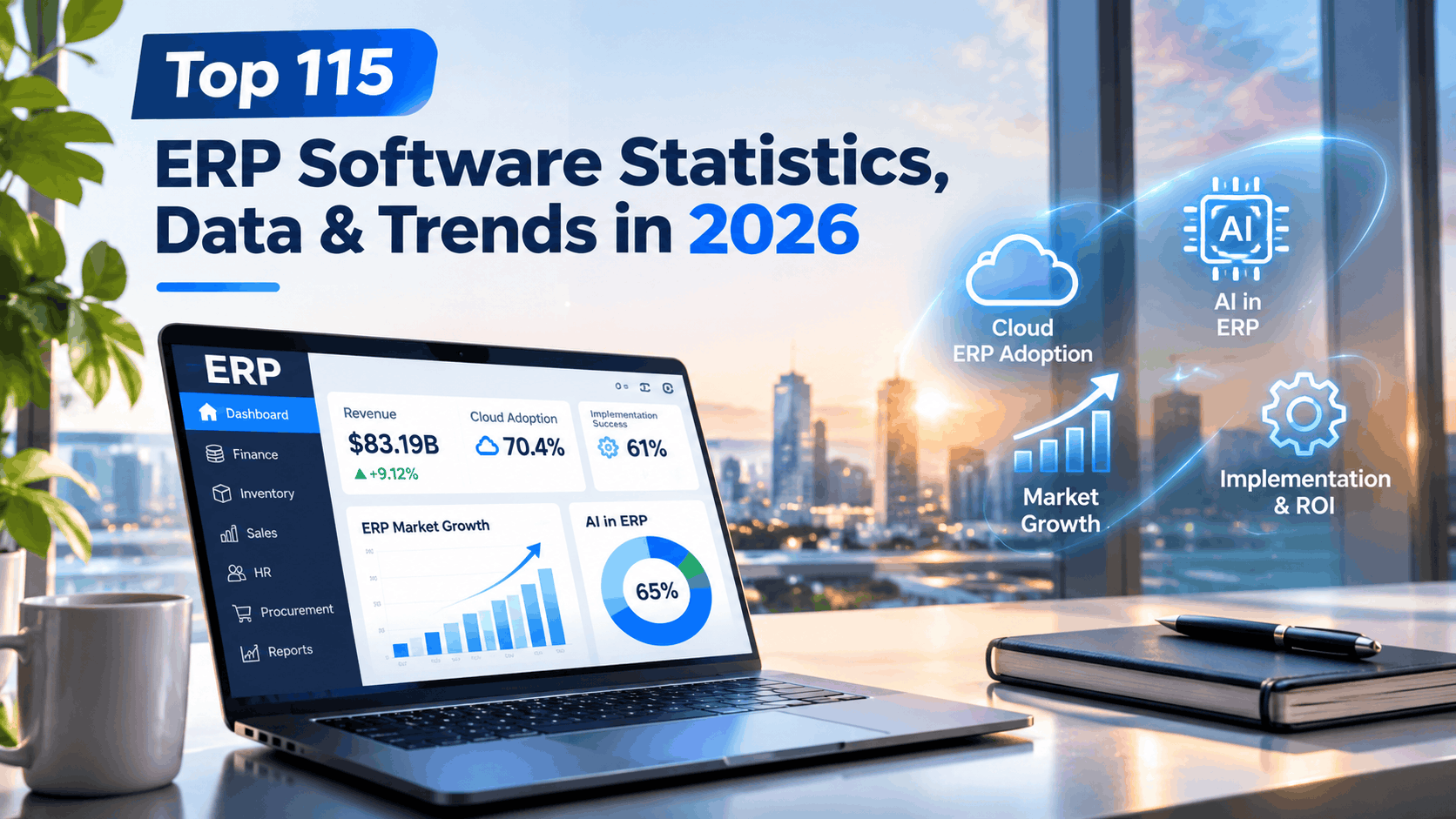
- ERP Software Market Growth: The global ERP software market is projected to reach $83.19 billion in 2026, driven by digital transformation, enterprise automation, and rising demand for integrated business management solutions.
- Cloud ERP Adoption and AI Integration: Cloud-based ERP accounted for 70.4% of deployments in 2025, while 65% of organizations consider artificial intelligence essential for improving ERP efficiency, automation, and decision-making.
- ERP Implementation Costs and ROI: While 64% of ERP implementations exceed their initial budgets, 74% of businesses report improved productivity and efficiency, highlighting the importance of strategic ERP investment and implementation planning.
Enterprise Resource Planning (ERP) software is transforming business operations in 2026, with the global market projected to reach $83.19 billion. The top 115 ERP software statistics highlight rapid cloud adoption, AI-powered automation, rising implementation costs, and measurable productivity gains. Businesses can leverage these insights to improve efficiency, reduce costs, and make informed technology investments.
Enterprise Resource Planning (ERP) software continues to transform how businesses manage their finances, human resources, supply chains, inventory, manufacturing, and daily operations. As organizations accelerate digital transformation, the demand for integrated, cloud-based, and AI-powered ERP solutions is growing rapidly. In 2026, ERP software has evolved beyond traditional business management systems into intelligent platforms that help companies automate workflows, improve operational efficiency, reduce costs, and make data-driven decisions.

The global ERP software market is experiencing substantial growth, although market estimates vary depending on research methodologies and industry definitions. According to Grand View Research, the global ERP software market is projected to reach $83.19 billion in 2026, up from $77.08 billion in 2025. Meanwhile, Fortune Business Insights estimates the market will reach $106.22 billion in 2026, reflecting strong enterprise investment in modern ERP technologies. These projections highlight the increasing importance of ERP systems across businesses of all sizes and industries.
Cloud ERP adoption is one of the most significant trends shaping the industry. Research cited in industry reports indicates that 70.4% of ERP deployments were cloud-based in 2025, while 78.6% of new ERP implementations selected cloud or hybrid-cloud environments. Organizations are increasingly moving away from traditional on-premises ERP systems to benefit from greater scalability, flexibility, accessibility, and lower infrastructure requirements. Small and medium-sized enterprises (SMEs) are also accelerating cloud ERP adoption as subscription-based solutions make advanced enterprise management capabilities more accessible.


Artificial intelligence (AI), machine learning, predictive analytics, and robotic process automation (RPA) are further reshaping the ERP software landscape. Industry statistics suggest that 65% of organizations consider AI critical to their ERP systems, while AI-enabled ERP implementations have been associated with improvements in forecasting accuracy and operational efficiency. Leading ERP software providers, including SAP, Oracle, Microsoft, and Workday, are increasingly integrating intelligent automation, AI assistants, and advanced analytics into their platforms to help businesses streamline complex processes.
Despite these technological advancements, ERP implementation remains a major investment that requires careful planning and execution. Industry data indicates that 64% of ERP implementations exceed their initial budgets, while 68% take longer than originally planned. Challenges such as data migration, system integration, employee training, customization, and organizational change management continue to influence ERP project outcomes. Nevertheless, successful ERP deployments can deliver substantial benefits, including improved productivity, reduced operational costs, better inventory management, and stronger collaboration across departments.
The ERP software industry in 2026 is also characterized by growing demand for industry-specific solutions, composable ERP architectures, real-time business intelligence, and enhanced cybersecurity. Manufacturing, financial services, healthcare, retail, logistics, and professional services organizations are increasingly adopting specialized ERP platforms tailored to their operational requirements. At the same time, ERP vendors are competing to deliver more flexible, intelligent, and user-friendly solutions that support long-term business growth.
Understanding the latest ERP software statistics, market size, adoption rates, implementation costs, ROI benchmarks, and emerging technology trends is essential for business leaders, IT professionals, software vendors, investors, and organizations evaluating enterprise resource planning solutions.
This comprehensive guide explores the Top 115 ERP Software Statistics, Data & Trends in 2026, covering global ERP market growth, cloud ERP adoption, leading ERP vendors, regional market developments, AI integration, implementation success rates, business benefits, and future industry forecasts. These statistics provide valuable insights into how the ERP software market is evolving and what businesses can expect as enterprise technology continues to advance throughout 2026 and beyond.
Before we venture further into this article, we would like to share who we are and what we do.
About 9cv9
9cv9 is a business tech startup based in Singapore and Asia, with a strong presence all over the world.
With over ten years of startup and business experience, and being highly involved in connecting with thousands of companies and startups, the 9cv9 team has listed some of the top and best companies/tools in this review.
If you like to get your company listed in our top B2B software reviews, check out our world-class 9cv9 Media and PR service and pricing plans here.
Top 115 ERP Software Statistics, Data & Trends in 2026
🌐 MARKET SIZE & GROWTH
- The global ERP software market was valued at $77.08 billion in 2025 and is expected to reach $83.19 billion in 2026, reflecting the sustained enterprise demand for integrated business management platforms. (Source: Grand View Research)
- Fortune Business Insights estimates the ERP market at $92.6 billion in 2025, growing to $106.22 billion in 2026 at a 13% CAGR — one of the more aggressive growth forecasts in the space. (Source: Fortune Business Insights)
- Mordor Intelligence values the ERP market at $71.62 billion in 2025, forecasting growth to $78.15 billion in 2026 and $120.96 billion by 2031 at a 9.12% CAGR. (Source: Mordor Intelligence)
- Research Nester estimates the ERP software market at $72.6 billion in 2025, reaching $81.3 billion in 2026 and $225.4 billion by 2035 — a 12% CAGR over the decade. (Source: Research Nester)
- Research and Markets places the ERP market at $175.94 billion in 2026, growing to $258.59 billion by 2030 at a 10.1% CAGR, reflecting broader definitions that include CRM and analytics. (Source: Research and Markets)
- Precedence Research values the ERP market at $63.76 billion in 2026, scaling to $116.54 billion by 2035 at a 6.97% CAGR — the most conservative major estimate. (Source: Precedence Research)
- Market Research Future projects ERP software to grow from $70.24 billion in 2025 to $172.51 billion by 2035 at a CAGR of 9.4%, driven by AI integration and cloud migration. (Source: Market Research Future)
- Gartner projected the global ERP market to reach $78.4 billion by 2026, consistent with other estimates from Grand View Research and Mordor Intelligence. (Source: Gartner via NetSuite)
- The global ERP market is on track to hit $78.15 billion in 2026, growing at a 9.12% CAGR through 2031, fueled by AI integration and cloud migration rather than first-time adoption. (Source: Mordor Intelligence via Hyperbots)
- The ERP market grew 11.3% year-over-year from $59 billion in 2023 to $66 billion in 2024, with growth now primarily driven by cloud migration rather than new deployments. (Source: Cargoson)
- Apps Run The World pegs the broader ERP applications market (including financial management and operations) at $135.9 billion in 2024, growing 9.4% year-over-year. (Source: Apps Run The World)
- The global ERP market is expected to reach $179.8 billion by 2029, at a 5.7% CAGR under Apps Run The World’s broader market definition. (Source: Apps Run The World)
☁️ CLOUD ERP ADOPTION
- Cloud ERP adoption reached 64% in 2024, up from just 44% in 2020 — a 20-percentage-point swing in four years reflecting the decisive industry shift. (Source: Companieshistory.com / IDC)
- 70.4% of all ERP deployments are now cloud-based in 2025, with on-premise rapidly becoming a legacy option for most businesses. (Source: Anchor Group)
- 78.6% of new ERP implementations in 2025 chose cloud or hybrid-cloud, confirming cloud as the default deployment model for enterprise software. (Source: Sci-Tech-Today)
- The global cloud ERP market is projected to reach $47.25 billion in 2025, then surge to $117.03 billion by 2030 — a near-20% annual growth rate. (Source: Anchor Group / Innowise)
- The cloud ERP market is expected to grow from $87.73 billion in 2024 to $172.74 billion by 2029, at a CAGR of 14.5%. (Source: DocuClipper / Fortune Business Insights)
- The cloud ERP market is expected to reach $140 billion by 2030, growing at a CAGR of nearly 16% — making cloud the primary growth engine for ERP vendors. (Source: Jacopo.ee)
- 72.1% of organizations chose a SaaS deployment model for their ERP in 2024, as opposed to hosted or managed services — a strong indicator of preference for subscription models. (Source: BlueLinker ERP)
- SaaS ERP solutions are growing at 17.4% annually, outpacing traditional on-premise ERP systems by a wide margin. (Source: DocuClipper)
- 39% of businesses moved to cloud ERP primarily to benefit from improved and standardized business processes — the top motivation cited in migration surveys. (Source: BlueLinker ERP)
- 32% of cloud ERP adopters cited scalability and flexibility as their key motivations for migration, along with the potential for higher ROI. (Source: Sci-Tech-Today)
- Cloud-based ERP solutions can reduce deployment costs by approximately 40% compared to traditional on-premise alternatives, per major ERP solution providers. (Source: IndustryARC)
- North America holds 35.40% of cloud ERP market revenue, with the US market alone valued at $27.82 billion in 2025. (Source: Anchor Group / Mordor Intelligence)
- Small and medium enterprises represent the fastest-growing cloud ERP segment, with a 21.22% CAGR through 2030 as cloud makes enterprise-grade tools accessible. (Source: Mordor Intelligence)
- After moving to the cloud, 94% of businesses reported improvements in their security posture — addressing one of the top concerns around cloud migration. (Source: BlueLinker ERP)
- The main barriers to cloud ERP adoption are: security breach concerns (32%), integration challenges (25%), and fear of data loss (19%). (Source: Jacopo.ee)
🏢 VENDOR LANDSCAPE & MARKET SHARE
- Oracle surpassed SAP as the #1 ERP vendor by revenue in 2024 for the first time in industry history, generating $8.7 billion in ERP revenue vs. SAP’s $8.6 billion. (Source: Cargoson / Apps Run The World)
- SAP serves more than 425,000 customers across 180 countries, maintaining the largest ERP customer base globally despite Oracle’s revenue overtake. (Source: MarketReportsWorld)
- SAP’s flagship S/4HANA platform is used by over 20,000 enterprises globally, with the company reporting 28% YoY cloud ERP suite revenue growth in 2025. (Source: MarketReportsWorld / NextMSC)
- Microsoft’s ERP revenue reached $5.4 billion in 2024, making it the third-largest ERP vendor, with Dynamics 365 total revenue exceeding $7 billion. (Source: Cargoson)
- Workday’s ERP revenue was $3.3 billion in 2024, estimated at 45.6% of its $7.3 billion total subscription revenue. (Source: Cargoson)
- Sage leads ERP by customer count with 6.1 million customers, despite generating “only” $3.1 billion in revenue — highlighting its dominance in SMB markets. (Source: Cargoson)
- Oracle’s Fusion Cloud ERP is used by over 10,000 organizations worldwide, with Oracle embedding 50+ domain-specific AI agents as standard features. (Source: MarketReportsWorld / Apps Run The World)
- The top 10 ERP vendors account for only 26.5% of the total market — reflecting how fragmented the ERP landscape remains at the global level. (Source: Apps Run The World)
- Oracle, SAP, and Microsoft collectively control over 70% of the large-enterprise ERP market — while mid-tier players like Infor and Epicor dominate specialized verticals. (Source: Hyperbots)
- NetSuite (Oracle) serves over 40,000 customers globally across 215+ countries, and is the leading cloud ERP platform for SMBs. (Source: Anchor Group)
- In August 2025, SAP unveiled SAP Cloud ERP as the successor to legacy SAP ERP and Business Suite — a cloud-first, AI-native platform integrating Joule AI copilot. (Source: Research Nester)
🌍 REGIONAL BREAKDOWN
- North America dominates the ERP market with 37.6% revenue share in 2025, driven by high enterprise software adoption and presence of major vendors. (Source: Grand View Research)
- The U.S. ERP market is valued at $20.81 billion in 2026, the single largest national ERP market — driven by manufacturing, distribution, and financial services. (Source: Fortune Business Insights)
- The Asia-Pacific ERP market grew at 14% CAGR — double North America’s rate — driven by digitization in India, China, and Southeast Asia. (Source: Cargoson)
- The Asia-Pacific region accounted for $21.9 billion in 2025 (23.6% global share), projected to reach $26.35 billion in 2026. (Source: Fortune Business Insights)
- The China ERP market is valued at $7.81 billion in 2026, supported by government initiatives like “Made in China 2025” and rising cloud adoption. (Source: Fortune Business Insights)
- The Japan ERP market is valued at $6.8 billion in 2026, reflecting the country’s mature enterprise software ecosystem. (Source: Fortune Business Insights)
- The India ERP market is valued at $5.15 billion in 2026, with strong growth expected from the manufacturing and BFSI sectors. (Source: Fortune Business Insights)
- Europe’s ERP adoption is compliance-driven — GDPR, VAT reporting, and cross-border trade complexity push businesses toward ERP systems with built-in regulatory workflows. (Source: Hyperbots)
- North America’s ERP market reached $31.72 billion in 2025 (34.2% global share) and is projected to reach $35.53 billion in 2026. (Source: Fortune Business Insights)
- Cloud ERP adoption in Africa is growing at 16% annually, supported by rising internet penetration; South Africa holds the continent’s largest ERP market share. (Source: MarketReportsWorld)
🏭 INDUSTRY VERTICALS
- Manufacturing is the largest ERP vertical, accounting for 24.53–24.89% of ERP market share in 2025, anchored by bill-of-materials tracking, MRP, and Industry 4.0 integration. (Source: Mordor Intelligence)
- The manufacturing ERP segment is forecast to grow at a 9.6% CAGR through 2035, driven by IoT sensor data feeding maintenance and quality-control workflows. (Source: Precedence Research)
- IT and Telecom is the fastest-growing ERP vertical, expanding at a 15.76% CAGR through 2031, fueled by 5G monetization and high-volume subscription billing. (Source: Mordor Intelligence)
- Services hold 27.1% of ERP market revenue share in 2025 — the largest segment by Precedence Research’s vertical classification, reflecting services sector digitization. (Source: Precedence Research)
- Finance is the fastest-growing ERP function by CAGR — capturing 26.4% of revenue share in 2025 and accelerating due to real-time cash management and AI-driven analytics. (Source: Grand View Research / Precedence Research)
- Human Resources ERP is one of the fastest-growing segments, with a projected 9.1% CAGR from 2026 to 2035 as businesses automate payroll, recruitment, and performance management. (Source: Precedence Research)
- ERP buyers are expected to spend $13 billion on Supply Chain Management (SCM) applications in the next year, a 4% YoY increase, reflecting post-pandemic supply chain resilience investment. (Source: HG Insights)
- Finance Application ERP spending is projected to reach $39.7 billion (27% of total ERP market), growing 3% in the next 12 months. (Source: HG Insights)
- HCM spend is forecast to grow 8% to $34.6 billion over the next 12 months — with SAP holding the largest HCM customer base at nearly 106,000 buyers. (Source: HG Insights)
🤖 AI & TECHNOLOGY INTEGRATION
- 65% of organizations consider AI critical to their ERP systems, and 65% of ERP vendors had integrated AI/ML capabilities by 2025. (Source: BlueLinker ERP)
- AI-enabled ERP implementations report a 20% improvement in forecasting accuracy and a 15% reduction in operational costs on average. (Source: DocuClipper / BlueLinker)
- RPA integration with ERP drives a 30% increase in efficiency for rule-based tasks and a 25% reduction in manual errors across business processes. (Source: DocuClipper)
- ERP platforms with embedded intelligence features achieve a 35% improvement in decision-making speed and a 20% enhancement in overall business agility. (Source: DocuClipper)
- Gartner expects 80% of ERP systems to include generative AI and predictive analytics as standard features by 2028 — moving AI from differentiator to baseline. (Source: Innowise)
- SAP Business AI includes over 200 AI-powered use cases within its ERP platform, with plans to double that number by end of 2025. (Source: Innowise)
- Oracle has embedded 50+ domain-specific AI agents in its ERP Cloud, executing predictive forecasting, sustainability compliance, and content generation without additional licensing. (Source: Apps Run The World)
- Gartner predicts 15% of finance decisions will be made autonomously by AI agents by 2030, with 2026 marking a pivot year toward agentic AI in ERP. (Source: Global Mediator)
- 40% of businesses surveyed said AI was an important consideration for their ERP investment; nearly 16% said embedded AI was a must-have requirement. (Source: NetSuite)
- 33% of organizations said AI integration helped increase their project management metrics within ERP environments. (Source: NetSuite)
- By 2027, 50%+ of organizations will use ERP systems for carbon tracking and environmental compliance — embedding ESG reporting directly in core business operations. (Source: Cargoson)
- IoT-enabled ERP systems improve supply chain efficiency by 35%, with sensors monitoring machine performance, energy usage, and cargo conditions in real time. (Source: Accio.com)
- The vertical (industry-specific) ERP market is projected to grow from $169 billion in 2025 to $549 billion by 2035 — driven by AI-powered sector-specific functionality. (Source: Innowise)
💰 IMPLEMENTATION COSTS & ROI
- The average ROI for ERP projects is 52% in 2025 — meaning every $1 invested returns $1.52 on average, per 2025 industry research. (Source: Zconsulto)
- A mid-size ERP implementation averages $7.1 million in cost, runs 17.4 months, and goes over budget 55% of the time, per Panorama Consulting. (Source: Companieshistory.com)
- 83% of organizations that performed a pre-implementation ROI analysis met or exceeded their ERP ROI expectations after go-live. (Source: Panorama Consulting / Zconsulto)
- Median time to ROI for ERP systems is 2.5 years, per Nucleus Research — with well-run cloud systems cutting operational costs by 23%. (Source: Companieshistory.com)
- Most businesses recover their ERP investment within 16 months on average, with SMBs reporting 11–14 months to fully realize anticipated financial benefits. (Source: Zconsulto)
- A Forrester Total Economic Impact study of a manufacturing ERP deployment found a 106% ROI over 3 years, with payback in 17 months and $8.9M in productivity gains. (Source: Zconsulto)
- The average budget per user for ERP projects is $7,200 over a five-year period, per 2025 Software Path research — not including hidden costs. (Source: Zconsulto)
- ERP implementation professional services typically cost 100–200% of annual software fees, with US consultants charging $150–$400 per hour. (Source: Zconsulto)
- Companies using ERP consultants report an 85% project success rate, compared to significantly lower rates for self-directed implementations. (Source: NetSuite / BlueLinker)
- 77% of successful ERP implementers cite institutional leadership support as the most critical success factor. (Source: NetSuite)
- Up to 75% of ERP financial benefits are directly linked to effective organizational change management (OCM), yet most companies allocate less than 10% of budget to OCM. (Source: Sci-Tech-Today)
- Budget overruns stem from: underestimating project staffing (38%), scope expansion (35%), and technical or data issues (34%). (Source: Zconsulto / Panorama)
- 64% of ERP implementations exceed their initial budget, with average cost overruns of 25–40% above the original estimate. (Source: Sci-Tech-Today)
- 68% of ERP projects run longer than planned — on average 3.6 months past the original timeline. (Source: Companieshistory.com / Panorama)
- 65% of organizations report that scope creep and post-launch customization requirements are the leading cause of massive ERP budget spikes. (Source: Sci-Tech-Today)
- Only 61% of ERP implementations meet their original objectives, per Mint Jutras — highlighting the critical importance of upfront planning. (Source: Companieshistory.com)
📊 BUSINESS BENEFITS & OUTCOMES
- 91% of companies with at least one ERP phase live for 1+ years report optimized inventory levels as the most commonly realized benefit. (Source: Panorama / Zconsulto)
- 74% of businesses experienced increased productivity and improved efficiency following ERP implementation. (Source: Jacopo.ee)
- 62% of companies said ERP helped reduce costs, particularly in purchasing and inventory control. (Source: Jacopo.ee)
- 78% of businesses reported greater productivity after ERP go-live; 77% broke down data silos; 76% improved supplier collaboration. (Source: Jacopo.ee)
- 40% of businesses achieve reduced IT costs after ERP deployment — the most commonly reported ROI category in 2024 surveys. (Source: Cavallo)
- 38% of businesses report reduced inventory levels as a key ERP benefit, improving business liquidity and agility. (Source: Cavallo)
- 35% of organizations report reduced cycle time following ERP implementation, improving throughput across manufacturing and distribution. (Source: Cavallo)
- Organizations using industry-specific ERP are 32% more likely to integrate successfully with existing specialized systems vs. those using generic ERPs. (Source: Panorama 2024 via ECI Solutions)
- 95% of organizations using industry-specific ERP report improved customer experience; 91% report better standardization; 91% reduced IT maintenance costs. (Source: Panorama 2024)
- Gartner notes organizations on composable, cloud-based ERP achieve up to 30% faster time-to-value and 20% higher process efficiency vs. legacy systems. (Source: Rand Group / Gartner 2024)
🔭 ERP ADOPTION & ENTERPRISE USAGE
- 95% of companies above $1 billion in revenue run an ERP system — making it functionally mandatory for large enterprise operations. (Source: Companieshistory.com)
- The overall ERP adoption rate globally is 57% of all companies in 2025, with adoption accelerating rapidly among SMBs through cloud-based offerings. (Source: Cargoson)
- 92% of high-performing SMBs use or plan to use ERP systems to compete effectively with larger enterprise organizations. (Source: Cargoson)
- 50% of companies globally are currently acquiring, upgrading, or planning to update their ERP systems, signaling a massive ongoing replacement cycle. (Source: NetSuite)
- Large enterprises account for 39% of ERP market share, while the SMB segment is expected to grow at 7% annually through 2025. (Source: NetSuite)
- 89% of ERP buyers consider accounting as their primary feature requirement, followed by inventory & distribution (67%), CRM (33%), and general technology (21%). (Source: Market.us)
- More than 80% of SMEs with annual revenue under $50 million rely on ERP systems — debunking the myth that ERP is only for large enterprises. (Source: Market.us)
- 75% of SaaS apps usage is growing in 2025, with ERP as the backbone of digital operations for companies with multiple software subscriptions. (Source: BlueLinker)
- 53% of organizations with industry-specific ERP have already implemented or plan to implement AI capabilities, with 35% more planning deployment within two years. (Source: ECI Solutions / Panorama 2024)
- 84% of organizations have successfully implemented business intelligence features within their ERP environments. (Source: ECI Solutions / Panorama 2024)
- 62% of organizations cite data migration as their biggest ERP challenge; 54% report data entry as their main ongoing bottleneck post-implementation. (Source: Gartner via Companieshistory.com)
- The top reason for ERP implementation (cited by 30%+ of businesses) is to support business growth, followed by greater functionality (20%) and efficiency improvements (13%). (Source: ECI Solutions)
🔮 KEY 2026 TRENDS
- 75% of organizations will replace monolithic ERP systems with composable/modular architectures by 2027, per Gartner — making composable ERP the dominant design pattern. (Source: Cargoson)
- 84% of IT decision-makers who are aware of composable ERP have planned to invest in it — confirming this as the next major architectural shift in enterprise software. (Source: NetSuite)
- SAP’s end of mainstream support for on-premise ECC in 2027 is forcing hundreds of thousands of customers to migrate to S/4HANA Cloud, driving massive upgrade activity. (Source: Cargoson)
- There is an estimated 30,000–40,000-person talent shortfall for SAP-certified consultants alone — inflating daily rates and extending implementation timelines industry-wide. (Source: Mordor Intelligence)
- Only 4% of existing ERP software solutions natively support modern omnichannel capabilities or offer a consumer-grade user interface — highlighting a major UX gap. (Source: Sci-Tech-Today)
- Only 15% of executives currently believe AI integration in ERP will fundamentally change their competitive landscape — suggesting significant upside as AI matures. (Source: Sci-Tech-Today)
- IBM’s 2025 Cost of a Data Breach Report puts the average global data breach cost at $4.4 million — making ERP cybersecurity a board-level investment priority. (Source: Innowise)
Conclusion
The Top 115 ERP Software Statistics, Data & Trends in 2026 highlight the growing importance of Enterprise Resource Planning (ERP) software in helping organizations streamline operations, improve productivity, reduce costs, and accelerate digital transformation. As businesses face increasing operational complexity, evolving customer expectations, and competitive pressures, ERP systems have become essential tools for integrating business processes, enhancing visibility, and supporting data-driven decision-making.
The global ERP software market continues to demonstrate strong growth, with industry estimates projecting market valuations ranging from approximately $63.76 billion to $175.94 billion in 2026, depending on market definitions and research methodologies. This expansion reflects sustained investment in cloud-based ERP solutions, artificial intelligence, automation, and industry-specific enterprise applications. Major ERP vendors such as SAP, Oracle, Microsoft, Workday, and Sage are responding to these developments by introducing more intelligent, scalable, and flexible platforms designed to meet changing business requirements.
One of the most significant ERP software trends in 2026 is the accelerating transition toward cloud ERP and Software-as-a-Service (SaaS) deployment models. Industry research indicates that 70.4% of ERP deployments were cloud-based in 2025, while 78.6% of new implementations selected cloud or hybrid-cloud environments. This shift demonstrates how organizations are prioritizing scalability, remote accessibility, operational flexibility, and reduced infrastructure complexity. Cloud ERP adoption is particularly important for small and medium-sized enterprises seeking enterprise-grade capabilities without the substantial upfront investments associated with traditional on-premises systems.
Artificial intelligence, machine learning, predictive analytics, and robotic process automation are also redefining the capabilities of modern ERP software. With 65% of organizations considering AI critical to their ERP systems, intelligent automation is becoming an increasingly important factor in enterprise software investment decisions. AI-powered ERP platforms can help businesses improve demand forecasting, automate financial processes, optimize inventory management, strengthen supply chain visibility, and generate actionable insights from operational data.
However, the ERP implementation statistics also reveal important challenges. Approximately 64% of ERP implementations exceed their original budgets, while 68% experience project delays. Data migration, integration complexity, organizational resistance, and inadequate change management remain significant obstacles to successful deployment. These findings emphasize the importance of selecting appropriate ERP software, establishing realistic implementation timelines, allocating sufficient resources, and securing strong executive support.
Despite these challenges, ERP software continues to deliver measurable business value. Industry findings indicate that 74% of businesses experienced increased productivity and operational efficiency following ERP implementation, while 62% reported cost reductions. Additional benefits include improved inventory management, enhanced supplier collaboration, reduced data silos, and greater visibility across business functions. These outcomes reinforce the potential of well-planned ERP investments to generate long-term operational and financial improvements.
Looking ahead, the future of ERP software will increasingly revolve around AI-powered automation, composable ERP architectures, industry-specific solutions, advanced cybersecurity, real-time analytics, and cloud-native technologies. Organizations will seek ERP platforms that not only integrate existing business processes but also adapt quickly to changing market conditions, regulatory requirements, and emerging technological opportunities.
Ultimately, the 115 ERP software statistics and trends for 2026 demonstrate that enterprise resource planning technology is evolving from a traditional back-office management solution into a strategic foundation for business innovation, resilience, and sustainable growth. For organizations evaluating new ERP systems or modernizing existing platforms, understanding ERP market trends, implementation costs, adoption rates, and return on investment will be critical to making informed technology decisions.
Businesses that prioritize scalable ERP infrastructure, intelligent automation, effective change management, and continuous process optimization will be better positioned to improve operational performance, strengthen competitiveness, and capitalize on the next generation of enterprise software innovation in 2026 and beyond.
If you find this article useful, why not share it with your hiring manager and C-level suite friends and also leave a nice comment below?
We, at the 9cv9 Research Team, strive to bring the latest and most meaningful data, guides, and statistics to your doorstep.
To get access to top-quality guides, click over to 9cv9 Blog.
To hire top talents using our modern AI-powered recruitment agency, find out more at 9cv9 Modern AI-Powered Recruitment Agency.
People Also Ask
What is ERP software, and why is it important in 2026?
Enterprise Resource Planning (ERP) software integrates finance, HR, inventory, supply chain, and other business operations into one system. In 2026, ERP helps organizations automate processes, improve efficiency, and make data-driven decisions.
What is the global ERP software market size in 2026?
According to Grand View Research, the global ERP software market is projected to reach $83.19 billion in 2026. Other research firms estimate different market sizes, reflecting variations in market definitions and methodologies.
How fast is the ERP software market growing in 2026?
Mordor Intelligence forecasts the ERP software market will grow at a compound annual growth rate (CAGR) of 9.12% through 2031, reaching approximately $120.96 billion, driven by cloud migration and AI integration.
What are the biggest ERP software trends in 2026?
Major ERP software trends in 2026 include cloud migration, AI-powered automation, predictive analytics, composable ERP architectures, industry-specific solutions, enhanced cybersecurity, and real-time business intelligence.
What percentage of businesses use ERP software in 2026?
Industry research cited in the report estimates global ERP adoption at 57% of companies in 2025. Adoption is particularly high among large enterprises, with approximately 95% of companies generating over $1 billion annually using ERP systems.
What percentage of ERP systems are cloud-based?
Industry statistics indicate that 70.4% of ERP deployments were cloud-based in 2025. Additionally, 78.6% of new ERP implementations selected cloud or hybrid-cloud solutions, highlighting the shift away from traditional on-premises systems.
How big is the cloud ERP market in 2026?
Cloud ERP market estimates vary by research provider. Industry forecasts project substantial growth, with one estimate placing the market at $47.25 billion in 2025 and forecasting expansion to $117.03 billion by 2030.
What are the benefits of cloud ERP software?
Cloud ERP software offers scalability, remote accessibility, automatic updates, reduced infrastructure requirements, and improved collaboration. It also allows businesses to access integrated enterprise management capabilities through subscription-based pricing.
Which companies lead the ERP software market in 2026?
Leading ERP software vendors include Oracle, SAP, Microsoft, Workday, and Sage. Oracle and SAP are major enterprise ERP providers, while Microsoft Dynamics 365, Workday, and Sage serve businesses across different industries and market segments.
What is SAP’s market position in the ERP software industry?
SAP remains one of the largest ERP software providers globally, serving more than 425,000 customers across 180 countries according to industry estimates. Its S/4HANA platform and cloud ERP solutions support enterprise digital transformation.
How does Oracle compare with SAP in ERP market share?
According to Apps Run The World data cited in the report, Oracle generated approximately $8.7 billion in ERP revenue in 2024, slightly exceeding SAP’s $8.6 billion. Both companies remain major competitors in enterprise resource planning.
What percentage of ERP software users are small businesses?
The report does not establish a definitive percentage of ERP users who are small businesses. However, it identifies small and medium-sized enterprises as a rapidly growing cloud ERP segment, with a projected CAGR of 21.22% through 2030.
How is artificial intelligence transforming ERP software in 2026?
Artificial intelligence enables ERP systems to automate repetitive tasks, improve demand forecasting, detect anomalies, analyze financial data, and support decision-making. AI-powered ERP platforms increasingly incorporate predictive analytics and intelligent assistants.
What percentage of ERP systems use artificial intelligence?
Industry statistics indicate that 65% of ERP vendors had integrated AI or machine learning capabilities by 2025. Additionally, 65% of organizations consider AI critical to their ERP systems, reflecting growing demand for intelligent automation.
What is the average cost of ERP implementation in 2026?
ERP implementation costs vary by company size, customization, and deployment model. Research cited from Panorama Consulting estimates an average mid-sized ERP implementation cost of approximately $7.1 million, although individual projects can differ significantly.
How long does ERP implementation typically take?
Implementation timelines depend on business complexity and system requirements. Panorama Consulting research cited in the report indicates an average ERP implementation duration of 17.4 months for mid-sized projects.
What percentage of ERP implementations exceed their budgets?
Industry statistics suggest that approximately 64% of ERP implementations exceed their initial budgets, with reported cost overruns averaging 25% to 40%. Common causes include scope expansion, staffing requirements, and data migration challenges.
What is the average ROI of ERP software?
Industry research cited in the report estimates an average ERP return on investment of 52% in 2025. Actual ROI depends on implementation costs, operational improvements, business size, and how effectively organizations use their ERP systems.
How long does it take to achieve ROI from ERP software?
ERP payback periods vary significantly. The report cites a median time to ROI of 2.5 years from Nucleus Research, while other industry estimates suggest some businesses recover their investments within approximately 16 months.
What are the biggest challenges of ERP implementation?
Common ERP implementation challenges include data migration, integration complexity, budget overruns, project delays, employee resistance, inadequate training, and scope creep. Strong project management and organizational change management are essential.
What percentage of ERP implementations are successful?
Research cited from Mint Jutras indicates that approximately 61% of ERP implementations meet their original objectives. Success depends on realistic planning, executive support, employee adoption, data quality, and effective implementation management.
How does ERP software improve business productivity?
ERP software improves productivity by automating workflows, centralizing business information, reducing manual data entry, and improving collaboration. Industry statistics indicate that 74% of businesses experienced increased productivity and efficiency after implementation.
Can ERP software reduce business operating costs?
Yes. ERP software can reduce operating costs through process automation, inventory optimization, and improved resource allocation. Industry research indicates that 62% of businesses reported cost reductions following ERP implementation.
Which industries use ERP software the most?
Manufacturing is a leading ERP software industry, accounting for approximately 24.53% to 24.89% of the market in 2025 under one research classification. Other major sectors include services, finance, retail, healthcare, logistics, and telecommunications.
Which region has the largest ERP software market?
North America leads the global ERP software market, accounting for approximately 37.6% of market revenue in 2025 according to Grand View Research. The United States remains a major contributor to enterprise software spending.
How fast is the Asia-Pacific ERP software market growing?
Industry research cited in the report indicates that the Asia-Pacific ERP market has experienced approximately 14% annual growth. Digital transformation across China, India, Japan, and Southeast Asia supports regional ERP adoption.
What is the difference between cloud ERP and on-premises ERP?
Cloud ERP operates on remotely hosted infrastructure and is typically accessed through subscription services. On-premises ERP runs on company-managed servers, offering greater infrastructure control but requiring more internal maintenance and investment.
What is composable ERP, and why is it trending in 2026?
Composable ERP uses modular applications and services that businesses can combine or modify independently. This approach offers greater flexibility, easier integration, and faster adaptation to changing business requirements than traditional monolithic ERP systems.
What features should businesses look for in ERP software in 2026?
Important ERP features include financial management, inventory control, supply chain management, HR integration, AI-powered analytics, workflow automation, cybersecurity, cloud accessibility, reporting dashboards, and integration with existing business applications.
What is the future of ERP software beyond 2026?
The future of ERP software centers on AI agents, predictive analytics, cloud-native platforms, composable architectures, industry-specific applications, and automated compliance. These technologies are expected to make ERP systems more intelligent, flexible, and efficient.
Sources
Grand View Research
Fortune Business Insights
Mordor Intelligence
Precedence Research
Research Nester
Market Research Future
Research and Markets
NetSuite
Panorama Consulting Group
ECI Solutions
Companies History
BlueLinker ERP
Cargoson
Apps Run The World
Hyperbots
HG Insights
Zconsulto
Rand Group
Sci-Tech Today
Innowise
Anchor Group
DocuClipper
Jacopo
Cavallo
Market.us
Market Reports World


