


Key Takeaways
- Customer training software is becoming a strategic business investment in 2026, with rapid LMS market growth, widespread AI adoption, and proven improvements in customer retention, product adoption, and revenue.
- Modern customer education platforms leverage AI, microlearning, gamification, mobile learning, and self-service capabilities to enhance onboarding, reduce support costs, improve customer satisfaction, and accelerate digital transformation.
- These 115 customer training software statistics provide valuable insights into global market trends, customer education ROI, enterprise learning, onboarding best practices, and the future of customer success for businesses worldwide.
Customer training software enables businesses to educate users, accelerate product adoption, improve customer retention, and reduce support costs through scalable digital learning experiences. These 115 customer training software statistics for 2026 reveal the latest market size, AI adoption, LMS trends, customer education ROI, onboarding performance, and emerging technologies shaping the future of customer success.
Customer training software has rapidly evolved from a supplementary learning tool into a mission-critical component of modern business strategy. In 2026, organisations across virtually every industry recognise that educating customers is no longer simply about reducing support requests or providing product documentation—it is about accelerating product adoption, increasing customer lifetime value, improving retention, driving expansion revenue, and creating sustainable competitive advantage. As businesses continue to embrace digital transformation, customer education platforms have become essential infrastructure for delivering scalable, personalised, and measurable learning experiences throughout the customer lifecycle.
Also, read our top guide on the Top 10 Best Customer Training Software To Try in 2025.
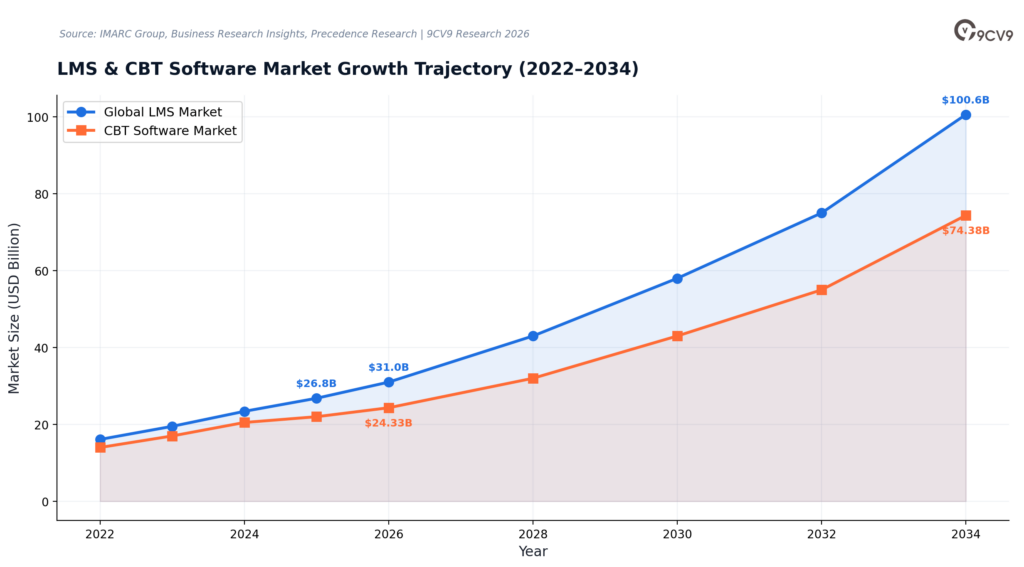
The numbers behind this transformation are remarkable. The global Learning Management System (LMS) market reached approximately USD 26.8 billion in 2025 and is forecast to expand to more than USD 100.6 billion by 2034, reflecting an impressive compound annual growth rate (CAGR) of nearly 16%. Alongside this explosive growth, enterprise-focused Corporate LMS solutions are projected to grow even faster, reaching over USD 72 billion by 2034. These figures demonstrate that companies are making long-term investments in structured customer education rather than viewing training as a one-time onboarding exercise.


At the same time, digital learning has firmly established itself as the dominant method of knowledge delivery. More than 72% of organisations worldwide have integrated digital learning platforms into their operations, while approximately 68% of all corporate training programmes are now delivered online. Learning Management Systems have achieved near-universal enterprise adoption, with around 93% of companies using an LMS to manage online learning. Cloud deployment has become the preferred approach, allowing organisations to deploy customer education programmes more quickly, integrate seamlessly with other business applications, and scale globally with minimal infrastructure investment.

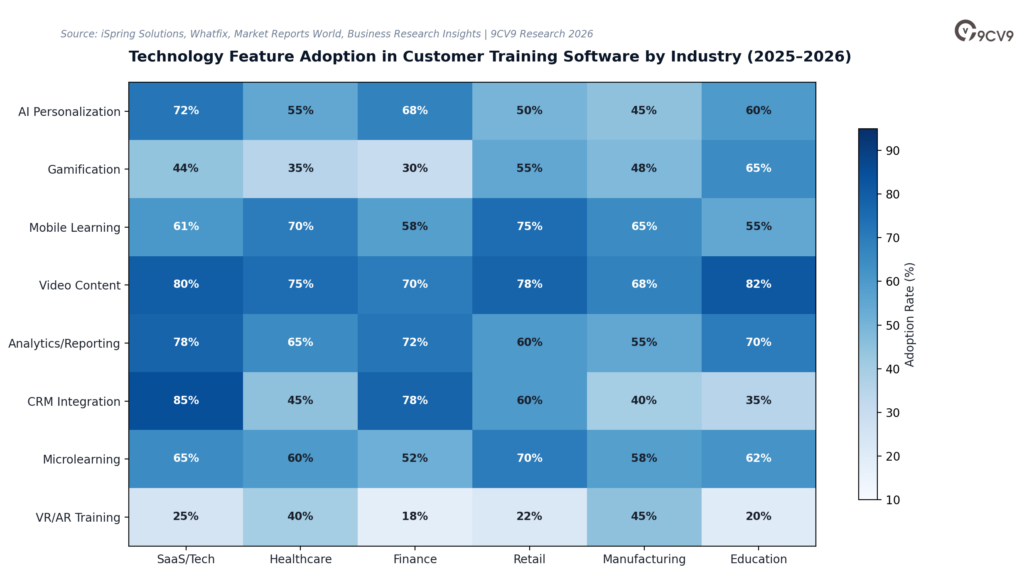
Customer expectations have also shifted dramatically. Today’s customers expect immediate access to educational resources, self-service knowledge, certification programmes, interactive onboarding experiences, and personalised learning journeys that adapt to their needs. They increasingly prefer to learn independently, at their own pace, through mobile devices, bite-sized lessons, interactive simulations, and AI-powered recommendations. As a result, customer training software vendors are investing heavily in adaptive learning technologies, microlearning capabilities, gamification features, mobile-first experiences, analytics dashboards, and generative AI functionality to create richer and more engaging educational environments.

Artificial intelligence has emerged as one of the biggest catalysts reshaping customer education. AI integration across learning platforms has grown by nearly 47%, while close to 40% of LMS platforms now include active AI capabilities. Enterprises are increasingly leveraging AI to personalise learning paths, recommend relevant courses, predict customer training needs, generate educational content, identify churn risks, and automate customer support interactions. Industry analysts expect AI adoption for customer retention initiatives to become nearly universal among enterprise organisations by 2026, fundamentally transforming how companies educate, support, and retain customers.

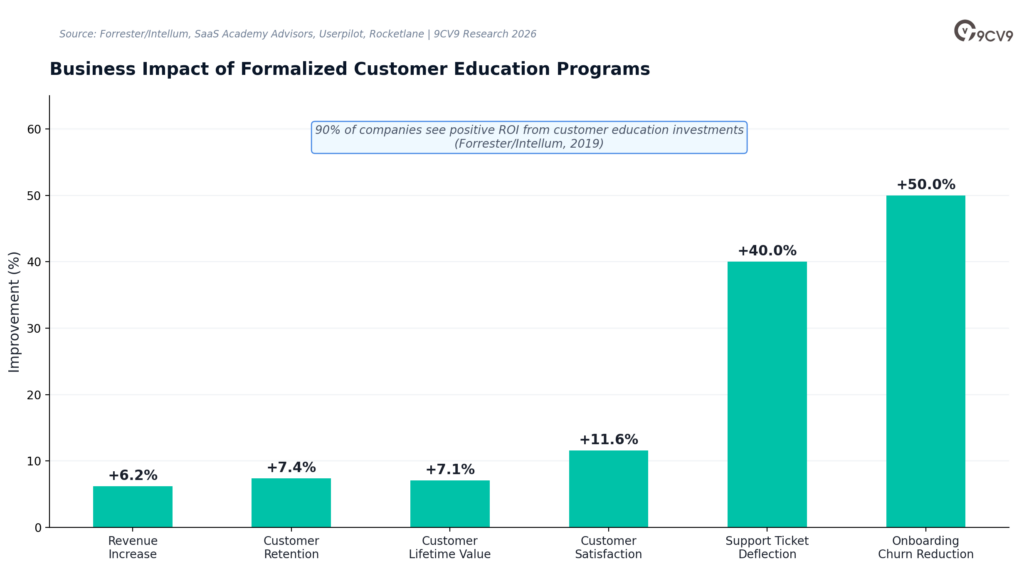
The business case for customer training has become equally compelling. Research consistently shows that organisations investing in structured customer education achieve measurable improvements across nearly every customer success metric. Companies with formal customer education programmes report higher customer satisfaction, stronger product adoption, increased customer lifetime value, improved retention rates, and higher revenues. An overwhelming 90% of organisations indicate that customer education delivers a positive return on investment, while businesses implementing structured training programmes experience measurable gains in revenue growth, customer loyalty, and long-term profitability. These outcomes demonstrate that customer education has evolved into a strategic revenue driver rather than simply a support function.

One of the strongest arguments for investing in customer training software lies in its direct impact on customer retention. In subscription-based business models, retaining existing customers has become significantly more valuable than acquiring new ones. Industry data consistently shows that customer acquisition costs remain approximately five times higher than customer retention costs, making every improvement in retention financially significant. Effective onboarding programmes alone can improve customer retention by as much as 50%, while structured education programmes substantially reduce onboarding-related churn and accelerate customers’ time-to-value. Customers who quickly understand how to use a product are considerably more likely to continue using it, expand their subscriptions, and advocate for the brand.

Customer training software is also transforming customer support operations. Instead of relying solely on support agents to resolve recurring questions, organisations are increasingly empowering customers through comprehensive self-service learning portals, interactive knowledge bases, certification programmes, and guided onboarding experiences. Well-designed self-service platforms can deflect between 40% and 60% of incoming customer queries, dramatically reducing support costs while simultaneously improving customer satisfaction. AI-powered customer service systems further enhance these efficiencies by automatically surfacing relevant educational content before customers submit support requests, creating faster and more cost-effective service experiences.

The shift towards microlearning has further accelerated customer engagement. Rather than requiring users to complete lengthy training sessions, organisations are delivering concise, highly targeted learning modules that fit naturally into daily workflows. Microlearning platforms consistently achieve significantly higher completion rates than traditional online courses, while learners retain more knowledge and engage more frequently with educational content. Combined with gamification techniques—including badges, leaderboards, achievements, progress tracking, and rewards—modern customer training platforms have substantially improved learner motivation, participation, and long-term engagement.

Regional trends further illustrate the rapid expansion of customer education technologies. North America continues to dominate the global LMS market thanks to its mature SaaS ecosystem, enterprise software adoption, and regulatory training requirements. However, Asia-Pacific is emerging as the fastest-growing region, driven by widespread digital transformation, mobile-first learning adoption, expanding enterprise technology investments, and a rapidly growing workforce requiring continuous upskilling. As online learning platforms approach one billion global users over the coming years, customer training software providers are increasingly tailoring their products for international scalability and multilingual learning environments.
Another defining trend in 2026 is the increasing integration of customer education with Customer Success platforms. Rather than operating independently, training software now works alongside customer relationship management (CRM) systems, product analytics platforms, health scoring tools, support platforms, marketing automation systems, and customer success solutions. This integration enables organisations to automatically recommend training content based on customer behaviour, trigger onboarding sequences when adoption slows, personalise educational journeys according to usage patterns, and proactively intervene before customers become disengaged or at risk of churn. The result is a far more intelligent, data-driven approach to customer education that directly supports revenue growth and long-term customer relationships.
Looking beyond technology, customer education itself is becoming a strategic differentiator. Organisations increasingly recognise that successful customer training programmes influence far more than product knowledge. They improve customer confidence, increase feature adoption, accelerate onboarding, strengthen brand loyalty, reduce support workloads, boost expansion opportunities, and contribute directly to overall customer experience. Businesses that consistently educate customers effectively create stronger partnerships, lower churn, and build sustainable competitive advantages that extend well beyond product functionality alone.
Against this rapidly evolving landscape, staying informed about the latest statistics has become essential for software vendors, customer success leaders, product managers, training professionals, learning and development teams, support managers, SaaS executives, digital transformation consultants, and enterprise decision-makers. Market data provides valuable insights into emerging technologies, evolving customer expectations, investment priorities, adoption patterns, return on investment, regional growth opportunities, and future industry direction.
This comprehensive guide presents the Top 115 Customer Training Software Statistics, Data & Trends in 2026, bringing together the latest research, market forecasts, adoption metrics, AI developments, customer education benchmarks, onboarding insights, retention data, self-service performance indicators, microlearning trends, gamification statistics, regional market analysis, and customer success metrics. Whether you are evaluating customer training software for your organisation, developing a customer education strategy, benchmarking industry performance, or exploring the future of enterprise learning, these carefully curated statistics provide a data-driven overview of one of the fastest-growing and most strategically important segments of the modern software industry.
Before we venture further into this article, we would like to share who we are and what we do.
About 9cv9
9cv9 is a business tech startup based in Singapore and Asia, with a strong presence all over the world.
With over ten years of startup and business experience, and being highly involved in connecting with thousands of companies and startups, the 9cv9 team has listed some important and crucial software tools in this review.
If you like to get your company listed in our top B2B software reviews, check out our world-class 9cv9 Media and PR service and pricing plans here.
Top 115 Customer Training Software Statistics, Data & Trends in 2026
01 | Market Size & Growth
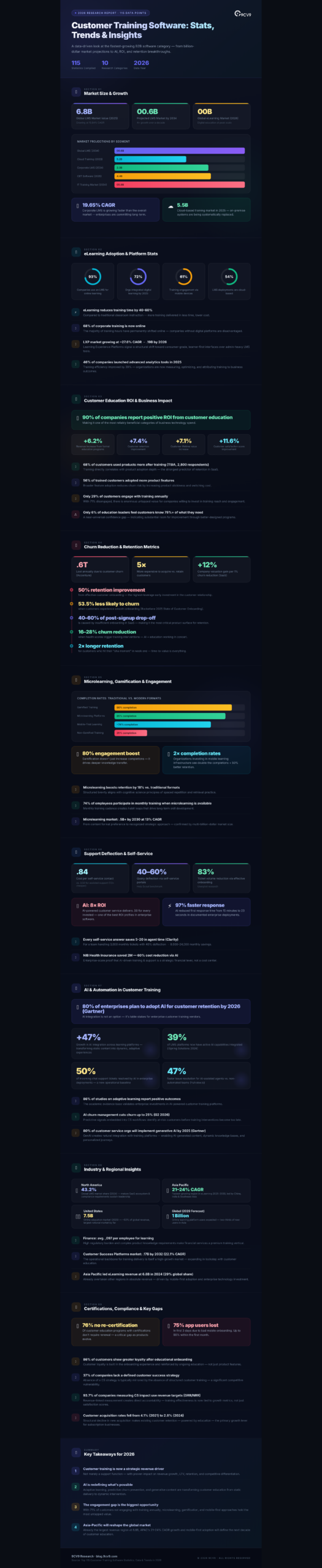
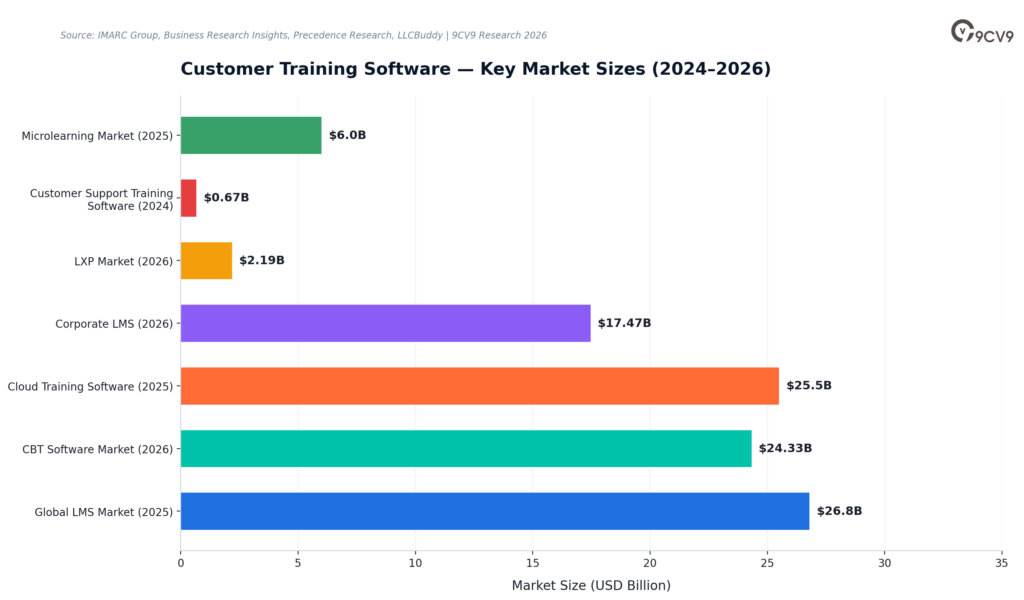
- The global LMS market was valued at USD 26.8 billion in 2025. This figure confirms that Learning Management Systems have become mission-critical enterprise infrastructure, with organizations worldwide investing heavily to digitize training delivery.
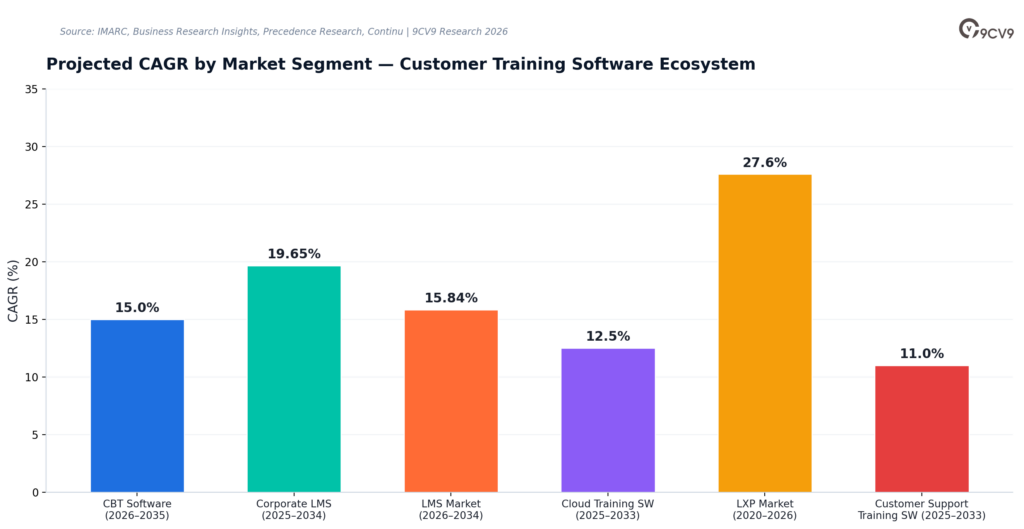
- The global LMS market is projected to reach USD 100.6 billion by 2034 at a CAGR of 15.84%. The near-quadrupling of market size over a decade underscores how deeply customer training software has embedded itself into organizational strategy.
- The Computer-Based Training (CBT) software market is valued at USD 24.33 billion in 2026. CBT platforms now rival general LMS solutions in scale, reflecting widespread demand for structured, interactive digital learning beyond simple document repositories.
- The CBT software market is expected to reach USD 74.38 billion by 2035 at a 15% CAGR. This trajectory highlights a sustained, not speculative, investment cycle where enterprise buyers are committing to digital training infrastructure over the long term.
- The Corporate LMS market is estimated at USD 17.47 billion in 2026. Enterprise-focused platforms command a substantial premium over consumer learning tools, driven by compliance requirements, integrations, and scale.
- The Corporate LMS market is forecast to reach USD 72.30 billion by 2034 at a CAGR of 19.65%. Corporate learning is outpacing overall market growth, as companies prioritize measurable skills development and structured customer education programs.
- The global cloud-based training software market is projected at USD 25.5 billion in 2025. The rapid shift to cloud deployment removes the barriers of on-premise infrastructure, making sophisticated customer training accessible to companies of all sizes.
- Cloud-based training software is expected to reach USD 55.2 billion by 2033. Sustained double-digit growth in cloud training confirms that on-premise legacy systems are being systematically replaced across industries.
- The Customer Support Training Software market was valued at USD 0.67 billion in 2024 and is expected to reach USD 1.67 billion by 2033 at an 11% CAGR. Though smaller in absolute terms, this segment’s growth rate reflects growing recognition that front-line customer service teams require purpose-built, specialized training tools.
- The global IT Training market reached USD 82.4 billion in 2025. IT and software-related customer training remains the single largest training vertical, fueled by the relentless pace of technological change requiring continuous upskilling.
- The global eLearning market is projected to reach approximately USD 400 billion by 2026. This landmark figure confirms that digital education has transitioned from a supplemental resource to the primary mode of corporate learning globally.
- The U.S. online education market is estimated at USD 87.5–99.8 billion in 2025, representing nearly 50% of global revenue. North America’s outsized share reflects the maturity of its enterprise learning infrastructure and the depth of SaaS adoption in corporate training.
02 | eLearning Adoption & Platform Statistics
- Over 72% of organizations globally integrated at least one digital learning platform by 2025. Digital learning is no longer a differentiator — it has become the baseline expectation for organizations serious about customer and employee development.
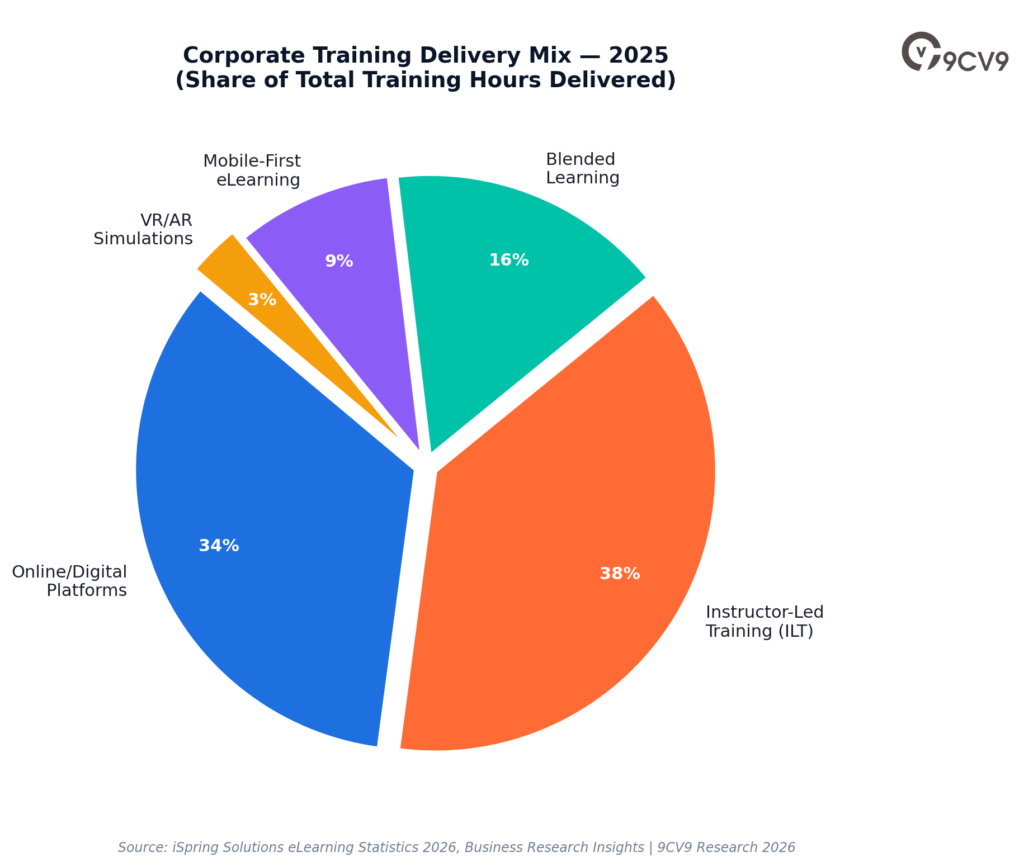
- Approximately 68% of corporate training programs are now delivered through online platforms. The majority of training hours have permanently shifted online, meaning companies without a robust digital training platform are systematically disadvantaged.
- 93% of companies globally use a Learning Management System (LMS) for online learning. Near-universal LMS adoption means platform quality and feature differentiation — not adoption itself — are now the critical competitive dimensions.
- Around 89–93% of companies worldwide use an LMS for online learning, with approximately 55% cloud-based and the remainder on-premise. Cloud-first LMS deployment is now the majority position, reducing IT overhead while enabling rapid feature deployment and global accessibility.
- The LXP (Learning Experience Platform) market is projected at USD 2.19 billion by 2026, up from approximately USD 0.5 billion in 2020. The LXP segment’s ~27.6% CAGR signals a structural shift toward consumer-grade learning interfaces that prioritize learner experience over administrative compliance tracking.
- Mobile-based learning accounts for nearly 61% of total user engagement across training platforms. With over 6.8 billion smartphone users worldwide, mobile-first design is no longer optional for customer training platforms — it is the primary interaction surface.
- AI integration in learning platforms has grown by 47%. This rapid AI adoption is transforming customer training from static content delivery to dynamic, adaptive learning that responds to individual user behavior in real time.
- eLearning reduces training completion time by 40–60% compared to traditional classroom-based instruction. The efficiency gains are compelling: companies can deliver more training in less time, reducing the productivity cost of customer education programs.
- By 2026, the Training eLearning Software market is valued at USD 1,693.65 million, projected to reach USD 2,918.75 million by 2035 at a CAGR of 6.2%. This steady growth reflects continuous demand from enterprises seeking scalable, technology-driven training solutions.
- In 2025, approximately 46% of companies launched advanced analytics tools that improved training efficiency by 39%. Data-driven training is maturing: organizations are not just delivering training but actively measuring, optimizing, and attributing it to business outcomes.
- About 44% of training vendors integrated gamification features in 2023, boosting course completion rates by 34%. Gamification has moved from novelty to norm, with measurable impact on completion demonstrating its practical value beyond engagement theater.
- The global digital education market was valued at USD 24.9 billion in 2024 and is projected to reach USD 215.2 billion by 2033 at a CAGR of 27.05%. Digital education — spanning both employee and customer training — is one of the fastest-growing technology categories of this decade.
- North America dominates the global LMS market with a 43.2% share in 2025. The region’s technology infrastructure maturity, regulatory compliance requirements, and high SaaS adoption rates create structural advantages that will sustain its market leadership.
03 | Customer Education ROI & Business Impact
- 90% of companies have seen a positive return on their customer education investments. The near-universal positive ROI signal makes customer training software one of the most reliably beneficial categories of business technology spend.
- Companies with formalized education programs see a 6.2% increase in revenue. Structured customer education is not just a support function — it is a growth lever, with trained customers converting, expanding, and referring at measurably higher rates.
- Companies with formalized customer education programs see a 7.4% increase in customer retention. In subscription businesses where every percentage point of retention compounds into significant ARR, the 7.4% retention improvement from education represents an outsized return.
- Companies with formalized education programs see a 7.1% increase in customer lifetime value. The LTV impact of customer education cascades across the entire relationship: educated customers renew more, expand more, and cost less to support.
- Companies with formalized customer education programs see an 11.6% increase in customer satisfaction scores. Customer satisfaction improvements of this magnitude typically require significant product investment — education achieves them through empowerment rather than features.
- 68% of customers reported using products more after undergoing a training program (TSIA survey of 2,800 respondents). Training directly correlates with product adoption depth, which is the single strongest predictor of customer retention in SaaS environments.
- 56% of trained customers said they used more product features than they had previously. Broader feature adoption reduces churn risk by increasing product stickiness and the perceived cost of switching to alternatives.
- Customers who receive educational or usage content post-sale have 20–30% higher product adoption and retention. Post-sale education is one of the highest-leverage retention investments available to customer success teams.
- 82% of respondents whose organizations used a dedicated third-party customer education vendor said it was very important or crucial to their program’s success. This validates the market for specialized customer training software providers over generic LMS deployments.
- 63% of high-success organizations use dedicated third-party vendors for customer education vs just 43% of low-success organizations. The gap between high and low performers in customer education is substantially explained by the commitment to purpose-built training tools.
- Only 19% of Education Service teams align their content to a product adoption curve or customer journey map. The vast majority of customer training programs are leaving impact on the table by not connecting educational content to specific customer lifecycle moments.
- Over a quarter (28%) of customers, on average, are not offered training at all, and nearly half (47%) have not utilized available education offerings. The underutilization of customer training represents one of the largest untapped value pools in enterprise software businesses.
- Only 6% of customer education teams feel their learners know 75% or more of what they need to know. This self-reported confidence gap underscores the persistent challenge of achieving true educational outcomes rather than just course completions.
- On average, 29% of a company’s customer base is engaged in training annually. With roughly 7 in 10 customers not actively engaging with training in any given year, there is substantial headroom for expanding training reach and compounding its impact.
- Companies with strong CX grow revenue 1.5–2× faster than competitors. Customer training software, as a primary enabler of positive customer experience, contributes directly to this revenue velocity differential.
04 | Churn Reduction & Retention Metrics
- Effective customer onboarding has been shown to improve customer retention by 50%. The magnitude of this retention improvement makes onboarding quality the highest-leverage early investment in the customer relationship.
- Customers who experience a smooth onboarding experience are 53.5% less likely to churn (Rocketlane 2025 State of Customer Onboarding). This is a causal, not merely correlational, relationship: the quality of onboarding training directly determines whether customers reach their “aha moment” before losing motivation.
- Companies with strong education content reduce onboarding-related churn by 15–20%. Education-led churn prevention is a durable strategy because it addresses the root cause — lack of product understanding — rather than symptoms like price sensitivity.
- Companies lose approximately USD 1.6 trillion per year due to customer churn (Accenture). Framed against this global figure, investments in customer training software are not a cost but a risk mitigation strategy of significant financial magnitude.
- Reducing churn by 1% can increase company valuation by 12%+ for subscription businesses. Even incremental churn improvements powered by better customer training translate into material enterprise value creation.
- Using customer health scores to trigger training interventions reduces churn by 16–28% in subscription models. Health-score-triggered training sequences represent the intersection of customer success analytics and customer education — a powerful combination.
- The average annual B2B SaaS churn rate in 2025 is 3.5%, with 2.6% voluntary (Recurly). This baseline churn rate is the benchmark against which customer training ROI should be measured: education-driven churn reduction directly attacks the voluntary component.
- Annual billing reduces churn by 40–50% compared to monthly billing. While not a training metric per se, annual billing predictability allows companies to invest more confidently in longer-horizon customer education programs.
- Structured onboarding reduces early-stage churn by 50%, and customers who hit their “aha moment” in week one stay 2× longer. Time-to-value acceleration through structured onboarding training is the single most impactful intervention in preventing early churn.
- AI-driven churn management platforms reported churn reductions of up to 25% when predictive signals were embedded directly into customer success workflows (G2 2026). AI is not only personalizing training content but also predicting which customers need training intervention before churn risk becomes critical.
- In SaaS, insufficient onboarding is responsible for 40–60% of post-signup user drop-off. The majority of customer losses happen before a product proves its value — making onboarding training arguably the most important product surface for customer retention.
- Companies that act on customer feedback see a 15–25% reduction in churn (Gartner/Forrester). Feedback-driven training iteration — adjusting educational content based on what customers are struggling with — creates a compounding improvement cycle.
- Companies with dedicated customer success teams retain customers at higher rates and close 25% more expansion revenue. Dedicated CSM investment and customer training investment are complements, not substitutes — the most successful programs deploy both.
- Enterprise customers churn at below 1.5% monthly, 5.8× better retention than SMB customers. The retention differential between enterprise and SMB underscores the importance of account-level onboarding and education programs that are scaled to customer size.
05 | Microlearning, Gamification & Engagement
- The corporate microlearning market is projected to reach approximately USD 5.5 billion by 2030 at a 13% CAGR. Microlearning’s growth into a multi-billion-dollar category confirms its transition from a content format preference to a recognized strategic training approach.
- The US microlearning market reached USD 2.96 billion in 2025 and is expected to surpass USD 5 billion within five years. The US market’s maturity and scale signal that microlearning has crossed the chasm from early-adopter LMS feature to mainstream enterprise training standard.
- The global microlearning platforms market size is estimated at between USD 6 billion and USD 15 billion in 2025 (Research & Markets). The wide range reflects different scoping methodologies, but both endpoints confirm microlearning’s substantial market presence.
- Microlearning platform case studies report 85% course completion rates. The contrast with typical long-form eLearning completion rates (often below 30%) demonstrates that format drives engagement in ways that content quality alone cannot.
- Microlearning boosts learner retention rates by 18% compared to traditional formats. Retention improvement — not just completion — is the meaningful learning metric, and microlearning’s structured brevity aligns with cognitive science principles of spaced repetition and retrieval practice.
- 74% of employees participate in monthly training programs when microlearning modules are available. Monthly training cadence is dramatically higher with microlearning, creating the habit loops that drive long-term skill development.
- 90% of learners appreciate the convenience and relevance of microlearning content. Near-universal learner satisfaction with the format is a strong signal that microlearning delivers training in a way that respects learners’ time and context.
- Gamified training achieves a 90% course completion rate, versus just 25% for non-gamified training (Continu). This 3.6× completion rate differential makes gamification one of the most statistically significant engagement levers available to customer training designers.
- Gamification can boost learner engagement by up to 80% (5Mins.ai). Engagement — not just completion — matters for actual knowledge transfer, and gamification’s 80% engagement uplift translates into meaningfully better learning outcomes.
- 67.7% of organizational behavior students reported that gamified courses were more motivating than traditional courses, irrespective of gender, age, and student status. The motivational effect of gamification is robust across demographic segments, making it a reliable engagement strategy for diverse customer training audiences.
- Organizations investing in mobile learning infrastructure see up to 2× higher completion rates and 50% better knowledge retention. The business case for mobile-first customer training investment is compelling: doubling completion while improving retention simultaneously.
- 40% of companies are using microlearning more than before the pandemic, making it a post-COVID standard. The pandemic permanently shifted baseline expectations for training format: learners experienced microlearning’s convenience and have not returned to preferring long-form alternatives.
- 50%+ monthly engagement is reported by microlearning platforms in case studies (Atrixware). Monthly engagement at this level is extraordinary for training platforms and approaches the engagement rates of consumer entertainment apps — which is precisely the design goal.
06 | Support Deflection & Self-Service
- Self-service training support costs USD 1.84 per contact compared to USD 13.50 for assisted support (Guideflow). The 7.3× cost differential between self-service and human-assisted support makes customer education the most capital-efficient support investment available.
- Well-designed self-service portals deflect 40–60% of incoming customer queries (Help Scout). Achieving half-to-two-thirds ticket deflection through self-service education is within reach for most organizations with structured knowledge base and training programs.
- Teams using AI-first support platforms see 60% higher ticket deflection rates and 40% faster response times compared to traditional help desks (Gartner). AI-powered training content surfaces the right answer at the right moment — transforming support from reactive to proactive.
- Effective onboarding can decrease support ticket volume by up to 83% by helping users understand the product before they need assistance (Userpilot). An 83% ticket reduction from onboarding training alone represents a transformative operational efficiency gain that compounds as the customer base grows.
- Every question answered through self-service saves USD 15–20 in agent time (Clarity). For a team handling 3,000 monthly tickets with 40% deflection, this equates to USD 18,000–24,000 in monthly savings.
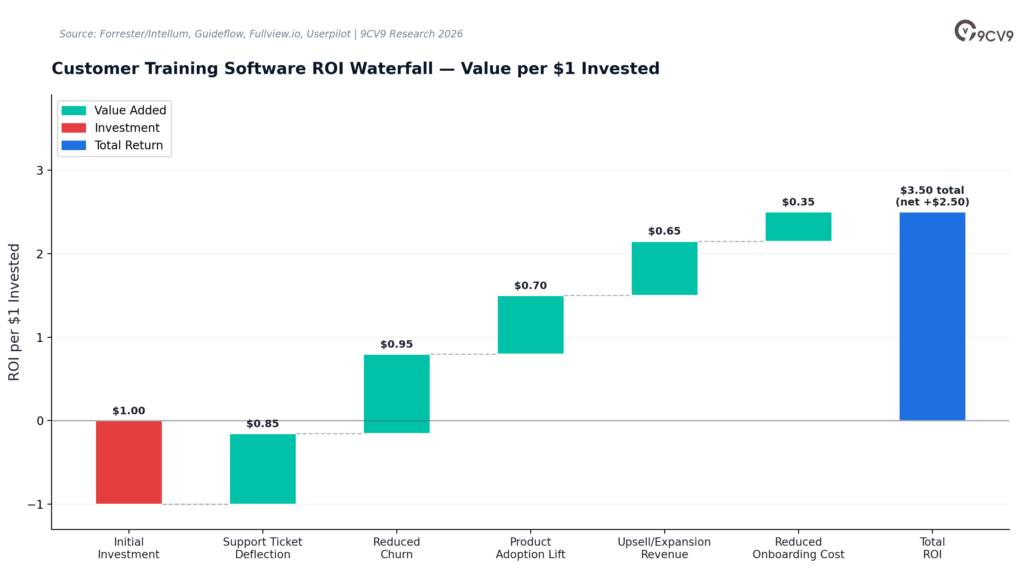
- AI-powered customer service systems deliver up to 8× ROI, returning an average of USD 3.50 for every USD 1 invested. The ROI profile of AI-enabled customer training and support investment compares favorably to almost any other category of enterprise software spend.
- Companies adopting AI and self-service effectively see 25–45% ticket deflection and ROI multipliers of 2×–5× within the first year (LiveChatAI 2025). First-year ROI realization at this scale makes AI-powered customer training software a compelling investment even under conservative assumptions.
- AI-powered tools reduced first response time by 97% — from 15 minutes to 23 seconds in documented cases (Pylon/AssemblyAI). Near-instantaneous response delivered through AI-trained knowledge bases redefines customer support expectations.
- AI agents now deflect over 45% of incoming customer queries, with retail and travel companies seeing deflection rates above 50% (Freshworks). Industry-specific deflection rates above 50% signal that AI-powered training and self-service is mature enough to carry the majority of routine support interactions.
- Customer acquisition costs 5× more than customer retention. The economic imperative for retention-through-training is straightforward: every dollar invested in customer education protects existing revenue that would cost five times more to recapture through new customer acquisition.
- AI-enabled customer service teams save 45% of the time spent on calls, resolve issues 44% faster, and experience a 35% improvement in support quality (Clarity). The triple impact on time, speed, and quality makes AI-augmented customer training support a structural operational advantage.
- Unity saved USD 1.3 million by deflecting 8,000 tickets with AI agents. This real-world case study quantifies the direct financial return of AI-powered training and self-service at enterprise scale.
- NIB Health Insurance achieved USD 22 million in savings, representing a 60% cost reduction, through AI-powered customer service (Fullview.io). Enterprise-scale cost reduction of this magnitude demonstrates that AI-driven customer training and support is not merely a productivity tool but a strategic financial lever.
07 | Industry & Regional Insights
- North America dominated the global LMS market in 2024 with a 43.2% market share. The region’s combination of regulatory compliance requirements, high per-employee training budgets, and mature cloud infrastructure sustains its market leadership position.
- US organizations reported that 34% of their training hours were delivered via online or computer-based platforms in 2025. While still below the global 68% online delivery average, the US figure reflects a large installed base of hybrid and blended learning programs.
- Asia Pacific is projected to grow at a 21–24% CAGR in eLearning between 2025 and 2030 — the fastest-growing region globally. Asia Pacific’s massive learner population, rising corporate investment, and mobile-first internet adoption create a structural growth engine that will reshape the global market’s center of gravity.
- Asia Pacific led global eLearning service revenue in 2024 with approximately 29% market share at USD 86.8 billion. Asia Pacific has already overtaken other regions in absolute eLearning revenue, driven primarily by China, India, and Southeast Asia’s scale.
- The U.S. online education market is estimated at USD 87.5 billion in 2025, representing approximately 50% of global revenue. The US remains the single largest national market for online education and customer training software by a wide margin.
- Online learning platforms are expected to reach approximately 1 billion users by 2029, with two-thirds of new users in Asia. The coming billion-user milestone will be driven overwhelmingly by Asian markets — a strategic consideration for global customer training software vendors.
- Docebo LMS serves 3,978 customers globally as of March 31, 2025. Docebo’s customer count provides a useful reference point for the enterprise segment of the LMS market, where individual customer contracts carry significant ACV.
- The global IT Training market is expected to reach USD 105.9 billion by 2034 at a CAGR of 2.70%. While IT training’s CAGR is modest relative to the broader LMS market, its absolute scale makes it the largest single training vertical.
- Finance organizations allocated an average of USD 1,097 per employee for learning. Per-employee training spend of over USD 1,000 in finance reflects the high regulatory compliance burden and complex product knowledge requirements of financial services customer education.
- The global Customer Success Platforms market was valued at approximately USD 1.86 billion in 2024 and is projected to reach USD 9.17 billion by 2032 at a 22.1% CAGR. Customer success platforms — the operational backbone for customer training delivery — are themselves a major high-growth market.
08 | AI & Automation in Customer Training
- 80% of enterprises plan to adopt AI for customer retention by 2026 (Gartner). The near-universal enterprise commitment to AI-driven retention strategies makes AI integration table stakes for customer training software vendors serving the enterprise segment.
- More than 50% of companies are now integrating AI into core customer success workflows (Gainsight 2025 Customer Success Index). AI has crossed the chasm in customer success from experimental to operational, with training personalization and churn prediction leading adoption.
- 86% of academic studies on adaptive learning report positive outcomes (Atrixware 2026 LMS Statistics Report). The strong academic evidence base for adaptive learning systems validates enterprise investments in AI-powered customer training platforms.
- AI has helped resolve close to 50% of incoming chat support tickets in documented enterprise deployments. The 50% automated resolution rate represents a new operational baseline for organizations combining customer training knowledge bases with AI support agents.
- 59% of research studies found that personalization via adaptive learning positively impacts academic performance (Wooclap). Personalized learning paths — the primary value proposition of AI in customer training — have an evidence-backed record of improving knowledge transfer outcomes.
- 39% of LMS platforms now have active AI capabilities integrated (iSpring Solutions 2026). AI capability is now present in a significant minority of LMS platforms and growing rapidly, with AI-native platforms beginning to displace feature-lagging incumbents.
- Companies with dedicated customer success managers see up to 25% higher net revenue retention (NRR) than those without (Benchmarkit). The human-plus-technology combination of CSMs equipped with AI-powered training platforms delivers the strongest retention outcomes.
- AI-assisted agents resolve issues 47% faster and achieve 25% higher first-contact resolution rates than teams without automation (Fullview.io). The performance multiplier from AI augmentation of human customer training and support teams is substantial and measurable.
- 80% of customer service organizations will implement generative AI by 2025 (Gartner). Generative AI’s rapid deployment in customer service creates natural integration opportunities with customer training platforms — enabling AI-generated training content, personalized learning recommendations, and dynamic knowledge base generation.
09 | Certifications, Compliance & Engagement
- 76% of customer education programs that have certifications do not require learners to get re-certified, even periodically (Thought Industries 2021). This certification gap is significant: certifications without renewal requirements fail to capture ongoing product updates and create a false sense of customer knowledge adequacy.
- On average, 29% of a company’s customer base is engaged in training in any given year (SkillJar 2022 Customer Education Benchmarks). With 71% of customers disengaged from available training annually, most customer education programs have not cracked the engagement problem at scale.
- Customer acquisition costs 5× more than customer retention. This foundational economic ratio is the ultimate justification for prioritizing customer training investment as a retention tool over marketing spend on new acquisition.
- Employees at companies offering eLearning are up to 36% more likely to stay long-term. Employee retention benefits from customer training software investments extend beyond the customer relationship — they also improve internal team stability.
- 46% of companies launched advanced analytics tools in 2025, improving training efficiency by 39%. The analytics layer of customer training software is maturing rapidly, enabling organizations to close the loop between training activity and business outcomes.
- Companies with blended learning dashboards saw a ~35% increase in multi-format engagement (TalentLMS, 2024). Multi-format training programs — combining synchronous and asynchronous delivery — drive significantly higher engagement than single-format approaches.
- Firms that run regular quarterly business reviews (QBRs) report 33% higher expansion revenue and lower rates of silent churn (Benchmarkit). QBRs function as scheduled training and alignment touchpoints — organizations that conduct them regularly create a structured education cadence that protects and expands revenue.
- 86% of customers express greater loyalty to businesses that provide educational and welcoming onboarding experiences. Customer loyalty — the ultimate output of effective training — is built in the onboarding experience and reinforced by ongoing education programs.
- Only 6% of customer education leaders feel their learners know 75% or more of what they need to know. The near-universal dissatisfaction with learner knowledge depth is both a challenge and an opportunity — indicating substantial room for improvement through better-designed, more comprehensive training programs.
- The global Customer Churn Software market, valued at USD 1.5 billion in 2023, is projected to reach USD 4.8 billion by 2032 at a 13.7% CAGR. The rapid growth of dedicated churn management software confirms that preventing customer loss — which training software directly addresses — is a high-priority enterprise technology investment.
- Bad mobile app onboarding results in the loss of an average of 75% of active users within the first three days and up to 90% within the first month. Mobile-first customer training platforms are essential precisely because most customer abandonment happens before users experience a product’s core value.
10 | Additional Key Data Points
- The Customer Success Management market was estimated at USD 2.20 billion in 2025 and forecast to grow to USD 2.68 billion in 2026 at ~21.7% CAGR through 2031 (Mordor Intelligence). The CS platform market’s explosive growth is directly linked to enterprise demand for customer training orchestration, health scoring, and lifecycle management.
- 37% of companies do not have a clearly defined customer success strategy (SurveySparrow). The absence of a CS strategy is typically mirrored by the absence of a structured customer training program — representing a significant competitive vulnerability.
- 93.7% of companies that measure customer success impact are using a revenue target (GRR or NRR). Revenue-linked CS measurement creates direct accountability for customer training effectiveness as a revenue protection and growth mechanism.
- Customer acquisition rates in subscription businesses fell from 4.1% in 2021 to 2.8% in 2024, driving retention-first strategies (2025 State of Subscriptions). The structural decline in new customer acquisition rates makes existing customer retention — powered by education — the primary growth lever.
- Telecom providers using AI-driven training and intervention programs cut churn by up to 15%. Even in notoriously high-churn telecom environments, AI-powered customer education interventions deliver statistically meaningful retention improvements.
Conclusion
The customer training software industry has reached a defining moment in 2026. What was once considered a supplementary feature for onboarding new users has evolved into a strategic business platform that influences customer adoption, retention, expansion revenue, operational efficiency, and long-term competitive advantage. The statistics presented throughout this report paint a consistent picture: organisations that invest in structured customer education are positioning themselves to outperform competitors in an increasingly digital and customer-centric economy.
Perhaps the clearest indicator of this transformation is the unprecedented growth of the broader learning technology market. With the global Learning Management System (LMS) market projected to exceed USD 100 billion over the next decade and Corporate LMS solutions expanding even faster, enterprise investment in digital learning infrastructure is accelerating rather than slowing. These forecasts demonstrate that customer education is no longer viewed as a discretionary expense but as a long-term strategic investment capable of generating measurable business returns.
The widespread adoption of learning platforms further reinforces this trend. Today, the overwhelming majority of organisations already utilise LMS platforms, while digital learning has become the dominant method for delivering both employee and customer education. Cloud-native deployment models, mobile accessibility, and scalable online delivery have removed many of the traditional barriers that once limited customer training initiatives. As organisations continue expanding globally, digital customer education platforms provide the flexibility needed to train thousands—or even millions—of users consistently across multiple regions and languages.
Equally significant is the growing evidence linking customer education directly to business performance. The data consistently shows that companies implementing formal customer education programmes experience higher customer retention, increased customer lifetime value, stronger customer satisfaction, improved product adoption, and measurable revenue growth. Rather than serving purely educational purposes, customer training has become an integral component of customer success, revenue operations, and sustainable business growth. For subscription-based businesses in particular, where recurring revenue depends heavily on long-term customer engagement, structured education has become one of the most effective tools for protecting and expanding recurring revenue streams.
Customer onboarding remains one of the most influential stages in the customer journey, and the statistics clearly illustrate its importance. Organisations delivering structured onboarding experiences consistently reduce early-stage churn while accelerating customers’ time-to-value. When users quickly understand how to derive value from a product, they are more likely to continue using it, adopt additional features, renew subscriptions, and recommend the solution to others. Conversely, insufficient onboarding continues to be one of the leading causes of customer abandonment across SaaS and digital product businesses, making onboarding excellence a critical competitive differentiator.
The rapid integration of artificial intelligence represents another defining trend shaping the future of customer training software. AI-powered recommendations, adaptive learning paths, predictive analytics, automated content generation, personalised learning experiences, and intelligent customer support are fundamentally changing how organisations educate their customers. Instead of offering identical learning experiences to every user, modern platforms increasingly tailor educational journeys according to customer behaviour, product usage, proficiency levels, and predicted business outcomes. As AI adoption continues to accelerate across customer success and enterprise software ecosystems, intelligent customer education will likely become the industry standard rather than a premium capability.
Microlearning, gamification, and mobile-first learning have also emerged as major drivers of learner engagement. Traditional long-form training programmes are increasingly giving way to shorter, more interactive learning experiences that better align with modern user behaviour. Organisations embracing these approaches consistently report higher course completion rates, stronger knowledge retention, increased learner participation, and more frequent engagement with educational content. These improvements ultimately translate into faster product adoption, greater customer confidence, and stronger long-term loyalty.
The operational benefits of customer training software extend well beyond education itself. Self-service knowledge bases, interactive onboarding, AI-powered support agents, and structured learning portals continue to reduce customer support costs by deflecting significant volumes of incoming support requests. Instead of relying exclusively on customer service representatives to answer repetitive questions, organisations increasingly empower customers to find solutions independently. This not only reduces operational expenditure but also creates faster, more satisfying customer experiences while allowing support teams to focus on more complex, high-value issues.
Regional developments also highlight the industry’s expanding global footprint. While North America continues to lead in enterprise learning technology adoption, Asia-Pacific is emerging as the fastest-growing market due to widespread digital transformation, rapid SaaS adoption, increasing corporate investment, and expanding online learning ecosystems. These regional growth patterns indicate that customer training software is becoming an essential component of business operations across both mature and emerging markets, creating substantial opportunities for software vendors and enterprise buyers alike.
Another notable insight is the increasing convergence between customer training platforms and broader customer success ecosystems. Modern organisations are no longer treating education as an isolated function. Instead, customer training software is becoming deeply integrated with CRM platforms, customer health scoring systems, product analytics, support platforms, marketing automation tools, and customer success platforms. This integration enables businesses to deliver timely educational interventions, identify customers at risk of churn, personalise learning pathways, and directly connect education metrics with commercial outcomes such as renewals, upsells, and expansion revenue.
Despite these impressive advances, the statistics also reveal significant opportunities for improvement. Many organisations still fail to offer training to large portions of their customer base, while learner engagement remains relatively low across many customer education programmes. Few education teams currently align their training content with customer journey stages, and only a small minority believe their customers possess sufficient product knowledge. These gaps suggest that, although the technology has matured considerably, many organisations have yet to fully realise the strategic potential of customer education.
Looking ahead, customer training software is expected to become even more intelligent, personalised, measurable, and deeply embedded within enterprise technology stacks. Future platforms will likely leverage generative AI to create dynamic educational content automatically, predict learning requirements before customers encounter problems, personalise every stage of the customer journey, and continuously optimise educational experiences based on behavioural data. Learning analytics will become increasingly sophisticated, allowing organisations to demonstrate direct links between customer education and measurable business outcomes such as retention, expansion revenue, product utilisation, customer satisfaction, and profitability.
For business leaders, customer success executives, product managers, learning and development professionals, software buyers, and enterprise decision-makers, these trends carry an important message. Customer education should no longer be viewed merely as a support initiative or onboarding programme. Instead, it should be recognised as a strategic growth engine capable of improving customer outcomes while strengthening business performance across every stage of the customer lifecycle. Organisations that invest early in scalable, AI-enabled, data-driven customer training platforms will be significantly better positioned to meet rising customer expectations, reduce churn, accelerate adoption, and maximise long-term customer value.
Ultimately, the Top 115 Customer Training Software Statistics, Data & Trends in 2026 demonstrate that the future of customer success will be increasingly shaped by education. As digital transformation accelerates, artificial intelligence matures, and customer expectations continue to evolve, organisations that empower customers through effective learning experiences will not only build stronger relationships but also create lasting competitive advantages. Whether you are evaluating customer education technologies, benchmarking industry performance, planning your customer success strategy, or identifying future investment opportunities, these statistics provide valuable evidence that customer training software is rapidly becoming one of the most influential technologies driving business growth, customer loyalty, and enterprise success in 2026 and beyond.
If you find this article useful, why not share it with your hiring manager and C-level suite friends and also leave a nice comment below?
We, at the 9cv9 Research Team, strive to bring the latest and most meaningful data, guides, and statistics to your doorstep.
To get access to top-quality guides, click over to 9cv9 Blog.
To hire top talents using our modern AI-powered recruitment agency, find out more at 9cv9 Modern AI-Powered Recruitment Agency.
People Also Ask
What is customer training software?
Customer training software is a digital platform that helps businesses educate customers through online courses, onboarding programmes, certifications, tutorials, and self-service learning resources to improve product adoption and customer success.
Why is customer training software important in 2026?
Customer training software helps businesses reduce support costs, increase product adoption, improve customer retention, accelerate onboarding, and deliver personalised learning experiences using AI and automation.
How large is the customer training software market in 2026?
The customer training software market continues to expand rapidly alongside the global LMS market, driven by enterprise digital transformation, AI adoption, cloud learning platforms, and customer education investments.
What are the biggest customer training software trends in 2026?
Major trends include AI-powered learning, adaptive education, microlearning, gamification, mobile learning, learning analytics, personalised onboarding, self-service knowledge, and customer success integration.
How does customer training software improve customer retention?
Well-designed training programmes help customers achieve value faster, reduce frustration, improve product knowledge, and increase satisfaction, making customers more likely to renew subscriptions.
What industries use customer training software?
Customer training software is widely used across SaaS, healthcare, finance, manufacturing, education, telecommunications, retail, cybersecurity, and enterprise technology industries.
How does AI improve customer training software?
AI personalises learning paths, recommends relevant content, automates course creation, predicts customer needs, analyses learner behaviour, and improves customer engagement throughout the learning journey.
What is a customer education platform?
A customer education platform enables organisations to create, manage, deliver, and measure learning experiences that help customers successfully adopt and maximise products or services.
How does customer onboarding software differ from customer training software?
Onboarding software focuses on helping new users get started, while customer training software supports continuous education, advanced learning, certifications, and long-term product adoption.
Why are LMS platforms essential for customer education?
Learning Management Systems centralise course management, learner tracking, certifications, analytics, assessments, and content delivery while supporting large-scale customer education programmes.
What is microlearning in customer training?
Microlearning delivers short, focused lessons that are easier to complete, improve knowledge retention, increase learner engagement, and fit naturally into customers’ daily workflows.
How does gamification improve customer training?
Gamification motivates learners using badges, points, achievements, certificates, and leaderboards, encouraging higher course completion rates and stronger engagement.
What role does customer training play in customer success?
Customer training accelerates product adoption, reduces churn, increases customer satisfaction, improves feature usage, and supports long-term customer success strategies.
Can customer training software reduce support costs?
Yes. Self-service learning resources, tutorials, and knowledge bases reduce repetitive support requests, allowing customer support teams to focus on more complex issues.
What features should businesses look for in customer training software?
Important features include AI recommendations, mobile learning, analytics, certifications, assessments, integrations, gamification, multilingual support, reporting, and cloud deployment.
How does customer training software improve product adoption?
Training helps users understand features faster, builds confidence, reduces onboarding friction, and encourages customers to use products more effectively.
What is adaptive learning?
Adaptive learning uses AI and learner behaviour to personalise educational content, ensuring customers receive relevant lessons based on their knowledge and progress.
What are learning analytics?
Learning analytics measure learner progress, course completion, engagement, assessment performance, and customer outcomes to improve educational programmes and business decisions.
Why is mobile learning growing rapidly?
Customers increasingly prefer learning anytime and anywhere using smartphones and tablets, making mobile-first customer education a key competitive advantage.
How does customer training software support SaaS businesses?
SaaS companies use training software to improve onboarding, reduce churn, increase feature adoption, support customer success teams, and drive recurring revenue growth.
What is customer education ROI?
Customer education ROI measures business outcomes such as increased retention, lower support costs, higher customer satisfaction, faster onboarding, and improved revenue.
Which region leads the customer training software market?
North America remains the largest market, while Asia-Pacific is experiencing the fastest growth due to digital transformation and increasing enterprise technology investments.
How does cloud-based customer training software benefit businesses?
Cloud platforms offer scalability, automatic updates, remote accessibility, lower infrastructure costs, easier integrations, and faster global deployment.
Can customer training software integrate with CRM systems?
Yes. Many platforms integrate with CRM, customer success, marketing automation, help desk, and product analytics solutions to create personalised learning experiences.
What is self-service customer education?
Self-service education enables customers to access courses, tutorials, videos, documentation, and knowledge bases independently without contacting support teams.
How does certification improve customer engagement?
Certification programmes motivate learners to complete courses, validate their expertise, increase product proficiency, and strengthen long-term customer loyalty.
What challenges do organisations face with customer education?
Common challenges include creating engaging content, maintaining course updates, measuring ROI, increasing learner participation, and personalising training at scale.
How is generative AI changing customer education?
Generative AI helps create training materials faster, generate quizzes, personalise lessons, answer learner questions, and improve educational efficiency.
What metrics should businesses track in customer training programmes?
Key metrics include course completion rates, learner engagement, certification rates, product adoption, onboarding time, customer satisfaction, retention, and support ticket reduction.
Why should businesses follow customer training software statistics in 2026?
Customer training software statistics help organisations understand market trends, benchmark performance, identify emerging technologies, optimise customer education strategies, and make informed investment decisions.
Sources
IMARC Group Business Research Insights Data Insights Market Edstellar Custify Market Reports World Guideflow iSpring Solutions Continu Atrixware Precedence Research SaaS Academy Advisors Marketing LTB SerpSculpt Ringly Userpilot Whatfix 5Mins.ai Wooclap Research & Markets LiveChatAI Pylon Fullview Freshworks Clarity Mordor Intelligence Archive Market Research Webmobinfo


