
Key Takeaways
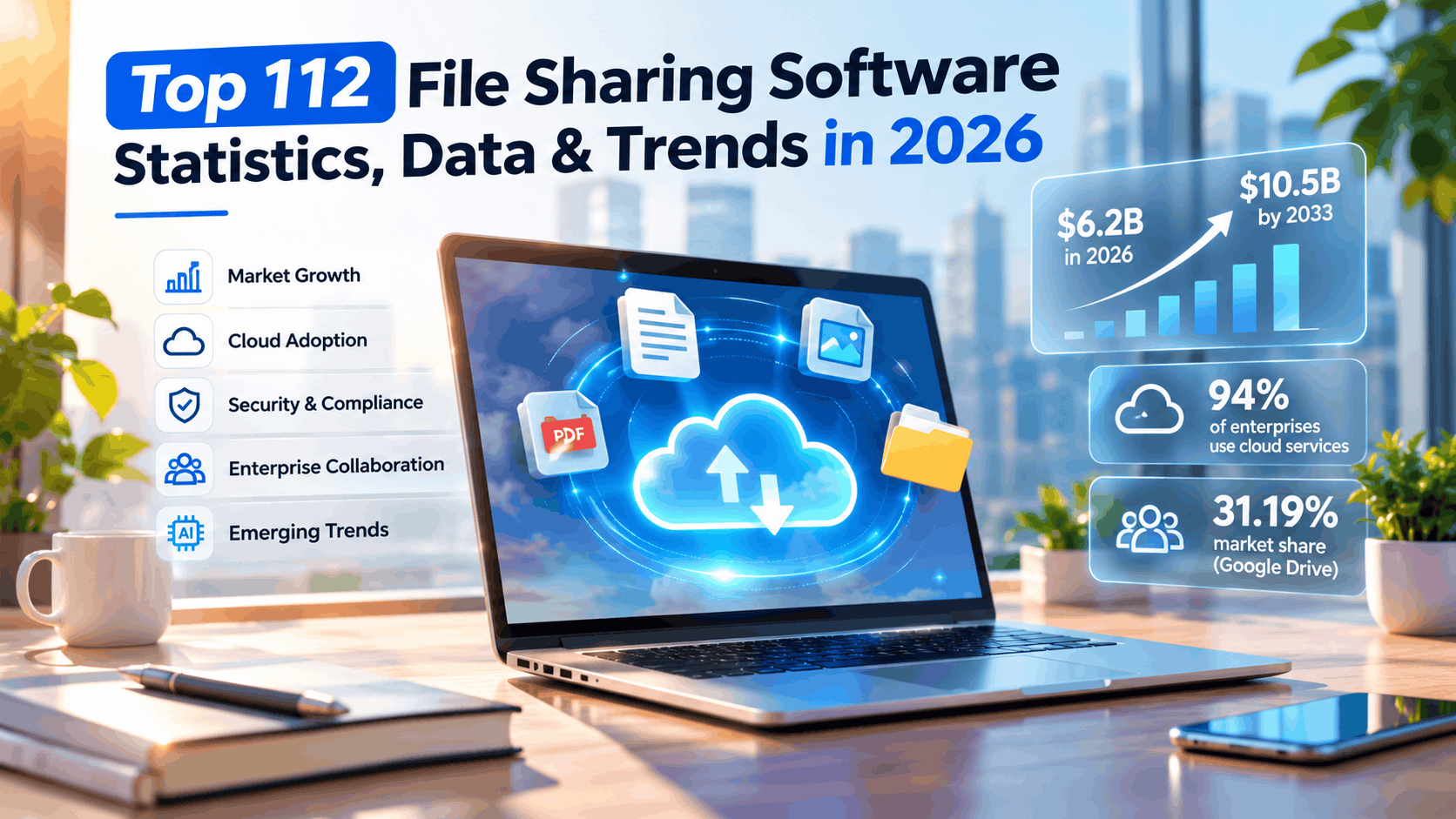
- File Sharing Software Market Growth: The global file sharing software market is projected to reach $6.2 billion in 2026 and $10.5 billion by 2033, driven by increasing demand for secure cloud storage, enterprise collaboration, and digital transformation.
- Cloud Adoption and Enterprise Collaboration: Approximately 94% of enterprises use cloud services, while 82% adopt hybrid cloud storage models, highlighting the growing importance of cloud-based file sharing software for remote work, productivity, and business operations.
- Cybersecurity and AI-Powered File Sharing Trends: With average data breach costs reaching $4.44 million in 2025, businesses are prioritizing encryption, zero-trust security, data loss prevention, and AI-powered file management to protect sensitive information and improve collaboration.
File sharing software in 2026 is experiencing rapid growth, with the global market projected to reach $6.2 billion and expand to $10.5 billion by 2033. Key trends include cloud storage adoption, AI-powered collaboration, cybersecurity, and secure file transfers. Explore 112 essential statistics covering market growth, enterprise adoption, leading platforms, and emerging technologies.
File sharing software has become an essential component of modern business operations, transforming how organizations store, transfer, access, and collaborate on digital information. As businesses increasingly embrace cloud computing, hybrid work environments, and digital transformation, the demand for secure, scalable, and efficient file sharing solutions continues to accelerate. From small businesses managing everyday documents to multinational enterprises transferring sensitive information across borders, file sharing technology plays a critical role in maintaining productivity, operational efficiency, and data security.
Also, read our article on the Top 10 File Sharing Software To Try.

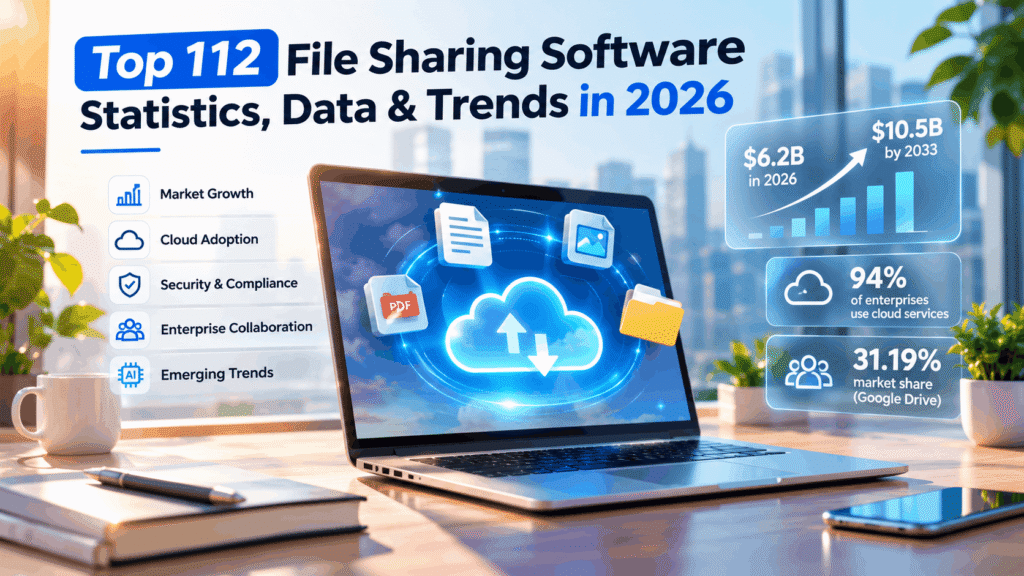
In 2026, the global file sharing software market is experiencing substantial growth, supported by rising enterprise adoption, increasing cybersecurity requirements, and advancements in cloud-based collaboration technologies. Industry forecasts estimate that the broader file sharing software market could reach $6.2 billion in 2026 and expand to $10.5 billion by 2033, representing a compound annual growth rate (CAGR) of 7.6%. Meanwhile, the enterprise file synchronization and sharing (EFSS) market is projected to grow from $11.96 billion in 2026 to $20.33 billion by 2031, highlighting the growing importance of centralized file management and secure collaboration platforms. Market estimates vary depending on the software categories and services included in each analysis.
Cloud adoption is another major force reshaping the file sharing software industry. Approximately 94% of enterprises worldwide use some form of cloud service, while an estimated 60% of corporate data is now stored in cloud environments. Furthermore, around 82% of organizations rely on hybrid cloud storage models, combining public and private infrastructure to balance accessibility, performance, and security. These developments demonstrate how businesses are moving beyond traditional on-premises file servers toward more flexible, cloud-enabled file sharing ecosystems.

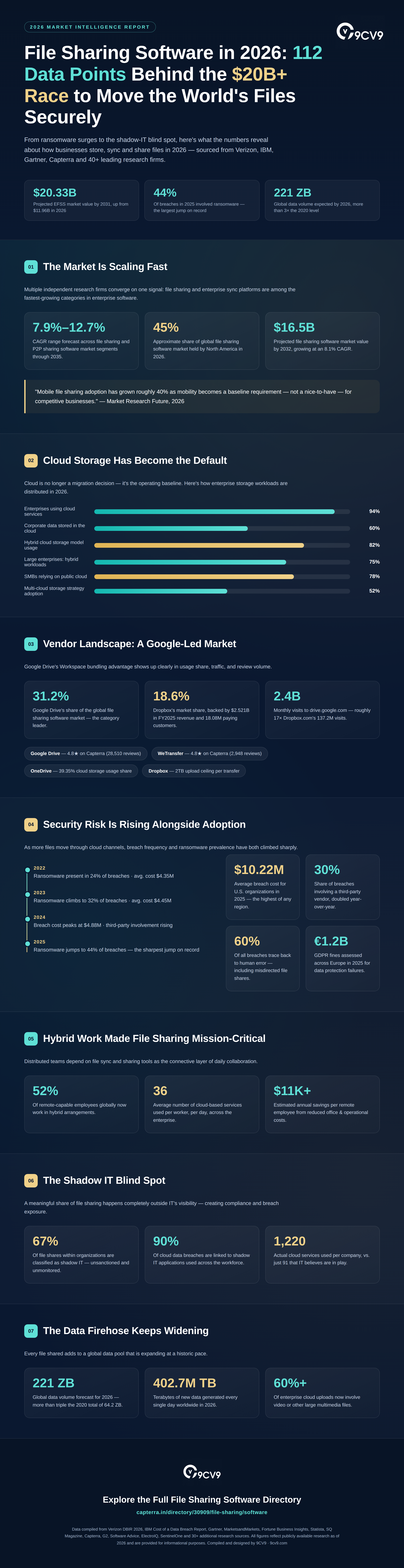
Leading file sharing platforms such as Google Drive, Microsoft OneDrive, Dropbox, Box, and WeTransfer continue to influence how individuals and businesses exchange digital content. According to vendor technographic data, Google Drive accounts for approximately 31.19% of the file sharing software market, followed by Dropbox at 18.61% and Box at approximately 13%. These figures illustrate the competitive landscape of the industry, where established providers compete through storage capacity, collaboration capabilities, integration options, pricing, and enterprise security features.
However, the rapid expansion of digital file sharing also introduces significant cybersecurity and compliance challenges. The average global cost of a data breach reached $4.44 million in 2025, while ransomware was involved in approximately 44% of analyzed breaches. Organizations must increasingly address unauthorized file access, shadow IT, accidental data exposure, third-party vulnerabilities, and evolving regulatory requirements. Consequently, encryption, data loss prevention (DLP), zero-trust security, automated access controls, and secure managed file transfer solutions are becoming increasingly important considerations when selecting file sharing software.
Emerging technologies are also redefining the future of file sharing and collaboration. Artificial intelligence, machine learning, automated file classification, intelligent search, and advanced threat detection are helping organizations improve information management and strengthen security. At the same time, growing volumes of multimedia content, remote collaboration requirements, and cross-platform integrations are encouraging software providers to deliver faster, more intelligent, and more accessible file sharing experiences.
Understanding these developments is essential for business leaders, IT professionals, cybersecurity specialists, software vendors, and organizations evaluating digital collaboration investments. Reliable file sharing software statistics provide valuable insights into market opportunities, enterprise adoption patterns, competitive positioning, security risks, and emerging technology trends.
This comprehensive guide explores the Top 112 File Sharing Software Statistics, Data & Trends in 2026, covering global market size and growth forecasts, cloud storage adoption, leading software providers, managed file transfer solutions, cybersecurity threats, regulatory compliance, remote work collaboration, shadow IT, and industry-specific developments. By examining these statistics and trends, businesses can better understand the evolving file sharing software landscape, identify opportunities for operational improvement, and make more informed decisions about their digital infrastructure and collaboration strategies.
Before we venture further into this article, we would like to share who we are and what we do.
About 9cv9
9cv9 is a business tech startup based in Singapore and Asia, with a strong presence all over the world.
With over ten years of startup and business experience, and being highly involved in connecting with thousands of companies and startups, the 9cv9 team has listed some of the top and best companies/tools in this review.
If you like to get your company listed in our top B2B software reviews, check out our world-class 9cv9 Media and PR service and pricing plans here.
Top 112 File Sharing Software Statistics, Data & Trends in 2026
Market Size & Growth
- The global file sharing software market is valued at approximately $2.5 billion in 2024 and is projected to reach $5.771 billion by 2035, growing at a CAGR of 7.9%, reflecting sustained enterprise demand for secure collaboration tools.
- Peer-to-peer file sharing software alone is estimated at $1.4 billion in 2026 and is expected to climb to $4.07 billion by 2035, driven by a robust 12.7% CAGR fueled by blockchain integration and decentralized platform adoption.
- Another industry analysis places the broader file sharing software market at $6.2 billion in 2026, forecasting growth to $10.5 billion by 2033 at a 7.6% CAGR, underscoring strong demand across IT and telecom sectors.
- A separate market study values the file sharing software industry at $8.5 billion in 2024, projecting expansion to $18.5 billion by 2033 at a 9.5% CAGR, powered by hybrid and remote work adoption.
- Enterprise File Synchronization and Sharing (EFSS) platforms are forecast to grow from $11.96 billion in 2026 to $20.33 billion by 2031, posting an 11.2% CAGR as organizations replace legacy file servers with modern sync platforms.
- The file sharing software market is projected to hit $16,540.75 million by 2032, growing at an 8.1% CAGR between 2026 and 2032, with cloud-based deployment capturing the largest 54.2% segment share.
- One long-range forecast estimates the global file sharing software market will reach $12.5 billion by 2035, growing at a 9.3% CAGR, as businesses prioritize secure, accessible collaboration platforms.
- Mobile file sharing solutions have recorded roughly 40% growth in user adoption, signaling how mobility has become a core requirement for competitive, fast-paced business operations.
- Cloud file sharing services have grown by more than 30% in the past year alone, driven by the convenience and scalability cloud infrastructure offers to businesses of every size.
- The media and entertainment sector generates the highest revenue share within the file sharing software market, largely due to the frequent transfer of large video, image, and audio files.
- North America commands the largest regional share of the file sharing software market, holding approximately 45% of global market share thanks to advanced infrastructure and strict data protection regulation.
- A separate forecast projects North America’s file sharing software share at 38.7% by 2032, with the United States alone accounting for 23.5% of the global market.
Cloud Storage & Enterprise Adoption
- The global cloud storage market is projected to grow from $172.97 billion in 2026 to $380.15 billion by 2031, expanding at a striking 17.1% CAGR fueled by AI-driven data growth and analytics workloads.
- Roughly 94% of enterprises worldwide now use some form of cloud service, including storage, analytics, or infrastructure platforms, showing cloud adoption has become the operational default.
- Approximately 60% of all corporate data is now stored in the cloud, a dramatic rise from just 30% in 2015, highlighting the decade-long migration away from on-premise file servers.
- Around 82% of organizations rely on hybrid cloud storage models that combine public cloud infrastructure with private systems, balancing flexibility with data control.
- By 2026, the total volume of data stored in cloud environments is expected to exceed 200 zettabytes globally, illustrating the sheer scale of enterprise and consumer file storage.
- Cloud backup adoption climbed to over 65% among small and mid-sized businesses, largely driven by growing concerns over ransomware attacks targeting business-critical files.
- More than 90% of large enterprises in the United States now rely on cloud storage for disaster recovery and business continuity planning.
- Public cloud storage workloads account for 65% of total storage usage globally, while private cloud remains the choice for 42% of regulated enterprises handling sensitive files.
- Large enterprises run approximately 75% of their storage workloads in hybrid cloud environments, compared to SMBs, which lean heavily on public cloud at 78%.
- Multi-cloud storage strategies have been adopted by 52% of enterprises, reflecting a deliberate move to avoid vendor lock-in for critical file assets.
- The BFSI (banking, financial services and insurance) sector is projected to hold a 22.22% share of cloud storage demand in 2026, driven by digitalization of financial recordkeeping.
- The large enterprise segment accounts for a dominant 70.30% of cloud-based storage revenue globally, reflecting the scale of remote workforce and data management needs at big organizations.
- The public cloud segment is projected to command 63.71% of the cloud storage market share globally in 2026, driven by rising end-user spending on scalable storage infrastructure.
- Among EU enterprises purchasing cloud services, approximately 71.53% use it specifically for file storage, closely trailing office software adoption at 71.69%.
- Large EU enterprises reached 84.67% paid cloud adoption in 2025, up 6.9 percentage points from 2023, showing accelerating enterprise reliance on cloud-based file infrastructure.
Vendor Market Share & Platform Comparison
- Google Drive leads the file sharing software market with a 31.19% market share, followed by Dropbox at 18.61% and Box at approximately 13%, according to vendor technographic data.
- Google Drive serves over 1 billion users globally and functions as the storage backbone for more than 3 billion monthly active Google Workspace users.
- Dropbox closed fiscal 2025 with $2.521 billion in revenue and 18.08 million paying customers, underscoring its position as a leading premium file sharing provider.
- Google Drive’s ecosystem spans more than 2 billion registered users, with an estimated 6 to 8 million paying Google Workspace customers driving enterprise revenue.
- Microsoft OneDrive holds 39.35% usage share among cloud storage users, edging out Apple iCloud at 38.89% in comparative platform usage data.
- In direct file-sharing category comparisons, Google Drive holds a 7.43% share of the market versus Dropbox’s 1.94%, reflecting Drive’s dominant reach among business users.
- Drive.google.com recorded approximately 2.4 billion visits in a single month compared to Dropbox.com’s 137.2 million, a nearly 17-fold traffic gap between the two platforms.
- File sharing via shared links or email is used by more than 75% of Google Drive users for collaborative projects, highlighting how deeply link-sharing is embedded in daily workflows.
- Dropbox’s block-level sync technology processes incremental file edits up to 40% faster than Google Drive for very large files, giving it an edge for media-heavy workflows.
- Google Drive supports individual file uploads of up to 5 TB for paid users, while imposing a 750 GB daily upload cap per account across the platform.
- Dropbox allows uploads of up to 2 TB at a time, giving it a notably higher single-transfer ceiling than Google Drive’s 750 GB daily limit.
- Around 60% of enterprise cloud uploads now include video or multimedia assets, driving demand for higher file-size limits and faster large-file transfer tools.
- WeTransfer’s free tier is capped at 2 GB per transfer with files expiring after 7 days, positioning it as a lightweight tool for one-off external file deliveries rather than persistent storage.
- On Capterra, WeTransfer holds a 4.8 out of 5 rating from nearly 3,000 reviews, with 92% of reviewers saying they would recommend the product to others.
- Google Drive holds a 4.8 out of 5 rating on Capterra based on more than 28,000 verified reviews, with cloud storage, file sharing, and document management as its top three use cases.
- Around 54.62% of cloud storage users report actively using three different cloud storage services simultaneously, reflecting fragmented file-sharing habits across personal and work contexts.
- Google Workspace commanded a 44% share of the office suite market in 2024, reinforcing Drive’s built-in advantage as the default file-sharing layer for millions of businesses.
Managed File Transfer (MFT) & Enterprise-Grade Solutions
- The global managed file transfer (MFT) software market generated $1.97 billion in 2025 and is projected to reach $7.23 billion by 2035, growing at a 13.9% CAGR as businesses replace ad-hoc FTP scripts with governed platforms.
- North America dominates the MFT market with more than 42% share, driven by stringent regulatory requirements in healthcare, finance, and government sectors.
- The BFSI sector accounts for 28.1% of the managed file transfer software market, reflecting the sensitivity of financial records and transaction data moving between institutions.
- Large enterprises capture 76% of the managed file transfer software market, reflecting their need to manage high transfer volumes across departments, partners, and geographies.
- The on-premise deployment segment holds 54.2% share of the MFT software market, as organizations handling regulated or confidential files prefer direct infrastructure control.
- IBM Sterling Secure File Gateway’s AI-powered threat detection reportedly blocks 99% of attempted ransomware intrusions on managed file transfer pathways, per an April 2026 product update.
- A 16% year-on-year increase in U.S. enterprise data breaches in 2024 has been directly linked to elevated investment in secure managed file transfer platforms.
- The application integration segment of the MFT market is expected to register the fastest growth rate through 2035 as businesses automate data-driven file exchange workflows.
Data Breaches & File Security Risks
- The average global cost of a data breach declined to $4.44 million in 2025, a 9% decrease from the prior year’s all-time high, though U.S. organizations still face costs averaging $10.22 million per incident.
- Ransomware — malware that locks files until a ransom is paid — appeared in 44% of breaches analyzed in 2025, up sharply from 32% the year before, marking the largest single-year jump on record.
- The average ransomware breach now costs organizations $5.08 million, with roughly half of attacks skipping encryption entirely in favor of stealing and threatening to leak files.
- The share of ransomware victims who chose to pay fell from 41% to 36%, with 86% of businesses refusing to pay ransoms in 2025, reflecting improved backup and recovery practices.
- Third-party and vendor-related breach involvement doubled year-over-year to 30% of all breaches, with supply-chain incidents costing an average of $4.91 million each.
- Cloud security intrusions jumped 26% year-over-year, illustrating how attackers are increasingly following enterprise data as it migrates to cloud-based file storage.
- Human error remains a dominant breach factor, contributing to an estimated 60% of all security breaches through misdelivery, poor password hygiene, and social engineering susceptibility.
- Misdelivery of files to the wrong recipient accounts for about 45% of human-error-related breach cases, a risk directly tied to everyday file sharing and email attachment habits.
- Roughly 75% of insider-related data breaches are non-malicious, with about 55% attributable to employees who were careless or mistaken while accessing or sharing company files.
- GDPR-related personal data breach reports across Europe rose by approximately 22% year-over-year, with regulators now processing roughly 443 reported breaches daily on average.
- European data protection authorities assessed nearly €1.2 billion in GDPR fines in 2025 alone, reinforcing the compliance stakes tied to how organizations store and transfer files.
- Telecommunications faces the highest share of cloud-related attacks at 38% of all industry targets, followed by the finance sector at 27%.
- Organizations using extensive security AI and automation identified and contained data breaches roughly 80 days faster, saving close to $1.9 million compared to organizations without such tools.
- The mean time to identify and contain a data breach fell to 241 days in 2025, a nine-year low, though this remains a lengthy exposure window for compromised files.
- Deepfake-enabled impersonation featured in roughly 35% of AI-assisted breaches, while AI-written phishing lures accounted for about 37% of AI-driven attacks in 2025-2026.
- Roughly 99% of major corporations globally are connected to at least one third-party vendor that has experienced a data breach, highlighting the interconnected risk of shared file access.
- API vulnerabilities affect an estimated 95-99% of organizations, with API traffic representing 57-71% of all web traffic — a growing attack surface for file-sharing integrations.
Compliance, Data Loss Prevention & Regulation
- Over 87% of companies plan to increase encryption investments in 2026, reflecting a direct response to escalating file-sharing and data-at-rest security requirements.
- More than 50% of organizations have already implemented post-quantum cryptography programs to future-proof file encryption against emerging computational threats.
- The global Data Loss Prevention (DLP) market is projected to reach $21 billion by 2034, growing from $3.7 billion in 2026 at a 22.32% CAGR, driven partly by unauthorized file-sharing risks.
- Cloud-based DLP solutions capture 67.3% of the overall DLP market share, reflecting the shift toward monitoring file movement across distributed, cloud-first work environments.
- Organizations face an average of 15 data loss incidents annually, many originating from uncontrolled file sharing across personal devices, email, and unsanctioned cloud apps.
- Dropbox is GDPR compliant and can be configured for HIPAA compliance on business plans, while also holding ISO 27001 and SOC 2 certifications for enterprise-grade file security.
- Google Drive is GDPR compliant and can operate in a HIPAA-compliant manner on paid Workspace plans, backed by ISO/IEC 27001 and SOC 2/3 certifications.
- Both Google Drive and Dropbox encrypt files at rest using AES-256 encryption and secure data in transit via TLS, representing the current industry-standard baseline for file protection.
Remote Work, Collaboration & File-Sharing Behavior
- Approximately 52% of remote-capable employees globally now work in hybrid arrangements, a structural shift that has made cross-location file sharing a daily operational necessity.
- Storage and document-sharing tool usage rose by roughly 10 percentage points among remote and hybrid teams as collaboration technology adoption became near-universal.
- About 56% of workers use collaboration tools — including file-sharing platforms — on a daily basis to keep distributed teams aligned and productive.
- Employers report saving over $11,000 per year per remote employee through reduced office costs, a saving made possible in part by cloud-based file access replacing physical document handling.
- Roughly 73% of remote workers use personal devices for work purposes, with breach costs running about $1.07 million higher for incidents tied to remote work file access.
- On average, the enterprise workforce uses 36 cloud-based services daily, with the typical enterprise relying on approximately 1,295 distinct cloud services across departments.
- Around 92% of organizations report using a multicloud approach, combining different public and private providers for storage, sharing, and collaboration needs.
- File sharing, alongside chat and video, ranks among the core features cited by users as essential in platforms like Microsoft Teams, which commands roughly 44% share of the team collaboration software market.
Shadow IT & Unauthorized File Sharing
- Roughly 67% of file shares within organizations are classified as shadow IT, meaning they occur outside sanctioned, IT-monitored file-sharing infrastructure.
- About 90% of cloud data breaches have been linked to shadow IT applications used by an estimated 65% of the workforce, according to cybersecurity vendor research.
- File storage services rank among the top categories of shadow IT usage, with approximately 35% of employees admitting to using unapproved file storage tools for work purposes.
- File transfer and sharing services specifically account for about 21% of shadow IT incidents, alongside video conferencing and collaboration tool categories.
- Around 30% of file-sharing instances within organizations involve sending files to personal accounts, effectively bypassing corporate security and compliance policies.
- The average employee maintains approximately 54 shared resources — such as files, folders, or shared drives — many of which fall outside formal IT oversight and auditing.
- Only about 8% of organizations report having full visibility into their shadow IT footprint, leaving the majority with significant blind spots around uncontrolled file movement.
- Companies believe they use an average of 91 public cloud services, while actual measured usage averages 1,220 services — a striking visibility gap tied largely to unsanctioned file storage and sharing tools.
Global Data Volume & Internet Traffic
- Global data creation is expected to reach roughly 221 zettabytes by 2026, a scale that underscores the growing burden on file storage and sharing infrastructure worldwide.
- An estimated 402.74 million terabytes of data are generated every single day in 2026, much of which eventually moves through file sharing and cloud sync platforms.
- File sharing protocols such as BitTorrent alone account for roughly 8% of global internet traffic, with tens of millions of monthly active users worldwide.
- Global internet traffic is projected to reach 143 exabytes per month by 2026, growing at a 27% compound annual rate between 2022 and 2026.
- Video content continues to dominate internet traffic, accounting for an estimated 66% of global IP traffic and heavily influencing file size and bandwidth demands on sharing platforms.
- Approximately 60% of enterprise cloud uploads now involve video or multimedia files, a trend reshaping how file sharing platforms design upload limits and transfer speeds.
- Around 70% of all data generated globally is now user-generated, spanning documents, photos, videos, and other files routinely moved through file sharing tools.
- Enterprise data volumes surged 35% year-over-year amid what researchers describe as a broader “data explosion,” directly increasing demand for scalable file sharing and storage capacity.
- Small businesses now average around 3 TB of cloud storage per account for documents and client files, reflecting rising baseline storage needs even among smaller organizations.
Industry & Segment-Specific Trends
- The Cloud-Based deployment sub-segment dominates the file sharing software market, commanding approximately 60% of total market share, compared to 40% for On-Premise solutions.
- Commercial and enterprise users represent roughly 70% of total file sharing software market revenue, with private/individual users accounting for the remaining 30%.
- Private and individual users represent the fastest-growing application segment in file sharing software, fueled by increased personal adoption of cloud storage and collaboration tools.
- Healthcare organizations rely heavily on secure file sharing for patient data management, with compliance regulations such as HIPAA directly shaping platform feature requirements.
- The education sector increasingly depends on file sharing platforms to distribute learning resources and facilitate remote and hybrid learning environments.
- AI and machine learning integration is emerging as a top trend in file sharing software, enabling automated file classification, smarter search, and enhanced security monitoring.
- Zero-trust security models are becoming mainstream within file sharing software, requiring advanced authentication and encryption as standard rather than optional features.
- Around 3,520,217 companies worldwide are currently using one or more file sharing software solutions, with roughly 59.88% of them headquartered in the United States.
- Small companies with 0-9 employees represent the largest company-size segment using file sharing software, followed by organizations in the 20-49 employee range.
- Marketing, education, and digital marketing rank among the top industries using dedicated file sharing software solutions, according to technographic adoption data.
Conclusion
The Top 112 File Sharing Software Statistics, Data & Trends in 2026 highlight an industry undergoing significant transformation, driven by rapid cloud adoption, increasing enterprise collaboration requirements, heightened cybersecurity concerns, and continuous technological innovation. As organizations generate and exchange unprecedented volumes of digital information, file sharing software has evolved from a basic document transfer solution into a critical component of modern business infrastructure, supporting productivity, security, compliance, and operational efficiency.
The global file sharing software market continues to demonstrate strong growth potential. Industry projections estimate that the market could reach $6.2 billion in 2026 and expand to $10.5 billion by 2033, representing a compound annual growth rate (CAGR) of 7.6%. Meanwhile, the enterprise file synchronization and sharing (EFSS) market is forecast to grow from $11.96 billion in 2026 to $20.33 billion by 2031. Although market estimates vary depending on industry definitions and research methodologies, these forecasts consistently indicate sustained demand for secure, scalable, and accessible file sharing solutions.
Cloud computing remains one of the most influential factors shaping the future of file sharing software. With approximately 94% of enterprises worldwide using cloud services, an estimated 60% of corporate data stored in cloud environments, and around 82% of organizations adopting hybrid cloud storage models, businesses are increasingly prioritizing flexibility, accessibility, and seamless collaboration. The continued expansion of remote and hybrid work arrangements further reinforces the importance of cloud-based file sharing platforms that enable employees to securely access and exchange information regardless of location or device.
Competition among leading file sharing software providers is also intensifying. Platforms such as Google Drive, Dropbox, Microsoft OneDrive, Box, and WeTransfer continue to compete through storage capabilities, collaboration features, enterprise integrations, pricing structures, and security protections. Vendor technographic data indicates that Google Drive holds approximately 31.19% of the file sharing software market, followed by Dropbox at 18.61% and Box at approximately 13%. These figures illustrate the importance of established software ecosystems while highlighting opportunities for specialized providers offering differentiated solutions for particular industries and business requirements.
However, cybersecurity and data protection remain among the most significant challenges facing the file sharing software industry in 2026. With the average global cost of a data breach reaching $4.44 million in 2025 and ransomware appearing in approximately 44% of analyzed breaches, organizations must adopt stronger safeguards to protect sensitive information. Unauthorized file sharing, shadow IT, third-party vulnerabilities, accidental data exposure, and increasingly complex regulatory obligations reinforce the need for encryption, granular access permissions, data loss prevention, secure managed file transfer, and zero-trust security frameworks.
The growing importance of artificial intelligence and automation represents another defining trend. AI-powered file classification, intelligent search, automated security monitoring, predictive threat detection, and workflow integrations are creating opportunities for software vendors to improve user experiences while reducing administrative complexity. As organizations manage increasingly diverse digital assets, including large multimedia files and sensitive business documents, intelligent file management capabilities are likely to become an increasingly important competitive differentiator.
For businesses evaluating file sharing software in 2026, the statistics emphasize the importance of selecting solutions that balance security, scalability, usability, integration capabilities, regulatory compliance, and long-term cost efficiency. Small and medium-sized enterprises may prioritize affordability and straightforward collaboration features, while larger organizations often require advanced governance, centralized administration, audit trails, and sophisticated data protection controls. Understanding these differences can help decision-makers identify platforms that align with their operational needs and digital transformation objectives.
Looking ahead, the file sharing software industry is positioned for continued expansion as cloud infrastructure matures, enterprise data volumes increase, and organizations demand more secure and intelligent collaboration environments. The convergence of artificial intelligence, hybrid cloud architecture, automated workflows, and zero-trust security will likely influence the next generation of file sharing platforms, creating new opportunities for innovation and market differentiation.
Ultimately, the 112 file sharing software statistics, data points, and trends for 2026 demonstrate that effective file sharing is no longer simply about transferring documents between users. It is about enabling secure digital collaboration, protecting valuable business information, improving organizational productivity, and supporting increasingly interconnected workplaces. Businesses that stay informed about these market developments and invest strategically in reliable, secure, and adaptable file sharing technologies will be better positioned to navigate emerging challenges, strengthen operational resilience, and maintain a competitive advantage in an increasingly data-driven global economy.
If you find this article useful, why not share it with your hiring manager and C-level suite friends and also leave a nice comment below?
We, at the 9cv9 Research Team, strive to bring the latest and most meaningful data, guides, and statistics to your doorstep.
To get access to top-quality guides, click over to 9cv9 Blog.
To hire top talents using our modern AI-powered recruitment agency, find out more at 9cv9 Modern AI-Powered Recruitment Agency.
People Also Ask
What is the global file sharing software market size in 2026?
The global file sharing software market is estimated at $6.2 billion in 2026 and projected to reach $10.5 billion by 2033, growing at a compound annual growth rate (CAGR) of 7.6%.
How fast is the file sharing software market growing?
The file sharing software market is projected to grow at a CAGR of 7.6% to 9.5%, depending on market definitions and research methodologies. Growth is driven by cloud adoption, remote work, cybersecurity requirements, and digital collaboration.
What are the biggest file sharing software trends in 2026?
Major trends include cloud-based file sharing, AI-powered file management, zero-trust security, hybrid cloud storage, automated file transfers, advanced encryption, and growing demand for secure enterprise collaboration.
Which file sharing software has the largest market share?
According to vendor technographic data, Google Drive leads the file sharing software market with approximately 31.19% market share, followed by Dropbox at 18.61% and Box at around 13%.
How many businesses use file sharing software worldwide?
Technographic estimates indicate that approximately 3.52 million companies worldwide use file sharing software solutions, with nearly 59.88% of these organizations headquartered in the United States.
What percentage of enterprises use cloud storage in 2026?
Approximately 94% of enterprises worldwide use some form of cloud service, while an estimated 60% of corporate data is stored in cloud environments. Cloud adoption continues to support enterprise file sharing and digital collaboration.
What is enterprise file synchronization and sharing (EFSS)?
Enterprise file synchronization and sharing (EFSS) refers to software that enables organizations to securely store, synchronize, access, and share files across devices, employees, and business locations.
How large is the enterprise file sharing market in 2026?
The enterprise file synchronization and sharing market is projected to reach $11.96 billion in 2026 and expand to $20.33 billion by 2031, representing an estimated CAGR of 11.2%.
What are the most popular file sharing software platforms in 2026?
Popular file sharing platforms include Google Drive, Microsoft OneDrive, Dropbox, Box, and WeTransfer. These solutions offer cloud storage, document sharing, collaboration features, and varying levels of enterprise security.
How many people use Google Drive worldwide?
Google Drive serves more than 1 billion users globally, according to estimates cited in industry research. Its integration with Google Workspace supports document storage, file sharing, and collaboration across businesses and individuals.
What is Dropbox’s market share in file sharing software?
Dropbox holds approximately 18.61% of the file sharing software market according to vendor technographic estimates, making it one of the leading providers of cloud-based file storage and collaboration solutions.
How does Google Drive compare with Dropbox in 2026?
Google Drive benefits from extensive Google Workspace integration and widespread adoption. Dropbox emphasizes file synchronization and large-file workflows. Both provide cloud storage, file sharing, collaboration tools, and security features.
What percentage of companies use hybrid cloud storage?
Approximately 82% of organizations rely on hybrid cloud storage models that combine public and private infrastructure. These approaches help businesses balance accessibility, operational flexibility, security, and data control.
What is the cloud storage market forecast for 2031?
The global cloud storage market is projected to increase from $172.97 billion in 2026 to $380.15 billion by 2031, reflecting a CAGR of approximately 17.1% as enterprise data volumes and cloud adoption increase.
Why is secure file sharing important for businesses?
Secure file sharing protects sensitive business information against unauthorized access, accidental exposure, cyberattacks, and data breaches. It also supports regulatory compliance, controlled collaboration, and business continuity.
What is the average cost of a data breach in 2026?
The latest figure cited in the dataset places the average global data breach cost at $4.44 million in 2025. U.S. organizations experienced significantly higher average costs of approximately $10.22 million per incident.
How does ransomware affect file sharing security?
Ransomware appeared in approximately 44% of analyzed data breaches in 2025. Attackers increasingly target shared files, cloud storage systems, and enterprise networks to steal information, disrupt operations, or demand payments.
What is managed file transfer (MFT) software?
Managed file transfer software securely automates and monitors file exchanges between systems, employees, and business partners. It typically includes encryption, access controls, audit logs, scheduling, and compliance capabilities.
How big is the managed file transfer software market?
The global managed file transfer software market generated approximately $1.97 billion in 2025 and is projected to reach $7.23 billion by 2035, growing at an estimated CAGR of 13.9%.
What industries use file sharing software the most?
File sharing software is widely used across media and entertainment, financial services, healthcare, education, marketing, and technology. These industries depend on secure document exchange, collaboration, and digital asset management.
How does artificial intelligence improve file sharing software?
Artificial intelligence improves file sharing through automated file classification, intelligent search, threat detection, and security monitoring. These capabilities help organizations manage information more efficiently and reduce manual administrative tasks.
What is zero-trust security in file sharing software?
Zero-trust security requires users and devices to be continuously verified before accessing shared files. It emphasizes identity authentication, restricted permissions, encryption, and monitoring to reduce unauthorized data access.
What is data loss prevention (DLP) in file sharing?
Data loss prevention refers to technologies and policies that detect, monitor, and restrict unauthorized transfers of sensitive information. DLP solutions help businesses prevent accidental disclosures and enforce data protection requirements.
How large is the data loss prevention software market in 2026?
The global data loss prevention market is estimated at $3.7 billion in 2026 and projected to reach $21 billion by 2034, with a CAGR of approximately 22.32%, driven partly by growing concerns about unauthorized file sharing.
What is shadow IT in file sharing software?
Shadow IT refers to employees using unauthorized applications or cloud storage platforms without IT department approval. These practices can expose sensitive files, weaken security oversight, and create regulatory compliance risks.
How common is unauthorized file sharing in businesses?
The dataset estimates that approximately 67% of organizational file shares occur outside sanctioned IT-monitored systems. It also reports that around 30% of file-sharing instances involve transfers to personal accounts.
How does remote work influence file sharing software adoption?
Remote and hybrid work increases demand for cloud-based file access and collaboration. Approximately 52% of remote-capable employees globally work in hybrid arrangements, reinforcing the importance of secure file sharing across locations.
What are the benefits of cloud-based file sharing software?
Cloud-based file sharing enables remote access, real-time collaboration, scalable storage, automatic synchronization, and simplified document management. Enterprise solutions may also provide encryption, access controls, and audit capabilities.
What should businesses consider when choosing file sharing software?
Businesses should evaluate data security, storage capacity, pricing, collaboration features, integration capabilities, regulatory compliance, user permissions, scalability, and support for remote or hybrid work environments.
What is the future of file sharing software beyond 2026?
File sharing software is expected to evolve through AI-powered automation, stronger encryption, zero-trust security, hybrid cloud integration, and intelligent file management. Growing enterprise data volumes will continue to influence platform development.
Sources
- Market Research Future
- Business Research Insights
- Market Research Intellect
- OpenPR
- Verified Market Reports
- MarketsandMarkets
- Statista
- Datanyze
- Future Market Report
- WiseGuyReports
- 6sense
- G2
- SQ Magazine
- Spacelift
- CloudZero
- Cloudwards
- Fortune Business Insights
- Second Talent
- Softjourn
- PKWARE
- Verizon
- DeepStrike
- Bitsight
- SentinelOne
- Integrate.io
- Bright Defense
- Memeburn
- Secureframe
- PreVeil
- Pumble
- SurveyMonkey
- Chanty
- Achievers
- Neat
- OfficeRnD
- Yomly
- Gable
- The Digital Project Manager
- XtendedView
- Software Advice
- Chat Odyssey
- Fastio
- Picflow
- Tech Insider
- Capterra
- Globalscape
- Precedence Research
- Aayu Technologies
- Persistence Market Research
- Future Market Insights
- Market.us
- Mordor Intelligence
- Systech
- HostingAdvice
- ResearchGate
- Zipdo
- DemandSage
- Economy Insights
- WiFi Talents
- Worldmetrics
- Wikipedia
- SOAX
- Gitnux
- ElectroIQ
- Group-IB
- Auvik
- IBM
- Josys
- GoVirtual IT
- Security Insights Pro