Key Takeaways
- Fuel Management Software Market Growth: The global fuel management software market is projected to reach USD 26.07 billion by 2033, driven by increasing demand for cloud-based platforms, IoT integration, and real-time fleet monitoring solutions.
- Fuel Cost Savings and Operational Efficiency: GPS-based fuel management systems can reduce fleet fuel expenses by approximately 12–15%, while telematics, route optimization, and fuel theft prevention help businesses improve profitability and operational performance.
- Emerging Fuel Management Technology Trends: AI-powered analytics, GPS telematics, IoT fuel sensors, and electric vehicle integration are transforming fuel management software in 2026, enabling smarter fleet operations, improved sustainability, and data-driven decision-making.
Fuel management software in 2026 helps businesses reduce fuel costs, prevent theft, and improve fleet efficiency. The global market is projected to reach USD 26.07 billion by 2033, while GPS-based monitoring can reduce fuel expenses by 12–15%. Explore 110 statistics covering market growth, cloud adoption, IoT, telematics, and emerging industry trends.
Fuel management software has become an essential technology for businesses seeking to reduce fuel expenses, improve fleet efficiency, prevent fuel theft, and optimize transportation operations. As global fuel prices fluctuate and operating costs continue to rise, organizations across logistics, transportation, construction, manufacturing, and commercial fleet management are increasingly investing in digital fuel monitoring solutions to improve profitability and operational visibility.
Also, read our article on the Top 10 Best Fuel Management Software To Know.

In 2026, the global fuel management software market is experiencing significant growth, driven by the adoption of cloud-based platforms, GPS fleet tracking, Internet of Things (IoT) sensors, artificial intelligence (AI), and real-time fuel consumption analytics. One market estimate valued the global fuel management software industry at USD 8.69 billion in 2025, with projections indicating that it could reach USD 26.07 billion by 2033, representing a compound annual growth rate (CAGR) of approximately 14.72%. Although market estimates vary considerably depending on whether they include software, hardware, and associated services, the overall outlook points toward sustained demand for fuel management technologies.
The financial importance of effective fuel management cannot be overstated. Fuel expenses can account for approximately 30% to 40% of total operating costs for commercial trucking fleets, making fuel consumption one of the most significant controllable business expenses. Even relatively small improvements in fuel efficiency can generate substantial savings when applied across hundreds or thousands of vehicles.

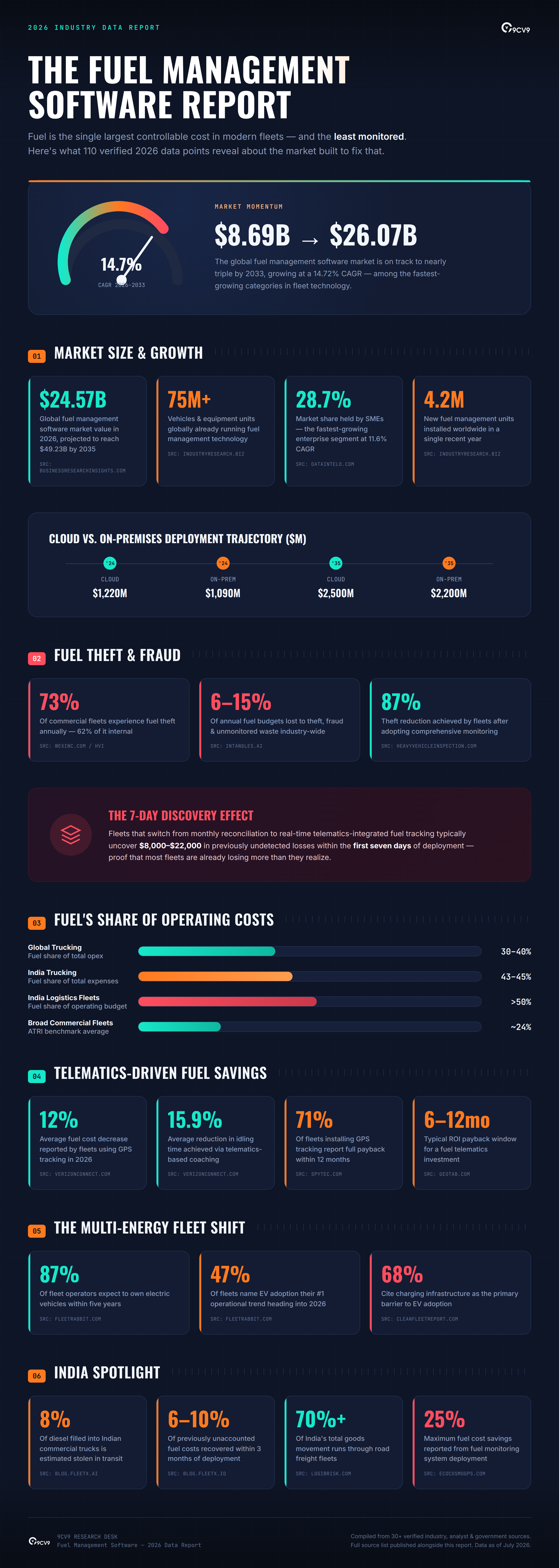
At the same time, fuel theft, unauthorized fuel usage, inefficient routing, excessive engine idling, and inaccurate fuel reporting continue to create financial challenges for fleet operators. Industry estimates included in this analysis suggest that fuel theft, fraud, and unmonitored waste can represent between 6% and 15% of annual fleet fuel budgets, highlighting the potential value of automated fuel monitoring and fraud prevention systems.
Modern fuel management software addresses these challenges by integrating real-time vehicle tracking, automated fuel transaction monitoring, driver behavior analytics, fuel card management, route optimization, and predictive maintenance capabilities into centralized digital platforms.
The Growing Importance of Fuel Management Software in 2026
One of the most significant fuel management software trends in 2026 is the transition from traditional manual fuel tracking toward intelligent, connected fleet management systems.
Historically, many businesses relied on spreadsheets, paper-based fuel logs, manual reconciliation, and standalone GPS devices to monitor fuel consumption. These methods often created delays in identifying discrepancies, detecting unauthorized transactions, and understanding the underlying causes of excessive fuel expenditure.
Today, cloud-based fuel management software enables fleet managers to monitor vehicle fuel consumption, track refueling activities, identify suspicious transactions, and analyze operational performance through centralized dashboards.
According to the statistics examined in this article, demand for cloud-based fuel management solutions increased by approximately 45% between 2023 and 2024. Cloud implementations have also been associated with deployment cycles approximately 30% to 40% faster than traditional on-premises systems, making cloud-based fuel management increasingly attractive to businesses seeking faster implementation and reduced infrastructure requirements.
The adoption of IoT-enabled fuel sensors, GPS tracking devices, and connected vehicle technologies is further transforming how organizations collect and analyze fuel consumption data. These technologies can provide greater visibility into fuel levels, engine idling, vehicle location, driving behavior, and operational inefficiencies.
For businesses operating large fleets, such capabilities can support more accurate budgeting, improved driver accountability, stronger fraud prevention, and better-informed operational decisions.
Fuel Management Software and the Business Case for Cost Savings
Beyond market expansion and technological innovation, the strongest argument for investing in fuel management software remains its potential to deliver measurable financial returns.
The data examined in this report indicates that fleets using GPS-based fuel management systems have reported fuel cost reductions of approximately 12% to 15%, while some telematics-driven implementations have achieved fuel consumption improvements of 10% to 15% within the first year.
Driver behavior monitoring, including speeding alerts, excessive idling detection, harsh acceleration analysis, and fuel-efficient driving recommendations, can also contribute to lower operating expenses.
For example, diesel-powered commercial trucks can consume approximately 0.8 gallons of fuel per hour while idling. Across a fleet of 50 trucks, eliminating two unnecessary hours of daily idling could save more than 29,000 gallons of diesel annually, depending on operating days and vehicle conditions.
Fuel management software can also help businesses identify discrepancies between recorded fuel purchases and actual vehicle consumption, detect unexpected fuel-level changes, and automate administrative processes such as fuel tax reporting.
Some fleet technology studies and industry estimates suggest that fuel telematics investments can achieve payback within 6 to 12 months, although actual returns depend on fleet size, baseline inefficiencies, fuel prices, implementation costs, and operational practices.
These findings demonstrate why fuel management systems are increasingly evaluated not simply as tracking tools but as investments in long-term operational efficiency and financial performance.
Emerging Fuel Management Software Trends: AI, IoT, Telematics, and Electric Vehicles
The fuel management software industry is also undergoing a broader technological transformation as businesses adopt increasingly sophisticated fleet intelligence platforms.
Artificial intelligence and advanced analytics are creating opportunities for predictive fuel consumption modeling, automated anomaly detection, driver performance analysis, and more efficient route planning. Meanwhile, IoT-connected sensors and GPS telematics systems are enabling businesses to collect more detailed operational data and respond to potential inefficiencies faster.
Fleet electrification is introducing another important dimension to fuel management technology.
As businesses transition toward electric vehicles (EVs) and hybrid commercial fleets, traditional fuel management platforms are evolving into integrated energy management solutions capable of monitoring diesel, gasoline, electricity consumption, charging activities, and total vehicle operating costs.
The statistics reviewed in this article indicate that 87% of surveyed fleet operators expect to own electric vehicles within the next five years, while 68% identify charging infrastructure as a major barrier to wider EV adoption.
These trends suggest that future fuel management software platforms will increasingly need to support mixed-energy fleets, charging infrastructure integration, sustainability reporting, and comprehensive total cost of ownership analysis.
Regional developments are also influencing the industry’s growth trajectory. North America remains a major market for fleet tracking and fuel management technologies, while Asia-Pacific is emerging as an important growth region due to expanding logistics networks, industrial development, and rising demand for transportation efficiency.
In markets such as India, fuel theft prevention, GPS tracking adoption, and automated fuel monitoring are particularly relevant because of the substantial role fuel expenses play in commercial transportation operations.
What Do the Top 110 Fuel Management Software Statistics Reveal?
Understanding the latest fuel management software statistics is essential for fleet operators, logistics companies, transportation businesses, software vendors, investors, and technology decision-makers evaluating the future of fleet management.
This comprehensive collection of 110 fuel management software statistics, data points, and industry trends for 2026 examines the major developments shaping the global market, including:
- Fuel Management Software Market Size and Growth: Global market valuations, revenue forecasts, growth rates, and emerging investment opportunities.
- Cloud-Based Fuel Management Adoption: Cloud deployment trends, implementation timelines, SaaS adoption, and digital transformation.
- Fuel Theft and Fraud Prevention: Fuel theft statistics, unauthorized fuel usage, financial losses, and automated monitoring technologies.
- Fleet Fuel Costs and Operating Expenses: Commercial trucking expenses, diesel price trends, fuel efficiency, and cost optimization opportunities.
- GPS Tracking, IoT, and Telematics: Connected vehicle adoption, fuel monitoring accuracy, driver behavior analytics, and operational efficiency improvements.
- Fuel Management Software ROI: Fuel savings, reduced engine idling, route optimization, administrative efficiency, and investment payback periods.
- Regional Fuel Management Market Trends: Developments across North America, Asia-Pacific, India, and other emerging markets.
- Electric Vehicle and Sustainability Trends: Fleet electrification, EV charging management, multi-energy monitoring, and total cost of ownership.
- Future Fuel Management Technologies: AI-powered analytics, predictive monitoring, intelligent sensors, and integrated fleet management platforms.
Together, these statistics provide a detailed perspective on how fuel management software is evolving from a basic fuel tracking solution into a broader platform for fleet intelligence, financial control, and operational optimization.
Whether an organization manages a small commercial fleet, operates a large transportation network, develops fleet management technology, or evaluates investment opportunities in the logistics software market, understanding these fuel management software statistics and trends in 2026 can support more informed technology investments and strategic decisions.
As fuel cost pressures, digital transformation, and sustainability requirements continue to reshape the transportation industry, businesses that effectively leverage fuel consumption data and intelligent fleet management technologies will be better positioned to control expenses, improve efficiency, and maintain long-term competitiveness.
The following 110 statistics explore the market developments, adoption patterns, financial implications, and emerging technologies defining the future of fuel management software in 2026 and beyond.
Before we venture further into this article, we would like to share who we are and what we do.
About 9cv9
9cv9 is a business tech startup based in Singapore and Asia, with a strong presence all over the world.
With over ten years of startup and business experience, and being highly involved in connecting with thousands of companies and startups, the 9cv9 team has listed some of the top and best companies/tools in this review.
If you like to get your company listed in our top B2B software reviews, check out our world-class 9cv9 Media and PR service and pricing plans here.
Top 110 Fuel Management Software Statistics, Data & Trends in 2026
Market Size & Growth
1. The global fuel management software market reached USD 8.69 billion in 2025, growing at a 14.72% CAGR toward 2033.
This double-digit growth rate confirms fuel management software has shifted from a niche fleet tool to a mainstream enterprise investment category.
2. Fuel management software is projected to hit USD 26.07 billion by 2033, nearly tripling its 2025 valuation.
Buyers evaluating platforms today are entering a market still in its early growth curve, not a mature, saturated one.
3. A separate analysis values the fuel management software market at USD 24.57 billion in 2026, forecast to reach USD 49.23 billion by 2035 at a 7.9% CAGR.
The wide variance between market reports underscores how differently analysts scope “fuel management software,” so buyers should compare feature sets, not just price against market averages.
4. The narrower fuel management system market (software plus hardware) is valued at USD 1.88 billion in 2026, projected to reach USD 2.96 billion by 2032 at a 7.7% CAGR.
This steadier, hardware-inclusive figure reflects sustained enterprise demand for integrated sensor-plus-software deployments.
5. The fuel management software segment alone is estimated at USD 6.49 billion in 2025, expanding at a 9.2% CAGR to USD 14.27 billion by 2034.
Software-specific growth outpacing hardware growth signals a market maturing toward analytics and subscription value rather than one-time device sales.
6. One 2026 forecast pegs the fuel management software market at USD 2.73 billion in 2025, rising to USD 5.5 billion by 2035 at a 7.2% CAGR.
Even conservative projections still show the category doubling within a decade, reinforcing long-term demand stability.
7. The global fuel management system (hardware + software + services) market is projected at USD 706.59 million in 2026, growing to USD 1.645 billion by 2035 at a 9.85% CAGR.
Steady near-double-digit growth reflects fuel cost volatility pushing more organizations toward structured monitoring tools.
8. Small and medium enterprises (SMEs) represent 28.7% of fuel management software market value and are the fastest-growing enterprise segment at 11.6% CAGR.
SaaS pricing models have opened the category to smaller fleets that previously found fuel software financially out of reach.
9. On-premises fuel management software license fees have historically exceeded USD 100,000 upfront before cloud alternatives emerged.
This cost barrier explains why the shift to subscription-based delivery has been such a decisive driver of category-wide adoption.
10. More than 75 million vehicles and pieces of equipment globally were estimated to use fuel management technology as of 2024.
The scale of existing deployment shows fuel monitoring has already become an operational norm across transportation, construction, and industrial fleets.
11. Approximately 4.2 million new fuel management units were installed worldwide in 2024 alone.
This single-year install volume illustrates how quickly the addressable market is still expanding rather than plateauing.
12. The asset tracking software market, closely adjacent to fuel management, is estimated to reach USD 6.2 billion by 2026.
Fuel management increasingly sits inside a broader asset-visibility software stack rather than functioning as a standalone tool.
Deployment Models & Technology Adoption
13. Cloud-based fuel management deployment was valued at USD 1.22 billion in 2024 and is projected to reach USD 2.5 billion by 2035.
Cloud delivery has become the default architecture, letting fleets of any size access real-time dashboards without on-site servers.
14. On-premises fuel management deployment, valued at USD 1.09 billion in 2024, is still expected to grow to USD 2.2 billion by 2035.
Legacy on-premises demand persists mainly among large enterprises and government fleets with strict data-residency requirements.
15. Demand for cloud-based fuel management software solutions rose 45% between 2023 and 2024.
This surge shows cloud migration accelerating faster in fuel management than in many other enterprise software categories.
16. Organizations deploying cloud-based fuel management solutions achieve 30–40% faster implementation cycles than on-premises systems.
Faster time-to-value is becoming a decisive purchase factor as fleets look to start capturing fuel savings within weeks, not months.
17. Cloud fuel management implementations typically take 6–12 weeks, versus 16–24 weeks for on-premises configurations.
The shorter deployment window materially changes the ROI calculation in favor of cloud-first fuel management platforms.
18. Over 33% of fuel management providers introduced IoT-integrated smart fuel sensors in a single recent year.
Vendors are racing to embed IoT hardware directly into their software stacks rather than treating sensors as a third-party add-on.
19. Hardware components still represent roughly 52–59% of total fuel/fleet tracking market volume.
Despite the software boom, physical sensors, GPS units, and flow meters remain the foundation that all fuel analytics depend on.
20. The IoT fleet management market grew from USD 9.17 billion in 2025 to an estimated USD 10.6 billion in 2026, a 15.5% CAGR.
IoT connectivity is now a baseline expectation for fuel management buyers, not a premium feature.
21. The IoT fleet management market is forecast to reach USD 17.35 billion by 2030 at a 13.1% CAGR.
Continued double-digit growth signals fuel management vendors will keep investing heavily in sensor and connectivity R&D.
22. The GPS tracking device market was valued at USD 3.2 billion in 2024 and is projected to reach USD 8.2 billion by 2033, a 10.94% CAGR.
GPS remains the backbone technology that fuel management software layers its consumption and theft-detection analytics on top of.
23. Real-time tracking capabilities are now integrated into the vast majority of new commercial fleet deployments.
Real-time visibility, once a premium feature, has effectively become table stakes for any modern fuel or fleet management purchase.
24. Fuel sensor accuracy in leading fuel management systems now reaches ±1–2% of tank capacity.
This precision level allows fleets to detect even small-volume theft events that older float-based sensors would have missed entirely.
Fuel Theft, Fraud & Financial Loss
25. 73% of commercial fleets experience fuel theft annually, with internal theft accounting for 62% of incidents.
The dominance of internal theft over external theft explains why driver-level accountability features are now core to fuel management platforms.
26. The National Association of Fleet Administrators (NAFA) estimates fuel theft can account for up to 6% of a fleet’s total fuel cost.
On a fleet spending USD 500,000 annually on fuel, that single leakage point alone can represent USD 30,000 in avoidable losses.
27. Industry estimates consistently place fuel theft, fraud, and unmonitored waste at 6–15% of a fleet’s annual fuel budget.
This wide range highlights how fuel management software’s value scales directly with the size and looseness of a fleet’s existing controls.
28. U.S. commercial fleets can lose 15–25% of their total fuel budget to theft, fraud, or unauthorized usage.
At the upper end, a quarter of fuel spend disappearing before productive use makes fuel management software one of the highest-ROI fleet technology investments available.
29. Fleets using comprehensive fuel monitoring systems report theft reductions of up to 87% after implementation.
This scale of reduction demonstrates that fuel theft is largely a visibility problem, not an unsolvable operational reality.
30. 96% of U.S. companies surveyed reported facing at least one fuel-related fraud attempt in a recent 12-month period.
Near-universal exposure to fraud attempts means fuel fraud prevention has become a baseline operational requirement, not an edge case.
31. 14% of fleet payments industrywide are lost to fraud or theft, rising to 16% among small fleets specifically.
Smaller fleets, often lacking dedicated fraud-monitoring staff, are disproportionately exposed without automated software controls.
32. Fuel theft incidents in the trucking sector rose 90% in 2022 and a further 77% in 2023.
Back-to-back triple-digit and near-triple-digit increases show fuel theft has escalated far faster than most fleets’ existing controls could keep pace with.
33. Switching from monthly fuel reconciliation to real-time telematics-integrated tracking typically surfaces USD 8,000–22,000 in previously undetected losses within the first seven days.
The speed of discovery illustrates how much fuel loss goes completely unnoticed under manual, periodic reconciliation processes.
34. Diesel-powered trucks burn roughly 0.8 gallons of fuel per hour of idling.
Multiplied across an entire fleet’s daily idle time, this single inefficiency often rivals theft as a source of preventable fuel loss.
35. A 50-truck fleet idling two unnecessary hours daily can waste over 29,000 gallons of diesel annually, worth more than USD 61,000.
This single-fleet example shows why idle-time alerts are one of the most consistently high-ROI features in fuel management dashboards.
36. Suboptimal routing contributes an estimated 2–5% of total fleet fuel waste.
Route optimization modules built into modern fuel management platforms directly target this often-overlooked loss category.
37. Vehicles equipped with active GPS tracking are recovered at rates above 80%, compared to a roughly 34% national average without GPS.
This gap illustrates the compounding value of GPS-enabled fuel and asset tracking beyond fuel savings alone.
38. GPS tracking installed across 80% of U.S. fleet vehicles has been linked to roughly 60% reductions in vehicle and fuel theft.
High-density GPS coverage across a fleet meaningfully amplifies the deterrent effect against theft compared to partial rollouts.
39. Replacing a single stolen commercial work van costs USD 35,000–65,000 at 2026 prices, excluding lost revenue during replacement.
Fuel and asset theft prevention pays for itself many times over when measured against a single vehicle-theft incident.
Fuel Costs & Fleet Operating Expenses
40. Fuel typically represents 30–40% of total operating costs for commercial trucking fleets under normal market conditions.
As the single largest controllable cost line for most fleets, fuel is the natural starting point for any operational efficiency initiative.
41. Fuel averages roughly 24% of total fleet operating costs across the broader commercial fleet sector, per ATRI benchmarking data.
Even outside heavy trucking, fuel remains one of the top two or three expense categories fleet managers must actively manage.
42. The industry-average cost to operate a truck reached USD 2.336 per mile in 2025, the highest figure in ATRI’s reporting history.
Record per-mile costs are pushing fuel efficiency from a “nice to have” into a direct survival metric for carrier profitability.
43. Excluding fuel, non-fuel trucking operating costs rose 4.2% to USD 1.854 per mile in 2025.
Rising non-fuel costs make controllable fuel expenses an even more important lever for fleets trying to protect margins.
44. U.S. fuel costs rose 5.9% in the first quarter of 2026 after remaining flat through all of 2025.
This sudden reversal after a stable year shows how quickly fuel volatility can erode a fleet’s operating budget without warning.
45. National on-highway diesel prices climbed above USD 5 per gallon in parts of 2026 amid global supply disruptions.
Price spikes of this magnitude turn even a single-digit percentage fuel-efficiency gain into a meaningful dollar-value saving.
46. A gap of just 1.5 MPG (5.5 vs. 7.0) at USD 3.50 diesel equates to roughly USD 17,680 in annual fuel savings on a 130,000-mile truck.
Small, sustained efficiency improvements compound into significant annual savings once scaled across mileage and fleet size.
47. Fuel card discounts of USD 0.45–2.00 per gallon can translate into USD 5,941–26,404 in annual savings for individual owner-operators.
Integrated fuel-card discount tracking inside fuel management platforms directly captures savings that would otherwise go unclaimed.
48. Commercial insurance premiums for fleets of 1–20 trucks have risen 47% since 2010, compounding pressure on total operating costs.
Rising insurance costs alongside fuel volatility make every available cost-control lever, including fuel software, increasingly valuable.
49. 85–90% of new owner-operator trucking businesses fail within their first two years, primarily due to cash-flow and cost-estimation problems.
Accurate, real-time fuel cost visibility directly addresses the cash-flow unpredictability cited as a leading cause of small-fleet failure.
50. Diesel prices are forecast to range between USD 4.30 and USD 4.80 per gallon through parts of 2026 amid continued market volatility.
Sustained high-price environments like this materially shorten the payback period for fuel management software investments.
51. Insurance premiums rose 6.4%, driver benefits 4.5%, and tolls 2.7% in Q1 2026, compounding fuel cost pressure on fleets.
Fuel management software’s savings increasingly need to offset not just fuel volatility but a broader wave of rising fleet operating costs.
52. Fuel expenses account for 43–45% of total truck operating costs in India, among the highest shares globally.
This exceptionally high share explains why Indian logistics operators have been especially aggressive adopters of fuel monitoring technology.
53. Fuel accounts for more than 50% of total operating budgets for many Indian logistics fleets.
At this proportion, fuel management software arguably delivers a larger proportional cost-control impact in India than in most other markets.
54. India’s road freight sector moves more than 70% of the country’s total goods, making fleet fuel efficiency a national logistics priority.
The scale of India’s trucking-dependent supply chain amplifies the macroeconomic importance of fuel management adoption.
Telematics, GPS & IoT-Driven Fuel Savings
55. Fleets using GPS tracking reported an average 12% decrease in fuel costs in 2026.
This double-digit average savings rate makes GPS-integrated fuel monitoring one of the most measurable ROI technologies a fleet can deploy.
56. Fleets using GPS-based telematics achieved an average 15.9% reduction in idling time.
Idle-time reduction alone often accounts for a significant share of the total fuel savings telematics adoption delivers.
57. GPS-based fuel management systems reduce fuel costs by an average of 15% for adopting fleets.
A savings rate at this level typically allows fuel management software to pay for itself well within the first operating year.
58. Telematics-driven fuel monitoring typically delivers 10–15% fuel consumption reductions within the first year of adoption.
This consistent first-year impact is a key reason fuel management software has become a default fleet technology purchase rather than an optional upgrade.
59. Fleets with significant route waste or excessive idling routinely see fuel savings above 20% after telematics adoption.
Fleets with the poorest starting efficiency stand to gain the most, making software adoption especially valuable for previously unmonitored operations.
60. Driver behavior monitoring, including idling and speeding alerts, can reduce total fuel spend by 6%.
Behavioral coaching features embedded in fuel software directly translate driving-pattern data into measurable cost reductions.
61. Fleets using data analytics report a 20% reduction in fuel costs compared to fleets relying on manual, paper-based processes.
The gap between analytics-driven and manual fuel tracking illustrates the direct cost of delayed or incomplete visibility.
62. Structured eco-driving training programs paired with telematics coaching deliver an average 13.6% improvement in fuel efficiency.
Combining software-driven data with human driver coaching consistently outperforms either approach used in isolation.
63. The average ROI payback period for fuel telematics investment is 6 to 12 months.
A sub-year payback window is a strong justification for fleets still weighing whether fuel management software is worth the upfront cost.
64. 71% of fleets that install GPS tracking report full payback on their investment within the first 12 months.
This high payback rate reflects how quickly fuel and theft savings alone can offset software and hardware subscription costs.
65. Commercial vehicles idle anywhere from 20% to 50% of their total engine operating time.
The scale of this inefficiency shows why idle-time monitoring is consistently one of the highest-impact features in fuel management platforms.
66. Idling wastes an estimated USD 3,500–4,500 per vehicle per year in a typical service fleet.
Multiplied across a fleet of even modest size, idle-related waste alone can justify a fuel management software subscription.
67. Route optimization through fuel/fleet software can cut daily drive time by 15–20%, with proportional fuel savings.
Route efficiency gains compound with fuel savings, delivering both cost and productivity benefits from the same software investment.
68. VehicleTrax customers report up to a 30% reduction in idling and downtime after implementing monitoring and driver accountability tools.
Real-world customer outcomes at this scale reinforce that idle-time reduction is one of fuel management software’s most reliable value drivers.
69. Automated IFTA fuel tax reporting can save interstate fleets 160–240 hours of administrative work annually.
Beyond direct fuel savings, automated compliance reporting represents a significant, often underappreciated labor-cost reduction.
70. Fleets adopting real-time fuel tracking can identify existing losses of USD 8,000–22,000 within the first week of deployment.
This immediate discovery effect is frequently cited by vendors as proof that most fleets are already losing more than they realize.
71. In India, modern fuel monitoring platforms have helped fleets recover 6–10% of previously unaccounted fuel costs within just three months of deployment.
This rapid recovery window demonstrates that fuel management ROI in emerging markets can materialize even faster than in mature ones.
72. Fuel monitoring systems in Indian fleet deployments have been linked to fuel cost savings of up to 25%.
This figure sits at the high end of global benchmarks, reflecting how much unmonitored loss exists in markets with historically manual fuel tracking.
73. Driver coaching programs achieved a 13% reduction in fuel consumption alongside a 79% reduction in hard acceleration events.
The strong correlation between driving-behavior metrics and fuel savings validates behavior-focused features within fuel management dashboards.
74. The same driver-coaching data set recorded a 40% reduction in hard braking events and a 20% reduction in idling time.
Consistent double-digit improvements across multiple driving metrics show fuel software’s behavioral analytics deliver compounding operational benefits.
GPS & Telematics Market Adoption
75. 80% of fleet professionals now use GPS fleet tracking, an 11-percentage-point increase year over year.
Adoption climbing this quickly in a single year signals GPS-enabled fuel tracking has crossed from early-majority into near-universal use.
76. North American commercial fleets operated roughly 19.2 million active fleet management systems as of Q4 2024.
This installed base represents the addressable market fuel management software vendors are already serving, not one still being built.
77. North America’s installed telematics base is forecast to reach 33.2 million units by 2029, an 11.6% CAGR.
Continued double-digit growth in an already-large installed base shows the category is far from adoption saturation.
78. The top five fleet telematics vendors control roughly 50% of North America’s active telematics units.
Despite this concentration, half the market remains served by smaller and regional vendors, leaving meaningful competitive room.
79. Nearly 80% of fleets use GPS tracking, and 46% have deployed video telematics for safety and fuel-related monitoring.
Video telematics adoption approaching half the market shows fuel and safety monitoring are increasingly converging into unified platforms.
80. Video telematics units in North America are projected to more than double to 17.3 million by 2030, an 18% CAGR.
This growth trajectory outpaces most other fleet technology categories, reflecting rising demand for visual verification alongside fuel data.
81. One leading video telematics provider surpassed 1 million vehicle subscriptions, while another reports more than 5 million commercial vehicles equipped globally.
Milestones at this scale confirm video-integrated fuel and safety monitoring has moved well past the early-adopter stage.
82. GPS fleet tracking adoption sits at roughly 67% across all commercial fleets but only 40–50% among fleets with fewer than 10 vehicles.
This adoption gap represents the single largest untapped growth opportunity for fuel management software vendors targeting small fleets.
83. Large fleets of 100+ vehicles show telematics adoption above 80%, compared to 40–50% for fleets under 10 vehicles.
The adoption curve confirms fuel management software has already won the enterprise segment and is now expanding into the SMB market.
84. 85% of fleet managers using GPS tracking report it improved overall fleet productivity.
Productivity gains alongside fuel savings give fuel management software a broader business case than cost reduction alone.
Regional & Competitive Landscape
85. North America holds an estimated 37.5–38% share of the global GPS fleet tracking and fuel management deployment market.
North America’s continued market leadership reflects its mature regulatory environment and early telematics infrastructure investment.
86. Asia-Pacific is consistently identified as the fastest-growing region for fuel monitoring software adoption.
Rapid industrialization and expanding logistics networks are driving APAC fleets to leapfrog directly into cloud-based fuel monitoring.
87. The Asia-Pacific fuel monitoring software market was valued at USD 2.1 billion in 2025, projected to reach USD 4.0 billion by 2033 at a 9.4% CAGR.
This near-doubling within a decade positions APAC as one of the most important growth regions for fuel management software vendors.
88. The North American fuel monitoring software market was valued at USD 2.4 billion in 2025, projected to reach USD 4.2 billion by 2033 at an 8.4% CAGR.
Even in a mature market, sustained high-single-digit growth shows continued upgrade and expansion demand among existing telematics users.
89. The hardware segment accounts for an estimated 44.8–59.2% share of fleet and fuel tracking technology markets, depending on report scope.
Hardware remains foundational even as software and analytics increasingly define the competitive differentiation between vendors.
90. Active (real-time) tracking technology accounts for 78.3% of the vehicle tracking system market in 2026.
Passive, after-the-fact tracking has become a minority approach as fleets prioritize real-time fuel and location visibility.
91. Deployment of hybrid and electric vehicles is prompting fuel management vendors to build multi-energy-source monitoring capabilities.
Vendors that can track diesel, gasoline, and electric consumption within a single dashboard are best positioned for the coming fleet transition.
92. Payment digitalization (fuel cards and fuel management software) dominated the broader fuel management systems market with roughly USD 234.67 million in value in 2022.
Digital payment integration has become a core differentiator, not just an add-on feature, within competitive fuel management platforms.
Electric Vehicles, Sustainability & the Multi-Energy Fleet
93. 80% of commercial fleet operators running mixed ICE/EV fleets plan to electrify at least 25% of their fleet by 2030.
This level of stated commitment signals fuel management software must evolve to track electricity consumption alongside traditional fuel.
94. Nearly 50% of these fleet operators expect EVs to make up half or more of their total fleet by 2030.
Vendors that fail to build EV-compatible monitoring risk losing relevance with a large share of forward-looking fleet operators.
95. 10% of light-duty vehicles sold in the United States in 2024 were electric.
Even at a national scale, EV penetration is now high enough that fuel management platforms treating electric assets as an afterthought will fall behind.
96. 47% of fleets identified EV adoption as their top operational trend heading into 2026.
Electrification has moved from a sustainability talking point to the single most-cited fleet strategy priority.
97. Light commercial EVs now deliver up to 13% lower total cost of ownership than diesel equivalents.
This cost advantage is accelerating fleet electrification decisions on pure economics, independent of any environmental motivation.
98. EV maintenance costs run 25–40% lower than internal combustion equivalents, due to fewer moving parts and regenerative braking.
Lower maintenance costs compound with fuel savings to strengthen the overall business case for mixed-energy fleet management software.
99. 87% of fleet operators expect to own electric vehicles within the next five years.
Near-universal expectation of EV ownership makes multi-energy tracking a near-term requirement, not a distant future feature.
100. 68% of fleet leaders cite charging infrastructure as the primary barrier to wider EV adoption.
Fuel and energy management platforms that integrate charging-station visibility directly address the leading obstacle to fleet electrification.
101. Commercial EV registrations grew 47% year-over-year in 2025.
This growth rate outpaces nearly every other fleet technology adoption curve tracked in the industry.
102. Total cost of ownership for electric delivery vans and last-mile trucks is now competitive with diesel in 34 U.S. states.
Economic parity across more than two-thirds of states removes one of the last major objections to fleet electrification.
103. 31% of fleet leaders rank total cost of ownership as their top three-year operational challenge.
TCO-focused concerns reinforce why integrated fuel and energy cost software has become a board-level, not just operational, priority.
104. 38% of fleet leaders cite lower environmental impact, and 35% cite reduced fuel costs, as their primary motivations for EV adoption.
Cost and sustainability motivations are now roughly equally weighted, broadening the audience fuel management vendors can market EV features to.
105. 99% of fleet leaders have implemented or plan to implement a formal EV charging policy for drivers.
Near-universal policy planning indicates fuel and energy management software vendors have a narrow window to build charging-policy features before it becomes a checklist requirement.
India & Emerging Market Fuel Theft Dynamics
106. Approximately 8% of diesel filled into Indian commercial trucks is estimated to be stolen during transit.
This single statistic makes fuel theft prevention arguably the single highest-value feature for fuel management software buyers in India.
107. Black-market fuel diversion is estimated to cost Indian fleet operators 8–12% of total fuel expenditure annually.
Losses at this scale mean fuel management software can often pay for itself through theft reduction alone within an Indian fleet’s first year.
108. India’s road transport regulatory mandates (such as AIS-140) have driven widespread GPS hardware installation, creating a ready-made base for fuel-sensor integration.
Fleets that already carry mandated GPS hardware face a lower incremental cost to add fuel-monitoring sensors on top of existing infrastructure.
109. Sensor-based fuel monitoring can flag fuel-level drops at non-registered filling station locations as a near-instant theft signal.
This kind of automated cross-referencing between location and fuel-level data is precisely the capability manual fuel logs cannot replicate.
110. Beyond theft, avoidable driver behavior is estimated to add a further 10–15% to fleet fuel costs in emerging markets like India.
Combined with theft losses, this suggests fuel management software can influence 20% or more of total fuel spend in under-monitored fleets.
Conclusion
The top 110 fuel management software statistics, data, and trends in 2026 highlight an industry undergoing significant transformation as businesses increasingly prioritize fuel efficiency, cost reduction, operational transparency, and intelligent fleet management. With rising transportation expenses, fluctuating fuel prices, and growing demand for connected vehicle technologies, fuel management software has evolved from a basic fuel tracking solution into an essential component of modern fleet operations.
The global fuel management software market continues to demonstrate strong growth potential. One industry estimate valued the market at USD 8.69 billion in 2025, with projections indicating that it could reach USD 26.07 billion by 2033, representing a compound annual growth rate (CAGR) of approximately 14.72%. Although market forecasts vary depending on their definitions and coverage, the overall direction suggests sustained investment in digital fuel monitoring, cloud-based fleet management platforms, and advanced fuel analytics.
One of the most important findings from the 2026 fuel management software statistics is the substantial financial impact of effective fuel monitoring. Fuel expenses can represent 30% to 40% of total operating costs for commercial trucking fleets, making fuel efficiency a critical factor in maintaining profitability. At the same time, fuel theft, unauthorized consumption, inefficient routing, and excessive engine idling continue to create significant financial losses for fleet operators.
Modern fuel management systems offer businesses an opportunity to address these challenges through real-time fuel tracking, automated transaction monitoring, GPS telematics, driver behavior analytics, and intelligent reporting. The data reviewed in this article indicates that fleets implementing GPS-based fuel management solutions have reported fuel cost reductions of approximately 12% to 15%, while telematics-driven monitoring can deliver additional improvements through reduced idling, better route planning, and more efficient driving practices.
These potential savings demonstrate why fuel management software is increasingly viewed as a strategic investment rather than simply another operational expense.
Cloud Technology, IoT, and AI Are Reshaping Fuel Management
The growing adoption of cloud-based fuel management software represents another defining trend in 2026. Businesses are moving away from manual spreadsheets, disconnected tracking systems, and traditional on-premises infrastructure toward centralized platforms that provide real-time visibility across their vehicle fleets.
The statistics examined in this report indicate that demand for cloud-based fuel management solutions increased by approximately 45% between 2023 and 2024, reflecting growing interest in scalable and accessible fleet management technologies.
Cloud deployment also offers potential advantages in implementation speed, system integration, remote accessibility, and operational flexibility. These benefits are particularly relevant for small and medium-sized businesses seeking affordable fuel monitoring solutions without substantial upfront infrastructure investments.
Meanwhile, the integration of Internet of Things (IoT) sensors, GPS tracking, artificial intelligence, and predictive analytics is expanding the capabilities of modern fuel management platforms.
Instead of relying exclusively on historical fuel consumption reports, fleet operators can increasingly use connected technologies to identify unusual fuel-level changes, monitor inefficient driving behavior, optimize routes, and detect potential fuel theft.
AI-powered fuel management capabilities also create opportunities for more sophisticated fuel consumption forecasting, automated anomaly detection, and predictive operational insights.
As these technologies continue to develop, fuel management software is likely to become increasingly integrated with broader fleet management, transportation management, and enterprise resource planning systems.
Fuel Theft Prevention and Operational Efficiency Remain Major Priorities
Fuel theft and fraud prevention continue to be important drivers of fuel management software adoption.
The industry estimates examined in this article suggest that fuel theft, fraud, and unmonitored waste can account for approximately 6% to 15% of annual fleet fuel expenditure, depending on operating conditions and the effectiveness of existing controls.
For businesses managing large vehicle fleets, even a relatively small percentage of fuel loss can translate into substantial annual financial exposure.
Automated fuel monitoring systems can help reduce these risks by combining fuel-level sensors, GPS location data, fuel card transactions, and driver accountability tools.
Beyond theft prevention, fuel management platforms can improve operational efficiency by identifying unnecessary engine idling, inefficient routes, excessive fuel consumption, and other avoidable expenses.
The data also indicates that some fuel telematics investments can achieve payback within 6 to 12 months, although actual returns vary based on fleet size, implementation costs, operational practices, and existing inefficiencies.
These findings reinforce the importance of evaluating fuel management software based on measurable business outcomes, including fuel cost savings, reduced administrative workloads, improved fleet productivity, and stronger financial controls.
Electric Vehicles and Sustainability Are Expanding the Role of Fuel Management Software
Another major development shaping the future of fuel management software is the transition toward electric and hybrid commercial fleets.
As businesses adopt electric vehicles, traditional fuel management platforms must evolve to accommodate different energy sources, charging requirements, and vehicle operating characteristics.
The statistics reviewed in this article indicate that 87% of surveyed fleet operators expect to own electric vehicles within the next five years, while 68% identify charging infrastructure as a major obstacle to wider EV adoption.
These findings highlight the growing importance of integrated fuel and energy management systems capable of monitoring diesel consumption, gasoline usage, electricity consumption, charging costs, and overall fleet efficiency.
Future fuel management platforms may increasingly incorporate EV charging management, battery performance analytics, emissions reporting, and total cost of ownership calculations.
For fleet operators, the ability to manage conventional and electric vehicles within a single software platform could become an important factor when selecting long-term fleet management technology.
What Businesses Should Prioritize When Choosing Fuel Management Software
The 2026 fuel management software statistics demonstrate that successful implementation requires more than simply installing GPS tracking devices or purchasing fuel monitoring software.
Businesses should evaluate potential solutions based on their operational requirements, existing fleet infrastructure, integration capabilities, and financial objectives.
Important considerations include real-time fuel consumption visibility, fuel theft detection, automated reporting, driver behavior monitoring, route optimization, cloud accessibility, and compatibility with existing fleet management systems.
Organizations should also assess implementation costs, ongoing subscription fees, hardware requirements, data accuracy, customer support, and the potential return on investment.
For smaller fleets, affordable cloud-based fuel management software may provide a practical entry point into digital fleet optimization. Larger enterprises may require more comprehensive platforms that integrate fuel monitoring with telematics, predictive maintenance, compliance reporting, and enterprise analytics.
Regardless of fleet size, businesses should establish clear performance benchmarks before implementation and continuously monitor fuel consumption, cost savings, operational efficiency, and system effectiveness.
Final Thoughts on Fuel Management Software Statistics and Trends in 2026
The 110 fuel management software statistics and trends for 2026 reveal a market increasingly shaped by digital transformation, connected fleet technologies, financial efficiency, and sustainability considerations.
From cloud-based fuel monitoring and IoT-enabled sensors to GPS telematics, fuel fraud prevention, AI-powered analytics, and electric vehicle energy management, the industry is moving toward more intelligent and integrated solutions.
The most significant takeaway is that fuel management software is no longer solely about tracking how much fuel vehicles consume. It is about understanding where fuel costs originate, identifying preventable losses, improving operational decisions, and maximizing the financial performance of an entire fleet.
As transportation and logistics businesses face continued pressure to control expenses while maintaining service quality, effective fuel management will remain an important competitive advantage.
Organizations that invest in accurate fuel consumption data, automated monitoring, and actionable fleet analytics will be better equipped to reduce waste, strengthen operational accountability, and respond to changing market conditions.
Looking ahead to 2027 and beyond, the convergence of artificial intelligence, cloud computing, IoT connectivity, GPS telematics, and electric vehicle technologies is expected to further expand the capabilities of fuel management software.
Ultimately, the future of fuel management will be defined by businesses’ ability to transform real-time operational data into measurable improvements in efficiency, profitability, and sustainability.
For fleet operators, logistics companies, transportation providers, and enterprise decision-makers, understanding these fuel management software statistics, market trends, and industry developments in 2026 provides a foundation for making informed technology investments and building more efficient, resilient, and competitive fleet operations.
If you find this article useful, why not share it with your hiring manager and C-level suite friends and also leave a nice comment below?
We, at the 9cv9 Research Team, strive to bring the latest and most meaningful data, guides, and statistics to your doorstep.
To get access to top-quality guides, click over to 9cv9 Blog.
To hire top talents using our modern AI-powered recruitment agency, find out more at 9cv9 Modern AI-Powered Recruitment Agency.
People Also Ask
What is fuel management software?
Fuel management software is a digital solution that helps businesses monitor fuel consumption, track fuel expenses, prevent theft, and improve fleet efficiency through GPS tracking, IoT sensors, automated reporting, and real-time analytics.
What is the global fuel management software market size in 2026?
Market estimates vary significantly. One forecast values the global fuel management software market at USD 24.57 billion in 2026, while other reports use narrower definitions that produce substantially lower valuations.
How fast is the fuel management software market growing in 2026?
One industry forecast projects a 14.72% compound annual growth rate (CAGR) through 2033. Other estimates suggest growth rates between 7% and 10%, depending on market definitions and included technologies.
What is the projected fuel management software market size by 2033?
One market forecast projects the global fuel management software industry will reach USD 26.07 billion by 2033, up from USD 8.69 billion in 2025, reflecting increasing demand for digital fuel monitoring and fleet optimization.
What are the biggest fuel management software trends in 2026?
Major trends include cloud-based fuel management, IoT fuel sensors, GPS telematics, AI-powered analytics, automated fuel theft detection, real-time fleet monitoring, and integration with electric vehicle energy management systems.
How does fuel management software reduce fuel costs?
Fuel management software reduces fuel expenses by identifying excessive idling, inefficient routes, unauthorized fuel purchases, fuel theft, and poor driving behavior. Automated monitoring helps fleet managers identify waste and improve operational efficiency.
How much can businesses save with fuel management software?
Industry estimates suggest GPS-based fuel management systems can reduce fuel expenses by approximately 12–15%. Actual savings depend on fleet size, fuel consumption, driving behavior, existing inefficiencies, and implementation quality.
What percentage of fleet operating costs comes from fuel?
Fuel typically represents approximately 30–40% of total operating costs for commercial trucking fleets. The exact percentage varies depending on fuel prices, vehicle efficiency, transportation routes, and operating conditions.
How does GPS tracking improve fuel management?
GPS tracking provides real-time vehicle location data, enabling fleet managers to monitor routes, reduce unnecessary mileage, identify excessive idling, and investigate suspicious fuel consumption patterns.
What percentage of fleets use GPS tracking in 2026?
Industry survey data cited in the report indicates that approximately 80% of fleet professionals use GPS fleet tracking. Adoption varies by fleet size, with larger commercial fleets generally reporting higher usage rates.
What is cloud-based fuel management software?
Cloud-based fuel management software allows businesses to monitor fuel consumption, manage fleet expenses, and access operational reports through internet-connected platforms without maintaining extensive on-premises server infrastructure.
How popular is cloud-based fuel management software in 2026?
Industry estimates indicate that demand for cloud-based fuel management solutions increased by approximately 45% between 2023 and 2024, reflecting growing interest in scalable, remotely accessible fleet monitoring platforms.
What is the difference between cloud-based and on-premises fuel management software?
Cloud-based software provides remote accessibility, subscription pricing, and potentially faster deployment. On-premises systems offer greater infrastructure control but typically require more internal IT resources and maintenance.
How long does fuel management software implementation take?
Cloud-based fuel management implementations typically take 6–12 weeks, while on-premises configurations may require 16–24 weeks. Actual deployment timelines depend on fleet size, hardware installation, integrations, and customization.
What is the average ROI of fuel management software?
Industry estimates suggest fuel telematics investments can achieve payback within 6–12 months. Returns depend on subscription costs, hardware expenses, fuel savings, theft prevention, and operational improvements.
Can fuel management software prevent fuel theft?
Fuel management software helps detect and deter fuel theft through real-time fuel-level monitoring, GPS tracking, transaction verification, automated alerts, and comparisons between recorded fuel purchases and actual consumption.
How much money do fleets lose to fuel theft annually?
Industry estimates suggest fuel theft, fraud, and unmonitored waste can account for approximately 6–15% of annual fleet fuel budgets. Actual losses vary depending on fleet operations, internal controls, and monitoring capabilities.
How effective are fuel monitoring systems at reducing theft?
Some industry estimates report fuel theft reductions of up to 87% following comprehensive monitoring implementation. Results depend on existing theft exposure, sensor accuracy, monitoring practices, and enforcement measures.
What role does IoT play in fuel management software?
IoT technology connects fuel sensors, GPS devices, and vehicle monitoring equipment to software platforms. It enables real-time fuel-level tracking, automated alerts, consumption analysis, and improved fleet visibility.
How accurate are modern fuel management sensors?
Leading fuel monitoring systems can achieve reported accuracy levels of approximately ±1–2% of tank capacity. Actual performance depends on sensor technology, tank configuration, installation quality, and calibration.
How does AI improve fuel management software?
AI-powered fuel management can analyze consumption patterns, identify unusual transactions, forecast fuel demand, detect inefficiencies, and support predictive maintenance and route optimization decisions.
How much fuel can telematics systems save?
Industry estimates indicate that telematics-driven fuel monitoring can reduce fuel consumption by approximately 10–15% during the first year. Savings depend on driving habits, routing efficiency, idling levels, and fleet conditions.
How much fuel is wasted through vehicle idling?
Diesel-powered commercial trucks can consume approximately 0.8 gallons of fuel per hour while idling. Across large fleets, unnecessary engine idling can generate substantial fuel expenses and avoidable emissions.
Can route optimization software reduce fuel consumption?
Yes. Route optimization can reduce unnecessary mileage, congestion exposure, and driving time. Industry estimates suggest optimized routes may reduce daily driving time by 15–20%, although fuel savings are not necessarily proportional.
How does driver behavior monitoring improve fuel efficiency?
Driver monitoring identifies excessive speeding, harsh acceleration, unnecessary braking, and prolonged idling. Telematics-based coaching helps drivers adopt more fuel-efficient habits and reduce operating expenses.
Which region dominates the fuel management software market?
North America is a major market for GPS fleet tracking and fuel management technologies, with some estimates placing its share at approximately 37.5–38%. Market leadership varies depending on the technology category measured.
Which region has the fastest-growing fuel management software market?
Asia-Pacific is frequently identified as a fast-growing region for fuel management software, supported by expanding logistics networks, industrialization, commercial transportation growth, and increasing adoption of digital fleet technologies.
How is fuel management software used in India?
Indian logistics operators use fuel management software to monitor diesel consumption, detect fuel theft, track commercial vehicles, reduce idling, and improve fleet efficiency. GPS integration also supports compliance and operational visibility.
How does electric vehicle adoption affect fuel management software?
Electric vehicle adoption is encouraging fuel management platforms to support electricity consumption, charging costs, battery monitoring, and mixed-energy fleets alongside traditional diesel and gasoline tracking.
What is the future of fuel management software beyond 2026?
Fuel management software is expected to evolve through AI analytics, IoT connectivity, cloud platforms, automated fraud detection, predictive monitoring, and electric vehicle integration, supporting more efficient and sustainable fleet operations.
Sources
- Market Research Intellect
- Business Research Insights
- Research and Markets
- Verified Market Reports
- Wise Guy Reports
- DataIntelo
- Straits Research
- MarketsandMarkets
- Industry Research
- Data Insights Market
- SourceForge
- Market Research Future
- WEX
- Heavy Vehicle Inspection
- Motive
- Spytec
- Trucking Info
- American Transportation Research Institute (ATRI)
- Intangles
- FleetRabbit
- AtoB
- Hydrox Systems
- Truck Dispatch Experts
- Business Standard
- Verizon Connect
- Locus
- Geotab
- EnVue Telematics
- VehicleTrax
- Coherent Market Insights
- OpenPR
- LiveViewGPS
- IMARC Group
- The Business Research Company
- Roots Analysis
- Recurrent
- Clean Fleet Report
- Climate Policy Dashboard
- BloombergNEF
- LogiRisk
- Business Connect India
- Fleetx
- Watsoo
- EcoCosmo GPS
- Wikipedia
- Mansfield Energy