Key Takeaways
- Rapid Market Growth: The global restaurant management software market is projected to reach USD 14.70 billion by 2030, growing at a 17.4% CAGR, driven by cloud-based platforms, digital transformation, and increasing demand for integrated foodservice solutions.
- AI and Automation Adoption: Approximately 26% of restaurant operators use AI-related technologies, while 81% plan to expand AI adoption, accelerating innovation in restaurant POS systems, inventory management, workforce scheduling, and operational efficiency.
- Cost Optimization and Digital Innovation: Food service management software can reduce food costs by 3–5% and improve workforce productivity by approximately 8%, while growing investments in digital ordering, food waste reduction, customer loyalty, and food safety compliance reshape the foodservice industry in 2026.
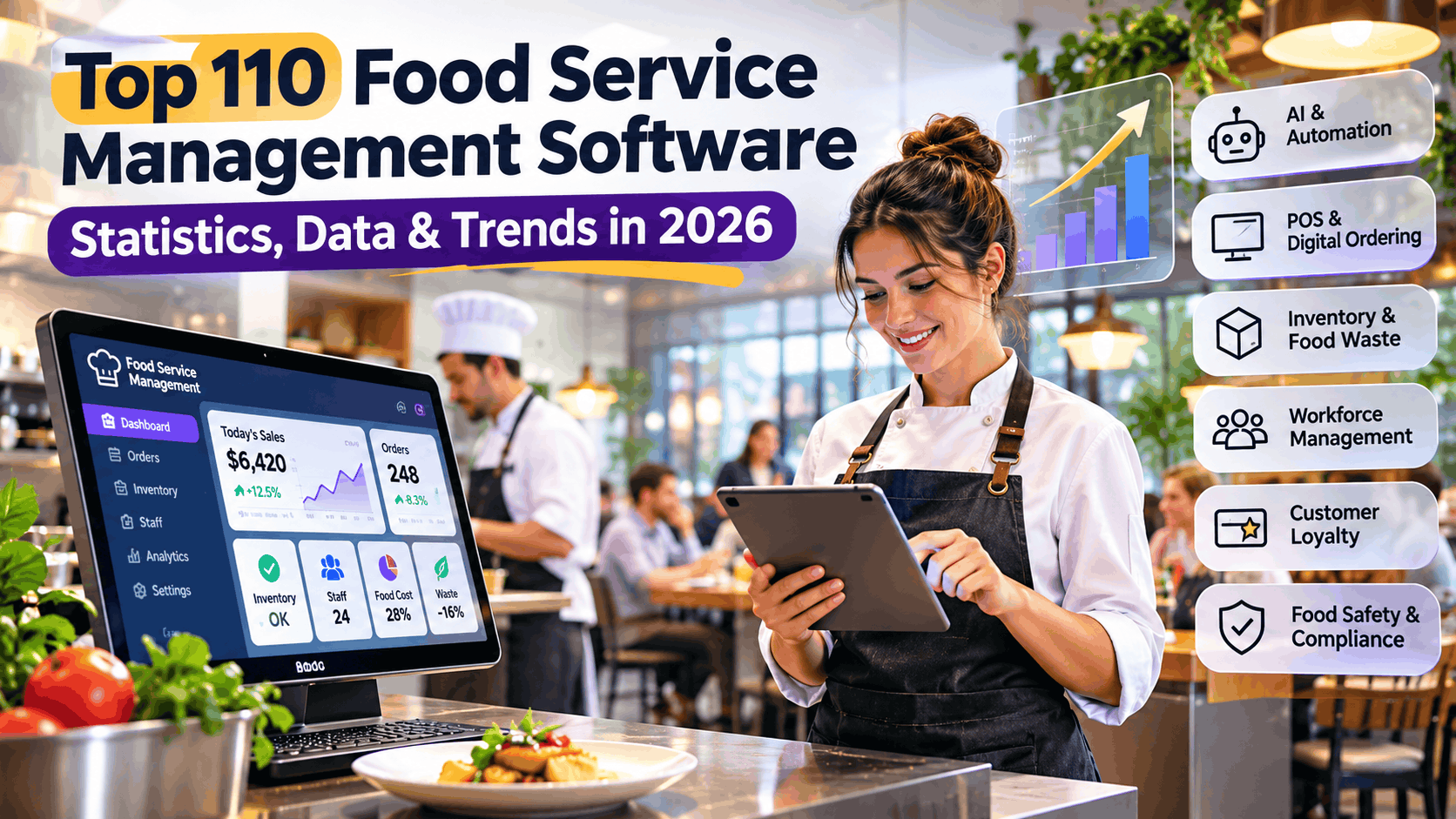
Food service management software is transforming restaurant operations in 2026 through AI, automation, cloud-based POS systems, and inventory management. The global restaurant management software market is projected to reach USD 14.70 billion by 2030, with 17.4% annual growth. Key trends include digital ordering, workforce optimization, food waste reduction, and customer loyalty technology.
The global food service industry is undergoing a significant digital transformation in 2026, driven by rising operational costs, changing consumer expectations, workforce challenges, and the rapid adoption of artificial intelligence (AI) and automation. As restaurants, catering companies, cloud kitchens, and institutional foodservice providers seek greater efficiency and profitability, food service management software has become an essential component of modern hospitality operations.
Also, read our article on the Top 10 Best Food Service Management Software.
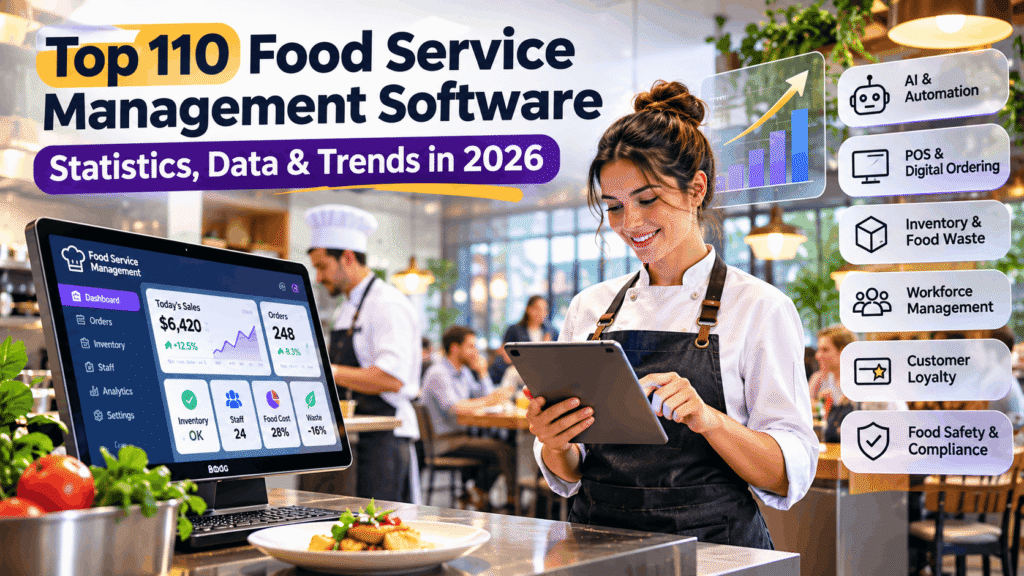
From point-of-sale (POS) systems and inventory management platforms to employee scheduling, food safety compliance, customer relationship management (CRM), and AI-powered analytics, digital solutions are transforming how foodservice businesses operate, manage resources, and serve customers.
According to industry market projections, the global restaurant management software market is expected to grow from USD 6.60 billion in 2025 to USD 14.70 billion by 2030, representing a compound annual growth rate (CAGR) of approximately 17.4%. Meanwhile, the global restaurant POS software market reached an estimated USD 11.75 billion in 2025 and is projected to expand to USD 21.62 billion by 2033, highlighting the increasing importance of integrated technology solutions across the foodservice ecosystem.
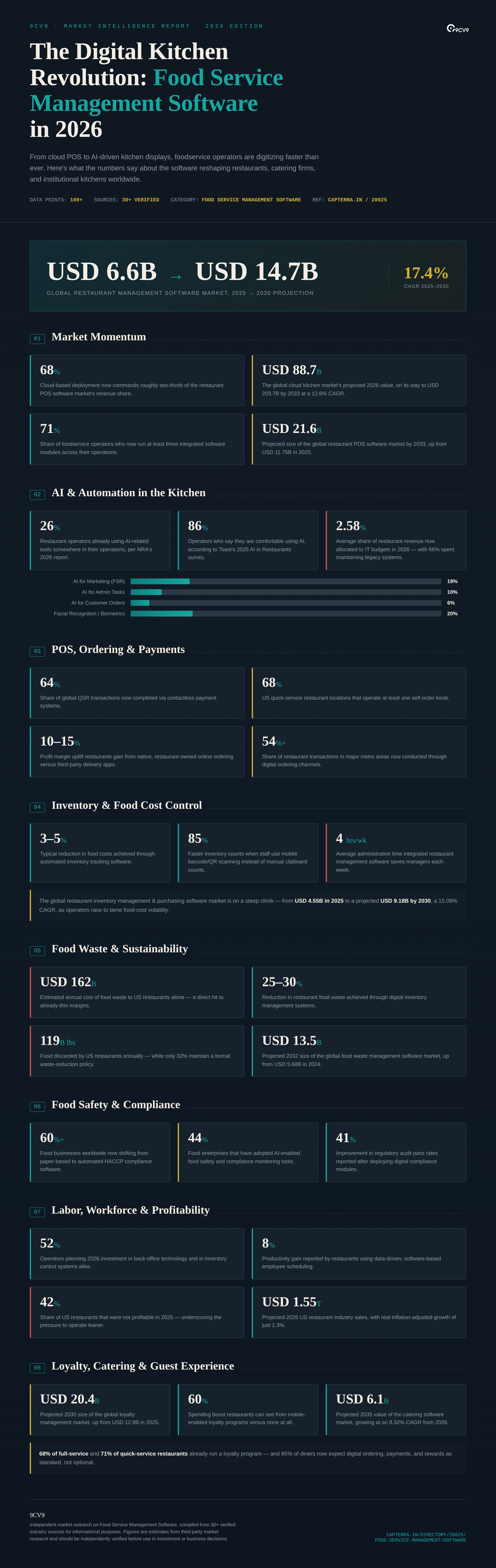
Artificial intelligence is emerging as another major driver of technological innovation. Industry findings indicate that approximately 26% of restaurant operators are already using AI-related tools, while 81% of operators surveyed by Toast plan to expand their AI adoption. These technologies are increasingly being deployed for demand forecasting, automated inventory management, personalized marketing, workforce scheduling, and operational analytics.
However, technology adoption is not simply about innovation. It is increasingly becoming a financial necessity.
With restaurant profit margins estimated at just 2.8% for full-service establishments and 4% for limited-service restaurants, businesses face considerable pressure to reduce waste, optimize labor costs, and improve operational productivity. Research estimates suggest that automated inventory tracking can reduce food costs by 3–5%, while software-based employee scheduling can improve productivity by approximately 8% compared with manual scheduling practices.
The growing importance of digital transformation is also reflected in investment priorities. In 2026, approximately 60% of restaurant operators plan to invest in customer-experience technologies, while 52% intend to invest in back-office systems and inventory management solutions. Furthermore, eight in ten restaurant operators believe technology provides a meaningful competitive advantage, reinforcing the strategic role of software in an increasingly competitive industry.
Beyond operational efficiency, several emerging trends are reshaping the food service management software market in 2026. Cloud-based restaurant management platforms, self-service ordering kiosks, contactless payments, AI-powered kitchen automation, digital food safety monitoring, and integrated loyalty programs are gaining importance as businesses seek more connected and data-driven operations.
At the same time, cybersecurity, regulatory compliance, software integration, and implementation costs remain important considerations for foodservice organizations evaluating new technologies.
Understanding these developments is essential for restaurant owners, foodservice operators, hospitality executives, technology vendors, software developers, and investors seeking to navigate the rapidly evolving digital foodservice landscape.
This comprehensive guide explores the top 110 food service management software statistics, data, and trends in 2026, covering market size, industry growth forecasts, AI adoption, POS technology, inventory optimization, food waste reduction, workforce management, cloud kitchens, customer loyalty, food safety compliance, and cybersecurity.
By examining these key statistics and emerging industry trends, businesses can gain valuable insights into the technologies shaping the future of foodservice management, identify opportunities for operational improvement, and make more informed software investment decisions in 2026 and beyond.
Before we venture further into this article, we would like to share who we are and what we do.
About 9cv9
9cv9 is a business tech startup based in Singapore and Asia, with a strong presence all over the world.
With over ten years of startup and business experience, and being highly involved in connecting with thousands of companies and startups, the 9cv9 team has listed some of the top and best companies/tools in this review.
If you like to get your company listed in our top B2B software reviews, check out our world-class 9cv9 Media and PR service and pricing plans here.
Top 110 Food Service Management Software Statistics, Data & Trends in 2026
1. Market Size, Growth & Investment
- The global restaurant management software market is valued at USD 6.60 billion in 2025 and is projected to reach USD 14.70 billion by 2030, more than doubling in five years.
- That growth translates to a robust 17.4% compound annual growth rate (CAGR) from 2025 to 2030, among the fastest-growing categories in hospitality tech.
- North America dominated the restaurant management software market by revenue share in 2024, reflecting the region’s mature restaurant-tech ecosystem.
- The US restaurant management software market alone is projected to reach USD 3,355.2 million by 2030, underscoring America’s outsized role in category growth.
- North America’s restaurant management software market is projected to hit USD 4,173.2 million by 2030, confirming the region’s continued leadership.
- A separate Technavio forecast pegs restaurant management software market growth at USD 9,117.3 million in absolute terms between 2026 and 2030, at a 19.4% CAGR.
- The global restaurant POS software market reached USD 11.75 billion in 2025 and is on track to hit USD 21.62 billion by 2033.
- North America commands roughly 40% of the global restaurant POS software market, the largest regional share of any market.
- Cloud-based deployment now holds close to 68% of restaurant POS software market revenue, cementing SaaS as the default delivery model.
- The software component of the US restaurant POS market held the largest 2024 revenue share at 45.5%, driven by AI-enabled analytics and mobile management tools.
2. AI, Automation & Emerging Technology
- Roughly 26% of restaurant operators report using AI-related tools somewhere in their business, according to the National Restaurant Association’s 2026 industry report.
- Marketing is the leading AI use case, with 19% of full-service and 15% of limited-service operators applying AI tools to marketing tasks.
- Only 10% of restaurant operators currently use AI for administrative tasks, showing meaningful headroom for back-office automation.
- Just 6% of restaurants use AI to take customer orders directly, despite heavy industry experimentation with drive-thru voice bots.
- Roughly six in ten millennial and Gen Z consumers say they’d be comfortable placing an order with an AI-generated bot.
- Toast’s 2025 AI in Restaurants survey found 86% of operators are comfortable using AI in their business.
- 81% of operators surveyed by Toast plan to expand their use of AI, and the same share believe AI will make them more efficient.
- Average restaurant IT budgets climbed to 2.58% of revenue in 2026, yet 66% of that spend goes toward maintaining existing systems rather than new innovation.
- Facial recognition and biometric technology adoption in restaurants has reached an estimated 20% in 2026, a sharp rise from prior years.
- Roughly 28% of restaurant operators are actively switching CRM platforms, signaling widespread dissatisfaction with legacy guest-data tools.
- Early adopters of voice-enabled “digital staff” technology are seeing around 80% accuracy in handling routine tasks, helping offset labor shortages.
- Back-of-house AI investment (9.09% of H2 2026 tech budgets) now outpaces front-of-house AI investment (6.31%), per Restaurant365’s mid-year report.
- Reporting and analytics, scheduling, and inventory forecasting are the three back-of-house AI applications seeing the fastest adoption.
- About 41% of global quick-service chains use AI-driven menu optimization tools to improve sales performance.
- Roughly 46% of QSR companies are actively investing in kitchen automation robotics to speed up food preparation.
3. POS Systems, Digital Ordering & Payments
- Contactless payment systems now process an estimated 64% of global QSR transactions, reflecting a permanent post-pandemic shift.
- Contactless payment terminals are installed at roughly 63% of QSR locations worldwide.
- The US restaurant POS software market is valued at USD 1.24 billion in 2025 and is projected to reach USD 1.33 billion in 2026 and USD 2.07 billion by 2032.
- Self-service kiosks account for approximately 57% of hardware installations in urban fast-food restaurants, cutting customer wait times by roughly 2.5 minutes per order.
- Drive-thru ordering systems make up an estimated 61% of hardware usage in developed markets such as North America.
- Kitchen display systems (KDS) are now integrated into roughly 49% of QSR kitchens, directly improving order accuracy.
- Digital menu boards represent about 52% of front-end hardware usage, lifting customer engagement by an estimated 44%.
- The global restaurant kiosk market is valued at USD 2,289.69 million in 2026 and is projected to reach USD 6,374.64 million by 2035.
- Contactless payment capability now ships with an estimated 88% of newly deployed restaurant kiosks.
- Approximately 68% of US quick-service restaurant locations operate at least one self-order kiosk.
- Digital ordering now accounts for more than 54% of restaurant transactions in major metropolitan areas.
- The global restaurant online ordering system installed base is expanding at an estimated 12–15% CAGR between 2026 and 2035.
- QSRs represent an estimated 42% of the global installed base of restaurant online ordering systems, the largest single segment.
- Native, restaurant-owned online ordering systems can lift profit margins by 10–15% compared with relying on third-party delivery apps.
- The kitchen display systems market reached an estimated USD 418.7 million in 2024, with North America holding the largest regional share.
4. Inventory Management & Food Cost Control
- The restaurant inventory management and purchasing software market grew from USD 3.95 billion in 2024 to USD 4.55 billion in 2025, and is projected to nearly double to USD 9.18 billion by 2030.
- That represents a 15.09% CAGR, among the fastest-growing subsegments of foodservice software.
- Automated inventory tracking software typically cuts food costs by an estimated 3–5% through tighter control over ordering and shrinkage.
- Mobile barcode and QR-code scanning can speed up inventory counts by as much as 85% compared with manual clipboard counting.
- Variance reporting and blind-count features in inventory software can flag discrepancies and cut shrinkage by up to 30%.
- Real-time inventory alerts can reduce overstocking by an estimated 20%, freeing up working capital tied to excess stock.
- Digital inventory tracking is estimated to reduce restaurant food waste by 10–15% on its own.
- Integrated restaurant management software saves managers an average of roughly 4 hours per week on administrative tasks.
- An estimated 80% of restaurateurs now use software-generated sales data to make menu adjustments.
- More than 52% of US restaurants operate two or more integrated software platforms simultaneously, up from far lower levels a few years ago.
5. Food Waste Management & Sustainability
- US restaurants lose an estimated USD 162 billion annually to food waste, a figure that rivals the revenue of many national economies.
- US restaurants discard approximately 119 billion pounds of food each year, while only 32% maintain a formal waste-reduction policy.
- Guest behavior — over-ordering and uneaten leftovers — is estimated to drive roughly 60% of all restaurant food waste.
- Digital inventory management systems can reduce restaurant food waste by an estimated 25–30%.
- Staff training focused on portion control and waste awareness can cut waste by a further 18–22%.
- The average full-service restaurant is estimated to waste 23–30% of the food it purchases.
- Quick-service restaurants waste an estimated 10–15% of food, with roughly 60% attributable to over-portioning and 30% to preparation losses.
- The global food waste management software market was valued at USD 5.68 billion in 2024 and is projected to reach USD 13.47 billion by 2032.
- Restaurants and food service represent one of the largest and fastest-growing end-use segments for food waste management software.
- At least 18 countries have now set formal national food waste reduction targets, including a 50% cut in restaurant waste by 2030.
6. Food Safety, Compliance & HACCP
- The global food safety HACCP software market is estimated at roughly USD 258.9 million in 2026, projected to reach USD 575.5 million by 2035.
- That growth reflects a 9.28% CAGR as food safety regulation tightens across major markets.
- More than 60% of food-related businesses worldwide are actively transitioning from manual, paper-based processes to automated HACCP software.
- Cloud-based HACCP deployments have expanded by an estimated 39% amid broader digital compliance adoption.
- Roughly 44% of food enterprises have now adopted AI-enabled food safety and compliance monitoring tools.
- Digital audit and reporting solutions for food safety compliance have grown by an estimated 36% in recent reporting periods.
- IoT-based monitoring of critical control points has increased by an estimated 38%, enabling continuous, automated safety tracking.
- Digital compliance modules are estimated to improve regulatory audit pass rates by roughly 41%.
- Automated inventory and compliance features can reduce food spoilage tied to safety issues by an estimated 28%.
- More than 47% of US restaurants report using food service management software specifically for institutional catering compliance needs.
7. Labor, Workforce & Profitability
- The North American restaurant employee scheduling software market was valued at USD 1.2 billion in 2024 and is projected to reach USD 2.2 billion by 2033.
- 52% of restaurant operators plan to invest in back-office technologies in 2026.
- Another 52% of operators plan to invest specifically in inventory control and management technology this year.
- 48% of operators plan investment in POS systems for 2026, while a separate survey found 53% prioritized POS upgrades — up sharply from 40% the year before.
- Restaurants using data-driven, software-based scheduling report 8% higher productivity than those relying on manual scheduling methods.
- A notable 42% of US restaurants were not profitable in 2025, according to the National Restaurant Association, intensifying pressure to adopt cost-saving software.
- More than 9 in 10 operators cite food, labor, insurance, energy, and swipe fees as significant ongoing business challenges.
- Restaurant profit margins remain razor-thin — just 2.8% for full-service restaurants and 4% for limited-service restaurants.
- 60% of restaurant operators plan to invest in customer-experience-focused technology in 2026, the single largest tech investment category.
- Eight in ten restaurant operators say technology now gives them a meaningful competitive advantage over rivals.
- US restaurant industry sales are projected to reach USD 1.55 trillion in 2026, though real, inflation-adjusted growth is a modest 1.3%.
8. Cloud Kitchens, Catering & Institutional Foodservice
- The global cloud kitchen market was valued at USD 80.3 billion in 2025 and is projected to reach USD 88.7 billion in 2026 and USD 203.7 billion by 2033.
- The independent cloud kitchen segment led with a 61.7% revenue share in 2025, ahead of shared commissary-style facilities.
- A separate Fortune Business Insights forecast projects the cloud kitchen market growing from USD 83.5 billion in 2026 to USD 175.14 billion by 2034.
- The catering software market is estimated at USD 2.98 billion in 2026 and is projected to reach USD 6.12 billion by 2035.
- Roughly 59% of medium-scale US catering operators shifted to cloud-based workflow platforms during 2025.
- An estimated 87,000 US foodservice businesses integrated digital event-scheduling modules into their operations in 2025.
- The restaurant catering software market specifically is valued at USD 3.5 billion in 2025, projected to reach USD 7.2 billion by 2034.
- Roughly 69% of catering software implementations in 2025 targeted dedicated catering service providers rather than general restaurants.
- Nearly 31 million banquet transactions were processed through integrated catering management platforms in a recent measured period.
- Web-based food service management platforms represent an estimated 36% of the broader market, with 42% preference among institutional foodservice providers specifically.
9. Customer Loyalty, Mobile Apps & Guest Experience
- The global loyalty management market — which includes restaurant loyalty platforms — is estimated at USD 12.9 billion in 2025, projected to reach USD 20.36 billion by 2030.
- 68% of full-service restaurants and 71% of quick-service restaurants already operate a loyalty program.
- Mobile-enabled loyalty programs can drive up to a 60% boost in customer spending compared with no loyalty program at all.
- Loyalty program members can account for up to 45% of a restaurant’s total sales, an outsized share relative to program membership rates.
- 47% of loyalty members now engage with restaurant programs weekly, up sharply from 34% in 2023.
- 93% of loyalty members say they check for deals before deciding where or what to eat, showing how central loyalty has become to dining decisions.
- An estimated 47.4% of restaurant customers are enrolled in at least one loyalty program.
- Wallet-based loyalty push notifications achieve roughly 90% open rates, dramatically outperforming standard app notifications at just 15–25%.
- A striking 83% of restaurant loyalty apps are opened fewer than three times before being uninstalled within 30 days, highlighting a major app-retention challenge.
- 85% of diners now expect online ordering, digital payments, and loyalty programs as standard restaurant features, not differentiators.
10. Cybersecurity, Cloud Infrastructure & Risk
- Business email compromise (BEC) attacks — a growing risk vector for restaurant back offices — rose 15% in 2025, with average losses reaching USD 137,000 per incident.
- Average BEC losses have climbed 83% since 2019, reflecting increasingly sophisticated social-engineering tactics aimed at finance teams.
- Nearly USD 2.9 billion in BEC losses were recorded across industries, including hospitality, in 2024 alone.
- Ransomware attacks on hospitality back-office systems have forced some multi-location chains into temporary manual operations during recovery.
- Attackers increasingly target POS back-end admin portals and online ordering systems rather than just in-store terminals, raising the stakes of cloud security hygiene.
11. Broader Foodservice Industry Backdrop
- The global food service market was valued at approximately USD 3.19 trillion in 2025 and is projected to reach USD 4.27 trillion by 2034.
- Asia Pacific holds the largest share of the global food service market, at an estimated 37% of total revenue.
- Digital adoption across foodservice operations now exceeds 68% globally, spanning POS, inventory, scheduling, and compliance tools.
- Food, labor, insurance, and energy costs have collectively risen roughly 35% since 2019, a primary driver of software adoption as operators hunt for efficiency gains.
Conclusion
The top 110 food service management software statistics, data, and trends in 2026 demonstrate that digital transformation is becoming increasingly essential for restaurants, catering businesses, cloud kitchens, and institutional foodservice providers seeking to improve efficiency, reduce operational costs, and remain competitive in a rapidly evolving industry.
With the global restaurant management software market projected to grow from USD 6.60 billion in 2025 to USD 14.70 billion by 2030, at a compound annual growth rate (CAGR) of 17.4%, demand for integrated foodservice technology solutions is expected to accelerate. This growth reflects the increasing reliance on cloud-based platforms, artificial intelligence, automated inventory systems, digital ordering solutions, and data-driven business management tools.
One of the most significant food service management software trends in 2026 is the growing adoption of artificial intelligence and automation. Approximately 26% of restaurant operators already use AI-related technologies, while 81% of operators surveyed by Toast intend to expand their AI capabilities. From predictive demand forecasting and intelligent workforce scheduling to automated food preparation and personalized customer engagement, AI is creating new opportunities to improve operational performance.
Financial efficiency remains another major driver of software adoption. With estimated profit margins of just 2.8% for full-service restaurants and 4% for limited-service establishments, operators are increasingly prioritizing technologies that deliver measurable cost savings. Automated inventory management solutions can potentially reduce food costs by 3–5%, while data-driven employee scheduling systems have been associated with productivity improvements of approximately 8%.
Meanwhile, the expansion of restaurant POS software, cloud-based foodservice management platforms, self-service kiosks, and digital payment systems is transforming customer experiences and streamlining daily operations. Cloud deployment accounts for approximately 68% of restaurant POS software market revenue, illustrating the growing preference for scalable, accessible, and integrated software solutions.
Sustainability and regulatory compliance are also becoming central to foodservice technology investments. Digital food waste management platforms, automated HACCP monitoring systems, real-time inventory tracking, and IoT-enabled food safety solutions are helping businesses strengthen operational oversight while addressing environmental and compliance challenges.
Customer loyalty and personalization represent additional opportunities for growth. With 68% of full-service restaurants and 71% of quick-service restaurants operating loyalty programs, businesses are increasingly using customer data, mobile applications, and integrated CRM platforms to encourage repeat purchases, strengthen customer relationships, and improve long-term revenue performance.
However, the increasing dependence on interconnected digital systems also introduces challenges involving cybersecurity, data privacy, software integration, implementation expenses, and employee training. Foodservice businesses must therefore evaluate technology investments carefully, balancing potential efficiency gains against operational risks and long-term ownership costs.
Looking ahead, the future of food service management software beyond 2026 is likely to be shaped by deeper AI integration, predictive analytics, automated kitchen operations, unified cloud-based management platforms, real-time food safety monitoring, and increasingly personalized digital customer experiences.
For restaurant owners, hospitality executives, foodservice operators, software vendors, and investors, these industry statistics highlight an important strategic shift: food service management software is evolving from a supporting operational tool into a critical driver of business efficiency, profitability, scalability, and competitive differentiation.
Ultimately, organizations that successfully combine technology adoption with effective workforce management, cost optimization, customer experience improvements, and data-driven decision-making will be better positioned to navigate industry challenges and capitalize on emerging opportunities.
As the foodservice industry continues its digital evolution, understanding the latest food service management software statistics, market trends, adoption rates, and growth forecasts will remain essential for making informed investment decisions and building more resilient, efficient, and profitable foodservice operations in 2026 and beyond.
If you find this article useful, why not share it with your hiring manager and C-level suite friends and also leave a nice comment below?
We, at the 9cv9 Research Team, strive to bring the latest and most meaningful data, guides, and statistics to your doorstep.
To get access to top-quality guides, click over to 9cv9 Blog.
To hire top talents using our modern AI-powered recruitment agency, find out more at 9cv9 Modern AI-Powered Recruitment Agency.
People Also Ask
What is food service management software?
Food service management software is a digital solution that helps restaurants, catering businesses, and foodservice providers manage daily operations, including inventory, POS transactions, employee scheduling, food safety, accounting, and customer relationships.
How big is the global food service management software market in 2026?
The global restaurant management software market was valued at USD 6.60 billion in 2025 and is projected to reach USD 14.70 billion by 2030, growing at a compound annual growth rate (CAGR) of 17.4%.
What are the biggest food service management software trends in 2026?
Major trends include AI-powered automation, cloud-based POS systems, predictive inventory management, digital ordering, self-service kiosks, workforce optimization, food waste reduction, and integrated customer loyalty platforms.
What is the projected growth rate of restaurant management software?
The global restaurant management software market is projected to grow at a CAGR of 17.4% between 2025 and 2030, driven by increasing demand for automation, cloud technology, and integrated restaurant operations.
How is artificial intelligence transforming food service management in 2026?
AI helps restaurants automate inventory forecasting, optimize employee schedules, personalize marketing campaigns, analyze customer behavior, and improve operational efficiency. Approximately 26% of restaurant operators already use AI-related technologies.
What percentage of restaurants use AI technology in 2026?
Approximately 26% of restaurant operators report using AI-related tools. Additionally, a Toast survey found that 81% of participating restaurant operators plan to expand their use of artificial intelligence.
How much is the global restaurant POS software market worth?
The global restaurant POS software market reached approximately USD 11.75 billion in 2025 and is projected to reach USD 21.62 billion by 2033, reflecting growing demand for digital payments and integrated restaurant management systems.
What percentage of restaurant POS software is cloud-based?
Cloud-based deployment accounts for approximately 68% of global restaurant POS software market revenue, highlighting the growing adoption of scalable, remotely accessible, and subscription-based restaurant technology.
What are the benefits of cloud-based food service management software?
Cloud-based food service management software enables remote access, centralized reporting, automatic updates, multi-location management, real-time inventory monitoring, and integration with digital ordering and payment platforms.
How does food service management software reduce restaurant operating costs?
Food service management software reduces costs through automated inventory tracking, optimized employee scheduling, waste reduction, and improved purchasing decisions. Automated inventory systems can potentially lower food costs by 3–5%.
How much can restaurant inventory management software save businesses?
Automated restaurant inventory management software can reduce food costs by an estimated 3–5%. Real-time inventory alerts may also reduce overstocking by approximately 20%, improving cash flow and purchasing efficiency.
What is the market size of restaurant inventory management software?
The global restaurant inventory management and purchasing software market reached approximately USD 4.55 billion in 2025 and is projected to grow to USD 9.18 billion by 2030, representing a CAGR of 15.09%.
How does restaurant management software help reduce food waste?
Restaurant management software tracks inventory levels, expiration dates, purchasing patterns, and ingredient usage. Digital inventory systems can potentially reduce food waste by 10–15%, while broader waste management solutions may achieve greater reductions.
How much food waste can digital restaurant management systems prevent?
Digital inventory management systems are estimated to reduce restaurant food waste by approximately 25–30% in some implementations, depending on existing processes, employee training, and inventory control practices.
What is the role of POS systems in modern restaurant management?
Restaurant POS systems process transactions, track sales, manage orders, monitor inventory, and connect payment systems with kitchen operations. Modern cloud-based POS platforms also support customer analytics, loyalty programs, and multi-location reporting.
How popular are self-service ordering kiosks in restaurants in 2026?
Approximately 68% of US quick-service restaurant locations are estimated to operate at least one self-order kiosk. These systems help streamline ordering, reduce waiting times, and improve customer convenience.
What percentage of restaurant transactions use contactless payments?
Contactless payment systems are estimated to process approximately 64% of global quick-service restaurant transactions, reflecting growing consumer demand for fast, convenient, and digitally enabled payment experiences.
How does food service management software improve employee scheduling?
Food service management software automates shift planning, tracks employee availability, monitors labor costs, and forecasts staffing requirements. Restaurants using data-driven scheduling report approximately 8% higher productivity than those using manual methods.
What are the most important restaurant technology investments in 2026?
Approximately 60% of restaurant operators plan to invest in customer-experience technology in 2026. Another 52% prioritize back-office technology, while 48% plan investments in POS systems.
How profitable are restaurants in 2026?
Restaurant profit margins remain relatively narrow, with estimated margins of 2.8% for full-service restaurants and 4% for limited-service establishments. These financial pressures encourage investment in cost-saving management software.
What is HACCP software in food service management?
HACCP software helps foodservice businesses manage Hazard Analysis and Critical Control Points through digital monitoring, automated documentation, temperature tracking, compliance reporting, and food safety audits.
How big is the global food safety HACCP software market?
The global food safety HACCP software market is estimated at approximately USD 258.9 million in 2026 and projected to reach USD 575.5 million by 2035, representing a CAGR of approximately 9.28%.
How does IoT technology improve food safety management?
IoT-enabled food safety systems monitor refrigeration temperatures, storage conditions, and critical control points in real time. Automated alerts and digital records help businesses identify potential food safety risks and strengthen regulatory compliance.
What is cloud kitchen management software?
Cloud kitchen management software helps delivery-focused food businesses coordinate online orders, kitchen workflows, inventory, delivery platforms, employee schedules, and financial reporting through centralized digital systems.
How big is the global cloud kitchen market in 2026?
The global cloud kitchen market is estimated at USD 88.7 billion in 2026 and projected to reach USD 203.7 billion by 2033, driven by increasing demand for online food delivery and technology-enabled restaurant operations.
What is the market size of catering management software in 2026?
The global catering software market is estimated at USD 2.98 billion in 2026 and projected to reach USD 6.12 billion by 2035, reflecting growing adoption of digital event scheduling, order management, and catering workflow automation.
How do restaurant loyalty programs improve customer retention?
Restaurant loyalty software encourages repeat purchases through rewards, personalized offers, customer insights, and digital engagement. Approximately 68% of full-service restaurants and 71% of quick-service restaurants operate loyalty programs.
What percentage of restaurants use customer loyalty software?
Approximately 68% of full-service restaurants and 71% of quick-service restaurants operate loyalty programs. These programs increasingly integrate with POS systems, mobile applications, and customer relationship management platforms.
What are the biggest cybersecurity risks for food service management software?
Major cybersecurity risks include ransomware, phishing, business email compromise, unauthorized POS access, payment data theft, and cloud account breaches. Restaurants should prioritize secure integrations, access controls, software updates, and employee training.
What is the future of food service management software beyond 2026?
The future of food service management software will likely involve greater AI adoption, predictive analytics, automated kitchens, cloud-based integrations, real-time inventory monitoring, digital food safety compliance, and personalized customer experiences.
Sources
- Grand View Research
- Grand View Research Horizon
- Technavio
- DataM Intelligence
- OpenPR
- Verified Market Research
- Data Bridge Market Research
- Market Reports World
- National Restaurant Association
- Toast
- Restaurant Dive
- Hospitality Technology
- Restaurant365
- Restaurant Business Online
- Business Research Insights
- IndexBox
- Growth Market Reports
- Research and Markets
- StockFlow Systems
- GOIS (Goods Order Inventory System)
- WorldMetrics
- WiseGuyReports
- Market Growth Reports
- Global Growth Insights
- MarketMan
- GBQ CPAs
- Restroworks
- LoyaltyPass
- Restolabs
- Access Development
- PYMNTS Intelligence
- IMARC Group
- WiFi Talents