Key Takeaways
- Fleet Management Software Market Growth: The global fleet management software market is projected to reach USD 38.28 billion in 2026 and USD 152.89 billion by 2034, driven by digital transformation, cloud adoption, and increasing demand for connected fleet solutions.
- AI, GPS Tracking, and Predictive Maintenance Adoption: Approximately 80% of surveyed fleet professionals use GPS tracking, while AI-assisted route optimization adoption has reached 71% and AI-driven maintenance scheduling adoption has climbed to 64.5% in 2026.
- Fleet Management Software ROI and Cost Savings: GPS fleet tracking can reduce operating expenses by 11–19%, while predictive maintenance can lower maintenance costs by 25–40%. Approximately 71% of fleets implementing GPS or telematics solutions report recovering their investment within 12 months.
Fleet management system software in 2026 is a rapidly growing market, projected to reach USD 38.28 billion globally. Businesses use fleet management software to reduce operating costs, improve driver safety, optimize fuel consumption, and prevent vehicle downtime. Key trends include AI-powered automation, GPS tracking, predictive maintenance, electric vehicle management, and real-time fleet analytics.
The global fleet management system software industry is undergoing a significant transformation in 2026, driven by the rapid adoption of artificial intelligence (AI), GPS fleet tracking, predictive maintenance, cloud-based platforms, and electric vehicle (EV) management solutions. As businesses face increasing pressure to reduce operating costs, improve driver safety, optimize fuel consumption, and maintain regulatory compliance, fleet management software has become an essential investment for transportation companies, logistics providers, construction businesses, and organizations operating commercial vehicle fleets.
According to industry projections, the global fleet management software market is expected to reach approximately USD 38.28 billion in 2026, compared with USD 32.36 billion in 2025. The market is forecast to expand to USD 152.89 billion by 2034, representing a compound annual growth rate (CAGR) of 18.9%. North America remains the largest regional market, accounting for approximately 38.6% of global revenue, while Asia-Pacific is emerging as one of the fastest-growing regions, supported by expanding e-commerce logistics, transportation infrastructure investments, and increasing demand for connected fleet technologies.
Also, read our article on the Top 10 Best Fleet Management System To Use.

One of the most important fleet management software trends in 2026 is the accelerating integration of AI and automation into everyday fleet operations. Survey data indicates that AI-assisted route optimization adoption increased from 42.9% in 2025 to 71.0% in 2026, while AI-driven maintenance scheduling adoption nearly doubled from 33.3% to 64.5%. Meanwhile, approximately 80% of surveyed fleet professionals now use GPS tracking technology, and video telematics adoption has reached 46%, reflecting growing demand for real-time vehicle monitoring, intelligent driver coaching, and automated operational insights.
The financial benefits of fleet management systems are also becoming increasingly measurable. Industry data suggests that GPS tracking solutions can help businesses reduce fuel, labor, accident, and maintenance expenses by approximately 11–19%. Predictive maintenance strategies have been associated with 25–40% lower maintenance costs and 30–50% reductions in unplanned vehicle downtime. Furthermore, 71% of fleets implementing GPS or telematics tracking reportedly recover their technology investment within the first 12 months, demonstrating the potential return on investment (ROI) of modern fleet management platforms.

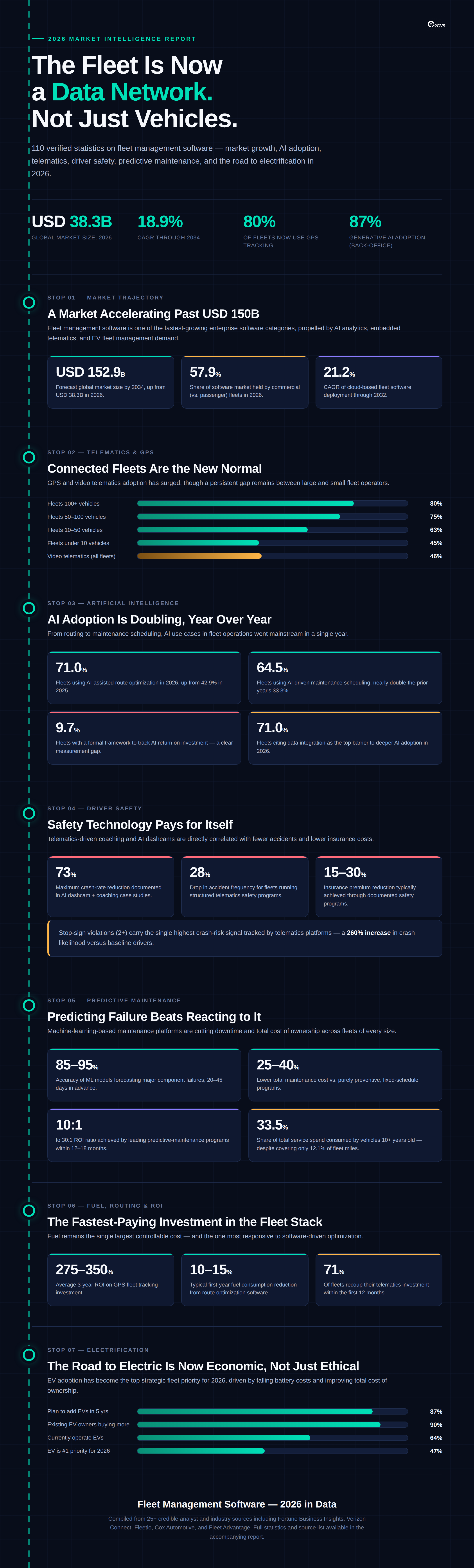
Fleet electrification, cybersecurity, and integrated data analytics are introducing additional opportunities and challenges. Approximately 87% of fleet owners expect to introduce electric vehicles within the next five years, while 71% of surveyed fleets identify data integration as a major obstacle to expanding AI adoption. These developments highlight the growing importance of comprehensive fleet management systems that combine vehicle tracking, fuel management, maintenance scheduling, driver safety monitoring, regulatory compliance, and advanced analytics within a unified digital platform.
This comprehensive guide to the Top 110 Fleet Management System Software Statistics, Data & Trends in 2026 examines the latest market growth projections, fleet tracking adoption rates, AI-powered fleet management trends, predictive maintenance statistics, fuel efficiency improvements, EV fleet management developments, and software ROI benchmarks. By exploring these data-driven insights, fleet operators, business owners, logistics professionals, technology providers, and industry investors can better understand the evolving fleet management software market, identify emerging opportunities, and make more informed decisions about fleet technology investments in 2026 and beyond.
Before we venture further into this article, we would like to share who we are and what we do.
About 9cv9
9cv9 is a business tech startup based in Singapore and Asia, with a strong presence all over the world.
With over ten years of startup and business experience, and being highly involved in connecting with thousands of companies and startups, the 9cv9 team has listed some of the top and best companies/tools in this review.
If you like to get your company listed in our top B2B software reviews, check out our world-class 9cv9 Media and PR service and pricing plans here.
Top 110 Fleet Management System Software Statistics, Data & Trends in 2026
1. Global Market Size & Growth
- The global fleet management software market is projected to reach approximately USD 38.28 billion in 2026, up from USD 32.36 billion in 2025, underscoring how quickly fleet operators are shifting IT budgets toward digital vehicle oversight.
- Fortune Business Insights forecasts the market will surge to USD 152.89 billion by 2034, translating into an 18.9% compound annual growth rate that outpaces most enterprise software categories.
- Global Market Insights pegs the broader fleet management market (hardware, software, and services combined) at USD 30.1 billion in 2026, climbing to USD 122.3 billion by 2035 at a 16.9% CAGR.
- Research and Markets values the fleet management software segment specifically at USD 32.79 billion in 2026, en route to USD 55.97 billion by 2030 — a 14.3% CAGR driven by AI analytics and EV management demand.
- Software already dominates the fleet management technology stack, commanding a 49% share of the combined hardware-software-services market in 2025 and continuing to grow at 17.1% CAGR through 2035.
- The operations management software segment alone holds the single largest slice of the market, accounting for 40.66% of total fleet software revenue in 2026.
- IndustryARC estimates fleet management software could reach USD 55.89 billion by 2026, with a longer-range projection of USD 94.5 billion by 2030 at a 19.4% CAGR.
- SkyQuest research places 2025 market value at USD 29.01 billion, rising toward USD 111.29 billion by 2033 — an 18.3% CAGR that reflects continued fragmentation and vendor consolidation activity.
- On-premises deployment still edges out cloud in installed base, holding 58.2% share in 2026, even as cloud is set to post the fastest growth at a 21.2% CAGR through 2032 thanks to easier multi-location rollout.
- Commercial fleets (versus passenger-car fleets) account for 57.9% of total software market share in 2026, reflecting how deeply logistics and delivery operators depend on digital tracking tools.
- Vehicle maintenance and diagnostics functionality is forecast to represent 42.0% share of fleet technology spend in 2026, as operators prioritize downtime control as a direct line-item cost.
- Direct sales channels dominate distribution, accounting for 75.0% of fleet software sales in 2026 because large fleet buyers require dedicated account support and systems-integration planning.
2. Regional Market Breakdown
- North America remains the single largest regional market, holding roughly 38.6% global share and an estimated USD 14.61 billion in 2026 software revenue.
- The United States alone represents close to USD 9.8–9.9 billion of global fleet software spend in 2026, reflecting dense regulatory requirements like the FMCSA electronic logging device (ELD) mandate.
- Europe is the second-largest region, generating an estimated USD 11.84 billion in 2026 revenue (about 30.6% global share), with Germany’s outsized commercial vehicle base anchoring demand.
- The UK fleet software market is projected to reach USD 2.609 billion in 2026, while Germany and France each approach the USD 2 billion mark the same year.
- Asia-Pacific is forecast to hit USD 7.63 billion in 2026 software revenue (about 19.6% global share) but is widely cited as the fastest-growing region, with some estimates placing its CAGR above 19% through the mid-2030s.
- China’s fleet management market is expanding at an estimated 18.7% CAGR from 2026–2035, propelled by e-commerce logistics growth and government-driven intelligent transportation initiatives.
- India’s fleet management software market is projected near USD 1.7 billion in 2026, with the country separately forecast to post the fastest national CAGR (17.8%) through 2036 as toll digitization and organized logistics expand.
- The Middle East & Africa region, while still emerging, is expected to reach roughly USD 2.19 billion in 2026 software revenue, supported by oil & gas, logistics, and government-fleet digitization in Saudi Arabia and the UAE.
- Verizon held an estimated 13%+ market share among fleet management vendors globally in 2025, making it the single largest named provider by revenue share.
- Analysts estimate the top seven fleet-technology vendors collectively control around 43% of the global market, indicating a moderately concentrated but still fragmented competitive landscape.
3. Telematics & GPS Tracking Adoption
- GPS fleet tracking adoption has reached roughly 80% of surveyed fleet professionals in 2026 — an 11-percentage-point jump year-over-year, per Verizon Connect’s sixth annual technology trends survey.
- Adoption skews heavily by fleet size: roughly 80% of fleets with 100+ vehicles use GPS tracking, compared to just 40–50% of fleets under 10 vehicles, showing a persistent small-fleet technology gap.
- Small fleets under 50 vehicles make up an estimated 85% of all U.S. commercial fleets, meaning the “long tail” of the market still represents the largest untapped growth opportunity for software vendors.
- Video telematics usage climbed to 46% of fleets in 2026, up from roughly 36% in 2023, as AI-powered dashcams move from niche safety tool to mainstream fleet infrastructure.
- Among fleets that have deployed video telematics, 74% report measurably improved driver safety outcomes tied to AI-based behavior detection and real-time coaching alerts.
- Fleets using GPS tracking report average cost reductions of 11–19% across fuel, labor, accident, and maintenance expense categories after implementation, according to Verizon Connect’s 2026 benchmark data.
- Roughly three out of four fleet professionals now use at least one core connected-fleet technology — GPS tracking, video telematics, or asset tracking — up sharply from prior years.
- In the European and North American car rental and leasing sector specifically, active telematics installations reached 8.6 million units by the end of 2025, with rental-fleet penetration expected to climb from 56% to 87% by 2030.
- Leasing-fleet telematics penetration is forecast to rise from 49% at year-end 2025 to 81% by 2030, driven increasingly by OEM-embedded connectivity rather than aftermarket hardware.
- The global commercial telematics market is projected to expand from roughly USD 104.9 billion in 2026 to USD 551.91 billion by 2034 — a striking 23.1% CAGR reflecting deep integration of connected-vehicle data into fleet platforms.
- An estimated 90%+ of vehicles manufactured in 2026 ship with embedded factory telematics, creating an unprecedented volume of usable operational data for AI-driven fleet analytics.
- Integrated telematics units that combine GPS, cellular modem, and onboard diagnostics into a single hardware package are projected to rise from roughly 60% of new installations in 2025 to over 70% by 2035.
4. Artificial Intelligence & Automation
- Generative AI (LLM-based tools) adoption among private fleets has reached 87.1% for back-office use cases such as documentation search and driver communications — a category that barely existed in the prior year’s survey.
- AI-assisted route optimization usage jumped from 42.9% of fleets in 2025 to 71.0% in 2026, one of the sharpest single-year technology adoption increases recorded in the sector.
- AI-driven maintenance scheduling adoption nearly doubled, rising from 33.3% in 2025 to 64.5% of surveyed fleets in 2026.
- AI-based fuel type and consumption analysis adoption climbed from effectively 0% in 2025 to 61.3% in 2026, reflecting rapid deployment as fleets electrify and diversify powertrains.
- Just 9.7% of fleets report having a formal framework for tracking AI return on investment, even as adoption accelerates — highlighting a measurement gap the industry is still working through.
- Roughly 48% of surveyed fleet managers report personally using AI tools in their day-to-day responsibilities, with an estimated 20% of total fleet vehicles considered “AI-enabled” in some capacity.
- AI-powered dynamic routing is credited with saving fleets at least 50% in combined fuel and operational costs in some documented deployments, according to 2026 State of Sustainable Fleets research.
- Data integration remains the top barrier to deeper AI usage, cited by 71.0% of fleets in 2026 — up sharply from 38.1% the prior year as adoption scales faster than data infrastructure.
- The generative AI in transportation market specifically is projected to grow from roughly USD 1.2 billion in 2025 to USD 2.83 billion by 2030, an 18.7% CAGR.
- AI penetration across fleet management software deployments overall is projected to exceed 82% by 2030 as predictive and prescriptive analytics become standard rather than premium features.
5. Driver Safety & Accident Reduction
- Fleets using structured, telematics-driven safety programs report 15–30% reductions in insurance premiums alongside a documented 28% drop in accident frequency.
- AI dashcam programs combined with coaching workflows have been associated with crash-rate reductions of up to 73% in some fleet safety case studies.
- Camera-based fatigue-detection systems now demonstrate roughly 85–95% accuracy under controlled validation testing, a substantial leap from earlier-generation driver monitoring tools.
- Commercial trucking insurance premiums rose more than 8.8% in a single recent year, while litigation “nuclear verdicts” against carriers reportedly totaled around USD 4.1 billion across just 15 cases — a major driver of safety-tech adoption.
- In a mid-sized fleet deployment of AI video telematics across roughly 100 vehicles, distracted-driving incidents fell 42% and close-following incidents dropped 57% after targeted coaching.
- One large enterprise deployment of AI video telematics across 800+ vehicles was associated with roughly USD 2 million in claim-loss savings after root-cause driver coaching programs were implemented.
- Drivers exhibiting high levels of cell-phone distraction are 240% more likely to be involved in a crash, according to Cambridge Mobile Telematics research cited in 2025–2026 industry analysis.
- More than two stop-sign violations per 1,000 km of driving is associated with a 260% higher crash likelihood, while three-plus speeding events raises crash risk by 230%, per Verizon Connect telematics data.
- GPS tracking specifically (separate from video) is cited by 32% of fleets as a direct contributor to accident reduction, while 48% credit video telematics with reducing accident-related costs.
- Fleets deploying documented GPS tracking programs report roughly 19% fewer accidents on average compared to non-tracked fleet baselines.
- Avoiding even a single weather-related accident can save a fleet an estimated USD 200,000–300,000 in combined damages and liability costs, illustrating the high leverage of proactive safety technology.
6. Predictive Maintenance & Vehicle Uptime
- Machine learning models used in modern predictive maintenance platforms now achieve 85–95% accuracy in forecasting major component failures, typically 20–45 days before traditional diagnostics would raise an alarm.
- A single unplanned roadside breakdown costs an estimated USD 450–760 in direct repairs alone, climbing past USD 1,900 per incident once towing, lost productivity, and driver downtime are factored in.
- 65% of fleet maintenance teams plan to adopt AI-driven predictive maintenance tools by the end of 2026, yet only around 27% have achieved full deployment — a meaningful execution gap.
- 52% of fleet managers using AI-powered predictive maintenance report a direct, measurable reduction in vehicle downtime as a result.
- Predictive maintenance strategies are associated with 25–40% lower total maintenance costs compared to purely preventive (fixed-schedule) approaches.
- Documented predictive-maintenance case studies show 30–50% reductions in unplanned downtime and 20–40% extensions to overall equipment lifespan.
- McKinsey-cited research finds that leading fleet organizations achieve 10:1 to 30:1 return-on-investment ratios from predictive maintenance programs within 12–18 months.
- The industry-standard maintenance approach in 2026 is now a hybrid model, with roughly 66% of fleet operators combining preventive scheduling for standard assets with predictive analytics for critical, high-value equipment.
- Fleetio’s 2026 benchmark analysis of 1.2 million vehicles found that vehicles over 10 years old account for just 12.1% of total fleet miles but a disproportionate 33.5% of total service spend.
- Service cost per mile rises sharply with vehicle age — from roughly USD 0.20 per mile for vehicles aged 0–5 years to USD 1.10 per mile for vehicles over 10 years old.
- The median time-to-start for a maintenance work order across surveyed fleets is 31 minutes, though the average full job cycle stretches to 6.7 days, reflecting real-world capacity strain on maintenance teams.
- Vehicles receiving regular preventive maintenance experience roughly 40% fewer unexpected breakdowns compared to reactively maintained vehicles.
- Reactive-only maintenance still dominates a meaningful share of the industry — an estimated 52% of facilities rely on “fix it when it breaks” strategies for at least some of their equipment, representing the highest total cost of ownership tier.
7. Fuel Management & Route Optimization
- Fuel typically represents 24–38% of total fleet operating costs, making it the single largest controllable expense category for most commercial fleet operators.
- Telematics-driven fuel and route optimization programs typically deliver a 10–15% reduction in fuel consumption within the first year of deployment.
- Some fleets achieve fuel savings as high as 20–25% within 90 days when combining AI-powered route optimization with real-time driver coaching.
- A documented 180-vehicle logistics fleet case study achieved a 22% reduction in fuel consumption — roughly USD 412,000 in annual savings — purely through AI-driven driver-behavior coaching on identical routes and vehicles.
- Idling alone wastes an estimated USD 3,500–4,500 per vehicle per year in a typical service fleet, before accounting for the added engine wear and maintenance costs it causes.
- Route optimization software is credited with reducing total miles driven by 10–20%, translating into proportional fuel savings without any change to fleet size or vehicle mix.
- GPS-enabled dispatch and routing tools have been shown to reduce customer response times by 22–31%, directly improving service-level metrics alongside cost savings.
- Businesses that provide customers with GPS-based ETA updates report 41% fewer cancellations and 28% fewer complaint calls compared to fleets without real-time visibility tools.
- Inefficient routing is estimated to account for 15–30% of unnecessary fuel consumption in a typical unoptimized fleet, representing a significant recoverable-cost opportunity.
- Fuel-fraud and theft detection tools built into modern fleet software are reported to catch approximately 95% of fraudulent transactions in real time when tank-monitoring sensors are deployed alongside GPS verification.
- Driver behavior coaching tied to telematics scoring has been shown to improve fleet-wide fuel economy (MPG) by 8–12% without any vehicle or route changes.
8. Electric Vehicle Fleet Transition
- 47% of fleets identify electric vehicle adoption as their top strategic priority for 2026, marking EV transition as the single most-cited fleet trend of the year.
- 87% of fleet owners overall — including those with no EVs today — expect to add electric vehicles to their fleet within the next five years, according to Cox Automotive survey data.
- Among fleet owners who already operate EVs, 90% say they plan to purchase additional electric vehicles, reflecting strong satisfaction once operators cross the initial adoption threshold.
- Zero-emission truck (ZET) deployments in the U.S. reached more than 59,000 cumulative vehicles as of mid-2025, though six-month deployment volume fell 49.2% year-over-year amid a pullback in electric cargo-van orders specifically.
- Only one new public EV charging port was added for every 30 newly registered electric vehicles in the most recent reporting period, underscoring a persistent infrastructure lag relative to vehicle adoption.
- Electric vehicle battery costs have fallen roughly 40% over the past five years, a key factor making commercial EV total-cost-of-ownership increasingly competitive with internal combustion vehicles.
- The electric vehicle fleet management software market specifically is valued at roughly USD 26.29 billion in 2026, projected to reach USD 32.33 billion by 2030.
- Fleets incorporating EVs can reduce fuel expenses by up to 70% compared to equivalent internal-combustion vehicles on a per-mile energy-cost basis.
- In earlier fleet-electrification surveys, 64% of fleet professionals reported currently operating at least some EVs, with 29% also running plug-in hybrids as a transitional option.
- Only 13% of fleet professionals cite uncertain ROI as a barrier to EV adoption, while upfront vehicle cost (33%) and charging infrastructure limitations (23%) remain the two dominant obstacles.
- An estimated 19,500 new DC fast-charging ports are expected to come online in 2026 alone, as depot-charging infrastructure standardizes across major fleet operators.
9. ROI, Cost Savings & Insurance Impact
- Comprehensive fleet management software deployments deliver an average 30% operational cost reduction, 25% fuel savings, and up to 60% reduction in maintenance-related downtime when all modules are fully utilized.
- Average ROI for GPS fleet tracking specifically ranges from 275–350% over a three-year period, with most operators recouping investment within 4–8 months.
- 71% of fleets that install GPS or telematics tracking report recouping their software investment within the first 12 months of deployment.
- A typical 10-vehicle service fleet can save an estimated USD 15,000–30,000 per year through combined fuel reduction, overtime cuts, insurance discounts, and theft prevention.
- Insurance carriers commonly offer 8–15% premium discounts to fleets that can document active GPS tracking and driver-safety programs.
- GPS-tracked vehicles that are stolen achieve recovery rates of 93–97% within an average of 2.3 hours, compared to just 44% recovery for non-tracked vehicles.
- Customer satisfaction scores rise by an average of 23 points within six months of GPS fleet-tracking implementation, reflecting the service-quality benefits beyond pure cost savings.
- Payback periods for modern fleet management software now average as little as 2–8 weeks for core modules like GPS tracking and route optimization, according to 2026 ROI-calculator benchmarks.
- Approximately 85% of fleet managers using GPS tracking report a measurable improvement in overall fleet productivity.
- Software cost typically represents just 15–25% of total realized savings once a fleet management platform reaches full operational maturity — meaning the majority of value flows straight to the bottom line.
10. Compliance, Industry Verticals & Adoption Barriers
- Transportation and logistics remains the leading fleet management software vertical, commanding roughly 32–41% of total market revenue depending on methodology, followed by construction, field services, and government/public-sector fleets.
- Non-compliance with U.S. DOT, FMCSA, and ELD regulations can trigger penalties exceeding USD 16,000 per violation, making compliance software adoption a direct financial risk-mitigation decision rather than a discretionary purchase.
- An estimated 34% of small business owners still manage fleet operations entirely without dedicated software, representing a substantial and largely untapped segment for vendors targeting the sub-10-vehicle tier.
- Data privacy and cybersecurity concerns affect an estimated 36% of fleet operators, while 28% separately report facing regulatory compliance challenges tied to growing data volumes.
- Cybersecurity risk is cited as a top operational challenge by roughly 24% of fleet technology buyers, reflecting the growing attack surface created by connected-vehicle data streams.
- Only about 5.6% of fleets report broad, mature use of AI tools in daily operations as of 2026, even though 53.3% are actively researching or piloting AI capabilities — showing most of the market remains in an early-adoption phase.
- Roughly one-third (32.3%) of fleets still perform total-cost-of-ownership (TCO) modeling manually rather than through software, while another 29% perform no formal TCO modeling at all.
- Fleet software vendor consolidation is accelerating, with increased merger and acquisition activity as larger platforms acquire specialized point solutions to build comprehensive, all-in-one offerings.
- Americans logged a record 3.324 trillion miles driven in 2025 alone (a 0.9% year-over-year increase), a macro trend that continues to expand the addressable base of vehicles fleet software vendors can serve.
- Standalone, single-purpose fleet tools are increasingly giving way to integrated ecosystems that connect ELDs, fuel cards, accounting systems, HR platforms, and dispatch — with the 10–50 vehicle segment showing the highest adoption-growth rate of any fleet-size tier.
Conclusion
The Top 110 Fleet Management System Software Statistics, Data & Trends in 2026 highlight an industry experiencing rapid technological advancement, increasing digital adoption, and growing demand for intelligent fleet operations. As businesses prioritize operational efficiency, cost reduction, driver safety, and regulatory compliance, fleet management software is evolving from a basic vehicle tracking solution into a comprehensive platform for managing transportation assets, optimizing resources, and supporting data-driven business decisions.
With the global fleet management software market projected to reach USD 38.28 billion in 2026 and expand to USD 152.89 billion by 2034, the industry’s long-term growth potential remains substantial. This expansion is being supported by increasing adoption of GPS fleet tracking, artificial intelligence, predictive maintenance, cloud-based fleet management systems, and electric vehicle fleet management solutions. North America continues to lead in market revenue, while Asia-Pacific presents significant growth opportunities as logistics networks expand and commercial fleet operators accelerate their digital transformation initiatives.
Artificial intelligence and automation are among the most influential fleet management software trends in 2026. With AI-assisted route optimization adoption reaching 71.0% and AI-driven maintenance scheduling adoption climbing to 64.5% among surveyed fleets, intelligent technologies are increasingly reshaping how organizations manage vehicles, drivers, fuel consumption, and maintenance activities. Predictive maintenance solutions, in particular, offer opportunities to reduce unexpected breakdowns, extend vehicle lifespans, and improve fleet availability.
The financial advantages of modern fleet management systems further reinforce their importance. Industry findings indicate that GPS tracking can contribute to operational cost reductions of approximately 11–19%, while predictive maintenance strategies are associated with maintenance cost savings of 25–40%. Additionally, 71% of fleets implementing GPS or telematics solutions reportedly recover their investment within 12 months. These figures demonstrate how fleet management software can deliver measurable returns through improved productivity, lower operating expenses, reduced vehicle downtime, and better resource utilization.
However, the industry’s continued expansion also introduces challenges. Data integration difficulties, cybersecurity concerns, implementation costs, and the transition toward electric vehicles require fleet operators to adopt more strategic approaches to technology investments. Although AI adoption is accelerating, relatively few organizations have established formal frameworks for measuring AI return on investment, emphasizing the need for stronger performance monitoring, data governance, and technology integration.
Looking ahead, the future of fleet management software beyond 2026 will likely be shaped by increasingly sophisticated AI analytics, automated fleet maintenance, connected vehicle ecosystems, real-time operational intelligence, and integrated EV charging and energy management capabilities. Businesses that successfully combine these technologies with effective driver management, preventive maintenance programs, and comprehensive fleet performance analytics will be better positioned to improve operational resilience and maintain a competitive advantage.
Ultimately, these 110 fleet management system software statistics, data points, and industry trends for 2026 demonstrate that digital fleet management is becoming an increasingly important component of modern transportation and logistics operations. For fleet managers, logistics companies, business owners, software providers, and investors, understanding these developments is essential for identifying market opportunities, evaluating fleet management technology investments, and developing sustainable strategies for long-term operational efficiency, profitability, and business growth.
If you find this article useful, why not share it with your hiring manager and C-level suite friends and also leave a nice comment below?
We, at the 9cv9 Research Team, strive to bring the latest and most meaningful data, guides, and statistics to your doorstep.
To get access to top-quality guides, click over to 9cv9 Blog.
To hire top talents using our modern AI-powered recruitment agency, find out more at 9cv9 Modern AI-Powered Recruitment Agency.
People Also Ask
What is the global fleet management software market size in 2026?
The global fleet management software market is projected to reach approximately USD 38.28 billion in 2026, up from USD 32.36 billion in 2025, driven by growing demand for GPS tracking, AI automation, and connected vehicle technologies.
How fast is the fleet management software market growing?
The global fleet management software market is forecast to grow at a compound annual growth rate (CAGR) of 18.9%, reaching approximately USD 152.89 billion by 2034.
What are the biggest fleet management software trends in 2026?
Major fleet management software trends in 2026 include AI-powered route optimization, predictive maintenance, GPS tracking, video telematics, cloud-based fleet platforms, electric vehicle management, and automated compliance monitoring.
What percentage of fleet operators use GPS tracking software in 2026?
Approximately 80% of surveyed fleet professionals use GPS tracking technology in 2026. Adoption is particularly strong among larger fleets, while smaller businesses represent a significant opportunity for future growth.
How much can businesses save with fleet management software?
Fleet management software can help businesses reduce fuel, labor, maintenance, and accident-related expenses by approximately 11–19%. Actual savings depend on fleet size, operational efficiency, software features, and implementation quality.
What is the average ROI of fleet management software?
Industry estimates suggest GPS fleet tracking can deliver a 275–350% return on investment over three years. Approximately 71% of fleets implementing GPS or telematics solutions report recovering their investment within 12 months.
How is artificial intelligence transforming fleet management in 2026?
AI is transforming fleet management through automated route planning, predictive maintenance, driver behavior analysis, fuel optimization, and operational forecasting. AI-assisted route optimization adoption reached 71% among surveyed fleets in 2026.
What percentage of fleets use AI-powered route optimization?
AI-assisted route optimization adoption increased from 42.9% in 2025 to 71.0% in 2026 among surveyed fleets, reflecting growing demand for intelligent routing systems that reduce unnecessary mileage and improve delivery efficiency.
How popular is predictive maintenance software in fleet management?
AI-driven maintenance scheduling adoption reached 64.5% among surveyed fleets in 2026, compared with 33.3% in 2025. Predictive maintenance is increasingly used to identify mechanical problems before they cause costly vehicle breakdowns.
How much does predictive maintenance reduce fleet maintenance costs?
Predictive maintenance strategies are associated with 25–40% lower maintenance costs compared with traditional fixed-schedule approaches. They can also reduce unplanned vehicle downtime by approximately 30–50%.
What is the market share of North America in fleet management software?
North America accounts for approximately 38.6% of the global fleet management software market in 2026, representing an estimated USD 14.61 billion in revenue. Strong telematics adoption and regulatory requirements support regional demand.
Which region has the fastest-growing fleet management software market?
Asia-Pacific is among the fastest-growing fleet management software markets, with some forecasts projecting annual growth above 19%. Expanding e-commerce, logistics infrastructure, and commercial vehicle digitization are major growth drivers.
What is the fleet management software market size in Europe in 2026?
Europe’s fleet management software market is estimated to generate approximately USD 11.84 billion in 2026, representing around 30.6% of global revenue. Germany, the United Kingdom, and France are important regional markets.
What percentage of fleets use video telematics in 2026?
Video telematics adoption reached approximately 46% of surveyed fleets in 2026, compared with around 36% in 2023. AI-powered dashcams and driver monitoring systems are becoming increasingly important for commercial fleet safety.
How does fleet management software improve driver safety?
Fleet management software improves driver safety through GPS monitoring, AI dashcams, speeding alerts, fatigue detection, and driver coaching. Structured telematics-based safety programs have been associated with accident reductions of approximately 28%.
Can AI dashcams reduce commercial fleet accidents?
Yes. AI dashcam programs combined with driver coaching have been associated with crash-rate reductions of up to 73% in selected fleet safety case studies. Results vary depending on driver behavior, implementation, and operating conditions.
How much fuel can fleet management software save?
Telematics-driven fuel management and route optimization programs typically reduce fuel consumption by approximately 10–15% within the first year. Some deployments report savings of 20–25% when combining intelligent routing with driver coaching.
How does route optimization software reduce fleet operating costs?
Route optimization software identifies efficient travel routes, reduces unnecessary mileage, and improves dispatch scheduling. Industry estimates suggest optimized routing can reduce total miles driven by approximately 10–20%.
What percentage of fleet operating costs comes from fuel?
Fuel typically accounts for approximately 24–38% of total commercial fleet operating costs. This makes fuel management software, route optimization, and driver behavior monitoring important tools for controlling transportation expenses.
How much does vehicle idling cost fleet operators annually?
Excessive vehicle idling can cost approximately USD 3,500–4,500 per vehicle annually in a typical service fleet. These expenses exclude additional engine wear, maintenance requirements, and potential environmental costs.
What are the benefits of cloud-based fleet management software?
Cloud-based fleet management software enables remote vehicle monitoring, centralized reporting, easier system integration, and scalable deployment. Cloud solutions are projected to grow at approximately 21.2% annually through 2032.
What percentage of fleet management software is deployed on-premises?
On-premises fleet management software accounts for an estimated 58.2% of deployments in 2026. However, cloud-based platforms are expected to experience faster growth as businesses prioritize flexibility and multi-location accessibility.
How is electric vehicle adoption affecting fleet management software?
Electric vehicle adoption is increasing demand for battery monitoring, charging management, energy optimization, and EV maintenance tools. Approximately 87% of surveyed fleet owners expect to add electric vehicles within five years.
What percentage of fleet operators plan to adopt electric vehicles?
Approximately 87% of surveyed fleet owners expect to introduce electric vehicles within the next five years. Among operators already using EVs, 90% plan to purchase additional electric vehicles.
How much can electric vehicles reduce fleet fuel expenses?
Electric vehicles can reduce per-mile energy expenses by up to 70% compared with equivalent internal combustion vehicles. Actual savings depend on electricity prices, charging infrastructure, vehicle efficiency, and operating conditions.
What are the biggest challenges facing fleet management software adoption?
Major challenges include data integration, cybersecurity, implementation costs, regulatory compliance, and employee training. Approximately 71% of surveyed fleets identify data integration as a significant barrier to expanding AI adoption.
How important is cybersecurity in fleet management software?
Cybersecurity is increasingly important as fleet platforms collect vehicle locations, driver information, and operational data. Approximately 36% of fleet operators report data privacy and cybersecurity concerns.
Do small businesses need fleet management software?
Yes. Small businesses can benefit from GPS tracking, maintenance reminders, fuel monitoring, and automated dispatch. Approximately 34% of small business owners still manage fleet operations without dedicated software, highlighting an opportunity for digital adoption.
How does fleet management software help with regulatory compliance?
Fleet management software supports regulatory compliance through electronic logging devices, driver hours monitoring, vehicle inspection records, maintenance documentation, and automated reporting. These capabilities help businesses manage compliance risks and administrative workloads.
What is the future of fleet management software beyond 2026?
The future of fleet management software will likely center on AI-powered automation, predictive analytics, connected vehicles, EV fleet optimization, and integrated cloud platforms. AI capabilities are projected to feature in more than 82% of fleet software deployments by 2030.