Key Takeaways
- The delivery management software market is expanding rapidly, driven by e-commerce growth, rising last-mile costs, SaaS adoption and increasing demand for faster, real-time delivery experiences.
- AI is reshaping delivery operations, with AI-powered route optimization linked to 25% shorter delivery times, 20% lower fuel consumption and 75% less route-planning time.
- Same-day delivery, real-time tracking, sustainability and autonomous delivery are defining 2026 trends as businesses respond to higher consumer expectations and growing logistics complexity.
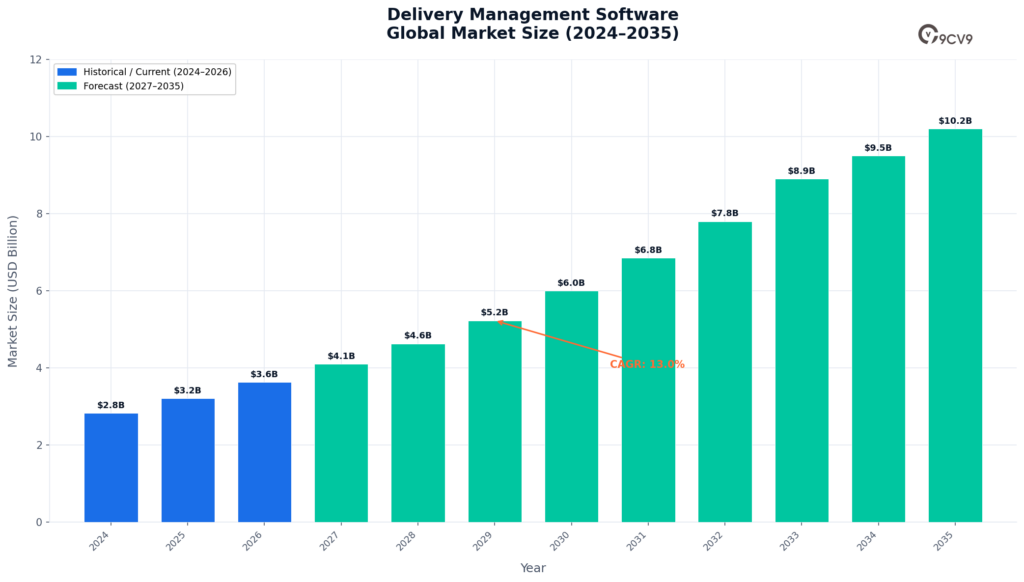
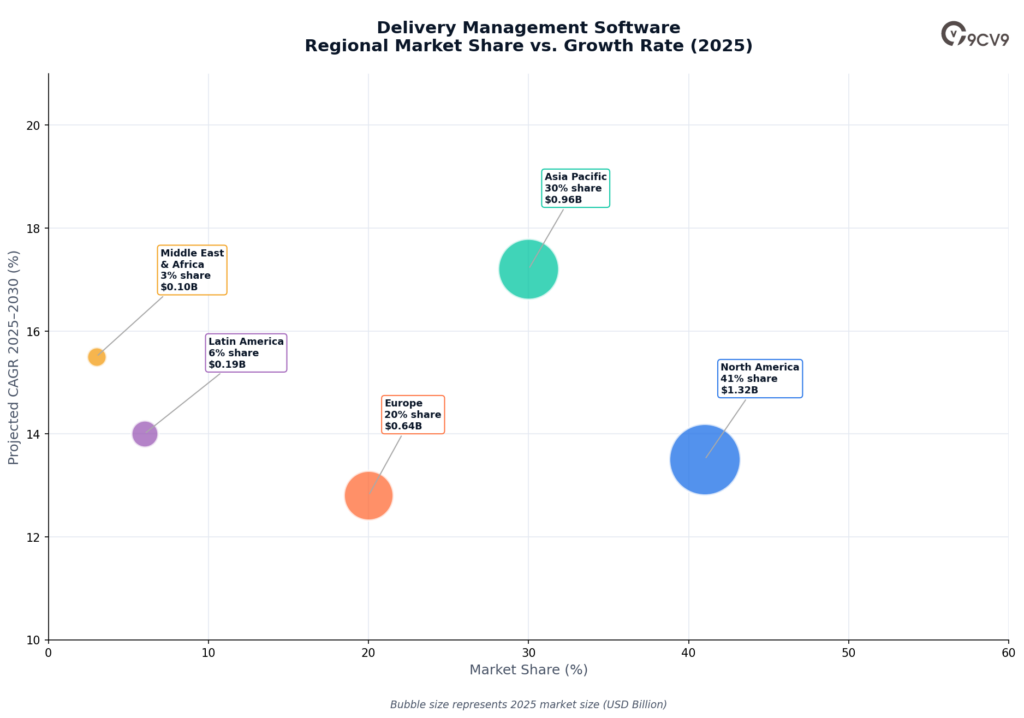
Delivery management software transforms how businesses plan, track and optimize deliveries in 2026. The global market reached about $3.21 billion in 2025 and is projected to reach $5.23 billion by 2029, as companies adopt AI routing, real-time tracking and cloud-based platforms to reduce costs and meet rising delivery expectations.
Delivery management software has moved from being a specialized logistics tool to becoming a critical part of the technology infrastructure behind modern commerce. As retailers, e-commerce companies, restaurants, logistics providers, couriers, manufacturers, healthcare organizations, and other delivery-dependent businesses process increasingly complex order volumes, the ability to plan routes, dispatch drivers, track deliveries, communicate with customers, and analyze delivery performance in real time has become a major competitive advantage.

The numbers illustrate how quickly this transformation is occurring.
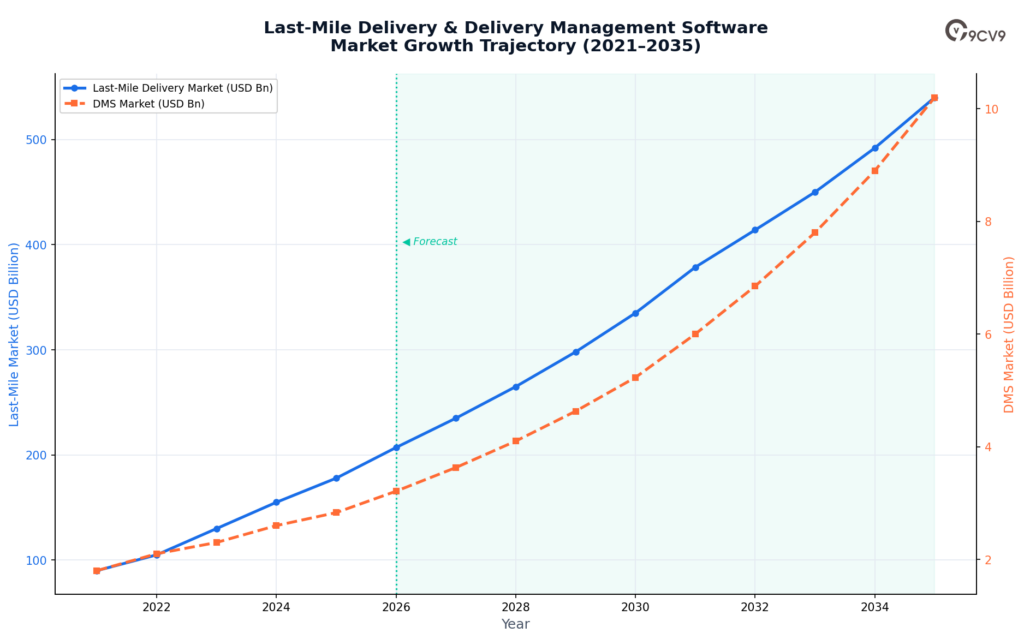
According to the compiled industry data, the global delivery management software market was valued at approximately $2.83 billion in 2024 before expanding to around $3.21 billion in 2025, representing annual growth of approximately 13.3%. The market is projected to reach approximately $5.23 billion by 2029, while another long-range forecast estimates that it could reach $10.2 billion by 2035, supported by a projected 13.8% CAGR between 2026 and 2035.
Different research organizations arrive at different market sizes because their definitions of delivery management software vary. Some include broader delivery orchestration, dispatch, last-mile, and adjacent logistics platforms. Under one broader definition cited in the dataset, the market was estimated at $11.6 billion in 2025 and could reach approximately $25.5 billion by 2035. Despite these methodological differences, the direction of the data is consistent: businesses are allocating substantially more technology spending toward digitizing delivery operations.


Delivery Management Software Is Becoming Critical Last-Mile Infrastructure
One of the strongest forces behind delivery management software growth is the extraordinary size and complexity of the last-mile delivery economy.
The global last-mile delivery market reached approximately $177.94 billion in 2025 and is estimated at $207.10 billion in 2026. It could expand to approximately $378.59 billion by 2033. The B2C segment alone accounts for approximately 66.8% of the last-mile delivery market in 2026, while road transportation represents roughly 73% of the market.
More importantly for businesses, the final stage of delivery is disproportionately expensive.

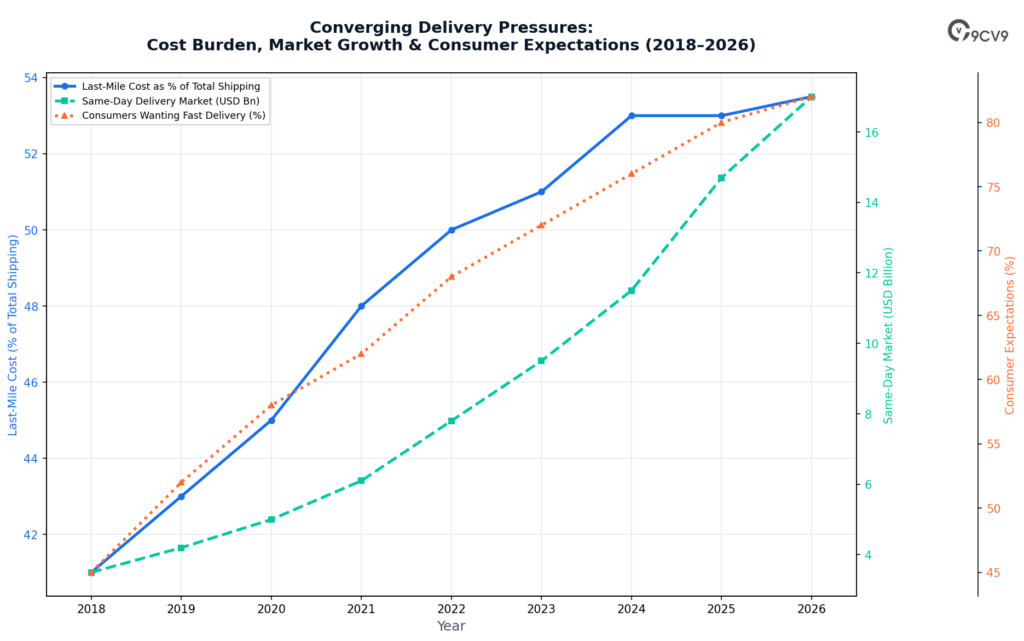
The statistics compiled for this report indicate that last-mile delivery can account for approximately 53% of total shipping costs in 2026, compared with 41% in an earlier benchmark. That cost concentration makes relatively small improvements in routing, dispatching, vehicle utilization, driver productivity and first-attempt delivery rates potentially valuable at scale.
The software opportunity surrounding this problem is consequently substantial. The dataset places the last-mile delivery software segment at approximately $15.2 billion in 2025, with projections suggesting that it could exceed $41.5 billion by 2035.
For delivery-intensive companies, the question is increasingly shifting from whether delivery operations should be digitized to how extensively automation, artificial intelligence and real-time data should be incorporated into them.
Consumer Expectations Are Raising the Standard for Delivery
Delivery management software growth is not being driven exclusively by operational cost pressures. Consumer expectations are changing what retailers and delivery providers must be capable of offering.

The dataset shows that 92% of consumers consider delivery windows when deciding whether to purchase online, while 88% consider real-time delivery tracking critical to a positive customer experience. Approximately 74% of online shoppers expect delivery within two days, while another statistic indicates that 90% of U.S. online shoppers expect their purchases within two to three days.
Speed is only one dimension of the modern delivery experience.
Approximately 76% of shoppers prefer retailers that provide personalized delivery options, while 82% prefer free shipping over expedited alternatives. At the same time, 55% of consumers are willing to pay more for same-day delivery, demonstrating that different customer segments value different combinations of price, speed, convenience and flexibility.
These expectations increasingly affect conversion as well as customer satisfaction.

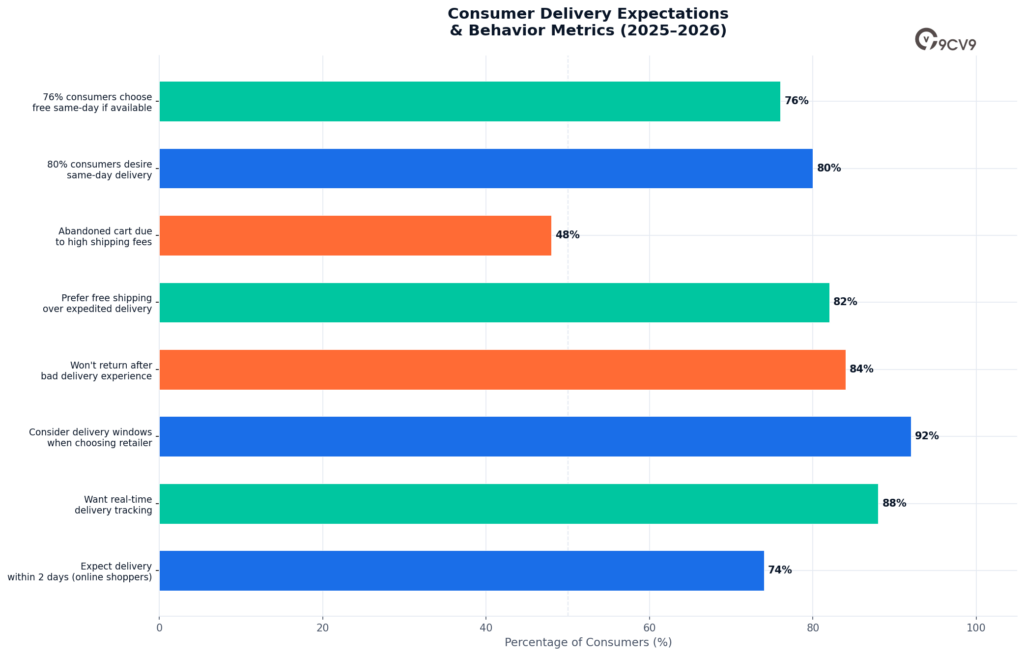
According to the compiled statistics, 63% of consumers may choose another retailer when shipping takes longer than two days, while 22% of shoppers abandon carts because delivery is too slow. Another 48% of shopping cart abandonment is associated with shipping fees and taxes.
Real-time visibility is becoming particularly important. The dataset reports that 61% of consumers abandon their cart if a retailer does not provide real-time tracking, and more than 70% think about delivery before they even reach checkout.

Delivery performance, therefore, is no longer merely a post-purchase logistics issue. It increasingly influences the customer before the transaction has even occurred.
Failed Deliveries Carry Significant Financial and Customer Costs
Failed deliveries represent another major reason companies are investing in delivery management technology.
The dataset estimates that a failed delivery costs an average of approximately $17.78 per parcel in the United States and around £11.60 per parcel in the United Kingdom. Globally, approximately 8% to 20% of parcels may fail to reach their recipients on the first delivery attempt, although performance varies considerably between markets and operators.
The consequences extend well beyond redelivery costs.
Approximately 84% of customers surveyed said they would not return to a business following an unfavorable delivery experience, while another statistic indicates that 70% of shoppers are unlikely to return following a failed delivery. Some 23% refuse to reorder after a failed delivery, while 21% lose trust in the retailer altogether.
For businesses with high customer acquisition costs or recurring purchase models, improving delivery reliability can therefore affect customer lifetime value as well as logistics expenses.
This helps explain why features such as automated dispatching, proof of delivery, customer notifications, address validation, delivery windows, driver tracking and exception management are increasingly central to delivery management software platforms.
AI Is Transforming Delivery Management Software

Artificial intelligence is another defining delivery management software trend in 2026.
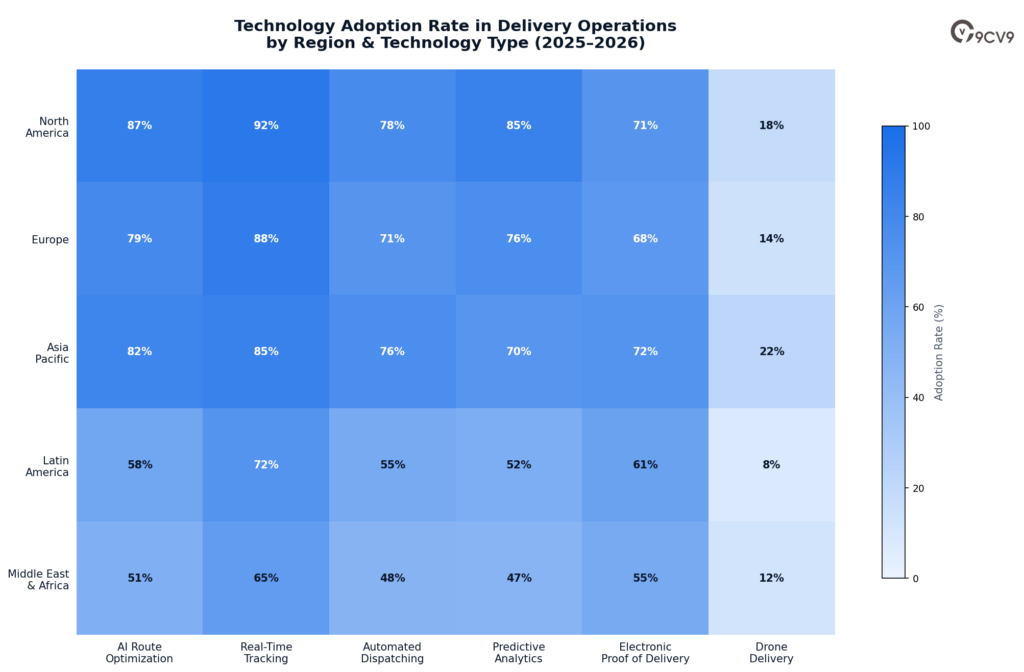
According to the dataset, 96% of global transportation professionals surveyed were already using AI within their operations in 2025, with 39% identifying route or load optimization as their leading AI use case.
The potential efficiency gains are substantial.
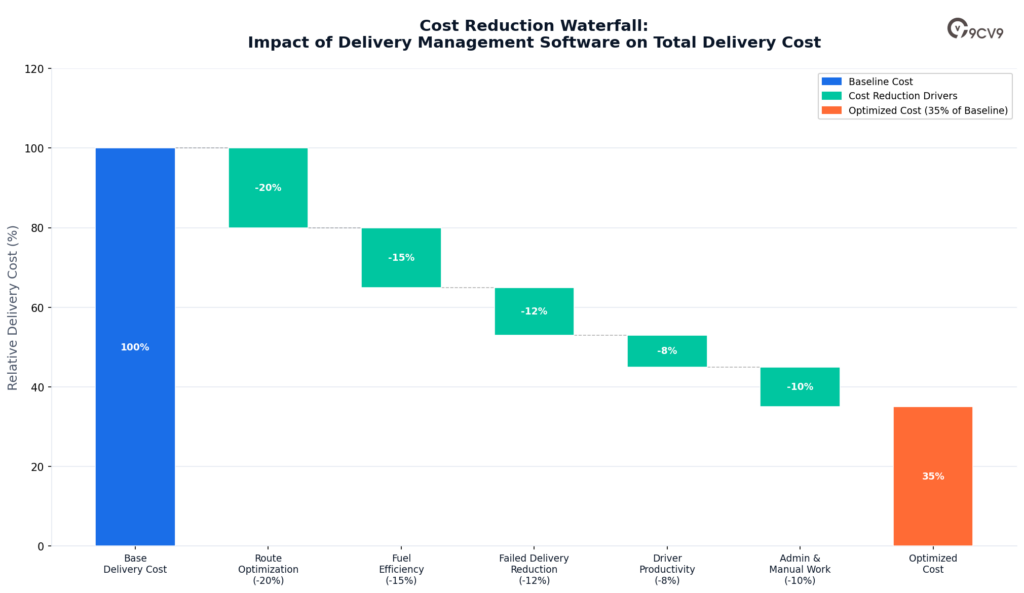
AI-powered route optimization is associated in the compiled statistics with approximately a 25% reduction in delivery times and 20% lower fuel consumption, while AI systems can reduce route-planning time by approximately 75%. Predictive analytics can potentially improve delivery efficiency by as much as 20%.
The scale of deployment is already significant. More than 300 delivery platforms globally reportedly integrate AI-based route optimization, collectively managing more than 3 billion annual deliveries. Meanwhile, more than 500 new software platforms and feature upgrades entered the on-demand delivery ecosystem between 2023 and 2025.

AI-enabled last-mile delivery itself reached an estimated $1.56 billion in 2025, reinforcing the shift from AI as an experimental logistics feature toward AI as an increasingly important component of delivery infrastructure.
Cloud-Based Delivery Management Software Dominates the Market
The technology architecture supporting delivery management is changing alongside its functionality.
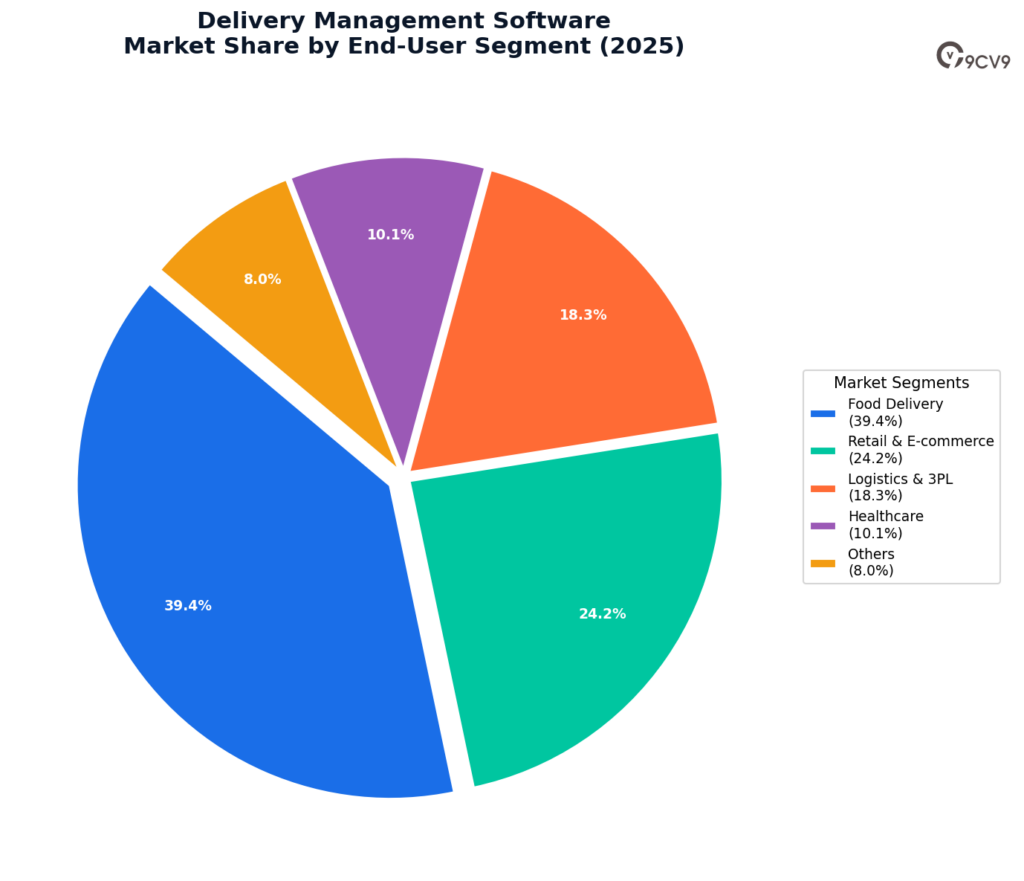
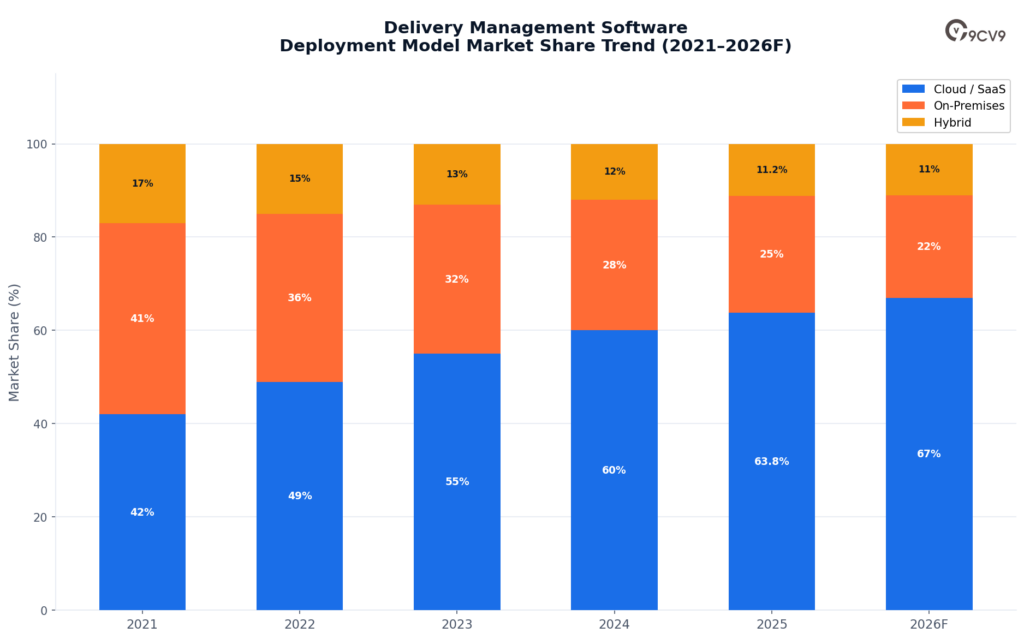
SaaS-based deployment accounted for approximately 63.8% of delivery management software market revenue in 2025, making cloud delivery the dominant deployment model. Driver applications represented approximately 34.7% of DMS revenue, highlighting the importance of mobile technology connecting dispatch centers with workers operating in the field.
Food delivery was another particularly important segment, accounting for approximately 39.4% of delivery management software revenue in 2025. High order frequency, short delivery windows, dynamic routing requirements and constant customer communication make food delivery one of the clearest examples of why real-time delivery orchestration matters.

The broader enterprise environment is also favorable to cloud delivery platforms. The dataset notes that 94% of enterprises worldwide were using cloud computing as of 2025, while 83% of organizations had adopted at least one SaaS product. The average enterprise was managing more than 130 SaaS applications by April 2026, increasing the importance of APIs and integrations between delivery management platforms and order management, ERP, CRM, e-commerce, warehouse and customer service systems.
Same-Day Delivery Is Accelerating the Need for Better Software
Few trends illustrate the pressure on delivery infrastructure more clearly than same-day delivery.
The global same-day delivery market reached approximately $14.7 billion in 2025, with the dataset citing annual growth of around 20.8%. The market could reach approximately $82.9 billion by 2033 at roughly a 21% CAGR.
Retail adoption is already considerable. Approximately 51% of retailers offered same-day delivery in 2025, while 65% of online merchants reportedly plan to introduce it in the coming years.
Consumers are responding accordingly.

Around 49% say the availability of same-day delivery significantly influences their decision to shop online, while 76% choose free same-day delivery when it is available. Conversely, 28% of buyers have abandoned purchases because the estimated delivery time was too long.
As same-day delivery moves toward mainstream adoption, companies need increasingly sophisticated software capable of coordinating inventory availability, order prioritization, dispatch, routing, driver capacity and customer communication within extremely compressed timeframes.
Sustainability Is Becoming a Delivery Technology Requirement
Environmental pressure represents another important delivery management software trend for 2026 and beyond.
Last-mile delivery is estimated in the dataset to account for approximately 30% of logistics-sector CO₂ emissions, with some estimates placing its contribution to delivery-vehicle emissions even higher. Optimized routing and delivery consolidation can potentially reduce emissions by approximately 10% to 40%.
Alternative delivery technologies could amplify those gains. The dataset reports that autonomous delivery robots can generate 84% lower greenhouse gas emissions than conventional trucks, while drone delivery may consume as much as 94% less energy per parcel than conventional delivery trucks under the referenced comparisons.
Consumer attitudes provide an additional incentive. Approximately 66% of global consumers consider sustainability when making purchasing decisions, while 30% are willing to wait longer for a delivery if doing so makes shipping more sustainable.
Delivery management platforms are consequently evolving beyond simply calculating the fastest route. Future systems increasingly need to balance cost, speed, vehicle type, EV range, charging requirements, emissions and customer delivery preferences.
Autonomous Delivery Is Moving Toward Commercial Scale
Autonomous delivery technologies are also progressing from experimentation toward real-world deployment.
The delivery drone market is projected to reach approximately $4.4 billion by 2030, growing at roughly 32% annually according to the dataset. Serve Robotics has deployed more than 2,000 robots and completed over 100,000 deliveries, while Zipline has surpassed 100 million autonomous commercial delivery miles and approximately 1.4 million deliveries.
These developments have important implications for delivery management software.
Tomorrow’s delivery management platform may not simply assign orders to human drivers. It may need to determine whether an order should be fulfilled by a van, EV, bicycle, autonomous ground robot, drone or another delivery mode while simultaneously accounting for cost, capacity, geography, weather, customer preferences and promised delivery windows.
That evolution could transform DMS from route-planning software into a broader orchestration layer for increasingly complex delivery networks.
The Scale of Digital Delivery Is Enormous
Underlying all these trends is the sheer volume of transactions moving through modern logistics networks.
The statistics collected for this report indicate that integrated logistics software systems process more than 250 million transactions every day globally, while more than 4 billion delivery orders are fulfilled annually through digital platforms. More than 75% of urban consumers depend on delivery applications for food, grocery or parcel services.
Meanwhile, U.S. parcel volume alone reached approximately 22.37 billion shipments in 2024, representing a 3.4% increase from 2023. The wider parcel delivery logistics market is projected to expand from approximately $510.3 billion in 2025 to $826.2 billion by 2034.
At that scale, even small percentage improvements in first-attempt delivery rates, route efficiency, vehicle utilization, driver productivity or fuel consumption can translate into substantial financial savings.
This is ultimately why delivery management software matters so much in 2026.
The Top 110 Delivery Management Software Statistics, Data & Trends in 2026 compiled below examine the industry from multiple perspectives: global DMS market growth, last-mile economics, consumer expectations, failed delivery costs, artificial intelligence, SaaS adoption, same-day delivery, sustainability, autonomous delivery, workforce pressures and real-time tracking.
Together, these statistics provide a quantitative picture of an industry being reshaped by rising parcel volumes, increasingly demanding consumers, expensive last-mile operations, labor constraints, AI-powered optimization and the transition toward faster, greener and more autonomous delivery networks.
Before we venture further into this article, we would like to share who we are and what we do.
About 9cv9
9cv9 is a business tech startup based in Singapore and Asia, with a strong presence all over the world.
With over ten years of startup and business experience, and being highly involved in connecting with thousands of companies and startups, the 9cv9 team has listed some important and crucial software tools in this review.
If you like to get your company listed in our top B2B software reviews, check out our world-class 9cv9 Media and PR service and pricing plans here.
Top 110 Delivery Management Software Statistics, Data & Trends in 2026
🏪 SECTION 1: GLOBAL MARKET SIZE & GROWTH
- The global delivery management software (DMS) market was valued at $2.83 billion in 2024. This benchmark establishes DMS as one of logistics software’s most commercially significant and fastest-growing segments, attracting sustained enterprise investment globally.
- The DMS market grew to $3.21 billion in 2025 at a CAGR of 13.3% year-on-year. Double-digit annual growth confirms that delivery management software is moving from a niche operational tool to a core logistics infrastructure investment for businesses of all sizes.
- The DMS market is forecast to reach $5.23 billion by 2029. This mid-term projection signals that DMS investment will nearly double within five years, making now an opportune window for vendors and investors to establish competitive positions.
- By 2035, the DMS market is expected to reach $10.2 billion (Spherical Insights). A near-4× expansion over a decade underscores the structural, long-term demand for software that automates and optimizes the delivery lifecycle.
- The DMS market will grow at a CAGR of 13.8% between 2026 and 2035. Consistently above-market growth rates signal that delivery management software is becoming mission-critical infrastructure rather than optional tooling for logistics-intensive businesses.
- Verified Market Reports projects a 12.9% CAGR for the DMS market from 2026 to 2033. Cloud platform dominance and the continued expansion of e-commerce are cited as the primary structural drivers sustaining this growth trajectory.
- The US holds over 41% of the global DMS market share. North American enterprises — with their mature e-commerce ecosystems and high consumer expectations — remain the single largest demand pool for delivery management platforms worldwide.
- An alternative estimate (Future Market Insights) places the DMS market at $11.6 billion in 2025 when broader adjacent platforms are included. The variation in estimates reflects different scope definitions, but all sources agree on strong double-digit growth as the industry expands into new verticals.
- The DMS market is projected to reach $25.5 billion by 2035 under a broader market scope (FMI), at an 8.2% CAGR. Even the more conservative growth scenario represents more than doubling the market, making DMS a compelling long-term investment thesis for technology and logistics investors.
- The Business Research Company forecasts the DMS market to reach $4.63 billion by 2028 at a 13.1% CAGR. This mid-term milestone confirms that the market’s growth momentum is broad-based and not reliant on any single geographic or vertical catalyst.
- Verified Market Research values the DMS market at $2.17 billion in 2024, reaching $4.94 billion by 2031 at a 10.82% CAGR. While estimates vary by methodology, all major research houses agree on sustained above-10% annualized growth for the sector.
- The on-demand delivery software market specifically is valued at $632.39 million in 2026, forecast to reach $1.39 billion by 2035 at a 9% CAGR. This sub-segment — serving food, grocery, and parcel platforms — is growing alongside the broader gig economy and consumer preference for instant gratification.
🚚 SECTION 2: LAST-MILE DELIVERY MARKET
- The global last-mile delivery market reached $177.94 billion in 2025. The sheer scale of this market — larger than many countries’ GDPs — explains why even marginal efficiency improvements driven by DMS have enormous financial impact.
- The last-mile delivery market is estimated at $207.10 billion in 2026. Expanding at a 9% CAGR, last-mile delivery represents the most complex and costly phase of the logistics chain, creating robust demand for software-driven optimization.
- The last-mile market is projected to reach $378.59 billion by 2033. This near-doubling in seven years will require proportional investment in delivery management platforms, route optimization, and real-time visibility tools to remain operationally competitive.
- Last-mile delivery accounts for 53% of total shipping costs in 2026, up from 41% in 2018. This dramatic 29.3% increase in cost share over five years is the single most compelling economic argument for adopting delivery management software.
- The last-mile delivery software segment alone was valued at $15.2 billion in 2025. As a standalone software category, last-mile delivery platforms have grown into one of logistics technology’s most valuable and competitive market segments.
- Last-mile delivery software is projected to exceed $41.5 billion by 2035. The near-3× growth projection reflects how software-defined logistics is replacing manual processes across every industry that ships physical goods.
- The B2C segment accounts for 66.8% of last-mile delivery market share in 2026. Consumer e-commerce dominates delivery volumes, driven by millennials and Gen Z whose purchasing behaviors are inherently digital and delivery-dependent.
- North America holds 37.7% of the global last-mile delivery market in 2026. The region’s dense urban infrastructure, consumer expectations, and investment in logistics technology make it the world’s leading last-mile delivery ecosystem.
- The road segment accounts for 73% of the last-mile delivery market in 2026. Despite drone and autonomous vehicle innovations, traditional road delivery remains the dominant mode — though DMS optimization of road fleets delivers the greatest near-term ROI.
- Uber Technologies acquired an 85% stake in Turkish delivery platform Trendyol Go for $700 million in May 2025. This landmark acquisition signals that global platforms are aggressively consolidating last-mile assets to build unified delivery software ecosystems.
👤 SECTION 3: CONSUMER EXPECTATIONS & BEHAVIOR
- 92% of consumers consider delivery windows when deciding whether to buy online. With nearly universal relevance to purchase decisions, delivery experience has become as important as product quality and price in driving e-commerce conversion.
- 88% of consumers find real-time delivery tracking critical for a positive customer experience. Real-time visibility is no longer a premium feature — it is the baseline expectation that delivery management software must deliver to retain customer loyalty.
- 74% of online shoppers expect delivery within two days. Amazon Prime has fundamentally reset consumer expectations, forcing retailers of all sizes to invest in delivery management software capable of supporting compressed fulfillment windows.
- 90% of US online shoppers expect delivery within 2–3 days. The near-universal nature of this expectation means that businesses without delivery management software risk systematic customer attrition to faster competitors.
- 80% of consumers desire same-day delivery, with 76.3% expecting packages within three hours of ordering. The gap between this aspiration and operational reality creates an urgent imperative for AI-driven dispatch, route optimization, and micro-fulfillment center strategies.
- 84% of customers stated they would not return to a business after an unfavorable delivery experience (Honeywell survey). Customer acquisition is expensive — a single failed delivery erases lifetime value, making delivery management software a retention investment, not just an operational one.
- 70% of shoppers are unlikely to return after experiencing a failed delivery. Failed deliveries are not just operational inconveniences — they are brand-damaging events that permanently destroy customer relationships at scale.
- 23% of consumers refuse to reorder after a failed delivery, while 21% lose trust in the retailer entirely. Trust, once eroded by delivery failure, is exceptionally difficult to rebuild, underscoring the ROI of preventive delivery management software.
- 63% of consumers choose a different retailer if shipping takes longer than two days. Speed of delivery is a direct determinant of retail market share — businesses unable to meet 2-day windows are systematically losing customers to software-enabled competitors.
- 82% of online shoppers prefer free shipping over expedited delivery options. Free shipping remains the dominant consumer preference, making route efficiency and cost optimization through DMS essential to preserving margin while meeting expectations.
- 76% of shoppers prefer retailers offering personalized delivery options. Customization — not just speed — is becoming a competitive differentiator, requiring delivery management software that can handle customer-specific preferences at scale.
- 48% of shopping cart abandonment is directly caused by excessive shipping fees and taxes. By reducing delivery costs through software-driven efficiency, retailers can recover a substantial portion of the estimated $260 billion in abandoned cart revenue.
- 22% of shoppers abandon carts because shipping is too slow. The combination of cost and speed barriers represents a recoverable revenue opportunity that delivery management software directly addresses through route optimization and carrier selection.
- 69% of consumers say one-day delivery is the best incentive to shop online. Next-day delivery capability is rapidly becoming a prerequisite for online retail success, not just a premium offering — pushing businesses to invest in DMS.
- 49% of millennials expect free two-day delivery; 40% expect free same-day delivery. The generation with the highest purchasing power has the most demanding delivery expectations, creating strong commercial pressure on DMS adoption timelines.
- 55% of consumers are willing to pay extra for same-day delivery. Willingness to pay for speed validates the business case for premium delivery tiers enabled by intelligent dispatch and routing software.
- Same-day delivery growth has exceeded 160% in recent years. The explosion in same-day demand is reshaping logistics infrastructure requirements and accelerating DMS investment across retail, food, grocery, and healthcare sectors.
- Next-day shipping is now 58% more popular than in prior years. Rapid acceleration in near-instant delivery expectations is leaving businesses without modern delivery management software increasingly unable to compete on service levels.
💸 SECTION 4: FAILED DELIVERIES & COST IMPACT
- Failed deliveries cost an average of $17.78 per parcel in the United States. At this cost per failure, even a 5% failure rate on 140,000 annual orders can generate nearly $200,000 in direct losses — a powerful ROI argument for DMS investment.
- Failed deliveries contribute an estimated $216 billion in lost US retail revenue annually. This systemic economic loss dwarfs the cost of implementing delivery management software, making the business case for adoption mathematically unambiguous.
- Globally, 8–20% of parcels fail to reach recipients on the first attempt. First-attempt delivery failure rates this high represent both a massive cost inefficiency and a significant source of customer dissatisfaction addressable through DMS optimization.
- The average failed delivery cost in the UK is £11.6 per parcel. Cross-border consistency in the high cost of delivery failures confirms that DMS adoption is a universal business priority regardless of geography.
- First-attempt delivery success rates are: US 97.2%, UK 93.7%, Ireland 88.07%. Significant variance across markets reflects the differing maturity of delivery infrastructure and software adoption, with improvement headroom representing substantial revenue opportunity.
🤖 SECTION 5: AI & TECHNOLOGY ADOPTION
- 96% of global transportation professionals are already using AI within their operations (2025 survey). AI has crossed from experimental to standard in delivery operations, making AI-enabled delivery management software the baseline expectation for enterprise logistics technology.
- 39% of transportation professionals cite route/load optimization as their top AI use case. Route optimization is the highest-ROI application of AI in last-mile logistics, directly reducing fuel costs, delivery times, and driver overtime.
- AI-powered route optimization reduces delivery times by 25%. A quarter reduction in delivery time translates directly to more daily deliveries per driver, lower labor costs, and higher customer satisfaction scores across the board.
- AI route optimization reduces fuel consumption by 20%. In an era of volatile fuel prices and ESG reporting requirements, a 20% fuel reduction through delivery management software represents both financial and reputational value.
- AI systems are cutting route planning time by 75%. Eliminating 75% of manual route planning work frees operations teams to focus on exception management, customer service, and strategic improvements rather than administrative tasks.
- Predictive analytics can improve delivery efficiency by up to 20% (DHL Logistics Trend Radar). DHL’s own data confirms that forward-looking analytics embedded in delivery management platforms produce measurable operational improvements at enterprise scale.
- AI systems typically require 6–12 months of historical data to achieve optimal performance. Businesses considering DMS adoption should account for this learning curve when projecting ROI timelines, while recognizing the compounding value of longer data histories.
- Over 300 delivery platforms globally integrate AI-based route optimization, managing 3 billion+ annual deliveries. The scale at which AI-driven delivery management is already operating globally confirms that this is no longer emerging technology — it is mature operational infrastructure.
- More than 500 new software platforms and feature upgrades were introduced globally between 2023 and 2025 in on-demand delivery. This rapid pace of innovation means that delivery management software buyers have more capable options available than ever before.
- Amazon’s AI demand forecasting engine has already reduced out-of-stock incidents by factoring in regional events like holidays and weather. Amazon’s operational success with predictive DMS features validates the technology’s practical value beyond theoretical efficiency claims.
- Amazon’s Wellspring AI tool maps over 2.8 million apartment addresses and identifies parking/access points at 14,000+ complexes. Granular AI-driven location intelligence is becoming a competitive differentiator in urban last-mile delivery — and is now entering mainstream DMS platforms.
- AI-enabled fraud, including deepfake voice calls, is increasingly targeting logistics operations in 2026. The rise of AI-assisted fraud against delivery networks creates a new security imperative for DMS vendors to integrate authentication and fraud detection capabilities.
☁️ SECTION 6: SAAS & DEPLOYMENT MODELS
- SaaS-based deployment holds 63.8% of DMS market revenue in 2025. Cloud-first is definitively the dominant deployment model for delivery management software, driven by its lower upfront costs, faster deployment, and easier scalability.
- The driver application module accounts for 34.7% of DMS market revenue. Mobile driver apps are the fastest-growing functional category within delivery management software, reflecting the shift toward real-time mobile-first field operations.
- The food delivery segment holds 39.4% of DMS market revenue in 2025. Food delivery’s dominance reflects the highest-frequency, highest-complexity delivery use case — one that demands the most sophisticated DMS capabilities for route optimization and real-time communication.
- Global SaaS spending is expected to hit $300 billion in 2025. Delivery management software is part of a massive structural shift toward cloud-delivered enterprise software, benefiting from the same tailwinds driving SaaS growth across all industries.
- 83% of organizations globally have adopted at least one SaaS product in their operations. The near-universal adoption of SaaS across enterprises removes the organizational and cultural barriers to adopting cloud-based delivery management software.
- 94% of enterprises worldwide are using cloud computing as of 2025. Cloud infrastructure ubiquity means that deploying cloud-based DMS is now a trivially low-friction decision compared to the on-premises software deployments of a decade ago.
- 95% of organizations are expected to adopt AI-powered SaaS applications by 2025. The intersection of AI and SaaS delivery is directly shaping next-generation delivery management software capabilities across route optimization, demand forecasting, and exception handling.
- North America’s SaaS market will reach $211.7 billion by 2026, holding 46% of global SaaS market share. North American enterprise software spending reflects the region’s leadership in delivery management software adoption and innovation.
- The average enterprise managed 130+ distinct SaaS applications as of April 2026. DMS platforms must integrate seamlessly with this complex application ecosystem — making open APIs and pre-built connectors critical vendor selection criteria.
📅 SECTION 7: SAME-DAY DELIVERY MARKET
- The global same-day delivery market hit $14.7 billion in 2025, growing at a CAGR of 20.8%. Same-day delivery is one of the fastest-growing segments in logistics, creating exceptional demand for the delivery management software that makes it operationally viable.
- The US same-day delivery market is worth $9.25 billion as of 2024, with 62.1% of global industry revenues. The US leads globally in same-day delivery infrastructure maturity, reflecting deep investment in both physical logistics networks and enabling software platforms.
- The global same-day delivery market is projected to reach $82.9 billion by 2033 at a 21% CAGR. This extraordinary growth trajectory makes same-day delivery capability one of the most strategically important features any delivery management software platform can offer.
- 51% of retailers already offer same-day delivery in 2025. More than half of retailers have made the operational investment to compete on same-day, signaling that laggards without DMS-enabled rapid fulfillment risk material competitive disadvantage.
- 65% of online merchants plan to offer same-day delivery in the coming years. The near-universal intention to adopt same-day delivery confirms it will become a market hygiene factor — not a differentiator — within the next few years.
- 49% of consumers say same-day delivery availability significantly impacts their decision to shop online. Delivery speed is a conversion driver, not just a satisfaction metric — meaning DMS investment has a direct, measurable impact on top-line revenue.
- 76% of consumers choose free same-day delivery when it is available. The combination of speed and no added cost is the strongest driver of delivery satisfaction — achievable only through operationally efficient DMS-enabled logistics.
- 28% of buyers have abandoned online purchases when estimated delivery time was too long. Cart abandonment from slow delivery is a recoverable revenue loss — and the most direct economic argument for retailers to invest in same-day-capable delivery management platforms.
- The domestic same-day delivery segment accounts for $11.5 billion in 2025, versus $3.19 billion for international. The maturity gap between domestic and international same-day capability highlights the infrastructure investments still needed to globalize rapid delivery software.
🌿 SECTION 8: SUSTAINABILITY & GREEN LOGISTICS
- Last-mile delivery accounts for approximately 30% of logistics-sector CO₂ emissions. Software-driven route optimization and consolidation are the most scalable interventions available to reduce last-mile’s disproportionate environmental footprint.
- In some estimations, last-mile delivery generates up to 50% of all CO₂ emissions from delivery vehicles. The wide range in estimates reflects the complexity of measuring delivery emissions, but both ends of the range confirm last-mile as the primary decarbonization target in logistics.
- 66% of global consumers consider sustainability when making purchase decisions (McKinsey). With two-thirds of consumers factoring sustainability into choices, green delivery options enabled by DMS are increasingly a revenue driver, not just a cost item.
- Autonomous delivery robots produce 84% lower greenhouse emissions than traditional trucks. The environmental advantage of autonomous delivery — managed and dispatched through modern delivery management software — adds a sustainability dimension to the business case for DMS adoption.
- Drone deliveries use up to 94% less energy per parcel compared to conventional delivery trucks. As drone delivery scales from pilot to commercial reality, delivery management platforms that can orchestrate mixed fleets including drones will have a significant technological advantage.
- Optimized routing and consolidated deliveries reduce emissions by 10–40%. Route optimization through delivery management software is simultaneously the most cost-effective and most immediately deployable emission reduction strategy available to logistics operators.
- Combining e-bikes with white-label delivery models can reduce delivery costs by up to 51%. Zero-emission micromobility solutions, when integrated with intelligent DMS routing, offer the dual benefit of cost reduction and carbon footprint minimization.
- Last-mile delivery contributes nearly 30% of logistics-related CO₂ emissions in major cities. Urban delivery’s outsized environmental impact is driving municipal regulations that favor electric fleets and DMS-optimized routing — making software compliance a regulatory necessity.
- E-commerce parcel delivery could reach 5.5 million metric tonnes of CO₂ by 2032 without intervention. The scale of potential environmental harm from unoptimized delivery creates regulatory and reputational pressure that reinforces the business case for DMS adoption.
- Electrification and alternative delivery methods could reduce e-commerce emissions by over 90% in the next decade. DMS platforms that natively support EV fleet management, charging optimization, and alternative vehicle routing will be essential infrastructure for the decarbonized logistics era.
- Amazon plans 100,000 Rivian electric delivery vans by 2030; FedEx has committed $2 billion to fleet electrification. These major fleet electrification commitments are driving demand for DMS platforms capable of managing mixed conventional and electric fleets with integrated range and charging management.
🚁 SECTION 9: AUTONOMOUS DELIVERY & DRONES
- The delivery drone market will reach $4.4 billion by 2030, growing at a 32% CAGR. Drone delivery is transitioning from science fiction to commercial reality — and will require sophisticated delivery management software for fleet orchestration, airspace management, and customer communication.
- Serve Robotics has deployed 2,000+ robots completing over 100,000 deliveries across US cities. Ground-based autonomous delivery is already operating at commercial scale, validating the near-term viability of robot-inclusive delivery management software platforms.
- Zipline surpassed 100 million autonomous commercial delivery miles with 1.4 million deliveries. The milestone confirms that autonomous delivery is no longer a pilot program — it is a scaling commercial operation that demands enterprise-grade management software.
- Autonomous vehicles and drones are projected to handle 40% of urban deliveries, reducing reliance on human couriers. As autonomous delivery share grows, DMS platforms must evolve to orchestrate multi-modal fleets that blend human drivers with robots and drones seamlessly.
- DoorDash launched its Dot delivery robot in September 2025. Major food delivery platforms entering the autonomous hardware space signals that software-hardware integration will become a key DMS differentiation dimension in the near future.
👷 SECTION 10: WORKFORCE & INDUSTRY CHALLENGES
- There is an estimated shortage of 24,000 truck drivers in the US in 2025 (ATRI). Labor scarcity is one of the most powerful catalysts for delivery management software adoption — automation and optimization partially compensate for the unavailability of human capacity.
- Driver turnover surpasses 90% at major carriers. High turnover makes consistent, software-driven delivery operations — where institutional knowledge is embedded in the platform rather than the person — essential for operational stability.
- 62% of the trucking workforce is comprised of Baby Boomers and Gen X. Mass retirement of experienced drivers in the coming decade will accelerate investment in delivery management software as carriers seek to replace tribal knowledge with systematic digital tools.
- Only 20% of truck drivers are under 35, versus 35% of the overall labor force. The demographic mismatch in trucking creates a structural workforce crisis that makes automation-enabling delivery management software a long-term investment imperative.
- 66% of consumers experienced delivery issues within the last three months (2025 survey), rising to 79% among under-35s. The frequency of delivery failure confirms that the industry’s operational baseline remains below consumer expectations — a gap that delivery management software is uniquely positioned to close.
- 15–30% cost reductions are achieved by companies mastering AI routing, micro-fulfillment, and real-time visibility platforms. This range from leading DMS adopters demonstrates the tangible financial upside available to businesses that implement delivery management software effectively.
- Last-mile delivery rates have risen 12%+ in recent years. Rising unit delivery costs increase the financial urgency of implementing DMS-driven efficiency — every dollar saved through optimization has greater absolute value in a high-cost operating environment.
📡 SECTION 11: REAL-TIME TRACKING & VISIBILITY
- Over 250 million daily transactions are processed through integrated logistics software systems globally. The transactional scale of delivery management software confirms that the technology must operate at enterprise reliability standards — downtime has immediate, costly operational consequences.
- More than 1,500 software vendors globally offer scalable delivery management solutions. The competitive landscape reflects both the enormous market opportunity and the importance of careful vendor selection criteria, including integration depth, AI capability, and vertical expertise.
- Over 75% of urban consumers depend on delivery applications for food, grocery, and parcel services. Consumer dependency on delivery apps has created a structural demand floor for the software that powers them — delivery management platforms are now part of daily life infrastructure.
- More than 4 billion delivery orders are fulfilled annually using digital platforms. At 4 billion orders, even a 1% improvement in delivery efficiency through better DMS has an extraordinary aggregate economic and environmental impact.
- 61% of consumers abandon their cart if a retailer doesn’t offer real-time tracking. Real-time visibility is not a nice-to-have — it is a purchase prerequisite for a majority of today’s online shoppers, making DMS tracking capabilities a direct revenue enabler.
- More than 70% of consumers think about delivery before reaching checkout. Delivery capability shapes purchase intent before a single item is added to cart, meaning DMS-driven delivery speed and reliability are now pre-sale marketing assets.
🔍 SECTION 12: ADDITIONAL INDUSTRY DATA POINTS
- The parcel delivery logistics market is expected to rise from $510.3 billion in 2025 to $826.2 billion by 2034 at a 5.5% CAGR. The broader parcel logistics market — of which DMS is a critical enabling technology — is expanding to enormous scale, creating a massive addressable market for delivery software providers.
- US parcel volume reached 22.37 billion shipments in 2024, a 3.4% increase from 2023. Volume growth at this scale demands software-driven logistics management — manual processes cannot scale to meet the operational complexity of 22+ billion annual shipments.
- The growing demand for last-mile delivery is expected to result in 36% more delivery vehicles in the top 100 global cities by 2030. A 36% increase in urban delivery vehicle density will dramatically worsen congestion and emissions without intelligent DMS-driven route consolidation and optimization.
- By 2030, delivery vehicles could add up to 5 minutes to the average urban commute and account for 13% of total city carbon emissions. The urban externality cost of delivery growth creates a policy and social licence imperative for DMS adoption — cities are increasingly mandating more efficient, software-driven delivery operations.
- AI-enabled last-mile delivery market reached $1.56 billion in 2025. The AI-enabled sub-segment’s standalone scale confirms that artificial intelligence is not an add-on feature in delivery management — it is increasingly the core product proposition.
- 30% of consumers are willing to wait longer for delivery if it makes shipping more sustainable. A significant sustainability premium exists in consumer behavior — DMS platforms that enable and communicate green delivery options can use this as both a loyalty and pricing lever.
Conclusion
The Top 110 Delivery Management Software Statistics, Data & Trends in 2026 reveal an industry undergoing rapid structural change. Delivery management software is no longer simply a tool for assigning drivers or plotting routes. It is becoming the digital coordination layer connecting orders, vehicles, drivers, customers, inventory, real-time tracking, artificial intelligence, automation and increasingly autonomous delivery technologies.
The market numbers reinforce this shift. The global delivery management software market was valued at approximately $2.83 billion in 2024 and increased to around $3.21 billion in 2025, representing annual growth of roughly 13.3%. It is projected to reach approximately $5.23 billion by 2029, while one longer-term forecast places the market at $10.2 billion by 2035, supported by a projected 13.8% CAGR between 2026 and 2035.
Although individual market estimates differ depending on what researchers include within the delivery management software category, the overall direction is remarkably consistent: businesses are investing more heavily in technology that can make deliveries faster, more predictable, more economical and easier to manage.
The economics of the last mile help explain why.
The global last-mile delivery market reached approximately $177.94 billion in 2025 and is estimated at $207.10 billion in 2026, with projections suggesting it could reach approximately $378.59 billion by 2033. At the same time, last-mile delivery can account for approximately 53% of total shipping costs, making it one of the most expensive and operationally challenging components of the logistics process.
For businesses processing thousands or millions of deliveries, relatively small efficiency improvements can therefore produce significant financial results.
Artificial intelligence is becoming particularly important in achieving those improvements. The statistics compiled in this report show that 96% of surveyed global transportation professionals were already using AI in their operations in 2025, while 39% identified route and load optimization as their leading AI use case. AI-powered route optimization has been associated with 25% shorter delivery times, 20% lower fuel consumption, and a 75% reduction in route-planning time. Predictive analytics can potentially improve delivery efficiency by as much as 20%.
These capabilities help explain why AI is rapidly becoming a fundamental feature of modern delivery management platforms rather than an experimental add-on.
Consumer expectations are applying equally strong pressure.
Approximately 92% of consumers consider delivery windows when deciding whether to buy online, while 88% regard real-time tracking as critical to a positive customer experience. Around 74% of online shoppers expect delivery within two days, and 90% of U.S. online shoppers expect delivery within two to three days.
Delivery performance can consequently influence purchasing decisions before checkout, customer satisfaction after checkout and the probability that someone will purchase from the same retailer again.
The cost of getting delivery wrong can be substantial. A failed delivery costs an estimated $17.78 per parcel in the United States, while globally approximately 8% to 20% of parcels may fail to reach recipients on the first attempt. The customer consequences can be even more damaging: 70% of shoppers are unlikely to return following a failed delivery, while 23% may refuse to reorder and 21% may lose trust in the retailer altogether.
For retailers and e-commerce businesses, this means delivery management software should increasingly be evaluated as part of the customer experience and retention technology stack, not simply as logistics software.
Speed is another defining competitive battleground.
The global same-day delivery market reached approximately $14.7 billion in 2025 and could expand to $82.9 billion by 2033, with projected annual growth of around 21%. Approximately 51% of retailers already offered same-day delivery in 2025, while 65% of online merchants plan to provide it in the coming years.
Consumer demand supports that expansion. Around 49% of consumers say same-day delivery availability significantly affects their decision to shop online, while 55% are willing to pay more for same-day delivery. Conversely, 28% of buyers have abandoned purchases because estimated delivery times were too long.
Meeting these expectations at sustainable margins will require increasingly sophisticated combinations of real-time dispatching, route optimization, demand forecasting, inventory visibility and automated customer communication.
Cloud technology is providing the foundation for much of this transformation. SaaS-based deployment represented approximately 63.8% of delivery management software market revenue in 2025, while driver applications accounted for approximately 34.7%. With enterprises increasingly operating large ecosystems of interconnected SaaS products, APIs and integrations are becoming important considerations when organizations evaluate delivery management software.
Sustainability is simultaneously emerging as another major factor shaping delivery technology.
Last-mile delivery contributes approximately 30% of logistics-sector CO₂ emissions according to the compiled statistics. Optimized routing and consolidated deliveries can potentially reduce emissions by 10% to 40%, while alternative delivery technologies could produce even greater efficiencies under suitable operating conditions. Autonomous delivery robots have been associated with 84% lower greenhouse gas emissions than traditional trucks, while drone deliveries can use up to 94% less energy per parcel than conventional delivery trucks.
Consumer preferences may further accelerate this transition. Approximately 66% of consumers consider sustainability when making purchase decisions, while 30% are willing to wait longer for delivery when doing so makes shipping more sustainable.
The delivery networks of the future may also look substantially different from today’s driver-and-van model.
The delivery drone market is projected to reach $4.4 billion by 2030, growing at approximately 32% annually. Serve Robotics has already deployed more than 2,000 delivery robots, while Zipline has surpassed 100 million autonomous commercial delivery miles and approximately 1.4 million deliveries.
As autonomous technologies scale, delivery management platforms may increasingly be required to orchestrate mixed fleets consisting of human couriers, conventional vehicles, electric vans, e-bikes, autonomous robots and drones.
The broader scale of digital delivery makes these developments particularly consequential. More than 4 billion delivery orders are fulfilled annually through digital platforms, while integrated logistics software systems process more than 250 million transactions per day globally. U.S. parcel volume alone reached approximately 22.37 billion shipments in 2024, up 3.4% from 2023.
At such volumes, a seemingly modest 1%, 5% or 10% improvement in delivery efficiency can translate into enormous cumulative savings in time, labor, fuel, vehicle utilization and emissions.
Ultimately, the delivery management software statistics for 2026 point toward a logistics industry becoming more software-defined, AI-powered, cloud-based, data-driven, customer-centric and increasingly automated.
Businesses evaluating delivery management software should therefore look beyond basic route planning and driver tracking. The strongest platforms will increasingly be those capable of integrating intelligent route optimization, predictive analytics, automated dispatching, real-time tracking, customer communications, delivery analytics, flexible delivery windows, proof of delivery, third-party integrations, sustainability metrics and support for evolving vehicle technologies.
For delivery management software vendors, logistics companies, retailers, e-commerce businesses and investors, the opportunity is substantial. The challenge will be turning rapidly advancing technology into measurable improvements in delivery cost, speed, reliability and customer experience.
If the trends contained within these 110 delivery management software statistics continue, 2026 will represent another important stage in the transition from manually coordinated delivery operations toward intelligent, highly automated logistics networks capable of making millions of real-time decisions every day.
If you find this article useful, why not share it with your hiring manager and C-level suite friends and also leave a nice comment below?
We, at the 9cv9 Research Team, strive to bring the latest and most meaningful data, guides, and statistics to your doorstep.
To get access to top-quality guides, click over to 9cv9 Blog.
To hire top talents using our modern AI-powered recruitment agency, find out more at 9cv9 Modern AI-Powered Recruitment Agency.
People Also Ask
What is delivery management software?
Delivery management software helps businesses plan, dispatch, track and optimize deliveries. It can manage drivers, routes, customer notifications, proof of delivery, real-time tracking and delivery analytics from one platform.
How big is the delivery management software market in 2026?
The dataset places the global DMS market at $3.21 billion in 2025, with forecasts reaching $5.23 billion by 2029. Long-term estimates project continued strong growth through 2035.
How fast is the delivery management software market growing?
The global DMS market grew about 13.3% year over year into 2025. One forecast projects a 13.8% CAGR between 2026 and 2035, although estimates vary by market definition.
What is driving delivery management software growth in 2026?
Growth is being driven by e-commerce, costly last-mile operations, same-day delivery, real-time tracking expectations, cloud adoption, AI route optimization and demand for more automated logistics.
How large is the last-mile delivery market in 2026?
The global last-mile delivery market is estimated at $207.10 billion in 2026 and is projected to reach $378.59 billion by 2033, creating substantial demand for delivery optimization technology.
What percentage of shipping costs comes from last-mile delivery?
Last-mile delivery accounts for approximately 53% of total shipping costs in 2026, making the final stage of fulfillment one of the biggest opportunities for software-driven cost optimization.
How big is the last-mile delivery software market?
The last-mile delivery software segment was valued at approximately $15.2 billion in 2025 and is projected to exceed $41.5 billion by 2035.
How important is real-time delivery tracking to consumers?
Real-time tracking is a major customer expectation. According to the dataset, 88% of consumers consider real-time delivery tracking critical to creating a positive customer experience.
What percentage of consumers consider delivery windows when shopping online?
Approximately 92% of consumers consider delivery windows when deciding whether to buy online, showing how delivery performance can influence purchasing decisions before checkout.
How fast do online shoppers expect deliveries in 2026?
About 74% of online shoppers expect delivery within two days, while 90% of U.S. online shoppers expect orders within two to three days, according to the compiled statistics.
How do failed deliveries affect customer retention?
Failed deliveries can seriously damage loyalty. The dataset reports that 70% of shoppers are unlikely to return after a failed delivery, while 23% refuse to reorder and 21% lose trust in the retailer.
How much does a failed delivery cost?
A failed delivery costs an average of approximately $17.78 per parcel in the United States. The UK average is about £11.60 per parcel, demonstrating the financial importance of first-attempt delivery success.
What percentage of deliveries fail on the first attempt?
Globally, approximately 8% to 20% of parcels fail to reach recipients on the first attempt, although failure rates vary significantly by country, carrier and delivery environment.
How is AI used in delivery management software?
AI supports route optimization, load planning, demand forecasting, predictive analytics and delivery decision-making. In the dataset, 39% of transportation professionals cite route or load optimization as their top AI use case.
What percentage of transportation professionals use AI?
Approximately 96% of global transportation professionals surveyed were already using AI within their operations in 2025, indicating that AI adoption in logistics has become widespread.
How much can AI route optimization reduce delivery times?
AI-powered route optimization can reduce delivery times by approximately 25%, helping operators complete more deliveries while improving service speed and operational efficiency.
How much fuel can AI route optimization save?
The dataset reports that AI-powered route optimization can reduce fuel consumption by approximately 20%, potentially lowering operating expenses while supporting logistics sustainability goals.
How much time can AI save on route planning?
AI systems can reduce route-planning time by approximately 75%. This allows logistics teams to spend less time manually planning routes and more time managing exceptions and delivery performance.
Is cloud-based delivery management software popular?
Yes. SaaS-based deployment accounted for approximately 63.8% of delivery management software market revenue in 2025, making cloud-based delivery the dominant deployment model.
Which industry has the largest delivery management software share?
Food delivery accounted for approximately 39.4% of DMS market revenue in 2025, reflecting its high order frequency, short delivery windows and need for real-time dispatch and tracking.
How large is the same-day delivery market?
The global same-day delivery market reached approximately $14.7 billion in 2025 and is projected to reach $82.9 billion by 2033, with an estimated CAGR of around 21%.
How many retailers offer same-day delivery?
Approximately 51% of retailers already offered same-day delivery in 2025, while 65% of online merchants plan to offer same-day delivery in the coming years.
Do consumers want same-day delivery?
Yes. Around 49% of consumers say same-day availability significantly influences their decision to shop online, while 55% are willing to pay extra for same-day delivery.
How does slow delivery affect online shopping cart abandonment?
Approximately 22% of shoppers abandon carts because shipping is too slow. Another statistic in the dataset shows 28% of buyers have abandoned purchases when estimated delivery times were too long.
How does delivery management software support sustainability?
Delivery software can optimize routes, consolidate deliveries and coordinate lower-emission vehicles. Optimized routing and consolidated deliveries can reduce emissions by approximately 10% to 40%.
How much CO2 comes from last-mile delivery?
Last-mile delivery accounts for approximately 30% of logistics-sector CO₂ emissions according to the dataset, making route efficiency and fleet decarbonization important sustainability priorities.
How large will the delivery drone market become?
The delivery drone market is projected to reach approximately $4.4 billion by 2030, with an estimated CAGR of 32%, as autonomous delivery technology moves toward wider commercial deployment.
Are autonomous delivery robots already being used commercially?
Yes. Serve Robotics has deployed more than 2,000 robots and completed over 100,000 deliveries, while Zipline has recorded 100 million autonomous commercial delivery miles and 1.4 million deliveries.
How many delivery orders are processed through digital platforms?
More than 4 billion delivery orders are fulfilled annually using digital platforms, while integrated logistics software systems process more than 250 million transactions globally each day.
What are the biggest delivery management software trends in 2026?
Major 2026 trends include AI route optimization, real-time tracking, SaaS platforms, same-day delivery, predictive analytics, sustainable logistics, EV fleets, delivery robots, drones and greater automation.
Sources
Research and Markets Future Market Insights Spherical Insights Verified Market Reports TechBuilder Market Reports World The Business Research Company Market Report Analytics Verified Market Research FleetRabbit Coherent Market Insights Capital One Shopping SmartRoutes ClickPost Market.biz Global Trade Magazine Bringg Dista OneRail Wodely nuVizz Locus Supply & Demand Chain Executive Hostinger BetterCloud SQMagazine SalessSo Elite EXTRA World Electric Vehicle Journal Retail Today DataIntelo