
Key Takeaways
- DDoS attacks surged 121% year over year in 2025, while the largest recorded attack reached 31.4 Tbps, highlighting the need for scalable, always-on DDoS protection.
- The global DDoS protection software market is estimated at $6.58 billion in 2026, with sustained double-digit growth expected as cloud, IoT, and cyber threats expand.
- AI-driven mitigation, cloud security, hybrid deployments, and advanced bot protection are emerging as major DDoS protection trends as attacks become faster, larger, and more automated.
DDoS protection software protects organizations from a rapidly escalating cyber threat landscape, with attacks rising 121% year over year in 2025 and reaching a record 31.4 Tbps. In 2026, businesses increasingly rely on automated, cloud-based, and AI-driven DDoS protection to maintain availability, reduce downtime, and defend critical digital infrastructure.
Distributed denial-of-service attacks have moved far beyond the era when they could be treated as occasional website outages or relatively straightforward bandwidth floods. In 2026, DDoS attacks represent a persistent operational, financial, cybersecurity, and geopolitical risk for organizations that depend on digital infrastructure. The latest DDoS protection software statistics reveal an environment characterized by rapidly increasing attack frequency, unprecedented traffic volumes, expanding botnets, application-layer attacks, ransom-driven campaigns, and a growing dependence on automated cloud-scale mitigation.
Also, read our Top 10 Best DDoS Protection Software.


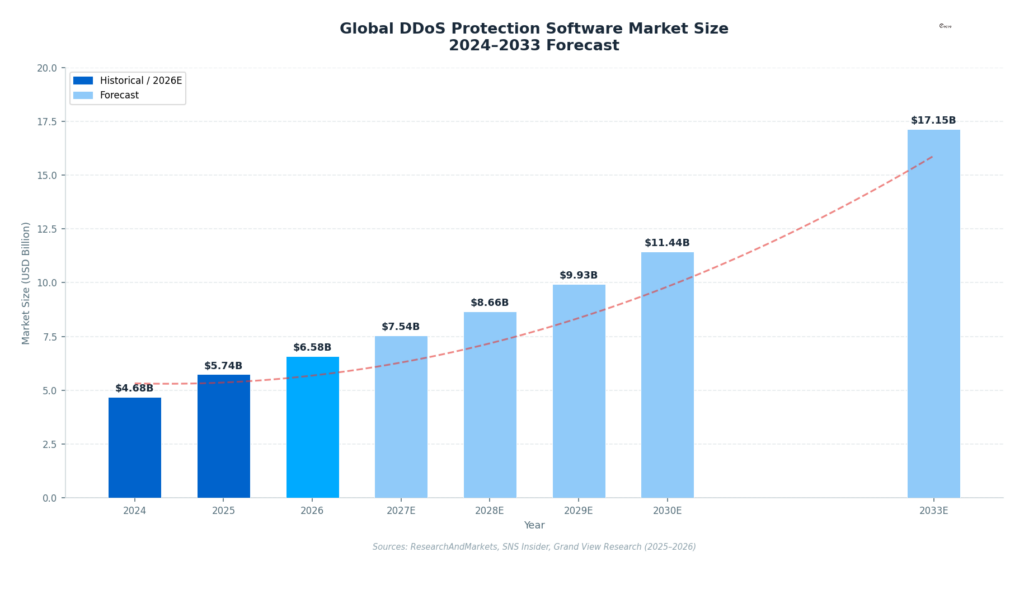
The commercial market is expanding accordingly. The global DDoS protection software market is estimated at approximately $6.58 billion in 2026 under one forecast, with the market projected to reach $11.44 billion by 2030 at a compound annual growth rate of 14.7%. Another projection places the 2030 market at $10.39 billion with a 12.3% CAGR, while longer-term forecasts estimate that the market could reach between $17.15 billion and $20.31 billion by 2033. Precedence Research offers another trajectory, estimating a $4.94 billion market in 2026 and projecting expansion to $13.90 billion by 2034 at a 13.81% CAGR.
Although research firms differ on the precise market size, their forecasts point in the same direction: DDoS protection is becoming a much larger cybersecurity category. The underlying dataset shows the market increasing from $4.68 billion in 2024 to $5.74 billion in 2025, representing a 22.6% year-over-year increase. Mordor Intelligence’s projection cited in the data forecasts a 13.82% CAGR between 2026 and 2031, with the market reaching $10.28 billion by 2031. DDoS protection services alone are projected to grow at a 13.4% CAGR through 2030.


The reason for this investment becomes much clearer when looking at attack volumes.
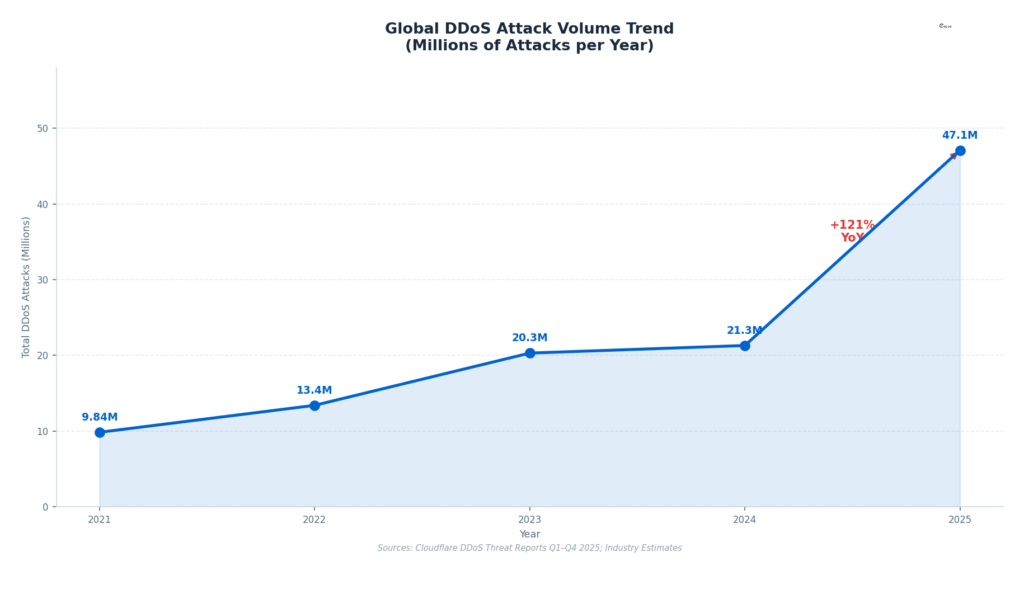
Cloudflare reportedly mitigated 47.1 million DDoS attacks during 2025, equivalent to an average of approximately 5,376 attacks every hour. Overall DDoS attack activity increased 121% year over year, while the longer-term increase between 2023 and 2025 reached 236%. These numbers suggest that organizations are no longer preparing primarily for isolated DDoS incidents. They are operating in an internet environment where malicious traffic is continuously probing infrastructure for weaknesses.

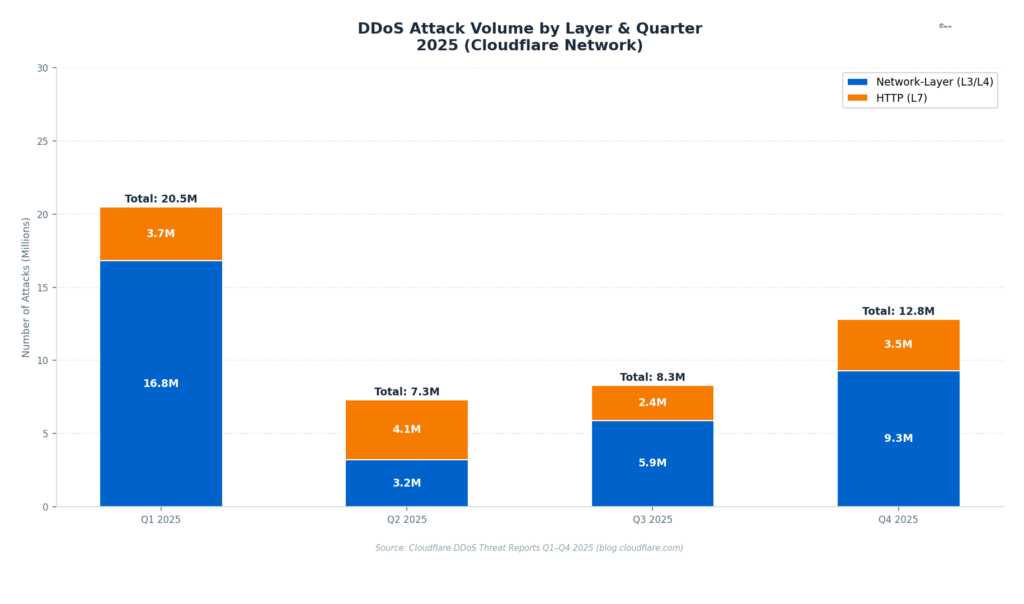
The first quarter of 2025 illustrated just how quickly that environment was changing. Cloudflare blocked 20.5 million DDoS attacks during Q1 alone, an amount equivalent to approximately 96% of the company’s reported attack total for the entirety of 2024. Total DDoS attacks increased 358% year over year during the quarter. Network-layer L3/L4 attacks increased an extraordinary 509%, while HTTP Layer 7 DDoS attacks increased 118%.
Attack activity remained elevated later in the year rather than returning to historical levels. Cloudflare mitigated 8.3 million DDoS attacks during Q3 2025, representing a 40% increase compared with Q3 2024. In Q4, attack volume increased another 31% from the previous quarter and stood 58% above Q4 2024. NETSCOUT’s ATLAS platform independently observed more than 8 million DDoS attacks globally during the first half of 2025, while Radware reported a 168% year-over-year increase in attack volume across its network.
The frequency becomes even more striking when translated into shorter time periods. Approximately 44,000 DDoS attacks are estimated to occur worldwide every day. Radware reports that its average customer encounters 139 attempted DDoS attacks per day, while Cloudflare’s Q3 2025 mitigation figures translate to roughly 3,780 attacks every hour. StormWall’s forecast cited in the dataset goes even further, projecting that it could mitigate 58 million attacks during 2026, nearly three times its 2025 level.
But attack frequency tells only part of the story. One of the defining DDoS trends entering 2026 is the extraordinary increase in maximum attack capacity.

The largest DDoS attack cited in the dataset reached an unprecedented 31.4 terabits per second in December 2025. The attack was associated with the Aisuru-Kimwolf botnet and exceeded an earlier 2025 record of 22.2 Tbps. For comparison, the DDoS record stood at approximately 3.8 Tbps in October 2024. That means the recorded peak increased roughly 726% in just 14 months.
Packet rates are increasing alongside bandwidth. Cloudflare recorded a 4.8 billion-packets-per-second attack during Q1 2025, reportedly 52% higher than the previous benchmark. Q2 subsequently produced attacks reaching 7.3 Tbps and 4.8 Bpps, while the Aisuru botnet generated a peak of 29.7 Tbps during Q3. The Aisuru-Kimwolf botnet itself was estimated to contain between one million and four million compromised Android TV devices, demonstrating the increasingly important relationship between poorly secured consumer IoT infrastructure and industrial-scale DDoS capacity.
Terabit-scale attacks are also becoming substantially more common rather than remaining exceptional record-setting events. Cloudflare blocked approximately 700 hyper-volumetric attacks exceeding either 1 Tbps or 1 Bpps during Q1 2025, equivalent to about eight per day. In Q2, that number exceeded 6,500, or approximately 71 hyper-volumetric attacks every day. During Q4’s “Night Before Christmas” campaign, 902 hyper-volumetric attacks were recorded over 53 days. Meanwhile, A10 Networks tracks approximately 12.3 million systems worldwide capable of being used as DDoS weapons.
These developments fundamentally change what effective DDoS protection software must accomplish. A mitigation platform cannot simply be capable of surviving yesterday’s average attack. It needs enough distributed capacity, automation, behavioral intelligence, and network visibility to respond to attacks that can change vectors, generate billions of packets per second, or suddenly reach tens of terabits per second.
At the same time, focusing exclusively on enormous attacks can create another security blind spot because most DDoS incidents are considerably smaller and extremely short-lived.
According to the statistics compiled for this report, 89% of network-layer DDoS attacks last less than 10 minutes, while 71% of HTTP DDoS attacks terminate within the same timeframe. Approximately 94.4% of web DDoS attacks remain below 100,000 requests per second, and 93% of L3/L4 attacks use less than 500 Mbps of bandwidth. Yet at the extreme end, 6% of HTTP DDoS attacks exceed one million requests per second.

This combination of short duration, high frequency, and widely varying scale has major implications for DDoS mitigation strategies. If an attack lasts only a few minutes, a defense process that depends on an administrator identifying the incident, confirming it, contacting a service provider, and manually activating mitigation may respond after the attack has already caused disruption. Always-on detection and automated mitigation therefore become increasingly important as attacks get faster.
The upper end of the distribution is simultaneously becoming more dangerous. Attacks exceeding 100 million packets per second increased 189% quarter over quarter during Q3 2025, while attacks above 1 Tbps increased 227%. In Q2, L3/L4 attacks exceeding 1 Tbps had already increased 1,150% quarter over quarter. Specific techniques can experience even more extreme surges: CLDAP amplification attacks increased 3,488% quarter over quarter during Q1 2025.
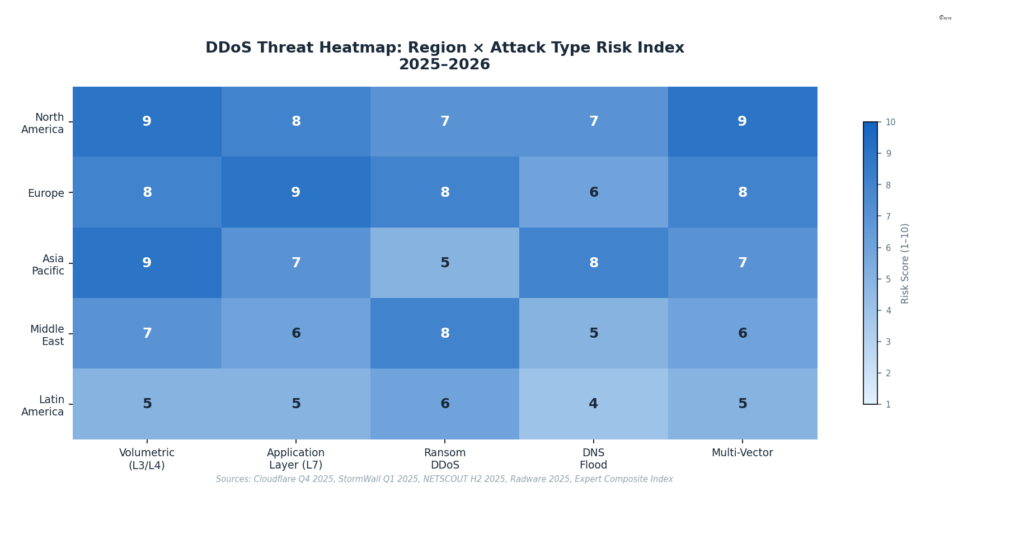
Attack complexity is evolving as well. Multi-vector application-layer attacks represented 38% of attacks during H1 2025, compared with 28% previously. This trend matters because organizations increasingly need to defend multiple layers of their technology stack simultaneously. Network bandwidth, DNS infrastructure, APIs, application servers, authentication systems, and web endpoints can all become part of the same denial-of-service campaign.
The economics surrounding DDoS attacks make these developments particularly concerning.
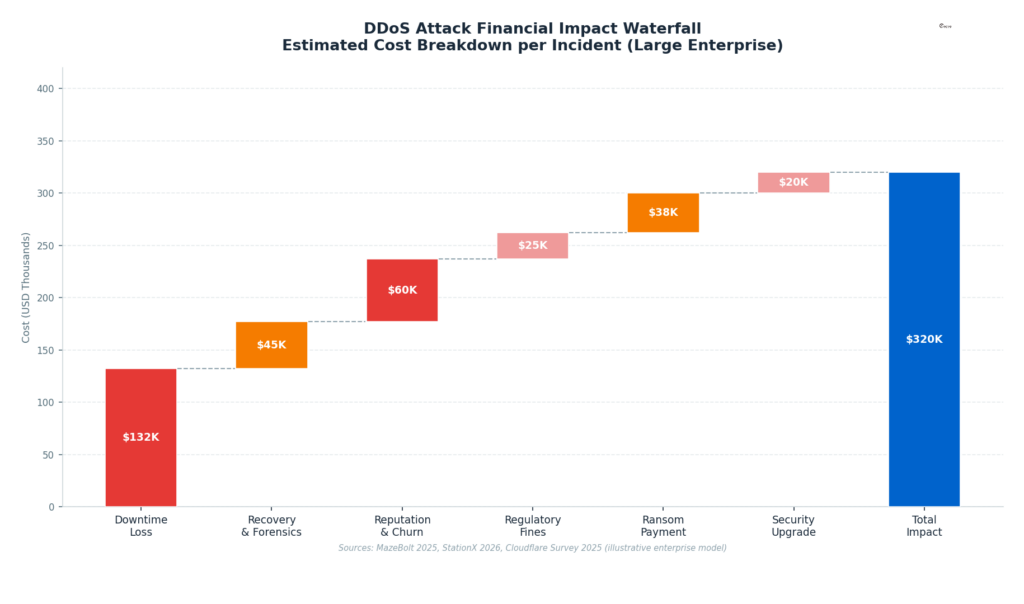
The dataset places the average cost of DDoS downtime at approximately $22,000 per minute, equivalent to around $1.32 million per hour. At that rate, a disruption lasting just 15 minutes could theoretically generate approximately $330,000 in losses. Small and medium-sized businesses are estimated to spend around $120,000 recovering from a DDoS incident, while losses for a large enterprise can exceed $1 million from a single event.
On the opposite side of that equation, DDoS-for-hire services can reportedly cost attackers as little as $38 per hour. The statistics therefore put the attacker-to-defender economic ratio at approximately 1:3,158. This extraordinary asymmetry helps explain why denial-of-service remains attractive to financially motivated attackers, hacktivists, extortion groups, and other threat actors. The infrastructure needed to create serious disruption can be inexpensive relative to the economic damage inflicted on the target.
Ransom DDoS adds another financial dimension. Twelve percent of Cloudflare customers targeted by DDoS attacks during Q4 2024 reportedly received ransom notes, representing a 78% quarter-over-quarter increase. Ransom DDoS attacks subsequently increased 68% quarter over quarter during Q2 2025 and 6% year over year. Enterprise cybersecurity budgets, meanwhile, increased 31% in 2025 according to the statistics compiled here, with DDoS and other cyber threats contributing to higher security expenditure.
The DDoS protection software market is therefore being shaped by a simple but powerful economic reality: the cost of generating malicious traffic can remain extremely low while the cost of being unavailable can be enormous.
Geography introduces another layer of complexity.
North America accounted for approximately 41% of global DDoS protection market revenue in 2025, while Europe represented roughly 26%. Asia Pacific, however, is identified as the fastest-growing region, with DDoS protection spending projected to expand at a 16.84% CAGR through 2033. Continued digitalization, cloud migration, IoT growth, 5G deployment, e-commerce expansion, and the increasing importance of online infrastructure across Asian economies are expanding both the addressable security market and the potential attack surface.
Cyber conflict is also making attack geography increasingly volatile. Israel accounted for 12.2% of geopolitical hacktivist DDoS incidents in the dataset. Belgium received 9.7% of global DDoS attacks during Q1 2025 following a sudden increase associated with government targeting. Hong Kong rose 12 positions to become the second most DDoS-targeted location during Q4, while the United Kingdom jumped 36 places to sixth.
The speed with which geopolitical events can translate into cyberattacks is particularly notable. DDoS activity against U.S. businesses reportedly surged 800% within 24 hours of Israeli airstrikes on Iran in June 2025. More broadly, geopolitical conflicts were associated with nearly two-thirds of observed cyber activity during 2025 in the statistics reviewed for this article.
This means DDoS risk is increasingly dynamic. A company does not necessarily need to change its infrastructure, business model, or cybersecurity posture to experience a sudden increase in threat exposure. A political event thousands of kilometers away can rapidly redirect botnet capacity toward companies, governments, financial institutions, telecommunications providers, or digital platforms associated with a particular country or industry.
Industry targeting demonstrates the same volatility.
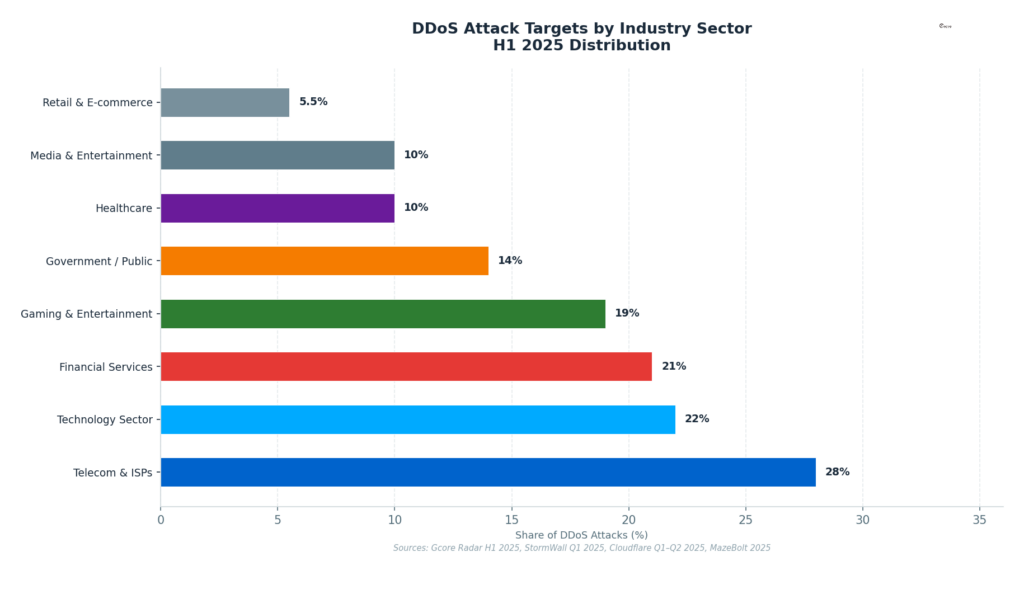
Telecommunications represented 28% of attacks during Q1 2025, making it the most heavily targeted industry in that period. Technology subsequently overtook gaming as the most attacked sector during H1 2025, while financial services represented 21% of attacks. Gaming’s share declined from 34% in H2 2024 to 19% during H1 2025. AI companies emerged as another rapidly escalating target, with attacks against the sector increasing 347% month over month in September 2025.
Government services represented 38.8% of hacktivist DDoS targets, reinforcing the connection between denial-of-service activity and political disruption. Meanwhile, cybersecurity spending is expected to increase rapidly in regulated industries. Healthcare and life sciences DDoS protection spending is projected to grow at a 14.52% CAGR through 2031, while banking, financial services, and insurance is forecast to expand at a 16.98% CAGR through 2033.
Technology itself is consequently becoming a major competitive battleground within the DDoS protection software industry, particularly around artificial intelligence, machine learning, automation, behavioral analysis, and globally distributed mitigation.
The statistics highlight NETSCOUT’s Arbor suite as neutralizing approximately 80% of DDoS attacks without human intervention. Its ATLAS network monitors more than 550 Tbps of real-time internet traffic across approximately 500 ISPs and 2,000 enterprise sites. NETSCOUT also introduced additional AI and machine-learning capabilities to Arbor TMS in March 2025.
Cloudflare introduced an AI-driven adaptive DDoS mitigation engine in July 2025 that can identify threat patterns in milliseconds, with the dataset citing a 40% improvement in blocking Layer 7 attacks. Akamai introduced its Behavioral DDoS Engine in June 2025 using continuous machine-learning feedback loops. These developments illustrate how competitive differentiation is moving beyond raw scrubbing capacity toward faster identification, automated mitigation, behavioral modeling, and context-sensitive decision-making.
Infrastructure capacity is nevertheless still critical. GTT Communications expanded global DDoS scrubbing capacity to 4 Tbps in June 2025, while Radware added 30 Tbps of global cloud security capacity in January 2026 through DefensePro X. Cloudflare’s network, according to the compiled statistics, spans 335 cities and provides approximately 348 Tbps of total capacity.
Artificial intelligence is simultaneously creating opportunities for defenders and potentially increasing capabilities available to attackers. Mentions of malicious AI tools on the dark web increased 219% in 2025, while discussions about jailbreaking AI platforms rose 52%. The dataset also highlights GhostGPT, an AI malware-generation tool reportedly offered through Telegram for $50 per week.
For enterprise security teams, the implication is that automation is becoming important on both sides of the cybersecurity equation. Attackers can increasingly automate reconnaissance, infrastructure management, campaign execution, and adaptation, while defenders are responding with machine-learning models capable of identifying abnormal behavior and activating mitigation without waiting for manual intervention.
These technological changes are influencing how organizations purchase DDoS protection.
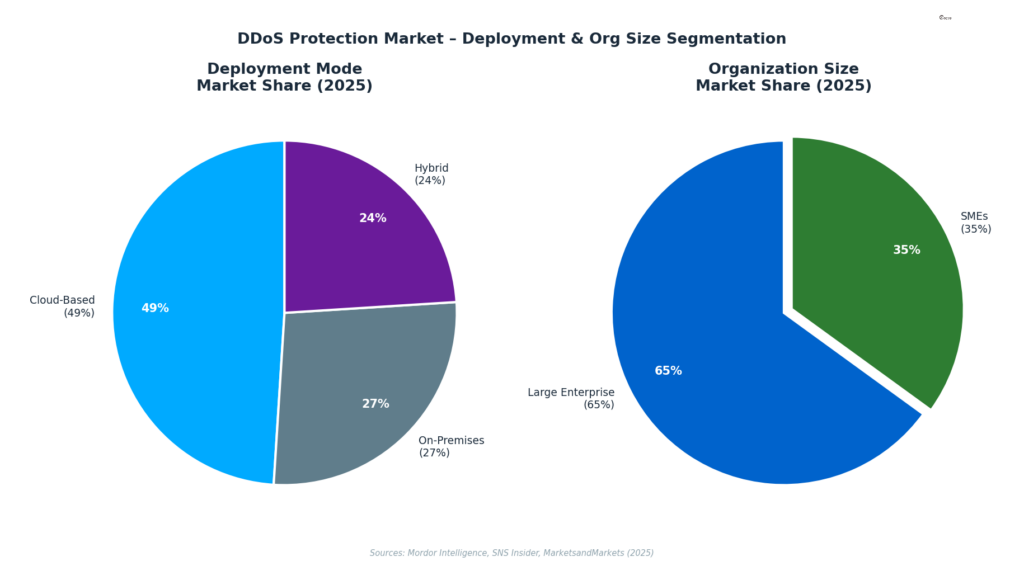
Integrated solution suites accounted for 60.65% of DDoS protection revenue in 2025. Cloud-based DDoS protection represented 49.02% of the market, while hybrid deployments are projected to grow at a 15.25% CAGR through 2031, making hybrid the fastest-growing deployment model in the dataset.
Large enterprises currently generate approximately 65% of DDoS protection market revenue, but smaller organizations are becoming increasingly important. SME spending is projected to increase at a 15.82% CAGR through 2033, the fastest growth rate among organization-size segments. Cloud delivery and managed security services are making sophisticated mitigation capabilities increasingly accessible to organizations that cannot operate their own global security infrastructure.
IT and telecommunications organizations lead adoption with an estimated 27% to 35% market share, depending on the underlying segmentation. Network security applications represent approximately 44% of DDoS protection revenue, while application security is expected to be the fastest-growing protection category, expanding at roughly 15.79% annually through 2033. Advanced bot mitigation is similarly projected to grow at a 15.05% CAGR.
The vendor landscape reflects this shift toward large distributed security platforms. The statistics compiled for this article cite Cloudflare Security with an 82.16% global market share in DDoS and bot protection software based on Datanyze/Statista data from February 2024. Cloudflare also reportedly protected more than 35% of Fortune 500 companies by 2025. Radware, meanwhile, partnered with Taiwan’s CHT Security in March 2025 to provide AI-powered security capabilities to more than 300 enterprises and 40,000 SMEs.
Yet technology and infrastructure alone do not solve every problem.
The cybersecurity labor shortage remains significant, with the dataset citing more than 3.4 million unfilled network security roles globally. That shortage strengthens the case for automated and managed DDoS protection because organizations cannot indefinitely solve increasing attack volume by adding more analysts to security operations teams. Automation, managed mitigation, threat intelligence, and unified security platforms are becoming operational necessities as much as technological upgrades.
Organizational coordination is another weakness. More than 50% of organizations reportedly lack sufficient coordination among teams responsible for implementing DDoS mitigation, according to statistics attributed to Corero’s 2025 Threat Intelligence Report. At the same time, 68% of organizations struggle to demonstrate the return on investment of DDoS mitigation to leadership.
This creates an important contradiction for 2026. DDoS attacks can cost organizations thousands of dollars per minute, terabit-scale events are becoming increasingly common, attack volumes are climbing rapidly, and the protection market is experiencing sustained double-digit growth. Yet many businesses still struggle to quantify the financial value of preventing an outage that never happens.
The expanding Internet of Things could make this challenge even more urgent. The dataset projects approximately 49 billion IoT-connected devices worldwide by 2026, growing around 7% annually. As the Aisuru-Kimwolf example demonstrates, consumer devices can become part of enormous botnets when weak credentials, vulnerable firmware, insecure supply chains, or poor patching practices leave them exposed. Every new generation of connected televisions, routers, cameras, appliances, sensors, and other devices potentially expands the infrastructure that attackers can attempt to compromise.
Taken together, these 102 DDoS protection software statistics for 2026 describe a cybersecurity market undergoing rapid structural change. DDoS attacks are becoming more frequent, larger at their extremes, increasingly multi-vector, economically asymmetric, closely connected with geopolitical events, and more dependent on vast networks of compromised devices. Meanwhile, DDoS protection is moving toward cloud-native architectures, hybrid mitigation, application-layer security, advanced bot management, AI-assisted detection, behavioral analytics, automated response, and globally distributed scrubbing infrastructure.
For CISOs, cybersecurity teams, SaaS providers, hosting companies, telecommunications operators, financial institutions, e-commerce businesses, government agencies, and technology leaders, the central question in 2026 is increasingly not whether DDoS protection is necessary. The more consequential questions are how much protection is required, how quickly mitigation can activate, whether the architecture can withstand attacks measured in tens of terabits per second, how effectively application-layer attacks can be distinguished from legitimate users, and whether defenses can adapt as rapidly as the botnets targeting them.
The following 102 DDoS protection software statistics, data points, and trends provide a quantitative view of that changing landscape, covering market growth, attack frequency, record-breaking attack scale, duration, financial impact, regional patterns, industry targeting, AI and machine learning, cloud adoption, deployment models, market segmentation, leading vendors, cybersecurity staffing challenges, and the rapidly expanding IoT attack surface shaping DDoS protection in 2026 and beyond.
Before we venture further into this article, we would like to share who we are and what we do.
About 9cv9
9cv9 is a business tech startup based in Singapore and Asia, with a strong presence all over the world.
With over ten years of startup and business experience, and being highly involved in connecting with thousands of companies and startups, the 9cv9 team has listed some important and crucial software tools in this review.
If you like to get your company listed in our top B2B software reviews, check out our world-class 9cv9 Media and PR service and pricing plans here.
Top 102 DDoS Protection Software Statistics, Data & Trends in 2026
🏦 Market Size & Growth
1. The global DDoS protection software market is valued at $6.58 billion in 2026.
As enterprises face record-breaking attack volumes, the DDoS protection market has crossed the $6.5B milestone in 2026, signalling that cybersecurity investment is firmly keeping pace with the escalating threat landscape.
2. The market is projected to reach $11.44 billion by 2030 at a 14.7% CAGR.
A compound annual growth rate of nearly 15% places DDoS protection among the fastest-growing cybersecurity verticals globally, driven by the convergence of cloud adoption, IoT proliferation, and geopolitical cyber conflict.
3. An alternative projection puts the 2030 market at $10.39 billion (12.3% CAGR).
While estimates vary across research firms, the consensus is unambiguous — DDoS protection software spending will nearly double within five years, making it a critical line item in every enterprise security budget.
4. The market was valued at $5.74 billion in 2025, up from $4.68 billion in 2024.
The 22.6% single-year jump from 2024 to 2025 reflects an industry in crisis-response mode, as the volume and velocity of attacks pushed organizations to urgently upgrade their defenses.
5. By 2033, the DDoS protection market could reach $17.15 billion (SNS Insider).
With a decade-long growth runway ahead, DDoS protection software is on course to triple in market size from current levels — presenting massive commercial opportunity for vendors and managed security providers alike.
6. Grand View Research projects the market reaching $20.31 billion by 2033 at 18.7% CAGR.
The wide variance between forecasts (17–20B) underscores analysts’ uncertainty about how much faster attack escalation could drive demand — but all scenarios point to sustained, strong growth.
7. Precedence Research estimates the market at $4.94 billion in 2026, growing to $13.90 billion by 2034 at a 13.81% CAGR.
Regardless of which projection baseline you use, the trajectory is clear: a decade of double-digit growth lies ahead for DDoS protection vendors serving enterprises of every size.
8. The DDoS protection market grew at a 14.05% CAGR from 2024 to 2025 per 360iResearch.
This consistent double-digit growth rate demonstrates that DDoS protection is not a cyclical or optional spend — it has become a foundational, non-negotiable component of enterprise cybersecurity architecture.
9. Mordor Intelligence estimates the 2026–2031 period will see a 13.82% CAGR, reaching $10.28 billion by 2031.
Mid-term forecasts consistently show a market doubling in under six years — a pace driven by the permanent shift from reactive to proactive, always-on defense postures.
10. The DDoS protection services segment is growing at a 13.4% CAGR through 2030.
Managed DDoS protection services — covering 24/7 monitoring, threat intelligence, and incident response — are outpacing hardware-only solutions as organizations outsource complex mitigation to specialized providers.
⚡ Attack Volume & Frequency
11. Cloudflare mitigated 47.1 million DDoS attacks in full-year 2025.
The staggering 47.1 million figure — averaging 5,376 attacks per hour — means DDoS has become constant background noise on the internet, requiring always-on automated defenses rather than human-triggered responses.
12. DDoS attacks surged 121% year-over-year in 2025.
A 121% annual surge is not a spike — it is a structural acceleration. Organizations that have not adopted automated DDoS mitigation are statistically certain to face costly downtime events in 2026.
13. Cloudflare blocked 20.5 million DDoS attacks in Q1 2025 alone — 96% of its entire 2024 total.
The Q1 2025 figure alone equaling nearly all of 2024 illustrates how dramatically the threat environment shifted in a single quarter, driven largely by an unprecedented 18-day multi-vector attack campaign.
14. DDoS attacks spiked 236% between 2023 and 2025.
A near-tripling of attack volume in just two years reflects the compounding effect of accessible DDoS-for-hire platforms, IoT botnet growth, and rising geopolitical cyber conflict — trends showing no sign of reversal.
15. Q1 2025 saw a 358% year-over-year increase in DDoS attacks (Cloudflare).
The 358% YoY surge in Q1 2025 — partially driven by 13.5 million attacks targeting Cloudflare’s own infrastructure — set a new benchmark for how rapidly attack campaigns can materialize and scale.
16. Network-layer (L3/L4) DDoS attacks increased 509% YoY in Q1 2025.
The 509% explosion in network-layer attacks signals that volumetric flood tactics have been dramatically democratized, with botnets now generating packet floods that can overwhelm traditional on-premises appliances in seconds.
17. HTTP (L7) DDoS attacks rose 118% YoY in Q1 2025.
Application-layer attacks are growing alongside volumetric floods, creating a multi-front challenge where defenders must simultaneously protect network infrastructure and individual web application endpoints.
18. In Q3 2025, Cloudflare mitigated 8.3 million DDoS attacks — 40% more than Q3 2024.
The sustained 40% YoY growth in Q3 confirms that Q1’s extraordinary spike was not an outlier but part of a structural upward trend that persisted throughout all four quarters of 2025.
19. In Q4 2025, DDoS attack volume grew 58% over Q4 2024 and 31% over Q3 2025.
The Q4 surge — fueled by the “Night Before Christmas” Aisuru-Kimwolf botnet campaign — demonstrates that seasonal attack spikes are now layering on top of an already elevated baseline.
20. NETSCOUT’s ATLAS platform observed over 8 million DDoS attacks globally in H1 2025 alone.
Independent corroboration from NETSCOUT’s global sensor network confirms Cloudflare’s findings: 2025 was categorically the most severe DDoS year on record by every measurable metric.
21. Radware reported a 168% YoY increase in DDoS attack volume on its network.
Cross-referencing data from multiple vendors — Cloudflare (+121% globally), Radware (+168%), Gcore (+41% H1) — reveals consistent directional evidence of a sustained, industry-wide attack escalation.
22. StormWall forecasts mitigating 58 million DDoS attacks in 2026 — nearly triple 2025 levels.
If StormWall’s 2026 projection holds, the attack volume trajectory is exponential rather than linear — a critical planning assumption for CISOs sizing their mitigation infrastructure and budgets for the year ahead.
23. Approximately 44,000 DDoS attacks are launched worldwide every day.
Breaking the annual figure down to a daily rate of 44,000 attacks underscores the relentless, industrial-scale nature of modern DDoS threats — far beyond what manual response teams could ever address.
24. Radware reports its average customer faces 139 attempted DDoS attacks per day.
An average of 139 daily attempts per customer means even mid-market enterprises need automated, policy-driven defenses — organizations relying on manual triage are systematically outpaced before they even begin.
25. Cloudflare mitigated an average of 3,780 DDoS attacks per hour in Q3 2025.
The per-hour mitigation rate growing from ~450/hr in 2024 to 3,780/hr in Q3 2025 represents an 8x increase in defensive action density — a telling indicator of the speed at which the threat environment is escalating.
🌊 Attack Scale & Records
26. The largest DDoS attack ever recorded peaked at 31.4 Tbps in December 2025.
The 31.4 Tbps record — launched by the Aisuru-Kimwolf botnet — sets a sobering new upper bound for what modern attack infrastructure can generate, far exceeding the scrubbing capacity of most legacy mitigation systems.
27. The previous record was 22.2 Tbps, also set in 2025, showing records were broken multiple times.
Five record-breaking events within a single year demonstrate that attack capability is scaling faster than defensive infrastructure in most organizations — a gap that only cloud-scale mitigation can reliably close.
28. In October 2024, the DDoS record was 3.8 Tbps — meaning it grew 726% in 14 months.
A 726% escalation in peak attack bandwidth within 14 months is unprecedented in the history of DDoS — legacy on-premises hardware purchased even 18 months ago is already insufficient against peak 2026 threats.
29. Cloudflare blocked the most intense packet-rate attack on record: 4.8 billion packets per second (Bpps) in Q1 2025.
The 4.8 Bpps record — 52% above the prior benchmark — highlights that volumetric attacks are now measured in billions of packets per second, a scale that only purpose-built, distributed scrubbing infrastructure can absorb.
30. A 7.3 Tbps and 4.8 Bpps attack were recorded in Q2 2025 — the largest at the time.
The Q2 2025 dual records confirm that hyper-volumetric attack capability is proliferating rapidly, with individual threat actors able to generate attack volumes that would have been nation-state-exclusive just three years prior.
31. In Q3 2025, attacks peaked at 29.7 Tbps from the Aisuru botnet.
The 29.7 Tbps peak in Q3 came from a single botnet — Aisuru — comprising an estimated 1–4 million infected hosts, illustrating how a single well-resourced threat actor can produce near-record-breaking attack traffic.
32. The Aisuru-Kimwolf botnet contained an estimated 1–4 million infected Android TV devices.
The weaponization of consumer IoT devices — in this case Android TV boxes — into a DDoS botnet represents a new and growing threat vector, as hundreds of millions of unmanaged smart devices sit on poorly secured home networks.
33. Cloudflare blocked 700 hyper-volumetric attacks (>1 Tbps or >1 Bpps) in Q1 2025 — averaging 8/day.
Eight hyper-volumetric attacks per day — each individually capable of taking down unprotected infrastructure — signals that terabit-scale DDoS has normalized as a routine tactic rather than a rare, specialized operation.
34. In Q2 2025, Cloudflare blocked over 6,500 hyper-volumetric attacks — averaging 71/day.
The 9x jump from 8 hyper-volumetric attacks/day in Q1 to 71/day in Q2 captures how rapidly the upper end of the attack distribution is inflating — with 2026 on track to see even higher daily peak frequencies.
35. The number of hyper-volumetric attacks surged 54% QoQ in Q3 2025, averaging 14 per day.
Even as total attack volume fluctuated quarter to quarter, the hyper-volumetric sub-category grew consistently — indicating that threat actors are specifically investing in capability to overwhelm even well-resourced defenders.
36. The “Night Before Christmas” campaign in Q4 2025 produced 902 hyper-volumetric attacks over 53 days, averaging 53/day.
The systematic, sustained nature of the Q4 2025 campaign — 902 hyper-volumetric strikes in under two months — demonstrates that botnets are now operated with military-grade operational discipline and persistence.
37. A10 Networks tracks 12.3 million DDoS weapons (attack-capable systems) worldwide.
With 12.3 million compromised, attack-ready systems tracked globally, the reservoir of potential DDoS firepower vastly exceeds what any single organization’s perimeter can absorb without cloud-scale scrubbing capacity.
⏱️ Attack Duration & Characteristics
38. 89% of network-layer DDoS attacks last under 10 minutes.
The predominance of sub-10-minute attacks — too fast for on-demand or manually triggered mitigation to respond — makes always-on automated defense the only architecture that provides consistent protection.
39. 71% of HTTP DDoS attacks end in under 10 minutes.
Even at the application layer, the majority of attacks are designed as “hit-and-run” pulses, overwhelming targets briefly before defenses can adapt — a tactic specifically engineered to exploit slow, human-dependent response workflows.
40. 94.4% of web DDoS attacks measure under 100,000 requests per second.
The vast majority of web DDoS attacks fly under the radar of high-threshold detection systems — a deliberate stealth strategy that makes low-sensitivity, behavior-based detection essential rather than optional.
41. 93% of L3/L4 DDoS attacks are under 500 Mbps in bandwidth.
The combination of small size and high frequency creates a “distributed stealth” problem — individually innocuous-looking traffic that overwhelms application logic without triggering bandwidth-based alarms.
42. 6% of HTTP DDoS attacks exceed 1 million requests per second.
While the majority of attacks are small, 6% of HTTP floods operate above 1M rps — large enough to instantly saturate unprotected web application infrastructure and cause complete service denial within seconds.
43. Attacks exceeding 100 million packets per second increased 189% QoQ in Q3 2025.
The near-tripling of extreme-scale packet-rate attacks within a single quarter illustrates that the distribution of attack severity is widening at both ends simultaneously — more stealth attacks and more devastating peak events.
44. Attacks exceeding 1 Tbps increased 227% QoQ in Q3 2025.
A 227% quarterly increase in terabit-scale attacks signals that hyper-volumetric DDoS has crossed from “rare exception” to “regular operational hazard” — fundamentally changing the infrastructure requirements for adequate protection.
45. L3/L4 attacks exceeding 1 Tbps grew 1,150% QoQ in Q2 2025.
The 1,150% single-quarter surge in terabit-scale L3/L4 attacks — driven by emerging botnet capabilities — represents one of the most dramatic escalations in attack-scale metrics ever recorded in a single reporting period.
46. CLDAP amplification attacks surged 3,488% QoQ in Q1 2025.
The extraordinary CLDAP amplification spike illustrates how quickly specific attack vectors can be weaponized at massive scale once exploited — underscoring the need for real-time threat intelligence integration in mitigation systems.
47. Multi-vector application layer attacks accounted for 38% of total attacks in H1 2025, up from 28%.
The 10-percentage-point shift toward multi-vector attacks within a single half-year confirms that modern DDoS is increasingly layered, simultaneously targeting network, application, and DNS layers to overwhelm defenses.
💰 Cost & Financial Impact
48. Every minute of DDoS downtime costs an average of $22,000.
At $22,000 per minute, even a 15-minute DDoS event inflicts $330,000 in direct costs — a figure that makes proactive mitigation investments in the tens of thousands annually appear extremely cost-effective by comparison.
49. The average hourly cost of DDoS downtime is $1.32 million.
An hourly cost of $1.32 million means a single sustained DDoS incident can exceed the annual DDoS protection budget of most mid-market enterprises — making “we’ll deal with it if it happens” a financially reckless posture.
50. SMBs spend approximately $120,000 to recover from a DDoS attack.
For small and medium businesses, a $120,000 recovery bill can be existential — particularly for e-commerce operations, SaaS startups, and healthcare providers for whom even brief outages carry regulatory and reputational consequences.
51. Large enterprises face losses exceeding $1 million from a single DDoS event.
Seven-figure losses per incident for large enterprises — encompassing downtime, forensics, reputation damage, regulatory fines, and infrastructure upgrades — create a compelling ROI case for enterprise-grade DDoS protection software.
52. A DDoS-for-hire service costs as little as $38 per hour.
The $38/hour attack cost vs. $120,000+ recovery cost creates an asymmetry so extreme (roughly 1:3,000) that the economic incentive structure systemically favors attackers — making affordable defense access a critical market need.
53. The attacker-to-defender cost ratio is approximately 1:3,158.
No other class of cyberattack offers attackers such a favorable economic ratio — a fact that explains why DDoS remains a go-to tactic for competitors, hacktivists, and extortionists worldwide.
54. Enterprise cybersecurity budgets increased 31% in 2025, driven by DDoS and other cyber threats.
The 31% budget increase — the largest single-year jump in recent memory — reflects boardroom-level recognition that DDoS is an existential operational risk, not just an IT inconvenience to be managed on existing budgets.
55. 12% of Cloudflare customers targeted by DDoS in Q4 2024 received a ransom note — a 78% QoQ increase.
The sharp rise in ransom DDoS (RDoS) incidents reflects attackers pivoting from pure disruption to monetization, creating a hybrid threat that combines denial-of-service with extortion economics.
56. Ransom DDoS attacks increased 68% QoQ in Q2 2025 and 6% YoY.
The sustained growth in RDoS — both quarter-over-quarter and year-over-year — indicates this is not a transient tactic but a permanent feature of the threat landscape that security budgets must explicitly account for.
🌍 Regional Distribution
57. North America held 41% of global DDoS protection market revenue in 2025.
North America’s dominant market share reflects its combination of advanced cybersecurity infrastructure, regulatory mandates (CISA, NIST), and concentration of high-value targets in finance, technology, and critical infrastructure.
58. Asia Pacific is the fastest-growing DDoS protection region with a 16.84% CAGR through 2033.
Rapid digitalization in China, India, Japan, and Southeast Asia — combined with 5G rollouts and IoT adoption — is creating both greater attack exposure and commensurate demand for sophisticated DDoS mitigation solutions.
59. Europe held approximately 26% of the global DDoS protection market in 2025.
Europe’s market share is shaped by GDPR compliance requirements, NIS2 Directive mandates, and the high concentration of financial services firms — all of which drive demand for enterprise-grade, compliance-ready DDoS protection.
60. Israel was the most targeted country for geopolitical DDoS attacks, accounting for 12.2% of all hacktivist incidents.
Israel’s top position in geopolitical DDoS targeting reflects the intensification of the Israel-Iran cyber conflict, with hacktivist groups launching coordinated campaigns following each escalation in physical hostilities.
61. Belgium received 9.7% of all global DDoS attacks in Q1 2025 — a sudden spike tied to government targeting.
Belgium’s dramatic emergence as a major DDoS target in Q1 2025 — from statistical anonymity to top-ten — illustrates how rapidly hacktivist campaigns can redirect global attack capacity toward new political targets.
62. Hong Kong jumped 12 places to become the second most DDoS’d location on Earth in Q4 2025.
The Hong Kong surge reflects escalating geopolitical tensions in the Asia Pacific region, with hacktivist and state-sponsored actors using DDoS as a tool of political pressure against commercial and governmental targets.
63. The UK leapt 36 places to become the sixth most DDoS’d location in Q4 2025.
A 36-place ranking jump in a single quarter signals a coordinated, politically motivated targeting campaign rather than organic growth — consistent with broader patterns of DDoS being weaponized in geopolitical disputes.
64. An 800% DDoS surge against US businesses occurred within 24 hours of Israeli airstrikes on Iran in June 2025.
The near-instantaneous 800% surge illustrates that DDoS infrastructure is now pre-positioned and ready for rapid geopolitical deployment — giving nation-state actors and their proxies a near-zero-latency cyber response capability.
65. Geopolitical conflicts drove nearly two-thirds of all observed cyber activity in 2025.
The dominance of geopolitical motivation in cyber activity — particularly Russia-Ukraine, Israel-Iran, and India-Pakistan flashpoints — means that DDoS protection is increasingly a matter of national security as much as enterprise IT.
🏭 Industry Targeting
66. Telecommunications was the most targeted industry in Q1 2025, accounting for 28% of all attacks.
Telecom’s top-target status reflects the cascading impact of successful attacks — disabling a carrier can simultaneously disrupt millions of downstream customers, making it a high-leverage target for maximum disruption per attack.
67. Technology sector overtook gaming as the most attacked sector in H1 2025.
The shift from gaming to technology as the primary attack target reflects attackers following the money — as tech companies host critical APIs, SaaS platforms, and AI infrastructure that have become essential business utilities.
68. Financial services accounted for 21% of DDoS attacks in H1 2025.
Finance remains a perennial top-three DDoS target due to the combination of high disruption value, regulatory sensitivity, and the increasing frequency of ransom DDoS campaigns targeting banks and payment processors.
69. Gaming’s share of DDoS attacks fell from 34% in H2 2024 to 19% in H1 2025.
The decline in gaming’s attack share — from #1 to #4 — reflects improved defenses deployed by major gaming platforms rather than reduced attacker interest, as improved targets shifted attention to less-defended sectors.
70. DDoS attacks against AI companies surged 347% month-over-month in September 2025.
The extraordinary 347% MoM spike in attacks against AI companies — coinciding with intensified public and regulatory scrutiny of AI — reveals how quickly new sectors can become politically motivated DDoS targets.
71. Government services accounted for 38.8% of hacktivist DDoS targets.
Government organizations are hacktivist groups’ preferred target, as disrupting public services creates maximum political visibility — a trend that will intensify as more countries face election cycles and diplomatic crises in 2026.
72. Healthcare and life sciences is projected to grow at a 14.52% CAGR in DDoS protection spending through 2031.
Healthcare’s rapid growth in DDoS protection investment reflects the sector’s recognition that digitized patient records, telemedicine platforms, and connected medical devices create an expanded and highly consequential attack surface.
73. The BFSI segment will grow at the fastest CAGR of 16.98% through 2033.
Banking, financial services, and insurance leading all segments in projected CAGR reflects the sector’s exposure to ransom DDoS, its strict regulatory requirements for uptime, and its willingness to pay premium prices for enterprise-grade protection.
🤖 AI, Technology & Innovation
74. NETSCOUT’s Arbor suite neutralizes 80% of DDoS attacks without human intervention.
An 80% autonomous mitigation rate — processing 700+ Tbps of real-time global traffic — represents the gold standard for AI-driven DDoS defense, and the benchmark that modern enterprise protection platforms are now measured against.
75. NETSCOUT’s ATLAS monitors over 550 Tbps of real-time internet traffic across 500 ISPs and 2,000 enterprise sites.
The scale of NETSCOUT’s ATLAS intelligence network — spanning half a terabit of monitored traffic per second — provides threat detection coverage that is statistically impossible to replicate with any organization-specific monitoring approach.
76. Cloudflare’s AI-driven adaptive DDoS engine showed a 40% improvement in blocking Layer-7 attacks in July 2025.
The 40% improvement in application-layer blocking — achieved through continuous ML feedback loops rather than signature updates — demonstrates how AI-native architectures are widening the defensive capability gap over legacy rule-based systems.
77. Malicious AI tool mentions on dark web increased 219% in 2025 vs. the prior year.
The 219% surge in dark web AI tool adoption signals that AI offense is scaling faster than most organizations’ awareness of it — making AI-powered defense not a future investment but an immediate necessity for 2026.
78. GhostGPT — an AI malware generation tool — is available on Telegram for just $50/week.
The commoditization of AI-assisted attack development at $50/week price points means that previously expert-only attack sophistication is now accessible to low-skill actors, dramatically expanding the threat actor population targeting enterprise infrastructure.
79. Jailbreaking discussions on AI platforms increased 52% on dark web forums in 2025.
The growing underground focus on bypassing AI safety guardrails to repurpose legitimate AI models for attack development signals a structural shift in how DDoS campaigns are planned, automated, and executed.
80. Application-layer DDoS attacks increased 43% and volumetric attacks rose 30%, per NETSCOUT.
NETSCOUT’s independent confirmation of dual-front attack growth — both application layer and volumetric — reinforces that any adequate DDoS protection strategy must deliver comprehensive multi-layer coverage in 2026.
81. In March 2025, NETSCOUT launched enhanced Arbor TMS with additional AI/ML functionality.
NETSCOUT’s Arbor TMS enhancement reflects an industry-wide pivot: the largest DDoS protection vendors are now competing on AI capability rather than bandwidth capacity alone, reshaping how enterprise buyers evaluate solutions.
82. Cloudflare unveiled an AI-driven adaptive DDoS mitigation engine in July 2025 capable of identifying threat patterns in milliseconds.
Millisecond-level threat pattern identification — enabled by ML models trained on petabyte-scale traffic — represents a quantum leap over signature-based systems that typically require seconds-to-minutes to begin blocking novel attack vectors.
83. Akamai introduced its Behavioral DDoS Engine in June 2025, applying continuous ML feedback loops.
Akamai’s behavioral engine approach — adapting mitigation policies per application context rather than applying static rules — marks the maturation of AI-native DDoS defense as a mainstream enterprise capability rather than a premium differentiator.
84. GTT Communications expanded its global DDoS scrubbing capacity to 4 Tbps in June 2025.
GTT’s 4 Tbps scrubbing expansion — adding centers in São Paulo, Hong Kong, and Miami — illustrates how providers are racing to build geographically distributed capacity to absorb attacks closer to their source.
85. Radware added 30 Tbps of global cloud security capacity in January 2026 with DefensePro X.
Radware’s 30 Tbps capacity expansion sets a new benchmark for cloud-scale mitigation infrastructure, directly targeting the class of attacks exemplified by the 31.4 Tbps December 2025 record that overwhelmed legacy systems.
📊 Market Segmentation
86. Solution suites command 60.65% of DDoS protection revenue in 2025 vs. standalone services.
The dominance of integrated solution suites — combining network, application, DNS, and bot mitigation — over point solutions reflects enterprise demand for unified management, consistent policy enforcement, and reduced vendor complexity.
87. Cloud-based DDoS protection held 49.02% of the market in 2025.
Cloud deployment’s near-majority market share reflects the fundamental advantage of elastic bandwidth pools and global anycast routing — capabilities that on-premises hardware cannot economically replicate for volumetric flood absorption.
88. Hybrid deployments are projected to grow at a 15.25% CAGR through 2031 — the fastest of any deployment mode.
Hybrid architecture’s fastest-growth status reflects enterprises’ need to balance the latency advantages of on-premises detection with the scale advantages of cloud scrubbing — a combination unavailable from pure-play vendors on either side.
89. Large enterprises account for 65% of DDoS protection market revenue in 2025.
Enterprise dominance of revenue share reflects the combination of greater attack exposure, more complex infrastructure requiring multi-layer protection, and larger budgets capable of funding comprehensive mitigation platforms.
90. SMEs are projected to grow at a 15.82% CAGR through 2033 — the fastest organizational segment.
The SME growth surge reflects the democratization of cloud-native DDoS protection — subscription-based models and managed services are finally putting enterprise-grade defense within reach of organizations that previously had no viable mitigation options.
91. The IT and telecommunications segment leads end-user adoption with 27–35% market share.
Telecom and IT firms’ leadership in DDoS protection adoption is self-reinforcing — as primary infrastructure providers, their own resilience directly determines the protection available to thousands of downstream customers.
92. Network security applications lead DDoS protection with ~44% revenue share in 2025.
Network-layer dominance in DDoS protection reflects where attacks cause the most immediate and measurable harm — bandwidth exhaustion and connection-table saturation remain the most common tactics, requiring network-level mitigation as the first line of defense.
93. Application security is the fastest-growing DDoS protection segment at ~15.79% CAGR through 2033.
Application-layer protection’s fastest-growth status tracks the rise of L7 attacks — HTTP floods, slow-rate attacks, and API abuse — as attackers pivot toward more targeted, harder-to-detect methods that bypass network-layer defenses.
🏆 Vendor & Competitive Landscape
94. Cloudflare Security holds 82.16% global market share in DDoS and bot protection software (Datanyze/Statista, Feb 2024).
Cloudflare’s dominant 82% market share reflects the decisive network effect of its global anycast infrastructure — with 348 Tbps of capacity across 335 cities, it offers mitigation scale that no competitor currently matches.
95. Cloudflare’s network spans 335 cities with 348 Tbps of total capacity.
Cloudflare’s 348 Tbps network capacity — nearly 11x the largest recorded DDoS attack peak — provides the headroom necessary to absorb even record-breaking volumetric events without performance degradation for legitimate traffic.
96. Cloudflare protected over 35% of the Fortune 500 as of 2025.
Fortune 500 penetration exceeding 35% positions Cloudflare as the de facto enterprise standard for DDoS protection — a competitive moat reinforced by deep integration with customers’ broader security and CDN infrastructure.
97. Radware partnered with Taiwan’s CHT Security in March 2025 to deliver AI-powered protection to 300+ enterprises and 40,000 SMEs.
Radware’s CHT Security partnership exemplifies the regional MSP alliance strategy through which DDoS protection vendors are rapidly expanding SME penetration in Asia Pacific — the market’s fastest-growing geography.
98. Advanced bot mitigation is forecast to grow at a 15.05% CAGR — the fastest sub-segment within DDoS solutions.
The rapid growth of bot mitigation reflects the blurring of boundaries between DDoS and bot attacks — modern web DDoS increasingly uses “legitimate-looking” bot traffic designed to evade traditional volumetric detection thresholds.
99. Global network security role vacancies exceed 3.4 million positions, accelerating demand for automated DDoS solutions.
A 3.4 million-position talent shortage in network security is one of the most powerful structural tailwinds for DDoS protection software — organizations without staff capacity to manage threats manually have no choice but to adopt automated, policy-driven platforms.
100. Over 50% of organizations lack coordination across teams implementing DDoS mitigation, per Corero’s 2025 Threat Intelligence Report.
Corero’s finding that half of organizations suffer from cross-team coordination failures in DDoS response highlights a critical execution gap — the best software investment is undermined without aligned processes, clear ownership, and regular resilience testing.
101. 68% of organizations fail to demonstrate DDoS mitigation ROI to leadership teams.
The inability to quantify mitigation value to the C-suite — despite $22,000/minute downtime costs — represents a communications failure that leaves security teams chronically underfunded relative to the actual financial exposure they are preventing.
102. IoT-connected devices are projected to reach 49 billion by 2026, growing at 7% annually.
The expansion of IoT to 49 billion devices — with the majority lacking meaningful security controls — provides botnet operators with an enormous and continuously replenished reservoir of potential DDoS weapons for years to come.
Conclusion
The 102 DDoS protection software statistics examined throughout this report point to one overriding conclusion: distributed denial-of-service attacks have become a permanent and rapidly evolving component of the global cybersecurity threat landscape. DDoS is no longer primarily a problem of occasional bandwidth saturation or temporary website downtime. In 2026, organizations face an environment defined by millions of attacks, record-breaking traffic volumes, enormous IoT botnets, application-layer targeting, geopolitical campaigns, ransom DDoS, AI-enabled threats, and attacks that can begin and end faster than traditional security teams can manually respond.
The growth of the DDoS protection software market reflects this transformation. One estimate places the global market at approximately $6.58 billion in 2026 and projects it to reach $11.44 billion by 2030 at a 14.7% CAGR. Other forecasts differ on the precise baseline and endpoint but consistently anticipate double-digit expansion. Estimates cited throughout this report range as high as $17.15 billion to $20.31 billion by 2033, while another forecast projects a $13.90 billion market by 2034.
These forecasts matter because they demonstrate that DDoS protection is developing into a substantial cybersecurity category rather than remaining a specialized network-security product. Organizations are increasingly purchasing cloud mitigation, managed protection services, application-layer defenses, behavioral detection, bot mitigation, hybrid architectures, threat intelligence, and automated response capabilities as parts of a broader resilience strategy.
The underlying threat statistics explain why.
Cloudflare reportedly mitigated 47.1 million DDoS attacks during 2025, an average of approximately 5,376 attacks every hour. Overall DDoS attacks increased 121% year over year, while attack activity rose 236% between 2023 and 2025. Approximately 44,000 attacks are estimated to occur worldwide every day, and Radware reports that its average customer encounters 139 attempted DDoS attacks daily.
Those figures change how organizations should think about DDoS risk. The relevant question is increasingly not whether an organization will encounter malicious traffic, but whether its infrastructure can continuously identify and mitigate that traffic without disrupting legitimate users.
The extraordinary first quarter of 2025 demonstrated the speed of this escalation. Cloudflare mitigated 20.5 million attacks during Q1 alone, equivalent to approximately 96% of its reported total for all of 2024. Overall DDoS attacks increased 358% year over year during the quarter, network-layer attacks increased 509%, and HTTP DDoS attacks rose 118%.
Later quarters confirmed that elevated DDoS activity was not confined to one exceptional period. Cloudflare mitigated 8.3 million attacks during Q3 2025, 40% more than during Q3 2024. Q4 attack volume subsequently increased 31% quarter over quarter and 58% year over year. NETSCOUT independently observed more than 8 million attacks globally during the first half of 2025, while Radware reported a 168% year-over-year increase across its network.
For businesses planning cybersecurity investments in 2026, these figures make attack frequency only one part of the equation. The scale of the largest attacks is increasing even faster.
The largest attack identified in the statistics reached 31.4 Tbps in December 2025. Another 2025 record had already reached 22.2 Tbps, while the record in October 2024 was approximately 3.8 Tbps. The jump from 3.8 Tbps to 31.4 Tbps represents an increase of roughly 726% in only 14 months.
The significance is difficult to overstate. Infrastructure designed around historical attack peaks can become inadequate surprisingly quickly when the upper boundary of DDoS capacity expands several-fold within little more than a year.
Packet-rate records tell a similar story. A 4.8 billion-packets-per-second attack was recorded during Q1 2025. Q2 saw attacks reach 7.3 Tbps and 4.8 Bpps, while Q3 produced a 29.7 Tbps attack associated with the Aisuru botnet. The Aisuru-Kimwolf infrastructure was estimated to contain between one million and four million compromised Android TV devices.
Perhaps even more important than individual records is the normalization of hyper-volumetric attacks.
Cloudflare blocked approximately 700 attacks exceeding 1 Tbps or 1 Bpps during Q1 2025, averaging around eight per day. During Q2, the number surpassed 6,500, or approximately 71 per day. The Q4 “Night Before Christmas” campaign generated 902 hyper-volumetric attacks across 53 days. A10 Networks, meanwhile, tracks approximately 12.3 million DDoS weapons worldwide.
Terabit-scale DDoS therefore cannot necessarily be treated as a theoretical worst-case scenario reserved for the world’s largest technology companies. The statistics indicate that hyper-volumetric capability is becoming increasingly accessible and frequently deployed.
At the same time, the most visible record-breaking attacks should not distract businesses from another critical trend: most DDoS attacks are comparatively small and short.
Approximately 89% of network-layer attacks last less than 10 minutes, and 71% of HTTP DDoS attacks end within that timeframe. Around 93% of L3/L4 attacks remain below 500 Mbps, while 94.4% of web DDoS attacks operate below 100,000 requests per second.
These statistics reinforce the importance of automated DDoS protection. A five-minute attack can cause significant disruption even though it never appears among record-breaking events. If mitigation depends on a human analyst identifying the problem, escalating it internally, contacting a provider and manually activating protection, the attack may have achieved its objective before the response process is complete.
Always-on protection, behavioral detection and automated mitigation therefore become increasingly valuable as attack duration decreases.
Attack complexity is evolving alongside attack speed. Multi-vector application-layer attacks represented 38% of total attacks during H1 2025, up from 28%. Meanwhile, extreme attack categories experienced enormous quarterly increases: attacks exceeding 100 million packets per second rose 189% during Q3, attacks exceeding 1 Tbps increased 227%, and L3/L4 attacks above 1 Tbps had previously surged 1,150% quarter over quarter during Q2. CLDAP amplification attacks alone increased 3,488% quarter over quarter during Q1.
The result is an increasingly polarized threat environment. Security platforms must identify large numbers of relatively small attacks without producing excessive false positives while simultaneously maintaining enough infrastructure capacity to absorb enormous volumetric events.
That combination helps explain why cloud-based and hybrid DDoS protection architectures are gaining importance.
Cloud-based protection represented 49.02% of the market in 2025, while hybrid deployment is projected to grow at a 15.25% CAGR through 2031. Integrated solution suites accounted for 60.65% of DDoS protection revenue. Network security represented approximately 44% of revenue, while application security is projected to grow at roughly 15.79% annually through 2033.
The market is effectively moving toward comprehensive protection across network, application, DNS and bot-related attack surfaces rather than treating each problem as a completely isolated security category.
The financial case for this investment is equally important.
The statistics reviewed in this report estimate DDoS downtime at approximately $22,000 per minute, equivalent to about $1.32 million per hour. SMB recovery costs are estimated at approximately $120,000 per incident, while large enterprises can experience losses exceeding $1 million from a single DDoS event.
Against those potential losses, an attacker may be able to purchase DDoS-for-hire capacity for as little as $38 per hour. The resulting attacker-to-defender economic ratio cited in the data is approximately 1:3,158.
This asymmetry remains one of the fundamental reasons DDoS is such a persistent cyber threat. Attackers do not necessarily need to compromise sensitive databases, maintain long-term persistence inside corporate networks, or develop highly sophisticated proprietary malware to create substantial financial damage. Sometimes preventing customers from accessing a company’s digital services is enough.
Ransom DDoS further strengthens the economic incentive. Twelve percent of Cloudflare customers targeted by DDoS attacks in Q4 2024 reportedly received ransom notes, while ransom DDoS activity increased 68% quarter over quarter during Q2 2025.
For e-commerce platforms, SaaS providers, financial institutions, online marketplaces, telecommunications companies, gaming businesses and other digital-first organizations, availability itself has become a valuable asset that attackers can attempt to hold hostage.
Geopolitics adds another dimension that security teams cannot easily model using traditional enterprise risk assessments.
The statistics show an 800% increase in DDoS attacks against U.S. businesses within 24 hours of Israeli airstrikes on Iran in June 2025. Israel represented 12.2% of geopolitical hacktivist incidents, Belgium suddenly received 9.7% of global DDoS attacks during Q1 2025, Hong Kong climbed 12 positions in global targeting during Q4, and the UK jumped 36 positions. Nearly two-thirds of observed cyber activity during 2025 was associated with geopolitical conflicts according to the data compiled for this report.
This volatility makes DDoS risk difficult to forecast purely from an organization’s historical attack data. A company that was not heavily targeted last year can suddenly find itself exposed because of its country, customers, industry, business relationships or association with a geopolitical event.
Industry statistics reinforce that point.
Telecommunications represented 28% of attacks during Q1 2025. Financial services accounted for 21% during H1, while technology overtook gaming as the most attacked sector. AI companies experienced a 347% month-over-month surge in DDoS attacks during September 2025, while government services represented 38.8% of hacktivist DDoS targets.
The industries receiving the greatest attention can therefore change quickly. Protection strategies should be based on the potential business impact of an attack rather than assumptions that a particular sector is unlikely to become a target.
Artificial intelligence is another major DDoS protection trend to watch in 2026.
NETSCOUT’s Arbor suite reportedly neutralizes approximately 80% of DDoS attacks without human intervention, while its ATLAS infrastructure monitors more than 550 Tbps of real-time internet traffic across 500 ISPs and 2,000 enterprise sites. Cloudflare’s adaptive DDoS engine reportedly delivered a 40% improvement in blocking Layer 7 attacks, while Akamai introduced a Behavioral DDoS Engine using continuous machine-learning feedback loops.
The direction of the market is clear: DDoS mitigation is becoming increasingly autonomous.
AI and machine learning can potentially help security platforms establish normal traffic baselines, identify anomalous behavior, distinguish malicious bots from legitimate users, recognize previously unseen attack patterns, adapt mitigation policies and react at speeds that human operators cannot match.
Attackers, however, are gaining access to similar technological advantages. Malicious AI tool mentions on dark-web environments increased 219% in 2025, while AI jailbreaking discussions increased 52%. The statistics also identify GhostGPT as an AI malware-generation service reportedly available for approximately $50 per week.
The cybersecurity industry is consequently entering a period in which automation competes with automation. Faster automated attacks increase the value of faster automated defenses.
Infrastructure capacity remains essential within that equation. Cloudflare’s network is reported to provide approximately 348 Tbps of capacity across 335 cities, while Radware added 30 Tbps of global cloud security capacity in January 2026 and GTT Communications expanded its scrubbing infrastructure to 4 Tbps during 2025.
These capacity expansions highlight an important consideration for businesses evaluating the best DDoS protection software in 2026: feature lists alone do not determine resilience.
Organizations should consider mitigation capacity, network distribution, time to mitigation, application-layer capabilities, behavioral detection, false-positive management, bot protection, API security, DNS resilience, threat intelligence, reporting, service-level agreements, incident support and the ability to handle simultaneous attacks across multiple vectors.
Market segmentation suggests that these requirements are spreading beyond the world’s largest enterprises.
Large enterprises still account for approximately 65% of DDoS protection revenue, but SMEs are projected to become the fastest-growing organizational segment, expanding at a 15.82% CAGR through 2033. Advanced bot mitigation is forecast to grow at 15.05%, while BFSI DDoS protection spending is expected to increase at 16.98% and healthcare and life sciences at 14.52%.
This democratization of DDoS protection could become one of the most consequential market trends over the remainder of the decade. Historically, smaller businesses could not economically replicate the networks, scrubbing centers, security teams and threat-intelligence capabilities available to multinational corporations. Cloud-based DDoS protection and managed security services increasingly allow those organizations to consume shared global defensive infrastructure as a service instead.
The growing cybersecurity skills shortage makes that transition even more important. The statistics cite more than 3.4 million vacant network-security roles globally. Organizations already struggling to recruit security specialists cannot reasonably respond to rapidly increasing attack volumes simply by adding more employees.
Automation and managed services therefore address two problems simultaneously: increasing technical complexity and insufficient human capacity.
However, organizations must also solve internal operational problems.
More than 50% reportedly lack adequate coordination between teams implementing DDoS mitigation, while 68% struggle to demonstrate the return on investment of DDoS protection to leadership. These findings expose a gap between technological capability and organizational readiness.
A company can purchase sophisticated DDoS protection software and still remain poorly prepared if responsibilities are unclear, escalation procedures are outdated, applications have not been tested under attack conditions, mitigation policies are misconfigured, or business leaders do not understand the financial importance of availability.
The best DDoS protection strategy in 2026 therefore extends beyond purchasing software. Organizations need technical defenses supported by clear ownership, incident-response procedures, resilience testing, traffic baselines, capacity planning, application architecture reviews and measurable business-continuity objectives.
The continuing expansion of IoT makes long-term preparation particularly important.
The statistics project approximately 49 billion connected IoT devices worldwide in 2026. The Aisuru-Kimwolf botnet’s estimated one million to four million compromised Android TV devices demonstrate what can happen when even a small fraction of a massive global device ecosystem becomes available to attackers.
As billions more routers, cameras, televisions, sensors, appliances and other connected devices come online, botnet operators potentially gain an expanding reservoir of infrastructure from which to construct future attacks. This creates a structural reason to expect DDoS capability to remain elevated even if individual botnets are dismantled.
For organizations comparing DDoS protection software in 2026, the most important lesson from these 102 statistics is therefore not simply that attacks are increasing. It is that almost every major dimension of the threat is changing simultaneously.
Attack frequency is increasing. Peak bandwidth is increasing. Packet rates are increasing. Hyper-volumetric attacks are becoming more common. Application-layer attacks are expanding. Multi-vector techniques are becoming more important. Botnets are becoming larger. IoT creates new attack infrastructure. Ransom DDoS adds direct monetization. Geopolitical conflicts can rapidly redirect attacks. AI is increasing automation. Downtime remains expensive. Cybersecurity skills remain scarce.
Meanwhile, the defense market is responding with cloud-scale networks, hybrid architectures, behavioral analytics, machine learning, automated mitigation, managed services, application security and increasingly sophisticated bot protection.
The organizations best positioned for this environment will be those that stop treating DDoS mitigation as an emergency switch activated after an outage begins and instead treat availability protection as a permanent layer of digital infrastructure.
That distinction will become increasingly important as businesses depend more heavily on cloud applications, APIs, e-commerce, digital payments, SaaS platforms, AI services, remote work infrastructure and always-connected customer experiences. When revenue, operations and customer relationships depend on continuous connectivity, protecting availability becomes inseparable from protecting the business itself.
Ultimately, the Top 102 DDoS Protection Software Statistics, Data & Trends in 2026 reveal a cybersecurity landscape in which the economics and technology of denial-of-service attacks continue to favor rapid escalation. With attacks reaching 31.4 Tbps, tens of millions of incidents being mitigated annually, hyper-volumetric campaigns occurring repeatedly, and market forecasts pointing toward sustained double-digit growth in DDoS protection spending, organizations have strong quantitative reasons to make resilience a strategic priority.
DDoS protection software is consequently evolving from a specialized security purchase into a fundamental component of modern digital resilience. The next generation of effective platforms will increasingly be judged not simply by whether they can block an attack, but by whether they can identify threats automatically, mitigate them in milliseconds, distinguish legitimate activity from malicious automation, absorb unprecedented traffic volumes, protect applications as well as networks, and maintain service availability without requiring constant human intervention.
If current trends continue, 2026 will not represent the peak of the DDoS threat. Instead, it may be remembered as another stage in the transition toward larger, faster, more automated and more economically disruptive attacks. Organizations that build scalable, automated and continuously tested defenses now will therefore be better positioned for the next generation of DDoS threats than those waiting for a major outage to demonstrate why such protection was necessary in the first place.
If you find this article useful, why not share it with your hiring manager and C-level suite friends and also leave a nice comment below?
We, at the 9cv9 Research Team, strive to bring the latest and most meaningful data, guides, and statistics to your doorstep.
To get access to top-quality guides, click over to 9cv9 Blog.
To hire top talents using our modern AI-powered recruitment agency, find out more at 9cv9 Modern AI-Powered Recruitment Agency.
People Also Ask
What is DDoS protection software?
DDoS protection software detects and mitigates distributed denial-of-service attacks by filtering malicious traffic before it can overwhelm networks, websites, applications, APIs, or other digital services.
How large is the DDoS protection software market in 2026?
The global DDoS protection software market is estimated at about $6.58 billion in 2026 under one market forecast, reflecting rapidly growing enterprise demand for automated cyber defenses.
How fast is the DDoS protection market growing?
One forecast projects the DDoS protection market to reach $11.44 billion by 2030, representing a 14.7% CAGR. Other forecasts similarly indicate sustained double-digit growth.
How many DDoS attacks occurred in 2025?
Cloudflare mitigated 47.1 million DDoS attacks during 2025, equivalent to an average of roughly 5,376 attacks every hour.
Are DDoS attacks increasing in 2026?
The available data shows a strong upward trend entering 2026. DDoS attacks surged 121% year over year during 2025 and increased 236% between 2023 and 2025.
How many DDoS attacks happen each day?
Approximately 44,000 DDoS attacks are launched worldwide every day, illustrating why automated and always-on mitigation has become increasingly important for online organizations.
What was the largest DDoS attack recorded?
The largest DDoS attack cited in the data peaked at 31.4 Tbps in December 2025 and was associated with the Aisuru-Kimwolf botnet.
How quickly are DDoS attacks getting larger?
The DDoS bandwidth record increased from 3.8 Tbps in October 2024 to 31.4 Tbps in December 2025, representing approximately 726% growth in just 14 months.
What is a hyper-volumetric DDoS attack?
In the cited statistics, hyper-volumetric attacks are attacks exceeding 1 Tbps or 1 Bpps. Cloudflare blocked more than 6,500 such attacks during Q2 2025.
How long do most DDoS attacks last?
Most DDoS attacks are relatively short. About 89% of network-layer DDoS attacks and 71% of HTTP DDoS attacks end within 10 minutes.
How much does DDoS downtime cost?
The statistics estimate average DDoS downtime costs at approximately $22,000 per minute, equivalent to around $1.32 million for one hour of disruption.
How much can a DDoS attack cost a small business?
Small and medium-sized businesses can spend approximately $120,000 recovering from a DDoS attack, making prevention and automated mitigation financially important.
How much can a DDoS attack cost a large enterprise?
Large enterprises can suffer losses exceeding $1 million from a single DDoS incident when downtime, recovery, infrastructure, and other business impacts are considered.
How much does it cost to launch a DDoS attack?
A DDoS-for-hire service can reportedly cost as little as $38 per hour, creating a significant economic imbalance between the cost of launching attacks and defending against them.
What are ransom DDoS attacks?
Ransom DDoS attacks combine service disruption with extortion demands. Ransom DDoS activity increased 68% quarter over quarter during Q2 2025 and 6% year over year.
Which industry receives the most DDoS attacks?
Telecommunications was the most targeted industry during Q1 2025, accounting for 28% of attacks. Technology later overtook gaming as the most attacked sector during H1 2025.
Are financial services major DDoS targets?
Yes. Financial services accounted for 21% of DDoS attacks during H1 2025, while BFSI DDoS protection spending is projected to grow at a 16.98% CAGR through 2033.
Are AI companies being targeted by DDoS attacks?
Yes. DDoS attacks targeting AI companies surged 347% month over month in September 2025, demonstrating how quickly emerging technology sectors can become major targets.
Which region has the largest DDoS protection market?
North America accounted for approximately 41% of global DDoS protection market revenue in 2025, giving it the largest regional share cited in the statistics.
Which region is growing fastest for DDoS protection?
Asia Pacific is projected to be the fastest-growing DDoS protection market, with spending expected to expand at a 16.84% CAGR through 2033.
How is AI changing DDoS protection software?
AI and machine learning enable faster behavioral detection and automated mitigation. The data cites an 80% autonomous mitigation rate for NETSCOUT’s Arbor suite.
Why is automated DDoS mitigation important?
About 89% of network-layer attacks last less than 10 minutes. Automated mitigation can respond faster than manual workflows when attacks begin and end within very short periods.
Is cloud-based DDoS protection becoming more popular?
Yes. Cloud-based DDoS protection held 49.02% of the market in 2025, reflecting demand for scalable mitigation capacity and globally distributed security infrastructure.
What is hybrid DDoS protection?
Hybrid DDoS protection combines on-premises capabilities with cloud-based mitigation. Hybrid deployments are projected to grow at a 15.25% CAGR through 2031.
Are SMEs investing more in DDoS protection software?
Yes. SMEs are projected to be the fastest-growing organizational segment for DDoS protection, with spending forecast to increase at a 15.82% CAGR through 2033.
How are IoT devices contributing to DDoS attacks?
Compromised IoT devices can become DDoS botnet nodes. The Aisuru-Kimwolf botnet was estimated to contain between one million and four million infected Android TV devices.
How many IoT devices could exist in 2026?
The statistics project approximately 49 billion IoT-connected devices worldwide by 2026, creating an enormous potential attack surface for botnet operators.
Are application-layer DDoS attacks increasing?
Yes. HTTP Layer 7 DDoS attacks increased 118% year over year during Q1 2025, while application security is projected to be a fast-growing DDoS protection segment.
What DDoS protection trends matter most in 2026?
Major trends include AI-driven detection, automated mitigation, cloud and hybrid deployment, application-layer security, bot protection, hyper-volumetric attacks, IoT botnets, and managed services.
Why is DDoS protection software important in 2026?
Attack volume, speed, scale and financial exposure are increasing simultaneously. With record attacks reaching 31.4 Tbps, organizations increasingly need scalable, automated protection to maintain digital availability.
Sources
Mordor Intelligence StationX Grand View Research 360iResearch Precedence Research SNS Insider ResearchAndMarkets MarketsandMarkets Cloudflare NETSCOUT TechMonitor Digital Watch Observatory MazeBolt Gcore Radar The Hacker News StormWall Statista Datanyze GlobeNewswire OpenPR DataM Intelligence Expert Market Research DeepStrike eMarketer