


Key Takeaways
- High-Profile Tech Executive Scandals: Extramarital affairs and workplace relationship controversies involving executives from Microsoft, Amazon, Google, Intel, and other tech giants have sparked global attention, corporate investigations, and reputational damage.
- Corporate Governance and Financial Consequences: Major IT and tech industry scandals have resulted in executive resignations, costly divorce settlements, shareholder uncertainty, legal disputes, and increased scrutiny of workplace ethics and leadership accountability.
- Workplace Ethics and Executive Accountability: The biggest technology industry relationship scandals highlight the importance of transparent corporate governance, conflict-of-interest policies, independent investigations, and distinguishing proven misconduct from unverified allegations.
The top 10 scandals and extramarital affairs in the IT and tech industry highlight high-profile controversies involving technology executives, including Bill Gates. These cases reveal workplace relationships, alleged infidelity, executive resignations, costly divorces, and corporate investigations, with significant consequences for company reputations, shareholder confidence, workplace ethics, and corporate governance.
The global information technology (IT) and tech industry is widely recognized for groundbreaking innovations, influential entrepreneurs, and some of the world’s most valuable companies. However, behind the success of Silicon Valley billionaires, technology executives, and multinational corporations lies a history of high-profile scandals, extramarital affairs, workplace relationship controversies, and allegations of executive misconduct. These incidents have attracted international media attention, raised serious questions about corporate governance, and, in some cases, resulted in executive resignations, legal disputes, and significant reputational damage.


From Jeff Bezos’s widely publicized extramarital relationship and Bill Gates’s workplace affair controversy to the executive relationship scandals involving Intel, Hewlett-Packard, Google, and Alibaba, the technology industry has witnessed numerous incidents in which the personal lives of powerful business leaders became matters of public interest. Such controversies demonstrate how relationships involving senior executives can create conflicts of interest, undermine employee confidence, and expose organizations to increased scrutiny over workplace ethics and leadership accountability.
One of the most widely discussed recent examples is the 2025 Astronomer Coldplay concert scandal involving former CEO Andy Byron and former Chief People Officer Kristin Cabot. A viral concert video brought intense public attention to the company’s leadership and highlighted how quickly social media can transform a private interaction into an international corporate reputation crisis. The incident also sparked broader discussions about workplace relationships, executive conduct, and the responsibilities of human resources leaders.

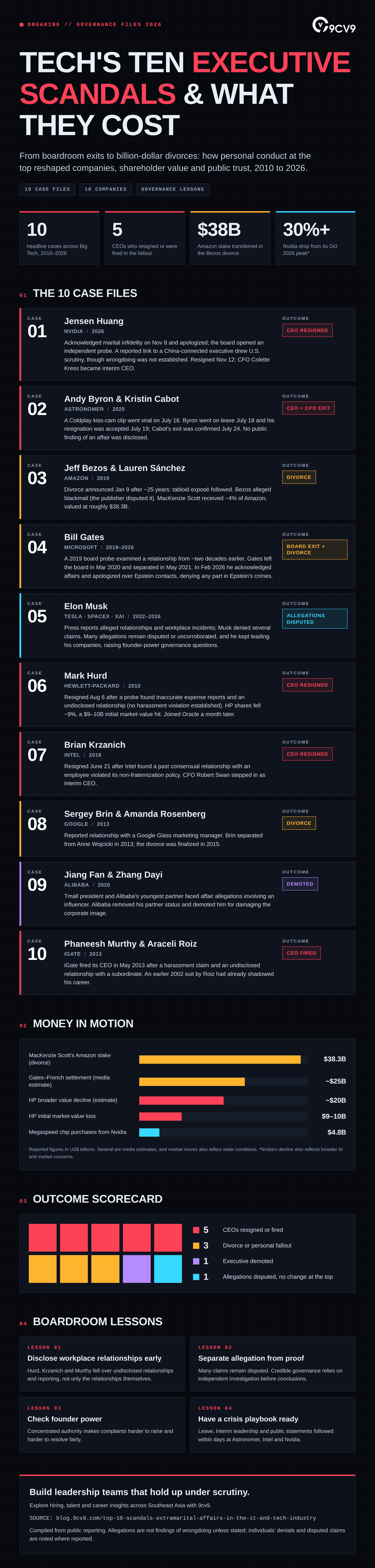
Other notable controversies include Intel CEO Brian Krzanich’s resignation following the discovery of a consensual employee relationship that violated company policy, Mark Hurd’s departure from Hewlett-Packard after an investigation into business conduct and expense reporting, and the reported relationship between Google co-founder Sergey Brin and Google Glass executive Amanda Rosenberg. These cases illustrate the different ways personal relationships, workplace policies, and corporate leadership responsibilities can intersect.
Beyond the United States, the Alibaba controversy involving Jiang Fan and influencer Zhang Dayi demonstrates how allegations concerning executives’ personal relationships can create governance concerns in major Asian technology companies. Similarly, the iGate scandal involving Phaneesh Murthy raised questions about workplace relationship disclosures, professional boundaries, and executive accountability in the IT services industry.
Importantly, not every widely reported technology executive scandal involves a confirmed extramarital affair or proven workplace misconduct. Some incidents concern consensual relationships, while others involve disputed allegations, corporate policy violations, or investigations that did not substantiate the original accusations. Distinguishing established facts from speculation is essential to understanding these controversies fairly and accurately.
The consequences of major tech industry scandals can extend far beyond the individuals involved. Executive departures may disrupt corporate leadership, public controversies can damage brand reputation, and allegations involving employees or subordinates may raise concerns about favoritism, power imbalances, and conflicts of interest. For investors, employees, customers, and business partners, these situations also highlight the importance of transparent decision-making, independent investigations, and consistent corporate governance standards.
As technology companies continue to shape the global economy, expectations surrounding ethical leadership and workplace accountability have become increasingly important. Organizations must balance employee privacy and personal freedom with their responsibility to maintain professional boundaries, prevent abuse of authority, and protect stakeholder confidence.
This article explores the top 10 scandals and extramarital affairs in the IT and tech industry, examining prominent technology executives, the circumstances surrounding their controversies, the corporate responses, and the consequences for their organizations. It also highlights important lessons about workplace relationships, executive accountability, corporate governance, and reputation management that employers, HR professionals, business leaders, and technology industry observers can learn from these high-profile cases.
Before we venture further into this article, we would like to share who we are and what we do.
About 9cv9
9cv9 is a business tech startup based in Singapore and Asia, with a strong presence all over the world.
With over ten years of startup and business experience, and being highly involved in connecting with thousands of companies and startups, the 9cv9 team has listed some of the top and best companies/tools in this review.
If you like to get your company listed in our top B2B software reviews, check out our world-class 9cv9 Media and PR service and pricing plans here.
Top 10 Scandals, Extramarital Affairs in the IT and Tech Industry
- Jensen Huang and Nvidia Extramarital Affair Scandal
- Andy Byron and Kristin Cabot Astronomer Coldplay Concert Scandal
- Jeff Bezos and Lauren Sánchez Amazon Extramarital Affair Scandal
- Bill Gates Microsoft Extramarital Affairs and Epstein Controversy
- Elon Musk SpaceX, Neuralink, and Tesla Relationship Scandals
- Mark Hurd and Jodie Fisher Hewlett-Packard Relationship Scandal
- Brian Krzanich Intel Workplace Relationship Scandal
- Sergey Brin and Amanda Rosenberg Google Glass Affair Scandal
- Jiang Fan and Zhang Dayi Alibaba Extramarital Affair Scandal
- Phaneesh Murthy and Araceli Roiz iGate Workplace Affair and Sexual Harassment Scandal
1. Jensen Huang and Nvidia Extramarital Affair Scandal
The resignation of Nvidia co-founder Jensen Huang in November 2026 became one of the most consequential leadership scandals in the technology industry. What initially emerged as a controversy involving extramarital relationships developed into a broader corporate crisis encompassing alleged foreign espionage, artificial intelligence chip exports, executive misconduct, shareholder confidence, and national security concerns.
As of November 13, 2026, Huang had resigned as Nvidia’s chief executive officer following revelations about relationships involving a business executive suspected by United States intelligence officials of working for China and an Nvidia employee who reportedly reported directly to him.
Nvidia appointed Chief Financial Officer Colette Kress as interim CEO while its board began searching for a permanent replacement.
The scandal attracted exceptional attention because Nvidia occupies a central position in the global artificial intelligence industry. Its advanced graphics processing units power major AI infrastructure projects, making uncertainty surrounding its leadership a significant concern for technology companies, governments, and institutional investors.
Unlike conventional corporate infidelity scandals, the Nvidia controversy raised questions about whether personal relationships could expose sensitive commercial information, influence international technology policy, or create vulnerabilities in corporate governance.
Jensen Huang’s Personal Background and Leadership at Nvidia
Jensen Huang co-founded Nvidia in 1993 and transformed the company from a graphics technology specialist into a dominant supplier of artificial intelligence computing infrastructure.
His leadership became closely associated with Nvidia’s rapid expansion, technological innovation, and growing influence over the global semiconductor market.
Huang married Lori Mills Huang in 1985, and the couple have two children. His longstanding marriage and family connections formed part of his public identity as a technology entrepreneur.
However, revelations about his extramarital relationships in November 2026 significantly altered public perceptions of his leadership.
| Category | Details |
|---|---|
| Executive | Jensen Huang |
| Company | Nvidia |
| Industry | Semiconductors, artificial intelligence, and computing |
| Position before resignation | Co-founder, President, and CEO |
| Year Nvidia was founded | 1993 |
| Spouse | Lori Mills Huang |
| Year of marriage | 1985 |
| Scandal became public | October to November 2026 |
| Principal controversy | Extramarital relationships and alleged foreign intelligence involvement |
| Corporate response | Independent board investigation |
| Leadership outcome | Resignation on November 12, 2026 |
| Interim successor | Colette Kress |
The Alleged Relationship Between Jensen Huang and Alice Huang
One of the most serious elements of the controversy involved Alice Huang, a Chinese business executive previously associated with Singapore-based cloud computing company Megaspeed International.
Alice Huang, who is not related to Jensen Huang, reportedly developed a close personal relationship with the Nvidia executive while working in an industry heavily dependent on advanced AI processors.
Her professional background included experience in finance, media, and technology-related business activities.
The relationship attracted the attention of American intelligence officials because of concerns that Alice Huang might have been recruited by China’s Ministry of State Security to obtain information or influence decisions involving advanced semiconductor technology.
According to media reporting, intelligence officials suspected that she was gathering information relevant to Nvidia’s business activities and American restrictions on advanced AI chip exports.
These allegations remained distinct from established findings of wrongdoing. Public reporting did not establish that Jensen Huang knowingly participated in espionage or deliberately transferred protected information.
China rejected the espionage allegations, while Nvidia initially stated that it had no reason to believe company secrets or American national security had been compromised.
Why the Relationship Raised National Security Concerns
The controversy extended beyond personal misconduct because Nvidia’s products are subject to United States export controls intended to restrict access to certain advanced semiconductor technologies.
American policymakers have increasingly treated high-performance AI chips as strategically important products because of their potential applications in advanced computing, scientific research, intelligence systems, and military technologies.
A personal relationship between a senior technology executive and an individual suspected of foreign intelligence connections therefore created potential concerns about information security, influence, and regulatory compliance.
| Risk Area | Potential Concern | Corporate Implication |
|---|---|---|
| National security | Possible foreign intelligence access | Government investigations |
| Trade secrets | Exposure of confidential technology information | Intellectual property risks |
| Export controls | Potential diversion of restricted AI chips | Regulatory scrutiny |
| Executive influence | Personal relationships affecting business decisions | Governance concerns |
| Customer relationships | Commercial connections involving sensitive markets | Enhanced due diligence |
| Reputation | Public concerns about executive judgment | Reduced stakeholder confidence |
| Shareholder interests | Leadership uncertainty and regulatory exposure | Market volatility |
Megaspeed International and the AI Chip Export Controversy
Megaspeed International became a central company in the scandal because of its commercial relationship with Nvidia and its role in purchasing advanced AI computing equipment.
Reports indicated that Megaspeed purchased more than $4.8 billion worth of Nvidia chips over approximately two years.
The scale of these purchases attracted attention because American authorities were already examining whether restricted Nvidia processors could have been diverted to Chinese customers through overseas intermediaries.
The company’s business relationship with Nvidia created additional scrutiny surrounding Alice Huang’s reported relationship with Jensen Huang.
Investigators and policymakers faced several important questions, including whether commercial transactions complied with export restrictions, whether confidential information was shared, and whether personal relationships influenced business decisions.
However, the existence of substantial commercial transactions does not independently demonstrate export-control violations.
Megaspeed denied wrongdoing, and the allegations required examination through appropriate regulatory and investigative processes.
Commercial and Regulatory Issues
| Issue | Reported Development | Significance |
|---|---|---|
| Nvidia chip purchases | More than $4.8 billion over approximately two years | Significant commercial exposure |
| Business relationship | Megaspeed operated within Nvidia’s AI computing ecosystem | Potential conflict-of-interest concerns |
| Export restrictions | Scrutiny of advanced chips reaching China | Possible regulatory consequences |
| Intelligence allegations | Alice Huang suspected of gathering information for Beijing | National security concerns |
| Corporate investigation | Nvidia initiated an independent inquiry | Board-level accountability |
| Company response | Megaspeed denied export violations | Allegations remained contested |
Jensen Huang’s Public Admission of Marital Infidelity
On November 8, 2026, Jensen Huang publicly acknowledged that he had been unfaithful to his wife.
In a message distributed to Nvidia employees, Huang apologized to his family, colleagues, directors, business partners, and shareholders.
He accepted responsibility for his personal conduct and acknowledged that his actions had damaged the trust expected of a corporate leader.
The statement also addressed national security concerns, confirming his willingness to cooperate with an independent investigation initiated by Nvidia’s board.
At that stage, Nvidia continued to express confidence in Huang’s leadership and indicated that the investigation would examine whether the company or American national security interests had been compromised.
The apology represented a significant development because it transformed the controversy from speculation about a senior executive’s private life into an acknowledged leadership and reputational crisis.
Nevertheless, Huang’s admission of infidelity did not constitute an admission of espionage, unlawful chip exports, or other criminal wrongdoing.
The Reported Workplace Affair Involving Kimberly Powell
The scandal intensified when additional reporting identified a separate alleged relationship involving Kimberly Powell, an Nvidia executive working in the company’s healthcare business.
The New York Times reported that Huang had been involved in an extramarital relationship with Powell, who reportedly had a direct reporting relationship with him.
The allegations introduced a different set of corporate governance concerns.
Unlike the relationship involving Alice Huang, which raised questions about foreign intelligence and export controls, the reported relationship with Powell focused attention on workplace power dynamics, executive ethics, and potential conflicts of interest.
Romantic relationships between senior executives and employees can create significant organizational risks when one individual holds authority over the other’s career progression, compensation, performance evaluations, or employment conditions.
The reported relationship also raised questions about whether Nvidia’s internal policies adequately addressed relationships involving senior leadership.
Public reporting had not established that Powell received improper professional benefits or that the relationship involved coercion.
Comparison of the Reported Relationships
| Category | Alice Huang | Kimberly Powell |
|---|---|---|
| Professional connection | Former Megaspeed executive | Nvidia healthcare executive |
| Relationship with Nvidia | External commercial ecosystem | Internal employment |
| Main controversy | Alleged foreign intelligence involvement | Workplace relationship with a senior executive |
| Principal risk | National security and information protection | Conflicts of interest and workplace governance |
| Regulatory implications | Export controls and possible intelligence investigation | Corporate compliance and employment policies |
| Public status | Relationship reported amid espionage allegations | Relationship reported by major news organizations |
| Proven criminal misconduct | Not established by the reported relationship | Not established by the reported relationship |
Timeline of the Nvidia Extramarital Affair Scandal
The controversy developed rapidly, progressing from intelligence-related reporting to a formal corporate investigation and the resignation of one of the technology industry’s most influential executives.
| Date | Major Development | Corporate Significance |
|---|---|---|
| 2023 | Megaspeed developed commercial connections within Nvidia’s computing ecosystem | Established business relationship |
| 2024 to 2025 | Reported interactions between Jensen Huang and Alice Huang | Subsequent intelligence scrutiny |
| October 2026 | Reports intensified around Megaspeed and suspected intelligence activities | Growing regulatory and reputational concerns |
| Early November 2026 | Media investigations examined Huang’s reported personal relationship | Increased public scrutiny |
| November 8, 2026 | Huang admitted marital infidelity | Public acknowledgment of misconduct |
| November 8, 2026 | Nvidia announced an independent investigation | Formal board oversight |
| November 11, 2026 | Reports emerged about an alleged relationship with Kimberly Powell | Expanded corporate governance controversy |
| November 11, 2026 | Nvidia directors reviewed Huang’s leadership position | Escalating succession concerns |
| November 12, 2026 | Huang resigned from Nvidia leadership | Major executive transition |
| November 12, 2026 | Colette Kress became interim CEO | Leadership continuity measures |
| November 13, 2026 | Additional reporting examined another alleged employee relationship | Continuing reputational and governance scrutiny |
Nvidia’s Board Investigation and Jensen Huang’s Resignation
Nvidia’s board initially responded to the scandal by establishing an independent investigation into the allegations surrounding Huang and potential foreign intelligence activities.
The investigation involved independent directors and external legal advisers.
Its purpose was to examine whether Huang’s personal relationships had created risks involving confidential information, corporate governance, regulatory compliance, or national security.
As additional reports emerged about workplace relationships, the situation became increasingly difficult for Nvidia’s directors.
On November 12, 2026, Huang resigned as CEO, president, and a member of the company’s board.
The board appointed Colette Kress, Nvidia’s chief financial officer, to lead the company temporarily.
Longtime director Harvey C. Jones was also appointed board chair.
The leadership changes marked a major turning point for a company whose strategy, investor relationships, and public identity had been closely associated with its founder for more than three decades.
Corporate Governance Implications
| Governance Area | Key Challenge | Potential Response |
|---|---|---|
| Executive accountability | Alleged misconduct involving the CEO | Independent investigation |
| Board independence | Oversight of a powerful company founder | Independent directors and external counsel |
| Succession planning | Sudden departure of a longstanding leader | Interim CEO appointment |
| Workplace relationships | Potential power imbalances | Clear disclosure and conflict-of-interest policies |
| Information security | Possible exposure through external relationships | Security and access reviews |
| Regulatory compliance | Concerns involving restricted technology | Export-control audits |
| Investor relations | Uncertainty about leadership stability | Transparent corporate communication |
Financial Consequences and Nvidia’s Market Valuation
The controversy unfolded during a period of heightened investor sensitivity toward artificial intelligence spending, semiconductor valuations, and technology-sector profitability.
Nvidia’s share price experienced substantial volatility as investors assessed the potential implications of Huang’s departure and the continuing investigations.
Reports indicated that Nvidia shares had declined by more than 30% from their early October 2026 peak by November 12.
The company also experienced significant market capitalization losses during the period surrounding the scandal.
However, attributing the entire decline to Huang’s personal misconduct would be misleading.
Broader concerns about AI infrastructure spending, technology valuations, semiconductor demand, and market conditions also contributed to investor uncertainty.
The scandal nevertheless introduced additional company-specific risks, particularly regarding leadership continuity, government scrutiny, and Nvidia’s relationships with major customers.
Financial and Business Impact Matrix
| Impact Area | Reported or Potential Effect | Risk Level |
|---|---|---|
| Share price | Significant volatility during the controversy | High |
| Market capitalization | Substantial valuation decline amid wider market weakness | High |
| Executive succession | Departure of a longstanding founder-CEO | High |
| Investor confidence | Uncertainty over governance and future strategy | High |
| AI chip demand | No demonstrated immediate collapse in underlying demand | Uncertain |
| Export compliance | Potential regulatory and investigative exposure | High |
| Customer relationships | Possible uncertainty among major AI infrastructure buyers | Moderate |
| Employee morale | Leadership instability and reputational concerns | Moderate |
| Corporate reputation | Extensive international media coverage | High |
Risk levels are qualitative assessments rather than independently calculated financial ratings.
Government Investigations and Political Reactions
The allegations attracted attention from American lawmakers and government agencies because Nvidia plays a strategically important role in the global AI semiconductor market.
Congressional representatives sought additional information about the reported relationship between Huang and Alice Huang, particularly whether sensitive American technology or information could have been exposed.
The controversy also intensified debate surrounding restrictions on advanced semiconductor exports to China.
President Donald Trump publicly discussed the allegations and indicated that Huang had told him he was unaware of Alice Huang’s suspected intelligence connections.
Chinese authorities rejected accusations of espionage.
The competing statements highlighted the geopolitical sensitivity of the situation.
The central regulatory question was not simply whether Huang had engaged in extramarital relationships, but whether those relationships had affected business conduct, confidential information, or compliance with American export restrictions.
No conclusion of criminal liability should be drawn solely from the existence of an investigation.
Public Reaction and the Technology Industry’s Response
The scandal generated widespread discussion among technology professionals, investors, and online communities.
Public reactions generally focused on three interconnected issues.
The first concerned Huang’s personal conduct and the reputational consequences of infidelity.
The second involved concerns about whether a senior technology executive could become vulnerable to foreign intelligence influence through personal relationships.
The third centered on Nvidia’s corporate governance, including whether its board had sufficient independence and succession planning to manage a crisis involving its founder.
Online discussions also questioned the extent to which Nvidia’s valuation depended on Huang’s leadership.
Some investors argued that the company’s technological capabilities, customer relationships, and AI computing ecosystem would remain valuable regardless of its CEO.
Others emphasized the potential disruption caused by removing an executive who had shaped the company’s strategy for more than three decades.
Public Reaction Matrix
| Stakeholder | Primary Concern | Broader Implication |
|---|---|---|
| Retail investors | Share price volatility | Investment uncertainty |
| Institutional investors | Leadership stability | Governance and valuation risk |
| Nvidia employees | Management transition | Organizational confidence |
| Technology customers | Product and supply continuity | Commercial planning |
| Regulators | Export-control compliance | Potential enforcement action |
| Government officials | Foreign intelligence concerns | National security policy |
| Corporate governance experts | Executive accountability | Stronger oversight expectations |
| General public | Personal misconduct and reputation | Public trust in technology leaders |
Why the Jensen Huang Scandal Matters to the Global Tech Industry
The Jensen Huang controversy illustrates how personal relationships involving influential technology executives can develop into major corporate crises when they intersect with sensitive commercial operations, workplace authority, and national security.
Several lessons are particularly relevant to technology companies operating in highly regulated industries.
First, executive relationships can create conflicts of interest even when no criminal wrongdoing is established.
Second, companies handling strategically sensitive technologies require strong information-security practices and effective oversight of external commercial relationships.
Third, boards must maintain credible succession plans, particularly when a company’s identity and market confidence are closely tied to a founder.
Fourth, transparent corporate communication becomes essential when allegations affect shareholders, employees, customers, and regulators simultaneously.
Finally, investigations must distinguish between confirmed misconduct, credible allegations, and speculation.
Huang acknowledged marital infidelity and subsequently resigned. The separate allegations concerning foreign intelligence activities, potential technology diversion, and additional workplace relationships require their own evidentiary assessments.
The broader significance of the scandal lies in the intersection of personal accountability, corporate governance, and the strategic importance of artificial intelligence technology.
For an industry increasingly responsible for critical digital infrastructure, the controversy demonstrates that executive conduct can become a material business issue when it raises credible questions about security, compliance, and institutional trust.
2. Andy Byron and Kristin Cabot Astronomer Coldplay Concert Scandal
The Astronomer Coldplay concert scandal, widely known as “Coldplaygate,” became one of the most viral executive relationship controversies in the technology industry in July 2025. The incident involved Andy Byron, then CEO of artificial intelligence and data orchestration company Astronomer, and Kristin Cabot, the company’s Chief People Officer.
On July 16, 2025, the two executives appeared together on a stadium video screen during a Coldplay concert at Gillette Stadium in Foxborough, Massachusetts. Their unexpected reaction to being filmed sparked widespread speculation about a possible romantic relationship.
A short video of the encounter circulated rapidly across TikTok, Reddit, LinkedIn, and other social media platforms, transforming an otherwise private interaction into an international corporate controversy.
The incident attracted particular attention because Byron was Astronomer’s chief executive, while Cabot oversaw human resources, workplace culture, and employee-related policies.
Within days, Astronomer initiated an internal investigation, placed the executives on leave, and announced Byron’s resignation. Cabot subsequently left the company.
Although the incident became popularly described as an extramarital affair scandal, subsequent statements challenged aspects of the public narrative. The viral footage alone did not establish the marital status or relationship arrangements of either executive.
Who Were Andy Byron and Kristin Cabot?
Andy Byron became CEO of Astronomer in July 2023, leading a technology company specializing in data orchestration, workflow automation, and infrastructure supporting artificial intelligence applications.
Astronomer is particularly associated with Apache Airflow, an open-source platform used by organizations to schedule, manage, and monitor complex data workflows.
Kristin Cabot joined Astronomer in November 2024 as Chief People Officer. Her responsibilities involved human resources leadership, organizational culture, talent management, and employee engagement.
Their senior positions made the controversy especially sensitive because relationships involving company executives can raise concerns about conflicts of interest, workplace power dynamics, and the consistent enforcement of corporate policies.
| Category | Andy Byron | Kristin Cabot |
|---|---|---|
| Company | Astronomer | Astronomer |
| Position | Chief Executive Officer | Chief People Officer |
| Joined company | July 2023 | November 2024 |
| Industry | Enterprise software and AI data infrastructure | Enterprise software and human resources |
| Primary responsibilities | Corporate strategy, operations, and leadership | Human resources, workplace culture, and talent management |
| Public controversy | Viral concert appearance with a senior colleague | Viral concert appearance with the CEO |
| Corporate outcome | Resigned in July 2025 | Subsequently resigned in July 2025 |
What Happened at the Coldplay Concert?
The controversy began during Coldplay’s July 16, 2025, performance at Gillette Stadium.
As part of the concert’s audience interaction, a stadium camera displayed attendees on a large screen.
The camera captured Byron and Cabot standing close together, with Byron’s arms around Cabot.
When the pair noticed themselves appearing on the stadium screen, their reactions immediately attracted attention.
Byron moved away from the camera and ducked out of view, while Cabot turned around and covered her face.
Coldplay lead singer Chris Martin commented humorously on their reaction, suggesting that the couple might either be having an affair or simply feeling shy.
The audience laughed, but the brief interaction soon became a major social media story.
An attendee recorded the moment and shared it online, where viewers began attempting to identify the individuals involved.
The video quickly became associated with discussions about workplace relationships, executive accountability, privacy, and the consequences of unexpected public exposure.
How the Coldplay Video Became a Global Viral Sensation
The scandal demonstrated how quickly a short video can develop into an international news story when social media users connect footage with publicly available professional information.
After the video appeared online, users identified Byron and Cabot through professional profiles and other publicly accessible information.
Their positions at Astronomer intensified public interest, particularly because the incident involved both the company’s CEO and its senior human resources executive.
The video accumulated millions of views, while online discussions spread across entertainment news, technology publications, business media, and professional networking platforms.
Search interest in Astronomer and Andy Byron increased substantially as the story developed.
The controversy also generated memes, commentary, corporate governance discussions, and speculation about potential resignations.
Factors Behind the Viral Spread
| Viral Factor | Description | Effect |
|---|---|---|
| Unexpected public exposure | Executives appeared on a stadium screen | Immediate audience attention |
| Visible reaction | Both individuals attempted to avoid the camera | Increased speculation |
| Celebrity involvement | Chris Martin commented during the concert | Greater entertainment news interest |
| Executive identities | Both held senior positions at Astronomer | Strong business media interest |
| Human resources connection | Cabot led the company’s HR function | Workplace ethics debate |
| Short-form video | Footage circulated through social media | Rapid international distribution |
| Public professional profiles | Users identified the executives online | Accelerated media coverage |
| Corporate response | Astronomer investigated and announced departures | Sustained news attention |
Astronomer’s Internal Investigation and Executive Resignations
Astronomer responded to the controversy by announcing a formal investigation into the conduct of its senior leadership.
The company emphasized that executives were expected to uphold professional standards and remain accountable for their actions.
On July 18, 2025, Byron was placed on leave while the investigation proceeded.
On July 19, Astronomer announced that its board had accepted Byron’s resignation. Co-founder and Chief Product Officer Pete DeJoy assumed the position of interim CEO.
Cabot’s departure was subsequently confirmed on July 24, 2025.
Astronomer did not publicly disclose detailed findings establishing that the executives had engaged in an extramarital affair. The company also rejected fabricated apology statements circulating online under Byron’s name.
Timeline of the Astronomer Coldplay Scandal
| Date | Development | Significance |
|---|---|---|
| July 16, 2025 | Byron and Cabot appeared on Coldplay’s stadium screen | Beginning of the controversy |
| July 17, 2025 | Concert footage spread internationally | Rapid growth in public attention |
| July 18, 2025 | Astronomer announced an investigation and placed Byron on leave | Formal corporate response |
| July 19, 2025 | Byron resigned as CEO | Major leadership change |
| July 24, 2025 | Cabot’s resignation was confirmed | Departure of the HR executive |
| July 2025 | Astronomer launched a promotional video featuring Gwyneth Paltrow | Unconventional reputation management |
| September 2025 | Reports clarified Cabot’s marital separation and disputed affair allegations | Important correction to public speculation |
| March 2026 | Cabot discussed the incident in an interview with Oprah Winfrey | Renewed debate about privacy and public judgment |
Was There Actually an Extramarital Affair?
Although the incident became internationally known as an affair scandal, subsequent reporting complicated the original narrative.
In September 2025, a source close to Kristin Cabot told People that she and Byron had maintained a close friendship and professional relationship but had not been having an affair.
The source acknowledged that their physical interaction at the concert was inappropriate in a workplace context but disputed the suggestion that Cabot had broken up a marriage.
Andrew Cabot, Kristin Cabot’s estranged husband, also confirmed through a representative that the couple had separated before the concert and were already pursuing a divorce.
In March 2026, Cabot publicly discussed the controversy during an interview with Oprah Winfrey. She explained that she had already separated from her husband and described her professional relationship with Byron as unusually close.
These developments demonstrated why the initial social media interpretation should not be treated as an established account of the executives’ private relationships.
Confirmed Events Versus Public Allegations
| Issue | Established Information | Important Qualification |
|---|---|---|
| Concert appearance | Byron and Cabot were filmed embracing | The footage did not independently prove an affair |
| Executive positions | Both held senior Astronomer roles | Their professional relationship raised governance questions |
| Viral footage | Video attracted enormous online attention | Popularity did not establish allegations as facts |
| Corporate investigation | Astronomer announced a formal inquiry | Detailed findings were not publicly disclosed |
| Byron’s resignation | Confirmed in July 2025 | Specific investigative findings were not published |
| Cabot’s resignation | Confirmed in July 2025 | Her departure did not establish marital infidelity |
| Cabot’s marital status | She was separated before the concert | Initial claims about her marriage were incomplete |
| Alleged affair | Widely speculated about online | A source close to Cabot explicitly denied an affair |
Astronomer’s Funding and Business Reputation
The controversy occurred shortly after Astronomer announced a $93 million Series D funding round in May 2025.
The investment demonstrated significant financial support for the company’s data infrastructure and artificial intelligence technology.
Astronomer’s enterprise software helps businesses manage complex data pipelines, making operational reliability and customer confidence important components of its commercial reputation.
The scandal created an unusual challenge for a business-to-business technology company.
Although millions of people suddenly became familiar with Astronomer’s name, much of that attention had little connection to its products or technical capabilities.
The situation raised an important marketing question: whether viral publicity generated by executive misconduct could create lasting commercial value.
Business Impact Assessment
| Business Area | Potential Impact | Strategic Consideration |
|---|---|---|
| Brand awareness | Dramatic increase in public recognition | Awareness does not automatically create qualified leads |
| Enterprise reputation | Greater scrutiny of leadership | Corporate credibility remains essential |
| Investor confidence | Questions about executive oversight | Clear succession and governance processes |
| Employee relations | Uncertainty following leadership departures | Consistent workplace policies |
| Customer relationships | Possible concerns about organizational stability | Continued service reliability |
| Recruitment | Increased public attention to workplace culture | Strong employer branding |
| Marketing | Opportunity to redirect attention toward products | Balance humor with professionalism |
| Executive succession | Sudden change in senior leadership | Operational continuity |
Gwyneth Paltrow and Astronomer’s Unusual Public Relations Strategy
Astronomer adopted an unconventional communications approach following the scandal by featuring actress and entrepreneur Gwyneth Paltrow in a promotional video.
Paltrow’s involvement attracted attention because she was previously married to Coldplay frontman Chris Martin.
The promotional campaign used humor to acknowledge the extraordinary publicity surrounding Astronomer while redirecting attention toward its business activities.
Rather than discussing the executives’ personal relationships, the video emphasized Astronomer’s technology and services.
The campaign generated substantial media attention and became a widely discussed example of crisis-related brand marketing.
However, the approach also divided observers.
Some marketing professionals considered the campaign a creative way to reclaim the company’s narrative.
Others questioned whether humorous advertising was appropriate for an enterprise technology company dealing with sensitive leadership and workplace issues.
Public Reaction and the Consequences of Online Shaming
The Coldplay scandal illustrated the speed with which social media audiences can identify individuals, interpret personal behavior, and distribute accusations internationally.
Online commentary initially focused heavily on the apparent irony of a human resources executive becoming involved in a workplace relationship controversy.
As the story developed, discussions expanded to include executive privilege, corporate accountability, marital relationships, and the boundaries between public and private life.
However, subsequent reporting revealed serious personal consequences.
A source close to Cabot reported that she and her family experienced extensive harassment, including threats and unwanted public attention.
The reaction highlighted a significant distinction between legitimate scrutiny of executive conduct and disproportionate personal harassment.
Public Reaction and Ethical Concerns
| Discussion Area | Public Focus | Broader Lesson |
|---|---|---|
| Executive conduct | Professional behavior of senior leaders | Accountability applies to executives |
| Human resources ethics | Consistency in workplace policy enforcement | HR leadership requires credibility |
| Workplace relationships | Potential conflicts of interest | Transparent disclosure policies |
| Social media investigations | Rapid identification of individuals | Privacy risks from public information |
| Viral misinformation | Unverified allegations spreading online | Importance of fact-checking |
| Online harassment | Threats and public humiliation | Need for proportionate responses |
| Corporate marketing | Humor following a reputational crisis | Brand strategy must consider stakeholder trust |
| Digital privacy | Unexpected recording and mass distribution | Public visibility can have lasting consequences |
Why Coldplaygate Matters to the Technology Industry
The Astronomer scandal became a prominent example of how executive behavior, digital surveillance, and social media amplification can intersect.
Unlike corporate controversies involving financial fraud, cybersecurity breaches, or regulatory violations, Coldplaygate began with a brief public interaction.
Yet the consequences included executive departures, international media attention, reputational disruption, and significant personal scrutiny.
The incident also demonstrated the risks of drawing definitive conclusions about private relationships from limited video evidence.
For technology companies, the central lessons concern leadership accountability, clear workplace relationship policies, crisis communication, and the protection of employees from harassment.
For the wider public, the controversy illustrates how rapidly online speculation can develop into a seemingly established narrative, even when important facts remain unknown or are later disputed.
Ultimately, Coldplaygate remains one of the most recognizable technology executive relationship scandals of 2025, not because an extramarital affair was conclusively established, but because a few seconds of concert footage triggered an extraordinary corporate and social media crisis.
3. Jeff Bezos and Lauren Sánchez Amazon Extramarital Affair Scandal
The extramarital affair involving Amazon founder Jeff Bezos and former television journalist Lauren Sánchez became one of the most widely publicized personal scandals in the technology industry in 2019. The controversy combined a high-profile relationship, a multibillion-dollar divorce settlement, allegations of tabloid blackmail, and questions about corporate ownership.
In January 2019, Bezos and his wife of 25 years, MacKenzie Bezos, now known as MacKenzie Scott, announced their decision to divorce. Shortly afterward, the National Enquirer published details of Bezos’s relationship with Sánchez, including private communications between the pair.
The controversy intensified in February 2019 when Bezos publicly accused the National Enquirer’s parent company, American Media Inc., of attempting to extort him by threatening to publish intimate photographs.
Despite the extensive media coverage, Bezos retained his position as Amazon CEO and preserved substantial voting control over the company.
The divorce was finalized in July 2019, with MacKenzie receiving Amazon shares valued at approximately $38.3 billion, making it one of the largest publicly reported divorce settlements in history.
Jeff Bezos’s Marriage and Relationship With Lauren Sánchez
Jeff Bezos married MacKenzie Scott in 1993, before founding Amazon in 1994. Their marriage lasted approximately 25 years, during which Amazon developed from an online bookstore into one of the world’s largest technology and e-commerce companies.
MacKenzie played an important role during Amazon’s early development and later established herself as a prominent philanthropist and author.
Lauren Sánchez was a television journalist, media personality, and licensed helicopter pilot who had worked in broadcasting and aviation-related businesses.
The relationship between Bezos and Sánchez attracted international attention because both were publicly associated with existing marriages when the story emerged.
However, the precise timing of their relationship and the respective marital separations became subjects of competing public accounts.
| Category | Jeff Bezos | Lauren Sánchez |
|---|---|---|
| Professional background | Amazon founder and technology entrepreneur | Television journalist and aviation entrepreneur |
| Main industry | E-commerce, cloud computing, and technology | Media, entertainment, and aviation |
| Marital relationship in 2019 | Married to MacKenzie Bezos before divorce | Married to Patrick Whitesell before divorce |
| Public controversy | Relationship disclosed in January 2019 | Relationship disclosed in January 2019 |
| Main consequences | Divorce settlement and tabloid dispute | Extensive media attention |
| Corporate involvement | Amazon | No equivalent Amazon executive position |
How the National Enquirer Exposed the Relationship
In January 2019, the National Enquirer published an investigation into Bezos’s relationship with Sánchez.
The publication included descriptions of private messages and details about their interactions.
The disclosures immediately attracted widespread attention because Bezos was one of the world’s wealthiest individuals and the CEO of Amazon.
Following the publication, Bezos commissioned an investigation into how the tabloid obtained his private communications.
The investigation examined possible sources of the leaked material and whether the reporting had been influenced by political interests.
Questions also emerged about the relationship between the National Enquirer’s leadership and political figures who had previously criticized Bezos and The Washington Post, which he owned.
These concerns contributed to a wider dispute involving press ethics, personal privacy, and the potential misuse of confidential information.
Jeff Bezos’s Blackmail and Extortion Allegations
On February 7, 2019, Bezos published a statement accusing American Media Inc. of attempting to blackmail him.
He alleged that representatives of the company threatened to publish intimate photographs unless he agreed to stop investigating the publication’s conduct and publicly state that its reporting had not been politically motivated.
Bezos released correspondence that he said demonstrated the proposed arrangement.
The allegations attracted attention from federal prosecutors, who examined whether the publisher’s actions could have violated an existing cooperation agreement with the United States government.
American Media Inc. disputed the accusations and maintained that it had acted lawfully.
The controversy raised important questions about the boundaries between legitimate investigative journalism, privacy rights, and coercive threats involving personal information.
Key Issues in the Tabloid Controversy
| Issue | Reported Development | Significance |
|---|---|---|
| Private communications | Personal messages were obtained by the tabloid | Privacy and information security concerns |
| Intimate photographs | Publisher allegedly threatened publication | Potential coercion and privacy violations |
| Public statement | Bezos was asked to reject claims of political influence | Concerns about editorial pressure |
| Federal scrutiny | Prosecutors reviewed the allegations | Possible legal and regulatory implications |
| Publisher’s response | American Media denied unlawful conduct | Disputed allegations |
| Media ethics | Questions about methods used to obtain information | Wider debate about journalistic accountability |
Michael Sanchez and the Legal Dispute Over Leaked Messages
The controversy also involved Michael Sanchez, Lauren Sánchez’s brother.
Reporting by The Wall Street Journal indicated that American Media Inc. had paid Michael Sanchez approximately $200,000 for information connected to Bezos’s relationship.
Michael Sanchez disputed aspects of the allegations surrounding his involvement.
The disagreement eventually resulted in litigation involving Bezos and his representatives.
In 2020, Michael Sanchez filed a defamation lawsuit alleging that statements connected to the investigation had damaged his reputation.
The lawsuit was subsequently dismissed, and additional legal proceedings concerned the recovery of legal expenses.
The dispute illustrated how the unauthorized disclosure of private communications can generate prolonged legal consequences extending beyond the original media investigation.
The $38.3 Billion Jeff Bezos Divorce Settlement
The financial consequences of Bezos’s divorce became one of the most significant aspects of the scandal.
In July 2019, the divorce settlement was finalized, transferring approximately 19.7 million Amazon shares to MacKenzie Scott.
At the time, the shares represented approximately 4% of Amazon’s outstanding equity and were valued at around $38.3 billion.
The settlement immediately placed MacKenzie among the world’s wealthiest individuals.
However, the agreement also preserved Bezos’s influence over Amazon.
Bezos retained approximately 12% of the company’s outstanding shares and maintained voting control over the shares transferred to MacKenzie under the settlement arrangements.
This structure helped address investor concerns about whether the divorce might destabilize Amazon’s ownership and governance.
Amazon Divorce Settlement Financial Breakdown
| Financial Metric | Reported Figure |
|---|---|
| Divorce finalized | July 2019 |
| Length of marriage | Approximately 25 years |
| Amazon shares transferred to MacKenzie | 19.7 million |
| MacKenzie’s ownership stake | Approximately 4% |
| Estimated settlement value | $38.3 billion |
| Bezos’s retained ownership stake | Approximately 12% |
| Estimated value of Bezos’s retained stake | $114.8 billion |
| Voting control | Bezos retained voting authority over MacKenzie’s transferred shares |
| Corporate leadership outcome | Bezos remained Amazon CEO |
All share counts, ownership percentages, and valuations refer to the 2019 settlement period, before Amazon’s subsequent stock split and later ownership changes.
Why the Divorce Did Not Destabilize Amazon
Despite the extraordinary value of the settlement, Amazon avoided an immediate corporate leadership crisis.
The divorce agreement was structured to preserve Bezos’s voting influence, reducing uncertainty over the company’s strategic direction.
Investors were particularly concerned that a substantial transfer or sale of Amazon shares could affect the company’s ownership structure and stock price.
However, the settlement did not require an immediate large-scale sale of Amazon stock.
Bezos continued directing Amazon’s business strategy, including its e-commerce operations, Amazon Web Services, logistics infrastructure, and technology investments.
The outcome demonstrated how carefully structured ownership arrangements can limit corporate disruption during a founder’s personal financial settlement.
Corporate Impact Assessment
| Business Area | Outcome | Implication |
|---|---|---|
| CEO leadership | Bezos remained CEO | Management continuity |
| Share ownership | Significant equity transferred | Redistribution of personal wealth |
| Voting control | Bezos retained voting authority | Reduced governance uncertainty |
| Stock market | Investor concerns were moderated | Limited immediate ownership disruption |
| Corporate strategy | No direct leadership change | Continued business operations |
| Public reputation | Extensive international media scrutiny | Increased attention to executive conduct |
| Legal exposure | Disputes involving the tabloid and leaked information | Privacy and litigation concerns |
MacKenzie Scott’s Wealth and Philanthropic Commitments
The settlement transformed MacKenzie Scott into one of the world’s wealthiest women.
In May 2019, she announced her commitment to the Giving Pledge, an initiative encouraging wealthy individuals to dedicate a substantial portion of their fortunes to charitable causes.
Her subsequent philanthropic activities became a major part of her public identity.
Scott directed billions of dollars toward nonprofit organizations working in education, healthcare, economic mobility, racial equity, and community development.
The financial independence created by the divorce settlement enabled her to pursue large-scale charitable giving without maintaining an executive role at Amazon.
Her philanthropic approach also attracted attention for emphasizing direct financial support to organizations, frequently with relatively few restrictions on how funds could be used.
Timeline of the Jeff Bezos Affair and Divorce Scandal
| Date | Major Development | Significance |
|---|---|---|
| 1993 | Jeff Bezos married MacKenzie Scott | Beginning of their marriage |
| 1994 | Amazon was founded | Start of the company’s development |
| January 9, 2019 | Bezos and MacKenzie announced their divorce | Public confirmation of marital separation |
| January 2019 | National Enquirer disclosed Bezos’s relationship with Sánchez | International media controversy |
| February 7, 2019 | Bezos publicly accused the publisher of blackmail | Escalation into a legal and media ethics dispute |
| February 2019 | Federal prosecutors reviewed the allegations | Government scrutiny |
| April 2019 | Divorce settlement terms were announced | Clarification of Amazon ownership |
| May 2019 | MacKenzie joined the Giving Pledge | Major philanthropic commitment |
| July 2019 | Divorce was finalized | Approximately $38.3 billion equity settlement |
| 2021 | Bezos stepped down as Amazon CEO | Planned leadership transition unrelated to the 2019 divorce settlement |
Why the Jeff Bezos Scandal Matters to the Technology Industry
The Jeff Bezos affair and divorce controversy demonstrated how the personal relationships of prominent technology founders can intersect with corporate ownership, investor confidence, privacy, and media accountability.
Unlike executive scandals that result in immediate dismissals or management investigations, the Bezos controversy did not remove him from Amazon’s leadership.
Instead, its most significant corporate consequence was the redistribution of billions of dollars in company shares.
The case also highlighted the importance of protecting private communications and the potential consequences of using sensitive personal information as leverage in disputes involving powerful individuals.
For technology companies, the incident offers several lessons concerning founder ownership, succession planning, corporate governance, and reputational risk.
The distinction between personal misconduct and corporate wrongdoing is particularly important. Bezos’s relationship and divorce generated enormous publicity, but the settlement itself did not establish misconduct involving Amazon’s business operations.
Ultimately, the Jeff Bezos and Lauren Sánchez controversy remains one of the most financially consequential personal scandals associated with the technology industry, combining a historic divorce settlement with an unusually public confrontation over alleged tabloid extortion.
4. Bill Gates Microsoft Extramarital Affairs and Epstein Controversy
The extramarital affairs involving Microsoft co-founder Bill Gates became one of the most significant personal and corporate reputation controversies in the technology industry. The scandal developed through several stages, including a Microsoft board investigation in 2019, Gates’s departure from the company’s board in 2020, his divorce from Melinda French Gates in 2021, and additional admissions of infidelity in February 2026.
For decades, Gates was recognized as a pioneering software entrepreneur, billionaire investor, and influential philanthropist. However, revelations about his relationships with Microsoft employees and other women raised questions about executive accountability, workplace ethics, and the responsibilities of powerful technology leaders.
The controversy intensified because of Gates’s association with convicted sex offender Jeffrey Epstein. In February 2026, Gates acknowledged having affairs with two Russian women while apologizing to Gates Foundation employees for his past interactions with Epstein.
Gates denied participating in Epstein’s crimes or knowing about ongoing criminal activities. His admission of extramarital affairs should therefore be distinguished from the separate, disputed allegations surrounding Epstein.
Bill Gates’s Marriage and Professional Background
Bill Gates co-founded Microsoft with Paul Allen in 1975, helping establish one of the world’s most influential software companies.
He met Melinda French in 1987 while she was working at Microsoft. The couple married in 1994 and had three children.
Together, they established the Bill & Melinda Gates Foundation in 2000, developing it into one of the world’s largest private philanthropic organizations.
Their marriage and charitable partnership became closely associated with global health initiatives, education, poverty reduction, and international development.
However, reports about Gates’s extramarital relationships and his association with Epstein contributed to growing scrutiny of his personal conduct.
| Category | Details |
|---|---|
| Executive | Bill Gates |
| Company founded | Microsoft |
| Microsoft co-founder | Paul Allen |
| Industry | Software, computing, and technology |
| Spouse | Melinda French Gates |
| Marriage | 1994 to 2021 |
| Children | Three |
| Microsoft board departure | March 2020 |
| Divorce announcement | May 2021 |
| Divorce finalized | August 2021 |
| Foundation leadership change | June 2024 |
| Additional affair admissions | February 2026 |
| Main controversies | Workplace relationships, marital infidelity, and association with Jeffrey Epstein |
Microsoft’s Investigation Into Bill Gates’s Workplace Affair
In 2019, Microsoft’s board received information concerning a previous intimate relationship between Gates and a female Microsoft employee.
The employee reported a relationship dating back approximately two decades, prompting the company to establish an investigation involving external legal advisers.
Microsoft confirmed that a board committee reviewed the matter and provided support to the employee who raised the concern.
In May 2021, a representative for Gates acknowledged that he had engaged in an affair with a Microsoft employee approximately 20 years earlier.
The representative maintained that the relationship had ended amicably.
The investigation attracted attention because Gates remained a prominent Microsoft board member despite having stepped down from day-to-day executive leadership years earlier.
Microsoft’s Response to the Allegations
| Issue | Reported Development | Corporate Significance |
|---|---|---|
| Employee disclosure | Microsoft received a complaint in 2019 | Formal workplace accountability |
| Relationship period | Approximately 2000 to 2002 | Historical executive conduct |
| Board response | Independent legal investigation | Corporate governance oversight |
| Gates’s acknowledgment | Representative confirmed a past affair | Public confirmation |
| Investigation outcome | Detailed findings were not publicly released | Limited public transparency |
| Board departure | Gates resigned in March 2020 | End of his formal board membership |
| Disputed explanation | Gates denied that the investigation caused his departure | Competing accounts of executive succession |
Earlier Reports of Inappropriate Workplace Communications
Additional reporting in October 2021 revealed that Microsoft executives had previously addressed concerns about Gates’s communications with another female employee.
According to The Wall Street Journal, company executives became aware in 2008 of emails Gates had sent in 2007.
The messages reportedly included flirtatious language and proposals to meet outside the workplace.
Microsoft spokesperson Frank Shaw confirmed that the communications had been considered inappropriate, although they were not described as explicitly sexual.
Senior executives reportedly advised Gates to discontinue the behavior.
The employee involved did not file a formal complaint.
These disclosures raised broader questions about how Microsoft historically handled concerns involving influential senior executives and whether workplace standards were applied consistently.
Why Bill Gates Left Microsoft’s Board in 2020
In March 2020, Gates announced that he was stepping down from the boards of Microsoft and Berkshire Hathaway.
His publicly stated reason was to devote more attention to philanthropic activities, including global health, education, and climate change.
However, reporting published in 2021 indicated that Microsoft’s board had been investigating the previous workplace relationship before Gates resigned.
The Wall Street Journal reported that some directors believed Gates should leave the board because of concerns about the relationship.
Gates’s representatives disputed that explanation and maintained that his departure was unrelated to the investigation.
Consequently, the circumstances surrounding his resignation remain important to distinguish: the investigation was confirmed, but the competing explanations for his board departure were not fully reconciled publicly.
Bill Gates and Melinda French Gates’s $25 Billion Divorce
On May 3, 2021, Bill Gates and Melinda French Gates announced that they were ending their marriage after 27 years.
The announcement attracted international attention because of the couple’s enormous combined wealth, influence in the technology industry, and leadership of their philanthropic foundation.
Their divorce was finalized in August 2021.
The financial settlement was not publicly disclosed in full. Media estimates placed the assets received by Melinda at approximately $25 billion, although that figure should not be treated as a verified final settlement amount.
The divorce also raised questions about the future governance of their foundation, which managed substantial financial resources and supported programs worldwide.
Financial and Organizational Impact of the Divorce
| Category | Reported Information | Important Context |
|---|---|---|
| Marriage duration | 27 years | Married in 1994 |
| Divorce announcement | May 2021 | Joint public announcement |
| Divorce finalized | August 2021 | Legal dissolution |
| Estimated settlement | Approximately $25 billion | Media estimate, not confirmed final amount |
| Melinda’s estimated wealth | Approximately $30.2 billion in April 2025 | Wealth fluctuates with asset values |
| Foundation involvement | Both initially continued as co-chairs | Temporary leadership continuity |
| Melinda’s departure | June 2024 | Separate philanthropic direction |
| Additional philanthropic funding | $12.5 billion commitment | Associated with Melinda’s foundation departure |
Melinda French Gates’s Departure From the Gates Foundation
Following the divorce, Bill Gates and Melinda French Gates initially continued working together through their philanthropic organization.
However, in May 2024, Melinda announced that she would leave her position as co-chair, with her departure taking effect in June.
The organization subsequently adopted the name Gates Foundation.
Bill Gates became its sole chair, while Melinda pursued independent philanthropic activities through Pivotal, an organization focused on advancing opportunities for women and families.
As part of the separation arrangements, Melinda received a commitment of $12.5 billion from Bill Gates to support her future philanthropic work.
The leadership transition represented a significant institutional consequence of the couple’s separation, although it would be inaccurate to attribute every organizational change exclusively to the affair allegations.
Bill Gates’s Relationship With Jeffrey Epstein
Another major element of the controversy involved Gates’s past association with Jeffrey Epstein, the financier and convicted sex offender.
Gates met Epstein on multiple occasions beginning in 2011, after Epstein’s 2008 conviction involving solicitation of a minor.
Gates previously explained that the meetings were intended to explore possible philanthropic funding opportunities.
However, the relationship attracted substantial criticism because Epstein’s criminal history was already publicly known.
In February 2026, newly released documents renewed scrutiny of their interactions.
The Gates Foundation confirmed that a small number of employees had communicated with Epstein regarding possible fundraising arrangements.
The foundation stated that no joint fund was established, Epstein was never employed by the organization, and no foundation payments were made to him.
Gates subsequently acknowledged that associating with Epstein had been a serious mistake.
He denied involvement in Epstein’s criminal conduct.
Bill Gates Admitted Affairs With Two Russian Women in February 2026
In February 2026, Gates addressed employees during a Gates Foundation town hall meeting.
During the discussion, he acknowledged having engaged in extramarital relationships with two Russian women.
He described one woman as a bridge player whom he had met through bridge events and the other as a nuclear physicist whom he had met through business activities.
The admission attracted international media coverage because the relationships had become relevant to questions about what Epstein knew regarding Gates’s private life.
Earlier reporting had identified the bridge player as Mila Antonova, whose relationship with Gates had previously attracted attention.
Reports indicated that Epstein later attempted to use knowledge of Gates’s relationship with Antonova to exert pressure on him.
Gates denied participating in any illegal activities associated with Epstein.
The disclosures were significant because they represented a direct acknowledgment of additional extramarital relationships rather than allegations based solely on anonymous reporting.
Comparison of the Reported Relationships and Controversies
| Category | Microsoft Employee | Russian Bridge Player | Russian Nuclear Physicist |
|---|---|---|---|
| Relationship context | Microsoft workplace | Bridge-related events | Business activities |
| Approximate period | Early 2000s | Reportedly around 2010 | Not publicly established |
| Public disclosure | 2021 | Earlier reporting, reaffirmed in 2026 | February 2026 |
| Gates’s acknowledgment | Confirmed through representative | Personally acknowledged | Personally acknowledged |
| Corporate implications | Microsoft board investigation | Reputational concerns involving Epstein | Reputational concerns involving Epstein |
| Criminal wrongdoing established | No | No | No |
Distinguishing Confirmed Affairs From Epstein Allegations
The distinction between admitted infidelity and alleged criminal involvement is essential to understanding the controversy accurately.
Gates acknowledged extramarital affairs and expressed regret over his association with Epstein.
However, those admissions did not establish that Gates participated in sexual exploitation, trafficking, or other criminal conduct associated with Epstein.
Some documents released in 2026 contained allegations made by Epstein concerning Gates’s private life. Gates’s representatives rejected those claims as false.
The Gates Foundation also denied having established financial arrangements with Epstein.
| Issue | Established Information | Qualification |
|---|---|---|
| Microsoft employee affair | Gates’s representative acknowledged the relationship | Historical relationship investigated by Microsoft |
| Russian women affairs | Gates personally acknowledged two relationships | Admissions did not establish criminal conduct |
| Epstein association | Gates met Epstein repeatedly | Gates later expressed regret |
| Epstein-related criminal involvement | Gates denied participation | No criminal wrongdoing established by the reported affairs |
| Foundation communications | Employees explored potential fundraising | Foundation denied payments or formal collaboration |
| Alleged pressure by Epstein | Reports described attempts to leverage personal information | Details and interpretations remain contested |
| Divorce | Finalized in 2021 | Complete financial settlement not publicly disclosed |
Timeline of the Bill Gates Affair and Divorce Scandal
| Date | Major Development | Significance |
|---|---|---|
| 1975 | Bill Gates co-founded Microsoft | Beginning of his technology career |
| 1987 | Gates met Melinda French | Start of their personal relationship |
| 1994 | Bill and Melinda married | Beginning of their 27-year marriage |
| Early 2000s | Gates engaged in a relationship with a Microsoft employee | Later subject of corporate investigation |
| 2007 to 2008 | Microsoft executives addressed inappropriate emails | Earlier workplace conduct concerns |
| 2011 onward | Gates met Jeffrey Epstein | Subsequent reputational controversy |
| 2019 | Microsoft received information about the previous employee relationship | Board investigation initiated |
| March 2020 | Gates left Microsoft and Berkshire Hathaway boards | Major governance transition |
| May 2021 | Gates and Melinda announced their divorce | Public marital separation |
| May 2021 | Microsoft confirmed its investigation | Affair became publicly acknowledged |
| August 2021 | Divorce finalized | Legal separation completed |
| June 2024 | Melinda departed the Gates Foundation | End of joint foundation leadership |
| February 2026 | Additional Epstein-related documents attracted scrutiny | Renewed public controversy |
| February 2026 | Gates admitted affairs with two Russian women | Direct acknowledgment of additional infidelity |
Corporate Governance and Workplace Ethics Lessons
The Bill Gates controversy illustrates how personal conduct involving influential technology founders can create long-lasting consequences for corporate governance, institutional reputation, and public trust.
The Microsoft investigation raised questions about workplace relationships involving senior executives, particularly when significant differences in organizational authority exist.
The Gates Foundation controversy highlighted the importance of reputational due diligence when philanthropic institutions interact with controversial external figures.
The divorce and subsequent foundation leadership changes also demonstrated how personal relationships can influence the governance of major nonprofit organizations.
Key Lessons for Technology Companies
| Governance Area | Risk Illustrated | Recommended Practice |
|---|---|---|
| Executive relationships | Potential workplace conflicts of interest | Clear relationship disclosure policies |
| Employee protection | Unequal organizational influence | Independent reporting mechanisms |
| Board oversight | Investigations involving founders | External and independent review |
| Corporate transparency | Conflicting accounts of leadership departures | Accurate public communication |
| Reputational due diligence | Associations with controversial individuals | Background and risk assessments |
| Philanthropic governance | Dependence on prominent founders | Independent institutional oversight |
| Leadership succession | Founder-related reputational uncertainty | Strong governance continuity |
| Public accountability | Long-term effects of historical misconduct | Consistent ethical standards |
Why the Bill Gates Scandal Matters to the Technology Industry
The Bill Gates extramarital affairs scandal demonstrates how the personal conduct of technology founders can influence their professional legacies long after they leave operational leadership.
Unlike scandals that immediately result in executive dismissals, the Gates controversy developed gradually through historical workplace allegations, board investigations, divorce proceedings, philanthropic leadership changes, and subsequent public admissions.
The case is especially significant because Gates’s reputation extends beyond Microsoft into global health, education, charitable giving, and public policy.
His acknowledged affairs raised questions about personal accountability, while the Epstein controversy introduced separate concerns about judgment, institutional due diligence, and reputational risk.
Nevertheless, the confirmed facts must remain distinct from disputed allegations. Gates admitted infidelity and regretted his association with Epstein, but he denied involvement in Epstein’s criminal activities.
Ultimately, the Bill Gates controversy remains one of the most consequential executive relationship scandals associated with the technology industry, illustrating the lasting intersection of personal conduct, corporate oversight, philanthropy, and public trust.
5. Elon Musk SpaceX, Neuralink, and Tesla Relationship Scandals
Elon Musk, the billionaire entrepreneur behind Tesla, SpaceX, Neuralink, and xAI, has faced repeated public scrutiny over alleged extramarital affairs, relationships with employees, and concerns about workplace power dynamics.
Unlike several high-profile technology executives whose personal controversies resulted in resignations, Musk retained leadership of his major businesses despite extensive media investigations into his relationships.
The controversies attracted particular attention in June 2024, when The Wall Street Journal published an investigation describing Musk’s alleged romantic and sexual relationships with women working at SpaceX.
Other prominent incidents included a disputed 2022 affair allegation involving Nicole Shanahan, the former wife of Google co-founder Sergey Brin, and Musk’s relationship with Neuralink executive Shivon Zilis, with whom he has four children.
In October 2026, further developments emerged when Zilis publicly confirmed that her romantic relationship with Musk had ended.
These controversies have raised questions about executive accountability, workplace relationships, conflicts of interest, and the influence of powerful technology founders over corporate governance.
Elon Musk’s Professional Background and Personal Relationships
Musk has established himself as one of the technology industry’s most influential entrepreneurs through his leadership of companies operating in electric vehicles, aerospace, artificial intelligence, and neurotechnology.
His public profile has also attracted extensive attention to his marriages, romantic relationships, and family life.
Musk was previously married to author Justine Wilson and actress Talulah Riley. He subsequently had a relationship with musician Claire Boucher, professionally known as Grimes.
His relationships with women associated with his businesses have generated additional scrutiny because of the potential conflicts between personal interests and professional authority.
| Category | Details |
|---|---|
| Executive | Elon Musk |
| Major companies | Tesla, SpaceX, Neuralink, and xAI |
| Industries | Electric vehicles, aerospace, artificial intelligence, and neurotechnology |
| Former spouses | Justine Wilson and Talulah Riley |
| Notable former partners | Grimes and Shivon Zilis |
| Disputed affair allegation | Nicole Shanahan |
| Workplace controversy | Reported relationships involving SpaceX employees |
| Major investigation | The Wall Street Journal, June 2024 |
| Governance concerns | Executive influence, workplace relationships, and conflicts of interest |
| Public leadership outcome | Continued leadership of major companies |
Elon Musk and Nicole Shanahan’s Alleged Affair
One of Musk’s most widely reported personal controversies emerged in July 2022, when The Wall Street Journal alleged that he had engaged in a brief affair with Nicole Shanahan.
At the time of the alleged relationship in late 2021, Shanahan was married to Sergey Brin, the Google co-founder, although the couple had reportedly separated.
The publication suggested that the alleged relationship contributed to tensions between Musk and Brin, who had previously maintained a friendship.
However, both Musk and Shanahan denied the affair.
Musk publicly rejected the reporting and maintained that his interactions with Shanahan had been limited and nonromantic.
The Wall Street Journal stood by its reporting.
Consequently, the alleged affair should be understood as a disputed media claim rather than an established instance of infidelity.
Key Facts About the Nicole Shanahan Allegations
| Category | Reported Information |
|---|---|
| Individuals involved | Elon Musk and Nicole Shanahan |
| Connection to technology industry | Shanahan was married to Google co-founder Sergey Brin |
| Alleged relationship period | Late 2021 |
| Public disclosure | July 2022 |
| Original reporting | The Wall Street Journal |
| Musk’s response | Denied any romantic relationship |
| Shanahan’s response | Denied the affair |
| Reported consequences | Alleged tensions between Musk and Brin |
| Evidentiary status | Disputed allegation |
Elon Musk and Amber Heard’s Relationship Controversy
Musk’s relationship with actress Amber Heard also attracted attention during legal disputes involving Heard and her former husband, actor Johnny Depp.
Court filings and testimony raised questions about when Musk and Heard began their relationship.
Depp alleged that the relationship started while Heard was still married to him.
Musk’s representatives disputed that timeline, maintaining that the relationship developed after Heard’s separation from Depp.
The controversy became part of the broader public discussion surrounding the former couple’s legal proceedings.
However, the disputed timeline does not independently establish that Musk engaged in an extramarital affair.
The incident primarily illustrates how relationships involving prominent technology entrepreneurs can become entangled in high-profile litigation and public speculation.
The 2024 SpaceX Workplace Relationship Investigation
In June 2024, The Wall Street Journal published an extensive investigation examining Musk’s interactions with women employed at SpaceX.
The reporting drew on interviews with more than four dozen individuals, alongside messages, documents, and affidavits.
The investigation described several alleged relationships and incidents involving women who had worked directly or indirectly with Musk.
These included a former SpaceX intern, an employee who reportedly had a brief sexual relationship with Musk, and another employee who alleged that Musk had repeatedly asked her to have children with him.
The investigation raised concerns about whether SpaceX’s workplace policies were consistently enforced when allegations involved its founder and chief executive.
SpaceX President Gwynne Shotwell defended the company’s procedures, stating that complaints were investigated and appropriate action was taken.
Musk did not provide a detailed response to every allegation in the investigation and had denied specific misconduct claims reported previously.
SpaceX Workplace Allegations Matrix
| Reported Incident | Main Allegation | Workplace Concern |
|---|---|---|
| Former SpaceX intern | Romantic and sexual involvement with Musk | Power imbalance and professional boundaries |
| Direct-report employee | Brief sexual relationship with Musk | Conflict of interest |
| Former female employee | Repeated requests to have Musk’s children | Potential workplace pressure |
| Engineering employee | Unwanted personal attention and invitations | Professional boundaries |
| Flight attendant | Alleged sexual misconduct | Workplace harassment |
| Management response | Disputed claims of inconsistent accountability | Corporate governance and employee protection |
The incidents were reported allegations with differing levels of corroboration. They should not be treated collectively as proven findings of unlawful misconduct.
Elon Musk’s Reported Relationship With a Former SpaceX Intern
Among the allegations examined in 2024 was Musk’s relationship with a former SpaceX intern who was substantially younger than him.
According to The Wall Street Journal, the woman met Musk while studying at university and later developed a personal relationship with him.
The reporting described a romantic encounter that occurred before she subsequently joined Musk’s executive staff.
The woman reportedly maintained professional contact with Musk after their initial relationship ended.
The investigation also examined whether his personal attention affected her workplace experience.
However, affidavits associated with the reporting disputed certain interpretations of the relationship, including suggestions that romantic involvement continued during her employment.
The case highlighted the difficulty of assessing relationships involving powerful executives when professional opportunities, personal connections, and organizational authority overlap.
Allegations Involving Other SpaceX Employees
The Wall Street Journal investigation also described allegations involving other women who worked at SpaceX.
One former employee reportedly stated that Musk had asked her to have children with him.
Another woman who reported directly to Musk described a brief sexual relationship that ended amid professional disagreements.
Additional reporting examined allegations of inappropriate attention and potential retaliation involving female employees.
These accounts prompted debate about whether employees could safely reject personal advances from influential executives without risking professional consequences.
The allegations did not establish that every reported interaction violated company policy or employment law.
Nevertheless, they illustrated the importance of independent reporting channels and workplace safeguards when complaints involve individuals with substantial organizational authority.
The SpaceX Flight Attendant Harassment Allegation
In May 2022, Business Insider reported allegations that Musk had engaged in sexual misconduct involving a SpaceX flight attendant during a private flight.
The former employee alleged that Musk exposed himself and made an inappropriate proposition.
The reporting also described a financial settlement connected to the complaint.
Musk denied the allegations, characterizing them as politically motivated and untrue.
The incident attracted attention because of concerns about confidentiality agreements, employee protections, and the handling of misconduct allegations involving senior executives.
A reported settlement does not, by itself, establish that the underlying allegations were true.
Elon Musk and Shivon Zilis: Neuralink Executive Relationship
One of Musk’s most consequential personal relationships involved Shivon Zilis, a technology executive who worked in senior roles associated with Neuralink and other organizations connected to Musk.
In July 2022, Business Insider reported that Musk and Zilis had welcomed twins in November 2021.
The disclosure attracted attention because their children had not previously been publicly acknowledged and because Zilis held professional positions within Musk’s business network.
Subsequent reporting confirmed that Musk and Zilis had four children together.
The relationship became particularly relevant to corporate governance discussions because Zilis had also served on OpenAI’s board while maintaining professional and personal connections with Musk.
In 2026, court testimony provided additional details about their relationship.
Zilis stated that Musk had offered to be a sperm donor in 2020 and that she had accepted the arrangement. She also acknowledged that they had previously been romantically involved.
The testimony clarified aspects of their personal history that had previously been subject to speculation.
Shivon Zilis Relationship and Career Timeline
| Period | Development | Significance |
|---|---|---|
| 2016 | Zilis became associated with OpenAI | Established AI industry involvement |
| 2020 | Musk offered to act as a sperm donor | Beginning of family planning arrangement |
| November 2021 | Twins were born | Previously private parenthood |
| July 2022 | Parenthood became publicly known | Increased media scrutiny |
| 2023 | Zilis departed OpenAI’s board | Governance transition |
| 2024 to 2025 | Additional children became publicly known | Family relationship became more visible |
| May 2026 | Court testimony detailed their personal and professional connections | Clarified earlier relationship history |
| October 2026 | Zilis confirmed their romantic separation | End of their publicly acknowledged partnership |
The Relationship Between Elon Musk, Shivon Zilis, and Grimes
Musk’s relationship with Zilis attracted additional attention because of its overlap with his complicated personal relationship with musician Grimes.
Musk and Grimes had three children together, while Musk also became a father with Zilis during the broader period in which his relationship with Grimes attracted public attention.
The overlapping timelines generated considerable speculation about the nature of Musk’s relationships and whether the individuals involved had been aware of his other family arrangements.
However, overlapping parenthood does not independently establish infidelity.
The precise boundaries of Musk’s relationships and the private understandings between those involved were not fully documented publicly.
The controversy nevertheless became a major subject of discussion among social media communities following Musk’s personal life.
Shivon Zilis and Elon Musk’s Separation in October 2026
A significant development occurred in October 2026 when Zilis publicly confirmed that her romantic relationship with Musk had ended.
According to reporting by The Washington Post, Zilis described the separation as sudden and expressed hope that the two could maintain a positive co-parenting relationship.
The announcement marked a change from their increasingly public partnership earlier in 2026.
During court proceedings involving Musk and OpenAI, both Musk and Zilis had discussed aspects of their relationship and shared living arrangements.
Their separation also highlighted the challenges that can arise when personal relationships intersect with professional responsibilities across several technology companies.
There was no publicly established finding that the separation resulted from corporate misconduct or a workplace disciplinary process.
Corporate Governance Concerns Across SpaceX, Neuralink, and Tesla
Musk’s relationship controversies have generated sustained discussion about the governance of founder-led technology companies.
Unlike executives who operate under more independent boards and formal management structures, Musk has maintained substantial influence over multiple organizations.
This concentration of authority can complicate the handling of complaints involving the founder.
Corporate governance specialists generally emphasize that workplace relationship policies should apply consistently, regardless of an individual’s seniority or ownership position.
Potential concerns include favoritism, retaliation, conflicts of interest, confidentiality, and employee confidence in internal reporting systems.
Corporate Governance Risk Matrix
| Governance Area | Potential Risk | Recommended Safeguard |
|---|---|---|
| Founder authority | Excessive concentration of decision-making | Independent board oversight |
| Executive relationships | Conflicts between personal and professional interests | Relationship disclosure requirements |
| Employee consent | Power imbalances involving senior leaders | Independent HR reporting channels |
| Workplace harassment | Inadequate investigation of complaints | External investigators |
| Retaliation | Employees fearing career consequences | Whistleblower protections |
| Confidentiality | Misuse of sensitive employment information | Restricted access and independent reviews |
| Favoritism | Perceived preferential treatment | Transparent promotion and compensation processes |
| Corporate reputation | Loss of stakeholder confidence | Consistent accountability standards |
Public Reaction to Elon Musk’s Relationship Controversies
The allegations generated extensive discussion across Reddit, X, and other online communities.
Critics focused particularly on the power imbalance between Musk and women employed by his companies.
Some commentators questioned whether employees could freely decline personal attention from an executive who controlled their employment opportunities.
Others argued that consensual relationships between adults should not automatically become matters of corporate discipline.
The public debate also reflected broader disagreements about Musk’s leadership style, personal conduct, and influence over his companies.
However, online commentary should be distinguished from verified investigative findings.
Public criticism, speculation, and social media discussions do not independently establish wrongdoing.
Major Themes in Public Discussion
| Discussion Theme | Main Concern | Broader Implication |
|---|---|---|
| Executive accountability | Whether founders face the same standards as employees | Corporate governance |
| Workplace consent | Power differences between executives and subordinates | Employment ethics |
| Relationship disclosure | Transparency about potential conflicts | Organizational trust |
| Employee protection | Ability to report concerns without retaliation | Workplace safety |
| Founder influence | Concentration of corporate authority | Board independence |
| Personal privacy | Boundaries of legitimate public scrutiny | Media ethics |
| Reputation | Impact of repeated allegations | Stakeholder confidence |
Why Elon Musk’s Relationship Scandals Matter to the Technology Industry
Elon Musk’s relationship controversies illustrate the governance challenges that can arise when highly influential founders maintain extensive control over their organizations.
The allegations involving SpaceX employees raised questions about professional boundaries, workplace accountability, and the handling of complaints involving powerful executives.
His relationship with Shivon Zilis demonstrated how personal and professional connections can overlap across several major technology organizations, creating potential conflicts that require transparent governance.
Meanwhile, the disputed Nicole Shanahan and Amber Heard allegations highlighted the importance of distinguishing verified relationships from contested claims.
Unlike several other technology executives whose personal scandals resulted in immediate resignations, Musk continued leading his businesses despite sustained public scrutiny.
The broader lesson is that founder influence should not replace independent corporate oversight, and allegations involving workplace relationships should be investigated fairly without presuming guilt.
Ultimately, the Elon Musk controversies remain among the most widely discussed executive relationship scandals in the technology industry, reflecting the complex intersection of personal conduct, workplace authority, corporate governance, and public accountability.
6. Mark Hurd and Jodie Fisher Hewlett-Packard Relationship Scandal
The Mark Hurd scandal at Hewlett-Packard (HP) in August 2010 remains one of the most significant executive misconduct controversies in the technology industry. The incident involved allegations of sexual harassment, an undisclosed personal relationship with former HP contractor Jodie Fisher, inaccurate expense reports, and a corporate governance crisis that contributed to billions of dollars in shareholder losses.
Hurd had served as HP’s chairman, president, and chief executive officer since 2005, overseeing a period of operational improvements, cost reductions, and business expansion.
However, his leadership ended abruptly on August 6, 2010, after an internal investigation uncovered violations of HP’s Standards of Business Conduct.
Although investigators did not find that Hurd had violated the company’s sexual harassment policy, they identified inaccurate expense reporting, undisclosed conflicts of interest, and questionable payments involving Fisher.
The controversy became particularly notable because the financial amounts directly associated with the disputed expenses were relatively small compared with HP’s multibillion-dollar operations.
Nevertheless, the loss of confidence in Hurd’s judgment resulted in his resignation, significant stock market volatility, executive succession challenges, and shareholder litigation.
Mark Hurd’s Leadership and Career at HP
Mark Hurd became HP’s CEO in April 2005, succeeding Carly Fiorina during a period of strategic and operational challenges.
He developed a reputation for financial discipline, cost management, and improving corporate efficiency.
Under his leadership, HP expanded its enterprise technology business, strengthened its position in personal computers and printing, and competed more aggressively with major technology companies such as IBM and Dell.
Hurd’s management approach contributed to stronger profitability and improved investor confidence.
His sudden departure therefore created uncertainty about whether HP could maintain its operational performance without him.
| Category | Details |
|---|---|
| Executive | Mark Hurd |
| Company | Hewlett-Packard |
| Industry | Information technology, computers, and enterprise services |
| CEO appointment | April 2005 |
| Leadership positions | Chairman, President, and CEO |
| Person involved in controversy | Jodie Fisher |
| Fisher’s professional role | Former HP marketing and events contractor |
| Initial allegations | Sexual harassment and inappropriate conduct |
| Investigation findings | Business conduct violations involving expenses and disclosure |
| Resignation | August 6, 2010 |
| Interim successor | Cathie Lesjak |
| Subsequent employer | Oracle Corporation |
| Oracle appointment | September 2010 |
Who Was Jodie Fisher?
Jodie Fisher was a former actress and marketing contractor who worked with HP between 2007 and 2009.
Her responsibilities included helping organize executive events and introducing important customers to senior company representatives.
Through this work, Fisher interacted with Hurd at business meetings, conferences, and corporate functions.
In June 2010, Fisher, represented by attorney Gloria Allred, raised allegations concerning Hurd’s conduct during their professional relationship.
The complaint alleged that Hurd had made unwanted advances and that Fisher’s professional opportunities had been affected.
Hurd disputed the harassment allegations.
The investigation subsequently revealed that Hurd and Fisher had maintained a close personal relationship that had not been disclosed to HP’s board.
Importantly, a close personal relationship is not equivalent to a confirmed sexual affair. Fisher publicly denied having a sexual relationship with Hurd, and HP did not establish that the two had engaged in an extramarital affair.
The case is therefore more accurately characterized as an executive relationship and business ethics scandal than a proven infidelity scandal.
The Sexual Harassment Allegations and HP Investigation
The controversy began when Gloria Allred sent a letter dated June 24, 2010, outlining Fisher’s allegations.
HP received the letter on June 29, prompting its board to commission an independent investigation involving external legal counsel.
The investigation examined Fisher’s allegations, Hurd’s professional interactions with her, and the company’s financial records.
Investigators found insufficient evidence to establish a violation of HP’s sexual harassment policy.
However, the inquiry uncovered separate issues involving Hurd’s handling of company expenses and his failure to disclose the nature of his relationship with Fisher.
These findings became the primary basis for the board’s decision that Hurd could no longer effectively lead HP.
Investigation Findings and Outcomes
| Investigation Area | Finding | Corporate Implication |
|---|---|---|
| Sexual harassment | No violation of HP’s harassment policy established | Allegations not substantiated under company policy |
| Personal relationship | Close relationship with Fisher was not disclosed | Conflict-of-interest concerns |
| Expense reporting | Multiple inaccurate reports identified | Violation of financial accountability standards |
| Contractor payments | Certain payments lacked legitimate business justification | Potential misuse of corporate resources |
| Executive transparency | Hurd provided inaccurate or incomplete information | Loss of board confidence |
| Business conduct | Violations of HP’s Standards of Business Conduct | Basis for leadership departure |
| Corporate outcome | Hurd resigned | Immediate executive transition |
Inaccurate Expense Reports and Corporate Ethics Violations
The most consequential findings concerned inaccurate expense reports associated with Hurd’s interactions with Fisher.
HP’s investigation determined that certain reports concealed the nature of their meetings.
Some expenses were reportedly recorded as meals involving Hurd alone or with his security personnel, despite Fisher’s presence.
Investigators also identified payments and reimbursements involving Fisher for which a legitimate business purpose could not be established.
The amounts were not financially material to a corporation of HP’s size, but the board considered the conduct a serious breach of executive accountability.
The central issue was not simply the value of the expenses. It was whether the company’s most senior executive had accurately disclosed business transactions and complied with the ethical standards expected of employees.
Expense Reporting and Governance Risk Matrix
| Issue | Reported Conduct | Governance Concern |
|---|---|---|
| Business meals | Inaccurate descriptions of dining arrangements | Financial transparency |
| Contractor expenses | Payments without established business justification | Misuse of company funds |
| Relationship disclosure | Personal connection not disclosed to directors | Conflict of interest |
| Executive reporting | Misleading or incomplete explanations | Board trust |
| Internal controls | Expense irregularities involving senior leadership | Compliance enforcement |
| Corporate accountability | CEO subject to company conduct standards | Consistent ethical expectations |
Mark Hurd’s Resignation on August 6, 2010
Following the investigation, HP’s board concluded that Hurd’s conduct had undermined the trust required for him to remain CEO.
On August 6, 2010, HP announced that Hurd would resign as chairman, president, chief executive officer, and board member.
Chief Financial Officer Cathie Lesjak was appointed interim CEO while the company searched for a permanent replacement.
Hurd acknowledged that aspects of his conduct had fallen short of the standards he had promoted during his leadership.
The resignation surprised investors because Hurd was widely credited with improving HP’s financial performance.
It also generated debate about whether the board’s response was proportionate to the misconduct uncovered.
Some corporate governance observers supported the decision, arguing that senior executives must be held accountable for inaccurate financial reporting.
Others questioned whether the board had sacrificed substantial shareholder value by removing an effective CEO over comparatively limited expense irregularities.
HP’s Stock Market Losses Following Hurd’s Departure
The market reacted negatively to Hurd’s resignation.
HP shares declined sharply following the announcement, with contemporary reporting describing an initial decline of approximately 9% and a market capitalization loss approaching $10 billion.
The stock experienced further weakness as investors assessed leadership uncertainty and the company’s succession strategy.
Some estimates placed the broader market value decline during the following weeks at approximately $20 billion.
However, those losses should not be attributed exclusively to the scandal. Market conditions, management uncertainty, and subsequent corporate decisions also influenced HP’s share price.
Financial Impact of the Mark Hurd Scandal
| Financial Indicator | Reported Figure | Context |
|---|---|---|
| Initial share price reaction | Approximately 9% decline | Following resignation announcement |
| Initial market value reduction | Approximately $9 billion to $10 billion | Estimated immediate investor reaction |
| Broader subsequent decline | Approximately $20 billion in market value | Reported over the following weeks |
| HP quarterly revenue | Approximately $30.7 billion | Fiscal third quarter of 2010 |
| Quarterly revenue growth | Approximately 11% year over year | Continued operational performance |
| Cash severance | $12.22 million | Disclosed separation agreement |
| Vested stock options | Up to 775,000 options | Exercise period extended |
| Additional equity awards | Subject to settlement terms and subsequent changes | Not equivalent to guaranteed cash compensation |
These figures represent different financial measures and periods and should not be added together as a single cost of the scandal.
Mark Hurd’s Multimillion-Dollar Severance Package
Despite resigning following findings of business conduct violations, Hurd received a substantial severance agreement.
HP’s regulatory filings disclosed a cash severance payment of $12,224,693.
The original agreement also included an extension of the exercise period for up to 775,000 vested stock options and provisions involving restricted stock units.
The compensation arrangements generated criticism because shareholders questioned whether an executive departing under an ethics controversy should receive substantial financial benefits.
However, the cash payment, option rights, and restricted stock awards were different forms of compensation. Their estimated values should not be treated as a single guaranteed cash payment.
Mark Hurd’s Severance Breakdown
| Compensation Component | Reported Amount | Outcome |
|---|---|---|
| Cash severance | $12,224,693 | Granted under separation agreement |
| Vested stock options | Up to 775,000 options | Exercise period extended |
| Performance-based restricted stock units | 330,177 units | Initially included in agreement |
| Time-based restricted stock units | 15,853 units | Initially included in agreement |
| Total restricted stock units | 346,030 units | Subsequently forfeited |
| Estimated value of forfeited units | Approximately $14 million in September 2010 | Relinquished following Oracle-related settlement |
| Other benefits | Accrued salary and applicable benefits | Governed by separation terms |
Mark Hurd Joined Oracle One Month After Leaving HP
On September 6, 2010, Oracle announced that Hurd would join the company as president and become a member of its board.
The appointment came approximately one month after his resignation from HP.
Oracle founder Larry Ellison strongly criticized HP’s decision to remove Hurd, arguing that the company had lost an effective executive.
Hurd’s appointment intensified tensions between HP and Oracle, which competed in enterprise technology while maintaining important commercial relationships.
HP subsequently filed a lawsuit alleging that Hurd’s new position could threaten confidential company information.
The dispute was resolved on September 20, 2010, when Hurd agreed to relinquish rights to 346,030 HP restricted stock units and reaffirm obligations concerning confidential information.
The settlement allowed Hurd to continue working at Oracle.
His rapid return to a senior technology leadership position demonstrated that an executive’s departure following a corporate ethics controversy does not necessarily end their career.
Shareholder Lawsuits and Corporate Governance Disputes
Hurd’s departure and severance arrangements generated several shareholder lawsuits involving HP’s directors and management.
Investors questioned whether the board had acted appropriately when approving substantial compensation for an executive whose conduct had violated company standards.
Other litigation examined whether HP’s public statements about corporate ethics and governance had been misleading.
Prominent legal proceedings included Espinoza v. Hewlett-Packard, shareholder derivative litigation, and securities claims brought by institutional investors.
These cases addressed different legal questions, including access to corporate records, fiduciary duties, executive compensation, and securities disclosure obligations.
The existence of shareholder litigation did not establish that HP’s directors had committed wrongdoing. Several claims were dismissed or otherwise resolved through subsequent legal proceedings.
Shareholder Litigation and Governance Issues
| Legal Issue | Main Concern | Corporate Significance |
|---|---|---|
| Executive severance | Compensation following misconduct findings | Board accountability |
| Fiduciary duties | Whether directors protected shareholder interests | Corporate governance |
| Securities disclosure | Accuracy of statements concerning executive conduct | Investor protection |
| Shareholder derivative claims | Alleged misuse of corporate resources | Oversight of company assets |
| Corporate records | Access to investigation-related documents | Shareholder transparency |
| Oracle employment | Potential disclosure of confidential information | Trade secret protection |
HP’s Appointment of Leo Apotheker as CEO
Following Hurd’s resignation, HP began searching for a permanent chief executive.
On September 30, 2010, the company announced the appointment of Leo Apotheker, the former CEO of SAP.
Apotheker officially assumed leadership on November 1, 2010.
HP also appointed Ray Lane as nonexecutive chairman.
The announcement received a mixed reaction from investors, with HP shares declining approximately 3% in after-hours trading.
Some analysts questioned whether Apotheker’s enterprise software background was sufficiently aligned with HP’s extensive hardware, printing, and services businesses.
The appointment demonstrated the broader difficulties companies can face when replacing a successful executive unexpectedly.
Timeline of the Mark Hurd and HP Scandal
| Date | Major Development | Significance |
|---|---|---|
| April 2005 | Mark Hurd became HP CEO | Beginning of leadership tenure |
| 2007 to 2009 | Jodie Fisher worked as an HP contractor | Professional relationship developed |
| June 24, 2010 | Gloria Allred dated a letter outlining allegations | Initial formal complaint |
| June 29, 2010 | HP received the letter | Board investigation initiated |
| July 28, 2010 | Investigation findings presented to HP’s board | Business conduct concerns identified |
| August 5, 2010 | Hurd reached a confidential settlement with Fisher | Personal legal dispute resolved |
| August 6, 2010 | Hurd resigned from HP | Immediate leadership change |
| August 2010 | HP shares declined sharply | Significant investor reaction |
| September 6, 2010 | Hurd joined Oracle | Return to technology leadership |
| September 7, 2010 | HP sued Hurd over his Oracle appointment | Trade secret concerns |
| September 20, 2010 | HP and Hurd settled the dispute | Restricted stock rights forfeited |
| September 30, 2010 | HP named Leo Apotheker as CEO | Permanent successor announced |
| November 1, 2010 | Apotheker assumed leadership | Completion of CEO transition |
Why the Mark Hurd Scandal Matters to the Technology Industry
The Mark Hurd controversy remains an important example of how relatively limited financial irregularities can have disproportionate consequences when they involve a company’s most senior executive.
The case was not primarily about a proven extramarital affair. Its central findings concerned inaccurate expense reports, undisclosed personal relationships, questionable contractor payments, and the resulting loss of board confidence.
HP’s decision to remove Hurd demonstrated that executive accountability can extend beyond criminal wrongdoing or substantiated sexual harassment.
The immediate market reaction also highlighted the financial risks associated with sudden leadership changes, particularly when investors strongly associate a company’s performance with its CEO.
At the same time, the substantial severance package and Hurd’s rapid appointment at Oracle generated debate about executive compensation and the consistency of corporate accountability.
Ultimately, the Mark Hurd scandal remains a notable case in technology industry history because it illustrates how personal relationships, financial disclosure failures, corporate governance decisions, and executive succession can combine to produce consequences far greater than the monetary value of the original misconduct.
7. Brian Krzanich Intel Workplace Relationship Scandal
The resignation of Brian Krzanich as Intel CEO on June 21, 2018, became one of the technology industry’s most prominent examples of a company enforcing its workplace relationship policies against its highest-ranking executive.
Krzanich stepped down after an internal investigation confirmed that he had previously engaged in a consensual relationship with an Intel employee, violating the company’s non-fraternization policy.
The policy prohibited managers from maintaining certain personal relationships with employees, reflecting Intel’s emphasis on professional boundaries, conflicts of interest, and consistent workplace standards.
The announcement surprised investors because Krzanich had led Intel since 2013 and was overseeing the company’s expansion into artificial intelligence, autonomous driving, data centers, and advanced semiconductor technologies.
His departure also revived scrutiny of a separate controversy involving substantial Intel stock sales before the public disclosure of the Meltdown and Spectre processor vulnerabilities.
Although the company identified the workplace relationship violation as the reason for his resignation, some investors questioned whether the earlier stock transactions had contributed to broader concerns about his leadership.
Intel did not publicly establish that the relationship controversy was a pretext for removing Krzanich over the stock sales.
Brian Krzanich’s Career and Leadership at Intel
Brian Krzanich joined Intel in 1982 as a process engineer and spent more than three decades working across the company’s manufacturing, operations, and executive leadership functions.
He became CEO in May 2013, succeeding Paul Otellini.
During his tenure, Intel pursued growth beyond its traditional personal computer processor business, investing in cloud infrastructure, artificial intelligence, connected devices, and autonomous vehicle technologies.
Krzanich also oversaw Intel’s acquisition of Mobileye in 2017, strengthening the company’s position in automotive technology.
However, his leadership faced challenges involving semiconductor competition, manufacturing delays, cybersecurity vulnerabilities, and questions about executive decision-making.
| Category | Details |
|---|---|
| Executive | Brian Krzanich |
| Company | Intel Corporation |
| Industry | Semiconductors and computing technology |
| Joined Intel | 1982 |
| Became CEO | May 2013 |
| Resignation date | June 21, 2018 |
| Main controversy | Past consensual relationship with an Intel employee |
| Policy violated | Intel’s non-fraternization policy |
| Internal investigation | Confirmed the relationship and policy violation |
| Interim successor | Robert Swan |
| Separate controversy | Intel stock sales before Meltdown and Spectre disclosures |
| Leadership outcome | Resigned as CEO and board member |
The Workplace Relationship That Led to Krzanich’s Resignation
Intel announced that an internal investigation had established that Krzanich previously maintained a consensual relationship with an employee.
The company stated that the relationship violated its non-fraternization policy, which applied to all managers.
The investigation followed information brought to Intel’s attention concerning the past relationship.
Intel did not publicly identify the employee or disclose detailed information about the relationship’s duration, circumstances, or ending.
The company also did not establish publicly that the relationship constituted an extramarital affair.
Consequently, the incident is more accurately described as a workplace relationship and corporate ethics scandal rather than a confirmed case of marital infidelity.
Intel emphasized that all employees, including senior executives, were expected to respect the company’s values and comply with its code of conduct.
Key Facts About the Relationship Investigation
| Investigation Area | Confirmed Information | Significance |
|---|---|---|
| Relationship | Past consensual relationship with an employee | Confirmed by internal investigation |
| Employee identity | Not publicly disclosed | Privacy considerations |
| Relationship duration | Not publicly established | Limited verified details |
| Workplace policy | Non-fraternization rules applied to managers | Executive accountability |
| Investigation outcome | Policy violation confirmed | Basis for resignation |
| Sexual harassment | Not established in Intel’s announcement | Distinct from the confirmed policy violation |
| Extramarital affair | Not publicly established | Should not be presented as confirmed infidelity |
| Corporate response | CEO and board resignation | Immediate leadership transition |
Intel’s Strict Non-Fraternization Policy
Intel’s decision attracted attention because the company enforced a workplace relationship policy against its chief executive.
Non-fraternization policies are intended to reduce conflicts of interest, favoritism, workplace pressure, and situations in which professional authority could influence personal relationships.
Such policies are particularly relevant when managers have responsibility for employee compensation, promotions, performance evaluations, or career development.
Intel’s policy applied to managers broadly rather than exclusively to relationships involving direct reports.
The company’s response demonstrated that a consensual relationship can still violate corporate rules, even when there is no finding of harassment or coercion.
Corporate Relationship Policy Risk Matrix
| Workplace Risk | Potential Problem | Corporate Safeguard |
|---|---|---|
| Power imbalance | Employees may feel pressured by senior managers | Clear relationship restrictions |
| Favoritism | Personal relationships may influence career decisions | Independent performance evaluations |
| Conflicts of interest | Managers may supervise romantic partners | Disclosure and reassignment requirements |
| Employee complaints | Workers may fear retaliation | Confidential reporting channels |
| Executive misconduct | Senior leaders may receive preferential treatment | Consistent policy enforcement |
| Organizational trust | Employees may perceive unequal standards | Transparent governance procedures |
| Reputational exposure | Leadership controversies may damage confidence | Independent investigations |
Brian Krzanich’s Resignation on June 21, 2018
Following the investigation, Krzanich resigned as Intel’s chief executive officer and a member of its board of directors.
The company appointed Chief Financial Officer Robert Swan as interim CEO while beginning a search for a permanent replacement.
Intel’s board stated that it expected employees to uphold the company’s values and comply with its code of conduct.
The leadership transition occurred during a period when Intel was navigating significant technological and competitive challenges.
The company also reaffirmed its financial outlook, indicating that the leadership change did not immediately alter its business forecasts.
Intel shares declined approximately 1.8% following the announcement, reflecting investor concerns about the unexpected departure.
Robert Swan’s Appointment as Interim Intel CEO
Robert Swan, who had joined Intel as chief financial officer in 2016, was selected to oversee operations during the leadership transition.
His appointment provided continuity in financial management and corporate strategy.
Swan initially served as interim CEO while Intel evaluated internal and external candidates.
In January 2019, Intel appointed Swan as permanent CEO.
The succession process demonstrated the importance of having experienced senior executives capable of maintaining operations during unexpected leadership changes.
Intel Leadership Transition
| Leadership Position | Before June 21, 2018 | After June 21, 2018 |
|---|---|---|
| Chief Executive Officer | Brian Krzanich | Robert Swan, interim |
| Chief Financial Officer | Robert Swan | Finance leadership responsibilities redistributed |
| Board membership | Krzanich served as director | Krzanich resigned |
| Permanent CEO | Brian Krzanich | Robert Swan appointed in January 2019 |
| Strategic priorities | Semiconductors, data centers, AI, autonomous driving | Continued during transition |
The Meltdown and Spectre Security Controversy
Krzanich’s resignation also revived scrutiny of Intel’s handling of two major processor security vulnerabilities, known as Meltdown and Spectre.
Researchers discovered that weaknesses in speculative execution, a technique used to improve processor performance, could potentially allow attackers to access sensitive information.
Google researchers notified Intel of relevant vulnerabilities in June 2017, several months before the problems became public in January 2018.
The disclosure affected confidence in Intel’s processor security and prompted widespread efforts to develop software and firmware mitigations.
The controversy became particularly sensitive because Krzanich had sold substantial Intel shares before the vulnerabilities were publicly disclosed.
Meltdown and Spectre Overview
| Category | Meltdown | Spectre |
|---|---|---|
| Vulnerability type | Speculative execution and memory isolation weakness | Speculative execution and information leakage |
| Primary concern | Potential access to protected memory | Potential exposure of sensitive information |
| Affected technology | Particularly certain Intel processors | Multiple processor architectures |
| Public disclosure | January 2018 | January 2018 |
| Potential consequences | Exposure of confidential information | Information theft through side-channel attacks |
| Mitigation approach | Operating system and processor-level protections | Software, firmware, and hardware mitigations |
| Business significance | Processor security and customer confidence | Industry-wide cybersecurity concerns |
Brian Krzanich’s $39 Million Intel Stock Sale
On November 29, 2017, Krzanich exercised stock options and sold Intel shares in transactions with a combined reported value of approximately $39 million.
The transactions generated roughly $24 million to $25 million in proceeds or gains, depending on the calculation used.
Following the sales, Krzanich retained approximately 250,000 Intel shares, the minimum required under the company’s executive ownership guidelines.
The timing attracted scrutiny because Intel had already received information about the Meltdown and Spectre vulnerabilities, but the general public had not.
Intel maintained that the transactions were conducted under a Rule 10b5-1 trading plan and were unrelated to the security issues.
However, the plan had been adopted in October 2017, after Intel became aware of the vulnerabilities.
That sequence prompted questions from securities specialists and lawmakers about whether Krzanich possessed material nonpublic information when establishing the trading arrangements.
Intel Stock Sale Financial Breakdown
| Financial Metric | Reported Figure | Significance |
|---|---|---|
| Transaction date | November 29, 2017 | Before public vulnerability disclosure |
| Total stock and option transaction value | Approximately $39 million | Scale of executive trading |
| Estimated proceeds or gains | Approximately $24 million to $25 million | Financial benefit associated with transactions |
| Shares and options involved | Nearly 900,000 | Substantial reduction in holdings |
| Remaining Intel shares | Approximately 250,000 | Minimum ownership requirement |
| Trading plan adoption | October 2017 | After Intel learned of vulnerabilities |
| Public security disclosure | January 3, 2018 | Approximately five weeks after transactions |
| Intel’s explanation | Transactions unrelated to vulnerabilities | Company denied improper connection |
Insider Trading Concerns and Regulatory Scrutiny
The stock transactions generated criticism from investors, cybersecurity professionals, and securities law specialists.
The principal concern was whether Krzanich had access to information about significant processor vulnerabilities that could influence Intel’s stock price.
Under United States securities law, corporate insiders generally cannot trade securities while improperly using material nonpublic information.
Rule 10b5-1 provides a framework for prearranged trading plans, but the protections depend on compliance with applicable legal requirements.
In January 2018, Senators Jack Reed and John Kennedy requested that federal authorities examine Krzanich’s transactions.
The concerns focused on the timing of the trading plan, the volume of shares sold, and the relationship between the transactions and Intel’s undisclosed security issues.
Nevertheless, the suspicious timing of a transaction does not independently establish insider trading.
No finding of unlawful insider trading was established by Intel’s June 2018 announcement concerning Krzanich’s resignation.
Comparison of the Two Intel Controversies
| Category | Workplace Relationship | Stock Sale Controversy |
|---|---|---|
| Main issue | Consensual employee relationship | Executive stock transactions |
| Relevant period | Undisclosed historical relationship | November 2017 |
| Public disclosure | June 2018 | January 2018 |
| Corporate policy concern | Non-fraternization rules | Insider trading and securities compliance |
| Confirmed violation | Intel confirmed a policy violation | No established insider trading violation |
| Official corporate response | CEO resignation | Intel defended trading plan arrangements |
| Regulatory concern | Workplace governance | Potential use of material nonpublic information |
| Direct connection to resignation | Confirmed by Intel | Not established |
| Broader lesson | Executive accountability | Financial transparency and trading controls |
Shareholder Lawsuits Following the Security Disclosures
The Meltdown and Spectre vulnerabilities also generated legal challenges involving Intel.
Shareholders and consumers filed lawsuits alleging that the company had failed to adequately disclose security risks or had made misleading statements about its products.
Some shareholder claims also examined the timing of Krzanich’s stock sales.
The litigation raised questions about cybersecurity disclosures, product representations, investor protection, and corporate governance.
However, the existence of lawsuits did not establish that Krzanich committed securities fraud or that the stock transactions caused his subsequent resignation.
These legal issues remained separate from Intel’s confirmed finding that he violated its workplace relationship policy.
Brian Krzanich’s Potential Severance and Departure Compensation
Krzanich’s resignation also generated discussion about the compensation available to departing Intel executives.
Earlier corporate filings indicated that certain termination scenarios could have resulted in compensation valued at approximately $38 million.
However, this figure represented a hypothetical amount calculated under specific employment and compensation conditions.
It was not a confirmed payment made when Krzanich resigned.
Reuters reported that a source familiar with the situation indicated there were no new payments associated with his departure.
This distinction is important because estimated executive termination benefits are frequently mistaken for actual severance payments.
Executive Compensation Comparison
| Compensation Category | Reported Information | Interpretation |
|---|---|---|
| Potential termination benefits | Approximately $38 million | Hypothetical filing-based estimate |
| Actual new departure payment | No new payment reported by Reuters source | Not equivalent to hypothetical benefits |
| Previously vested compensation | Subject to existing agreements | Separate from new severance |
| Stock sale proceeds | Approximately $24 million to $25 million | Related to 2017 transactions, not resignation |
| Final compensation arrangements | Governed by applicable agreements and disclosures | Should not be inferred from hypothetical figures |
Investor and Technology Community Reactions
Krzanich’s resignation produced mixed reactions among investors and technology professionals.
Some commentators supported Intel’s enforcement of its non-fraternization policy, arguing that senior executives should face the same disciplinary standards as other managers.
Others questioned whether the relationship violation adequately explained the company’s decision to remove its CEO.
The earlier stock sales became a recurring topic in online discussions, particularly among investors concerned about the timing of transactions preceding the Meltdown and Spectre disclosures.
Technology forums also debated whether Intel’s board had handled the cybersecurity controversy transparently.
These reactions reflected broader concerns about executive accountability, but public speculation did not establish an undisclosed motive for Krzanich’s departure.
Public Reaction Matrix
| Stakeholder | Primary Concern | Broader Implication |
|---|---|---|
| Shareholders | Unexpected CEO resignation | Leadership stability |
| Technology professionals | Processor security vulnerabilities | Product trust |
| Corporate governance specialists | Consistent enforcement of relationship policies | Executive accountability |
| Securities analysts | Timing of stock sales | Insider trading controls |
| Employees | Workplace relationship standards | Organizational fairness |
| Regulators and lawmakers | Potential use of confidential information | Investor protection |
| Customers | Security and performance implications | Technology reliability |
Timeline of the Brian Krzanich Intel Scandal
| Date | Major Development | Significance |
|---|---|---|
| 1982 | Krzanich joined Intel | Beginning of his career |
| May 2013 | Became Intel CEO | Executive leadership appointment |
| June 2017 | Google researchers notified Intel of processor vulnerabilities | Company became aware of security risks |
| October 2017 | Krzanich adopted a stock trading plan | Subsequent securities scrutiny |
| November 29, 2017 | Krzanich executed approximately $39 million in stock and option transactions | Major financial controversy |
| January 3, 2018 | Meltdown and Spectre became public | Global cybersecurity concern |
| January 2018 | Lawmakers requested scrutiny of stock transactions | Potential regulatory implications |
| June 20, 2018 | Krzanich resigned, according to Intel’s regulatory filing | Leadership departure |
| June 21, 2018 | Intel publicly announced the resignation | Workplace policy violation confirmed |
| June 21, 2018 | Robert Swan became interim CEO | Immediate leadership continuity |
| January 2019 | Swan appointed permanent CEO | Completion of succession process |
Why the Brian Krzanich Scandal Matters to the Technology Industry
The Brian Krzanich controversy remains an important case study in corporate governance, executive relationships, and securities compliance.
Intel’s decision to accept his resignation demonstrated that consensual workplace relationships can still violate corporate policies when they involve senior management.
The incident also showed that executive accountability does not necessarily depend on criminal conduct, sexual harassment findings, or proven financial misconduct.
At the same time, the stock sale controversy illustrated how transactions involving senior executives can attract heightened scrutiny when they occur before the disclosure of significant cybersecurity risks.
Although investors questioned whether the Meltdown and Spectre controversy contributed to Krzanich’s removal, Intel publicly identified the non-fraternization violation as the reason for his departure.
The case therefore highlights two distinct governance principles: companies must enforce workplace policies consistently, and executives must exercise particular care when trading securities while possessing potentially sensitive corporate information.
Ultimately, Krzanich’s resignation remains one of the most recognizable workplace relationship scandals in the semiconductor industry, demonstrating how a previously undisclosed consensual relationship can end a long executive career while unrelated financial controversies amplify public scrutiny.
8. Sergey Brin and Amanda Rosenberg Google Glass Affair Scandal
The relationship between Google co-founder Sergey Brin and Google Glass marketing manager Amanda Rosenberg became one of Silicon Valley’s most widely discussed executive relationship scandals in August 2013.
The controversy emerged when reports revealed that Brin had separated from his wife, Anne Wojcicki, the co-founder of genetic testing company 23andMe, and was romantically involved with Rosenberg, a younger Google employee.
The situation attracted additional attention because Rosenberg had previously dated Hugo Barra, Google’s Vice President of Android Product Management, who announced his departure for Chinese smartphone manufacturer Xiaomi during the same week.
The overlapping personal and professional relationships generated extensive media coverage and raised questions about workplace ethics, executive influence, conflicts of interest, and personal relationships within major technology companies.
Unlike several executive scandals that resulted in immediate dismissals, Brin retained his position at Google. His reported prenuptial agreement with Wojcicki also helped reduce concerns about potential disruptions to Google’s ownership structure.
Sergey Brin’s Background and Marriage to Anne Wojcicki
Sergey Brin co-founded Google with Larry Page in 1998, transforming the company into one of the world’s most influential technology businesses.
By 2013, Brin was primarily involved in Google’s experimental technology initiatives, including Google Glass, autonomous vehicles, and other projects developed through Google X.
Brin married Anne Wojcicki in 2007. The couple had two children and shared interests in technology, biotechnology, philanthropy, and scientific research.
Wojcicki co-founded 23andMe in 2006, establishing a consumer genetics company focused on DNA testing and personalized genetic information.
Their marriage connected two prominent Silicon Valley businesses and several influential technology executives.
| Category | Details |
|---|---|
| Executive | Sergey Brin |
| Company | |
| Industry | Internet technology, artificial intelligence, and consumer electronics |
| Google co-founder | Larry Page |
| Spouse at the time | Anne Wojcicki |
| Marriage year | 2007 |
| Children | Two |
| Reported romantic partner | Amanda Rosenberg |
| Rosenberg’s position | Google Glass marketing manager |
| Other executive involved | Hugo Barra |
| Public separation announcement | August 2013 |
| Divorce finalized | 2015 |
| Estimated wealth in 2013 | Approximately $22.8 billion |
| Corporate leadership outcome | Brin remained at Google |
Who Was Amanda Rosenberg?
Amanda Rosenberg was a marketing manager associated with Google Glass, the company’s ambitious wearable computing project.
Google Glass was designed to integrate digital information, communication features, and camera functionality into smart eyewear.
Rosenberg played a visible role in the product’s marketing and public communications.
She was also credited with developing the product’s recognizable voice activation phrase, “OK Glass.”
Her position placed her within Google’s experimental technology division, where Brin exercised substantial influence over product development and strategic direction.
The relationship attracted scrutiny because it involved a company co-founder and an employee associated with one of his major projects.
However, contemporary reporting indicated that Rosenberg did not directly report to Brin.
How the Sergey Brin and Amanda Rosenberg Relationship Became Public
On August 28, 2013, news organizations reported that Brin and Wojcicki had been living separately for several months.
A representative for the couple confirmed their separation and indicated that they intended to maintain a cooperative relationship.
Shortly afterward, reports identified Rosenberg as Brin’s new romantic partner.
The disclosure attracted significant attention because Brin and Wojcicki had previously been viewed as a prominent Silicon Valley couple.
Further reporting by Vanity Fair in 2014 described tensions surrounding the relationship and suggested that Wojcicki had become concerned about communications between Brin and Rosenberg before the couple publicly acknowledged their separation.
The reporting also described personal connections between Rosenberg and Wojcicki, adding to the controversy.
However, the exact timing of the relationship relative to Brin’s marital separation was not conclusively established in the initial reporting.
Key Facts About the Relationship
| Category | Reported Information | Important Context |
|---|---|---|
| Relationship | Sergey Brin and Amanda Rosenberg | Widely reported in August 2013 |
| Professional connection | Google co-founder and Google Glass employee | Same technology organization |
| Marital status | Brin was married to Anne Wojcicki | Couple had separated before the public announcement |
| Direct reporting relationship | Not established | Rosenberg was not reported to be Brin’s direct subordinate |
| Public disclosure | August 28, 2013 | Extensive technology media coverage |
| Workplace concerns | Potential conflicts of interest | No publicly established policy violation |
| Corporate consequences | Internal tensions reportedly emerged | Brin retained his leadership position |
| Divorce outcome | Brin and Wojcicki divorced in 2015 | No reported loss of Google corporate control |
Hugo Barra and the Google Executive Love Triangle
The controversy became more complicated because Amanda Rosenberg had previously been romantically involved with Hugo Barra.
Barra was a prominent Google executive responsible for Android product management and had helped develop the company’s mobile operating system ecosystem.
During the same week that Brin’s separation became public, Barra announced that he would leave Google to join Xiaomi as Vice President of Xiaomi Global.
The timing generated speculation that his departure might have been connected to the relationship involving Brin and Rosenberg.
However, contemporary reporting indicated that Barra had already been considering the Xiaomi opportunity and that his departure was unrelated to the romantic controversy.
There was no established evidence that Brin forced Barra out of Google or that Barra’s career transition resulted from the relationship.
Google Executive Relationship Matrix
| Individual | Position in 2013 | Connection to Controversy | Professional Outcome |
|---|---|---|---|
| Sergey Brin | Google co-founder | Relationship with Amanda Rosenberg | Remained at Google |
| Amanda Rosenberg | Google Glass marketing manager | Relationship with Brin; previously dated Barra | Continued working at Google at the time |
| Anne Wojcicki | 23andMe co-founder | Brin’s wife during the separation | Continued leading 23andMe |
| Hugo Barra | Google Android Vice President | Rosenberg’s former partner | Joined Xiaomi |
| Larry Page | Google CEO | Brin’s co-founder and senior colleague | Continued leading Google |
Internal Workplace Tensions at Google
The relationship reportedly generated discomfort among some Google employees and senior executives.
Vanity Fair reported in 2014 that certain employees questioned why Brin and Rosenberg continued working within the same broader organization despite their personal relationship.
The publication also described tensions involving Larry Page, although these accounts were attributed to sources rather than formal company statements.
The situation highlighted the challenges technology companies face when founders maintain personal relationships with employees.
Even without a direct reporting relationship, a company founder may possess substantial influence over professional opportunities, organizational decisions, and workplace culture.
Google did not publicly announce disciplinary action against Brin or Rosenberg in connection with the relationship.
Workplace Governance Concerns
| Governance Issue | Potential Risk | Recommended Corporate Practice |
|---|---|---|
| Founder-employee relationships | Unequal organizational influence | Clear relationship disclosure policies |
| Conflicts of interest | Personal interests affecting decisions | Independent oversight |
| Career advancement | Perceived preferential treatment | Transparent promotion procedures |
| Employee confidence | Concerns about unequal workplace standards | Consistent policy enforcement |
| Internal leadership tensions | Personal disputes affecting collaboration | Independent conflict resolution |
| Reputation management | Public scrutiny of executive conduct | Clear corporate communication |
| Workplace privacy | Excessive attention to employees’ personal lives | Confidentiality protections |
Sergey Brin and Anne Wojcicki’s Prenuptial Agreement
One of the most important financial aspects of the controversy was the reported existence of a prenuptial agreement between Brin and Wojcicki.
The agreement was widely described as protecting Brin’s ownership interests in Google.
At the time, Brin’s wealth was estimated at approximately $22.8 billion, with much of his fortune tied to Google shares.
The agreement helped reduce concerns that a divorce might require a substantial transfer or liquidation of his holdings.
This distinguished the case from later technology industry divorces involving major publicly reported equity transfers.
However, the full financial terms of Brin and Wojcicki’s agreement were not publicly disclosed.
Consequently, the precise division of their marital assets should not be presented as established.
Financial and Corporate Impact
| Financial Area | Reported Information | Corporate Significance |
|---|---|---|
| Brin’s estimated wealth in 2013 | Approximately $22.8 billion | Significant founder ownership |
| Prenuptial agreement | Reportedly existed | Reduced ownership uncertainty |
| Google equity | Brin retained his ownership influence | Corporate continuity |
| Divorce settlement | Full financial terms not disclosed | Limited public visibility |
| Google leadership | No immediate executive departure | Operational stability |
| 23andMe relationship | Existing investment and business connections | Continued commercial considerations |
| Shareholder impact | No major disruption directly established | Limited immediate market consequences |
The Relationship Between Google and 23andMe
The separation also attracted attention because Google and Brin had financial connections to Wojcicki’s biotechnology company, 23andMe.
Google had previously invested in 23andMe, while Brin and Wojcicki were involved in philanthropic and scientific initiatives.
Their family connections extended further into Google’s leadership.
Anne’s sister, Susan Wojcicki, was a senior Google executive and had played an important role in the company’s early development.
Google’s first headquarters had been established in a garage belonging to Susan Wojcicki.
These relationships demonstrated how closely connected Silicon Valley’s technology, investment, and entrepreneurial communities had become.
Despite the personal separation, there was no established evidence that the controversy caused an immediate breakdown in Google and 23andMe’s commercial relationships.
Sergey Brin and Anne Wojcicki’s Divorce in 2015
Brin and Wojcicki finalized their divorce in 2015, approximately two years after their separation became public.
The couple continued to share parenting responsibilities and maintained connections through philanthropic and scientific interests.
Their divorce did not result in a publicly documented corporate control dispute involving Google.
The case illustrated how prenuptial arrangements and separation agreements can help preserve business continuity when prominent technology founders experience major personal changes.
Timeline of the Sergey Brin and Google Glass Affair Scandal
| Date | Major Development | Significance |
|---|---|---|
| 1998 | Sergey Brin and Larry Page founded Google | Beginning of the technology company |
| 2006 | Anne Wojcicki co-founded 23andMe | Expansion of the family’s business interests |
| 2007 | Brin and Wojcicki married | Beginning of their marriage |
| 2012 to 2013 | Rosenberg worked on Google Glass marketing | Professional connection to Brin’s projects |
| Early 2013 | Reports later described growing personal tensions | Relationship controversy developed |
| April 2013 | Brin reportedly moved out of the family home | Marital separation |
| August 28, 2013 | Brin and Wojcicki’s separation became public | International media attention |
| August 28, 2013 | Hugo Barra’s departure for Xiaomi was announced | Speculation about executive relationships |
| August 2013 | Rosenberg was identified as Brin’s romantic partner | Workplace relationship controversy |
| April 2014 | Vanity Fair published a detailed investigation | Additional information about internal tensions |
| 2015 | Brin and Wojcicki finalized their divorce | Legal conclusion of the marriage |
Why the Sergey Brin Scandal Matters to the Technology Industry
The Sergey Brin and Amanda Rosenberg controversy remains a notable example of how personal relationships among influential technology executives can generate workplace tensions and reputational concerns.
The case attracted attention because it involved a Google founder, an employee associated with a high-profile technology project, the co-founder of a biotechnology company, and a senior Android executive departing for a competitor.
However, the evidence does not establish that Hugo Barra’s departure was caused by the relationship or that Google formally determined Brin had violated workplace policies.
The controversy also demonstrated the importance of prenuptial agreements and corporate ownership arrangements in protecting business continuity during high-value divorces.
For technology companies, the broader lessons concern professional boundaries, conflicts of interest, founder accountability, and the need to distinguish verified facts from speculation.
Ultimately, the Sergey Brin affair scandal became one of Silicon Valley’s most recognizable executive relationship controversies of 2013, illustrating how closely intertwined personal relationships and professional networks can become within major technology organizations.
9. Jiang Fan and Zhang Dayi Alibaba Extramarital Affair Scandal
The Jiang Fan and Zhang Dayi scandal became one of China’s most widely discussed technology executive relationship controversies in April 2020. The incident involved Jiang Fan, a rising Alibaba executive responsible for major e-commerce operations, and Zhang Dayi, a prominent online influencer and entrepreneur associated with Ruhnn Holding.
The controversy began on April 17, 2020, when a social media account identified by Chinese media as belonging to Jiang’s wife publicly accused Zhang of interfering in her marriage.
The allegations attracted immediate attention because Jiang was considered a potential future leader of Alibaba, while Zhang maintained significant commercial connections with the company’s e-commerce platforms.
The controversy quickly developed beyond allegations of personal infidelity, raising questions about conflicts of interest, platform favoritism, executive accountability, and the relationship between technology companies and influential online merchants.
Alibaba subsequently launched an internal investigation. Although investigators found no evidence that Jiang had improperly favored Zhang or Ruhnn Holding in business decisions, the company imposed disciplinary measures for reputational damage.
Jiang was removed from Alibaba’s partnership body, demoted from senior vice president to vice president, and deprived of his 2019 annual bonus.
The incident demonstrated how allegations involving personal relationships can create substantial governance concerns when executives exercise influence over businesses connected to their alleged romantic partners.
Who Were Jiang Fan and Zhang Dayi?
Jiang Fan was one of Alibaba’s most prominent younger executives, having developed a reputation for his leadership in mobile commerce and digital retail.
He joined Alibaba after the company acquired Umeng, a mobile analytics startup he had founded.
By 2020, Jiang held senior responsibilities across Taobao and Tmall, two of China’s largest online shopping platforms.
He was also a member of the Alibaba Partnership, an influential group involved in the company’s governance and leadership nominations.
Zhang Dayi was a leading Chinese social commerce influencer and entrepreneur known for promoting fashion and lifestyle products through online retail platforms.
She was closely associated with Ruhnn Holding, a company specializing in influencer marketing, online retail operations, and digital commerce.
| Category | Jiang Fan | Zhang Dayi |
|---|---|---|
| Professional background | Technology entrepreneur and Alibaba executive | Online influencer and entrepreneur |
| Main organization | Alibaba Group | Ruhnn Holding |
| Industry | E-commerce and digital technology | Influencer marketing and online retail |
| Position in 2020 | Senior Vice President | Influencer and business partner |
| Commercial connection | Oversight of Taobao and Tmall operations | Business activities on Alibaba platforms |
| Public controversy | Alleged extramarital relationship | Alleged involvement with a married executive |
| Corporate consequence | Demotion and disciplinary measures | Reputational scrutiny |
| Investigation outcome | No improper commercial favoritism established | No preferential treatment established |
How the Alibaba Affair Allegations Became Public
On April 17, 2020, a social media account identified as belonging to Jiang Fan’s wife published a message directed at Zhang Dayi.
The post warned Zhang against becoming involved with her husband.
The message rapidly circulated across Chinese social media platforms, attracting extensive public commentary.
The allegation became especially sensitive because Jiang held significant authority over Alibaba’s e-commerce businesses, while Zhang’s commercial activities depended heavily on the same digital retail ecosystem.
Public attention therefore shifted from the alleged relationship itself to whether Jiang could have used his executive position to benefit Zhang or businesses connected to her.
However, the original social media accusation did not independently establish that an extramarital affair had occurred.
The incident should be understood as a publicly alleged relationship controversy accompanied by an officially confirmed corporate disciplinary response.
Why the Allegations Created a Conflict-of-Interest Controversy
The controversy raised concerns because Ruhnn Holding maintained commercial connections with Alibaba’s e-commerce platforms.
Ruhnn operated influencer-driven retail businesses, including online storefronts associated with Zhang Dayi.
Alibaba also had an investment relationship with Ruhnn, increasing public scrutiny of whether Jiang’s personal connections could influence commercial decisions.
At the time, Alibaba-related entities reportedly held an approximately 8.56% stake in Ruhnn.
The combination of a senior platform executive, a prominent influencer, and a commercially connected company created the appearance of a potential conflict of interest.
The central concern was whether Ruhnn or Zhang could have received preferential access to platform traffic, marketing opportunities, promotional resources, or other commercial advantages.
Potential Conflict-of-Interest Matrix
| Business Relationship | Potential Concern | Governance Implication |
|---|---|---|
| Jiang’s senior Alibaba position | Influence over major e-commerce platforms | Executive accountability |
| Zhang’s online retail businesses | Dependence on Taobao and Tmall | Potential commercial favoritism |
| Alibaba’s investment in Ruhnn | Financial relationship between organizations | Related-party scrutiny |
| Platform promotional resources | Possible preferential merchant exposure | Fair competition |
| Executive decision-making | Personal interests influencing business decisions | Conflict-of-interest policies |
| Public allegations | Damage to corporate reputation | Investor and consumer confidence |
| Internal investigation | Need to establish whether improper advantages existed | Independent oversight |
Alibaba’s Internal Investigation and Findings
Following the allegations, Jiang requested an internal investigation into his conduct and the potential commercial connections involving Zhang Dayi.
Alibaba established a special investigative team to review its investment in Ruhnn and the treatment of Zhang’s businesses on Taobao and Tmall.
The investigation examined whether Ruhnn had received favorable platform policies, promotional opportunities, traffic allocation, or other commercial advantages because of Jiang’s influence.
On April 27, 2020, Alibaba announced that investigators had found no evidence of improper benefit transfers.
The company also concluded that Jiang had not participated in its original 2016 investment decision involving Ruhnn.
Nevertheless, Alibaba determined that Jiang’s handling of his personal affairs had caused serious reputational damage.
Investigation Findings
| Investigation Area | Alibaba’s Finding | Outcome |
|---|---|---|
| Investment in Ruhnn | Jiang was not involved in the 2016 investment decision | No improper involvement established |
| Preferential platform treatment | No evidence of special treatment | Allegations not substantiated |
| Zhang Dayi’s online stores | No improper commercial benefits identified | No favoritism established |
| Business transactions | No improper benefit transfers discovered | Commercial misconduct not established |
| Personal conduct | Handling of family affairs damaged Alibaba’s reputation | Disciplinary action |
| Executive accountability | Conduct considered inconsistent with leadership expectations | Demotion and loss of privileges |
Jiang Fan’s Demotion and Removal From Alibaba’s Partnership
Alibaba imposed several disciplinary measures on Jiang following the investigation.
He was removed from the Alibaba Partnership, a powerful governance body whose members influence the composition of the company’s board.
He was also demoted from group senior vice president to group vice president.
Additionally, Alibaba issued an internal disciplinary warning and canceled his financial rewards for the previous fiscal year, including his annual bonus.
The measures were particularly significant because Jiang had been regarded as a promising future leader within Alibaba.
However, the company did not immediately dismiss him or remove him from his operational responsibilities overseeing Taobao and Tmall.
Disciplinary Measures Against Jiang Fan
| Disciplinary Action | Description | Professional Impact |
|---|---|---|
| Partnership removal | Removed from Alibaba’s influential partnership group | Reduced governance influence |
| Executive demotion | Senior Vice President to Vice President | Lower corporate rank |
| Internal disciplinary warning | Formal action for reputational damage | Official misconduct record |
| Bonus cancellation | Previous fiscal year’s financial rewards withdrawn | Direct financial penalty |
| Operational responsibilities | Initially retained Taobao and Tmall leadership duties | Continued business involvement |
| Succession prospects | Previously considered a potential future CEO | Increased uncertainty over advancement |
Financial Impact on Ruhnn Holding
The allegations also affected investor sentiment toward Ruhnn Holding.
Ruhnn had completed its Nasdaq initial public offering in April 2019, raising approximately $125 million.
The company operated an influencer-driven business model, helping online personalities develop brands, market products, and operate digital storefronts.
Zhang Dayi was one of its most commercially important influencers.
Following the public allegations in April 2020, Ruhnn shares declined as investors considered possible reputational damage and the risk of disruption to its relationship with Alibaba.
TechNode reported a 5.53% decline in Ruhnn’s share price during the relevant Friday trading session.
The movement reflected market uncertainty rather than proof of commercial misconduct.
Ruhnn Holding Financial Overview
| Financial Indicator | Reported Figure | Significance |
|---|---|---|
| Nasdaq IPO | April 2019 | Public market listing |
| IPO proceeds | Approximately $125 million | Capital raised |
| Alibaba-related ownership | 8.56% before the IPO | Strategic investment relationship |
| Zhang Dayi’s ownership | Approximately 15% before the IPO | Significant shareholder |
| Share price reaction | Approximately 5.53% decline | Investor concern following allegations |
| Business model | Influencer marketing and online retail | Dependence on digital commerce platforms |
| Investigation outcome | No improper preferential treatment found | Reduced concerns about proven favoritism |
Ownership figures reflect the pre-IPO shareholding structure and should not be interpreted as necessarily unchanged in April 2020.
Why the Scandal Threatened Alibaba’s Leadership Succession
Before the controversy, Jiang was widely considered one of Alibaba’s most promising younger executives.
His reputation was closely connected to the company’s successful transition toward mobile commerce.
His leadership of Taobao and Tmall also placed him at the center of Alibaba’s most important consumer-facing businesses.
At the time, Daniel Zhang served as Alibaba’s chairman and chief executive officer, following Jack Ma’s retirement as chairman in 2019.
Jiang’s removal from the partnership weakened his standing within Alibaba’s leadership structure.
The incident also demonstrated how personal conduct could affect succession prospects even when an investigation found no evidence of improper business transactions.
However, Alibaba had not publicly designated Jiang as its next CEO. Claims that the scandal definitively ended an official succession arrangement would therefore be inaccurate.
Public Reaction and Corporate Reputation
The controversy generated widespread discussion across Chinese social media and technology news outlets.
Many commentators criticized the alleged personal relationship, while others focused on the possibility of commercial favoritism involving influential online merchants.
Some users also questioned whether the removal of social media posts reflected attempts to suppress discussion.
However, there was no established finding that Alibaba had directed the deletion of the original accusation.
The controversy highlighted how quickly personal allegations can become corporate governance issues when a senior executive holds authority over a commercially connected business.
Public Reaction Matrix
| Discussion Area | Main Concern | Broader Implication |
|---|---|---|
| Executive conduct | Alleged extramarital relationship | Leadership reputation |
| Platform favoritism | Potential advantages for Zhang’s businesses | Fair competition |
| Corporate investments | Alibaba’s financial connection to Ruhnn | Conflict-of-interest management |
| Social media discussion | Rapid circulation of accusations | Reputational risk |
| Executive succession | Jiang’s reduced leadership standing | Management continuity |
| Investor confidence | Ruhnn share price volatility | Financial market sensitivity |
| Corporate accountability | Disciplinary measures despite no proven favoritism | Executive ethics standards |
Timeline of the Jiang Fan and Zhang Dayi Scandal
| Date | Major Development | Significance |
|---|---|---|
| 2013 | Jiang joined Alibaba following its acquisition of Umeng | Beginning of his Alibaba career |
| 2016 | Alibaba invested in Ruhnn Holding | Commercial relationship established |
| April 2019 | Ruhnn completed its Nasdaq IPO | Approximately $125 million raised |
| April 17, 2020 | Social media accusation involving Jiang and Zhang appeared | Beginning of public controversy |
| April 17, 2020 | Ruhnn shares declined | Immediate investor reaction |
| April 2020 | Jiang requested an internal investigation | Corporate scrutiny initiated |
| April 27, 2020 | Alibaba released investigation findings | No improper commercial favoritism established |
| April 27, 2020 | Jiang was removed from the Alibaba Partnership | Major governance consequence |
| April 27, 2020 | Jiang was demoted and lost financial rewards | Formal disciplinary action |
Why the Jiang Fan Scandal Matters to the Technology Industry
The Jiang Fan and Zhang Dayi controversy illustrates how allegations involving an executive’s personal relationships can create significant corporate governance risks when commercial interests overlap.
The incident was especially sensitive because Jiang oversaw major e-commerce platforms, while Zhang’s businesses operated within the same ecosystem.
Alibaba’s investigation found no evidence of improper commercial favoritism, yet the company still imposed substantial disciplinary measures because of the reputational damage.
This distinction makes the case particularly relevant to discussions about executive accountability.
It demonstrates that corporate consequences can arise from reputational and governance concerns even when allegations of financial misconduct are not substantiated.
The scandal also highlighted the importance of conflict-of-interest policies, independent investigations, transparent platform governance, and effective succession planning.
Ultimately, the Jiang Fan controversy remains one of China’s most prominent technology executive relationship scandals, illustrating how public allegations, commercial connections, and corporate reputation can combine to alter the career trajectory of a rising industry leader.
10. Phaneesh Murthy and Araceli Roiz iGate Workplace Affair and Sexual Harassment Scandal
The Phaneesh Murthy scandal at iGate Corporation in May 2013 became one of the most prominent executive relationship and sexual harassment controversies in the global information technology services industry. The incident involved Murthy, then president and chief executive officer of iGate, and Araceli Roiz, the company’s head of investor relations.
On May 20, 2013, iGate announced Murthy’s immediate termination following an investigation conducted by external legal counsel. The investigation established that Murthy had failed to disclose a personal relationship with a subordinate employee, violating company policy and his employment contract.
The controversy intensified when Roiz’s legal representatives alleged that Murthy had pressured her to terminate a pregnancy and leave the company to conceal their relationship. Murthy acknowledged having a personal relationship with Roiz but denied the sexual harassment allegations.
The scandal attracted additional attention because Murthy had previously left Infosys in 2002 following a separate sexual harassment lawsuit that was settled out of court.
His second departure from a major IT services company raised questions about executive accountability, workplace relationships, corporate governance, and the effectiveness of policies designed to protect employees from potential abuses of authority.
Phaneesh Murthy’s Career at Infosys and iGate
Phaneesh Murthy was a prominent executive in India’s information technology outsourcing industry, having developed a reputation for enterprise sales, international business development, and corporate expansion.
He rose through the ranks at Infosys, eventually becoming a senior executive responsible for major global operations.
Following his departure from Infosys in 2002, Murthy founded Quintant Services, which was subsequently acquired by iGate.
At iGate, he helped transform the company into a significant international IT services provider.
One of his most important strategic achievements was the acquisition of Patni Computer Systems in 2011 for approximately $1.2 billion.
The acquisition expanded iGate’s workforce, customer relationships, and international delivery capabilities.
However, his leadership ended abruptly following the 2013 workplace relationship investigation.
| Category | Details |
|---|---|
| Executive | Phaneesh Murthy |
| Industry | Information technology services and outsourcing |
| Previous employer | Infosys |
| Company involved in 2013 scandal | iGate Corporation |
| Position | President and Chief Executive Officer |
| Employee involved | Araceli Roiz |
| Employee’s position | Head of Investor Relations |
| Earlier controversy | Infosys sexual harassment lawsuit in 2002 |
| Main 2013 issue | Undisclosed relationship with a subordinate |
| Additional allegations | Sexual harassment and pressure relating to pregnancy |
| Termination announced | May 20, 2013 |
| Interim successor | Gerhard Watzinger |
| Later legal outcome | Disputes resolved through settlements |
The Earlier Infosys Sexual Harassment Controversy in 2002
Murthy’s 2013 dismissal was particularly significant because it followed an earlier workplace misconduct controversy during his employment at Infosys.
In 2002, a former employee brought sexual harassment allegations against Murthy and the company.
The lawsuit attracted considerable attention because Murthy was considered one of Infosys’s most promising senior executives.
He subsequently left the organization, and the legal dispute was settled out of court.
The settlement did not establish a judicial finding that the allegations were true.
Nevertheless, the incident significantly affected Murthy’s professional reputation and became an important part of the public discussion when similar allegations emerged at iGate approximately 11 years later.
Comparison of the Infosys and iGate Controversies
| Category | Infosys Scandal | iGate Scandal |
|---|---|---|
| Year | 2002 | 2013 |
| Company | Infosys | iGate Corporation |
| Executive | Phaneesh Murthy | Phaneesh Murthy |
| Main issue | Sexual harassment allegations | Undisclosed employee relationship and harassment allegations |
| Corporate consequence | Departure from Infosys | Termination for cause |
| Legal outcome | Out-of-court settlement | Subsequent legal settlements |
| Confirmed policy violation | Not established by the reported settlement | Failure to disclose relationship |
| Career impact | Departure from major IT employer | Second major executive departure |
Phaneesh Murthy’s Relationship With Araceli Roiz
The 2013 controversy centered on Murthy’s relationship with Araceli Roiz, who worked as iGate’s head of investor relations.
Roiz joined iGate in May 2010 and held responsibilities involving communications with investors, analysts, and other financial stakeholders.
Murthy acknowledged that the two had maintained a personal relationship lasting several months.
However, he disputed the company’s conclusion that he had failed to disclose the relationship appropriately.
Murthy maintained that he had informed iGate’s chairman about the relationship before his dismissal.
The company disagreed, stating that its investigation established a violation of its disclosure requirements and Murthy’s employment agreement.
The case became particularly sensitive because Roiz was a subordinate employee and Murthy held the company’s highest executive position.
Such relationships can raise concerns about conflicts of interest, professional independence, and the potential influence of senior executives over employees’ careers.
Sexual Harassment and Pregnancy-Related Allegations
Following Murthy’s dismissal, Roiz’s legal representatives made additional allegations concerning the relationship.
In May 2013, her lawyers stated that Roiz was pregnant and alleged that Murthy was the father.
They further alleged that Murthy had pressured Roiz to terminate the pregnancy and leave iGate to protect his professional position.
These were serious allegations made by Roiz’s representatives, not findings established by iGate’s initial investigation.
Murthy denied sexually harassing Roiz and disputed the characterization of his conduct.
He also alleged that the accusations were connected to an attempt to obtain money from him, an allegation rejected by Roiz’s legal representatives.
At the time of its termination announcement, iGate stated that the investigation had not uncovered a violation of its sexual harassment policy.
The company nevertheless determined that Murthy’s failure to disclose the relationship constituted grounds for dismissal.
Allegations and Confirmed Findings
| Issue | Reported Information | Evidentiary Status |
|---|---|---|
| Personal relationship | Murthy acknowledged a relationship with Roiz | Confirmed |
| Employee reporting relationship | Roiz was a subordinate employee | Confirmed |
| Relationship disclosure | iGate found that Murthy failed to report it properly | Confirmed company finding |
| Sexual harassment | Roiz’s representatives alleged misconduct | Disputed |
| Pregnancy | Roiz’s lawyers stated that she was pregnant with Murthy’s child | Public allegation |
| Pressure to terminate pregnancy | Alleged by Roiz’s legal representatives | Disputed allegation |
| Pressure to leave employment | Alleged by Roiz’s legal representatives | Disputed allegation |
| Corporate policy violation | iGate identified a breach of policy and contract | Confirmed company finding |
| Criminal wrongdoing | Not established by the reported investigation | No confirmed criminal finding |
iGate’s Internal Investigation and Termination Decision
iGate’s board engaged external legal counsel to investigate the circumstances surrounding Murthy’s relationship with Roiz and the sexual harassment complaint.
The investigation concluded that Murthy had failed to report the relationship in accordance with company policy.
The board also determined that the failure violated his employment contract.
Although the investigation had not established a breach of the company’s harassment policy when the termination was announced, directors considered the disclosure violation sufficiently serious to justify removing Murthy.
The company appointed Gerhard Watzinger as interim president and CEO.
The decision demonstrated that an executive can face dismissal for violating relationship disclosure requirements even when separate harassment allegations have not been substantiated.
Corporate Investigation and Governance Matrix
| Investigation Area | Finding or Response | Corporate Implication |
|---|---|---|
| Relationship disclosure | Violation identified | Failure of executive transparency |
| Employment contract | Breach established by company investigation | Grounds for termination |
| Sexual harassment | No violation uncovered at announcement | Allegations remained disputed |
| Board oversight | External legal counsel engaged | Independent investigation |
| Executive accountability | CEO terminated for cause | Enforcement of company policy |
| Leadership continuity | Interim CEO appointed | Operational stabilization |
| Investor communication | Public announcement issued | Corporate disclosure obligations |
iGate’s Share Price Reaction and Investor Concerns
Murthy’s departure created uncertainty among investors because he had played an important role in iGate’s expansion and strategic development.
Reuters reported that iGate shares declined approximately 13% following the announcement of his removal.
The stock market reaction reflected concerns about leadership continuity, the company’s growth strategy, and potential litigation costs.
Investors also considered the implications for iGate’s integration of Patni Computer Systems, which had substantially expanded the company’s operations.
The acquisition had involved significant financing commitments, making stable management particularly important.
However, the share price decline should not be interpreted as a direct measurement of the financial cost of the relationship controversy.
Financial and Business Impact
| Financial Indicator | Reported Figure | Significance |
|---|---|---|
| Patni acquisition value | Approximately $1.2 billion | Major strategic expansion |
| Initial iGate share price reaction | Approximately 13% decline | Investor concern |
| Share price on May 23, 2013 | Approximately $14.19 | Continued market uncertainty |
| Potential contractual severance | Approximately $15.09 million | Benefits at risk following dismissal |
| Actual severance eligibility | Denied following termination for cause | Financial consequence for Murthy |
| Reported 2014 legal settlement charge | $4.6 million | Subsequent litigation-related expense |
The $15 Million Severance Dispute
One of the most important financial consequences of Murthy’s termination involved his contractual severance benefits.
Under certain termination circumstances, Murthy could have been eligible for compensation valued at approximately $15.09 million.
However, iGate stated that he had been dismissed for cause and was therefore not entitled to the severance package.
The company also reviewed separate post-termination benefits that had previously been agreed upon.
Murthy disputed aspects of the termination and later pursued legal claims against iGate.
The disagreement highlighted the importance of clearly defined executive employment contracts, including provisions governing misconduct, disclosure obligations, and termination benefits.
Executive Compensation Breakdown
| Compensation Component | Reported Amount | Outcome |
|---|---|---|
| Contractual cash severance | $1 million | Not payable under termination-for-cause provisions |
| Accelerated restricted stock units | Approximately $6.84 million | Conditional benefit |
| Accelerated stock options | Approximately $7.25 million | Conditional benefit |
| Total potential package | Approximately $15.09 million | Not automatically payable |
| Post-termination benefits | Approximately $6,000 monthly | Subject to company review |
| Later settlement-related charge | $4.6 million | Reported in 2014 financial results |
The $15.09 million represented conditional contractual benefits rather than an amount actually paid following dismissal.
Phaneesh Murthy’s Lawsuit Against iGate
Following his termination, Murthy pursued legal action against iGate, alleging defamation and breach of contract.
He maintained that senior company representatives had been aware of his relationship with Roiz and that the company had improperly relied on its disclosure policy to justify terminating his employment.
Murthy also disputed the withholding of certain stock-related benefits and other compensation.
The legal conflict continued into 2015.
In February 2015, Murthy confirmed that his disputes with iGate had been resolved.
Contemporary reporting connected the resolution to a $4.6 million legal settlement charge disclosed by the company, although the precise confidential terms were not publicly established in full.
The settlement resolved the dispute without providing a public judicial determination of every contested allegation.
Timeline of the Phaneesh Murthy Scandal
| Date | Major Development | Significance |
|---|---|---|
| 2002 | Murthy left Infosys following sexual harassment litigation | First major career controversy |
| 2003 | Murthy joined iGate following its acquisition of Quintant | Return to IT leadership |
| May 2010 | Araceli Roiz joined iGate | Beginning of professional connection |
| 2011 | iGate acquired Patni Computer Systems | Major business expansion |
| May 20, 2013 | iGate announced Murthy’s termination | Executive leadership crisis |
| May 21, 2013 | Murthy publicly disputed the allegations | Competing accounts emerged |
| May 22, 2013 | iGate clarified severance eligibility | Potential $15 million package affected |
| May 23, 2013 | Roiz’s lawyers publicly described pregnancy-related allegations | Controversy intensified |
| June 7, 2013 | Murthy’s removal from iGate’s board became effective | Formal governance separation |
| 2013 | Legal disputes involving Murthy, Roiz, and iGate continued | Litigation exposure |
| 2014 | iGate reported a $4.6 million legal settlement charge | Financial impact |
| February 2015 | Murthy confirmed resolution of his disputes with iGate | Legal conflict concluded |
Corporate Governance Lessons for Technology Companies
The Murthy controversy illustrates the importance of workplace relationship policies, independent investigations, and consistent enforcement of executive conduct standards.
The case was particularly significant because it involved a CEO with substantial influence over a company’s strategy, employees, and corporate reputation.
It also demonstrated why organizations must distinguish between consensual relationships, conflicts of interest, sexual harassment allegations, and confirmed contractual violations.
Key Workplace Governance Lessons
| Governance Area | Risk Illustrated | Recommended Practice |
|---|---|---|
| Executive relationships | Undisclosed relationship with a subordinate | Mandatory disclosure policies |
| Workplace power dynamics | Potential pressure involving senior management | Independent employee protection mechanisms |
| Sexual harassment complaints | Allegations involving company leadership | External investigations |
| Employment contracts | Disputes over reporting obligations | Clear contractual requirements |
| Executive severance | Compensation disputes following termination | Defined misconduct provisions |
| Board oversight | Need for independent decision-making | Strong governance procedures |
| Investor confidence | Sudden leadership departure | Effective succession planning |
| Corporate reputation | Repeated allegations involving senior executives | Consistent accountability standards |
Why the Phaneesh Murthy Scandal Matters to the IT Industry
The Phaneesh Murthy controversy remains one of the most significant workplace relationship scandals in the IT outsourcing industry because it involved two major employers, repeated harassment allegations, and substantial executive compensation disputes.
His departure from Infosys in 2002 and termination from iGate in 2013 demonstrated how workplace misconduct allegations can affect executive careers across different organizations.
The iGate investigation established a failure to disclose a relationship with a subordinate, while the separate harassment and pregnancy-related allegations remained contested.
The company’s decision to terminate Murthy emphasized that executive accountability can arise from violations of disclosure requirements even without a confirmed finding of sexual harassment.
The subsequent litigation and settlement also illustrated the financial and legal complications associated with executive departures.
Ultimately, the Murthy scandal remains an important case study in technology industry governance, highlighting the need for transparent workplace policies, independent investigations, employee protections, and consistent standards for senior corporate leaders.
Conclusion
The top 10 scandals and extramarital affairs in the IT and tech industry demonstrate how the personal relationships and conduct of influential technology executives can have far-reaching consequences for corporate governance, shareholder confidence, employee morale, and brand reputation. From high-profile relationship controversies involving Jeff Bezos, Bill Gates, and Elon Musk to workplace misconduct investigations involving Mark Hurd, Brian Krzanich, and Phaneesh Murthy, these incidents highlight the complex relationship between personal decisions and professional accountability.
One of the most important lessons from these technology industry scandals is that executive relationships can create significant conflicts of interest, particularly when they involve employees, subordinates, business partners, or individuals with commercial connections to the company. The controversies involving Andy Byron and Kristin Cabot at Astronomer, Sergey Brin and Amanda Rosenberg at Google, and Jiang Fan and Zhang Dayi at Alibaba illustrate how personal relationships can attract intense public scrutiny and raise questions about workplace ethics, leadership judgment, and organizational transparency.
Beyond reputational damage, some of the biggest tech executive scandals have also resulted in substantial financial and operational consequences. Executive resignations, leadership transitions, legal disputes, shareholder uncertainty, and costly divorce settlements demonstrate how personal controversies can affect businesses and their stakeholders. However, it is essential to distinguish confirmed misconduct from disputed allegations and recognize that not every reported relationship constitutes a proven extramarital affair or corporate policy violation.
The rise of social media has further transformed how technology scandals unfold. Incidents that might once have remained private can now attract international attention within hours, exposing executives and their organizations to unprecedented public scrutiny. The viral Astronomer Coldplay concert controversy particularly illustrates how digital platforms can amplify speculation, influence corporate reputations, and create lasting consequences before all relevant facts are established.
For technology companies, these scandals reinforce the importance of strong corporate governance, clearly defined workplace relationship policies, independent investigations, effective whistleblower protections, and consistent ethical standards across all levels of leadership. Organizations must ensure that senior executives are held accountable while protecting employee privacy, maintaining procedural fairness, and avoiding conclusions based solely on public speculation.
Ultimately, the biggest scandals and extramarital affairs in the IT and tech industry reveal that technological innovation, financial success, and executive influence do not eliminate the need for personal integrity and professional responsibility. As the global technology sector continues to expand, companies that prioritize ethical leadership, transparent decision-making, and responsible corporate governance will be better positioned to protect stakeholder trust, maintain organizational stability, and build sustainable long-term success.
If you find this article useful, why not share it with your hiring manager and C-level suite friends and also leave a nice comment below?
We, at the 9cv9 Research Team, strive to bring the latest and most meaningful data, guides, and statistics to your doorstep.
To get access to top-quality guides, click over to 9cv9 Blog.
To hire top talents using our modern AI-powered recruitment agency, find out more at 9cv9 Modern AI-Powered Recruitment Agency.
People Also Ask
What are the biggest scandals and extramarital affairs in the IT and tech industry?
Major controversies include Jeff Bezos’s extramarital relationship, Bill Gates’s reported workplace affair, Brian Krzanich’s Intel policy violation, Mark Hurd’s HP resignation, and Sergey Brin’s reported relationship controversy.
Which famous tech CEOs have been involved in extramarital affair scandals?
Jeff Bezos, Bill Gates, and Sergey Brin are among the prominent technology leaders whose reported personal relationships attracted public attention. The circumstances and level of confirmation differ across cases.
What was the Jeff Bezos extramarital affair scandal?
In 2019, reports revealed Jeff Bezos’s relationship with Lauren Sánchez while he was still married to MacKenzie Scott. The controversy attracted international media attention and coincided with the announcement of his divorce.
How did Jeff Bezos’s affair affect Amazon?
The controversy generated significant media attention around Amazon’s founder but did not directly cause his departure as CEO. Bezos remained in leadership until his planned transition to executive chair in 2021.
What was the Bill Gates Microsoft affair scandal?
Bill Gates acknowledged an affair with a Microsoft employee that ended years before his divorce. The relationship received renewed scrutiny in 2021 amid reporting about Microsoft’s investigation into the matter.
Did Bill Gates resign from Microsoft because of an affair?
Gates left Microsoft’s board in 2020. Although reports subsequently linked his departure to an investigation involving a past relationship, his representatives disputed that the affair caused his resignation.
What is the Elon Musk relationship controversy?
Elon Musk has faced media scrutiny over reported relationships and personal conduct involving people connected to his companies. Some allegations remain disputed, making it important to distinguish verified facts from speculation.
Was Elon Musk involved in a SpaceX employee relationship scandal?
Media investigations reported allegations involving Musk and SpaceX employees. Musk or his representatives have disputed aspects of the reporting, and not every allegation has been independently established.
What happened in the Andy Byron and Kristin Cabot Coldplay scandal?
In 2025, a concert video showing Astronomer CEO Andy Byron and executive Kristin Cabot went viral. The incident prompted widespread speculation about their relationship and intense scrutiny of the company’s leadership.
Did the Astronomer CEO resign after the Coldplay concert controversy?
Yes. Andy Byron resigned as Astronomer’s CEO in July 2025 following the viral Coldplay concert incident. The company announced a leadership transition amid widespread public attention.
What was the Sergey Brin and Amanda Rosenberg Google scandal?
In 2013, reports linked Google co-founder Sergey Brin romantically with Google Glass executive Amanda Rosenberg during his separation from Anne Wojcicki. The reported relationship attracted attention because of their professional connections.
How did Sergey Brin’s reported affair affect Google?
The controversy raised questions about workplace relationships and executive judgment at Google. However, there is limited public evidence that the reported relationship directly caused major operational or financial damage.
Why did Intel CEO Brian Krzanich resign in 2018?
Brian Krzanich resigned after Intel investigated a past consensual relationship with an employee. The company concluded that the relationship violated its non-fraternization policy, which applied to managers.
Was Brian Krzanich’s relationship against Intel’s company policy?
Yes. Intel stated that Krzanich’s past consensual relationship with an employee violated its non-fraternization policy. The finding resulted in his resignation in June 2018.
What was the Mark Hurd Hewlett-Packard scandal?
In 2010, HP investigated allegations involving CEO Mark Hurd and contractor Jodie Fisher. HP found no violation of its sexual harassment policy but identified expense-reporting and business conduct issues that contributed to his resignation.
Did Mark Hurd resign from HP because of sexual harassment allegations?
Hurd resigned following an investigation initiated by sexual harassment allegations. HP stated that the investigation did not substantiate a harassment-policy violation but identified other breaches of company standards.
What was the Alibaba Jiang Fan and Zhang Dayi affair scandal?
In 2020, allegations about Alibaba executive Jiang Fan and influencer Zhang Dayi circulated online. Alibaba investigated potential conflicts of interest and disciplined Jiang, while the personal relationship allegations remained disputed.
Did Alibaba punish Jiang Fan after the relationship controversy?
Yes. Alibaba removed Jiang Fan from its partnership structure and imposed other disciplinary measures in 2020. Its investigation reportedly found no evidence that he had improperly transferred benefits to companies linked to Zhang Dayi.
What was the Phaneesh Murthy iGate workplace scandal?
In 2013, iGate dismissed CEO Phaneesh Murthy following an investigation into his relationship with an employee and related disclosure issues. The case also involved sexual harassment allegations that Murthy disputed.
Why was Phaneesh Murthy fired from iGate?
iGate terminated Murthy in 2013 after determining that he had failed to disclose a relationship with a subordinate, violating company policies. The controversy also involved allegations of workplace misconduct.
What are the consequences of extramarital affairs for tech CEOs?
Consequences can include reputational damage, executive resignation, legal disputes, conflicts of interest, and loss of stakeholder confidence. Outcomes depend on company policies, professional relationships, and established misconduct.
Can a tech CEO be fired for having an extramarital affair?
Yes, particularly when the relationship violates workplace policies, creates conflicts of interest, involves misuse of authority, or results in other misconduct. An affair alone does not automatically justify dismissal in every jurisdiction.
How do workplace affairs affect technology companies?
Workplace affairs can create concerns about favoritism, reporting relationships, employee trust, and leadership judgment. When conflicts of interest arise, companies may face investigations, reputational risks, and management disruption.
Why are Silicon Valley executive scandals widely reported?
Technology executives often lead influential companies and have significant public visibility. Their personal controversies attract attention because of potential implications for corporate governance, employee treatment, and investor confidence.
How does social media amplify tech CEO affair scandals?
Social media allows videos, allegations, and commentary to spread rapidly. Viral attention can intensify reputational pressure before investigations establish the facts, increasing the importance of accurate reporting and responsible communication.
Do extramarital affair scandals affect technology company stock prices?
They can influence investor sentiment when they create leadership uncertainty or governance concerns. However, stock movements have multiple causes, and a direct financial impact should not be assumed without supporting evidence.
What is the difference between a workplace affair and sexual harassment?
A workplace affair may involve a consensual relationship, while sexual harassment involves unwelcome conduct or other behavior prohibited by applicable law or workplace policy. Consent, authority, coercion, and professional boundaries are important distinctions.
How can technology companies prevent workplace relationship scandals?
Companies can establish clear relationship disclosure rules, conflict-of-interest policies, confidential reporting channels, independent investigations, and consistent disciplinary procedures for executives and employees.
What role does corporate governance play in tech executive scandals?
Corporate governance establishes oversight, accountability, and ethical standards. Independent boards and transparent investigation procedures help organizations address misconduct allegations while protecting employees and stakeholders.
What lessons can businesses learn from major tech industry scandals?
Businesses should prioritize ethical leadership, transparent conflict-of-interest disclosures, consistent workplace policies, employee protections, and evidence-based investigations. These measures can reduce reputational risks and strengthen organizational trust.
Sources
- The Guardian
- The Economic Times
- PBS
- CP24
- Associated Press
- Harvard Law School Forum on Corporate Governance
- CBC
- Gulf News
- AIM Network
- Medium
- Strategy&
- PwC
- BusinessDay
- NTB Kommunikasjon
- Kancelaria Skarbiec
- Borsite
- ClassAction.org
- The Times of India
- SHRM
- ResearchGate
- Risk Management Magazine
- Red Flag Reporting
- Catapult HR
- Exodus HR Group
- People Matters
- Challenger, Gray & Christmas
- Mint
- VnExpress International
- INDmoney
- The Express
- Fox Business
- The National
- InfluenceWatch
- The Gates Effect
- Kenh14
- NDTV
- Financial Express
- Delaware Courts
- Courthouse News Service
- CNET
- CBS News
- TalkEsport
- Justia
- The Independent
- TG Daily
- Evening Standard
- International Business Times
- Conpaper
- TechNode
- Forbes India
- Scribd
- Rediff
- Amazon Web Services
- The Reflector
- The Indian Express
- 24/7 Wall St.
- The Star
- The Nightly
- Forbes Australia
- Legit
- PRLab
- NDTV Profit
- The Mirror
- GSM Global News
- TAdviser
- OfficeChai
- WeMoral
- VentureBeat
- Chief Investment Officer
- EEVblog
- No Agenda
- DigitalDefynd
- Oral Practice Forum
- The Motley Fool
- RADII
- People Matters Online


