


Key Takeaways
- The top decision support software in 2026 integrates AI, machine learning, and real-time analytics to drive faster, data-informed decisions.
- Platforms like Power BI, Tableau, and ThoughtSpot lead the market by offering scalable, user-friendly, and industry-specific decision intelligence.
- Choosing the right software depends on data readiness, cloud compatibility, and the ability to empower non-technical users through intuitive interfaces.
In 2026, decision-making is no longer a manual or instinct-driven process—it is increasingly guided, supported, and in many cases, automated by sophisticated decision support software (DSS). As global markets grow more complex, data flows multiply, and the stakes of every business decision rise, organizations are turning to intelligent platforms that can analyze vast amounts of information, identify patterns, recommend actions, and even execute decisions autonomously. From financial institutions managing risk and compliance to healthcare systems improving clinical outcomes and manufacturers optimizing supply chains, the adoption of decision support software has become a strategic necessity rather than an optional enhancement.


The rise of Decision Support Systems and Decision Intelligence Platforms is closely aligned with the broader digital transformation sweeping across all industries. These platforms combine the power of data analytics, artificial intelligence, machine learning, and predictive modeling to provide organizations with actionable insights in real-time. What sets the top decision support tools apart in 2026 is their ability to go beyond dashboards and reports. The leading software now offers capabilities like conversational AI, contextual awareness, natural language querying, autonomous actions, and integration across hybrid and multi-cloud environments. These systems are no longer just “nice to have” tools for analysts—they are now enterprise-wide “cognitive engines” embedded directly into operational workflows.
The global market reflects this shift. The Decision Support Software sector was valued at around USD 43.9 billion in 2024 and is expected to grow to USD 82.3 billion by 2030, driven by a compound annual growth rate (CAGR) of 11%. Meanwhile, the Decision Intelligence submarket is expanding even faster, with projections estimating a leap from USD 18.91 billion in 2026 to over USD 68 billion by 2035, marking a CAGR of 15.36%. This rapid growth is being fueled by several converging trends, including the rise of 5G and edge computing, the integration of AI with Internet of Things (AIoT) infrastructure, increasing regulatory mandates for explainability and auditability, and the evolution from knowledge-based systems to adaptive, self-learning platforms.
Geographically, North America leads the market with the highest share, particularly due to early adoption across healthcare, finance, and government. However, the Asia-Pacific region is growing at the fastest pace, with countries like China and India investing heavily in decision intelligence to support digital governance, public health, and smart city initiatives. Sector-wise, finance and healthcare dominate usage, but adoption is expanding rapidly across manufacturing, logistics, retail, energy, and education.
For enterprise leaders, data officers, CIOs, and strategic planners looking to upgrade or invest in decision-making technologies, 2026 presents an unprecedented array of options. However, choosing the right platform depends on multiple factors including scalability, integration capability, industry fit, AI maturity, pricing model, ease of use, and support for advanced analytics.
In this detailed guide, we explore the top 10 Decision Support Software platforms in the world for 2026. Each platform has been selected based on a combination of market performance, technological innovation, customer satisfaction, integration depth, and strategic value across industries. From household names like Microsoft Power BI and SAP Analytics Cloud to cutting-edge platforms like Quantexa and Aera Decision Cloud, this list represents the current global benchmarks in decision intelligence.
Readers will gain a comprehensive understanding of each software’s strengths, pricing models, use cases, user reviews, and how they fit into different organizational contexts. Alongside software breakdowns, this blog also includes industry insights, market trends, regional growth statistics, comparison matrices, and expert recommendations to help businesses navigate the rapidly evolving decision intelligence landscape.
By the end of this guide, readers will not only know which software tools dominate the global market in 2026—they will also understand why these tools matter, how they work, and which one may be best aligned with their organization’s data readiness, goals, and decision-making maturity.
Welcome to the definitive guide on the top 10 decision support software platforms in 2026. Let’s explore the future of intelligent, data-driven decision-making.
Before we venture further into this article, we would like to share who we are and what we do.
About 9cv9
9cv9 is a business tech startup based in Singapore and Asia, with a strong presence all over the world.
With over nine years of startup and business experience, and being highly involved in connecting with thousands of companies and startups, the 9cv9 team has listed some important learning points in this overview of the Top 10 Decision Support Software in 2026.
If you like to get your company listed in our top B2B software reviews, check out our world-class 9cv9 Media and PR service and pricing plans here.
Top 10 Decision Support Software in 2026
- Microsoft Power BI
- Salesforce Tableau
- Qlik Sense
- Google Looker
- ThoughtSpot
- Oracle Analytics Cloud (OAC)
- SAP Analytics Cloud (SAC)
- Aera Decision Cloud
- FICO Decision Management Platform
- Quantexa Decision Intelligence Platform
1. Microsoft Power BI


Overview of Microsoft Power BI’s Global Leadership in 2026
Microsoft Power BI stands as a dominant force in the global decision support software market in 2026. Its continued success is driven by its tight integration with the Microsoft ecosystem, including Microsoft 365, Azure, and Teams. Used by approximately 97% of Fortune 500 companies and boasting over 30 million monthly active users, Power BI has proven to be a reliable and powerful solution for businesses seeking data-driven decision-making capabilities.
Power BI provides users with real-time data visualization, advanced analytics, and a collaborative environment for both technical and non-technical teams. Its role in simplifying data integration and enhancing executive decision-making makes it one of the most trusted tools in the modern business intelligence space.
Pricing and Feature Comparison
The pricing structure of Microsoft Power BI is one of its strongest competitive advantages. The platform offers tiered plans to accommodate the needs of startups, SMEs, and large enterprises.
Microsoft Power BI Pricing Table (2026)
| License Type | Monthly Cost (USD) | Max Dataset Size | Key Features |
|---|---|---|---|
| Power BI Pro | $10.00 | 1 GB | Team collaboration, real-time dashboard sharing |
| Premium Per User | $20.00 | 100 GB | AI-powered analytics, paginated reports, deployment pipelines |
| Premium Capacity | $4,995.00+ | 400+ GB | Dedicated cloud resources, on-premise report server |
| Power BI Embedded | $1.00 per hour | Not Applicable | White-label reporting for SaaS and client-facing applications |
This wide spectrum of pricing and capabilities allows businesses of all sizes to access cutting-edge analytics technology at scale.
Economic Impact and Efficiency Gains
Research in 2026 has shown that companies using Power BI have improved their reporting processes significantly. Compared to manual methods, automated reporting through Power BI is up to 2.5 times faster. This leads to substantial savings in labor and operational costs, especially for firms that rely on frequent reporting cycles.
Key Adoption Trends
- 58% of enterprises plan to increase their investment in Power BI by the end of 2026.
- Power BI holds 30.2% of the analytics and business intelligence (ABI) platform market.
- It contributes to 13.74% of the overall business intelligence market share worldwide.
These figures underline the strategic value organizations see in adopting Power BI as part of their long-term digital transformation journey.
Real-World Application in the Manufacturing Industry
Power BI’s effectiveness has been widely acknowledged in manufacturing, where data from operations, supply chain, and sales are abundant but often siloed.
Case Study: Mid-Sized US Manufacturing Firm
A senior analyst from a manufacturing company with annual revenues between $50M–$250M shared the following insights:
- Automation Gains: Reporting time was cut by approximately 60%–70% through Power BI’s automation features.
- Unified Data View: Integration across automation systems created a centralized dashboard, leading to faster and more informed decisions.
- User-Friendly Interface: Business users without technical backgrounds were able to adopt and use the platform efficiently.
Challenges and Developer Limitations
Despite its strengths, Power BI does present some technical challenges for more advanced use cases:
- Learning Curve: The DAX (Data Analysis Expressions) language used in Power BI has a steep learning curve, particularly for custom measures and calculated columns.
- Documentation Gaps: Developers have noted that guidance on more advanced features is not always sufficient, which can slow down implementation.
- Performance Issues: When handling very large datasets or poorly structured data models, performance can degrade, requiring significant optimization.
- Gateway Troubleshooting: Data gateway errors, particularly with hybrid on-premise setups, are time-consuming to debug.
Comparison Matrix: Power BI vs Key Competitors (2026)
| Feature | Microsoft Power BI | Tableau (Salesforce) | Qlik Sense | IBM Cognos |
|---|---|---|---|---|
| Cloud Integration | Excellent | Very Good | Good | Moderate |
| AI & ML Features | Advanced | Moderate | Good | Limited |
| Affordability for SMEs | High | Low | Moderate | Low |
| Real-time Collaboration | Strong | Strong | Moderate | Weak |
| On-Premise Reporting | Supported | Limited | Supported | Supported |
| Ease of Use | High | Moderate | Moderate | Low |
| Community & Ecosystem | Very Strong | Strong | Moderate | Limited |
This matrix reflects Power BI’s balance between affordability, advanced features, and usability, giving it a competitive edge in both developed and emerging markets.
Market Positioning Bar Chart (2026 ABI Market Share)
- Power BI: 30.2%
- Tableau: 20.5%
- Qlik: 13.1%
- SAP Analytics Cloud: 11.8%
- IBM Cognos: 7.3%
- Others: 17.1%
Conclusion
Microsoft Power BI remains one of the most comprehensive and adaptable decision support software platforms available in 2026. Its strengths in AI analytics, cost-effectiveness, and deep integration with Microsoft services make it a top choice for companies across industries.
While some limitations exist—particularly for developers seeking deep customization—the platform’s overall performance, scalability, and ease of use make it a valuable tool for both everyday reporting and strategic decision-making.
As data continues to play a vital role in global business operations, Power BI is well-positioned to lead the decision intelligence revolution in 2026 and beyond.
2. Salesforce Tableau


Salesforce Tableau continues to be one of the most trusted and widely adopted decision support software platforms in the world. In 2026, it supports over 100,000 business accounts across various industries. Known for its strength in visual analytics and intuitive data exploration, Tableau is an essential tool for organizations that rely on real-time data-driven decisions.
As part of the Salesforce ecosystem, Tableau benefits from tight integration with Einstein AI. This combination allows users to go beyond simple data reporting by using predictive analytics, real-time data alerts, and AI-driven suggestions through features like Tableau Pulse and Tableau Copilot. With a strong presence in the global market, Tableau holds 16.99% of the total share in the business intelligence and data visualization sector in 2026.
Flexible Subscription Model and Cost Breakdown
Salesforce Tableau offers a subscription-based pricing model to meet the needs of users across all technical levels—from data creators to executives and casual viewers.
Tableau Pricing Matrix (2026)
| Subscription Tier | Annual Billing (Monthly Equivalent) | Primary User Role | Key Capabilities |
|---|---|---|---|
| Tableau Creator | $70.00 – $75.00 | Data authors, analysts, developers | Full authoring, prep builder, desktop analytics |
| Tableau Explorer | $35.00 | Business users, team leads | Interactive dashboards, web editing, shared data spaces |
| Tableau Viewer | $12.00 – $15.00 | Executives, casual users | View-only dashboards, filtered reports, data subscriptions |
This structure allows for scalable deployment across organizations, making it suitable for large enterprises and mid-sized firms with varying data access needs.
Financial Performance and Growth Outlook
Salesforce’s strategic emphasis on AI and integrated platforms has helped accelerate Tableau’s growth trajectory. In the fiscal year 2025, Salesforce generated $37.9 billion in revenue, with Tableau forming a critical part of the “Salesforce Platform and Other” category. This segment alone contributed over $4.51 billion by 2022 and is expected to grow even further through stronger CRM-AI integration in 2026 and beyond.
Real-World Use Case in the Real Estate Tech Industry
In practice, Tableau has delivered significant value for businesses operating in data-intensive environments. A data analyst from a technology-driven real estate firm shared their experience of using Tableau to transform raw and siloed data into real-time, interactive executive dashboards.
These dashboards pulled live data from Google BigQuery and Microsoft Excel to visualize essential performance indicators such as:
- Lead-to-sale conversion rates
- Sales funnel drop-offs
- Operational throughput
- Agent performance metrics
The drag-and-drop functionality helped non-technical users explore data on their own, while technical analysts could perform in-depth evaluations using calculated fields, parameter controls, and advanced filtering tools.
Reported Strengths of Tableau
| Area | User Feedback Highlights |
|---|---|
| Usability | Friendly interface for beginners, easy visual building via drag-and-drop |
| Integration | Seamless data connection with platforms like BigQuery, Excel, and Snowflake |
| Visualization Capabilities | High-quality, interactive, and dynamic charts and dashboards |
| Collaboration Features | Ability to publish and share dashboards across departments |
Reported Limitations and Technical Barriers
While Tableau provides high value, users have also reported a few key challenges:
- Performance Issues: Dashboards with large datasets (millions of rows) can experience noticeable lag, even on optimized servers.
- Licensing Costs: Higher pricing tiers can become a challenge for early-stage startups or small teams.
- Learning Curve: Advanced features such as Level of Detail (LOD) calculations, parameter actions, and set controls can be difficult for new users.
- Server Maintenance: On-premise deployments require substantial technical support and infrastructure management.
Tableau vs Competitors: Capability Comparison Matrix (2026)
| Feature Area | Salesforce Tableau | Microsoft Power BI | Qlik Sense | Looker (Google Cloud) | SAP Analytics |
|---|---|---|---|---|---|
| Visual Analytics Strength | Excellent | Good | Good | Moderate | Moderate |
| AI Integration | Advanced (Einstein) | Moderate | Good | Advanced | Basic |
| Ease of Use for Beginners | High | High | Moderate | Moderate | Low |
| Real-time Collaboration | Excellent | Strong | Moderate | Strong | Weak |
| Performance with Big Data | Moderate | Moderate | Strong | Moderate | Strong |
| Licensing Flexibility | Moderate | Excellent | Good | Good | Low |
Global Market Share Chart (Data Visualization Software – 2026)
- Microsoft Power BI: 30.2%
- Salesforce Tableau: 16.99%
- Qlik Sense: 13.1%
- Looker (Google): 9.8%
- SAP Analytics Cloud: 8.5%
- Others: 21.41%
Conclusion
Salesforce Tableau remains one of the top-tier decision support software platforms in 2026, especially for enterprises that require deep, interactive data visualizations and advanced analytics. Its combination of AI-powered insights, strong visual tools, and seamless integration within the Salesforce ecosystem makes it a preferred solution for companies aiming to turn complex datasets into clear business decisions.
Although there are challenges with performance and pricing for some user segments, the platform’s strengths in usability, dashboard design, and collaborative features continue to drive adoption across industries—from real estate and finance to healthcare and retail. As the demand for real-time, data-informed decision-making grows, Tableau is expected to remain at the forefront of the analytics landscape.
3. Qlik Sense

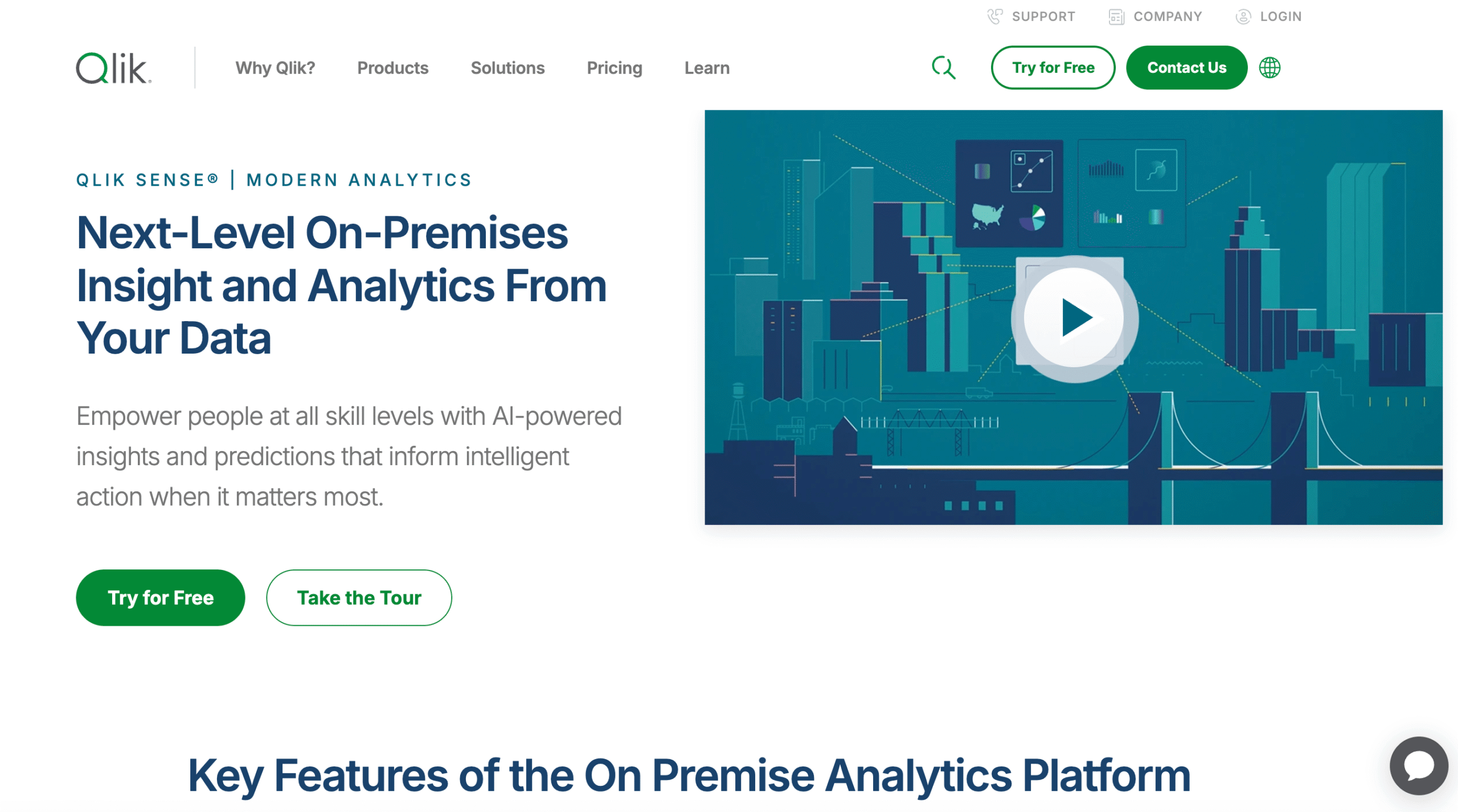
In 2026, Qlik Sense continues to be a powerful and well-respected name in the decision support software market. For 15 straight years, Gartner has recognized Qlik as a Leader in business intelligence due to its innovation in real-time analytics and data-driven workflows. Qlik’s core philosophy, called “Active Intelligence,” enables teams to make decisions using live, constantly updated data, instead of relying on old or static reports.
The platform gained additional strength after acquiring Talend, a move that enhanced its data integration capabilities and improved information quality. Today, Qlik offers a full cloud-based solution designed to automate data pipelines, streamline reporting, and support faster business decisions. This makes Qlik especially suitable for medium to large enterprises with complex data environments.
Qlik Sense Pricing and Market Reach
Qlik’s pricing is designed for enterprise-level deployments, offering flexible tiers for professional analysts and general business users.
Qlik Sense Pricing Breakdown (2026)
| User Type | Price Range (Monthly) | Role Description | Key Features |
|---|---|---|---|
| Professional User | $70 – $150 | Full data analysts, administrators | Complete dashboard authoring, governance, permissions |
| Analyzer User | $30 – $50 | Business users and decision-makers | Explore dashboards, filter insights, export summaries |
| Annual Team Cost | $60,000 – $100,000 | Based on 50 users | Effective rate of $100–$165 per user per month |
This pricing puts Qlik in a similar range to Tableau for large-scale deployment, although it remains more expensive than Microsoft Power BI. Qlik currently serves between 40,000 to 50,000 business customers globally, reinforcing its position in the premium segment of the business intelligence space.
Market Share and Platform Adoption Insights
Qlik holds a market share estimated between 4% and 10% in the broader business intelligence software market in 2026. While not as dominant as Power BI or Tableau in volume, Qlik has carved out a niche among firms that require fast, self-service analytics and integrated data pipelines.
Business Value Chart: Qlik vs Other BI Platforms (2026)
| Platform | Real-Time Analytics | Ease of Use | Data Integration | Market Share | Performance on Large Data |
|---|---|---|---|---|---|
| Microsoft Power BI | Moderate | High | Strong | 30.2% | Moderate |
| Salesforce Tableau | Moderate | High | Good | 16.99% | Moderate |
| Qlik Sense | Strong | High | Excellent | 4–10% | Moderate |
| Looker (Google) | Good | Moderate | Strong | 9.8% | Good |
| SAP Analytics Cloud | Basic | Low | Moderate | 8.5% | Strong |
Qlik stands out for its Associative Data Engine, which allows users to explore data without needing rigid hierarchies or predefined structures. This gives users freedom to ask complex questions and quickly shift perspectives without losing context—something traditional SQL-based tools often struggle with.
Retail Industry Review: Hands-On Experience with Qlik
A senior IT manager at a large retail company shared detailed insights on Qlik Sense’s role in improving their internal operations. According to the review, Qlik is their company’s main platform for analyzing and sharing business performance data with teams across departments.
Key benefits reported include:
- Fast Data Delivery: Qlik enabled business users to get insights within minutes, cutting down traditional report cycles.
- Self-Service Model: Employees could explore dashboards, analyze trends, and export findings without waiting for IT teams.
- Precise KPIs: Qlik’s analytics tools produced highly accurate business indicators that directly improved decision-making speed.
Usability and Limitations Reported
| Area | Observations from Enterprise Users |
|---|---|
| Setup & Migration | Challenging transition when legacy systems are involved |
| Documentation | Gaps in tutorials for custom connectors and tenant administration |
| Performance on Big Data | Occasional lags during processing of extremely large datasets |
| Interface & Navigation | Easy for most users, but advanced topics may require external help |
Despite some setup and migration challenges, Qlik’s intuitive user experience and speed in delivering business-critical data have made it a favorite among retail, healthcare, finance, and logistics sectors.
Qlik Sense Strength Assessment Chart (2026)
- Ease of Use: 8.5 / 10
- Real-Time Analytics: 9.0 / 10
- Scalability for Enterprises: 8.0 / 10
- Data Integration Tools: 9.5 / 10
- Performance with Big Data: 7.0 / 10
- Learning Curve for Advanced Users: 7.5 / 10
Conclusion
Qlik Sense is a top-tier decision support software in 2026 for organizations looking for real-time intelligence, fast decision-making tools, and deep data integration capabilities. Its associative engine sets it apart from traditional BI tools, making it highly interactive and dynamic.
While the onboarding and pricing may be more suitable for larger enterprises, Qlik’s powerful analytics features, especially for companies handling massive or diverse datasets, continue to attract forward-thinking organizations. It is a leading choice for businesses that need more than just dashboards—they need decisions delivered in real time.
4. Google Looker


In 2026, Google Looker stands out as a premium decision support platform focused on delivering unified, real-time business intelligence across large organizations. Developed by Google Cloud, Looker is designed with a unique semantic modeling layer called LookML, which allows teams to define data logic and metrics in a reusable and consistent way. This ensures that everyone in the organization works from the same version of the truth, avoiding reporting discrepancies.
Looker is especially popular among companies deeply invested in the Google Cloud ecosystem. Its architecture is optimized for Google BigQuery, making it ideal for businesses that handle vast amounts of data and prioritize scalability, security, and tight cloud integration.
Pricing Insights and Total Cost Breakdown
Unlike many other BI tools, Looker does not offer publicly available per-user pricing. Instead, costs are bundled into custom contracts based on Google Cloud usage, platform size, and service levels. This often results in higher costs than platforms like Power BI or Tableau, but Looker’s live-query architecture and semantic governance layer offer unique advantages that justify the investment for large enterprises.
Google Looker Cost Matrix (2026 Estimate)
| Team Size | Annual License Estimate | Total Year-One Cost (Including Setup & Services) |
|---|---|---|
| 10 Users | $36,000 – $48,000 | $126,000 – $198,000 |
| 50 Users | $84,000 – $120,000 | $194,000 – $310,000 |
| 100 Users | $120,000 – $180,000 | $290,000+ |
| 250+ Users | $216,000 – $360,000+ | $870,000 – $1.2 Million+ |
One of the often-overlooked cost factors is LookML maintenance. Organizations regularly invest 40%–60% of their Looker budgets in maintaining and updating this semantic layer. Additionally, companies incur $50,000 to $200,000 annually in BigQuery processing charges to support Looker’s live-query data delivery model.
Key Financial Considerations for Enterprises
| Cost Element | Estimated Annual Range | Notes |
|---|---|---|
| Looker License | $36,000 – $360,000+ | Based on user count and deployment scale |
| LookML Maintenance | 40% – 60% of total cost | Requires skilled developers and ongoing optimization |
| BigQuery Usage Fees | $50,000 – $200,000 | Supports real-time data queries; varies by volume and complexity |
Enterprise Use Case: Education Sector
A procurement professional from a major educational institution, managing between 5,000 to 50,000 staff, described Looker as highly effective for integrating and analyzing institutional spending data. They appreciated how Looker made it easier to visualize complex purchasing patterns, providing clearer oversight for financial audits and vendor management.
Positive feedback included:
- Ease of Use for Non-Technical Staff: Basic dashboard creation was quicker compared to other enterprise tools.
- Data Accuracy: LookML ensured consistent data definitions across departments.
- Operational Transparency: Spend analytics helped leadership pinpoint inefficiencies.
However, the same user noted that:
- Initial Setup: Building foundational data models (“views” and “explores”) required a steep learning phase.
- Advanced Use Barriers: While basic dashboards were accessible, more complex configurations felt closer to database engineering than visual reporting.
Insights from Other Sectors
An analytics manager in the energy and utilities sector added that Looker Studio—the freemium, lightweight version—was useful as an entry point into the Google BI ecosystem. However, they found its limited analytical tools restrictive for enterprise-level data manipulation.
Feature Comparison Matrix: Looker vs Other Decision Support Tools (2026)
| Platform | Semantic Layer | Cloud Integration | Ideal User Base | Cost Efficiency | Data Governance Strength |
|---|---|---|---|---|---|
| Google Looker | Yes (LookML) | Excellent (GCP) | Large enterprises on GCP | Low | Excellent |
| Power BI | No | Excellent (Azure) | SMEs to large enterprises | High | Moderate |
| Tableau | No | Strong (Salesforce) | All sizes | Moderate | Moderate |
| Qlik Sense | No | Good | Medium to large firms | Moderate | Moderate to Strong |
Performance Ratings: Google Looker in 2026
| Category | Score (Out of 10) |
|---|---|
| Integration with GCP | 10.0 |
| Data Consistency (LookML) | 9.5 |
| Ease of Use for Beginners | 7.0 |
| Advanced Configuration Power | 9.0 |
| Cost for Enterprises | 6.0 |
| Real-Time Querying | 8.5 |
Conclusion
Google Looker is one of the most advanced and enterprise-focused decision support software platforms in the world in 2026. Its strengths lie in semantic modeling, real-time data querying, and deep cloud integration. While it requires significant investment—both financially and technically—it provides unmatched data governance and consistency across large organizations.
This makes Looker particularly well-suited for educational institutions, multinational corporations, and regulated industries that need accurate, real-time insights built on a trustworthy data foundation. For companies already using Google Cloud, Looker is not just a BI tool—it is a strategic advantage in unlocking business intelligence at scale.
5. ThoughtSpot

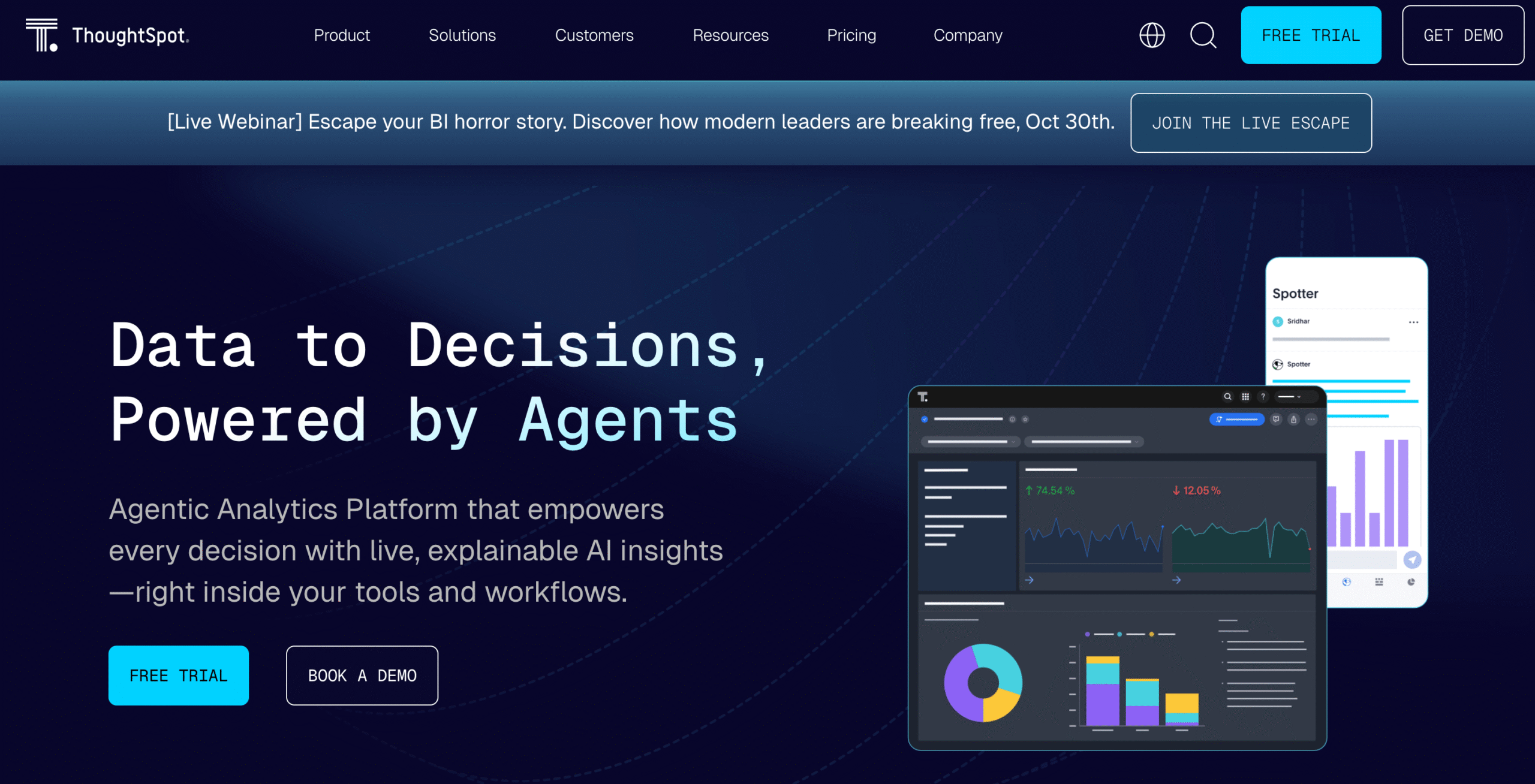
In 2026, ThoughtSpot is widely recognized as one of the most innovative decision support software platforms in the global analytics space. Marketed as the “Agentic Analytics Platform,” ThoughtSpot is built to empower business users with real-time access to insights using natural language search and artificial intelligence. Its core vision is to eliminate traditional dashboard delays by letting users ask questions in plain English and receive instant visual responses powered by live data.
Unlike conventional tools that require specialized knowledge of data queries or SQL, ThoughtSpot provides an intuitive experience through its search-based interface. This self-service model makes analytics accessible to non-technical users, enabling faster decisions across departments such as sales, operations, and finance.
Pricing Structure and Usage Capacity
ThoughtSpot introduced a new tiered user-based pricing model in 2026, replacing its older consumption-only billing system. This shift was made to provide organizations with more cost predictability. However, businesses with heavy usage patterns may still face cost challenges when query volumes scale.
ThoughtSpot Pricing Matrix (2026)
| Plan Tier | Starting Price (Per User/Month) | Recommended Team Size | Data Capacity | Included Features |
|---|---|---|---|---|
| Essentials | $25 | 5 – 50 users | Up to 25M data rows | Natural language search, basic analytics |
| Pro | $50 | 25 – 1,000 users | Up to 250M data rows | Spotter AI, anomaly detection, trend analysis |
| Enterprise | Custom Pricing | Unlimited users | Unlimited rows and queries | Advanced data modeling, full AI features, enterprise support |
These pricing tiers are designed to scale from small data teams to large, enterprise-wide deployments. However, usage unpredictability—especially under high query volumes—can still cause budgeting challenges for some enterprises.
Speed and Automation Capabilities
One of ThoughtSpot’s most valuable features is its speed. On average, user queries return results in less than 15 seconds, even when running against live, complex datasets. Its AI-powered feature, SpotIQ, proactively scans data in the background and flags anomalies, unexpected shifts, or emerging trends without requiring user input.
Performance Benchmarks: ThoughtSpot in 2026
| Metric | Value/Feedback |
|---|---|
| Average Query Response Time | Under 15 seconds |
| Predictive Analytics Capability | High – via SpotIQ anomaly and trend detection |
| Ease of Use for Non-Technical Users | Excellent – natural language search interface |
| Enterprise Query Volume Handling | Moderate – may lead to rising costs under heavy load |
Real-World Use Case: Global Operations at Apple
A senior data analyst from Apple shared a detailed review of ThoughtSpot’s enterprise usage. According to the review, ThoughtSpot significantly changed how the company consumes data across global departments. By enabling real-time search and dashboard delivery, business teams could make quicker and more confident decisions without bottlenecks.
Key outcomes from their experience included:
- Enhanced Data Accessibility: Business teams received answers to critical questions in seconds without waiting for analytics teams.
- Workflow Transformation: Teams transitioned from static reports to self-guided exploration, boosting decision agility.
- User Empowerment: Non-technical team members successfully used ThoughtSpot’s search-driven UI without training.
Challenges and Considerations Reported by Users
Despite its strengths, ThoughtSpot requires careful data preparation and modeling. The platform does not inherently “understand” data structure, so organizations must invest time in configuring the backend properly to ensure accurate search results.
Finance teams also noted that working with highly complex or nested data structures can become overwhelming. Additionally, as usage scales across large teams, the per-query pricing model can lead to rapidly increasing costs—especially for organizations that conduct frequent or multi-source analysis.
Strength vs Limitation Matrix: ThoughtSpot in 2026
| Feature Area | Strengths | Limitations |
|---|---|---|
| Real-Time Analytics | Extremely fast answers with live data | None significant |
| Natural Language Search | Very intuitive for non-technical users | Requires well-structured data models |
| AI Automation (SpotIQ) | High-value alerts and predictive analytics | May require tuning for precision |
| Setup and Configuration | Quick basic setup | Complex modeling needed for advanced data relationships |
| Pricing and Scalability | Flexible tiers for different team sizes | Rising costs under high-frequency query environments |
Competitive Positioning in the 2026 Decision Intelligence Market
| Platform | Natural Language Interface | Predictive AI Features | Self-Service Analytics | Cost Predictability | Market Focus |
|---|---|---|---|---|---|
| ThoughtSpot | Yes | Yes (SpotIQ) | Excellent | Moderate | Large enterprise and mid-market |
| Power BI | Limited | Yes | Good | High | SMEs to large enterprises |
| Tableau | No | Moderate | Good | Moderate | All business sizes |
| Qlik Sense | No | Moderate | Strong | Moderate | Data-intensive businesses |
| Google Looker | No | Yes | Moderate | Low | GCP-focused organizations |
Conclusion
ThoughtSpot is one of the top-ranked decision support software platforms in 2026 due to its unique ability to combine natural language search with AI-driven analytics. It is especially effective for organizations that want to give more autonomy to business users while reducing dependence on data teams.
With powerful automation tools like SpotIQ, lightning-fast query responses, and user-friendly interfaces, ThoughtSpot helps companies turn live data into immediate action. However, it requires thoughtful backend data modeling and careful budget planning to maximize value—particularly for large-scale enterprise implementations with high analytical demand. For data-driven teams seeking real-time answers without the wait, ThoughtSpot offers a compelling, forward-thinking solution.
6. Oracle Analytics Cloud (OAC)


Oracle Analytics Cloud (OAC) is one of the leading decision support software platforms in 2026, specifically built to manage the entire analytics journey—from ingesting and preparing data to generating insights through artificial intelligence and machine learning. Developed as a fully integrated cloud-based platform, OAC is particularly popular among enterprises that already use Oracle databases and infrastructure, especially the Oracle Autonomous Database.
What sets OAC apart is its ability to combine traditional business intelligence with augmented analytics, AI forecasting, and extensive data governance. This makes it a reliable tool for highly regulated industries like banking, manufacturing, and healthcare, where security, performance, and scalability are non-negotiable.
Subscription Models and Pricing Framework
Oracle Analytics Cloud uses a flexible, subscription-based pricing model that allows organizations to choose plans based on their user count, computational needs, and the level of AI/ML functionality required. It supports both license-included and Bring Your Own License (BYOL) options, enabling customers with existing Oracle investments to save on long-term costs.
Oracle Analytics Cloud Pricing Table (2026)
| Product Option | Unit Price (Monthly) | Billing Type | Key Features Included |
|---|---|---|---|
| OAC Professional | $16.00 per user | Subscription | Core analytics, dashboards, and data visualizations |
| OAC Enterprise | $80.00 per user | Subscription | ML, advanced AI, forecasting, NLP insights |
| OAC Professional (BYOL) | $0.3226 per OCPU-hour | Usage-based | License reuse, cost-efficient for Oracle customers |
| OAC Enterprise (BYOL) | $0.3226 per OCPU-hour | Usage-based | Full platform features with BYOL pricing |
| OAC Enterprise (Standard) | $2.1506 per OCPU-hour | Pay-as-you-go | High performance compute, enterprise-grade governance |
OAC is considered premium in cost compared to tools like Power BI or Tableau, but it provides powerful automation, governance, and infrastructure management benefits, which make it valuable for complex enterprise environments.
Cost and Performance Comparison Chart: OAC vs Top BI Platforms (2026)
| Platform | Monthly Entry Price (User) | AI & ML Integration | Security & Governance | Deployment Flexibility | Enterprise Adoption |
|---|---|---|---|---|---|
| Oracle OAC | $16 – $80+ | Advanced | Enterprise-Grade | Cloud / BYOL / Hybrid | High (Banking, MFG) |
| Microsoft Power BI | $10 – $20 | Moderate | Good | Cloud / On-premise | Very High |
| Salesforce Tableau | $12 – $75 | Moderate | Moderate | Cloud / On-premise | High |
| Google Looker | $300+ (Est.) | Advanced | Strong | Cloud (GCP) | Medium |
| Qlik Sense | $30 – $150 | Moderate | Strong | Cloud / On-premise | High |
Hands-On User Experience Across Industries
Oracle Analytics Cloud has been well-received in both human resources and manufacturing environments. In large enterprises managing thousands of employees, HR executives praised the ability to upload large datasets—such as workforce records or payroll files—quickly and efficiently.
One HR executive shared that the platform allowed bulk user imports without system lag, reducing the time and complexity usually associated with onboarding new teams into analytics dashboards. In the manufacturing sector, where companies often deal with massive operational data across global factories, a senior analytics user highlighted that OAC’s machine learning integration helped detect performance trends and predict production issues.
User Review Highlights: Pros and Cons
| Feature Category | Positive Feedback | Reported Limitations |
|---|---|---|
| Data Upload and Integration | Bulk upload capability praised in HR scenarios | Requires strong internet for large file imports |
| Visualization Tools | Described as intuitive and professional | Slower rendering in low-bandwidth conditions |
| AI & ML Capabilities | Powerful predictions and scenario planning | High cost for full-feature usage |
| Ease of Use | Simplified workflows for large user management | No dedicated mobile app at the time of review |
| Pricing and Licensing | BYOL option seen as cost-saving for Oracle clients | Comparatively expensive for basic analytics-only needs |
An IT director from a global firm described Oracle Analytics Cloud as the “Rolls Royce” of business intelligence tools—extremely powerful, but with a price tag that requires financial commitment and strategic ROI planning.
Platform Capability Ratings: Oracle Analytics Cloud (2026)
| Capability Area | Rating (Out of 10) |
|---|---|
| Integration with Oracle Stack | 10.0 |
| AI and Machine Learning | 9.0 |
| Visualization and Dashboards | 8.5 |
| Security and Compliance | 9.5 |
| Ease of Use for Analysts | 7.5 |
| Overall Value for Large Orgs | 8.8 |
Conclusion
Oracle Analytics Cloud ranks among the top decision support software solutions in 2026 for large enterprises requiring a unified, scalable, and secure analytics platform. It goes beyond basic reporting by offering embedded machine learning, natural language processing, and AI-powered forecasting tools.
While it may not be the first choice for startups or small teams due to its cost, OAC excels in environments where large-scale data operations, enterprise governance, and integration with existing Oracle systems are critical. For organizations seeking high performance, rich analytics, and long-term data strategy alignment, Oracle Analytics Cloud remains a best-in-class solution for decision intelligence.
7. SAP Analytics Cloud (SAC)

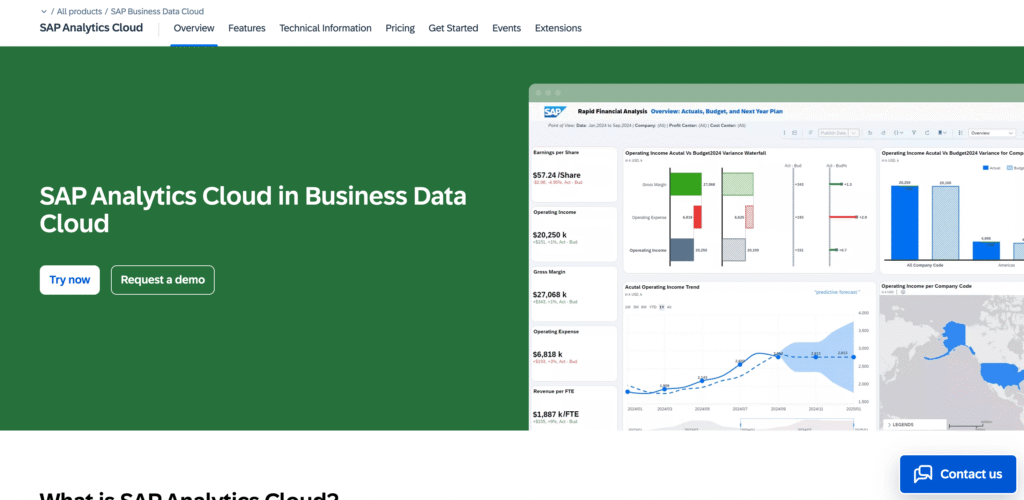
SAP Analytics Cloud (SAC) continues to play a central role in SAP’s overall business intelligence ecosystem in 2026. As a key component of SAP’s “Business Data Cloud” framework, SAC is built to enable live data analytics directly from SAP ERP systems, eliminating the need for time-consuming data rehosting or replication.
By combining business intelligence, financial planning, and predictive analytics within a single cloud-native platform, SAC helps organizations manage all aspects of their data strategy—reporting, forecasting, and real-time visualization—in one environment. This makes it especially effective for companies already using SAP applications across their operations.
Licensing Structure and Performance Metrics
SAP Analytics Cloud offers flexible pricing depending on the module being used—either Business Intelligence (BI) or Financial Planning. Its pricing aligns with large enterprise deployments but may be perceived as higher than alternatives for those seeking basic analytics functions.
SAP Analytics Cloud Pricing and Efficiency Matrix (2026)
| SAC Module | Pricing (Monthly per User) | Target Functionality | Key Features |
|---|---|---|---|
| SAC Business Intelligence | $36.00 | Entry-level cloud analytics | Dashboards, live SAP data access, ad-hoc reporting |
| SAC Planning | Price on Request | Financial modeling and forecasting | Integrated planning, cost simulations, what-if analysis |
Operational Efficiency Benchmarks with SAC
| Metric | Value Range | Operational Benefit |
|---|---|---|
| Resource Savings | 17% – 20% | Reduced reliance on manual reporting processes |
| Lead Time Reduction | 5% | Faster decision-making in sales and logistics workflows |
| Time to Value (Deployment) | Rapid (with prebuilt content) | Faster implementation through SAP’s templates |
SAC is purpose-built to work seamlessly within the SAP ecosystem, particularly with solutions like SAP S/4HANA and SAP BW/4HANA. Although it can connect to external data sources, its real strength lies in the live connectivity to SAP systems, enabling accurate, real-time reports that reflect the latest operational data.
Real-World User Experience from Banking and Retail Sectors
An IT leader from the banking industry described SAP Analytics Cloud as a “powerful analytics tool” thanks to its live connectivity features, which provide accurate and fast updates directly from their ERP systems. This connectivity allowed leadership teams to make informed decisions without needing frequent manual updates.
However, the same reviewer noted that the rollout of new features in SAC can be inconsistent. Some functions are initially released without full capabilities and require adjustments later on, which may result in duplicated efforts in sensitive or highly regulated environments.
A separate user from a large retail company with over 5,000 employees shared that SAC had become a valuable tool for warehouse and logistics tracking. The platform enabled them to monitor inventory levels, delivery performance, and warehouse KPIs through prebuilt dashboards. While this reduced implementation time and improved operational oversight, the user highlighted the following challenges:
- Steep Learning Curve: Users not familiar with SAP systems required extensive onboarding.
- Outdated Interface: Compared to more modern tools like Tableau or Power BI, SAC’s user interface was described as less intuitive.
- High Cost: Especially when used only for basic analytics tasks, SAC was seen as more expensive than several other BI tools on the market.
SAP Analytics Cloud Platform Evaluation Matrix (2026)
| Evaluation Criteria | SAP Analytics Cloud Rating | Notes |
|---|---|---|
| Real-Time Data Connectivity | 9.5 / 10 | Excellent when used with SAP systems |
| Financial Planning Integration | 9.0 / 10 | Strong support for advanced modeling and simulations |
| Learning Curve for New Users | 6.5 / 10 | Difficult for non-SAP users |
| UI/UX Design | 6.0 / 10 | Less modern than competitors |
| Pricing vs. Value | 7.5 / 10 | High price, but strong value when deeply integrated with SAP |
| Feature Stability | 7.0 / 10 | Feature rollout inconsistencies occasionally impact business workflows |
BI Software Market Comparison Matrix: SAP Analytics Cloud vs. Alternatives (2026)
| Platform | Best For | Pricing (Per User) | Real-Time Data Access | Financial Modeling | Ease of Use | Deployment Flexibility |
|---|---|---|---|---|---|---|
| SAP Analytics Cloud | SAP-based enterprises | $36.00+ | Excellent (SAP-native) | Strong | Moderate | Cloud-only |
| Microsoft Power BI | Cost-conscious SMBs & enterprises | $10.00 – $20.00 | Moderate | Limited | High | Cloud & on-premise |
| Salesforce Tableau | Visual analytics & dashboards | $12.00 – $75.00 | Moderate | Moderate | High | Cloud & on-premise |
| Qlik Sense | Advanced self-service analytics | $30.00 – $150.00 | Strong | Moderate | Moderate | Cloud & hybrid |
| Google Looker | Data modeling & governance | $300.00+ (est.) | Excellent (GCP) | Moderate | Moderate | Cloud (GCP) |
Conclusion
SAP Analytics Cloud ranks among the top 10 decision support software platforms in the world in 2026 due to its strong integration with SAP systems, advanced planning functions, and real-time data visualization capabilities. For enterprises already embedded in the SAP ecosystem, SAC offers unmatched value in terms of accuracy, speed, and analytics depth.
While it may not be the most user-friendly or cost-effective choice for organizations outside the SAP environment, it remains a strategic asset for large-scale enterprises looking for enterprise-grade business intelligence, especially in industries such as banking, retail, and logistics. For these organizations, SAC acts not only as a reporting platform but as a unified engine for informed, data-driven decision-making.
8. Aera Decision Cloud

In 2026, Aera Decision Cloud stands out as a specialized platform focused on cognitive automation and autonomous decision-making, particularly for complex supply chain, procurement, and logistics operations. Unlike traditional business intelligence software, Aera does not just report or visualize data—it actively recommends and executes decisions directly into enterprise systems such as ERPs, based on live, continuously updated inputs.
This “digital brain” model enables large enterprises to automate repetitive, time-sensitive business actions, saving both operational costs and decision latency. Aera’s core strength lies in its ability to analyze large volumes of real-time data, simulate outcomes, and trigger system responses without manual intervention. This makes it an ideal solution for companies managing high volumes of supply chain activities across distributed global operations.
Company Scale, Revenue, and Funding Status
Aera Technology has rapidly emerged as a challenger to traditional BI platforms by raising significant venture capital and focusing its resources heavily on R&D and core technology development.
Aera Decision Cloud Company Metrics (2026)
| Metric | Value | Details & Insights |
|---|---|---|
| Total Employees | 183 – 425 | Varies by region and operations |
| Engineering Staff | 162 | Strong emphasis on platform development |
| Estimated Annual Revenue | $30 Million | Based on 2025/2026 industry reports |
| Total Funding Raised | ~$174 Million | Series C led by DFJ Growth |
| Series C Round | $80 Million | Boosted AI and automation investments |
| Notable Clients | Unilever, others | Focus on enterprise-scale deployments |
The company’s focus on automation has attracted high-value enterprise clients in sectors such as consumer goods, pharmaceuticals, and manufacturing, where inventory rebalancing, demand planning, and cost optimization are major challenges.
Core Features and Real-Time Execution Capabilities
Aera Decision Cloud goes beyond dashboards by embedding itself into enterprise workflows. It is designed to monitor data 24/7, recommend decisions, and even execute them when configured to do so. This feature, often described as “self-driving enterprise,” allows global companies to react faster and with more precision to supply chain disruptions, demand fluctuations, or procurement bottlenecks.
Operational Capability Table: Aera Decision Cloud (2026)
| Feature Category | Description | Benefit to Enterprise Users |
|---|---|---|
| Real-Time System Crawling | Constant scanning of ERP and operational data | Live monitoring of changing variables |
| Automated Decision Execution | Triggers actions automatically in connected systems | Removes manual intervention for routine decisions |
| Predictive Supply Chain Modeling | Forecasts inventory needs and adjusts procurement accordingly | Prevents overstock and understock situations |
| Cognitive Automation Engine | AI that learns from historical actions and system behaviors | Improves decisions over time through reinforcement |
| Integration Flexibility | Compatible with SAP, Oracle, Workday, and others | Seamless enterprise deployment |
User Experience from Pharmaceutical and IT Industries
A quality assurance specialist in the pharmaceutical sector reported that Aera Decision Cloud improved their ability to make fast, impactful decisions. Instead of waiting for scheduled reports or manual exports, users could get instant access to real-time trending data, actionable insights, and AI-generated decision paths. In highly regulated environments where timing and compliance are crucial, this feature significantly enhanced operational outcomes.
A second review from an IT analyst highlighted Aera’s ability to “crawl enterprise systems continuously” and offer full visibility across workflows. This capability was especially valuable for identifying bottlenecks or inefficiencies before they escalated into serious issues.
Challenges Reported by Enterprise Users
Despite its advanced capabilities, Aera Decision Cloud has some limitations that enterprises should consider:
- Learning Curve: New users often find the platform complex, especially those unfamiliar with AI-driven automation interfaces.
- Limited Brand Awareness: Compared to well-established platforms like Power BI or Tableau, Aera remains less known in the broader BI community.
- Focused Use Cases: While extremely powerful in supply chain, procurement, and logistics, its general-purpose analytics features are limited.
- Pricing Complexity: Licensing models and pricing tiers may not be transparent or accessible for mid-market clients, creating budget challenges for smaller teams.
Aera Decision Cloud Platform Review Matrix (2026)
| Feature Area | Rating (Out of 10) | Comment |
|---|---|---|
| Supply Chain Decision Support | 9.5 | Market-leading real-time and automated decision-making |
| Integration with ERP Systems | 9.0 | Strong compatibility with SAP, Oracle, and others |
| General BI and Visualization | 6.0 | Less emphasis on dashboards and ad-hoc reporting |
| Ease of Use | 6.5 | Steep learning curve for non-technical users |
| AI-Powered Automation | 9.5 | Executes real-time decisions with minimal human intervention |
| Cost Transparency | 6.0 | Pricing model needs more clarity, especially for non-enterprise users |
Comparison Matrix: Aera vs Traditional BI Platforms (2026)
| Platform | Best Use Case | Real-Time Execution | Automation Capabilities | General BI Features | Market Awareness |
|---|---|---|---|---|---|
| Aera Decision Cloud | Supply chain, logistics, procurement | Yes | Very High | Moderate | Emerging |
| Power BI | Broad business reporting | Moderate | Low | Strong | High |
| Tableau | Data visualization & dashboards | Moderate | Low | Strong | High |
| Qlik Sense | Self-service exploration | Moderate | Moderate | Strong | Medium |
| Google Looker | Centralized data modeling | High | Moderate | Moderate | Medium |
Conclusion
Aera Decision Cloud is one of the most advanced and specialized decision support platforms in the world in 2026, particularly for global enterprises with complex supply chain and procurement operations. By merging real-time data processing with autonomous decision execution, Aera helps companies move from reactive analytics to proactive, automated operations.
While it may not offer the broad visual dashboards or general-purpose BI functionality found in more mature platforms, its impact in specific verticals—especially where speed, volume, and automation are critical—is unmatched. For large organizations seeking to build a self-operating decision infrastructure, Aera Decision Cloud represents a forward-looking investment in operational intelligence.
9. FICO Decision Management Platform

In 2026, the FICO Decision Management Platform remains one of the most trusted and widely adopted tools for advanced decision automation, especially in high-stakes sectors such as finance, risk management, fraud prevention, and regulatory compliance. While FICO is best known for its industry-standard consumer credit score in the United States, its enterprise-grade platform extends far beyond credit analytics.
The FICO platform is built to manage complex, rules-driven decisioning processes using artificial intelligence, machine learning, and real-time data streaming. Businesses use it to reduce fraud losses, improve operational efficiency, and ensure compliance with evolving regulations across over 80 countries.
Performance Metrics and Quantitative Impact
FICO’s AI-driven decisioning engine has shown measurable results for organizations across sectors. Whether improving fraud detection or accelerating hiring decisions, its impact is consistently quantifiable.
FICO Performance Metrics Table (2026)
| Key Metric | Improvement Level | Business Outcome |
|---|---|---|
| Fraud Loss Reduction | 80% Reduction | Applied by major banks and payment processors |
| False Positive Reduction | 97% Fewer | Increased efficiency and fewer manual investigations |
| Time-to-Hire Improvement | 50% Faster | Faster objective screening using AI decision rules |
| Decision Accuracy | Over 90% | Driven by contextual and predictive models |
FICO’s architecture enables real-time streaming and decisioning across structured and unstructured data. It pre-processes incoming data using user-defined rules and dynamically adjusts based on new patterns, making it ideal for environments where milliseconds matter.
Subscription Value and Deployment Advantages
The platform offers high-value returns, especially for companies seeking to automate large-scale operational decisions. It allows both business users and data scientists to collaborate using intuitive visual interfaces and prebuilt templates.
FICO Platform Capability Matrix
| Feature Category | Description | Strategic Benefit |
|---|---|---|
| Real-Time Streaming | Live data ingestion and analytics | Faster, automated decision-making |
| Visual Rule Design | No-code and low-code interface for policy logic | Empowers business users to manage decision rules |
| Integrated Compliance Layer | Rule governance and audit trail tracking | Supports global regulatory compliance |
| Prebuilt Decision Models | Templates for fraud, credit risk, KYC, AML | Reduces deployment time and improves reliability |
| Cross-Channel Integration | ERP, CRM, core banking systems compatibility | Seamless data orchestration across platforms |
Enterprise Case Study: Financial Services Sector
A mid-market financial services firm shared that FICO’s decision engine was “extremely helpful for generating accurate reports on compliance, risk, and financial health.” Analysts reported that the system empowered both technical and business teams to quickly build, test, and deploy decision logic—significantly reducing the time it took to respond to new regulations or operational changes.
The platform’s user-friendly design allowed decision makers to visualize workflows and simulate policy changes before deployment. Clients appreciated the detailed client support and availability of guided rule creation, which made regulatory reporting easier.
User Insights: Strengths and Reported Challenges
Despite its benefits, FICO’s platform has several noted limitations:
- Integration Complexity: Organizations with older or non-standard systems often face challenges integrating FICO’s tools with external platforms.
- High Data Requirements: Accurate risk predictions rely on high-quality, large-volume datasets, which can pose challenges for smaller teams.
- Learning Curve for Beginners: First-time users may struggle without embedded tutorials or structured onboarding.
- Advanced Feature Pricing: Some users noted that enterprise-grade functionalities come at a premium price.
User Feedback Matrix: FICO Decision Management Platform (2026)
| Area | Positive Feedback | Reported Limitation |
|---|---|---|
| Client Support | Highly rated support teams and onboarding assistance | None significant |
| Business Rule Configuration | Intuitive UI for rule definition | Advanced configurations can still require technical support |
| AI and Predictive Accuracy | High-accuracy modeling | Requires significant test data |
| Pricing Structure | Value for large enterprise use cases | Considered expensive for mid-size or budget-conscious users |
BI Market Positioning Matrix: FICO vs Leading Competitors (2026)
| Platform | Core Focus Area | Automation Capability | AI Integration | Pricing Level | Regulatory Support |
|---|---|---|---|---|---|
| FICO Decision Platform | Risk, fraud, compliance | High | Advanced | High | Enterprise-grade |
| Microsoft Power BI | General business reporting | Low | Moderate | Low | Moderate |
| Salesforce Tableau | Visualization and reporting | Low | Moderate | Medium | Limited |
| Qlik Sense | Data exploration and dashboards | Moderate | Moderate | Medium | Moderate |
| Oracle Analytics Cloud | Financial modeling and operations | High | High | High | Strong |
Platform Capability Ratings: FICO Decision Management Platform
| Functional Category | Score (Out of 10) |
|---|---|
| Risk & Fraud Automation | 9.5 |
| Decision Rule Customization | 9.0 |
| Real-Time Analytics | 9.0 |
| Ease of Use for New Users | 6.5 |
| Integration Flexibility | 7.0 |
| Regulatory Compliance Tools | 9.5 |
Conclusion
FICO’s Decision Management Platform is one of the most powerful and enterprise-ready decision support software solutions in the world in 2026. It provides unmatched capabilities in risk automation, fraud prevention, and regulatory compliance—making it the preferred choice for financial institutions, insurance firms, and compliance-heavy industries.
While the learning curve and integration complexity may challenge newer or smaller businesses, organizations with the resources and strategic need for real-time, high-accuracy decisioning will find tremendous value in FICO’s AI-driven ecosystem. With proven results in fraud loss reduction and decision agility, FICO remains a key driver of intelligent automation in the modern enterprise landscape.
10. Quantexa Decision Intelligence Platform


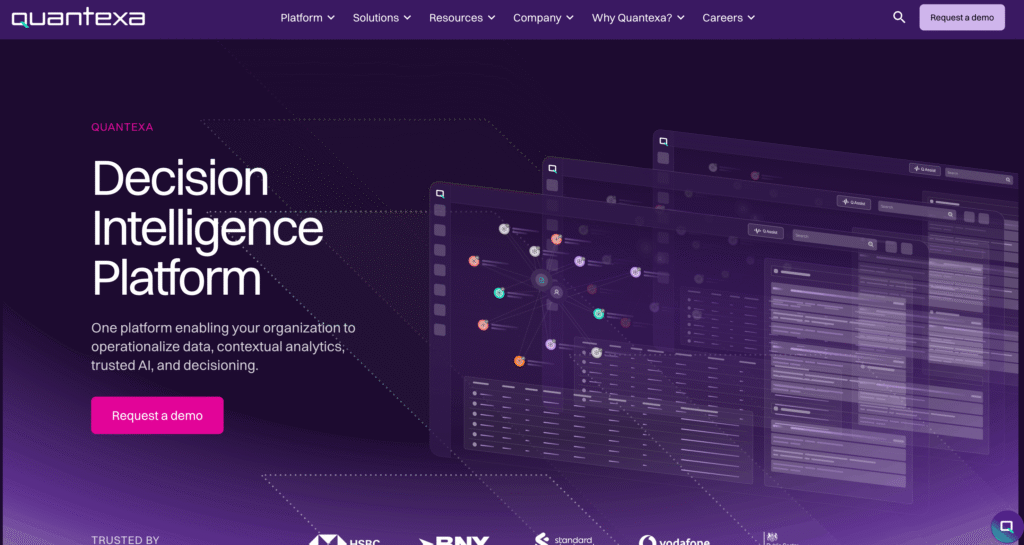
In 2026, Quantexa has firmly established itself as one of the world’s top decision support platforms through its advanced use of contextual decision intelligence (CDI). Unlike traditional analytics tools that rely on isolated data points, Quantexa connects and organizes data from multiple systems—creating a dynamic knowledge graph that reveals relationships, behaviors, and patterns not visible through standard reporting methods.
This powerful contextual model enables enterprises to detect fraud, strengthen customer intelligence, and make smarter decisions based on the full operational context. Its platform is especially well-suited for financial services, public sector, and enterprise risk management environments.
Quantexa’s approach delivers real-time, relationship-based insights, helping businesses solve complex problems in compliance, anti-money laundering (AML), and customer lifecycle analysis. Its growing influence is backed by rapid revenue growth, deep industry integration, and strong funding momentum.
Financial Performance, Market Valuation, and ROI Metrics
Quantexa reached “Centaur status” in 2025 after surpassing US$100 million in annual recurring revenue (ARR). By March 2025, the company had reported £126 million (approximately US$160 million) in revenue, reflecting a 49% year-over-year increase. Its Series F funding round raised US$175 million and brought its total valuation to US$2.6 billion.
Quantexa Financial and Performance Metrics (2026)
| Metric | Result | Context and Source |
|---|---|---|
| Annual Revenue (FY 2025) | US$160 Million | £126M reported in March 2025 |
| Revenue Growth YoY | +49% | Year-over-year increase |
| Annual Recurring Revenue (ARR) | Over US$100 Million | Achieved Centaur status |
| Total Funding Raised | US$546 Million | Across 7 successful rounds |
| Latest Valuation | US$2.6 Billion | After Series F funding |
Quantexa ROI and Analytical Impact Matrix
| Performance Metric | Value | Business Impact |
|---|---|---|
| Return on Investment (3 Years) | 228% | Based on Forrester TEI Study |
| Payback Period | 8 Months | Faster recovery of initial investment |
| Decision Accuracy | Over 90% | Compared to traditional analytics models |
| Analytical Resolution Speed | 60x Faster | Enabled by contextual modeling |
Core Platform Capabilities and Use Cases
The Quantexa platform excels in resolving complex data identities, enriching datasets with contextual connections, and feeding refined information into downstream tools like Tableau, Power BI, and Looker. This contextual engine allows for better-informed decisions at strategic, operational, and tactical levels.
Platform Capability Comparison Table: Quantexa Decision Intelligence (2026)
| Feature Area | Description | Strategic Advantage |
|---|---|---|
| Contextual Data Resolution | Entity-linking across disconnected sources | Uncovers hidden patterns and relationships |
| Knowledge Graph Modeling | AI-powered network of people, transactions, and behaviors | Supports fraud, AML, and customer insight use cases |
| Scalable Architecture | Supports millions of entities and events in real-time | Reliable for global financial institutions |
| Integration Compatibility | Connects with servers, cloud systems, and APIs | Feeds visual and predictive tools |
| Decision Intelligence Layer | Runs contextual models for detection and alerting | Automates operational and compliance decisions |
Enterprise Experience: Product Management Perspective
A product manager at a global software enterprise (US$3B–10B revenue range) shared that Quantexa played a critical role in data transformation before the analytics layer. The platform’s ability to “cleanse, unify, and structure” messy datasets helped reduce system resource usage and improved the performance of their visualization dashboards.
The manager noted that Quantexa’s backend engine was particularly strong, with fast processing speeds and high-quality data preparation. One of the platform’s standout advantages was its ability to pull data from both on-premises servers and cloud environments, streamlining access for large teams.
Strengths and Reported Challenges from User Feedback
While the overall feedback on Quantexa is highly positive, a few areas for improvement were highlighted by enterprise users:
- Contracting Friction: New clients reported that procurement and evaluation processes could be complex or slower than expected.
- Onboarding Complexity: While highly capable, the platform requires expert configuration for maximum benefit.
- Focused Scope: Although powerful for contextual and risk-based use cases, it may be overengineered for organizations looking for simple BI features.
Strengths vs. Limitations Matrix: Quantexa Decision Intelligence (2026)
| Area | Strengths | Challenges |
|---|---|---|
| Data Resolution | Real-time entity linking and contextual insights | Initial setup can be resource-intensive |
| System Performance | Efficient query engine, reduced resource usage | Advanced configuration needed for optimal performance |
| Integration Support | Seamless across cloud and server systems | May require tailored API or connector setup |
| Strategic Application | Effective for fraud, AML, and compliance | Less applicable to generic analytics tasks |
| Pricing and Licensing | Scalable for large enterprise deployment | Evaluation phase can feel long for procurement teams |
Market Position Matrix: Quantexa vs Other Decision Support Platforms (2026)
| Platform | Core Strength | Ideal Use Case | Data Connectivity | Entity Resolution | Visual Reporting |
|---|---|---|---|---|---|
| Quantexa | Contextual graph intelligence | Financial crime, compliance, customer risk | Excellent | Very Strong | External (via BI tools) |
| FICO Decision Platform | Risk and fraud automation | Credit scoring, regulatory compliance | Strong | Strong | Built-in |
| Microsoft Power BI | General reporting and dashboards | Business intelligence for all teams | Good | Basic | Native |
| Tableau (Salesforce) | Visual analytics and exploration | Exploratory dashboards and trends | Good | Limited | Native |
| Oracle Analytics Cloud | ERP and planning insights | Financial operations and forecasting | Strong (Oracle) | Moderate | Native |
Conclusion
Quantexa Decision Intelligence Platform is one of the top-performing and most innovative decision support tools in 2026. Its focus on contextual decision intelligence, supported by real-time knowledge graphs and entity resolution, delivers immense value for complex use cases—especially in financial crime, compliance, and customer intelligence.
Backed by over US$546 million in funding and strong enterprise adoption, Quantexa continues to evolve as a leader in turning disconnected enterprise data into actionable, high-confidence decisions. While setup and contracting may require more time and planning, the long-term benefits in decision accuracy, risk mitigation, and operational clarity are well worth the investment for large-scale enterprises.
Global Market Outlook for Decision Support Software and Decision Intelligence in 2026
The decision support software (DSS) and broader decision intelligence (DI) landscape are undergoing rapid growth as organizations around the world recognize the critical role of intelligent decision-making tools in a volatile economy. In 2024, the global DSS software market was valued at approximately US$43.9 billion, and it is projected to reach US$82.3 billion by 2030, driven by a compound annual growth rate (CAGR) of 11.0%.
This surge reflects a fundamental shift in enterprise priorities. Businesses are no longer viewing DSS tools as optional enhancements but as essential infrastructure for managing risk, improving operational resilience, and accelerating data-driven decision-making in unpredictable markets.
Decision Intelligence: A High-Growth Subsegment in the Analytics Ecosystem
Within this broader analytics category, decision intelligence (DI) is emerging as one of the fastest-growing sectors. In 2026, the global DI market is estimated to be valued at US$18.91 billion, and forecasts suggest a jump to US$68.20 billion by 2035, growing at a strong CAGR of 15.36%.
The rapid expansion of DI is powered by the integration of large language models (LLMs) and domain-specific AI that allow for natural language-based data querying, simplifying how organizations interact with complex datasets. This evolution is helping democratize access to decision-making insights, enabling non-technical users across departments to leverage advanced analytics with minimal friction.
Global Growth Forecast Matrix for DSS and DI Markets
| Market Segment | 2024/2025 Valuation | 2030/2035 Projection | Projected CAGR |
|---|---|---|---|
| Global DSS Software Market | US$43.9 Billion (2024) | US$82.3 Billion (2030) | 11.0% |
| Decision Intelligence Market | US$16.34 Billion (2025) | US$68.20 Billion (2035) | 15.36% |
| US Clinical Decision Support Systems | US$2.18 Billion (2024) | US$4.84 Billion (2034) | 8.3% |
| Intelligent Medical Software | US$4.79 Billion (2025) | US$22.33 Billion (2035) | 16.64% |
| AIoT (AI + IoT) Global Market | US$9.98 Billion (2024) | US$41.28 Billion (2029) | 32.0% |
Regional Market Dynamics and Adoption Patterns
The adoption of decision support technologies shows wide variation across global regions. North America continues to lead the global market, holding approximately 43% to 46.5% of global revenue in 2025 and 2026. This leadership is underpinned by strong R&D infrastructure, early AI adoption, and deep penetration in healthcare, finance, and government sectors in the U.S. and Canada.
Meanwhile, the Asia-Pacific region is emerging as the fastest-growing market, with a forecasted CAGR of 12.21% through 2031. Notably, China is projected to reach a market valuation of US$16.8 billion by 2030, supported by massive investments in digital transformation and a healthcare system facing increased demand due to a rapidly aging population.
Regional Adoption Growth Table (2026 Projection)
| Region | Market Share / Valuation | Key Growth Drivers |
|---|---|---|
| North America | 43% – 46.5% of global revenue | AI maturity, R&D investment, enterprise-scale adoption |
| Asia-Pacific | Fastest growth (12.21% CAGR) | Healthcare demand, tech infrastructure, digital reforms |
| China (within APAC) | US$16.8 Billion (2030 est.) | Public sector transformation, population-driven demand |
| Europe | Moderate but stable growth | Privacy-led adoption in banking and government sectors |
Sector-Wise Implementation and Use Case Expansion
The adoption of decision support software is especially strong in finance (BFSI) and healthcare. In 2024, the financial services sector accounted for 20% of the total business software and services market, propelled by increased demand for real-time credit scoring, fraud detection, and automated regulatory compliance.
In the healthcare domain, growth is being driven by the rising need for clinical decision support systems (CDSS)that assist providers in diagnosing conditions, selecting treatments, and ensuring patient safety. The global CDSS market is forecasted to rise from US$7.26 billion in 2026 to US$16.96 billion by 2034.
Industry-Specific Adoption Trends Matrix (2026)
| Industry Segment | 2026 Market Trend | Drivers of Adoption |
|---|---|---|
| Finance (BFSI) | High adoption, 20% software market share | Fraud detection, credit risk modeling, compliance tools |
| Healthcare (CDSS) | Growing rapidly (US$7.26B in 2026) | Clinical diagnostics, treatment planning, patient safety |
| Retail & E-commerce | Emerging adoption | Real-time pricing, inventory optimization, personalization |
| Manufacturing | Operational integration phase | Demand forecasting, quality control, supply chain planning |
Technology Shift: From On-Premise to Cloud-Based Decision Platforms
Another important transformation driving market growth is the shift from traditional on-premise solutions to cloud-based decision support systems. While on-premise deployments accounted for 42% to 63% of market revenue in 2024–2025 (primarily due to security preferences in finance and government sectors), the cloud segment is accelerating rapidly.
Cloud-based decision tools are increasingly favored for their scalability, lower total cost of ownership, and compatibility with hybrid work models. Cloud-native DSS platforms are projected to grow at a 13.6% CAGR, significantly outpacing legacy models.
Deployment Trend Comparison Table (2026 Forecast)
| Deployment Type | 2024–2025 Share | 2026–2030 CAGR | Key Benefits |
|---|---|---|---|
| On-Premise | 42% – 63% | Slower | Security control, legacy system alignment |
| Cloud-Based DSS | Increasing share | 13.6% | Scalability, remote access, AI and LLM integration |
| Hybrid Environments | Rapid adoption | Flexible growth | Balances security and accessibility across use cases |
Conclusion
In 2026, the global market for decision support systems and decision intelligence solutions is not only expanding in size—it is evolving in complexity, functionality, and strategic value. With significant growth fueled by AI, cloud infrastructure, and cross-sector adoption, DSS and DI platforms are becoming essential to modern enterprise operations.
As organizations prioritize real-time, data-driven decision-making, investment in these platforms is expected to accelerate further—especially in fast-growing economies and industries with high compliance and performance demands. The next decade will likely see these systems mature from decision support tools to full-fledged autonomous decision ecosystems, transforming how business is conducted on a global scale.
Comparative Framework and Technical Integration Landscape for Decision Support Software in 2026
In 2026, one of the defining elements of enterprise decision support software is how well these tools integrate with a company’s existing data environment. The concept often referred to as the “Integration Paradox” is becoming increasingly relevant: as decision platforms evolve to become more intelligent and autonomous, they also place greater demands on data quality, interoperability, and harmonization.
Enterprises are no longer satisfied with standalone analytical tools. They now expect decision support systems to connect directly with CRMs, ERPs, data warehouses, and unstructured data sources in real time. This has created a technical challenge, where achieving high-performance automation is only possible if the foundational data architecture is reliable, well-governed, and adaptable.
Evolution from Knowledge-Based to Machine Learning-Based Systems
Another major transformation in 2026 is the industry-wide shift from traditional knowledge-based systems—which rely on manually coded rules and logic—to non-knowledge-based systems that adapt autonomously using machine learning. The rapid growth of data, especially in sectors like healthcare and finance, makes manual rule maintenance increasingly unsustainable.
For example, in clinical decision support systems (CDSS), the volume of new medical literature now doubles every 73 days, rendering static rule trees obsolete shortly after deployment. AI-powered systems can automatically retrain models as new data becomes available, drastically improving decision speed, accuracy, and flexibility.
System Architecture Comparison Matrix: Knowledge-Based vs. Non-Knowledge-Based (2026)
| System Type | 2025 Market Share | Projected CAGR | Maintenance Requirement |
|---|---|---|---|
| Knowledge-Based Systems | 61.55% | Slowing | Manual rule updates (quarterly) |
| Non-Knowledge-Based Systems | 38.45% | 14.25% | Automated retraining with new data |
This trend is accelerating adoption of adaptive decision intelligence, particularly in industries where conditions change rapidly and data evolves continuously.
Deployment Models: Cloud Growth vs. On-Premise Stability
While cloud-native platforms like ThoughtSpot, Looker, and Quantexa are leading innovation in 2026, on-premise deployments remain highly relevant—especially in industries with strict regulatory and data sovereignty requirements, such as banking, government, and pharmaceuticals.
Despite cloud’s advantages in scalability and remote accessibility, on-premise solutions still hold a dominant share, accounting for approximately 54.53% to 63% of revenue in 2025 and early 2026. However, the cloud-based segment is expanding more rapidly, with growth rates between 13.6% and 16.85% CAGR, driven by small and medium enterprises (SMEs), technology startups, and retail companies.
Deployment Model Comparison Table: On-Premise vs. Cloud-Based Systems (2026)
| Delivery Mode | Revenue Share (2025–2026) | Projected CAGR | Common Use Cases |
|---|---|---|---|
| On-Premise | 54.53% – 63% | Stable or slow growth | Banking, Government, Pharma |
| Cloud-Based | 37% – 45% | 13.6% – 16.85% | SMEs, E-commerce, Tech Startups |
| Hybrid Models | Rapidly growing adoption | Moderate to high | Large enterprises balancing compliance |
Organizations are also increasingly demanding flexible deployment options, where cloud and on-premise systems operate in tandem—a model gaining traction in large multinational corporations managing diverse regulatory environments.
Software Licensing Shift: Rise of Subscription and Usage-Based Pricing
A notable shift in 2026 is the movement away from traditional perpetual licensing toward subscription-based and consumption-based models. Vendors are now bundling hosting, updates, and support into monthly or annual plans, providing clients with predictable costs and automatic feature upgrades.
The software subscription model is currently growing at a 13.87% CAGR, reflecting enterprise demand for operational flexibility, budget control, and continuous innovation.
Licensing Model Comparison Table (2026)
| Licensing Type | Pricing Approach | Growth Rate (CAGR) | Typical Vendor Strategy |
|---|---|---|---|
| Perpetual License | One-time payment | Declining | Traditional on-premise platforms |
| Subscription-Based License | Monthly or annual fees | 13.87% | Cloud-first vendors (e.g., Tableau, Looker) |
| Usage-Based (Consumption) | Pay-per-use or OCPU-hour | High in cloud BI | Oracle OAC, ThoughtSpot Pro, Looker BYOL |
This licensing evolution supports greater accessibility for mid-market organizations and allows vendors to offer premium analytics features under scalable pricing models.
Conclusion
The 2026 decision support software market is evolving beyond standalone tools into a connected ecosystem where integration quality, adaptability, and delivery flexibility are strategic priorities. The transition from knowledge-based to AI-driven systems signals a major leap toward autonomous decision-making, especially in fast-moving industries such as healthcare, finance, and retail.
Meanwhile, organizations are increasingly aligning their deployment models and licensing preferences with operational needs—choosing hybrid architectures and flexible subscription plans to stay agile and competitive. For enterprises investing in decision intelligence, success will depend not only on feature depth but also on seamless data integration, cloud readiness, and intelligent learning capabilities embedded across their platforms.
Macro-Level Trends Shaping the Global Decision Support Software Landscape in 2026
One of the most transformative forces shaping decision support systems (DSS) and decision intelligence (DI) in 2026 is the rapid adoption of 5G networks and Edge Computing technologies. These innovations are enabling what is now referred to as the Artificial Intelligence of Things (AIoT)—a hybrid approach that combines machine intelligence with real-time data processing directly at the source of data collection.
Rather than sending data back to centralized servers for analysis, devices and sensors in industries like manufacturing, logistics, and energy can now process and act on information immediately at the edge. This significantly reduces latency, improves decision speed, and increases operational responsiveness. The global AIoT market is projected to grow at a compound annual growth rate (CAGR) of 32%, reaching a total market size of US$41.28 billion by 2029.
Impact of AIoT on Real-Time Decision Support
| Technology Element | Business Value for DSS | Typical Use Case |
|---|---|---|
| 5G Networks | Ultra-fast data transmission | Remote monitoring in logistics |
| Edge Computing | Real-time data processing | Machine performance alerts in factories |
| Embedded AI in Devices | Autonomous decision execution | Predictive maintenance in smart grids |
These capabilities are making decision intelligence platforms not just faster but also location-aware and context-sensitive, especially in environments where every second counts.
Regulatory Pressure Driving DSS Adoption in Healthcare and Government
Governments worldwide are increasingly embedding decision support requirements into law and policy, particularly in healthcare, life sciences, and regulated industries. In the United States, the 21st Century Cures Act and CMS Interoperability Rules are accelerating the deployment of Clinical Decision Support Systems (CDSS) to ensure that healthcare providers use evidence-based tools for treatment recommendations and diagnostics.
In Europe, the introduction of the European Health Data Space (EHDS) regulation is pushing for cross-border health data interoperability, standardization, and transparency. This mandates the use of advanced DSS platforms capable of interpreting diverse data sources across languages, care settings, and policy frameworks.
Key Regulatory Drivers and Geographic Adoption Matrix
| Region | Key Regulation or Policy | DSS Adoption Impact |
|---|---|---|
| United States | 21st Century Cures Act, CMS Rules | Mandatory CDSS for healthcare interoperability |
| European Union | European Health Data Space (EHDS) | Standardized data interpretation tools needed |
| Asia-Pacific | HealthTech and Smart Nation Initiatives | Growing investments in real-time decision systems |
This wave of regulatory compliance is no longer optional—it is a foundational requirement. As a result, DSS vendors are building more regulatory-aware and interoperable features into their platforms.
Rise of Explainable AI (XAI) and Transparent Decisioning
Another defining trend in 2026 is the growing emphasis on Explainable Artificial Intelligence (XAI). As organizations become more dependent on autonomous decision systems—especially in high-risk domains such as finance, insurance, and healthcare—the demand for transparency and accountability has intensified.
The traditional “black box” approach, where algorithms generate outputs without explanation, is now viewed as a legal and ethical liability. Enterprises, regulators, and end-users are demanding clear visibility into how and why decisions are made.
Leading platforms like FICO and Quantexa are addressing this need by embedding auditable decision logic, traceable workflows, and data lineage features that allow every output to be explained, documented, and reviewed.
XAI Implementation Comparison: Governance and Transparency Features
| Platform | Explainability Tools Offered | Industry Focus | Compliance Readiness |
|---|---|---|---|
| FICO | Auditable outputs, model governance | Banking, Fraud, Credit Risk | High – aligns with global regulations |
| Quantexa | Knowledge graph traceability, explainable logic | Financial Crime, Public Sector | High – supports investigation-based audits |
| Oracle OAC | Forecast diagnostics, scenario modeling | Enterprise Planning and Ops | Moderate |
| ThoughtSpot | Query transparency, search audit logs | Sales, Marketing, BI | Moderate |
As explainability becomes a competitive requirement, organizations are increasingly choosing decision platforms that deliver not just speed and accuracy, but also clarity, traceability, and compliance.
Conclusion
The global decision support software environment in 2026 is being reshaped by a combination of macro-technical and policy-driven forces. From the deployment of edge-powered AIoT to the institutionalization of regulatory compliance and explainable decisioning, modern DSS platforms are being asked to deliver more than just insights. They must now provide real-time intelligence, legal accountability, and complete interoperability across diverse ecosystems.
The platforms leading in this space are those that balance technical sophistication with operational transparency, enabling enterprises to make faster, smarter, and more trustworthy decisions in an increasingly complex and regulated world.
Strategic Outlook for Decision Support Software in 2026: From BI Tools to Enterprise Intelligence Engines
In 2026, the world’s top decision support software platforms have evolved far beyond their original roles as data visualization or reporting tools. These systems now function as core components of enterprise infrastructure—forming a “Cognitive Operating System” that powers real-time decision-making, automation, and business agility.
Rather than being used solely by data analysts or IT teams, these platforms are now embedded throughout the entire organization, enabling every department—from operations and finance to HR and marketing—to make faster, more informed decisions. The leading tools in the market—such as Microsoft Power BI, ThoughtSpot, FICO, and Quantexa—have become mission-critical layers of the digital enterprise, directly influencing strategy execution and performance outcomes.
Key Selection Imperative: Data Readiness and Maturity
One of the most important factors when choosing a decision support platform in 2026 is data maturity. Not all software tools deliver equal results unless the organization has the right data infrastructure in place. Advanced systems like Google Looker or Aera Decision Cloud offer exceptional analytical depth, but they require well-structured data environments and strong internal data governance.
Organizations that lack a centralized data warehouse or struggle with fragmented data quality will find it difficult to extract full value from these high-end platforms without significant investments in preparation and modeling.
Data Maturity Alignment Table: Platform Fit vs. Readiness Level
| Platform | Data Readiness Required | Ideal Enterprise Type | Data Modeling Complexity |
|---|---|---|---|
| Aera Decision Cloud | Very High | Global supply chains, logistics | Advanced |
| Google Looker | High | GCP-native enterprises | High |
| Power BI | Moderate | SMEs to large enterprises | Moderate |
| Tableau | Moderate | Sales and operations teams | Low to Moderate |
| ThoughtSpot | Moderate | Business users in dynamic environments | Low |
Organizations are advised to conduct internal data audits before platform selection to avoid misalignment between software capability and operational reality.
Interoperability as a Long-Term Success Factor
In an era where enterprise data is increasingly distributed across multiple cloud services, legacy systems, and edge devices, interoperability is no longer optional—it is critical.
Platforms like Microsoft Power BI and Qlik Sense stand out in this area, offering seamless integration with hundreds of data connectors, APIs, and third-party systems. This connectivity ensures that insights are not siloed and that organizations can unlock value across their full data ecosystem.
Integration Flexibility Comparison Matrix (2026)
| Platform | Native Data Connectors | Cloud-to-Cloud Integration | Legacy System Compatibility | Multi-Cloud Support |
|---|---|---|---|---|
| Power BI | 200+ | Strong | High | Azure + others |
| Qlik Sense | 150+ | Strong | High | AWS, Azure, GCP |
| Tableau | 100+ | Moderate | Moderate | Salesforce, AWS |
| ThoughtSpot | 80+ | Moderate | Low to Moderate | AWS, GCP |
| Quantexa | Custom API-based | High | High | Private/Hybrid |
Organizations prioritizing long-term scalability and data unification should give preference to tools that support multi-cloud strategies and offer built-in connectors for both modern and legacy systems.
Human-Centered Design and the Role of Conversational AI
As decision platforms grow more complex under the hood, the user experience is becoming more simplified—thanks to Conversational AI and Agentic AI features. These technologies enable users to interact with data in natural language, lowering the barrier for non-technical professionals and reducing the reliance on specialist teams.
For example, ThoughtSpot’s Spotter allows business users to ask plain English questions and get instant answers, while Tableau Pulse proactively sends alerts and updates based on real-time data changes. These innovations help democratize access to intelligence, encouraging broader adoption across all roles and departments.
User Accessibility Feature Matrix: Conversational AI in DSS (2026)
| Platform | Conversational AI Feature | Skill Requirement | End-User Friendliness |
|---|---|---|---|
| ThoughtSpot | Spotter | Low | Very High |
| Tableau | Pulse | Low | High |
| Microsoft Power BI | Q&A Visuals | Moderate | High |
| FICO | Guided Workflows | Moderate | Medium |
| Quantexa | Contextual Discovery UI | Moderate | Medium |
The most successful decision support deployments are those that enhance human expertise, not replace it. These platforms are becoming valuable partners in business processes by making insights more intuitive, faster to access, and easier to act on.
The Transition to Active Intelligence as a Competitive Edge
The global decision support market is forecasted to reach US$82.3 billion by 2030, and this growth reflects a broader philosophical shift across industries. Companies are no longer treating decision-making as a quarterly or annual process. Instead, decision-making is becoming continuous, automated, and adaptive—a model known as “Active Intelligence.”
Organizations that thrive in this environment will be those that implement decision intelligence at every level of the business: from front-line staff guided by real-time alerts to executive teams using predictive modeling for long-term strategy. The movement from data-driven to decision-centric operations is not just an emerging trend—it is the new standard.
Strategic Transformation Model: The Shift Toward Decision-Centricity
| Stage of Maturity | Key Focus Area | Example Capability |
|---|---|---|
| Data-Driven | Centralized reporting | KPI dashboards |
| Insight-Oriented | Predictive analytics | Forecasting models |
| Decision-Centric | Actionable recommendations | Autonomous alerts, real-time decisions |
| Active Intelligence | Self-adjusting systems | AI-triggered workflows and policy changes |
Conclusion
In 2026, decision support software is no longer just a category of business tools—it is the operational backbone of modern enterprises. The platforms leading this transformation are those that offer a strong balance of interoperability, AI-powered insights, and human-centric design.
For organizations evaluating their DSS strategy, success depends on matching platform capabilities with internal readiness, prioritizing cross-system connectivity, and empowering non-technical users to interact with data confidently. The journey toward decision-centric transformation has already begun—and those who embrace it now will define the future of enterprise agility.
Strategic Vision for Decision Support Software in 2026: A Transformation Toward Decision-Centric Intelligence
In 2026, the market for decision support software has evolved into something far more advanced than just dashboards and analytics. The top decision platforms now operate as Cognitive Operating Systems, playing a central role in how modern enterprises make critical decisions. These tools are no longer limited to technical teams. Instead, they are integrated deeply into daily operations, enabling business units to act on real-time insights across every layer of the organization.
Leading platforms such as Google Looker, Aera Decision Cloud, Microsoft Power BI, and ThoughtSpot have transitioned from passive reporting tools into proactive engines that automate insights and guide actions.
Data Readiness and Platform Alignment: Choosing the Right Fit
A key factor in the success of decision support software is how well it matches an organization’s existing data maturity. High-performance platforms like Looker or Aera are designed to work with clean, well-structured, and continuously updated data environments. These tools demand strong data pipelines and skilled teams capable of maintaining sophisticated models.
Organizations that are early in their data journey may benefit more from solutions like Microsoft Power BI or Tableau, which offer easier onboarding and less complexity.
Platform Alignment by Data Readiness
| Platform | Data Infrastructure Required | Implementation Complexity | Ideal Organization Size |
|---|---|---|---|
| Aera Decision Cloud | Very High | Advanced | Global supply chains, logistics |
| Google Looker | High | High | Large data-native enterprises |
| ThoughtSpot | Moderate | Moderate | Growth-stage businesses |
| Tableau | Moderate | Low | Sales, retail, operations |
| Power BI | Low to Moderate | Low | SMEs to large enterprises |
This table demonstrates that platform performance depends heavily on how prepared an organization is to feed and maintain its data environment.
Interoperability as a Strategic Advantage
In a world where enterprise data exists in multiple locations—across public clouds, private servers, SaaS applications, and edge devices—interoperability has become a competitive differentiator. Businesses need decision software that can connect to and unify these fragmented sources.
Solutions like Power BI and Qlik Sense are particularly strong in this area, offering hundreds of prebuilt connectors, flexible APIs, and support for hybrid-cloud architectures. These features help organizations build a connected decision ecosystem that delivers consistent insights regardless of where the data lives.
Multi-System Connectivity Comparison
| Platform | Cloud Integration | Legacy System Support | API Flexibility | Real-Time Data Access |
|---|---|---|---|---|
| Power BI | Excellent | Strong | High | Yes |
| Qlik Sense | Excellent | High | High | Yes |
| Tableau | Very Good | Moderate | Moderate | Yes |
| Looker | Strong (GCP-based) | Moderate | Moderate | Yes |
| ThoughtSpot | Good | Limited | Moderate | Yes |
Choosing a platform that ensures smooth integration across systems helps maximize long-term ROI and improves data-driven agility.
Human-Centered AI: Augmenting Expertise Through Natural Interfaces
A growing trend in 2026 is the inclusion of conversational and agentic AI features. These are designed not to replace humans but to enhance their ability to make decisions by simplifying how they interact with data.
Platforms like ThoughtSpot and Tableau are at the forefront, introducing features that allow users to ask natural language questions and receive instant, visual answers. These capabilities dramatically reduce reliance on technical users, empowering business professionals to access insights independently.
AI Accessibility Feature Breakdown
| Platform | Conversational AI | AI Recommendations | Ease of Use for Non-Technical Users |
|---|---|---|---|
| ThoughtSpot | Spotter AI | Yes | Very High |
| Tableau | Pulse | Yes | High |
| Power BI | Q&A Visual | Moderate | High |
| FICO | Guided Workflows | Yes | Medium |
| Quantexa | Contextual UI | Yes | Medium |
Tools that simplify the user experience while still offering deep insights are seeing higher adoption and broader usage across departments.
From Periodic Reports to Active Intelligence
Traditional decision-making processes have often been static and reactive—driven by monthly reports and retrospective analysis. But in 2026, the best-performing companies have shifted toward an “Active Intelligence” model. This approach focuses on continuous, automated decision cycles that adapt in real time to business conditions.
Platforms now feature live data feeds, predictive alerts, and autonomous recommendations that ensure decisions are not just data-informed but data-triggered.
Organizational Maturity Journey
| Stage | Decision Approach | Data Usage Model | System Behavior |
|---|---|---|---|
| Basic Analytics | Manual Reporting | Historical | Static |
| Self-Service BI | On-Demand Queries | Historical + Near Real-Time | Semi-Interactive |
| Decision-Centric | Embedded Recommendations | Predictive & Prescriptive | Guided |
| Active Intelligence | Autonomous Adjustments | Real-Time + Forecasting | Dynamic & Continuous |
This evolution is turning decision-making into a living process that operates at the speed of change, rather than at the pace of meetings.
Final Perspective
As the global market for decision support software grows toward US$82.3 billion by 2030, organizations that embrace this strategic transformation will lead in their industries. The best platforms are no longer those with the most charts or dashboards—they are the ones that connect to everything, learn continuously, and empower everyone.
To succeed in this new environment, enterprises must align their platform choices with their data capabilities, integration needs, and user accessibility goals. Those that do will unlock faster responses, smarter automation, and more confident decision-making across every level of the business.
Conclusion
The year 2026 marks a significant turning point in the global landscape of business intelligence and decision support. With data volumes expanding exponentially, business environments growing more complex, and AI integration becoming essential, organizations are no longer just seeking tools that report the past—they are demanding intelligent platforms that shape the future. The top 10 decision support software platforms in 2026 demonstrate this shift, evolving beyond traditional business intelligence to become the core engines of real-time decision-making, strategic forecasting, and automated actions.
From cloud-native platforms like Microsoft Power BI and Salesforce Tableau to domain-specific intelligence engines such as Aera Decision Cloud and FICO Decision Management Platform, today’s most advanced tools are enabling businesses to make faster, more accurate, and more confident decisions. These platforms support everything from high-level strategy to operational execution, offering live dashboards, AI-powered recommendations, predictive modeling, and seamless integration with a wide range of data sources and enterprise systems.
One of the most transformative developments seen across these leading solutions is the rise of Active Intelligence—a framework that emphasizes continuous decision-making fueled by real-time data streams, AI-generated insights, and proactive alerts. In this new paradigm, the line between data and action is increasingly blurred. Platforms like ThoughtSpot, Google Looker, and Qlik Sense are helping companies automate analysis and reduce decision latency through conversational AI and natural language processing, making complex analytics accessible to non-technical users across departments.
Strategic Decision-Making Is No Longer Optional
In 2026, decision support systems are not just enhancing business performance—they are becoming mission-critical assets. In sectors such as healthcare, banking, manufacturing, retail, logistics, and energy, where every second and every decision can translate into millions of dollars gained or lost, the ability to access timely, actionable intelligence has become a core competitive advantage.
This growing reliance on decision support platforms is also reflected in global investment trends. The decision support software market, valued at over US$43.9 billion in 2024, is on track to surpass US$82.3 billion by 2030, with an accelerating compound annual growth rate (CAGR) of over 11%. More narrowly, the decision intelligence segment is projected to grow at over 15.36% CAGR, reaching US$68.2 billion by 2035. These numbers underline a structural shift in how organizations view data—not as a backend function, but as a frontline asset.
Choosing the Right Platform: Aligning with Your Business Needs
While all ten platforms profiled in this guide are world-class in their capabilities, each excels in different areas. Some, like SAP Analytics Cloud (SAC) and Oracle Analytics Cloud (OAC), are highly integrated within enterprise ERP systems and are ideal for large organizations with deep operational footprints. Others, such as Quantexa Decision Intelligence Platform, specialize in entity resolution and contextual analytics—making them invaluable for fraud detection, compliance, and complex risk modeling.
Here’s a simplified view of where each platform shines:
| Software Platform | Core Strengths | Best For |
|---|---|---|
| Microsoft Power BI | Ease of use, Microsoft ecosystem integration | SMEs, Corporate Dashboards |
| Salesforce Tableau | Data visualization, real-time collaboration | Sales, Marketing, Enterprise Reporting |
| Qlik Sense | Associative engine, fast data exploration | Finance, Retail, Operations |
| Google Looker | Live query engine, LookML modeling | GCP-native Enterprises, Advanced Modeling |
| ThoughtSpot | Natural language queries, fast AI answers | Business Users, Sales, Marketing |
| Oracle Analytics Cloud | Advanced AI, enterprise-level governance | Finance, Manufacturing, Large Orgs |
| SAP Analytics Cloud | ERP connectivity, predictive planning | SAP Users, Logistics, Supply Chain |
| Aera Decision Cloud | Cognitive automation, ERP action execution | Procurement, Logistics, Pharma |
| FICO Decision Management | Risk analytics, fraud detection | BFSI, Insurance, Regulatory Compliance |
| Quantexa Decision Platform | Contextual insights, entity resolution | Financial Crime, Government, Defense |
Choosing the right decision support software in 2026 requires aligning your platform selection with your data readiness, integration ecosystem, business goals, and user sophistication. High-end tools offer incredible depth but often require significant setup and governance. Meanwhile, user-friendly, plug-and-play platforms may offer faster time-to-value for less technical organizations.
Looking Ahead: The Future Is Decision-Centric
As we look toward 2027 and beyond, several long-term trends will continue to shape the evolution of the decision support software landscape:
- Integration with large language models (LLMs) and agentic AI will make querying data as simple as holding a conversation.
- Edge computing and AIoT (Artificial Intelligence of Things) will allow for real-time decision-making at the point of data generation—in warehouses, hospitals, and factories.
- Explainable AI (XAI) and governance-by-design will be critical to ensure transparency and accountability in high-stakes automated decisions.
- Cloud-native architecture will continue to dominate, offering scalability and access from anywhere while supporting hybrid and remote teams.
What’s clear is that the role of decision support platforms is no longer limited to a back-office function. In 2026, they are core to how companies compete, innovate, and grow.
Organizations that embrace a decision-centric culture—backed by intelligent platforms, continuous data flows, and empowered employees—will be best positioned to lead in an era defined by speed, uncertainty, and opportunity.
The Final Word
In today’s fast-moving business world, making smarter decisions faster is not just a goal—it is a necessity. The top 10 decision support software platforms highlighted in this comprehensive guide serve as the foundation for building that capability. Whether your organization is optimizing logistics, detecting fraud, improving patient outcomes, or forecasting demand, these tools offer the intelligence, flexibility, and scale required to stay ahead of the curve.
As decision support systems continue to evolve into autonomous decision intelligence platforms, enterprises that invest early—and wisely—will not only keep pace with change but drive it.
The future of business is not just data-driven. It is decision-driven. And the time to act is now.
If you find this article useful, why not share it with your hiring manager and C-level suite friends and also leave a nice comment below?
We, at the 9cv9 Research Team, strive to bring the latest and most meaningful data, guides, and statistics to your doorstep.
To get access to top-quality guides, click over to 9cv9 Blog.
To hire top talents using our modern AI-powered recruitment agency, find out more at 9cv9 Modern AI-Powered Recruitment Agency.
People Also Ask
What is decision support software in 2026?
Decision support software in 2026 combines AI, analytics, and automation to help businesses make smarter, faster decisions using real-time data.
Which is the best decision support software in 2026?
Top platforms include Microsoft Power BI, Tableau, Qlik Sense, ThoughtSpot, and Google Looker, each offering unique strengths in AI and data integration.
What features should I look for in a decision support tool?
Key features include AI-powered analytics, real-time dashboards, cloud integration, scalability, ease of use, and customizable data models.
Is Microsoft Power BI still relevant in 2026?
Yes, Power BI remains a leading decision support tool due to its affordability, strong integration with Microsoft 365, and powerful analytics features.
How does Tableau support business decisions in 2026?
Tableau offers interactive visualizations and AI-powered insights, helping teams discover trends and make data-backed business decisions quickly.
What makes Qlik Sense different in 2026?
Qlik Sense uses an associative data engine for intuitive data exploration and supports real-time decision-making with Active Intelligence.
Is Google Looker good for real-time analytics?
Yes, Looker supports real-time querying and is ideal for enterprises already using Google Cloud and BigQuery for large-scale data processing.
What is ThoughtSpot known for in 2026?
ThoughtSpot stands out with its natural language search and SpotIQ AI, allowing users to ask questions and get instant insights from live data.
Why choose Oracle Analytics Cloud in 2026?
Oracle Analytics Cloud offers robust machine learning, augmented analytics, and native integration with Oracle databases for enterprise-grade use.
Is SAP Analytics Cloud good for enterprises?
SAP Analytics Cloud is excellent for organizations using SAP ERP, offering live connectivity, predictive planning, and business intelligence in one suite.
What does Aera Decision Cloud offer in 2026?
Aera provides autonomous decision-making powered by AI, especially useful for supply chain, logistics, and real-time operational execution.
How does FICO Decision Management help with compliance?
FICO offers advanced rule-based decisioning, fraud detection, and regulatory compliance tools for finance, banking, and insurance sectors.
Why is Quantexa popular in 2026?
Quantexa uses contextual decision intelligence and knowledge graphs to uncover hidden data relationships, useful for risk, fraud, and customer analytics.
Are these tools cloud-based or on-premise?
Most top platforms in 2026 offer both cloud and hybrid deployment options, with cloud adoption growing due to scalability and remote access needs.
Can small businesses use decision support software?
Yes, tools like Power BI and ThoughtSpot offer affordable pricing tiers and user-friendly features suitable for small and medium-sized businesses.
What industries benefit most from DSS tools?
Finance, healthcare, manufacturing, retail, and logistics are key industries leveraging decision support tools for efficiency and growth in 2026.
What is Active Intelligence in Qlik Sense?
Active Intelligence refers to Qlik’s ability to use real-time, continuously updated data to support immediate decision-making across the business.
How much does decision support software cost in 2026?
Costs vary widely. Entry-level plans start around $25–$50 per user/month, while enterprise deployments can exceed $100,000 annually.
Do these tools support AI and machine learning?
Yes, leading platforms like Tableau, Oracle Analytics Cloud, and ThoughtSpot embed machine learning for predictive analytics and anomaly detection.
Are decision support tools easy to use for non-technical users?
Many tools now offer natural language queries, drag-and-drop interfaces, and AI assistants to make data analysis accessible to non-technical staff.
How do DSS tools help in healthcare?
In healthcare, DSS tools support clinical decisions, patient risk scoring, and treatment planning using real-time patient data and medical guidelines.
Is integration with other platforms important?
Yes, integration with ERPs, CRMs, cloud data warehouses, and APIs is critical to ensure comprehensive decision-making across systems.
What is Explainable AI in decision support software?
Explainable AI allows users to understand the reasoning behind AI-generated decisions, which is essential for transparency and compliance.
Can DSS tools replace human decision-makers?
No, these tools are designed to assist and augment human decision-making, not replace it. They provide insights to support smarter choices.
How secure are modern decision support platforms?
Most leading platforms in 2026 offer enterprise-grade security, encryption, access controls, and compliance with international data regulations.
Do these tools work with real-time data?
Yes, platforms like ThoughtSpot, Qlik Sense, and Aera are optimized for real-time data streams to enable instant decision-making.
What is SpotIQ in ThoughtSpot?
SpotIQ is an AI feature in ThoughtSpot that automatically detects trends, anomalies, and key drivers in the data without manual exploration.
Are free versions available for decision support tools?
Some platforms offer limited free tiers or trial versions, such as Looker Studio or Power BI Free, suitable for small-scale or test use.
What’s the future of decision support software beyond 2026?
The future includes deeper AI integration, edge computing, more personalized insights, and expanded use in everyday business operations.
How do I choose the best decision support software for my business?
Consider your budget, data complexity, integration needs, user skills, and scalability to select a platform that aligns with your business goals.
Sources
Gartner
TrustRadius
Financial Post
Research and Markets
Precedence Research
Mordor Intelligence
Fortune Business Insights
SkyQuest
Spherical Insights
MarketsandMarkets
SoftwareWorld
Polaris Market Research
Towards Healthcare
EIN Presswire
CX Today
BARC
ElectroIQ
Acuity Training
Research.com
Mammoth Analytics
SR Analytics
G2
Qlik
Stravito
Luzmo
Oracle
GetApp
SAP
Amazon
Tracxn
PitchBook
Bitscale
Slashdot
Tech.eu
FinTech Futures
Verified Market Research
Quantexa