


Key Takeaways
- Data quality software in 2026 is essential for AI readiness, trusted analytics, regulatory compliance, and enterprise-wide decision making
- Leading data quality platforms now combine automation, AI-driven profiling, governance, and observability to prevent data issues before they impact the business
- Choosing the right data quality software depends on scalability, cloud flexibility, measurable ROI, and alignment with business and data maturity goals
In 2026, data quality is no longer a back-office concern or a purely technical challenge. It has become a foundational requirement for analytics, artificial intelligence, regulatory compliance, digital transformation, and competitive advantage. As organizations collect and process data from more sources than ever before—cloud platforms, SaaS applications, IoT devices, customer touchpoints, and AI pipelines—the risk and cost of poor-quality data continue to rise. Inaccurate, incomplete, or inconsistent data now directly impacts business performance, decision-making confidence, and the success of AI-driven initiatives.


Modern enterprises are facing a perfect storm. Data volumes are growing exponentially, data environments are increasingly hybrid and multi-cloud, and AI systems demand clean, well-governed, and bias-free datasets to function correctly. At the same time, regulatory pressure around data privacy, lineage, and auditability is intensifying across industries. In this environment, traditional manual data checks and fragmented tools are no longer sufficient. Organizations need advanced, automated, and scalable data quality software that can continuously monitor, cleanse, validate, and govern data across its entire lifecycle.
This is where modern data quality software plays a critical role. Today’s leading platforms go far beyond basic data cleansing. They combine automated profiling, AI-driven anomaly detection, adaptive rules, data observability, enrichment, and governance into unified solutions. These tools help organizations move from reactive data fixing to proactive data prevention, ensuring that data issues are identified and resolved before they impact dashboards, reports, operational systems, or AI models. In many cases, they also provide the ability to measure the financial impact of poor data quality, helping business leaders clearly understand return on investment.
Another major shift shaping data quality in 2026 is accessibility. The best data quality software is no longer built only for IT teams. Modern platforms offer low-code and no-code interfaces that allow business users, data stewards, analysts, and governance teams to actively participate in maintaining data quality. This democratization of data quality reduces bottlenecks, improves adoption, and embeds data trust into everyday business processes rather than treating it as a one-time cleanup project.
Deployment flexibility is equally important. Organizations today operate across on-premise systems, cloud data warehouses, real-time streaming platforms, and SaaS applications. The most effective data quality tools are cloud-agnostic, scalable, and capable of running in batch or real time using consistent rules and standards. This ensures that data quality remains intact regardless of where data is created, transformed, or consumed.
This guide to the Top 10 Best Data Quality Software To Try In 2026 is designed to help organizations navigate this increasingly complex landscape. It highlights leading data quality platforms that stand out for their automation capabilities, AI readiness, governance depth, scalability, and proven business impact. The tools covered in this list serve a wide range of use cases, from enterprise-wide governance and regulatory compliance to customer data enrichment, analytics acceleration, and AI model reliability.
Whether an organization is at an early stage of its data maturity journey or already operating advanced analytics and AI programs, choosing the right data quality software in 2026 is a strategic decision. The right platform not only improves data accuracy but also builds trust, reduces operational risk, accelerates insights, and enables sustainable data-driven growth. This introduction sets the stage for a detailed exploration of the best data quality solutions available today and why they are worth considering for the year ahead and beyond.
Before we venture further into this article, we would like to share who we are and what we do.
About 9cv9
9cv9 is a business tech startup based in Singapore and Asia, with a strong presence all over the world.
With over nine years of startup and business experience, and being highly involved in connecting with thousands of companies and startups, the 9cv9 team has listed some important learning points in this overview of the Top 10 Best Data Quality Software To Try In 2026.
If you like to get your company listed in our top B2B software reviews, check out our world-class 9cv9 Media and PR service and pricing plans here.
Top 10 Best Data Quality Software To Try In 2026
- Informatica
- Ataccama ONE
- Talend Data Fabric
- Alteryx AI Platform for Enterprise Analytics
- Collibra Data Quality
- Oracle Enterprise Data Quality
- SAP Data Services
- Experian Aperture Data Studio
- Precisely Trillium Quality
- SAS Data Quality
1. Informatica

Informatica is widely recognized as one of the most established and trusted providers in enterprise cloud data management. Its core focus is on helping organizations turn large, complex, and fragmented data environments into reliable and business-ready assets. Through its Intelligent Data Management Cloud, Informatica delivers a unified platform that supports modern digital transformation initiatives across analytics, AI, governance, and operational systems.
What differentiates Informatica in the data quality market is its ability to combine depth, scale, and intelligence within a single cloud-native ecosystem. Rather than offering isolated tools, the platform enables organizations to manage data quality as part of a broader, end-to-end data strategy. This approach is especially valuable in 2026, when enterprises are increasingly dealing with multi-cloud architectures, real-time data flows, and AI-driven decision systems that demand consistently clean and trusted data.
Core Capabilities That Set Informatica Apart
Informatica Data Quality and Observability provides a comprehensive set of features designed to automate, scale, and continuously monitor data quality across the enterprise. These capabilities go beyond basic cleansing and validation, focusing instead on proactive detection, root-cause analysis, and long-term governance.
Key strengths include automated data profiling that scans large datasets to detect anomalies, inconsistencies, and structural issues without manual intervention. The platform also includes prebuilt, AI-driven data quality rules that adapt over time, reducing the effort required to define and maintain validation logic. Data observability features allow teams to track data health in real time, identify unexpected changes, and understand how issues propagate across pipelines and downstream applications.
At the foundation of these capabilities is Informatica’s proprietary AI and machine learning engine, CLAIRE. This intelligence layer continuously analyzes metadata, usage patterns, and data relationships to recommend rules, automate matching, and accelerate governance workflows. As a result, data teams spend less time on repetitive tasks and more time on strategic initiatives that directly support business outcomes.
Unified Platform Advantage
One of Informatica’s strongest advantages is that data quality does not operate in isolation. The same cloud platform also includes data integration, data cataloging, data governance, and master data management. This unified design reduces tool sprawl, improves metadata consistency, and ensures that data quality policies are applied consistently across all data assets.
Below is a simplified view of how Informatica positions data quality within a broader data management framework.
Functional Area Role Within the Platform
Data Integration Moves and transforms data across systems
Data Quality Profiles, cleans, validates, and monitors data
Data Observability Detects anomalies and pipeline issues in real time
Data Catalog Creates searchable, trusted data inventories
Data Governance Enforces policies, ownership, and compliance
Master Data Management Creates a single source of truth for core entities
This holistic approach is particularly important for large organizations undergoing complex digital transformations, where data quality issues often originate upstream and affect multiple systems downstream.
Market Leadership and User Confidence
Informatica’s position in the data quality market is reinforced by long-standing industry recognition and consistently strong user feedback. The platform has been named a Leader in Gartner’s Magic Quadrant for Augmented Data Quality Solutions for seventeen consecutive evaluations, reflecting sustained innovation and execution over many years.
User sentiment further supports this leadership position. Customer reviews highlight strong performance in areas such as support quality, automation, and data issue identification. While some users note that preventative cleaning features can be improved, overall satisfaction remains high, especially for enterprise-scale deployments.
The platform’s adoption footprint is also significant. Thousands of organizations worldwide rely on Informatica for data quality, and its broader customer base spans more than one hundred countries. A large share of Fortune 100 companies use Informatica solutions to support data-driven decision-making, regulatory compliance, and AI initiatives, underscoring its credibility at the highest levels of enterprise complexity.
Pricing Structure and Scalability
Informatica uses a consumption-based pricing model built around Informatica Processing Units. Customers typically pre-purchase annual usage, which can then be allocated flexibly across eligible cloud services. This structure aligns costs with actual data processing needs rather than fixed licenses, making it easier for organizations to scale usage over time.
Typical annual spending varies widely depending on scope and scale, but the pricing model is designed to reward growth. As consumption increases, the effective cost per unit decreases, allowing larger organizations to achieve better economies of scale while still supporting smaller teams with more limited workloads.
This pricing flexibility is particularly attractive in 2026, as data volumes and processing demands continue to grow unpredictably due to AI, real-time analytics, and expanding digital channels.
Real-World Use Cases and Quantifiable Business Impact
Informatica’s value is not only theoretical; it is supported by measurable outcomes across multiple industries. Independent research has shown that organizations using Informatica Cloud Data Integration achieved significant financial returns, with average ROI figures exceeding three hundred percent. These gains were driven by faster data processing, reduced manual effort, and improved decision accuracy.
Enterprise case studies further demonstrate the platform’s impact. Financial services organizations have used Informatica to unify fragmented customer data, enabling more personalized and AI-driven customer experiences while lowering operational costs. Manufacturing and consumer brands have leveraged real-time data quality and integration capabilities to improve customer experience, streamline operations, and reduce IT overhead.
Internal Transformation as Proof of Maturity
A notable example of Informatica’s effectiveness is its own internal deployment of the Intelligent Data Management Cloud. By applying its master data management and data quality capabilities internally, the company consolidated and cleaned multiple large-scale data sources into a single, reliable customer view.
The results included the reduction of millions of duplicate or inconsistent records, significant improvements in data accuracy for reporting, and a dramatic increase in lead-to-account matching success rates. These improvements translated directly into more efficient marketing spend, better sales productivity, and more reliable analytics.
This internal case is particularly compelling because it demonstrates that the platform can handle complex, high-volume enterprise data environments at scale, using the same tools offered to customers.
Why Informatica Stands Out in 2026
Informatica Data Quality and Observability earns its place among the top data quality software solutions for 2026 due to its combination of advanced AI, unified platform design, proven enterprise scalability, and strong financial returns. Rather than focusing solely on cleaning data after problems occur, the platform emphasizes continuous monitoring, intelligence-driven automation, and governance-aligned quality management.
For organizations facing growing data complexity, regulatory pressure, and AI adoption, Informatica offers a mature and future-ready solution that directly links data quality improvements to measurable business value.
2. Ataccama ONE

Ataccama was founded in 2007 with a clear mission to help organizations build trust in their data. In an era where businesses rely heavily on analytics, AI, and automation, Ataccama focuses on ensuring that data is accurate, consistent, and reliable before it is used for decision-making. Its flagship platform, Ataccama ONE, is designed as a single, unified system that brings together data quality, data governance, and master data management in one AI-powered environment.
What makes Ataccama ONE particularly relevant for 2026 is its emphasis on proactive data quality. Instead of reacting to data issues after they cause problems, the platform is built to prevent bad data from entering systems in the first place. This preventive approach is increasingly important as organizations manage larger data volumes across cloud, on-premise, and hybrid infrastructures.
AI-Driven Capabilities That Differentiate the Platform
Ataccama ONE is built around automation and artificial intelligence to reduce manual work and improve consistency across data operations. One of its most notable strengths is smart rule generation, which allows users to convert plain language descriptions into working data quality rules. This lowers the barrier for business users and reduces reliance on technical teams.
The platform also provides automated rule suggestions based on observed data patterns, helping teams identify issues they may not have anticipated. Smart anomaly detection continuously monitors data and flags unusual changes even when no predefined rules exist. This capability is especially valuable in dynamic environments where data structures and sources change frequently.
A unique feature of Ataccama ONE is its Data Quality firewall. This acts as a protective layer that stops low-quality or non-compliant data before it reaches downstream systems, analytics platforms, or AI models. By addressing issues at the source, organizations can avoid costly rework and reporting errors later.
Integrated Governance and End-to-End Visibility
Beyond data quality, Ataccama ONE integrates governance features directly into the same platform. This includes metadata management, a searchable data catalog, a business glossary, and full data lineage tracking. These elements work together to provide transparency into where data comes from, how it is transformed, and who is responsible for it.
This integrated approach supports faster root-cause analysis when issues occur. Instead of searching across multiple tools, teams can trace problems back to their origin within a single interface. The result is faster resolution times and better collaboration between business, data, and IT teams.
The platform is also designed for scale. It can process billions of records and support millions of API calls, making it suitable for large enterprises with complex data ecosystems. Deployment options include cloud, on-premise, and hybrid models, allowing organizations to align data quality initiatives with their infrastructure strategies.
Summary of Core Capabilities and Business Value
Capability Area Practical Business Impact
AI rule generation Reduces manual setup and speeds up deployment
Anomaly detection Identifies hidden issues without predefined rules
DQ firewall Prevents poor-quality data from entering systems
Metadata and lineage Improves transparency and root-cause analysis
High-performance processing Supports enterprise-scale data volumes
Flexible deployment Fits cloud, hybrid, and on-premise environments
Market Recognition and Customer Confidence
Ataccama ONE has earned strong recognition from industry analysts, reinforcing its credibility in the data quality and governance space. The platform has been named a Leader in Gartner’s Magic Quadrant for Augmented Data Quality and also recognized in Gartner’s Magic Quadrant for Data and Analytics Governance. These acknowledgements reflect Ataccama’s ability to deliver both innovation and consistent execution.
User feedback further supports this positioning. Customers rate the platform highly for its unified design, automation capabilities, and overall effectiveness in managing data trust initiatives. With hundreds of customers worldwide, Ataccama serves organizations that are focused on building reusable, high-quality data products and scaling data-driven innovation across teams.
Pricing Structure and Commercial Model
Ataccama ONE follows a contract-based pricing model centered on its Unified Data Trust Platform. A typical managed service contract spans twelve months, with a base cost that covers core platform capabilities. Additional usage is billed through upgrade units, allowing organizations to pay only for the scale and dimensions they actually use.
This structure provides predictability for budgeting while still supporting growth. Organizations can start with a defined scope and expand usage as data volumes, domains, or governance needs increase. Infrastructure costs, particularly in cloud environments, are typically handled separately, giving enterprises flexibility in how they manage overall spending.
Proven Use Cases and Measurable Outcomes
Ataccama ONE has demonstrated strong, measurable results across multiple industries. Independent economic impact studies based on real customer deployments show that organizations can achieve very high returns on investment within a relatively short timeframe. Reported benefits include faster access to insights, reduced manual data quality work, and lower operational costs tied to data remediation.
Below is a simplified view of commonly reported improvements.
Performance Area Typical Improvement
Time to insights Around 40 percent faster
Manual data quality effort Around 30 percent reduction
Return on investment Exceeds three hundred percent over three years
Payback period Less than one year in many cases
Enterprise Success Stories in Practice
Large financial institutions and global enterprises have used Ataccama ONE to address complex data challenges. Banks have implemented centralized rule management to scale data quality initiatives across departments. Insurance and financial services companies have built complete, unified customer views using master data management, improving coordination across sales, marketing, and service teams.
Other organizations have used the platform to consolidate millions of customer records, integrate business and technical metadata, and reduce access complexity for end users. These outcomes highlight how Ataccama ONE supports both technical efficiency and business alignment, bringing data producers and data consumers onto the same page.
Why Ataccama ONE Is a Strong Choice for 2026
Ataccama ONE stands out as one of the top data quality software solutions for 2026 because it combines automation, governance, and scalability within a single platform. Its proactive approach to data quality, supported by AI-driven monitoring and prevention, helps organizations avoid downstream issues before they impact analytics or operations.
For enterprises facing growing data complexity, regulatory requirements, and increased reliance on AI, Ataccama ONE offers a mature and future-ready solution. Its proven ROI, strong analyst recognition, and real-world enterprise success make it a compelling option for organizations seeking to build long-term trust in their data.
3. Talend Data Fabric

Qlik strengthened its enterprise data management portfolio by bringing Talend Data Fabric into its ecosystem. Talend Data Fabric is positioned as a unified data management platform that connects data integration, data quality, and data governance into a single, coordinated environment. The platform is designed to help organizations manage growing data complexity across cloud, on-premise, and hybrid infrastructures while maintaining consistent data trust.
In 2026, businesses are dealing with higher data volumes, more real-time use cases, and stronger regulatory pressure. Talend Data Fabric addresses these challenges by ensuring that data is accurate, reliable, and ready for analytics, reporting, and operational use. Instead of treating data quality as an isolated task, the platform embeds it across the entire data lifecycle, from ingestion to consumption.
Unified Capabilities Across the Data Lifecycle
Talend Data Fabric is built to support end-to-end data workflows in a modular and scalable way. Organizations can adopt only the components they need while still benefiting from a consistent architecture. This flexibility makes the platform suitable for both mid-sized companies and large enterprises with complex data environments.
Data inventory capabilities allow teams to collect, transform, and map data from many different sources, helping break down data silos. Data preparation features automatically profile and cleanse data in real time, reducing the risk of errors before data is used downstream. This early intervention is critical for preventing poor-quality data from affecting analytics, customer experiences, or automated systems.
At the core of the platform is its data quality layer, which continuously measures and improves trust in data. One of the most visible indicators is the Talend Trust Score, which provides a simple and understandable way for business users and technical teams to assess data reliability at a glance. This shared visibility helps align stakeholders around data quality standards.
Key Functional Areas and Business Impact
Functional Area Value Delivered to the Business
Data inventory Unifies data from multiple sources
Data preparation Cleans and profiles data in real time
Data quality Measures and improves data trust
Application and API integration Enables secure data sharing internally and externally
Data stewardship Improves accountability and long-term data reliability
Application Integration and Data Sharing
Talend Data Fabric also plays a strong role in application and API integration. It enables organizations to distribute trusted data both internally and externally through self-service capabilities. This is particularly useful for digital platforms, partner ecosystems, and data-driven products that rely on consistent and accurate information.
Data stewardship features allow users to track data reliability over time, not just at a single point. Stewards and data owners can monitor trends, identify recurring issues, and ensure that quality improvements are sustained. This long-term view is essential for organizations that want to treat data as a strategic asset rather than a short-term project.
Market Adoption and Customer Confidence
Talend Data Fabric has built a solid reputation in the data quality and integration market. User feedback reflects strong satisfaction with the platform’s ability to manage data pipelines, maintain data health, and support business-critical use cases. Thousands of organizations worldwide rely on Talend solutions to operate on trusted data, highlighting broad adoption across industries.
Its presence in the data quality category is reinforced by consistent customer ratings and a meaningful market footprint. This level of adoption signals maturity and reliability, which are key considerations for enterprises evaluating long-term data platforms in 2026.
Pricing Structure and Scalability
Talend’s pricing model varies by deployment and scope. Talend Cloud offerings are typically priced per user per year, with options that support high or unlimited usage. Talend Data Fabric, as a broader enterprise platform, follows a custom pricing approach based on scale, functionality, and contract terms.
This pricing flexibility allows organizations to start with essential capabilities and expand as their data needs grow. While enterprise deployments may require higher investment, the structure is designed to align cost with value, especially for organizations managing large data volumes or complex integration scenarios.
Demonstrated Use Cases and Measurable Results
Talend Data Fabric supports a wide range of strategic business goals. Organizations use the platform to improve customer experiences through more accurate and personalized data, increase operational efficiency by reducing manual data work, and lower risk by maintaining consistent and compliant datasets.
Independent economic impact studies have reported strong financial outcomes for organizations using Talend. These results include high returns on investment, rapid payback periods, significant development time savings, and substantial reductions in infrastructure costs. Such outcomes demonstrate that the platform does not only improve data quality in theory, but also delivers tangible business benefits.
Typical Performance Improvements Reported
Performance Metric Observed Improvement
Return on investment Above 300 percent
Payback period Less than six months
Development time Up to 40 percent faster
Server and infrastructure costs Up to 80 percent reduction
Enterprise Success in Practice
Large digital businesses have used Talend Data Fabric to modernize their data and application integration processes in a short timeframe. By simplifying pipelines and reducing transaction volumes, organizations have reported smoother operations, lower system friction, and faster delivery of data-driven initiatives. These real-world examples highlight the platform’s ability to scale and adapt to demanding enterprise environments.
Why Talend Data Fabric Is a Strong Choice for 2026
Talend Data Fabric stands out as one of the top data quality software solutions for 2026 because it combines integration, quality, and governance within a single, flexible platform. Its focus on real-time data preparation, measurable data trust, and efficient data sharing makes it highly relevant for modern, data-driven organizations.
For companies looking to reduce complexity, improve data reliability, and achieve faster time to value, Talend Data Fabric offers a proven and scalable solution. Its strong ROI, broad customer adoption, and alignment with modern cloud and hybrid architectures position it as a compelling option for enterprises prioritizing data quality in 2026.
4. Alteryx AI Platform for Enterprise Analytics

Alteryx is a long-established analytics software provider that focuses on enabling people across an organization to work confidently with data. The Alteryx AI Platform for Enterprise Analytics is built to simplify how data is prepared, cleaned, and analyzed, while ensuring that data quality remains high throughout the analytics lifecycle. Rather than limiting advanced analytics to technical teams, the platform is designed to make trusted, analytics-ready data accessible to business users, analysts, and data scientists alike.
In 2026, organizations are under pressure to move faster, rely more heavily on AI-driven decisions, and reduce dependency on complex data engineering workflows. Alteryx addresses these needs by combining automation, artificial intelligence, and self-service analytics in a single platform. This approach helps ensure that data is not only fast to analyze, but also accurate, consistent, and reliable.
AI-Driven Analytics and Data Readiness
A defining strength of the Alteryx AI Platform is its ability to guide users through the process of preparing data for analytics and AI use. AI-guided workflows help identify data issues, recommend transformations, and ensure that datasets are suitable for advanced analysis. This reduces the risk of poor-quality data entering dashboards, reports, or machine learning models.
Generative AI capabilities further enhance productivity by helping users generate insights, summaries, and reports more quickly. These features are especially valuable for organizations that need to scale analytics across many teams without sacrificing data quality or governance.
Self-Service Data Preparation and Workflow Automation
Alteryx is widely recognized for its visual, code-free approach to data preparation. Users can build repeatable workflows using a drag-and-drop interface, making it easier to clean, standardize, and enrich data from multiple sources. This self-service model significantly reduces reliance on data engineering teams for routine preparation tasks.
By automating repetitive processes such as data extraction, cleansing, and transformation, Alteryx helps organizations reduce errors caused by manual handling. The result is more consistent data quality and faster turnaround times for analytics projects.
Key benefits of this approach include faster onboarding for new users, easier collaboration between business and technical teams, and improved transparency into how data is transformed before analysis.
Scalable Analytics and Enterprise Deployment
The Alteryx AI Platform is designed to scale analytics across departments and teams. Organizations can deploy workflows, share insights, and operationalize analytics without rebuilding processes from scratch. This scalability allows companies to move from small, individual use cases to enterprise-wide analytics initiatives.
Analytics that once took weeks to deliver can often be produced in hours. This speed is critical in environments where decisions must be made quickly, such as finance, operations, marketing, and supply chain management. At the same time, standardized workflows help maintain consistent data quality standards as usage expands.
Integration Across Modern Data Ecosystems
Another key reason Alteryx stands out in 2026 is its broad integration capabilities. The platform connects with major cloud data platforms, data warehouses, enterprise applications, and large language models. This allows organizations to work with data wherever it resides, without duplicating or fragmenting data pipelines.
By integrating seamlessly with modern data stacks, Alteryx supports consistent data preparation and quality checks across systems. This reduces the risk of conflicting metrics, incomplete datasets, or outdated information being used in decision-making.
Core Capability Overview and Business Impact
Capability Area Business Impact
AI-guided analytics Faster, more accurate data preparation
Self-service workflows Reduced dependency on engineering teams
Workflow automation Lower manual effort and fewer errors
Scalable analytics deployment Faster insights across the organization
Broad integrations Consistent data quality across platforms
Market Adoption and User Confidence
Alteryx has built a strong reputation in the analytics and data preparation market, supported by a large and growing global customer base. Thousands of organizations use the platform to automate analytics and improve business performance. User feedback consistently highlights ease of use, strong automation features, and high confidence in results.
High renewal intent and recommendation rates suggest that customers see long-term value in the platform. This level of satisfaction is an important indicator for organizations evaluating data quality and analytics tools as long-term strategic investments.
Pricing Structure and Commercial Considerations
Alteryx follows a custom pricing approach based on deployment size, number of users, and required capabilities. While entry-level licenses are suitable for individual users or small teams, larger enterprise deployments can scale to support advanced analytics, automation, and cloud connectivity.
The annual contract model encourages long-term adoption and standardization across teams. Additional costs typically apply for extra users, advanced analytics features, and cloud-based capabilities. This flexible structure allows organizations to align spending with actual usage and business value.
Demonstrated Use Cases and Measurable Outcomes
Alteryx has delivered measurable benefits across a wide range of industries. Organizations report significant reductions in manual effort, faster compliance processes, and improved financial and operational outcomes. Time savings are a recurring theme, with teams reclaiming thousands of hours annually by automating analytics workflows.
Retail, manufacturing, finance, telecommunications, and education organizations have used Alteryx to improve cost efficiency, revenue performance, and customer insights. These outcomes are driven by the platform’s ability to combine high-quality data preparation with fast, repeatable analytics.
Typical Improvements Reported by Organizations
Performance Area Observed Outcome
Manual processing time Large reductions through automation
Compliance and reporting Faster and more reliable delivery
Campaign performance Noticeable uplift from better targeting
Operational efficiency Significant cost and time savings
Revenue impact Measurable growth from improved insights
Why Alteryx Is a Top Data Quality Choice for 2026
The Alteryx AI Platform for Enterprise Analytics earns its place among the top data quality software solutions for 2026 by making high-quality data accessible at scale. Its focus on self-service, AI-powered automation, and repeatable workflows helps organizations maintain data trust while moving faster.
By reducing manual effort, improving consistency, and enabling advanced analytics across the business, Alteryx supports better decisions and stronger outcomes. For organizations seeking to improve data quality as a foundation for analytics, AI, and automation, Alteryx represents a mature, proven, and future-ready solution.
5. Collibra Data Quality

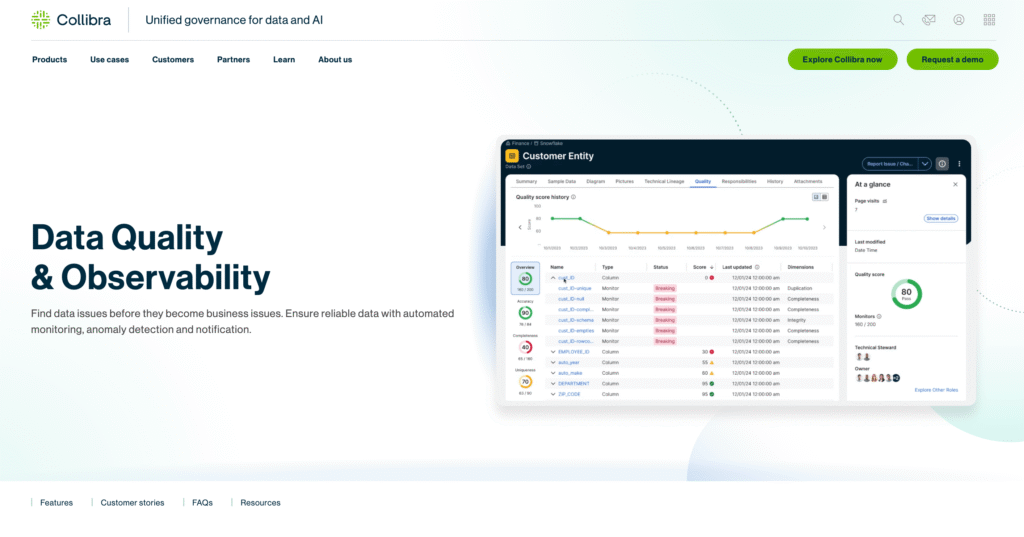
Collibra is widely regarded as a leading enterprise-grade data governance and data quality platform. It is built for organizations managing large, complex data environments, especially those operating across hybrid and multi-cloud ecosystems. Collibra’s core objective is to help businesses find, understand, trust, and confidently use their data, particularly as data and AI initiatives become central to decision-making.
In 2026, data quality is no longer optional. Enterprises must ensure that analytics, reporting, and AI models are built on accurate, well-governed data. Collibra Data Quality is designed to meet this challenge by tightly integrating data quality, observability, and governance into a single, business-friendly platform. This makes it especially valuable for large organizations where data ownership, compliance, and accountability are critical.
Advanced Data Discovery and Profiling Capabilities
Collibra Data Quality accelerates data understanding by automatically discovering and profiling data across multiple sources. The platform identifies data structure, content types, classifications, and sensitivity levels without heavy manual effort. This capability allows organizations to quickly understand what data they have, where it resides, and how it should be used.
Automated profiling reduces the risk of hidden data issues and supports faster onboarding of new data sources. For enterprises managing thousands of datasets, this level of automation is essential to maintain consistent data quality at scale.
Intelligent Rule Creation and Adaptive Quality Controls
A major strength of Collibra Data Quality is its simplified approach to rule creation. The platform enables no-code and self-service rule generation, allowing both technical and business users to define data quality expectations. These rules are automatically linked to datasets and adjust thresholds dynamically to reduce false positives.
This adaptive behavior is particularly important in modern data environments where data patterns change frequently. Instead of static rules that break over time, Collibra’s rules evolve with the data, ensuring continuous and reliable quality monitoring.
Automated Monitoring, Observability, and Impact Analysis
Collibra continuously monitors data sources, systems, and pipelines to detect issues as soon as they occur. Using multiple machine learning techniques, the platform can identify hidden anomalies that fall outside normal data behavior, even when no predefined rules exist.
Beyond detection, Collibra also analyzes root causes and downstream impacts. This allows teams to understand not only what went wrong, but also which reports, dashboards, or AI models are affected. Such visibility helps organizations prioritize fixes based on real business impact rather than technical severity alone.
Proactive Notifications and Business-Aligned Response
Collibra Data Quality includes intelligent notification and workflow capabilities that alert the right stakeholders when issues arise. Notifications are aligned with business context, ensuring that data owners, stewards, and consumers are all informed.
This coordinated response model reduces resolution times and prevents data issues from spreading across the organization. By linking data quality incidents to business processes, Collibra helps enterprises move from reactive troubleshooting to proactive data management.
Integrated Data Catalog, Governance, and Compliance
One of Collibra’s defining advantages is its deep integration of data quality with governance. The platform includes a comprehensive data catalog, business glossary, privacy controls, and strong lineage visualization. These features work together to create transparency and accountability across the entire data lifecycle.
Recent platform enhancements further unify data quality, observability, and governance, making it easier for organizations to manage AI-ready data while meeting regulatory and compliance requirements. This integrated design is especially valuable in regulated industries such as finance, healthcare, and insurance.
Core Capability Overview and Enterprise Value
Capability Area Enterprise Benefit
Automated data discovery Faster understanding of large data estates
No-code rule creation Broader adoption beyond technical teams
Adaptive quality rules Fewer false positives and better accuracy
ML-based anomaly detection Early identification of hidden data issues
Lineage and impact analysis Faster root-cause resolution
Integrated governance and catalog Strong compliance and accountability
Market Adoption and User Confidence
Collibra is trusted by hundreds of organizations worldwide, including a significant number of large enterprises and Fortune 500 companies. Its customer base is predominantly enterprise-focused, reflecting its strength in handling complex governance and quality requirements.
User sentiment consistently highlights strong confidence in the platform’s governance depth, reliability, and business usability. High renewal intent and recommendation rates indicate that organizations view Collibra as a long-term strategic investment rather than a short-term tool.
Pricing Structure and Enterprise Investment
Collibra operates on an annual subscription licensing model for its cloud platform. Pricing typically reflects enterprise-scale usage, with contract terms spanning one to three years. Costs can vary depending on user roles, feature sets, data volume, and integration complexity.
While the investment level is higher than entry-level data quality tools, the pricing aligns with Collibra’s enterprise focus. Organizations adopting the platform typically do so as part of a broader data governance and AI-readiness strategy, where the cost of poor data quality far exceeds platform investment.
Demonstrated Use Cases and Financial Impact
Collibra Data Quality delivers measurable business value across several critical use cases. Enterprises use the platform to certify trusted data for business reporting, ensuring that executives and analysts understand data quality and lineage before making decisions.
In compliance and risk management scenarios, Collibra helps organizations standardize business terminology, automate policy enforcement, and demonstrate regulatory compliance. This reduces audit risk and improves confidence in regulatory reporting.
Financially, organizations report substantial returns from Collibra implementations. Benefits include millions of dollars in annual business value, significant productivity gains for governance and analytics teams, and strong multi-year ROI. Data quality improvements also reduce rework, saving time and operational costs across departments.
Typical Measured Outcomes Reported by Enterprises
Performance Area Reported Improvement
Business benefits Multi-million annual impact
Three-year ROI Several hundred percent
Governance team productivity Around 25 to 30 percent increase
Analytics team productivity Over 10 percent increase
Rework reduction Up to 50 percent less rework time
Payback period Often within months
Why Collibra Is a Top Data Quality Platform for 2026
Collibra Data Quality stands out as one of the top data quality software solutions for 2026 due to its deep integration of quality, observability, and governance. Its ability to connect technical data checks with business context and financial impact makes it especially valuable for large, regulated, and data-driven organizations.
For enterprises investing heavily in analytics and AI, Collibra provides the trust layer required to ensure that decisions are based on accurate, well-governed data. Its strong ROI, enterprise adoption, and governance-first design position it as a leading choice for organizations that treat data quality as a strategic priority rather than a technical afterthought.
6. Oracle Enterprise Data Quality

Oracle is a global technology provider known for delivering large-scale cloud infrastructure, databases, and enterprise software. Oracle Enterprise Data Quality is designed to help organizations create and maintain trusted, accurate, and consistent master data across complex systems. The platform focuses on party and product data, ensuring that critical business information can be confidently used across applications, analytics platforms, and operational workflows.
In 2026, large enterprises face growing pressure to manage vast volumes of data while supporting AI initiatives, regulatory compliance, and real-time decision-making. Oracle Enterprise Data Quality is positioned to address these challenges by offering a mature and scalable data quality environment that integrates tightly with Oracle’s broader ecosystem, including databases, applications, and cloud infrastructure.
Comprehensive Data Profiling and Quality Assessment
Oracle Enterprise Data Quality provides advanced data profiling capabilities that help organizations understand the current state of their data. By analyzing structure, completeness, consistency, and integrity metrics, teams can quickly identify weaknesses and prioritize improvement efforts.
This profiling capability is especially valuable in environments where data comes from many systems and geographies. Enterprises can gain visibility into data issues early, reducing the risk of inaccurate reporting, failed integrations, or unreliable analytics.
Data Parsing, Standardization, and Global Coverage
A key strength of Oracle Enterprise Data Quality is its ability to parse, standardize, and validate data at scale. The platform supports complex formatting rules and global address validation across more than two hundred countries. This makes it well suited for multinational organizations managing customer, supplier, or partner data across regions.
Standardization ensures that data follows consistent formats and definitions, which is essential for downstream analytics, master data management, and regulatory reporting. By correcting inconsistencies at the source, organizations can significantly reduce downstream rework and manual fixes.
Data Matching, Deduplication, and Relationship Management
Oracle Enterprise Data Quality includes powerful matching and cleansing capabilities that operate in both real-time and batch modes. These features help identify duplicate records, resolve inconsistencies, and establish accurate relationships between entities.
This functionality is critical for master data initiatives, where duplicate or fragmented records can undermine trust in analytics and operational systems. By consolidating records into a single, accurate view, organizations improve data reliability across CRM, ERP, and reporting systems.
Business-Driven Workflows and Collaboration
The platform supports business-driven workflows that allow data quality rules, thresholds, and remediation processes to be defined collaboratively by business users and IT teams. This shared ownership model helps ensure that data quality standards reflect real business needs rather than purely technical criteria.
Built-in issue resolution workflows make it easier to track problems, assign responsibility, and monitor progress. This approach encourages accountability and helps embed data quality practices into daily operations rather than treating them as one-off projects.
Scalability and Cloud Compatibility
Oracle Enterprise Data Quality is designed for large-scale deployments and can handle very large datasets without compromising performance. This scalability makes it suitable for enterprises with millions or billions of records across multiple domains.
The platform is compatible with cloud-based tools and supports collaboration across global teams. When combined with Oracle’s cloud infrastructure, organizations can deploy data quality processes closer to where data is generated and consumed, supporting near real-time use cases.
Core Capability Overview and Enterprise Benefits
Capability Area Business Benefit
Data profiling Clear visibility into data health
Parsing and standardization Consistent formats across systems
Global address validation Reliable international data coverage
Matching and deduplication Single, trusted view of entities
Business-driven workflows Strong alignment between IT and business
Enterprise scalability Supports very large data volumes
Market Adoption and User Confidence
Oracle Enterprise Data Quality is most commonly used by large enterprises, particularly in technology-intensive and data-heavy industries. User feedback highlights strong performance in data cleansing accuracy, integration with enterprise systems, and suitability for complex environments.
Ratings across independent review platforms reflect solid user satisfaction, especially among organizations already invested in the Oracle ecosystem. Its adoption profile indicates that it is often chosen for mission-critical data quality initiatives where reliability and scale are essential.
Pricing Model and Investment Considerations
Oracle Enterprise Data Quality typically follows a processor-based licensing model, with pricing varying depending on the specific modules deployed. Different components, such as profiling, real-time processing, dashboards, and address verification, are licensed separately.
This pricing structure reflects the platform’s enterprise focus and depth of functionality. While some users describe the solution as expensive, it is often evaluated in the context of large-scale data environments where the cost of poor data quality can far exceed licensing fees. Organizations usually consider Oracle Enterprise Data Quality as part of a broader Oracle investment strategy.
Use Cases and Business Impact
Oracle Enterprise Data Quality supports a wide range of enterprise data initiatives. It is commonly used in master data management programs to clean and consolidate customer, supplier, and product data. In data governance and data integration scenarios, it helps ensure that data flowing between systems meets defined quality standards.
Organizations in education, public sector, and enterprise IT environments use the platform to maintain accurate records, improve reporting quality, and support compliance requirements. While direct ROI metrics for the data quality platform alone are not always isolated, broader Oracle case studies show significant gains in productivity, cost reduction, and operational efficiency when data quality is improved as part of an integrated cloud strategy.
Typical Outcomes Enabled by Improved Data Quality
Outcome Area Observed Impact
Data accuracy Fewer errors and inconsistencies
Operational efficiency Reduced manual correction effort
Reporting reliability Higher confidence in insights
Integration success Smoother system-to-system data flows
Decision-making Faster, more informed actions
Why Oracle Enterprise Data Quality Is a Strong Choice for 2026
Oracle Enterprise Data Quality stands out as one of the top data quality software solutions for 2026 because of its depth, scalability, and tight integration with enterprise systems. It is particularly well suited for large organizations managing complex, global datasets and operating within the Oracle technology ecosystem.
By combining robust profiling, cleansing, matching, and governance-oriented workflows, the platform helps enterprises maintain high data integrity at scale. For organizations where data quality directly impacts analytics, compliance, and operational performance, Oracle Enterprise Data Quality offers a proven and enterprise-ready foundation for trusted data in 2026.
7. SAP Data Services

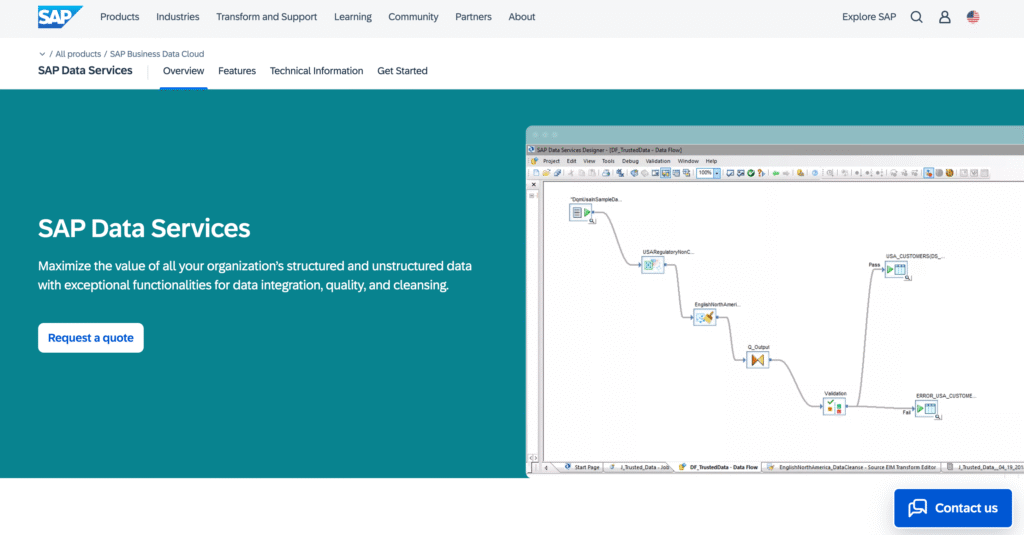
SAP is one of the world’s most established enterprise software providers, trusted by the largest organizations to run mission-critical operations. SAP Data Services is designed to help enterprises unlock real value from their data by ensuring it is accurate, complete, consistent, and ready for both operational and analytical use.
As organizations move deeper into AI, automation, and real-time decision-making in 2026, data quality becomes a foundational requirement. SAP Data Services addresses this need by combining data integration, data quality, and data cleansing within a single enterprise-grade platform. It enables IT and data teams to confidently deliver trusted data across systems, departments, and business processes.
Universal Data Access Across Complex Environments
SAP Data Services is built to work across highly complex enterprise landscapes. It provides universal access to both SAP and non-SAP data sources through native connectors, allowing organizations to integrate data from ERP systems, cloud platforms, legacy databases, and third-party applications.
This broad connectivity helps eliminate data silos and ensures that all critical business data can be accessed, transformed, and governed consistently. For enterprises operating hybrid or multi-system environments, this capability is essential for maintaining a single version of truth.
Advanced Data Transformation and Cleansing Capabilities
At the core of SAP Data Services is a powerful data transformation and cleansing engine. The platform supports profiling, enrichment, harmonization, and standardization of data across multiple domains, including customer, supplier, and address data. It can identify duplicates, correct inconsistencies, and apply standardized business rules at scale.
The platform supports batch, microbatch, and real-time processing, making it suitable for both large-scale data migrations and ongoing operational workflows. This flexibility allows organizations to maintain high data quality whether data is processed periodically or streamed continuously.
Business-Friendly Interfaces and Reduced Manual Effort
SAP Data Services is designed with usability in mind, offering intuitive interfaces that make it easier for users to standardize, match, and correct data. These interfaces reduce reliance on custom coding and manual intervention, which helps lower error rates and speeds up data preparation cycles.
By simplifying how data quality rules and transformations are applied, the platform enables better collaboration between IT teams and business users. This shared approach ensures that data quality standards align closely with real business requirements.
Data Quality Visibility and Impact Analysis
The platform includes data quality dashboards that provide visibility into the health of data across systems. These dashboards show how data quality issues affect downstream applications, reports, and business processes.
This level of transparency helps organizations prioritize remediation efforts based on business impact rather than technical metrics alone. As a result, teams can focus on fixing the issues that matter most to operations, compliance, and decision-making.
Centralized Governance and Rule Management
SAP Data Services supports simplified data governance through centralized rule repositories and reusable objects. Business rules can be defined once and applied consistently across multiple datasets and processes.
This centralized approach improves consistency, reduces duplication of effort, and makes it easier to enforce enterprise-wide data standards. It also supports compliance initiatives by ensuring that data transformations and quality checks follow documented and auditable rules.
High Performance and Enterprise Scalability
Designed for large enterprises, SAP Data Services supports high-volume data processing through parallel execution, grid computing, and bulk loading techniques. This ensures stable performance even when handling very large datasets or complex transformations.
As data volumes continue to grow rapidly, this scalability allows organizations to expand their data initiatives without sacrificing data quality or system reliability.
Core Capability Overview and Business Value
Capability Area Business Value
Universal data access Eliminates data silos across systems
Data profiling and cleansing Improves accuracy and consistency
Duplicate detection Creates trusted master records
Real-time and batch processing Supports diverse operational needs
Data quality dashboards Highlights business impact of issues
Centralized governance rules Enforces consistent data standards
High-performance architecture Handles enterprise-scale data volumes
Market Adoption and User Confidence
SAP Data Services is widely adopted by large enterprises, particularly those already invested in SAP’s ecosystem. The platform has earned strong user ratings across independent review platforms, reflecting confidence in its stability, data quality capabilities, and enterprise readiness.
Its recognition as a customer-favored solution highlights long-term satisfaction and renewal intent. The fact that most of the world’s largest organizations rely on SAP technologies further reinforces trust in SAP Data Services as a dependable data quality solution.
Pricing Model and Deployment Flexibility
SAP Data Services is typically licensed under enterprise agreements and is also available through cloud marketplaces using a bring-your-own-license model. Infrastructure costs depend on deployment choices, such as cloud instance types and usage levels.
Pricing varies widely based on scale, functionality, and integration scope. While enterprise-level investment is required, organizations often view the cost in the context of broader SAP transformation programs, where improved data quality directly supports operational efficiency, compliance, and analytics performance.
Use Cases and Enterprise-Level Impact
SAP Data Services supports a wide range of enterprise use cases. Organizations use it to enable business transformation initiatives, modernize legacy systems, and support migrations to next-generation ERP platforms. It also plays a key role in maintaining data quality and regulatory compliance across industries.
Enterprises have leveraged SAP Data Services to improve inventory accuracy, enhance employee and customer experiences, and streamline complex system landscapes. The platform is particularly valuable in environments where data volumes are growing rapidly and real-time access to trusted data is essential for competitive advantage.
Typical Outcomes Enabled by SAP Data Services
Outcome Area Observed Benefit
Data accuracy Fewer errors across systems
Operational efficiency Reduced manual data correction
System modernization Smoother migrations and upgrades
Compliance and governance Stronger adherence to regulations
Real-time decision-making Faster access to trusted insights
Why SAP Data Services Is a Top Data Quality Platform for 2026
SAP Data Services earns its place among the top data quality software solutions for 2026 due to its deep integration capabilities, enterprise scalability, and strong alignment with SAP’s broader application ecosystem. It is particularly well suited for large organizations that require consistent, governed, and high-quality data across complex environments.
By combining robust data integration, advanced cleansing, and centralized governance, SAP Data Services helps enterprises transform raw data into a trusted and ever-ready resource. For organizations already relying on SAP technologies, it represents a natural and powerful foundation for maintaining data quality and supporting data-driven growth in 2026.
8. Experian Aperture Data Studio

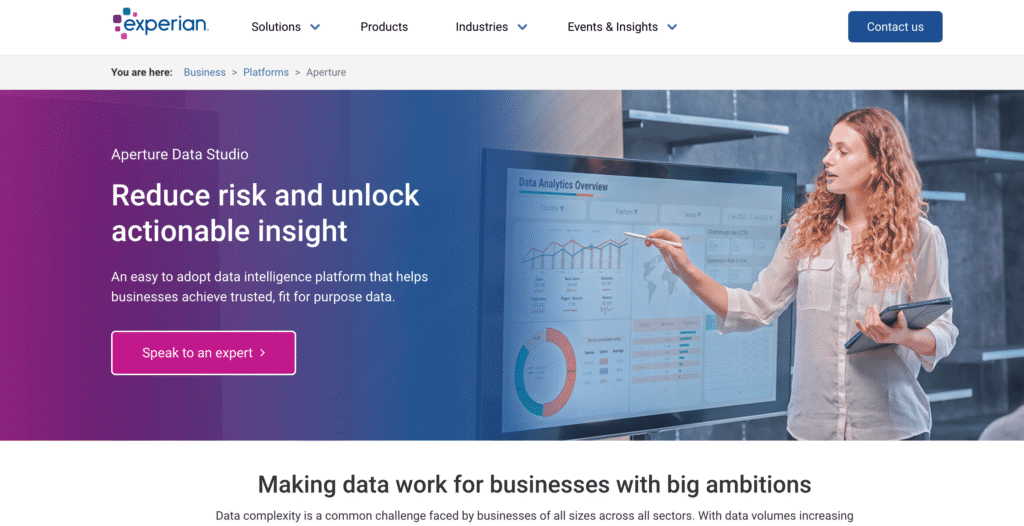
Experian is one of the world’s longest-established and most trusted data companies, with nearly two centuries of experience in managing, validating, and enriching data. Experian Aperture Data Studio represents the company’s modern, intelligent approach to data quality, combining self-service capabilities with enterprise-grade governance and enrichment.
In 2026, organizations are increasingly dependent on high-quality customer and operational data to support analytics, personalization, regulatory compliance, and AI initiatives. Aperture Data Studio is designed to meet these demands by enabling business and data teams to quickly understand, fix, enrich, and govern data within a single, unified platform. Its focus on usability, automation, and measurable business impact makes it especially relevant in a data-driven economy.
Advanced Data Profiling and Cleansing Capabilities
Experian Aperture Data Studio provides powerful data profiling tools that allow users to visually explore data patterns, detect inconsistencies, and identify anomalies across large datasets. These capabilities help organizations quickly assess the health of their data without extensive manual analysis.
Automated cleansing tools correct inaccuracies, standardize formats, and resolve inconsistencies at scale. By reducing reliance on manual checks, organizations can maintain high data accuracy while significantly lowering operational effort. This is particularly valuable for customer data, where even small errors can lead to poor experiences or compliance risks.
Data Enrichment and Real-Time Validation
One of the strongest differentiators of Experian Aperture Data Studio is its access to Experian’s extensive proprietary datasets. The platform enriches internal data with verified external information, improving completeness and reliability.
Real-time validation of phone numbers, email addresses, and credit-related attributes ensures that data is accurate at the point of capture. This capability is critical for organizations that rely on customer communications, credit assessments, and identity verification. Enrichment not only improves data quality but also enhances downstream analytics and personalization efforts.
AI-Powered Automation and Rule Creation
Experian Aperture Data Studio integrates artificial intelligence to simplify and accelerate data quality management. A standout feature is its use of Generative AI to create data quality rules from natural language prompts. This allows users to describe requirements in plain language and generate working rules almost instantly.
This AI-driven approach dramatically reduces setup time and lowers the barrier for non-technical users. By making advanced data quality functions more accessible, organizations can scale governance and quality initiatives without overburdening specialist teams.
Integrated Data Governance and Business Impact Analysis
Beyond cleansing and enrichment, Aperture Data Studio extends into data governance through an integrated catalog, governance templates, and lineage-aware controls. These features help organizations define ownership, standardize definitions, and manage policies across datasets.
A particularly valuable capability is business impact analysis. The platform allows teams to quantify the financial cost of poor data quality, linking data issues directly to revenue loss, operational inefficiencies, or compliance risks. This financial visibility helps justify data investments and prioritize remediation based on real business value.
Flexible Deployment for Enterprise Needs
Experian Aperture Data Studio supports both cloud-hosted and on-premise deployments. This flexibility allows organizations to align data quality initiatives with security, compliance, and infrastructure requirements.
Whether deployed centrally or across distributed environments, the platform is designed to scale with growing data volumes and user adoption, making it suitable for both mid-sized organizations and large global enterprises.
Core Capability Overview and Business Value
Capability Area Business Value
Data profiling and visualization Faster understanding of data health
Automated cleansing Higher accuracy with lower manual effort
Data enrichment More complete and reliable customer data
AI-driven rule creation Rapid setup and broader user adoption
Governance and catalog Strong control and accountability
Business impact analysis Clear financial justification for data quality
Market Adoption and User Confidence
Experian Aperture Data Studio has earned strong user satisfaction ratings across independent review platforms, reflecting confidence in both its functionality and ease of use. Experian’s global presence, large workforce, and thousands of corporate customers underscore its stability and long-term commitment to data quality innovation.
Organizations value the platform’s combination of governance depth, enrichment strength, and practical usability. High renewal and recommendation rates indicate that Aperture Data Studio is seen as a strategic, long-term solution rather than a tactical tool.
Pricing Structure and Commercial Considerations
Experian Aperture Data Studio is typically licensed on an annual subscription basis, with pricing tied to user roles, data volumes, and contract terms. Standard licenses include defined numbers of designers and consumers, supported record volumes, and training.
While enterprise-level investment is required, pricing reflects the platform’s advanced capabilities and access to proprietary enrichment data. Infrastructure costs may vary depending on deployment choices, particularly in cloud environments.
Real-World Use Cases and Measurable Outcomes
Experian Aperture Data Studio has delivered measurable results across multiple industries, particularly in customer data management. Organizations report dramatic improvements in operational efficiency, accuracy, and speed once automated quality checks replace manual processes.
Examples include major reductions in processing time, near-perfect data accuracy levels, and faster onboarding of new users. Financial institutions have used the platform to validate complex credit datasets in seconds rather than hours, while retail and financial brands have created unified customer views to support personalized marketing and loyalty programs.
Typical Measured Improvements
Performance Area Reported Outcome
Data accuracy Up to 99 percent accuracy
Manual processing time Reduced from days to minutes
Validation speed From hours to seconds
Operational cost savings Around 30 to 40 percent
User onboarding time Weeks reduced to days
Why Experian Aperture Data Studio Is a Top Data Quality Platform for 2026
Experian Aperture Data Studio stands out as one of the top data quality software solutions for 2026 because it combines trusted data expertise, advanced AI automation, and strong governance within a single platform. Its ability to enrich data using proprietary datasets gives it a unique advantage, especially for customer-centric organizations.
By linking data quality improvements directly to financial impact, the platform helps businesses move beyond technical metrics and focus on real outcomes. For organizations prioritizing customer data accuracy, regulatory confidence, and measurable ROI, Experian Aperture Data Studio represents a powerful and future-ready data quality solution.
9. Precisely Trillium Quality


Precisely is a global provider focused on helping organizations maintain accurate, consistent, and reliable data across complex environments. Its portfolio spans data integration, data quality, data governance, enrichment, and location intelligence. Precisely Trillium Quality sits at the center of this portfolio as an enterprise-grade data quality platform built to scale with changing business needs.
In 2026, enterprises face increasing pressure to manage data across multiple systems, regions, and formats while supporting analytics, AI, and regulatory compliance. Precisely Trillium Quality addresses these challenges by delivering a flexible and proven solution that works consistently in batch or real-time scenarios, on-premises or in the cloud. This adaptability makes it especially valuable for organizations with diverse and evolving data landscapes.
Advanced Data Cleansing and Standardization
Precisely Trillium Quality is designed to understand and process data in its natural form, without requiring extensive pre-formatting or manual preparation. The platform automatically interprets customer, product, and financial data across different contexts and regions, simplifying data quality operations.
Its advanced clustering and entity resolution capabilities help identify duplicates, link related records, and establish trusted views of key business entities. By applying consistent transformation and standardization rules, organizations can reduce inconsistencies and ensure that data is ready for analytics and operational use.
Comprehensive Data Profiling and Visualization
The platform includes strong data profiling and visualization features that allow teams to examine data quality and integrity metrics in detail. Users can analyze datasets at both column and relationship levels, quickly identifying anomalies, missing values, or rule violations.
This profiling capability supports early detection of data issues and helps organizations prioritize remediation efforts. By providing clear visual insights, Precisely Trillium Quality makes it easier for both technical and non-technical users to understand data health and trends over time.
Flexible Deployment Across Environments
One of the defining strengths of Precisely Trillium Quality is its deployment flexibility. The same rule sets and quality standards can be applied across unlimited applications and systems, whether data is processed in batch or real time.
Organizations can deploy the platform on-premises, in the cloud, or in hybrid environments without redesigning their data quality logic. This consistency reduces complexity, lowers maintenance effort, and ensures uniform data quality across the enterprise.
Global Verification and Address Intelligence
Precisely Trillium Quality applies global verification rules built from country-specific reference data. It uses appropriate postal and regional standards to clean and correct names and addresses, making it well suited for organizations operating internationally.
This global coverage improves accuracy in customer and supplier data, supports regulatory requirements, and enhances downstream processes such as billing, logistics, and customer communications.
Open APIs and Centralized Control
The platform provides open APIs that enable seamless integration with custom applications and third-party systems. This openness allows organizations to embed data quality services directly into operational workflows while maintaining centralized control.
Centralized management ensures that quality rules, standards, and updates are governed from a single location. This approach reduces duplication, improves consistency, and supports enterprise-wide data governance initiatives.
Core Capability Overview and Enterprise Value
Capability Area Business Value
Data cleansing and standardization Accurate and consistent enterprise data
Entity resolution and clustering Trusted single views of key entities
Data profiling and visualization Faster identification of data issues
Flexible deployment Consistent quality across environments
Global verification rules Reliable international data handling
Open APIs and central governance Scalable and controlled integration
Market Adoption and User Confidence
Precisely Trillium Quality has built a strong reputation among enterprise users, particularly in data-intensive and regulated industries. Independent reviews consistently highlight high satisfaction, with users praising its accuracy, reliability, and flexibility.
The platform is trusted by thousands of organizations worldwide, including many large enterprises and a significant share of Fortune 100 companies. High recommendation rates reflect confidence in the solution’s long-term value and enterprise readiness.
Pricing Structure and Investment Considerations
Specific pricing for Precisely Trillium Quality is typically provided through custom enterprise agreements, reflecting deployment scale, data volumes, and functional scope. While public pricing details are limited, the platform is positioned as an enterprise investment aligned with mission-critical data quality initiatives.
Organizations evaluating Precisely Trillium Quality often consider it alongside broader data integrity programs, where the cost of data errors, rework, and compliance failures can significantly outweigh platform licensing costs.
Use Cases and Measurable Business Benefits
Precisely Trillium Quality is widely used to improve data accuracy, reduce redundancy, and support better decision-making. Organizations leverage the platform to build reliable business insights by ensuring that analytics and reporting are based on high-quality data delivered at speed.
The platform has been successfully integrated into master data management initiatives, including address cleansing for large regional datasets. Its discovery and anomaly detection capabilities are particularly valued for quickly spotting issues that might otherwise remain hidden.
Industries such as finance and healthcare rely on Precisely Trillium Quality to support compliance and operational precision, while retailers use it to streamline customer data management and manufacturers benefit from improved supply chain visibility.
Typical Outcomes Enabled by Precisely Trillium Quality
Outcome Area Observed Benefit
Data accuracy Fewer errors and duplicates
Operational efficiency Reduced rework and manual fixes
Analytics reliability Stronger business insights
Regulatory compliance Improved data consistency and auditability
User adoption Effective for both business and IT teams
Why Precisely Trillium Quality Is a Top Data Quality Platform for 2026
Precisely Trillium Quality earns its place among the top data quality software solutions for 2026 due to its deep focus on data integrity, global coverage, and deployment flexibility. Its ability to apply consistent quality standards across diverse systems and environments makes it particularly well suited for large and complex enterprises.
By combining powerful cleansing, profiling, and governance-friendly controls with an adaptable architecture, the platform helps organizations maintain trusted data at scale. For enterprises seeking a reliable and proven solution to support data quality, compliance, and analytics in 2026, Precisely Trillium Quality stands out as a strong and future-ready choice.
10. SAS Data Quality
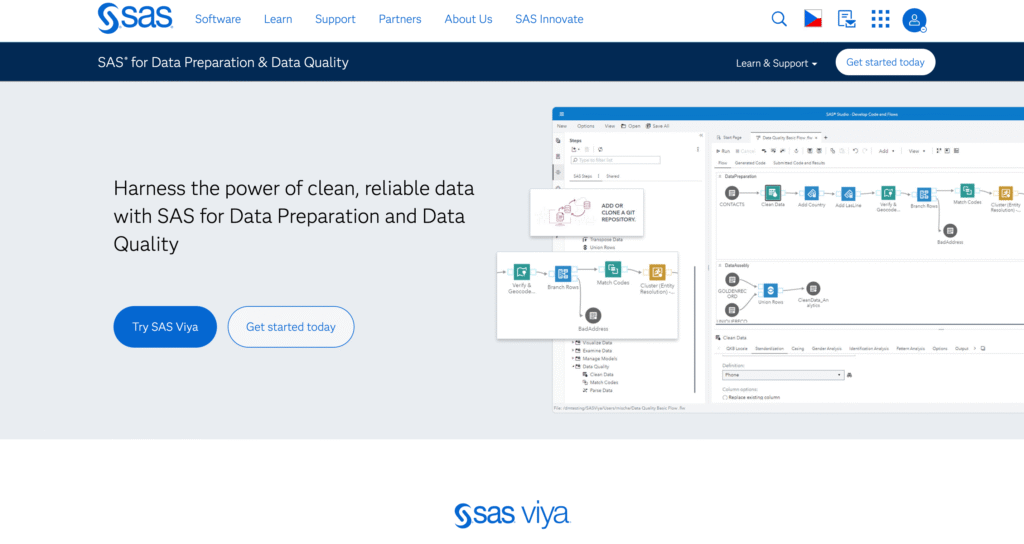
SAS is one of the most established analytics and data management companies in the world, with decades of experience supporting data-driven decision-making across industries. SAS Data Quality is built on this legacy, offering a mature and reliable solution designed to improve data accuracy, consistency, and trust without forcing organizations to move or duplicate data.
In 2026, enterprises are increasingly focused on using data directly where it resides, especially in cloud and hybrid environments. SAS Data Quality is specifically designed to work in-place, reducing complexity while ensuring that data used for analytics, reporting, and AI initiatives meets high quality standards. Its strong emphasis on business usability makes it particularly attractive to organizations that want to empower non-technical users.
Business-Friendly Data Preparation and Usability
SAS Data Quality is intentionally designed for business users rather than purely technical teams. Its visual, low-code interface allows users to blend, cleanse, and prepare data independently, without needing programming skills, SQL expertise, or heavy IT involvement.
Prebuilt transformations and cleansing functions run in memory, enabling fast processing and near-real-time responses. This approach significantly reduces turnaround times for analytics projects and allows teams to respond quickly to changing business requirements.
Low-Code and No-Code Data Quality Capabilities
The platform provides a powerful low-code and no-code environment for building data quality workflows. Users can apply industry-proven profiling, standardization, and entity resolution techniques through visual flows rather than scripts.
This flexibility allows organizations to scale data quality efforts beyond small specialist teams. Business analysts, data stewards, and operational users can actively participate in improving data quality, increasing adoption and long-term sustainability.
Collaboration, Reuse, and Enterprise Consistency
SAS Data Quality operates within the broader SAS Viya platform, which supports collaboration and reuse across teams. Data preparation tasks, quality rules, and workflows can be shared and reused, ensuring consistency across departments and use cases.
This collaborative model reduces duplication of effort and helps organizations standardize how data quality is managed across the enterprise. It also supports governance initiatives by ensuring that approved rules and processes are applied consistently.
Data Discovery and Visibility
The platform includes automated data discovery capabilities through its information catalog tools. These crawlers help organizations locate, understand, and assess data assets more efficiently.
By improving visibility into available datasets and their quality characteristics, SAS Data Quality enables faster onboarding of new data sources and more informed decision-making around data usage.
Cloud-Native and Cloud-Agnostic Architecture
SAS Data Quality is built on the cloud-native SAS Viya architecture, allowing it to run on major cloud platforms such as Microsoft Azure, Amazon Web Services, and Google Cloud. Organizations can choose between SAS-managed or self-managed deployments depending on security, compliance, and operational requirements.
This cloud-agnostic design ensures long-term flexibility and protects organizations from vendor lock-in, making the platform suitable for evolving IT strategies through 2026 and beyond.
Core Capability Overview and Business Value
Capability Area Business Value
Visual data preparation Faster adoption by business users
Low-code and no-code workflows Reduced dependency on IT teams
In-memory processing Near-real-time data quality actions
Collaboration and reuse Consistent standards across teams
Automated data discovery Improved visibility and governance
Cloud-native deployment Scalable and future-ready architecture
Market Adoption and User Confidence
SAS Data Quality consistently receives solid user ratings across independent review platforms, reflecting trust in its stability, usability, and analytical depth. SAS’s leadership in advanced and predictive analytics further strengthens confidence in its data quality offerings.
Organizations across multiple industries rely on SAS to support mission-critical analytics, which reinforces the perception of SAS Data Quality as a dependable and enterprise-ready solution. High customer satisfaction and positive sentiment indicate strong long-term value.
Pricing Model and Value Considerations
SAS Data Quality is typically licensed on an annual basis, with pricing tied to usage credits and deployment scale. While it may not be positioned as a low-cost option, many users report strong value for money given the platform’s depth, performance, and integration with advanced analytics.
SAS also offers flexible pricing models across its broader portfolio, allowing organizations to align data quality investments with analytics, AI, and cloud initiatives.
Use Cases and Measurable Business Impact
SAS Data Quality supports a wide range of data quality operations, including parsing, standardization, fuzzy matching, and bias reduction. Organizations use it to clean and prepare data for analysts, significantly improving confidence in downstream analytics.
Operational teams rely on the platform to maintain accurate location, customer, supplier, and employee data, enabling smoother day-to-day operations. By ensuring data accuracy at the source, organizations can operate faster and reduce costly rework.
SAS’s strong foundation in predictive analytics amplifies the value of clean data. Improved data quality directly supports advanced analytics use cases such as fraud detection, customer analytics, and forecasting, where even small data errors can have large financial impacts.
Typical Outcomes Reported by Organizations
Outcome Area Observed Benefit
Data accuracy More complete and reliable datasets
Bias reduction Fairer and more trustworthy analytics
Operational efficiency Faster processes and fewer errors
Cost optimization Reduced operating and labor costs
Revenue and profit growth Improved outcomes from better insights
Why SAS Data Quality Is a Top Choice for 2026
SAS Data Quality stands out as one of the top data quality software solutions for 2026 because it combines deep analytics expertise with practical, business-focused usability. Its ability to improve data quality without forcing data movement, while supporting advanced analytics and AI, makes it highly relevant in modern enterprise environments.
For organizations seeking a proven, scalable, and business-friendly data quality solution that directly supports trusted decision-making and operational efficiency, SAS Data Quality remains a strong and future-ready choice in 2026.
Conclusion
As organizations move deeper into a data-driven, AI-powered, and highly regulated digital economy, data quality has shifted from being a technical concern to a core business priority. In 2026, the success of analytics initiatives, artificial intelligence models, regulatory compliance programs, and real-time decision-making depends heavily on the reliability, accuracy, and consistency of underlying data. Poor data quality no longer results only in reporting errors; it leads to flawed AI outputs, compliance risks, operational inefficiencies, lost revenue, and erosion of customer trust.
The software solutions featured in this list of the Top 10 Best Data Quality Software To Try In 2026 represent the most mature, capable, and future-ready platforms available today. Each solution brings a distinct strength to the table, ranging from enterprise-scale governance and observability to AI-driven automation, self-service usability, global data enrichment, and deep integration with modern cloud and analytics ecosystems. Together, they reflect how far data quality technology has evolved and how central it has become to modern business strategy.
One of the most important trends shaping data quality in 2026 is the convergence of data quality, data governance, and data observability. Leading platforms no longer treat these as separate disciplines. Instead, they unify profiling, cleansing, rule management, monitoring, lineage, and business context into a single, cohesive framework. This integrated approach allows organizations to move from reactive data fixing to proactive data prevention, ensuring issues are identified, prioritized, and resolved before they impact critical business processes or AI models.
Another defining theme across the top data quality platforms is the increasing use of artificial intelligence and automation. AI-powered profiling, anomaly detection, adaptive rules, and even generative rule creation are dramatically reducing manual effort and accelerating time to value. These capabilities make data quality more scalable and accessible, allowing business users, data stewards, and analysts to actively participate without relying exclusively on technical specialists. As data volumes continue to grow exponentially, automation is no longer optional; it is essential.
Equally important is the shift toward measurable business impact. Modern data quality software is no longer evaluated only on technical metrics such as error rates or duplicate counts. The most advanced platforms help organizations quantify the financial cost of poor data quality and clearly demonstrate return on investment. By linking data issues to revenue loss, operational inefficiencies, compliance exposure, or customer experience degradation, these tools enable stronger executive buy-in and faster prioritization of data initiatives.
Deployment flexibility is also a critical consideration for 2026. Organizations operate across hybrid, multi-cloud, and on-premise environments, often simultaneously. The best data quality solutions are cloud-agnostic, scalable, and capable of running in real time or batch mode using consistent rules and standards. This flexibility ensures that data quality remains intact regardless of where data is created, processed, or consumed.
It is also clear that there is no one-size-fits-all solution. Some organizations may prioritize deep enterprise governance and regulatory compliance, while others may focus on self-service data preparation, customer data enrichment, or AI-readiness. The key is alignment between business objectives, data maturity, regulatory requirements, and technical architecture. Choosing the right data quality software in 2026 means selecting a platform that not only solves today’s problems but can scale with future data, AI, and compliance demands.
Ultimately, investing in the right data quality software is an investment in trust. Trust in analytics. Trust in AI outputs. Trust in regulatory reporting. Trust in customer-facing systems. The platforms highlighted in this guide stand out because they help organizations build and sustain that trust at scale, turning raw data into a dependable foundation for growth, innovation, and competitive advantage.
As data continues to be one of the most valuable assets in the digital economy, organizations that prioritize data quality today will be the ones best positioned to succeed in 2026 and beyond.
If you find this article useful, why not share it with your hiring manager and C-level suite friends and also leave a nice comment below?
We, at the 9cv9 Research Team, strive to bring the latest and most meaningful data, guides, and statistics to your doorstep.
To get access to top-quality guides, click over to 9cv9 Blog.
To hire top talents using our modern AI-powered recruitment agency, find out more at 9cv9 Modern AI-Powered Recruitment Agency.
People Also Ask
What is data quality software and why is it important in 2026
Data quality software ensures data is accurate, complete, and consistent. In 2026, it is essential for AI models, analytics, compliance, and reliable business decision making.
What makes data quality software different from data integration tools
Data quality software focuses on cleansing, profiling, validating, and monitoring data, while data integration tools mainly move and connect data between systems.
Why is data quality critical for AI and machine learning
AI models rely on clean and unbiased data. Poor data quality leads to inaccurate predictions, biased outcomes, and unreliable automation.
What features should the best data quality software include in 2026
Key features include automated profiling, AI-driven rules, anomaly detection, data observability, governance integration, and scalability.
Is data quality software only for large enterprises
No. Many modern platforms offer scalable and self-service options suitable for mid-sized businesses and growing organizations.
How does AI improve data quality software
AI automates profiling, detects hidden anomalies, adapts rules over time, and reduces manual effort, improving speed and accuracy.
What is data observability and why does it matter
Data observability monitors data health in real time, helping teams detect issues early and understand downstream business impact.
Can data quality software support regulatory compliance
Yes. It helps enforce data standards, track lineage, manage sensitive data, and support audits for regulations like GDPR and financial reporting rules.
What is the difference between data quality and data governance
Data quality focuses on fixing and monitoring data, while data governance defines ownership, policies, standards, and accountability.
How does data quality software reduce business costs
It reduces rework, prevents reporting errors, improves operational efficiency, and lowers the cost of bad data.
What industries benefit most from data quality software
Finance, healthcare, retail, manufacturing, telecom, and government benefit heavily due to compliance, scale, and data complexity.
Can data quality software work in real time
Yes. Many platforms support real-time validation and monitoring for streaming data and operational systems.
What is master data management and how is it related to data quality
Master data management creates a single trusted view of key entities, and data quality ensures that master data remains accurate and consistent.
Is cloud deployment necessary for data quality software in 2026
Not mandatory, but cloud and hybrid support provide flexibility, scalability, and easier integration with modern data platforms.
How long does it take to see ROI from data quality software
Many organizations see benefits within months through reduced errors, faster analytics, and improved operational efficiency.
Can business users use data quality software without technical skills
Yes. Modern tools offer low-code or no-code interfaces designed for analysts and data stewards.
What is data enrichment in data quality platforms
Data enrichment adds external or reference data to improve completeness, accuracy, and business context.
How does data quality software support analytics teams
It provides clean, trusted datasets, reducing time spent fixing data and increasing confidence in insights.
What role does automation play in modern data quality tools
Automation handles profiling, rule creation, monitoring, and remediation, making data quality scalable and sustainable.
Is data quality software expensive to implement
Costs vary, but the long-term savings and risk reduction often outweigh the initial investment.
How does data quality software handle duplicate records
It uses matching and entity resolution techniques to identify, merge, or link duplicate records.
Can data quality software integrate with BI and analytics tools
Yes. Leading platforms integrate with data warehouses, BI tools, and analytics platforms.
What is the impact of poor data quality on customer experience
Poor data leads to incorrect communications, personalization errors, and loss of customer trust.
How often should data quality checks run
Checks can run continuously, in real time, or on scheduled intervals depending on business needs.
What is data lineage and why is it important
Data lineage shows where data comes from and how it changes, helping with trust, compliance, and root cause analysis.
Can data quality software scale with growing data volumes
Yes. Enterprise platforms are designed to handle millions or billions of records efficiently.
How does data quality software support digital transformation
It ensures data reliability across systems, enabling automation, AI, and real-time decision making.
What should companies consider when choosing data quality software
They should assess scalability, AI capabilities, governance needs, integration, and measurable business impact.
Is data quality software a one-time project
No. Data quality is an ongoing process that requires continuous monitoring and improvement.
Why is 2026 a critical year for investing in data quality software
AI adoption, regulatory pressure, and data growth make trusted data essential for competitiveness and resilience.
Sources
Google Cloud
Datafloq
Informatica
Gartner
Collibra
Qlik
IDC
ContactPigeon
G2
Info-Tech
SoftwareReviews
Ataccama
Business Wire
DQLabs
Experian
Metaplane
Precisely
Enlyft
FirstEigen
Vendr
Software Trends
Amazon Web Services
Princeton IT Services
Talend
BARC
6sense
Rivery
Alteryx
LeadIQ
Business Quant
Mammoth Analytics
DataGalaxy
Data.World
Decube
Oracle
Redress Compliance
Oracle Licensing Experts
SAP
Deloitte
PeerSpot
TrustRadius
Bloor Research
SAS
HubSpot
Digital Marketplace UK