

Key Takeaways
- NVIDIA Nemotron 3.5 ASR Streaming Multilingual 0.6B uses a cache-aware FastConformer-RNNT architecture to deliver efficient, low-latency real-time speech recognition.
- The model supports 40 language-locales, automatic language detection, native punctuation and configurable streaming latency from 80 milliseconds to 1.12 seconds.
- Nemotron 3.5 ASR is designed for scalable voice AI applications, including multilingual AI agents, live transcription, contact centers, meeting assistants and speech analytics.
NVIDIA Nemotron 3.5 ASR Streaming Multilingual 0.6B delivers real-time speech-to-text across 40 language-locales using a cache-aware streaming architecture. The 600-million-parameter model supports configurable latency, automatic language detection, punctuation and capitalization, making it suitable for multilingual voice agents, live transcription, contact centers and conversational AI systems.
Real-time speech recognition is becoming a critical infrastructure layer for AI voice agents, live captioning, contact centers, meeting assistants, accessibility tools, and multilingual conversational AI. Yet streaming speech-to-text systems face a difficult engineering challenge: they must accurately understand speech while keeping latency low enough for natural interaction and infrastructure costs manageable at scale.


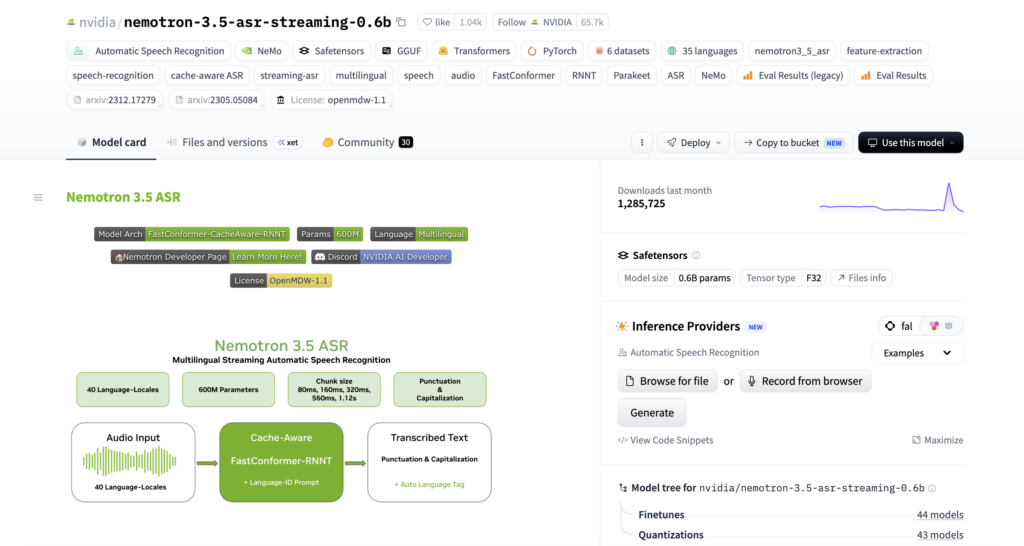
NVIDIA Nemotron 3.5 ASR Streaming Multilingual 0.6B is designed specifically for this problem. The approximately 600-million-parameter automatic speech recognition model combines multilingual speech-to-text with a cache-aware FastConformer-RNNT architecture that preserves useful information from previous audio chunks. Instead of repeatedly processing overlapping sections of audio, the model can reuse cached states as new speech arrives, reducing redundant computation during continuous transcription.
The model supports 40 language-locales across different readiness tiers and includes automatic language detection, native punctuation and capitalization, and configurable streaming behavior. Its supported chunk configurations range from 80 milliseconds to 1.12 seconds, allowing developers to adjust the balance between responsiveness, recognition accuracy, and inference efficiency for different applications.
This flexibility makes Nemotron 3.5 ASR particularly relevant to modern voice AI. A highly interactive AI assistant may prioritize very small audio chunks for faster responses, while a contact-center transcription system can tolerate additional latency in exchange for greater context and higher processing efficiency. NVIDIA’s H100 benchmarks also demonstrate how cache-aware streaming can substantially increase the number of simultaneous real-time streams compared with buffered streaming approaches.
Nemotron 3.5 ASR is not a complete voice agent by itself. Rather, it can serve as the speech-recognition layer within a larger system that includes voice activity detection, turn detection, an AI model or agent, business tools, and text-to-speech generation. Its relatively compact model size and emerging local inference ecosystem also make it relevant to organizations exploring private, self-hosted, and edge speech processing.
This guide explains what NVIDIA Nemotron 3.5 ASR Streaming Multilingual 0.6B is, how its cache-aware architecture works, which languages it supports, how latency and accuracy can be configured, how it was trained, and how it performs under high-concurrency workloads. It also examines deployment economics, local inference, production integrations, real-world use cases, and the technical limitations developers should consider before adopting it for multilingual voice AI.
NVIDIA Nemotron 3.5 ASR Streaming Multilingual 0.6B: What It Is & How It Works
- Executive Overview
- Detailed Model Architecture and Cache-Aware Mechanics
- The Latency-Accuracy Pareto Frontier
- Multilingual Scope and Benchmark Performance
- Training Regimes and Synthetic Distillation Pipelines
- Hardware Concurrency, Edge Quantization, and Cost Economics
- Production Integration Patterns and Real-World Implementations
- Technical Limitations and Operational Considerations
1. Executive Overview
NVIDIA Nemotron 3.5 ASR Streaming Multilingual 0.6B is a 600-million-parameter automatic speech recognition model designed specifically for real-time, multilingual speech-to-text applications. Released in June 2026, it extends NVIDIA’s earlier English-focused Nemotron streaming ASR technology into a single model covering 40 language-locales.
Its main distinction is not simply multilingual transcription. Nemotron 3.5 ASR was engineered around a cache-aware streaming architecture that processes new audio while retaining useful computational state from previous audio frames. This approach reduces the repeated computation associated with conventional buffered streaming systems and enables substantially higher numbers of simultaneous speech streams on GPU infrastructure.
The model combines a Cache-Aware FastConformer encoder, an RNN-Transducer decoder and language-ID prompt conditioning. It can generate punctuation and capitalization directly and allows applications to change the streaming chunk size at runtime, creating a configurable trade-off between responsiveness, accuracy and throughput.
What Is NVIDIA Nemotron 3.5 ASR Streaming Multilingual 0.6B?
Nemotron 3.5 ASR is a speech-to-text foundation model optimized for situations where audio must be transcribed while a person is still speaking.
Instead of waiting for an entire recording, meeting or conversation to finish, the system receives small pieces of incoming audio and incrementally converts them into text. This makes the architecture particularly relevant to AI voice agents, live captions, contact centers, meeting transcription, conversational interfaces and other applications where waiting several seconds for a transcription can noticeably affect the user experience.
NVIDIA describes the model as supporting both low-latency streaming and high-throughput speech-recognition workloads. It is also available as an open-weight model under the OpenMDW-1.1 license.
| Model Attribute | NVIDIA Nemotron 3.5 ASR Streaming Multilingual 0.6B |
|---|---|
| Model type | Streaming automatic speech recognition |
| Parameter count | Approximately 600 million |
| Core architecture | Cache-Aware FastConformer with RNN-T decoder |
| Encoder depth | 24 layers |
| Language mechanism | Language-ID prompt conditioning |
| Language coverage | 40 language-locales |
| Automatic language detection | Supported |
| Streaming chunk sizes | 80, 160, 320, 560 and 1,120 milliseconds |
| Text formatting | Native punctuation and capitalization |
| Primary workload | Real-time multilingual speech-to-text |
| License | OpenMDW-1.1 |
| Initial model release | June 4, 2026 |
Why NVIDIA Built a Cache-Aware Streaming ASR Model
Real-time speech recognition creates a different engineering problem from transcribing completed recordings.
A buffered system can repeatedly examine overlapping portions of an audio stream to retain context. The disadvantage is that some audio is processed multiple times. As the number of concurrent users increases, that redundant computation can become an important infrastructure and GPU-capacity problem.
Nemotron 3.5 ASR takes a different approach.
Its FastConformer encoder maintains cached information from previous processing steps. When another audio chunk arrives, the model can reuse the relevant internal state instead of recomputing overlapping audio frames. NVIDIA describes this as strictly non-overlapping processing.
| Streaming Approach | Audio Processing Method | Computational Effect | Production Implication |
|---|---|---|---|
| Offline transcription | Processes completed audio | Efficient for completed files | Poor fit for immediate conversational text |
| Buffered streaming | Reprocesses overlapping audio windows | Creates repeated computation | GPU demand rises with concurrency |
| Cache-aware streaming | Processes new chunks and reuses cached state | Reduces redundant encoder computation | Better suited to large real-time workloads |
How Nemotron 3.5 ASR Works
The transcription pipeline can be understood as several connected stages.
Incoming speech is divided into small streaming chunks. The Cache-Aware FastConformer encoder extracts acoustic representations from the new audio while retaining context through cached encoder states.
A language representation is then introduced through language-ID prompt conditioning. The acoustic and language representations are combined before being passed toward the RNN-T decoding system, which incrementally predicts text tokens from the incoming speech.
The simplified workflow is:
| Processing Stage | What Happens |
|---|---|
| Audio ingestion | Live audio enters the speech-recognition pipeline |
| Chunking | Audio is divided according to the selected streaming window |
| Acoustic encoding | FastConformer converts speech into acoustic representations |
| State caching | Previous encoder information is retained for reuse |
| Language conditioning | Language identity helps condition transcription |
| Feature fusion | Acoustic and language representations are combined |
| RNN-T decoding | The decoder incrementally predicts text tokens |
| Text formatting | Capitalization and punctuation are generated |
| Streaming output | Transcribed text becomes available to the application |
Cache-Aware FastConformer Architecture
FastConformer forms the acoustic-processing backbone of Nemotron 3.5 ASR.
The model uses a 24-layer cache-aware FastConformer encoder. Self-attention and convolution states can be cached across streaming steps, allowing information from earlier speech to remain available without repeatedly processing the corresponding audio.
This is particularly important for conversational AI. A voice application does not simply need an accurate transcript; it needs that transcript quickly enough for downstream language models, retrieval systems or agents to begin determining what the speaker wants.
The architecture therefore targets three production objectives simultaneously:
| Engineering Objective | Nemotron 3.5 ASR Approach |
|---|---|
| Low latency | Small configurable streaming chunks |
| Context preservation | Cached encoder states |
| High throughput | Elimination of overlapping encoder computation |
| Multilingual operation | Shared model with language-ID conditioning |
| Readable transcription | Native punctuation and capitalization |
| Deployment flexibility | Runtime-selectable streaming configuration |
Language-ID Prompt Conditioning
Multilingual speech recognition introduces another challenge: the acoustic model needs to distinguish linguistic patterns that may differ substantially between languages.
Nemotron 3.5 ASR introduces language-ID prompt conditioning into the transcription architecture. The language representation is combined with acoustic features before they are projected toward the RNN-T decoder. This gives the transcription process explicit information about the language being processed.
The system can also operate with automatic language detection. In this mode, applications do not necessarily need to specify the language manually for every utterance.
This is particularly valuable for international platforms where one speech-recognition service may receive conversations from many different markets.
Understanding the 40 Language-Locales
The headline figure of 40 language-locales requires some qualification.
NVIDIA divides support into different readiness levels. According to the model documentation, 32 locales provide out-of-the-box transcription across transcription-ready and broad-coverage categories, while another eight are adaptation-ready and are intended to benefit from additional fine-tuning for full transcription capability.
| Language Support Tier | Number of Locales | Intended Status |
|---|---|---|
| Transcription-ready | 19 | Highest out-of-the-box ASR readiness |
| Broad-coverage | 13 | Additional supported transcription markets |
| Adaptation-ready | 8 | Intended for domain or language-specific fine-tuning |
| Total | 40 | Combined multilingual model coverage |
This distinction matters for enterprises evaluating the model. “40 language-locales” should not be interpreted as identical accuracy or production maturity across every supported locale.
Configurable Streaming Latency
One of Nemotron 3.5 ASR’s most practical features is its configurable chunk size.
The model supports streaming increments of 80, 160, 320, 560 and 1,120 milliseconds. Applications can therefore select different operating points without training a separate model.
| Chunk Size | Relative Responsiveness | Relative Throughput Potential | Typical Deployment Priority |
|---|---|---|---|
| 80 ms | Very high | Lower | Interactive voice experiences |
| 160 ms | High | Moderate | Voice assistants and conversational AI |
| 320 ms | Balanced | Higher | General-purpose live transcription |
| 560 ms | Moderate | High | Large-scale transcription services |
| 1,120 ms | Lower | Very high | Throughput-focused streaming environments |
The exact configuration should depend on application requirements rather than assuming that the smallest chunk is universally superior. Larger chunks can improve the operating balance between accuracy, throughput and infrastructure utilization. NVIDIA’s FLEURS evaluations indicate that recognition accuracy generally improves as chunk size increases.
High-Concurrency Speech Recognition
The cache-aware design becomes particularly significant when hundreds or thousands of speech sessions are running simultaneously.
NVIDIA reports that a single H100 GPU can sustain approximately 240 concurrent real-time Nemotron streams at the 80-millisecond configuration and approximately 2,400 streams with 1,120-millisecond chunks. These figures represent measured NVIDIA configurations rather than guaranteed performance for every deployment.
| Streaming Configuration | Nemotron Concurrent Streams on One H100 | Buffered Parakeet RNNT 1.1B Comparison |
|---|---|---|
| 80 ms | Approximately 240 | Approximately 14 |
| 1,120 ms | Approximately 2,400 | Approximately 400 |
At the 80-millisecond setting, this represents roughly 17 times the concurrent streams reported for the compared buffered Parakeet model. At 1,120 milliseconds, the difference is approximately sixfold.
Nemotron 3.5 ASR Versus Traditional Buffered Streaming
| Capability | Traditional Buffered Streaming | Nemotron 3.5 Cache-Aware Streaming |
|---|---|---|
| Audio windows | Often overlapping | Non-overlapping |
| Previous audio computation | May be repeated | Cached representations are reused |
| Real-time operation | Possible | Native design objective |
| Multilingual deployment | Architecture-dependent | 40 language-locales |
| Runtime latency adjustment | Model-dependent | Five configurable chunk sizes |
| Language conditioning | Model-dependent | Language-ID prompting |
| Automatic language handling | Model-dependent | Supported |
| Punctuation | May require additional processing | Generated natively |
| Capitalization | May require additional processing | Generated natively |
| High-concurrency focus | Variable | Core architectural objective |
Where Nemotron 3.5 ASR Fits in the AI Stack
Nemotron 3.5 ASR should primarily be viewed as the listening layer of a real-time AI application.
It converts human speech into structured text quickly enough for another AI system to interpret the request, retrieve information, generate a response or execute an action.
| Application | Role of Nemotron 3.5 ASR |
|---|---|
| AI voice agents | Converts caller speech into text for an LLM |
| Customer service automation | Transcribes customer conversations in real time |
| Contact-center intelligence | Produces live transcripts for analysis |
| Meeting assistants | Generates multilingual meeting transcripts |
| Live captions | Converts speech into readable on-screen text |
| Voice search | Converts spoken queries into searchable text |
| Agentic AI systems | Provides speech input to downstream AI agents |
| Multilingual applications | Consolidates multiple markets into one ASR model |
| Speech analytics | Produces text for classification and extraction |
Why Nemotron 3.5 ASR Matters
Nemotron 3.5 ASR reflects a broader shift in speech AI from transcription as a background processing task toward speech recognition as real-time infrastructure for conversational AI.
For an AI voice agent, transcription latency becomes part of the overall conversational latency budget. Speech recognition must operate quickly enough that language-model inference, tool execution and speech generation can begin without making the interaction feel unnecessarily delayed.
Nemotron 3.5 ASR addresses this problem through cache-aware computation, runtime-adjustable streaming chunks and multilingual language conditioning. Its 0.6-billion-parameter scale also positions it as a comparatively compact model intended for production speech infrastructure rather than a general-purpose multimodal foundation model.
The result is an ASR architecture designed around the operational requirements of modern voice AI: low latency, high concurrency, multilingual coverage and efficient continuous processing. For organizations building multilingual voice agents, live transcription systems or large-scale conversational platforms, those characteristics may be more consequential than model size alone.
2. Detailed Model Architecture and Cache-Aware Mechanics
NVIDIA Nemotron 3.5 ASR Streaming Multilingual 0.6B is built around a Cache-Aware FastConformer-RNNT architecture designed specifically for continuous speech recognition. Rather than repeatedly processing overlapping portions of an audio stream, the model preserves encoder state between successive chunks and reuses that information as new audio arrives.
The architecture contains a 24-layer Cache-Aware FastConformer encoder, an RNN-T decoder and a multilingual language-ID conditioning mechanism. NVIDIA confirms that the model contains approximately 600 million parameters and produces punctuated, capitalized text while supporting runtime-configurable streaming latency.
At a high level, the processing pipeline can be represented as follows:
Audio Input
|
v
Acoustic Feature Extraction
|
v
FastConformer Subsampling
|
v
24-Layer Cache-Aware FastConformer
|
+———————-+
| |
v v
Acoustic Representation Language-ID Prompt
1,024 Dimensions 128 Dimensions
| |
+———-+———–+
|
v
Acoustic-Language Fusion
|
v
RNN-T Decoder
|
v
Punctuated, Capitalized Text
NVIDIA’s documentation specifically confirms a 1,024-dimensional acoustic representation and a 128-dimensional one-hot language vector. The language representation is expanded across time, concatenated with the acoustic representation and projected toward the RNN-T decoder.
Core Architecture at a Glance
| Architecture Component | Role in Nemotron 3.5 ASR |
|---|---|
| Model family | Cache-Aware FastConformer-RNNT |
| Model size | Approximately 600 million parameters |
| Encoder | 24-layer Cache-Aware FastConformer |
| Acoustic representation | 1,024 dimensions |
| Language representation | 128-dimensional one-hot prompt |
| Language conditioning | Acoustic and language feature fusion |
| Decoder | Recurrent Neural Network Transducer |
| Streaming mechanism | Persistent attention and convolution caches |
| Left attention context | 56 encoder frames |
| Configurable right context | 0, 1, 3, 6 or 13 frames |
| Effective frame duration | 80 milliseconds |
| Streaming chunks | 80, 160, 320, 560 or 1,120 milliseconds |
| Text output | Native capitalization and punctuation |
| Automatic language detection | Supported |
Acoustic Front-End and Temporal Subsampling
Nemotron 3.5 ASR receives mono audio and transforms the incoming waveform into an acoustic representation suitable for neural processing. The FastConformer family uses convolutional subsampling before the main encoder, substantially reducing the number of temporal positions that subsequently pass through computationally expensive attention layers.
For Nemotron 3.5 ASR, NVIDIA exposes streaming configuration in terms of 80-millisecond encoder frames. The smallest streaming configuration operates with one such frame, while progressively larger configurations incorporate additional right-context frames.
The resulting operating points are:
| Right Context | Processed Chunk | Approximate Audio Duration |
|---|---|---|
| 0 frames | 1 frame | 80 ms |
| 1 frame | 2 frames | 160 ms |
| 3 frames | 4 frames | 320 ms |
| 6 frames | 7 frames | 560 ms |
| 13 frames | 14 frames | 1,120 ms |
These settings allow developers to alter the latency-versus-accuracy operating point during inference rather than training separate ASR models for different responsiveness requirements.
The 24-Layer Cache-Aware FastConformer Encoder
The main acoustic processing system consists of 24 Cache-Aware FastConformer encoder layers.
Conformer architectures combine self-attention with convolution. Attention helps capture longer-range relationships within speech, while convolution is effective at identifying local acoustic patterns. FastConformer modifies this architecture to reduce the computational burden associated with processing long speech sequences.
Nemotron adds another important mechanism: persistent streaming caches.
NVIDIA states that caches are maintained for encoder self-attention and convolution layers. Hidden states generated while processing previous chunks can therefore be reused when the next chunk arrives.
| Encoder Mechanism | Information Captured | Streaming Benefit |
|---|---|---|
| Self-attention | Longer-range relationships between frames | Preserves linguistic and acoustic context |
| Convolution | Local speech patterns | Captures short-range acoustic structure |
| Attention cache | Relevant previous attention state | Avoids rebuilding historical context |
| Convolution cache | Previous convolution state | Maintains continuity across chunk boundaries |
| Bounded context | Selected past and future encoder frames | Controls computational requirements |
| Non-overlapping chunks | Newly arriving audio | Eliminates repeated chunk computation |
How Cache-Aware Streaming Works
The fundamental difference between cache-aware and buffered streaming lies in what happens when the next piece of audio arrives.
Consider a conventional buffered implementation that needs historical context. It might process:
Chunk A:
Previous Audio + New Audio A
Then:
Chunk B:
Some Previous Audio + New Audio B
The overlapping historical section may therefore pass through the encoder again.
Nemotron’s cache-aware system instead operates conceptually as:
Chunk A:
New Audio A -> Encoder -> Cache State A
Chunk B:
Cache State A + New Audio B -> Encoder -> Cache State B
Chunk C:
Cache State B + New Audio C -> Encoder -> Cache State C
The historical audio itself does not need to be repeatedly sent through the complete encoder. Relevant internal representations survive through cached state.
NVIDIA explicitly describes its chunks as strictly non-overlapping and says that cached activations eliminate the redundant computation characteristic of buffered inference.
Bounded Attention Context
Nemotron does not need unrestricted attention across an indefinitely growing conversation.
Instead, NVIDIA exposes attention context using two values:
[Left Context, Right Context]
The standard documented configurations use 56 frames of left context while varying right context between 0 and 13 frames.
The conceptual receptive field for a frame can therefore be expressed as:
Past Cached Context + Current Frame + Limited Future Context
Because each encoder frame represents approximately 80 milliseconds, 56 frames correspond to roughly 4.48 seconds of left-context representation.
| Attention Component | Typical Setting | Approximate Temporal Coverage |
|---|---|---|
| Left context | 56 frames | 4.48 seconds |
| Current frame | 1 frame | 80 ms |
| Right context | 0 frames | 0 ms |
| Right context | 1 frame | 80 ms |
| Right context | 3 frames | 240 ms |
| Right context | 6 frames | 480 ms |
| Right context | 13 frames | 1.04 seconds |
This bounded-context architecture helps prevent the computational workload from increasing indefinitely as a conversation becomes longer.
Why Right Context Matters
Right context provides the model with a limited glimpse of upcoming speech before committing to its current acoustic interpretation.
Increasing right context generally gives the encoder more information with which to disambiguate sounds, words and linguistic structures. The trade-off is additional latency because the model must wait for those future frames to arrive.
This produces the central streaming trade-off:
| Configuration | Responsiveness | Future Context | Accuracy Potential | Throughput Potential |
|---|---|---|---|---|
| 80 ms | Very high | Minimal | Lower relative | Lower relative |
| 160 ms | Very high | Very small | Improved | Moderate |
| 320 ms | High | Small | Balanced | High |
| 560 ms | Moderate | Medium | Higher | Higher |
| 1,120 ms | Lower | Largest | Highest relative | Very high |
NVIDIA’s published evaluations show the same general relationship: recognition accuracy tends to improve as chunk size increases, while smaller chunks prioritize responsiveness.
Cache-Aware Streaming Versus Buffered Streaming
| Characteristic | Buffered Streaming | Nemotron Cache-Aware Streaming |
|---|---|---|
| Historical audio | May be repeatedly processed | Represented through cached encoder states |
| Chunk overlap | Common | Strictly non-overlapping |
| Attention history | Reconstructed from audio buffers | Reused through cache |
| Convolution history | May require overlapping input | Maintained through convolution cache |
| Computational duplication | Potentially significant | Designed to minimize duplication |
| Long-session scalability | Reprocessing overhead accumulates | Bounded context limits per-step computation |
| Latency control | Implementation-dependent | Five documented runtime operating points |
| Production concurrency | Limited by repeated computation | Designed for high stream density |
Multilingual Language-ID Prompt Conditioning
Nemotron 3.5 extends NVIDIA’s earlier English streaming ASR architecture through language-ID prompt conditioning.
Instead of maintaining completely separate ASR models or decoding heads for every language, Nemotron provides the acoustic network with information indicating which language should guide transcription.
NVIDIA documents the FastConformer output as:
Acoustic Representation = 1,024 dimensions x Time
The language identifier is represented as:
Language Representation = 128 dimensions
The one-hot language vector is expanded across the time dimension so every acoustic frame receives the same language-conditioning information.
The resulting conceptual transformation is:
Acoustic Features
1,024 x T
Language Prompt
128 x T
↓
Concatenated Multilingual Representation
1,152 x T
↓
Projection
↓
RNN-T Decoder
This design enables one shared model to support multiple language-locales while explicitly steering transcription toward a target language.
Manual Language Conditioning Versus Automatic Detection
Nemotron supports two principal language-selection modes.
An application can explicitly supply a locale, or it can request automatic language detection.
| Mode | Language Information | Appropriate Scenario |
|---|---|---|
| Explicit language | Application supplies target locale | Language already known |
| Automatic detection | Model determines spoken language | Multilingual incoming traffic |
| Explicit multilingual | Same model receives varying prompts | International applications |
| Auto-tagged output | Detected locale is appended to output | Analytics and language-routing applications |
In automatic mode, NVIDIA states that the model detects the spoken language and can append its detected language tag after the transcript’s terminal punctuation. The tag can subsequently be retained for downstream routing or removed when only clean transcription is required.
The RNN-T Decoder
Following acoustic encoding and language conditioning, Nemotron uses a Recurrent Neural Network Transducer decoder.
RNN-T architectures are particularly suitable for streaming speech recognition because they can incrementally generate text as acoustic frames arrive rather than requiring the complete utterance before decoding begins.
The architecture conceptually combines two information streams:
Encoder Representation
“What acoustic information is present at this moment?”
and
Prediction State
“What text has already been generated?”
These representations enter the transducer’s joint network, which determines the next output symbol or produces a blank transition indicating that another acoustic frame should be processed.
The model’s generation configuration identifies token ID 13,087 as the decoder start token, while NVIDIA documents native punctuation and capitalization as model capabilities.
Why the Blank Token Matters
The RNN-T does not need to generate a visible character or word for every acoustic frame.
Its blank mechanism allows the decoder to advance through speech without emitting text until sufficient acoustic evidence exists.
Conceptually:
| Decoder Decision | Meaning |
|---|---|
| Text token | Add a token to the transcript |
| Punctuation | Add formatting learned by the model |
| Blank | Consume acoustic information without output |
| Language tag | Identify detected locale in automatic mode |
This asynchronous relationship between incoming audio and generated tokens is one reason RNN-T architectures remain well suited to real-time transcription.
Native Punctuation and Capitalization
Nemotron 3.5 ASR generates formatted text rather than requiring a completely separate punctuation-restoration pipeline.
NVIDIA states that the model supports uppercase and lowercase text, punctuation, spaces and apostrophes.
This simplifies downstream application architecture.
| Traditional ASR Pipeline | Nemotron 3.5 Pipeline |
|---|---|
| Speech recognition | Speech recognition |
| Raw lowercase transcript | Formatted transcript |
| Punctuation restoration | Integrated |
| Capitalization restoration | Integrated |
| Language identification | Can be integrated |
| Final application text | Final application text |
For real-time voice agents, eliminating additional post-processing stages can reduce system complexity and avoid adding another inference service between speech recognition and the downstream language model.
End-of-Utterance Handling
An important distinction should be made between transcription streaming and conversational turn detection.
NVIDIA’s published Nemotron 3.5 ASR documentation emphasizes streaming transcription, configurable context and language detection, but does not document a dedicated end-of-utterance classification mechanism equivalent to a specialized turn-taking model. Consequently, claims that Nemotron itself uses a particular silence threshold, a specific third-party VAD system or punctuation alone to terminate turns should be treated as application-level implementation choices rather than intrinsic properties of the Nemotron checkpoint.
A production voice system can therefore surround Nemotron with additional components:
| System Layer | Primary Responsibility |
|---|---|
| Voice activity detection | Determine whether speech is currently present |
| Nemotron 3.5 ASR | Convert incoming speech into incremental text |
| Turn-detection logic | Determine whether the speaker has finished |
| Language model | Understand intent and formulate response |
| Tool or agent layer | Execute requested operations |
| Text-to-speech system | Convert generated response back into speech |
Why Cache Awareness Is Important for AI Voice Agents
The architectural value of Nemotron’s caching mechanism becomes clearest in continuous conversational workloads.
A voice agent may need to maintain thousands of simultaneous speech streams. Reprocessing overlapping audio for every streaming update wastes GPU computation that could otherwise support additional conversations.
Nemotron instead maintains the acoustic context required for subsequent processing and feeds only new, non-overlapping chunks through the streaming pipeline. NVIDIA reports that this design supports between roughly 240 and 2,400 concurrent real-time streams on a single H100 GPU depending on streaming configuration.
The architecture therefore addresses more than transcription accuracy. It targets the economics of running real-time speech AI at scale.
| Production Requirement | Nemotron Architectural Response |
|---|---|
| Fast partial transcripts | 80 ms minimum streaming configuration |
| Context across chunks | Persistent encoder caches |
| Reduced redundant processing | Non-overlapping chunk computation |
| Multilingual deployment | Shared model with language-ID conditioning |
| Adjustable latency | Runtime-selectable right context |
| High concurrent usage | Cache-aware computational efficiency |
| Readable output | Native punctuation and capitalization |
| Language routing | Automatic language detection and optional tagging |
Architectural Significance
Nemotron 3.5 ASR’s most important architectural feature is the combination of bounded attention, persistent encoder caching and multilingual prompt conditioning within a streaming RNN-T system.
The model does not simply divide audio into smaller pieces. It is designed so that computational state survives from one piece to the next. Previous context can therefore influence new transcription without forcing the encoder to repeatedly process overlapping audio.
That distinction helps explain why NVIDIA positions Nemotron 3.5 ASR for real-time voice agents and high-concurrency speech services. Cache-aware FastConformer handles continuous acoustic context, language-ID conditioning allows a single model to serve multilingual traffic, and RNN-T incrementally transforms those representations into formatted text.
Together, these mechanisms turn Nemotron 3.5 ASR from a conventional speech-to-text checkpoint into a streaming speech-recognition architecture optimized for low-latency, multilingual and large-scale production AI systems.
3. The Latency-Accuracy Pareto Frontier
Runtime-Configurable Streaming Latency
One of the most important characteristics of NVIDIA Nemotron 3.5 ASR Streaming Multilingual 0.6B is that developers do not need separate model checkpoints for ultra-low-latency and higher-accuracy transcription.
Instead, the same model exposes a runtime setting called att_context_size. NVIDIA defines it as a pair representing the amount of left and right attention context, measured in 80-millisecond encoder frames. The currently documented configurations are [56,0], [56,1], [56,3], [56,6] and [56,13]. The [56,3] configuration is identified as the default.
This creates a practical latency-accuracy Pareto frontier: applications can prioritize immediate transcription or give the model more future speech context to improve recognition, without retraining or fine-tuning the underlying 600-million-parameter checkpoint. NVIDIA’s fine-tuning guidance explicitly describes this as choosing an operating point at inference time.
How att_context_size Works
The configuration can be represented conceptually as:
att_context_size = [Left Context, Right Context]
Both values are measured in 80-millisecond encoder frames.
The left-context value determines how much historical encoder context remains available to attention. Nemotron’s documented inference configurations use 56 left-context frames.
The second value controls how much right context, or future acoustic information, is available before the model processes the current streaming chunk.
| Configuration | Left Context | Right Context | NVIDIA Chunk Size | Streaming Profile |
|---|---|---|---|---|
| [56,0] | 56 frames | 0 frames | 80 ms | Ultra-low latency |
| [56,1] | 56 frames | 1 frame | 160 ms | Low latency |
| [56,3] | 56 frames | 3 frames | 320 ms | Balanced |
| [56,6] | 56 frames | 6 frames | 560 ms | Medium latency |
| [56,13] | 56 frames | 13 frames | 1,120 ms | Highest accuracy |
An Important Clarification About Latency
The original latency calculation requires an important correction.
NVIDIA defines the published chunk size as the current 80-millisecond frame plus the selected right-context frames. Therefore, right-context duration should not be added to NVIDIA’s documented chunk duration a second time.
Conceptually:
Chunk Duration = (1 + Right Context Frames) x 80 ms
This produces:
[56,0] = 1 x 80 ms = 80 ms
[56,1] = 2 x 80 ms = 160 ms
[56,3] = 4 x 80 ms = 320 ms
[56,6] = 7 x 80 ms = 560 ms
[56,13] = 14 x 80 ms = 1,120 ms
NVIDIA explicitly states that chunk size equals the current frame plus right context and that chunks are processed in a non-overlapping manner.
Consequently, describing [56,13] as having approximately 2.16 seconds of algorithmic latency by adding a 1.12-second chunk to another 1.04 seconds of lookahead would double-count the right context.
A cleaner representation is:
| Mode | att_context_size | Right Context | Processing Chunk | Relative Latency | Operational Priority |
|---|---|---|---|---|---|
| Ultra-Low | [56,0] | 0 ms | 80 ms | Lowest | Responsiveness |
| Low | [56,1] | 80 ms | 160 ms | Very low | Interactive speech |
| Balanced | [56,3] | 240 ms | 320 ms | Low | General streaming |
| Medium | [56,6] | 480 ms | 560 ms | Moderate | Accuracy balance |
| Highest Accuracy | [56,13] | 1,040 ms | 1,120 ms | Highest | Recognition quality |
Why More Right Context Can Improve Accuracy
Speech is inherently contextual. A sound heard at one instant may remain ambiguous until the speaker produces subsequent sounds.
Consider the conceptual sequence:
Current acoustic frame
↓
Possible interpretation A or B
↓
Future speech arrives
↓
Additional phonetic and linguistic evidence
↓
More confident interpretation
Giving the encoder additional right context therefore provides more evidence before it has to process a portion of the stream.
The cost is straightforward: the system must wait for that future audio to exist.
This produces the central engineering trade-off:
Lower Right Context → Faster Processing → Less Future Evidence
Higher Right Context → Slower Processing → More Future Evidence
NVIDIA consequently characterizes [56,0] as an ultra-low-latency configuration and [56,13] as the highest-accuracy, high-latency configuration.
The Five Streaming Operating Points
Ultra-Low Latency: [56,0]
The [56,0] configuration processes one 80-millisecond frame at a time and receives no right-context frames.
This is Nemotron’s most aggressive streaming configuration.
| Attribute | [56,0] Profile |
|---|---|
| Chunk duration | 80 ms |
| Right context | 0 frames |
| Future context | None |
| Relative latency | Lowest |
| Relative accuracy | Lowest of the documented modes |
| Best suited for | Highly interactive voice experiences |
NVIDIA specifically associates this configuration with ultra-low-latency voice agents.
Low Latency: [56,1]
The [56,1] setting introduces one right-context frame.
The system therefore processes the current frame together with 80 milliseconds of additional acoustic context, producing a 160-millisecond chunk.
| Attribute | [56,1] Profile |
|---|---|
| Chunk duration | 160 ms |
| Right context | 1 frame |
| Right-context audio | 80 ms |
| Relative latency | Very low |
| Accuracy trade-off | More context than [56,0] |
| Best suited for | Interactive conversational AI |
NVIDIA describes this operating point as suitable for interactive voice agents and conversational AI.
Balanced Streaming: [56,3]
The [56,3] configuration uses three right-context frames and processes four encoder frames, corresponding to 320 milliseconds of audio.
NVIDIA identifies [56,3] as the default supported attention-context configuration.
| Attribute | [56,3] Profile |
|---|---|
| Chunk duration | 320 ms |
| Right context | 3 frames |
| Right-context audio | 240 ms |
| Relative latency | Low |
| Operating objective | Balance responsiveness and accuracy |
| Example applications | Conversational AI and live captions |
For many general-purpose streaming systems, this represents the middle ground between immediate partial results and additional acoustic context.
Medium-Latency Streaming: [56,6]
The [56,6] mode processes seven 80-millisecond frames, resulting in a 560-millisecond chunk.
NVIDIA characterizes this configuration as targeting higher accuracy while retaining reasonable latency.
| Attribute | [56,6] Profile |
|---|---|
| Chunk duration | 560 ms |
| Right context | 6 frames |
| Right-context audio | 480 ms |
| Relative latency | Moderate |
| Accuracy objective | Higher recognition quality |
| Suitable workload | Accuracy-sensitive live transcription |
Highest-Accuracy Streaming: [56,13]
At the other end of the spectrum is [56,13].
The model receives 13 right-context frames in addition to the current frame, resulting in a 14-frame, 1.12-second processing chunk.
| Attribute | [56,13] Profile |
|---|---|
| Chunk duration | 1,120 ms |
| Right context | 13 frames |
| Right-context audio | 1,040 ms |
| Relative latency | Highest |
| Accuracy objective | Highest of documented configurations |
| Primary priority | Recognition quality |
This configuration is appropriate where transcription quality matters more than sub-second responsiveness.
Latency Versus Accuracy Matrix
| Application | 80 ms | 160 ms | 320 ms | 560 ms | 1,120 ms |
|---|---|---|---|---|---|
| Interactive voice agent | High fit | Excellent fit | Good fit | Moderate | Low fit |
| Conversational AI | Good | Excellent | Excellent | Good | Moderate |
| Live captions | Excellent | Excellent | Excellent | Good | Moderate |
| Contact-center transcription | Good | Excellent | Excellent | Excellent | Good |
| Meeting transcription | Moderate | Good | Excellent | Excellent | Excellent |
| Offline transcription | Low priority | Low priority | Moderate | Good | Excellent |
| Accuracy-sensitive ASR | Moderate | Good | Good | Excellent | Excellent |
These application mappings are practical deployment interpretations rather than NVIDIA performance guarantees. Actual selection should be based on measured word-error rate, hardware utilization, traffic concurrency and end-to-end application latency.
Why the Pareto Frontier Matters
The significance of Nemotron’s configurable context extends beyond a simple latency setting.
Many speech applications have fundamentally different requirements. A conversational voice agent may need transcription updates almost immediately because every additional delay contributes to the time before an LLM can formulate its response. A meeting transcription platform, by contrast, can tolerate considerably more latency if doing so improves recognition accuracy.
A single fixed-latency ASR architecture forces both applications toward the same compromise.
Nemotron allows them to use the same checkpoint differently.
| Deployment A: Voice Agent | Deployment B: Transcription Platform |
|---|---|
| Same Nemotron checkpoint | Same Nemotron checkpoint |
| [56,0] or [56,1] | [56,6] or [56,13] |
| Prioritizes responsiveness | Prioritizes recognition accuracy |
| Minimal future context | Greater future context |
| Frequent processing | Larger processing chunks |
The model can therefore be deployed across multiple product categories without maintaining separately trained low-latency and accuracy-oriented checkpoints. NVIDIA explicitly notes that switching operating points requires no retraining.
Left Context and Historical Memory
Right context determines how much future information the encoder can access, while the left-context value determines how much historical representation remains available.
The documented Nemotron configurations use 56 frames of left context.
At 80 milliseconds per encoder frame:
56 x 80 ms = 4,480 ms
This corresponds to approximately 4.48 seconds of encoder-level historical context.
Importantly, this does not mean Nemotron repeatedly processes the preceding 4.48 seconds of waveform audio for every chunk. Cache-aware streaming preserves relevant encoder states so that historical context can be reused. NVIDIA describes incoming chunks as non-overlapping.
Nemotron’s Pareto Curve in Practice
The operating principle can be summarized as:
80 ms
Maximum responsiveness
Minimum future context
|
v
160 ms
Interactive operation
|
v
320 ms
Balanced default
|
v
560 ms
Higher-accuracy streaming
|
v
1,120 ms
Maximum documented future context
Highest accuracy orientation
The important point is that no single position is universally “best.”
The optimal setting depends on whether the application’s primary constraint is human-perceived responsiveness, recognition quality, GPU efficiency, concurrent stream capacity or some combination of these factors.
Chunk Size Is Not Total User-Perceived Latency
Nemotron’s documented 80-millisecond to 1.12-second chunk sizes should also not be interpreted as the complete end-to-end latency experienced by a user.
A production voice system may contain several additional latency sources:
| Latency Component | Example Source |
|---|---|
| Audio capture | Microphone and client buffering |
| Network transport | Audio transfer to inference infrastructure |
| ASR chunking | Nemotron streaming configuration |
| ASR inference | GPU computation |
| Turn detection | Determining whether the speaker has finished |
| LLM inference | Understanding and generating the response |
| Tool execution | Database, search or API operations |
| Speech synthesis | Generating response audio |
| Return transport | Delivering generated audio to the user |
Therefore, an 80-millisecond ASR configuration does not imply an 80-millisecond voice-agent response.
It means that the ASR component operates with NVIDIA’s smallest documented streaming chunk. Actual end-to-end conversational latency depends on the complete system.
Operational Significance
Nemotron 3.5 ASR’s latency controls illustrate why modern streaming speech recognition increasingly needs to be evaluated as infrastructure rather than simply by headline transcription accuracy.
The [56,0] configuration prioritizes immediate processing. The [56,13] configuration gives the model substantially more future acoustic evidence. Between them are three intermediate operating points that allow developers to balance responsiveness and recognition quality.
Most importantly, this flexibility exists within the same model checkpoint. NVIDIA’s documented configurations range from 80 milliseconds to 1.12 seconds, with [56,3] providing the default 320-millisecond balanced mode.
This runtime-adjustable architecture makes Nemotron 3.5 ASR particularly relevant to organizations operating multiple speech workloads. A latency-sensitive AI voice agent and an accuracy-focused transcription service can use the same underlying model while selecting substantially different inference behavior.
4. Multilingual Scope and Benchmark Performance
Multilingual Coverage
NVIDIA Nemotron 3.5 ASR Streaming Multilingual 0.6B extends NVIDIA’s cache-aware streaming speech architecture to 40 language-locales within a single 600-million-parameter model. NVIDIA divides these locales into three tiers reflecting their expected out-of-the-box transcription readiness: transcription-ready, broad-coverage and adaptation-ready.
This distinction is important because support for 40 locales does not mean identical transcription quality across all 40. NVIDIA states that 32 locales can produce ASR transcription out of the box, while eight adaptation-ready locales are recognized by the tokenizer but require fine-tuning on suitable data to enable full production transcription.
Language Support Tiers
| Tier Classification | Locale Count | Deployment Status |
|---|---|---|
| Transcription-Ready | 19 | Highest-accuracy ASR and ready for direct transcription |
| Broad-Coverage | 13 | Out-of-the-box production ASR coverage |
| Adaptation-Ready | 8 | Fine-tuning recommended before production use |
| Total | 40 | Combined multilingual coverage |
Transcription-Ready Languages
The first tier contains 19 language-locales that NVIDIA identifies as its highest-readiness multilingual group.
| Language | Supported Locale Coverage |
|---|---|
| English | United States, United Kingdom |
| Spanish | United States, Spain |
| French | France, Canada |
| Italian | Italy |
| Portuguese | Brazil, Portugal |
| Dutch | Netherlands |
| German | Germany |
| Turkish | Turkey |
| Russian | Russia |
| Arabic | Arabic locale |
| Hindi | India |
| Japanese | Japan |
| Korean | South Korea |
| Vietnamese | Vietnam |
| Ukrainian | Ukraine |
These 19 locales constitute Nemotron 3.5 ASR’s transcription-ready tier and are the strongest candidates for deployments requiring high-quality streaming recognition without additional language-specific training.
Broad-Coverage Languages
The broad-coverage tier adds another 13 locales that NVIDIA describes as supporting production ASR.
| Language | Coverage Classification |
|---|---|
| Polish | Broad-Coverage |
| Swedish | Broad-Coverage |
| Czech | Broad-Coverage |
| Norwegian Bokmal | Broad-Coverage |
| Danish | Broad-Coverage |
| Bulgarian | Broad-Coverage |
| Finnish | Broad-Coverage |
| Croatian | Broad-Coverage |
| Slovak | Broad-Coverage |
| Mandarin Chinese | Broad-Coverage |
| Hungarian | Broad-Coverage |
| Romanian | Broad-Coverage |
| Estonian | Broad-Coverage |
Together, the transcription-ready and broad-coverage tiers provide 32 locales capable of generating transcription without mandatory language adaptation.
Adaptation-Ready Languages
The remaining eight locales should be interpreted differently.
NVIDIA describes these as adaptation-ready rather than fully transcription-ready. Their linguistic symbols are represented by the tokenizer, but NVIDIA recommends fine-tuning using suitable language or domain data before relying on them for production transcription.
| Language | Status | Recommended Action |
|---|---|---|
| Greek | Adaptation-Ready | Fine-tune with representative speech data |
| Lithuanian | Adaptation-Ready | Fine-tune with representative speech data |
| Latvian | Adaptation-Ready | Fine-tune with representative speech data |
| Maltese | Adaptation-Ready | Fine-tune with representative speech data |
| Slovenian | Adaptation-Ready | Fine-tune with representative speech data |
| Hebrew | Adaptation-Ready | Fine-tune with representative speech data |
| Thai | Adaptation-Ready | Fine-tune with representative speech data |
| Norwegian Nynorsk | Adaptation-Ready | Fine-tune with representative speech data |
This distinction prevents a potentially misleading interpretation of the model’s “40 language-locales” specification. For immediate deployment without language fine-tuning, the practical out-of-the-box coverage is 32 locales.
Automatic Language Detection
Nemotron 3.5 ASR can operate with an explicitly selected language or with automatic language detection.
When automatic detection is enabled, the model identifies the spoken language and can append the corresponding language tag to the transcription. This allows a single deployed model to receive multilingual traffic without requiring a separate language-identification service before ASR.
| Deployment Mode | Language Handling | Best Fit |
|---|---|---|
| Explicit language | Application specifies the expected language | Known-language calls and applications |
| Automatic detection | Model identifies the incoming language | International user traffic |
| Single-language use | One locale dominates deployment | Country-specific services |
| Multilingual routing | Detection identifies language before downstream AI | Global voice agents and contact centers |
NVIDIA’s current NIM implementation exposes the multilingual model as its multi profile and supports automatic language selection for the 40-locale model.
Understanding Nemotron 3.5 ASR Benchmark Results
NVIDIA reports multilingual accuracy primarily using the FLEURS speech benchmark. Word Error Rate is used for most languages, while Character Error Rate is more appropriate for some writing systems.
Both metrics follow the same general interpretation:
Lower Error Rate = Better Recognition Accuracy
A 5 percent WER, for example, means that approximately five word-level recognition errors occur for every 100 reference words under that benchmark’s evaluation methodology.
Benchmark scores should not be interpreted as guaranteed production error rates. Microphone quality, background noise, accents, conversational speech, specialist terminology and domain-specific vocabulary can substantially change real-world results.
FLEURS Results at the 1.12-Second Operating Point
NVIDIA’s published model evaluation reports the following self-reported FLEURS results using explicit language-ID conditioning and the 1.12-second frame configuration.
| Language | Evaluation Metric | 1.12-Second Error Rate |
|---|---|---|
| Spanish | WER | 4.11% |
| Italian | WER | 4.25% |
| Portuguese | WER | 5.48% |
| Hindi | WER | 6.81% |
| Korean | CER | 7.12% |
| English | WER | 7.91% |
| German | WER | 8.31% |
| French | WER | 9.03% |
The results illustrate that multilingual performance varies considerably by language. Spanish and Italian achieve particularly low error rates in the reported FLEURS evaluation, while languages such as French and German present higher error rates under the same general evaluation framework.
Accuracy Changes With Streaming Chunk Size
Nemotron’s benchmark performance should also be understood alongside its configurable streaming architecture.
The model supports chunk sizes of 80, 160, 320, 560 and 1,120 milliseconds. NVIDIA positions these settings along a latency-accuracy Pareto frontier: smaller chunks prioritize responsiveness, while larger chunks provide more acoustic context and generally improve recognition quality.
| Chunk Size | Latency Priority | Acoustic Context | Expected Accuracy Direction |
|---|---|---|---|
| 80 ms | Maximum | Minimum | Lowest relative accuracy |
| 160 ms | Very high | Low | Improved |
| 320 ms | Balanced | Moderate | Balanced |
| 560 ms | Moderate | Higher | Higher |
| 1,120 ms | Lowest | Maximum | Highest relative accuracy |
This characteristic matters when interpreting benchmark tables. A Nemotron WER figure is incomplete unless the streaming configuration used to produce it is also known.
Selected FLEURS Results Across Chunk Sizes
NVIDIA’s published evaluations show the general improvement in transcription accuracy as additional streaming context becomes available.
| Language | 80 ms | 160 ms | 320 ms | 560 ms | 1,120 ms |
|---|---|---|---|---|---|
| Spanish | 4.87% | 4.64% | 4.39% | 4.26% | 4.11% |
| Italian | 5.23% | 4.85% | 4.83% | 4.41% | 4.25% |
| Portuguese | 6.29% | 6.10% | 5.81% | 5.65% | 5.48% |
| Hindi | 8.13% | 7.97% | 7.41% | 7.05% | 6.81% |
| Korean | 7.59% | 7.70% | 7.27% | 7.18% | 7.12% |
| English | 9.43% | 8.88% | 8.27% | 7.99% | 7.91% |
| German | 9.81% | 9.21% | 8.83% | 8.42% | 8.31% |
| French | 10.97% | 10.60% | 9.79% | 9.45% | 9.03% |
Korean is evaluated using CER; the other languages shown use WER. These figures demonstrate the overall trend rather than a perfectly monotonic relationship in every language and configuration.
What the Chunk-Size Results Reveal
The benchmark results demonstrate why Nemotron’s runtime configurability is significant.
For English, moving from the 80-millisecond configuration to the 1.12-second configuration reduces reported FLEURS WER from 9.43 percent to 7.91 percent.
For French, the corresponding reduction is from 10.97 percent to 9.03 percent.
Hindi improves from 8.13 percent to 6.81 percent.
| Language | 80 ms Error | 1.12 s Error | Absolute Improvement |
|---|---|---|---|
| Spanish | 4.87% | 4.11% | 0.76 percentage points |
| Italian | 5.23% | 4.25% | 0.98 percentage points |
| Hindi | 8.13% | 6.81% | 1.32 percentage points |
| English | 9.43% | 7.91% | 1.52 percentage points |
| German | 9.81% | 8.31% | 1.50 percentage points |
| French | 10.97% | 9.03% | 1.94 percentage points |
This illustrates a genuine production trade-off: an application can sacrifice some recognition accuracy for faster streaming updates or accept more latency to improve transcription quality.
Explicit Language Selection Versus Automatic Detection
NVIDIA also evaluates explicit language conditioning and automatic language detection.
Explicit conditioning supplies the expected language to the model. Automatic mode requires the system to infer it from the incoming speech before or while producing the transcript. As a result, explicit language information can provide an advantage in some languages, although the magnitude varies considerably.
Selected 1.12-second results illustrate this difference:
| Language | Explicit Language | Automatic Detection | Difference |
|---|---|---|---|
| Spanish | 4.11% | 4.13% | 0.02 pp |
| Italian | 4.25% | 4.32% | 0.07 pp |
| Portuguese | 5.48% | 5.47% | -0.01 pp |
| Hindi | 6.81% | 8.23% | 1.42 pp |
| Korean | 7.12% | 7.30% | 0.18 pp |
| English | 7.91% | 8.84% | 0.93 pp |
| German | 8.31% | 8.22% | -0.09 pp |
| French | 9.03% | 9.02% | -0.01 pp |
| Russian | 9.17% | 10.03% | 0.86 pp |
| Turkish | 11.17% | 11.32% | 0.15 pp |
The results show that automatic detection does not impose a uniform accuracy penalty. For several languages the difference is negligible, while Hindi, English and Russian show a more noticeable gap in the reported evaluation.
Why Explicit Language Selection Can Still Be Preferable
If an application already knows the language, there is little reason to force the ASR system to infer it.
For example, a German-language customer-support number can supply German directly. A multilingual global hotline, by contrast, may benefit from automatic detection because callers cannot be assumed to use a predefined language.
| Deployment Situation | Preferred Strategy |
|---|---|
| Country-specific voice agent | Explicit language |
| Language selected in app UI | Explicit language |
| International hotline | Automatic detection |
| Multilingual meeting platform | Automatic detection |
| Known-language transcription | Explicit language |
| Unknown incoming speech | Automatic detection |
Automatic detection therefore represents an operational convenience and routing capability rather than an automatic accuracy improvement.
English-Only Versus Multilingual Nemotron
Nemotron 3.5 should not automatically replace NVIDIA’s English-only Nemotron model in every deployment.
NVIDIA explicitly recommends the dedicated Nemotron ASR Streaming English model for English-only transcription, while Nemotron 3.5 is recommended when multilingual support is required.
| Requirement | More Appropriate NVIDIA Model |
|---|---|
| English-only streaming | Nemotron ASR Streaming English |
| Multilingual streaming | Nemotron 3.5 ASR |
| Automatic language detection | Nemotron 3.5 ASR |
| 40-locale deployment | Nemotron 3.5 ASR |
| Lowest-latency English focus | English-specific profile |
This is an important qualification when comparing benchmark results. The multilingual model is optimized for breadth and deployment consolidation rather than necessarily being NVIDIA’s strongest checkpoint for every individual language.
Fine-Tuning and Domain Adaptation
Nemotron 3.5 ASR is also designed to be fine-tuned.
This is particularly important for the eight adaptation-ready languages, but customization can also be useful for transcription-ready languages when deployments contain specialist vocabulary, strong regional accents, industry terminology or unusual acoustic environments.
| Adaptation Scenario | Why Fine-Tuning May Help |
|---|---|
| Medical transcription | Specialized terminology |
| Financial services | Company names, acronyms and technical vocabulary |
| Contact centers | Telephone acoustics and conversational speech |
| Regional accents | Pronunciation differences |
| Noisy environments | Domain-specific acoustic conditions |
| Adaptation-ready languages | Establish stronger transcription capability |
NVIDIA’s documentation specifically directs users toward fine-tuning for adaptation-ready languages rather than presenting tokenizer coverage alone as sufficient for production ASR.
Interpreting Low-Resource Adaptation Claims Carefully
Reported experiments involving languages such as Dholuo, Kikuyu and Kalenjin can be useful demonstrations of Nemotron-style adaptation, but they should not be presented as part of the official 40-locale out-of-the-box benchmark unless they are directly documented for this exact checkpoint and evaluation setup.
The current NVIDIA model card identifies the official deployment scope as 40 language-locales divided into 19 transcription-ready, 13 broad-coverage and eight adaptation-ready locales. Dholuo, Kikuyu and Kalenjin are not included in that official list.
For an SEO-focused technical article, separating official NVIDIA benchmark results from third-party fine-tuning experiments prevents readers from interpreting experimental research results as native Nemotron 3.5 capabilities.
What the Multilingual Benchmarks Show
Nemotron 3.5 ASR’s benchmark profile highlights three important characteristics.
First, multilingual performance is heterogeneous. The model performs substantially better on some languages than others, meaning organizations should evaluate their specific languages rather than relying on a single global accuracy number.
Second, chunk size matters. Larger streaming windows generally reduce error rates because the model receives more acoustic context, while 80-millisecond operation prioritizes responsiveness.
Third, automatic language detection introduces relatively little difference for some languages but a more noticeable accuracy gap for others. Applications that already know the expected language can therefore benefit from explicitly providing it.
Combined with 40 language-locales, automatic language detection, cache-aware streaming and configurable latency from 80 milliseconds to approximately 1.12 seconds, this makes Nemotron 3.5 ASR particularly relevant to multilingual voice agents, international contact centers and live transcription systems that need to consolidate many languages into a single streaming ASR deployment.
5. Training Regimes and Synthetic Distillation Pipelines
Training Overview
NVIDIA Nemotron 3.5 ASR Streaming Multilingual 0.6B was trained on a large multilingual mixture combining proprietary NVIDIA speech data with major public speech corpora. NVIDIA describes the overall training-data scale as between 10,000 and 1 million hours of audio and confirms coverage across 40 language-locales.
An important characteristic of the training regime is its mixture of human-generated and synthetic labels. Rather than depending entirely on manually transcribed speech, NVIDIA used multiple ASR systems to generate synthetic transcripts and Qwen3-32B to generate punctuation and capitalization.
This makes the training process a hybrid human-and-machine supervision pipeline designed to scale multilingual speech recognition while producing consistently formatted transcription targets.
Training Data Composition
The training corpus combines NVIDIA’s proprietary multilingual speech resources with several established open speech datasets.
| Training Source | Dataset Type | Primary Contribution |
|---|---|---|
| NVIDIA Riva Multilingual ASR | Proprietary | Large-scale multilingual speech |
| NVIDIA Granary | Public NVIDIA speech corpus | Large multilingual ASR training data |
| Multilingual LibriSpeech | Public | Multilingual read speech |
| Mozilla Common Voice | Public | Diverse speakers and languages |
| FLEURS | Public multilingual dataset | Broad language representation |
| VoxPopuli | Public | Multilingual European speech |
| Europarl-ASR | Public | Parliamentary and formal European speech |
NVIDIA’s current model card explicitly identifies these datasets as components of a dynamic training blend rather than suggesting that every dataset contributed an equal number of hours.
A Dynamic Multilingual Data Mixture
The term “dynamic blend” is significant.
Training a multilingual ASR system by simply combining all available recordings can cause languages with very large datasets to dominate optimization. Lower-resource languages can consequently receive insufficient exposure.
A multilingual training mixture can instead control how frequently different datasets, languages and examples appear during optimization.
Conceptually:
Large Proprietary Speech Corpora
Public Multilingual Speech Corpora
Human Transcriptions
Synthetic ASR Labels
Normalized Punctuation and Capitalization
↓
Dynamic Multilingual Training Mixture
↓
Nemotron 3.5 ASR
NVIDIA confirms that its data was normalized to use spoken-form text with punctuation and capitalization.
Human and Synthetic Supervision
Nemotron’s training labels were not produced through a single methodology.
NVIDIA identifies both human and synthetic labeling as part of the training pipeline. Synthetic transcription targets were generated using an ensemble of speech-recognition systems.
| Label Source | Role |
|---|---|
| Human transcription | Provides manually labeled speech supervision |
| Synthetic ASR | Expands usable labeled training audio |
| Punctuation synthesis | Standardizes formatted transcription targets |
| Capitalization synthesis | Produces naturally formatted written text |
This hybrid strategy can substantially increase the amount of useful training material without requiring every hour of audio to be manually transcribed.
Synthetic Acoustic Label Generation
NVIDIA’s current Nemotron 3.5 model card identifies five ASR model families used to produce synthetic labels:
| Teacher Model | Role in Synthetic Labeling |
|---|---|
| NVIDIA Canary | ASR-generated transcription labels |
| Parakeet Multilingual 1.1B RNNT | Multilingual ASR supervision |
| Parakeet CTC 1.1B | CTC-based ASR supervision |
| OpenAI Whisper | Additional multilingual ASR labels |
| FunASR | Additional speech-recognition labels |
Using several ASR architectures is potentially useful because their errors are unlikely to be perfectly identical. An ensemble can therefore provide more diverse synthetic supervision than relying on a single teacher model.
What Can and Cannot Be Confirmed About Ensemble Filtering
The available NVIDIA documentation confirms that synthetic labels were generated from an ensemble of Canary, Parakeet Multilingual RNNT, Parakeet CTC, Whisper and FunASR.
However, NVIDIA’s current public model card does not provide enough detail to establish that a specific “cross-model hypothesis alignment” or “high-agreement filtering” algorithm was used to remove hallucinations.
The safest technical description is therefore:
Multiple ASR Models
↓
Synthetic Transcript Candidates
↓
NVIDIA Synthetic-Labeling Pipeline
↓
Training Transcriptions
The exact ensemble reconciliation, confidence thresholds and filtering rules should not be presented as confirmed architectural details unless NVIDIA publishes additional methodology.
Punctuation and Capitalization Synthesis With Qwen3-32B
Another notable component of the training pipeline is the use of a large language model for text formatting.
NVIDIA states that punctuation and capitalization labels were generated using Qwen3-32B.
The conceptual transformation is:
Raw or Normalized Speech Transcript
↓
Qwen3-32B
↓
Capitalized and Punctuated Transcript
↓
ASR Training Target
This helps explain why Nemotron can generate readable text directly rather than requiring a separate punctuation-restoration model after transcription.
Why Punctuation Synthesis Matters
Traditional ASR pipelines have often separated speech recognition from text formatting.
| Traditional Pipeline | Nemotron-Oriented Training Approach |
|---|---|
| Audio | Audio |
| ASR | ASR |
| Raw transcript | Formatted transcript |
| Separate capitalization model | Formatting learned during training |
| Separate punctuation model | Formatting learned during training |
| Final text | Final text |
By training against formatted targets, Nemotron learns to associate acoustic and linguistic evidence with capitalization and punctuation during transcription itself.
This is particularly valuable for conversational AI because the downstream language model receives cleaner text with fewer preprocessing stages.
The Role of NVIDIA Granary
NVIDIA Granary is an especially relevant part of the broader training ecosystem because it was developed as a large multilingual speech corpus intended to expand high-quality speech-recognition training resources.
Its inclusion alongside proprietary NVIDIA Riva data, Multilingual LibriSpeech, Common Voice, FLEURS, VoxPopuli and Europarl-ASR gives Nemotron exposure to different speakers, recording environments, accents, languages and speech domains.
| Dataset Diversity Dimension | Why It Matters for ASR |
|---|---|
| Speaker diversity | Reduces speaker-specific overfitting |
| Accent diversity | Improves regional speech recognition |
| Language diversity | Enables multilingual operation |
| Recording diversity | Improves acoustic robustness |
| Domain diversity | Broadens vocabulary and speaking styles |
| Synthetic labeling | Expands usable supervision |
A Correction Regarding ASRSet
The proposed training description includes the approximately 250,000-hour English ASRSet. However, NVIDIA’s current Nemotron 3.5 ASR model card does not list ASRSet among the documented training sources for this multilingual checkpoint.
The currently documented sources are NVIDIA Riva multilingual ASR data, NVIDIA Granary, Multilingual LibriSpeech, Mozilla Common Voice, FLEURS, VoxPopuli and Europarl-ASR.
ASRSet should therefore not be presented as a confirmed Nemotron 3.5 training source without separate NVIDIA evidence linking it specifically to this checkpoint.
Training Data Scale
NVIDIA gives a broad range for the amount of training audio:
10,000 to 1 Million Hours
The model card uses this range rather than publishing an exact final training-hour count.
An earlier version of NVIDIA’s model documentation described the multilingual training mixture as exceeding 450,000 hours, but the current model card uses the broader 10,000-to-1-million-hour disclosure.
| Training Data Statement | Interpretation |
|---|---|
| 40 language-locales | Confirmed multilingual scope |
| 10,000 to 1 million hours | Current NVIDIA disclosed training-data range |
| More than 450,000 hours | Appeared in earlier model documentation |
| Exact final hour count | Not publicly specified |
| Public plus proprietary data | Confirmed |
| Human plus synthetic labels | Confirmed |
For an accurate technical article, the current NVIDIA disclosure should take precedence over attempting to assign an exact number of training hours.
Distillation as Data Scaling
The synthetic-labeling strategy can be understood as a form of knowledge distillation through training data.
Instead of transferring knowledge only through teacher logits during optimization, capable ASR models generate transcripts for speech that can then become supervision for the smaller production model.
The simplified pipeline is:
Multilingual Audio
↓
Human Labels Where Available
Synthetic ASR Labels
↓
Transcript Normalization
↓
Qwen3-32B Punctuation and Capitalization
↓
Formatted Multilingual Training Targets
↓
Nemotron 3.5 ASR Training
This allows information captured by larger or complementary speech models to contribute indirectly to Nemotron’s training corpus.
Why Multiple Teacher Models Matter
Different ASR models can have different architectural strengths.
| Teacher Family | Architectural Perspective |
|---|---|
| Canary | NVIDIA multilingual speech model |
| Parakeet RNNT | Transducer-based ASR |
| Parakeet CTC | CTC-based recognition |
| Whisper | Encoder-decoder multilingual ASR |
| FunASR | Additional multilingual speech system |
A heterogeneous teacher ensemble potentially provides broader supervision than one teacher architecture alone.
However, NVIDIA has not publicly documented the precise weighting assigned to each teacher or how competing hypotheses were reconciled. Those details should therefore remain unspecified.
Training for Multiple Streaming Contexts
Nemotron’s production architecture supports multiple attention-context configurations within the same checkpoint. The model can operate across streaming chunks ranging from 80 milliseconds to 1.12 seconds.
This implies that the model has been prepared to function across different streaming contexts rather than being restricted to one fixed inference window.
However, the available NVIDIA model card does not provide enough methodological detail to confirm the specific claim that context masks were “randomly sampled” during training at every step.
It is more accurate to describe the outcome:
| Streaming Capability | Confirmed Model Behavior |
|---|---|
| 80 ms operation | Supported |
| 160 ms operation | Supported |
| 320 ms operation | Supported |
| 560 ms operation | Supported |
| 1,120 ms operation | Supported |
| Same checkpoint | Yes |
| Retraining when switching | Not required for inference |
| Exact context-sampling training algorithm | Not publicly detailed |
This distinction separates demonstrated model behavior from undocumented assumptions about NVIDIA’s internal training procedure.
Why Multi-Context Training Is Important
A conventional streaming model optimized for only one latency configuration can become less accurate when deployed with a substantially different amount of context.
Nemotron’s ability to operate across five documented streaming configurations gives developers a more flexible deployment model:
Training
↓
Single Nemotron 3.5 Checkpoint
↓
Runtime Context Selection
↓
| Deployment | Streaming Priority |
|---|---|
| 80 ms | Maximum responsiveness |
| 160 ms | Interactive speech |
| 320 ms | Balanced operation |
| 560 ms | Higher accuracy |
| 1,120 ms | Maximum documented context |
The same checkpoint can therefore serve applications with different latency requirements.
Training Versus Evaluation Data
Another important distinction concerns datasets that appear in both the training and evaluation documentation.
NVIDIA lists FLEURS, Common Voice and Multilingual LibriSpeech among training sources while also reporting evaluation on multilingual benchmark datasets including FLEURS, Common Voice and MLS.
This does not necessarily mean the exact evaluation examples were used during optimization. Modern speech datasets have defined training, validation and test partitions.
| Dataset | Training Ecosystem | Evaluation Ecosystem |
|---|---|---|
| FLEURS | Yes | Yes |
| Common Voice | Yes | Yes |
| Multilingual LibriSpeech | Yes | Yes |
| NVIDIA internal sets | Proprietary | Yes |
| Granary | Yes | Not listed as primary reported benchmark |
| VoxPopuli | Yes | Used within broader evaluation ecosystem |
NVIDIA states that its evaluation datasets use human labels.
Training Pipeline Summary
| Training Stage | Input | Output |
|---|---|---|
| Data aggregation | Public and proprietary audio | Multilingual speech mixture |
| Human supervision | Human-transcribed recordings | Ground-truth ASR labels |
| Synthetic ASR labeling | Unlabeled or augmented audio | Machine-generated transcripts |
| Teacher diversification | Multiple ASR model families | Broader synthetic supervision |
| Text normalization | Heterogeneous transcripts | Consistent spoken-form targets |
| Qwen3-32B processing | Transcript text | Punctuation and capitalization |
| Multilingual training | Audio plus formatted targets | Shared 600M-parameter ASR model |
| Streaming preparation | Multiple supported contexts | Runtime-configurable streaming ASR |
Why the Training Strategy Matters
Nemotron 3.5’s training pipeline reflects a broader change in how production speech models can be scaled.
The traditional approach of manually transcribing every additional hour becomes increasingly expensive when a system needs to cover dozens of languages. NVIDIA instead combines large human-labeled datasets with machine-generated supervision from multiple established ASR systems and LLM-generated punctuation and capitalization.
This approach helps explain how a relatively compact 600-million-parameter model can support 40 language-locales while retaining native text formatting and multiple streaming operating points.
The key distinction is that Nemotron’s capabilities come not only from its FastConformer-RNNT architecture but also from the scale and diversity of the supervision used to train it. Human transcripts provide high-quality anchors, synthetic ASR labels expand the available training material, Qwen3-32B standardizes written formatting, and the resulting multilingual dataset trains a single model capable of operating across substantially different real-time latency requirements.
6. Hardware Concurrency, Edge Quantization, and Cost Economics
Data Center Inference Efficiency
One of NVIDIA Nemotron 3.5 ASR Streaming Multilingual 0.6B’s strongest production characteristics is its ability to support large numbers of simultaneous real-time transcription streams on a single data-center GPU.
NVIDIA attributes this efficiency to the combination of a relatively compact 600-million-parameter model and cache-aware streaming. Instead of repeatedly encoding overlapping portions of incoming audio, Nemotron preserves relevant encoder states and processes strictly non-overlapping chunks. This reduces redundant computation as concurrent stream counts increase.
Nemotron 3.5 ASR Concurrency on NVIDIA H100
NVIDIA reports throughput measured on a single H100 GPU. At the lowest-latency 80-millisecond configuration, Nemotron supports approximately 240 concurrent real-time streams. At the 1.12-second configuration, this increases to approximately 2,400 streams.
| Model Architecture | Parameters | Streaming Method | 80 ms Concurrency | 1,120 ms Concurrency |
|---|---|---|---|---|
| Parakeet RNNT 1.1B | 1.1B | Buffered streaming | 14 streams | 400 streams |
| Nemotron 3.5 ASR | 0.6B | Cache-aware streaming | 240 streams | 2,400 streams |
| Nemotron Relative Gain | — | — | About 17.1x | 6x |
These figures are NVIDIA benchmark results rather than guaranteed capacity for every production deployment. Actual concurrency will depend on serving software, batching, audio characteristics, GPU configuration and other workloads sharing the accelerator.
Why Concurrency Increases With Larger Chunks
At first glance, it may appear counterintuitive that the 1.12-second configuration can support substantially more streams than the 80-millisecond configuration.
The reason is scheduling frequency.
With 80-millisecond chunks, each active stream requires the inference system to process updates very frequently. A 1.12-second configuration provides a much larger amount of audio per processing interval, allowing the GPU to perform work in larger and potentially more efficient batches.
| Streaming Mode | Update Frequency | Responsiveness | Potential GPU Efficiency | Reported H100 Concurrency |
|---|---|---|---|---|
| 80 ms | Very high | Maximum | Lower | About 240 |
| 160 ms | High | Very high | Higher | Higher |
| 320 ms | Moderate | High | Higher | Higher |
| 560 ms | Lower | Moderate | Very high | Higher |
| 1,120 ms | Lowest | Lowest | Maximum | About 2,400 |
Consequently, chunk size affects three dimensions simultaneously: recognition accuracy, responsiveness and infrastructure efficiency.
Cache-Aware Streaming Versus Buffered Infrastructure
The infrastructure advantage becomes clearer when comparing how each architecture handles historical audio.
Buffered streaming conceptually operates as:
Previous Audio + New Audio
↓
Encode Combined Window
↓
Move Window Forward
↓
Some Previous Audio + New Audio
↓
Encode Again
Cache-aware streaming instead operates as:
New Audio
↓
Encode
↓
Save Encoder State
↓
New Audio + Cached State
↓
Encode Only New Information
This difference becomes increasingly important when hundreds or thousands of simultaneous streams are being processed. NVIDIA specifically attributes Nemotron’s concurrency advantage to avoiding redundant recomputation inherent in buffered inference.
Concurrency Versus Latency
Higher concurrency does not automatically mean a better deployment configuration.
A voice assistant serving humans interactively may value immediate transcription more than maximizing GPU utilization. A large-scale transcription platform can make the opposite trade-off.
| Deployment Scenario | Latency Priority | Concurrency Priority | Suitable Direction |
|---|---|---|---|
| AI voice agent | Very high | Medium | 80–160 ms |
| Interactive customer service | High | High | 160–320 ms |
| Live captions | High | Medium | 160–320 ms |
| Contact-center analytics | Medium | Very high | 320–560 ms |
| Meeting transcription | Medium | High | 320–1,120 ms |
| High-volume transcription | Low | Maximum | 560–1,120 ms |
These ranges are practical deployment interpretations rather than NVIDIA-prescribed configurations.
Latency Under Parallel Load
NVIDIA’s official documentation provides latency-versus-parallel-request benchmark curves and states that Nemotron maintains low median final-token latency well beyond 1,000 parallel requests, whereas the compared buffered Parakeet RNNT model saturates at substantially lower concurrency.
However, the specific claims that Nemotron produces a 98-millisecond time-to-first-token at eight streams, 138 milliseconds at 100 streams, or zero packet-level errors across 100 WebSocket connections are not established by the NVIDIA sources reviewed.
Those figures should therefore not be presented as official Nemotron 3.5 benchmarks without a reproducible source describing the hardware, server implementation, protocol and measurement methodology.
WebSocket Versus gRPC Serving
Protocol choice can influence a production speech system because live ASR involves continuous transmission of relatively small audio packets.
Conceptually:
| Protocol Approach | Potential Advantage | Potential Trade-Off |
|---|---|---|
| WebSocket | Straightforward browser and web integration | Application-level framing overhead |
| gRPC streaming | Efficient binary RPC and streaming | Less browser-native |
| HTTP requests | Simple integration | Less natural for continuous streaming |
| Local IPC | Minimal network overhead | Limited to local infrastructure |
Nevertheless, claims that gRPC provides a particular Nemotron concurrency improvement should be benchmarked against the specific serving implementation rather than treated as an inherent property of the ASR model.
Edge and Local Deployment
Nemotron’s 0.6-billion-parameter size also makes local deployment technically more plausible than substantially larger speech foundation models.
At approximately 600 million parameters, the raw parameter storage requirement is roughly:
| Numerical Representation | Theoretical Weight Storage |
|---|---|
| FP32 | About 2.4 GB |
| FP16/BF16 | About 1.2 GB |
| INT8 | About 600 MB |
| 5-bit | About 375 MB |
| 4-bit | About 300 MB |
These are theoretical weight-storage estimates only. Real model files and runtime memory are larger because inference also requires metadata, tokenizer assets, activations, caches, decoder states and framework overhead.
Third-Party C++ Support
An important development for local Nemotron deployment is parakeet.cpp, a community C++17 inference implementation based on GGML.
Its documentation now lists Nemotron 3.5 ASR Streaming 0.6B as supported, including multilingual prompt conditioning, automatic language selection and cache-aware streaming. The project reports transcript parity with NVIDIA NeMo for its supported Nemotron tests.
| Capability | NVIDIA NeMo | Community C++ Runtime |
|---|---|---|
| Nemotron 3.5 support | Official | Supported |
| Multilingual transcription | Yes | Yes |
| Language selection | Yes | Yes |
| Automatic language mode | Yes | Yes |
| Cache-aware streaming | Yes | Yes |
| Python required | Yes | No |
| GGML-based execution | No | Yes |
| NVIDIA-supported runtime | Yes | No |
The distinction in the final row is important: parakeet.cpp is a community project rather than NVIDIA’s official production runtime.
Quantization Claims Require Caution
The proposed MLX and CoreML table contains highly specific figures for BF16, 8-bit, 5-bit and 4-bit variants, including exact file sizes, memory consumption and FLEURS WER.
Those numbers are not documented in NVIDIA’s official Nemotron 3.5 model card or the NVIDIA NeMo sources reviewed. They should therefore not be presented as official Nemotron benchmarks.
Similarly, support for Apple MLX, CoreML, the Apple Neural Engine or Android should be distinguished from NVIDIA’s officially documented NeMo deployment path.
A more defensible deployment matrix is:
| Deployment Environment | Current Evidence Level | Practical Interpretation |
|---|---|---|
| NVIDIA GPU + NeMo | Official | Primary supported path |
| NVIDIA H100 | Officially benchmarked | Data-center scaling |
| GGML / C++ | Community implementation | Local/CPU alternative |
| Apple Silicon | Potential community path | Requires validation |
| MLX quantization | Third-party/community dependent | Benchmark before use |
| CoreML / Neural Engine | Third-party conversion dependent | Not an official NVIDIA benchmark |
| Android | Conversion/runtime dependent | Requires device testing |
Understanding “WER 0” in parakeet.cpp
The community C++ project’s documentation uses “WER 0 against NeMo” to describe validation. This should not be interpreted as zero transcription errors against human speech references.
Instead, it means the C++ implementation produced the same transcript as NVIDIA NeMo for the validation material.
These are fundamentally different metrics:
| Metric | What It Measures |
|---|---|
| ASR WER | Transcript versus human reference |
| Runtime parity WER | One runtime’s transcript versus another runtime |
| WER 0 against NeMo | Identical compared transcripts |
| FLEURS WER | Recognition error against benchmark references |
Therefore, “WER 0 against NeMo” demonstrates implementation parity, not perfect speech-recognition accuracy.
Cost Economics of Self-Hosting
Nemotron’s H100 concurrency numbers provide an interesting way to understand infrastructure economics.
Suppose an H100 server costs C dollars per GPU-hour and sustains N simultaneous real-time streams.
The theoretical GPU cost per fully utilized stream-hour becomes:
Cost per Stream-Hour = C / N
For illustration only, if GPU infrastructure cost $3 per H100-hour:
| H100 Capacity | GPU Cost | Theoretical Cost per Stream-Hour |
|---|---|---|
| 240 streams | $3/hour | $0.0125 |
| 500 streams | $3/hour | $0.0060 |
| 1,000 streams | $3/hour | $0.0030 |
| 2,000 streams | $3/hour | $0.0015 |
| 2,400 streams | $3/hour | $0.00125 |
These are capacity-based calculations, not quoted NVIDIA prices. They assume perfect utilization and exclude CPU resources, memory, storage, networking, orchestration, redundancy, engineering, monitoring and idle capacity.
Why Utilization Matters More Than Headline GPU Price
Self-hosted ASR economics depend heavily on utilization.
Consider two organizations running identical H100 infrastructure:
Company A
2,000 active streams
↓
GPU highly utilized
↓
Infrastructure cost distributed across many users
↓
Low cost per transcription hour
Company B
30 active streams
↓
Most GPU capacity idle
↓
Same infrastructure bill
↓
High effective cost per transcription hour
This creates an important deployment principle:
High Concurrency + Predictable Traffic → Self-Hosting Becomes More Attractive
Low Concurrency + Highly Variable Traffic → Managed Infrastructure Can Be More Attractive
Managed API Versus Self-Hosted Nemotron
The proposed hosted pricing figures should be treated cautiously because API prices can change and third-party services do not necessarily expose identical infrastructure, latency or service guarantees.
The more durable comparison is architectural:
| Deployment Model | Capital Commitment | Utilization Risk | Operational Burden | Data Control | Best Fit |
|---|---|---|---|---|---|
| Hosted API | Very low | Very low | Low | Lower | Prototypes and variable traffic |
| Managed GPU endpoint | Low | Low to medium | Medium | Medium | Growing production workloads |
| Dedicated cloud GPU | Medium | High | High | High | Predictable high-volume ASR |
| Owned GPU infrastructure | High | High | Very high | Very high | Large sustained deployments |
| Local edge inference | Device cost | Minimal cloud risk | Device-dependent | Maximum | Privacy and offline workloads |
The Break-Even Question
The relevant question for organizations considering Nemotron is therefore not simply whether an H100 is cheaper than an API.
The more useful equation is:
Total Self-Hosted Cost
=
GPU Compute
- CPU and Memory
- Networking
- Storage
- Redundancy
- Orchestration
- Engineering
- Monitoring
- Idle Capacity
This should then be compared against:
Managed ASR Cost
=
Processed Audio Volume
x
Provider Price
A self-hosted deployment becomes economically compelling when utilization is sufficiently high that Nemotron’s large concurrency capacity can be consistently exploited.
Edge Economics
Local inference changes the economics again.
Once compatible hardware has already been purchased, an on-device speech model can potentially process audio without a per-minute cloud ASR charge. It can also avoid continuously transmitting microphone audio to remote infrastructure.
| Economic Factor | Cloud ASR | Local ASR |
|---|---|---|
| Per-minute API charge | Usually applicable | None |
| Hardware purchase | Provider absorbs | Device owner absorbs |
| Internet requirement | Usually required | Potentially unnecessary |
| Audio egress | Required | Can remain local |
| Scaling | Provider-managed | Limited by local hardware |
| Maintenance | Provider-managed | Application responsibility |
| Privacy | Depends on architecture | Potentially fully local |
However, “zero cost” would be misleading. Local inference still consumes electricity, memory, compute resources and engineering effort. The more accurate description is zero incremental cloud ASR API fees.
Where Nemotron’s Economics Are Most Compelling
Nemotron 3.5’s architecture creates several distinct deployment opportunities.
| Deployment Profile | Primary Nemotron Advantage |
|---|---|
| Large contact center | High H100 stream density |
| Global AI voice platform | Multilingual consolidation |
| Real-time voice agent | Low-latency streaming |
| Enterprise transcription | High concurrency |
| Private enterprise ASR | Self-hosted model weights |
| Local desktop application | Potential community runtimes |
| Offline speech application | No continuous cloud dependency |
| Privacy-sensitive workload | Local processing potential |
The strongest verified infrastructure result remains NVIDIA’s H100 benchmark: approximately 240 concurrent real-time streams at the 80-millisecond operating point and approximately 2,400 streams at 1.12 seconds, compared with 14 and 400 respectively for the buffered Parakeet RNNT 1.1B baseline.
Infrastructure Significance
Nemotron 3.5 ASR demonstrates that speech-model economics are influenced by more than parameter count or raw inference speed.
The crucial production metric is how much useful real-time audio one accelerator can process while meeting the application’s latency target.
Cache-aware streaming substantially changes that calculation. By retaining useful encoder state instead of repeatedly recomputing overlapping audio, Nemotron can distribute the cost of an H100 across hundreds or potentially thousands of simultaneous streams. NVIDIA’s reported advantage ranges from approximately 6x to 17x over its buffered Parakeet RNNT 1.1B comparison, depending on chunk size.
At the opposite end of the deployment spectrum, community C++ support demonstrates that Nemotron is also beginning to move beyond its official NVIDIA GPU and NeMo environment.
The result is a model with two potentially important economic directions: very high stream density in data centers and increasingly practical local inference through third-party runtimes. The first is supported by NVIDIA’s published H100 benchmarks; the second is promising but should be evaluated using reproducible device-specific benchmarks before production adoption.
7. Production Integration Patterns and Real-World Implementations
Production Integration Overview
NVIDIA Nemotron 3.5 ASR Streaming Multilingual 0.6B can be integrated at several levels of a production speech stack. Developers can run the checkpoint directly through NVIDIA NeMo or Transformers, place it behind an application-specific transcription service, or connect that service to a real-time voice framework such as LiveKit.
A particularly useful reference implementation comes from LiveKit, which demonstrated Nemotron 3.5 inside a fully local multilingual teleprompter. The project combines local speech recognition, WebRTC audio transport, a LiveKit agent and a Next.js interface to show how streaming ASR can drive an interactive application rather than simply transcribe completed recordings.
Nemotron 3.5 Integration Layers
| Integration Layer | Role | Typical Use Case |
|---|---|---|
| NeMo | Direct model loading and streaming inference | Custom NVIDIA GPU applications |
| Transformers | Standardized model inference interface | Python and ML applications |
| OpenAI-compatible layer | Presents familiar transcription API semantics | Existing application integration |
| WebSocket streaming | Sends continuous audio and receives live deltas | Voice agents and live captions |
| LiveKit Agents | Orchestrates STT with other voice components | Conversational AI |
| WebRTC | Transports live microphone audio | Browser and mobile applications |
| Application frontend | Consumes transcription events | Teleprompters, captions, assistants |
The official model is available through both NeMo and Transformers, while OpenAI-compatible serving and the teleprompter architecture are integration patterns demonstrated by LiveKit rather than properties built directly into the checkpoint.
Direct Integration Through NVIDIA NeMo
The most direct deployment pattern loads Nemotron through NVIDIA NeMo.
In this architecture, the application controls the model itself, including language conditioning, streaming configuration and audio-buffer management.
The simplified processing flow is:
Microphone or Audio Source
↓
Streaming Audio Buffer
↓
Nemotron 3.5 ASR
↓
Cache-Aware FastConformer
↓
RNN-T Decoder
↓
Incremental Transcript
LiveKit’s implementation demonstrates setting the target language once and then processing incoming audio through NeMo’s cache-aware streaming utilities. The attention-context configuration can also be changed to select the desired latency-versus-accuracy operating point.
Using an OpenAI-Compatible Transcription Interface
A second integration pattern places Nemotron behind an OpenAI-compatible transcription service.
This abstraction is useful because an application no longer needs to understand NeMo’s internal streaming APIs. Instead, it interacts with a familiar transcription endpoint while the server handles model loading and inference.
LiveKit’s demonstration wraps Nemotron behind an endpoint following the familiar audio-transcription API pattern. The language field can specify a locale such as Spanish or German, or it can be omitted when automatic language detection is desired.
| Application Layer | Responsibility |
|---|---|
| Client | Supplies audio and optional language |
| Compatibility API | Accepts standardized transcription requests |
| Nemotron service | Maintains loaded ASR model |
| Streaming engine | Processes audio chunks and cached state |
| Decoder | Produces transcript hypotheses |
| Application | Consumes final or partial text |
This architecture also makes replacing an existing transcription backend easier because application code can remain largely insulated from model-specific inference logic.
Nemotron 3.5 With LiveKit Voice Agents
LiveKit provides a concrete example of how Nemotron can become the speech-recognition component of a larger voice-agent architecture.
Its demonstration connects an OpenAI-compatible Nemotron server to LiveKit Agents using the OpenAI STT plugin. The agent therefore treats the local Nemotron service much like another compatible speech-recognition provider.
Conceptually:
User Speech
↓
LiveKit / WebRTC
↓
Nemotron STT
↓
Live Transcript
↓
Agent
↓
LLM or Application Logic
↓
Optional TTS
↓
User
This separation is useful because ASR becomes one modular component of the voice pipeline rather than being tightly coupled to the agent’s reasoning system.
Batch-Compatible Versus True Streaming Integration
There is an important distinction between sending recordings to a transcription endpoint and maintaining a persistent real-time speech session.
| Integration Pattern | Connection Model | Output Behavior | Best Use |
|---|---|---|---|
| File transcription | Request/response | Completed transcript | Uploaded recordings |
| Streaming HTTP/SSE | Longer-running request | Progressive output | Near-live transcription |
| WebSocket | Persistent bidirectional | Continuous transcript deltas | Voice agents |
| Direct NeMo streaming | In-process | Incremental hypotheses | Custom low-latency systems |
LiveKit’s demonstration provides both an OpenAI-style transcription endpoint and a live WebSocket path. The WebSocket accepts raw PCM audio while returning transcript updates as the speaker talks.
Partial and Final Transcription Events
Real-time applications generally need two classes of transcription output.
Partial results provide immediate feedback but may still change as additional speech arrives. Final results represent stabilized transcription for a completed segment.
A production implementation can therefore expose events conceptually similar to:
| Event Type | Stability | Application Use |
|---|---|---|
| Transcript delta | Temporary | Live captions and visual feedback |
| Updated hypothesis | Temporary | Replace previous partial text |
| Completed transcript | Stable | LLM input, storage and analytics |
| Final session result | Stable | Conversation archival |
Current hosted implementations of Nemotron-compatible streaming similarly expose partial transcription delta events followed by completed transcription events.
Why Persistent Streaming Matters
Restarting ASR inference for every small audio fragment would undermine one of Nemotron’s primary architectural advantages.
Its cache-aware encoder is designed to preserve state across successive audio chunks. A persistent streaming service can therefore maintain the attention and convolution context associated with a session.
The desired architecture is:
Audio Chunk A
↓
Nemotron
↓
Cache A
Audio Chunk B + Cache A
↓
Nemotron
↓
Cache B
Audio Chunk C + Cache B
↓
Nemotron
↓
Cache C
This is particularly important for voice agents because a user may speak continuously for several seconds while the application expects transcript updates throughout the utterance.
Local Multilingual Teleprompter
LiveKit’s multilingual teleprompter provides one of the clearest public demonstrations of Nemotron 3.5 in an interactive application.
The objective is straightforward: a presenter reads a prepared script aloud while the application determines the presenter’s current position and automatically scrolls the script.
Nemotron provides the real-time speech recognition necessary to determine what the presenter is saying.
The application demonstrates an important point about production ASR: transcription is often only the first stage of the product’s actual intelligence.
Teleprompter System Architecture
LiveKit describes four principal processes launched together by its local setup:
| Component | Responsibility |
|---|---|
| Local LiveKit server | Routes real-time audio through WebRTC |
| Nemotron STT service | Performs local speech recognition |
| LiveKit agent | Connects audio and transcription logic |
| Next.js frontend | Displays and automatically scrolls the script |
The reference implementation runs the STT service on port 8000 and the frontend on port 3000. A launcher starts the required components together.
End-to-End Teleprompter Flow
The complete interaction can be represented as:
Presenter Microphone
↓
WebRTC Audio
↓
Local LiveKit Server
↓
LiveKit Agent
↓
Nemotron 3.5 Streaming ASR
↓
Incremental Words
↓
Position Tracker
↓
Script Cursor Position
↓
Next.js Interface
↓
Automatic Scrolling
The presenter therefore does not need to manually control scrolling speed. The interface reacts to what is actually being spoken.
Multilingual Operation
The application can explicitly select a Nemotron language or allow the model to detect it automatically.
LiveKit’s implementation exposes the language through an environment setting passed to its LocalNemotronSTT component. A known language can be pinned for greater stability, while automatic mode is useful when the language is unknown.
| Scenario | Language Strategy |
|---|---|
| Spanish presentation | Explicit Spanish |
| German presentation | Explicit German |
| Japanese presentation | Explicit Japanese |
| Known corporate language | Explicit locale |
| Multilingual application | Automatic detection |
| Unknown incoming speaker | Automatic detection |
The Position-Tracking Problem
Simply receiving a transcript is not sufficient to build a reliable teleprompter.
People make mistakes while speaking. They repeat words, skip sentences, pause, restart paragraphs or pronounce words differently from the written script.
The application therefore needs to answer a separate question:
“Where in the script is the speaker currently reading?”
LiveKit implements this logic in a position tracker that compares incoming recognized words with the expected script.
Constrained Forward Matching
The first important rule is forward-biased matching.
The tracker searches within an 18-word lookahead window from the current cursor position. This reflects the assumption that a presenter will normally continue reading forward rather than randomly jumping throughout the document.
| Matching Strategy | Purpose |
|---|---|
| Current cursor anchor | Establish known reading position |
| 18-word forward window | Limit possible next matches |
| Forward preference | Prevent unnecessary backward jumps |
| Progressive cursor | Follow normal reading order |
This small constraint can substantially reduce false matches because common words may appear dozens of times in a long script.
Bigram Confirmation for Large Jumps
Single-word matching is dangerous when the script contains common words.
Suppose the recognizer returns:
“the”
That word could occur hundreds of times.
If the application immediately jumped to any matching occurrence, the teleprompter could suddenly move several paragraphs.
The tracker therefore requires stronger evidence for larger forward jumps. LiveKit describes using confirmation from adjacent spoken words before committing to a substantial movement.
Conceptually:
Single Common Word Match
↓
Insufficient Evidence
↓
Wait for Next Recognized Word
↓
Two Consecutive Words Match
↓
Higher Confidence
↓
Move Cursor
Fuzzy Matching
Exact text comparison is also insufficient for speech recognition.
An ASR system may produce a minor spelling variation while still clearly recognizing the intended word. The teleprompter therefore uses constrained fuzzy matching rather than requiring every token to be identical.
The principle is:
| Match Type | Confidence | Cursor Action |
|---|---|---|
| Exact sequence | High | Advance |
| Strong bigram | High | Advance/jump |
| Minor variation | Moderate | Potential match |
| Common short word | Low | Require additional evidence |
| Unrelated word | Very low | Ignore |
This prevents small transcription differences from immediately breaking synchronization.
Recovery From Reading Errors
A robust teleprompter must also tolerate speakers who deviate from the script.
Typical situations include:
| Speaker Behavior | Required System Response |
|---|---|
| Repeats a phrase | Avoid jumping forward incorrectly |
| Misses one word | Continue tracking nearby text |
| Skips a sentence | Locate subsequent matching sequence |
| Restarts a paragraph | Re-establish position |
| Pronunciation differs | Use tolerant matching |
| Pauses | Hold current position |
This illustrates why real-world ASR applications often need a secondary state machine above the speech-recognition model.
Local Processing and Privacy
Another notable characteristic of the LiveKit demonstration is that the ASR model runs locally.
LiveKit reports that Nemotron can operate on CPU, Apple Silicon or an NVIDIA GPU, although performance differs substantially between hardware configurations. The demonstration emphasizes that local operation means microphone audio does not have to be sent to an external ASR API.
| Deployment Characteristic | Local Nemotron |
|---|---|
| External ASR API required | No |
| Audio cloud upload | Not required |
| Per-minute ASR API fee | None |
| Internet dependency | Potentially avoidable |
| Data locality | High |
| Hardware requirement | Local compute |
| Performance | Device-dependent |
Browser and Multi-Device Access
Local ASR does not necessarily mean that the user interface must run on the same machine.
In the teleprompter implementation, LiveKit handles synchronization between the voice-processing system and frontend. The application can consequently be opened from another device, such as a tablet or phone, while the local computer performs speech recognition.
This creates a useful architectural pattern:
Powerful Local Computer
↓
Runs Nemotron + Agent
↓
Local Network
↓
Tablet / Phone
↓
Lightweight User Interface
The expensive AI workload remains on the more capable machine while lower-powered devices function as interfaces.
Beyond the Teleprompter
The same architecture can be generalized to many other real-time applications.
| Application | Nemotron Role | Downstream Logic |
|---|---|---|
| AI voice assistant | Live transcription | LLM reasoning |
| Customer-support agent | Caller transcription | CRM and agent workflow |
| Live captions | Streaming speech-to-text | Caption rendering |
| Meeting assistant | Participant transcription | Summarization |
| Interview assistant | Real-time transcript | Question analysis |
| Sales coaching | Conversation transcription | Coaching signals |
| Voice search | Spoken query recognition | Search engine |
| Teleprompter | Spoken-word tracking | Script alignment |
| Accessibility application | Real-time speech conversion | Text display |
| Multilingual kiosk | Language-aware transcription | Application routing |
Production Voice Agent Architecture
For conversational AI, Nemotron occupies only one part of a larger pipeline.
A complete production architecture might look like:
Microphone
↓
WebRTC Transport
↓
Voice Activity Detection
↓
Nemotron 3.5 ASR
↓
Partial Transcript
↓
Turn Detection
↓
Final Transcript
↓
LLM / AI Agent
↓
Tools and Business Systems
↓
Response Generation
↓
Text-to-Speech
↓
Audio Response
Nemotron’s responsibility is intentionally narrow: efficiently transform incoming speech into text. Turn-taking, reasoning, retrieval, business actions and response synthesis remain separate system responsibilities.
OpenAI Compatibility Is an Integration Layer, Not a Model Feature
A useful technical distinction should be maintained when describing Nemotron integrations.
The Nemotron checkpoint itself does not inherently “run an OpenAI API.”
Rather, LiveKit’s reference implementation and commercial serving platforms can place an OpenAI-compatible API layer around the model. FlexAI, for example, also lists Nemotron 3.5 through an OpenAI-compatible audio-transcription endpoint.
| Capability | Source |
|---|---|
| Cache-aware ASR | Nemotron model |
| Multilingual transcription | Nemotron model |
| Language conditioning | Nemotron model |
| OpenAI-compatible HTTP API | Serving layer |
| WebSocket events | Serving implementation |
| LiveKit integration | Agent/integration layer |
| Teleprompter position tracking | Application layer |
Keeping these layers separate makes the architecture easier for readers to understand and prevents implementation-specific behavior from being attributed to NVIDIA’s checkpoint.
Why This Integration Pattern Matters
The LiveKit implementation demonstrates how Nemotron 3.5 can move from an ASR benchmark into a real interactive product.
Its most important lesson is architectural modularity.
Nemotron handles speech recognition. LiveKit handles real-time media transport and agent orchestration. A persistent streaming service exposes transcription events. Application-specific logic interprets those events. The frontend then converts the resulting state into a useful user experience.
This separation allows the same core ASR model to support very different products without redesigning the speech-recognition layer itself.
For organizations building multilingual voice agents, live captioning, meeting assistants, accessibility products or locally processed speech applications, Nemotron 3.5 can therefore function as the real-time listening layer within a broader AI system rather than as a standalone transcription application.
10. Technical Limitations and Operational Considerations
Production Considerations
NVIDIA Nemotron 3.5 ASR Streaming Multilingual 0.6B combines high-throughput cache-aware streaming, configurable latency and multilingual transcription, but production deployment still requires engineering around the ASR model itself.
The most important considerations involve conversational turn detection, automatic language identification, partial-transcript stability, language-specific accuracy, latency configuration and domain adaptation. NVIDIA’s documentation also makes clear that the model’s 40 supported language-locales do not all have the same level of out-of-the-box readiness.
No Documented Native End-of-Utterance Head
Nemotron 3.5 ASR is fundamentally a streaming transcription model. NVIDIA documents its FastConformer-RNNT architecture, language prompting, automatic language detection and punctuation capabilities, but does not document a dedicated end-of-utterance classification head for conversational turn detection.
This distinction matters for voice agents.
Speech recognition answers:
“What did the user say?”
Turn detection answers:
“Has the user finished speaking?”
These are related but separate problems.
| Component | Primary Responsibility |
|---|---|
| Nemotron 3.5 ASR | Convert speech into streaming text |
| Voice activity detection | Determine whether speech is physically present |
| Turn detector | Decide whether the user’s turn has finished |
| LLM or AI agent | Interpret the completed request |
| TTS | Generate the spoken response |
A production voice application may therefore combine Nemotron with voice-activity or semantic turn-detection logic rather than expecting ASR alone to determine when the agent should respond.
Why VAD Configuration Matters
A voice activity detector typically observes acoustic activity and determines whether the speaker is talking or silent.
Conceptually:
Speech
↓
Nemotron produces partial transcript
↓
Silence detected
↓
Wait for configured silence interval
↓
Finalize utterance
↓
Send transcript to AI agent
The silence threshold introduces another latency-quality trade-off.
| VAD Configuration | Potential Benefit | Potential Problem |
|---|---|---|
| Very short threshold | Extremely responsive agent | Interrupts natural pauses |
| Short threshold | Responsive conversation | May truncate hesitant speakers |
| Moderate threshold | Balanced turn-taking | Slight response delay |
| Long threshold | Protects against interruption | Agent feels noticeably slower |
A third-party VAD such as Silero is one possible implementation, but it should be described as an application-layer choice rather than an intrinsic Nemotron component.
Punctuation Is Not a Complete Turn Detector
Nemotron natively generates punctuation and capitalization. NVIDIA specifically documents support for uppercase and lowercase text, punctuation, spaces and apostrophes.
This can provide useful linguistic information to downstream applications.
For example:
Partial transcript:
“I need to change my booking”
Later:
“I need to change my booking.”
The terminal period may provide additional evidence that a linguistic unit is complete.
However, punctuation should not automatically be interpreted as proof that a speaker has finished talking. A person can naturally pause between sentences while intending to continue.
| Turn Signal | Strength |
|---|---|
| Brief silence | Weak on its own |
| Long silence | Stronger |
| Terminal punctuation | Linguistic evidence |
| Completed grammatical phrase | Stronger linguistic evidence |
| VAD + semantic evidence | More robust |
Production conversational systems can therefore benefit from combining acoustic and linguistic turn signals.
Automatic Language Detection Introduces Another Decision Layer
Nemotron can operate either with an explicitly specified target language or with automatic language detection.
NVIDIA documents target_lang=auto as the automatic mode. When used, the model identifies the spoken language and appends the corresponding language tag after the transcript’s terminal punctuation. The tag can subsequently be retained or stripped from the returned text.
| Language Mode | Advantage | Operational Consideration |
|---|---|---|
| Explicit locale | Model already knows expected language | Application must know language beforehand |
| Automatic detection | Handles unknown multilingual traffic | Language must also be inferred |
| Explicit routing | Predictable language conditioning | More application logic |
| Automatic routing | Simplifies multilingual intake | Detection accuracy becomes another factor |
Where the language is already known, explicit conditioning can be operationally preferable because the system does not need to solve an unnecessary identification problem.
Auto-Detect Accuracy Is Language-Dependent
It would be too broad to claim that automatic language detection always produces higher WER than explicit language conditioning.
NVIDIA’s FLEURS results show a mixed picture. For some languages, explicit conditioning performs better; for others, the difference is negligible or automatic mode is marginally better.
| Language | Explicit Language at 1.12 s | Auto-Detect at 1.12 s | Better Result |
|---|---|---|---|
| Spanish | 4.11% | 4.13% | Explicit |
| Italian | 4.25% | 4.32% | Explicit |
| Portuguese | 5.48% | 5.47% | Auto, marginally |
| Hindi | 6.81% | 8.23% | Explicit |
| Korean | 7.12% | 7.30% | Explicit |
| English | 7.91% | 8.84% | Explicit |
| German | 8.31% | 8.22% | Auto, marginally |
| French | 9.03% | 9.02% | Auto, marginally |
Korean uses CER rather than WER.
The practical conclusion is therefore more nuanced: if the application already knows the speaker’s language, explicitly supplying it removes language identification as an additional uncertainty. Automatic detection is most valuable when incoming language genuinely cannot be known beforehand.
Short Utterances and Language Identification
Very short utterances are inherently challenging for automatic language identification because there is less acoustic and linguistic evidence available.
Expressions equivalent to acknowledgements, names, numbers and loanwords can provide considerably less language-specific information than complete sentences.
A multilingual application should therefore test automatic language detection against its actual traffic rather than assuming benchmark performance will transfer equally to every utterance length and acoustic environment.
| Input Condition | Language-ID Difficulty |
|---|---|
| Long clear sentence | Lower |
| Normal conversation | Moderate |
| Short phrase | Higher |
| Single word | Higher |
| Proper name | Potentially ambiguous |
| Noisy short utterance | Particularly difficult |
NVIDIA confirms automatic language detection across the model’s supported locale framework, but does not provide a guarantee that every short or noisy utterance will be identified correctly.
Partial Transcript Stability
Another consideration is the difference between partial and finalized transcription.
Streaming ASR must make predictions before the complete linguistic context is available. As more speech arrives, the model may gain evidence that changes how an earlier phrase should be interpreted or formatted.
This issue is not unique to Nemotron; it is inherent to incremental speech recognition.
Applications should therefore distinguish visually or programmatically between:
| Transcript State | Recommended Treatment |
|---|---|
| Early partial | Treat as provisional |
| Updated partial | Allow replacement |
| Stable phrase | Suitable for temporary application state |
| Finalized utterance | Suitable for durable downstream processing |
A live-caption interface, for example, can tolerate revisions. A business system executing transactions based on every partial token cannot.
Streaming Punctuation Can Be Provisional
The same principle applies to punctuation.
Nemotron generates punctuation natively, which removes the need for a separate punctuation-restoration service.
However, an application displaying incremental text should not assume that punctuation observed in an intermediate hypothesis is permanently settled.
More future context may change the model’s interpretation of a phrase.
A sensible UI pattern is:
Partial Transcript → Visually Provisional
Final Transcript → Committed
This is particularly relevant for subtitles, teleprompters, meeting transcription and voice-agent interfaces where text is displayed before the speaker has finished.
Eight Languages Require Adaptation
The largest multilingual qualification concerns Nemotron’s adaptation-ready tier.
NVIDIA explicitly states that eight of the 40 language-locales are recognized by the tokenizer but require fine-tuning on in-domain data to enable full transcription.
| Adaptation-Ready Language | Out-of-the-Box Status | Recommended Action |
|---|---|---|
| Greek | Adaptation required | Fine-tune |
| Lithuanian | Adaptation required | Fine-tune |
| Latvian | Adaptation required | Fine-tune |
| Maltese | Adaptation required | Fine-tune |
| Slovenian | Adaptation required | Fine-tune |
| Hebrew | Adaptation required | Fine-tune |
| Thai | Adaptation required | Fine-tune |
| Norwegian Nynorsk | Adaptation required | Fine-tune |
This means the headline “40 language-locales” should not be interpreted as 40 equally production-ready ASR configurations.
32 Locales Are Available for Out-of-the-Box Transcription
NVIDIA’s actual language structure is:
| Language Tier | Locales | Out-of-the-Box Transcription |
|---|---|---|
| Transcription-Ready | 19 | Yes |
| Broad-Coverage | 13 | Yes |
| Adaptation-Ready | 8 | Fine-tuning required |
| Total | 40 | 32 immediately enabled |
NVIDIA specifically states that the first 32 locales produce ASR transcription out of the box.
This is an important procurement consideration for organizations planning global deployments.
Adaptation-Ready Does Not Mean “No Pre-Training”
The claim that the eight adaptation-ready languages “have not undergone extensive multilingual pre-training” should be avoided unless NVIDIA explicitly documents that training history.
What NVIDIA confirms is narrower: these languages are recognized by the tokenizer but are not tuned for production transcription out of the box. Fine-tuning on in-domain data is required to unlock full transcription.
That distinction matters.
Tokenizer Coverage ≠ Production ASR Accuracy
A tokenizer may represent the written symbols of a language without the acoustic model having sufficient speech-recognition performance for production use.
Accuracy Varies Across Supported Languages
Even among production-supported languages, there is no universal Nemotron accuracy number.
NVIDIA reports WER for most languages and CER for Japanese, Korean and Mandarin. Performance varies by language, chunk size and whether language conditioning or automatic detection is used. NVIDIA also warns that residual normalization mismatches can inflate some reported error rates.
Organizations should therefore benchmark:
| Evaluation Dimension | Why It Matters |
|---|---|
| Target language | Accuracy varies by language |
| Regional accent | Benchmark speech may differ from users |
| Domain terminology | Specialist vocabulary can raise errors |
| Background noise | Alters acoustic recognition |
| Microphone quality | Changes signal quality |
| Telephony compression | Can remove useful acoustic information |
| Speaker demographics | Production population may differ |
| Chunk configuration | Latency and accuracy change together |
| Auto versus explicit ID | Performance can differ |
Latency Configuration Requires Application-Specific Testing
Nemotron’s configurable attention context is an advantage, but it also creates another production decision.
NVIDIA supports five chunk configurations ranging from 80 milliseconds to 1.12 seconds without requiring model retraining.
| Chunk Size | Relative Priority | Operational Trade-Off |
|---|---|---|
| 80 ms | Maximum responsiveness | Least future context |
| 160 ms | Very low latency | Limited future context |
| 320 ms | Balanced | Default middle ground |
| 560 ms | Accuracy-oriented | Higher delay |
| 1,120 ms | Maximum context | Highest latency |
The fastest setting should therefore not automatically be selected for every workload.
A customer-service analytics pipeline may prefer additional recognition accuracy, while a conversational voice agent may value immediate transcription more heavily.
The Model Does Not Replace the Complete Voice Stack
Nemotron is an ASR model, not a complete conversational system.
A production implementation may still require several surrounding services:
Audio Input
↓
Noise Suppression
↓
Voice Activity Detection
↓
Nemotron 3.5 ASR
↓
Turn Detection
↓
LLM or AI Agent
↓
Business Tools
↓
Text-to-Speech
↓
Audio Output
Each component contributes its own latency, failure modes and infrastructure requirements.
Operational Risk Matrix
| Consideration | Risk if Ignored | Mitigation |
|---|---|---|
| No documented EOU head | Poor conversational turn timing | Add VAD or semantic turn detection |
| Automatic language ID | Incorrect language routing | Supply explicit locale when known |
| Partial transcript changes | Premature downstream actions | Distinguish partial and final text |
| Streaming punctuation | UI text may change during speech | Treat partial formatting as provisional |
| Adaptation-ready languages | Weak production transcription | Fine-tune on representative data |
| Domain terminology | Higher recognition errors | Domain adaptation and evaluation |
| Chunk-size selection | Excess latency or reduced accuracy | Benchmark several configurations |
| Acoustic conditions | Production WER differs from benchmarks | Test real microphones and environments |
| GPU capacity planning | Saturation during peak traffic | Load-test expected concurrency |
| Language-specific variation | Uneven global experience | Evaluate each priority locale separately |
Production Deployment Checklist
Before deploying Nemotron 3.5 ASR at scale, organizations should validate the model against real application conditions rather than relying exclusively on headline benchmark numbers.
| Production Question | Recommended Validation |
|---|---|
| Which languages are required? | Confirm their NVIDIA readiness tier |
| Is language known beforehand? | Prefer explicit conditioning when practical |
| How quickly must partial text appear? | Benchmark 80–1,120 ms modes |
| How is speech completion detected? | Implement and tune turn detection |
| Can partial transcripts trigger actions? | Require stabilization before sensitive actions |
| Are specialist terms common? | Evaluate domain adaptation |
| Will users speak over telephone audio? | Test actual codec and channel conditions |
| Is traffic highly concurrent? | Load-test target serving infrastructure |
| Are adaptation-ready languages required? | Plan fine-tuning before launch |
Overall Technical Assessment
Nemotron 3.5 ASR’s limitations are best understood as engineering boundaries rather than fundamental weaknesses.
Its cache-aware architecture addresses one of the most expensive problems in streaming ASR: repeatedly computing overlapping audio. Its configurable attention context allows one checkpoint to span very-low-latency and higher-accuracy operating points, while language-ID conditioning expands that architecture to 40 language-locales. NVIDIA also provides native punctuation, capitalization and automatic language detection.
However, ASR remains only one component of a production voice system. Conversational applications still need robust turn detection; partial hypotheses should be treated as provisional; automatic language detection should be tested against real traffic; and eight of the 40 supported locales require fine-tuning before full transcription use.
For production teams, the strongest deployment strategy is therefore not simply to select Nemotron’s lowest-latency configuration. It is to jointly optimize language selection, streaming context, turn detection, infrastructure capacity and domain-specific accuracy around the actual workload.
Conclusion
NVIDIA Nemotron 3.5 ASR Streaming Multilingual 0.6B represents a significant evolution in real-time automatic speech recognition, particularly for organizations building multilingual voice agents, live transcription platforms, contact-center systems and other latency-sensitive speech applications. Rather than relying on repeatedly processed overlapping audio windows, its cache-aware FastConformer-RNNT architecture preserves useful encoder states and processes incoming speech as non-overlapping chunks. This approach helps reduce redundant computation while supporting high levels of concurrent streaming.
Its flexibility is equally important. Nemotron 3.5 ASR combines approximately 600 million parameters with support for 40 language-locales, automatic language detection, native punctuation and capitalization, and configurable streaming modes ranging from 80 milliseconds to 1.12 seconds. Developers can therefore use the same model checkpoint for highly responsive conversational applications or choose additional acoustic context when transcription accuracy and throughput are higher priorities.
The model’s multilingual capabilities should nevertheless be evaluated carefully. NVIDIA divides language support into transcription-ready, broad-coverage and adaptation-ready tiers, meaning that not every supported locale provides the same level of out-of-the-box recognition. Benchmark performance also varies by language, streaming configuration and whether the application supplies an explicit language or relies on automatic detection. Production teams should test Nemotron using representative accents, microphones, background noise, domain terminology and real-world audio conditions.
Nemotron 3.5 ASR is also best understood as the speech-recognition layer of a broader voice AI architecture rather than a complete conversational system. Production voice agents may still require voice activity detection, turn detection, an LLM or AI agent, business-system integrations and text-to-speech generation. The model’s cache-aware streaming design makes it particularly well suited to occupying the critical listening layer within that stack.
Ultimately, NVIDIA Nemotron 3.5 ASR Streaming Multilingual 0.6B demonstrates how modern speech recognition is moving beyond standalone transcription toward scalable, continuously operating voice AI infrastructure. Its combination of multilingual coverage, runtime-adjustable latency, efficient state caching, high GPU concurrency and open-weight availability makes it a compelling option for developers and enterprises seeking to build responsive multilingual speech applications while retaining greater control over deployment, infrastructure and customization.
If you find this article useful, why not share it with your hiring manager and C-level suite friends and also leave a nice comment below?
We, at the 9cv9 Research Team, strive to bring the latest and most meaningful data, guides, and statistics to your doorstep.
To get access to top-quality guides, click over to 9cv9 Blog.
To hire top talents using our modern AI-powered recruitment agency, find out more at 9cv9 Modern AI-Powered Recruitment Agency.
People Also Ask
What is NVIDIA Nemotron 3.5 ASR Streaming Multilingual 0.6B?
NVIDIA Nemotron 3.5 ASR Streaming Multilingual 0.6B is a 600-million-parameter automatic speech recognition model designed for real-time multilingual speech-to-text applications.
How does NVIDIA Nemotron 3.5 ASR work?
Nemotron 3.5 ASR processes incoming audio in small, non-overlapping chunks while caching previous encoder states, allowing it to produce real-time transcripts without repeatedly processing historical audio.
What architecture does Nemotron 3.5 ASR use?
Nemotron 3.5 ASR uses a Cache-Aware FastConformer encoder combined with an RNN-T decoder and multilingual language-ID conditioning for efficient real-time speech recognition.
How many parameters does NVIDIA Nemotron 3.5 ASR have?
NVIDIA Nemotron 3.5 ASR contains approximately 600 million parameters, or 0.6 billion, making it relatively compact for a multilingual streaming speech recognition model.
How many languages does Nemotron 3.5 ASR support?
Nemotron 3.5 ASR supports 40 language-locales. NVIDIA divides them into 19 transcription-ready, 13 broad-coverage and eight adaptation-ready locales.
Does Nemotron 3.5 ASR support real-time transcription?
Yes. Nemotron 3.5 ASR is specifically designed for streaming speech recognition and can incrementally transcribe audio while a person is still speaking.
What is cache-aware streaming in Nemotron 3.5 ASR?
Cache-aware streaming preserves useful encoder states from previous audio chunks. New audio can use this cached context without repeatedly processing overlapping historical audio.
What is Cache-Aware FastConformer?
Cache-Aware FastConformer is the encoder architecture behind Nemotron 3.5 ASR. It combines attention and convolution while preserving historical states for efficient streaming inference.
What streaming chunk sizes does Nemotron 3.5 ASR support?
Nemotron 3.5 ASR supports documented streaming chunk sizes of 80, 160, 320, 560 and 1,120 milliseconds, allowing developers to balance responsiveness and recognition accuracy.
What is att_context_size in Nemotron 3.5 ASR?
att_context_size controls the encoder’s left and right attention context. Adjusting it changes how much historical and future acoustic information the model uses during streaming inference.
What is the lowest-latency Nemotron 3.5 ASR configuration?
The documented [56,0] attention configuration processes an 80-millisecond chunk with no right-context frames, making it Nemotron 3.5 ASR’s most latency-focused operating point.
What is the default Nemotron 3.5 ASR streaming configuration?
NVIDIA documents [56,3] as the default attention-context configuration. It corresponds to a 320-millisecond streaming chunk and provides a balance between responsiveness and accuracy.
Does Nemotron 3.5 ASR automatically detect languages?
Yes. Nemotron 3.5 ASR supports automatic language detection, allowing applications to process multilingual speech when the speaker’s language is not known beforehand.
Is explicit language selection better than automatic detection?
It depends on the language and workload. If the language is already known, explicit selection removes language identification as an additional uncertainty and can improve accuracy for some languages.
Does Nemotron 3.5 ASR generate punctuation and capitalization?
Yes. Nemotron 3.5 ASR can directly produce capitalized and punctuated transcripts, reducing the need for separate punctuation and capitalization restoration models.
What is the RNN-T decoder in Nemotron 3.5 ASR?
The Recurrent Neural Network Transducer decoder incrementally converts Nemotron’s acoustic representations into text tokens, making it suitable for continuous real-time transcription.
How does Nemotron 3.5 ASR reduce redundant computation?
Nemotron retains attention and convolution states between audio chunks. This allows new non-overlapping chunks to reuse previous context rather than repeatedly encoding overlapping audio.
How many concurrent streams can Nemotron 3.5 ASR handle?
NVIDIA reports about 240 concurrent real-time streams at the 80-ms setting and about 2,400 streams at 1.12 seconds on one H100 GPU under its benchmark conditions.
Is Nemotron 3.5 ASR suitable for AI voice agents?
Yes. Its streaming architecture, multilingual support and configurable latency make Nemotron 3.5 ASR suitable as the speech-to-text layer for real-time AI voice agents.
What are the main use cases for Nemotron 3.5 ASR?
Major use cases include AI voice agents, live captions, contact-center transcription, meeting assistants, multilingual voice interfaces, accessibility tools and real-time speech analytics.
Can Nemotron 3.5 ASR run locally?
Yes, local deployment is possible through supported or community runtimes, although hardware requirements and performance vary. NVIDIA GPU environments remain a primary deployment path.
Can Nemotron 3.5 ASR run without a cloud API?
Yes. Because the model weights are available for deployment, organizations can build self-hosted speech recognition systems instead of depending entirely on external ASR APIs.
Can Nemotron 3.5 ASR be fine-tuned?
Yes. Nemotron 3.5 ASR can be adapted using additional speech data, which is useful for specialized terminology, regional accents, unusual acoustic environments and adaptation-ready languages.
Which Nemotron 3.5 ASR languages require fine-tuning?
Eight locales are adaptation-ready: Greek, Lithuanian, Latvian, Maltese, Slovenian, Hebrew, Thai and Norwegian Nynorsk. NVIDIA recommends fine-tuning them for full transcription use.
How accurate is NVIDIA Nemotron 3.5 ASR?
Accuracy varies by language and streaming configuration. NVIDIA’s multilingual benchmarks show that larger streaming chunks generally provide lower error rates by giving the model more acoustic context.
What is WER in Nemotron 3.5 ASR benchmarks?
Word Error Rate measures differences between a generated transcript and its reference transcription. Lower WER generally indicates better speech-recognition accuracy.
Does Nemotron 3.5 ASR have native end-of-utterance detection?
NVIDIA’s model documentation does not describe a dedicated end-of-utterance classification head. Voice applications may therefore combine the ASR model with VAD or separate turn-detection logic.
What is the difference between Nemotron 3.5 ASR and buffered streaming ASR?
Buffered systems may repeatedly process overlapping audio. Nemotron’s cache-aware architecture instead preserves encoder states and processes non-overlapping chunks, reducing redundant computation.
Can Nemotron 3.5 ASR integrate with LiveKit?
Yes. LiveKit has demonstrated Nemotron 3.5 ASR in a local multilingual real-time application, showing how the model can function as the speech-recognition layer in a broader streaming architecture.
Why is NVIDIA Nemotron 3.5 ASR important for real-time voice AI?
Nemotron 3.5 ASR combines multilingual recognition, cache-aware streaming, configurable latency and high GPU concurrency, addressing key requirements for scalable voice agents and real-time speech applications.
Sources
arXiv LocalAI Bear Blog Hugging Face King of Computer Media LiveKit Soniqo GitHub Baseten NVIDIA Research ISCA Archive OpenRouter Victor Augusteo Interfaze ACL Anthology