
Key Takeaways
- Recruitment agency fees in Macau in 2026 typically vary by hiring model, with contingency recruitment commonly benchmarked at 15%–25% of first-year remuneration and executive search costing more.
- Employers should calculate the total cost of hiring in Macau, including agency fees, non-resident worker levies, housing obligations, staffing costs, and compliance expenses.
- Choosing the best recruitment agency in Macau requires comparing pricing alongside candidate quality, replacement guarantees, hiring speed, regulatory compliance, and Service Level Agreements.
Macau recruitment agencies charge employers based on the hiring model, role seniority, and service scope in 2026. Employers typically pay 15%–25% of first-year remuneration for contingency recruitment, while executive search, RPO, EOR, and temporary staffing use different pricing structures. Comparing total hiring costs helps businesses choose the most cost-effective recruitment solution.
Understanding how much recruitment agencies charge in Macau in 2026 is increasingly important for employers seeking permanent professionals, senior executives, temporary workers, or non-resident talent. Recruitment costs can vary substantially depending on the position, salary level, hiring volume, industry, sourcing difficulty, and type of recruitment service required.
Also, read our article on the Top 10 Best Recruitment Agencies in Macau.


For conventional permanent hiring, recruitment agencies in Macau commonly operate through contingency arrangements, where employers pay a success fee after hiring an agency-introduced candidate. As a practical market benchmark, these fees can range from approximately 15% to 25% of the successful candidate’s first-year remuneration. Senior leadership and C-suite appointments can be considerably more expensive, with retained executive search fees potentially reaching approximately 20% to 40% of eligible first-year compensation depending on the complexity and scope of the mandate.
However, percentage-based placement commissions represent only one part of Macau’s recruitment services market. Employers with large or recurring hiring requirements can use Recruitment Process Outsourcing, project recruitment, temporary and contract staffing, payroll outsourcing, and subscription-based recruitment solutions. Foreign businesses establishing small teams in Macau may also consider Employer of Record services, which typically use recurring per-employee management fees rather than traditional placement commissions.

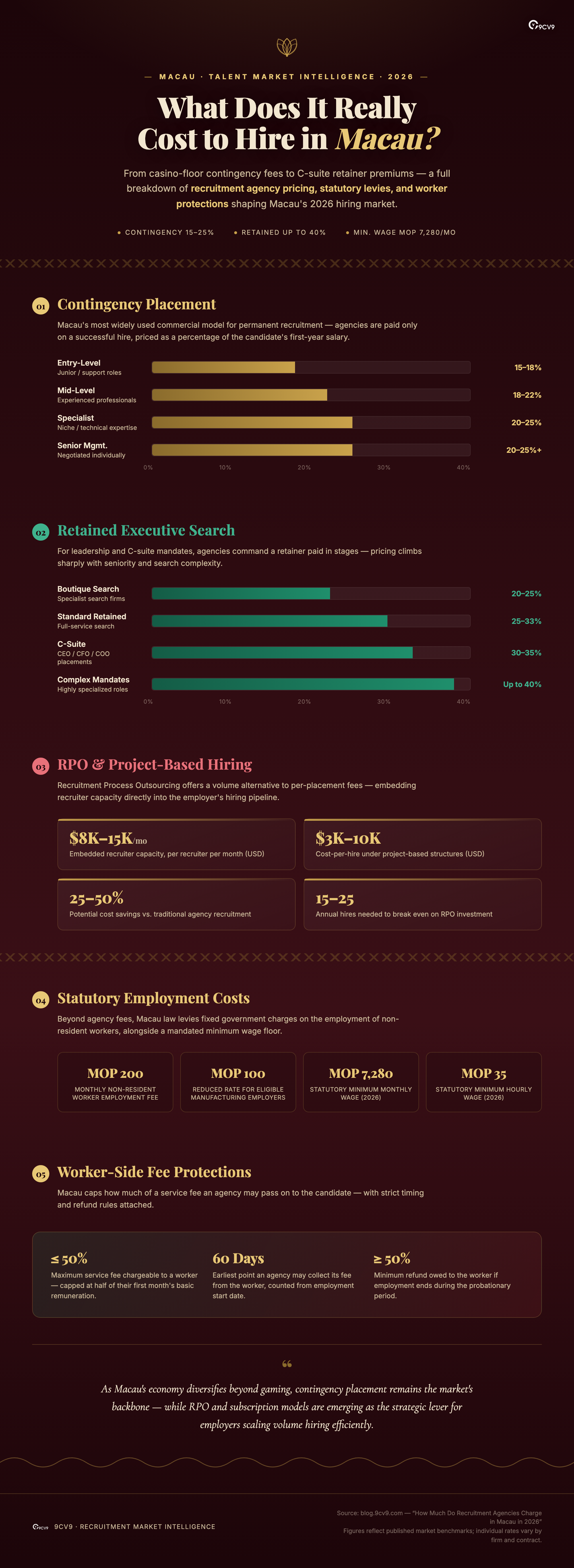
Recruitment pricing becomes even more complex when employers hire non-resident workers. Macau maintains a regulated framework governing employment agencies and foreign labour. Employers may need to account for recruitment and administrative services, employment authorisation, statutory employment fees, accommodation requirements, insurance, mobilisation, payroll administration, and other workforce-related expenses. Consequently, the headline recruitment agency fee does not necessarily represent the true cost of bringing a worker into productive employment.
Macau’s Employment Agency Activity Law also affects how recruitment agencies structure their fees. Law No. 16/2020 regulates employment agency activities and imposes specific restrictions on fees charged to workers. This regulatory environment makes transparent fee schedules, compliant recruitment practices, and clearly defined contractual responsibilities particularly important when employers evaluate recruitment providers.
Different industries also create substantially different recruitment economics. Macau’s gaming and integrated resort sector can require both highly specialised executive searches and large-scale operational recruitment. Luxury retail and hospitality frequently need flexible frontline talent, while banking and financial services place greater emphasis on professional experience, qualifications, compliance, and candidate screening. These differences influence which recruitment model provides the strongest value.
| Recruitment Requirement | Common Commercial Model | Indicative Pricing Approach |
|---|---|---|
| Permanent Professional Hiring | Contingency Recruitment | Approximately 15%–25% of first-year remuneration |
| Senior and C-Suite Hiring | Retained Executive Search | Approximately 20%–40% depending on mandate |
| High-Volume Recruitment | RPO / Project Recruitment | Monthly, project or cost-per-hire pricing |
| Temporary Workforce | Contract Staffing | Hourly, daily or monthly bill rate |
| Foreign Market Entry | Employer of Record | Monthly fee per employee |
| Recurring Internal Hiring | Subscription Recruitment | Fixed monthly subscription |
| Non-Resident Worker Recruitment | Recruitment plus Compliance Support | Fixed, per-worker or project-based fees |
These figures should be treated as indicative commercial benchmarks rather than universal or government-mandated Macau recruitment rates. Actual quotations can differ considerably between agencies and assignments.
Employers should therefore evaluate recruitment agencies using total cost per successful hire rather than simply comparing commission percentages. Candidate quality, time-to-shortlist, replacement guarantees, sector expertise, compliance capabilities, workforce technology, candidate retention, and Service Level Agreements can materially affect the eventual return on recruitment expenditure.
This guide to recruitment agency fees in Macau in 2026 examines the major commercial models in detail, including contingency recruitment, retained executive search, Recruitment Process Outsourcing, Employer of Record services, temporary staffing, quota and work-permit support, candidate replacement guarantees, and non-resident workforce costs. It also explains the regulatory and operational considerations employers should assess before selecting a recruitment agency.
For companies hiring in Macau in 2026, the central question is therefore not simply how much a recruitment agency charges. The more valuable question is what the employer receives for that fee and how much each successfully recruited, compliant, and retained employee ultimately costs the business.
Before we venture further into this article, we would like to share who we are and what we do.
About 9cv9
9cv9 is a business tech startup based in Singapore and Asia, with a strong presence all over the world.
With over ten years of startup and business experience, and being highly involved in connecting with thousands of companies and startups, the 9cv9 team has listed some of the top and best companies/tools in this review.
If you like to get your company listed in our top B2B software reviews, check out our world-class 9cv9 Media and PR service and pricing plans here.
How Much Do Recruitment Agencies Charge in Macau in 2026?
- Commercial Models, Fee Structures, and Agency Service Level Agreements of Recruitment Agencies in Macau in 2026
- Contingency Placement Model
- Retained Executive Search Model
- Recruitment Process Outsourcing (RPO) and Subscription Models
- Employer of Record (EOR) and PEO Services
- Temporary and Contract Staffing Markups
- Quota Advisory and Work Permit Processing Services
- Operational Governance and SLA Parameters
- Sectoral Sourcing Dynamics and Cross-Border Operations
- Strategic Industry Outlook and Executive Conclusions
1. Commercial Models, Fee Structures, and Agency Service Level Agreements of Recruitment Agencies in Macau in 2026
Macau’s recruitment agency market in 2026 operates within a tightly regulated employment framework, particularly for agencies involved in recruiting non-resident workers. Recruitment costs therefore extend beyond a simple placement commission. Employers must consider agency fees, government employment levies, statutory wage requirements, accommodation obligations, immigration administration, replacement guarantees, and other workforce mobilisation expenses.
For corporate HR and procurement teams, the most effective comparison is therefore based on total hiring cost, regulatory compliance, recruitment speed, candidate quality, replacement protection, and clearly defined Service Level Agreements rather than headline agency fees alone.
Commercial Recruitment Models Used by Recruitment Agencies in Macau
Recruitment agencies serving Macau employers can structure their commercial arrangements according to the complexity, seniority, volume, and scarcity of the positions being filled.
| Commercial Model | Typical Application in Macau | Fee Structure | Employer Risk Profile |
|---|---|---|---|
| Contingency Recruitment | Professional and general permanent hiring | Fee becomes payable following successful placement | Relatively low |
| Retained Executive Search | Senior executives, specialists and difficult-to-fill positions | Engagement fee paid in stages | Medium |
| Volume Recruitment | Hospitality, retail, gaming support and operational hiring | Negotiated per-hire or project fee | Low to medium |
| Non-Resident Worker Recruitment | Cross-border operational and specialist recruitment | Recruitment plus permitted administrative services | Medium to high |
| Recruitment Process Outsourcing | Large or continuous hiring programmes | Monthly, project or performance-based commercial agreement | Medium |
| Temporary or Outsourced Staffing | Short-term and flexible workforce requirements | Recurring service charge or staffing margin | Medium |
The appropriate model depends heavily on the employer’s hiring objectives. Contingency recruitment can be attractive when companies want to minimise upfront financial commitments, while retained search provides agencies with greater resources to conduct confidential or highly specialised searches.
Volume recruitment agreements, meanwhile, can reduce the effective cost per employee when employers need dozens or hundreds of workers within a defined period.
Employer-Side Recruitment Agency Fees
Macau’s Employment Agency Activity Law places a statutory ceiling on what agencies may collect from workers, but employer fees operate differently. Licensed fee-charging employment agencies must establish a service fee schedule, submit it to the Labour Affairs Bureau, display it at their business premises, and cannot charge employers more than the amount established in that schedule.
This means that employers should distinguish between statutory restrictions and commercially negotiated recruitment prices.
| Fee Category | Typical Commercial Basis | Key Consideration for Employers |
|---|---|---|
| Permanent Placement | Agreed placement charge | Determine exactly when the fee becomes payable |
| Executive Search | Retainer or milestone payments | Examine cancellation and shortlist provisions |
| Volume Recruitment | Per-hire or project pricing | Negotiate volume discounts and hiring thresholds |
| Overseas Recruitment | Placement plus permitted support services | Confirm which immigration and mobilisation services are included |
| Recruitment Process Outsourcing | Monthly or project-based fee | Establish hiring KPIs and reporting requirements |
| Replacement Recruitment | Included or separately charged | Confirm replacement period and qualifying conditions |
Employers comparing recruitment agencies in Macau should request an itemised quotation rather than relying exclusively on a headline percentage or placement price.
Candidate Fee Restrictions
One of the most important characteristics of Macau recruitment agency fee structures is the statutory protection provided to workers.
Under Law No. 16/2020, the total service fee charged to a worker cannot exceed 50% of the first month’s basic remuneration specified in the employment contract. The agency generally may collect this amount only once and only after 60 days have elapsed from commencement of the employment relationship.
If employment ends before the 60-day threshold, the permitted fee can instead be collected once on the termination date.
| Candidate Fee Rule | 2026 Requirement |
|---|---|
| Maximum worker service fee | 50% of first month’s contractual basic remuneration |
| Standard collection point | After 60 days from employment commencement |
| Multiple collections | Not permitted under the statutory collection framework |
| Employment ending before 60 days | Collection may occur once on termination |
| Current employer renewing non-resident worker stay authorisation | No additional service fee may be charged to the worker |
| Receipt requirement | Itemised receipt must be provided |
| Agency record retention | Fee receipts must be retained for three years |
These requirements are particularly important for employers using agencies to source non-resident workers because questionable worker-paid recruitment charges can create legal, operational, and reputational risks.
Refund and Replacement Obligations
The statutory refund framework also affects how recruitment agencies structure commercial guarantees.
If a service user is subject to unilateral termination during the probationary period, the agency must refund or reduce at least 50% of the applicable service fee, unless a larger amount has been contractually agreed. Where the relevant fee has already been collected, the statutory refund must generally be made within three days after written notification.
For employers, statutory protection can be supplemented with stronger contractual replacement guarantees.
| Guarantee Structure | Typical SLA Approach |
|---|---|
| Candidate fails to commence employment | Free replacement or agreed refund |
| Candidate leaves during guarantee period | Replacement search initiated |
| Candidate fails required compliance checks | Replacement without additional placement fee |
| Work authorisation cannot be obtained | Refund or replacement subject to contractual and statutory conditions |
| Employer materially changes position | Guarantee may become void |
| Replacement candidate | Same or comparable position usually required |
A strong Macau recruitment agency agreement should specify exactly which events trigger refunds, credits, replacements, or additional charges.
Non-Resident Worker Recruitment Framework
Recruitment of non-resident workers requires additional compliance controls under Macau’s Law No. 21/2009.
Employers cannot treat non-resident recruitment as equivalent to ordinary domestic hiring. Employment authorisation, permitted occupation, employer identity, workplace location, remuneration and accommodation requirements can affect whether a placement remains legally compliant.
Macau law can penalise employers that arrange for non-resident employees to work at locations or in occupational activities outside their approved authorisation.
| Compliance Area | Agency and Employer Consideration |
|---|---|
| Employment Authorisation | Verify approval before mobilisation |
| Employment Contract | Ensure terms correspond with approved employment conditions |
| Occupation | Worker should perform authorised duties |
| Workplace | Deployment should comply with approved work location |
| Accommodation | Employer must satisfy applicable lodging obligations |
| Employment Levy | Employer remains responsible for statutory payment |
| Worker Documentation | Documentation should be verified before deployment |
| Termination | Repatriation and administrative procedures should be clearly allocated |
Consequently, agencies specialising in non-resident recruitment can provide considerably more operational value than agencies functioning solely as candidate introducers.
Statutory Employer Costs Beyond Recruitment Agency Fees
Employers should calculate the landed cost of recruitment rather than treating the agency invoice as the complete hiring expense.
The Social Security Fund confirms that employers generally pay a monthly employment fee of MOP 200 for each effectively employed non-resident worker. Eligible processing and manufacturing employers receive a 50% reduction to MOP 100, while employers of non-resident domestic workers are exempt.
| Cost Component | 2026 Cost or Requirement | Primary Cost Bearer |
|---|---|---|
| Recruitment Agency Fee | Commercially agreed subject to applicable regulation | Employer and, where legally permitted, worker |
| Non-Resident Worker Employment Fee | MOP 200 per month per worker | Employer |
| Eligible Manufacturing Employment Fee | MOP 100 per month per worker | Employer |
| Non-Resident Domestic Worker Levy | Exempt | Employer |
| Accommodation | Statutory lodging entitlement or applicable cash arrangement | Employer |
| Minimum Wage | MOP 7,280 monthly for covered employees | Employer |
| Immigration and Administration | Depends on applicable procedures | Usually employer |
| Replacement Recruitment | Depends on agency SLA | Agency or employer depending on contract |
Failure to pay the non-resident worker employment fee within the statutory period can result in a fine of MOP 300 to MOP 1,000 for each affected worker. Persistent non-payment can also affect employment authorisation.
Minimum Wage Considerations in Recruitment Pricing
Macau increased its statutory minimum wage from 1 January 2026.
The applicable minimum wage for covered employees is MOP 7,280 per month, MOP 1,680 per week, MOP 280 per day, or MOP 35 per hour. Domestic workers and certain other categories remain outside the general minimum-wage framework.
| Remuneration Basis | Macau Minimum Wage in 2026 |
|---|---|
| Monthly | MOP 7,280 |
| Weekly | MOP 1,680 |
| Daily | MOP 280 |
| Hourly | MOP 35 |
| Piecework or Commission | Average of at least MOP 35 per hour |
These wage levels also influence recruitment economics because salaries can affect candidate expectations, workforce availability, retention, and any legally permitted worker-side service fee.
Recruitment Agency Service Level Agreements in Macau
A Service Level Agreement should transform broad recruitment promises into measurable obligations. This is particularly important for employers conducting repeated hiring or recruiting non-resident workers.
| SLA Metric | Recommended Measurement |
|---|---|
| Candidate Acknowledgement | Time required to begin handling vacancy |
| First Shortlist | Number of business days to initial qualified candidates |
| Candidate Screening | Defined verification and interview process |
| Interview Scheduling | Maximum coordination turnaround |
| Compliance Verification | Completion before candidate mobilisation |
| Offer Acceptance | Recorded acceptance and documentation |
| Work Authorisation Support | Defined responsibilities and document turnaround |
| Candidate Deployment | Target commencement timeline |
| Replacement Guarantee | Clearly stated guarantee period |
| Replacement Response | Maximum time before replacement search begins |
| Reporting | Weekly or monthly recruitment dashboard |
| Escalation | Named account manager and escalation procedure |
The strongest recruitment agreements define not only targets but also remedies when those targets are missed.
Suggested SLA Matrix for Macau Employers
| Service Area | Basic Agency | Professional Recruitment Partner | Strategic Recruitment Partner |
|---|---|---|---|
| Candidate Sourcing | Included | Included | Multi-channel sourcing strategy |
| Candidate Screening | Basic | Structured | Advanced competency assessment |
| Reference Checks | Optional | Included | Included with documented verification |
| Compliance Review | Limited | Included | Dedicated compliance workflow |
| Non-Resident Hiring Support | Optional | Available | End-to-end coordination |
| Recruitment Reporting | Placement updates | Regular reports | Recruitment analytics |
| Replacement Guarantee | Limited | Defined | Extended or negotiated |
| Account Management | Recruiter | Dedicated consultant | Dedicated account team |
| Workforce Planning | Not included | Limited | Strategic advisory |
| Volume Hiring | Case-by-case | Supported | Dedicated recruitment programme |
Recruitment Agency Procurement Checklist
Before signing an agency agreement, Macau employers should evaluate the complete commercial and operational package.
| Procurement Question | Why It Matters |
|---|---|
| Is the employment agency appropriately licensed? | Reduces regulatory exposure |
| Is the complete employer fee schedule disclosed? | Prevents unexpected charges |
| Are candidate-side charges compliant? | Protects workers and employer reputation |
| What triggers the placement fee? | Clarifies financial liability |
| Is there a replacement guarantee? | Reduces failed-hire risk |
| What happens when work authorisation fails? | Determines financial exposure |
| Are overseas recruitment costs itemised? | Improves budget transparency |
| Who manages employment documentation? | Prevents responsibility gaps |
| What are the shortlist timelines? | Measures recruitment performance |
| What reporting is provided? | Supports procurement oversight |
| Are escalation procedures documented? | Improves problem resolution |
| Are statutory employer costs separated from agency fees? | Enables accurate total-cost comparison |
Total Cost of Recruitment Framework
The most useful way to compare recruitment agencies in Macau in 2026 is through a total-cost model.
| Total Hiring Cost Layer | Examples |
|---|---|
| Agency Acquisition Cost | Placement fee, search retainer or project fee |
| Candidate Assessment Cost | Screening, assessments and verification |
| Immigration Cost | Work authorisation and documentation administration |
| Mobilisation Cost | Travel, arrival and deployment coordination |
| Statutory Employment Cost | Employment levy and applicable government charges |
| Accommodation Cost | Housing or applicable accommodation entitlement |
| Payroll Cost | Salary and statutory remuneration requirements |
| Replacement Risk | Cost associated with unsuccessful placements |
| Internal HR Cost | Interviews, onboarding and administration |
| Compliance Risk | Potential penalties and operational disruption |
This approach prevents employers from selecting an agency solely because it offers the lowest initial placement price. An agency charging a higher recruitment fee may ultimately produce a lower cost per successful hire if it delivers stronger screening, faster placements, better retention, compliant non-resident worker processing, and meaningful replacement protection.
Commercial Outlook for Recruitment Agencies in Macau in 2026
Macau’s recruitment market in 2026 increasingly rewards agencies capable of combining talent sourcing with regulatory knowledge and measurable service delivery. Employers recruiting across hospitality, tourism, gaming-related services, retail, construction, professional services, technology, and other labour-intensive sectors need recruitment partners capable of navigating both candidate scarcity and Macau’s regulated labour environment.
As a result, recruitment agency comparisons should move beyond the question of how much an agency charges. Employers should assess what the fee actually includes, which risks remain with the employer, how unsuccessful placements are handled, whether worker-side charges comply with Macau law, and whether the agency can consistently achieve agreed hiring timelines.
A well-designed recruitment agreement in Macau should therefore combine transparent pricing, regulatory compliance, measurable Service Level Agreements, replacement guarantees, clearly allocated responsibilities, and detailed reporting. For employers making multiple hires, these factors can be considerably more important than obtaining the lowest headline recruitment fee.
2. Contingency Placement Model
Contingency Placement Model
The contingency placement model remains one of the most widely used commercial structures for permanent recruitment in Macau in 2026, particularly for entry-level, mid-level professional, managerial, and specialist positions. Under this arrangement, the recruitment agency generally assumes the initial sourcing risk because a placement fee becomes payable only when an introduced candidate is successfully hired.
For employers, contingency recruitment can provide a relatively low-risk method of accessing external talent without paying a substantial search retainer before candidates are identified. Macau’s regulatory framework permits fee-charging employment agencies, while agencies are expected to maintain and disclose their applicable service-fee schedules.
Typical Contingency Recruitment Fee Structure
Market benchmarks indicate that traditional contingent permanent-placement fees commonly fall within approximately 15% to 25% of the successful candidate’s annual salary, although actual Macau agency charges depend on the agency, position, recruitment difficulty, service scope, and negotiated commercial agreement.
| Recruitment Category | Indicative Fee Benchmark | Typical Application |
|---|---|---|
| Entry-Level Recruitment | Around 15%–18% of annual salary | Administrative, junior professional and operational roles |
| Mid-Level Recruitment | Around 18%–22% of annual salary | Experienced professionals and supervisors |
| Specialist Recruitment | Around 20%–25% of annual salary | Technical, digital, financial and scarce-skill positions |
| Senior Management | Around 20%–25% or individually negotiated | Department heads and senior managers |
| Executive Search | Usually structured separately | C-suite and strategic leadership appointments |
These percentages should be treated as commercial benchmarks rather than statutory Macau fee rates. Employers should verify the agency’s registered or disclosed fee schedule and obtain written commercial terms before commencing a search.
Contingency Placement Fee Calculation
A standard percentage-based contingency fee can be represented as:
Contingency Placement Fee = Agreed Fee Percentage × First-Year Gross Annual Salary
For example, consider a Macau integrated resort recruiting an Assistant Financial Controller earning MOP 40,000 per month.
| Calculation Component | Amount |
|---|---|
| Monthly Base Salary | MOP 40,000 |
| Annual Base Salary | MOP 480,000 |
| Agreed Agency Fee | 20% |
| Recruitment Fee | MOP 96,000 |
Under this example, the employer would pay a MOP 96,000 recruitment commission if the candidate were successfully placed, subject to the agency agreement.
Employers should establish whether the percentage applies exclusively to basic salary or to a broader guaranteed remuneration package containing allowances, guaranteed bonuses, commissions, or other contractual payments. This definition can materially affect the final recruitment cost.
How the Contingency Model Allocates Commercial Risk
| Commercial Factor | Recruitment Agency | Employer |
|---|---|---|
| Initial Candidate Sourcing Cost | Primarily bears cost | Usually no upfront placement fee |
| Unsuccessful Search | May receive no placement revenue | Generally limited financial exposure |
| Successful Placement | Receives agreed commission | Pays placement fee |
| Candidate Screening | Usually agency responsibility | Reviews shortlisted candidates |
| Hiring Decision | No final authority | Full decision-making authority |
| Replacement Guarantee | Subject to agreement | Receives protection where included |
| Multiple Agency Competition | Common in non-exclusive mandates | Can appoint several agencies |
This allocation of risk explains why contingency recruitment is particularly attractive to employers making occasional permanent hires.
Exclusive vs Non-Exclusive Contingency Recruitment
Contingency recruitment does not necessarily mean that every vacancy is distributed to multiple recruitment agencies. Macau employers can use either non-exclusive or exclusive contingency mandates.
| Model | Non-Exclusive Contingency | Exclusive Contingency |
|---|---|---|
| Number of Agencies | Multiple agencies | Usually one appointed agency |
| Upfront Retainer | Usually none | Usually none |
| Candidate Reach | Potentially broad | Concentrated sourcing effort |
| Duplicate Candidates | Higher possibility | Significantly reduced |
| Agency Commitment | Can vary | Generally stronger |
| Employer Administration | Higher | Lower |
| Best Suited For | Urgent or relatively common vacancies | Specialist and strategically important positions |
Non-exclusive recruitment can increase sourcing velocity because several agencies search simultaneously. However, it can also generate duplicate candidate submissions, inconsistent candidate communication, and additional administrative work.
Exclusive contingency arrangements can encourage the appointed agency to dedicate more sourcing resources because it has greater confidence that another recruiter will not fill the vacancy first.
Payment and Replacement Terms
The exact payment trigger should always be defined contractually. Depending on the recruitment agency, invoicing may occur when the candidate accepts the employment offer, signs the employment contract, or begins employment.
Likewise, payment terms such as 30 or 60 days should be regarded as negotiated commercial conditions rather than universal Macau requirements.
| Contract Provision | Recommended Employer Clarification |
|---|---|
| Fee Trigger | Offer acceptance, contract signature or start date |
| Invoice Due Date | Clearly defined payment period |
| Salary Definition | Base salary or total guaranteed remuneration |
| Candidate Ownership | Period during which an introduction remains attributable to the agency |
| Duplicate Submission | Rules determining which agency owns the candidate |
| Candidate Withdrawal | Whether any fee remains payable |
| Replacement Period | Duration of free replacement protection |
| Early Resignation | Replacement, credit or refund mechanism |
| Termination | Circumstances that preserve or invalidate guarantees |
| Rehire Clause | Treatment of candidates hired later |
Why Macau Employers Use Contingency Recruitment
The principal advantage is cost-risk alignment. Employers generally incur the core recruitment commission only after the agency produces a successful hiring outcome.
This makes contingency recruitment particularly suitable for Macau companies seeking permanent employees without committing to the upfront retainers associated with executive search.
However, the lowest contingency percentage does not necessarily represent the lowest overall recruitment cost. Employers should also compare candidate quality, time-to-shortlist, replacement guarantees, sector expertise, regulatory compliance, candidate retention, and the agency’s ability to recruit within Macau’s relatively constrained labour market.
For procurement purposes, the most effective comparison is therefore not simply “which agency charges the lowest percentage,” but rather “which agency delivers the lowest sustainable cost per successful and retained hire.”
3. Retained Executive Search Model
The retained executive search model is generally reserved for senior leadership, vice-president, C-suite, board-level, and other strategically critical appointments where confidentiality, candidate quality, and market coverage carry greater importance than recruitment volume. In Macau, this approach is particularly relevant to integrated resorts and gaming, luxury hospitality, banking and financial services, construction, infrastructure, and other industries competing for a relatively limited pool of experienced senior executives. Macau-focused executive search firms specifically identify gaming, integrated resorts, luxury hospitality, banking, and financial services among their specialist markets.
Unlike contingency recruitment, retained executive search is normally exclusive. The employer appoints one search firm and commits financially at the beginning of the assignment. In return, the search firm dedicates research and consulting resources to market mapping, confidential approaches, passive candidate identification, assessment, compensation benchmarking, reference checking, offer management, and appointment completion.
Retained Executive Search Fee Structure
Current 2026 executive-search benchmarks generally place retained search fees at approximately 20% to 35% of first-year compensation, with around one-third of first-year total cash compensation remaining a common benchmark. Some highly complex or top-tier mandates can command fees approaching 40%.
Accordingly, a 20% to 40% range can be used as a broad planning spectrum, but employers should not interpret this as a statutory Macau rate or assume every Macau agency charges within this range.
| Executive Search Category | Indicative Fee Benchmark | Typical Application |
|---|---|---|
| Boutique Retained Search | Around 20%–25% | Director and specialist leadership appointments |
| Standard Retained Search | Around 25%–33% | VP, functional leadership and senior management |
| C-Suite Executive Search | Around 30%–35% | CEO, CFO, COO, CHRO and equivalent appointments |
| Highly Complex Search | Up to approximately 40% in some cases | Confidential, scarce-talent or exceptionally difficult mandates |
Fee Calculation
The professional search fee is commonly calculated against the executive’s projected first-year compensation:
Retained Search Fee = Agreed Search Percentage × First-Year Eligible Compensation
The definition of eligible compensation is important. Many retained search firms calculate their fees using first-year total cash compensation rather than base salary alone. This commonly includes base salary and target or guaranteed bonuses, while treatment of signing bonuses, equity, stock awards, allowances, and long-term incentives varies between firms.
For example, consider a Macau employer recruiting a senior executive under the following package:
| Compensation Component | Amount |
|---|---|
| Annual Base Salary | MOP 1,800,000 |
| Guaranteed or Eligible Annual Bonus | MOP 300,000 |
| Fee-Bearing Compensation | MOP 2,100,000 |
| Agreed Search Fee | 30% |
| Total Professional Search Fee | MOP 630,000 |
Under this illustrative arrangement, the employer would incur a professional executive search fee of MOP 630,000, excluding any separately agreed expenses or administrative charges.
Three-Tranche Retained Search Payment Model
A defining characteristic of retained executive search is staged payment. The traditional structure divides the professional fee into approximately three equal instalments. Contemporary executive-search benchmarks continue to identify engagement, shortlist and completion as common payment milestones.
| Payment Stage | Approximate Share | Typical Trigger | Principal Services Funded |
|---|---|---|---|
| Engagement Tranche | 33.3% | Search agreement executed | Role definition, research strategy and market mapping |
| Shortlist Tranche | 33.3% | Qualified shortlist delivered | Candidate identification, approaches, interviews and assessment |
| Completion Tranche | 33.4% | Offer acceptance or agreed completion milestone | Negotiation, appointment completion and transition support |
Engagement Tranche
The first payment is generally invoiced when the employer formally appoints the executive search firm.
This tranche finances the initial search infrastructure, including stakeholder consultation, position specification development, competitor mapping, compensation research, target-company identification, candidate-market analysis, and the commencement of confidential approaches.
Unlike contingency recruitment, this amount is generally not dependent on a successful placement because the employer is purchasing a dedicated professional search process rather than simply paying for a candidate introduction.
Shortlist Presentation Tranche
The second tranche is commonly associated with delivery of a qualified shortlist, although some firms instead invoice according to a predetermined timetable such as 30 days after commencement.
At this stage, a sophisticated retained search should have progressed considerably beyond CV sourcing.
| Shortlist Deliverable | Expected Search Activity |
|---|---|
| Market Mapping | Identification of relevant organisations and executives |
| Passive Candidate Outreach | Confidential direct approaches |
| Preliminary Assessment | Experience and leadership suitability evaluation |
| Motivation Assessment | Candidate interest and mobility analysis |
| Compensation Review | Current and expected remuneration assessment |
| Candidate Reports | Structured profiles for shortlisted executives |
| Risk Identification | Notice periods, counteroffers and relocation considerations |
Completion Tranche
The final tranche is typically invoiced when the selected executive accepts the offer, when the placement is completed, or according to another contractually agreed milestone.
Where the search was originally priced using estimated compensation, some executive-search agreements reconcile the final professional fee against the executive’s actual agreed remuneration package.
This provision is particularly important for Macau employers recruiting executives whose final packages may contain substantial guaranteed bonuses, housing benefits, allowances, or other negotiated compensation.
Retained Search Versus Contingency Recruitment
| Commercial Factor | Retained Executive Search | Contingency Recruitment |
|---|---|---|
| Primary Hiring Level | Senior leadership and C-suite | Entry to senior professional |
| Exclusivity | Usually exclusive | Frequently non-exclusive |
| Upfront Payment | Required | Usually none |
| Payment Structure | Multiple staged payments | Primarily success-based |
| Typical Fee Benchmark | Approximately 25%–35%, with broader variation | Approximately 15%–25% |
| Market Mapping | Extensive | Usually more targeted |
| Passive Candidate Search | Core component | Varies |
| Confidential Search | Strong | More limited |
| Dedicated Research Resources | Usually included | Varies |
| Candidate Assessment | Extensive | Standard to advanced |
| Employer Financial Risk | Higher | Lower |
| Search Firm Commitment | High | Depends on probability of placement |
| Replacement Protection | Commonly stronger | Usually shorter or more limited |
Current retained-search benchmarks commonly associate the model with six-to-12-month replacement guarantees, although actual protection varies significantly by firm and contract.
Executive Search SLA Considerations
For Macau employers, the higher cost of retained recruitment makes a detailed Service Level Agreement particularly important.
| SLA Area | Recommended Contract Provision |
|---|---|
| Search Exclusivity | Clearly defined duration and scope |
| Market Mapping | Agreed industries, competitors and geographical markets |
| Longlist Delivery | Target completion date |
| Shortlist Delivery | Target timeframe and candidate quantity |
| Candidate Assessment | Defined interview and evaluation methodology |
| Reference Checking | Scope and timing established |
| Confidentiality | Enhanced controls for sensitive appointments |
| Compensation Advice | Benchmarking and negotiation support |
| Replacement Guarantee | Clearly stated guarantee period |
| Search Failure | Define continuation, replacement or termination provisions |
| Expenses | Specify whether travel and assessment costs are included |
| Off-Limits Policy | Define restrictions on recruiting from the client |
| Reporting | Weekly or milestone-based progress reports |
Why Macau Employers Use Retained Executive Search
The principal value of retained search lies in accessing executives who are not actively applying for jobs. Senior leaders within Macau’s gaming, integrated resort, luxury hospitality, financial services, and other specialist sectors may need to be identified through targeted research and approached confidentially rather than sourced through conventional job advertisements.
Retained search firms consequently sell depth of coverage rather than simply candidate volume. Market mapping, passive-candidate headhunting, structured assessment, confidentiality, compensation advice, and dedicated consultant resources account for much of the premium over contingency recruitment.
For Macau employers in 2026, retained executive search is therefore most economically justified when the cost of appointing the wrong executive substantially exceeds the recruitment fee. The model is particularly appropriate for strategically important, confidential, difficult-to-fill, or business-critical leadership positions where candidate quality and search completeness outweigh the objective of securing the lowest possible agency fee.
4. Recruitment Process Outsourcing (RPO) and Subscription Models
Recruitment Process Outsourcing, or RPO, provides an alternative to conventional percentage-of-salary recruitment fees for Macau employers with sustained or high-volume hiring requirements. Rather than engaging an agency separately for every vacancy, an employer transfers defined portions of its recruitment operation to an external provider that functions as an extension of the internal talent acquisition team.
In Macau, this model is particularly relevant during integrated resort expansions, hotel openings, large hospitality recruitment campaigns, new business launches, and other periods when employers must recruit significant numbers of employees within relatively short timeframes.
RPO Delivery Models in Macau
RPO does not necessarily require outsourcing the entire recruitment function. Employers can select a service scope according to their internal HR capabilities.
| RPO Model | Recruitment Scope | Suitable Employer Profile |
|---|---|---|
| Full-Cycle RPO | Sourcing through onboarding | Large employers with continuous recruitment |
| Project RPO | Recruitment for a defined expansion or project | Hotel openings and business expansions |
| Embedded RPO | Dedicated external recruiters integrated with HR | Employers requiring additional TA capacity |
| Point-of-Service RPO | Selected stages such as sourcing and shortlisting | Employers retaining strong internal HR teams |
| Hybrid RPO | Internal HR combined with outsourced recruitment | Medium-to-large employers |
| On-Demand RPO | Flexible capacity activated when required | Employers with fluctuating hiring demand |
A notable Macau example is EvolutionHR’s Points-of-Service RPO model. The company describes its service as providing sourcing and shortlisting assistance for approximately 10 to 100 positions per month with multiple headcount requirements. Its dedicated recruitment team operates as an extension of the employer’s internal HR function.
EvolutionHR also states that its Points-of-Service arrangement can assume approximately 70% of the recruitment process, allowing internal HR professionals to concentrate more heavily on core HR responsibilities.
Typical RPO Pricing Structures
Unlike contingency recruitment, RPO generally avoids charging a large percentage of annual salary for every employee hired. Pricing instead tends to be based on recruitment capacity, hiring output, project scope, or combinations of these variables.
| Pricing Model | Commercial Structure | Best Application |
|---|---|---|
| Monthly Management Fee | Fixed recurring RPO charge | Continuous recruitment |
| Cost Per Hire | Fixed amount for each successful employee | Predictable volume recruitment |
| Hybrid Model | Lower monthly fee plus per-hire charge | Continuous but variable recruitment |
| Project Fee | Fixed price for defined recruitment campaign | Hotel opening or expansion |
| Embedded Recruiter | Monthly charge for dedicated recruiters | Internal TA capacity expansion |
| Subscription Model | Recurring software or sourcing access fee | SMEs and self-managed recruitment |
Published 2026 RPO benchmarks commonly place dedicated embedded recruitment capacity at approximately USD 8,000 to USD 15,000 per recruiter per month, while cost-per-hire structures frequently fall around USD 3,000 to USD 10,000 per placement. Actual pricing varies substantially according to geography, recruitment volume, seniority, technology requirements and service scope.
Hybrid RPO Pricing
One commercially attractive approach combines a predictable management fee with a reduced success fee.
Hybrid RPO Cost = Monthly Management Fee + Number of Successful Hires × Agreed Cost Per Hire
Under this structure, the management component finances dedicated recruitment capacity while the per-hire component provides a performance incentive.
| Cost Component | Purpose |
|---|---|
| Monthly Management Fee | Recruiters, management and infrastructure |
| Cost-Per-Hire Fee | Performance-linked placement component |
| Implementation Fee | Initial setup and process integration |
| Recruitment Technology | ATS, sourcing or assessment technology |
| Advertising Budget | Job boards and recruitment campaigns |
| Assessment Costs | Testing and specialist evaluations |
| Background Checks | Candidate verification |
| Additional Services | Out-of-scope or specialist recruitment |
Employers should therefore compare the total RPO contract value rather than the management fee alone.
Potential RPO Cost Savings
The original assumption that RPO automatically reduces recruitment expenditure by 40% to 60% should be treated cautiously. There is no universal Macau-specific saving at this level.
Current industry research more commonly places potential cost-per-hire savings around 25% to 50%, depending heavily on recruitment volume and the comparison baseline. One 2026 industry analysis reports potential savings of approximately 25% to 40%, while another estimates approximately 30% to 50% compared with agency recruitment at equivalent volumes.
| Recruitment Environment | Likely RPO Economics |
|---|---|
| Very Low Hiring Volume | Traditional agency may remain more economical |
| Irregular Hiring | Contingency recruitment can offer greater flexibility |
| Moderate Recurring Hiring | Hybrid RPO becomes increasingly attractive |
| High-Volume Hiring | Strong potential for lower cost per hire |
| Major Expansion | Project RPO can provide scalable recruitment capacity |
| Continuous Enterprise Hiring | Embedded or full RPO may provide strongest economics |
Published 2026 benchmarks suggest RPO can begin outperforming traditional agency recruitment economically at sustained volumes of approximately 15 to 25 hires annually, although the actual break-even point depends heavily on salaries, agency commissions and RPO contract terms.
Why RPO Can Reduce Cost Per Hire
The potential savings arise primarily from replacing repeated percentage-based commissions with shared recruitment infrastructure.
| Traditional Contingency Recruitment | RPO Model |
|---|---|
| Fee charged separately for each placement | Recruitment capacity purchased collectively |
| Commonly salary-percentage based | Fixed, per-hire or hybrid pricing |
| Recruiter works externally | Recruiter can operate as embedded team |
| Vacancy-by-vacancy sourcing | Continuous talent pipeline |
| Limited economies of scale | Cost efficiency can improve with volume |
| Multiple agency relationships possible | Consolidated recruitment governance |
| Primarily placement focused | Can cover wider recruitment lifecycle |
For Macau employers recruiting hundreds of operational employees, even relatively small reductions in average cost per hire can produce substantial aggregate savings.
Points-of-Service RPO for Macau Employers
EvolutionHR’s Macau model demonstrates how partial RPO can bridge the gap between conventional recruitment agencies and complete recruitment outsourcing.
| Recruitment Activity | Internal HR | Points-of-Service RPO Provider |
|---|---|---|
| Workforce Planning | Primary | Supporting |
| Vacancy Definition | Primary | Supporting |
| Candidate Sourcing | Shared or outsourced | Primary |
| Candidate Screening | Shared | Primary |
| Shortlisting | Shared | Primary |
| Hiring Interviews | Primary | Coordination support |
| Final Selection | Primary | Advisory |
| Offer Decision | Primary | Supporting |
| Onboarding | Shared | Supporting |
EvolutionHR also advertises overseas recruitment services involving candidate sourcing, screening, interview arrangements, documentation, medical and background checks, visa assistance where applicable, transportation coordination and post-placement follow-up. It states that suitable CVs for its overseas recruitment service can be presented within seven days after receiving a job order.
RPO Service Level Agreements
Because RPO providers assume greater operational responsibility than conventional recruitment agencies, Service Level Agreements become particularly important.
| RPO KPI | Suggested Measurement |
|---|---|
| Time to Shortlist | Business days from approved vacancy |
| Time to Hire | Days from requisition to acceptance |
| Cost Per Hire | Total RPO expenditure divided by hires |
| Offer Acceptance Rate | Accepted offers as percentage issued |
| Candidate Conversion | Applications progressing through stages |
| Vacancy Fulfilment Rate | Positions filled against hiring target |
| Candidate Quality | Performance or probation outcomes |
| Retention Rate | Employees remaining after agreed period |
| Compliance Accuracy | Percentage of compliant candidate files |
| Hiring Manager Satisfaction | Periodic internal satisfaction score |
| Candidate Satisfaction | Post-recruitment experience score |
Subscription-Based Recruitment Models
A separate development in recruitment economics is the growth of subscription-based hiring platforms. These should be distinguished from true RPO.
Instead of outsourcing recruitment operations, the employer purchases recurring access to recruitment technology, candidate databases, job advertising, applicant management, sourcing tools, or related functionality while retaining responsibility for most recruitment activities internally.
| Feature | Contingency Agency | RPO | Recruitment Subscription |
|---|---|---|---|
| Pricing | Percentage per hire | Monthly, per-hire or hybrid | Recurring subscription |
| Recruiters Provided | Yes | Yes | Usually no |
| Internal HR Required | Moderate | Lower | High |
| Recruitment Technology | Agency controlled | Integrated | Employer controlled |
| Best Hiring Volume | Low to moderate | Moderate to very high | Recurring self-managed hiring |
| Cost Predictability | Moderate | High | Very high |
| Salary-Based Commission | Usually | Generally reduced or absent | Usually absent |
| Employer Control | Moderate | Shared | High |
Technology-led recruitment platforms can therefore be particularly attractive to startups, SMEs and growing companies that already possess internal hiring capabilities but want greater candidate reach without paying a percentage commission for every employee recruited.
RPO Versus Subscription Recruitment Decision Matrix
| Employer Requirement | Most Suitable Model |
|---|---|
| Occasional specialist vacancy | Contingency Recruitment |
| Senior executive appointment | Retained Executive Search |
| 10–100 recurring positions per month | RPO |
| Major hotel or resort opening | Project RPO |
| Continuous enterprise recruitment | Embedded or Full-Cycle RPO |
| Strong internal recruiters needing sourcing tools | Subscription Platform |
| SME requiring recurring recruitment access | Subscription Platform |
| Employer needing recruitment team plus technology | Hybrid RPO |
Commercial Outlook for Macau in 2026
RPO represents an increasingly relevant commercial model for Macau employers because the economics of recruitment change significantly as hiring volumes increase. A traditional agency charging a percentage of annual remuneration can remain efficient for occasional vacancies, but repeating that commission across dozens or hundreds of hires can become expensive.
RPO instead converts recruitment from a sequence of individual placement transactions into an operational service with measurable capacity, costs and performance targets.
For Macau employers undertaking resort expansions, hotel openings, large-scale operational recruitment or continuous workforce replacement, the most appropriate comparison is therefore cost per successful and retained hire. RPO becomes commercially compelling when predictable hiring volume allows fixed recruitment resources, technology and sourcing infrastructure to be spread across a sufficiently large number of appointments.
5. Employer of Record (EOR) and PEO Services
Employer of Record services provide foreign companies with an alternative route for employing personnel in Macau without first establishing their own local employing entity. This structure can be particularly useful for technology companies, professional-services firms, regional consultancies, overseas vendors, and businesses testing the Macau market before committing to a permanent corporate presence.
Under a typical EOR arrangement, the provider becomes the formal local employer while the client company retains responsibility for the employee’s day-to-day duties, objectives, reporting relationships, and operational management. Macau EOR providers commonly handle employment contracts, payroll, statutory administration, professional tax processes, benefits administration, and employment compliance.
EOR Versus PEO Structure
Although EOR and PEO are frequently marketed together, employers should distinguish between the two structures.
| Commercial Feature | Employer of Record | PEO / HR Outsourcing |
|---|---|---|
| Local Entity Required by Client | Generally no | Often depends on service structure |
| Formal Employer | EOR provider | Usually client or co-employment structure |
| Payroll Administration | Included | Included or optional |
| Employment Contracts | Managed through EOR | Usually supported |
| Statutory Administration | EOR responsibility within agreed scope | Shared or outsourced |
| Day-to-Day Employee Management | Client | Client |
| Best Application | Market entry and small overseas teams | Established companies outsourcing HR |
| Typical Commitment | Per employee per month | Monthly or service-based contract |
For this reason, EOR is generally the more relevant model when the primary objective is hiring employees without establishing an employing entity in Macau.
Macau EOR Service Scope
Providers operating in Macau can combine legal employment infrastructure with payroll and HR administration. Links International, for example, markets in-country Macau services covering PEO/EOR, payroll outsourcing, visa applications, HR analytics and related HR functions. It also advertises the ability to hire through its APAC and Middle East EOR network in under 48 hours.
| EOR Service Component | Typical Provider Responsibility |
|---|---|
| Employment Contract | Preparation and administration |
| Employee Onboarding | Documentation and registration |
| Monthly Payroll | Salary calculation and payment administration |
| Professional Tax | Payroll-related calculation and filing support |
| Statutory Compliance | Monitoring applicable employment requirements |
| HR Administration | Employee records and lifecycle administration |
| Benefits | Administration according to contract and law |
| Work Authorisation | Support where available and legally applicable |
| Termination | Documentation and final payroll administration |
| Reporting | Payroll and employment-cost reporting |
EOR Pricing in Macau in 2026
The proposed USD 500 to USD 800 monthly range is reasonable as a general international EOR planning benchmark, but it should not be presented as the standard Macau market price.
Published Macau-specific pricing in 2026 indicates a broader market. One Macau EOR guide estimates approximately USD 300 to USD 600 per employee per month, while another provider advertises Macau EOR services starting from USD 249 per month. Broader international EOR benchmarking places many major platforms around USD 400 to USD 800 per employee per month.
| EOR Pricing Reference | Indicative 2026 Level |
|---|---|
| Lower-Cost Macau Platform | From approximately USD 249 per employee/month |
| Macau Market Benchmark | Approximately USD 300–600 per employee/month |
| Broader EOR Market Benchmark | Approximately USD 400–800 per employee/month |
| Premium or Complex Service | Individually quoted |
| High-Volume Workforce | Frequently negotiable |
Actual pricing can vary according to employee headcount, compensation, employment complexity, benefits, work authorisation requirements, onboarding requirements and whether the provider owns its local infrastructure or relies on partners.
Total EOR Employment Cost
The monthly EOR fee represents only the management component of the employer’s total expenditure.
A more accurate calculation is:
Total Monthly Employment Cost = Gross Compensation + Statutory Employer Costs + Required Benefits and Allowances + EOR Management Fee + Applicable Additional Services
| Cost Layer | Typical Treatment |
|---|---|
| Gross Salary | Passed through to employer |
| EOR Management Fee | Fixed monthly or percentage-based |
| Statutory Contributions | Passed through at actual cost |
| Non-Resident Worker Employment Fee | Applicable where legally required |
| Housing Support | Applicable to non-resident employees |
| Benefits | Passed through or incorporated into package |
| Work Permit Administration | Included or separately charged |
| Insurance | Actual or provider-arranged cost |
| Setup Fee | Provider-dependent |
| Termination Administration | Provider-dependent |
This distinction is essential when comparing EOR quotations. A provider advertising a low monthly platform fee may ultimately cost more if onboarding, immigration, benefits administration, insurance, deposits, currency conversion, or termination services are separately charged.
Non-Resident Worker Costs
Macau imposes additional requirements where the employee is a non-resident worker. Employers must comply with the applicable employment authorisation framework, and the worker can only perform the authorised occupation for the authorised employer.
Non-resident workers are also entitled to free accommodation or a housing allowance of at least MOP 500 per month. The employer must additionally bear transportation costs to the worker’s habitual place of residence when the employment relationship ends.
| Non-Resident Employment Component | Macau Requirement |
|---|---|
| Employment Authorisation | Required |
| Written Employment Contract | Required |
| Approved Employer | Worker must work for authorised employer |
| Approved Position | Worker restricted to authorised employment |
| Housing | Free accommodation or at least MOP 500 monthly allowance |
| Employment Fee | Generally MOP 200 per worker per month |
| Repatriation Transport | Employer responsibility upon termination |
| Salary Payment | Subject to statutory payment requirements |
The non-resident worker employment fee is generally MOP 200 per worker per month and is paid by the employer quarterly. Eligible processing and manufacturing employers receive a 50% reduction.
EOR Onboarding and Activation Times
Rapid onboarding is an important competitive feature of modern EOR providers, but a distinction should be made between preparing an employment relationship and completing every regulatory process.
Links International advertises EOR hiring across its regional network in under 48 hours, while another Macau EOR provider advertises onboarding in as little as 12 hours. These should be understood as provider service targets rather than statutory Macau processing guarantees.
| Onboarding Stage | Potential SLA |
|---|---|
| Client Information Review | Same or next business day |
| Employment Cost Calculation | Within 24 hours |
| Contract Preparation | 24–48 hours where straightforward |
| Employee Onboarding | Provider-dependent |
| Payroll Registration | Defined implementation timetable |
| Work Authorisation | Subject to government processing |
| First Payroll | Agreed payroll calendar |
| Employee Support | Defined response-time SLA |
Employers should therefore be cautious about interpreting “hire in 48 hours” as meaning that every foreign employee can legally begin working within 48 hours. Non-resident employment remains dependent on the applicable Macau authorisation procedures.
EOR Service Level Agreements
An EOR assumes considerably greater administrative responsibility than a conventional recruitment agency. Consequently, the Service Level Agreement should contain measurable payroll, compliance, employee-support and reporting standards.
| EOR SLA Metric | Recommended Measurement |
|---|---|
| Contract Preparation | Hours or business days |
| Employee Onboarding | Target completion time |
| Payroll Accuracy | Defined contractual accuracy target |
| On-Time Payroll | Percentage completed by scheduled date |
| Employee Query Response | Maximum response time |
| Tax Administration | Filing completed by applicable deadline |
| Statutory Payments | 100% within required deadlines |
| Payroll Corrections | Defined resolution period |
| Work Permit Support | Document-processing turnaround |
| Offboarding | Final payroll and documentation timetable |
| Compliance Escalation | Named responsible contact |
| Reporting | Monthly payroll and cost reports |
A payroll accuracy target above 99% is commercially plausible for an EOR SLA, but it should be treated as a negotiated performance target rather than a universal Macau industry standard unless a specific provider contractually guarantees it.
EOR Versus Establishing a Macau Entity
| Decision Factor | EOR | Own Macau Entity |
|---|---|---|
| Initial Setup | Relatively fast | More extensive |
| Local Employment Infrastructure | Provided | Employer must establish |
| Fixed Administration | Lower initially | Higher |
| Per-Employee Cost | Higher | Potentially lower at scale |
| Payroll Administration | Outsourced | Internal or separately outsourced |
| Market Exit | Relatively flexible | Corporate closure requirements |
| Small Team | Highly suitable | May be inefficient |
| Large Permanent Workforce | Can become expensive | Increasingly attractive |
| Market Testing | Strong fit | Higher commitment |
| Long-Term Presence | Transitional or permanent | Often preferred at scale |
When EOR Becomes Commercially Attractive
EOR economics are strongest when a company needs only a small number of Macau employees or requires rapid market entry. Paying several hundred US dollars per employee each month can be considerably easier to justify for two or three strategic employees than establishing and administering an entity solely to employ them.
As headcount increases, however, the calculation changes.
| Macau Hiring Scenario | Potentially Suitable Structure |
|---|---|
| First Macau Employee | EOR |
| Market Validation | EOR |
| Regional Sales Representative | EOR |
| Small Technology Team | EOR |
| Temporary Market Entry | EOR |
| Existing Macau Entity Seeking Payroll Support | PEO or Payroll Outsourcing |
| Growing Permanent Team | Compare EOR against incorporation |
| Large Long-Term Workforce | Own Entity plus HR Outsourcing |
| Large Non-Resident Workforce | Specialist workforce and compliance structure |
Commercial Outlook for EOR Services in Macau in 2026
EOR services occupy a distinct position within Macau’s recruitment and HR services market. Traditional recruitment agencies solve the problem of finding candidates; EOR providers solve the additional problem of employing and administering those candidates through a compliant local employment structure.
For overseas companies entering Macau in 2026, this distinction can make EOR particularly valuable. The model converts much of the complexity associated with contracts, payroll, statutory administration and ongoing HR compliance into a predictable recurring operating expense.
However, employers should compare providers according to total employment cost rather than monthly EOR fees alone. Pricing transparency, local employment expertise, payroll accuracy, onboarding speed, work-authorisation capability, employee support, termination handling, data security and contractual Service Level Agreements can ultimately matter more than a difference of USD 100 or USD 200 in the advertised monthly management fee.Employer of Record services provide foreign companies with an alternative route for employing personnel in Macau without first establishing their own local employing entity. This structure can be particularly useful for technology companies, professional-services firms, regional consultancies, overseas vendors, and businesses testing the Macau market before committing to a permanent corporate presence.
Under a typical EOR arrangement, the provider becomes the formal local employer while the client company retains responsibility for the employee’s day-to-day duties, objectives, reporting relationships, and operational management. Macau EOR providers commonly handle employment contracts, payroll, statutory administration, professional tax processes, benefits administration, and employment compliance.
EOR Versus PEO Structure
Although EOR and PEO are frequently marketed together, employers should distinguish between the two structures.
| Commercial Feature | Employer of Record | PEO / HR Outsourcing |
|---|---|---|
| Local Entity Required by Client | Generally no | Often depends on service structure |
| Formal Employer | EOR provider | Usually client or co-employment structure |
| Payroll Administration | Included | Included or optional |
| Employment Contracts | Managed through EOR | Usually supported |
| Statutory Administration | EOR responsibility within agreed scope | Shared or outsourced |
| Day-to-Day Employee Management | Client | Client |
| Best Application | Market entry and small overseas teams | Established companies outsourcing HR |
| Typical Commitment | Per employee per month | Monthly or service-based contract |
For this reason, EOR is generally the more relevant model when the primary objective is hiring employees without establishing an employing entity in Macau.
Macau EOR Service Scope
Providers operating in Macau can combine legal employment infrastructure with payroll and HR administration. Links International, for example, markets in-country Macau services covering PEO/EOR, payroll outsourcing, visa applications, HR analytics and related HR functions. It also advertises the ability to hire through its APAC and Middle East EOR network in under 48 hours.
| EOR Service Component | Typical Provider Responsibility |
|---|---|
| Employment Contract | Preparation and administration |
| Employee Onboarding | Documentation and registration |
| Monthly Payroll | Salary calculation and payment administration |
| Professional Tax | Payroll-related calculation and filing support |
| Statutory Compliance | Monitoring applicable employment requirements |
| HR Administration | Employee records and lifecycle administration |
| Benefits | Administration according to contract and law |
| Work Authorisation | Support where available and legally applicable |
| Termination | Documentation and final payroll administration |
| Reporting | Payroll and employment-cost reporting |
EOR Pricing in Macau in 2026
The proposed USD 500 to USD 800 monthly range is reasonable as a general international EOR planning benchmark, but it should not be presented as the standard Macau market price.
Published Macau-specific pricing in 2026 indicates a broader market. One Macau EOR guide estimates approximately USD 300 to USD 600 per employee per month, while another provider advertises Macau EOR services starting from USD 249 per month. Broader international EOR benchmarking places many major platforms around USD 400 to USD 800 per employee per month.
| EOR Pricing Reference | Indicative 2026 Level |
|---|---|
| Lower-Cost Macau Platform | From approximately USD 249 per employee/month |
| Macau Market Benchmark | Approximately USD 300–600 per employee/month |
| Broader EOR Market Benchmark | Approximately USD 400–800 per employee/month |
| Premium or Complex Service | Individually quoted |
| High-Volume Workforce | Frequently negotiable |
Actual pricing can vary according to employee headcount, compensation, employment complexity, benefits, work authorisation requirements, onboarding requirements and whether the provider owns its local infrastructure or relies on partners.
Total EOR Employment Cost
The monthly EOR fee represents only the management component of the employer’s total expenditure.
A more accurate calculation is:
Total Monthly Employment Cost = Gross Compensation + Statutory Employer Costs + Required Benefits and Allowances + EOR Management Fee + Applicable Additional Services
| Cost Layer | Typical Treatment |
|---|---|
| Gross Salary | Passed through to employer |
| EOR Management Fee | Fixed monthly or percentage-based |
| Statutory Contributions | Passed through at actual cost |
| Non-Resident Worker Employment Fee | Applicable where legally required |
| Housing Support | Applicable to non-resident employees |
| Benefits | Passed through or incorporated into package |
| Work Permit Administration | Included or separately charged |
| Insurance | Actual or provider-arranged cost |
| Setup Fee | Provider-dependent |
| Termination Administration | Provider-dependent |
This distinction is essential when comparing EOR quotations. A provider advertising a low monthly platform fee may ultimately cost more if onboarding, immigration, benefits administration, insurance, deposits, currency conversion, or termination services are separately charged.
Non-Resident Worker Costs
Macau imposes additional requirements where the employee is a non-resident worker. Employers must comply with the applicable employment authorisation framework, and the worker can only perform the authorised occupation for the authorised employer.
Non-resident workers are also entitled to free accommodation or a housing allowance of at least MOP 500 per month. The employer must additionally bear transportation costs to the worker’s habitual place of residence when the employment relationship ends.
| Non-Resident Employment Component | Macau Requirement |
|---|---|
| Employment Authorisation | Required |
| Written Employment Contract | Required |
| Approved Employer | Worker must work for authorised employer |
| Approved Position | Worker restricted to authorised employment |
| Housing | Free accommodation or at least MOP 500 monthly allowance |
| Employment Fee | Generally MOP 200 per worker per month |
| Repatriation Transport | Employer responsibility upon termination |
| Salary Payment | Subject to statutory payment requirements |
The non-resident worker employment fee is generally MOP 200 per worker per month and is paid by the employer quarterly. Eligible processing and manufacturing employers receive a 50% reduction.
EOR Onboarding and Activation Times
Rapid onboarding is an important competitive feature of modern EOR providers, but a distinction should be made between preparing an employment relationship and completing every regulatory process.
Links International advertises EOR hiring across its regional network in under 48 hours, while another Macau EOR provider advertises onboarding in as little as 12 hours. These should be understood as provider service targets rather than statutory Macau processing guarantees.
| Onboarding Stage | Potential SLA |
|---|---|
| Client Information Review | Same or next business day |
| Employment Cost Calculation | Within 24 hours |
| Contract Preparation | 24–48 hours where straightforward |
| Employee Onboarding | Provider-dependent |
| Payroll Registration | Defined implementation timetable |
| Work Authorisation | Subject to government processing |
| First Payroll | Agreed payroll calendar |
| Employee Support | Defined response-time SLA |
Employers should therefore be cautious about interpreting “hire in 48 hours” as meaning that every foreign employee can legally begin working within 48 hours. Non-resident employment remains dependent on the applicable Macau authorisation procedures.
EOR Service Level Agreements
An EOR assumes considerably greater administrative responsibility than a conventional recruitment agency. Consequently, the Service Level Agreement should contain measurable payroll, compliance, employee-support and reporting standards.
| EOR SLA Metric | Recommended Measurement |
|---|---|
| Contract Preparation | Hours or business days |
| Employee Onboarding | Target completion time |
| Payroll Accuracy | Defined contractual accuracy target |
| On-Time Payroll | Percentage completed by scheduled date |
| Employee Query Response | Maximum response time |
| Tax Administration | Filing completed by applicable deadline |
| Statutory Payments | 100% within required deadlines |
| Payroll Corrections | Defined resolution period |
| Work Permit Support | Document-processing turnaround |
| Offboarding | Final payroll and documentation timetable |
| Compliance Escalation | Named responsible contact |
| Reporting | Monthly payroll and cost reports |
A payroll accuracy target above 99% is commercially plausible for an EOR SLA, but it should be treated as a negotiated performance target rather than a universal Macau industry standard unless a specific provider contractually guarantees it.
EOR Versus Establishing a Macau Entity
| Decision Factor | EOR | Own Macau Entity |
|---|---|---|
| Initial Setup | Relatively fast | More extensive |
| Local Employment Infrastructure | Provided | Employer must establish |
| Fixed Administration | Lower initially | Higher |
| Per-Employee Cost | Higher | Potentially lower at scale |
| Payroll Administration | Outsourced | Internal or separately outsourced |
| Market Exit | Relatively flexible | Corporate closure requirements |
| Small Team | Highly suitable | May be inefficient |
| Large Permanent Workforce | Can become expensive | Increasingly attractive |
| Market Testing | Strong fit | Higher commitment |
| Long-Term Presence | Transitional or permanent | Often preferred at scale |
When EOR Becomes Commercially Attractive
EOR economics are strongest when a company needs only a small number of Macau employees or requires rapid market entry. Paying several hundred US dollars per employee each month can be considerably easier to justify for two or three strategic employees than establishing and administering an entity solely to employ them.
As headcount increases, however, the calculation changes.
| Macau Hiring Scenario | Potentially Suitable Structure |
|---|---|
| First Macau Employee | EOR |
| Market Validation | EOR |
| Regional Sales Representative | EOR |
| Small Technology Team | EOR |
| Temporary Market Entry | EOR |
| Existing Macau Entity Seeking Payroll Support | PEO or Payroll Outsourcing |
| Growing Permanent Team | Compare EOR against incorporation |
| Large Long-Term Workforce | Own Entity plus HR Outsourcing |
| Large Non-Resident Workforce | Specialist workforce and compliance structure |
Commercial Outlook for EOR Services in Macau in 2026
EOR services occupy a distinct position within Macau’s recruitment and HR services market. Traditional recruitment agencies solve the problem of finding candidates; EOR providers solve the additional problem of employing and administering those candidates through a compliant local employment structure.
For overseas companies entering Macau in 2026, this distinction can make EOR particularly valuable. The model converts much of the complexity associated with contracts, payroll, statutory administration and ongoing HR compliance into a predictable recurring operating expense.
However, employers should compare providers according to total employment cost rather than monthly EOR fees alone. Pricing transparency, local employment expertise, payroll accuracy, onboarding speed, work-authorisation capability, employee support, termination handling, data security and contractual Service Level Agreements can ultimately matter more than a difference of USD 100 or USD 200 in the advertised monthly management fee.
6. Temporary and Contract Staffing Markups
Temporary and contract staffing represents an important component of Macau’s recruitment market in 2026, particularly for employers that require flexible workforce capacity without permanently increasing headcount. The model is especially relevant across retail, hospitality, gaming-related operations, events, conventions, administrative support, promotional campaigns, and other industries experiencing fluctuating manpower requirements.
Under this arrangement, the staffing provider typically assumes responsibilities extending beyond candidate sourcing. These can include employee screening, scheduling, attendance administration, payroll processing, insurance administration, statutory contributions, and workforce deployment.
MSS Recruitment and Macau’s Temporary Staffing Market
MSS Recruitment is particularly prominent in this segment. The company states that it serves approximately 80% of Macau’s temporary staffing market and provides contract and temporary workforce solutions designed around rapid mobilisation, cost management and statutory compliance.
Importantly, this figure should be described as the company’s stated market coverage rather than an independently verified official market-share statistic.
| Market Indicator | MSS Recruitment Position |
|---|---|
| Temporary Staffing Coverage | Company states approximately 80% of Macau market |
| Operating History | Providing HR solutions since 2008 |
| Client Base | More than 800 clients stated |
| Core Temporary Staffing Functions | Sourcing, screening, scheduling, attendance and payroll |
| Workforce Administration | Insurance and statutory contribution administration |
| Technology | Cloud-based employee management system and mobile application |
| Major Relevant Sectors | Retail, hospitality, gaming and other service industries |
The company also identifies temporary staffing, contract staffing, payroll outsourcing and HR outsourcing as components of its wider Macau HR services portfolio.
How Temporary Staffing Pricing Works
Unlike permanent recruitment, where agencies commonly charge a percentage of annual remuneration, temporary staffing is normally structured around an hourly, daily, monthly or assignment-based bill rate.
The employer pays the staffing provider an all-inclusive commercial rate covering both worker compensation and the provider’s employment and administrative costs.
A simplified pricing framework can be expressed as:
All-Inclusive Bill Rate = Worker Compensation + Statutory Employment Costs + Insurance + Workforce Administration + Agency Commercial Margin
| Bill-Rate Component | Commercial Purpose |
|---|---|
| Worker Pay | Direct compensation for hours or days worked |
| Statutory Employment Costs | Applicable employer-side statutory obligations |
| Insurance | Employment-related insurance costs |
| Payroll Administration | Salary calculation, payment and payroll records |
| Scheduling Administration | Shift planning and workforce allocation |
| Attendance Management | Verification of hours actually worked |
| Recruitment Cost | Candidate sourcing, screening and onboarding |
| HR Administration | Employee records and workforce support |
| Agency Margin | Staffing provider’s commercial return |
The precise markup percentage is generally commercially negotiated and can vary considerably according to workforce size, assignment duration, occupational risk, working hours, recruitment difficulty, insurance requirements, payroll complexity and the services included.
Markup Versus Margin
Employers should distinguish between staffing markup and agency gross margin because the two calculations are not interchangeable.
For example, if a worker costs MOP 80 per hour and the staffing company applies a 25% markup:
Agency Markup = MOP 80 × 25% = MOP 20
Employer Bill Rate = MOP 80 + MOP 20 = MOP 100 per hour
| Pricing Component | Illustrative Amount |
|---|---|
| Underlying Worker and Employment Cost | MOP 80/hour |
| Staffing Markup | 25% |
| Markup Value | MOP 20/hour |
| Employer Bill Rate | MOP 100/hour |
This is only an illustrative calculation and should not be interpreted as a standard Macau staffing markup.
Factors Affecting Macau Temporary Staffing Markups
Staffing prices can differ significantly even when two workers receive identical basic wages.
| Pricing Driver | Likely Effect on Staffing Cost |
|---|---|
| Large Workforce Volume | Potentially lowers unit markup |
| Long Contract Duration | Can support lower negotiated rates |
| Short-Term Event Staffing | May increase rate |
| Urgent Mobilisation | Can increase sourcing premium |
| Specialist Skills | Higher recruitment cost |
| Night or Irregular Shifts | Potentially higher employment cost |
| Extensive Screening | Higher administrative cost |
| High Workforce Turnover | Higher replacement cost |
| Insurance Requirements | Added cost |
| Complex Scheduling | Increased administrative overhead |
| Multi-Venue Deployment | Greater workforce-management complexity |
| Technology Integration | May create implementation or platform costs |
Employers should therefore avoid comparing temporary staffing providers purely on markup percentages. One provider’s higher markup may include payroll, scheduling, attendance management, insurance and replacement support that another provider charges separately.
Technology-Enabled Temporary Staffing
One of the more developed features of Macau’s temporary staffing market is the integration of workforce-management technology.
MSS Recruitment states that its temporary staffing operation uses a real-time cloud-based employee management system. Its system supports employee records, shift scheduling, attendance management, leave administration and payroll synchronisation.
| Technology Function | Operational Benefit |
|---|---|
| Central Employee Database | Consolidates temporary worker records |
| Shift Scheduling | Allocates workers across changing schedules |
| Mobile Scheduling | Allows employees to view assigned shifts |
| Location-Based Attendance | Supports verification of clock-in and clock-out activity |
| Mobile Attendance | Enables attendance recording through employee devices |
| Leave Management | Digitises leave applications and approvals |
| Employee Self-Service | Provides access to schedules, records and payslips |
| Payroll Synchronisation | Connects attendance data with payroll calculations |
| Digital Payslips | Reduces paper-based payroll administration |
The company specifically describes web-based and geolocation tracking as part of its attendance-management functionality. Employees can use its mobile application to view schedules, request leave, clock in and out, and access payslips. Attendance and workforce information can then be synchronised with payroll processing.
Operational Advantages for High-Volume Employers
Technology becomes particularly important when temporary employees are distributed across multiple stores, hotels, event locations or operational sites.
| Traditional Manual Process | Technology-Enabled Staffing |
|---|---|
| Spreadsheet Rosters | Centralised digital scheduling |
| Paper Timesheets | Electronic attendance records |
| Manual Clock-In Verification | Location-enabled attendance |
| Separate Payroll Records | Attendance-to-payroll integration |
| Manual Leave Requests | Mobile leave workflows |
| Printed Payslips | Digital employee access |
| Telephone Shift Changes | Application-based scheduling |
| Fragmented Employee Records | Central employee database |
For Macau employers, these systems can reduce administrative workload while improving visibility over labour deployment and actual hours worked.
Temporary Staffing Service Level Agreements
Because temporary staffing agencies participate directly in daily workforce operations, Service Level Agreements should extend beyond simple recruitment targets.
| SLA Category | Recommended Measurement |
|---|---|
| Staffing Fulfilment Rate | Percentage of requested shifts successfully filled |
| Mobilisation Time | Hours or days required to deploy workers |
| Attendance Rate | Percentage of scheduled shifts attended |
| Replacement Time | Maximum time to replace absent workers |
| Payroll Accuracy | Percentage of payroll processed without errors |
| Payroll Timeliness | Percentage paid according to schedule |
| Timesheet Accuracy | Reconciliation between attendance and billing |
| Candidate Screening | Required checks completed before deployment |
| Insurance Compliance | Valid coverage maintained |
| Statutory Compliance | Required payments and records completed |
| Client Query Response | Maximum response time |
| Incident Escalation | Defined reporting and resolution process |
Temporary Staffing Pricing Matrix
| Staffing Requirement | Likely Commercial Structure | Key Employer Priority |
|---|---|---|
| Single Temporary Employee | Hourly or daily bill rate | Flexibility |
| Short Event Deployment | Hourly or project pricing | Rapid mobilisation |
| Retail Campaign | Hourly or daily volume pricing | Scheduling accuracy |
| Seasonal Hospitality Workforce | Volume staffing agreement | Fulfilment capacity |
| Long-Term Contractor | Monthly charge | Cost predictability |
| Multi-Venue Workforce | Managed staffing contract | Workforce visibility |
| Large Continuous Workforce | Outsourced staffing programme | Cost per productive hour |
Temporary Staffing Versus Permanent Recruitment
| Commercial Factor | Temporary Staffing | Permanent Recruitment |
|---|---|---|
| Pricing Basis | Hourly, daily or monthly | Percentage or fixed placement fee |
| Employment Duration | Temporary or contractual | Permanent |
| Workforce Flexibility | High | Lower |
| Payroll Administration | Often agency-managed | Employer-managed |
| Scheduling | Can be agency-managed | Employer-managed |
| Attendance Management | Can be agency-managed | Employer-managed |
| Recruitment Cost | Incorporated into bill rate | Separate placement fee |
| Best Application | Variable workforce demand | Long-term positions |
| Employer Commitment | Relatively flexible | Higher |
| Cost at Large Scale | Requires careful markup negotiation | Repeated placement fees can accumulate |
Commercial Considerations for Macau Employers in 2026
Temporary staffing should ultimately be evaluated according to total workforce cost rather than the agency margin in isolation. An employer receiving a quotation of MOP 100 per hour needs to understand precisely what that amount covers.
The strongest commercial agreements separate direct worker compensation, statutory costs, insurance, administration and agency margin sufficiently for procurement teams to understand the underlying economics.
For Macau’s hospitality, retail, gaming-related, event and service sectors, temporary staffing provides an effective mechanism for matching labour capacity with changing customer demand. Technology-enabled staffing providers can extend this model further by integrating recruitment, scheduling, attendance, payroll and workforce reporting into a single managed service.
As a result, the most useful procurement metric in 2026 is not necessarily the lowest hourly markup. Employers should instead compare cost per productive hour, shift fulfilment rates, worker attendance, replacement speed, payroll accuracy, compliance performance and the staffing provider’s ability to mobilise large numbers of workers reliably.
7. Quota Advisory and Work Permit Processing Services
Recruiting non-resident workers in Macau requires considerably more administration than conventional local recruitment. Employers must obtain the appropriate employment authorisation from the Labour Affairs Bureau before employing non-resident personnel, with separate procedures applying to specialized workers, non-specialized workers, and domestic workers.
This regulatory process has created a complementary market for quota advisory, employment-authorisation support, document preparation, renewal management, and workforce compliance services. Recruitment agencies and HR consultancies can assist employers in preparing applications, coordinating supporting documentation, monitoring application status, and managing subsequent worker mobilisation.
Understanding Macau’s Non-Resident Worker Quota Process
The term “quota application” is commonly used commercially, but employers are effectively seeking government authorisation to employ a specified number and category of non-resident workers.
For specialized non-resident workers, the government states that the service is intended for employers that have been unable to recruit suitable or sufficient local employees. Applications require information concerning the proposed employment terms as well as the employer’s existing workforce.
Non-specialized worker applications require additional workforce information, including the number of workers employed during the preceding 12 months.
| Application Category | Typical Employer Requirement | Key Administrative Focus |
|---|---|---|
| Specialized Workers | Professional or highly skilled positions | Role justification, qualifications and remuneration |
| Non-Specialized Workers | Operational and general workforce requirements | Headcount, existing workforce and employment terms |
| Domestic Workers | Household employment | Employer eligibility and supporting documentation |
| Permit Renewal | Existing authorised foreign workforce | Continued workforce requirement and timely submission |
| Worker Transfer | Changes involving authorised employment | Compliance with applicable transfer procedures |
Importantly, approval is not automatic. The Labour Affairs Bureau assesses applications based on the submitted information and may request additional documentation before reaching a decision.
Government Application Fee Versus Agency Processing Fee
A particularly important distinction for employers is that the Macau government’s application procedure itself is currently free of charge for both specialized and non-specialized non-resident worker employment applications.
Consequently, any MOP 2,000 or similar amount quoted by a recruitment agency or consultancy should not be described as a government quota application fee. It would instead represent the private provider’s professional service or processing charge.
| Cost Component | Government or Commercial | 2026 Treatment |
|---|---|---|
| Specialized Worker Employment Application | Government | Free of charge |
| Non-Specialized Worker Employment Application | Government | Free of charge |
| Domestic Worker Employment Application | Government | Free of charge |
| Agency Application Preparation | Commercial | Provider-dependent |
| Quota Advisory | Commercial | Provider-dependent |
| Document Review | Commercial | Included or separately charged |
| Application Monitoring | Commercial | Provider-dependent |
| Renewal Administration | Commercial | Provider-dependent |
| Recruitment of Approved Workers | Commercial | Separate recruitment fee may apply |
The proposed MOP 2,000 per-person benchmark could therefore be used only as an illustrative commercial assumption where supported by a specific provider quotation. Current official sources do not establish MOP 2,000 as a standard Macau market rate.
Commercial Pricing Models for Quota Advisory
Recruitment and workforce consultancies can structure quota-processing services in several ways depending on application complexity and workforce volume.
| Pricing Model | Commercial Structure | Suitable Application |
|---|---|---|
| Fixed Application Fee | Predetermined fee per application | Small workforce requirements |
| Per-Worker Processing Fee | Charge multiplied by number of workers | Predictable hiring volumes |
| Project Fee | Single price for entire quota exercise | Large recruitment campaigns |
| Monthly Retainer | Recurring advisory and administration fee | Continuous foreign-worker hiring |
| Hybrid Fee | Initial fee plus completion payment | Complex applications |
| Volume-Based Fee | Unit price declines as workforce increases | Large operational employers |
For major hospitality, retail, construction, gaming-related, and service-sector employers, volume pricing can be more economical than paying a separate advisory charge for every employee.
Result-Contingent Pricing
Some commercial advisers may also structure engagements around an initial engagement payment followed by a completion fee linked to the result.
A simplified commercial structure could be represented as:
Total Advisory Fee = Initial Application Fee + Approval-Linked Completion Fee
For example:
| Commercial Stage | Illustrative Payment Trigger |
|---|---|
| Initial Assessment | Employer appoints adviser |
| Application Preparation | Required documentation assembled |
| Formal Submission | Application submitted |
| Additional Information | Government queries addressed |
| Approval | Approved workforce volume confirmed |
| Worker Processing | Individual employment documentation proceeds |
However, employers should be cautious about contracts that imply an agency can guarantee government approval. The Labour Affairs Bureau remains responsible for assessing the application and determining the outcome.
What Quota Advisory Services Typically Cover
The commercial value of quota advisory therefore lies primarily in administrative expertise rather than access to guaranteed approvals.
| Advisory Service | Employer Benefit |
|---|---|
| Workforce Requirement Review | Helps structure the application appropriately |
| Worker Category Assessment | Identifies appropriate application pathway |
| Documentation Checklist | Reduces incomplete submissions |
| Employment Terms Review | Improves consistency across supporting documents |
| Workforce Data Preparation | Organises existing headcount information |
| Application Preparation | Reduces internal HR administration |
| Submission Coordination | Manages procedural requirements |
| Government Query Support | Coordinates supplementary documentation |
| Status Monitoring | Provides visibility over application progress |
| Renewal Management | Reduces permit-expiry risk |
| Recruitment Coordination | Connects approved headcount with candidate sourcing |
| Worker Mobilisation | Supports post-approval employment procedures |
Document Completeness Is Critical
Employers should pay particular attention to document completeness. Macau’s official procedures state that the Labour Affairs Bureau may request additional information required to process an application.
If all required supplementary documents are not provided within 15 days of application submission, the application will not be processed.
This requirement makes document-management capability an important component of an agency’s Service Level Agreement.
Quota Processing SLA Matrix
| SLA Area | Recommended Employer Requirement |
|---|---|
| Initial Eligibility Review | Within 1–3 business days |
| Document Checklist | Provided immediately after engagement |
| Application Preparation | Defined number of business days |
| Document Validation | Completed before submission |
| Submission Confirmation | Same or next business day after filing |
| Missing Document Alerts | Immediate notification |
| Government Query Response | Defined turnaround after employer provides information |
| Status Updates | Weekly or milestone-based |
| Approval Notification | Same business day where practicable |
| Renewal Monitoring | Advance expiry reminders |
| Compliance Records | Centralised application documentation |
| Escalation | Named account manager |
These are recommended contractual targets rather than statutory government processing times.
Renewal Management
Quota advisory becomes particularly valuable for employers managing large existing non-resident workforces because approvals must subsequently be monitored and renewed.
For specialized non-resident workers, the official procedure states that renewal applications must be submitted three months before the employment permit expires.
| Workforce Stage | Administrative Priority |
|---|---|
| Initial Workforce Planning | Determine foreign-labour requirement |
| Application | Secure employment authorisation |
| Candidate Recruitment | Source appropriate workers |
| Mobilisation | Complete required worker procedures |
| Active Employment | Maintain compliant employment conditions |
| Renewal | Submit applications within required timetable |
| Workforce Reduction | Notify authorities where required |
| Termination | Complete applicable employment and immigration procedures |
Statutory Costs After Approval
Employers should also distinguish quota-processing fees from recurring statutory employment costs.
Once non-resident workers are effectively employed, employers generally pay a monthly employment fee of MOP 200 per worker. Eligible processing and manufacturing employers receive a 50% reduction to MOP 100, while employers of non-resident domestic workers are exempt.
| Cost Layer | Example |
|---|---|
| Government Employment Application | Free |
| Private Quota Advisory | Commercially negotiated |
| Recruitment Fee | Commercially negotiated |
| Worker Documentation | Applicable administrative costs |
| Employment Fee | Generally MOP 200 per worker/month |
| Eligible Manufacturing Employment Fee | MOP 100 per worker/month |
| Domestic Worker Employment Fee | Exempt |
| Accommodation and Employment Costs | Employer responsibility where applicable |
Compliance Risk
Macau employers should avoid treating quota processing as a purely administrative formality. Employing a non-resident worker without valid employment authorisation can result in fines of MOP 10,000 to MOP 20,000 per affected worker. Additional consequences can include revocation of employment permits and temporary restrictions on applying for new permits.
This significantly increases the commercial value of accurate application and compliance management.
Quota Advisory Procurement Considerations
| Procurement Question | Why It Matters |
|---|---|
| Is the quoted amount a government fee or agency fee? | Prevents misleading cost presentation |
| Is pricing per application or per worker? | Determines total project cost |
| What services are included? | Enables accurate vendor comparison |
| Are supplementary document responses included? | Prevents unexpected charges |
| Is renewal management included? | Reduces future administrative risk |
| Is candidate recruitment separately charged? | Clarifies total hiring cost |
| What happens if fewer workers are approved? | Important for result-linked pricing |
| Does the provider guarantee approval? | Government decisions cannot legitimately be assumed |
| What reporting is provided? | Improves HR visibility |
| Who monitors expiry dates? | Reduces compliance risk |
Commercial Role of Quota Advisory in Macau in 2026
Quota and work-permit advisory services should ultimately be viewed as compliance and administrative outsourcing rather than government access services. The Macau government does not currently charge employers an application fee for the principal specialized and non-specialized non-resident worker employment applications.
The commercial fee paid to an agency therefore compensates the provider for preparing documentation, reviewing workforce information, coordinating submissions, responding to administrative requirements, tracking approvals and managing subsequent employment procedures.
For Macau employers managing substantial non-resident workforces in 2026, the most valuable agency proposition is consequently not the lowest processing fee or a promise of approval. It is the ability to maintain accurate documentation, minimise application errors, coordinate high-volume cases, manage renewals and reduce the considerably greater financial and operational risks associated with non-compliant foreign-worker employment.
8. Operational Governance and SLA Parameters
Recruitment agency Service Level Agreements in Macau in 2026 should establish measurable standards covering candidate delivery, replacement protection, candidate ownership, screening, regulatory compliance, reporting, and escalation procedures. These provisions are particularly important where employers use multiple recruitment vendors or depend heavily on non-resident workers.
Macau law regulates employment agencies through Law No. 16/2020, including licensing, permissible services, fee schedules, worker-fee restrictions, receipts, refunds, and prohibited conduct. However, many operational SLA provisions, such as 90-day guarantees or 12-month candidate ownership periods, are commercial terms rather than statutory requirements.
Shortlist Turnaround Time Commitments
Time-to-shortlist is one of the most useful recruitment performance indicators because it measures how quickly an agency converts an approved vacancy into qualified candidates.
Turnaround expectations should vary according to position complexity rather than imposing a single deadline across every recruitment category.
| Recruitment Model | Indicative Shortlist SLA | Typical Hiring Requirement |
|---|---|---|
| High-Volume Recruitment | 2–5 business days | Operational and frontline hiring |
| Contingency Recruitment | 3–10 business days | Professional and mid-level positions |
| RPO / Embedded Recruitment | 2–7 business days | Recurring or high-volume recruitment |
| Specialist Recruitment | 7–14 business days | Scarce technical or professional skills |
| Retained Executive Search | 14–21+ business days | Senior leadership and C-suite appointments |
| EOR Recruitment Support | Provider-dependent | International market-entry hiring |
These ranges should be regarded as commercial SLA benchmarks rather than statutory Macau deadlines.
Executive search generally requires longer delivery periods because recruiters may need to conduct market mapping, competitor research, compensation benchmarking, confidential outreach, and assessment of passive candidates before presenting a shortlist.
Recruitment Turnaround SLA Matrix
| Recruitment Stage | Suggested SLA Measurement |
|---|---|
| Vacancy Acknowledgement | Within one business day |
| Role Calibration | 1–2 business days |
| Search Commencement | Immediately after approval |
| Initial Candidate Pipeline | Defined by recruitment category |
| Qualified Shortlist | 2–21+ business days depending on complexity |
| Interview Coordination | 1–2 business days |
| Candidate Feedback | Within 1–3 business days |
| Offer Coordination | Same or next business day |
| Replacement Search | Commences immediately after qualifying event |
| Recruitment Reporting | Weekly or milestone-based |
Replacement Guarantee Protocols
Replacement guarantees protect employers when a newly placed employee resigns or otherwise leaves shortly after joining.
Commercial contingency recruitment agreements frequently use replacement periods measured in months, while retained executive-search guarantees can be considerably longer. A practical procurement benchmark is approximately 60–90 days for conventional permanent recruitment and around six months for senior executive appointments, although actual periods depend entirely on the agency contract.
| Recruitment Category | Indicative Commercial Guarantee | Typical Remedy |
|---|---|---|
| Entry-Level Placement | 30–60 days | Replacement |
| Professional Placement | 60–90 days | Replacement or credit |
| Specialist Placement | 90 days or negotiated | Replacement or credit |
| Senior Management | 90–180 days | Extended replacement |
| Retained Executive Search | Around 180 days or longer | Repeat search |
| Temporary Staffing | Assignment-specific | Rapid worker replacement |
These periods are not prescribed by Macau employment-agency legislation and should therefore be expressly documented in the recruitment agreement.
Statutory Protection Versus Commercial Guarantees
Macau law separately provides certain mandatory fee protections.
Where a service user has an employment contract unilaterally terminated during the probationary period, the licensed agency must refund or reduce at least 50% of the applicable service fee unless the parties agreed to a higher amount. A similar minimum 50% refund or reduction applies to the employer where a non-resident worker cannot apply for or obtain the required stay authorisation because of reasons attributable to that worker. Where an applicable fee has already been collected, the required refund must generally be made within three days after written notification.
| Protection | Statutory or Commercial | Typical Remedy |
|---|---|---|
| Statutory Fee Refund/Reduction | Statutory | At least 50% in qualifying circumstances |
| 60–90 Day Replacement Guarantee | Commercial | Replacement candidate |
| Executive 180-Day Guarantee | Commercial | Repeat executive search |
| Candidate Credit | Commercial | Credit against future recruitment |
| Extended Guarantee | Commercial | Negotiated replacement protection |
| Cash Refund Beyond Statutory Requirement | Commercial | Contract-dependent |
This distinction is important because employers should not assume that a commercially advertised replacement guarantee replaces statutory obligations.
Replacement Guarantee Conditions
Agency agreements normally establish qualifying and disqualifying events.
| Candidate Departure Scenario | Typical Commercial Treatment |
|---|---|
| Voluntary Resignation | Usually covered |
| Termination for Documented Performance Issues | Frequently covered |
| Serious Candidate Misrepresentation | Usually covered |
| Candidate No-Show | Usually covered |
| Redundancy | Usually excluded |
| Corporate Restructuring | Usually excluded |
| Position Elimination | Usually excluded |
| Material Change to Role | Usually excluded |
| Employer Breach of Contract | Usually excluded |
| Material Salary Reduction | Usually excluded |
| Failure to Pay Agency Invoice | Often voids guarantee |
| Loss of Required Employment Authorisation | Depends on cause and contract |
For non-resident recruitment, agreements should additionally specify what happens when employment authorisation, immigration documentation, or other legally required permissions cannot be obtained or maintained.
Candidate Ownership Windows
Candidate ownership provisions determine which recruitment agency is entitled to a commission when several agencies introduce the same individual.
A common commercial approach gives the first valid introducing agency ownership of the candidate for a specified period, often approximately 6–12 months.
| Candidate Ownership Provision | Recommended Contract Definition |
|---|---|
| Ownership Period | Clearly state duration |
| Valid Introduction | Define what constitutes representation |
| Timestamp | Record date and time of submission |
| Candidate Consent | Require authority to represent candidate |
| Duplicate Submission | Establish dispute-resolution procedure |
| Existing Candidate | Define treatment of candidates already known to employer |
| Direct Application | Clarify whether prior agency introduction remains valid |
| Different Vacancy | Define whether ownership applies across positions |
| Rehire | Establish rules for later employment |
| Expiry | Candidate becomes unrestricted after agreed period |
The 6–12 month ownership period is a commercial convention rather than a statutory Macau requirement.
A carefully drafted agreement should also prevent an agency from claiming ownership merely because a candidate’s name existed somewhere in its database. A stronger standard requires evidence of an actual introduction connected with the employer.
Candidate Ownership Decision Matrix
| Scenario | Recommended Commercial Treatment |
|---|---|
| Agency A submits candidate first with consent | Agency A receives ownership |
| Candidate already applied directly | Employer’s prior relationship may prevail |
| Candidate already interviewed by employer | Employer should document prior contact |
| Two agencies submit candidate | Timestamp and representation evidence determine ownership |
| Candidate hired for different role | Contract determines whether fee remains payable |
| Candidate hired after ownership expires | Generally no original-agency fee |
| Candidate independently approaches employer | Prior valid introduction may still apply during ownership window |
Compliance Pre-Vetting Standards
Candidate screening becomes especially important for regulated, financially sensitive, senior, security-related, and non-resident-worker appointments.
The appropriate screening package should be determined according to position risk rather than applying the same background checks indiscriminately to every candidate.
| Screening Component | Typical Application |
|---|---|
| Identity Verification | All hires |
| Employment History Verification | Professional and managerial positions |
| Academic Credential Verification | Qualification-dependent positions |
| Professional Licence Verification | Regulated occupations |
| Reference Checks | Professional and senior appointments |
| Criminal Record Documentation | Where legally relevant and permitted |
| Financial or Integrity Screening | Certain regulated or fiduciary positions |
| Health Examination | Where required for employment or immigration procedures |
| Right-to-Work Verification | All applicable hires |
| Non-Resident Worker Documentation | Foreign-worker placements |
Macau provides an official Certificate of Criminal Record process, but employers and agencies should ensure that criminal-record screening is appropriate, legally justified, and handled in accordance with applicable privacy and employment requirements rather than treating it as an automatic requirement for every vacancy.
Agency Compliance Obligations Under Law No. 16/2020
Compliance warranties should form a central component of Macau recruitment SLAs.
Licensed fee-charging employment agencies must establish a service-fee schedule, submit it to the Labour Affairs Bureau, display it prominently, and notify the authority when the schedule changes. Employer charges cannot exceed the amounts specified in that schedule.
Worker-side protections are particularly important.
| Compliance Requirement | Macau Regulatory Standard |
|---|---|
| Maximum Employee Service Fee | 50% of first month’s contractual basic remuneration |
| Standard Collection Timing | Once, after 60 days of employment |
| Employment Ending Before 60 Days | Fee may be collected once upon termination |
| Current Employer Renewing Non-Resident Worker Stay | No worker service fee permitted |
| Fee Receipt | Required |
| Receipt Retention | Three years |
| Employer Fee | Cannot exceed agency’s established fee schedule |
| Identity Documents | Agency cannot unlawfully retain worker documents |
| Illegal Employment | Agency cannot induce service users to accept or provide illegal work |
These requirements are established under Macau’s Employment Agency Activity Law.
The law also prohibits employment agencies from retaining job seekers’ or employees’ identification documents or property and from inducing service users to accept or provide illegal employment.
Recommended Recruitment Compliance Warranty
For employers using significant numbers of non-resident workers, an SLA can contractually require the recruitment agency to demonstrate compliance rather than merely promise it.
| Compliance Control | Recommended SLA Evidence |
|---|---|
| Valid Agency Licence | Licence verification |
| Approved Fee Schedule | Current documented schedule |
| Candidate Charges | Written fee disclosure |
| Fee Receipts | Auditable receipts |
| Candidate Consent | Recorded representation consent |
| Worker Documentation | Document checklist |
| Employment Verification | Verification report |
| Qualification Verification | Supporting evidence |
| Immigration Support | Application records where applicable |
| Complaints | Documented complaint procedure |
| Compliance Breach | Immediate employer notification |
| Regulatory Audit | Agency cooperation requirement |
Macau’s current government licensing framework requires fee-charging agencies to satisfy licensing conditions including technical and organisational capability and provision of the required guarantee. The official government portal remained current as of May 2026.
Integrated Recruitment SLA Scorecard
Employers can combine commercial and compliance indicators into a single vendor-management scorecard.
| SLA Category | Example KPI | Suggested Review Frequency |
|---|---|---|
| Candidate Delivery | Time to shortlist | Per vacancy |
| Candidate Quality | Interview-to-shortlist ratio | Monthly |
| Hiring Effectiveness | Offer acceptance rate | Monthly |
| Recruitment Speed | Time to hire | Monthly |
| Retention | 90/180-day retention | Quarterly |
| Replacement | Replacement completion time | Per incident |
| Candidate Ownership | Duplicate-submission rate | Monthly |
| Screening | Verification completion rate | Per candidate |
| Documentation | Complete-file rate | Monthly |
| Compliance | Confirmed regulatory breaches | Continuous |
| Candidate Experience | Complaints or satisfaction | Quarterly |
| Employer Experience | Hiring-manager satisfaction | Quarterly |
| Reporting | On-time reporting rate | Monthly |
Recommended SLA Governance Framework
| Performance Level | SLA Outcome | Recommended Employer Response |
|---|---|---|
| Exceeds Target | Consistently superior performance | Increase vacancy allocation |
| Meets Target | Contractual requirements achieved | Maintain vendor status |
| Minor Underperformance | Occasional missed KPI | Corrective action |
| Repeated Underperformance | Multiple SLA failures | Reduce vacancy allocation |
| Material Compliance Failure | Regulatory or ethical breach | Immediate escalation and contractual review |
| Serious Worker-Fee Violation | Potential statutory breach | Compliance investigation and appropriate regulatory escalation |
Operational Governance Outlook for Macau Recruitment in 2026
The strongest recruitment agency agreements in Macau increasingly combine commercial performance metrics with compliance controls. Time-to-shortlist, replacement guarantees, candidate ownership and recruitment conversion rates measure whether an agency performs effectively, while fee controls, licensing verification, documentation, candidate consent and worker-protection provisions measure whether recruitment is being conducted responsibly.
Employers should nevertheless distinguish between statutory obligations and negotiated commercial practices. Law No. 16/2020 establishes enforceable requirements concerning employment-agency licensing, permitted services, fees, refunds and prohibited conduct, whereas 60–90-day replacement guarantees, 180-day executive guarantees, 6–12-month candidate ownership periods and specific shortlist deadlines remain contractual benchmarks that should be explicitly negotiated rather than assumed.
9. Sectoral Sourcing Dynamics and Cross-Border Operations
Macau’s recruitment market in 2026 is highly sector-dependent. Gaming and integrated resorts require a combination of senior specialist recruitment and large operational workforces, while luxury retail depends heavily on customer-facing talent. Banking and financial services place greater emphasis on professional qualifications, integrity, regulatory awareness, and multilingual capabilities.
At the same time, Macau’s relatively constrained domestic labour pool means that non-resident recruitment remains an important component of workforce planning. Agencies supporting cross-border recruitment must therefore combine talent sourcing with employment-authorisation expertise and coordination with appropriately qualified overseas labour-service providers.
Gaming, Integrated Resorts, and Mega-Hospitality
Gaming remains one of the largest sources of employment and recruitment activity in Macau. The latest official gaming-sector wage survey available for the second quarter of 2025 recorded 52,898 full-time employees and average monthly earnings of MOP 27,390. Directors and managers earned an average MOP 67,590 per month, illustrating the considerable difference between general workforce and leadership remuneration.
More recent fourth-quarter 2025 data reported in March 2026 placed average gaming-sector earnings at approximately MOP 28,020 per month, indicating continued wage growth entering 2026.
| Gaming Workforce Indicator | Latest Available Benchmark |
|---|---|
| Full-Time Gaming Employees, Q2 2025 | 52,898 |
| Average Monthly Earnings, June 2025 | MOP 27,390 |
| Resident Employee Average | MOP 27,340 |
| Directors and Managers | MOP 67,590 |
| Technicians and Associate Professionals | MOP 29,370 |
| Clerical Employees | MOP 24,830 |
| Reported Average Earnings, Q4 2025 | Approximately MOP 28,020 |
These compensation levels make gaming and integrated-resort recruitment commercially important to agencies because percentage-based professional and executive recruitment fees can produce substantially higher placement values than lower-paid operational sectors.
Gaming Recruitment Models
Integrated resorts require fundamentally different recruitment approaches according to occupational level.
| Workforce Segment | Typical Recruitment Approach | Agency Value Proposition |
|---|---|---|
| C-Suite Leadership | Retained Executive Search | Confidential international headhunting |
| Gaming Directors | Retained or Exclusive Search | Specialist industry networks |
| Finance and Corporate Leadership | Retained Search | Professional and leadership assessment |
| Technical Specialists | Contingency or Exclusive Search | Scarce-skill sourcing |
| Hotel Operations | RPO or Volume Recruitment | High-volume candidate pipelines |
| Food and Beverage | RPO, Temporary or Volume Recruitment | Rapid workforce mobilisation |
| Guest Services | Volume Recruitment | Candidate screening and deployment |
| Casual Hospitality Workers | Temporary Staffing | Flexible scheduling and payroll |
The latest official data also demonstrate that gaming recruitment cannot simply be characterised as permanently high-volume. At the end of the second quarter of 2025, there were 208 gaming-sector vacancies, while recruitment and turnover rates had declined year-on-year, indicating that manpower demand was becoming more stable.
Luxury Retail and FMCG Recruitment
Macau’s position as an international tourism and shopping destination creates continuing recruitment requirements across luxury boutiques, cosmetics, fashion, consumer goods, and premium retail.
Specialist recruiters such as MSS Recruitment operate across Macau’s recruitment market, while its affiliated employment platform covers sectors including FMCG, hospitality, gaming, banking, financial services, IT, construction, and retail-related categories.
| Retail Recruitment Segment | Common Positions |
|---|---|
| Frontline Retail | Sales Associates |
| Experienced Retail | Senior Sales Associates |
| Store Leadership | Supervisors and Store Managers |
| Luxury Client Services | Client Advisors |
| Merchandising | Visual Merchandisers |
| Corporate Retail | Marketing, HR and Finance |
| Operations | Inventory and Administrative Personnel |
| Seasonal Workforce | Temporary and Part-Time Sales Staff |
Digital recruitment infrastructure is particularly useful in this segment. hello-jobs provides job-search categories spanning FMCG, hotels, food and beverage, gaming, financial services and numerous other Macau industries.
Retail Recruitment Commercial Models
| Hiring Requirement | Appropriate Commercial Model |
|---|---|
| Individual Sales Associate | Contingency Recruitment |
| Store Manager | Contingency or Exclusive Search |
| Luxury Boutique Manager | Specialist Search |
| New Store Opening | Volume Recruitment |
| Tourist Peak Season | Temporary Staffing |
| Promotional Campaign | Contract Staffing |
| Multiple Store Expansion | Project RPO |
| Corporate Retail Leadership | Retained Search |
A 15% to 18% contingency fee can be used as an illustrative planning assumption for conventional frontline permanent recruitment, but it should not be represented as a statutory or universally established Macau retail recruitment rate. Actual fees depend on individual agency schedules and commercial agreements.
Banking, Insurance, and Financial Services
Macau’s banking and financial-services recruitment market requires a different candidate profile. Employers commonly seek university-educated professionals with relevant industry experience, client-management capabilities, compliance awareness, and strong communication skills.
Current 2026 recruitment listings demonstrate active agency recruitment for Macau banking positions. MSS Recruitment, for example, advertised a 12-month contract position with a major bank requiring a bachelor’s degree and at least two years of relevant experience. Another banking recruitment listing sought relationship-management experience and identified multilingual communication capabilities as advantageous.
| Financial Services Function | Typical Recruitment Requirements |
|---|---|
| Relationship Management | Client development and banking experience |
| Wealth Management | Product knowledge and client advisory |
| Risk | Analytical and regulatory expertise |
| Compliance | Regulatory and AML knowledge |
| Internal Audit | Audit and governance experience |
| Finance | Accounting and reporting capabilities |
| Operations | Banking administration experience |
| Senior Management | Leadership and regulatory experience |
Professional Credentials
Professional qualifications can materially influence candidate suitability for insurance, securities, wealth-management, and regulated financial positions. However, requirements such as specific insurance or securities examination papers should be verified against the precise Macau role and applicable regulatory framework rather than automatically applied to every financial-services vacancy.
| Screening Area | Agency Verification Priority |
|---|---|
| Academic Qualifications | Degree and institution verification |
| Employment History | Previous financial-sector experience |
| Professional Qualifications | Role-specific certification verification |
| Regulatory Experience | Relevant compliance background |
| Client Portfolio | Appropriate verification where relevant |
| Language Capabilities | Position-dependent assessment |
| References | Previous employer or professional references |
| Integrity Screening | Appropriate role-based background review |
Because experienced relationship managers, compliance specialists, senior risk professionals and financial executives represent comparatively narrow talent pools, exclusive contingency or retained executive search can be more appropriate than high-volume recruitment.
Cross-Border Greater Bay Area Sourcing
Cross-border sourcing remains strategically important where Macau’s resident labour supply cannot satisfy employer requirements. However, the recruitment of non-resident workers is governed by formal employment-authorisation procedures rather than unrestricted movement of labour from neighbouring cities.
For employment agencies recruiting individuals from Mainland China or Vietnam, Macau’s licence-renewal framework requires evidence demonstrating recognised qualifications for providing labour-exportation services from the relevant authorities.
This requirement reinforces the importance of properly authorised recruitment networks.
| Cross-Border Recruitment Stage | Principal Responsibility |
|---|---|
| Workforce Planning | Macau employer |
| Employment Authorisation | Employer with advisory support |
| Overseas Candidate Sourcing | Qualified recruitment network |
| Candidate Screening | Recruitment provider |
| Labour Export Procedures | Appropriately qualified Mainland provider where applicable |
| Documentation | Employer, worker and intermediaries |
| Macau Employment Processing | Employer and authorised service providers |
| Worker Deployment | Coordinated process |
| Employment Administration | Employer |
| Ongoing Compliance | Employer and relevant service providers |
Mainland Labour Export Service Charges
Mainland labour-export arrangements require particular care when analysing recruitment costs.
Official Mainland rules governing labour supplied to Macau state that operating companies may charge workers a service fee not exceeding 12.5% of total contractual wages. The framework also regulates how authorised labour-export organisations recruit, train and dispatch workers to Macau.
| Mainland Labour Export Cost | Regulatory Treatment |
|---|---|
| Labour Service Fee | Maximum 12.5% of total contractual wages under cited Mainland framework |
| Recruitment | Conducted through authorised operating companies |
| Pre-Departure Administration | Managed according to applicable Mainland procedures |
| Training | Required within applicable export framework |
| Worker Documentation | Coordinated before deployment |
| Insurance | Subject to applicable labour-export arrangements |
The proposed RMB 300 to RMB 400 monthly service-fee range should therefore be treated as a possible commercial benchmark rather than a universal statutory Macau or Mainland fee. The stronger verifiable regulatory benchmark is the 12.5% ceiling contained in the applicable Mainland labour-export framework.
Macau-Side Non-Resident Worker Costs
Cross-border recruitment also creates employer-side costs after workers are legally employed in Macau.
The Social Security Fund confirms that employers generally pay MOP 200 per month for each effectively employed non-resident worker. Eligible processing and manufacturing employers receive a 50% reduction to MOP 100, while non-resident domestic workers are exempt.
| Macau Employment Cost | 2026 Requirement |
|---|---|
| General Non-Resident Worker Employment Fee | MOP 200 per worker/month |
| Eligible Processing and Manufacturing Employers | MOP 100 per worker/month |
| Non-Resident Domestic Workers | Exempt |
| Late Payment Fine | MOP 300–1,000 per affected worker |
| Recruitment and Processing Services | Commercially negotiated |
The employment fee is entirely an employer obligation and should therefore be incorporated into workforce budgeting separately from recruitment agency commissions and any worker-side charges permitted under applicable regulations.
Sectoral Recruitment Strategy Matrix
| Macau Sector | Primary Talent Challenge | Preferred Recruitment Models | Sourcing Reach |
|---|---|---|---|
| Gaming | Specialist expertise and operational scale | Retained Search, RPO, Contingency | Macau and international |
| Integrated Resorts | Diverse workforce requirements | RPO, Volume Recruitment, Search | Macau and regional |
| Hospitality | High operational headcount | Volume, RPO, Temporary Staffing | Macau and regional |
| Luxury Retail | Customer-facing talent | Contingency, Temporary Staffing | Macau and regional |
| FMCG | Sales and operational recruitment | Contingency, Volume Recruitment | Macau and Greater Bay Area |
| Banking | Experienced professionals | Contingency and Retained Search | Macau and regional |
| Wealth Management | Relationship and advisory talent | Specialist Search | Greater Bay Area and regional |
| Compliance and Risk | Scarce regulated expertise | Retained or Exclusive Search | Regional |
| Engineering | Technical talent shortages | Specialist and Cross-Border Recruitment | Greater Bay Area |
| Construction | Workforce scale | Cross-Border and Volume Recruitment | Mainland China and regional |
Strategic Implications for Macau Employers in 2026
Macau employers should avoid applying a single recruitment model across every workforce category. The economics and sourcing requirements of recruiting a casino executive are fundamentally different from those of staffing a hotel opening, luxury boutique, banking operations team, or large technical workforce.
The strongest recruitment strategies therefore use multiple sourcing channels simultaneously: retained search for leadership and scarce specialists, contingency recruitment for professional vacancies, RPO for sustained hiring volumes, temporary staffing for variable operational demand, and regulated cross-border recruitment where domestic labour supply is insufficient.
For cross-border recruitment in particular, employers should evaluate agencies not only according to sourcing reach but also according to regulatory capability. Appropriate labour-export qualifications, Macau employment authorisation, transparent fee structures, statutory employment costs, documentation controls, and ongoing worker administration collectively determine the real cost and compliance risk of recruiting non-resident workers into Macau.
10. Strategic Industry Outlook and Executive Conclusions
Macau’s recruitment agency sector in 2026 operates within an increasingly structured, compliance-driven and technology-enabled environment. Law No. 16/2020 establishes the regulatory framework for private employment agencies, while Law No. 21/2009 and related regulations govern the employment of non-resident workers. Together, these frameworks shape how recruitment agencies charge fees, manage workers, support employers and structure cross-border recruitment programmes.
The market is consequently evolving beyond traditional candidate brokerage. Permanent recruitment, retained executive search, temporary staffing, Recruitment Process Outsourcing, Employer of Record services, payroll outsourcing and workforce-management technology increasingly coexist within broader HR service ecosystems.
Commercial Rebalancing Toward Employer-Funded Recruitment
One of the most significant structural influences is the regulation of candidate-side recruitment charges.
Under Law No. 16/2020, a fee-charging employment agency cannot charge a worker more than 50% of the first month’s contractual basic remuneration. The fee can generally be collected only once and after 60 days from commencement of employment. When the existing employer renews the stay authorisation of a non-resident worker, the agency cannot charge that worker another service fee.
These restrictions strengthen the commercial importance of employer-funded recruitment and HR services.
| Commercial Model | Indicative 2026 Pricing Approach | Primary Client |
|---|---|---|
| Contingency Recruitment | Approximately 15%–25% of annual remuneration as a planning benchmark | Employer |
| Retained Executive Search | Approximately 20%–40%, depending on mandate | Employer |
| Temporary Staffing | Hourly, daily or monthly bill rate plus staffing margin | Employer |
| RPO | Monthly, project, per-hire or hybrid pricing | Employer |
| EOR | Recurring per-employee management fee | Employer |
| Payroll Outsourcing | Monthly or per-employee fee | Employer |
| Quota / Permit Administration | Fixed, project or per-worker professional fee | Employer |
| Worker-Side Agency Fee | Statutorily restricted | Worker |
The percentage ranges above represent commercial planning benchmarks rather than Macau statutory tariffs. Employer charges remain subject to the agency’s established fee schedule under Law No. 16/2020.
Expansion of HR Technology and Workforce Automation
Technology is increasingly differentiating Macau recruitment providers, especially within high-volume temporary and contract staffing.
MSS Recruitment states that it serves approximately 80% of Macau’s temporary staffing market and uses a real-time cloud-based employee management system. Its temporary staffing services combine candidate sourcing and screening with employee scheduling, attendance administration, payroll processing, insurance and statutory contribution administration.
Its cloud workforce infrastructure also supports paperless scheduling, attendance and leave-management processes through web and application-based systems.
| Traditional Recruitment Model | Technology-Enabled HR Model |
|---|---|
| CV Submission | Digital candidate pipeline |
| Manual Rostering | Cloud scheduling |
| Paper Timesheets | Digital attendance |
| Separate Payroll Records | Integrated payroll processing |
| Manual Leave Administration | Application-based leave management |
| Vacancy-by-Vacancy Recruitment | Continuous talent pools |
| Periodic Client Updates | Real-time workforce information |
| Recruitment Agency | Integrated workforce-services provider |
Technology therefore creates advantages beyond recruitment speed. It can improve labour utilisation, attendance visibility, payroll accuracy, reporting, workforce deployment and the ability to administer large numbers of workers across multiple locations.
Total Landed Cost of Non-Resident Hiring
For employers recruiting non-resident workers, the agency placement fee represents only one component of the true workforce cost.
Macau’s Social Security Fund confirms that employers generally pay an employment fee of MOP 200 per month for each effectively employed non-resident worker. Qualifying processing and manufacturing employers receive a 50% reduction to MOP 100, while employers of non-resident domestic workers are exempt.
Non-resident employees are additionally entitled to free accommodation or a housing allowance of at least MOP 500 per month.
| Landed Cost Component | Employer Budget Consideration |
|---|---|
| Recruitment Agency Fee | Placement, search or project cost |
| Basic Remuneration | Contractual employee salary |
| Employment Fee | Generally MOP 200 per worker/month |
| Eligible Manufacturing Fee | MOP 100 per worker/month |
| Housing | Free accommodation or minimum MOP 500 monthly allowance |
| Recruitment Administration | Agency-dependent |
| Cross-Border Processing | Applicable where overseas sourcing is used |
| Insurance | Applicable employment-related coverage |
| Mobilisation | Travel and deployment costs where applicable |
| Repatriation | Employer responsibility when employment ends |
| Replacement Risk | Potential additional recruitment expenditure |
| Compliance Risk | Potential fines and operational disruption |
The FSS also imposes fines of MOP 300 to MOP 1,000 for each affected non-resident worker where an employer fails to pay the employment fee within the statutory period. Continued non-payment can potentially become grounds for abolition of the employment permit.
This makes total landed cost per productive worker a considerably stronger procurement metric than recruitment commission alone.
Strategic Adoption of RPO, Staffing and EOR Models
The traditional placement agency is increasingly only one option within Macau’s HR services market.
Employers with intermittent professional vacancies can continue using contingency agencies, while businesses requiring scarce executives can justify retained search. Large employers with sustained recruitment demand can use RPO or embedded recruitment, while businesses experiencing fluctuating operational requirements can use temporary staffing.
Foreign companies entering Macau can additionally consider EOR structures where appropriate rather than immediately building a complete local HR and payroll infrastructure.
| Business Requirement | Potentially Appropriate Model |
|---|---|
| Occasional Professional Hiring | Contingency Recruitment |
| C-Suite Appointment | Retained Executive Search |
| Major Resort or Hotel Recruitment | Project RPO |
| Continuous High-Volume Recruitment | Embedded or Full RPO |
| Seasonal Workforce Demand | Temporary Staffing |
| Large Casual Workforce | Managed Staffing |
| Overseas Company Testing Macau | EOR |
| Existing Entity Requiring HR Support | Payroll or HR Outsourcing |
| Large Non-Resident Workforce | Recruitment plus compliance administration |
These models should not be viewed simply as substitutes for one another. Large Macau employers can use several simultaneously, assigning different vendors according to occupational category and recruitment complexity.
Compliance Becomes a Procurement Metric
The importance of compliance extends beyond avoiding penalties.
Law No. 16/2020 requires fee-charging employment agencies to establish a service-fee schedule, submit it to the Labour Affairs Bureau and display it prominently at their business premises. Employer charges cannot exceed the amounts established in that schedule.
The legislation also provides refund protections in specified circumstances, including a requirement for at least a 50% refund or reduction in certain qualifying cases.
Consequently, procurement teams should incorporate compliance into recruitment-vendor scoring.
| Agency Evaluation Dimension | Suggested Procurement Priority |
|---|---|
| Regulatory Compliance | Critical |
| Licence Status | Critical |
| Transparent Fee Schedule | Critical |
| Worker-Fee Compliance | Critical |
| Non-Resident Worker Expertise | High |
| Candidate Quality | High |
| Time to Hire | High |
| Replacement Protection | High |
| Technology Capability | Medium to High |
| Reporting and Analytics | Medium to High |
| Lowest Placement Fee | Secondary |
The cheapest agency can therefore become the most expensive vendor if poor documentation, worker-fee practices, payroll errors or non-resident employment failures create regulatory exposure.
Shift Toward Outcome-Based Agency Evaluation
Recruitment procurement in Macau is also likely to become increasingly performance-oriented.
Instead of measuring agencies primarily according to CV volume, employers can evaluate them according to successful hiring outcomes and workforce performance.
| Traditional KPI | More Strategic 2026 KPI |
|---|---|
| Number of CVs Submitted | Qualified Candidate Ratio |
| Agency Fee Percentage | Cost per Successful Hire |
| Number of Placements | 90/180-Day Retention |
| Candidate Volume | Candidate Quality |
| Recruitment Speed | Time to Productive Employment |
| Lowest Staffing Markup | Cost per Productive Hour |
| Lowest RPO Fee | Cost per Retained Hire |
| Fastest Candidate Submission | SLA-Qualified Shortlist |
| Lowest EOR Fee | Total Employment Cost |
| Number of Overseas Workers | Compliant Productive Workforce |
Executive Decision Matrix
| Hiring Environment | Recommended Commercial Priority | Principal Risk |
|---|---|---|
| Low-Volume Hiring | Contingency flexibility | Repeated placement fees |
| Executive Hiring | Search quality and confidentiality | Wrong senior appointment |
| High-Volume Hiring | Cost per hire and scalability | Recruitment bottlenecks |
| Temporary Staffing | Cost per productive hour | Attendance and fulfilment |
| Non-Resident Recruitment | Compliance and landed cost | Regulatory exposure |
| Market Entry | Employment infrastructure | Entity and employment complexity |
| Continuous Enterprise Hiring | RPO efficiency | Provider dependency |
| Specialist Hiring | Candidate access | Talent scarcity |
Executive Conclusions for Macau Recruitment in 2026
Macau’s recruitment industry in 2026 should be understood as an increasingly diversified HR services market rather than a conventional placement-agency sector.
The regulatory framework has placed clear limits around candidate-side employment-agency fees, including the 50% first-month basic-remuneration ceiling and 60-day collection rule. This creates strong incentives for agencies to build commercially sustainable employer-funded services around recruitment, staffing, payroll, RPO, workforce technology, executive search and employment administration.
At the same time, technology is becoming a meaningful competitive differentiator. Providers capable of integrating sourcing, scheduling, attendance, payroll and workforce reporting can support substantially more complex employment environments than agencies operating exclusively through candidate placement. MSS Recruitment’s stated temporary-staffing coverage and cloud workforce platform provide a visible example of this evolution in Macau.
For employers recruiting non-resident workers, total landed cost should remain the central financial metric. The MOP 200 monthly employment fee, minimum MOP 500 housing allowance or free accommodation requirement, remuneration, recruitment costs, insurance, administration, mobilisation and potential compliance exposure must all be incorporated into workforce budgeting.
Ultimately, the most competitive recruitment agency in Macau in 2026 is not necessarily the provider offering the lowest commission. For HR directors, procurement leaders and executive management, the stronger strategic partner is one capable of delivering qualified talent at a predictable total cost while maintaining measurable SLAs, transparent pricing, strong workforce technology, high retention and demonstrable compliance with Macau’s employment and non-resident worker framework.
Conclusion
Understanding how much recruitment agencies charge in Macau in 2026 requires looking beyond a single placement percentage. Recruitment costs vary considerably according to the seniority of the position, hiring volume, talent scarcity, recruitment model, workforce location, compliance requirements, and the level of service provided by the agency.
For conventional permanent recruitment, employers can generally use approximately 15% to 25% of a candidate’s first-year remuneration as a practical market planning range. Retained executive search commands higher fees, commonly around 20% to 40% for complex senior and C-suite mandates. High-volume employers may instead find Recruitment Process Outsourcing, project recruitment, subscription-based hiring, or temporary staffing more economical because these models can reduce dependence on repeated salary-based placement commissions.
Foreign companies entering Macau have additional options. Employer of Record and HR outsourcing arrangements can provide employment, payroll, compliance, and workforce administration infrastructure without requiring the company to immediately build a complete local HR operation. Meanwhile, employers recruiting non-resident workers must consider substantially more than the recruitment agency’s headline fee.
The total cost of hiring non-resident workers can include salaries, recruitment and processing charges, the applicable non-resident worker employment fee, accommodation or housing obligations, insurance, cross-border recruitment expenses, mobilisation costs, and ongoing workforce administration. For this reason, total landed employment cost is often a more useful procurement metric than placement commission alone.
Macau’s regulatory environment is equally important when evaluating recruitment costs. Law No. 16/2020 establishes significant controls over employment agency activities and worker-side service fees, while the non-resident worker framework imposes additional requirements on employers recruiting foreign labour. Businesses should therefore verify agency licensing, fee transparency, worker charging practices, employment-authorisation expertise, and compliance procedures before signing a recruitment agreement.
Service Level Agreements should also form part of the commercial comparison. Employers should assess time-to-shortlist, time-to-hire, replacement guarantees, candidate ownership periods, screening standards, reporting frequency, payroll accuracy where applicable, and procedures for handling unsuccessful placements. A slightly higher agency fee can represent better value if the provider consistently delivers stronger candidates, faster hiring, better retention, and lower compliance risk.
The appropriate recruitment model ultimately depends on the employer’s hiring strategy.
| Hiring Requirement | Potentially Suitable Recruitment Model |
|---|---|
| Occasional Professional Hiring | Contingency Recruitment |
| Specialist Recruitment | Contingency or Exclusive Search |
| Senior Leadership and C-Suite | Retained Executive Search |
| High-Volume Recruitment | RPO or Project Recruitment |
| Seasonal Workforce Requirements | Temporary or Contract Staffing |
| Continuous Enterprise Recruitment | Embedded RPO |
| Foreign Company Entering Macau | EOR or HR Outsourcing |
| Non-Resident Workforce Recruitment | Specialist Recruitment and Compliance Support |
For employers asking, “How much do recruitment agencies charge in Macau in 2026?”, the most useful answer is therefore that there is no universal agency fee. Pricing ranges from relatively inexpensive subscription and outsourced recruitment arrangements to substantial executive-search commissions, depending on the service required.
The strongest procurement strategy is to compare recruitment agencies according to total cost per successful and retained hire rather than simply selecting the lowest advertised fee. Transparent pricing, candidate quality, recruitment speed, replacement protection, technology capabilities, sector expertise, and regulatory compliance should all influence the final decision.
As Macau’s employment market becomes increasingly sophisticated, recruitment agencies are evolving from traditional candidate brokers into broader workforce partners. Employers that select agencies based on measurable hiring outcomes, transparent commercial terms, strong Service Level Agreements, and compliant workforce management will be better positioned to control recruitment costs while securing the talent required for sustainable growth in Macau throughout 2026 and beyond.
If you find this article useful, why not share it with your hiring manager and C-level suite friends and also leave a nice comment below?
We, at the 9cv9 Research Team, strive to bring the latest and most meaningful data, guides, and statistics to your doorstep.
To get access to top-quality guides, click over to 9cv9 Blog.
To hire top talents using our modern AI-powered recruitment agency, find out more at 9cv9 Modern AI-Powered Recruitment Agency.
People Also Ask
How much do recruitment agencies charge in Macau in 2026?
Recruitment agency fees in Macau vary by hiring model. Permanent contingency recruitment is commonly benchmarked at around 15%–25% of first-year remuneration, while executive search, RPO, temporary staffing, and EOR services use different pricing structures.
What is the average recruitment agency fee in Macau?
For permanent professional recruitment, employers can generally budget around 15%–25% of the successful candidate’s first-year remuneration. Actual fees depend on seniority, skills scarcity, recruitment complexity, and the agency’s service scope.
How are recruitment agency fees calculated in Macau?
Percentage-based fees are generally calculated by multiplying the agreed recruitment percentage by the candidate’s eligible first-year remuneration. Employers should confirm whether bonuses, allowances, and other guaranteed compensation are included.
What is a contingency recruitment fee in Macau?
A contingency fee is generally payable when an agency successfully places a candidate. This model is widely used for permanent professional recruitment and commonly carries an indicative fee of around 15%–25% of first-year remuneration.
Do Macau recruitment agencies charge candidates?
Licensed fee-charging employment agencies may charge workers within Macau’s legal limits. Under Law No. 16/2020, the worker service fee cannot exceed 50% of the first month’s basic remuneration, subject to statutory collection rules.
When can a Macau recruitment agency collect a worker service fee?
Under Law No. 16/2020, the permitted worker service fee is generally collected once after 60 days from the beginning of employment. Special rules apply when the employment relationship ends before the 60-day point.
How much does executive search cost in Macau?
Retained executive search can typically be budgeted at approximately 20%–40% of eligible first-year executive compensation, depending on seniority, search difficulty, confidentiality, geographic scope, and the executive search firm.
Why is executive recruitment more expensive in Macau?
Executive searches require deeper market mapping, confidential headhunting, passive candidate outreach, leadership assessment, reference checking, compensation analysis, and dedicated consultant resources.
What is retained executive search in Macau?
Retained search involves appointing an executive search firm, usually exclusively, and paying professional fees in stages. It is primarily used for C-suite, senior leadership, confidential, and difficult-to-fill positions.
Do recruitment agencies in Macau offer replacement guarantees?
Many agencies provide commercial replacement guarantees if a candidate leaves within an agreed period. Around 60–90 days is a useful benchmark for permanent recruitment, while executive-search guarantees can extend considerably longer.
Are recruitment agency fees refundable in Macau?
Refund rights depend on Macau law and the agency contract. Law No. 16/2020 provides specific fee refund or reduction protections in qualifying circumstances, while additional commercial refunds and credits depend on agreed terms.
What is Recruitment Process Outsourcing in Macau?
Recruitment Process Outsourcing, or RPO, allows an employer to outsource part or all of its recruitment operation. Providers can manage sourcing, screening, shortlisting, recruitment administration, reporting, and other hiring processes.
How much does RPO cost in Macau?
RPO pricing varies according to recruitment volume and service scope. Providers can charge monthly management fees, fixed project fees, cost-per-hire charges, embedded recruiter fees, or hybrid combinations.
Is RPO cheaper than recruitment agencies in Macau?
RPO can produce a lower cost per hire for employers with sustained recruitment volumes because recruitment resources and technology are shared across many vacancies instead of attracting a separate percentage commission for every placement.
What is an Employer of Record in Macau?
An Employer of Record, or EOR, formally employs workers on behalf of another company while providing employment contracts, payroll, statutory administration, HR support, and related compliance services.
How much does an EOR cost in Macau in 2026?
Published Macau EOR pricing can range from roughly USD 250 to USD 600 per employee per month, with premium services potentially costing more. Salary, statutory expenses, benefits, immigration support, and additional services are normally separate.
Can a foreign company hire employees in Macau through an EOR?
An EOR can provide a practical employment structure for certain foreign businesses entering Macau without immediately establishing their own employing entity. Suitability depends on the company’s activities, workforce, and regulatory requirements.
How much does temporary staffing cost in Macau?
Temporary staffing is usually priced through hourly, daily, monthly, or assignment-based bill rates. The charge can incorporate worker compensation, statutory employment costs, insurance, administration, recruitment expenses, and agency margin.
What is a temporary staffing markup in Macau?
A staffing markup is the amount added to the underlying cost of employing and administering a temporary worker. It compensates the staffing provider for recruitment, payroll, scheduling, insurance, HR administration, and commercial risk.
What industries use recruitment agencies most in Macau?
Recruitment agencies serve gaming, integrated resorts, hospitality, luxury retail, banking, financial services, construction, engineering, technology, professional services, food and beverage, and other major Macau industries.
How much does it cost to recruit gaming employees in Macau?
Gaming recruitment costs depend heavily on seniority. Operational positions may use volume or contingency recruitment, while gaming directors and senior executives can require retained searches carrying substantially higher professional fees.
How much do recruitment agencies charge for hospitality hiring in Macau?
Hospitality recruitment pricing depends on hiring volume and position level. Hotels can use contingency recruitment for individual hires, temporary staffing for variable demand, and project RPO for major openings or expansion programmes.
What does it cost to hire non-resident workers in Macau?
Employers should budget beyond agency fees. Costs can include salary, the applicable non-resident worker employment fee, accommodation obligations, recruitment administration, insurance, mobilisation, and other employment expenses.
What is the non-resident worker employment fee in Macau?
Employers generally pay MOP 200 per month for each effectively employed non-resident worker. Eligible processing and manufacturing employers receive a 50% reduction, while employers of non-resident domestic workers are exempt.
Do employers need to provide housing for non-resident workers in Macau?
Applicable non-resident workers are entitled to suitable accommodation provided by the employer or an accommodation allowance of at least MOP 500 per month, adding another component to the total landed employment cost.
Do Macau recruitment agencies process non-resident worker applications?
Some recruitment and HR providers assist employers with employment-authorisation applications, documentation, status monitoring, renewals, and worker mobilisation. These are commercial services separate from the government’s application procedure.
Is there a government fee for applying to hire non-resident workers in Macau?
The principal government application procedures for specialized and non-specialized non-resident worker employment authorisation are currently listed as free. Private agencies may separately charge professional processing or advisory fees.
How can employers compare recruitment agency fees in Macau?
Employers should compare total cost per successful hire, fee triggers, replacement guarantees, candidate quality, time-to-hire, screening, regulatory compliance, sector expertise, reporting, and additional charges rather than commission percentages alone.
What should be included in a Macau recruitment agency SLA?
A strong Service Level Agreement should define shortlist turnaround, candidate screening, interview coordination, replacement guarantees, candidate ownership, reporting, compliance responsibilities, escalation procedures, and performance KPIs.
How can companies reduce recruitment costs in Macau in 2026?
Companies can reduce recruitment costs by negotiating volume pricing, selecting the appropriate hiring model, using RPO for recurring recruitment, tracking cost per retained hire, strengthening internal recruitment, and comparing total costs rather than headline agency fees.
Sources
Acclime EvolutionHR Macau Daily Times MdME Lawyers Remote People MSS Recruitment 9cv9 Job Mentis OfferToday ZHIAO Scribd Macau Research Group Labour Affairs Bureau Social Security Fund Galaxy APAC AGTSI FirstHR Majhi Group KinzaHR Pyck Multiplier Alliance Recruitment Agency Teamed AGB KOS International