Key Takeaways
- A resume is a concise, role-focused document used for corporate and industry jobs, while a CV is a detailed career record required for academic, research, medical, and many international applications.
- Choosing the wrong document can weaken an application, as resumes prioritize relevance and results, whereas CVs emphasize depth, credibility, and long-term professional contribution.
- Understanding when and how to use each format, including how to convert between a CV and a resume, improves hiring alignment and increases interview success across global job markets.
Choosing between a CV and a resume is one of the most common yet most misunderstood decisions job seekers face at every stage of their careers. While the terms are often used interchangeably, especially in online job applications, they serve very different purposes and are structured for entirely different hiring contexts. Using the wrong document can immediately weaken an otherwise strong application, regardless of skills, experience, or qualifications. Understanding the distinction between a CV and a resume is therefore not just helpful, but essential for anyone serious about career growth, academic progression, or international job opportunities.
To get a top CV, try our CV Building service here.

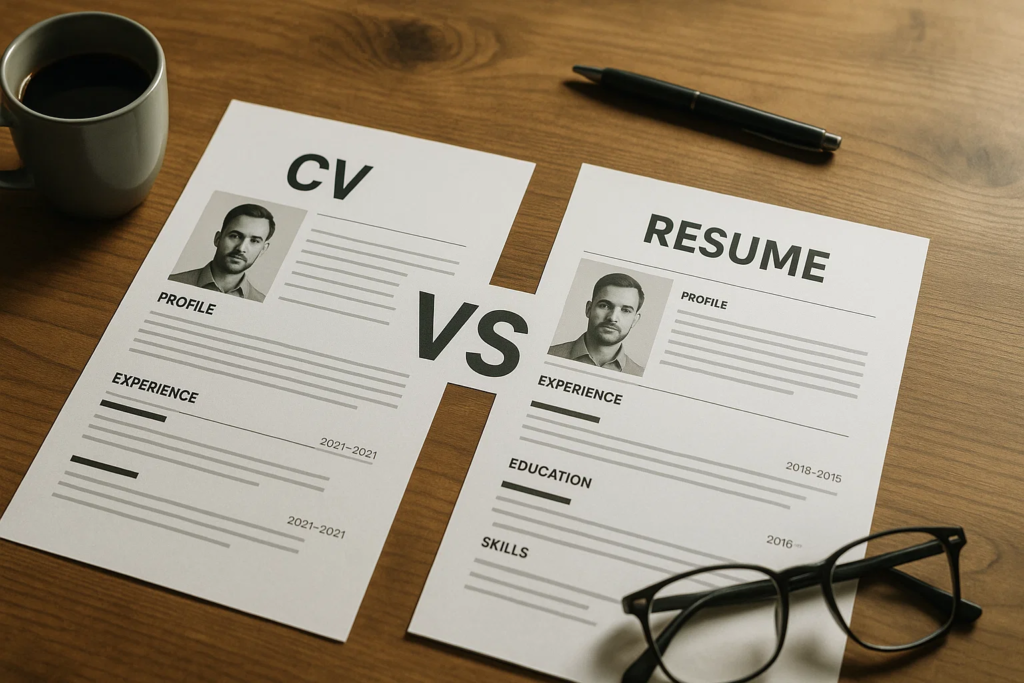
In today’s competitive job market, recruiters and hiring managers typically spend only a few seconds scanning an application before deciding whether to proceed. This makes clarity, relevance, and format critical. A resume is designed to be concise, targeted, and role-specific, highlighting only the most relevant skills and achievements for a particular job. A CV, on the other hand, is a comprehensive record of one’s academic background, professional history, research, publications, and achievements, often spanning multiple pages. Knowing when to use each document can significantly improve visibility, credibility, and interview success.
The confusion around CVs and resumes is further amplified by regional differences. In the United States, Canada, and much of Asia, employers generally expect a resume for corporate, technical, and industry roles, while a CV is reserved for academic, research, and medical positions. In contrast, many European, Middle Eastern, and African countries use the term CV to describe what is effectively a resume. This regional variation means that job seekers applying internationally must be especially careful to understand local hiring norms to avoid misalignment with employer expectations.
Beyond terminology, the structure, length, and content strategy of a CV and a resume differ significantly. A resume prioritizes impact over completeness, focusing on measurable results, core competencies, and recent experience. It is often tailored for applicant tracking systems and customized for each role. A CV emphasizes depth over brevity, documenting a full professional journey, including education, certifications, research work, teaching experience, grants, and publications. Employers reviewing a CV are usually looking for long-term expertise, academic credibility, or subject-matter authority rather than immediate job fit alone.
This guide is designed to remove all ambiguity around CVs and resumes by clearly explaining their key differences, ideal use cases, and real-world examples. It breaks down what each document is meant to achieve, how they are structured, and why choosing the right one matters. Readers will gain a clear understanding of when a resume is the right choice, when a CV is required, and how to adapt their documents based on industry, geography, and career goals.
Whether applying for a corporate role, an academic position, a research grant, or an international opportunity, having the right document can be the difference between being shortlisted or overlooked. By the end of this article, job seekers will be equipped with practical clarity, actionable insights, and a confident framework for deciding whether a CV or a resume is the best tool for their next application.
Before we venture further into this article, we would like to share who we are and what we do.
About 9cv9
9cv9 is a business tech startup based in Singapore and Asia, with a strong presence all over the world.
With over nine years of startup and business experience, and being highly involved in connecting with thousands of companies and startups, the 9cv9 team has listed some important learning points in this overview of CV vs Resume: Key Differences, Examples, and When to Use Each.
If you are looking for a job or an internship, click over to use the 9cv9 Job Portal to find your next top job and internship now.
Email hello@9cv9.com now for career and job finding services.
Or hope over to 9cv9 Job Placement Services for Professionals to learn how to get hired and find a high-paying job.
CV vs Resume: Key Differences, Examples, and When to Use Each
- What Is a Resume?
- What Is a CV (Curriculum Vitae)?
- Side-by-Side Comparison: CV vs Resume
- When to Use a Resume
- When to Use a CV
- How to Convert a Resume to a CV (and Vice Versa)
- Common Mistakes to Avoid
- Expert Tips for Writing Both CVs and Resumes
1. What Is a Resume?
A resume is a concise, targeted professional document designed to summarize an individual’s most relevant skills, work experience, and achievements for a specific job role. Its primary purpose is to demonstrate job fit quickly and clearly, allowing recruiters and hiring managers to assess suitability within seconds. Unlike a CV, a resume is not meant to document an entire career history. Instead, it highlights only the information that directly supports the job application at hand.
A resume functions as a marketing tool rather than a record-keeping document. Every section, bullet point, and metric is selected to align with the employer’s requirements, job description, and hiring priorities. In modern hiring environments, resumes are also optimized for applicant tracking systems, making keyword relevance and structured formatting essential.
Typical Scenarios Where a Resume Is Used
Resumes are most commonly requested for non-academic, industry-focused roles. These include corporate, technical, operational, and creative positions across most private-sector organizations.
Common resume use cases include
- Corporate roles in marketing, sales, finance, operations, and management
- Technology roles such as software engineering, data analysis, and IT support
- Startups and scale-ups prioritizing speed, versatility, and measurable impact
- Government and public-sector roles in many countries
- Entry-level, mid-level, and senior professional positions outside academia
In many regions, especially the United States, Southeast Asia, and parts of the Middle East, resumes are the default hiring document unless a CV is explicitly requested.
Key Characteristics of a Resume
Resume Length and Scope
A resume is intentionally brief and focused.
General length guidelines
- Entry-level professionals: 1 page
- Mid-level professionals: 1–2 pages
- Senior professionals: rarely more than 2 pages
The emphasis is on relevance, not completeness. Older roles, unrelated experience, and outdated skills are often removed to maintain clarity and impact.
Resume Customisation
A resume is tailored for each job application. This means
- Adjusting keywords to match the job description
- Prioritising relevant achievements over general duties
- Reordering sections based on role requirements
- Highlighting industry-specific skills and tools
This level of customization is one of the most important differences between a resume and a CV.
Core Sections of a Resume
Header and Contact Information
This section identifies the candidate and provides essential contact details.
Typical elements include
- Full name
- Professional title aligned with the role
- Phone number
- Professional email address
- Location (city and country)
- LinkedIn profile or portfolio link if relevant
Professional Summary or Objective
This is a short introductory paragraph at the top of the resume that sets context.
Professional summary is used when the candidate has experience.
It focuses on
- Years of experience
- Core expertise
- Key achievements
- Industry or role specialization
Objective statements are more common for entry-level candidates or career switchers.
They emphasize
- Career goals
- Transferable skills
- Motivation and alignment with the role
Example professional summary
Results-driven digital marketing specialist with 6+ years of experience managing SEO and paid media campaigns across Asia-Pacific markets. Proven track record of increasing organic traffic by over 120 percent and driving measurable ROI for B2B clients.
Work Experience
This is the most critical section of a resume.
Each role typically includes
- Job title
- Company name
- Location
- Employment dates
- Bullet points describing achievements
Effective resume bullet points focus on outcomes rather than responsibilities.
Example comparison
Weak bullet point
- Responsible for managing social media accounts
Strong bullet point
- Managed and scaled social media campaigns across three platforms, increasing engagement by 65 percent and reducing cost per lead by 30 percent within six months
Skills Section
This section highlights technical, professional, and role-specific skills.
Common skill categories
- Technical skills (software, tools, platforms)
- Industry skills (SEO, financial modeling, supply chain optimization)
- Soft skills when relevant (stakeholder management, leadership, communication)
Skills are often optimized to match applicant tracking systems by reflecting terminology used in job postings.
Education
Education is usually concise and placed lower on the resume for experienced professionals.
Typical elements
- Degree title
- Institution name
- Graduation year
- Relevant coursework or honors (optional)
Optional Resume Sections
Depending on the role, a resume may also include
- Certifications and licenses
- Projects
- Volunteer experience
- Languages
- Awards and recognitions
Resume vs Depth Matrix
Depth of Information by Section
Section Resume Depth CV Depth
Work Experience High relevance Full history
Education Summary Detailed
Publications Rare Essential
Length Short Long
Customisation High Low
This matrix highlights how resumes prioritise relevance and brevity over exhaustive detail.
Example Resume Structure
Name and Professional Title
Contact Information
Professional Summary
Key Skills
- Skill 1
- Skill 2
- Skill 3
Professional Experience
Role Title – Company
Achievement-focused bullet points
Education
Certifications / Projects (Optional)
This structure is widely accepted across industries and performs well in both recruiter reviews and automated screening systems.
Why Employers Prefer Resumes
Employers value resumes because they
- Save time during screening
- Highlight job-specific value quickly
- Enable easier comparison across candidates
- Support structured hiring workflows and ATS systems
In fast-moving hiring environments, resumes allow decision-makers to identify high-potential candidates without reviewing unnecessary or unrelated information.
Common Resume Mistakes to Avoid
- Listing duties instead of achievements
- Including irrelevant or outdated experience
- Using generic summaries across multiple applications
- Overloading the resume with text
- Ignoring keyword alignment with job descriptions
Strategic Role of a Resume in Career Growth
A resume is not a static document. It evolves with career progression, industry changes, and job market trends. High-performing professionals continuously refine their resumes to reflect new achievements, emerging skills, and changing career goals. When used correctly, a resume becomes a powerful positioning tool that opens doors to interviews, negotiations, and career advancement opportunities.
2. What Is a CV (Curriculum Vitae)?
A CV, short for Curriculum Vitae, is a comprehensive professional document that provides a full and detailed record of an individual’s academic background, professional experience, research activities, and intellectual contributions. The term originates from Latin and translates to “course of life,” which accurately reflects its purpose. Unlike a resume, a CV is not a marketing snapshot tailored for a single role, but a complete career narrative that grows over time.
The primary purpose of a CV is to demonstrate depth, credibility, and subject-matter expertise. It is used in contexts where decision-makers require a thorough understanding of a candidate’s qualifications, academic rigor, research output, and long-term professional development rather than a quick assessment of job fit.
Typical Scenarios Where a CV Is Used
CVs are most commonly requested in academic, research, medical, and international hiring environments where detailed evaluation is required.
Common CV use cases include
- Academic positions such as professors, lecturers, and researchers
- Applications for PhD programs, postdoctoral roles, and research fellowships
- Grant, scholarship, and funding applications
- Medical and healthcare roles in many countries
- International job applications where “CV” is the standard document
- Senior advisory, policy, and subject-matter expert roles
In many regions outside North America, the CV is also used for corporate roles, though its structure may resemble what is called a resume in the United States.
Key Characteristics of a CV
CV Length and Scope
A CV has no strict page limit. Its length depends on the individual’s career stage and achievements.
Typical length by career stage
- Early-career academic: 2–4 pages
- Mid-career researcher or professional: 4–8 pages
- Senior academic or expert: 8+ pages
The emphasis is on completeness and accuracy rather than brevity. Information is rarely removed; instead, the CV expands as new achievements are added.
CV Customisation
A CV is only lightly tailored compared to a resume.
Common customization actions include
- Reordering sections to emphasize research, teaching, or clinical work
- Highlighting specific publications or grants relevant to the role
- Adding brief contextual notes for international or interdisciplinary audiences
However, the core content of a CV remains stable, as it serves as a cumulative professional record.
Core Sections of a CV
Header and Contact Information
This section identifies the candidate and establishes professional credibility.
Typical elements include
- Full name
- Academic or professional titles
- Institutional or organizational affiliation
- Email address
- Phone number
- City and country
- Professional profiles or research identifiers when relevant
Professional Profile or Research Statement
Many CVs begin with a short overview that summarizes academic focus or professional specialization.
This section may include
- Primary research or professional interests
- Areas of expertise
- Methodological or theoretical focus
- Career stage and positioning
Example profile
Economist specializing in emerging markets with a focus on labor policy, wage dynamics, and workforce digitization across Southeast Asia. Over ten years of experience in applied research, policy advisory, and academic publishing.
Education
Education is a core pillar of a CV and is presented in full detail.
Typical elements include
- Degree titles
- Institutions
- Years attended
- Thesis or dissertation titles
- Supervisors or advisors when relevant
- Academic honors and distinctions
Professional and Academic Experience
This section documents all relevant appointments and roles.
Examples include
- Academic positions
- Research appointments
- Clinical roles
- Policy advisory work
- Consulting or professional practice
Unlike a resume, responsibilities and scope are often described in more detail to reflect teaching load, research output, leadership responsibilities, or clinical exposure.
Research Experience and Projects
For research-focused CVs, this section outlines
- Research projects and initiatives
- Funding sources
- Methodologies used
- Collaboration with institutions or teams
Publications and Academic Output
This is one of the most defining sections of a CV.
Common inclusions
- Peer-reviewed journal articles
- Books and book chapters
- Conference papers
- Working papers and preprints
Publications are typically listed in reverse chronological order using standardized citation formats.
Teaching Experience
Teaching-focused CVs include a dedicated section covering
- Courses taught
- Institutions and departments
- Levels (undergraduate, postgraduate, executive education)
- Curriculum development responsibilities
Grants, Fellowships, and Funding
This section highlights the candidate’s ability to secure funding and institutional trust.
Examples include
- Research grants
- Scholarships
- Fellowships
- Sponsored projects
Awards and Honors
Awards signal recognition and credibility.
Examples include
- Academic awards
- Professional recognitions
- Competitive honors
- Institutional distinctions
Certifications and Professional Memberships
This section documents
- Licenses
- Board certifications
- Memberships in professional associations
- Editorial or review board roles
Languages and Skills
Unlike resumes, skills in a CV are often contextualized rather than listed as keywords.
Examples include
- Languages with proficiency levels
- Research methods
- Technical or laboratory skills
- Statistical or analytical tools
Optional CV Sections
Depending on the field, a CV may also include
- Conferences and presentations
- Invited talks
- Media appearances
- Community engagement
- Service roles and committees
CV vs Resume Information Depth Matrix
Section CV Depth Resume Depth
Career History Complete Selective
Education Detailed Summary
Publications Extensive Rare
Teaching Experience Core Optional
Research Grants Core Not included
Customisation Level Low High
Document Length Long Short
This matrix illustrates how CVs prioritize completeness, academic rigor, and long-term credibility.
Example CV Structure
Name and Academic Title
Contact Information
Professional or Research Profile
Education
Academic and Professional Appointments
Research Experience
Publications
Teaching Experience
Grants and Funding
Awards and Honors
Certifications and Memberships
Languages and Skills
Service and Affiliations
Why Institutions Prefer CVs
Institutions and academic bodies prefer CVs because they
- Enable thorough evaluation of expertise and credibility
- Support peer review and committee-based decision-making
- Provide transparency across research, teaching, and service
- Allow long-term assessment beyond immediate role fit
In these contexts, depth and evidence matter more than brevity.
Common CV Mistakes to Avoid
- Omitting key academic or research details
- Using resume-style brevity in academic sections
- Poor organization that reduces readability
- Inconsistent formatting or citation styles
- Failing to update the CV regularly
Strategic Role of a CV in Long-Term Careers
A CV is a living document that evolves alongside an individual’s academic or professional journey. It reflects intellectual growth, institutional trust, and cumulative achievement. When maintained carefully and structured clearly, a CV becomes a powerful asset for securing academic positions, research funding, leadership roles, and international opportunities where credibility and depth are non-negotiable.
3. Side-by-Side Comparison: CV vs Resume
The most fundamental difference between a CV and a resume lies in their strategic intent. A resume is designed to secure an interview by quickly demonstrating role-specific value. It functions as a targeted marketing document, emphasizing relevance, measurable impact, and alignment with a specific job description. A CV, in contrast, is intended to provide a complete and transparent record of professional and academic life. It supports in-depth evaluation by committees, institutions, and reviewers who assess long-term expertise rather than immediate job fit.
In practice, this means a resume answers the question, “Is this candidate suitable for this role right now?” while a CV answers, “What has this individual accomplished over the course of their career, and how credible is their expertise?”
Document Length and Information Depth
Length is one of the most visible distinctions between the two documents, but it reflects a deeper difference in philosophy.
Resume characteristics
- Typically limited to one or two pages
- Focuses on recent and relevant experience
- Excludes unrelated or outdated roles
- Prioritizes clarity and speed of review
CV characteristics
- No formal page limit
- Expands continuously over time
- Includes all relevant academic, professional, and research history
- Prioritizes completeness and documentation
The difference in length directly impacts how information is presented and evaluated.
Content Focus and Structure
A resume emphasizes outcomes and performance metrics, while a CV emphasizes scope, contribution, and intellectual depth.
Resume content focus
- Key skills aligned with job requirements
- Achievement-driven bullet points
- Quantified results and performance indicators
- Selective career highlights
CV content focus
- Full education history
- Detailed academic and professional appointments
- Research, publications, and teaching
- Grants, awards, and institutional service
This distinction influences how each document is structured and read.
Customisation and Update Frequency
Customisation is central to resume effectiveness but secondary in CV usage.
Resume customisation approach
- Tailored for each job application
- Keywords adjusted to match job descriptions
- Sections reordered to highlight role-specific strengths
- Bullet points rewritten for relevance
CV update approach
- Updated periodically rather than per application
- New achievements added without removing older entries
- Minor reordering based on emphasis, not role-specific tailoring
This difference makes resumes dynamic and application-driven, while CVs remain stable and cumulative.
Side-by-Side Comparison Table
Comparison Factor Resume CV
Primary Purpose Job application Career documentation
Typical Length 1–2 pages 2–10+ pages
Content Scope Selective Comprehensive
Customisation Level High Low to moderate
Update Frequency Per application Periodic
Focus Impact and relevance Depth and credibility
This table highlights how resumes and CVs serve fundamentally different evaluation models.
Work Experience Presentation
The way professional experience is presented varies significantly.
Resume work experience
- Emphasizes achievements over responsibilities
- Uses action verbs and quantified outcomes
- Focuses on the most recent and relevant roles
Example resume entry
- Led a regional marketing campaign that increased qualified leads by 85 percent within nine months
CV work experience
- Describes role scope, responsibilities, and duration
- Includes academic, clinical, or advisory duties
- Often provides context for long-term projects
Example CV entry
- Served as Associate Research Fellow from 2018 to 2023, leading multi-year labor market studies across Southeast Asia and supervising graduate research assistants
Education and Academic Detail
Education plays a different role in each document.
Resume education section
- Brief and summary-based
- Often placed at the bottom for experienced professionals
- Limited to degree, institution, and graduation year
CV education section
- Central and detailed
- Includes thesis titles, supervisors, and honors
- May appear near the top regardless of experience
Publications, Research, and Teaching
This is where the divergence becomes most pronounced.
Resume approach
- Publications and research rarely included
- Teaching experience only listed if directly relevant
CV approach
- Dedicated sections for publications, research, and teaching
- Full citation listings
- Clear differentiation between peer-reviewed and non-peer-reviewed work
Information Inclusion Matrix
Information Type Resume CV
Publications No Yes
Research Projects Rare Yes
Teaching Experience Optional Yes
Grants and Funding No Yes
Awards and Honors Selective Yes
This matrix clarifies why CVs are essential in academic and research-driven environments.
Geographic and Industry Usage
The distinction between CV and resume is also influenced by geography.
Common resume regions
- United States
- Canada
- Southeast Asia
- Corporate roles globally
Common CV regions and contexts
- Europe
- Middle East
- Africa
- Academia and research worldwide
In many countries, the term CV is used generically, but the expected content often aligns more closely with a resume. Understanding local norms is critical in international applications.
Screening and Evaluation Methods
Resumes and CVs are reviewed using different evaluation processes.
Resume screening
- Often reviewed by recruiters or HR professionals
- Frequently processed through applicant tracking systems
- Evaluated quickly for role alignment
CV evaluation
- Reviewed by academic committees or panels
- Assessed for credibility, depth, and contribution
- Evaluated over a longer timeframe
This difference affects how information should be organized and prioritized.
Decision Framework: Which One to Use
Scenario Recommended Document
Corporate job application Resume
Academic faculty position CV
PhD or postdoctoral application CV
Startup or private sector role Resume
Grant or fellowship application CV
International academic role CV
This framework provides a practical reference for document selection.
Common Mistakes in Using the Wrong Document
- Submitting a CV when a resume is requested
- Using a resume for academic or research applications
- Overloading a resume with irrelevant details
- Oversimplifying a CV and omitting key contributions
Strategic Implications for Career Progression
Understanding the difference between a CV and a resume is not just a formatting concern; it is a strategic career decision. Professionals who use resumes effectively position themselves for faster hiring cycles and competitive corporate roles. Individuals who maintain well-structured CVs strengthen their credibility for academic, research, and expert-level opportunities. Choosing the correct document ensures alignment with hiring expectations, evaluation criteria, and long-term career objectives.
4. When to Use a Resume
A resume should be used when the hiring decision is driven by role-specific relevance, measurable performance, and immediate business impact. In these situations, employers are not looking for a complete career history or academic depth. Instead, they want a concise document that clearly shows how a candidate’s skills and experience align with the responsibilities and outcomes of a specific role. A resume is most effective in fast-paced hiring environments where screening efficiency, clarity, and comparability between candidates are critical.
Corporate and Private-Sector Job Applications
Resumes are the standard document for most corporate, commercial, and private-sector roles. These environments prioritize efficiency, performance metrics, and role alignment.
Typical corporate scenarios include
- Full-time roles in marketing, sales, finance, operations, and management
- Technology and engineering positions in startups and enterprises
- Consulting, professional services, and agency roles
- Business development, strategy, and product management positions
In these contexts, hiring managers expect a focused document that highlights recent achievements, core competencies, and results-driven contributions rather than a detailed career archive.
Example
A product manager applying to a SaaS company would use a resume that highlights product launches, user growth metrics, revenue impact, and cross-functional leadership rather than listing every role held since graduation.
High-Volume and Competitive Hiring Environments
Resumes are essential in hiring environments where employers receive a large number of applications and must shortlist candidates quickly.
Common high-volume scenarios
- Online job portals and career platforms
- Campus recruitment programs
- Graduate and entry-level hiring pipelines
- Mass hiring for sales, support, or operations teams
In these cases, resumes allow recruiters to
- Scan key qualifications within seconds
- Compare candidates using consistent criteria
- Filter applications using applicant tracking systems
A CV would be impractical in these environments due to its length and level of detail.
Applicant Tracking System and Keyword-Driven Hiring
Resumes are specifically designed to work with applicant tracking systems.
Situations where ATS compatibility is critical
- Applications submitted through corporate career portals
- Roles at multinational companies
- Tech, finance, and regulated industries
- Recruitment agencies and staffing firms
A resume allows candidates to strategically incorporate role-specific keywords, skills, and terminology drawn from job descriptions. This improves visibility during automated screening and increases the likelihood of human review.
Resume vs ATS Suitability Matrix
Hiring Factor Resume CV
ATS compatibility High Low
Keyword targeting High Low
Automated screening Yes Limited
Fast recruiter review Yes No
This matrix illustrates why resumes are preferred in system-driven hiring processes.
Roles Focused on Practical Skills and Execution
Resumes are ideal when the role emphasizes execution, hands-on skills, and short- to medium-term performance.
Examples include
- Software development and IT roles
- Digital marketing and performance marketing positions
- Sales, account management, and customer success
- Operations, logistics, and supply chain roles
- Creative roles such as design, content, and media
In these roles, employers care more about what a candidate can do now than about their complete academic or professional history.
Example
A digital marketer applying for a growth role would use a resume highlighting campaign ROI, conversion rate improvements, and platform expertise rather than academic research or unrelated early-career roles.
Geographic Contexts Where Resumes Are Expected
Understanding regional hiring norms is critical when deciding to use a resume.
Regions where resumes are the default document
- United States
- Canada
- Southeast Asia
- Australia for most non-academic roles
In these regions, submitting a CV instead of a resume can signal unfamiliarity with local hiring practices and reduce credibility.
International Applications to Global Companies
Even when applying internationally, resumes are often preferred by global companies, especially those headquartered in resume-centric markets.
Typical scenarios
- Applying to multinational corporations
- Roles within global consulting firms
- Remote positions with international teams
- Jobs listed on global hiring platforms
Unless the job description explicitly requests a CV, a resume is usually the safer and more effective choice.
Career Stage Considerations
Resumes are suitable for professionals at almost every non-academic career stage.
Early-career professionals
- Focus on education, internships, and transferable skills
- Use concise resumes to demonstrate potential and adaptability
Mid-career professionals
- Highlight progression, leadership, and measurable results
- Use resumes to reposition experience for new roles or industries
Senior professionals
- Focus on strategic impact, leadership outcomes, and business results
- Avoid long career histories that dilute relevance
Resume Use by Career Stage Matrix
Career Stage Resume Use Case
Entry-level Primary document
Mid-level Primary document
Senior-level Primary document
Academic roles Not suitable
Situations Where a Resume Is Explicitly Required
Some employers clearly specify document requirements.
Examples include
- Job postings stating “Submit your resume”
- Online forms with resume upload fields
- Recruitment agencies requesting resumes for screening
- Corporate HR departments standardizing resume formats
In these situations, submitting a CV instead of a resume can lead to immediate disqualification.
Situations Where a Resume Is Preferable Even If a CV Is Accepted
There are cases where employers accept both documents, but a resume remains the better option.
Examples
- Roles with mixed academic and commercial elements
- Industry research roles without teaching responsibilities
- Corporate strategy roles within universities or NGOs
In such cases, a resume provides clarity and focus, while a CV may introduce unnecessary complexity.
Decision Chart: Should You Use a Resume?
Question Answer Action
Is the role non-academic? Yes Use a resume
Is the employer a corporation or startup? Yes Use a resume
Is the application via an online portal? Yes Use a resume
Is the role research or teaching focused? No Use a resume
Common Mistakes When Choosing to Use a Resume
- Using a resume for academic or research roles
- Including excessive historical detail
- Treating a resume as a static document
- Ignoring keyword alignment with job descriptions
Strategic Value of Using a Resume Correctly
Using a resume in the right context significantly increases hiring efficiency and interview conversion rates. It positions candidates as business-focused, results-oriented, and aligned with employer expectations. When used strategically, a resume becomes a powerful tool for navigating competitive job markets, career transitions, and fast-moving hiring cycles.
5. When to Use a CV
A CV should be used when decision-makers require a deep, transparent, and comprehensive view of an individual’s academic background, professional development, and long-term contributions. In these contexts, hiring or selection is not based on quick screening or immediate role fit, but on credibility, subject-matter authority, and sustained performance over time. A CV allows evaluators to assess qualifications holistically, including education, research output, teaching experience, publications, grants, and professional service.
Academic and University Positions
CVs are the standard and expected document for academic roles at universities, colleges, and research institutions.
Typical academic scenarios include
- Faculty positions such as professor, associate professor, and lecturer
- Research appointments and postdoctoral roles
- Visiting scholar and adjunct positions
- Academic leadership roles such as department heads or program directors
In these environments, hiring committees assess not only professional competence but also research depth, teaching history, and institutional contribution.
Example
A candidate applying for a university lecturer position would submit a CV detailing degrees, dissertation topic, publications, courses taught, academic service, and conference presentations rather than a short resume.
Research, Grants, and Fellowship Applications
CVs are essential for research-driven opportunities where credibility and scholarly output are critical evaluation criteria.
Common research-related scenarios
- PhD and doctoral program applications
- Postdoctoral fellowships
- Research grants and funded projects
- Think tank and policy research roles
Funding bodies and academic committees rely on CVs to assess an applicant’s research trajectory, publication record, and ability to deliver long-term projects.
Example
A researcher applying for a funded labor economics project would use a CV highlighting peer-reviewed publications, datasets used, methodologies, prior grants, and institutional affiliations.
Medical, Scientific, and Clinical Roles
In many countries, medical and scientific professions require CVs rather than resumes due to the need for detailed credential verification.
Typical scenarios include
- Physician and specialist appointments
- Clinical research roles
- Hospital and academic medical center positions
- Scientific research and laboratory roles
A CV allows employers to review licenses, certifications, training programs, clinical rotations, and research contributions in detail.
Example
A medical specialist applying to a teaching hospital would submit a CV listing medical degrees, residency training, board certifications, clinical appointments, research publications, and professional memberships.
International Job Applications Where CV Is the Standard
In many regions, the term CV is used as the default hiring document, even for non-academic roles.
Regions where CVs are commonly expected
- Europe
- Middle East
- Africa
- Parts of South America
In these regions, employers often expect more detail than a traditional resume but less academic depth than a full research CV. Understanding local norms is essential.
International CV Usage Matrix
Region CV Expected Resume Expected
Europe Yes Rare
Middle East Yes Rare
Africa Yes Rare
United States Rare Yes
Canada Rare Yes
This matrix highlights geographic expectations for document usage.
Senior Advisory, Policy, and Expert Roles
CVs are preferred for roles where expertise, reputation, and long-term contribution are more important than immediate execution.
Common scenarios include
- Policy advisory roles
- Senior consultants and subject-matter experts
- Board and committee appointments
- NGO and international organization roles
These roles often involve committee-based selection processes that rely on CVs to evaluate experience breadth and institutional credibility.
Example
An economic policy advisor applying to an international development organization would use a CV outlining advisory roles, published policy papers, speaking engagements, and institutional affiliations.
Situations Requiring Full Credential Transparency
CVs are necessary when full disclosure of qualifications is required for verification or compliance.
Typical scenarios
- Accreditation and certification processes
- Immigration or work permit applications
- Professional licensing reviews
- Security-cleared or regulated roles
In these cases, completeness and accuracy outweigh brevity.
Decision Framework: Should You Use a CV?
Evaluation Question Yes No
Is the role academic or research-focused? CV Resume
Is teaching or publication required? CV Resume
Is the application committee-reviewed? CV Resume
Is the role based in CV-centric regions? CV Resume
This framework helps candidates make informed document choices.
Career Stage Considerations for CV Usage
CVs are especially relevant for professionals whose careers emphasize intellectual contribution or formal credentialing.
Early-career academics
- Use CVs to document education, research projects, and early publications
Mid-career professionals in research or medicine
- Use CVs to demonstrate progression, specialization, and funded work
Senior experts and academics
- Use CVs to present leadership, institutional service, and lifetime contributions
CV vs Resume Suitability by Role Type
Role Type Preferred Document
Corporate management Resume
Academic faculty CV
Research scientist CV
Medical specialist CV
Startup operations Resume
Policy advisor CV
Common Mistakes When Choosing to Use a CV
- Submitting a CV for roles that explicitly request a resume
- Overloading non-academic CVs with irrelevant academic detail
- Poor organization that reduces readability
- Failing to adapt the CV for international or interdisciplinary audiences
Strategic Value of Using a CV Correctly
Using a CV in the appropriate context signals professionalism, credibility, and alignment with institutional expectations. It allows evaluators to assess depth of expertise, consistency of contribution, and long-term potential. When used strategically, a CV becomes an essential asset for academic progression, research funding, medical appointments, and international career opportunities where comprehensive evaluation is required.
6. How to Convert a Resume to a CV (and Vice Versa)
Professionals increasingly move between corporate, academic, research, and international environments where document expectations change. A resume that performs well in a corporate hiring process may be unsuitable for academic or research applications, while a CV that demonstrates credibility in academic settings may overwhelm corporate recruiters. Knowing how to convert a resume into a CV, and a CV into a resume, ensures alignment with evaluation criteria, regional norms, and hiring intent without losing critical information.
Converting a Resume into a CV
Strategic Shift in Mindset
Converting a resume into a CV requires a shift from selectivity to completeness. The goal is no longer to highlight only role-specific relevance, but to document the full professional and academic journey in a structured, transparent manner.
Key mindset changes
- From marketing snapshot to career record
- From brevity to depth
- From job-specific tailoring to cumulative documentation
Step-by-Step Conversion Process
Expand Professional Experience
Resume experience sections typically include only recent or relevant roles. When converting to a CV, all significant roles should be included.
Actions to take
- Add earlier positions that were removed from the resume
- Expand role descriptions to include scope, responsibilities, and duration
- Include academic, research, consulting, and advisory roles
Example
Resume entry
- Led market expansion strategy that increased regional revenue by 40 percent
CV expansion
- Served as Strategy Manager from 2017 to 2021, leading multi-market expansion initiatives across Southeast Asia, overseeing cross-functional teams, managing regional partners, and contributing to long-term revenue growth strategies
Restore and Expand Education Details
Education in resumes is often brief. CVs require full academic documentation.
Include
- Degree titles and institutions
- Years attended
- Thesis or dissertation titles
- Academic supervisors or advisors
- Honors and distinctions
Add Research, Publications, and Academic Output
One of the most important steps in resume-to-CV conversion is adding academic content that is usually excluded from resumes.
Common additions
- Peer-reviewed journal articles
- Conference papers and presentations
- Research projects and working papers
- Academic collaborations
If no publications exist, include
- Research-in-progress
- Independent studies
- Capstone projects
Introduce Teaching and Instructional Experience
Teaching experience, even if limited, should be included in a CV.
Examples
- Courses assisted or taught
- Guest lectures
- Workshops and training sessions
Add Grants, Fellowships, and Awards
These elements demonstrate institutional trust and professional recognition.
Include
- Research funding
- Scholarships and fellowships
- Competitive awards
Include Professional Service and Affiliations
CVs value service and contribution beyond core roles.
Examples
- Peer review activities
- Committee memberships
- Editorial roles
- Professional associations
Resume to CV Expansion Matrix
Information Area Resume State CV State
Career History Selective Complete
Education Detail Minimal Full
Publications Excluded Included
Teaching Experience Optional Core
Awards and Grants Limited Detailed
This matrix illustrates how information depth increases during conversion.
Converting a CV into a Resume
Strategic Shift in Mindset
Converting a CV into a resume requires discipline and prioritization. The objective is to extract only the information that directly supports a specific role and present it in a concise, results-focused format.
Key mindset changes
- From completeness to relevance
- From documentation to persuasion
- From academic depth to business impact
Step-by-Step Conversion Process
Identify the Target Role and Industry
Resume conversion should begin with a clear understanding of the role.
Actions to take
- Analyze the job description
- Identify required skills, tools, and outcomes
- Determine which experiences directly support the role
Remove or Deprioritize Academic Detail
Academic CVs often contain extensive educational and research sections that are unnecessary in resumes.
Actions to take
- Remove publication lists
- Exclude thesis titles and supervisors
- Summarize education in one or two lines
Focus on Recent and Relevant Experience
Resumes prioritize recency and relevance.
Actions to take
- Select the most relevant roles from the CV
- Limit work experience to the last 10–15 years
- Remove unrelated early-career roles
Rewrite Descriptions into Achievement Statements
CV descriptions often emphasize responsibilities. Resume bullets should focus on outcomes.
Example
CV description
- Conducted longitudinal labor market research and policy analysis
Resume rewrite
- Delivered labor market research that informed national workforce policy, contributing to the adoption of two regulatory reforms
Condense Sections and Merge Information
Resumes benefit from consolidation.
Examples
- Merge teaching and training into a single “Professional Experience” section
- Combine grants and awards into “Selected Achievements”
CV to Resume Reduction Matrix
Information Area CV State Resume State
Career History Full Selected
Publications Extensive Removed
Teaching Detail Detailed Condensed or removed
Role Descriptions Descriptive Outcome-focused
Document Length Long 1–2 pages
Balancing Accuracy and Relevance
During conversion, accuracy must be preserved even as content is added or removed.
Best practices
- Do not fabricate or exaggerate achievements
- Maintain consistent dates and titles
- Ensure terminology aligns with the target industry
Common Conversion Mistakes to Avoid
- Treating a resume as a shortened CV without rewriting
- Removing too much context when converting to a resume
- Overloading a CV with irrelevant corporate detail
- Failing to adapt language for academic or industry audiences
Decision Chart: Which Conversion Direction Do You Need?
Career Goal Action
Applying for academic or research role Resume to CV
Applying for corporate or startup role CV to Resume
International academic application Resume to CV
Industry transition from academia CV to Resume
Strategic Value of Mastering Both Formats
Professionals who maintain both a well-structured CV and a targeted resume gain flexibility across industries, geographies, and career stages. Mastering conversion ensures that achievements are presented in the right format for the right audience, maximizing credibility, relevance, and career mobility in an increasingly global and interdisciplinary job market.
7. Common Mistakes to Avoid
One of the most frequent and damaging mistakes job seekers make is submitting the wrong document type. A CV and a resume are evaluated using very different criteria, and using the incorrect one can lead to immediate rejection regardless of qualifications.
Common scenarios
- Submitting a CV for a corporate or startup role that explicitly asks for a resume
- Using a resume for academic, research, or teaching positions that require a CV
- Assuming “CV” and “resume” are interchangeable across countries
Example
A candidate applying for a university research assistant role submits a one-page resume focused on metrics and KPIs, omitting publications and research experience. The application is rejected because evaluators cannot assess academic credibility.
Document Selection Error Matrix
Application Context Correct Document Common Mistake
Corporate job role Resume Submitting a CV
Academic faculty position CV Submitting a resume
Research grant or fellowship CV Submitting a resume
Online job portal Resume Uploading a CV
Treating a Resume as a Career History
A resume is not a chronological archive of everything a candidate has ever done. Overloading it with excessive detail is a common mistake that reduces clarity and impact.
Typical errors
- Listing every job since graduation
- Including outdated or irrelevant roles
- Writing long paragraphs instead of concise bullet points
Why this hurts
Recruiters skim resumes quickly. Excess information dilutes relevance and makes it harder to identify key qualifications.
Example
Instead of highlighting recent leadership achievements, a mid-career professional lists entry-level roles from over a decade ago, pushing critical experience onto a second page.
Treating a CV Like a Resume
The opposite mistake occurs when candidates oversimplify a CV, especially in academic or research settings.
Common issues
- Removing publications to shorten length
- Omitting thesis titles or research projects
- Using vague bullet points instead of detailed descriptions
Why this hurts
Committees rely on CVs to evaluate depth, rigor, and consistency. A shortened CV can signal a lack of experience or attention to academic standards.
Example
A PhD applicant submits a two-page CV without listing conference papers or research methods, making it impossible for reviewers to assess research capability.
Lack of Customisation Where It Matters
Another major mistake is misunderstanding where customization is required and where it is not.
Resume-specific mistakes
- Using the same resume for every job application
- Ignoring keywords from job descriptions
- Failing to align achievements with role requirements
CV-specific mistakes
- Over-customising and removing historical content
- Rewriting core sections for each application unnecessarily
Customisation Expectation Matrix
Document Type Customisation Level Common Error
Resume High Using one generic version
CV Low to moderate Removing historical content
Weak or Responsibility-Based Language
Many candidates describe what they were responsible for rather than what they achieved.
Resume language mistakes
- Using passive or generic phrasing
- Focusing on duties instead of outcomes
Example
Weak
- Responsible for managing projects
Strong
- Led cross-functional projects delivered on time and under budget, improving operational efficiency by 25 percent
CV language mistakes
- Being too vague about research scope
- Failing to explain significance or contribution
Inconsistent Formatting and Poor Structure
Inconsistent formatting reduces readability and professionalism.
Common formatting issues
- Inconsistent dates or job titles
- Uneven spacing and alignment
- Mixing writing styles across sections
Why this matters
Recruiters and committees associate formatting errors with lack of attention to detail, which can be especially damaging in academic or regulated fields.
Including Irrelevant or Sensitive Information
Another frequent mistake is including information that does not belong in professional documents.
Examples
- Personal data such as marital status, religion, or national ID numbers
- Irrelevant hobbies that add no value
- Salary expectations embedded in resumes or CVs
Relevance Filter Chart
Information Type Include? Reason
Professional achievements Yes Demonstrates value
Academic publications Yes (CV) Shows credibility
Personal beliefs No Irrelevant
Unrelated hobbies No Distracts focus
Ignoring Geographic and Cultural Norms
Document expectations vary significantly by region, and ignoring these differences can harm applications.
Common mistakes
- Using US-style resumes in European CV markets
- Adding photos where they are discouraged
- Omitting details expected in certain regions
Example
A candidate applies to a role in Germany with a one-page US-style resume, while the employer expects a detailed CV outlining education, certifications, and work history.
Failing to Update Regularly
Outdated documents weaken credibility.
Typical signs
- Missing recent roles or promotions
- Outdated skill sets or tools
- Old contact information
Best practice
- Resumes should be updated after major achievements
- CVs should be updated whenever new publications, roles, or awards are added
Overloading Documents with Buzzwords
Using excessive buzzwords without evidence is another common issue.
Examples
- “Results-driven,” “dynamic,” or “innovative” without metrics
- Long lists of skills without context
Better approach
- Support claims with measurable outcomes
- Demonstrate skills through examples rather than labels
Mistake Impact Matrix
Mistake Type Impact on Application
Wrong document type Immediate rejection
Excessive length (resume) Reduced readability
Missing academic detail (CV) Loss of credibility
Poor formatting Lower professionalism
Strategic Takeaway
Avoiding these common mistakes requires understanding the fundamental purpose of each document and the expectations of the audience reviewing it. A resume succeeds through clarity, relevance, and measurable impact. A CV succeeds through depth, accuracy, and comprehensive documentation. Professionals who align document type, content, and structure with the correct context significantly increase their chances of progressing to interviews, evaluations, and final selection stages.
8. Expert Tips for Writing Both CVs and Resumes
The most important expert-level insight when writing both CVs and resumes is understanding how they are evaluated. Recruiters, hiring managers, and academic committees do not read these documents the same way candidates write them. They scan, compare, and validate information against specific criteria.
Key evaluation differences
- Recruiters prioritize speed, relevance, and clarity
- Hiring managers look for proof of impact and role fit
- Academic committees assess credibility, depth, and consistency
- Funding bodies evaluate track record, rigor, and long-term potential
Writing with the evaluator’s mindset ensures that information is positioned where it will be noticed and valued.
Design for Skimmability Without Sacrificing Substance
Both CVs and resumes must be easy to scan while still conveying meaningful information. Dense text blocks reduce readability and increase the risk of key information being overlooked.
Best practices
- Use clear section separation and logical ordering
- Keep bullet points concise but informative
- Front-load important information within each section
- Maintain consistent formatting throughout the document
Example
Instead of burying achievements in long paragraphs, place measurable outcomes at the beginning of each line so they stand out during scanning.
Use Strong, Evidence-Based Language
Expert-level documents replace vague descriptors with evidence-backed statements. This applies to both resumes and CVs, though the execution differs.
Resume language focus
- Action-oriented verbs
- Quantified outcomes
- Business impact
CV language focus
- Scope of responsibility
- Methodology and contribution
- Academic or professional significance
Example comparison
Weak statement
- Contributed to research and analysis
Strong resume version
- Delivered market analysis that informed pricing strategy and increased gross margin by 18 percent
Strong CV version
- Conducted multi-year labor market research using panel data analysis, contributing to peer-reviewed publications and policy recommendations
Prioritise Section Order Strategically
The order of sections should reflect what matters most to the target audience.
Resume prioritisation
- Professional summary
- Key skills
- Work experience
- Education
CV prioritisation
- Education
- Academic or professional appointments
- Research and publications
- Teaching and service
Section Priority Matrix
Document Type Highest Priority Sections
Resume Skills, achievements, experience
CV Education, research, publications
This prioritisation ensures evaluators see the most relevant information first.
Maintain Consistent and Accurate Timelines
Chronological consistency is a hallmark of professional documents. Inaccurate or conflicting dates raise red flags.
Best practices
- Use consistent date formats
- Ensure no unexplained gaps
- Align roles, education, and publications chronologically
If gaps exist, they should be addressed through context rather than omission.
Balance Brevity and Depth Correctly
Experts understand that brevity and depth are not opposites but tools used differently depending on the document.
Resume balance
- One to two lines per achievement
- Focus on outcomes, not processes
- Remove low-impact information
CV balance
- Include full details but avoid redundancy
- Group related activities logically
- Use headings to prevent clutter
Depth Control Matrix
Information Type Resume Depth CV Depth
Work responsibilities Minimal Moderate
Achievements High Moderate
Research methods Excluded High
Publications Excluded High
Align Keywords With Purpose, Not Trends
Keyword optimization is critical, especially for resumes, but indiscriminate keyword stuffing reduces credibility.
Resume keyword strategy
- Extract keywords directly from job descriptions
- Use industry-standard terminology
- Integrate keywords naturally into achievements
CV keyword strategy
- Use discipline-specific terminology
- Maintain consistency with published work
- Avoid oversimplification for academic audiences
Example
Instead of listing “leadership” as a standalone skill, demonstrate leadership through context and outcomes.
Show Progression and Growth Clearly
Both CVs and resumes should tell a story of progression, not just list roles.
Indicators of progression
- Increasing responsibility
- Expanded scope or team size
- Advancement in titles or institutions
- Growing research complexity or impact
Progression signals are especially important for mid-career and senior professionals.
Progression Visibility Chart
Career Signal Resume Use CV Use
Promotion history Yes Yes
Leadership scope Yes Yes
Research evolution No Yes
Teaching responsibility Optional Yes
Keep Design Professional and Conservative
Expert documents prioritize clarity over visual flair.
Design principles
- Simple fonts
- Clear spacing
- No excessive colors or graphics
- Consistent alignment
Over-designed documents can distract from content and reduce compatibility with screening systems.
Maintain Two Master Documents
Professionals with long-term career strategies maintain both a master CV and a master resume.
Best practice workflow
- Maintain a full master CV with all achievements
- Create tailored resumes by extracting relevant content
- Update both documents regularly
This approach reduces errors and ensures consistency across applications.
Regularly Audit and Update Content
Outdated documents signal stagnation.
Recommended update frequency
- Resume: after major achievements, promotions, or role changes
- CV: whenever new publications, roles, awards, or affiliations are added
Audit checklist
- Remove obsolete tools or skills
- Add recent accomplishments
- Verify contact information
Common Expert-Level Pitfalls to Avoid
- Over-polishing language at the expense of clarity
- Using the same tone for both documents
- Assuming evaluators will infer impact
- Neglecting structure while focusing on content
Expert Writing Impact Matrix
Practice Applied Impact
Clear prioritisation Higher readability
Evidence-based language Stronger credibility
Correct depth control Better evaluation fit
Consistent formatting Professional perception
Strategic Takeaway
Expertly written CVs and resumes are not just documents but strategic assets. When structured with evaluator psychology, optimized for purpose, and supported by evidence, they communicate credibility, relevance, and progression with clarity. Professionals who master these principles gain a competitive advantage across corporate, academic, and international career opportunities by consistently presenting the right information in the right way to the right audience.
Conclusion
Understanding the difference between a CV and a resume is no longer optional in a modern, globalised job market. As hiring processes become more specialised, competitive, and geographically diverse, using the correct document has a direct impact on how qualifications are interpreted and evaluated. A CV and a resume are not simply different formats of the same content. They serve distinct purposes, are reviewed by different audiences, and are judged using entirely different criteria. Recognising this distinction allows job seekers to present their experience with clarity, relevance, and strategic intent.
A resume is designed to communicate value quickly. It is concise, targeted, and results-driven, making it ideal for corporate, private-sector, and high-volume hiring environments. When used correctly, a resume highlights the most relevant achievements, aligns closely with job requirements, and supports efficient screening through both human reviewers and applicant tracking systems. Its strength lies in its focus on immediate impact and role-specific fit rather than comprehensive career documentation.
A CV, on the other hand, is built for depth, credibility, and long-term evaluation. It provides a complete record of academic and professional development, making it essential for academic, research, medical, and international applications where decision-makers require transparency and detailed evidence of expertise. A well-structured CV allows committees and institutions to assess progression, intellectual contribution, and sustained performance over time, which cannot be captured in a short resume format.
Throughout this guide, the key differences between CVs and resumes have been clearly defined through structure, content, length, customisation, and use cases. Practical examples, comparison frameworks, and decision matrices demonstrate that choosing the right document is not about preference, but about alignment with hiring expectations. Submitting the wrong document, even when qualifications are strong, can undermine credibility and reduce the chances of being shortlisted.
Equally important is the ability to adapt between the two formats. Professionals who understand how to convert a resume into a CV, and a CV into a resume, gain flexibility across industries, career stages, and geographic markets. Maintaining both documents and updating them strategically ensures readiness for a wide range of opportunities, from fast-moving corporate roles to highly competitive academic or research positions.
Ultimately, success in job applications is not only about what experience you have, but how effectively that experience is presented. A resume succeeds through relevance, precision, and measurable impact. A CV succeeds through completeness, accuracy, and documented contribution. When each document is used in the right context and written with purpose, it becomes a powerful tool that supports career growth, professional credibility, and long-term mobility.
By applying the principles outlined in this article, job seekers can make informed, confident decisions about when to use a CV, when to use a resume, and how to structure each document for maximum effectiveness. In a hiring landscape where first impressions are formed in seconds, choosing the right document can be the difference between being overlooked and being seriously considered.
If you find this article useful, why not share it with your hiring manager and C-level suite friends and also leave a nice comment below?
We, at the 9cv9 Research Team, strive to bring the latest and most meaningful data, guides, and statistics to your doorstep.
To get access to top-quality guides, click over to 9cv9 Blog.
To hire top talents using our modern AI-powered recruitment agency, find out more at 9cv9 Modern AI-Powered Recruitment Agency.
People Also Ask
What is the main difference between a CV and a resume?
A resume is a concise, role-focused document highlighting relevant skills and achievements, while a CV is a comprehensive record of academic and professional history used for in-depth evaluation.
Is a CV longer than a resume?
Yes, a CV has no strict page limit and can span multiple pages, whereas a resume is typically limited to one or two pages.
When should I use a resume instead of a CV?
A resume should be used for corporate, private-sector, startup, and most non-academic job applications where quick screening and role relevance matter.
When is a CV required?
A CV is required for academic, research, teaching, medical, grant, fellowship, and many international job applications.
Are CV and resume the same thing in all countries?
No, terminology varies by region. Some countries use “CV” to mean a resume, but content expectations may still differ significantly.
Can I use a CV for a corporate job?
In most cases, no. Submitting a CV for a corporate role can reduce clarity and may hurt your chances unless explicitly requested.
Can I use a resume for academic positions?
No, academic roles typically require a CV because committees need detailed information on research, teaching, and publications.
What does a resume focus on most?
A resume focuses on recent experience, job-specific skills, and measurable achievements that align with the role.
What does a CV focus on most?
A CV focuses on education, research, publications, teaching, grants, awards, and long-term professional contributions.
Do resumes need to be customised for each job?
Yes, resumes should be tailored for each role by adjusting keywords, achievements, and section order.
Do CVs need to be customised for each application?
Only minimally. CVs are updated periodically and may be reordered slightly, but core content remains stable.
How long should a resume be?
Most resumes should be one page for early careers and up to two pages for experienced professionals.
How long should a CV be?
A CV has no page limit and grows with your career, often ranging from two to ten pages or more.
Should publications be included in a resume?
Usually no. Publications belong in a CV unless directly relevant to an industry role.
Should publications always be included in a CV?
Yes, publications are a core part of a CV and demonstrate expertise and academic credibility.
What document works best with applicant tracking systems?
Resumes are designed to work better with applicant tracking systems through keyword optimisation and structured formatting.
Is a CV suitable for online job portals?
Generally no. Online portals are optimized for resumes and may not handle long CVs effectively.
Can I convert a resume into a CV?
Yes, by expanding experience, adding education details, research, publications, teaching, awards, and professional service.
Can I convert a CV into a resume?
Yes, by selecting only relevant experience, removing academic sections, and rewriting content to focus on achievements.
Which document is better for international jobs?
It depends on the country and role. Academic and European roles often require CVs, while global corporations prefer resumes.
Should students use a CV or resume?
Students use resumes for internships and corporate roles, and CVs for academic, research, or postgraduate applications.
Do medical professionals need a CV or resume?
Medical and clinical roles typically require a CV due to credential verification and detailed training history.
Is a CV more detailed than a resume?
Yes, a CV provides far more detail about education, experience, and professional contributions.
Can using the wrong document cause rejection?
Yes, submitting a CV instead of a resume, or vice versa, can lead to immediate rejection despite strong qualifications.
Which document is better for career changes?
A resume is better because it allows you to highlight transferable skills and relevant achievements.
Should I keep both a CV and a resume?
Yes, maintaining both allows flexibility across industries, roles, and international opportunities.
How often should I update my resume?
Resumes should be updated after major achievements, promotions, or role changes.
How often should I update my CV?
CVs should be updated whenever new publications, roles, awards, or affiliations are added.
Which document shows credibility better?
A CV shows long-term credibility and expertise, while a resume shows immediate value and job fit.