
Key Takeaways
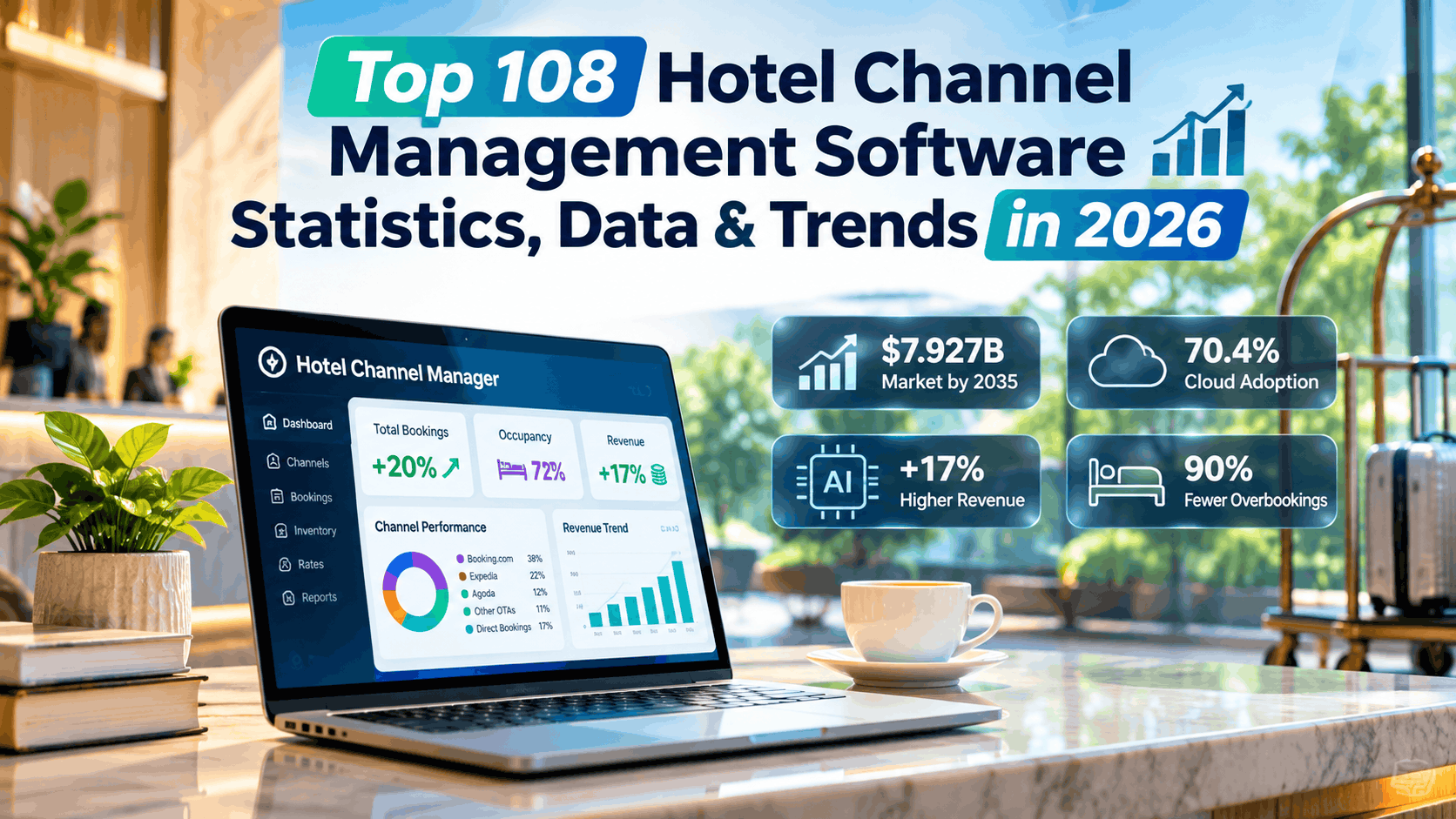
- Strong Market Growth: The global hotel channel management software market is projected to reach $7.927 billion by 2035, growing at a 9.7% CAGR, driven by cloud adoption, automation, and digital hospitality transformation.
- Improved Operational Efficiency and Profitability: Hotel channel management software can reduce overbookings by up to 90%, save two to four administrative hours daily, and increase bookings by up to 20%.
- AI and Cloud Technologies Drive Innovation: Cloud-based channel managers account for approximately 70.4% of market revenue, while AI-powered dynamic pricing can increase average daily rates by 10% to 15%, supporting hotel revenue optimisation.
Hotel channel management software automates room inventory, pricing, and reservation distribution across multiple booking platforms. In 2026, industry statistics indicate potential overbooking reductions of up to 90%, daily administrative savings of two to four hours, and a projected global market value of $7.927 billion by 2035, with a 9.7% compound annual growth rate.
The global hospitality industry is undergoing a significant digital transformation in 2026, with hotel channel management software emerging as an essential technology for improving distribution efficiency, maximising revenue, reducing operational costs, and strengthening competitiveness across an increasingly complex online travel marketplace. As hotels, resorts, boutique properties, and independent accommodation providers compete for visibility across multiple booking platforms, the ability to manage room availability, pricing, reservations, and inventory in real time has become a fundamental requirement for sustainable business growth.
Hotel channel management software enables hospitality businesses to centralise and automate their distribution activities across online travel agencies (OTAs), global distribution systems (GDS), direct booking websites, and other reservation platforms. By synchronising room rates, availability, and inventory across connected channels, these solutions help hoteliers minimise manual administrative tasks, prevent double bookings, improve pricing consistency, and expand their market reach.
The Growing Hotel Channel Management Software Market in 2026
The global hotel channel management software market is experiencing substantial growth as hospitality businesses increasingly invest in digital distribution infrastructure. According to Market Research Future, the market is projected to expand from $3.141 billion in 2025 to $7.927 billion by 2035, representing a compound annual growth rate (CAGR) of 9.7%.

Similarly, InsightAce Analytic estimates that the global market was valued at $3.47 billion in 2025 and could reach $8.40 billion by 2035, growing at a CAGR of 9.4%. MarkWide Research provides an even stronger growth outlook, forecasting an expansion from $1.8 billion in 2026 to $4.76 billion by 2035, with a reported CAGR of 11.4%.
Although market valuations vary considerably depending on research methodologies and software category definitions, these forecasts consistently indicate sustained demand for hotel distribution management technology.
Several factors are contributing to this expansion, including:
- Increasing adoption of online hotel booking platforms and digital travel marketplaces.
- Growing demand for automated room inventory and reservation management.
- Accelerating migration from legacy on-premises systems to cloud-based hospitality software.
- Rising online travel agency commissions and distribution expenses.
- Increasing integration between channel managers, property management systems, and revenue management software.
- Growing adoption of artificial intelligence, predictive analytics, and dynamic pricing technologies.
- Expansion of international hotel chains and independent accommodation businesses.
- Increasing demand for mobile-friendly and personalised booking experiences.
These developments are transforming hotel channel managers from standalone distribution tools into strategically important components of integrated hospitality technology ecosystems.
Why Hotel Channel Management Software Is Becoming Essential
The increasing complexity of hotel distribution represents one of the most significant challenges facing hospitality businesses in 2026. Hotels must maintain accurate pricing, room availability, and booking information across numerous distribution channels while protecting profitability and delivering seamless guest experiences.
According to Jetstream Technologies, properties managing distribution channels manually can spend between two and three hours every day updating rates and room availability. Meanwhile, research published by Zuzu Hospitality indicates that channel management automation can save hotels between two and four hours daily, equivalent to approximately 730 to 1,460 hours annually.
The operational benefits extend considerably beyond administrative efficiency. Industry estimates suggest that hotel channel management software can reduce overbooking rates by up to 90% through automated inventory synchronisation. RoomMaster also reports that hotels using channel management solutions can experience up to 20% more bookings and up to 80% fewer overbookings compared with manual distribution management.
With individual overbooking incidents potentially costing hotels between $200 and $500 or more in relocation expenses, guest compensation, and reputational damage, automated distribution management presents a compelling financial and operational investment opportunity.
Modern hotel channel management platforms can help hospitality businesses achieve several important objectives:
- Reduce manual reservation and inventory management workloads.
- Minimise overbooking incidents and distribution errors.
- Improve room availability accuracy across booking platforms.
- Expand visibility across domestic and international travel marketplaces.
- Optimise room pricing and distribution strategies.
- Improve booking conversion rates and occupancy performance.
- Strengthen revenue management and forecasting capabilities.
- Reduce unnecessary distribution expenses and operational inefficiencies.
For independent hotels and smaller hospitality businesses operating with limited staffing resources, these capabilities can be particularly valuable.
Rising OTA Commissions and the Importance of Direct Bookings
One of the most influential trends shaping the hotel channel management software industry in 2026 is the growing need to balance online travel agency distribution with profitable direct booking strategies.
Online travel agencies continue to play a dominant role in global hospitality distribution. According to Cloudbeds’ 2026 State of Independent Hotels Report, which analysed 90 million bookings across 180 countries, OTAs accounted for 63.4% of independent hotel bookings in 2025, reaching nearly 80% in certain markets.
However, this extensive reliance on third-party booking platforms presents significant financial challenges. OTA commission fees typically range from 15% to 30% per reservation, depending on the platform, geographical market, property type, and participation in promotional programmes.
Booking.com generally charges standard commissions of approximately 15% to 17%, while Expedia Group commissions are estimated to range between 18% and 22%. Hotels participating in preferred partner programmes may encounter considerably higher distribution costs.
Cancellation behaviour further complicates hotel distribution economics. Cloudbeds reports that OTA reservations have a cancellation rate of 21.8%, compared with just 10.6% for direct bookings.
These statistics highlight the importance of developing a balanced distribution strategy rather than relying exclusively on third-party booking platforms.
Hotel channel management software supports this objective by enabling hospitality businesses to manage OTA relationships, optimise distribution performance, monitor pricing consistency, and integrate direct booking engines within a centralised technology environment.
According to revenue modelling published by StayNTouch, shifting just 10 percentage points of reservations from OTAs to direct booking channels could generate more than $64,000 in additional annual net operating income for a 100-room independent hotel operating at 70% occupancy, without increasing occupancy or average daily rates.
As distribution expenses continue to influence hotel profitability, channel management technology is becoming increasingly important for achieving sustainable revenue growth.
Cloud-Based Hotel Channel Management Software Is Reshaping Hospitality Operations
Cloud computing represents another major force driving the evolution of hotel channel management software in 2026.
Traditional on-premises hospitality systems often require significant upfront investments, dedicated IT infrastructure, ongoing maintenance, and complex software upgrades. Cloud-based channel management solutions provide an alternative through subscription-based pricing, remote accessibility, automated updates, and scalable integration capabilities.
According to PW Consulting, cloud-based hotel channel managers generated approximately $316.95 million in revenue in 2025, accounting for an estimated 70.4% of the global hotel channel manager market under its market definition. On-premises solutions represented the remaining 29.6%.
The broader hospitality software ecosystem demonstrates similar adoption patterns. Business Research Insights estimates that cloud-based deployment accounted for approximately 68% of the property management software market in 2025.
Furthermore, approximately 90% of property management system platforms reportedly support interoperability with channel managers and revenue management tools, according to Market Growth Reports.
This increasing integration enables hospitality businesses to establish interconnected technology ecosystems encompassing:
- Hotel property management systems (PMS).
- Hotel channel management software.
- Central reservation systems (CRS).
- Revenue management systems (RMS).
- Direct booking engines.
- Customer relationship management software (CRM).
- Payment processing platforms.
- Business intelligence and hospitality analytics solutions.
By connecting these technologies, hotels can improve data consistency, automate workflows, enhance operational visibility, and make more informed distribution and revenue management decisions.
Artificial Intelligence and Automation Are Transforming Hotel Distribution
Artificial intelligence is rapidly emerging as a major technological differentiator within the hotel channel management software industry.
In 2026, hospitality businesses are increasingly exploring AI-powered forecasting, automated pricing recommendations, predictive demand analytics, intelligent inventory allocation, and dynamic revenue optimisation.
According to Hotel Technology News, hotels adopting AI-driven revenue management report an estimated 17% increase in total revenue compared with non-adopters. The same analysis indicates that AI-powered demand forecasting can improve forecasting accuracy by approximately 20% compared with legacy revenue management models.
Real-time AI-powered dynamic pricing can also potentially increase average daily rates (ADR) by between 10% and 15%, according to industry analyses.
The growing confidence in artificial intelligence is further reflected in hospitality technology investment plans. Canary Technologies’ 2026 Navigating AI report, covering more than 400 hospitality technology decision-makers across North America, Europe, the Middle East, Africa, and Asia-Pacific, reveals that:
- 82% of hoteliers expect artificial intelligence usage across their organisations to increase over the following year.
- 71% believe AI is already having a significant or transformative impact on their businesses.
- 85% of hospitality technology decision-makers plan to allocate at least 5% of their IT budgets to AI tools in 2026.
These findings suggest that artificial intelligence is moving beyond experimental applications and becoming an increasingly important component of hospitality technology investment strategies.
As channel management platforms evolve, AI-powered capabilities are expected to play a greater role in automated pricing, demand forecasting, distribution channel selection, inventory optimisation, and revenue performance analysis.
Global Hospitality Growth Is Expanding Demand for Channel Management Solutions
The expansion of the global hospitality industry provides an additional foundation for long-term growth in hotel channel management software adoption.
According to IBISWorld, there are approximately 339,091 hotel and resort businesses globally in 2026, representing a 2.8% increase from 2025. Broader industry estimates cited by ZoomShift and OysterLink suggest that more than 700,000 hotels and resorts operate worldwide, encompassing at least 17.5 million guest rooms.
Digital booking behaviour is also becoming increasingly prevalent. Industry estimates indicate that between 68% and 72% of hotel bookings are now completed online, compared with approximately 45% a decade earlier. Mobile devices account for an estimated 50% to 55% of online hotel reservations.
Meanwhile, the global online travel booking market is projected to expand from $566 billion in 2024 to more than $1.3 trillion by 2033.
Regional growth opportunities are particularly significant across Asia-Pacific, the Middle East, Africa, and Latin America, where expanding tourism infrastructure, new hotel developments, and increasing digital adoption are creating demand for scalable hospitality distribution technologies.
DataIntelo forecasts that the Middle East and Africa hotel channel management software market could achieve a CAGR of 10.9% between 2026 and 2034, supported by tourism diversification initiatives and substantial hospitality infrastructure investments.
These developments are expanding the addressable market for channel management software providers while encouraging hotels to modernise their distribution strategies.
Understanding the Top Hotel Channel Management Software Statistics in 2026
As the hospitality industry becomes increasingly interconnected, automated, and data-driven, understanding the latest hotel channel management software statistics is essential for hotel owners, general managers, revenue managers, hospitality technology professionals, software developers, investors, and business decision-makers.
This comprehensive guide to the Top 108 Hotel Channel Management Software Statistics, Data & Trends in 2026 examines the most important developments shaping the global hotel distribution technology landscape, including:
- Global hotel channel management software market size and growth forecasts.
- Leading hotel channel management software providers and competitive market dynamics.
- Software adoption and operational efficiency statistics.
- Overbooking prevention and automated inventory synchronisation.
- OTA commission rates and hotel distribution economics.
- Direct booking trends and reservation profitability.
- Cloud-based channel management software adoption.
- Property management system integration and interoperability.
- Artificial intelligence, automation, and dynamic pricing trends.
- Regional market performance and emerging growth opportunities.
- Global hospitality industry statistics and digital booking behaviour.
By examining these 108 statistics, hospitality professionals can gain a deeper understanding of the technological, operational, and economic forces transforming hotel distribution management in 2026 and beyond.
Whether an independent boutique hotel is evaluating its first channel management platform, a multinational hotel chain is modernising its distribution infrastructure, or a hospitality technology provider is identifying emerging market opportunities, these statistics provide valuable insights into the evolving industry landscape.
Ultimately, hotel channel management software is no longer merely a tool for synchronising reservations across multiple booking platforms. It is becoming a strategic foundation for revenue optimisation, operational efficiency, distribution diversification, digital transformation, and long-term hospitality competitiveness in an increasingly technology-driven global travel economy.
Before we venture further into this article, we would like to share who we are and what we do.
About 9cv9
9cv9 is a business tech startup based in Singapore and Asia, with a strong presence all over the world.
With over ten years of startup and business experience, and being highly involved in connecting with thousands of companies and startups, the 9cv9 team has listed some of the top and best companies/tools in this review.
If you like to get your company listed in our top B2B software reviews, check out our world-class 9cv9 Media and PR service and pricing plans here.
Top 108 Hotel Channel Management Software Statistics, Data & Trends in 2026
Market Size & Growth
- The hotel channel management software market was estimated at $2.863 billion in 2024, according to Market Research Future. This baseline figure underscores how quickly the category has scaled from a niche distribution tool into a core hospitality technology investment.
- Market Research Future projects the hotel channel management software industry will grow from $3.141 billion in 2025 to $7.927 billion by 2035, a 9.7% CAGR. Hoteliers evaluating long-term technology budgets should note this sustained double-digit growth trajectory heading into the next decade.
- InsightAce Analytic values the global hotel channel management software market at $3.47 billion in 2025, forecasting growth to $8.40 billion by 2035 at a 9.4% CAGR. This estimate reinforces that channel management is one of hospitality tech’s fastest-compounding software categories.
- Verified Market Research pegs the market at $369.76 million in 2023, projecting growth to $531.55 million by 2030 at a 6.24% CAGR. The comparatively conservative figures reflect a narrower market definition focused strictly on standalone channel management tools.
- Market Reports World estimates the global market at $563.68 million in 2026, rising to $1.164 billion by 2035 at an 8.4% CAGR. This estimate lists 30 named vendors actively competing in the space, signaling a fragmented but maturing competitive landscape.
- DataIntelo forecasts the market growing from $1.8 billion in 2025 to $4.2 billion by 2034 at a 9.8% CAGR from 2026–2034. Buyers can expect continued vendor investment and feature innovation as this growth compounds through the decade.
- MarkWide Research values the broader hotel channel management market at $1.8 billion in 2026, projecting expansion to $4.76 billion by 2035 at an 11.40% CAGR — one of the highest growth rates cited across all sources. This suggests accelerating urgency among independent hotels to adopt distribution technology.
- Business Research Insights sizes the market at $0.408 billion in 2024, forecasting $0.82 billion by 2033 at an 8.1% CAGR. The wide variance across these market sizing reports (from hundreds of millions to billions) reflects differing methodologies on what counts as “channel management” versus adjacent hospitality software.
- The global Channel Manager Market specifically is estimated at $3.26 billion in 2026, projected to reach $7.57 billion by 2035 at a 9.8% CAGR, per Business Research Insights. Around 45% of this growth is attributed to broader digital adoption trends in hospitality.
- A related Business Research Insights estimate puts the Channel Manager Market at $3.07 billion in 2025, rising to $3.38 billion in 2026, and reaching $7.13 billion by 2034 at a 9.8% CAGR. Nearly 30% of smaller hotels reportedly cite high deployment and maintenance costs as a barrier to adopting advanced channel manager solutions.
- The Hotel Channel Managers Market reached an estimated $450.0 million in 2025 and is projected to grow to $796.57 million by 2032, implying an 8.5% CAGR, according to PW Consulting. This mid-range estimate sits between the more conservative and more bullish market sizing reports.
- Hotel Channel Management Systems Market valuation stood at $800 million in 2024, anticipated to surge to $1.5 billion by 2033 at an 8.5% CAGR from 2026–2033, per Market Research Intellect. The consistency of 8–10% CAGR estimates across multiple independent firms lends credibility to sustained mid-to-high single-digit growth for the category.
- The broader hotel and hospitality management software market (which includes channel management as a component) was valued at $4.2 billion in 2025 and is projected to reach $7.0 billion by 2033 at a 7.2% CAGR, per Grand View Research. North America dominated this market with a 35.1% revenue share in 2025.
- The Business Research Company estimates the hotel and hospitality management software market grew from $3.62 billion in 2025 to $3.85 billion in 2026 at a 6.5% CAGR, driven by digital transformation and chain hotel expansion. It further projects growth to $4.78 billion by 2030 at a 5.5% CAGR as smart-property adoption accelerates.
- Within the hospitality management software market, the property management segment accounted for the largest revenue share at 18.5% in 2025, per Grand View Research. Cloud-based deployment led all deployment types in the same year, reflecting hoteliers’ clear preference for subscription-based, browser-accessible platforms.
Competitive Landscape & Vendor Data
- SiteMinder serves over 45,000 properties across more than 160 countries and holds an estimated 16.8% market share, making it the dominant player in the hotel channel manager category, according to DataIntelo. This scale gives SiteMinder significant leverage in negotiating distribution partnerships with OTAs.
- Australia’s Trade and Investment Commission (Austrade) reports that over 39,000 hotels globally use SiteMinder solutions, reinforcing its position as one of the largest channel management platforms by property count. This figure is slightly lower than DataIntelo’s estimate, reflecting different measurement periods.
- SiteMinder connects hotels to more than 450 booking channels, including major GDS networks, and holds Booking.com Premier Connectivity Partner status. This breadth of connectivity is a key differentiator for mid-size and enterprise hotels seeking maximum distribution reach.
- SiteMinder was voted the #1 Channel Managers provider in the 2026 HotelTechAwards by hoteliers, based on HotelTechReport’s rigorous three-month evaluation process. This peer-driven recognition carries significant weight for buyers comparing vendors on real-world performance rather than marketing claims.
- SiteMinder holds a 93% recommendation rate among 853 small hotels surveyed on HotelTechReport, one of the strongest small-property satisfaction scores in the category. Small independent hotels frequently cite real-time ARI (availability, rate, inventory) distribution as the primary driver of this satisfaction.
- In a head-to-head HotelTechReport comparison based on 4,136 verified hotelier reviews, SiteMinder scored an HT Score of 100 versus Cloudbeds’ 98. Both platforms scored within a narrow margin, indicating the choice between them often comes down to property type and specific feature needs rather than a clear overall winner.
- SiteMinder offers 248 verified integration partners compared to Cloudbeds’ 199, per HotelTechReport’s comparative analysis. Hotels prioritizing PMS and third-party software compatibility may weigh this broader partner ecosystem heavily in vendor selection.
- SiteMinder edges out Cloudbeds on ease-of-use ratings at 4.7 out of 5 versus 4.6 out of 5, based on verified hotelier reviews. For small hotels with limited IT resources, this marginal usability advantage can meaningfully reduce onboarding friction.
- Cloudbeds earned top honors from HotelTechReport for channel management every year from 2021 through 2025, reflecting sustained customer satisfaction across a five-year period. This consistency suggests Cloudbeds has successfully maintained product quality even as it has scaled its customer base.
- Cloudbeds holds Booking.com Premier Connectivity Partner status, matching SiteMinder in this key OTA distinction. This dual accreditation among the market’s top two vendors indicates Booking.com actively curates its highest-tier technology partnerships around proven, high-volume integrators.
- According to U.S. Small Business Administration data, 70% of boutique hotels in North America are classified as small and medium enterprises (SMEs) — a segment where Cloudbeds has scaled significantly through its integrated channel management offering. This SME concentration explains why all-in-one platforms bundling PMS, channel manager, and booking engine appeal strongly to this buyer segment.
- Leading vendors SiteMinder, Cloudbeds, and RateGain collectively control more than 50% of the global hotel channel manager market, according to Business Research Insights. This level of concentration among the top three players signals a maturing market where scale and integration depth increasingly matter more than pure feature count.
- The broader hotel channel manager market remains highly fragmented, with 80+ viable vendors globally, yet just 8 to 12 major platforms capture approximately 65% to 70% of global revenue, per DataIntelo. This “long tail with concentrated leadership” structure is typical of maturing SaaS categories.
- Market consolidation accelerated through 2024–2025, with private equity firms acquiring specialist channel management vendors and larger platforms absorbing niche competitors, according to DataIntelo’s analysis. Buyers should factor vendor stability and acquisition risk into long-term technology decisions given this consolidation wave.
- SiteMinder announced a strategic partnership with RMS Cloud in January 2025 to integrate distribution and channel management capabilities for unified reservation connectivity, per WiseGuyReports. Partnerships like this reflect the industry’s broader push toward interoperable, best-of-breed technology stacks rather than closed ecosystems.
- Cloudbeds completed its acquisition of Little Hotelier in April 2025, expanding its channel management and PMS offerings specifically for small and mid-sized hotels, according to WiseGuyReports. This acquisition illustrates how larger platforms are actively building out their small-hotel product lines through M&A rather than organic development alone.
- Yanolja expanded its global channel management reach through its acquisition of eZee Technosys, building a strong customer base across India, Southeast Asia, and the Middle East. eZee Centrix, its channel manager product, connects to more than 130 OTAs, GDS networks, and vacation rental portals.
- RateGain positions itself as a platform unifying direct bookings, distribution, and rate parity monitoring in a single system, appealing to hotels seeking to reduce vendor sprawl. Its blog-based research suggests total cost of ownership and operational fit now outweigh raw channel count as key switching drivers for hoteliers evaluating alternatives.
- Roughly a quarter of properties still running legacy or on-premises channel management systems are actively evaluating or planning a migration to cloud-based platforms, according to RateGain’s 2026 analysis. Independent hotels and small chains are reportedly leading this migration trend, often due to limited in-house IT staff.
- Semper’s channel management offering claims connectivity to more than 1,000 booking channels, among the highest channel counts advertised in the Capterra hotel channel management category listing. Such extensive coverage particularly benefits multi-property groups distributing across highly fragmented regional OTA landscapes.
Overbooking Reduction & Operational Efficiency
- Properties managing distribution channels manually spend two to three hours daily on manual rate and availability updates across platforms, according to Jetstream Technologies. This administrative burden is one of the clearest, most quantifiable justifications for channel management software adoption.
- Hotels using channel management automation report saving 2 to 4 hours per day in manual update work, per Zuzu Hospitality’s 2026 guide. For a 50-room independent hotel, this equates to an estimated 730 to 1,460 hours saved annually — roughly the workload of a full-time staff member.
- A single overbooking incident can cost a hotel $200 to $500 or more in relocation fees, compensation, and reputational damage from negative reviews, according to both Jetstream Technologies and Zuzu Hospitality. This tangible per-incident cost makes overbooking prevention one of the most direct ROI drivers for channel management software.
- Channel management software can reduce overbooking rates by up to 90% by maintaining accurate, synchronized inventory across all connected sales channels, per Jetstream Technologies and Zuzu Hospitality’s independently reported figures. This dramatic reduction stems from near-instantaneous inventory updates that eliminate the timing gaps inherent in manual, channel-by-channel management.
- Hotels using a channel manager report up to 20% more bookings and up to 80% fewer overbookings compared with manually managing channels, according to RoomMaster’s 2026 guide. This dual benefit of increased volume and reduced errors makes a compelling combined business case for adoption.
- Overbooking-related revenue loss from OTA distribution fees alone can range from 15% to 20%, climbing to nearly 30% to 40% for many hotels once relocation and compensation costs are factored in, according to AxisRooms. This range illustrates why even a single mismanaged peak period can materially damage a property’s annual profitability.
- Cloud-based channel management solutions can enable real-time synchronization of room inventory, rates, and restrictions across 30 to 60 connected channels within seconds, according to DataIntelo. This near-instant propagation is what allows properties to safely list on dozens of platforms simultaneously without incurring double-booking risk.
- Real-time channel synchronization is associated with an estimated 15% to 18% uplift in booking conversion rates, per DataIntelo’s market analysis. Faster, more accurate availability displays likely reduce guest abandonment caused by outdated pricing or sold-out listings showing as available.
OTA Commission Rates & Distribution Economics
- OTA commission fees typically range from 15% to 30% per booking depending on the platform, region, and property type, according to StayFi’s 2026 guide. This wide range underscores why channel mix strategy — not just channel count — is central to hotel profitability.
- Booking.com’s standard commission for most independent properties globally ranges from 15% to 17%, rising to 20–25% for hotels enrolled in preferred partner programs, per BookingWhizz’s 2026 analysis. Hotels opting into higher-visibility programs should weigh the incremental booking volume against this meaningfully higher commission cost.
- Expedia Group charges an estimated 18% to 22% commission across its family of brands, including Hotels.com, Vrbo, and Orbitz, according to BookingWhizz. This is consistently reported as higher than Booking.com’s baseline rate across multiple independent sources.
- Vrbo typically charges a 5% commission plus a 3% payment processing fee, a notably lower total cost structure than traditional OTA commissions, per StayFi. This lower-cost model reflects Vrbo’s positioning within the vacation rental segment rather than traditional hotel distribution.
- Regional OTAs such as Agoda and MakeMyTrip typically charge 18% to 22% commission, often bundled with additional marketing fees, according to BookingWhizz. Hotels operating in Asia-Pacific and Middle Eastern markets should budget for these regionally elevated commission structures when planning channel mix.
- For a 120-room hotel with a €140 average daily rate and 75% occupancy, a blended 18% OTA commission translates to roughly €8.30 per room night in commission costs alone, per BookingWhizz’s modeling. At 60% OTA booking share, this scales to approximately €290,000 in annual commission payments for a single mid-sized property.
- OTA preferred or sponsored placement programs typically carry commission rates 3 to 5 percentage points above baseline, according to BookingWhizz. Hotels should carefully calculate whether the incremental visibility from these programs generates enough additional bookings to offset the higher commission cost.
- The combined sales and marketing spend of the largest OTAs reached approximately $20 billion in 2025, according to Cloudbeds’ OTA commission analysis. This scale of advertising investment is effectively what hotel commission payments help fund, in exchange for consumer reach individual properties could rarely achieve alone.
- Average OTA commission rates have climbed from roughly 10% a decade ago to a 15%–30%+ range today, per Cloudbeds. This steady upward trend reinforces the growing financial incentive for hotels to invest in direct booking infrastructure alongside OTA distribution.
- Shifting 10 percentage points of bookings from OTA to direct channels can add more than $64,000 in annual net operating income for a 100-room independent hotel at 70% occupancy, with no change in occupancy or ADR, according to StayNTouch. This figure illustrates how distribution channel mix alone — independent of demand generation — can materially move a property’s bottom line.
Direct Booking Trends
- OTAs accounted for 63.4% of independent hotel bookings in 2025, rising to nearly 80% in some markets, according to Cloudbeds’ 2026 State of Independent Hotels Report, based on an analysis of 90 million bookings across 180 countries. This heavy OTA reliance among independents highlights the strategic importance of channel management tools that can balance OTA reach with direct booking growth.
- OTA bookings carry a cancellation rate of 21.8%, more than double the 10.6% cancellation rate for direct bookings, per the same Cloudbeds report. This disparity means OTA-sourced occupancy figures often overstate a property’s true confirmed revenue relative to direct bookings.
- Global RevPAR for independent hotels declined 5.4% in 2025 as OTA reliance increased and booking behavior shifted, according to Cloudbeds’ analysis of 90 million bookings. This decline reinforces industry warnings that rising OTA dependence, without a corresponding direct booking strategy, can actively erode property-level revenue performance.
- A realistic all-in direct booking cost is estimated at approximately 4.5%, once payment processing (1.5–2.5%), booking engine fees (1–3%), and a share of marketing spend are included, according to RevPARGenius. This all-in figure remains far below even the lowest published OTA commission rates.
- On a $200 room rate, a hotel keeps roughly $9 in costs for a direct booking versus paying $36 in commission for an 18% OTA booking, according to RevPARGenius’s 2026 cost modeling. This concrete dollar comparison makes the financial case for direct booking investment tangible for hotel owners.
- Direct bookings can generate up to 60% higher revenue per booking than OTA reservations, according to Zuzu Hospitality’s 2026 analysis. This premium reflects both lower distribution costs and typically higher guest lifetime value from direct relationships.
- Approximately 18% of travelers who begin their hotel search on an OTA ultimately complete their booking directly with the property, an increase of 3.3 percentage points, per Zuzu Hospitality. This “research on OTA, book direct” behavior — sometimes called the billboard effect — is a key rationale for maintaining a strong, well-optimized direct booking channel alongside OTA listings.
- Average hotel website conversion rates range from approximately 2.2% to 3.9%, compared with OTA conversion rates of 12% to 15%, according to BookBetterDirect’s 2026 benchmarking. This gap exists partly because OTA visitors typically arrive with purchase intent already established, while hotel website visitors are often still comparison shopping.
- High-performing boutique hotel websites can achieve conversion rates of 5% or higher, exceeding average industry benchmarks, per BookBetterDirect. Hotels investing in direct booking engine optimization and personalized offers can meaningfully close the conversion gap with OTAs.
- Hotels building a genuine direct booking program in 2026 can realistically capture 4 to 8 percentage points of direct-channel share gains within the year, according to ProStay’s analysis. Target direct-channel share benchmarks range from 35% to 50% by the end of year one, up from a typical independent-hotel baseline of 20% to 35%.
- The net contribution difference per booking shifted from OTA to direct typically ranges from $120 to $220 in 2026, according to ProStay’s revenue modeling. This per-booking economic gain compounds quickly across a property’s annual booking volume, making direct booking initiatives one of the highest-ROI distribution investments available.
- Mobile devices account for more than 50% of all online travel agency bookings as of 2024, a share expected to climb further through 2026, according to ProStay’s hotel booking statistics. Channel management platforms with strong mobile-responsive booking engines are increasingly essential to capture this majority mobile audience.
- The global online travel booking market is projected to grow from $566 billion in 2024 to more than $1.3 trillion by 2033, with mobile bookings expected to capture nearly half of that volume, per ProStay. This scale of projected market growth signals sustained long-term demand for the distribution technology, including channel managers, that underpins online hotel sales.
Cloud Adoption & PMS Integration
- Cloud PMS adoption stands at roughly 41% among small and independent hotels, with cloud deployments expected to outnumber on-premise systems industry-wide from 2026 onward, according to Softinn’s 2026 report. This tipping point marks a structural shift away from legacy, server-based hotel technology.
- 43.52% of hotels using Softinn’s platform operate without heavy OTA reliance, according to the company’s proprietary data. This figure suggests that a meaningful share of small, independent hotels have successfully built sustainable direct booking businesses despite broader industry OTA dependence trends.
- Over 65% of hoteliers are adopting PMS solutions specifically for automation and guest personalization capabilities, according to Business Research Insights and AHLA data cited by ChargeAutomation. This adoption driver reflects a shift in buyer priorities from basic record-keeping toward guest experience differentiation.
- 72% of mid-sized to large hotels had adopted mobile PMS applications as of 2024, per the same ChargeAutomation analysis. Mobile-first property management access is increasingly considered table stakes rather than a premium feature for hotels of this size.
- The global Hotel PMS Software Market is expected to reach $9.59 billion in 2026, according to 360iResearch data cited by ChargeAutomation. Growth is reportedly being driven largely by platforms offering broad third-party ecosystems rather than closed, proprietary architectures.
- Cloud-based PMS deployment accounts for approximately 68% of the property management software market in 2025, according to Business Research Insights. This dominant cloud share reflects hoteliers’ broad preference for subscription pricing and reduced on-site IT infrastructure requirements.
- The Hotel Property Management Software Market may reach $17.18 billion by 2032 at a 10.17% CAGR, according to Research and Markets data cited by ChargeAutomation. This projected growth trajectory suggests continued heavy technology investment across the broader hospitality software ecosystem that channel managers integrate into.
- 84% of Indian hoteliers report significant improvement in operational speed after adopting cloud-based hotel systems, according to HVS India 2025 data cited by mycloud Hospitality. This regional data point highlights how emerging hospitality markets are experiencing similarly strong efficiency gains from cloud migration as more mature markets.
- Cloud PMS adoption grew by 55% among mid-scale hotels between 2023 and 2025, driven primarily by the need to reduce staff workload and improve service turnaround times, per mycloud Hospitality. This growth rate signals accelerating, rather than plateauing, cloud migration momentum in this hotel segment.
- Over 70% of travelers in India expect digital convenience features such as instant check-ins and AI-powered service responses, according to Skift India 2025 data cited by mycloud Hospitality. Rising guest expectations for digital-first experiences are an important secondary driver pushing hotels toward integrated, cloud-connected technology stacks.
- Approximately 90% of PMS platforms interoperate with channel managers and revenue management tools, according to Market Growth Reports’ analysis of the hospitality PMS market. This high interoperability rate reflects an industry-wide move toward integrated technology ecosystems rather than siloed, single-purpose software.
- In the United States, over 85% of hotels had integrated their PMS with cloud-based technology by 2023, according to the U.S. Travel Association, cited by Business Research Insights. This high domestic adoption rate positions the U.S. hotel market as a mature, technology-forward benchmark for channel management software vendors.
- North America holds approximately 35% of the global hospitality PMS market share, encompassing more than 800,000 properties using property management systems, according to Market Growth Reports. Europe follows with a 26% share across roughly 400,000 properties, while Asia-Pacific contributes 22% and Middle East & Africa account for 6%.
- Recent industry surveys indicate an 80% to 85% PMS usage rate among hotels in the US and UK, according to Market Growth Reports, a considerably higher adoption rate than in more fragmented European hospitality markets. This adoption gap represents a meaningful growth opportunity for channel management vendors expanding into less digitally mature regions.
- Approximately 55% of PMS vendors have launched AI, mobile-first, or IoT features within the past 18 months, according to Business Research Insights. This rapid feature velocity indicates the competitive pressure vendors face to continuously differentiate their platforms beyond core distribution functionality.
AI, Automation & Dynamic Pricing
- Hotels using AI-driven revenue management report an estimated 17% increase in total revenue compared with non-adopters, according to Hotel Technology News’ 2026 analysis. This substantial revenue gap is prompting even smaller independent hotels to evaluate AI-enabled pricing tools that were previously accessible mainly to large chains.
- 86.1% of hoteliers say they already rely on AI for forecasting and demand analytics, per the same Hotel Technology News report. This high reported adoption rate suggests AI-assisted forecasting has moved from early-adopter status to mainstream practice within just a few years.
- AI-powered demand forecasting can improve accuracy by approximately 20% relative to legacy revenue management system models, according to Hotel Technology News. More accurate forecasting directly supports better channel allocation decisions, reducing the risk of both underpricing and lost-revenue overbooking scenarios.
- Real-time AI-powered dynamic pricing can increase average daily rate (ADR) by 10% to 15%, according to both Hotel Technology News and The AI Consulting Network’s 2026 analysis. This consistent range across independent sources reinforces dynamic pricing as one of AI’s most measurable near-term impacts on hotel revenue.
- AI-driven revenue management systems can deliver 5% to 12% higher gross operating profit compared with properties using traditional revenue management approaches, per The AI Consulting Network. This profit-level (rather than just revenue-level) impact makes a stronger investment case to hotel ownership groups focused on net returns.
- Hotels running AI-powered revenue management systems report up to 35% RevPAR gains and a 12% occupancy lift over static pricing models, according to ampliphi RMS. Adoption of cloud-native and AI-enhanced revenue management systems now reportedly exceeds 80% globally as hoteliers move away from manual spreadsheet-based pricing.
- 75% of hotel chains are exploring AI specifically for revenue management and dynamic pricing strategies, according to CareerTrainer.ai’s hospitality AI statistics. Predictive analytics applications within this exploration can increase hotel occupancy rates by 5% to 10% through optimized pricing decisions.
- AI adoption across the broader hospitality sector was projected to reach 60% by 2025, per CareerTrainer.ai. AI-driven personalization in hotel marketing is separately estimated to increase conversion rates by 8% to 15%.
- 82% of hoteliers expect AI usage across their organization to increase in the next year, while 71% already say AI is having a significant or transformative impact on their business, according to Canary Technologies’ 2026 “Navigating AI” report covering more than 400 technology decision-makers across North America, EMEA, and APAC. This broad, cross-regional survey suggests AI adoption sentiment in hospitality has moved decisively from cautious experimentation to active operational execution.
- 85% of hospitality technology decision-makers plan to allocate at least 5% of their IT budget to AI tools in 2026, per the same Canary Technologies report. This budget commitment signals sustained near-term investment appetite for AI-enabled distribution and revenue management platforms.
- Gartner projects that 40% of enterprise applications will embed an AI agent by the end of 2026, up from less than 5% in 2025, according to analysis cited by Rield. This is characterized as one of the fastest technology adoption curves ever measured, with direct relevance to how quickly AI features may become standard within hotel channel management platforms.
- The global agentic AI market is projected to grow from $7.8 billion to more than $52 billion by 2030, according to Rield’s 2026 technical guide. As this technology matures, hotel channel managers are likely candidates for embedding autonomous, agent-driven pricing and inventory decisions.
Regional Market Breakdown
- Asia Pacific dominated the global hotel channel management software market in 2025, accounting for approximately $0.54 billion and a 29.8% revenue share, according to DataIntelo. This regional leadership is attributed to the extraordinary pace of new hotel development across the region.
- In a separate regional breakdown, Asia Pacific captured an estimated $1.3 billion in hotel channel manager revenue in 2025, representing 34.2% of global revenue, according to DataIntelo’s related market report. The variance between this and the 29.8% figure above reflects different scoping between “channel management software” and the broader “channel managers market” category.
- North America leads the broader channel manager market with a 38% share, followed by Europe at 33% and Asia at 24%, according to Business Research Insights. A separate estimate from the same firm places Europe ahead at approximately 35% share, followed by North America at 30% and Asia-Pacific at 25%, reflecting the inherent variability across market research methodologies.
- Cloud-based hotel channel managers led the market with $316.95 million in revenue in 2025, representing an estimated 70.4% global market share, compared with $133.05 million (29.6% share) for on-premises solutions, according to PW Consulting. This roughly 70/30 cloud-to-on-premise split closely mirrors broader PMS market cloud adoption figures.
- Latin America generated an estimated $35.18 million in hotel channel manager revenue in 2025, representing approximately a 7.8% global share, while the Middle East and Africa region reached an estimated $24.86 million, or about a 5.5% share, per PW Consulting. These emerging regions, while smaller in absolute revenue, are frequently cited as high-growth-potential markets as hotel stock and booking infrastructure expand.
- The Middle East and Africa (MEA) region is forecast to register the highest regional CAGR of 10.9% during 2026–2034 for hotel channel management software, according to DataIntelo, driven by tourism diversification programs including Saudi Arabia’s Vision 2030 and continued hotel development in Dubai and Abu Dhabi. This growth rate outpaces every other region cited in the available market research.
- Significant untapped growth potential exists among small hotels, hostels, and vacation rentals that are only now recognizing the need for professional channel management, particularly across emerging economies in Asia-Pacific and Latin America, according to Intel Market Research. Vendors offering affordable, scaled-down solutions are best positioned to capture this underserved segment.
Broader Hotel Industry Context
- There are 339,091 global hotel and resort businesses as of 2026, an increase of 2.8% from 2025, according to IBISWorld. This continued net growth in the addressable property base directly expands the total market opportunity for channel management software vendors.
- The global hotel industry was expected to grow at 8.1% to reach $1.27 trillion, roughly 20% higher than the $1 trillion 2020 average, according to Statista data cited by ZoomShift. The global hotel market is separately estimated to exceed $1 trillion in 2026, per The Lobby agency’s industry analysis.
- There are more than 700,000 hotels and resorts worldwide, encompassing an estimated 17.5 million or more guest rooms globally, according to figures cited by both ZoomShift and OysterLink. Some broader estimates of total global hotel room inventory range as high as 33 million when including smaller and unregistered properties.
- Approximately 8,011 new hotel construction projects are in the global development pipeline, with 2,771 scheduled to open in a recent year, adding more than 514,000 new rooms, according to OysterLink. This substantial pipeline of new supply represents a parallel growth driver for channel management software, as newly opened properties require distribution technology from day one.
- Global average hotel occupancy sits at 66% to 70% in 2026, though top-performing independent hotels in strong urban and resort markets regularly exceed 80%, according to The Lobby agency. Between 68% and 72% of all hotel bookings are now made online, up from 45% a decade ago.
- OTAs control an estimated 40% to 43% of all online hotel bookings globally, making them the single most powerful distribution channel by booking volume, according to The Lobby agency. Mobile devices account for 50% to 55% of online hotel bookings and continue to gain share.
- Travel and tourism contributed an estimated $5 trillion to global GDP in 2025, according to Zippia’s hotel industry statistics. The global hotel and travel accommodation industry is separately projected to grow at a 6% CAGR from 2026 to 2030.
- Hotel listings featuring a significant number of high-quality photos see a 20% increase in booking conversion rates, according to Zippia, while TripAdvisor separately reports that listings with more photos receive a 150% increase in guest engagement. This underscores that channel management platforms with strong visual merchandising tools directly support conversion performance across every connected OTA.
Conclusion
The Top 108 Hotel Channel Management Software Statistics, Data & Trends in 2026 highlight a rapidly evolving hospitality technology landscape increasingly defined by automation, cloud computing, artificial intelligence, real-time distribution management, and revenue optimisation. As competition intensifies across global accommodation markets, hotel channel management software has evolved from a conventional reservation synchronisation tool into a strategic business solution supporting operational efficiency, profitability, and sustainable growth.
The statistics demonstrate that hospitality businesses can no longer rely exclusively on manual distribution processes, fragmented reservation systems, or traditional pricing strategies. Instead, hotels must embrace interconnected digital technologies that enable them to manage multiple booking channels efficiently, respond to changing market conditions, and deliver consistent guest experiences.
Hotel Channel Management Software Market Growth Signals Strong Long-Term Demand
The global hotel channel management software market is positioned for substantial expansion over the coming decade. Market Research Future projects that the industry will grow from $3.141 billion in 2025 to $7.927 billion by 2035, representing a CAGR of 9.7%. Meanwhile, InsightAce Analytic forecasts that the market will reach $8.40 billion by 2035.
Although market valuations differ across research organisations due to varying methodologies and industry definitions, the overall growth trajectory remains consistently positive.
Several fundamental factors are expected to sustain this expansion:
- Increasing digitalisation across the global hospitality industry.
- Growing adoption of online travel agencies and digital booking platforms.
- Accelerating demand for automated reservation and inventory management.
- Rising distribution costs and pressure on hotel profit margins.
- Increasing adoption of cloud-based hospitality management solutions.
- Expanding integration between channel managers, property management systems, and revenue management platforms.
- Growing investment in artificial intelligence and predictive analytics.
- Continued hotel development across emerging tourism markets.
These developments indicate that hotel channel management software will remain an important investment priority for hospitality businesses seeking to strengthen their digital capabilities and competitive positioning.
Automation Is Delivering Measurable Operational and Financial Benefits
One of the most significant findings from the 108 hotel channel management software statistics is the potential of automation to improve operational performance.
Hotels implementing automated channel management solutions can reportedly save between two and four hours daily on manual distribution tasks, equivalent to approximately 730 to 1,460 hours annually. These time savings allow hospitality employees to allocate more resources towards guest services, revenue optimisation, and other higher-value activities.
Furthermore, industry estimates suggest that channel management software can reduce overbooking rates by up to 90%, while certain implementations have reported booking volume improvements of up to 20%.
Considering that individual overbooking incidents can cost hotels between $200 and $500 or more, preventing reservation errors represents a significant opportunity to protect revenue and maintain customer satisfaction.
The operational advantages of hotel channel management software extend across several business functions:
- Automated room inventory synchronisation.
- Real-time rate and availability updates.
- Reduced administrative workloads and human errors.
- Improved reservation accuracy and booking management.
- Enhanced distribution channel visibility.
- More efficient pricing and inventory allocation.
- Improved scalability across multiple properties.
- Greater consistency in guest booking experiences.
For independent hotels, boutique accommodation providers, and smaller hospitality businesses, these capabilities can be particularly valuable in overcoming staffing limitations and competing with larger hotel chains.
Balancing OTA Distribution and Direct Bookings Will Remain a Strategic Priority
The growing financial implications of online travel agency commissions represent another critical trend shaping hotel distribution strategies in 2026.
Cloudbeds’ analysis of 90 million bookings across 180 countries found that OTAs accounted for 63.4% of independent hotel bookings in 2025, with reliance approaching 80% in certain markets.
Although OTAs provide substantial international exposure and access to established traveller audiences, their commission structures can significantly affect hotel profitability. With typical OTA commission rates ranging from 15% to 30%, excessive dependence on third-party distribution channels can place considerable pressure on operating margins.
Additionally, OTA bookings reportedly experience a cancellation rate of 21.8%, compared with 10.6% for direct reservations.
These findings reinforce the importance of developing diversified hotel distribution strategies that combine the visibility of online travel agencies with the financial advantages of direct bookings.
Revenue modelling suggests that shifting just 10 percentage points of reservations from OTAs to direct booking channels could generate more than $64,000 in additional annual net operating income for a 100-room independent hotel operating at 70% occupancy, assuming occupancy and average daily rates remain unchanged.
Rather than eliminating OTA participation entirely, successful hospitality businesses should focus on optimising their distribution channel mix through:
- Direct booking engine integration.
- Distribution cost monitoring and profitability analysis.
- Strategic OTA partnership management.
- Rate consistency and pricing optimisation.
- Hotel website conversion improvements.
- Mobile booking experience enhancements.
- Guest retention and customer loyalty initiatives.
- Data-driven distribution channel allocation.
Hotel channel management software provides the technological infrastructure necessary to coordinate these activities and support more profitable distribution decisions.
Cloud-Based Channel Management Is Becoming the Industry Standard
Cloud adoption represents a structural transformation within the hospitality technology industry.
According to PW Consulting, cloud-based hotel channel managers accounted for approximately 70.4% of global hotel channel manager market revenue in 2025, under its market definition. Similarly, cloud-based deployment represented approximately 68% of the broader property management software market.
These statistics reflect the increasing preference for flexible, scalable, remotely accessible hospitality technology solutions.
Cloud-based hotel channel management software offers several important advantages over traditional on-premises systems, including reduced infrastructure requirements, automated software updates, centralised data accessibility, subscription-based pricing, and improved integration capabilities.
The growing interoperability between hotel technology platforms further strengthens the business case for cloud adoption. Approximately 90% of property management system platforms reportedly support integration with channel managers and revenue management tools.
As hospitality businesses continue to modernise their technology infrastructure, integrated cloud-based ecosystems are expected to become increasingly important for managing reservations, pricing, distribution, payments, guest information, and operational performance.
Artificial Intelligence Will Shape the Future of Hotel Channel Management Software
Artificial intelligence, machine learning, predictive analytics, and intelligent automation are emerging as major competitive differentiators within the hotel channel management software market.
Industry analyses indicate that hotels using AI-driven revenue management can experience an estimated 17% increase in total revenue compared with non-adopters. AI-powered forecasting can potentially improve demand prediction accuracy by approximately 20%, while dynamic pricing technologies have been associated with average daily rate improvements of between 10% and 15%.
These potential performance improvements highlight the growing importance of intelligent decision-making within hotel distribution management, although actual outcomes will depend on property characteristics, implementation quality, market conditions, and data availability.
The growing confidence in AI adoption is further demonstrated by Canary Technologies’ 2026 research, which found that:
- 82% of hoteliers expect AI usage across their organisations to increase.
- 71% believe AI is already having a significant or transformative business impact.
- 85% of hospitality technology decision-makers plan to allocate at least 5% of their IT budgets to AI tools in 2026.
Looking ahead, artificial intelligence is expected to influence numerous aspects of hotel channel management, including automated pricing recommendations, predictive demand forecasting, intelligent inventory distribution, booking cancellation analysis, revenue performance monitoring, and personalised distribution strategies.
As these capabilities mature, hotel channel management platforms are likely to evolve towards increasingly intelligent systems capable of supporting faster and more sophisticated commercial decisions.
Regional Hospitality Expansion Is Creating New Market Opportunities
The global expansion of hospitality infrastructure and digital booking adoption continues to create substantial opportunities for hotel channel management software providers.
Asia-Pacific remains an important growth market, supported by expanding tourism industries, increasing hotel development, and growing adoption of digital hospitality solutions.
Meanwhile, the Middle East and Africa are emerging as particularly promising markets, with DataIntelo forecasting a regional CAGR of 10.9% between 2026 and 2034.
Latin America also presents opportunities for technology providers targeting independent hotels, smaller accommodation businesses, and properties transitioning from manual distribution processes to automated systems.
The broader growth of online travel further reinforces these opportunities. The global online travel booking market is projected to expand from $566 billion in 2024 to more than $1.3 trillion by 2033.
With approximately 68% to 72% of hotel reservations already estimated to occur online, hospitality businesses will increasingly require reliable distribution infrastructure capable of managing growing digital booking volumes.
Software providers offering affordable pricing, comprehensive integration capabilities, multilingual support, regional OTA connectivity, and scalable cloud-based solutions are likely to be well positioned to address these emerging market opportunities.
Choosing the Right Hotel Channel Management Software in 2026
For hotel owners, general managers, revenue managers, and hospitality technology decision-makers, the statistics presented throughout this article emphasise the importance of selecting channel management software based on long-term business objectives rather than software pricing or channel connectivity alone.
Leading hotel channel management software providers such as SiteMinder, Cloudbeds, and RateGain demonstrate how competition is increasingly centred on integration ecosystems, automation capabilities, usability, distribution reach, and revenue optimisation functionality.
When evaluating hotel channel management solutions, hospitality businesses should consider factors such as real-time inventory synchronisation, PMS compatibility, OTA connectivity, direct booking integration, pricing automation, reporting capabilities, implementation costs, customer support, data security, and multi-property scalability.
Equally important is the ability to measure software return on investment through relevant performance indicators, including overbooking frequency, administrative hours saved, booking conversion rates, distribution costs, direct booking share, average daily rate, revenue per available room, and overall profitability.
A comprehensive evaluation approach can help hotels identify solutions that address their immediate operational requirements while supporting future business expansion.
The Future of Hotel Channel Management Software Beyond 2026
The future of hotel channel management software will increasingly revolve around intelligent automation, interconnected hospitality technology ecosystems, real-time analytics, and profitable distribution optimisation.
As online travel marketplaces become more competitive and guest expectations continue to evolve, hospitality businesses will need greater flexibility in managing pricing, inventory, reservations, and distribution relationships.
Emerging technologies such as agentic AI, advanced predictive analytics, autonomous revenue management, and intelligent workflow automation could further transform how hotels manage their commercial operations.
Rather than functioning solely as intermediaries between hotel property management systems and external booking channels, next-generation channel management platforms are likely to become increasingly sophisticated commercial management solutions supporting broader hospitality business objectives.
Ultimately, the Top 108 Hotel Channel Management Software Statistics, Data & Trends in 2026 demonstrate that digital distribution management is becoming an indispensable component of modern hospitality operations.
Hotels that strategically invest in cloud-based channel management software, automated reservation synchronisation, artificial intelligence, integrated revenue management systems, and direct booking optimisation will be better positioned to reduce operational inefficiencies, protect profit margins, improve guest experiences, and respond effectively to changing market conditions.
For hospitality businesses worldwide, adopting the right hotel channel management software is no longer simply a matter of technological modernisation. It represents a strategic investment in operational resilience, distribution profitability, revenue growth, and long-term competitiveness within an increasingly digital, interconnected, and data-driven global hospitality industry.
If you find this article useful, why not share it with your hiring manager and C-level suite friends and also leave a nice comment below?
We, at the 9cv9 Research Team, strive to bring the latest and most meaningful data, guides, and statistics to your doorstep.
To get access to top-quality guides, click over to 9cv9 Blog.
To hire top talents using our modern AI-powered recruitment agency, find out more at 9cv9 Modern AI-Powered Recruitment Agency.
People Also Ask
What is hotel channel management software?
Hotel channel management software is a digital solution that synchronises room rates, availability, inventory, and reservations across multiple booking platforms, helping hotels automate distribution and improve operational efficiency.
What is the global hotel channel management software market size in 2026?
Market Reports World estimates the global hotel channel management software market at $563.68 million in 2026, while MarkWide Research values the broader market at $1.8 billion, reflecting different market definitions.
How fast is the hotel channel management software market growing?
Market Research Future projects a CAGR of 9.7%, with the hotel channel management software market expanding from $3.141 billion in 2025 to $7.927 billion by 2035.
What are the leading hotel channel management software providers in 2026?
Leading hotel channel management software providers include SiteMinder, Cloudbeds, RateGain, eZee Centrix, and Semper, offering automated distribution, inventory synchronisation, and hospitality technology integrations.
Which hotel channel management software provider has the largest market share?
According to DataIntelo, SiteMinder holds an estimated 16.8% market share, serving more than 45,000 properties across over 160 countries.
What are the main benefits of hotel channel management software?
Key benefits include automated inventory updates, reduced overbookings, improved distribution efficiency, increased booking opportunities, lower administrative workloads, and enhanced revenue management.
How much time can hotels save using channel management software?
Hotels using automated channel management software can reportedly save two to four hours daily on manual distribution tasks, equivalent to approximately 730 to 1,460 hours annually.
Can hotel channel management software reduce overbookings?
Yes. Industry estimates suggest that hotel channel management software can reduce overbooking rates by up to 90% through real-time inventory synchronisation across connected booking channels.
How much can hotel overbooking incidents cost?
A single hotel overbooking incident can cost between $200 and $500 or more in guest compensation, relocation expenses, administrative work, and reputational damage.
Can hotel channel management software increase bookings?
Hotels using channel management software can reportedly achieve up to 20% more bookings compared with manual distribution management, depending on channel coverage, pricing strategies, and market conditions.
What percentage of independent hotel bookings come from OTAs?
According to Cloudbeds’ 2026 State of Independent Hotels Report, online travel agencies accounted for 63.4% of independent hotel bookings in 2025, reaching nearly 80% in certain markets.
What are the average OTA commission rates in 2026?
Online travel agency commission rates typically range from 15% to 30% per booking, depending on the platform, geographical location, property type, and promotional programme participation.
How much commission does Booking.com charge hotels?
Booking.com typically charges independent hotels commissions of approximately 15% to 17%. Properties participating in preferred partner programmes may pay between 20% and 25%.
How much commission does Expedia charge hotels?
Expedia Group reportedly charges hotel commission rates of approximately 18% to 22%, although actual fees vary depending on property agreements, geographical markets, and promotional arrangements.
Are direct hotel bookings more profitable than OTA bookings?
Direct bookings are generally more profitable because hotels avoid substantial OTA commissions. Estimated direct booking costs average approximately 4.5%, compared with typical OTA commissions of 15% to 30%.
What is the cancellation rate for OTA hotel bookings?
According to Cloudbeds, OTA hotel bookings have a cancellation rate of approximately 21.8%, compared with 10.6% for direct hotel reservations.
How can hotels reduce their dependence on online travel agencies?
Hotels can reduce OTA dependence by improving their direct booking websites, integrating booking engines, investing in digital marketing, developing loyalty programmes, and optimising distribution through channel management software.
What percentage of hotel channel management software is cloud-based?
According to PW Consulting, cloud-based hotel channel managers accounted for approximately 70.4% of global market revenue in 2025, compared with 29.6% for on-premises solutions.
Why are hotels adopting cloud-based channel management software?
Hotels adopt cloud-based channel management software for remote accessibility, real-time synchronisation, reduced IT infrastructure costs, automatic updates, scalability, and seamless third-party integrations.
What is the difference between a hotel PMS and a channel manager?
A property management system manages internal hotel operations, while a channel manager synchronises room inventory, pricing, and reservations across external booking platforms. Both systems can integrate to automate hotel workflows.
Can hotel channel management software integrate with property management systems?
Yes. Approximately 90% of PMS platforms reportedly support interoperability with channel managers and revenue management tools, enabling automated data exchange and centralised hotel operations.
How is artificial intelligence transforming hotel channel management software?
Artificial intelligence supports automated pricing, predictive demand forecasting, intelligent inventory allocation, distribution optimisation, and real-time revenue analytics, helping hotels make more informed commercial decisions.
How much revenue can AI-powered hotel revenue management generate?
Industry analysis suggests that hotels using AI-driven revenue management report approximately 17% higher total revenue than non-adopters, although results vary according to implementation quality and market conditions.
Can AI-powered dynamic pricing increase hotel room rates?
AI-powered dynamic pricing can potentially increase average daily rates by 10% to 15% through automated pricing adjustments based on demand, competitor rates, seasonality, and market conditions.
What percentage of hoteliers expect AI adoption to increase in 2026?
According to Canary Technologies’ 2026 research, 82% of hoteliers expect AI usage across their organisations to increase over the following year, reflecting growing confidence in intelligent hospitality technologies.
Which region leads the hotel channel management software market?
Asia-Pacific accounted for approximately 29.8% of global hotel channel management software revenue in 2025, according to DataIntelo. Regional leadership varies across research methodologies and market definitions.
Which region has the fastest-growing hotel channel management software market?
The Middle East and Africa are projected to achieve a CAGR of 10.9% between 2026 and 2034, supported by tourism expansion, hotel development, and increasing hospitality digitalisation.
Is hotel channel management software suitable for small and independent hotels?
Yes. Hotel channel management software helps small and independent hotels reduce manual workloads, prevent double bookings, expand distribution reach, improve direct booking strategies, and compete with larger hospitality businesses.
What features should hotels look for in channel management software in 2026?
Essential features include real-time inventory synchronisation, OTA connectivity, PMS integration, dynamic pricing, direct booking integration, automated reservations, performance analytics, data security, and reliable customer support.
What is the future of hotel channel management software beyond 2026?
The future of hotel channel management software will increasingly involve AI-powered automation, agentic AI, cloud-native platforms, predictive analytics, intelligent pricing, integrated hospitality ecosystems, and profitable distribution optimisation.
Sources
- Market Research Future
- OpenPR
- InsightAce Analytic
- Verified Market Research
- Market Reports World
- DataIntelo
- MarkWide Research
- Business Research Insights
- PW Consulting
- Market Research Intellect
- Grand View Research
- The Business Research Company
- WiseGuyReports
- Intel Market Research
- RateGain
- HotelTechReport
- Cloudbeds
- Capterra
- AxisRooms
- Jetstream Technologies
- Zuzu Hospitality
- RoomMaster
- StayFi
- StayNTouch
- BookingWhizz
- Preno
- Little Hotelier
- Agency for Travel
- Heads on Pillows
- Asian Hospitality
- Krows Digital
- ProStay
- BookBetterDirect
- RevPARGenius
- Softinn
- ChargeAutomation
- mycloud Hospitality
- Hotel Tech Insight
- Valuates Reports
- Mordor Intelligence
- Market Growth Reports
- Gitnux
- Hotel Technology News
- CareerTrainer AI
- ampliphi
- The AI Consulting Network
- Tommaso Maria Ricci
- Rield
- IBISWorld
- ZoomShift
- OysterLink
- Statista
- SiteMinder
- Zippia
- International Travel Awards
- The Lobby