
Key Takeaways
- Rapid Fleet Maintenance Software Market Growth: The global fleet management software market is projected to reach $38.28 billion in 2026 and $152.89 billion by 2034, driven by cloud adoption, automation, and digital fleet management solutions.
- AI and Predictive Maintenance Reduce Costs: Predictive maintenance can reduce vehicle downtime by 35%–50%, while preventive maintenance software helps fleet operators lower repair expenses, improve vehicle reliability, and maximize operational efficiency.
- Telematics, EV Fleets, and Cloud Technology Drive Innovation: With 53.3% of fleets researching or piloting AI and cloud-based solutions holding 70% market share in 2025, fleet maintenance software trends increasingly emphasize automation, connected vehicles, and electric fleet management.
Fleet maintenance software in 2026 is transforming vehicle maintenance through AI, predictive analytics, and automation. The global fleet management software market is projected to reach $38.28 billion in 2026, while predictive maintenance can reduce vehicle downtime by 35%–50%. Explore 107 key statistics covering market growth, maintenance costs, software adoption, telematics, and emerging industry trends.
The global fleet maintenance software industry is undergoing a significant transformation in 2026 as businesses increasingly adopt digital solutions to reduce vehicle downtime, optimize maintenance costs, improve operational efficiency, and extend fleet lifespans. From transportation and logistics to construction, delivery services, and commercial fleet operations, organizations are turning to fleet maintenance management software, predictive analytics, artificial intelligence (AI), and telematics to streamline vehicle maintenance and improve profitability.
Also, read our article on the Top 10 Best Fleet Maintenance Software To Try.

The growing demand for fleet management technology reflects this shift toward smarter, data-driven operations. According to industry estimates, the global fleet management software market is projected to reach $38.28 billion in 2026, with forecasts suggesting it could expand to $152.89 billion by 2034, representing a compound annual growth rate (CAGR) of 18.9%. Meanwhile, cloud-based fleet management solutions accounted for approximately 70% of the market in 2025, highlighting the increasing preference for scalable, accessible, and automated fleet maintenance platforms.
One of the biggest drivers of fleet maintenance software adoption is the rising financial impact of vehicle breakdowns and unplanned downtime. Industry estimates suggest that unplanned vehicle downtime can cost businesses between $500 and $2,000 per vehicle per day, while reactive maintenance can cost three to five times more than preventive maintenance. As a result, fleet operators are investing in preventive maintenance scheduling, automated work orders, real-time vehicle diagnostics, and maintenance tracking systems to minimize unexpected repairs and improve vehicle availability.
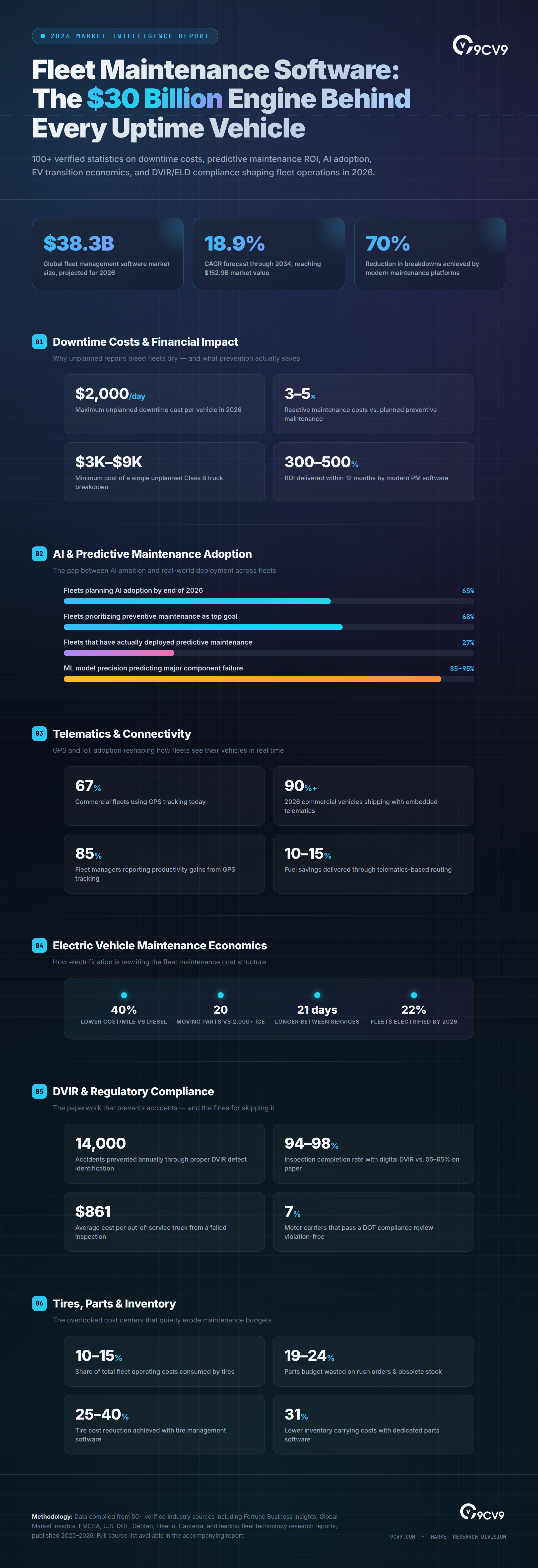
Artificial intelligence and predictive maintenance are also reshaping the fleet maintenance software landscape in 2026. Industry data indicates that 53.3% of fleets are actively researching or piloting AI capabilities, although only 5.6% report broad, mature AI adoption. Predictive maintenance technologies have demonstrated the potential to reduce vehicle downtime by 35% to 50%, allowing fleet managers to identify mechanical issues before they result in costly breakdowns. These developments are accelerating interest in AI-powered fleet maintenance software, IoT sensors, machine learning, and automated vehicle health monitoring.
Beyond maintenance automation, fleet operators are increasingly integrating GPS tracking, telematics, fuel management, tire monitoring, parts inventory management, and regulatory compliance tools into unified fleet management platforms. At the same time, the transition toward electric commercial vehicles is introducing new maintenance requirements, particularly around battery health monitoring, charging infrastructure, and electric vehicle lifecycle management. With electric vehicles potentially delivering 25% to 40% lower maintenance costs than comparable internal combustion engine vehicles, fleet electrification is becoming another important factor influencing fleet software investment decisions.
Despite these technological advances, significant adoption gaps remain, particularly among small and medium-sized fleet operators. Industry figures suggest that 82% of fleet operators still rely on manual tracking methods, while only 14% of small fleets use dedicated maintenance software. These challenges present substantial growth opportunities for fleet maintenance software providers offering affordable, cloud-based, user-friendly solutions that help businesses transition from spreadsheets and reactive maintenance processes to automated, preventive maintenance strategies.
This comprehensive guide to the Top 107 Fleet Maintenance Software Statistics, Data & Trends in 2026 examines the latest industry figures, market forecasts, fleet maintenance costs, software adoption rates, predictive maintenance performance, AI integration, telematics trends, electric vehicle maintenance, regulatory compliance, and software pricing. Whether evaluating fleet maintenance software solutions, managing a commercial vehicle fleet, developing fleet management technology, or researching emerging industry opportunities, these 107 statistics provide valuable insights into the technologies, operational challenges, and market trends shaping the future of fleet maintenance management in 2026 and beyond.
Before we venture further into this article, we would like to share who we are and what we do.
About 9cv9
9cv9 is a business tech startup based in Singapore and Asia, with a strong presence all over the world.
With over ten years of startup and business experience, and being highly involved in connecting with thousands of companies and startups, the 9cv9 team has listed some of the top and best companies/tools in this review.
If you like to get your company listed in our top B2B software reviews, check out our world-class 9cv9 Media and PR service and pricing plans here.
Top 107 Fleet Maintenance Software Statistics, Data & Trends in 2026
📊 SECTION 1: Market Size & Growth
- The global fleet management software market is projected to reach $38.28 billion in 2026, growing toward $152.89 billion by 2034 at an 18.9% CAGR — reflecting just how fast digital fleet tools are scaling worldwide. This growth trajectory signals long-term viability for buyers evaluating platform investments today.
- Fortune Business Insights values the fleet management software market at $32.36 billion in 2025, with North America commanding a dominant 38.6% share — underscoring the region’s outsized influence on product development and vendor competition.
- The commercial fleet segment accounted for 57.9% market share in 2026, confirming that logistics, delivery, and transportation companies remain the primary buyers of fleet maintenance technology.
- Operation management — which includes maintenance and diagnostics — held 40.66% of total market share in 2026, making it the single largest software category within the broader fleet tech stack.
- Research and Markets pegs the fleet management software market at USD 32.79 billion in 2026, projected to hit $55.97 billion by 2030 at a 14.3% CAGR — one of several independent forecasts confirming double-digit sustained growth.
- IndustryARC’s independent estimate placed the market at $55.89 billion by 2026 alone, illustrating how widely market sizing varies by methodology — but every major analyst agrees the trajectory is sharply upward.
- Software-based solutions generated 49% of total fleet management market revenue in 2025, confirming that software has overtaken hardware as the dominant revenue driver in this space.
- Cloud-based deployment held 70% market share in 2025 and is projected to grow at an 18.2% CAGR through 2035 — proof that fleet operators are decisively abandoning on-premise legacy systems.
- North America held 44% of the global fleet management market share in 2025, with a 15.1% CAGR expected through 2035, driven heavily by FMCSA ELD mandates and mature telematics infrastructure.
- The fleet maintenance software market specifically (distinct from broader fleet management) was valued at $31.98 billion in 2024, confirming maintenance-focused tools represent a massive standalone software category.
- The global fleet maintenance software market carries a projected 10.8% CAGR from 2026 to 2032, a healthy, sustainable growth rate reflecting steady rather than speculative adoption.
- The fleet maintenance software market is projected to surpass $30 billion in 2026 according to multiple independent analyst sources — a consistent benchmark across the industry.
- Germany’s fleet management market is forecast to grow at a 14.4% CAGR from 2026 to 2035, the strongest growth rate in Europe, driven by government-backed digital mobility programs.
- The Asia-Pacific fleet management region generated USD 23.08 billion in 2025, representing 26.95% of the global market, and is projected to reach $29.25 billion in 2026 — powered by e-commerce and logistics expansion in China and India.
💰 SECTION 2: Downtime Costs & ROI
- Unplanned vehicle downtime can cost fleets up to $2,000 per day per vehicle in 2026, making it one of the single largest hidden expenses in any fleet operation.
- A typical 50-vehicle fleet spending $1,800 annually on maintenance software saves $250+ per month from reduced downtime alone, breaking even in under 8 months.
- Predictive maintenance implementations deliver 2-4x ROI within 12-24 months, confirming that the technology pays for itself well within a single budget cycle.
- Reactive maintenance costs 3-5x more than preventive maintenance, making the financial case for proactive software-driven scheduling almost impossible to ignore.
- Modern fleet maintenance platforms reduce breakdowns by 70% and cut maintenance costs by 30%, delivering 300-500% ROI within 12 months for fleets that fully adopt preventive workflows.
- 95% of preventive maintenance software adopters report positive ROI, with 27% achieving full payback within just 12 months — a remarkably high satisfaction and success rate for enterprise software.
- Fleets using preventive maintenance software typically save $3,000-$5,000 per vehicle annually, far exceeding the cost of the software subscription itself.
- A single unplanned breakdown on a Class 8 truck — including towing, repair, and lost revenue — typically costs between $3,000 and $9,000 at minimum, illustrating why prevention is dramatically cheaper than reaction.
- Average unplanned repair costs range from $2,000 to $5,000, compared to just $400-$1,200 for the same scheduled preventive repair — a stark illustration of the “pay now or pay much more later” dynamic.
- Revenue loss from vehicle unavailability represents 30-40% of total downtime cost, meaning the invoice for a breakdown is often the smallest part of the real financial damage.
- Repair labor and parts costs consume another 35-45% of total downtime expense, driven by overtime premiums and expedited parts shipping during emergency repairs.
- Predictive maintenance reduces downtime by 35-50%, translating into $100,000-$300,000 in recovered annual revenue for mid-sized fleets that fully implement the technology.
- Emergency repair labor costs 2-3x more than scheduled maintenance labor because technicians must work overtime or be diverted from planned work.
- Average unplanned downtime costs per vehicle per day range from $500 to $2,000, a figure now widely cited across the fleet software industry as the core justification metric for software investment.
- The average cost of unplanned downtime per vehicle now runs approximately $760/hour, factoring in lost productivity, overtime, and schedule delays.
- Unplanned maintenance events consume roughly 11% of total operational hours annually for a typical 50-vehicle fleet — hours that could otherwise generate revenue.
- Average repair duration has risen to 4.3 days, up 31% since 2022, largely due to technician shortages and parts delays compounding the downtime problem.
🔧 SECTION 3: Preventive & Predictive Maintenance Adoption
- 68% of fleet operators now rank preventive maintenance as their top operational goal for 2026, making it the single most cited priority in the industry.
- Fleets using structured CMMS or fleet management software average just 15-20% reactive maintenance, compared to 40-55% reactive maintenance for fleets without digital systems.
- Organizations implementing a CMMS typically see 15-25% lower total maintenance costs within the first two years of adoption.
- 82% of fleet operators still rely on manual tracking methods, representing a massive addressable market opportunity for software vendors and a competitive edge for early digital adopters.
- Only 14% of small fleets currently use dedicated maintenance software, highlighting substantial untapped growth potential in the small-fleet segment specifically.
- 65% of maintenance teams across industries plan to adopt AI-powered tools by the end of 2026, signaling AI is crossing from experimental to mainstream status.
- Despite strong adoption intent, only 27% of fleets currently use predictive maintenance in practice, and just 32% have implemented AI even partially — revealing a substantial “adoption gap.”
- 53.3% of fleets are actively researching or piloting AI capabilities in 2026, according to Fleetio’s benchmark report covering 1.2 million vehicles.
- Only 5.6% of fleets report broad, mature use of AI tools, showing the technology remains in early-majority rather than late-majority adoption phase.
- 52% of fleet managers using AI-powered predictive maintenance confirm it directly reduced vehicle downtime in their own operations — real-world validation beyond vendor marketing claims.
- Machine learning models now achieve 85-95% precision predicting bearing, pump, motor, and major component failures, a level of accuracy that was unattainable just a few years ago.
- Predictive maintenance can surface failure risk 20-45 days before traditional diagnostics raise any alarm, giving fleet managers weeks of advance planning time instead of hours.
- Predictive analytics have decreased unplanned maintenance by 42% and extended vehicle life by 20% in fully deployed fleet environments.
- AI-driven predictive maintenance cuts unplanned roadside breakdowns by 41% and lowers repair costs by 28%, according to fleet-wide adoption data.
- Fortune 500 companies could collectively save $233 billion annually and recover 2.1 million hours of downtime through full adoption of condition monitoring and predictive maintenance.
- 69% of maintenance professionals are now age 50 or older, creating an urgent workforce succession and knowledge-transfer challenge across the industry.
- Over 30% of diesel technician positions remain unfilled nationwide, a labor shortage directly driving demand for AI-assisted diagnostic tools that extend technician productivity.
- 42% of current fleet technicians are expected to retire by 2028, compounding the technician shortage crisis facing maintenance-heavy industries.
- The average fleet technician vacancy now takes 67 days to fill, a hiring bottleneck that is pushing fleets toward software automation to bridge productivity gaps.
- Vendors report that AI copilots reduce mean time to repair (MTTR) and help junior technicians perform at senior technician skill levels significantly faster.
- 60-90 days of advance warning is now achievable for EV battery degradation prediction, compared to 20-45 days for typical ICE component failure prediction.
📡 SECTION 4: Telematics & IoT Adoption
- GPS fleet tracking adoption sits at approximately 67% across all commercial fleets, but drops sharply to just 40-50% for fleets under 10 vehicles.
- Large fleets with 100+ vehicles show telematics adoption above 80%, while small fleets under 10 vehicles remain closer to 40-50% — a clear adoption gap by fleet size.
- 85% of fleet managers using GPS tracking say it directly improved operational productivity, one of the highest satisfaction rates recorded for any fleet technology category.
- 71% of fleets that install GPS tracking report recouping their software investment within the first 12 months.
- Telematics-driven route optimization and idle reduction typically deliver 10-15% fuel savings within the first year of adoption.
- Nearly 80% of fleets now use GPS tracking, with 46% also deploying video telematics for enhanced safety monitoring, as of February 2026.
- Over 90% of commercial vehicles manufactured in 2026 ship with factory-embedded telematics, up from just a fraction a decade ago — a structural shift toward built-in connectivity.
- 85% of new commercial vehicles now ship with embedded telematics as standard equipment, streamlining data collection without requiring aftermarket hardware installs.
- Embedded OEM telematics control units are projected to account for 55-60% of market revenue by 2035, up from 45-50% in 2026, as automakers increasingly build connectivity in at the factory.
- Commercial vehicles waste approximately 6 billion gallons of fuel per year through unnecessary idling, costing fleet operators over $20 billion annually nationwide.
- Fleet operators implementing telematics-based driver coaching cut harsh braking events by 50-70% and speeding incidents by 60-80%, directly reducing accident-related maintenance costs.
- Telematics-equipped fleets report 15-25% fewer accidents, a safety improvement that compounds into lower insurance premiums and reduced collision-related repair costs.
- A typical service vehicle idles more than 1,500 hours per year, wasting roughly $3,500-$4,500 in fuel per vehicle annually before even accounting for accelerated engine wear.
- Small fleets under 50 vehicles make up roughly 85% of all U.S. commercial fleets, with fleets under 10 vehicles alone accounting for about 70% — confirming the SMB segment as the largest addressable market.
- The IoT fleet management market is projected to grow from $9.17 billion in 2025 to $17.35 billion by 2030, a 13.1% CAGR reflecting accelerating sensor and connectivity adoption.
📋 SECTION 5: DVIR, ELD & Regulatory Compliance
- FMCSA estimates that proper Driver Vehicle Inspection Reports (DVIRs) prevent approximately 14,000 accidents every year through early defect identification.
- Only 7% of motor carriers pass a focused DOT compliance review without a single violation, highlighting how widespread compliance gaps remain industry-wide.
- FMCSA’s final rule (effective March 23, 2026) explicitly authorizes fully electronic DVIRs, formally closing the last regulatory ambiguity around paperless inspection compliance.
- Digital DVIR systems raise inspection completion rates from the 55-65% typical of paper-based operations to 94-98% within just 30 days of implementation.
- Paper-based DVIR systems leave documented safety defects unactioned for an average of 12-36 hours, during which the vehicle continues operating with a known issue.
- A failed roadside inspection costs carriers an average of $861 per out-of-service truck, not including any additional fines or repair costs.
- More than 3.5 million roadside safety inspections are conducted annually in North America under FMCSA oversight — nearly 15 trucks or buses inspected every minute during the annual International Roadcheck.
- DVIR-related violation fines range from $1,270 to over $16,000 per occurrence, meaning a single audit at a 50-truck fleet with systematic gaps could trigger $63,500+ in penalties.
- Offsite DOT audits have increased 400% in recent years, with carriers sometimes receiving as little as 48 hours’ notice to produce compliant digital records.
- Electronic logging device (ELD) mandates have been a primary driver of North America’s 37.30% dominant regional share of the global commercial telematics market in 2026.
⚡ SECTION 6: Electric Vehicle (EV) Fleet Maintenance
- The global EV fleet maintenance market is projected to grow from $24.5 billion in 2025 to $96.1 billion by 2035, a 14.7% CAGR reflecting the accelerating electrification of commercial fleets.
- The U.S. Department of Energy confirms EVs cost approximately 40% less per mile in maintenance than conventional diesel vehicles.
- Electric vehicles have roughly 20 moving parts in their drivetrain, compared to over 2,000 in a traditional internal combustion engine — the core engineering reason behind lower EV maintenance costs.
- DOE 2025 data puts EV maintenance costs at $0.061 per mile versus $0.101 for gas vehicles, a $600 annual saving at typical 15,000-mile usage.
- Battery-electric trucks show maintenance costs of $0.14 per mile versus $0.22 per mile for diesel, according to ICCT research — a savings that compounds significantly over a vehicle’s operational life.
- EV fleet vehicles go an average of 21 days longer between maintenance visits compared to diesel vehicles, directly translating into higher vehicle availability and more billable miles.
- Maintenance costs for EVs run 25-40% lower than ICE equivalents across the board — driven by no oil changes, no transmission service, and reduced brake wear from regenerative braking.
- A fleet of 50 EVs can save $30,000-$55,000 annually on maintenance and servicing costs alone compared to an equivalent diesel fleet.
- EV commercial adoption reached 12% of fleets in 2025 and is projected to climb to 22% by the end of 2026, marking accelerating mainstream adoption.
- Total cost of ownership for medium-duty EVs is now 18-24% lower than diesel equivalents over a full 7-year operational lifecycle.
🛞 SECTION 7: Tires, Parts Inventory & Fuel Management
- Tires consume 10-15% of total fleet operating costs, ranking alongside fuel and maintenance as one of the three largest expense categories for any fleet.
- Improper tire management costs the average commercial fleet $2,500-$4,000 per vehicle annually through premature replacements, wasted fuel, and avoidable safety incidents.
- The U.S. Department of Energy estimates every 1 PSI drop in tire pressure reduces fuel economy by 0.3%, making tire pressure monitoring a direct fuel-cost lever.
- The U.S. DOT reports underinflated tires alone waste approximately 5 million gallons of fuel daily nationwide across all commercial and passenger vehicles.
- Skipping systematic tire rotation reduces tire lifespan by approximately 25%, costing a 100-truck fleet an estimated $75,000-$100,000 annually in avoidable replacement costs.
- Fleets implementing comprehensive tire management software programs reduce total tire costs by 25-40%, translating to $112,500-$180,000 in annual savings for a 100-truck fleet.
- The average commercial fleet wastes 19-24% of its total parts budget on rush orders, duplicate stock, and obsolete inventory sitting unused for over 36 months.
- Fleets that move from spreadsheets to dedicated parts inventory software report 31% lower carrying costs and 47% fewer stockout events.
- The top 20 parts SKUs — brake pads, filters, and belts — cause 78% of downtime incidents when they are missing from inventory at the moment they’re needed.
- Fleets that track vendor performance data achieve 15-25% lower parts costs compared to fleets that order based on relationships alone.
- Parts costs rose 3.7% year-over-year through Q4 2025, driven by tariff-related increases on steel and aluminum components — adding sustained pressure to maintenance budgets.
💻 SECTION 8: Software Pricing, Vendors & Capterra Buyer Data
- Entry-level fleet maintenance software plans average around $128 per month, while premium enterprise solutions can reach $856 per month depending on fleet size and feature depth.
- Capterra’s fleet maintenance software directory lists per-user, per-month pricing typically ranging from $4 to $28+, with enterprise tiers unlocking activity tracking, customizable reports, and historical reporting.
- Per-vehicle fleet maintenance software pricing in 2026 typically runs $4 to $50 per vehicle per month, depending on the depth of predictive analytics and telematics integration included.
- General maintenance management software (the broader CMMS category fleet maintenance sits within) is priced from $62 to $497 per month on Capterra, based on entry versus premium tiers.
- Capterra has verified over 2.5 million reviews across its software directories, with human moderators screening for authenticity, plagiarism, and generative AI-written content.
- Capterra published 4,629 reviews from maintenance management software users in the past year alone, reflecting the category’s high engagement from real-world buyers.
- Vehicles over 10 years old account for just 12.1% of total fleet miles driven but consume a disproportionate 33.5% of total service spend — a key data point fleet software buyers use to justify replacement-vs-repair decisions.
- Maintenance cost per mile jumps from $0.20 for vehicles 0-5 years old to $1.10 for vehicles over 10 years old, a 5.5x increase that fleet maintenance software helps track and forecast.
- Improving technician wrench-time utilization from 58% to 80% through CMMS work order management can reduce total maintenance costs by 6-7%, often worth $1,500-$3,000 per vehicle annually.
Conclusion
The Top 107 Fleet Maintenance Software Statistics, Data & Trends in 2026 highlight an industry undergoing rapid digital transformation, driven by rising operational costs, technological innovation, increasing regulatory requirements, and the growing demand for efficient fleet management solutions. As businesses seek to minimize vehicle downtime, reduce maintenance expenses, and maximize fleet productivity, fleet maintenance software has evolved from a basic vehicle tracking tool into an essential component of modern fleet operations.
With the global fleet management software market projected to reach $38.28 billion in 2026 and potentially expand to $152.89 billion by 2034, the industry presents substantial growth opportunities for software providers, fleet operators, technology developers, and investors. The increasing adoption of cloud-based fleet management platforms, automated maintenance scheduling, real-time vehicle diagnostics, and integrated telematics solutions demonstrates how digital technologies are reshaping commercial fleet management across transportation, logistics, construction, and other vehicle-intensive industries.
One of the most significant findings from the 2026 fleet maintenance software statistics is the financial importance of preventive and predictive maintenance. With unplanned vehicle downtime potentially costing businesses $500 to $2,000 per vehicle per day, organizations have strong incentives to replace reactive maintenance practices with proactive, data-driven strategies. Industry estimates suggest that predictive maintenance can reduce downtime by 35% to 50%, while structured maintenance management systems can lower overall maintenance costs by 15% to 25%. These potential savings reinforce the business case for investing in fleet maintenance management software, computerized maintenance management systems (CMMS), and automated vehicle servicing solutions.
Artificial intelligence, machine learning, and Internet of Things (IoT) technologies are expected to play increasingly important roles in the future of fleet maintenance. Although 53.3% of fleets are reportedly researching or piloting AI capabilities, only 5.6% have achieved broad, mature AI adoption. This gap highlights considerable opportunities for innovation in predictive vehicle diagnostics, automated fault detection, intelligent maintenance scheduling, and AI-powered fleet performance optimization. As these technologies become more accessible, fleet operators may gain greater visibility into vehicle health, maintenance requirements, and long-term operating costs.
The growing adoption of electric vehicles is also transforming fleet maintenance requirements. With electric vehicles potentially offering 25% to 40% lower maintenance costs than comparable internal combustion engine vehicles, fleet electrification could significantly influence maintenance budgets and software purchasing decisions. However, electric fleets introduce additional operational considerations, including battery health monitoring, charging infrastructure management, battery degradation forecasting, and specialized maintenance workflows. Fleet maintenance software providers that support both conventional and electric vehicles will be better positioned to serve businesses operating mixed fleets.
Despite these advancements, the industry continues to face substantial challenges, particularly among small and medium-sized fleet operators. The reported reliance on manual maintenance tracking by 82% of fleet operators, alongside dedicated maintenance software adoption of just 14% among small fleets, suggests considerable room for digital transformation. Affordable subscription pricing, intuitive user interfaces, mobile accessibility, cloud-based deployment, and seamless integration with existing fleet management systems will remain important factors influencing software adoption.
Looking ahead, the most important fleet maintenance software trends beyond 2026 will likely include AI-powered predictive maintenance, connected vehicle technology, automated compliance management, advanced telematics integration, EV battery monitoring, and increasingly data-driven fleet lifecycle management. Businesses that successfully integrate these capabilities into their operations may be better equipped to control maintenance costs, improve vehicle reliability, strengthen regulatory compliance, and maintain a competitive advantage.
Ultimately, the 107 fleet maintenance software statistics presented in this report demonstrate that the future of fleet management will be increasingly connected, automated, predictive, and data-driven. For fleet managers, logistics companies, transportation businesses, and technology providers, understanding these industry statistics and emerging trends is essential for making informed software investment decisions, optimizing fleet performance, and preparing for the evolving demands of commercial vehicle maintenance in 2026 and beyond.
If you find this article useful, why not share it with your hiring manager and C-level suite friends and also leave a nice comment below?
We, at the 9cv9 Research Team, strive to bring the latest and most meaningful data, guides, and statistics to your doorstep.
To get access to top-quality guides, click over to 9cv9 Blog.
To hire top talents using our modern AI-powered recruitment agency, find out more at 9cv9 Modern AI-Powered Recruitment Agency.
People Also Ask
What is fleet maintenance software?
Fleet maintenance software is a digital solution that helps businesses manage vehicle inspections, preventive maintenance, repair schedules, work orders, parts inventory, and maintenance costs. It improves vehicle reliability, reduces downtime, and streamlines fleet operations.
How big is the global fleet maintenance software market in 2026?
The global fleet management software market is projected to reach $38.28 billion in 2026, with forecasts suggesting growth to $152.89 billion by 2034. This broader market includes maintenance management, telematics, vehicle tracking, and fleet optimization solutions.
What is the projected growth rate of fleet maintenance software?
The fleet maintenance software market is projected to grow at a compound annual growth rate (CAGR) of 10.8% from 2026 to 2032. Growth is supported by increasing demand for preventive maintenance, cloud-based platforms, automation, and predictive analytics.
What are the biggest fleet maintenance software trends in 2026?
Major trends include AI-powered predictive maintenance, cloud-based fleet management, IoT sensors, real-time vehicle diagnostics, automated maintenance scheduling, telematics integration, electric vehicle maintenance, and digital regulatory compliance.
How much does fleet maintenance software cost in 2026?
Fleet maintenance software typically costs $4 to $50 per vehicle per month, depending on features, fleet size, and integrations. Entry-level plans average approximately $128 monthly, while premium enterprise solutions can reach $856 per month.
How does fleet maintenance software reduce operating costs?
Fleet maintenance software reduces costs through preventive maintenance scheduling, automated inspections, repair tracking, and inventory optimization. Organizations implementing maintenance management systems may achieve 15%–25% lower maintenance costs within two years.
What is the average cost of vehicle downtime in 2026?
Unplanned vehicle downtime can cost commercial fleets approximately $500 to $2,000 per vehicle daily. Expenses include lost revenue, emergency repairs, technician overtime, replacement vehicles, and operational disruptions.
What is preventive maintenance software for fleets?
Preventive maintenance software automates scheduled vehicle servicing based on mileage, operating hours, inspection results, or manufacturer recommendations. It helps fleet operators prevent unexpected breakdowns, extend vehicle lifespans, and reduce repair expenses.
How much can preventive maintenance software save businesses?
Industry estimates suggest preventive maintenance software can generate annual savings of $3,000–$5,000 per vehicle. Actual savings depend on fleet size, vehicle condition, maintenance practices, and the frequency of previously unplanned repairs.
What percentage of fleet operators prioritize preventive maintenance in 2026?
Approximately 68% of fleet operators reportedly identify preventive maintenance as their leading operational priority in 2026. This reflects growing awareness of vehicle downtime costs, maintenance efficiency, and long-term fleet reliability.
What is predictive maintenance in fleet management?
Predictive maintenance uses vehicle sensor data, artificial intelligence, machine learning, and historical repair information to identify potential mechanical failures before breakdowns occur. It helps businesses schedule repairs proactively and minimize unexpected downtime.
How effective is AI-powered predictive maintenance software?
Industry estimates suggest predictive maintenance can reduce vehicle downtime by 35%–50%. AI-powered systems analyze equipment conditions, identify emerging faults, and support maintenance planning, although results vary by implementation and fleet characteristics.
What percentage of fleets use artificial intelligence in 2026?
According to the supplied fleet industry data, 53.3% of fleets are researching or piloting AI capabilities, while only 5.6% report broad, mature AI adoption. This indicates substantial opportunities for further AI integration into fleet maintenance operations.
How does AI improve fleet maintenance management?
AI improves fleet maintenance through automated fault detection, predictive diagnostics, intelligent work order scheduling, repair recommendations, and vehicle health monitoring. These capabilities help maintenance teams identify problems earlier and allocate resources more efficiently.
What is the ROI of fleet maintenance software?
Predictive maintenance implementations can reportedly deliver two to four times their investment within 12–24 months. ROI depends on software costs, vehicle utilization, maintenance efficiency, avoided breakdowns, and improvements in operational productivity.
What percentage of fleets still use manual maintenance tracking?
Industry estimates suggest 82% of fleet operators still rely on manual tracking methods, while only 14% of small fleets use dedicated maintenance software. These figures highlight opportunities for digital transformation among smaller commercial fleet operators.
What are the benefits of cloud-based fleet maintenance software?
Cloud-based fleet maintenance software provides centralized maintenance records, remote accessibility, automated updates, real-time reporting, and easier collaboration. Cloud deployment accounted for approximately 70% of the broader fleet management market in 2025.
How widely adopted is GPS fleet tracking software in 2026?
Industry estimates place GPS tracking adoption at approximately 67% across commercial fleets, with some surveys reporting nearly 80%. Adoption is generally higher among large fleets, while smaller operators have lower implementation rates.
How does telematics improve fleet maintenance?
Telematics collects vehicle performance data, engine diagnostics, mileage, fuel consumption, and driver behavior information. Fleet managers use these insights to identify maintenance requirements, optimize servicing schedules, and reduce unexpected vehicle breakdowns.
Can fleet management software reduce fuel consumption?
Yes. Telematics-driven route optimization and idle reduction can reportedly generate fuel savings of 10%–15% during the first year. Actual results depend on driving patterns, vehicle types, route efficiency, and fleet management practices.
How does fleet maintenance software improve vehicle safety?
Fleet maintenance software improves safety through automated inspections, defect reporting, preventive servicing, and repair documentation. Telematics-equipped fleets reportedly experience 15%–25% fewer accidents, although results vary by operating conditions.
What is DVIR software in fleet maintenance?
Driver Vehicle Inspection Report (DVIR) software digitizes vehicle inspections, defect reporting, and maintenance documentation. It helps commercial fleet operators identify safety issues, track repairs, maintain inspection records, and support regulatory compliance.
How does fleet maintenance software support DOT compliance?
Fleet maintenance software supports DOT compliance by organizing inspection reports, maintenance histories, repair records, and vehicle safety documentation. Digital DVIR systems can also improve inspection completion rates and help operators identify unresolved defects.
How much can electric vehicles reduce fleet maintenance costs?
Electric vehicles can reportedly reduce maintenance expenses by 25%–40% compared with conventional internal combustion engine vehicles. Savings result from fewer moving drivetrain components, reduced brake wear, and fewer routine engine servicing requirements.
What are the main EV fleet maintenance software trends in 2026?
Key EV fleet maintenance trends include battery health monitoring, predictive battery degradation analysis, charging infrastructure integration, automated service scheduling, and maintenance management for mixed electric and conventional vehicle fleets.
How does tire management software reduce fleet costs?
Tire management software tracks tire pressure, rotation schedules, tread conditions, and replacement histories. Comprehensive tire management programs can reportedly reduce tire-related costs by 25%–40% through improved maintenance and reduced premature replacements.
Why is parts inventory management important for fleet maintenance?
Parts inventory management helps fleet operators maintain critical spare parts, prevent stockouts, reduce unnecessary purchases, and control storage expenses. Dedicated inventory software has been associated with 31% lower carrying costs and 47% fewer stockout events.
What features should businesses look for in fleet maintenance software?
Important features include preventive maintenance scheduling, automated work orders, vehicle inspection tracking, repair histories, parts inventory management, cost reporting, mobile access, telematics integration, predictive analytics, and compliance documentation.
Is fleet maintenance software suitable for small businesses?
Yes. Small businesses can benefit from affordable cloud-based fleet maintenance software that automates servicing reminders, tracks repair expenses, and organizes vehicle records. Per-vehicle subscription pricing makes maintenance management accessible to smaller fleets.
What is the future of fleet maintenance software beyond 2026?
Fleet maintenance software is expected to become increasingly automated, connected, and AI-driven. Predictive maintenance, IoT sensors, EV battery monitoring, cloud platforms, advanced analytics, and integrated compliance tools will shape future fleet management technology.
Sources
- Fortune Business Insights
- FleetRabbit
- Research and Markets
- Verified Market Research
- IndustryARC
- Global Market Statistics
- Global Market Insights
- The Business Research Company
- OxMaint
- MapTrack
- Intangles
- The Weekly Driver
- BusCMMS
- Coherent Market Insights
- Spytec GPS
- Geotab
- OpenPR
- DataM Intelligence
- Market Research Future
- IndexBox
- Calcix
- JointCharging
- DriveAuthority
- Heavy Vehicle Inspection
- Motive
- Truck Inspection Maintenance
- Capterra
- QuoteIQ
- MaintainX
- Work Truck Online
- Government Fleet
- Maintainly
- Marqstats
- Fleetio